How Much Does a Living Trust Cost? Attorney vs. DIY vs. Bulletproof Legacy
Compare the Real Cost of Creating, Funding, and Maintaining Your Living Trust
A living trust can cost as little as a few hundred dollars for a basic template or climb well past $10,000 once you add legal fees, funding assistance, and years of updates — the real number depends far less on the paperwork than on everything that happens after you sign it.
Article-at-a-Glance
- DIY living trust templates generally run under $300 to about $1,000, while online platforms typically cost $1,000 to $2,000.
- Attorney-drafted living trusts range from roughly $2,500 to $4,000 for simpler estates and $4,000 to $10,000 or more for complex situations.
- The price you pay for the trust document is not the same as the total cost of creating, funding, implementing, and maintaining a complete estate plan.
- Bulletproof Legacy / Integrated Trust Systems lists its eStatePlan package at $2,995 total, which includes attorney review, advisor assistance, and trust funding support, plus a $95 annual access fee. See a more in-depth comparison on your pricing page.
- Later in this guide, you’ll see exactly what separates a “cheap” trust from one that’s actually funded, implemented, and built to be updated as your life changes.
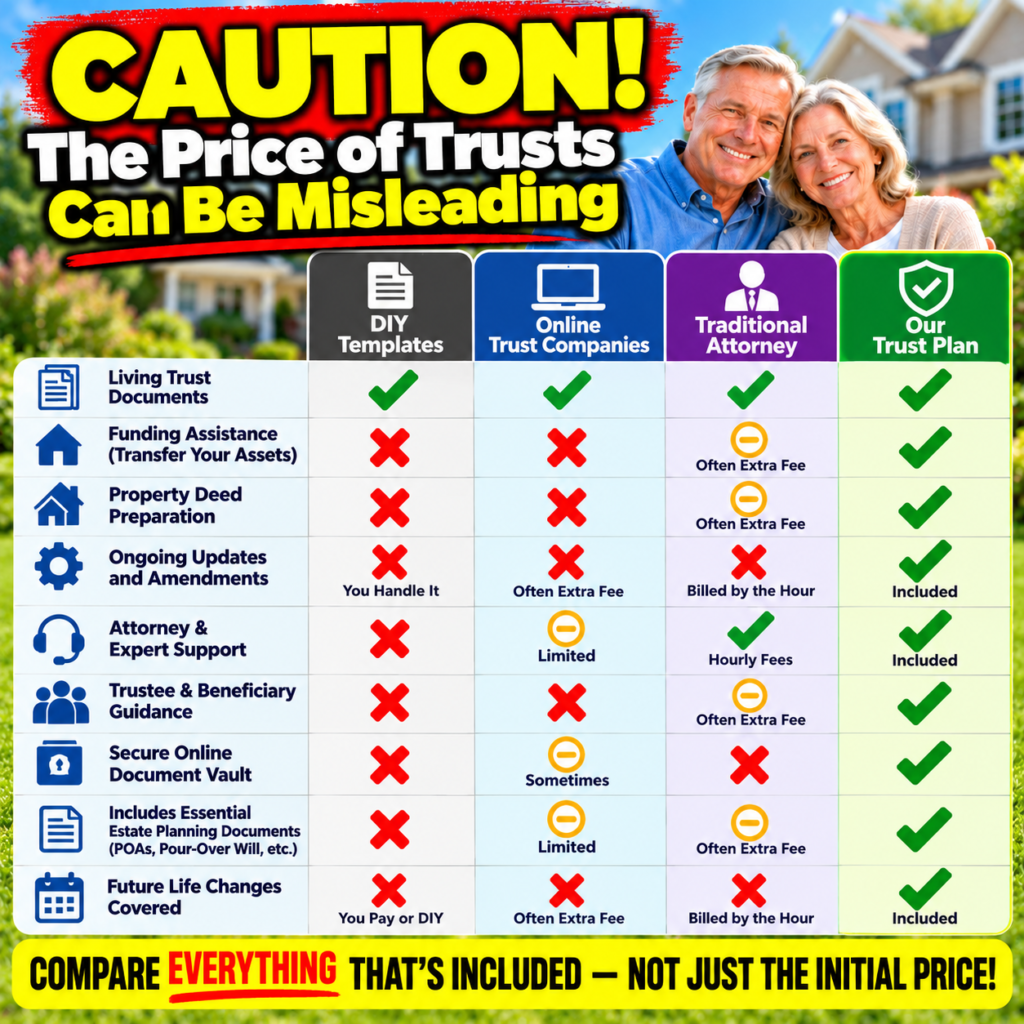
Most people searching for living trust cost information expect a single number, but the honest answer is that a living trust’s price depends on who prepares it, how much work goes into funding it, and how much support you’ll need years down the road.
Our services combine document preparation with attorney review and funding assistance in one package, which changes the math compared to buying a bare-bones template. Before comparing specific providers, it helps to understand the four general price tiers that show up across the industry and why they vary so much.
How Much Does a Living Trust Cost?
A living trust generally costs anywhere from under $300 to more than $10,000, depending on whether you use a template, an online platform, or an attorney, and depending on how complicated your estate happens to be. There is no single “correct” price because a living trust isn’t really a single product — it’s a legal structure that has to be drafted, signed, funded with your actual assets, and then kept current as your life changes. The number you see advertised almost always refers to the cost of creating the trust document itself, not the total cost of turning that document into a working estate plan.
Why Living Trust Prices Vary So Much
Geographic location plays a bigger role than most people expect. An estate-planning package that costs $1,500 in a smaller Midwestern city might run $3,500 or more in a coastal metro area, largely because attorney overhead and hourly rates differ so much by region. Beyond location, the biggest cost drivers include the complexity of your estate, whether you own real estate in more than one state, whether you have business interests, how many beneficiaries you’re naming, and whether your plan needs specialized tax or asset-protection strategies.
The provider you choose matters just as much as where you live. A basic template service, a full-featured online platform, a solo attorney, and a larger estate-planning firm can all produce a living trust, but they don’t provide the same level of individualized advice, review, or ongoing support. That difference in service level is often what separates a $200 product from a $3,000 one.
The Difference Between the Cost of a Trust Document and the Cost of a Complete Estate Plan
This distinction matters more than almost anything else in this guide: the price of the trust document is not necessarily the total cost of having a complete, funded, implemented, and maintained estate plan. A trust that sits in a drawer, unsigned properly or never funded with your actual assets, may not accomplish much no matter how little or how much you paid for it.
A meaningful cost comparison has to include more than the initial paperwork. It should factor in supporting documents like a pour-over will and powers of attorney, any professional review of the trust’s terms, the work of actually funding the trust with your real estate and financial accounts, coordination with banks and investment firms, your own time and effort, the cost of future amendments, ongoing maintenance, and any third-party fees like recording costs. Add all of that together, and the “cheapest” option on paper doesn’t always end up being the lowest total cost.
The Three Ways to Create a Living Trust: Attorney, DIY, or a Supported Digital System
Broadly speaking, consumers have three paths available. The first is hiring a traditional estate-planning attorney to draft a custom trust and supporting documents. The second is using a DIY template or online document-preparation service to create the trust largely on your own. The third, newer option is a supported digital system like Bulletproof Legacy / Integrated Trust Systems, which combines document preparation with professional review, funding assistance, and ongoing digital access.
Each of these paths has legitimate strengths, and none of them is automatically wrong for every situation. The rest of this guide walks through what you actually get, what remains your responsibility, and what might cost extra under each approach — not just the sticker price on day one.
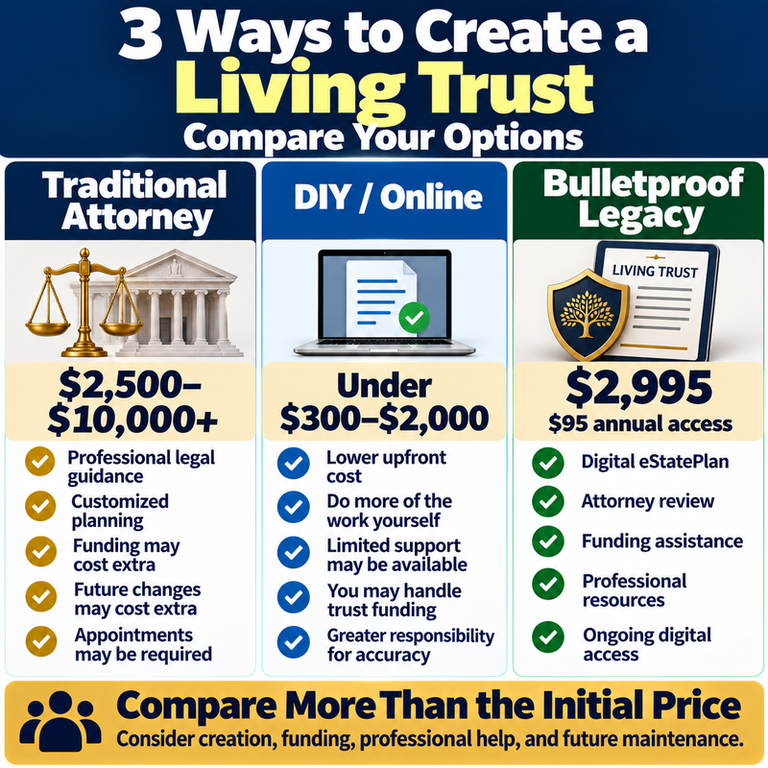
Living Trust Cost Comparison: Attorney vs. DIY vs. Bulletproof Legacy
Before diving into the details of each option, it helps to see the general price ranges side by side. Remember that these are estimated ranges, not fixed national prices — your actual cost will depend on your location, provider, and the complexity of your estate.
| Approach | General Estimated Price Range |
|---|---|
| DIY Template | Under $300 to approximately $1,000 |
| Online Platform | Approximately $1,000 to $2,000 |
| Attorney – Simple Estate | Approximately $2,500 to $4,000 |
| Attorney – Complex Estate | Approximately $4,000 to $10,000+ |
| Bulletproof Legacy / ITS Listed Package | $2,995 (plus $95 annual access fee) |
Option 1: Traditional Estate-Planning Attorney
An attorney can provide individualized legal advice, customize your trust to your family’s specific circumstances, and handle complicated situations involving business interests, blended families, or multi-state property. This customization is genuinely valuable for complex estates, but it typically comes with higher professional fees and may require additional appointments for funding assistance, deed preparation, or future amendments.
Option 2: DIY or Basic Online Living Trust
A DIY template or basic online service offers the lowest upfront price, along with convenience and the ability to work at your own pace. The tradeoff is that more of the responsibility — researching your state’s requirements, understanding trust provisions, funding the trust correctly, and updating it later — falls on you. A properly created, properly executed, and properly funded DIY trust can work, but “properly” is doing a lot of work in that sentence.
Option 3: Bulletproof Legacy / Integrated Trust Systems
Bulletproof Legacy / Integrated Trust Systems positions itself between these two models by combining a digital eStatePlan with attorney review, advisor team assistance, and trust funding support, all accessible through a Personal Client Portal. According to the company’s listed pricing, the eStatePlan costs $2,195, attorney review is $500, and advisor team assistance is $300, for a total listed package of $2,995, plus a $95 annual access fee for ongoing access. The value proposition here isn’t simply a lower price — it’s what’s included between the blank page and a properly implemented, maintainable estate plan.
Comparing Upfront Cost, Funding, Professional Support, and Future Maintenance
Looking only at the initial price tag hides most of the real story. The table below compares what each approach typically includes beyond the document itself — funding help, professional review, and what happens when you need to make changes later.
| Factor | Traditional Attorney | DIY / Online | Bulletproof Legacy / ITS |
|---|---|---|---|
| Trust Funding Assistance | Varies by firm; may cost extra | Typically self-directed | Included per listed package |
| Attorney Review | Included in most full-service engagements | Often an add-on or unavailable | Included ($500 line item) |
| Digital Access / Portal | Varies by firm | Varies by provider | Personal Client Portal included |
| Future Amendments | May require new appointment and fee | Consumer typically self-manages | Ongoing access via annual fee; some changes may still require professional assistance |
| Annual Ongoing Fee | Not standard; varies by firm | Varies by provider | $95 per year |
How Much Does an Attorney Charge for a Living Trust?
Attorney fees for a living trust generally fall into three billing structures: flat fees for a defined package, hourly billing for time spent, or a combination of both depending on the service. There is no single national number for what a lawyer charges for a living trust, because fee structures and rates vary significantly by firm, region, and the complexity of the estate involved.
Many estate-planning attorneys offer flat-fee packages for a standard revocable living trust, pour-over will, and powers of attorney, often landing in the $2,500 to $4,000 range for relatively straightforward estates. More complex situations — multiple properties, business ownership, blended families, or specialized tax planning — can push attorney-drafted plans into the $4,000 to $10,000-plus range.
Flat-Fee Living Trust Packages
A flat-fee package typically bundles the core documents into one price: the trust agreement, a pour-over will, financial and healthcare powers of attorney, and sometimes an initial consultation and one round of document review. Flat fees give consumers price certainty upfront, but it’s worth asking exactly which services are bundled in and which ones (like funding assistance or future amendments) are billed separately.
Attorney Hourly Rates for Estate-Planning Work
Some attorneys bill hourly rather than charging a flat fee, particularly for complex or highly customized work. Hourly rates can vary from roughly $150 to $400 per hour in many markets, with senior attorneys in high-cost metro areas sometimes charging $400 to $800 or more per hour. These figures are general estimates rather than universal rates — not every estate-planning attorney bills hourly, and rates depend heavily on experience, specialization, and location.
Why Complex Estates Can Cost Significantly More
Estate complexity, not the trust document itself, is usually the biggest driver of attorney fees. Multiple properties, out-of-state real estate, business ownership, specialized tax planning, and detailed beneficiary arrangements all require additional attorney time to draft correctly and coordinate. An attorney working through a straightforward single-property estate with two beneficiaries will typically spend far less time than one drafting a plan involving a family business, property in three states, and a special-needs beneficiary.
Individual vs. Married-Couple Living Trust Costs
Married couples don’t automatically pay a fixed “couple surcharge,” but they often need what attorneys call mirror trusts — parallel documents for each spouse — which can add drafting time compared to a single individual’s plan. Whether a couple pays more depends on factors like joint versus separate property, blended-family considerations, and how many total documents the plan requires, not simply the fact that two people are involved.
What Is Usually Included in an Attorney’s Initial Living Trust Fee?
A typical initial fee often includes the revocable living trust itself, a pour-over will, financial and healthcare powers of attorney, an initial consultation, document preparation, and at least one review and signing appointment. Some attorneys include limited funding guidance in this initial fee, while others treat funding as a separate service. This is exactly why it pays to ask what’s covered before assuming the quoted price is the final price.
What May Cost Extra?
Depending on the attorney’s fee structure, several services can fall outside the initial quoted price. It’s worth asking specifically about each of these before signing an engagement letter:
- Deed preparation and recording for real estate transfers
- Assistance retitling bank or investment accounts
- Business-interest transfers or corporate document updates
- Retirement-account beneficiary coordination
- Additional consultations beyond the initial meeting
- Future amendments or trust restatements
- Specialized tax or asset-protection planning
None of this means every attorney nickel-and-dimes clients for these services — many firms include some or all of them in a comprehensive package. The point is that fee structures vary enough that assuming a quoted number covers everything can lead to surprises later.

Why the Attorney’s Initial Trust Fee May Not Be the Total Cost
An attorney’s advertised or quoted price typically covers drafting and preparing the trust and its supporting documents. It doesn’t automatically mean every step needed to make the trust functional — funding it with your actual assets, transferring real estate, coordinating with financial institutions — is finished the day you sign.
Creating the Documents Is Only the First Step
A signed trust document that hasn’t been funded generally doesn’t accomplish much. Your house, bank accounts, and investment accounts still need to be legally retitled in the name of the trust for those assets to be governed by it. This funding step is separate work from drafting the trust, and depending on your attorney’s fee arrangement, it may be included, partially included, or billed as an additional service.
Attorney Fees for Trust Funding Assistance
Some attorneys include basic funding guidance in their flat fee; others charge separately, particularly for more involved funding work like preparing multiple deeds or coordinating several financial institutions. Legal fees for asset-transfer assistance can vary widely depending on the attorney’s hourly rate and how many assets need to be moved into the trust.
Attorney Time for Deeds and Real-Estate Transfers
Transferring real estate into a trust requires preparing a new deed and recording it with the appropriate county or local government office. Attorney fees for deed preparation can add a few hundred dollars per property on top of the base trust cost, and recording fees charged by the government are a separate expense entirely. If you own property in more than one state, each state’s recording requirements and fees may differ.
Assistance With Bank and Investment Accounts
Retitling bank and brokerage accounts into a trust’s name generally requires paperwork with each financial institution. Some attorneys will help coordinate this process; others leave it to the client. Financial institutions themselves typically charge little or nothing to update account titling, but the time and coordination involved — especially across multiple accounts and institutions — is real work either way.
Business Interests and More Complicated Assets
Business ownership adds another layer of complexity. Transferring an LLC membership interest, corporate stock, or partnership interest into a trust may require reviewing operating agreements, drafting assignment documents, and sometimes obtaining consent from other owners. This kind of work often falls outside a standard flat-fee package and may be billed separately.
Beneficiary Designation and Retirement-Account Coordination
Retirement accounts like IRAs, 401(k)s, and 403(b)s are not typically retitled directly into a living trust the way a bank account might be. These accounts involve specialized ownership, beneficiary, and tax rules, so coordinating them with your estate plan usually means updating beneficiary designations rather than simply changing account ownership. An attorney familiar with retirement-account rules can help you avoid mistakes that could trigger unintended tax consequences.
Recording, Filing, and Third-Party Fees
Separate from any attorney fee, government offices charge their own fees to record deeds and process other filings. These third-party costs vary by county and state and are paid regardless of which attorney, DIY service, or digital platform you use to prepare the underlying documents.
Additional Meetings, Phone Calls, Emails, and Professional Time
Complex estates often require more back-and-forth between attorney and client — additional meetings to clarify family circumstances, phone calls to walk through funding steps, or emails answering questions that come up after signing. Depending on the fee arrangement, this additional professional time may or may not be included in the original quote.
The Time Cost of Using a Traditional Estate-Planning Attorney
Money isn’t the only cost worth weighing. The traditional attorney process also requires your time and involves waiting on someone else’s schedule at several points along the way.
Scheduling the Initial Consultation
Before any drafting begins, you’ll typically need to find an attorney, schedule a consultation, and gather the information they’ll need — details about your assets, family structure, and goals. Attorney availability and scheduling times vary considerably by firm and region, so it’s not accurate to assume every attorney takes weeks to get you on the calendar, but some scheduling lead time is common.
Waiting for Documents to Be Prepared and Reviewed
Once your information is gathered, the attorney needs time to draft your customized documents. You’ll then typically review a draft, request any changes, and wait for a revised version before scheduling a signing appointment. This back-and-forth process takes real calendar time, even when everyone involved is responsive.
Signing and Executing the Estate Plan
Proper execution matters enormously for a living trust to hold up legally. This typically involves:
- Signing in the presence of a notary
- Meeting any state-specific witness requirements
- Confirming all supporting documents are executed correctly alongside the trust
Skipping or mishandling any of these steps can create problems later, which is one reason the signing appointment itself is a meaningful part of the process rather than a formality.
Scheduling Additional Funding Assistance
If your attorney helps with funding, that’s often a separate round of appointments after the trust is signed. Preparing deeds, coordinating with your bank, and handling other transfers can require additional meetings or calls, each of which takes time to schedule and complete.
Getting Deeds and Other Asset Transfers Completed
Even after a deed is prepared, it has to be recorded with the local government office, which can take additional processing time depending on the jurisdiction. The same is true for financial institutions processing account-retitling paperwork — some move quickly, others take weeks.
What Happens When You Need Help Again Later?
A revocable living trust may exist for decades, and life doesn’t stop changing after the signing appointment. When you need an amendment years later, you’re generally back in the same cycle — scheduling time with the attorney, waiting for updated documents, and coordinating a new signing. This is one of the reasons ongoing access and support matter just as much as the initial creation process.

What Does It Cost to Change a Living Trust?
Changing a living trust can cost anywhere from nothing, if you’re using a self-managed digital tool, to several hundred dollars or more for attorney-drafted amendments, depending on the scope of the change and your fee arrangement. Because a revocable living trust is designed to be changeable, this isn’t a hypothetical concern — most people who create a trust in their thirties or forties will likely need to update it multiple times before it’s ever used.
Why Revocable Living Trusts May Need to Be Updated
Life events that commonly trigger updates include:
- Marriage or divorce
- Birth or adoption of a child
- Death of a beneficiary or trustee
- Buying or selling real estate
- Starting or selling a business
- Receiving a significant inheritance
- Moving to another state
- Changes in who you want to inherit your assets
Attorney Fees for Trust Amendments
Depending on the attorney and the scope of the change, a simple amendment might cost a few hundred dollars, while a full trust restatement — essentially rewriting the trust from scratch while keeping the original date and structure — can cost closer to what a portion of the original drafting fee was. Some attorneys include a limited number of amendments in their original engagement; many do not.
Changing Beneficiaries or Distribution Instructions
Updating who receives what, and under what conditions, is one of the more common reasons people return to their attorney. Even a relatively simple change in beneficiary language typically requires a formal amendment to remain legally effective.
Changing Trustees or Successor Trustees
If your named trustee or successor trustee is no longer available or appropriate — due to death, relocation, or a change in relationship — the trust document needs to be formally updated to reflect the new choice.
Adding or Selling Real Estate
Every time you buy or sell property, the trust’s asset schedule and the associated deed work need attention. Selling a property that’s titled in the trust requires coordinating the trust’s terms with the sale, and buying new property means preparing a new deed to bring it into the trust.
For a deeper look at what a properly structured revocable trust involves, the revocable living trust guide covers the mechanics of ownership and control in more detail.
Moving to Another State
Trust laws vary by state, and while a properly drafted revocable living trust is generally designed to be portable, moving can still trigger a need for professional review — particularly around state-specific requirements for real estate, healthcare directives, or powers of attorney.
Major Family and Financial Changes
Marriage, divorce, a new child, a business sale, or a significant inheritance can each independently justify revisiting your trust, and several of these events happening within the same decade is common for most families.
These changes don’t always require a complete overhaul, but they do require someone — you, your attorney, or a support team — to review the trust and determine what needs updating.
Why Future Maintenance Should Be Part of Your Cost Comparison
A revocable living trust isn’t a one-time purchase; it’s closer to a piece of infrastructure that needs occasional upkeep over what could be several decades. When comparing providers, it’s worth asking not just what the initial price includes, but what future changes will cost and how easy the process will be when you need it.
- What does a simple amendment cost?
- Is there a limit on how many changes are included?
- How quickly can changes typically be made?
- Is ongoing support included, or billed separately each time?
Can a Traditional Attorney Living Trust Ultimately Cost $10,000 or More?
Yes, total professional costs for an attorney-created estate plan can potentially reach or exceed $10,000, though this is generally tied to complex circumstances rather than being the typical cost of every attorney-drafted living trust. A straightforward single-person or married-couple estate with modest assets and no unusual complications often costs meaningfully less than that figure.
When Initial Legal Fees Are Only the Beginning
Costs can climb toward or past $10,000 when several factors combine, including:
- Multiple properties, especially across different states
- Business ownership requiring specialized transfer work
- Extensive trust funding across many accounts and asset types
- Specialized trusts for tax planning or asset protection
- Complex beneficiary arrangements, including blended families or special-needs planning
- Significant revisions or a full restatement after major life changes
How Funding and Implementation Can Increase the Total Cost
Even a moderately priced initial trust document can accumulate additional costs once real-estate transfers, business-interest assignments, and financial-account coordination are added on top. For estates with several properties or complex holdings, funding assistance alone can represent a substantial portion of the total professional-service bill.
How Estate Complexity Affects Professional Fees
The more moving parts in your estate — multiple beneficiaries with different needs, out-of-state real estate, a family business, or specialized tax considerations — the more attorney time is required to draft, review, and implement the plan correctly. This is generally the single biggest factor separating a $3,000 estate plan from a $10,000 one.
How Future Amendments and Ongoing Legal Work Add to Lifetime Cost
Even after the initial plan is complete, decades of amendments, restatements, and consultations can add up. A trust that costs $4,000 to create might realistically cost several thousand dollars more over 20 or 30 years once you factor in updates triggered by marriage, divorce, new grandchildren, or property changes.
Why You Should Ask for the Complete Fee Structure Before Hiring an Attorney
Before signing an engagement letter, it’s worth asking directly what’s included in the quoted price, what typically costs extra, how amendments are billed, and whether funding assistance is part of the package. Getting these answers upfront helps you compare attorneys accurately instead of comparing quotes that cover different amounts of actual work.

How Much Does a DIY Living Trust Cost?
A DIY living trust generally costs under $300 to about $1,000 for a basic template, or $1,000 to $2,000 for a more full-featured online platform. This is by far the least expensive path to a signed trust document, and for a relatively simple estate, it can be a legitimate option — provided it’s completed correctly and actually funded afterward.
Living Trust Templates and Forms
Basic template services provide fill-in-the-blank trust documents based on your state and answers to a set of questions. These products are typically the least expensive option available, often priced under $300, and they generally don’t include attorney review, funding assistance, or ongoing support.
Online Document-Preparation Services
Online living trust platforms sit a step above basic templates. Some are purely questionnaire-based document generators, while others include add-ons like attorney review, notarization coordination, or digital storage. Pricing for these more full-featured platforms generally runs from around $1,000 to $2,000, though the exact price depends heavily on which add-ons are included.
What You Actually Receive for the Price
Not every online living trust service is the same product wearing a different label. Some generate documents only; others provide meaningful professional resources. Before assuming a lower price means a lesser plan, it’s worth checking exactly what’s bundled in — because two services priced within a few hundred dollars of each other can include very different levels of support.
Why a Low Upfront Price Can Be Appealing
For someone with a straightforward estate — one property, a small number of accounts, and clear beneficiaries — a lower-cost DIY option can make sense, especially if they’re comfortable doing the funding work themselves. The appeal is real: lower cost, faster turnaround, and full control over the process at your own pace.
The Costs a DIY Living Trust Price Doesn’t Show You
The advertised price of a DIY trust rarely reflects the total time and responsibility that comes with it. Because there’s no attorney or advisor managing the process for you, everything from research to execution to funding becomes your job.
Your Time Has Value Too
Filling out a trust questionnaire might take an hour or two, but properly completing the entire process — research, execution, and funding — often takes many more hours spread across weeks or months. That time has real value, even if it doesn’t show up as a line-item cost.
Researching Your State’s Requirements
Trust and estate laws vary by state, particularly around execution formalities, real-estate recording requirements, and notarization rules. A DIY user is generally responsible for confirming their documents comply with their specific state’s requirements.
Choosing the Correct Trust Provisions
Selecting trustees, successor trustees, and beneficiaries, and drafting distribution instructions, requires understanding how each choice affects the trust’s function. Without professional guidance, it’s up to the individual to make sure these choices reflect their actual intentions and work together logically.
Properly Executing the Documents
Signing a trust isn’t as simple as putting a name on a page. Most states require notarization, and some require witnesses as well. Missing a formality during execution can create questions later about whether the trust is valid.
Preparing or Coordinating Property Deeds
Transferring real estate into a trust requires preparing a new deed that meets your state and county’s specific requirements, then recording it with the appropriate government office. This step is separate from signing the trust itself and is one of the most commonly overlooked parts of DIY estate planning.
Funding Bank and Investment Accounts
Retitling accounts into the trust’s name typically means visiting or contacting each financial institution individually, providing trust documentation, and completing their specific paperwork. Multiply this across several banks and brokerage accounts, and the process can take considerable time.
Coordinating Beneficiary Designations
Certain assets, like life insurance policies, pass according to their beneficiary designations rather than through the trust document itself. Making sure these designations align with the overall estate plan — rather than accidentally contradicting it — is a step that’s easy to overlook without guidance.
Handling Retirement Accounts Correctly
IRAs, 401(k)s, and similar retirement accounts involve specialized ownership, tax, and distribution rules. These accounts generally aren’t retitled into a living trust the way a bank account is; instead, they require careful beneficiary-designation coordination. A DIY user who isn’t aware of this distinction risks creating conflicts between the trust and the account’s actual beneficiary rules.
Keeping Track of Assets That Still Need to Be Funded
Without a checklist or professional guidance, it’s easy to fund some assets and forget others. An asset accidentally left outside the trust generally isn’t protected by it, even if every other account was properly transferred.
Maintaining the Trust After Life Changes
Once the initial work is done, the responsibility for noticing when an update is needed — and completing that update — falls entirely on the individual with a basic DIY product. There’s typically no reminder system, no advisor check-in, and no built-in prompt to revisit the plan after a marriage, birth, or property purchase.

The Risk of DIY Living Trust Mistakes
DIY estate planning isn’t inherently flawed, but the lower price does transfer more responsibility to the consumer, and a handful of common mistakes show up often enough to be worth naming directly.
Creating the Trust but Never Funding It
This is likely the single most common DIY mistake. A trust that’s signed but never funded doesn’t accomplish its main purpose, because assets still titled in your individual name generally still pass through probate.
Improperly Executed Documents
Missing a notary signature, skipping a required witness, or misunderstanding a state-specific formality can create questions about a trust’s validity down the road. These issues are sometimes not discovered until the trust is actually needed, which is the worst possible time to find a problem.
Incorrect or Missing Deeds
A deed that’s drafted incorrectly, or one that’s never prepared at all, means the property doesn’t actually transfer into the trust despite the owner’s intentions. Fixing this after the fact typically requires professional help and additional fees.
Assets Accidentally Left Outside the Trust
Bank accounts opened after the trust was created, new investment accounts, or a property purchased later can easily be overlooked if there’s no ongoing system tracking what’s been funded and what hasn’t.
Beneficiary Designations That Conflict With the Estate Plan
A life insurance policy or retirement account with an outdated beneficiary designation can override the intentions expressed in the trust itself, since these assets typically pass according to their own designations rather than through the trust.
Mistakes Involving Retirement Accounts
Treating an IRA or 401(k) like an ordinary bank account — attempting to retitle it directly into the trust — can trigger unintended tax consequences. These accounts require a different approach entirely, generally centered on beneficiary coordination rather than direct transfer.
Failing to Update the Trust After Major Life Changes
A trust drafted before a divorce, a new marriage, or the birth of a grandchild may no longer reflect the person’s actual wishes. Without a system prompting a review, these gaps can go unnoticed for years.
None of this means DIY trusts are doomed to fail. It means the savings on the front end can shrink or disappear entirely if a mistake requires professional help to identify and correct later.
When Saving Money Upfront Can Create More Work Later
Correcting an improperly funded trust, fixing a defective deed, or untangling conflicting beneficiary designations often requires hiring an attorney anyway — at that point, on an hourly basis, to fix a problem rather than to build a plan from scratch. In some cases, the cost of correction can approach or exceed what a fuller-service option would have cost from the beginning.
What Professional Help Is Missing From Many DIY Options?
Basic DIY products are generally built around generating documents, not around providing ongoing professional guidance. Understanding what’s typically absent helps clarify what you’re trading for the lower price.
Individual Legal Advice
A template doesn’t know your specific family situation, and it can’t advise you on how a particular provision might interact with your unique circumstances. Individualized legal advice is one of the clearest differences between a DIY product and working directly with an attorney.
This matters most when circumstances aren’t simple — blended families, business ownership, or beneficiaries with special needs all benefit from advice tailored to the actual situation rather than generic guidance.
- Whether your specific state has unusual execution requirements
- How to structure provisions for a beneficiary with special needs
- How to handle a blended family’s competing interests
- Whether a specific asset needs specialized trust language
A basic template typically can’t answer these questions in a way tailored to your circumstances.
Attorney Review
Some DIY services offer attorney review as a paid add-on, while basic templates typically don’t include it at all. Attorney review provides a check on whether the documents were completed correctly and whether they reflect the person’s actual intentions.
Trust Funding Assistance
Most basic DIY products stop at document generation and leave funding entirely to the consumer. There’s typically no one helping prepare deeds, coordinate with financial institutions, or confirm every asset has actually been transferred.
Tax and Financial Guidance
Questions about how a trust interacts with estate taxes, capital gains, or retirement-account rules generally fall outside the scope of a document-generation service. These questions often require a tax professional or financial advisor familiar with the person’s full financial picture.
Help With Unusual Assets or Family Circumstances
Business interests, out-of-state property, or a beneficiary who needs specialized protections all benefit from guidance that a standard template isn’t built to provide.
The core question isn’t whether DIY estate planning can work — it’s whether the person creating it has the time, knowledge, and follow-through to complete every step correctly, from execution through full funding.
For estates with any complexity at all, this gap between “document created” and “estate plan fully implemented” is where the real cost difference tends to show up.
A guide to how to create a living trust walks through the full sequence of steps in more detail, which can help clarify how much work is actually involved before choosing a DIY path.
Ongoing Estate-Plan Maintenance
Basic DIY products generally don’t include any system for prompting future reviews or updates. The responsibility for noticing a needed change, and acting on it, rests entirely with the consumer.
Knowing When a Problem Requires Professional Help
Perhaps the biggest limitation isn’t any single missing feature — it’s not having anyone available to tell you when something in your plan needs professional attention in the first place.

How Much Does Bulletproof Legacy / Integrated Trust Systems Cost?
According to Bulletproof Legacy / Integrated Trust Systems’ listed pricing, the eStatePlan costs $2,195, attorney review is $500, and advisor team assistance is $300, bringing the total listed package to $2,995, with a $95 annual access fee for continued use of the system. This positions the package above basic DIY pricing but generally below the higher end of custom attorney-drafted complex estates.
Pricing structures can change over time, so it’s worth confirming current figures directly before making a final decision. What matters most for this comparison isn’t just the number itself, but what that number is actually purchasing.
The eStatePlan and Bulletproof Legacy Pricing
| Component | Listed Price |
|---|---|
| eStatePlan | $2,195 |
| Attorney Review | $500 |
| Advisor Team Assistance, Advice and Direction | $300 |
| Total Listed Package | $2,995 |
| Annual Access Fee | $95 |
The combination of a fixed document package with attorney review and advisor assistance bundled into one price is designed to answer the question this entire article keeps returning to: what does it actually take to get from a blank page to a properly implemented estate plan?
What Is Included in the Estate-Planning System
According to the supplied Bulletproof Legacy / ITS materials, the system includes a combination of core trust documents, supporting estate-planning documents, and digital tools:
- Revocable Living Trust
- Digital eStatePlan
- Personal Client Portal
- Healthcare Power of Attorney
- Financial Power of Attorney
- Pour-Over Will
- Assignment of Assets to Trust
- Notarization of applicable documents
- IRA Beneficiary Trust when appropriate
- Crawford Trust corporate trustee option
This list goes beyond a single trust document, which is one of the reasons the total listed package price is higher than a basic template but structured differently than an hourly attorney engagement.
It’s worth noting that not every feature listed here applies to every client. The IRA Beneficiary Trust and Crawford Trust corporate trustee option, for example, are described as available when appropriate rather than standard for every estate plan.
Attorney Review
The $500 attorney review component means the documents generated through the eStatePlan aren’t simply handed over without any professional check. Attorney review is meant to confirm the documents reflect the client’s stated wishes and are properly structured.
This distinguishes the package from a pure document-generation service where no attorney ever looks at what was created. Consumers evaluating any online provider should ask directly whether attorney review is included or offered as a separate add-on:
- Is attorney review included in the base price, or billed separately?
- Does the attorney review the entire estate plan or only the trust document?
- Is there an opportunity to ask the reviewing attorney questions?
Knowing the answers to these questions before purchasing any package helps set realistic expectations about what level of professional oversight you’re actually getting.
Advisor Team Assistance
The $300 advisor team component is described as providing assistance, advice, and direction. This is separate from the attorney review line item and appears intended to help clients work through practical questions about their overall estate plan and its implementation.
Combined with attorney review, this creates two distinct layers of professional support built into the total package price — something that’s typically absent from a basic DIY template purchased for a few hundred dollars.
Trust Funding Assistance
Trust funding assistance is listed among the system’s included features. Since funding is consistently one of the most commonly skipped or mishandled steps in DIY estate planning, having structured assistance for this step is a meaningful part of the package’s overall value.
This doesn’t mean every possible funding scenario is automatically simple or free of additional third-party costs. Real-estate recording fees, for example, are charged by government offices regardless of which provider prepares the underlying deed.
Funding assistance addresses the gap between “the trust exists” and “the trust actually controls your assets” — a gap that shows up in DIY estate planning far more often than most people expect.
Personal Client Portal and Digital Access
The Personal Client Portal provides digital access to the estate plan and related tools, which supports both convenience during the initial creation process and ongoing access afterward. This kind of centralized digital access is one of the features that separates the package from a static PDF trust document.
Ongoing Access and Estate-Plan Maintenance
Annual financial and client reviews are included among the listed features, which supports the idea that the plan isn’t meant to be created once and forgotten. Given that a revocable living trust may exist for decades and life circumstances change regularly, having a built-in review cadence is directly relevant to the maintenance themes covered earlier in this guide.
This does not mean every possible future change is automatically completed without any additional cost. Some updates, particularly those requiring new legal documents or specialized advice, may still involve additional professional assistance.
Annual Access Costs
The $95 annual access fee covers continued use of the digital system and portal. Compared to returning to an attorney’s office for a new appointment every time a minor question arises, an annual access model is structured to provide ongoing touchpoints for a predictable yearly cost.

What You Get With the Bulletproof Legacy eStatePlan
Beyond the pricing structure itself, it’s worth understanding what each document and feature in the package actually does, since the value of any estate-planning package comes down to whether its components fit together into a coherent, functional plan.
Several of these components work together rather than standing alone — the trust holds and manages assets, the pour-over will catches anything left outside it, and the powers of attorney handle decisions if you become incapacitated.
Reviewing each piece individually helps clarify why a full package, rather than a single document, is generally necessary for a complete estate plan.
Revocable Living Trust
The revocable living trust is the core document, designed to hold and manage assets during your lifetime, provide continuity if you become incapacitated, and direct how assets are distributed after death. Because it’s revocable, it can be changed as your circumstances evolve, which is central to the maintenance themes discussed throughout this guide.
For a deeper explanation of how a living trust functions on its own, that dedicated resource covers the mechanics in more depth than is necessary to repeat here.
Pour-Over Will
A pour-over will works alongside the trust to catch any assets that weren’t formally transferred into it during your lifetime. Those assets generally still pass through probate, but the pour-over will directs them into the trust afterward, which helps prevent an incomplete funding process from completely derailing the overall plan.
This document functions as a safety net rather than a primary planning tool — it’s meant to catch mistakes, not replace proper funding in the first place.
Healthcare Power of Attorney
This document names someone to make medical decisions on your behalf if you’re unable to make them yourself. It’s a critical piece of incapacity planning that operates independently of the trust itself but is typically included as part of a complete estate-planning package.
Without this document, family members may need to petition a court for guardianship authority to make medical decisions, which can be both time-consuming and costly during an already stressful situation.
Financial Power of Attorney
Similarly, a financial power of attorney names someone to handle financial matters — paying bills, managing accounts, handling business affairs — if you become unable to do so yourself. This document generally covers matters outside the trust’s own management structure.
Assignment of Assets to the Trust
This document formally assigns certain assets into the trust, supporting the broader funding process discussed throughout this guide. It’s one of several tools used to move personal property and other assets under the trust’s umbrella.
Assignment documents are particularly useful for personal property and other assets that don’t have a formal title, like a deed or account statement, making them harder to transfer through standard retitling alone.
IRA Beneficiary Trust When Appropriate
For clients where it’s appropriate, the IRA Beneficiary Trust option is designed to address the specialized rules surrounding retirement accounts, rather than treating an IRA like an ordinary asset that gets directly retitled into the living trust. This reflects the broader theme that retirement accounts require distinct handling.
Personal Client Portal
The portal provides a centralized digital location for accessing documents and estate-plan information, supporting both convenience and long-term organization.
Note Pad System, Postscript Page, E-Vault, and Medical ID Card
Several additional tools round out the package, each addressing a different practical need beyond the core legal documents.
The Note Pad System and Postscript Page provide space for personal instructions and messages that go beyond formal legal language — things like where important items are kept or personal wishes that don’t belong in a legal document. The E-Vault offers digital storage for important records, while the Medical ID Card provides a physical reference in emergency situations.
- Note Pad System — personal notes and instructions
- Postscript Page — additional personal messages
- E-Vault — digital document storage
- Medical ID Card — emergency reference tool
Attorney, Financial, Tax, and Trust Resources
The broader package is structured around access to a combination of professional resources — attorneys, financial professionals, tax professionals, and trust specialists — rather than a single point of contact. This is meant to address different types of questions that can arise across the life of an estate plan.
It’s worth noting that this doesn’t mean every client automatically receives unlimited, individualized services from every professional category listed. The scope of assistance available should be confirmed directly with the provider based on your specific plan and needs.
Trust Funding Assistance
Funding assistance is woven throughout the package rather than treated as a separate afterthought, which directly addresses one of the most consistent problems identified earlier in DIY and even some attorney-drafted plans: trusts that are signed but never properly funded.
If you’re weighing these options against your own family’s circumstances, a Free Living Trust Consultation can help clarify what your specific estate may require and which services actually matter for your situation.
The Cost Advantage of Getting Help With Trust Funding
Trust funding deserves its own extended discussion because it’s arguably the single most consequential factor in whether a living trust actually works the way it’s intended to. A beautifully drafted trust that holds no assets doesn’t accomplish much more than an unsigned will.
Why Signing the Trust Is Not the Same as Funding It
Signing the trust document creates the legal structure. Funding the trust means actually transferring ownership of your assets — real estate, accounts, business interests — into that structure. These are two separate steps, and skipping the second one is one of the most common and consequential mistakes in estate planning.
An unfunded trust generally avoids no probate at all, because assets still titled in your individual name still pass through the probate process regardless of what your trust document says.
Real Estate
Funding real estate into a trust requires preparing and recording a new deed that transfers ownership from your individual name to the trust. This process involves both the cost of preparing the deed and the government recording fee charged by the county or local jurisdiction, which typically ranges from around $10 to $300 per property depending on location — a general estimate rather than a fixed nationwide fee.
Bank and Savings Accounts
Retitling bank and savings accounts generally involves visiting the financial institution, providing a copy of the trust documentation, and completing their specific account-retitling paperwork. Financial institutions typically charge little or nothing for this process itself, though it does require time and coordination.
Steps commonly involved include:
- Providing a certification of trust or relevant trust pages to the bank
- Completing the institution’s own account-retitling forms
- Confirming the new account title correctly reflects the trust’s name
- Updating any linked automatic payments or direct deposits as needed
Investment and Brokerage Accounts
Investment and brokerage accounts follow a similar retitling process, though the paperwork requirements can vary by firm. Some brokerages have streamlined processes for trust retitling, while others require more extensive documentation before making the change.
Business Interests
Transferring business interests — an LLC membership interest, corporate stock, or partnership share — into a trust often requires reviewing the underlying operating agreement or partnership agreement, since some business structures include restrictions on ownership transfers that need to be addressed before the trust can hold the interest.
Life Insurance and Annuities
Life insurance and annuities generally pass according to their beneficiary designations rather than through the trust document directly. Coordinating these designations with the overall estate plan is an important step, since a policy naming an individual beneficiary will pass to that person regardless of what the trust says.
Beneficiary-Designated Assets
Beyond life insurance, several other asset types — payable-on-death bank accounts, transfer-on-death investment accounts, and certain retirement accounts — pass through beneficiary designations rather than trust ownership. Reviewing all of these designations together, alongside the trust itself, helps ensure the entire plan works as intended rather than fighting itself.
This coordination work is exactly the kind of task that benefits from professional funding assistance rather than being left entirely to the individual to track down independently.
Why Retirement Accounts Require Special Handling
Retirement accounts like IRAs, Roth IRAs, 401(k)s, and 403(b)s should not simply be retitled into a living trust the way a bank account might be. These accounts involve specialized ownership, distribution, and tax rules, and mishandling them can trigger unintended tax consequences. Coordination generally happens through updating beneficiary designations rather than changing account ownership directly, which is why specialized tools like an IRA Beneficiary Trust exist for situations where that structure is appropriate.
The Difference Between Receiving Documents and Receiving Implementation Assistance
A provider that only generates documents leaves every step described above entirely in the consumer’s hands. A provider that includes funding assistance is providing something materially different — help actually connecting the legal structure to the real assets it’s supposed to control.
This distinction is the clearest illustration of the article’s central theme: the price of the trust document and the total cost of a properly implemented estate plan are not the same number.

Living Trust Funding Costs You Should Consider With Any Provider
Regardless of whether you use an attorney, a DIY service, or a supported digital system, certain funding-related costs are largely unavoidable because they’re charged by third parties rather than by whichever provider drafted your documents.
Real-Estate Deeds and Recording Fees
Preparing a deed may involve a provider’s own fee, while recording that deed with the county or local government office involves a separate, government-set fee. As noted earlier, these recording fees generally range from around $10 to $300 per property, though this varies significantly by jurisdiction.
Financial-Institution Requirements
Each bank or brokerage firm has its own specific paperwork and process for retitling an account into a trust’s name. While the institution itself typically charges little or nothing for this change, the time required to work through each institution’s individual requirements is a real cost, especially for someone with accounts spread across multiple banks.
Vehicle and Titled-Property Fees Where Applicable
Some titled property, like vehicles, may involve their own transfer fees and paperwork if included in the trust, though many people choose to leave vehicles outside the trust and handle them separately given their generally lower value and different titling process.
Business-Ownership Transfers
Transferring business interests can sometimes involve professional fees beyond standard trust funding — particularly if the operating agreement requires drafting an amendment or obtaining consent from co-owners before the transfer can be completed.
Professional Assistance With Complicated Assets
More complex assets — out-of-state property, business interests, or specialized investment structures — may require additional professional assistance to fund correctly, regardless of which overall provider created the trust documents.
Third-Party and Government Fees
It’s worth distinguishing clearly between fees charged by whichever provider prepared your trust and fees charged by outside parties like county recording offices, title companies, or notaries. These third-party expenses apply no matter which path you choose to create your trust.
Why Funding Costs Depend on Your Assets and Location
Two people with identically priced trust documents can end up with very different total funding costs depending on how many properties they own, how many financial institutions are involved, and which state’s recording fees apply. This is one more reason the initial trust price alone doesn’t tell the whole cost story.
Traditional Attorney vs. DIY vs. Bulletproof Legacy: What Are You Actually Paying For?
Bringing all three approaches together in one place makes the total-cost comparison easier to see at a glance. The table below focuses on what’s actually included, not just the sticker price.
| What’s Included | Traditional Attorney | DIY / Online | Bulletproof Legacy / ITS |
|---|---|---|---|
| Initial Trust Documents | Custom-drafted | Template-based | Digital eStatePlan |
| Supporting Documents | Typically included | Varies by provider | Included per listed features |
| Individualized Legal Advice | Yes | Generally no | Advisor team assistance included |
| Attorney Review | Built into service | Often a paid add-on or unavailable | Included ($500 component) |
| Trust Funding Assistance | Varies by fee arrangement | Typically self-directed | Included per listed package |
| Real-Estate Assistance | Often available, may cost extra | Self-directed | Included as part of funding assistance |
| Retirement-Account Coordination | Available depending on attorney | Self-directed | IRA Beneficiary Trust option when appropriate |
| Digital Access | Varies by firm | Varies by provider | Personal Client Portal |
| Future Changes | New appointment, possible added fee | Self-managed | Ongoing access; some changes may require added assistance |
| Annual Fee | Not standard | Varies | $95 per year |
| Consumer Time Required | Moderate (appointments, review) | High (research, execution, funding) | Moderate (guided process with support) |
The Cheapest Living Trust Is Not Necessarily the Lowest-Cost Living Trust
It’s tempting to treat the lowest advertised price as the “winner,” but that view only accounts for the first line item in a much longer cost equation. The true cost of any living trust includes the upfront price plus every hour of your own time, every dollar of professional assistance you end up needing, the cost of funding, any corrections required for mistakes, future amendments, and years of ongoing maintenance.
A $300 template that never gets funded, or that requires $2,000 in attorney fees years later to fix an execution error, isn’t actually a $300 estate plan — it’s a much more expensive one once the full picture is counted. Conversely, a $10,000 attorney-drafted plan for someone with a genuinely complex estate involving multiple properties and business interests may be entirely reasonable given the scope of work required, even though it’s the most expensive of the three general categories discussed in this guide.
Value depends entirely on matching the level of service to the actual complexity of your circumstances — not on chasing the lowest number on the page.
What Factors Increase the Cost of a Living Trust?
Several specific circumstances tend to push living trust costs higher, regardless of which provider you choose:
- Blended families with children from multiple relationships
- Real estate located in more than one state
- Business ownership requiring specialized transfer documents
- Large or complicated investment portfolios
- Numerous beneficiaries with detailed or unequal distribution instructions
- Retirement assets requiring specialized coordination
- Special-needs planning for a beneficiary
- Tax-planning strategies beyond a standard revocable trust
- Specialized or irrevocable trust structures
- Use of a corporate or professional trustee
Each of these factors adds either drafting complexity, funding complexity, or ongoing administrative requirements — and often all three at once.
Individual vs. Couple Living Trust Costs
Married couples don’t automatically face a fixed surcharge for estate planning, but their plans often do involve more documents than a single individual’s plan would require. Couples frequently need mirror trusts — parallel documents reflecting each spouse’s wishes — along with coordinated powers of attorney and healthcare directives for each person.
Why Married Couples May Have Different Planning Needs
Joint property ownership, blended-family considerations, and separate versus shared assets all influence how a couple’s plan should be structured. A couple with simple, shared finances and no children from prior relationships may need relatively straightforward planning, while a couple with separate businesses, prior marriages, and children from different relationships will typically require more detailed coordination.
Joint vs. Separate Trust Considerations
Some couples use a single joint trust; others use separate individual trusts that work together. Which structure makes sense depends on how property is owned, state law, and the couple’s specific goals — a decision best made with guidance rather than defaulting to whichever option seems simpler on the surface.
Additional Documents and Complexity
Because most couples need parallel documents for each spouse, the drafting workload for a couple’s plan is often greater than for a single individual, which can be reflected in the overall price. Many flat-fee packages price a couple’s plan as a single engagement covering both partners rather than charging for two entirely separate plans.
Why Price Should Follow the Estate Plan Rather Than Marital Status Alone
The appropriate price for a couple’s plan should reflect the actual complexity of their combined estate — number of properties, businesses, beneficiaries, and special circumstances — rather than simply doubling an individual price because two people are involved.

Revocable Living Trust Costs vs. Irrevocable Trust Costs
A standard revocable living trust is generally less complex, and therefore less expensive, than a specialized irrevocable trust designed for advanced tax planning or asset protection. Because a revocable trust can be changed during your lifetime, it doesn’t require the same level of upfront legal precision that an irrevocable structure demands, since irrevocable trusts are much harder — and sometimes impossible — to modify once created.
Irrevocable trusts used for specialized purposes, such as certain tax-planning or asset-protection strategies, often involve additional legal complexity, ongoing administrative requirements, and potentially separate tax filings, all of which can add to both the initial and ongoing cost compared to a basic revocable living trust. For a full comparison of how these two trust types differ in structure, control, and appropriate use cases, the revocable vs. irrevocable trust guide covers this distinction in greater depth.
The key point for this cost guide is simple: a basic revocable living trust and an advanced irrevocable planning strategy are different products serving different purposes, and comparing their prices directly doesn’t tell you much without understanding what each is actually designed to accomplish.
Living Trust vs. Will: Is the Lower Upfront Cost of a Will Really Cheaper?
A simple will generally has a lower upfront document cost than a comprehensive living trust plan, but the two documents serve different functions, which makes a pure price comparison somewhat misleading. A will typically takes effect only at death and generally requires probate for property passing under it, while a properly funded revocable living trust can operate during your lifetime, provide management continuity during incapacity, and continue operating after death without necessarily requiring probate for the assets it holds.
Typical Difference in Upfront Planning Complexity
Because a will is a single document with a narrower scope, it’s typically faster and less expensive to prepare than a full living trust package that includes funding considerations, supporting documents, and incapacity planning.
Why a Will and Living Trust Do Different Things
A will directs how assets should be distributed after death and names a guardian for minor children if applicable, but it doesn’t help manage your affairs if you become incapacitated during your lifetime. A living trust can do both, provided it’s properly funded with the relevant assets.
Probate and Estate-Administration Costs
Assets passing solely under a will typically go through probate, a court-supervised process for validating the will and administering the estate. Probate can involve several types of costs, discussed in more detail below.
Why a Living Trust Does Not Guarantee That Every Asset Avoids Probate
A living trust can potentially help properly funded assets avoid probate, but this is
never guaranteed for every asset in every situation, and the outcome depends heavily on whether the trust was properly funded during your lifetime. An asset that was never retitled into the trust’s name generally still passes through probate regardless of how well the trust document itself was written. This is why funding assistance, discussed extensively throughout this guide, matters just as much as the quality of the trust document.
Why Total Cost Depends on How the Estate Plan Is Structured and Implemented
Comparing a will’s lower document price against a living trust’s higher document price misses the bigger picture. The real comparison should weigh the will’s upfront savings against the potential probate costs your family may face later, balanced against the living trust’s higher upfront cost and the funding work required to make probate avoidance possible in the first place.
Neither option is universally cheaper. A will paired with a smaller, simpler estate might result in modest probate costs that don’t come close to justifying a full trust package. A larger estate with real estate and multiple accounts, on the other hand, could face probate costs that make the trust’s higher upfront investment look inexpensive by comparison over time.
What Can Probate Cost if You Don’t Have an Effective Probate-Avoidance Plan?
Probate costs vary substantially by state and by the size and complexity of the estate, so there’s no single national figure that applies everywhere. What’s consistent is the general category of expenses involved, even if the exact dollar amounts differ from state to state.
Typical probate-related expenses can include several categories of costs that add up as the estate moves through the court process:
- Court filing fees
- Attorney fees for handling the probate case
- Executor or personal-representative fees
- Appraisal costs for real estate and other valuable property
- Accounting fees for preparing estate financial records
- Property-management expenses while the estate is being administered
Because probate is a court-supervised process, it also generally takes months to complete, sometimes longer for larger or contested estates, which adds an additional time cost beyond the direct dollar expenses.
Court and Filing Costs
Every probate case involves court filing fees, which are set by the state or county and generally apply regardless of the estate’s size. These fees are separate from any attorney or executor fees charged on top of them.
Some states, including California, use a statutory fee schedule that sets attorney and executor compensation as a percentage of the estate’s value, which can add predictability but also means the total dollar cost rises alongside the size of the estate itself. California’s statutory system is a useful example of how one state structures these fees, but it should not be read as representative of every state, since probate fee structures vary widely across the country.
In states without a statutory percentage system, probate attorney and executor fees may instead be billed hourly or negotiated based on the complexity of the estate. Either way, these costs are generally avoidable, at least in part, for assets that were properly transferred into a living trust before death — which circles back to why funding the trust correctly matters so much to the overall cost equation.
Questions to Ask Before Choosing a Living Trust Provider
Regardless of which of the three approaches you’re leaning toward, asking the right questions upfront can prevent unpleasant surprises later. A little bit of due diligence at the beginning can save considerable time, money, and frustration down the road.
Consider bringing this list to any consultation, whether with an attorney, an online service representative, or a Bulletproof Legacy advisor:
- What exactly is included in the quoted price?
- Is the trust customized to my specific family situation, or is it a standard template?
- What supporting documents come with the package?
- Is attorney review included, or is it a separate add-on?
- Is trust funding assistance included, and for which asset types?
- Are deeds for real estate prepared and recorded as part of the service?
- Who helps me retitle bank and investment accounts?
- Who helps coordinate beneficiary designations on life insurance and retirement accounts?
- How are retirement accounts specifically addressed in the plan?
- What happens when I need to make a future change?
- What do amendments typically cost?
- Is ongoing support or maintenance included, and for how long?
- Is there an annual fee, and what does it cover?
- What third-party expenses, like recording fees, should I expect separately?
- What parts of the process will I still need to complete myself?
Getting clear answers to these questions before committing to any provider makes it possible to compare apples to apples, rather than comparing a bare-bones document price against a comprehensive service package.
Frequently Asked Questions About Living Trust Cost
How much does a living trust cost?
A living trust generally costs under $300 to about $1,000 for a DIY template, $1,000 to $2,000 for an online platform, and $2,500 to $10,000 or more for an attorney-drafted plan, depending on estate complexity. These are general estimated ranges, and actual costs depend on your location, provider, and how complicated your assets and family circumstances are.
How much does a lawyer charge for a living trust?
Lawyer fees for a living trust typically range from about $2,500 to $4,000 for a simpler estate and $4,000 to $10,000 or more for a complex one. Some attorneys charge flat fees, others bill hourly at rates that can range roughly from $150 to $800 per hour depending on the market and experience level, and some use a combination of both depending on the specific service.
How much does it cost to set up a living trust?
Setting up a living trust involves more than just paying for the document — it includes drafting, signing, and funding the trust with your actual assets. The document itself might cost anywhere from under $300 to $10,000 or more, but the total setup cost also depends on how much real estate, accounts, and other assets need to be transferred into the trust afterward.
How much does a revocable living trust cost?
A revocable living trust generally falls into the same price ranges as living trusts overall: under $300 to $1,000 for DIY, $1,000 to $2,000 for online platforms, and $2,500 to $10,000 or more for attorney-drafted plans. Because revocable trusts are the most common type of living trust, most general cost estimates for “living trusts” are really describing revocable living trust costs.
How much does it cost to fund a living trust?
Funding costs depend heavily on what assets you own. Real-estate deed preparation and recording can run from around $10 to $300 per property, financial institutions typically charge little to nothing to retitle accounts, and business-interest transfers or specialized asset coordination may involve additional professional fees depending on complexity.
How much does it cost to change a living trust?
Changing a living trust can cost anywhere from nothing, with a self-managed digital tool, to several hundred dollars or more for an attorney-drafted amendment, depending on the scope of the change and your provider’s fee structure. A simple beneficiary update typically costs less than a full trust restatement.
What does an online living trust cost?
Online living trust platforms generally cost approximately $1,000 to $2,000, though pricing varies depending on which features and add-ons are included. Some online services only generate documents, while others bundle in attorney review, funding assistance, or digital storage tools, which affects both the price and the value received.
How much does a DIY living trust cost?
A DIY living trust template typically costs under $300 to about $1,000. This is the lowest upfront price among the three main approaches, though it generally shifts more research, execution, and funding responsibility onto the consumer.
What costs are not included in the advertised price?
Depending on the provider, costs that may not be included in an advertised price can include trust funding assistance, deed preparation and recording fees, financial-account coordination, retirement-account planning, future amendments, and ongoing maintenance. It’s important to ask specifically what’s covered before assuming the advertised number represents the total cost.
Are there ongoing living trust costs?
Yes, ongoing costs can include annual access fees for digital platforms, professional fees for future amendments, potential corporate trustee fees if one is used, and occasional legal or tax guidance as circumstances change over the years. A revocable living trust may exist for decades, so it’s reasonable to expect some level of ongoing cost over its lifetime.
Is a living trust worth the cost?
Whether a living trust is worth the cost depends on your specific goals, assets, and family circumstances. For estates with real estate, multiple accounts, or incapacity-planning concerns, a properly funded living trust can offer management continuity and potential probate avoidance for included assets, which may justify the higher upfront cost compared to a simple will.
What is the least expensive way to create a living trust?
A basic DIY template is generally the least expensive way to create a living trust, often costing under $300. However, the lowest document price doesn’t account for the time, research, and funding responsibility that shifts to the consumer, which can affect the total cost if mistakes need to be corrected later.
What is included in a living trust package?
A typical living trust package includes the trust document itself, along with supporting documents like a pour-over will, financial power of attorney, and healthcare power of attorney. More comprehensive packages, like the Bulletproof Legacy eStatePlan, may also include attorney review, advisor assistance, trust funding support, and digital access tools.
Can attorney estate planning cost $10,000 or more?
Yes, attorney estate-planning costs can potentially reach or exceed $10,000 in more involved circumstances, such as multiple properties, business interests, extensive trust funding, or specialized tax planning. This is not the typical cost for a straightforward estate, but it is a realistic possibility for complex situations.
Is a living trust more expensive than a will?
A living trust generally has a higher upfront document cost than a simple will. However, a will alone typically doesn’t avoid probate, so the total lifetime cost comparison should include potential probate expenses that a properly funded living trust may help certain assets avoid.
Can a living trust reduce future probate expenses?
A properly funded living trust can potentially help assets held in the trust avoid probate, which may reduce certain court, attorney, and executor costs associated with that process. This isn’t guaranteed for every asset in every situation, since only assets actually funded into the trust are affected, and probate costs vary significantly by state.
Bringing It All Together
The real answer to “how much does a living trust cost” was never going to be a single number, because a living trust isn’t a single transaction — it’s a legal structure that has to be created, funded, implemented, and maintained over what could be decades of your life. The price of the documents is just the entry point into that longer process.
A traditional attorney offers individualized advice and deep customization for complex estates, generally at a higher professional-service cost that can grow further with funding assistance and future amendments. A DIY template or basic online service offers the lowest upfront price, but shifts research, execution, and funding responsibility squarely onto the consumer, with real time and mistake-correction costs that don’t show up on the initial price tag. Bulletproof Legacy / Integrated Trust Systems occupies a middle position, combining a digital eStatePlan with attorney review, advisor assistance, funding support, and ongoing portal access for a listed total of $2,995 plus a $95 annual fee — an approach built around the idea that getting from a blank page to a properly implemented plan takes more than just a document.
Whichever path fits your family’s situation, the smartest next step is understanding exactly what your specific estate requires before comparing prices side by side, and a Free Living Trust Consultation can help you sort through those specifics with real numbers rather than guesswork.
Written by Jeffrey Smith · Licensed Insurance Agent and Estate Planning Specialist
Jeffrey Smith is a licensed insurance agent and retirement specialist. He is the Marketing Director of Bulletproof Legacy Financial, based in Medford, Oregon.