How A Living Trust Works: Its Components, Its Benefits And Limitations, What Goes In One, Probate, Assets, And Beneficiaries.
Living Trusts are a Great Way to Protect and Distribute Your Assets. Here’s what you Need to Know About How They Work and Who Should Consider Creating One:
A living trust is a legal arrangement that lets you place your assets under the control of a trust while you’re alive, so those assets can pass to the people you choose without necessarily going through probate court.
Understanding how a living trust actually functions matters more than most people realize, because the document itself is only one piece of a much larger puzzle. Groups like Bulletproof Legacy have built entire systems around helping people not just create a living trust, but properly fund, coordinate, and maintain it over time — and if you want to talk through your specific situation, you can always start with a free living trust consultation to see what actually applies to your family and assets.
Key Takeaways
- A living trust is a legal entity you create during your lifetime to hold and manage assets, with instructions for how those assets should be handled if you become incapacitated or after you die.
- Signing a living trust document doesn’t automatically move your assets into it — funding the trust is a separate, essential step that many people overlook.
- Properly funded trust assets can generally be administered outside the probate process, but this isn’t guaranteed for every asset or every situation.
- A standard revocable living trust generally does not protect your own assets from your own creditors, lawsuits, or divorce claims.
- Choosing a successor trustee and addressing incapacity planning are just as important as deciding who inherits your assets after death.

What a Living Trust Really Means
At its core, a living trust is a legal container you set up while you’re alive to hold ownership of your assets. Instead of your house, bank accounts, or investments being titled in your personal name, they’re retitled in the name of the trust. You still use and control everything exactly as before — the trust is simply a different way of holding legal title, with built-in instructions for what happens to those assets if you can’t manage them yourself or when you pass away.
The Three Key Roles: Grantor, Trustee, and Beneficiary
Every living trust involves three roles, and in most cases, one person fills two of them at the same time. The grantor is the person who creates the trust and transfers assets into it. The trustee is the person responsible for managing those assets according to the trust’s instructions. The beneficiary is the person who eventually receives the assets. With a typical revocable living trust, you’re usually the grantor, the trustee, and the primary beneficiary all at once during your lifetime — which is part of why you retain so much control.
How a Living Trust Works During Your Lifetime
While you’re alive and capable, nothing changes in how you use your property. You can buy, sell, spend, or give away trust assets exactly as you did before. The main practical difference is how the paperwork reads — your house deed, bank statements, or brokerage accounts show the trust’s name instead of yours. Because you can typically amend or revoke a revocable living trust at any time, you’re not locked into anything permanent.
What Happens to a Living Trust After Your Death
When you die, the person you named as your successor trustee takes over management of the trust. That successor trustee generally pays outstanding debts, files necessary tax returns, and distributes the remaining assets to your named beneficiaries according to the instructions you left behind. Ideally, this happens without needing court supervision, though the actual outcome depends on how well the trust was funded and maintained.
How a Living Trust Differs From a Will
A will and a living trust serve related but distinct purposes, and many complete estate plans use both. A few of the core differences include:
- A will typically goes through probate; a properly funded living trust is generally designed to avoid it.
- A will becomes public record once filed with the probate court; a living trust’s terms generally stay private.
- A will only takes effect after death; a living trust can also address incapacity during your lifetime.
- A will requires a court to validate it before it’s enforced; a properly funded trust doesn’t require that same validation step.
Even with a living trust in place, most estate plans still include a pour-over will as a backup for any assets that weren’t formally transferred into the trust. For a deeper comparison, our guide to creating a living trust walks through how these documents typically work together.
Why People Create Living Trusts
People turn to living trusts for a handful of practical reasons, and most of them come down to control, privacy, and avoiding unnecessary delays for the people they leave behind.
Helping Assets Avoid Probate
One of the biggest draws of a living trust is that properly funded assets can generally be administered and distributed without going through probate court. Probate is the court-supervised process of validating a will, paying debts, and distributing property — and it can take months or, in more complicated estates, years. Avoiding probate isn’t automatic just because a trust exists; it depends on whether the underlying assets were actually transferred into the trust or otherwise coordinated with it.
Keeping Estate Administration More Private
Probate proceedings become part of the public record. Anyone can potentially look up what you owned, who you owed money to, and who inherited your assets. A living trust administered outside of probate generally keeps those details out of the public record, which is part of why families dealing with sensitive situations or simply valuing privacy often prefer this approach.
Planning for Incapacity
A living trust isn’t only about what happens after death — it can also address what happens if you become unable to manage your own affairs due to illness or injury.
If you become incapacitated, your named successor trustee can typically step in to manage trust assets and pay your expenses, based on the terms you built into the trust — without needing a court to appoint a guardian or conservator over those assets.
This is a meaningful advantage over a will, which offers zero protection while you’re alive since it only takes effect at death.
Maintaining Control Over How Assets Are Distributed
A living trust can let you set specific conditions for how and when beneficiaries receive their inheritance, rather than handing everything over in one lump sum. Common examples include:
- Distributing assets in stages as a beneficiary reaches certain ages
- Withholding a lump-sum distribution from a young beneficiary until they’re more financially mature
- Setting aside specific instructions for a beneficiary with special needs
- Naming alternate beneficiaries if a primary beneficiary passes away before you
This level of customization is difficult to replicate with a simple will, which typically distributes assets outright once probate concludes.
Making the Transfer of Assets Easier for Your Family
Because a successor trustee can generally act without waiting on court approval, families often experience a smoother, faster transition when a trust is properly funded. Bills can get paid, property can be maintained, and beneficiaries can receive their inheritance without the extended delays that frequently come with formal probate administration.

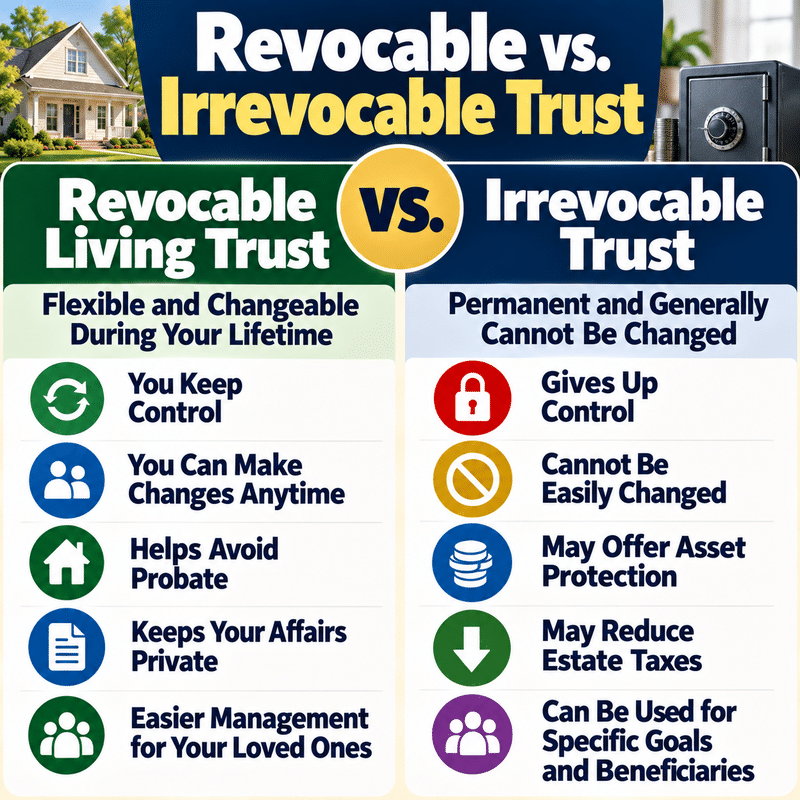
Revocable vs. Irrevocable Living Trusts
Not all living trusts work the same way, and the difference between revocable and irrevocable trusts affects how much control you keep and what the trust can accomplish.
| Feature | Revocable Living Trust | Irrevocable Trust |
|---|---|---|
| Can be changed or cancelled | Generally yes, by the grantor | Generally no, once established |
| Who can serve as trustee | Grantor often serves as trustee | Typically an outside trustee |
| Tax ID used | Grantor’s Social Security number | Trust obtains its own tax ID |
| Asset protection for grantor | Generally does not protect grantor’s assets from grantor’s creditors | May offer different protections depending on structure |
Revocable Living Trusts: Maintaining Control and Flexibility
A revocable living trust is the type most people picture when they hear “living trust.” You retain the ability to amend it, add or remove assets, change beneficiaries, or revoke it entirely, all while typically serving as your own trustee. Income generated by trust assets is reported on your personal tax return, since the IRS generally treats a revocable trust as a grantor trust during your lifetime.
Irrevocable Trusts: Different Rules, Control, and Planning Purposes
An irrevocable trust operates under a different set of rules. Once assets are transferred in and the trust is established, you typically can’t unilaterally change or cancel it, and you generally give up direct control over those assets to an outside trustee. Irrevocable trusts can serve specialized purposes — depending on how they’re structured, they may play a role in certain estate-tax, asset-protection, or Medicaid-planning strategies — but they don’t automatically produce those outcomes just by existing.
Which Type of Trust Is Appropriate for Your Goals?
Most people start their estate plan with a revocable living trust because of the flexibility it offers, and add irrevocable planning tools later only if specific goals call for it. Because this decision depends heavily on individual circumstances, our dedicated Revocable vs. Irrevocable Trust guide goes into much greater depth on how to evaluate which structure fits your situation.
How a Living Trust Actually Works
Understanding the living trust in theory is one thing — understanding the actual mechanics from creation to distribution is what helps you see why implementation matters so much.
Creating the Trust and Establishing Its Instructions
The process starts with drafting the trust document itself, which names the grantor, trustee, successor trustees, and beneficiaries, and spells out how assets should be managed and eventually distributed. This document becomes the rulebook that governs everything that happens afterward.
Transferring and Coordinating Assets With the Trust
Once the trust exists on paper, assets need to actually be moved into it or coordinated with it — a process commonly called “funding.” This step is frequently misunderstood or skipped entirely, and it’s arguably the single most important part of making a living trust functional.
Managing the Trust While You Are Alive
As trustee of your own revocable trust, you manage everything day to day exactly as you did before creating the trust. You can buy or sell property, open or close accounts, and make financial decisions freely, since a revocable trust generally doesn’t restrict your access to your own assets.
How a Successor Trustee Can Step In if You Become Incapacitated
If you become unable to manage your affairs, the trust’s terms typically allow your named successor trustee to step in and manage trust assets on your behalf — paying bills, managing property, and handling financial matters without requiring court intervention.
What the Successor Trustee Does After Your Death
After you pass away, the successor trustee generally takes over full administration of the trust: settling debts, filing final tax returns, and distributing remaining assets according to your instructions. Because this typically happens outside probate court, the process can often move faster than traditional estate administration — though timing still depends on the complexity of the estate and how thoroughly it was funded.
How Beneficiaries Receive Trust Assets
Beneficiaries receive their inheritance according to whatever instructions you built into the trust — whether that’s an outright distribution, staged payments over time, or conditions tied to specific milestones. This is one of the more flexible aspects of a living trust compared to a will.
What Can Go Into a Living Trust?
Not every asset belongs in a living trust, and figuring out what should — and shouldn’t — be transferred is a major part of building an effective estate plan.
Real Estate and Property
Homes, rental properties, and land are commonly transferred into a living trust by preparing and recording a new deed in the trust’s name. This is often one of the more valuable assets people want to keep out of probate.
Bank and Savings Accounts
Checking accounts, savings accounts, money market accounts, and certificates of deposit can typically be retitled in the name of the trust.
| Asset Type | Typically Funded Into Trust? |
|---|---|
| Checking / Savings Accounts | Yes, generally |
| Real Estate | Yes, generally |
| Brokerage / Investment Accounts | Yes, generally |
| Life Insurance / Annuities | Coordinated via beneficiary designation |
| IRAs / 401(k)s / 403(b)s | Generally not retitled directly; requires special handling |
Coordinating these accounts properly with the trust — rather than simply changing beneficiary designations without thought — is part of what makes the funding process worth doing carefully rather than quickly.
Investment and Brokerage Accounts
Non-retirement investment and brokerage accounts, along with individually held stocks and bonds, are commonly retitled into a living trust as part of the funding process.
Business Interests
Ownership interests in a business — whether a sole proprietorship, partnership share, or closely held company — can sometimes be transferred into a trust, though this often requires additional coordination depending on the business’s structure and any existing agreements among owners.
Personal Property and Vehicles
Personal belongings like jewelry, artwork, and collectibles, along with vehicles, can be addressed through a trust, though vehicles are sometimes left out due to state-specific titling and insurance considerations.
Life Insurance, Annuities, and Beneficiary-Designated Assets
Life insurance policies and annuities aren’t typically retitled into the trust directly. Instead, the trust can often be named as a beneficiary (or contingent beneficiary) depending on your goals, which allows these assets to be coordinated with the overall estate plan without changing ownership.
Retirement Accounts Such as IRAs and 401(k)s Require Special Handling
Retirement accounts deserve their own category because they don’t work like other assets.
Traditional IRAs, Roth IRAs, 401(k)s, 403(b)s, and similar retirement plans generally should not simply be retitled into a revocable living trust. These accounts carry specialized ownership, beneficiary, distribution, and tax rules, and moving ownership incorrectly can trigger unintended tax consequences.
Instead of retitling, retirement accounts are usually addressed through careful beneficiary designations — and in some circumstances, a specialized planning tool like an IRA Beneficiary Trust may be appropriate, which we’ll cover in more detail later in this guide.

Funding a Living Trust: The Step You Can’t Afford to Ignore
You can have the most beautifully drafted living trust document in the world, and it still won’t do anything for your family if your assets never actually get transferred into it. This is the single most overlooked part of the entire process, and it’s where a lot of DIY estate plans quietly fail.
What It Means to Fund a Living Trust
Funding simply means taking the legal steps necessary to move ownership of your assets into your trust, or coordinating those assets with the trust through proper beneficiary designations. It’s a separate process from signing the trust document itself, and it typically involves paperwork with banks, county recorder’s offices, investment firms, and insurance companies.
Why Signing the Trust Documents Isn’t Enough
There’s an important distinction between having a living trust document and having a properly implemented estate plan. A signed trust agreement establishes the rules — but those rules only govern the assets that have actually been retitled or coordinated with the trust. Anything left outside the trust may still need to go through probate, regardless of what your trust document says.
Retitling Real Estate, Bank Accounts, and Investment Accounts
For real estate, funding typically means preparing and recording a new deed that transfers the property from your individual name into the name of your trust. For financial accounts — checking, savings, money market, brokerage, and investment accounts — it usually means contacting each institution and completing their specific retitling paperwork. Every institution handles this a little differently, which is part of why this step trips people up.
Coordinating Beneficiary-Designated Assets With Your Estate Plan
Some assets, like life insurance and annuities, aren’t retitled into the trust directly. Instead, they’re coordinated through beneficiary designations that may name the trust as a primary or contingent beneficiary, depending on your goals. Retirement accounts require even more careful coordination, since naming a trust incorrectly as a beneficiary can create unintended tax consequences.
What Can Happen When Assets Are Left Outside the Trust
When assets are accidentally left untitled or unfunded, they generally don’t get the probate-avoidance or incapacity-planning benefits the trust was designed to provide. A pour-over will can act as a backup net to direct those forgotten assets into the trust after death, but that property may still need to pass through probate first — which is exactly the outcome a living trust was meant to prevent. This is one of the biggest reasons Integrated Trust Systems built dedicated funding assistance into its process, rather than simply handing clients a stack of documents and wishing them luck.
The Biggest Benefits of a Living Trust
When a living trust is properly drafted, funded, and maintained, it can offer real, practical advantages that a will alone typically can’t match.
Helping Properly Funded Assets Avoid Probate
Assets that have been correctly transferred into a living trust can generally be administered and distributed without going through the probate court process. This can save time and reduce court-related costs for your family, though the result depends entirely on whether the funding was actually completed.
Keeping More of Your Family’s Financial Affairs Private
Because trust administration typically happens outside of probate, the details of what you owned and who inherited it generally stay out of the public record — unlike a will, which becomes part of the public court file once it’s probated.
Planning for Incapacity Without Giving Up Control Today
A living trust lets you name a successor trustee who can step in and manage your affairs if you become incapacitated, all without needing a court-appointed guardian or conservator. Until that point, you retain full control as your own trustee.
Controlling How and When Beneficiaries Receive Their Inheritance
Rather than distributing everything in one lump sum, a living trust can spell out staged distributions, age-based milestones, or specific conditions tailored to each beneficiary’s situation.
Providing Continuity Through a Successor Trustee
Because a successor trustee is already named in the trust document, there’s typically no gap in who’s authorized to manage your affairs if something happens to you — no waiting on court appointments or probate filings to get someone in charge.
Making Estate Administration Easier for the People You Leave Behind
Families dealing with grief often benefit from a trust administration process that moves faster and involves less court paperwork than formal probate, which can meaningfully reduce stress during an already difficult time.

The Limitations of a Living Trust
A living trust is a powerful tool, but it’s not magic, and it’s important to understand what it can’t do just as clearly as what it can.
A Living Trust Does Not Automatically Keep Every Asset Out of Probate
Creating a living trust doesn’t guarantee that every single asset you own will avoid probate. Only assets that are properly funded into the trust — or otherwise coordinated with it — get that benefit. Anything left in your individual name may still be subject to probate court.
A Revocable Living Trust Generally Does Not Protect Your Assets From Your Own Creditors
This is one of the most misunderstood aspects of living trusts. A standard revocable living trust generally does not shield your own assets from your own creditors, lawsuits, divorce claims, or bankruptcy, because you retain full control and ownership rights over the trust during your lifetime. Specialized asset-protection trust structures exist for these purposes, but they operate under very different rules than an ordinary revocable living trust.
A Revocable Living Trust Does Not Automatically Reduce Your Taxes
Because a revocable living trust is generally treated as a grantor trust for federal income-tax purposes, creating one doesn’t by itself produce any income-tax savings — you continue reporting trust income on your personal tax return exactly as before.
The Trust Must Be Properly Funded and Maintained
A trust that sits unfunded, or one that hasn’t been updated after a major life change, may not function the way you intended. This is why ongoing maintenance deserves just as much attention as the initial creation of the document.
Other Estate-Planning Documents May Still Be Necessary
A living trust typically doesn’t address everything an estate plan needs. Supporting documents like a healthcare power of attorney, financial power of attorney, and pour-over will generally work alongside the trust to create a more complete plan.
Living Trust vs. Will: Why You May Need Both
People often ask whether they need a living trust or a will, but for most complete estate plans, the answer is both — because each document serves a different function.
What a Living Trust Can Do That a Will Cannot
A living trust can address incapacity planning during your lifetime, typically avoids probate for properly funded assets, and keeps administration details private. A will can’t do any of these things, since it only takes legal effect after death and must go through the public probate process.
What a Will Still Does in an Estate Plan
Even with a living trust, a will still plays an important role. It’s typically the only document that can name a guardian for minor children, and it can address any property that wasn’t transferred into the trust.
- Naming a guardian for minor children
- Directing distribution of assets not held in the trust
- Naming an executor to handle remaining probate matters, if needed
Simply put, having a living trust doesn’t mean you never need a will — the two documents are generally designed to work together, not replace each other.
How a Pour-Over Will Works With a Living Trust
A pour-over will is a specific type of will designed to work alongside a living trust. It generally directs that any assets not already titled in the trust’s name at death get transferred, or “poured over,” into the trust.
It’s worth noting that property passing through a pour-over will may still need to go through probate first, since the will itself is subject to the probate process. A pour-over will functions best as a safety net — not as a substitute for properly funding the trust in the first place.
Assets That May Transfer Outside Both a Will and a Living Trust
Some assets pass to beneficiaries automatically, regardless of what your will or trust says. This includes accounts with payable-on-death or transfer-on-death designations, jointly owned property with rights of survivorship, and life insurance or retirement accounts with named beneficiaries. These transfers happen by contract or account structure, independent of probate or trust administration.
Three Ways to Create a Living Trust
Once you understand what a living trust does and why funding matters so much, the next question is practical: how do you actually get one created? There are generally three paths people take.
Option 1: Hire an Estate-Planning Attorney
Working with an estate-planning attorney gives you access to individualized legal advice, customized document drafting, and guidance on complex issues specific to your situation. Attorney fees and service models vary considerably — some provide ongoing support for future updates, while others deliver a completed document set with additional work billed separately depending on their practice. If you’re considering this route, our living trust attorney guide covers what to look for and what questions to ask.
Option 2: Create a Living Trust Yourself
DIY and online document services can offer convenience and lower upfront costs. With this approach, though, more of the responsibility for determining which documents you need, executing them correctly, funding the trust, and keeping everything coordinated typically falls on you.
This doesn’t mean a self-prepared trust is invalid — plenty of people successfully create and fund their own trusts. It just means the implementation work generally isn’t included the way it might be with professional assistance.
For a closer look at what that implementation process actually involves, our step-by-step guide to creating a living trust breaks down each stage in detail.
Option 3: Use the Bulletproof Legacy Digital Estate-Planning System
Bulletproof Legacy, working with Integrated Trust Systems, offers a third approach built around a digital eStatePlan rather than a static paper document. This model is designed to combine professional resources — including attorney review, trust funding assistance, and access to financial and tax professionals — with an online platform you can return to as your life changes.
The real question worth asking isn’t which option is “better” in the abstract. It’s this: do you want a document, or do you want ongoing help creating, funding, and maintaining your entire estate plan?
If you’d like to talk through which approach fits your situation, a free living trust consultation is a low-pressure way to ask questions and get direct answers.

Why Bulletproof Legacy Takes a Different Approach to Living Trusts
Most of the conversation around living trusts stops at the document itself. Bulletproof Legacy, working alongside Integrated Trust Systems, built its entire model around the idea that the document is just the starting line — not the finish line.
Moving Beyond the Traditional Paper “Book Trust”
A traditional estate plan is often delivered as a printed binder or book of documents. That binder sits on a shelf, and unless someone actively pulls it out, reviews it, and updates it, it can quietly become outdated the moment your life changes. Bulletproof Legacy’s approach replaces the static binder with a living, digital plan you can actually interact with.
A Digital eStatePlan You Can Access as Your Life Changes
The Integrated Trust Systems eStatePlan is built as a digital platform rather than a one-time paper product. Instead of mailing in requests or scheduling office visits every time something changes, you can log in and view your documents, track your assets, and see what’s been funded into your trust.
Professional Legal, Tax, Financial, and Trust Resources
Rather than leaving you to figure out complicated questions alone, the system connects you with attorney review, financial resources, tax resources, and trust specialists as part of the overall process — so you’re not navigating retitling questions or beneficiary designations without any professional backup.
Trust Funding Assistance Instead of Stopping at the Documents
This is arguably the most important differentiator. Because funding is where so many DIY and even some traditionally drafted trusts fall short, Integrated Trust Systems builds funding assistance directly into the process, helping clients work through retitling real estate, coordinating accounts, and addressing beneficiary designations.
A Living Trust Designed to Be Maintained, Not Forgotten
Because the plan lives in a digital portal, updating it after a marriage, a move, a new grandchild, or a home purchase doesn’t require starting from scratch. The system is built around the expectation that your plan will need attention over time — not just once at signing.
How the Bulletproof Legacy Living Trust Process Works
Understanding the general flow of the process can help you see how document creation, funding, and maintenance fit together into one continuous system rather than separate, disconnected steps.
1. Start With a Free Living Trust Consultation
The process typically begins with a free living trust consultation, where you can talk through your family situation, assets, and questions before committing to anything.
2. Review Your Family, Assets, and Estate-Planning Goals
From there, the conversation moves into the specifics — who you want to protect, what you own, and what you’re hoping your estate plan accomplishes.
3. Determine Your Trustees, Successor Trustees, and Beneficiaries
You’ll identify who manages the trust today, who steps in if you become incapacitated, and who ultimately receives your assets.
4. Identify the Assets and Accounts That Need to Be Addressed
This step maps out real estate, bank accounts, investments, business interests, and retirement accounts so nothing gets overlooked during funding.
5. Create Your Living Trust and Supporting Estate-Planning Documents
Your revocable living trust and supporting documents are drafted based on the information gathered in the earlier steps.
6. Complete Professional Review and Properly Execute the Documents
Attorney review is included as part of the process, helping confirm the documents are properly prepared and executed according to your state’s requirements.
7. Work With the Funding Team to Implement Your Trust
Trust specialists assist with the practical work of funding — retitling property, coordinating accounts, and addressing beneficiary designations.
8. Access and Maintain Your Estate Plan Through Your Personal Client Portal
Once everything is in place, you retain ongoing access through your personal client portal, so future updates don’t require starting the entire process over.
More Than a Living Trust: The Supporting Estate-Planning Documents
A living trust rarely stands alone in a well-built estate plan. Several supporting documents typically work alongside it to address situations the trust itself doesn’t cover.
Healthcare Power of Attorney
This document lets you name someone to make medical decisions on your behalf if you’re unable to make them yourself.
Financial Power of Attorney
This document authorizes someone to handle financial matters that may fall outside the trust, such as tax filings or dealings with government agencies.
Pour-Over Will
As covered earlier, this document catches any assets that weren’t formally transferred into the trust and directs them there after death.
Assignment of Assets to Trust
This document can help address personal property and certain other assets that don’t require formal retitling through a deed or account transfer.
IRA Beneficiary Trust When Appropriate
For clients with significant retirement account balances, Integrated Trust Systems offers an IRA Beneficiary Trust as a specialized planning option. This isn’t something every client needs — it’s typically considered based on the size of the retirement account and the client’s specific distribution goals.
Other Specialized Planning When Your Circumstances Require It
Blended families, special-needs beneficiaries, business owners, and clients with property in multiple states may need additional planning beyond the standard document set. Professional guidance becomes especially valuable in these situations.

Why Your Living Trust Shouldn’t Be a “Set It and Forget It” Document
An estate plan reflects a snapshot of your life at the moment it was created. As your life moves forward, the plan needs to move with it.
Marriage, Divorce, Births, and Deaths
Each of these events can change who you want managing your trust, who should inherit, and how much control certain beneficiaries should have.
Buying or Selling Real Estate
Every time you buy or sell property, that asset needs to be funded into or removed from the trust — it doesn’t happen automatically.
Changes to Bank, Investment, and Other Financial Accounts
Opening a new account or closing an old one means revisiting how that asset is titled relative to your trust.
Changing Beneficiaries or Successor Trustees
A falling-out with a family member, a successor trustee who’s no longer able to serve, or simply a change of heart all justify updating your trust.
Moving to Another State
Because trust and probate laws vary by state, relocating can be a good reason to have your plan reviewed for continued effectiveness.
Changes in Your Financial Situation or Estate-Planning Goals
An inheritance, a business sale, or simply a shift in what matters most to you can all warrant a fresh look at your existing plan.
Digital Living Trust vs. Traditional Paper Trust
A properly drafted, executed, funded, and maintained trust can work effectively whether it exists on paper or in a digital system — the legal validity isn’t the differentiator. The practical difference shows up in how easily the plan can be accessed and kept current.
How a Traditional “Book Trust” Is Typically Maintained
A paper-based plan generally requires contacting the original attorney’s office, scheduling an appointment, and often paying additional fees any time something needs updating.
How the Integrated Trust Systems eStatePlan Is Maintained
The eStatePlan is built for ongoing digital interaction, giving clients tools to review and address changes without necessarily starting the entire drafting process over.
Accessing Your Estate Plan Through a Personal Client Portal
Through the personal client portal, you can view your documents, review what’s been funded, and stay organized in one central place rather than digging through a filing cabinet.
Making Appropriate Changes as Your Life and Assets Change
Because the system is designed around ongoing access, addressing appropriate updates tends to be a more straightforward part of the process rather than a separate, disconnected event.
The Note Pad System, Postscript Page, E-Vault, and Medical ID Card
Integrated Trust Systems includes several organizational tools designed to support the plan day to day — a Note Pad System for tracking personal notes about your estate, a Postscript Page for recording final wishes, an E-Vault for securely storing important documents digitally, and a Medical ID Card that can provide quick access to key information in an emergency.
Legal, Tax, Financial, and Trust Support in One Estate-Planning System
Estate planning touches legal, tax, financial, and administrative questions all at once — which is why relying on a single resource for every question can leave gaps.
Attorney Review and Legal Resources
Attorney review is built into the Bulletproof Legacy process, helping confirm your documents are properly drafted and executed.
Financial Professionals and Planning Resources
Financial resources are available to help address how your broader financial picture fits into your estate plan.
Tax Professionals and Tax-Planning Resources
Tax resources are available for questions about how trust income, retirement accounts, or larger estates may need specialized attention.
Trust Specialists and Funding Assistance
Trust specialists focus specifically on the funding side of the process — the retitling, coordination, and follow-through that turns a signed document into an actually implemented plan.
Having this kind of dedicated funding support is part of what separates a supported digital estate-planning system from simply downloading a set of forms and being left to interpret them alone.
Why Estate Planning Often Involves More Than Legal Documents
A trust document answers legal questions. But funding decisions, tax considerations, and long-term financial planning often require different expertise entirely — which is why an integrated approach can address more of the full picture than documents alone.
Nevada Trust Options and Living Trust Planning
Bulletproof Legacy materials discuss Nevada trust law as part of its available planning options, and it’s worth understanding what that does and doesn’t mean for a typical client.
Why Nevada Trust Laws May Be Considered
Nevada has developed trust laws that some clients and advisors consider favorable for certain trust administration purposes, depending on individual circumstances.
Privacy and Trust Administration Considerations
Depending on the structure used, Nevada trust administration may offer certain privacy or administrative considerations worth discussing with a professional.
Specialized Nevada Trust Strategies vs. a Standard Revocable Living Trust
It’s important not to confuse a standard revocable living trust with specialized Nevada trust strategies. A few key distinctions include:
- A standard revocable living trust doesn’t automatically gain asset-protection benefits simply because Nevada law is referenced.
- Specialized structures typically require specific trustee arrangements and legal setup beyond a basic revocable trust.
- Applicability depends heavily on your state of residence, the nature of your assets, and your specific planning objectives.
Not every client automatically benefits from Nevada-based planning just because the option exists — it depends on individual facts and goals.
The Crawford Trust Corporate Trustee Option
Integrated Trust Systems also offers the Crawford Trust as a corporate trustee option for clients who prefer professional, third-party trust administration rather than relying solely on an individual family member or friend as successor trustee.
A corporate trustee can provide continuity and objective management, which can be particularly useful in situations involving blended families or potential conflict among beneficiaries.
Why Nevada Planning Is Not Appropriate for Every Estate
Whether Nevada-based trust planning makes sense depends on your residence, your assets, your tax situation, and your overall objectives — it’s not a universal upgrade that applies equally to every client’s plan.

How Much Does a Living Trust Cost?
Living trust costs vary widely, and the initial price tag rarely tells the whole story about what you’re actually getting.
DIY and Online Living Trust Costs
DIY and online document services generally offer the lowest upfront costs, since you’re primarily paying for the documents themselves rather than professional guidance or implementation support.
Traditional Estate-Planning Attorney Costs
Attorney fees vary considerably depending on location, the attorney’s experience, and the complexity of your estate. Fee structures also differ — some attorneys bundle future amendments into their service, while others bill separately for updates down the road.
The Cost of Funding, Updating, and Maintaining a Living Trust
Regardless of which path you choose, funding and future maintenance carry their own time and cost considerations — whether that’s your own time spent retitling accounts, or fees associated with future updates and professional assistance.
Our eState Trust Plan pricing listed in Bulletproof Legacy’s materials is offered at $2,195, with an optional Attorney Review available for $500 and Advisor Team Assistance, Advice and Direction available for $300 — bringing the full listed package to $2,995, plus a $95 annual access fee for ongoing digital access, updates, changes and assitance.
Why the Initial Document Price Doesn’t Tell the Whole Story
A lower upfront price doesn’t necessarily mean lower total cost once you factor in funding assistance, future updates, and professional support. Before comparing prices, it helps to ask:
- What documents are actually included?
- Is attorney review part of the package?
- Is funding assistance provided, or is that entirely on you?
- Is there ongoing digital access, or a one-time delivery?
- What happens — and what does it cost — when you need to make a change later?
These questions often matter more than the sticker price alone.
Comparing the Long-Term Value of Different Living Trust Approaches
The right choice depends on how much support you want beyond the documents themselves. Our living trust cost guide breaks down these comparisons in greater detail if you want to dig deeper into pricing considerations.
Tax Implications of a Living Trust
Tax questions come up constantly with living trusts, and it’s important to have realistic expectations about what a trust does and doesn’t change.
How Revocable Living Trusts Are Generally Treated for Income-Tax Purposes
A revocable living trust is generally treated as a grantor trust for federal income-tax purposes during your lifetime. That means:
- Trust income is typically reported on your personal tax return
- The trust generally uses your own Social Security number as its tax ID
- You continue filing taxes largely the same way you did before creating the trust
In short, creating a revocable living trust doesn’t change your tax filing obligations in any meaningful way during your lifetime.
Why Irrevocable Trust Taxation Can Be Different
Irrevocable trusts, by contrast, often obtain their own separate tax ID and may need to file their own tax returns, depending on how the trust is structured.
Why a Living Trust Should Not Automatically Be Viewed as a Tax-Savings Strategy
A standard revocable living trust doesn’t automatically reduce income taxes or estate taxes. Tax savings, if any, typically come from more specialized planning strategies rather than the basic act of creating a revocable trust.
When Professional Tax Guidance May Be Important
Larger estates, business ownership, or more complicated family situations often benefit from individualized tax advice rather than general assumptions about how a trust affects taxes. This is one of the reasons having access to tax resources as part of an estate-planning system, rather than relying solely on a document template, can add real value.
- Estates approaching applicable estate-tax thresholds
- Clients with significant retirement account balances
- Business owners with complex asset structures
Is a Living Trust Right for You?
A living trust isn’t a one-size-fits-all solution, but it fits a wide range of situations reasonably well.
Homeowners and Real Estate Owners
If you own a home or other real estate, a properly funded trust can help that property transfer to your beneficiaries without a separate probate proceeding for each piece of property.
People Who Want to Plan for Incapacity
If avoiding court-appointed guardianship in the event of incapacity matters to you, a living trust paired with powers of attorney addresses that concern directly.
This combination lets a trusted person step in immediately, without a judge deciding who manages your affairs.
Families Concerned About Probate
If a smoother, more private transfer of assets matters to your family, a properly funded trust is designed to help address that goal.
People Who Want Greater Privacy
If keeping your financial affairs out of the public record is a priority, trust administration generally offers more privacy than probate.
Families With Specific Inheritance Instructions
If you want to control the timing or conditions of an inheritance — rather than a simple lump-sum distribution — a trust gives you that flexibility.
People With Property or Financial Accounts That Need Coordinated Planning
If you own multiple types of assets across different institutions, coordinating everything through one trust can simplify administration considerably.
Situations Where More Specialized Estate Planning May Be Needed
Blended families, special-needs beneficiaries, significant retirement assets, and business ownership often call for planning beyond a standard trust template. In these cases, professional guidance becomes particularly valuable.
Questions to Ask Before Choosing a Living Trust Provider
Choosing how to create your living trust is as important as deciding to create one in the first place. A little due diligence upfront can save considerable headaches later.
| Question | Why It Matters |
|---|---|
| Who reviews the documents? | Confirms accuracy and proper execution |
| Is funding assistance included? | Determines who handles implementation |
| Is there ongoing digital access? | Affects how easily you can update the plan |
| What professional resources are available? | Addresses legal, tax, and financial questions as they arise |
Asking these questions before committing to a provider helps you compare the full scope of service, not just the initial price.
Who Creates and Reviews the Estate-Planning Documents?
Find out whether an attorney reviews your documents and what state-specific requirements are addressed as part of that review.
This matters because improperly executed documents — even well-drafted ones — may not hold up the way you intend.
- Is attorney review included, or offered as an add-on?
- Does the review confirm proper execution according to your state’s requirements?
Will Someone Help You Fund the Trust?
Ask directly whether funding assistance is included, since this is where many self-prepared trusts fall short.
What Happens When Your Assets or Family Situation Change?
Find out what the update process looks like — and whether it requires starting over or simply logging in and making an adjustment.
Can You Access and Maintain Your Estate Plan Online?
Digital access can make ongoing maintenance considerably more manageable than relying solely on physical paperwork stored in a filing cabinet.
Ask whether documents, funding status, and account information are all viewable in one place.
What Professional Support Is Available After the Trust Is Created?
Confirm whether legal, tax, financial, and trust specialists remain accessible after your initial documents are signed — not just during the drafting phase.
| Support Type | What to Ask |
|---|---|
| Legal | Is attorney review ongoing or one-time? |
| Tax | Are tax resources available for complex questions? |
| Funding | Is there dedicated funding assistance staff? |
What Is Included in the Initial Cost and What May Cost Extra Later?
Ask specifically what’s bundled into the initial price versus what may require additional fees down the road, including any annual access charges.
A Living Trust Is Only as Effective as the Plan Behind It
A living trust can be one of the more effective tools available for managing how your assets are handled during incapacity and after death — but only when it’s properly structured, funded, and maintained.
The document creates the rules. Funding puts those rules into action. Maintenance keeps them accurate as your life changes.
Skipping any one of these three components can leave gaps between what you intended and what actually happens.
Creating the Documents Is Only the Beginning
Signing a trust agreement is an important first step, but it’s genuinely just the beginning of the process, not the end.
Funding and Maintaining the Trust Over Time
Properly funding your trust and revisiting it as your circumstances evolve is what determines whether it actually works the way you intended when the time comes.
Start With a Free Bulletproof Legacy Living Trust Consultation
If you’re weighing your options, a free living trust consultation offers a no-pressure way to ask questions specific to your family and assets.
Frequently Asked Questions
A few questions come up consistently when people are first learning about living trusts.
Do I Still Need a Will If I Have a Living Trust?
Yes, most complete estate plans include both. A pour-over will typically works alongside a living trust to catch any assets that weren’t formally transferred, and a will remains the document used to name a guardian for minor children.
Can I Change My Mind After Creating a Revocable Living Trust?
Yes, a revocable living trust can generally be amended or revoked entirely by the grantor at any time, as long as they remain mentally competent to do so.
How Long Does It Take to Set Up a Living Trust?
Document creation itself can often be completed in a matter of weeks, though the full funding process — retitling accounts and property — may take longer depending on how many assets need to be addressed.
Does a Living Trust Avoid Probate?
Properly funded trust assets can generally be administered outside the probate process, but this isn’t automatic or guaranteed for every asset.
Assets left outside the trust, or beneficiary designations that weren’t properly coordinated, may still require probate. Funding is what determines the actual outcome, not the mere existence of the trust document.
Does a Living Trust Protect My Assets From Lawsuits or Creditors?
No, a standard revocable living trust generally does not protect the grantor’s own assets from the grantor’s own creditors, lawsuits, or claims, since the grantor retains full control over the trust during their lifetime.
Does a Living Trust Reduce My Taxes?
No, a revocable living trust is generally treated as a grantor trust for income-tax purposes, meaning it doesn’t create automatic tax savings on its own.
Any potential tax benefits typically come from more specialized planning strategies rather than the basic act of creating a revocable living trust.
- Trust income is reported on your personal return
- The trust doesn’t reduce estate taxes automatically
- Specialized structures, not standard revocable trusts, are typically used for tax-specific goals
What Happens to Assets I Forget to Put in My Trust?
Assets left outside the trust may need to pass through probate, though a pour-over will can help direct those assets into the trust after your death as a backup measure.
Can I Create a Living Trust Without an Attorney?
Yes, DIY and online document services allow you to create a living trust without hiring an attorney, though you’ll generally take on more responsibility for determining which documents you need and properly funding the trust afterward.
Can I Create and Manage a Living Trust Online?
Yes, digital estate-planning platforms like the Integrated Trust Systems eStatePlan allow you to create, access, and maintain your living trust through an online client portal rather than relying solely on physical paperwork.
This kind of ongoing digital access can make it considerably easier to keep your plan current as your life changes.
How Often Should I Review or Update My Living Trust?
It’s generally a good idea to review your living trust after any major life event — marriage, divorce, a new child, a home purchase, or a significant financial change — and periodically even if nothing major has changed, just to confirm everything still reflects your current wishes.
To get personalized answers about your own situation, consider scheduling a free living trust consultation to talk through your questions directly.
Written by Jeffrey Smith · Licensed Insurance Agent and Estate Planning Specialist
Jeffrey Smith is a licensed insurance agent and retirement specialist. He is the Marketing Director of Bulletproof Legacy Financial, based in Medford, Oregon.