Revocable vs. Irrevocable Trust: Which One Is Right for Your Estate Plan?
Compare Control, Flexibility, Probate, Taxes, Asset Protection, and the Key Differences Between These Two Trusts
A revocable trust lets you change your mind whenever you want, while an irrevocable trust locks in most decisions the moment you sign it.
That single distinction—control—shapes almost everything else about how these two trust types work, including who manages the property, whether creditors can reach it, how it’s taxed, and what happens when you pass away. Understanding this difference is one of the most practical things you can do before building an estate plan, and it’s a topic where a knowledgeable resource like Bulletproof Legacy can help clarify which structure actually fits your goals rather than which one simply sounds stronger.
Key Takeaways
- Control is one of the biggest differences between a revocable and irrevocable trust, and it affects flexibility, taxes, and asset protection.
- A revocable living trust generally provides substantially greater flexibility because the grantor can amend, restate, or revoke it.
- Both trust types may keep properly transferred assets outside of probate, but funding the trust correctly is what actually makes that happen.
- A standard revocable living trust generally does not shield assets from creditors or automatically reduce estate or income taxes.
- Certain specialized irrevocable trusts may provide benefits unavailable through a standard revocable trust, but those benefits usually require giving up meaningful control—so the question of which structure fits your life is explored in detail below.
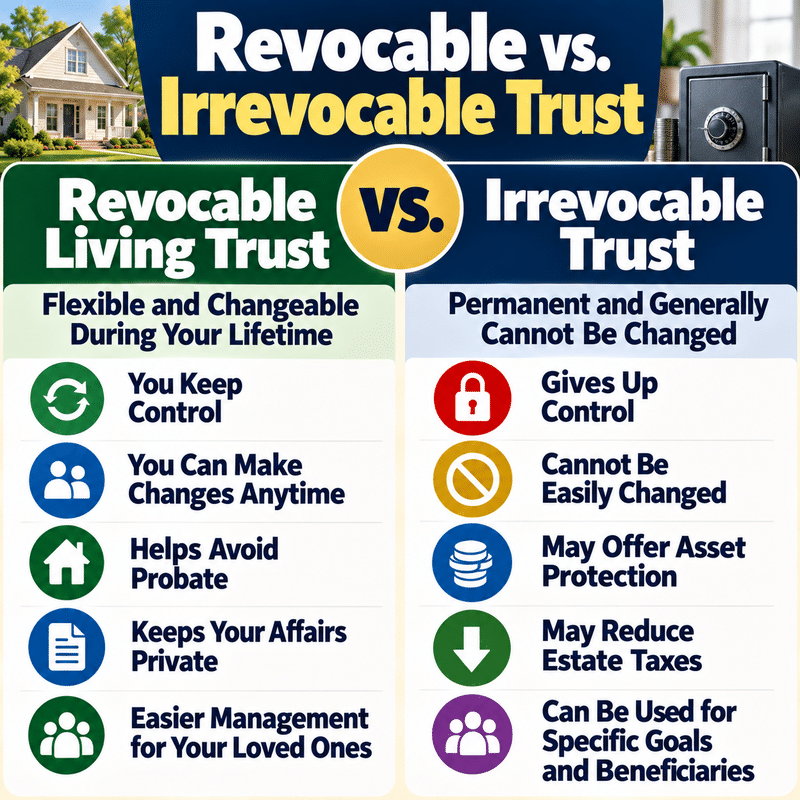
Revocable vs. Irrevocable Trust: What’s the Main Difference?
A revocable trust is a legal arrangement you can change or cancel during your lifetime, as long as you’re mentally competent to do so. An irrevocable trust, once properly created and funded, generally locks in its terms and removes the grantor’s ability to unilaterally take back the assets or rewrite the rules.
Neither structure is automatically “better.” They’re built to solve different problems. A revocable trust is designed around flexibility and control, while an irrevocable trust is often designed around a specific, narrower goal—like reducing estate tax exposure, protecting assets from certain creditors, or qualifying for long-term care benefits—that requires the grantor to give up some rights in exchange for that specialized benefit.
Revocable Trusts Can Generally Be Changed or Revoked
With a revocable living trust, you typically keep the reins. You can add assets, remove assets, swap out beneficiaries, replace a successor trustee, or cancel the entire trust and start over. This is why revocable trusts are sometimes described as “living” documents—they’re meant to grow and shift as your life does.
Depending on the trust’s terms and applicable state law, a grantor may typically be able to:
- Serve as trustee and manage the property directly
- Buy, sell, or refinance property held in the trust
- Add newly acquired assets to the trust
- Remove assets from the trust when appropriate
- Change beneficiaries as family circumstances shift
- Replace a successor trustee
- Amend, restate, or fully revoke the trust
This level of control is part of why revocable trusts remain a popular estate-planning foundation for people whose families, property, and goals are likely to change over time—which, realistically, describes most people.
Irrevocable Trusts Generally Require Giving Up More Control
An irrevocable trust asks for more commitment upfront. Once you transfer an asset into it and the trust is properly established, you typically can’t just take it back or rewrite the rules on your own. The trustee—who is often someone other than the grantor—takes on management responsibility according to the terms you originally set.
Why Control Is the Central Concept
It helps to think of control as a dial rather than a switch. A revocable trust keeps the dial turned toward the grantor: you can adjust nearly anything. An irrevocable trust turns that dial away from the grantor and toward the trust’s terms, the trustee, or the beneficiaries. That shift isn’t a flaw—it’s often the very mechanism that allows certain specialized benefits, like asset protection or Medicaid eligibility, to exist in the first place. Simply labeling a document “irrevocable,” though, doesn’t automatically create those benefits; the actual transfer of rights and control has to be genuine and properly structured.
Quick Comparison: Revocable vs. Irrevocable Trust
| Category | Revocable Trust | Irrevocable Trust |
|---|---|---|
| Control | Grantor generally retains substantial control | Grantor generally gives up significant control |
| Ability to amend | Typically yes, per trust terms and state law | Typically limited or restricted |
| Ability to revoke | Typically yes, during grantor’s lifetime | Typically no, absent specific mechanisms |
| Common trustee | Often the grantor, then a successor | Often someone other than the grantor |
| Probate considerations | May help properly funded assets avoid probate | May help properly funded assets avoid probate |
| Incapacity planning | Commonly used for this purpose | Not typically its primary purpose |
| Estate-tax considerations | Assets generally remain in taxable estate | May remove assets from taxable estate, depending on structure |
| Creditor considerations | Generally no protection from grantor’s own creditors | May offer protection, depending on structure and state law |
| Medicaid considerations | Assets generally remain countable | May be used in specialized Medicaid planning, depending on timing and structure |
| Complexity | Generally more straightforward | Generally more complex |
| Typical uses | Control, flexibility, incapacity and probate planning | Specialized tax, asset-protection, or Medicaid objectives |
What Is a Revocable Living Trust?
A revocable living trust is a legal document you create during your lifetime that holds title to your property for your benefit, with instructions for what happens to that property if you become incapacitated or pass away. “Living” simply means it takes effect while you’re alive, as opposed to a will, which only takes effect at death.
Because it’s revocable, you retain the right to change or cancel it at any point while you have legal capacity. This makes it one of the more adaptable tools available in estate planning, and it’s why so many people use it as the foundation of a broader plan.
How a Revocable Living Trust Works
You (the grantor) create the trust document, name yourself as trustee, and name a successor trustee to take over later. Then you transfer, or “fund,” ownership of appropriate assets—like your home, bank accounts, or investment accounts—into the name of the trust.
While you’re alive and competent, you generally continue using and managing those assets exactly as you did before. The trust doesn’t change your day-to-day life; it changes who legally holds title and what happens to that property if you can’t manage it yourself or after you die.
Your successor trustee only steps in if you become incapacitated or pass away, following the instructions you wrote into the trust document.
The Grantor Can Usually Serve as Trustee
One of the more practical features of a revocable living trust is that you can typically name yourself as the initial trustee. That means you don’t hand management of your assets over to anyone else while you’re capable of handling them yourself.
Maintaining Control of Trust Assets
Because you’re both the grantor and the trustee in most revocable trust arrangements, you keep full authority over how the property is used. You can sell a house held in the trust, close a bank account, open a new investment account in the trust’s name, or make any other ordinary financial decision—generally without needing anyone else’s permission.
This is a meaningful difference from an irrevocable trust, where those same decisions often require action by a separate trustee, and sometimes consent from beneficiaries or a court.
Changing the Trust During Your Lifetime
Life doesn’t stand still, and a revocable trust is built with that reality in mind. If a beneficiary needs to be added, removed, or have their share adjusted, the trust document generally allows for that through a formal amendment. The same goes for updating a successor trustee, changing distribution instructions, or adjusting which assets are titled in the trust’s name.
These changes still have to follow the trust’s own amendment procedures and any applicable state law—flexibility doesn’t mean informality. A properly executed amendment, not a verbal update or an unsigned note, is what actually modifies the trust’s terms.
Revoking the Trust
If your circumstances change dramatically—say, you want to start over with an entirely new estate plan—a revocable trust generally allows for full revocation. Once revoked, the trust no longer exists, and any assets titled in its name typically need to be retitled back into your individual name or into a new trust.
This option gives grantors a kind of safety valve: nothing about a revocable trust is permanent until you decide it is, or until your death makes it irrevocable by operation of law.
Naming a Successor Trustee
Every revocable living trust should name at least one successor trustee—someone who steps in if you become incapacitated or when you pass away. This person (or institution) takes on responsibility for managing and eventually distributing trust assets according to your instructions.
Because you can change this designation at any point while the trust remains revocable, you’re not locked into a decision made years earlier if your relationship with that person changes or if they’re no longer able to serve.
What Happens to a Revocable Trust at Death
A revocable trust generally becomes irrevocable the moment the grantor dies. That’s because the one person with the legal authority to amend or revoke it is no longer living to exercise that authority. From that point forward, the successor trustee steps in and administers the trust according to its written terms and applicable law—identifying trust property, paying valid debts and expenses, communicating with beneficiaries, and eventually making distributions or continuing to hold assets in further trust, depending on what the document says.

What Is an Irrevocable Trust?
An irrevocable trust is a legal arrangement where the grantor transfers assets out of their own name and generally gives up the right to unilaterally take them back or rewrite the trust’s terms. In exchange for that surrendered control, an irrevocable trust can sometimes accomplish specialized goals that a revocable trust typically can’t—like removing assets from a taxable estate or supporting certain asset-protection or Medicaid strategies.
It’s worth remembering that “irrevocable trust” isn’t one single product. It’s a category that includes many different trust types, each built for a different purpose, with different trustees, different beneficiary rights, and different tax treatment.
How an Irrevocable Trust Works
The grantor creates the trust document, names a trustee (often someone other than themselves), and transfers ownership of specific assets into the trust’s name. Once that transfer is complete and the trust is properly structured, the grantor generally no longer owns those assets in the eyes of the law—the trust does.
Why the Grantor Generally Gives Up More Control
This loss of control isn’t incidental; it’s often the entire point. Many of the benefits associated with irrevocable trusts—like keeping assets out of a taxable estate or protecting them from certain creditor claims—depend on the grantor genuinely no longer controlling or owning those assets. If a grantor retained too much control, the law may treat the assets as still belonging to the grantor, which can undercut the very benefit the trust was designed to achieve.
The Role of the Trustee
Because the grantor typically isn’t managing the assets directly, the trustee’s role becomes more significant in an irrevocable trust. This person or institution is responsible for managing property, following the trust’s distribution instructions, and acting in the best interests of the beneficiaries.
Depending on the type of irrevocable trust, the trustee might be a family member, a professional fiduciary, or a corporate trustee. The right choice often depends on the complexity of the assets involved and the specific purpose of the trust.
Why Irrevocable Trusts Are Used for Specialized Planning
Because irrevocable trusts involve more restrictions, they’re typically not the default choice for basic estate planning. Instead, they tend to show up when someone has a specific, well-defined objective—like providing for a special-needs beneficiary without jeopardizing government benefits, holding a life insurance policy outside the taxable estate, or structuring long-term-care planning years in advance of needing care.
What Happens to an Irrevocable Trust Over Time
Unlike a revocable trust, which becomes irrevocable at the grantor’s death, an irrevocable trust is already irrevocable from the start—so death doesn’t necessarily change its status. What happens next depends entirely on the trust’s own terms. Some irrevocable trusts terminate and distribute assets outright after the grantor’s death; others continue for years or even generations, particularly dynasty trusts or trusts designed for special-needs beneficiaries.
Revocable vs. Irrevocable Trust at a Glance
Before going deeper into taxes, probate, and specific asset types, it helps to step back and compare these two structures side by side across the categories that matter most to everyday estate planning.
Control of Assets
A revocable trust generally keeps control with the grantor. An irrevocable trust generally shifts meaningful control to the trustee and the terms of the document itself.
Ability to Make Changes
Revocable trusts are typically amendable through a formal process outlined in the trust document. Irrevocable trusts are typically much more restricted, though “restricted” doesn’t mean “impossible”—certain mechanisms can still allow modification depending on the trust and state law.
| Modification Method | Available to Revocable Trusts | Available to Irrevocable Trusts (Depending on Terms/State Law) |
|---|---|---|
| Grantor amendment | Typically yes | Typically no |
| Full revocation | Typically yes | Typically no |
| Trustee-held powers | Not usually necessary | Sometimes, if granted in the document |
| Beneficiary consent | Not usually necessary | Sometimes, depending on state law |
| Court modification | Rarely necessary | Sometimes available |
| Decanting or nonjudicial settlement | Rarely necessary | Sometimes available, depending on state |
Ability to Revoke the Trust
Revocation is one of the defining features that separates these two structures. A revocable trust can generally be revoked entirely by the grantor. An irrevocable trust generally cannot be revoked outright by the grantor alone, though certain state-law mechanisms may allow termination under specific circumstances.
Probate Considerations
Both trust types can potentially help assets avoid the probate process—but only if those assets are properly transferred into the trust’s name during the grantor’s lifetime. The trust label alone doesn’t avoid probate; funding does.
Incapacity Planning
Revocable living trusts are commonly built with incapacity in mind, since the grantor can name a successor trustee who steps in seamlessly if the grantor becomes unable to manage their own affairs. Irrevocable trusts aren’t typically designed around this purpose, since the grantor usually isn’t serving as trustee in the first place.
Estate-Tax Considerations
Assets in a standard revocable living trust are generally still counted as part of the grantor’s taxable estate. Certain irrevocable trusts may be structured to remove assets from that taxable estate, but this outcome depends heavily on how the trust is drafted and how assets are transferred—it’s not automatic just because the word “irrevocable” appears in the title.
Income-Tax Considerations
A standard revocable living trust is generally treated as a grantor trust for federal income-tax purposes, meaning the grantor continues reporting trust income on their own personal tax return. Irrevocable trusts can be classified differently—sometimes as grantor trusts, sometimes as separate taxpayers entirely—and the correct classification affects how income gets reported and taxed.
Creditor and Asset-Protection Considerations
| Trust Type | Protection From Grantor’s Own Creditors |
|---|---|
| Standard Revocable Living Trust | Generally no protection, since the grantor retains control and ownership |
| Properly Structured Irrevocable Trust | May provide protection depending on trust structure, state law, timing, and type of claim |
Asset protection through an irrevocable trust isn’t guaranteed just because the trust exists. Results can depend on how the trust is structured, what rights (if any) the grantor retained, applicable state law, the timing of the transfer relative to any existing claims, and fraudulent-transfer rules that can unwind transfers made to dodge a known creditor.
This is an area where the specifics matter enormously, and generic advice can be misleading. A transfer made years before any creditor issue arises looks very different, legally, than one made after a lawsuit has already been filed.
Medicaid and Long-Term-Care Planning
A standard revocable living trust generally doesn’t remove assets from consideration for Medicaid eligibility purposes, since the grantor still owns and controls them. Certain irrevocable trusts may play a role in long-term-care planning, but eligibility rules, look-back periods, and state-specific requirements make this a highly specialized area that typically benefits from elder-law guidance rather than generic planning.
Complexity
Revocable living trusts are generally more straightforward to create, understand, and maintain. Irrevocable trusts tend to involve more complexity—both in the initial drafting and in ongoing administration—because of the specialized goals they’re built to accomplish.
That complexity often shows up in several forms:
- More detailed drafting to accomplish a specific tax or protection objective
- Separate tax identification numbers and tax filings in many cases
- Trustee responsibilities that go beyond simple asset management
- Coordination with insurance policies, business agreements, or government benefit programs
- Ongoing recordkeeping to preserve the trust’s intended tax or legal treatment
Professional Assistance
Both trust types can benefit from professional guidance, but irrevocable trusts more frequently require input from living trust attorneys with specialized experience in tax law, asset protection, or elder law, given how easily a poorly structured irrevocable trust can fail to accomplish its intended purpose.
Cost
Costs for either structure can vary widely based on complexity, the number of specialized provisions needed, and how much attorney involvement is required. Revocable living trusts are often less expensive to draft, precisely because they don’t usually require the specialized tax or asset-protection engineering that many irrevocable trusts do.
Irrevocable trusts, on the other hand, can involve higher upfront legal fees, ongoing trustee fees, separate tax preparation, and periodic reviews to make sure the trust continues to serve its original purpose as laws and circumstances change.
Living trusts costs also vary widely based on how much of the work is completed by the client, on their own and how much is completed by the attorney or living trust service providing the guidance. Any work done on the client-based side is usually for part of the funding process.
Ongoing Administration
A revocable trust’s administration during the grantor’s lifetime is often minimal, since the grantor is typically managing everything directly as trustee. An irrevocable trust usually requires more formal administration from the start, since a separate trustee is managing the assets and must follow the trust’s terms carefully to preserve its intended benefits.
Common Uses
Revocable living trusts are commonly used for control, flexibility, incapacity planning, and helping properly funded assets avoid probate. Irrevocable trusts are commonly used for specialized objectives like estate-tax planning, certain asset-protection strategies, Medicaid planning, life insurance ownership, special-needs planning, and charitable giving strategies.

Who Controls the Assets in a Revocable Trust?
In most revocable living trust arrangements, the grantor keeps the driver’s seat.
The Grantor’s Role
The grantor creates the trust, funds it with property, and typically continues managing that property personally. Nothing about daily life usually changes—you still write checks, sell property, or make investment decisions the same way you always have.
The difference is largely on paper: instead of holding title as “John Smith,” you hold title as “John Smith, Trustee of the John Smith Revocable Living Trust.”
Serving as Your Own Trustee
Because most grantors name themselves as the initial trustee, there’s no loss of day-to-day authority. You can still deposit a paycheck, pay bills from a trust-owned bank account, or refinance a trust-owned home, generally without needing anyone else’s sign-off.
Buying, Selling, and Managing Trust Assets
As trustee of your own revocable trust, you typically retain full authority to buy new property in the trust’s name, sell existing trust property, or reinvest proceeds as you see fit. This is functionally similar to managing your own individual assets—just under a different legal title.
Adding and Removing Appropriate Assets
Life doesn’t stop once a trust is created. You can generally continue adding newly acquired property to the trust and removing property you no longer want held there, provided you follow the appropriate transfer steps, like updating a deed or retitling an account.
Changing Trustees and Beneficiaries
If your relationship with a named successor trustee changes, or if a beneficiary’s circumstances shift, a revocable trust generally allows you to update those designations through a proper amendment. This kind of adjustment is one of the most commonly used features of a revocable trust, particularly as families grow, shrink, or change through marriage, divorce, births, and deaths.
Why Retaining Control Appeals to Many Families
For many households, control isn’t just a legal concept—it’s peace of mind. Knowing you can update your plan without starting from scratch, without court involvement, and without anyone else’s approval tends to make the entire estate-planning process feel less permanent and intimidating. That flexibility becomes especially valuable as families change over the years through new marriages, additional children or grandchildren, changing finances, and shifting priorities.
Who Controls the Assets in an Irrevocable Trust?
Control in an irrevocable trust generally shifts away from the grantor and toward the trustee and the terms of the trust document itself.
Transferring Assets to the Trust
Once a grantor transfers an asset into a properly structured irrevocable trust, that asset is typically no longer considered the grantor’s property. This transfer has to be genuine—not just a change in paperwork while the grantor continues acting as though they still personally own the asset.
The Trustee’s Role
The trustee, who is often someone other than the grantor, becomes responsible for managing trust property according to its terms. This might involve investing funds, making distributions to beneficiaries, filing tax returns, and keeping detailed records of trust activity.
Depending on the type of irrevocable trust, the trustee’s authority and responsibilities can vary quite a bit—an Irrevocable Life Insurance Trust trustee has very different duties than a trustee overseeing a Special Needs Trust, for example.
Limits on the Grantor’s Control
Depending on the trust’s structure, a grantor may retain certain limited rights—like the ability to receive income, or the power to substitute assets of equal value—without necessarily undermining the trust’s intended purpose. But broad control, like the unrestricted ability to take property back or change beneficiaries at will, is generally inconsistent with a properly structured irrevocable trust.
Why Giving Up Control Can Produce Different Legal Results
This surrendered control is often exactly what allows an irrevocable trust to accomplish specialized goals. If a grantor could freely take assets back whenever they wanted, courts and tax authorities may still treat those assets as belonging to the grantor for estate-tax, creditor, or Medicaid purposes—defeating the trust’s intended benefit.
Why the Exact Terms of the Trust Matter
No two irrevocable trusts are automatically alike. The specific powers retained (or not retained) by the grantor, the rights given to beneficiaries, and the authority granted to the trustee can all vary significantly from one trust to the next—which is why irrevocable trust drafting tends to require careful, individualized legal attention rather than a one-size-fits-all template.

Can You Change a Revocable Living Trust?
Yes, generally—a revocable living trust is specifically designed to allow changes, as long as the grantor follows the trust’s own amendment procedures and applicable state law.
Adding or Removing Beneficiaries
Whether a new grandchild arrives, a relationship ends, or priorities shift, a revocable trust typically allows the grantor to update who receives what. This is usually accomplished through a written amendment rather than an informal note or verbal instruction.
Changing Successor Trustees
If a previously named successor trustee is no longer the right fit—due to a falling out, a move, health issues, or simply a change of heart—a revocable trust generally allows the grantor to name someone new through a proper amendment.
Changing Distribution Instructions
Instructions about how and when beneficiaries receive trust property—whether as an outright distribution, staggered payments over time, or held in further trust until a certain age—can typically be updated as the grantor’s goals evolve. A revocable trust doesn’t lock in these instructions permanently; it simply provides a framework that can be adjusted as life circumstances change.
Adding or Removing Appropriate Assets
Beyond beneficiaries and trustees, the property itself can typically be adjusted too. If you sell a home held in the trust and buy a new one, you can generally title the new property in the trust’s name. If you decide an asset no longer belongs in the trust—maybe you’re gifting it directly to a family member during your lifetime—you can typically remove it through the appropriate transfer process.
Amending the Trust
An amendment is a formal, written change to specific provisions of the trust without rewriting the entire document. This is the most common way grantors update beneficiaries, trustees, or distribution terms over the years.
Most revocable trust documents include specific language describing how amendments must be executed—often requiring a signed and sometimes notarized document that clearly references the original trust. Skipping these formalities, even with good intentions, can create confusion or even invalidate the intended change.
Restating the Trust
Sometimes a single amendment isn’t enough. If a grantor wants to overhaul large portions of the trust—updating multiple beneficiaries, restructuring distribution schemes, or changing successor trustee provisions all at once—a restatement may make more sense.
A restatement essentially replaces the entire body of the trust document while keeping the original trust’s name, date, and funding intact. This can be cleaner than stacking multiple amendments on top of each other, which sometimes gets confusing for whoever administers the trust later.
Revoking the Trust Completely
If a grantor decides they no longer want the trust to exist at all, most revocable trusts allow for full revocation. This might happen if someone moves to a state with different planning needs, remarries and wants to start fresh, or simply changes their overall estate-planning approach.
Revocation isn’t the same as simply forgetting about a trust. A formal revocation typically requires a written document, and any assets titled in the trust’s name generally need to be retitled back into the grantor’s individual name or transferred into a newly created trust.
Because revocation undoes the trust’s legal existence, it’s not usually something done casually. Most grantors who revoke a trust are doing so to replace it with an updated one, not simply to eliminate a trust and leave assets untitled.
Why Flexibility Matters Over a Lifetime
An estate plan created in your thirties may not fit your life in your sixties. Marriages happen, and sometimes end. Children grow up, and grandchildren arrive. Wealth can grow or shrink. People move across state lines. A revocable trust’s built-in flexibility means the plan can move with you instead of becoming outdated the moment your life changes.
Can You Change an Irrevocable Trust?
Yes, but the process is generally more limited and more involved than amending a revocable trust—and exactly what’s possible depends heavily on the specific trust document and the state law governing it.
It’s a common misconception that “irrevocable” means “frozen forever, no exceptions.” That’s an oversimplification. While these trusts are absolutely built to be more restrictive than revocable trusts, several legal mechanisms may still allow changes under the right circumstances.
Why “Irrevocable” Does Not Always Mean Absolutely Unchangeable
The word “irrevocable” specifically refers to the grantor’s inability to unilaterally cancel or rewrite the trust whenever they please—not necessarily to a total ban on any modification whatsoever. Depending on how the trust was drafted and what state law allows, there can be legitimate paths toward adjusting certain terms.
This distinction matters because families sometimes avoid irrevocable trusts out of fear that any mistake or changed circumstance becomes permanently unfixable. In reality, many states have developed statutory tools specifically designed to address outdated or impractical irrevocable trust terms.
That said, these mechanisms tend to be narrower and more procedural than simply signing an amendment, which is exactly why irrevocable trusts require more thoughtful drafting from the outset.
| Modification Mechanism | What It Generally Involves |
|---|---|
| Powers in the trust document | Specific authority the grantor built into the trust allowing limited changes |
| Trustee discretion | Authority given to the trustee to adjust certain administrative terms |
| Beneficiary consent | Agreement among beneficiaries to modify certain provisions, where state law allows |
| Court modification | Judicial approval of a change, often based on changed circumstances |
| Decanting | Pouring assets from an existing irrevocable trust into a new trust with updated terms |
| Nonjudicial settlement agreement | Agreement among interested parties to resolve or modify trust terms without going to court, where permitted by state law |
Changes Permitted by the Trust Document
A well-drafted irrevocable trust often anticipates that circumstances will change, even if the grantor can’t personally make adjustments later. Attorneys sometimes build in limited flexibility—like giving a trustee discretion over distribution timing, or allowing a trust protector to make certain administrative updates.
These built-in provisions don’t undo the trust’s fundamentally irrevocable nature. They simply acknowledge that rigid, permanent instructions written decades earlier may not always serve beneficiaries well, so a bit of structured flexibility gets baked in from day one.
Not every irrevocable trust includes these provisions, though. Older trusts, or those drafted without this kind of foresight, may offer far less room to adjust.
Beneficiary Consent
In some states, all beneficiaries (and sometimes the trustee) can agree to modify certain trust terms without court involvement, particularly if the change doesn’t conflict with the trust’s core purpose. This process, often formalized through a nonjudicial settlement agreement, can be faster and less expensive than going to court—but availability and requirements vary significantly by state.
Trustee Powers
Depending on how the trust is written, a trustee may hold specific powers to adjust administrative details—like changing how often distributions occur, or how trust assets are invested—without needing to touch the trust’s fundamental terms. These powers are typically narrower than a full modification and are usually spelled out explicitly in the trust document itself.
Court Modification
When beneficiary consent isn’t available or the desired change is more significant, a court petition may be necessary. Courts generally look at whether the requested modification aligns with the grantor’s original intent, whether circumstances have changed substantially, and whether the change serves the beneficiaries’ best interests.
Court modification isn’t automatically required for every irrevocable trust change, though it’s sometimes the only path available for more substantial revisions—particularly when beneficiaries disagree or when the trust document doesn’t include built-in flexibility.
Decanting and Other State-Law Mechanisms
Decanting allows a trustee, in states that permit it, to “pour” assets from an existing irrevocable trust into a newly created trust with updated terms—similar to pouring wine from one container into another, leaving sediment behind. This can be used to fix outdated administrative provisions, update trustee succession plans, or even adjust certain distribution terms, depending on state law and the scope of the trustee’s decanting authority.
Not every state allows decanting, and among those that do, the specific rules about what can and can’t be changed vary considerably. This is very much a state-specific tool rather than a universal fix.
Example: A trust drafted twenty years ago named a corporate trustee that has since gone out of business. Rather than leaving the trust without a functioning trustee, a decanting statute in the relevant state may allow the current trustee to transfer assets into a new trust naming a different corporate trustee, while preserving the original trust’s core purpose.
Nonjudicial settlement agreements offer another state-specific option, allowing interested parties to resolve certain trust questions or make adjustments by written agreement rather than litigation, provided the change doesn’t violate a material purpose of the trust.
Why Changing an Irrevocable Trust Can Be More Complicated
Even when a legal mechanism exists, using it typically takes more time, cost, and coordination than amending a revocable trust. Multiple parties may need to agree, court filings may be required, and any change has to be carefully evaluated to make sure it doesn’t accidentally undo the tax or asset-protection benefits the trust was originally created to achieve.
Why Professional Legal Guidance May Be Necessary
Given how much these rules vary by state, and how easily a poorly executed modification can create unintended tax consequences, working with an attorney experienced in irrevocable trust modification is generally a wise move rather than an optional extra. This is an area where guessing, or relying on generic online information, can create expensive problems down the road.

Revocable vs. Irrevocable Trust for Probate Avoidance
Both trust types can potentially help assets bypass the probate process—but neither one does so automatically just by existing on paper.
Can a Revocable Living Trust Avoid Probate?
Yes, when properly funded. Assets titled in the name of a revocable living trust generally pass to beneficiaries according to the trust’s terms without going through probate court, since the trust—not the deceased individual—technically owns the property.
Can an Irrevocable Trust Avoid Probate?
Yes, the same general principle applies. Assets properly transferred into an irrevocable trust are typically no longer part of the grantor’s individually owned estate, so they generally avoid probate as well.
This is one area where both trust types function similarly, even though they differ dramatically in terms of control and flexibility.
Why Trust Funding Matters More Than the Label
A trust—revocable or irrevocable—only controls assets that are actually titled in its name. An unfunded trust is often little more than an expensive piece of paper sitting in a drawer.
This is arguably one of the most overlooked aspects of trust-based estate planning. People sometimes assume that simply signing a trust document automatically protects all of their property from probate. In reality, each asset—the house, the bank account, the investment portfolio—has to be individually retitled or otherwise transferred into the trust’s name.
A perfectly drafted revocable living trust that’s never actually funded may fail to accomplish its intended probate-avoidance purpose, because any assets left in the grantor’s individual name at death typically still have to pass through probate.
This is exactly why trust funding assistance matters so much in a complete estate plan—it’s not enough to create the document; someone has to make sure the right assets actually end up titled correctly.
What Happens to Assets Left Outside the Trust
Any asset that isn’t properly transferred into the trust—whether revocable or irrevocable—generally remains part of the individual’s probate estate at death. This can include forgotten bank accounts, newly purchased property that was never retitled, or assets acquired after the trust was created but never added.
Pour-Over Wills and Remaining Assets
Many trust-based estate plans include a pour-over will as a backup. This type of will generally directs any assets left outside the trust at death to “pour over” into the trust, where they’re then distributed according to the trust’s terms. It’s a safety net, not a substitute for proper funding—assets that pass through a pour-over will still typically go through probate first before reaching the trust.
Privacy Compared With Probate
Probate proceedings generally create a public court record, meaning anyone can potentially look up what assets were involved and who received them. Trust administration, by contrast, typically happens privately, without the same level of public court involvement.
This added privacy is one of the practical benefits many families associate with trust-based planning, whether the trust is revocable or irrevocable—though it’s worth noting that privacy isn’t the same as absolute secrecy, and certain trust information may still become relevant in specific legal contexts.
Revocable vs. Irrevocable Trust for Incapacity Planning
Incapacity planning is an area where these two trust types tend to diverge significantly, largely because of who typically serves as trustee.
A revocable living trust is often specifically structured to provide a smooth transition of asset management if the grantor becomes unable to handle their own affairs—something that’s less central to how most irrevocable trusts function, since the grantor usually isn’t managing those assets in the first place.
How a Successor Trustee Can Step In
Because the grantor commonly serves as the initial trustee of a revocable trust, the document can include specific provisions describing how and when a successor trustee takes over if the grantor becomes incapacitated—often based on a physician’s written determination or another agreed-upon standard.
This built-in mechanism can allow bill-paying, property management, and financial decision-making to continue without interruption, without necessarily requiring a court-supervised guardianship or conservatorship proceeding.
Example: A grantor suffers a stroke and can no longer manage her finances. Because her revocable living trust names her daughter as successor trustee upon a doctor’s written certification of incapacity, the daughter can step in immediately to pay bills, manage investments, and handle property—without needing court approval for a guardianship.
This kind of continuity is one of the most practical, real-world benefits families experience from a properly funded revocable living trust.
Maintaining Management of Trust Assets
Because the successor trustee already has legal authority under the trust document, there’s typically no gap in who can access accounts, pay bills, or manage property. This can be a meaningful advantage compared to relying solely on a will, since a will provides no mechanism at all for managing assets during incapacity—it only takes effect at death.
Why Revocable Living Trusts Are Commonly Used for Incapacity Planning
This built-in successor trustee structure is a major reason revocable living trusts are so frequently recommended as an incapacity-planning tool, separate from their probate-avoidance benefits. Families often value knowing there’s already a clear, pre-established plan for who takes over financial management if the unexpected happens.
Why Powers of Attorney and Healthcare Documents Still Matter
A living trust, however, doesn’t cover everything. It generally only addresses assets actually titled in the trust’s name—not medical decisions, and not assets that were never transferred into the trust. That’s why a complete incapacity plan typically still includes a financial power of attorney, a healthcare power of attorney, and often a HIPAA authorization allowing designated people to access medical information.
These documents work alongside the trust, not instead of it, filling in gaps the trust alone can’t address.
Revocable vs. Irrevocable Trust for Estate Taxes
Taxes are often one of the primary reasons people consider an irrevocable trust in the first place—but it’s also an area where misunderstandings run especially deep.
- A standard revocable living trust generally does not remove assets from the grantor’s taxable estate.
- Certain specialized irrevocable trusts may be used for estate-tax planning purposes.
- Simply labeling a trust “irrevocable” does not automatically produce estate-tax savings.
Results depend heavily on how the trust is structured, what rights the grantor retained (if any), and current tax law—which can change over time.
Because estate-tax exemption amounts and rules are set by federal law and can be adjusted by future legislation, this article intentionally avoids anchoring its explanations to a specific dollar threshold that may no longer apply by the time you’re reading this.
What stays constant, though, is the underlying principle: control and ownership drive tax treatment, not the trust’s label.
Are Revocable Trust Assets Still Part of Your Taxable Estate?
Yes, generally. Since the grantor of a revocable living trust retains the ability to revoke it and reclaim the assets at any time, tax law generally continues to treat those assets as belonging to the grantor for estate-tax purposes—even though the property is technically titled in the trust’s name.
This is precisely why a revocable living trust shouldn’t be marketed or understood as an automatic estate-tax reduction strategy. Its primary value lies elsewhere—in control, flexibility, incapacity planning, and probate planning—not in shrinking a taxable estate.
Can an Irrevocable Trust Remove Assets From a Taxable Estate?
Potentially, yes—but only when the trust is properly structured and the grantor has genuinely given up the kind of control or retained interest that would otherwise cause the assets to be pulled back into the taxable estate. Certain irrevocable trusts, like an Irrevocable Life Insurance Trust, are specifically designed with this goal in mind.
The specific drafting matters enormously here. A poorly structured irrevocable trust that retains too much grantor control can fail to accomplish its estate-tax goal, even though it’s technically labeled irrevocable.
Why Transferring an Asset Does Not Automatically Eliminate Estate Taxes
It’s a common misconception that simply moving an asset into any irrevocable trust automatically shields it from estate tax. That’s not how it works. The outcome depends on several interconnected factors that a court or tax authority will examine closely.
These factors commonly include:
- Whether the grantor retained any right to income, use, or possession of the asset
- Whether the grantor retained any power to control who ultimately benefits from the trust
- How much time has passed between the transfer and the grantor’s death, in certain contexts like life insurance trusts
- Whether gift-tax rules applied at the time of the original transfer
- Whether the trust’s terms comply with current tax code requirements for the specific benefit being sought
Because these rules intersect in complicated ways, a generic irrevocable trust template downloaded online is unlikely to reliably achieve a specific estate-tax outcome without individualized legal review.
Federal Estate-Tax Considerations
Federal estate tax applies to estates above a certain exemption threshold, and that threshold has changed multiple times over the years based on legislation. Rather than citing a specific number that may be outdated by the time you read this, the more useful takeaway is that estate-tax exposure depends on your total estate value relative to whatever exemption applies at the time of death—which is why periodic estate-plan reviews matter, even for plans built around irrevocable trusts.
Example: A family creates an irrevocable trust years ago when estate-tax exemptions were lower, believing it was necessary to avoid estate tax. Years later, exemption amounts increase substantially, and the family’s estate no longer approaches the taxable threshold. Without a periodic review, they may not realize their planning objectives—and the tradeoffs they accepted—may no longer align with current tax law.
This example illustrates why “set it and forget it” isn’t really appropriate advice for either trust type, but it’s especially relevant for irrevocable trusts, since the restrictions accepted to achieve a tax benefit remain in place even if the underlying tax law changes.
State Estate and Inheritance Taxes
Beyond federal estate tax, some states impose their own estate or inheritance taxes, often with much lower exemption thresholds than the federal system. This means a family that isn’t concerned about federal estate tax may still need to think carefully about state-level tax exposure, depending on where they live or own property.
State rules vary considerably, and what works well in one state’s tax structure may produce a different outcome in another—another reason state-specific legal guidance matters for anyone seriously considering irrevocable estate-tax planning.
Why Specialized Tax Planning Requires Professional Guidance
Estate-tax planning through irrevocable trusts sits at the intersection of trust law, federal tax code, and sometimes state tax law—three areas that change independently of each other and interact in complicated ways. A qualified estate-planning attorney, often working alongside a tax professional, can help evaluate whether a specific irrevocable strategy actually fits a family’s financial picture.
This is also an area where a broader estate-planning system—one that connects a family’s foundational revocable trust with access to professional resources—can help identify when it might be time to have that specialized conversation, rather than leaving families to guess on their own.
For families just beginning to explore these questions, scheduling a free living trust consultation can be a practical first step toward understanding which parts of an estate plan may benefit from a revocable trust foundation, and which parts might warrant a deeper conversation about specialized irrevocable planning.

Revocable vs. Irrevocable Trust for Income Taxes
Income tax treatment is another area where these two trust types can diverge, though the specific outcome always depends on the exact trust structure involved.
How Revocable Trust Income Is Commonly Taxed During the Grantor’s Lifetime
A standard revocable living trust is generally treated as a “grantor trust” for federal income-tax purposes while the grantor is alive. This means the trust itself typically doesn’t file a separate tax return; instead, income generated by trust assets—interest, dividends, capital gains—is generally reported directly on the grantor’s personal income tax return, using the grantor’s own Social Security number.
In practical terms, this means creating a revocable living trust generally doesn’t change how you file your taxes during your lifetime. There’s no separate trust tax return to worry about, and no automatic income-tax savings to expect either.
Why Irrevocable Trust Tax Treatment Can Be Different
Irrevocable trusts don’t all follow the same tax rules. Depending on how the trust is structured, it might still be treated as a grantor trust for income-tax purposes (meaning income flows back to the grantor’s personal return), or it might be treated as a separate taxpayer entirely, filing its own tax return and potentially paying tax at trust income-tax rates.
Grantor vs. Non-Grantor Trusts
A grantor trust, whether revocable or irrevocable, is one where the grantor retains enough control or benefit that tax law continues attributing the trust’s income to the grantor personally. A non-grantor trust, by contrast, is treated as its own separate taxpayer, generally filing an independent tax return and potentially facing compressed tax brackets that reach higher rates at much lower income levels than individual tax brackets.
This distinction matters enormously for irrevocable trust planning, since non-grantor trust tax rates can sometimes result in higher taxes on retained trust income compared to what an individual might pay on the same income.
Why Irrevocable Trusts Can Have Different Tax Filing Requirements
A non-grantor irrevocable trust typically needs its own taxpayer identification number and generally must file its own annual tax return, separate from the grantor’s personal filing. This adds an administrative layer that simply doesn’t exist with a standard revocable living trust during the grantor’s lifetime.
Why “Irrevocable” Does Not Automatically Mean “Tax Savings”
It bears repeating: creating an irrevocable trust doesn’t automatically produce favorable income-tax treatment. Depending on the specific structure, an irrevocable trust could end up facing less favorable income-tax treatment than if the same income had simply been reported on the grantor’s individual return. The tax outcome always depends on the specific trust language, the type of income involved, and current tax law—not on the mere fact that the word “irrevocable” appears in the trust’s title.
Revocable vs. Irrevocable Trust for Asset Protection
Asset protection is one of the most frequently searched—and most frequently misunderstood—topics in this entire comparison.
The short version: a standard revocable living trust generally does not shield your assets from your own creditors. Certain properly structured irrevocable trusts may offer protection in some circumstances, but that protection is never automatic or guaranteed simply because the trust is labeled irrevocable.
Why a Standard Revocable Living Trust Generally Does Not Protect Your Assets From Your Own Creditors
Because the grantor of a revocable trust retains the ability to revoke it and reclaim the assets, courts generally treat those assets as still belonging to the grantor for creditor purposes. If you could face a lawsuit today and empty out your trust tomorrow, creditors would have essentially no way to reach assets held in any revocable trust—which is exactly why the law doesn’t allow this kind of protection through a revocable structure.
When Certain Irrevocable Trusts May Provide Asset-Protection Benefits
Because a properly structured irrevocable trust involves the grantor genuinely giving up ownership and control, certain types—like specific domestic asset-protection trusts recognized in some states, or trusts created for the benefit of someone other than the grantor—may offer creditor protection in appropriate circumstances.
Why Simply Calling a Trust “Irrevocable” Does Not Guarantee Protection
Asset protection through an irrevocable trust isn’t automatic just because the document uses that word. Courts examine the actual substance of the arrangement—what rights the grantor retained, how the trust was administered, and whether the transfer was made in good faith—rather than simply taking the trust’s label at face value.
State Law, Trust Structure, Timing, and Control
Several variables interact to determine whether an irrevocable trust actually provides meaningful asset protection:
- Which state’s law governs the trust, since asset-protection trust statutes vary significantly from state to state
- Whether the grantor retained any beneficial interest or control that undermines the protection
- How much time has passed between funding the trust and any creditor claim arising
- What type of creditor or claim is involved, since some claims (like certain support obligations) may not be blocked even by a well-structured trust
Fraudulent Transfer Considerations
Transferring assets into any trust after a creditor claim already exists—or in anticipation of one—can be challenged under fraudulent-transfer laws, potentially unwinding the transfer entirely regardless of how the trust is structured. Asset-protection planning generally needs to happen well before any claim arises to have a reasonable chance of holding up.
Why Asset Protection Requires Specialized Planning
Given how many variables affect the outcome, asset-protection planning through an irrevocable trust is not a do-it-yourself project. It typically requires an attorney with specific experience in this niche area of law, familiar with the relevant state statutes and how courts in that state have historically treated similar trust structures.
Families exploring asset protection often benefit from starting with a solid revocable living trust foundation for their broader estate plan, then bringing in specialized counsel separately for the specific asset-protection strategy—rather than trying to force one document to accomplish both goals at once.

Revocable vs. Irrevocable Trust for Medicaid and Long-Term-Care Planning
Medicaid planning brings its own specific rules, and this is an area where inaccurate advice circulating online can cause real financial harm if followed without professional guidance.
The core principle remains consistent with everything discussed so far: control determines outcome. Assets you can still access or direct are generally still counted against you for Medicaid eligibility purposes, regardless of what container they’re sitting in.
Why Revocable Trust Assets Are Generally Still Available to the Grantor
Since a revocable trust grantor retains the ability to revoke the trust and reclaim its assets, those assets generally remain countable resources for Medicaid eligibility purposes. Placing assets in a revocable living trust does not, on its own, help someone qualify for Medicaid long-term-care benefits.
How Certain Irrevocable Trusts May Be Used in Medicaid Planning
Certain irrevocable trusts, sometimes called Medicaid Asset Protection Trusts, may be used as part of a longer-term planning strategy, provided the grantor genuinely gives up direct access to trust principal in the way state Medicaid rules require. Even then, the specific terms of the trust—how income and principal can be distributed, and to whom—matter enormously.
Medicaid Look-Back Rules
Medicaid imposes a look-back period, during which any transfers made for less than fair value—including transfers into certain irrevocable trusts—can trigger a penalty period of ineligibility. This look-back period is measured in years, not weeks, which means Medicaid-related irrevocable trust planning generally needs to happen well in advance of when long-term care is actually needed.
Waiting until a health crisis is already underway to explore this kind of trust planning often significantly limits what options remain available.
Why Last-Minute Transfers Can Create Problems
Transferring a home or other significant asset into an irrevocable trust shortly before applying for Medicaid can trigger the exact penalty period the strategy was meant to avoid, potentially leaving a family without benefits during a critical stretch of time.
Example: A parent transfers their home into an irrevocable trust eight months before applying for Medicaid nursing-home benefits. Because this falls within the standard look-back period, the transfer may trigger a penalty period during which Medicaid won’t cover care costs—even though the home is now technically outside the parent’s name.
This example underscores why blanket statements like “put your house in an irrevocable trust and Medicaid can’t touch it” are misleading. Timing, structure, and state-specific rules all play a role in whether this strategy actually works as intended.
State-Specific Medicaid Rules
Medicaid is a joint federal-state program, and while certain baseline rules apply nationally, many important details—including specific eligibility thresholds, treatment of certain trust structures, and estate recovery rules—vary from state to state. A strategy that works well in one state may not translate directly to another.
Because of this complexity, Medicaid and long-term-care planning involving irrevocable trusts is an area where working with an elder-law attorney familiar with your specific state’s rules tends to matter more than almost any other type of trust planning discussed in this article.
Why Elder-Law Guidance Is Important
Medicaid rules sit at the intersection of federal law, state law, and constantly evolving agency guidance, which makes this one of the few areas of estate planning where generic advice genuinely isn’t good enough. An elder-law attorney who regularly handles Medicaid applications in your specific state can evaluate whether an irrevocable trust actually fits your timeline, your assets, and your family’s care needs.
This is also an area where a revocable living trust can still play a supporting role, even if it isn’t the primary Medicaid-planning tool. Many families use a revocable trust to organize their overall estate plan and handle incapacity, while bringing in specialized elder-law counsel separately if Medicaid planning becomes a genuine concern down the road.
- Medicaid eligibility rules vary by state and change periodically
- Look-back periods generally apply to irrevocable trust transfers
- Timing matters enormously—waiting until a crisis begins often limits available options
- A revocable trust generally does not, by itself, help someone qualify for Medicaid
No article can substitute for a conversation with a qualified elder-law professional familiar with your state’s specific Medicaid rules and your family’s actual circumstances.
Revocable vs. Irrevocable Trust for Real Estate
Real estate is often the single largest asset in someone’s estate, which makes it a natural focal point when comparing these two trust types.
For most families, a home fits comfortably into a revocable living trust, since the grantor typically wants to keep living in it, maintaining it, and having full authority to sell or refinance it without asking anyone’s permission.
Irrevocable ownership of real estate introduces a different set of considerations entirely—ones that touch on everything from homestead protections to mortgage terms to property tax treatment, depending on the state where the property sits.
Example: A married couple owns a family home worth a significant portion of their overall estate. They transfer it into their revocable living trust, continue living there exactly as before, and retain full ability to sell it, refinance it, or remove it from the trust later if their plans change. Years later, if they decide Medicaid planning becomes relevant, they can explore a separate irrevocable strategy for the home specifically—without having disrupted their original revocable trust plan.
Holding a Home in a Revocable Living Trust
Transferring a home into a revocable living trust typically involves executing and recording a new deed that shows the trust as the owner, rather than the individual grantor. This process is generally referred to as trust funding, and it’s a critical step—simply creating the trust document doesn’t accomplish anything for real estate until the deed itself is updated.
Because the grantor usually serves as trustee, day-to-day life doesn’t change. You still live in the home, pay the mortgage, handle maintenance, and make all the same decisions you always have.
Many families are surprised to learn how straightforward this step actually is, though it does require correctly prepared and recorded documentation—which is exactly where trust funding assistance becomes valuable rather than optional.
- A new deed transferring the property from the individual to the trust
- Proper recording with the relevant county or municipal office
- Notification to the mortgage lender, if a mortgage exists
- Confirmation that homeowner’s insurance still provides appropriate coverage
Skipping any of these steps can leave a gap between what the trust document says and what actually happened with the property—exactly the kind of gap that can undermine probate-avoidance goals.
Maintaining Control of Your Property
Because the home remains under the grantor’s control as trustee, nothing about ownership feels different in daily life. You can still make home improvements, take out a home equity line, or list the property for sale whenever you choose.
This retained control is one of the biggest reasons families choose a revocable trust for their primary residence rather than jumping straight to an irrevocable structure, which would generally require giving up this same level of control.
Buying and Selling Property
If you sell a home held in a revocable trust, the transaction generally proceeds much like any other sale, with the trustee (usually you) signing as the seller. Proceeds can then be reinvested into a new property, also titled in the trust’s name, or used for other purposes entirely.
Transferring Real Estate to an Irrevocable Trust
Moving real estate into an irrevocable trust is a more significant step, since the grantor generally gives up direct ownership and control once the transfer is complete. Depending on the trust’s purpose—estate-tax planning, asset protection, or Medicaid planning—the specific structure and restrictions can look quite different.
For Medicaid-related irrevocable trusts specifically, the grantor often retains the right to continue living in the home, even though they no longer own it outright, provided the trust is properly structured according to state-specific rules.
Why Mortgages, Taxes, Insurance, and State Law Matter
Transferring real estate into any trust can trigger practical questions that deserve attention before signing anything.
- Some mortgage agreements include due-on-sale clauses that could theoretically be triggered by a transfer, though many lenders accommodate transfers to revocable trusts under federal law
- Property tax reassessment rules vary by state and can sometimes be affected by ownership changes
- Homeowner’s insurance policies may need to be updated to reflect the trust as an additional insured or titled owner
- Homestead exemption and creditor-protection rules attached to a primary residence can be affected differently depending on whether the property sits in a revocable or irrevocable trust
None of these considerations are reasons to avoid trust-based planning altogether, but they are reasons to work with professionals who can confirm the transfer is handled correctly for your specific property and state.
This is precisely the kind of detail that trust funding assistance is designed to catch—confirming that a deed transfer doesn’t accidentally create an insurance gap or an unexpected tax consequence.
Property in Multiple States
If you own real estate in more than one state—a vacation home, a rental property, or land inherited from family—a revocable living trust can be particularly useful for avoiding multiple, separate probate proceedings in each state where property is located. Without a trust, out-of-state real estate often requires an additional probate process (sometimes called ancillary probate) in each state where it sits.
Properly funding a revocable trust with out-of-state property can consolidate what would otherwise be several separate court proceedings into a single, private trust administration process.

Revocable vs. Irrevocable Trust for Retirement Accounts
Retirement accounts deserve their own careful conversation, separate from how real estate or bank accounts are typically handled.
Unlike a bank account or a home, a 401(k), traditional IRA, Roth IRA, or 403(b) generally shouldn’t simply be retitled into either a revocable or irrevocable trust. These accounts operate under specific tax rules tied to individual ownership, and retitling them incorrectly can trigger unintended and sometimes significant tax consequences.
Why Retirement Accounts Require Special Treatment
Retirement accounts are tax-advantaged specifically because they’re owned by an individual person, not a trust. Moving a retirement account directly into a trust’s name can potentially trigger immediate income-tax consequences, effectively undoing the tax deferral the account was designed to provide.
This is one of the clearest examples in all of estate planning where good intentions can backfire if the wrong step is taken without professional guidance.
Beneficiary Designations vs. Retitling Accounts
Instead of retitling a retirement account into a trust, the more common and generally appropriate approach involves updating the account’s beneficiary designation. This form, kept on file with the account custodian, determines who receives the account after the owner’s death—separate from whatever the will or trust document says.
Because beneficiary designations generally override instructions written in a will or even a trust, keeping these forms current is just as important as updating the trust itself.
Naming a Trust as Beneficiary
In certain circumstances, naming a trust as the beneficiary of a retirement account can make sense—particularly when a beneficiary is a minor, has special needs, or when the account owner wants more control over how and when distributions happen after death. This is sometimes accomplished through a specifically drafted IRA beneficiary trust designed to meet the technical requirements retirement account rules impose on trust beneficiaries.
Tax and Distribution Considerations
Naming a trust as beneficiary of a retirement account can affect how quickly the account must be distributed after the owner’s death, potentially accelerating tax obligations for the beneficiaries if the trust isn’t drafted to meet specific technical requirements. These rules have changed over the years and continue to evolve, making this a particularly important area to review with a professional rather than assume based on outdated general information.
Why Retirement Assets Need Individualized Planning
Because the tax rules governing retirement accounts are detailed, specific, and prone to periodic legislative changes, this is an area where working with a financial or tax professional alongside your estate-planning attorney tends to produce better results than a generic, one-size-fits-all approach. What works for one family’s IRA might create problems for another family’s 401(k), depending on the beneficiaries involved and the specific account rules that apply.
Revocable vs. Irrevocable Trust for Business Owners
Business interests add another layer of complexity to trust planning, particularly when ownership involves more than one person or is governed by a formal operating agreement.
Holding Business Interests in a Revocable Trust
Many business owners transfer their ownership interest—whether shares of stock, an LLC membership interest, or a partnership interest—into their revocable living trust as part of their overall estate plan. This can help the business interest avoid probate while still allowing the owner to manage the business exactly as before, since they typically remain in control as trustee.
Business Succession Planning
A revocable trust can also help outline what happens to a business interest if the owner becomes incapacitated or passes away—naming a successor trustee who steps into management, or directing that the interest be sold, transferred to a co-owner, or passed to specific family members according to the owner’s wishes.
When Irrevocable Strategies May Be Considered
For larger or more complex business interests, certain irrevocable strategies—like a Grantor Retained Annuity Trust or a specialized succession trust—may be considered as part of a broader plan to transfer business value to the next generation while addressing estate-tax or gift-tax considerations. These strategies tend to involve significant complexity and are generally reserved for situations where the potential benefit clearly justifies the added restrictions.
Operating Agreements and Transfer Restrictions
Not every business interest can simply be transferred into a trust without checking the underlying governing documents first. Many LLC operating agreements, partnership agreements, or corporate bylaws include specific restrictions on who can hold an ownership interest, sometimes requiring consent from other owners before a transfer—including a transfer into a trust—can take place.
Ignoring these restrictions can create real problems, from technically violating the operating agreement to triggering rights of first refusal held by other owners. Reviewing the governing documents before attempting any transfer is an essential step that’s easy to overlook.
Why Business Planning May Require Additional Professionals
Business succession planning often benefits from input beyond just an estate-planning attorney—business attorneys, accountants, and sometimes valuation professionals may all play a role in structuring a transfer that protects both the business and the family’s broader estate plan.
What Happens to a Revocable Trust When You Die?
Death is the point where a revocable trust’s flexible nature comes to an end, and its terms become fixed.
The Trust Generally Becomes Irrevocable
Once the grantor dies, the trust generally becomes irrevocable, since the person who held the authority to amend or revoke it is no longer alive to exercise that power. From that moment forward, the trust’s terms are locked in exactly as the grantor last left them.
This is worth pausing on, because it highlights an important truth: every revocable trust eventually becomes irrevocable. The real question was never whether a trust becomes irrevocable—it’s when, and under whose control the transition happens.
The Successor Trustee Takes Over
The successor trustee named in the trust document steps into the role previously held by the grantor, taking on legal responsibility for managing and eventually distributing trust assets according to the trust’s written terms.
This transition is generally far less cumbersome than starting a probate proceeding from scratch, since the successor trustee already has a legal roadmap to follow, along with documentation showing what assets the trust holds.
Depending on the trust’s terms, the successor trustee’s job might be relatively quick—distributing assets outright to beneficiaries within months—or it might extend for years, particularly if the trust continues holding assets in further trust for young beneficiaries or beneficiaries with special needs.
Example: A grantor’s revocable trust names an adult daughter as successor trustee. After the grantor’s death, the daughter gathers the trust’s bank statements and property deeds, pays the final utility bills and funeral expenses from trust funds, files the final personal income-tax return, and then distributes the remaining assets to the beneficiaries named in the trust—all without needing to open a probate case for properly funded assets.
Paying Expenses and Obligations
Before distributing anything to beneficiaries, the successor trustee generally needs to identify and pay any valid debts, final expenses, and taxes owed by the grantor or the estate. This might include funeral costs, medical bills, outstanding loans, or final income-tax obligations.
Only after these obligations are addressed does it typically make sense to move forward with distributing the remaining trust assets according to the grantor’s instructions.
Distributing or Continuing to Hold Assets
Depending on the trust’s specific terms, the successor trustee might distribute assets to beneficiaries immediately, or continue holding certain assets in trust for a period of time—common when beneficiaries are minors, when the grantor wanted distributions staggered over specific ages or milestones, or when a beneficiary has special needs that require ongoing trust management rather than an outright distribution.
Why Proper Funding Before Death Matters
All of this smooth administration depends entirely on the trust having been properly funded during the grantor’s lifetime. Any asset left outside the trust at death generally still requires probate, regardless of how well the trust document itself was drafted—reinforcing why funding assistance is such a critical part of a complete estate plan, not an optional add-on.
What Happens to an Irrevocable Trust When You Die?
Unlike a revocable trust, an irrevocable trust doesn’t necessarily change status when the grantor dies—it was already irrevocable from the moment it was properly created and funded.
Why the Answer Depends on the Trust Terms
What actually happens after the grantor’s death depends entirely on why the trust was created and what instructions it contains. Some irrevocable trusts are designed to terminate shortly after the grantor’s death, distributing assets outright to beneficiaries. Others are built to continue for years, sometimes generations, depending on their specific purpose.
An Irrevocable Life Insurance Trust, for example, often springs into more active use precisely at the grantor’s death, since that’s when the life insurance proceeds are typically paid to the trust and then distributed or managed according to its terms.
- Some irrevocable trusts terminate and distribute assets outright after the grantor’s death
- Some continue holding assets for a surviving spouse or minor children
- Special Needs Trusts often continue for the lifetime of the beneficiary, regardless of when the grantor dies
- Dynasty or generation-skipping trusts may continue for multiple generations by design
This variability is a good reminder that irrevocable trusts aren’t a single, uniform category—each one is built around its own specific purpose, and that purpose dictates what happens after the grantor passes away.
Trustee Administration
The trustee named in the irrevocable trust—often someone other than the grantor from the very beginning—generally continues (or begins more actively) managing trust assets after the grantor’s death, following whatever instructions the trust document contains.
Because this trustee typically has experience managing the trust already, the transition after the grantor’s death is often less disruptive than it might be for a first-time trustee stepping into an unfamiliar role.
Continuing Trusts for Beneficiaries
Certain irrevocable trusts are specifically designed to continue providing for a beneficiary well beyond the grantor’s death—most notably Special Needs Trusts, which often need to remain in place for the beneficiary’s entire lifetime to preserve eligibility for government benefits programs.
Distribution Provisions
Distribution instructions in an irrevocable trust can range from simple (distribute everything outright after the grantor’s death) to highly detailed (distribute income only, preserve principal, or distribute specific percentages at specific ages). These provisions were generally locked in when the trust was created, which is exactly why thoughtful, individualized drafting matters so much upfront.
Tax and Reporting Considerations
Depending on how the irrevocable trust was structured, the grantor’s death may trigger specific tax reporting obligations—like a final return for a grantor trust that converts to a non-grantor trust, or specific estate-tax filings if the trust was designed to hold life insurance or other assets outside the taxable estate. These obligations vary enough by trust type that working with a tax professional after the grantor’s death is often a necessary step, not an optional one.
Benefits of a Revocable Living Trust
Having walked through probate, incapacity, taxes, asset protection, Medicaid, real estate, retirement accounts, and business interests, it’s worth stepping back to summarize why a revocable living trust functions as such a practical foundation for so many estate plans.
Maintain Control of Your Assets
You generally retain full control over trust assets throughout your lifetime, serving as your own trustee and making decisions exactly as you did before creating the trust.
Change the Trust as Life Changes
Marriages happen. Divorces happen. Children are born, grandchildren arrive, relationships shift, and financial circumstances change. A revocable trust generally allows you to update beneficiaries, successor trustees, and distribution instructions as these life events unfold, rather than locking you into decisions made years or decades earlier.
- Add a new grandchild as a beneficiary
- Remove a beneficiary after a falling out or a change in circumstances
- Replace a successor trustee who’s no longer the right fit
- Adjust distribution timing or amounts as family needs evolve
This built-in adaptability is arguably the single biggest reason revocable trusts remain such a popular estate-planning foundation across so many different family situations.
Replace Trustees and Beneficiaries
Beyond simple additions or removals, a revocable trust generally allows for wholesale changes to trustee and beneficiary structures through a formal restatement, if your overall plan needs a more significant overhaul rather than a minor tweak.
Plan for Incapacity
Because the trust already names a successor trustee, incapacity planning is built directly into the structure—allowing continued asset management without necessarily requiring a court-supervised guardianship proceeding.
Help Properly Funded Assets Avoid Probate
Assets correctly titled in the trust’s name generally bypass the public probate process, passing instead according to the trust’s private terms.
This benefit depends entirely on proper funding, which is exactly why ongoing attention to newly acquired assets matters just as much as the initial trust creation.
Maintain Greater Privacy Than Probate
Trust administration typically happens outside the public court system, unlike probate, which generally creates a public record accessible to anyone curious enough to look.
While this offers meaningful privacy advantages for many families, it’s worth remembering that privacy isn’t the same as absolute secrecy—certain circumstances can still bring trust details into public view, particularly if disputes arise among beneficiaries.
Create Instructions for Asset Distribution
A revocable trust lets you spell out exactly how and when beneficiaries receive their inheritance—whether outright immediately, staggered over specific ages, or held in further trust for beneficiaries who need more structured support.
Coordinate a Broader Estate Plan
A revocable living trust typically works alongside other essential documents—a pour-over will, financial power of attorney, healthcare power of attorney, and HIPAA authorization—creating a coordinated plan rather than a single document trying to accomplish everything on its own.
Limitations of a Revocable Living Trust
For all its flexibility, a standard revocable living trust isn’t a magic solution, and being upfront about its limitations is just as important as celebrating its benefits.
Understanding these limitations helps set realistic expectations from the start, rather than discovering gaps in the plan at the worst possible moment.
- Does not automatically protect assets from the grantor’s own creditors
- Does not automatically reduce estate taxes
- Does not automatically reduce income taxes
- Does not automatically help someone qualify for Medicaid
- Requires proper funding to accomplish probate-avoidance goals
- Does not replace every other estate-planning document
- Requires ongoing maintenance as life and assets change
Generally No Asset Protection From Your Own Creditors
Because the grantor retains full control and the ability to revoke the trust, courts generally treat trust assets as still belonging to the grantor for creditor purposes. Anyone hoping a revocable trust alone will shield assets from a lawsuit or judgment is likely to be disappointed.
This isn’t a flaw in the trust—it’s simply a natural consequence of the same control and flexibility that make revocable trusts so useful in other respects.
Generally No Automatic Estate-Tax Reduction
Since assets in a standard revocable trust remain part of the grantor’s taxable estate, this structure alone doesn’t reduce estate-tax exposure. Families with significant estate-tax concerns generally need to look toward specialized irrevocable strategies, developed with professional guidance, to address this specific goal.
This is precisely why a revocable trust and specialized tax planning aren’t mutually exclusive—many families use a revocable trust as the foundation while layering in targeted irrevocable strategies where genuinely needed.
The Trust Must Be Properly Funded
A revocable trust document that never gets funded generally fails to accomplish its probate-avoidance purpose, no matter how well-drafted the language is. Ongoing attention to newly acquired assets—new bank accounts, refinanced property, new investment accounts—is essential to keeping the trust effective over time.
Some Assets Require Special Handling
Retirement accounts, certain life insurance policies, vehicles, and a handful of other asset types generally shouldn’t simply be retitled into a revocable trust without careful consideration of beneficiary designations and specific tax rules that apply to those particular assets.
The Estate Plan Still Needs Maintenance
A trust created and then forgotten for twenty years risks becoming outdated—naming trustees who’ve since passed away, beneficiaries who no longer reflect the family’s current relationships, or excluding assets acquired long after the original signing. Periodic review keeps the plan aligned with actual, current circumstances.
A Living Trust Does Not Replace Every Estate-Planning Document
Financial powers of attorney, healthcare powers of attorney, and advance healthcare directives all continue playing essential roles that a living trust simply doesn’t cover. A complete estate plan generally includes these supporting documents alongside the trust itself, not instead of it.
Benefits of an Irrevocable Trust
None of this diminishes the genuine value irrevocable trusts can provide when the underlying objective actually calls for one.
Potential Estate-Tax Planning
Certain irrevocable trusts, properly structured and funded, may help remove specific assets from a taxable estate—particularly useful for families whose overall estate value approaches or exceeds applicable exemption thresholds. An Irrevocable Life Insurance Trust, for instance, is specifically designed to keep life insurance proceeds outside the taxable estate when structured and maintained correctly.
This benefit depends entirely on proper structuring and ongoing compliance with tax rules—it’s not something that happens automatically just because the trust exists.
Certain Asset-Protection Strategies
Properly structured irrevocable trusts, created well before any creditor issue arises and consistent with applicable state law, may provide meaningful asset-protection benefits for individuals in higher-liability professions or specific financial circumstances.
Medicaid and Long-Term-Care Planning in Appropriate Circumstances
For families thinking years ahead about potential long-term-care needs, certain irrevocable Medicaid-planning trusts may help structure assets in a way that supports future eligibility—provided the transfer happens well outside the applicable look-back period and follows state-specific requirements precisely.
Beyond taxes, asset protection, and Medicaid, specialized irrevocable trusts also serve important roles in special-needs planning, charitable giving, and multigenerational wealth transfer—each representing a distinct objective that a standard revocable trust typically isn’t built to accomplish on its own.
The overarching lesson across all of these specialized uses is consistent: irrevocable trusts aren’t inherently better or worse than revocable trusts—they’re simply built for different jobs. The right approach depends entirely on what problem you’re actually trying to solve, how much control you’re comfortable giving up, and how much complexity you’re prepared to take on in exchange for a specific, targeted benefit.
For many families, though, the starting point remains the same: a properly funded, well-maintained revocable living trust that provides control, flexibility, incapacity planning, and probate planning—with specialized irrevocable strategies added later, if and when a specific need genuinely arises. Bulletproof Legacy’s digital eStatePlan approach reflects exactly this philosophy, combining a flexible revocable living trust with attorney review, trust funding assistance, and a Personal Client Portal designed to keep your plan connected to your life as it changes.