When Pricing Trust Services, It Is Extremely Important To Compare Apples To Apples
There Are Three Important Factors To Consider: The Costs Of Creating The Trust, Funding The Trust, And Maintaining The Trust
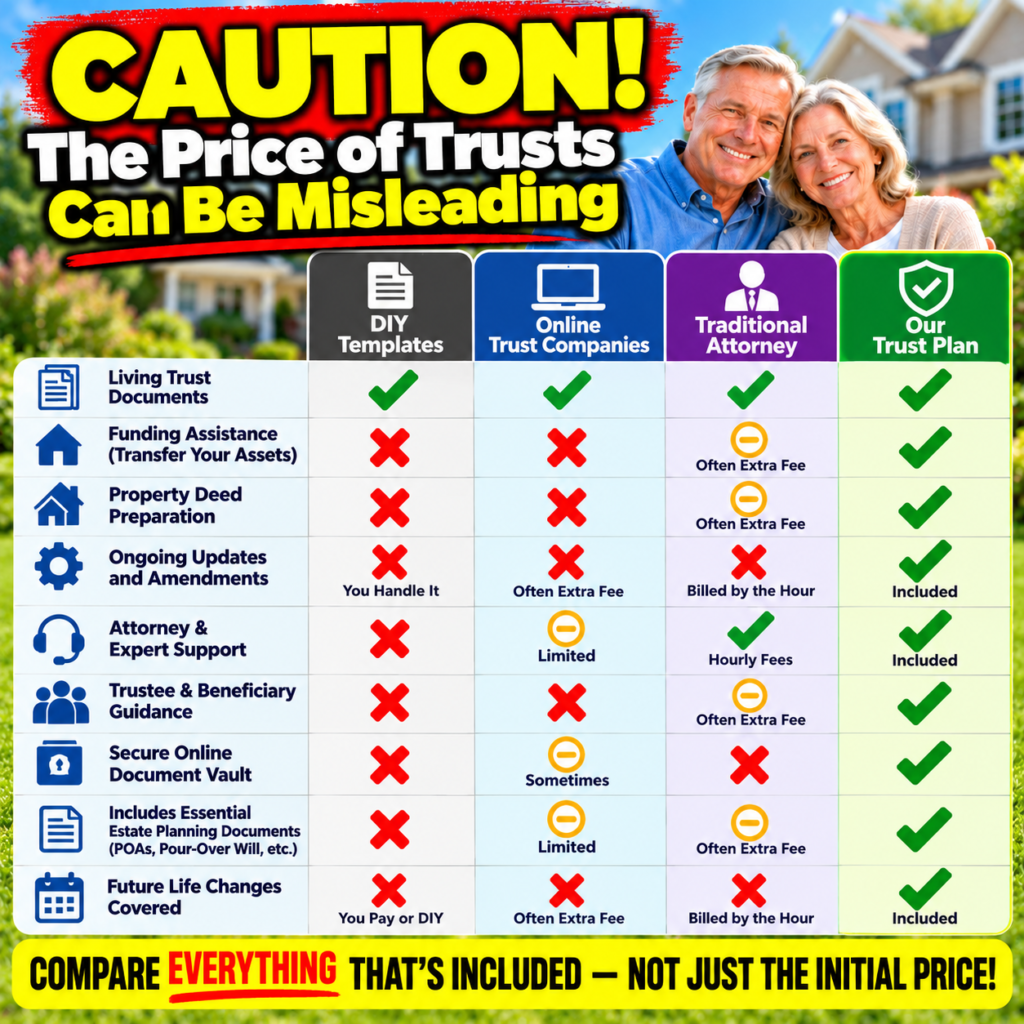
A $300 living trust might sound like a bargain. A $5,000 attorney-drafted trust might sound expensive. But what if neither price tells you what your estate plan will actually cost over your lifetime?
When comparing living trust services, most people make one costly mistake:
They compare the price of creating a trust without comparing everything that comes with it.
And that’s a problem.
Because a living trust is not simply a document you create once, put in a drawer, and forget about.
Your trust needs to be properly established. Your assets need to be coordinated with it. And as your life changes, your estate plan needs to keep up.
Some services provide little more than documents. Others offer professional legal assistance but charge separately for additional work. And many leave you responsible for the complicated and time-consuming process of funding your trust.
That’s why we created our eState Trust Plan — a comprehensive, digitally managed living trust solution designed to make estate planning easier, more convenient, and more affordable over the long term.
For $2,995 plus $95 per year, our plan combines trust preparation, funding assistance, access to professional support, digital document management, and ongoing updates in one convenient service.
Before you decide how to create your living trust, there are three costs you absolutely need to understand.
1. The Cost of Creating Your Living Trust
Not All Living Trusts Are Created Equal — And Neither Are Their Prices
There are four common ways to establish a living trust. Each comes with very different levels of service, professional assistance, convenience, and ongoing costs.
Option 1: Do-It-Yourself Living Trust Templates — Approximately $0–$300
DIY living trust templates are often the least expensive option upfront.
You purchase or download a template, fill in the information, and prepare the documents yourself.
Sounds simple, right?
But consider what you’re actually purchasing.
Generally, you’re paying for documents — not a comprehensive estate planning service.
You may be responsible for:
- Determining which trust provisions are appropriate for your family.
- Making sure your documents comply with applicable state laws.
- Preparing the necessary supporting documents.
- Properly signing and executing your trust.
- Transferring or coordinating your assets with the trust.
- Updating the documents as your circumstances change.
- Resolving mistakes or omissions without ongoing professional assistance.
The biggest concern? You may not discover a serious mistake until your family needs the trust to work.
A DIY trust can be a reasonable solution for some straightforward situations, but the low purchase price doesn’t necessarily reflect the time, responsibility, and potential professional assistance involved.
Option 2: Online Living Trust Companies — Approximately $500–$3,000
Online trust companies offer a more guided approach than basic DIY templates.
Many provide questionnaires, document generation, electronic document storage, and optional professional assistance.
But there’s an important question to ask:
Does the advertised price include everything needed to establish, fund, and maintain your trust?
Depending on the provider and package, you may discover that:
- Attorney consultations cost extra.
- Funding assistance is limited or not included.
- Real estate deed preparation requires an additional fee.
- Updates or amendments require a subscription or additional payment.
- Advanced estate planning provisions aren’t included.
- Ongoing trustee and beneficiary support is unavailable.
Online services vary considerably. Some offer excellent features, but you need to examine exactly what’s included before comparing their prices.
A trust that costs $1,000 initially may become substantially more expensive when additional services are needed.
Option 3: Traditional Estate Planning Attorney — Approximately $2,000–$10,000+ (Often Only To Create The Trust Documents, Funding And Future Updates Not Included)
Hiring a qualified estate planning attorney can provide valuable individualized legal advice and customized documents.
For complex estates, unusual family circumstances, business ownership, or sophisticated tax planning, an attorney may be particularly important.
However, traditional attorney services can also be expensive.
Depending on the attorney, geographic market, and complexity of the estate, the initial trust package may cost several thousand dollars.
And that initial fee may only be the beginning.
You need to ask whether the attorney’s quoted price includes:
- Transferring real estate into the trust.
- Coordinating financial accounts and beneficiary designations.
- Preparing additional deeds and supporting documents.
- Future trust amendments.
- Ongoing legal consultations.
- Trustee and successor trustee assistance.
- Reviewing the plan when your family or finances change.
Some attorneys include many of these services. Others bill separately, sometimes by the hour.
A traditional trust that costs $4,000 to establish could ultimately cost considerably more over your lifetime if additional work is billed separately.
Option 4: Our eState Trust Plan — $2,995 + $95 Per Year For Lifetime Updates, Changes & More
We designed our eState Trust Plan to combine the benefits of professional estate planning assistance with the convenience and efficiency of modern technology.
Instead of purchasing documents and then figuring everything else out on your own, you receive a more comprehensive estate planning solution.
Our plan includes:
- A professionally supported living trust plan.
- Trust funding assistance.
- Property deed preparation.
- Financial and healthcare powers of attorney.
- A pour-over will.
- IRA beneficiary trust planning provisions.
- Trust protector provisions.
- Trustee and successor trustee support.
- Beneficiary guidance and assistance.
- Access to legal and retirement planning specialists.
- A secure digital document vault.
- Online access to your estate planning documents.
- Ongoing trust updates and amendments under the plan.
- Continued support as your needs change.
One comprehensive plan. One clearly defined initial fee. An affordable annual maintenance fee.
And perhaps most importantly, a system designed to help you keep your estate plan current without repeatedly starting over.
2. The Cost of Funding Your Living Trust
This May Be the Most Important Difference of All
Here’s something many people don’t realize until after they’ve purchased a living trust:
Creating a trust and funding a trust are two completely different things.
You can spend thousands of dollars having a beautiful, professionally drafted living trust prepared.
But if your assets aren’t properly transferred into or coordinated with that trust, it may not accomplish everything you intended.
And that can create serious problems for your family.
What Does Funding a Living Trust Actually Mean?
Funding is the process of properly transferring or coordinating assets with your trust so that your estate plan can work as intended.
Depending on the type of asset, this may involve:
- Preparing and recording deeds for real estate.
- Retitling eligible bank or brokerage accounts.
- Assigning certain personal property or business interests.
- Reviewing beneficiary designations.
- Coordinating vehicles and other titled property where appropriate.
- Making sure newly acquired assets are addressed in your estate plan.
Not every asset should be titled directly in a living trust. Retirement accounts, for example, generally require careful beneficiary planning rather than retitling into the trust.
The correct approach depends on the asset, applicable law, and your individual estate planning goals.
The Hidden Cost of DIY and Online Trusts: Funding Is Often Your Responsibility
Imagine spending $500, $1,000, or even $2,000 for a living trust online.
You complete the questionnaire, receive your documents, and feel relieved that your estate plan is finished.
But is it?
You may still need to contact your bank, brokerage company, county recording office, insurance provider, or other institutions to make sure everything is properly coordinated.
You may need additional forms, deeds, notarizations, or professional assistance.
And if you make a mistake, the consequences could be far more expensive than the original trust.
A trust document alone doesn’t guarantee that your assets will avoid probate. Proper funding is essential.
Traditional Attorneys May Charge Separately for Funding
Some estate planning attorneys include funding assistance in their trust packages.
Others prepare the trust documents and provide instructions, leaving clients to complete much of the work themselves.
Additional deed preparation, account coordination, and future asset transfers may generate separate fees.
That’s why it’s important to ask:
“Does your quoted price include actually helping me fund the trust, or just preparing the documents?”
That one question can reveal a substantial difference between trust services.
Our eState Trust Plan Includes Funding Assistance
This is one of the most important advantages of our plan.
We don’t want to simply provide you with documents and leave you wondering what to do next.
Our eState Trust Plan includes assistance with the funding process, including property deed preparation and guidance for coordinating eligible assets with your trust.
Our digital platform is designed to simplify the process and reduce unnecessary paperwork, appointments, and administrative work.
Where permitted, documents and assignments can be completed electronically. When a bank, government office, or other institution requires additional procedures, our team can help guide you through the appropriate steps.
You receive assistance with both creating your trust and putting it to work.
That is a major difference between purchasing a trust document and receiving a comprehensive trust planning service.
3. The Cost of Maintaining Your Living Trust
Your Life Will Change. Your Trust Needs to Keep Up.
This is where the long-term cost of a living trust becomes especially important.
Think about how much your life has changed over the past 10 or 20 years.
Perhaps you’ve bought or sold a home.
Maybe you’ve purchased a new vehicle, changed banks, opened a brokerage account, welcomed new grandchildren, received an inheritance, or experienced a death or divorce in the family.
Now consider how many changes may occur over the next 10, 20, or 30 years.
Your estate plan needs to reflect your current circumstances — not simply the way your life looked when the trust was originally created.
Everyday Life Events That May Require Trust Maintenance
Consider these common situations:
You buy or sell a home.
You may need new deed preparation, title coordination, or updates to your trust’s asset records.
You buy or sell a vehicle.
Depending on your state and how the vehicle is owned, title or estate planning records may need attention.
A new grandchild is born.
You may want to add that grandchild as a beneficiary or modify how your estate is distributed.
You change brokerage firms or bank accounts.
New account ownership and beneficiary arrangements may need to be coordinated with your existing plan.
You receive an inheritance.
Your newly acquired assets may need to be incorporated into your estate planning strategy.
A beneficiary gets married or divorced.
You may want to reconsider how an inheritance will be distributed or protected.
Your successor trustee becomes unable or unwilling to serve.
You may need to appoint someone else.
You change your mind about who receives your assets.
Your trust may need to be amended to reflect your new wishes.
Your healthcare or financial decision-maker changes.
Your powers of attorney may need updating.
Some of these events require formal amendments. Others simply require updated asset records, beneficiary designations, or title documents.
But they all illustrate the same point:
Estate planning is not a one-time event. It’s an ongoing responsibility.
How Much Does an Attorney Charge to Change a Living Trust?
With a traditional attorney-drafted trust, future amendments and related legal work may be billed separately.
Depending on the attorney and the complexity of the work, hourly rates can run into several hundred dollars.
For illustration, consider an attorney charging $350 per hour.
| Work Required | Illustrative Cost |
|---|---|
| One-hour consultation or simple change | $350 |
| Two hours of amendment work | $700 |
| Three hours of revisions and related work | $1,050 |
| Four hours of more extensive work | $1,400 |
These are illustrative calculations, not universal attorney fees. Some firms charge flat fees for amendments, and some include future updates in maintenance plans.
But the important question remains:
How many times will your estate plan need attention over the rest of your life?
Suppose you require five separate updates over 20 years, and each one costs $700.
That’s another $3,500 in attorney fees, on top of what you originally paid to establish the trust.
More complex amendments, new deeds, additional consultations, or other legal work could increase the total.
You may never know the full lifetime cost of a traditional attorney-drafted trust when you first purchase it.
Our eState Trust Plan: $95 Per Year for Ongoing Maintenance and Support
This is where our program becomes especially attractive.
Instead of treating every routine change as a new project with a potentially substantial legal bill, our eState Trust Plan is designed around ongoing access and maintenance.
Our plan includes trust updates and amendments, continued professional support, and convenient digital access to your estate planning information.
You can access your plan online, review your information, and initiate updates without automatically having to schedule another in-person attorney appointment.
For qualifying changes covered by the plan, there is no separate amendment fee.
And the annual plan fee is just $95.
That’s less than $8 per month when averaged over a year.
For many families, the convenience and predictability of ongoing maintenance may be just as valuable as the initial trust documents.
What Could Your Living Trust Cost Over 20 Years?
Compare the Lifetime Cost — Not Just the Initial Price
Here’s an illustration of how the costs can add up.
| Trust Service | Initial Cost | Potential Additional Costs |
|---|---|---|
| DIY Trust | $0–$300 | Funding, professional help, revisions |
| Online Trust Company | $500–$3,000 | Funding, subscriptions, amendments, additional services |
| Traditional Attorney | $2,000–$10,000+ | Additional legal work, deeds, future amendments |
| Our eState Trust Plan | $2,995 + $95/year | Usually none |
Now look at the predictable base cost of our eState Trust Plan over time.
| Time Period | Total Plan Fees |
|---|---|
| Initial setup | $2,995 |
| 5 years | $3,470 |
| 10 years | $3,945 |
| 15 years | $4,420 |
| 20 years | $4,895 |
| 30 years | $5,845 |
Totals assume the current $95 annual fee remains unchanged, with the first annual fee paid at enrollment. Government charges, recording fees, third-party costs, and services outside the plan’s scope may be additional.
Think about that: 20 years of trust planning and ongoing plan access for $4,895 in base plan fees.
That’s less than the initial price of some traditional attorney-drafted trust packages.
And unlike a one-time document purchase, our plan is designed to help you maintain your estate plan throughout those years.
The goal isn’t simply to save money on day one.
It’s to help you save time, reduce administrative headaches, and keep your estate plan current for the long term.
Why Our Nevada-Based Digital Trust Platform Makes a Difference
Modern Estate Planning Without the Traditional Paperwork Headaches
Traditional estate planning has often involved printed documents, in-person meetings, notarizations, and a thick binder full of paperwork.
Our eState Trust Plan takes a more modern approach.
Our platform uses a Nevada-based trust planning structure and digital technology to help eligible clients establish and manage their estate plans conveniently.
Nevada is recognized for its developed trust laws, and its legal framework can offer advantages for appropriately structured trusts.
However, the ability to use Nevada law, select a Nevada trust situs, or execute documents electronically depends on the trust’s circumstances and applicable state and federal requirements.
Our approach is designed to streamline the process while helping clients comply with those requirements.
Estate Planning From the Comfort of Your Home
With our digital platform, you can:
- Access your estate planning information online.
- Review important trust documents.
- Request updates as your circumstances change.
- Use electronic document execution where legally permitted.
- Receive guidance on funding and asset coordination.
- Store important documents in a secure digital vault.
- Access ongoing support without automatically requiring an in-person meeting.
Many steps can be handled remotely, although certain assets or documents may still require notarization, recording, institution-specific forms, or other procedures.
Less paperwork. Fewer unnecessary appointments. More convenient access.
That’s the advantage of combining modern technology with professional estate planning support.
Everything Included With Our eState Trust Plan
More Than a Living Trust — A Comprehensive Estate Planning Solution
When comparing services, it’s important to look beyond the main trust document.
Our plan brings together important estate planning documents, funding assistance, ongoing support, and specialized planning features.
Your Core Estate Planning Documents
Revocable Living Trust
The foundation of your estate plan, designed to help manage and distribute your assets according to your wishes and potentially avoid probate for properly funded assets.
Pour-Over Will
A companion document that directs certain assets remaining outside the trust into it after death, subject to applicable probate procedures.
Financial Power of Attorney
Helps authorize a person you choose to handle specified financial matters if needed.
Healthcare Power of Attorney
Helps designate someone to make healthcare decisions on your behalf when legally appropriate.
Funding and Asset Coordination
Trust Funding Assistance
Guidance and assistance with transferring or coordinating eligible assets.
Property Deed Preparation
Preparation of applicable property deeds as part of the trust funding process, subject to property and jurisdictional requirements.
Beneficiary Planning Guidance
Assistance reviewing how beneficiary designations fit with your broader estate plan.
Family and Beneficiary Protection Planning
IRA Beneficiary Trust Planning
Specialized planning provisions intended to help address how retirement assets may be distributed to beneficiaries, subject to applicable retirement and tax laws.
Trust Protector Provisions
Additional trust oversight and flexibility through provisions appropriate to your plan.
Successor Trustee Support
Assistance designed to help the people who may eventually be responsible for administering your trust.
Beneficiary Guidance
Support and education concerning the roles and responsibilities of beneficiaries.
Professional Support
Legal Support and Representation Within the Plan’s Scope
Access to legal assistance associated with your trust planning service.
Trustee Support
Guidance concerning trust administration and responsibilities.
Retirement Specialist Access
Professional resources to help address the intersection of retirement planning and estate planning.
Ongoing Updates and Amendments
Routine covered changes without additional amendment fees.
Digital Convenience
Secure Digital Document Vault
A convenient place to store and access important estate planning documents.
Online Estate Plan Access
Review your plan and initiate changes from wherever you have internet access.
Continued Plan Maintenance
Ongoing access and support designed to help your estate plan keep pace with your life.
All these features are described as included in our eState Trust Plan, subject to the plan’s service agreement, eligibility, and scope of services.
The Real Difference: You’re Not Just Buying a Trust. You’re Getting an Ongoing Estate Planning Service.
Consider what matters most to you.
Do you simply want to purchase the least expensive trust documents available?
Or do you want a comprehensive estate plan that is easier to establish, properly coordinated with your assets, and supported as your circumstances change?
With DIY templates, much of the responsibility rests on you.
With many online services, funding assistance and additional support depend on the package you purchase.
With a traditional attorney, you may receive excellent individualized legal services, but future work can involve additional fees and appointments.
Our eState Trust Plan is designed to bring these important elements together in one convenient, affordable service.
You receive the benefits of digital estate planning, funding assistance, professional support, and ongoing maintenance for a predictable fee.
It’s an approach designed around how families actually live — and how their lives change.
A Trust Should Make Life Easier for Your Family — Not More Complicated for You
You’ve worked hard to build your home, savings, retirement accounts, and other assets.
You’ve spent years providing for the people you love.
Now it’s time to make sure your estate plan reflects those priorities.
A properly designed and maintained living trust can help your family avoid unnecessary probate proceedings, provide continuity during incapacity, preserve privacy, and make it easier to carry out your wishes.
But those benefits depend on having the right documents, coordinating the right assets, and maintaining the plan over time.
That’s why we believe the smartest way to compare living trust services is to evaluate the entire lifetime value — not just the advertised starting price.
With our eState Trust Plan, you can have a comprehensive, digitally accessible estate planning solution for $2,995 plus $95 per year.
No need to figure out the entire funding process by yourself.
No need to rely solely on a static set of documents that becomes increasingly outdated.
And no need to assume every covered routine amendment will generate another attorney bill.
Just a more convenient way to establish, manage, and maintain your estate plan.
See How Our eState Trust Plan Works — Watch Our Free Webinar
Before You Spend Thousands on a Living Trust, Learn What You Should Actually Be Getting
We’ve created a free educational webinar that explains how living trusts work, why funding matters, and how our modern eState Trust Plan differs from traditional estate planning services.
You’ll discover:
- Why having a living trust doesn’t automatically mean your assets will avoid probate.
- The important differences between DIY, online, attorney-drafted, and digitally managed trusts.
- Why properly funding your trust is essential.
- How everyday life changes can affect your estate plan.
- Why ongoing maintenance should be part of your cost comparison.
- How our Nevada-based digital trust planning approach works.
- What’s included in our $2,995 eState Trust Plan.
- How our $95 annual plan helps simplify future maintenance.
- How to take the next step with a free, no-obligation consultation.
The webinar is completely free, and there’s no obligation to purchase anything.
After watching, you’ll have the opportunity to schedule a free estate planning consultation to discuss your individual situation, ask questions, and find out whether our eState Trust Plan is right for you.
Protect Your Family. Simplify Your Estate Planning. Know What You’re Paying For.
WATCH THE FREE ESTATE PLANNING WEBINAR
Free educational webinar • Learn about the eState Trust Plan • Optional free consultation afterward
Important Information: Create A Living Trust provides educational information about estate planning and trust services. The eState Trust Plan’s documents, legal services, funding assistance, updates, and ongoing support are subject to the applicable service agreement and legal requirements. Results and available services may vary by individual circumstances and jurisdiction. A revocable living trust does not, by itself, protect the grantor’s assets from creditors, eliminate estate taxes, or guarantee probate avoidance. Consult qualified legal and tax professionals regarding your individual circumstances.