How to Prepare a Family Corporation for Business Succession
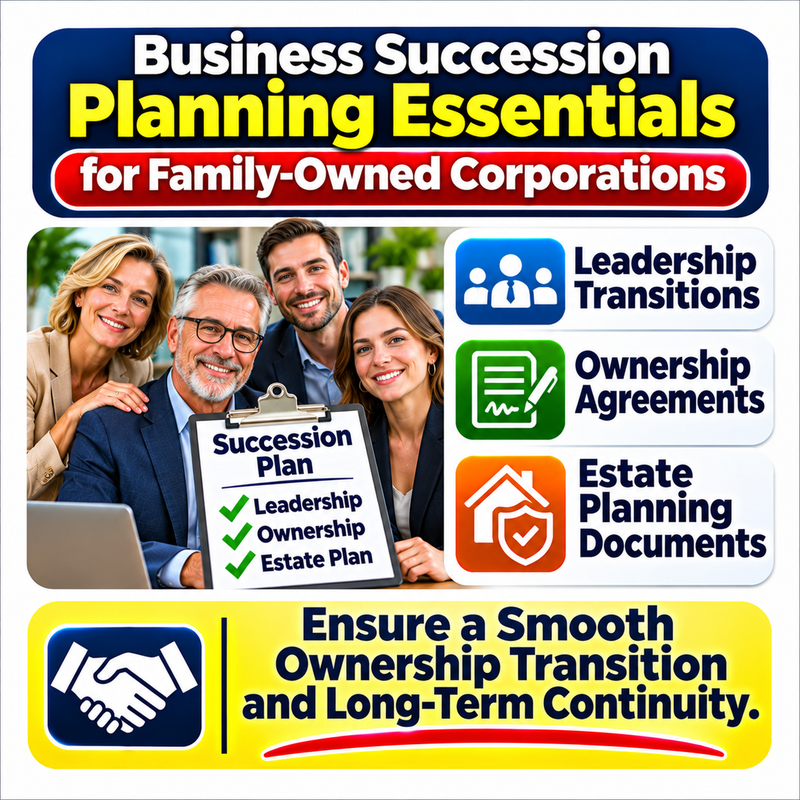
Identify leadership transitions, ownership agreements, and estate planning documents needed for continuity.
Key Takeaways
- A family corporation needs three separate succession plans: one for who owns the shares, one for who votes them, and one for who manages the company day to day.
- Corporate documents like bylaws, shareholder agreements, and buy-sell agreements control whether shares can transfer at all — a living trust cannot override those restrictions.
- Incapacity planning requires more than a power of attorney; it requires board resolutions, authorized signatories, and a clear interim leadership plan.
- Family fairness doesn’t always mean equal voting power, and the right structure depends on which heirs are active in the business versus which are not.
- Later in this guide, you’ll see a side-by-side comparison of what happens to a family corporation with no plan, a partial plan, and a fully coordinated plan.
A founder dies unexpectedly, and within weeks the surviving spouse, two adult children, and a bank loan officer are all asking the same question: who’s actually in charge now?
That scenario plays out in family-owned corporations across the country every year, and it’s rarely about a lack of love or good intentions. It’s about a missing framework. Family corporation succession planning means building a coordinated structure — spanning corporate documents and estate planning documents — that answers three distinct questions before a crisis forces the answer: who owns the stock, who votes it, and who runs daily operations. Those three roles do not have to belong to the same person, and treating them as if they automatically do is one of the most common and costly mistakes family businesses make.
Getting this right takes coordination between corporate counsel, estate planning counsel, a CPA, and sometimes a valuation professional. Organizations like Create A Living Trust focus on the estate planning side of that puzzle, helping families understand how trusts, wills, and powers of attorney fit alongside — not instead of — a corporation’s own governing documents.
Identify leadership transitions, ownership agreements, and estate planning documents needed for continuity.
Before any document gets drafted, a family corporation needs an honest inventory. That means listing every governing document currently in force — articles of incorporation, bylaws, any shareholder or voting agreements, buy-sell agreements, and the stock ledger showing who actually holds what. It also means identifying every person who could plausibly step into an ownership, voting, or management role, whether or not they currently work in the business.
Leadership transitions and ownership transitions don’t move on the same clock. A founder might retire from active management next year while keeping controlling shares for another decade. A different founder might die suddenly, instantly triggering both an ownership transfer and a leadership vacuum at the same time. Estate planning documents — a will, a revocable trust, powers of attorney — need to be built with these different timelines in mind, not treated as a single catch-all solution.
Why Family Corporations Need a Written Succession Plan
Verbal understandings about “who takes over” tend to fall apart exactly when they’re needed most — during grief, incapacity, or sudden illness. A written plan removes ambiguity by spelling out, in advance, which family members receive shares, which ones vote those shares, and which ones hold officer or director positions. It also gives banks, vendors, and insurers something concrete to rely on when a transition happens, which matters more than most owners expect.
Without a written plan, the default rules of state corporate law and probate procedure take over. Those default rules were not written with any particular family’s values or business realities in mind, and they rarely produce the outcome a founder would have chosen.
Three Pillars of Continuity: Ownership, Governance, and Leadership
Think of succession planning as resting on three separate pillars that each need their own documentation and their own successor:
- Ownership: Who legally holds the shares, receives dividends, and benefits economically from the corporation’s value.
- Governance: Who votes those shares at shareholder meetings, elects directors, and approves major corporate actions.
- Leadership: Who holds officer titles — CEO, president, CFO — and makes day-to-day operating decisions.
A single person can hold all three roles, and in many small family corporations, that’s exactly what happens with the founder. But succession planning gets more flexible, and often more fair, when these roles are allowed to separate. A nonactive heir might inherit economic value through nonvoting shares while an active heir receives voting control and an officer title — a structure that can reduce resentment on both sides if it’s documented and explained well in advance.

Shareholder Succession vs Management Succession: Know the Difference
One of the most persistent misunderstandings in family business planning is the assumption that receiving stock automatically means receiving authority. It doesn’t. A shareholder — even a controlling shareholder — has rights defined by the corporation’s bylaws and applicable state law, typically including the right to vote on directors and major transactions and the right to receive declared dividends. None of that inherently includes the authority to sign contracts, direct employees, or make operational decisions. Those powers belong to officers and, in some cases, the board of directors.
This distinction becomes especially important when a trust holds shares. A trustee managing shares inside a revocable trust has a fiduciary duty to the trust’s beneficiaries and typically exercises the voting rights attached to those shares. But a trustee is not automatically an officer of the corporation and does not automatically gain the power to manage daily operations, hire or fire staff, or sign vendor contracts, unless the corporation’s own board or shareholders separately appoint that person to an officer or director role.
Who Owns the Stock Versus Who Runs the Company
Picture a corporation with 1,000 shares. A founder’s estate plan might direct 500 voting shares to the child actively running operations and 500 nonvoting shares split between that child and a sibling who works elsewhere. The active child now controls board decisions, while both children share equally in the company’s economic value through dividends or an eventual sale. Neither child automatically becomes CEO just by holding shares — that title still requires a formal board resolution or shareholder vote, separate from the stock transfer itself.
Why Confusing the Two Creates Family Conflict
Families run into trouble when they assume a will or trust alone settles who’s in charge. A parent might believe that leaving the “family business” to all three children in equal shares automatically creates equal management authority, when in reality it can produce three equal votes on every decision with no tiebreaker, no designated leader, and no mechanism for resolving disagreement. Minority shareholders who never intended to run the company can find themselves locked into disputes over dividends, compensation, or strategy with siblings who do work there daily. Clarifying voting structure and officer appointments separately from the inheritance of economic value tends to prevent exactly this kind of standoff.
Review Your Bylaws, Shareholder Agreements, and Voting Control
Corporate documents — not a living trust — determine whether a proposed share transfer or leadership change is even legally possible. Articles of incorporation establish the share classes a corporation is authorized to issue. Bylaws typically set out how directors are elected, how officers are appointed, and what voting thresholds apply to major decisions. Shareholder agreements often go further, adding transfer restrictions, rights of first refusal, and consent requirements that can block a transfer to an heir or a trust unless specific conditions are met.
Before finalizing any estate plan involving corporate shares, these documents need a careful legal review:
- Articles of incorporation and any amendments
- Bylaws, including officer appointment and removal procedures
- Shareholder agreements and voting agreements
- Buy-sell agreements and their triggering events
- Stock certificates and the stock ledger
- Any lender covenants or licensing agreements referencing ownership changes
What Bylaws Say About Transferring Shares
Many family corporation bylaws require board or shareholder approval before shares can move to a new owner, even through inheritance. Some bylaws automatically trigger a buyout obligation when a shareholder dies, forcing the corporation or remaining shareholders to purchase the deceased owner’s shares at a predetermined or formula-based price rather than allowing those shares to pass directly to heirs. Reviewing this language well before a transition is critical, because discovering a mandatory buyout clause after a death has already occurred leaves far less room to negotiate.
Shareholder Agreements and Transfer Restrictions
Shareholder agreements frequently layer on additional restrictions beyond the bylaws, such as rights of first refusal that give existing shareholders the option to buy shares before they transfer to an outside party, or consent requirements that let other shareholders block a transfer to someone they haven’t approved. These provisions exist to keep ownership within a trusted circle, but they can also complicate a straightforward estate plan if a trust document and the shareholder agreement were never coordinated with each other.
Voting Rights vs Economic Rights in Family Stock
Corporations can typically issue different classes of stock — voting and nonvoting, or shares with different dividend preferences — and family succession plans increasingly rely on this flexibility. Separating voting rights from economic rights allows a founder to concentrate control in the hands of one or two capable successors while still giving every heir a fair economic stake in the company’s value. Whether this structure makes sense depends heavily on state corporate law and the corporation’s existing share structure, which is why a corporate attorney should review any proposed recapitalization before it’s finalized.

Plan for Incapacity, Death, and Emergency Leadership
A founder’s sudden stroke or serious accident can be just as disruptive as a death, sometimes more so, because the corporation still has an owner — just one who can’t currently sign checks, approve payroll, or make decisions. Incapacity planning for a family corporation needs to address who can access bank accounts, who can sign vendor contracts, who has authority to continue payroll, and who can make time-sensitive business decisions while the incapacitated owner recovers or while a longer-term transition is arranged.
It’s worth being direct about a common misconception here: a durable power of attorney and a trustee’s authority over trust-held shares are not the same thing, and neither one automatically hands over full corporate management power. A power of attorney grants the named agent authority over the principal’s personal affairs and, depending on how it’s drafted, potentially their individually held shares — but it doesn’t make that agent a corporate officer. Similarly, a successor trustee who steps in to manage trust assets exercises the voting rights attached to any shares the trust holds, but doesn’t automatically become CEO or gain signing authority over corporate bank accounts. Those powers come only from the corporation’s own board action or bylaws.
Naming an Interim or Emergency Successor
A practical incapacity plan names a specific person — formally, through board resolution or officer appointment — who can step into daily operations on short notice. This person doesn’t need to be the eventual long-term successor; the role is about keeping payroll running, vendors paid, and customer relationships intact during an emergency. Some family corporations formalize this through a standing board resolution that automatically activates an interim officer if the primary leader becomes unavailable, rather than waiting to improvise a decision during the crisis itself.
Board Authority When a Key Leader Becomes Incapacitated
The board of directors typically retains the authority to appoint or remove officers, which means a well-prepared board can act quickly to designate interim leadership even if the incapacitated owner also happens to be the controlling shareholder. This is one reason corporate governance review matters so much during succession planning — if the board is stacked entirely with family members who are themselves unprepared or in conflict, emergency decision-making can stall at the worst possible moment. Some families address this by adding an independent director or advisory board member specifically to help break ties or provide an objective voice during a transition.
| Authority Source | What It Grants | What It Does NOT Automatically Grant |
|---|---|---|
| Durable Power of Attorney | Authority over principal’s personal/individually held assets per document terms | Corporate officer powers; board voting rights |
| Successor Trustee of Living Trust | Authority to vote trust-held shares; manage trust assets | Officer title; daily operational control |
| Board Resolution / Officer Appointment | Authority to manage operations, sign contracts, direct staff | Ownership of shares; dividend rights |
Documenting Powers of Attorney for Business Decisions
A financial power of attorney should be drafted with the corporation’s specific needs in mind rather than relying on a generic form. That often means explicitly referencing the owner’s business interests, naming an agent with relevant business judgment, and coordinating the document’s terms with whatever the shareholder agreement or bylaws already say about incapacity. A secure continuity binder — containing copies of key corporate documents, banking information, insurance policies, and emergency contacts — gives whoever steps in a running start instead of a scavenger hunt during an already stressful situation.
Life Insurance and Other Liquidity Funding Options
Many succession plans collapse not because families lack good intentions, but because nobody worked out where the cash would come from. If one child inherits the operating business while a sibling and a surviving spouse are supposed to receive roughly equivalent value in cash, that cash has to exist somewhere — and that’s the real purpose behind combining a current valuation with a funded buy-sell agreement.
Life insurance is one of the more common funding tools family corporations use to solve this liquidity problem. A corporation can structure an entity-purchase arrangement, where the company itself owns a policy on a key shareholder and uses the proceeds to buy back that shareholder’s stock at death, or a cross-purchase arrangement, where co-owners carry policies on each other. Either structure needs to be reviewed by an insurance adviser familiar with buy-sell funding, because premium costs, coverage amounts, and policy ownership all depend on factors specific to the corporation and its shareholders — there’s no universal number that applies to every family business.
Beyond insurance, some families rely on installment payment terms written directly into the buy-sell agreement, allowing the corporation to pay out a departing shareholder’s value over several years rather than in one lump sum, sometimes paired with a cash reserve set aside specifically for this purpose. Valuation methods also need periodic updates — a formula or appraisal from eight years ago rarely reflects what the business is worth today, and outdated numbers are a common source of family disputes. Because gift, estate, and income tax consequences can all attach differently to a sale, a redemption, or a transfer at death, a CPA should review the chosen structure before it’s finalized rather than after.

Coordinate Estate Documents with Company Counsel and Tax Professionals
A revocable trust, a pour-over will, durable powers of attorney, and beneficiary designations all need to work in sync with the corporation’s own governing documents, not as a separate system running on its own track. Understanding how to create a living trust is a useful starting point, but when that trust is eventually going to hold shares in a closely held corporation, the drafting has to account for transfer restrictions, consent requirements, and successor-trustee powers that a generic trust template won’t automatically address. For multigenerational family businesses, succession planning is crucial to ensure a smooth transition and continuity.
This is where a team approach pays off. Business counsel reviews the bylaws and shareholder agreement for transfer restrictions; estate planning counsel drafts the trust, will, and powers of attorney; a CPA evaluates the tax consequences of any proposed transfer; a valuation professional supplies a defensible number for buy-sell purposes; and a lender or insurance adviser confirms that any existing covenants or policies still line up with the new plan. Leaving any one of these professionals out of the loop tends to surface problems later, usually at the worst possible time.
Why a Revocable Living Trust Doesn’t Replace Corporate Documents
A living trust can simplify how personal assets pass to beneficiaries, and in many cases it helps avoid probate for property that’s properly titled in the trust’s name. But it’s worth being clear-eyed about its limits: a revocable trust does not automatically shield the grantor’s shares from creditors, does not eliminate estate taxes, does not guarantee complete privacy in every circumstance, and does not confer Medicaid eligibility. For corporate shares specifically, placing them in a trust doesn’t override whatever consent or transfer-restriction language already exists in the shareholder agreement — the corporation’s own approval process still applies.
Aligning Your Trust, Will, and Buy-Sell Agreement
A pour-over will is typically designed to catch any assets that weren’t formally transferred into the trust during the owner’s lifetime, directing them into the trust after death. But assets caught by a pour-over will usually still pass through probate first, which can delay a business transition at the exact moment speed matters most. That’s one more reason corporate shares need to be actually retitled into the trust while the owner is alive and able to do so, rather than left for the pour-over will to clean up later.
It’s also worth understanding the difference between two very different failure modes. Reading about what happens if you die without a will makes clear how disruptive intestate succession can be, since state default rules — not the family’s wishes — decide who inherits what. But having a valid will doesn’t solve the business side of the equation either. A will can direct that shares pass to a particular heir, yet if the bylaws require board approval for any transfer, or if a buy-sell agreement forces a mandatory redemption at death, the will’s instructions may run headlong into corporate rules it never addressed. Coordinated planning closes that gap; a will or trust alone usually doesn’t.
When S-Corporation Shares Require Special Trust Planning
C corporations and S corporations are taxed differently, and that difference matters a great deal for succession planning. C corporations face no restriction on who can own shares, but S corporations are limited to a defined set of eligible shareholders — generally individuals, certain estates, and certain qualifying trusts — and exclude most other entities and nonresident aliens. Transferring S-corporation shares to the wrong kind of trust, or to too many shareholders, risks accidentally terminating the S election, which can trigger unwanted tax consequences for the entire corporation, not just the family involved.
Certain trusts, including qualifying revocable trusts during the grantor’s lifetime, are generally eligible S-corporation shareholders, but eligibility rules can shift once the grantor dies, and some trusts require a specific election to continue holding S-corporation stock after that point. Rather than assume any trust can hold S-corporation shares indefinitely, families should have a CPA or tax attorney confirm eligibility and any required elections promptly after a death or major ownership change, since timing matters and the specific rules are technical enough to warrant professional review rather than guesswork.

Governance Structures That Support a Smooth Transition
Documents alone rarely prevent family conflict — the conversations and decision-making structures built around those documents usually matter just as much. Family corporations that handle succession well tend to build governance habits well before a transition is forced on them, rather than scrambling to create structure in the middle of a crisis.
Two tools show up repeatedly in families that manage this transition successfully: a family council that meets regularly to discuss business matters outside the boardroom, and an advisory board that brings in outside expertise the family itself may not have. Neither replaces the legal authority of the actual board of directors, but both can make board decisions less contentious by surfacing disagreements early, in a lower-stakes setting.
Family Councils and Advisory Boards
A family council typically includes shareholders and close relatives, whether or not they work in the business, and gives them a forum to discuss expectations, concerns, and long-term goals separate from formal shareholder or board meetings. Advisory boards, by contrast, usually bring in non-family professionals — a retired executive from a related industry, an accountant, or an attorney — specifically to provide an outside perspective and help break ties when family members disagree. Broader family business governance research consistently points to communication structures like these as a factor separating families who transition smoothly from those who don’t.
Family Constitutions and Charters
A family constitution, sometimes called a family charter, is a formal written document that spells out the family’s shared values, the roles different members are expected to play, and the process for resolving disagreements before they escalate into shareholder disputes. It’s usually not a legally binding corporate document in the way bylaws are, but it carries real weight because it reflects something the family agreed to together, in calmer times, rather than rules imposed during a crisis. For more on this topic, explore succession planning within family business.
None of this replaces the legal documents a corporate attorney drafts. A family constitution works alongside the bylaws and shareholder agreement, giving the family a shared reference point for how decisions should be made, while the legal documents still determine what’s actually enforceable if a disagreement ends up in dispute.
Hypothetical Scenario: Planning Succession at a Family Hardware Corporation
Consider a hypothetical family-owned hardware manufacturing corporation. The founder holds 600 of 1,000 controlling shares. One adult child manages daily operations and wants to eventually run the company. A second adult child built a separate career outside the business and holds no interest in managing it, but still expects fair economic treatment. The founder’s spouse isn’t involved operationally but depends on the business for retirement income.
Without a plan, an unplanned death sends those 600 shares through whatever estate administration applies under the founder’s state law. If the shares were titled individually and not placed in a trust, they may pass through probate, a court-supervised process that can take months, during which no one has clear authority to sign contracts, approve payroll changes, or make strategic decisions. The operating child may continue managing day-to-day tasks informally, but without a board resolution or officer appointment, that authority remains uncertain, and the bank may hesitate to honor signatures from someone whose authority hasn’t been formally documented.
Now compare that to a coordinated buy-sell and voting arrangement set up years in advance. The agreement might specify that upon the founder’s death, the operating child receives voting shares at a value set by a predetermined formula, funded partly through a life insurance policy owned by the corporation, while the nonoperating child and surviving spouse receive cash or nonvoting shares with a guaranteed minimum dividend. Voting control transfers immediately under the agreement’s terms, and the board can formally appoint the operating child to an officer title without waiting on probate.
A third option layers in a properly funded living trust alongside updated bylaws. The founder’s revocable trust holds the eligible shares, and a named successor trustee steps in to vote those shares immediately upon the founder’s death or incapacity, without probate delay for that specific asset. But the trust alone doesn’t install the operating child as CEO — the corporation’s board still needs to formally appoint that officer role, exactly as the bylaws require. The trust solves the ownership and voting transition quickly; the leadership appointment still depends on a separate corporate action.
| Scenario | Share Ownership | Voting Control | Operational Leadership | Documents Needed |
|---|---|---|---|---|
| Unplanned Death, No Plan | Determined by probate / state intestacy or will | Uncertain until estate settles | Informal, undocumented authority | None in place; court process applies |
| Coordinated Buy-Sell Agreement | Transfers per formula at predetermined value | Shifts immediately per agreement terms | Board appoints officer per bylaws | Buy-sell agreement, valuation method, funding (e.g., insurance) |
| Funded Trust + Updated Bylaws | Trust holds shares; successor trustee manages | Successor trustee votes shares immediately | Still requires separate board/officer appointment | Trust, pour-over will, POAs, updated bylaws/shareholder agreement |
Succession Planning Checklist for Family Corporations
Turning all of this into action works best as a sequence rather than a single overwhelming project. Most family corporations that get through a transition smoothly follow some version of the steps below, roughly in order:
- Inventory current ownership, governance documents, and share classes.
- Choose management successors and ownership successors separately — they may not be the same people.
- Review bylaws, shareholder agreements, and any lender or licensing restrictions on transfers.
- Obtain a current valuation and complete tax review with a CPA.
- Update corporate documents and estate planning documents together, not in isolation.
- Arrange funding and liquidity sources for any buy-sell obligations.
- Document every transfer formally in the stock ledger and reissue certificates as needed.
- Communicate roles and responsibilities clearly to every family member involved.
- Rehearse an emergency transition — walk through who signs what, where the binder is, and who the interim leader would be.
- Review the entire plan periodically, especially after a major life event or business change.
Questions to Ask Before You Draft Documents
Before anyone drafts a trust or revises the bylaws, the family needs honest answers to a few foundational questions. Is the goal to keep the business in the family long-term, or would a future sale be acceptable if no successor is ready? Which family members actually want an operational role, as opposed to simply holding shares?
It also helps to ask what “fair” means to this particular family — equal shares for every heir, or equal economic value delivered through different structures for active and inactive heirs. There’s no universally correct answer here, and pretending otherwise tends to create more resentment than it resolves.
Questions to Bring to Your Attorney or Tax Advisor
Once the family has clarity on its own goals, the conversation with professional advisers gets more productive. A few questions worth raising directly:
- Does our shareholder agreement currently restrict transfers to a trust, and if so, what approval do we need?
- What happens to our S-corporation election if shares pass to multiple heirs or an ineligible trust?
- How current is our valuation, and does our buy-sell pricing formula still reflect reality?
- Who has signing authority on bank accounts and vendor contracts if the controlling shareholder becomes incapacitated tomorrow?
- What tax consequences follow a lifetime gift of shares versus a transfer at death?
A living trust attorney can help confirm how the trust side of the plan fits together, while corporate counsel confirms the shares themselves can actually move the way the family intends. Bringing both perspectives into the same conversation, rather than consulting each adviser separately, tends to catch conflicts before they become expensive surprises.
It’s also worth asking any prospective successor trustee directly whether they’re prepared to take on the role — voting shares, coordinating with corporate officers, and managing trust administration isn’t a responsibility every family member wants or should accept by default.

Creating Trust Documents vs Funding and Implementing Your Plan
Signing a trust agreement is only the first half of the job. The trust doesn’t actually control anything until it’s funded — meaning the shares themselves are formally retitled into the trust’s name, consistent with whatever the shareholder agreement allows.
What It Means to Fund a Trust with Business Interests
Funding a trust with corporate shares generally involves more steps than funding it with a bank account or a house. The corporation’s board or shareholders may need to formally consent to the transfer, the stock ledger needs to be updated to reflect the trust as the new holder of record, and a new stock certificate is typically issued in the trust’s name.
This is where many well-intentioned plans quietly stall. A family might sign a beautifully drafted trust, only to leave the actual shares sitting in the founder’s individual name for years afterward, because nobody circled back to complete the corporate-side paperwork.
Example: A founder signs a revocable trust naming a successor trustee. Two years later, the stock certificate still reads the founder’s individual name, the stock ledger was never updated, and no board consent was ever obtained for the transfer required by the shareholder agreement. When the founder dies, the trust technically exists — but the shares it was supposed to hold never actually made it in, meaning those shares may still need to pass through probate rather than directly to the trustee, depending on the jurisdiction and how the shareholder agreement handles transfers at death.
That gap between signing documents and actually funding them is one of the most avoidable failures in family corporation succession planning, and it’s also one of the easiest to catch with a simple annual review of the stock ledger against the trust’s asset schedule.
Common Gaps Between Signing Documents and Full Implementation
Beyond unfunded trusts, a few other gaps show up repeatedly. Banking access sometimes never gets updated to reflect a new trustee or officer, leaving payroll vulnerable if the person with historical signing authority becomes unavailable. Insurance policies funding a buy-sell agreement occasionally lapse or fall out of date with the corporation’s current valuation, which can leave a surviving family member short on the cash needed to complete a buyout exactly as the agreement intended. And sometimes the simplest gap of all shows up: nobody told the successor where the corporate records, passwords, or continuity binder are actually kept.
Comparing Support Services for Trust Funding and Succession Coordination
Family corporations typically draw on a mix of services to get from a signed plan to a fully implemented one, and it helps to understand what each type of support actually covers before assuming any single provider handles everything.
Trustee and Successor-Trustee Support
Platforms that assist with ordinary trust funding can help retitle many personal assets — bank accounts, a primary residence, investment accounts — into a trust’s name, and some offer guidance to successor trustees on general administration duties once a trust becomes irrevocable. For closely held corporate shares, though, that support typically coordinates with, rather than replaces, the corporate attorney who confirms the shareholder agreement actually permits the transfer and obtains whatever board or shareholder consent is required.
Beneficiary Guidance and Secure Document Storage
Secure digital storage for estate planning documents gives a family quick access to the trust, will, and powers of attorney when they’re needed most, rather than searching through a filing cabinet during a crisis. Beneficiary guidance can help family members understand their rights under the trust itself, though for corporate matters specifically, questions about voting rights or officer authority still need to go to corporate counsel rather than general estate planning support.
Working with a Network of Legal, Tax, and Financial Professionals
Because succession planning touches corporate law, tax law, and estate law all at once, having access to a coordinated network of professionals tends to produce better outcomes than assembling advisers independently and hoping they communicate with each other. A CPA reviewing the corporation’s books ahead of a transition can flag issues with payroll tax deposits, sales tax filings, or quarterly estimated payments well before they become surprises for a new leader stepping in.
Broader guidance on family business financial readiness consistently emphasizes keeping accounting records current and insurance coverage reviewed well before a transition becomes urgent, rather than scrambling once it’s already underway. Create A Living Trust’s role in this network generally centers on the estate planning documents themselves — trust funding, beneficiary guidance, and powers of attorney — while leaving specialized corporate drafting, buy-sell negotiation, and valuation work to the attorneys, CPAs, and valuation professionals equipped to handle those specific tasks.

Common Mistakes Family Corporations Make in Succession Planning
A handful of mistakes account for most of the succession disputes that end up in litigation or permanently damage family relationships. Recognizing them in advance is far cheaper than untangling them after the fact.
Treating a Trust as a Substitute for Corporate Approvals
It bears repeating because it’s so often misunderstood: placing shares in a trust doesn’t erase whatever consent requirements, rights of first refusal, or board approval processes already exist in the corporation’s own documents. A trust can hold shares efficiently and help avoid probate for that asset, but the corporation’s rules about who can hold shares and how they transfer still apply on top of the trust structure, not underneath it.
Families sometimes discover this the hard way only after a death, when a trustee tries to vote shares or sell them and runs into a shareholder agreement that requires consent from other shareholders first. Reviewing the shareholder agreement against the trust’s terms, well before anyone needs to rely on either document, prevents this collision entirely.
Waiting Too Long to Name an Emergency Successor
Founders often delay naming an interim successor because the conversation feels premature, or because no single heir seems like an obvious choice yet. But waiting for certainty before naming anyone means the corporation has no documented emergency leader if incapacity strikes before that certainty arrives. Naming an interim successor doesn’t lock in a permanent decision — it just ensures someone has clear authority to keep operations running while the family works out the longer-term plan.
Ignoring Family Members Who Hold Shares But Don’t Work in the Business
Nonactive shareholders — a sibling with an outside career, an aging parent, a spouse who never worked in the company — still have legal rights as shareholders, including rights to information and, in many cases, to declared dividends. Treating these family members as afterthoughts in succession planning, simply because they’re not involved operationally, tends to generate resentment and sometimes formal shareholder disputes down the road. Documenting dividend expectations, communication schedules, and the process for valuing their shares if they ever want to sell helps keep these family members engaged rather than sidelined.
Your Next Steps Toward a Coordinated Succession Plan
Start with the inventory: pull the bylaws, the shareholder agreement, the stock ledger, and any existing estate planning documents, and get them in front of corporate counsel and an estate planning attorney at the same time rather than separately. From there, the valuation, the tax review, and the funding mechanism can follow in sequence, with each professional building on what the others confirm. A plan built this way — coordinated rather than assembled piecemeal — gives a family corporation a real shot at surviving a transition intact, both as a business and as a family.
Frequently Asked Questions
Does a living trust give me control over my corporation after I die?
Not entirely on its own. A living trust can hold eligible shares and direct a successor trustee to vote them, which helps transfer ownership and voting control smoothly. But officer titles, management authority, and day-to-day operating decisions still depend on the corporation’s bylaws and board action, not the trust document itself.
Can a trust hold shares in an S-corporation?
Certain trusts, including many revocable trusts during the grantor’s lifetime, generally qualify as eligible S-corporation shareholders. Eligibility rules can change after the grantor’s death, and some trusts require a specific tax election to continue holding the stock. A CPA or tax attorney should confirm eligibility and any required election promptly after a major ownership change.
What happens to voting control if a shareholder becomes incapacitated?
It depends on how the shares are titled. If shares sit in a properly funded revocable trust, the successor trustee typically steps in to vote them under the trust’s terms. If shares are held individually, a durable power of attorney may grant an agent authority, but that authority depends entirely on how the document is drafted and what the bylaws allow.
Do all family members need to receive equal shares in the succession plan?
No, and many well-planned family corporations intentionally avoid equal shares when only some heirs work in the business. Options families consider include:
- Equal economic value through nonvoting shares, with voting shares concentrated in the active successor.
- Unequal share counts balanced by other inheritance, such as real estate or cash.
- Guaranteed minimum dividends for nonactive shareholders alongside reduced voting rights.
- Buy-sell arrangements that let nonactive heirs sell shares back to active family members over time.
How often should bylaws and shareholder agreements be reviewed?
Most corporate attorneys recommend a review every few years at minimum, and immediately after any major life event — a marriage, divorce, new child, serious illness, or significant change in business value. Valuation formulas inside buy-sell agreements in particular tend to go stale faster than owners expect, so periodic updates matter even when nothing dramatic has happened in the family.
Who decides if a family member is ready to lead the company?
Ultimately, the board of directors holds formal authority to appoint officers, but many families rely on objective criteria established in advance — relevant experience, cross-department exposure, mentorship from the outgoing leader, and sometimes input from an independent advisory board member. Involving an outside perspective can reduce the appearance of favoritism when multiple family members want the role.
What is the difference between a buy-sell agreement and a trust?
A buy-sell agreement is a corporate document that controls when and how shares can be sold, often triggered by death, disability, or retirement, and typically sets a valuation method for the buyout. A trust is an estate planning document that holds assets, including possibly shares, for the benefit of named beneficiaries. The two work together: the buy-sell agreement governs what the corporation does with shares a trust holds.
Neither document substitutes for the other. A family corporation generally needs both a funded buy-sell agreement at the corporate level and coordinated estate planning documents at the individual ownership level to achieve full continuity.
Should outside advisors sit on a family corporation’s board?
Many family corporations find that adding one or two independent directors helps break ties, brings outside industry expertise, and reduces the perception that major decisions are driven purely by family politics. It’s not a universal requirement, and smaller corporations sometimes manage well without it, but it’s worth genuine consideration especially when siblings or multiple branches of a family hold significant voting shares.
| Board Composition | Potential Benefit | Potential Tradeoff |
|---|---|---|
| All family members | Shared history, aligned long-term values | Limited outside expertise; harder to break deadlocks |
| Family plus independent director(s) | Objective tie-breaking vote, outside expertise | Requires trust in an outsider’s judgment on family matters |
What documents does an attorney need to coordinate a succession plan?
A corporate attorney typically needs the articles of incorporation, current bylaws, any shareholder or voting agreements, the existing buy-sell agreement, and the stock ledger. An estate planning attorney needs the existing will, trust, and powers of attorney, along with a current family asset summary. Sharing both sets of documents with both attorneys at the same time — rather than sequentially — tends to surface conflicts between the two sides faster.
Can a family corporation be sold instead of passed to the next generation?
Yes, and it’s a legitimate outcome rather than a failure of planning. Some families discover that no heir has the skills, experience, or genuine interest to run the business, and a sale to an outside buyer, a management buyout, or an employee stock ownership structure can preserve the company’s value and employee jobs even without a family successor at the helm. Deciding this early, rather than defaulting into it during a crisis, generally produces a better outcome for everyone involved.