How Dividends Are Taxed in Living Trusts
Distinguish grantor and non-grantor trust taxation, qualified dividends, Form 1041, and distributions to beneficiaries.
How Dividends Are Taxed in Living Trusts
Who actually owes the tax bill when a living trust collects a dividend check? The short answer: while you’re alive and in charge of your own revocable trust, you do. Once that trust changes hands after death, the answer gets more complicated fast.
Dividend taxation in living trusts trips up more families than almost any other post-death administration task, mostly because people assume a trust is its own separate taxpayer the moment it’s signed. That’s rarely true for an ordinary revocable trust. The team at Bulletproof Legacy Financial regularly fields questions from successor trustees who are stunned to learn that a trust holding Apple or Vanguard index fund shares doesn’t automatically shield dividend income from the grantor’s personal tax return — and later, doesn’t automatically shift to trust-level rates either. If you want a plain-language walkthrough of how this actually works before you touch a brokerage statement, a free consultation can help you sort out where your specific trust stands.
Key Takeaways
- While the grantor is alive, dividend income earned inside a revocable living trust is generally reported on the grantor’s personal Form 1040 — not taxed separately at trust rates.
- Not every dividend is created equal: ordinary dividends, qualified dividends, and capital gain distributions each follow different tax rules, even when held in the same trust account.
- After the grantor dies, the trust may become a separate taxpayer requiring its own EIN and a Form 1041 filing, depending on the trust’s terms and applicable law.
- Distributable net income (DNI) — not the cash amount distributed — determines how much dividend income beneficiaries must report on their own returns via Schedule K-1.
- Reinvested dividends, capital gains from selling shares, and distributions of trust principal are not interchangeable concepts, and mixing them up is one of the most common trustee mistakes.
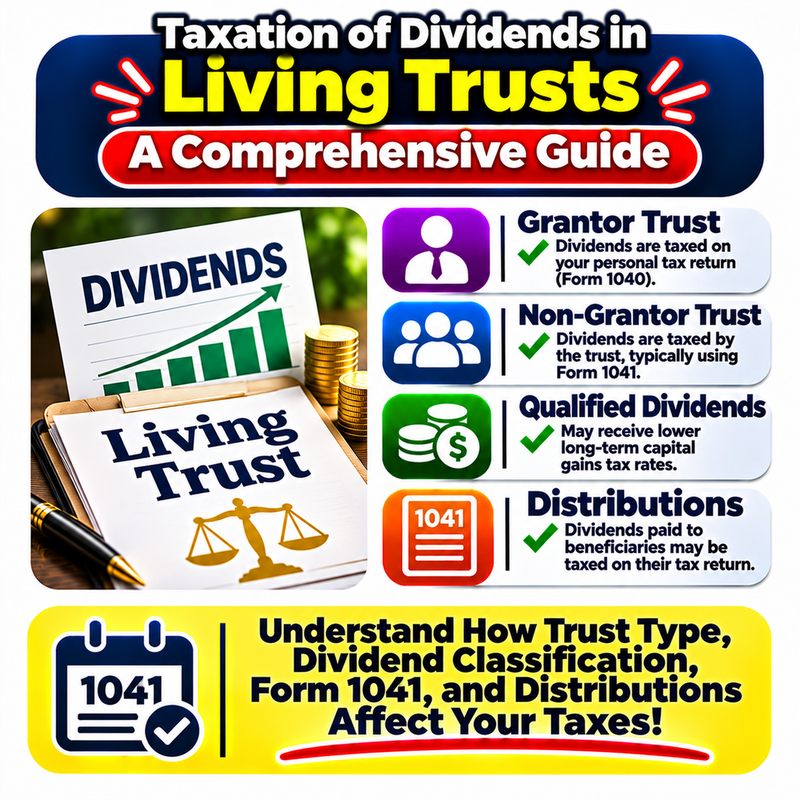
Distinguish grantor and non-grantor trust taxation, qualified dividends, Form 1041, and distributions to beneficiaries.
The Short Answer: Who Actually Pays Tax on Trust Dividends
For an ordinary revocable living trust during the grantor’s lifetime, the grantor is treated as the owner of the trust’s assets for federal income-tax purposes. That means dividend income generated by stocks, mutual funds, or ETFs titled in the trust’s name flows directly onto the grantor’s individual Form 1040, exactly as if the grantor held those shares personally. The trust itself does not file a separate income-tax return reporting that dividend income, and it does not pay tax at compressed trust rates on it.
After the grantor passes away, the picture shifts. The trust may become irrevocable under its own terms and may need to be treated as a separate taxpayer going forward. At that point, dividend income received by the trust could be reported by the trust itself, passed through to beneficiaries, or split between the two — depending on distributions, trust accounting rules, and a tax concept called distributable net income. None of this happens automatically or uniformly; it depends on the specific facts.
Why “It Depends on Grantor Status” Is the Real Rule
There’s no single blanket rule that says “trusts pay X% on dividends.” Instead, everything hinges on whether the trust is classified as a grantor trust or a nongrantor trust at the time the dividend is received. This single classification question determines which tax form applies, whose Social Security number or EIN appears on the 1099-DIV, and whether the income ultimately lands on an individual return, a fiduciary return, or both.
Grantor status isn’t necessarily tied to whether the grantor is mentally competent or actively managing the account. An ordinary revocable trust generally keeps its grantor-trust treatment even if the grantor becomes incapacitated, because the trust terms and the applicable tax rules — not day-to-day involvement — control the classification. It’s only when the trust terms cause it to become irrevocable, most commonly at the grantor’s death, that the analysis changes.

Grantor Trusts: Dividends Taxed Like You Still Own the Stock
An ordinary revocable living trust is designed so the person who created it keeps full control — the power to amend it, revoke it, add assets, or pull assets back out at any time. Because of that retained control, the IRS generally disregards the trust as a separate entity for income-tax purposes while the grantor is alive. This is what’s known as grantor trust treatment, and it’s the default status for most revocable trusts used in everyday estate planning.
Revocable Living Trusts Are Pass-Through Entities
Think of the trust as a transparent wrapper rather than a separate financial household. Income, deductions, and credits generated inside the trust pass straight through to the grantor’s personal return, as though the trust didn’t exist for tax purposes. If the trust-owned brokerage account earns $4,000 in dividends in a given year, that $4,000 shows up on the grantor’s Form 1040 — not on a separate trust filing.
This pass-through treatment also applies to any distributions the trust makes to the grantor or, in some cases, to other beneficiaries during the grantor’s lifetime. Because the IRS already treats the income as belonging to the grantor, there’s no separate layer of trust-level taxation stacked on top.
Reporting Dividends on Your Personal Form 1040
In practice, most brokerage firms issue the Form 1099-DIV using the grantor’s Social Security number, even though the account is technically titled in the name of the trust. That’s standard grantor-trust reporting procedure, and it keeps the paperwork simple: the dividend income lands on Schedule B or directly on Form 1040 just like income from a personally owned account.
Not every grantor trust uses the exact same reporting mechanics, however. Some trustees elect to obtain a separate taxpayer identification number for the trust even while it remains revocable, and attach a statement to the grantor’s return identifying the income. The end result — taxation to the grantor — stays the same, but the administrative path can look slightly different depending on how the account was set up with the custodian.
- Ordinary dividends from trust-held stock: reported on the grantor’s 1040, generally via Schedule B.
- Qualified dividends: still reported by the grantor, but potentially eligible for different tax treatment depending on holding period and source.
- Reinvested dividends: taxable to the grantor in the year paid, regardless of whether the cash was reinvested automatically.
- Capital gain distributions from mutual funds: also flow to the grantor’s return, separate from ordinary dividend income.
Why a Trust Is Not a Tax Shelter
One of the most persistent myths in estate planning is that moving dividend-paying investments into a revocable trust somehow reduces the tax owed on that income. It doesn’t. The trust is a legal arrangement for managing and transferring assets — it is not, by itself, a mechanism for lowering income tax, avoiding dividend taxation, or converting ordinary income into something more favorable.
The tax character of a dividend is set by the underlying investment and applicable tax law, not by the ownership wrapper around it. A qualified dividend from a blue-chip stock is qualified whether it’s held personally or inside a trust account; an ordinary dividend from a REIT stays ordinary either way. What changes by using a trust is who legally holds title and how the asset passes at death — not the fundamental tax treatment of the income it generates while the grantor is alive.
| Dividend Type | Where It’s Typically Reported | Key Consideration |
|---|---|---|
| Ordinary dividends | Grantor’s Form 1040 (Schedule B) | Taxed at the grantor’s regular income-tax rates |
| Qualified dividends | Grantor’s Form 1040, identified separately | May qualify for different treatment if holding-period rules are met |
| Reinvested dividends | Grantor’s Form 1040 in year received | Reinvestment does not defer or eliminate the tax |
| Capital gain distributions | Grantor’s Form 1040, separate line item | Distinct from both ordinary and qualified dividends |

Distributable Net Income and Schedule K-1 Explained
Once a trust stops being a grantor trust, the tax math changes in a way that trips up even organized trustees. The trust may now need its own Employer Identification Number and may be required to file an annual fiduciary income-tax return. If you’re a successor trustee wondering whether that step applies to the trust you’re managing, this guide on when a living trust needs to file its own tax return walks through the triggers that typically call for a separate filing, including the shift from revocable to irrevocable status at death.
How DNI Determines What Beneficiaries Report
Distributable net income, or DNI, is the tax-law number that decides how much of a trust distribution counts as taxable income to the person receiving it. It is not simply the cash the trustee hands out, and it is not the same thing as the trust’s book-keeping “accounting income.” DNI is a calculated figure — built from taxable income items like dividends, interest, and certain capital gains, adjusted by specific tax rules — that sets a ceiling on how much income a distribution can carry out to beneficiaries.
Here’s the part that catches people off guard: a trust can distribute a large sum of cash, but if DNI for the year is small, only a limited portion of that cash distribution may actually be taxable to the beneficiary. The rest may be treated as a distribution of principal, which isn’t income at all. This is why a trustee can’t just look at a bank transfer amount and assume it equals taxable income — the DNI calculation has to happen first.
Reading Your Schedule K-1 for Dividend Income
When a nongrantor trust passes taxable income out to beneficiaries, it reports each beneficiary’s share on Schedule K-1 (Form 1041). This form breaks the income into categories — ordinary dividends, qualified dividends, interest, capital gains — so the beneficiary can carry the right numbers onto their own Form 1040. The trust itself typically gets a deduction for the income it distributes, which is part of what keeps the same dollar of income from being taxed twice.
Beneficiaries should treat the K-1 the same way they’d treat a W-2 or a 1099: as the authoritative source for what to report, not a document to skim and set aside. If the K-1 shows qualified dividends in a separate box, that character generally carries through to the beneficiary’s return, assuming applicable holding-period and other requirements are independently met.
Undistributed Dividends Taxed at the Trust Level
Not every dollar of dividend income gets pushed out to beneficiaries in the year it’s earned. Trustees sometimes retain income inside the trust to cover administration costs, pending expenses, or because the trust document calls for accumulation rather than immediate distribution. When dividend income stays inside the trust rather than being distributed, the trust itself is generally responsible for reporting and paying tax on that retained portion through its own fiduciary return.
This is the piece of the puzzle that leads to the common — and incorrect — assumption that “trust dividends are always taxed at trust rates.” That’s only true for the income the trust actually retains. Distributed income shifts the tax obligation to the beneficiary through DNI and the distribution deduction; retained income stays with the trust. Both can happen in the same tax year, on the same pool of dividends, split between two different taxpayers.
| Trust Status | Who Reports Dividend Income | Key Form |
|---|---|---|
| Revocable grantor trust (lifetime) | The grantor, personally | Form 1040 |
| Nongrantor trust retaining income | The trust itself | Form 1041 |
| Nongrantor trust distributing income | Beneficiaries, up to DNI | Schedule K-1 / Form 1040 |

Dividends Versus Capital Gains Inside a Trust
Dividends and capital gains often get lumped together in casual conversation, but they’re taxed under different rules and often treated differently by trust accounting as well. A dividend is income generated by an investment the trust still owns. A capital gain is the profit realized when the trustee actually sells an appreciated asset — the stock, the fund, the property — and converts it to cash or a different investment.
This distinction matters because capital gains are frequently allocated to trust principal rather than trust accounting income, depending on the trust document and applicable state law. That means a capital gain realized by the trustee might stay inside the trust’s DNI calculation in some circumstances, or might be treated as principal and kept out of the income distributed to beneficiaries in others. There’s no universal default; the trust instrument and governing law decide.
Why Principal Distributions Are Not Taxable Income
When a trustee distributes trust principal — the original assets or their reinvested value, as opposed to income the trust generated — that distribution is generally not taxable income to the beneficiary. This is a separate concept from an inheritance itself not being taxable income, since the decedent’s estate has already accounted for transfer taxes where applicable. A trustee handing out principal shouldn’t automatically issue a K-1 treating that distribution as income unless the underlying tax analysis supports it.
How Capital Gains Allocation Differs From Dividend Income
Ordinary and qualified dividends typically flow into DNI and can be carried out to beneficiaries through distributions in the year received. Capital gains, by contrast, often remain with the trust for tax purposes unless the trust document, applicable law, or a specific circumstance directs otherwise. A trustee who assumes every brokerage sale automatically becomes taxable to the beneficiaries — the same way dividends often do — can misstate both the trust’s and the beneficiaries’ returns.

Timing Rules That Affect Your Tax Bill
The calendar matters more than most people expect when a trust is involved. Dividends received close to a tax-year boundary, or distributions made right around year-end, can shift which return — and which tax year — ends up reporting the income.
Why Distribution Timing Changes the Year Income Is Taxed
A trustee deciding whether to distribute dividend income before December 31 or wait until January isn’t just making an administrative choice — that timing can determine whether the income lands on this year’s beneficiary return or next year’s. Certain fiduciary elections allow limited flexibility in treating early-year distributions as if made in the prior tax year, but these elections carry their own eligibility rules and procedural requirements that a tax professional needs to evaluate case by case.
None of this should be treated as a guaranteed tax-reduction strategy. Shifting when income is taxed doesn’t make it disappear; it changes whose return it appears on and in which year. Trustees who try to time distributions without professional guidance risk creating mismatches between what the brokerage reports and what the trust’s fiduciary return shows.
Qualified Distributions for Education or Medical Expenses
Some trust documents specifically authorize distributions tied to a beneficiary’s education or medical costs, and depending on how the trust is drafted and the applicable tax rules, these distributions can carry their own treatment separate from ordinary income distributions. This is highly dependent on the specific trust language — it’s not a universal feature of every living trust — so trustees should confirm what their particular document actually authorizes before assuming special treatment applies.
Worked Example: One Trust, Two Beneficiaries, One Death
Consider a hypothetical settlor, Karen, who funded her revocable living trust years ago with a mix of dividend-paying blue-chip stocks and a few mutual funds. This example is entirely fictional and used only to illustrate how the mechanics typically work.
While the Settlor Is Alive: Dividends on the Settlor’s Return
Every year Karen is alive, the brokerage firm issues a 1099-DIV under her Social Security number for the trust-held account, even though the account is titled “Karen Smith, Trustee of the Karen Smith Revocable Living Trust.” The dividends — some ordinary, some qualified, some reinvested automatically into additional shares — all land on Karen’s personal Form 1040 each year. Because the trust is a grantor trust during her lifetime, there’s no separate trust return and no trust-level tax on this income.
When some of Karen’s dividends are automatically reinvested, she still owes tax on them in the year they’re paid, exactly as if she’d received cash and bought more shares herself. Her trustee — in this case, Karen acting as her own trustee — keeps records of each reinvestment: date, share count, and cost-basis adjustment, which will matter later when shares are eventually sold.
After Death: Splitting Dividend Income Between Two Beneficiaries
After Karen passes away, her adult children, Mark and Lisa, are named as successor co-trustees and equal beneficiaries. Mark and Lisa confirm their authority under the trust document, gather the trust agreement and recent brokerage statements, and identify which dividends were paid before Karen’s death (reportable on her final individual return) versus after (potentially reportable by the trust). They consult a CPA about obtaining a new EIN and determining whether Form 1041 filing obligations now apply.
Some dividend income is retained in the trust to cover appraisal fees and administration costs; the rest is distributed to Mark and Lisa according to the trust’s terms. The CPA calculates DNI for the year, applies the distribution deduction, and issues each sibling a Schedule K-1 reflecting their share of reportable dividend income — which may not match the cash each received dollar-for-dollar, since some of that cash represents principal rather than income. If Mark and Lisa had assumed every dollar distributed was automatically tax-free, or that every retained dividend was automatically taxed at trust rates, both assumptions would have led to an incorrect tax return.

Documents and Decisions Checklist
Good recordkeeping is the difference between a smooth fiduciary filing and a scramble every April. Trustees — whether managing a living grantor trust or stepping in after a death — benefit from organizing documentation early rather than reconstructing it under deadline pressure.
The following checklist covers the core items worth confirming before dividend income gets reported anywhere:
- Confirm legal ownership and account titling of all dividend-paying investments
- Review the trust agreement, including successor trustee powers and distribution terms
- Verify brokerage account registration matches the trust’s name correctly
- Coordinate beneficiary designations with the overall estate plan
- Gather current and historical Forms 1099-DIV for the relevant tax years
- Preserve purchase dates, reinvestment records, and cost-basis adjustments
- Identify which dividends are qualified versus ordinary for reporting purposes
- Document the date-of-death transition and any new tax ID requirements
- Determine whether fiduciary Form 1041 reporting is now required
- Keep detailed records of all distributions made to each beneficiary
- Review Schedule K-1 reporting obligations before filing season
- Consult qualified legal and tax professionals before complex distributions
Records to Pull From Brokerage Statements
At minimum, a trustee needs monthly or annual brokerage statements showing dividend payments, reinvestment transactions, and any sales of securities. Cost-basis reports — often available directly from the custodian — are essential for calculating gain or loss accurately when shares are eventually sold, whether by the grantor during life or by a successor trustee afterward.
Key Questions for Your CPA or Fiduciary Specialist
Before assuming how dividend income should be reported, it’s worth asking a tax professional directly: Has the trust’s classification actually changed from grantor to nongrantor status? Does the trust need a new EIN, and if so, effective when? What is this year’s DNI calculation, and how does it affect the distribution deduction? Which dividends retain qualified-dividend character once they pass through to a beneficiary’s Schedule K-1? These are not questions to guess at — they shape every subsequent filing.
Common Mistakes Trustees and Beneficiaries Make
Dividend taxation in trusts isn’t inherently complicated, but a handful of recurring errors turn a routine filing into a correction nightmare. Most of these mistakes trace back to one root cause: treating the trust as if it behaves the same way before and after the grantor’s death.
The good news is that these errors are predictable, which means they’re also avoidable with a bit of upfront diligence. A closer look at the breakdown of how irrevocable trusts calculate and distribute taxable income shows just how differently ordinary income, capital gains, and qualified distributions can be handled once a trust shifts away from grantor status — which is exactly where many trustees go wrong.
Confusing Grantor and Nongrantor Tax Rules
The single most common error is assuming that because a trust exists, it must file its own tax return and pay its own tax on every dollar of dividend income. During the grantor’s life, that’s typically backward — the grantor reports the income personally, and no separate trust return is required for that income. Trustees who apply nongrantor rules too early can misreport income or needlessly complicate a simple filing.
The reverse mistake happens just as often after death: a successor trustee keeps using the grantor’s Social Security number on brokerage paperwork for months after the trust has become irrevocable, simply because nobody flagged the change. This can create mismatched 1099-DIV reporting that takes extra effort to untangle with the IRS and the custodian later.
Missing the Window to File Form 1041
Once a trust becomes a separate taxpayer, fiduciary income-tax obligations don’t wait for the trustee to feel ready. Missing the filing window for Form 1041, or failing to realize a filing is required at all, is a frequent and avoidable misstep — particularly in estates where dividend-paying accounts were a smaller piece of a larger, more complex portfolio that didn’t immediately draw attention.
This is also where distinguishing ordinary income from capital gains becomes critical, since the two are frequently treated differently in trust accounting. A clear explanation of how trust principal distributions differ from taxable interest and dividend income can help a trustee avoid lumping everything into one category when the trust’s own records and 1041 filing need them separated.
When to Bring in a Living Trust Attorney
Not every trust administration requires an attorney for the tax piece specifically — that’s typically a CPA’s territory — but plenty of situations call for both. If the trust document itself is ambiguous about how income versus principal should be allocated, if there’s a dispute among beneficiaries about distribution timing, or if the trust includes unusual provisions like a generation-skipping feature, a living trust attorney can help interpret what the document actually requires before the CPA applies the tax rules to it.
Trustees shouldn’t wait until a dispute erupts to get this guidance. A short conversation early in the administration process, confirming how the trust document treats dividend income versus principal, can prevent months of back-and-forth later.

Frequently Asked Questions
Who pays taxes on dividends earned by a revocable living trust?
While the grantor is alive, the grantor generally pays the tax, because an ordinary revocable living trust is treated as a grantor trust for federal income-tax purposes. The dividend income flows onto the grantor’s personal Form 1040 regardless of whether it’s spent, saved, or reinvested inside the trust account. After the grantor’s death, the trust’s classification can change, and reporting responsibility may shift to the trust itself or to the beneficiaries, depending on distributions and applicable rules.
Are qualified dividends taxed differently from ordinary dividends in a trust?
Qualified dividends can be eligible for different federal tax treatment than ordinary dividends when specific holding-period and source requirements are met, whether the shares are held personally or inside a trust. This distinction doesn’t disappear once a trust becomes a nongrantor entity; qualified-dividend character can carry through to beneficiaries via Schedule K-1, subject to applicable rules. Not every ordinary dividend qualifies, so brokerage statements and fiduciary records need to be checked carefully each year.
Are reinvested dividends taxable when held in a living trust?
Yes. Automatic dividend reinvestment doesn’t erase the tax consequence of the original dividend payment — it simply uses that already-taxable income to purchase more shares. Whoever is responsible for reporting the dividend, whether the grantor during life or the trust and beneficiaries afterward, still owes tax on it in the year it was paid, even though no cash left the account.
Does a revocable living trust file its own income-tax return?
Generally, no, while the grantor is alive and the trust remains a grantor trust — the income is reported on the grantor’s individual return instead. After the grantor’s death, the trust may become irrevocable and may be required to file its own fiduciary return, Form 1041, depending on its new tax classification and the income it generates or retains.
What happens to dividend taxation when the grantor dies?
The trust may lose its grantor-trust status and become a separate taxpayer under applicable law, which can mean obtaining a new EIN and filing fiduciary income-tax returns going forward. The trustee must sort out which dividends were received before death, reportable on the grantor’s final individual return, versus those received afterward, which may be reportable by the trust or passed through to beneficiaries. For more information, you can learn about trust laws and taxes.
When does a nongrantor trust need to file Form 1041?
A nongrantor trust generally needs to evaluate Form 1041 filing obligations once it has its own taxable income or gross income above applicable thresholds, which commonly happens once it’s no longer treated as a grantor trust. The specific triggers depend on the trust’s income, structure, and current IRS rules, so this determination should be confirmed with a tax professional rather than assumed.
What is distributable net income, and how does it affect dividends?
Distributable net income, or DNI, is a tax-law calculation that caps how much of a trust distribution can be treated as taxable income to a beneficiary. It is not the same as the trust’s accounting income or the raw amount of cash distributed. Dividend income generally feeds into the DNI calculation, which then determines how much of any distribution carries taxable dividend income out to beneficiaries versus staying with the trust.
How are trust dividends reported to beneficiaries on Schedule K-1?
When a nongrantor trust distributes income within its DNI limits, it issues each beneficiary a Schedule K-1 (Form 1041) breaking out their share of ordinary dividends, qualified dividends, interest, and other income categories. Beneficiaries use these figures to complete their own Form 1040, and the characterization on the K-1 — qualified versus ordinary, for instance — generally carries over to the beneficiary’s return.
Are capital gains treated the same as dividends in a trust?
Not necessarily. Capital gains realized when a trustee sells appreciated securities are often allocated to trust principal rather than trust accounting income, depending on the trust document and governing state law, which can keep them separate from the DNI calculation that applies to dividends. Dividends and capital gains should be analyzed separately rather than assumed to follow identical rules.
Can putting dividend-paying investments in a living trust reduce estate taxes?
No. Assets held in an ordinary revocable living trust generally remain part of the grantor’s taxable estate for federal estate-tax purposes, since the grantor retains control over the trust during life. Placing dividend-paying stocks or funds into this type of trust does not, by itself, reduce federal estate tax, and it’s a separate question entirely from the income-tax treatment of the dividends themselves.
Get Your Trust’s Dividend Reporting Right From the Start
The core distinction to carry away from all of this is simple, even if the mechanics underneath it aren’t: while the grantor is alive, dividends earned by an ordinary revocable living trust are generally taxed to the grantor personally, and after death, the trust’s classification and applicable fiduciary rules determine who reports what. Qualified dividends, ordinary dividends, capital gains, and principal distributions are four different concepts, and treating them as interchangeable is where most reporting errors begin.
Start by pulling your trust-owned brokerage statements and recent Forms 1099-DIV, confirm that your successor trustee has clear access to those records, and schedule time with a qualified tax professional to review any post-death filing responsibilities before assumptions turn into mistakes on a return. If you’re still mapping out how your trust should be structured or funded in the first place, the Free Estate Planning Webinar is a useful starting point for understanding how these pieces fit together.
Bulletproof Legacy Financial helps families cut through exactly this kind of complexity by connecting them with the right professionals to handle trust funding, administration, and tax questions correctly from day one.