Bonds in a Living Trust: Ownership and Tax Treatment
Learn how bond titling, interest income, municipal bond treatment, and trust administration affect planning decisions.
Can you actually move Treasury bonds, municipal bonds, and corporate bonds into your revocable living trust, and does doing so change how Uncle Sam taxes the interest? The short answer is yes to the first question and generally no to the second — a trust can hold almost any bond you already own, but the IRS still taxes that interest the same way it always has.
That distinction trips up a lot of retirees who assume that “trust-owned” automatically means “tax-advantaged.” Before you start retitling brokerage accounts, it helps to get a clear picture of what actually changes and what stays exactly the same. If you want a second set of eyes on how your specific holdings fit into an estate plan, a free consultation is often a good low-pressure way to ask institution-specific questions before you move anything.
Key Takeaways
- Bonds in a living trust generally keep their original tax character — a revocable trust is not a tax shelter and doesn’t convert taxable interest into tax-free income.
- Treasury bond interest remains federally taxable and typically exempt from state income tax regardless of who holds legal title.
- Municipal bonds can retain their federal tax-exempt status inside a trust, but private activity bonds may still create alternative minimum tax exposure for the grantor.
- A successor trustee’s recordkeeping — purchase dates, cost basis, accrued interest, maturity schedules — determines how smoothly tax reporting goes after the grantor passes away, which we’ll walk through using a realistic example.
- Plans like the eState Living Trust package include ordinary funding assistance for titling assets into a trust, though bond-specific tax questions typically still call for a CPA or tax adviser.
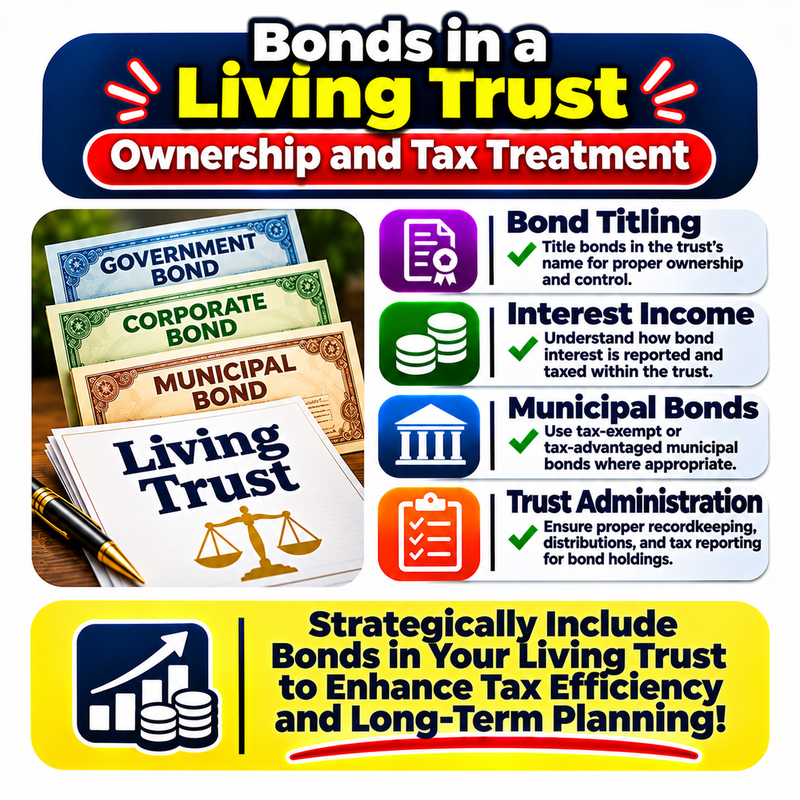
Retitling a bond into a trust is a paperwork and ownership exercise, not an investment strategy. It affects who controls the asset and how smoothly it transfers to beneficiaries — it doesn’t rewrite the tax code for that particular security. Understanding where the line falls between “ownership change” and “tax change” is the whole key to integrating bonds into a living trust without creating surprises down the road.
Treasury, municipal, and corporate bonds behave differently once you start asking tax questions, and a trust doesn’t erase those differences. This article walks through ownership mechanics, income-tax treatment while you’re alive, what changes after death, and the practical steps a successor trustee needs to follow.
Every bond you own has two separate stories: who legally owns it, and how the IRS taxes the income it produces. A living trust changes the first story. It almost never changes the second. Keeping those two threads separate is the single most useful mental model for this entire topic, and it’s one that gets lost when people treat “put it in the trust” as a one-size-fits-all fix for taxes, probate, and investment performance all at once.
Bonds are also not a uniform asset class for titling purposes. A Treasury note held directly through TreasuryDirect follows different transfer rules than a municipal bond sitting inside a brokerage account, and a corporate bond certificate held in direct registration follows yet another set of procedures. Before funding a trust with any of these, it’s worth understanding the mechanics section by section, because the process — and sometimes the eligibility — varies by security type and by institution.
Trust Ownership Does Not Change How Your Bonds Are Taxed
A revocable living trust is, for most practical and tax purposes, an extension of you. The living trust itself doesn’t own assets in the way a corporation or an irrevocable trust does — you retain the ability to amend it, revoke it, and pull assets back out whenever you want. Because of that retained control, the IRS generally looks straight through the trust and continues taxing you personally on the income the trust assets generate, bonds included.
Why Retitling a Bond Does Not Alter Its Tax Character
Think of a municipal bond’s tax-exempt status or a corporate bond’s taxable interest as baked into the security itself, not into whoever’s name sits on the account statement. Changing the registered owner from “John Smith” to “John Smith, Trustee of the John Smith Revocable Living Trust” doesn’t touch the bond’s issuer, its terms, or the federal tax code provisions that determine how its interest gets taxed. The bond doesn’t know — or care — that it moved into a trust.
What Actually Changes When You Fund a Trust With Bonds
What does shift is administrative: who can instruct the custodian, who has signing authority, and who steps in to manage the asset if you become incapacitated or pass away. Retitling also typically keeps the bond out of probate court, since the trust — not your individual name — holds legal title when you die. That’s a meaningful administrative benefit, but it’s separate from, and shouldn’t be confused with, any change in income-tax exposure.
Grantor Trust Status and Your Bond Interest
For federal income-tax purposes, an ordinary revocable living trust is classified as a “grantor trust” while you’re alive. This isn’t a special election you make — it’s the default result of retaining control over the trust. Because of grantor trust status, the trust itself typically doesn’t file its own tax return or pay its own tax on bond interest during your lifetime.
Instead, interest income flows straight back to you, the grantor, exactly as it did before you created the trust. If you had $20,000 in combined bond interest last year, moving those bonds into a revocable trust this year doesn’t create a second, separate taxpayer to report half of it. You still report all of it, under your own Social Security number, on your personal Form 1040.
This is a point worth repeating because it gets misunderstood so often: a grantor trust is a legal and administrative structure, not an income-tax-reduction device. The IRS’s grantor trust rules exist specifically to prevent people from using revocable trusts to shift taxable income away from themselves while they still control the assets.
| Situation | Who Reports the Bond Interest | Tax Form Typically Used |
|---|---|---|
| Bond held individually, grantor alive | The individual owner | Form 1040, Schedule B |
| Bond retitled into revocable trust, grantor alive | The grantor (same person) | Form 1040, Schedule B (often using grantor’s SSN) |
| Bond held by trust after grantor’s death | The trust as a separate taxpayer, or beneficiaries if distributed | Form 1041, possibly Schedule K-1 to beneficiaries |
How a Revocable Living Trust Is Treated While You’re Alive
Because the trust is disregarded for income-tax purposes during your lifetime, most financial institutions allow 1099 forms to continue being issued under the grantor’s Social Security number even after the account is retitled in the trust’s name. Some custodians instead issue the 1099 under the trust’s name and the grantor’s Taxpayer Identification Number — the underlying reporting obligation is the same either way, but the paperwork can look slightly different depending on the institution’s internal procedures.
Reporting Bond Interest Under Your Own Social Security Number
It’s worth double-checking your first 1099-INT or 1099-OID after any bond gets retitled. Confirm the taxpayer identification number on the form matches what you expect, and reconcile the account title shown with the trust document. A mismatch here isn’t usually a tax disaster, but it’s exactly the kind of detail that creates confusion — or an unnecessary IRS notice — if nobody catches it early.
What Changes for Tax Reporting After the Grantor Dies
Everything above describes the lifetime picture. Once the grantor dies, the revocable trust typically stops being a grantor trust and may need its own Employer Identification Number and its own fiduciary income-tax return. We’ll cover that transition — and why it matters for a successor trustee — later in this article, but it’s useful to flag now: the “disregarded entity” simplicity of a living trust is a lifetime feature, not a permanent one.
Before diving into Treasury-specific rules, it’s worth noting that tax treatment for trust-owned property doesn’t always track in the way people assume. For example, placing a home into a living trust raises a completely different set of questions — whether a house held in trust affects property tax assessments depends on state law and local assessment rules, which is a separate issue entirely from how bond interest gets taxed. The lesson carries across asset types: trust ownership interacts differently with every category of tax law, and bonds are no exception.

Treasury Bonds Inside a Living Trust
U.S. Treasury securities — bills, notes, bonds, and Treasury Inflation-Protected Securities — are a common holding for retirees who want predictable income with minimal credit risk. Moving them into a trust is possible, but the transfer mechanics depend heavily on how you currently hold them.
If your Treasury securities sit in a brokerage account, retitling often follows the same process as any other brokerage asset: you provide the custodian with a Certification of Trust, your trust’s tax identification details, and instructions to retitle the account. If instead you hold securities directly through TreasuryDirect, the process is different and not automatically identical across every security type or account configuration.
Don’t assume every TreasuryDirect holding transfers the same way. Some account structures and security types have their own registration and transfer requirements, and TreasuryDirect’s own procedures should be confirmed directly rather than assumed based on general brokerage practices. This is one area where it pays to call and verify rather than guess.
| Treasury Holding Method | General Transfer Approach | What to Verify |
|---|---|---|
| Brokerage-held Treasury securities | Standard account retitling using trust documentation | Custodian’s Certification of Trust requirements |
| TreasuryDirect account | Varies by account type and security; not uniform | Current TreasuryDirect rules for your specific holding |
| Paper/direct registration securities | May require separate reissue or transfer paperwork | Issuer or transfer agent instructions |
Retitling Treasury Securities Through TreasuryDirect
Because TreasuryDirect transfer procedures can change and vary by circumstance, this article won’t attempt to walk through a specific step-by-step process. What matters is the principle: confirm directly with TreasuryDirect or your financial institution what documentation is required, and don’t assume a brokerage-style Certification of Trust automatically satisfies every system’s requirements.
Why Treasury Interest Stays Fully Taxable at the Federal Level
Regardless of how the retitling process goes, Treasury interest remains subject to federal income tax whether it’s held individually or inside a revocable trust. Nothing about trust ownership exempts this interest from federal taxation. Depending on the specific security, you may also encounter:
- Coupon interest paid on a regular schedule for notes and bonds
- Original issue discount accounting for Treasury bills and certain other discount instruments
- Market discount or acquisition premium if the security was purchased after issuance at a price different from face value
- Capital gain or loss if the security is sold before maturity rather than held to redemption
Each of these components can require separate tracking, and a trust’s ownership doesn’t simplify or eliminate any of them. If anything, moving bonds into a trust makes clean recordkeeping more important, since a successor trustee will eventually need to reconstruct this same information without the benefit of having made the original purchase decisions.
State Tax Treatment of Treasury Bond Interest
One genuine advantage of Treasury securities — one that trust ownership doesn’t disturb — is that interest on qualifying U.S. Treasury obligations is generally exempt from state and local income tax, subject to each state’s specific rules. This exemption exists because of federal law governing Treasury obligations, not because of anything related to trust ownership. A trust holding Treasury bonds in a state with no such carve-out wouldn’t gain this benefit, and a trust holding them in a state that honors the exemption doesn’t lose it. The bond’s legal character travels with the bond, not with the name on the account.
Because rules can vary by state and by the specific type of security, it’s worth confirming current treatment with a tax professional familiar with your state’s income-tax code rather than relying on a general rule of thumb. This matters more for retirees who split time between states or who are evaluating whether a move affects their overall tax picture.
Even after confirming the state-tax treatment of Treasury interest, retirees holding municipal bonds face a different — and often more confusing — set of rules once those bonds move into a trust.

Municipal Bonds: Tax-Exempt Status and the AMT Trap
Municipal bonds are popular with retirees precisely because qualifying interest is often exempt from regular federal income tax. That exemption is a feature of the bond itself — tied to the issuer and the bond’s specific terms — not a feature that depends on who holds title to the account. A revocable trust doesn’t add tax-exempt status to a bond that doesn’t already qualify, and it doesn’t strip tax-exempt status from one that does.
How Municipal Bond Interest Retains Its Federal Tax-Exempt Status in Trust
If your municipal bond interest was exempt from regular federal income tax before you funded the trust, it generally remains exempt afterward, assuming the bond itself hasn’t changed and the grantor trust rules still apply. The trust is disregarded for income-tax purposes during your lifetime, so the exemption simply passes through to you exactly as it did when you held the bond individually.
Private Activity Bonds and Alternative Minimum Tax Exposure
Not every municipal bond is created equal, though. Some municipal bonds — particularly certain private activity bonds issued to finance projects like airports, housing developments, or hospitals — generate interest that, while still exempt from regular federal income tax, may be treated as a preference item for alternative minimum tax purposes. This has nothing to do with trust ownership. It’s baked into the classification of the bond itself, and it applies whether you hold the bond directly or through a revocable trust.
Retirees sometimes assume that because a bond is labeled “municipal,” it’s automatically free of every possible tax consequence. That’s an oversimplification. A bond’s prospectus or official statement typically identifies whether it’s a private activity bond, and this detail is worth confirming with a tax professional rather than assuming based on the general “municipal bond” label.
State and Local Tax Treatment Varies by Bond Source
Municipal bond interest is often — but not universally — exempt from tax in the state where the bond was issued, while interest from an out-of-state municipal bond may be fully taxable at the state level. A retiree holding bonds issued by their home state alongside bonds issued elsewhere may see very different state tax treatment between the two, even though both are “municipal bonds” and both sit inside the same trust. This is exactly the kind of detail that gets overlooked when people assume uniform treatment across an entire asset category.
| Municipal Bond Feature | Federal Tax Treatment | Trust Ownership Effect |
|---|---|---|
| Qualifying general obligation municipal bond | Interest typically exempt from regular federal income tax | No change; exemption passes through |
| Private activity municipal bond | May be a preference item for AMT purposes | No change; AMT exposure follows the bond, not the owner |
| Taxable municipal bond | Interest fully taxable federally | No change; remains taxable in trust |
| Out-of-state municipal bond | Federal exemption may apply; state exemption often does not | No change; state treatment depends on issuing state and your residency |
Corporate Bonds and Fully Taxable Interest
Corporate bonds don’t carry any of the tax-exemption complexity that comes with municipal bonds, but they bring their own set of considerations once they sit inside a trust. Interest from corporate bonds is fully taxable at the federal level, and depending on your state of residence, it may also be taxable at the state level.
Why Corporate Bond Interest Is Always Taxable Regardless of Trust Ownership
Unlike Treasury securities, corporate bonds receive no special exemption from state income tax, and unlike qualifying municipal bonds, they receive no exemption from federal income tax. Trust ownership doesn’t change any of this. The interest is reported the same way it would be if you held the bond directly, flowing through to your personal return under grantor trust rules while you’re alive.
Trust ownership also doesn’t neutralize the underlying investment risks that come with corporate debt. A trustee — whether that’s you during your lifetime or a successor trustee after your death — still has to manage credit risk, interest-rate risk, and liquidity risk exactly as any bondholder would. A revocable living trust is a legal and administrative structure; it has no bearing on whether the issuing corporation makes its coupon payments or whether the bond’s market price moves against you before maturity.
Comparing After-Tax Yield Across Bond Types Held in Trust
Because Treasury, municipal, and corporate bonds carry different federal and state tax treatments, the same stated interest rate can produce very different after-tax results depending on which type of bond generates it and which state you live in. Retirees evaluating a diversified fixed-income portfolio inside a trust should compare after-tax, not just stated, yields — and that comparison should be made with current rate and tax information from a qualified adviser rather than assumptions carried over from years past. A trust doesn’t change this math; it just means the comparison needs to happen before and after retitling, since the underlying holdings and their tax characteristics remain the same.

Accrued Interest and Original Issue Discount Explained
Beyond the big-picture question of taxable versus tax-exempt interest, bonds come with smaller mechanical details that matter enormously for accurate tax reporting — and these details don’t disappear just because a bond moves into a trust.
Two of the most commonly misunderstood concepts are accrued interest and original issue discount. Both affect how much income gets reported and when, and both require careful recordkeeping that a successor trustee will eventually need to rely on if they weren’t the one who originally purchased the bond.
How Accrued Interest at Purchase Affects Your Cost Basis
When a bond is purchased between its regular interest payment dates, the buyer typically pays the seller an amount representing interest that has accrued since the last payment. This accrued interest paid at purchase isn’t itself new taxable income to the buyer — it’s generally treated as an offset against the next interest payment received, which affects how much of that payment actually counts as taxable interest versus a return of the amount already paid. Getting this wrong is a common source of overstated interest income on tax returns, particularly when purchase records get lost in a transfer to a trust.
Original Issue Discount Rules for Zero-Coupon and Discount Bonds
Some bonds — zero-coupon Treasury securities and certain corporate issues among them — are sold at a price below face value with no regular coupon payments at all. The difference between the purchase price and the face value, known as original issue discount, is generally required to be recognized as taxable income over the life of the bond, even though no cash interest payment is actually received each year. This can catch retirees off guard: you can owe tax on income you haven’t received in cash, and a trust holding this type of bond doesn’t change that requirement.
Why These Details Matter More After a Trust Becomes Irrevocable
While you’re alive and the trust remains revocable, you’re the one reporting all of this income, and you presumably have access to your own purchase records. Once the trust becomes irrevocable — typically at your death — a successor trustee inherits the responsibility for continuing to track accrued interest, original issue discount, premium amortization, and market discount, often without having been present for the original purchase decisions. Complete records made available before that transition can save a successor trustee significant time and expense reconstructing basis information from scratch.
Maturity, Liquidity, and Trust Distribution Planning
Bonds don’t last forever, and a trust’s administration timeline rarely lines up perfectly with a bond’s maturity schedule. Planning for this mismatch is one of the more practical — and frequently overlooked — aspects of holding bonds in a living trust.
Matching Bond Maturities to Anticipated Trust Distributions
If a trust’s terms call for specific distributions at set times — say, annual payments to a beneficiary, or a lump-sum distribution once estate administration wraps up — it helps to know when individual bonds mature relative to those obligations. A bond maturing well before a planned distribution gives a trustee flexibility to reinvest or hold cash. A bond maturing well after creates a choice: sell before maturity, potentially at a loss or gain relative to face value, or find another way to meet the distribution need.
This is less about predicting markets and more about basic cash-flow planning. A grantor funding a trust with bonds today should think through, in general terms, how the bond maturities line up with what the trust is expected to do down the road — understanding that trust terms and family circumstances can change even when the bond schedule doesn’t.
Retirees who ladder bonds — staggering maturities across several years — often find this approach translates well into a trust context, since it naturally spreads out liquidity events rather than concentrating them all at once.
A properly funded trust doesn’t eliminate the need to think about cash flow. It just changes who’s responsible for thinking about it — you during your lifetime, and a successor trustee afterward.
Handling a Bond That Matures Before the Trust Settles
It’s fairly common for a bond to mature while a trust is still being administered after the grantor’s death — bills and notes in particular often have maturities measured in months or a few years. When this happens, the proceeds typically become cash held by the trust, and the trustee needs to decide whether to reinvest, distribute, or hold the funds pending further administration, consistent with the trust’s terms and the trustee’s fiduciary duties.
Laddering Strategies for Trustees Managing Fixed Income
A successor trustee stepping into an existing bond ladder doesn’t need to overhaul it immediately. In many cases, the simplest and most prudent approach is to let existing bonds mature on schedule, redeploying proceeds only as administration needs require, rather than making wholesale changes to a portfolio built with a particular strategy in mind. Fiduciary investment duties generally call for prudence and, where appropriate, diversification — not necessarily rapid liquidation of a reasonable existing strategy.
Successor Trustee Recordkeeping Responsibilities
A successor trustee stepping in after the grantor’s death or incapacity faces a learning curve, and bonds tend to be one of the more document-heavy categories of trust assets to administer well.
The core task is reconstructing, as completely as possible, the story of each bond: when it was purchased, for how much, what its terms are, and how much interest or discount income has already been recognized for tax purposes. Missing pieces of this puzzle don’t necessarily create legal problems, but they do create extra work — and sometimes extra cost — in working with tax professionals to fill gaps.
Documents a Successor Trustee Needs for Every Bond Holding
- Original purchase confirmation or trade statement showing purchase date and price
- Current brokerage or custodian statements confirming the bond is correctly titled in the trust’s name
- Prior years’ Form 1099-INT or 1099-OID showing reported interest or discount income
- The bond’s official statement or prospectus, particularly for municipal bonds, to confirm private activity bond status
- A record of any premium paid or discount received at purchase, along with any amortization already applied
- Maturity date and any call provisions that could cause early redemption
Gathering these documents while the grantor is still alive and able to answer questions is far easier than trying to reconstruct them after the fact. This is one of the simplest, highest-value steps a retiree can take when integrating bonds into a living trust — not because it changes the tax outcome, but because it prevents administrative headaches later.
Tracking Basis, Purchase Date, and Accrued Interest Over Time
Cost basis tracking matters for determining gain or loss if a bond is sold before maturity, and it matters again at the grantor’s death, when date-of-death values come into play for certain basis adjustments. Not every component of a bond’s value receives the same basis treatment at death, and the specific rules depend on the type of security and how it’s held — another reason individualized tax review is worth the cost for larger or more complex bond portfolios.
Preparing for a Final Fiduciary Income Tax Return
Once the grantor dies, a revocable trust often stops being treated as a grantor trust and may need to obtain its own Employer Identification Number, separate from the deceased grantor’s Social Security number. Depending on the trust’s income and distributions, this can trigger a requirement to file Form 1041, a fiduciary income-tax return, for income earned by trust assets — bonds included — after the date of death. This is separate from the grantor’s final individual income-tax return, which covers income earned up through the date of death. Because filing requirements depend on the specific facts of each trust, confirming the applicable rules with a tax professional is a standard and sensible step for any successor trustee.
| Tax Period | Return Filed | Taxpayer ID Typically Used |
|---|---|---|
| Income earned before grantor’s death | Grantor’s final Form 1040 | Grantor’s Social Security number |
| Income earned by trust after death (if applicable) | Form 1041, fiduciary return | Trust’s own EIN |
| Income distributed to beneficiaries | Schedule K-1 issued to beneficiary | Beneficiary’s own Social Security number |
It’s worth repeating that none of this fiduciary income-tax reporting has anything to do with federal estate tax. Estate tax, where it applies, is assessed against the value of the decedent’s overall estate; fiduciary income tax is assessed against income the trust’s assets generate after death. A successor trustee managing bond interest and filing a Form 1041, if required, isn’t automatically taking on any estate-tax liability by doing so.

Worked Example: Moving a Retiree’s Bond Portfolio Into a Funded Trust
To see how all of this plays out in practice, consider a hypothetical retiree — we’ll call her Diane, a fictional example used purely for illustration. Diane is 68, recently widowed, and has decided to set up a revocable living trust to simplify management of her assets and keep them out of probate for her two adult children.
Diane’s fixed-income holdings aren’t complicated by industry standards, but they do span the three major categories this article has covered, which makes her situation a useful walkthrough. For more information on how trusts can be beneficial for obtaining tax benefits, consider reading further.
Starting Point: A Treasury Bond Holding and a Municipal Bond Portfolio
- A 10-year Treasury note held directly through a TreasuryDirect account, purchased several years ago
- A diversified municipal bond portfolio held in a brokerage account, including bonds issued by her home state and a few out-of-state issuers
- One private activity municipal bond she’d forgotten she owned, purchased as part of a bundled municipal bond fund years earlier
- A small corporate bond position in a well-known company’s debt, also held in the brokerage account
Diane’s attorney helps her establish the trust and confirms its terms give the trustee — initially Diane herself, and later her named successor — clear authority to hold, manage, and transfer investment assets including bonds. With the trust document in hand, Diane turns to the practical work of funding it.
For her brokerage account, Diane’s financial institution requests a Certification of Trust along with a completed account retitling form. The municipal bonds and the corporate bond transfer without being sold — the account simply changes ownership designation from Diane individually to Diane as trustee of her trust. For the Treasury note, Diane learns that her TreasuryDirect account requires a separate process, and she contacts TreasuryDirect directly rather than assuming the brokerage paperwork will work the same way. It takes a few extra weeks, but the note is eventually retitled into the trust as well.
Step-by-Step Retitling Process for Each Bond Type
Before finalizing anything, Diane reviews her existing beneficiary designations and account titles to make sure nothing conflicts with the trust. She discovers that her brokerage account had a transfer-on-death designation naming her children directly — a leftover from years earlier. Had she left this in place, it could have bypassed the trust entirely at her death, regardless of the trust’s own instructions, since TOD designations generally control over trust terms for that specific account. She updates the designation to remove the conflict, ensuring the account will actually pass according to her trust’s terms rather than the old TOD instruction.
Diane also gathers her original purchase confirmations, noting that she bought the corporate bond at a slight premium to face value and the Treasury note near par. She keeps a simple folder — physical and digital — with these records alongside her trust documents, so her successor trustee won’t have to search for them later.
What Happens to the Interest Income After Funding
After the retitling is complete, Diane’s tax situation doesn’t change. Her Treasury note interest remains fully taxable federally and exempt from her state’s income tax, just as before. Her qualifying municipal bond interest remains exempt from regular federal income tax, though she now understands that her previously forgotten private activity bond may need to be factored into any alternative minimum tax calculation — a detail her tax preparer flags and addresses using her existing documentation. Her corporate bond interest remains fully taxable at both the federal and state level, exactly as it was before the trust owned the account.
Years later, Diane passes away while her Treasury note still has two years left before maturity. Her successor trustee — her older son — locates the folder Diane prepared, confirms the trust’s EIN application with the help of an estate-planning attorney, and works with a CPA to determine whether a Form 1041 is required for the period after Diane’s death. Because the note matures mid-administration, the proceeds become trust cash, which the trustee holds until final distributions are made to Diane’s children, consistent with the trust’s terms. The documentation Diane left behind turns what could have been a confusing reconstruction project into a straightforward handoff — illustrating why organized records matter as much as the retitling itself.
Decision Checklist Before You Retitle Bonds Into a Trust
Before moving any bond into a living trust, it helps to work through a short checklist rather than handling each account on an ad hoc basis. This keeps the process organized and reduces the chance of overlooking a conflicting beneficiary designation or missing cost-basis record.
Use this as a starting point, understanding that your specific institutions and bond types may require additional steps beyond what’s listed here.
Documents to Gather for Each Bond Holding
Start by pulling together everything related to each bond: current statements, original purchase confirmations, prior years’ tax forms, and — for municipal bonds — the official statement or prospectus identifying whether it’s a private activity bond. Having these in one place before contacting any institution speeds up the retitling conversation considerably and gives your eventual successor trustee a head start.
From there, confirm your revocable living trust document’s language actually authorizes the trustee to hold and manage investment-type assets like bonds, inventory every account and direct holding you currently have, contact each custodian or TreasuryDirect directly to confirm their specific transfer requirements, check for and resolve any conflicting TOD or POD designations, and confirm with your tax adviser that your understanding of each bond’s tax treatment is accurate before and after the move. Ask your estate-planning attorney whether the trust document needs any updates to clearly cover investment assets, ask your financial institution exactly what documentation they require and how long the process typically takes, and ask your tax adviser whether any of your specific bonds — particularly private activity municipal bonds — carry AMT implications worth factoring into your broader tax picture.

Bond Taxation Rules Don’t Change—Your Planning Clarity Does
Integrating Treasury, municipal, and corporate bonds into a living trust is largely an ownership and administration decision — one that can simplify management and help avoid probate for these assets, provided the retitling is done correctly with each institution’s specific requirements in mind. The tax character of the interest itself, however, follows the bond and applicable law, not the name on the account, so coordinating trust terms, account titles, beneficiary designations, and recordkeeping remains the real work.
Start by inventorying what you currently own, confirm how each bond is registered, and talk through transfer procedures and tax documentation with your financial institution and a qualified adviser — and if you’d like help thinking through how bond funding fits into a broader plan, a free estate planning webinar can be a useful next step.
Tax Questions to Answer Before Funding the Trust
Before you call your brokerage or TreasuryDirect, sit down and answer a short list of tax questions so you’re not guessing later. Does the bond generate taxable interest, potentially tax-exempt interest, or some combination through original issue discount? Is there a premium or discount baked into your purchase price that needs amortizing or recognizing over time? And critically — does your state tax this particular type of interest, or does it fall under an exemption?
Write the answers down alongside your bond records. It sounds basic, but retirees who skip this step often end up reconstructing the same information a year later when a 1099 looks unfamiliar or a successor trustee asks a question nobody can answer. A five-minute review now saves a much longer conversation with a tax preparer down the road.
Professionals Who Should Review Your Plan
Three professionals typically touch this process, each with a different job. An estate-planning attorney confirms your trust document actually authorizes the trustee to hold and manage bonds and other investment assets. Your financial institution — brokerage or TreasuryDirect — confirms its own transfer and titling requirements, which can differ from what worked for a different account or a different person’s trust. And a CPA or tax adviser confirms how each specific bond’s interest is taxed, both before and after the move, including any AMT exposure from private activity municipal bonds. None of these three can fully substitute for the others.
Common Mistakes When Placing Bonds in a Living Trust
Most of the problems that show up with trust-owned bonds aren’t legal disasters — they’re avoidable oversights that create confusion, extra paperwork, or an unpleasant tax surprise. Knowing the common ones ahead of time is the easiest way to sidestep them.
Assuming Trust Ownership Creates Tax-Free Income
This is the single most common misunderstanding, and it’s worth repeating one more time plainly: a revocable living trust does not convert taxable interest into tax-free interest. Treasury and corporate bond interest stays taxable. Municipal bond interest keeps whatever exemption it already had — no more, no less. If a bond was taxable the day before you funded the trust, it’s taxable the day after.
Forgetting to Update Beneficiary Designations on Savings Bonds
Many retirees hold savings bonds or brokerage accounts with a payable-on-death or transfer-on-death designation already in place, often set up years before the trust existed. These designations generally control over trust instructions for that specific asset, which means a bond with an old POD beneficiary can bypass the trust entirely at death — regardless of what the trust document says.
This creates a mismatch between what you intended and what actually happens. A trust built to distribute assets evenly among three children won’t do that if one bond quietly passes directly to a single named beneficiary through an outdated TOD designation.
The fix is simple but easy to forget: review every bond account’s beneficiary designation at the same time you retitle it into the trust, and update or remove conflicting designations so the trust’s terms actually govern.
Overlooking State-Specific Municipal Bond Rules
Municipal bond tax treatment is one of the more state-dependent corners of this topic, and it’s easy to assume uniform rules when none exist. A bond issued by your home state may be exempt from your state’s income tax, while a bond issued by a neighboring state generating the same type of interest may be fully taxable where you live.
Retirees who split time between two states, or who move during retirement, should revisit this question whenever their residency changes. State tax rules don’t follow you automatically just because the trust stayed the same.
When to Bring in a Tax Attorney, CPA, or Fiduciary Specialist
Not every bond transfer needs a specialist. A single Treasury note moving into a straightforward revocable trust is usually simple enough to handle with your attorney and brokerage alone. But certain situations call for more specialized help.
Consider bringing in additional expertise when your bond portfolio includes private activity municipal bonds with possible AMT exposure, when you hold bonds across multiple states with varying tax treatment, when a trust is approaching the point where it becomes irrevocable and may need its own EIN, or when a successor trustee is stepping in without complete purchase records.
A short list of situations that typically justify a specialist’s time:
- Significant original issue discount or market discount holdings requiring careful basis tracking
- Private activity bonds where AMT exposure needs to be weighed against overall tax planning
- A grantor’s death triggering the need for an EIN and a first fiduciary income-tax return
- Incomplete or missing purchase records for inherited or long-held bond positions
- Bonds held across state lines with inconsistent state tax treatment
When any of these apply, the cost of a CPA’s time is almost always smaller than the cost of an avoidable tax-reporting mistake.

Frequently Asked Questions
Here are answers to the questions retirees ask most often when they’re deciding whether and how to move bonds into a living trust.
These responses are general and educational — your own situation should still be confirmed with your attorney, financial institution, and tax adviser before you act.
Does putting a bond in a living trust make the interest tax-free?
No. A revocable living trust doesn’t change a bond’s underlying tax character. Taxable interest from Treasury or corporate bonds stays taxable, and tax-exempt municipal bond interest keeps whatever exemption it already had. The trust is a legal ownership structure, not a tax-exemption tool.
Can I retitle a Treasury bond into my revocable trust myself?
| Holding Type | Typical Next Step |
|---|---|
| Brokerage-held Treasury securities | Submit Certification of Trust and retitling form directly to custodian |
| TreasuryDirect account | Contact TreasuryDirect to confirm current transfer requirements for your specific account type |
In many cases, yes — but the process depends entirely on how the security is currently held. Brokerage-held Treasury securities usually follow standard trust retitling paperwork, similar to any other brokerage asset.
Trusts can be beneficial for obtaining tax benefits that would not otherwise be available. TreasuryDirect accounts are a different story. Transfer requirements there can vary based on the account type and the specific security, so it’s worth confirming directly with TreasuryDirect rather than assuming the brokerage process applies.
If you run into confusion or the institution asks for documentation your attorney didn’t anticipate, that’s a good signal to loop your attorney back in rather than guessing at what satisfies the requirement.
Are municipal bonds in a trust still exempt from federal tax?
Generally, yes, if the bond itself qualified for federal tax exemption before the transfer. The trust doesn’t add or remove this status — it simply holds legal title while the bond’s own characteristics determine its tax treatment.
That said, “municipal bond” isn’t a single uniform category. Some municipal bonds are fully taxable, and private activity bonds can carry AMT implications even while technically exempt from regular federal income tax.
Because of this variation, it’s worth checking the specific bond’s official statement rather than assuming based on the general label.
- Qualifying general obligation municipal bonds: typically exempt from regular federal tax
- Private activity municipal bonds: may still be a preference item for AMT purposes
- Taxable municipal bonds: fully taxable at the federal level despite being labeled “municipal”
What happens to bond interest reporting after I die?
While you’re alive, bond interest is reported under grantor trust rules, typically using your own Social Security number. After death, the trust may stop being a grantor trust, potentially requiring a new EIN and a fiduciary income-tax return, Form 1041, for income earned by the trust’s assets going forward — separate from your final personal return covering income through the date of death. For more information on how trusts can be beneficial for obtaining tax benefits, visit our detailed guide.
Does a revocable trust help avoid the alternative minimum tax on bonds?
No. AMT exposure from certain private activity municipal bonds is tied to the bond itself, not to who holds title to it. A revocable trust doesn’t shield bond interest from AMT consideration, and it doesn’t create AMT exposure where none existed before.
Who tracks accrued interest and original issue discount after I’m gone?
Your successor trustee takes on this responsibility, typically with help from a CPA or tax preparer. This is exactly why keeping organized purchase records, prior tax forms, and notes on premiums or discounts matters — it gives your successor trustee a running start instead of a blank page.
Without those records, reconstructing basis and discount information after the fact is possible but often more time-consuming and costly, especially for bonds purchased many years earlier.
Should I ladder bond maturities differently once bonds are in a trust?
Not necessarily. An existing, well-constructed bond ladder often continues to work fine inside a trust, and a successor trustee can usually let bonds mature on schedule rather than restructuring the portfolio immediately. The bigger priority is making sure maturities reasonably align with the trust’s anticipated distribution needs.
Can a successor trustee be held liable for bond recordkeeping errors?
| Scenario | General Fiduciary Expectation |
|---|---|
| Trustee acts prudently with available records | Generally consistent with fiduciary duty |
| Trustee ignores available records or acts carelessly | May raise fiduciary liability concerns |
A successor trustee is generally held to a standard of prudence, not perfection. Acting carefully with the information reasonably available, and seeking professional help when records are incomplete, is typically consistent with fiduciary duty.
Liability concerns tend to arise less from honest gaps in decades-old paperwork and more from carelessness — ignoring available records, failing to seek professional guidance when something is unclear, or acting against the trust’s stated terms.
This is part of why documentation matters so much on the front end. A well-organized bond file doesn’t just make tax reporting easier; it also gives a successor trustee a clear paper trail showing diligent administration.
When records are genuinely missing, bringing in a CPA or estate attorney to help reconstruct what’s reasonably possible is itself a prudent step, not an admission of failure.
Does the eState living trust package help with retitling bonds?
The eState Living Trust plan includes ordinary trust funding assistance as part of its $2,995 offering, which can help with standard asset retitling processes. It isn’t designed to replace individualized tax advice, CPA services, or specialized handling for TreasuryDirect accounts, brokerage-specific requirements, or bond-level tax questions — those pieces typically still call for your tax adviser or financial institution directly.
When should I consult a CPA instead of relying on trust documents alone?
Trust documents establish legal ownership and administration authority — they don’t answer tax questions. Any time you’re unsure how a specific bond’s interest is taxed, whether AMT applies, or how to handle accrued interest and original issue discount, that’s a CPA conversation, not something the trust paperwork itself can resolve.
Can Treasury bonds be placed in a revocable living trust?
Yes, in most cases. Treasury securities held through a brokerage account typically transfer using standard trust retitling documentation, such as a Certification of Trust. Treasury securities held directly through TreasuryDirect may follow a different process depending on the account type and security, so it’s worth confirming the specific requirements directly with TreasuryDirect rather than assuming a single uniform procedure applies to every holding.
Does transferring bonds into a living trust change their income-tax treatment?
Generally, no. A revocable living trust is typically treated as a grantor trust during the grantor’s lifetime, meaning the IRS continues taxing bond interest to the grantor personally, exactly as before the transfer. The bond’s underlying tax character — taxable or potentially tax-exempt — doesn’t change simply because a trust now holds legal title to it.
Is municipal bond interest always tax-free when held in a trust?
Not necessarily. Municipal bond interest that qualifies for federal tax exemption generally keeps that exemption inside a trust, but the exemption depends on the bond itself, not on trust ownership. Some municipal bonds are fully taxable, and private activity bonds can trigger alternative minimum tax considerations even while remaining exempt from regular federal income tax. Always verify a specific bond’s characteristics rather than relying on the general label.
Can municipal bond interest create alternative minimum tax considerations?
Yes, in certain cases. Interest from some private activity municipal bonds, while exempt from regular federal income tax, may be treated as a tax preference item for alternative minimum tax purposes. Not all municipal bonds trigger this issue — it depends on the bond’s classification. Reviewing your municipal bond holdings with a tax professional can clarify whether any of your specific bonds carry this exposure.
How is corporate bond interest reported while the grantor is alive?
Corporate bond interest held in a revocable living trust is generally reported the same way it was before the trust existed — under grantor trust rules, the income flows through to the grantor’s personal income-tax return. Form 1099-INT typically reports this interest, and it remains fully taxable at the federal level, with state taxation depending on the grantor’s state of residence.
Can TreasuryDirect securities be transferred into a trust?
Many TreasuryDirect-held securities can be transferred into a properly structured trust, but the process isn’t identical across every account type or security. Rather than assuming a single standard procedure, confirm directly with TreasuryDirect what documentation and steps apply to your specific holdings before attempting the transfer.
What happens when a trust-owned bond matures?
When a bond held in a trust reaches maturity, the proceeds typically become trust cash, which the trustee then manages according to the trust’s terms — whether that means reinvesting, holding for upcoming distributions, or distributing to beneficiaries. If maturity occurs during administration after the grantor’s death, the trustee needs to factor this into fiduciary tax reporting and distribution planning.
What records should a successor trustee retain for bonds?
A successor trustee should retain purchase confirmations, current account statements, prior tax forms like 1099-INT or 1099-OID, bond prospectuses or official statements, records of any premium or discount at purchase, and maturity or call date information. These records support accurate tax reporting and help establish cost basis for any future sale or redemption.
Does a trust need a new EIN or Form 1041 after the owner dies?
Often, yes, though this depends on the specific trust and its circumstances. A revocable trust frequently stops being treated as a grantor trust at the grantor’s death, which can require obtaining a new Employer Identification Number and filing a fiduciary income-tax return, Form 1041, for income earned afterward. A tax professional can confirm the specific filing requirements that apply to a given trust.
Does transferring bonds into a living trust reduce federal estate taxes?
Not on its own. Moving bonds into an ordinary revocable living trust doesn’t remove them from the grantor’s taxable estate, since the grantor retains control over the trust during their lifetime. Federal estate tax is a separate issue from income-tax reporting on bond interest, and a revocable trust by itself isn’t an estate-tax reduction strategy.
Bond Taxation Rules Don’t Change—Your Planning Clarity Does
Treasury, municipal, and corporate bonds can all generally be held inside a properly funded revocable living trust, and doing so can simplify management and help keep these assets out of probate. What doesn’t change is the tax character of the interest itself — that follows the bond and applicable federal and state law, not the name on the account title.
The real work in integrating bonds into a living trust isn’t chasing a tax break that doesn’t exist. It’s coordinating trust terms, account titles, beneficiary designations, and recordkeeping so that your successor trustee inherits clarity instead of confusion.
Start with a simple inventory: list every bond you own, confirm how each is currently registered, and reach out to your financial institution and a qualified tax adviser about transfer procedures before you make any changes — and if you’d like guidance on how this fits into a broader estate plan, Bulletproof Legacy Financial’s educational resources through Create A Living Trust are a reasonable place to start that conversation.