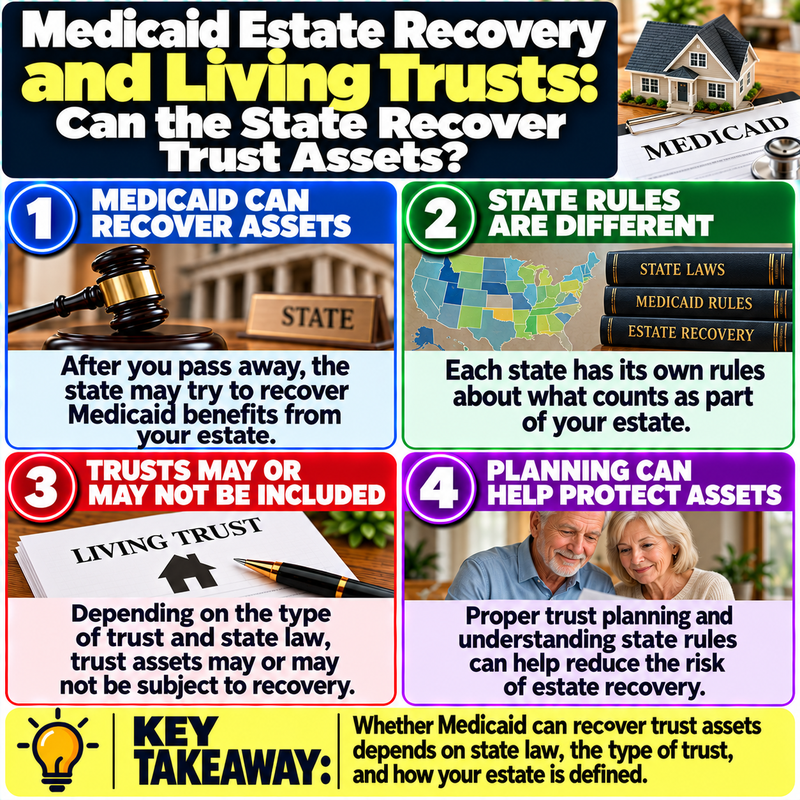
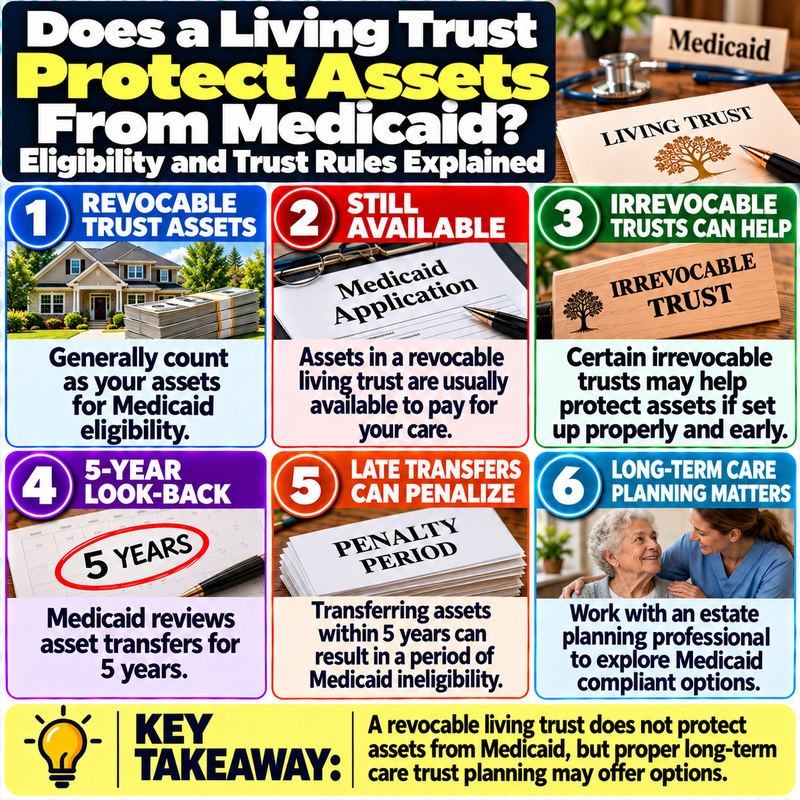
Category: Trust Laws & Taxes

Explore legal and tax considerations involving living trusts, including state trust laws, estate and income taxes, asset protection, Medicaid considerations and other rules that may affect an estate plan.

  • Taxation of Dividends in Living Trusts: A Comprehensive Guide

    Taxation of Dividends in Living Trusts: A Comprehensive Guide

    How Dividends Are Taxed in Living Trusts

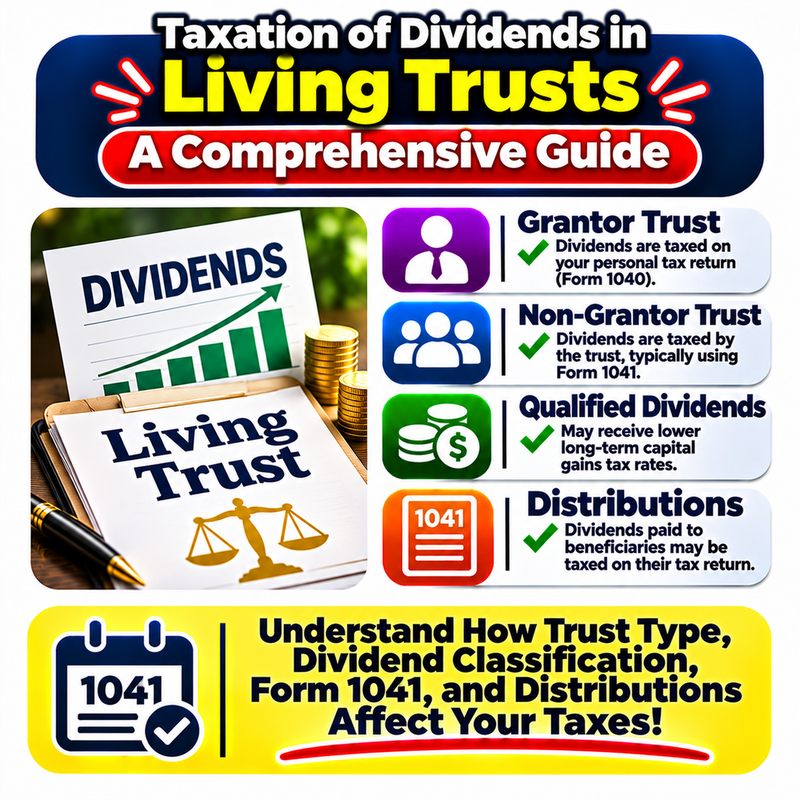
    Distinguish grantor and non-grantor trust taxation, qualified dividends, Form 1041, and distributions to beneficiaries.

    How Dividends Are Taxed in Living Trusts

    Who actually owes the tax bill when a living trust collects a dividend check? The short answer: while you’re alive and in charge of your own revocable trust, you do. Once that trust changes hands after death, the answer gets more complicated fast.

    Dividend taxation in living trusts trips up more families than almost any other post-death administration task, mostly because people assume a trust is its own separate taxpayer the moment it’s signed. That’s rarely true for an ordinary revocable trust. The team at Bulletproof Legacy Financial regularly fields questions from successor trustees who are stunned to learn that a trust holding Apple or Vanguard index fund shares doesn’t automatically shield dividend income from the grantor’s personal tax return — and later, doesn’t automatically shift to trust-level rates either. If you want a plain-language walkthrough of how this actually works before you touch a brokerage statement, a free consultation can help you sort out where your specific trust stands.

    Key Takeaways

    • While the grantor is alive, dividend income earned inside a revocable living trust is generally reported on the grantor’s personal Form 1040 — not taxed separately at trust rates.
    • Not every dividend is created equal: ordinary dividends, qualified dividends, and capital gain distributions each follow different tax rules, even when held in the same trust account.
    • After the grantor dies, the trust may become a separate taxpayer requiring its own EIN and a Form 1041 filing, depending on the trust’s terms and applicable law.
    • Distributable net income (DNI) — not the cash amount distributed — determines how much dividend income beneficiaries must report on their own returns via Schedule K-1.
    • Reinvested dividends, capital gains from selling shares, and distributions of trust principal are not interchangeable concepts, and mixing them up is one of the most common trustee mistakes.
    Dividend-Taxation-In-Living-Trusts

    Distinguish grantor and non-grantor trust taxation, qualified dividends, Form 1041, and distributions to beneficiaries.

    The Short Answer: Who Actually Pays Tax on Trust Dividends

    For an ordinary revocable living trust during the grantor’s lifetime, the grantor is treated as the owner of the trust’s assets for federal income-tax purposes. That means dividend income generated by stocks, mutual funds, or ETFs titled in the trust’s name flows directly onto the grantor’s individual Form 1040, exactly as if the grantor held those shares personally. The trust itself does not file a separate income-tax return reporting that dividend income, and it does not pay tax at compressed trust rates on it.

    After the grantor passes away, the picture shifts. The trust may become irrevocable under its own terms and may need to be treated as a separate taxpayer going forward. At that point, dividend income received by the trust could be reported by the trust itself, passed through to beneficiaries, or split between the two — depending on distributions, trust accounting rules, and a tax concept called distributable net income. None of this happens automatically or uniformly; it depends on the specific facts.

    Why “It Depends on Grantor Status” Is the Real Rule

    There’s no single blanket rule that says “trusts pay X% on dividends.” Instead, everything hinges on whether the trust is classified as a grantor trust or a nongrantor trust at the time the dividend is received. This single classification question determines which tax form applies, whose Social Security number or EIN appears on the 1099-DIV, and whether the income ultimately lands on an individual return, a fiduciary return, or both.

    Grantor status isn’t necessarily tied to whether the grantor is mentally competent or actively managing the account. An ordinary revocable trust generally keeps its grantor-trust treatment even if the grantor becomes incapacitated, because the trust terms and the applicable tax rules — not day-to-day involvement — control the classification. It’s only when the trust terms cause it to become irrevocable, most commonly at the grantor’s death, that the analysis changes.

    Grantor Trusts: Dividends Taxed Like You Still Own the Stock

    An ordinary revocable living trust is designed so the person who created it keeps full control — the power to amend it, revoke it, add assets, or pull assets back out at any time. Because of that retained control, the IRS generally disregards the trust as a separate entity for income-tax purposes while the grantor is alive. This is what’s known as grantor trust treatment, and it’s the default status for most revocable trusts used in everyday estate planning.

    Revocable Living Trusts Are Pass-Through Entities

    Think of the trust as a transparent wrapper rather than a separate financial household. Income, deductions, and credits generated inside the trust pass straight through to the grantor’s personal return, as though the trust didn’t exist for tax purposes. If the trust-owned brokerage account earns $4,000 in dividends in a given year, that $4,000 shows up on the grantor’s Form 1040 — not on a separate trust filing.

    This pass-through treatment also applies to any distributions the trust makes to the grantor or, in some cases, to other beneficiaries during the grantor’s lifetime. Because the IRS already treats the income as belonging to the grantor, there’s no separate layer of trust-level taxation stacked on top.

    Reporting Dividends on Your Personal Form 1040

    In practice, most brokerage firms issue the Form 1099-DIV using the grantor’s Social Security number, even though the account is technically titled in the name of the trust. That’s standard grantor-trust reporting procedure, and it keeps the paperwork simple: the dividend income lands on Schedule B or directly on Form 1040 just like income from a personally owned account.

    Not every grantor trust uses the exact same reporting mechanics, however. Some trustees elect to obtain a separate taxpayer identification number for the trust even while it remains revocable, and attach a statement to the grantor’s return identifying the income. The end result — taxation to the grantor — stays the same, but the administrative path can look slightly different depending on how the account was set up with the custodian.

    • Ordinary dividends from trust-held stock: reported on the grantor’s 1040, generally via Schedule B.
    • Qualified dividends: still reported by the grantor, but potentially eligible for different tax treatment depending on holding period and source.
    • Reinvested dividends: taxable to the grantor in the year paid, regardless of whether the cash was reinvested automatically.
    • Capital gain distributions from mutual funds: also flow to the grantor’s return, separate from ordinary dividend income.

    Why a Trust Is Not a Tax Shelter

    One of the most persistent myths in estate planning is that moving dividend-paying investments into a revocable trust somehow reduces the tax owed on that income. It doesn’t. The trust is a legal arrangement for managing and transferring assets — it is not, by itself, a mechanism for lowering income tax, avoiding dividend taxation, or converting ordinary income into something more favorable.

    The tax character of a dividend is set by the underlying investment and applicable tax law, not by the ownership wrapper around it. A qualified dividend from a blue-chip stock is qualified whether it’s held personally or inside a trust account; an ordinary dividend from a REIT stays ordinary either way. What changes by using a trust is who legally holds title and how the asset passes at death — not the fundamental tax treatment of the income it generates while the grantor is alive.

    Dividend TypeWhere It’s Typically ReportedKey Consideration
    Ordinary dividendsGrantor’s Form 1040 (Schedule B)Taxed at the grantor’s regular income-tax rates
    Qualified dividendsGrantor’s Form 1040, identified separatelyMay qualify for different treatment if holding-period rules are met
    Reinvested dividendsGrantor’s Form 1040 in year receivedReinvestment does not defer or eliminate the tax
    Capital gain distributionsGrantor’s Form 1040, separate line itemDistinct from both ordinary and qualified dividends

    Distributable Net Income and Schedule K-1 Explained

    Once a trust stops being a grantor trust, the tax math changes in a way that trips up even organized trustees. The trust may now need its own Employer Identification Number and may be required to file an annual fiduciary income-tax return. If you’re a successor trustee wondering whether that step applies to the trust you’re managing, this guide on when a living trust needs to file its own tax return walks through the triggers that typically call for a separate filing, including the shift from revocable to irrevocable status at death.

    How DNI Determines What Beneficiaries Report

    Distributable net income, or DNI, is the tax-law number that decides how much of a trust distribution counts as taxable income to the person receiving it. It is not simply the cash the trustee hands out, and it is not the same thing as the trust’s book-keeping “accounting income.” DNI is a calculated figure — built from taxable income items like dividends, interest, and certain capital gains, adjusted by specific tax rules — that sets a ceiling on how much income a distribution can carry out to beneficiaries.

    Here’s the part that catches people off guard: a trust can distribute a large sum of cash, but if DNI for the year is small, only a limited portion of that cash distribution may actually be taxable to the beneficiary. The rest may be treated as a distribution of principal, which isn’t income at all. This is why a trustee can’t just look at a bank transfer amount and assume it equals taxable income — the DNI calculation has to happen first.

    Reading Your Schedule K-1 for Dividend Income

    When a nongrantor trust passes taxable income out to beneficiaries, it reports each beneficiary’s share on Schedule K-1 (Form 1041). This form breaks the income into categories — ordinary dividends, qualified dividends, interest, capital gains — so the beneficiary can carry the right numbers onto their own Form 1040. The trust itself typically gets a deduction for the income it distributes, which is part of what keeps the same dollar of income from being taxed twice.

    Beneficiaries should treat the K-1 the same way they’d treat a W-2 or a 1099: as the authoritative source for what to report, not a document to skim and set aside. If the K-1 shows qualified dividends in a separate box, that character generally carries through to the beneficiary’s return, assuming applicable holding-period and other requirements are independently met.

    Undistributed Dividends Taxed at the Trust Level

    Not every dollar of dividend income gets pushed out to beneficiaries in the year it’s earned. Trustees sometimes retain income inside the trust to cover administration costs, pending expenses, or because the trust document calls for accumulation rather than immediate distribution. When dividend income stays inside the trust rather than being distributed, the trust itself is generally responsible for reporting and paying tax on that retained portion through its own fiduciary return.

    This is the piece of the puzzle that leads to the common — and incorrect — assumption that “trust dividends are always taxed at trust rates.” That’s only true for the income the trust actually retains. Distributed income shifts the tax obligation to the beneficiary through DNI and the distribution deduction; retained income stays with the trust. Both can happen in the same tax year, on the same pool of dividends, split between two different taxpayers.

    Trust StatusWho Reports Dividend IncomeKey Form
    Revocable grantor trust (lifetime)The grantor, personallyForm 1040
    Nongrantor trust retaining incomeThe trust itselfForm 1041
    Nongrantor trust distributing incomeBeneficiaries, up to DNISchedule K-1 / Form 1040

    Dividends Versus Capital Gains Inside a Trust

    Dividends and capital gains often get lumped together in casual conversation, but they’re taxed under different rules and often treated differently by trust accounting as well. A dividend is income generated by an investment the trust still owns. A capital gain is the profit realized when the trustee actually sells an appreciated asset — the stock, the fund, the property — and converts it to cash or a different investment.

    This distinction matters because capital gains are frequently allocated to trust principal rather than trust accounting income, depending on the trust document and applicable state law. That means a capital gain realized by the trustee might stay inside the trust’s DNI calculation in some circumstances, or might be treated as principal and kept out of the income distributed to beneficiaries in others. There’s no universal default; the trust instrument and governing law decide.

    Why Principal Distributions Are Not Taxable Income

    When a trustee distributes trust principal — the original assets or their reinvested value, as opposed to income the trust generated — that distribution is generally not taxable income to the beneficiary. This is a separate concept from an inheritance itself not being taxable income, since the decedent’s estate has already accounted for transfer taxes where applicable. A trustee handing out principal shouldn’t automatically issue a K-1 treating that distribution as income unless the underlying tax analysis supports it.

    How Capital Gains Allocation Differs From Dividend Income

    Ordinary and qualified dividends typically flow into DNI and can be carried out to beneficiaries through distributions in the year received. Capital gains, by contrast, often remain with the trust for tax purposes unless the trust document, applicable law, or a specific circumstance directs otherwise. A trustee who assumes every brokerage sale automatically becomes taxable to the beneficiaries — the same way dividends often do — can misstate both the trust’s and the beneficiaries’ returns.

    Timing Rules That Affect Your Tax Bill

    The calendar matters more than most people expect when a trust is involved. Dividends received close to a tax-year boundary, or distributions made right around year-end, can shift which return — and which tax year — ends up reporting the income.

    Why Distribution Timing Changes the Year Income Is Taxed

    A trustee deciding whether to distribute dividend income before December 31 or wait until January isn’t just making an administrative choice — that timing can determine whether the income lands on this year’s beneficiary return or next year’s. Certain fiduciary elections allow limited flexibility in treating early-year distributions as if made in the prior tax year, but these elections carry their own eligibility rules and procedural requirements that a tax professional needs to evaluate case by case.

    None of this should be treated as a guaranteed tax-reduction strategy. Shifting when income is taxed doesn’t make it disappear; it changes whose return it appears on and in which year. Trustees who try to time distributions without professional guidance risk creating mismatches between what the brokerage reports and what the trust’s fiduciary return shows.

    Qualified Distributions for Education or Medical Expenses

    Some trust documents specifically authorize distributions tied to a beneficiary’s education or medical costs, and depending on how the trust is drafted and the applicable tax rules, these distributions can carry their own treatment separate from ordinary income distributions. This is highly dependent on the specific trust language — it’s not a universal feature of every living trust — so trustees should confirm what their particular document actually authorizes before assuming special treatment applies.

    Worked Example: One Trust, Two Beneficiaries, One Death

    Consider a hypothetical settlor, Karen, who funded her revocable living trust years ago with a mix of dividend-paying blue-chip stocks and a few mutual funds. This example is entirely fictional and used only to illustrate how the mechanics typically work.

    While the Settlor Is Alive: Dividends on the Settlor’s Return

    Every year Karen is alive, the brokerage firm issues a 1099-DIV under her Social Security number for the trust-held account, even though the account is titled “Karen Smith, Trustee of the Karen Smith Revocable Living Trust.” The dividends — some ordinary, some qualified, some reinvested automatically into additional shares — all land on Karen’s personal Form 1040 each year. Because the trust is a grantor trust during her lifetime, there’s no separate trust return and no trust-level tax on this income.

    When some of Karen’s dividends are automatically reinvested, she still owes tax on them in the year they’re paid, exactly as if she’d received cash and bought more shares herself. Her trustee — in this case, Karen acting as her own trustee — keeps records of each reinvestment: date, share count, and cost-basis adjustment, which will matter later when shares are eventually sold.

    After Death: Splitting Dividend Income Between Two Beneficiaries

    After Karen passes away, her adult children, Mark and Lisa, are named as successor co-trustees and equal beneficiaries. Mark and Lisa confirm their authority under the trust document, gather the trust agreement and recent brokerage statements, and identify which dividends were paid before Karen’s death (reportable on her final individual return) versus after (potentially reportable by the trust). They consult a CPA about obtaining a new EIN and determining whether Form 1041 filing obligations now apply.

    Some dividend income is retained in the trust to cover appraisal fees and administration costs; the rest is distributed to Mark and Lisa according to the trust’s terms. The CPA calculates DNI for the year, applies the distribution deduction, and issues each sibling a Schedule K-1 reflecting their share of reportable dividend income — which may not match the cash each received dollar-for-dollar, since some of that cash represents principal rather than income. If Mark and Lisa had assumed every dollar distributed was automatically tax-free, or that every retained dividend was automatically taxed at trust rates, both assumptions would have led to an incorrect tax return.

    Documents and Decisions Checklist

    Good recordkeeping is the difference between a smooth fiduciary filing and a scramble every April. Trustees — whether managing a living grantor trust or stepping in after a death — benefit from organizing documentation early rather than reconstructing it under deadline pressure.

    The following checklist covers the core items worth confirming before dividend income gets reported anywhere:

    • Confirm legal ownership and account titling of all dividend-paying investments
    • Review the trust agreement, including successor trustee powers and distribution terms
    • Verify brokerage account registration matches the trust’s name correctly
    • Coordinate beneficiary designations with the overall estate plan
    • Gather current and historical Forms 1099-DIV for the relevant tax years
    • Preserve purchase dates, reinvestment records, and cost-basis adjustments
    • Identify which dividends are qualified versus ordinary for reporting purposes
    • Document the date-of-death transition and any new tax ID requirements
    • Determine whether fiduciary Form 1041 reporting is now required
    • Keep detailed records of all distributions made to each beneficiary
    • Review Schedule K-1 reporting obligations before filing season
    • Consult qualified legal and tax professionals before complex distributions

    Records to Pull From Brokerage Statements

    At minimum, a trustee needs monthly or annual brokerage statements showing dividend payments, reinvestment transactions, and any sales of securities. Cost-basis reports — often available directly from the custodian — are essential for calculating gain or loss accurately when shares are eventually sold, whether by the grantor during life or by a successor trustee afterward.

    Key Questions for Your CPA or Fiduciary Specialist

    Before assuming how dividend income should be reported, it’s worth asking a tax professional directly: Has the trust’s classification actually changed from grantor to nongrantor status? Does the trust need a new EIN, and if so, effective when? What is this year’s DNI calculation, and how does it affect the distribution deduction? Which dividends retain qualified-dividend character once they pass through to a beneficiary’s Schedule K-1? These are not questions to guess at — they shape every subsequent filing.

    Common Mistakes Trustees and Beneficiaries Make

    Dividend taxation in trusts isn’t inherently complicated, but a handful of recurring errors turn a routine filing into a correction nightmare. Most of these mistakes trace back to one root cause: treating the trust as if it behaves the same way before and after the grantor’s death.

    The good news is that these errors are predictable, which means they’re also avoidable with a bit of upfront diligence. A closer look at the breakdown of how irrevocable trusts calculate and distribute taxable income shows just how differently ordinary income, capital gains, and qualified distributions can be handled once a trust shifts away from grantor status — which is exactly where many trustees go wrong.

    Confusing Grantor and Nongrantor Tax Rules

    The single most common error is assuming that because a trust exists, it must file its own tax return and pay its own tax on every dollar of dividend income. During the grantor’s life, that’s typically backward — the grantor reports the income personally, and no separate trust return is required for that income. Trustees who apply nongrantor rules too early can misreport income or needlessly complicate a simple filing.

    The reverse mistake happens just as often after death: a successor trustee keeps using the grantor’s Social Security number on brokerage paperwork for months after the trust has become irrevocable, simply because nobody flagged the change. This can create mismatched 1099-DIV reporting that takes extra effort to untangle with the IRS and the custodian later.

    Missing the Window to File Form 1041

    Once a trust becomes a separate taxpayer, fiduciary income-tax obligations don’t wait for the trustee to feel ready. Missing the filing window for Form 1041, or failing to realize a filing is required at all, is a frequent and avoidable misstep — particularly in estates where dividend-paying accounts were a smaller piece of a larger, more complex portfolio that didn’t immediately draw attention.

    This is also where distinguishing ordinary income from capital gains becomes critical, since the two are frequently treated differently in trust accounting. A clear explanation of how trust principal distributions differ from taxable interest and dividend income can help a trustee avoid lumping everything into one category when the trust’s own records and 1041 filing need them separated.

    When to Bring in a Living Trust Attorney

    Not every trust administration requires an attorney for the tax piece specifically — that’s typically a CPA’s territory — but plenty of situations call for both. If the trust document itself is ambiguous about how income versus principal should be allocated, if there’s a dispute among beneficiaries about distribution timing, or if the trust includes unusual provisions like a generation-skipping feature, a living trust attorney can help interpret what the document actually requires before the CPA applies the tax rules to it.

    Trustees shouldn’t wait until a dispute erupts to get this guidance. A short conversation early in the administration process, confirming how the trust document treats dividend income versus principal, can prevent months of back-and-forth later.

    Frequently Asked Questions

    Who pays taxes on dividends earned by a revocable living trust?

    While the grantor is alive, the grantor generally pays the tax, because an ordinary revocable living trust is treated as a grantor trust for federal income-tax purposes. The dividend income flows onto the grantor’s personal Form 1040 regardless of whether it’s spent, saved, or reinvested inside the trust account. After the grantor’s death, the trust’s classification can change, and reporting responsibility may shift to the trust itself or to the beneficiaries, depending on distributions and applicable rules.

    Are qualified dividends taxed differently from ordinary dividends in a trust?

    Qualified dividends can be eligible for different federal tax treatment than ordinary dividends when specific holding-period and source requirements are met, whether the shares are held personally or inside a trust. This distinction doesn’t disappear once a trust becomes a nongrantor entity; qualified-dividend character can carry through to beneficiaries via Schedule K-1, subject to applicable rules. Not every ordinary dividend qualifies, so brokerage statements and fiduciary records need to be checked carefully each year.

    Are reinvested dividends taxable when held in a living trust?

    Yes. Automatic dividend reinvestment doesn’t erase the tax consequence of the original dividend payment — it simply uses that already-taxable income to purchase more shares. Whoever is responsible for reporting the dividend, whether the grantor during life or the trust and beneficiaries afterward, still owes tax on it in the year it was paid, even though no cash left the account.

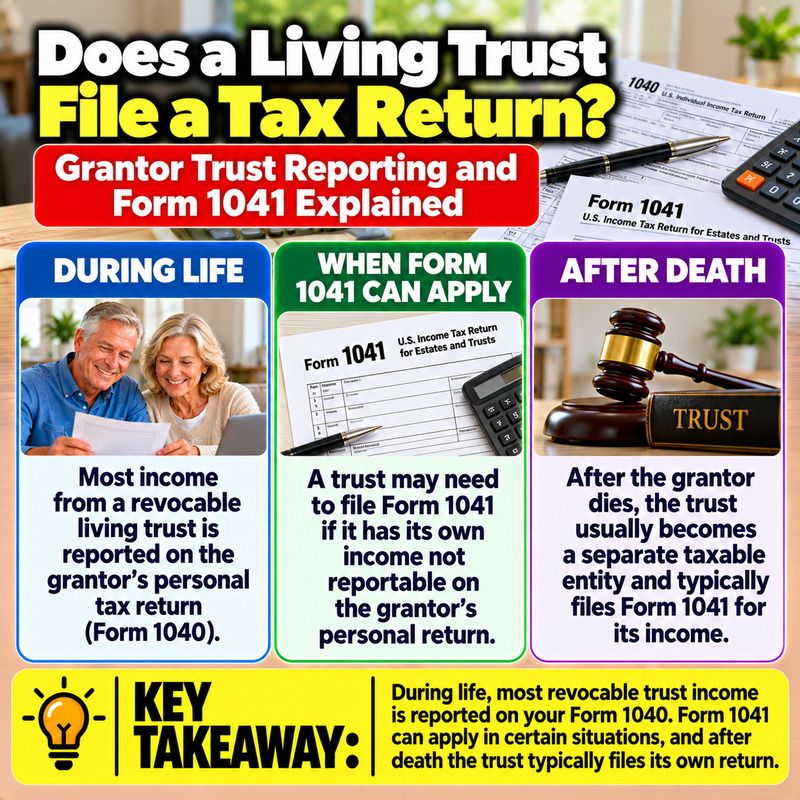
    Does a revocable living trust file its own income-tax return?

    Generally, no, while the grantor is alive and the trust remains a grantor trust — the income is reported on the grantor’s individual return instead. After the grantor’s death, the trust may become irrevocable and may be required to file its own fiduciary return, Form 1041, depending on its new tax classification and the income it generates or retains.

    What happens to dividend taxation when the grantor dies?

    The trust may lose its grantor-trust status and become a separate taxpayer under applicable law, which can mean obtaining a new EIN and filing fiduciary income-tax returns going forward. The trustee must sort out which dividends were received before death, reportable on the grantor’s final individual return, versus those received afterward, which may be reportable by the trust or passed through to beneficiaries. For more information, you can learn about trust laws and taxes.

    When does a nongrantor trust need to file Form 1041?

    A nongrantor trust generally needs to evaluate Form 1041 filing obligations once it has its own taxable income or gross income above applicable thresholds, which commonly happens once it’s no longer treated as a grantor trust. The specific triggers depend on the trust’s income, structure, and current IRS rules, so this determination should be confirmed with a tax professional rather than assumed.

    What is distributable net income, and how does it affect dividends?

    Distributable net income, or DNI, is a tax-law calculation that caps how much of a trust distribution can be treated as taxable income to a beneficiary. It is not the same as the trust’s accounting income or the raw amount of cash distributed. Dividend income generally feeds into the DNI calculation, which then determines how much of any distribution carries taxable dividend income out to beneficiaries versus staying with the trust.

    How are trust dividends reported to beneficiaries on Schedule K-1?

    When a nongrantor trust distributes income within its DNI limits, it issues each beneficiary a Schedule K-1 (Form 1041) breaking out their share of ordinary dividends, qualified dividends, interest, and other income categories. Beneficiaries use these figures to complete their own Form 1040, and the characterization on the K-1 — qualified versus ordinary, for instance — generally carries over to the beneficiary’s return.

    Are capital gains treated the same as dividends in a trust?

    Not necessarily. Capital gains realized when a trustee sells appreciated securities are often allocated to trust principal rather than trust accounting income, depending on the trust document and governing state law, which can keep them separate from the DNI calculation that applies to dividends. Dividends and capital gains should be analyzed separately rather than assumed to follow identical rules.

    Can putting dividend-paying investments in a living trust reduce estate taxes?

    No. Assets held in an ordinary revocable living trust generally remain part of the grantor’s taxable estate for federal estate-tax purposes, since the grantor retains control over the trust during life. Placing dividend-paying stocks or funds into this type of trust does not, by itself, reduce federal estate tax, and it’s a separate question entirely from the income-tax treatment of the dividends themselves.

    Get Your Trust’s Dividend Reporting Right From the Start

    The core distinction to carry away from all of this is simple, even if the mechanics underneath it aren’t: while the grantor is alive, dividends earned by an ordinary revocable living trust are generally taxed to the grantor personally, and after death, the trust’s classification and applicable fiduciary rules determine who reports what. Qualified dividends, ordinary dividends, capital gains, and principal distributions are four different concepts, and treating them as interchangeable is where most reporting errors begin.

    Start by pulling your trust-owned brokerage statements and recent Forms 1099-DIV, confirm that your successor trustee has clear access to those records, and schedule time with a qualified tax professional to review any post-death filing responsibilities before assumptions turn into mistakes on a return. If you’re still mapping out how your trust should be structured or funded in the first place, the Free Estate Planning Webinar is a useful starting point for understanding how these pieces fit together.

    Bulletproof Legacy Financial helps families cut through exactly this kind of complexity by connecting them with the right professionals to handle trust funding, administration, and tax questions correctly from day one.
  • Integrating Bonds into Your Living Trust for Optimal Tax Strategies

    Integrating Bonds into Your Living Trust for Optimal Tax Strategies

    Bonds in a Living Trust: Ownership and Tax Treatment

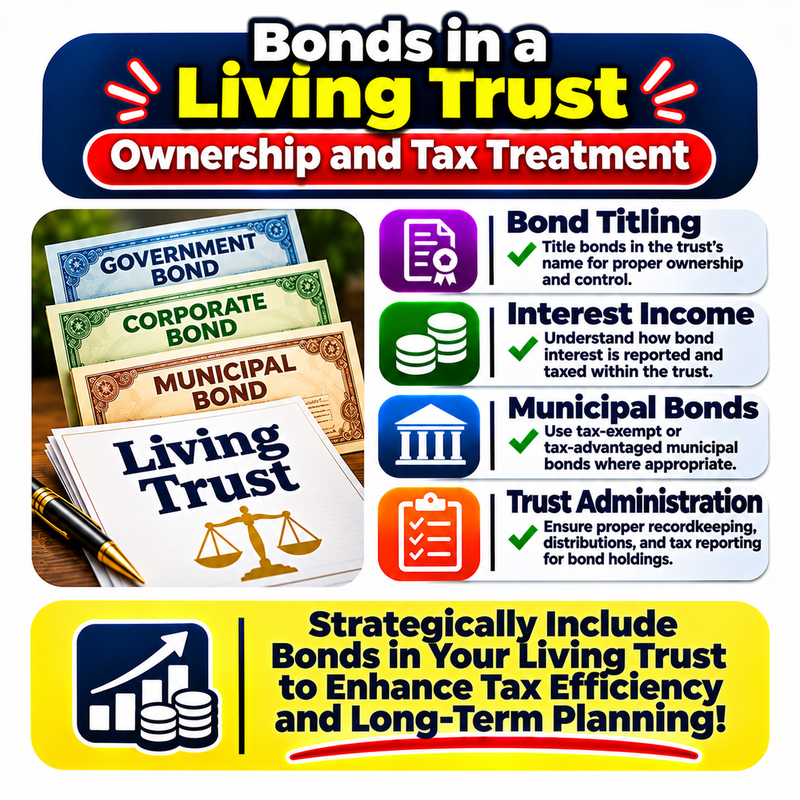
    Learn how bond titling, interest income, municipal bond treatment, and trust administration affect planning decisions.

    Can you actually move Treasury bonds, municipal bonds, and corporate bonds into your revocable living trust, and does doing so change how Uncle Sam taxes the interest? The short answer is yes to the first question and generally no to the second — a trust can hold almost any bond you already own, but the IRS still taxes that interest the same way it always has.

    That distinction trips up a lot of retirees who assume that “trust-owned” automatically means “tax-advantaged.” Before you start retitling brokerage accounts, it helps to get a clear picture of what actually changes and what stays exactly the same. If you want a second set of eyes on how your specific holdings fit into an estate plan, a free consultation is often a good low-pressure way to ask institution-specific questions before you move anything.

    Key Takeaways

    • Bonds in a living trust generally keep their original tax character — a revocable trust is not a tax shelter and doesn’t convert taxable interest into tax-free income.
    • Treasury bond interest remains federally taxable and typically exempt from state income tax regardless of who holds legal title.
    • Municipal bonds can retain their federal tax-exempt status inside a trust, but private activity bonds may still create alternative minimum tax exposure for the grantor.
    • A successor trustee’s recordkeeping — purchase dates, cost basis, accrued interest, maturity schedules — determines how smoothly tax reporting goes after the grantor passes away, which we’ll walk through using a realistic example.
    • Plans like the eState Living Trust package include ordinary funding assistance for titling assets into a trust, though bond-specific tax questions typically still call for a CPA or tax adviser.
    Bonds-In-A-Living-Trust

    Retitling a bond into a trust is a paperwork and ownership exercise, not an investment strategy. It affects who controls the asset and how smoothly it transfers to beneficiaries — it doesn’t rewrite the tax code for that particular security. Understanding where the line falls between “ownership change” and “tax change” is the whole key to integrating bonds into a living trust without creating surprises down the road.

    Treasury, municipal, and corporate bonds behave differently once you start asking tax questions, and a trust doesn’t erase those differences. This article walks through ownership mechanics, income-tax treatment while you’re alive, what changes after death, and the practical steps a successor trustee needs to follow.

    Every bond you own has two separate stories: who legally owns it, and how the IRS taxes the income it produces. A living trust changes the first story. It almost never changes the second. Keeping those two threads separate is the single most useful mental model for this entire topic, and it’s one that gets lost when people treat “put it in the trust” as a one-size-fits-all fix for taxes, probate, and investment performance all at once.

    Bonds are also not a uniform asset class for titling purposes. A Treasury note held directly through TreasuryDirect follows different transfer rules than a municipal bond sitting inside a brokerage account, and a corporate bond certificate held in direct registration follows yet another set of procedures. Before funding a trust with any of these, it’s worth understanding the mechanics section by section, because the process — and sometimes the eligibility — varies by security type and by institution.

    Trust Ownership Does Not Change How Your Bonds Are Taxed

    A revocable living trust is, for most practical and tax purposes, an extension of you. The living trust itself doesn’t own assets in the way a corporation or an irrevocable trust does — you retain the ability to amend it, revoke it, and pull assets back out whenever you want. Because of that retained control, the IRS generally looks straight through the trust and continues taxing you personally on the income the trust assets generate, bonds included.

    Why Retitling a Bond Does Not Alter Its Tax Character

    Think of a municipal bond’s tax-exempt status or a corporate bond’s taxable interest as baked into the security itself, not into whoever’s name sits on the account statement. Changing the registered owner from “John Smith” to “John Smith, Trustee of the John Smith Revocable Living Trust” doesn’t touch the bond’s issuer, its terms, or the federal tax code provisions that determine how its interest gets taxed. The bond doesn’t know — or care — that it moved into a trust.

    What Actually Changes When You Fund a Trust With Bonds

    What does shift is administrative: who can instruct the custodian, who has signing authority, and who steps in to manage the asset if you become incapacitated or pass away. Retitling also typically keeps the bond out of probate court, since the trust — not your individual name — holds legal title when you die. That’s a meaningful administrative benefit, but it’s separate from, and shouldn’t be confused with, any change in income-tax exposure.

    Grantor Trust Status and Your Bond Interest

    For federal income-tax purposes, an ordinary revocable living trust is classified as a “grantor trust” while you’re alive. This isn’t a special election you make — it’s the default result of retaining control over the trust. Because of grantor trust status, the trust itself typically doesn’t file its own tax return or pay its own tax on bond interest during your lifetime.

    Instead, interest income flows straight back to you, the grantor, exactly as it did before you created the trust. If you had $20,000 in combined bond interest last year, moving those bonds into a revocable trust this year doesn’t create a second, separate taxpayer to report half of it. You still report all of it, under your own Social Security number, on your personal Form 1040.

    This is a point worth repeating because it gets misunderstood so often: a grantor trust is a legal and administrative structure, not an income-tax-reduction device. The IRS’s grantor trust rules exist specifically to prevent people from using revocable trusts to shift taxable income away from themselves while they still control the assets.

    SituationWho Reports the Bond InterestTax Form Typically Used
    Bond held individually, grantor aliveThe individual ownerForm 1040, Schedule B
    Bond retitled into revocable trust, grantor aliveThe grantor (same person)Form 1040, Schedule B (often using grantor’s SSN)
    Bond held by trust after grantor’s deathThe trust as a separate taxpayer, or beneficiaries if distributedForm 1041, possibly Schedule K-1 to beneficiaries

    How a Revocable Living Trust Is Treated While You’re Alive

    Because the trust is disregarded for income-tax purposes during your lifetime, most financial institutions allow 1099 forms to continue being issued under the grantor’s Social Security number even after the account is retitled in the trust’s name. Some custodians instead issue the 1099 under the trust’s name and the grantor’s Taxpayer Identification Number — the underlying reporting obligation is the same either way, but the paperwork can look slightly different depending on the institution’s internal procedures.

    Reporting Bond Interest Under Your Own Social Security Number

    It’s worth double-checking your first 1099-INT or 1099-OID after any bond gets retitled. Confirm the taxpayer identification number on the form matches what you expect, and reconcile the account title shown with the trust document. A mismatch here isn’t usually a tax disaster, but it’s exactly the kind of detail that creates confusion — or an unnecessary IRS notice — if nobody catches it early.

    What Changes for Tax Reporting After the Grantor Dies

    Everything above describes the lifetime picture. Once the grantor dies, the revocable trust typically stops being a grantor trust and may need its own Employer Identification Number and its own fiduciary income-tax return. We’ll cover that transition — and why it matters for a successor trustee — later in this article, but it’s useful to flag now: the “disregarded entity” simplicity of a living trust is a lifetime feature, not a permanent one.

    Before diving into Treasury-specific rules, it’s worth noting that tax treatment for trust-owned property doesn’t always track in the way people assume. For example, placing a home into a living trust raises a completely different set of questions — whether a house held in trust affects property tax assessments depends on state law and local assessment rules, which is a separate issue entirely from how bond interest gets taxed. The lesson carries across asset types: trust ownership interacts differently with every category of tax law, and bonds are no exception.

    Treasury Bonds Inside a Living Trust

    U.S. Treasury securities — bills, notes, bonds, and Treasury Inflation-Protected Securities — are a common holding for retirees who want predictable income with minimal credit risk. Moving them into a trust is possible, but the transfer mechanics depend heavily on how you currently hold them.

    If your Treasury securities sit in a brokerage account, retitling often follows the same process as any other brokerage asset: you provide the custodian with a Certification of Trust, your trust’s tax identification details, and instructions to retitle the account. If instead you hold securities directly through TreasuryDirect, the process is different and not automatically identical across every security type or account configuration.

    Don’t assume every TreasuryDirect holding transfers the same way. Some account structures and security types have their own registration and transfer requirements, and TreasuryDirect’s own procedures should be confirmed directly rather than assumed based on general brokerage practices. This is one area where it pays to call and verify rather than guess.

    Treasury Holding MethodGeneral Transfer ApproachWhat to Verify
    Brokerage-held Treasury securitiesStandard account retitling using trust documentationCustodian’s Certification of Trust requirements
    TreasuryDirect accountVaries by account type and security; not uniformCurrent TreasuryDirect rules for your specific holding
    Paper/direct registration securitiesMay require separate reissue or transfer paperworkIssuer or transfer agent instructions

    Retitling Treasury Securities Through TreasuryDirect

    Because TreasuryDirect transfer procedures can change and vary by circumstance, this article won’t attempt to walk through a specific step-by-step process. What matters is the principle: confirm directly with TreasuryDirect or your financial institution what documentation is required, and don’t assume a brokerage-style Certification of Trust automatically satisfies every system’s requirements.

    Why Treasury Interest Stays Fully Taxable at the Federal Level

    Regardless of how the retitling process goes, Treasury interest remains subject to federal income tax whether it’s held individually or inside a revocable trust. Nothing about trust ownership exempts this interest from federal taxation. Depending on the specific security, you may also encounter:

    • Coupon interest paid on a regular schedule for notes and bonds
    • Original issue discount accounting for Treasury bills and certain other discount instruments
    • Market discount or acquisition premium if the security was purchased after issuance at a price different from face value
    • Capital gain or loss if the security is sold before maturity rather than held to redemption

    Each of these components can require separate tracking, and a trust’s ownership doesn’t simplify or eliminate any of them. If anything, moving bonds into a trust makes clean recordkeeping more important, since a successor trustee will eventually need to reconstruct this same information without the benefit of having made the original purchase decisions.

    State Tax Treatment of Treasury Bond Interest

    One genuine advantage of Treasury securities — one that trust ownership doesn’t disturb — is that interest on qualifying U.S. Treasury obligations is generally exempt from state and local income tax, subject to each state’s specific rules. This exemption exists because of federal law governing Treasury obligations, not because of anything related to trust ownership. A trust holding Treasury bonds in a state with no such carve-out wouldn’t gain this benefit, and a trust holding them in a state that honors the exemption doesn’t lose it. The bond’s legal character travels with the bond, not with the name on the account.

    Because rules can vary by state and by the specific type of security, it’s worth confirming current treatment with a tax professional familiar with your state’s income-tax code rather than relying on a general rule of thumb. This matters more for retirees who split time between states or who are evaluating whether a move affects their overall tax picture.

    Even after confirming the state-tax treatment of Treasury interest, retirees holding municipal bonds face a different — and often more confusing — set of rules once those bonds move into a trust.

    Municipal Bonds: Tax-Exempt Status and the AMT Trap

    Municipal bonds are popular with retirees precisely because qualifying interest is often exempt from regular federal income tax. That exemption is a feature of the bond itself — tied to the issuer and the bond’s specific terms — not a feature that depends on who holds title to the account. A revocable trust doesn’t add tax-exempt status to a bond that doesn’t already qualify, and it doesn’t strip tax-exempt status from one that does.

    How Municipal Bond Interest Retains Its Federal Tax-Exempt Status in Trust

    If your municipal bond interest was exempt from regular federal income tax before you funded the trust, it generally remains exempt afterward, assuming the bond itself hasn’t changed and the grantor trust rules still apply. The trust is disregarded for income-tax purposes during your lifetime, so the exemption simply passes through to you exactly as it did when you held the bond individually.

    Private Activity Bonds and Alternative Minimum Tax Exposure

    Not every municipal bond is created equal, though. Some municipal bonds — particularly certain private activity bonds issued to finance projects like airports, housing developments, or hospitals — generate interest that, while still exempt from regular federal income tax, may be treated as a preference item for alternative minimum tax purposes. This has nothing to do with trust ownership. It’s baked into the classification of the bond itself, and it applies whether you hold the bond directly or through a revocable trust.

    Retirees sometimes assume that because a bond is labeled “municipal,” it’s automatically free of every possible tax consequence. That’s an oversimplification. A bond’s prospectus or official statement typically identifies whether it’s a private activity bond, and this detail is worth confirming with a tax professional rather than assuming based on the general “municipal bond” label.

    State and Local Tax Treatment Varies by Bond Source

    Municipal bond interest is often — but not universally — exempt from tax in the state where the bond was issued, while interest from an out-of-state municipal bond may be fully taxable at the state level. A retiree holding bonds issued by their home state alongside bonds issued elsewhere may see very different state tax treatment between the two, even though both are “municipal bonds” and both sit inside the same trust. This is exactly the kind of detail that gets overlooked when people assume uniform treatment across an entire asset category.

    Municipal Bond FeatureFederal Tax TreatmentTrust Ownership Effect
    Qualifying general obligation municipal bondInterest typically exempt from regular federal income taxNo change; exemption passes through
    Private activity municipal bondMay be a preference item for AMT purposesNo change; AMT exposure follows the bond, not the owner
    Taxable municipal bondInterest fully taxable federallyNo change; remains taxable in trust
    Out-of-state municipal bondFederal exemption may apply; state exemption often does notNo change; state treatment depends on issuing state and your residency

    Corporate Bonds and Fully Taxable Interest

    Corporate bonds don’t carry any of the tax-exemption complexity that comes with municipal bonds, but they bring their own set of considerations once they sit inside a trust. Interest from corporate bonds is fully taxable at the federal level, and depending on your state of residence, it may also be taxable at the state level.

    Why Corporate Bond Interest Is Always Taxable Regardless of Trust Ownership

    Unlike Treasury securities, corporate bonds receive no special exemption from state income tax, and unlike qualifying municipal bonds, they receive no exemption from federal income tax. Trust ownership doesn’t change any of this. The interest is reported the same way it would be if you held the bond directly, flowing through to your personal return under grantor trust rules while you’re alive.

    Trust ownership also doesn’t neutralize the underlying investment risks that come with corporate debt. A trustee — whether that’s you during your lifetime or a successor trustee after your death — still has to manage credit risk, interest-rate risk, and liquidity risk exactly as any bondholder would. A revocable living trust is a legal and administrative structure; it has no bearing on whether the issuing corporation makes its coupon payments or whether the bond’s market price moves against you before maturity.

    Comparing After-Tax Yield Across Bond Types Held in Trust

    Because Treasury, municipal, and corporate bonds carry different federal and state tax treatments, the same stated interest rate can produce very different after-tax results depending on which type of bond generates it and which state you live in. Retirees evaluating a diversified fixed-income portfolio inside a trust should compare after-tax, not just stated, yields — and that comparison should be made with current rate and tax information from a qualified adviser rather than assumptions carried over from years past. A trust doesn’t change this math; it just means the comparison needs to happen before and after retitling, since the underlying holdings and their tax characteristics remain the same.

    Accrued Interest and Original Issue Discount Explained

    Beyond the big-picture question of taxable versus tax-exempt interest, bonds come with smaller mechanical details that matter enormously for accurate tax reporting — and these details don’t disappear just because a bond moves into a trust.

    Two of the most commonly misunderstood concepts are accrued interest and original issue discount. Both affect how much income gets reported and when, and both require careful recordkeeping that a successor trustee will eventually need to rely on if they weren’t the one who originally purchased the bond.

    How Accrued Interest at Purchase Affects Your Cost Basis

    When a bond is purchased between its regular interest payment dates, the buyer typically pays the seller an amount representing interest that has accrued since the last payment. This accrued interest paid at purchase isn’t itself new taxable income to the buyer — it’s generally treated as an offset against the next interest payment received, which affects how much of that payment actually counts as taxable interest versus a return of the amount already paid. Getting this wrong is a common source of overstated interest income on tax returns, particularly when purchase records get lost in a transfer to a trust.

    Original Issue Discount Rules for Zero-Coupon and Discount Bonds

    Some bonds — zero-coupon Treasury securities and certain corporate issues among them — are sold at a price below face value with no regular coupon payments at all. The difference between the purchase price and the face value, known as original issue discount, is generally required to be recognized as taxable income over the life of the bond, even though no cash interest payment is actually received each year. This can catch retirees off guard: you can owe tax on income you haven’t received in cash, and a trust holding this type of bond doesn’t change that requirement.

    Why These Details Matter More After a Trust Becomes Irrevocable

    While you’re alive and the trust remains revocable, you’re the one reporting all of this income, and you presumably have access to your own purchase records. Once the trust becomes irrevocable — typically at your death — a successor trustee inherits the responsibility for continuing to track accrued interest, original issue discount, premium amortization, and market discount, often without having been present for the original purchase decisions. Complete records made available before that transition can save a successor trustee significant time and expense reconstructing basis information from scratch.

    Maturity, Liquidity, and Trust Distribution Planning

    Bonds don’t last forever, and a trust’s administration timeline rarely lines up perfectly with a bond’s maturity schedule. Planning for this mismatch is one of the more practical — and frequently overlooked — aspects of holding bonds in a living trust.

    Matching Bond Maturities to Anticipated Trust Distributions

    If a trust’s terms call for specific distributions at set times — say, annual payments to a beneficiary, or a lump-sum distribution once estate administration wraps up — it helps to know when individual bonds mature relative to those obligations. A bond maturing well before a planned distribution gives a trustee flexibility to reinvest or hold cash. A bond maturing well after creates a choice: sell before maturity, potentially at a loss or gain relative to face value, or find another way to meet the distribution need.

    This is less about predicting markets and more about basic cash-flow planning. A grantor funding a trust with bonds today should think through, in general terms, how the bond maturities line up with what the trust is expected to do down the road — understanding that trust terms and family circumstances can change even when the bond schedule doesn’t.

    Retirees who ladder bonds — staggering maturities across several years — often find this approach translates well into a trust context, since it naturally spreads out liquidity events rather than concentrating them all at once.

    A properly funded trust doesn’t eliminate the need to think about cash flow. It just changes who’s responsible for thinking about it — you during your lifetime, and a successor trustee afterward.

    Handling a Bond That Matures Before the Trust Settles

    It’s fairly common for a bond to mature while a trust is still being administered after the grantor’s death — bills and notes in particular often have maturities measured in months or a few years. When this happens, the proceeds typically become cash held by the trust, and the trustee needs to decide whether to reinvest, distribute, or hold the funds pending further administration, consistent with the trust’s terms and the trustee’s fiduciary duties.

    Laddering Strategies for Trustees Managing Fixed Income

    A successor trustee stepping into an existing bond ladder doesn’t need to overhaul it immediately. In many cases, the simplest and most prudent approach is to let existing bonds mature on schedule, redeploying proceeds only as administration needs require, rather than making wholesale changes to a portfolio built with a particular strategy in mind. Fiduciary investment duties generally call for prudence and, where appropriate, diversification — not necessarily rapid liquidation of a reasonable existing strategy.

    Successor Trustee Recordkeeping Responsibilities

    A successor trustee stepping in after the grantor’s death or incapacity faces a learning curve, and bonds tend to be one of the more document-heavy categories of trust assets to administer well.

    The core task is reconstructing, as completely as possible, the story of each bond: when it was purchased, for how much, what its terms are, and how much interest or discount income has already been recognized for tax purposes. Missing pieces of this puzzle don’t necessarily create legal problems, but they do create extra work — and sometimes extra cost — in working with tax professionals to fill gaps.

    Documents a Successor Trustee Needs for Every Bond Holding

    • Original purchase confirmation or trade statement showing purchase date and price
    • Current brokerage or custodian statements confirming the bond is correctly titled in the trust’s name
    • Prior years’ Form 1099-INT or 1099-OID showing reported interest or discount income
    • The bond’s official statement or prospectus, particularly for municipal bonds, to confirm private activity bond status
    • A record of any premium paid or discount received at purchase, along with any amortization already applied
    • Maturity date and any call provisions that could cause early redemption

    Gathering these documents while the grantor is still alive and able to answer questions is far easier than trying to reconstruct them after the fact. This is one of the simplest, highest-value steps a retiree can take when integrating bonds into a living trust — not because it changes the tax outcome, but because it prevents administrative headaches later.

    Tracking Basis, Purchase Date, and Accrued Interest Over Time

    Cost basis tracking matters for determining gain or loss if a bond is sold before maturity, and it matters again at the grantor’s death, when date-of-death values come into play for certain basis adjustments. Not every component of a bond’s value receives the same basis treatment at death, and the specific rules depend on the type of security and how it’s held — another reason individualized tax review is worth the cost for larger or more complex bond portfolios.

    Preparing for a Final Fiduciary Income Tax Return

    Once the grantor dies, a revocable trust often stops being treated as a grantor trust and may need to obtain its own Employer Identification Number, separate from the deceased grantor’s Social Security number. Depending on the trust’s income and distributions, this can trigger a requirement to file Form 1041, a fiduciary income-tax return, for income earned by trust assets — bonds included — after the date of death. This is separate from the grantor’s final individual income-tax return, which covers income earned up through the date of death. Because filing requirements depend on the specific facts of each trust, confirming the applicable rules with a tax professional is a standard and sensible step for any successor trustee.

    Tax PeriodReturn FiledTaxpayer ID Typically Used
    Income earned before grantor’s deathGrantor’s final Form 1040Grantor’s Social Security number
    Income earned by trust after death (if applicable)Form 1041, fiduciary returnTrust’s own EIN
    Income distributed to beneficiariesSchedule K-1 issued to beneficiaryBeneficiary’s own Social Security number

    It’s worth repeating that none of this fiduciary income-tax reporting has anything to do with federal estate tax. Estate tax, where it applies, is assessed against the value of the decedent’s overall estate; fiduciary income tax is assessed against income the trust’s assets generate after death. A successor trustee managing bond interest and filing a Form 1041, if required, isn’t automatically taking on any estate-tax liability by doing so.

    Worked Example: Moving a Retiree’s Bond Portfolio Into a Funded Trust

    To see how all of this plays out in practice, consider a hypothetical retiree — we’ll call her Diane, a fictional example used purely for illustration. Diane is 68, recently widowed, and has decided to set up a revocable living trust to simplify management of her assets and keep them out of probate for her two adult children.

    Diane’s fixed-income holdings aren’t complicated by industry standards, but they do span the three major categories this article has covered, which makes her situation a useful walkthrough. For more information on how trusts can be beneficial for obtaining tax benefits, consider reading further.

    Starting Point: A Treasury Bond Holding and a Municipal Bond Portfolio

    • A 10-year Treasury note held directly through a TreasuryDirect account, purchased several years ago
    • A diversified municipal bond portfolio held in a brokerage account, including bonds issued by her home state and a few out-of-state issuers
    • One private activity municipal bond she’d forgotten she owned, purchased as part of a bundled municipal bond fund years earlier
    • A small corporate bond position in a well-known company’s debt, also held in the brokerage account

    Diane’s attorney helps her establish the trust and confirms its terms give the trustee — initially Diane herself, and later her named successor — clear authority to hold, manage, and transfer investment assets including bonds. With the trust document in hand, Diane turns to the practical work of funding it.

    For her brokerage account, Diane’s financial institution requests a Certification of Trust along with a completed account retitling form. The municipal bonds and the corporate bond transfer without being sold — the account simply changes ownership designation from Diane individually to Diane as trustee of her trust. For the Treasury note, Diane learns that her TreasuryDirect account requires a separate process, and she contacts TreasuryDirect directly rather than assuming the brokerage paperwork will work the same way. It takes a few extra weeks, but the note is eventually retitled into the trust as well.

    Step-by-Step Retitling Process for Each Bond Type

    Before finalizing anything, Diane reviews her existing beneficiary designations and account titles to make sure nothing conflicts with the trust. She discovers that her brokerage account had a transfer-on-death designation naming her children directly — a leftover from years earlier. Had she left this in place, it could have bypassed the trust entirely at her death, regardless of the trust’s own instructions, since TOD designations generally control over trust terms for that specific account. She updates the designation to remove the conflict, ensuring the account will actually pass according to her trust’s terms rather than the old TOD instruction.

    Diane also gathers her original purchase confirmations, noting that she bought the corporate bond at a slight premium to face value and the Treasury note near par. She keeps a simple folder — physical and digital — with these records alongside her trust documents, so her successor trustee won’t have to search for them later.

    What Happens to the Interest Income After Funding

    After the retitling is complete, Diane’s tax situation doesn’t change. Her Treasury note interest remains fully taxable federally and exempt from her state’s income tax, just as before. Her qualifying municipal bond interest remains exempt from regular federal income tax, though she now understands that her previously forgotten private activity bond may need to be factored into any alternative minimum tax calculation — a detail her tax preparer flags and addresses using her existing documentation. Her corporate bond interest remains fully taxable at both the federal and state level, exactly as it was before the trust owned the account.

    Years later, Diane passes away while her Treasury note still has two years left before maturity. Her successor trustee — her older son — locates the folder Diane prepared, confirms the trust’s EIN application with the help of an estate-planning attorney, and works with a CPA to determine whether a Form 1041 is required for the period after Diane’s death. Because the note matures mid-administration, the proceeds become trust cash, which the trustee holds until final distributions are made to Diane’s children, consistent with the trust’s terms. The documentation Diane left behind turns what could have been a confusing reconstruction project into a straightforward handoff — illustrating why organized records matter as much as the retitling itself.

    Decision Checklist Before You Retitle Bonds Into a Trust

    Before moving any bond into a living trust, it helps to work through a short checklist rather than handling each account on an ad hoc basis. This keeps the process organized and reduces the chance of overlooking a conflicting beneficiary designation or missing cost-basis record.

    Use this as a starting point, understanding that your specific institutions and bond types may require additional steps beyond what’s listed here.

    Documents to Gather for Each Bond Holding

    Start by pulling together everything related to each bond: current statements, original purchase confirmations, prior years’ tax forms, and — for municipal bonds — the official statement or prospectus identifying whether it’s a private activity bond. Having these in one place before contacting any institution speeds up the retitling conversation considerably and gives your eventual successor trustee a head start.

    From there, confirm your revocable living trust document’s language actually authorizes the trustee to hold and manage investment-type assets like bonds, inventory every account and direct holding you currently have, contact each custodian or TreasuryDirect directly to confirm their specific transfer requirements, check for and resolve any conflicting TOD or POD designations, and confirm with your tax adviser that your understanding of each bond’s tax treatment is accurate before and after the move. Ask your estate-planning attorney whether the trust document needs any updates to clearly cover investment assets, ask your financial institution exactly what documentation they require and how long the process typically takes, and ask your tax adviser whether any of your specific bonds — particularly private activity municipal bonds — carry AMT implications worth factoring into your broader tax picture.

    Bond Taxation Rules Don’t Change—Your Planning Clarity Does

    Integrating Treasury, municipal, and corporate bonds into a living trust is largely an ownership and administration decision — one that can simplify management and help avoid probate for these assets, provided the retitling is done correctly with each institution’s specific requirements in mind. The tax character of the interest itself, however, follows the bond and applicable law, not the name on the account, so coordinating trust terms, account titles, beneficiary designations, and recordkeeping remains the real work.

    Start by inventorying what you currently own, confirm how each bond is registered, and talk through transfer procedures and tax documentation with your financial institution and a qualified adviser — and if you’d like help thinking through how bond funding fits into a broader plan, a free estate planning webinar can be a useful next step.

    Tax Questions to Answer Before Funding the Trust

    Before you call your brokerage or TreasuryDirect, sit down and answer a short list of tax questions so you’re not guessing later. Does the bond generate taxable interest, potentially tax-exempt interest, or some combination through original issue discount? Is there a premium or discount baked into your purchase price that needs amortizing or recognizing over time? And critically — does your state tax this particular type of interest, or does it fall under an exemption?

    Write the answers down alongside your bond records. It sounds basic, but retirees who skip this step often end up reconstructing the same information a year later when a 1099 looks unfamiliar or a successor trustee asks a question nobody can answer. A five-minute review now saves a much longer conversation with a tax preparer down the road.

    Professionals Who Should Review Your Plan

    Three professionals typically touch this process, each with a different job. An estate-planning attorney confirms your trust document actually authorizes the trustee to hold and manage bonds and other investment assets. Your financial institution — brokerage or TreasuryDirect — confirms its own transfer and titling requirements, which can differ from what worked for a different account or a different person’s trust. And a CPA or tax adviser confirms how each specific bond’s interest is taxed, both before and after the move, including any AMT exposure from private activity municipal bonds. None of these three can fully substitute for the others.

    Common Mistakes When Placing Bonds in a Living Trust

    Most of the problems that show up with trust-owned bonds aren’t legal disasters — they’re avoidable oversights that create confusion, extra paperwork, or an unpleasant tax surprise. Knowing the common ones ahead of time is the easiest way to sidestep them.

    Assuming Trust Ownership Creates Tax-Free Income

    This is the single most common misunderstanding, and it’s worth repeating one more time plainly: a revocable living trust does not convert taxable interest into tax-free interest. Treasury and corporate bond interest stays taxable. Municipal bond interest keeps whatever exemption it already had — no more, no less. If a bond was taxable the day before you funded the trust, it’s taxable the day after.

    Forgetting to Update Beneficiary Designations on Savings Bonds

    Many retirees hold savings bonds or brokerage accounts with a payable-on-death or transfer-on-death designation already in place, often set up years before the trust existed. These designations generally control over trust instructions for that specific asset, which means a bond with an old POD beneficiary can bypass the trust entirely at death — regardless of what the trust document says.

    This creates a mismatch between what you intended and what actually happens. A trust built to distribute assets evenly among three children won’t do that if one bond quietly passes directly to a single named beneficiary through an outdated TOD designation.

    The fix is simple but easy to forget: review every bond account’s beneficiary designation at the same time you retitle it into the trust, and update or remove conflicting designations so the trust’s terms actually govern.

    Overlooking State-Specific Municipal Bond Rules

    Municipal bond tax treatment is one of the more state-dependent corners of this topic, and it’s easy to assume uniform rules when none exist. A bond issued by your home state may be exempt from your state’s income tax, while a bond issued by a neighboring state generating the same type of interest may be fully taxable where you live.

    Retirees who split time between two states, or who move during retirement, should revisit this question whenever their residency changes. State tax rules don’t follow you automatically just because the trust stayed the same.

    When to Bring in a Tax Attorney, CPA, or Fiduciary Specialist

    Not every bond transfer needs a specialist. A single Treasury note moving into a straightforward revocable trust is usually simple enough to handle with your attorney and brokerage alone. But certain situations call for more specialized help.

    Consider bringing in additional expertise when your bond portfolio includes private activity municipal bonds with possible AMT exposure, when you hold bonds across multiple states with varying tax treatment, when a trust is approaching the point where it becomes irrevocable and may need its own EIN, or when a successor trustee is stepping in without complete purchase records.

    A short list of situations that typically justify a specialist’s time:

    • Significant original issue discount or market discount holdings requiring careful basis tracking
    • Private activity bonds where AMT exposure needs to be weighed against overall tax planning
    • A grantor’s death triggering the need for an EIN and a first fiduciary income-tax return
    • Incomplete or missing purchase records for inherited or long-held bond positions
    • Bonds held across state lines with inconsistent state tax treatment

    When any of these apply, the cost of a CPA’s time is almost always smaller than the cost of an avoidable tax-reporting mistake.

    Frequently Asked Questions

    Here are answers to the questions retirees ask most often when they’re deciding whether and how to move bonds into a living trust.

    These responses are general and educational — your own situation should still be confirmed with your attorney, financial institution, and tax adviser before you act.

    Does putting a bond in a living trust make the interest tax-free?

    No. A revocable living trust doesn’t change a bond’s underlying tax character. Taxable interest from Treasury or corporate bonds stays taxable, and tax-exempt municipal bond interest keeps whatever exemption it already had. The trust is a legal ownership structure, not a tax-exemption tool.

    Can I retitle a Treasury bond into my revocable trust myself?

    Holding TypeTypical Next Step
    Brokerage-held Treasury securitiesSubmit Certification of Trust and retitling form directly to custodian
    TreasuryDirect accountContact TreasuryDirect to confirm current transfer requirements for your specific account type

    In many cases, yes — but the process depends entirely on how the security is currently held. Brokerage-held Treasury securities usually follow standard trust retitling paperwork, similar to any other brokerage asset.

    Trusts can be beneficial for obtaining tax benefits that would not otherwise be available. TreasuryDirect accounts are a different story. Transfer requirements there can vary based on the account type and the specific security, so it’s worth confirming directly with TreasuryDirect rather than assuming the brokerage process applies.

    If you run into confusion or the institution asks for documentation your attorney didn’t anticipate, that’s a good signal to loop your attorney back in rather than guessing at what satisfies the requirement.

    Are municipal bonds in a trust still exempt from federal tax?

    Generally, yes, if the bond itself qualified for federal tax exemption before the transfer. The trust doesn’t add or remove this status — it simply holds legal title while the bond’s own characteristics determine its tax treatment.

    That said, “municipal bond” isn’t a single uniform category. Some municipal bonds are fully taxable, and private activity bonds can carry AMT implications even while technically exempt from regular federal income tax.

    Because of this variation, it’s worth checking the specific bond’s official statement rather than assuming based on the general label.

    • Qualifying general obligation municipal bonds: typically exempt from regular federal tax
    • Private activity municipal bonds: may still be a preference item for AMT purposes
    • Taxable municipal bonds: fully taxable at the federal level despite being labeled “municipal”

    What happens to bond interest reporting after I die?

    While you’re alive, bond interest is reported under grantor trust rules, typically using your own Social Security number. After death, the trust may stop being a grantor trust, potentially requiring a new EIN and a fiduciary income-tax return, Form 1041, for income earned by the trust’s assets going forward — separate from your final personal return covering income through the date of death. For more information on how trusts can be beneficial for obtaining tax benefits, visit our detailed guide.

    Does a revocable trust help avoid the alternative minimum tax on bonds?

    No. AMT exposure from certain private activity municipal bonds is tied to the bond itself, not to who holds title to it. A revocable trust doesn’t shield bond interest from AMT consideration, and it doesn’t create AMT exposure where none existed before.

    Who tracks accrued interest and original issue discount after I’m gone?

    Your successor trustee takes on this responsibility, typically with help from a CPA or tax preparer. This is exactly why keeping organized purchase records, prior tax forms, and notes on premiums or discounts matters — it gives your successor trustee a running start instead of a blank page.

    Without those records, reconstructing basis and discount information after the fact is possible but often more time-consuming and costly, especially for bonds purchased many years earlier.

    Should I ladder bond maturities differently once bonds are in a trust?

    Not necessarily. An existing, well-constructed bond ladder often continues to work fine inside a trust, and a successor trustee can usually let bonds mature on schedule rather than restructuring the portfolio immediately. The bigger priority is making sure maturities reasonably align with the trust’s anticipated distribution needs.

    Can a successor trustee be held liable for bond recordkeeping errors?

    ScenarioGeneral Fiduciary Expectation
    Trustee acts prudently with available recordsGenerally consistent with fiduciary duty
    Trustee ignores available records or acts carelesslyMay raise fiduciary liability concerns

    A successor trustee is generally held to a standard of prudence, not perfection. Acting carefully with the information reasonably available, and seeking professional help when records are incomplete, is typically consistent with fiduciary duty.

    Liability concerns tend to arise less from honest gaps in decades-old paperwork and more from carelessness — ignoring available records, failing to seek professional guidance when something is unclear, or acting against the trust’s stated terms.

    This is part of why documentation matters so much on the front end. A well-organized bond file doesn’t just make tax reporting easier; it also gives a successor trustee a clear paper trail showing diligent administration.

    When records are genuinely missing, bringing in a CPA or estate attorney to help reconstruct what’s reasonably possible is itself a prudent step, not an admission of failure.

    Does the eState living trust package help with retitling bonds?

    The eState Living Trust plan includes ordinary trust funding assistance as part of its $2,995 offering, which can help with standard asset retitling processes. It isn’t designed to replace individualized tax advice, CPA services, or specialized handling for TreasuryDirect accounts, brokerage-specific requirements, or bond-level tax questions — those pieces typically still call for your tax adviser or financial institution directly.

    When should I consult a CPA instead of relying on trust documents alone?

    Trust documents establish legal ownership and administration authority — they don’t answer tax questions. Any time you’re unsure how a specific bond’s interest is taxed, whether AMT applies, or how to handle accrued interest and original issue discount, that’s a CPA conversation, not something the trust paperwork itself can resolve.

    Can Treasury bonds be placed in a revocable living trust?

    Yes, in most cases. Treasury securities held through a brokerage account typically transfer using standard trust retitling documentation, such as a Certification of Trust. Treasury securities held directly through TreasuryDirect may follow a different process depending on the account type and security, so it’s worth confirming the specific requirements directly with TreasuryDirect rather than assuming a single uniform procedure applies to every holding.

    Does transferring bonds into a living trust change their income-tax treatment?

    Generally, no. A revocable living trust is typically treated as a grantor trust during the grantor’s lifetime, meaning the IRS continues taxing bond interest to the grantor personally, exactly as before the transfer. The bond’s underlying tax character — taxable or potentially tax-exempt — doesn’t change simply because a trust now holds legal title to it.

    Is municipal bond interest always tax-free when held in a trust?

    Not necessarily. Municipal bond interest that qualifies for federal tax exemption generally keeps that exemption inside a trust, but the exemption depends on the bond itself, not on trust ownership. Some municipal bonds are fully taxable, and private activity bonds can trigger alternative minimum tax considerations even while remaining exempt from regular federal income tax. Always verify a specific bond’s characteristics rather than relying on the general label.

    Can municipal bond interest create alternative minimum tax considerations?

    Yes, in certain cases. Interest from some private activity municipal bonds, while exempt from regular federal income tax, may be treated as a tax preference item for alternative minimum tax purposes. Not all municipal bonds trigger this issue — it depends on the bond’s classification. Reviewing your municipal bond holdings with a tax professional can clarify whether any of your specific bonds carry this exposure.

    How is corporate bond interest reported while the grantor is alive?

    Corporate bond interest held in a revocable living trust is generally reported the same way it was before the trust existed — under grantor trust rules, the income flows through to the grantor’s personal income-tax return. Form 1099-INT typically reports this interest, and it remains fully taxable at the federal level, with state taxation depending on the grantor’s state of residence.

    Can TreasuryDirect securities be transferred into a trust?

    Many TreasuryDirect-held securities can be transferred into a properly structured trust, but the process isn’t identical across every account type or security. Rather than assuming a single standard procedure, confirm directly with TreasuryDirect what documentation and steps apply to your specific holdings before attempting the transfer.

    What happens when a trust-owned bond matures?

    When a bond held in a trust reaches maturity, the proceeds typically become trust cash, which the trustee then manages according to the trust’s terms — whether that means reinvesting, holding for upcoming distributions, or distributing to beneficiaries. If maturity occurs during administration after the grantor’s death, the trustee needs to factor this into fiduciary tax reporting and distribution planning.

    What records should a successor trustee retain for bonds?

    A successor trustee should retain purchase confirmations, current account statements, prior tax forms like 1099-INT or 1099-OID, bond prospectuses or official statements, records of any premium or discount at purchase, and maturity or call date information. These records support accurate tax reporting and help establish cost basis for any future sale or redemption.

    Does a trust need a new EIN or Form 1041 after the owner dies?

    Often, yes, though this depends on the specific trust and its circumstances. A revocable trust frequently stops being treated as a grantor trust at the grantor’s death, which can require obtaining a new Employer Identification Number and filing a fiduciary income-tax return, Form 1041, for income earned afterward. A tax professional can confirm the specific filing requirements that apply to a given trust.

    Does transferring bonds into a living trust reduce federal estate taxes?

    Not on its own. Moving bonds into an ordinary revocable living trust doesn’t remove them from the grantor’s taxable estate, since the grantor retains control over the trust during their lifetime. Federal estate tax is a separate issue from income-tax reporting on bond interest, and a revocable trust by itself isn’t an estate-tax reduction strategy.

    Bond Taxation Rules Don’t Change—Your Planning Clarity Does

    Treasury, municipal, and corporate bonds can all generally be held inside a properly funded revocable living trust, and doing so can simplify management and help keep these assets out of probate. What doesn’t change is the tax character of the interest itself — that follows the bond and applicable federal and state law, not the name on the account title.

    The real work in integrating bonds into a living trust isn’t chasing a tax break that doesn’t exist. It’s coordinating trust terms, account titles, beneficiary designations, and recordkeeping so that your successor trustee inherits clarity instead of confusion.

    Start with a simple inventory: list every bond you own, confirm how each is currently registered, and reach out to your financial institution and a qualified tax adviser about transfer procedures before you make any changes — and if you’d like guidance on how this fits into a broader estate plan, Bulletproof Legacy Financial’s educational resources through Create A Living Trust are a reasonable place to start that conversation.

  • Blended Families and Living Trusts: Key Tax Considerations

    Blended Families and Living Trusts: Key Tax Considerations

    Blended Family Living Trust Tax Considerations

    Explore marital deductions, estate tax exposure, beneficiary arrangements, and state-specific rules for blended-family estate plans.

    Key Takeaways: Article at a Glance

    • A revocable living trust does not automatically reduce federal estate tax; the result depends on ownership, trust terms, and tax elections made at the right time.
    • Blended families often need to balance a surviving spouse’s access to income and housing against preserving an eventual inheritance for children from an earlier marriage.
    • The federal marital deduction, portability, and specialized tools like QTIP trusts each work differently and are not interchangeable strategies.
    • Retirement accounts, life insurance, and payable-on-death accounts pass by beneficiary form, not by what a trust or will says, so these documents need separate review.
    • Later in this article, you’ll see how a fictional remarried couple worked through asset titling, trustee selection, and a possible subtrust to protect both a spouse and stepchildren.
    Blended-Family-Living-Trust-Taxes

    Blended Family Living Trust Tax Considerations

    Explore marital deductions, estate tax exposure, beneficiary arrangements, and state-specific rules for blended-family estate plans.

    Blended family trust planning means coordinating a surviving spouse’s financial security with an intended eventual inheritance for children from a prior relationship, and it requires careful attention to ownership, beneficiary designations, and potential taxes. Simply creating a revocable trust does not, by itself, reduce estate tax exposure. The tax outcome depends on how assets are titled, which elections get filed, and how the trust is written.

    Remarried couples often assume that once everything sits inside a trust, the tax questions are settled. That assumption causes real problems down the road, especially when stepchildren and a surviving spouse end up with competing interests in the same assets. Organizations that focus on estate planning, including Create A Living Trust, frequently see families discover these gaps only after a death has already occurred, when options for fixing them are far more limited.

    This article walks through the specific tax mechanics that matter most for blended households: the marital deduction, estate inclusion, portability, retirement account coordination, and the role irrevocable subtrusts sometimes play. None of this replaces personalized legal and tax advice, but it should help you ask better questions when you sit down with a professional.

    Trusts and Taxes Are Not the Same Thing

    A living trust is a legal arrangement for holding and distributing property. A tax return, by contrast, reports income and determines what’s owed to the IRS and possibly a state revenue department. These are related but separate systems, and blended families sometimes conflate them, assuming that moving assets into a trust changes their tax character. It doesn’t, at least not automatically.

    Grantor Trusts vs. Nongrantor Trusts: Why the Difference Matters

    While you’re alive and the trust remains revocable, it’s generally treated as a grantor trust for federal income tax purposes. That means the IRS looks through the trust and taxes you personally on the income your trust assets generate, the same as if you owned them outside the trust. This grantor status typically continues as long as you retain the power to revoke or amend the trust.

    Income Tax Rules During Your Lifetime

    Because of grantor trust treatment, you usually keep reporting dividends, interest, and capital gains on your personal Form 1040 just as you did before funding the trust. The trust doesn’t need its own separate tax identification number while you’re alive and competent, since it uses your Social Security number. This is one reason revocable trusts are popular: they don’t complicate your annual tax filing during your lifetime.

    What Changes for Tax Purposes After the Grantor Dies

    Once the grantor dies, the trust may become irrevocable, and its tax treatment can shift to a nongrantor trust. At that point, the trust may need its own employer identification number (EIN), and ongoing income might be reported on Form 1041, the fiduciary income tax return, instead of the deceased person’s personal return. Whether this applies, and how it applies, depends heavily on the trust’s specific terms and whether it splits into subtrusts at death.

    Why a Revocable Trust Does Not Automatically Lower Estate Taxes

    Here’s the detail many blended families miss: assets held in an ordinary revocable trust are still considered part of your taxable estate when you die. Retitling your home or investment account into a trust changes who manages it and how it transfers, but it does not remove the asset’s value from federal estate tax calculations. For a deeper look at how revocable trusts are actually taxed, this explanation of revocable living trust taxation breaks down the income tax and estate tax distinctions in more detail. If estate tax reduction is a goal, that typically requires additional, specialized planning beyond a standard revocable trust.

    The Marital Deduction and Estate Inclusion in Blended Families

    The federal estate tax marital deduction allows one spouse to pass an unlimited amount of qualifying property to a surviving spouse without triggering estate tax at the first death. This is a powerful tool, but it comes with conditions that blended families need to understand, because not every transfer to a spouse automatically qualifies.

    How the Marital Deduction Works for a Surviving Spouse

    To qualify for the marital deduction, the surviving spouse generally must be a U.S. citizen, the property must pass to that spouse in a way the law recognizes as a “qualifying” interest, and the correct elections may need to be made on an estate tax return. This is an estate tax deduction, which is different from an income tax deduction you might claim on your annual Form 1040. Confusing the two can lead to planning mistakes, since the rules, forms, and timing are entirely different.

    What Happens When Assets Pass Outside the Marital Deduction

    Not every blended family wants to leave everything outright to a surviving spouse, and not every arrangement will qualify for the marital deduction even if that’s the intent. When assets pass to someone other than a spouse, or when a trust interest doesn’t meet the technical requirements for a qualifying interest, the marital deduction may not apply to that portion of the estate. This is one reason remarried couples sometimes consider specialized trust structures rather than relying on simple outright transfers.

    Estate Inclusion Risks When Children From a Prior Marriage Are Involved

    Blended families face a particular wrinkle: a plan designed to support a surviving spouse can inadvertently expose assets to inclusion in that spouse’s estate later, potentially affecting what eventually reaches children from the first marriage. A properly structured qualified terminable interest property (QTIP) trust is one tool some couples use to address this, since it can provide income to a surviving spouse while still controlling where the principal goes afterward. QTIP treatment isn’t automatic, though. It generally requires a specific election on the deceased spouse’s estate tax return, and the trust terms must meet technical requirements to qualify.

    Balancing Surviving Spouse Access With Remainder Beneficiaries

    One of the hardest parts of blended family planning isn’t tax law at all, it’s human nature. A surviving spouse often needs continued access to the family home and investment income to maintain their standard of living. Meanwhile, children from an earlier marriage may be counting on an inheritance that could shrink or disappear if the survivor spends down the assets, remarries, or redirects them through a will.

    Income Rights for the Survivor vs. Principal Protection for Children

    Trust drafting can address this tension by separating income rights from principal control. A surviving spouse might receive income generated by trust assets, along with limited rights to invade principal for health, education, maintenance, or support, while the underlying assets remain earmarked for the first spouse’s children as remainder beneficiaries. Different structures accomplish this with varying degrees of flexibility, and the right fit depends on family dynamics, asset types, and whether the couple prioritizes the surviving spouse’s comfort or the children’s eventual inheritance.

    ApproachSurvivor AccessRemainder ControlAdministrative ComplexityPossible Tax Issues
    Outright inheritance to surviving spouseFull, unrestricted accessNone; spouse can redirect assetsLowMay qualify for marital deduction, but no guarantee assets reach children later
    Revocable trust with coordinated provisionsTypically high, subject to trust termsDepends on drafting; can be weak without subtrustModerateStill included in survivor’s estate; no automatic tax reduction
    Marital or other irrevocable subtrust (e.g., QTIP)Often limited to income and defined support standardsGenerally stronger; remainder set at first deathHigher; separate tax ID, possible Form 1041 filingsMay qualify for marital deduction if election made correctly; fact-dependent

    Every row in that table carries conditions. Outright inheritance offers simplicity but little protection for stepchildren. A subtrust offers more control but adds administrative cost and ongoing tax reporting. None of these options is universally correct, and the right choice depends on the couple’s assets, family relationships, and risk tolerance.

    Why Trustee Selection Affects Fairness Between Spouse and Children

    Choosing a trustee in a blended family plan is rarely simple. A surviving spouse named as sole trustee has obvious conflicts of interest when deciding how much principal to distribute to themselves versus preserving it for stepchildren. Many blended families consider a neutral co-trustee, a professional fiduciary, or clearly defined distribution standards to reduce friction, though no structure can fully eliminate the possibility of disagreement or litigation.

    Separate Property, Community Property, and Why It Affects Taxes

    Not every blended couple owns everything jointly, and the rules governing what counts as “yours,” “mine,” and “ours” vary significantly depending on where you live and how your assets were acquired. This matters for tax purposes because ownership characterization affects what’s includible in whose estate, what basis adjustments apply at death, and what a surviving spouse is legally entitled to keep.

    How Community Property States Treat Jointly Held Assets

    A handful of states follow community property rules, where assets acquired during the marriage are generally considered owned equally by both spouses, regardless of whose name is on the title. Other states use separate property principles, where ownership more closely follows whoever earned or purchased the asset, unless the couple has taken steps to retitle it jointly. Because these rules differ by state, and because blended families often move between states during a marriage, it’s worth confirming which framework actually applies to your situation rather than assuming.

    Keeping Separate Property Separate in a Second Marriage

    Premarital assets, inheritances, and gifts received individually often start out as separate property, but that status can erode over time through commingling, joint titling, or using separate funds to improve jointly owned property. For blended families wanting to preserve certain assets for children from a first marriage, maintaining clear records and avoiding unnecessary commingling can matter as much as the trust document itself.

    Consider a spouse who brings a paid-off home into a second marriage. If that home stays titled in the original spouse’s name alone and is later transferred into that spouse’s revocable trust, it may retain its separate property character. But if the new spouse is added to the title, or marital funds are used for major renovations, tracing the original ownership becomes harder, and state law may treat part of the home’s value differently than the couple intended.

    A prenuptial or postnuptial agreement can help clarify these ownership questions in writing, which can reduce ambiguity when it’s time to settle an estate. Reviewing these agreements alongside a properly funded living trust helps make sure the trust’s distribution terms don’t accidentally contradict what the couple already agreed to regarding separate and marital property.

    What a Portability Election Does and Does Not Do

    Portability allows a surviving spouse to claim any unused portion of a deceased spouse’s federal estate tax exemption and add it to their own. For blended families, this can be valuable because it potentially increases the amount the surviving spouse can later pass on free of federal estate tax, benefiting whoever ultimately inherits, including stepchildren if the plan is structured that way.

    Here’s the catch many families miss: portability is not automatic. To preserve the unused exemption, the deceased spouse’s estate generally must file a timely, properly prepared federal estate tax return, even if no tax is actually owed at that first death. Skipping this filing because “no tax was due” can permanently forfeit the portability benefit, which is a costly and often irreversible mistake.

    When Portability May Not Be Available or Practical

    Portability applies to the federal estate tax exemption, but it doesn’t address every tax concern a blended family might have. It doesn’t resolve income tax issues, doesn’t automatically extend to state estate taxes, and doesn’t replace the kind of trust planning that protects a surviving spouse’s access while preserving principal for children from a first marriage. A couple can elect portability and still need a carefully drafted trust to accomplish their broader goals.

    There are also practical tradeoffs. Filing an estate tax return solely to preserve portability takes time, costs money in professional fees, and requires accurate asset valuations at the date of death. Some smaller estates decide the administrative burden outweighs the benefit, while others find it well worth the cost given future growth potential in the surviving spouse’s remaining assets. This is a case-by-case decision, not a one-size-fits-all rule.

    Blended families sometimes assume that because federal exemption amounts are historically generous, estate tax planning isn’t necessary at all. That assumption can backfire if a state has its own, separate estate or inheritance tax with a much lower threshold, a possibility discussed further below. Portability, state tax exposure, and trust design all need to be evaluated together rather than in isolation.

    A surviving spouse who skips the estate tax return after the first spouse’s death, assuming nothing was owed, might later discover they can’t claim the first spouse’s unused exemption when they eventually die. If their own estate has grown substantially in the years since, that lost portability election could mean a larger taxable estate with fewer tools available to offset it.

    Retirement Accounts Require Their Own Beneficiary Strategy

    Retirement accounts often represent one of the largest pieces of a family’s wealth, and they don’t pass according to what a will or trust says. They pass according to the beneficiary designation form filed with the plan administrator or custodian, full stop. For blended families, this single fact causes more unintended outcomes than almost any other planning oversight.

    A trust document might say “all assets are to be divided equally between my spouse and my children,” but if an old 401(k) beneficiary form still names an ex-spouse or only lists biological children, that retirement account will go exactly where the form says, regardless of the trust’s instructions. Courts generally honor the beneficiary designation over conflicting language in a will or trust.

    Why IRAs and 401(k)s Bypass the Trust Unless Properly Coordinated

    Retirement accounts are considered “contractual” assets, meaning the custodian or plan administrator is bound by the beneficiary form on file, not by probate instructions. This is actually useful when the form is accurate, since it lets these accounts pass directly to the named person without going through probate at all. But when the form is outdated or was never updated after a remarriage, it can completely override the careful balance a couple thought they’d built into their trust.

    Blended families should also understand that retirement account inheritance rules for beneficiaries changed significantly under the SECURE Act of 2019 and were further modified by SECURE 2.0. These laws affect how quickly different types of beneficiaries, including spouses, children, and trusts, must withdraw inherited retirement funds, and the rules are not identical for every beneficiary category. Because these payout rules are nuanced and change based on relationship and account type, specialized review with a retirement account specialist is worth the cost before finalizing beneficiary choices.

    Naming a Trust as Beneficiary: Benefits and Tax Complications

    Some blended families consider naming a trust, rather than an individual, as the beneficiary of a retirement account. This can provide more control over how and when a surviving spouse or children receive distributions, which is appealing when a couple wants to protect principal for stepchildren.

    However, naming a trust as a retirement account beneficiary introduces real complexity around required minimum distribution calculations and whether the trust qualifies under IRS “see-through trust” rules. This is a technical area where a general living trust package typically does not include this level of specialized retirement account drafting, and a dedicated review with a tax professional familiar with these rules is strongly recommended before naming any trust as a retirement account beneficiary.

    Keeping Beneficiary Forms Updated After Remarriage

    Every time a blended family’s structure changes, whether through remarriage, divorce, birth, or death, it’s worth pulling every beneficiary form and confirming it still reflects current intentions. This includes IRAs, 401(k)s, life insurance policies, and payable-on-death bank accounts. None of these respond to updates made in a will or trust alone; each one requires its own separate form filed directly with the institution holding the account.

    State Inheritance and Estate Taxes Add Another Layer

    Federal estate tax rules get most of the attention, but they’re only part of the picture. A number of states impose their own estate tax, inheritance tax, or both, often with exemption thresholds considerably lower than the federal amount. For blended families, this matters because a plan that looks tax-neutral at the federal level could still generate a state tax bill depending on where the deceased spouse lived or owned property.

    Estate tax and inheritance tax are not the same thing, even though people often use the terms interchangeably. An estate tax is assessed against the estate itself before distribution, based on the total value of what the deceased person owned. An inheritance tax, where it exists, is assessed against individual beneficiaries based on what they personally receive, and the rate can depend on their relationship to the deceased. A stepchild, for instance, may be taxed differently than a biological child under some state inheritance tax schemes, which is a detail blended families specifically need to check.

    Why Federal Rules Alone Do Not Tell the Whole Story

    Because state estate and inheritance tax rules vary so widely, and because they change from time to time, it’s not accurate to assume that avoiding federal estate tax means avoiding all transfer taxes. Some states have no estate or inheritance tax at all. Others have both. Still others impose one but not the other, with their own distinct exemption amounts and rate structures. For more insights on estate planning, especially for blended families, it’s crucial to stay informed about both federal and state regulations.

    This is an area where professional, state-specific guidance makes the biggest difference. A general discussion of estate tax minimization strategies, such as the overview of gifting, trusts, and charitable giving as tax-reduction tools, can be a useful starting point, but it still needs to be checked against the specific state rules that apply to your situation. What works in a no-estate-tax state may not translate cleanly somewhere else.

    Example: How State-Level Estate Taxes Can Differ From Federal Rules

    Consider a hypothetical: one state might impose its own estate tax with an exemption amount far below the federal exemption, meaning an estate that owes nothing to the IRS could still generate a state estate tax bill. Another state might have no estate tax but impose an inheritance tax specifically on transfers to non-lineal relatives, which could include stepchildren who were never legally adopted. Neither scenario is universal, but both illustrate why blended families should never assume “no federal tax owed” means “no tax owed anywhere.”

    A remarried widow living in a state with its own estate tax threshold might owe nothing federally but still face a state-level estate tax bill on the same assets, depending on her state of residence at death and that state’s specific exemption amount, which can be dramatically different from the federal figure.

    Because adoption status, state residency, and property location all factor into these calculations, blended families with property in more than one state, or with stepchildren who were never formally adopted, should raise this topic directly with an attorney licensed in the relevant state rather than relying on general assumptions.

    Irrevocable Subtrusts as a Blended Family Planning Tool

    When a couple wants more certainty than a simple revocable trust can offer, irrevocable subtrusts sometimes enter the conversation. These structures can trade some flexibility for stronger guarantees about where assets eventually go, which appeals to blended families worried that a surviving spouse might redirect assets away from the first spouse’s children, whether intentionally or simply through the natural course of remarriage or new estate planning down the road.

    It’s worth being clear-eyed about the tradeoff here. Irrevocable generally means exactly what it sounds like: once established, the terms typically cannot be changed, even if family circumstances shift in ways nobody anticipated. This rigidity is the whole point, since it’s what gives remainder beneficiaries confidence that the plan will actually be followed, but it also removes the flexibility that makes revocable trusts so popular during a person’s lifetime.

    QTIP Trusts: Income for the Spouse, Principal for the Children

    A qualified terminable interest property trust is one of the more common tools blended families explore for this exact tension. The surviving spouse typically receives income generated by the trust assets, and sometimes limited access to principal under defined standards, for the rest of their life. When the surviving spouse dies, the remaining principal passes to whoever the first spouse designated, often children from that spouse’s prior marriage, rather than being subject to the surviving spouse’s own estate plan or remarriage.

    Getting QTIP treatment isn’t automatic just because a trust is labeled that way. The executor of the first spouse’s estate generally must make a specific election on a federal estate tax return, and the trust terms must meet technical requirements, including that the surviving spouse be entitled to all trust income at least annually. Because the asset still typically ends up included in the surviving spouse’s estate at their later death, this strategy addresses control and protection concerns more directly than it eliminates total estate tax exposure across both deaths.

    Bypass and Credit Shelter Trusts in a Second-Marriage Plan

    Other blended families look at bypass trusts, sometimes called credit shelter trusts, which are designed to use up a deceased spouse’s exemption amount at the first death rather than relying solely on portability. These trusts can also incorporate provisions that benefit a surviving spouse during their lifetime while directing the remainder to children from an earlier marriage. Whether a QTIP structure, a bypass trust, portability alone, or some combination makes the most sense depends heavily on the specific assets, state of residence, and family goals involved, which is exactly why this isn’t a decision to make without professional input.

    A Worked Example: Income for the Survivor, Inheritance for the Kids

    Meet Linda and Frank, a fictional remarried couple in their early sixties. Linda has two adult children from her first marriage, and Frank has one adult son from his. They’ve been married for seven years and want to make sure that whichever of them dies first, the surviving spouse can stay in their home and keep a reasonable income, but that each spouse’s own children eventually receive what that parent intended for them.

    The Couple’s Goals and Family Structure

    Linda brought a paid-off vacation property into the marriage, inherited from her own parents years before she met Frank. Frank owns a retirement account built up over thirty years at his previous job, along with a life insurance policy that still, as it turns out, lists his first wife as primary beneficiary, an oversight nobody caught until they sat down with an estate planning attorney. Together, they also purchased their current home, which is jointly titled.

    During an asset inventory, their attorney flagged the outdated life insurance beneficiary form immediately, since it would have sent a significant death benefit to Frank’s ex-wife regardless of what his will or trust said. They also discussed whether Linda’s vacation property should remain her separate property, destined for her children alone, or whether it should be treated as part of the couple’s shared estate plan, something Linda felt strongly about preserving for her side of the family specifically.

    How a QTIP-Style Subtrust Could Address Both Concerns

    After reviewing their goals, their attorney discussed the difference between leaving assets outright to the surviving spouse versus structuring a subtrust that would provide income and limited principal access to whichever spouse survived, while ultimately directing the remainder to each spouse’s own children. This approach directly addressed Linda and Frank’s underlying worry: that the survivor might remarry, change their own estate plan, or simply outlive the money in a way that left the first spouse’s children with nothing. Their attorney was careful not to promise that this structure would eliminate every possible tax consequence, since much would depend on final asset values, applicable elections, and the state’s own estate tax rules at the time of each death.

    Tax Questions This Couple Would Need to Resolve

    Linda and Frank left that first meeting with a list of open questions rather than finished answers, which is typical for blended families working through this process. Would their jointly titled home receive a full or partial step-up in basis depending on how it’s titled and where they live? Would a QTIP election actually be necessary given the size of their combined estate, or would simpler planning suffice? Should Frank’s retirement account name Linda directly, a subtrust, or some combination, given the complexity that comes with naming a trust as a retirement beneficiary?

    Their attorney also recommended involving a CPA early, rather than waiting until after a death occurred, since questions about potential Form 1041 filings, EIN applications for any subtrust created at the first death, and state-specific estate tax exposure all benefit from coordinated planning. A detailed look at how blended families can structure retirement accounts and designate specific payout arrangements, similar to guidance on retirement account beneficiary planning for blended families, helped Linda and Frank understand why a one-size-fits-all beneficiary form wasn’t going to work for their situation.

    Blended Family Estate Plan Checklist

    Whether your situation resembles Linda and Frank’s or looks completely different, a structured review process helps make sure nothing important slips through the cracks. Blended families benefit from working through this systematically rather than addressing issues piecemeal as they come up.

    Documents to Gather Before Meeting a Professional

    • Current trust document and any amendments made since it was signed
    • Deeds and titling information for real estate, including how each property is currently held
    • Beneficiary designation forms for every IRA, 401(k), life insurance policy, and payable-on-death account
    • Any prenuptial, postnuptial, or marital property agreements
    • Prior gift tax or estate tax returns, if any have ever been filed
    • Recent account statements and, where relevant, appraisals or valuations for significant assets

    Having these documents organized before the first meeting saves time and lets the attorney or CPA focus on strategy rather than hunting down basic facts. It also tends to surface outdated beneficiary forms or titling issues early, before they turn into disputes after someone has died.

    Tax Questions to Ask a CPA or Attorney

    Blended families often don’t know which questions to ask, so here are a few worth raising directly: Does this plan’s marital provisions actually qualify for the federal marital deduction, or does something need to change? Would a portability election make sense for our estate, and what would the deceased spouse’s estate need to file to preserve it? Does an irrevocable subtrust, such as a QTIP arrangement, fit our goals, and what would it cost to administer on an ongoing basis? What tax returns, if any, would need to be filed after the first death, and who would be responsible for handling them?

    Professionals Who May Need to Be Involved

    Blended family tax planning rarely rests on one professional’s shoulders alone. An estate planning attorney typically drafts the trust, addresses property law questions, and structures provisions for a surviving spouse and remainder beneficiaries. A CPA or tax professional handles the numbers side: income tax reporting while the grantor is alive, potential fiduciary returns after death, and coordination around portability elections or state estate tax filings.

    Depending on the family’s situation, a financial advisor familiar with retirement account distribution rules, or even a corporate trustee for larger or more contentious estates, might also belong at the table. Linda and Frank, from the earlier example, ultimately brought in both their attorney and a CPA before finalizing any beneficiary changes, since the retirement account and life insurance questions touched on tax rules neither professional alone could fully resolve.

    Common Mistakes Blended Families Make With Trusts

    Even well-intentioned couples stumble into predictable traps when blending families and finances. Most of these mistakes trace back to assumptions rather than malice, which is exactly why they’re worth naming directly.

    Forgetting to Update Beneficiary Designations

    This is, by a wide margin, the most common and most damaging oversight. A first marriage ends, a second one begins, and somewhere in the paperwork shuffle, an old 401(k) or life insurance form never gets updated. Years later, that outdated form can send a significant sum directly to an ex-spouse, overriding every carefully worded provision in the trust.

    The fix is straightforward in concept, though easy to neglect in practice: review every beneficiary form after any major life change, and don’t assume the trust document “handles it.” It doesn’t, not for these specific asset types.

    Assuming a Revocable Trust Automatically Reduces Estate Taxes

    This misunderstanding shows up constantly. A revocable trust is an excellent tool for avoiding probate, organizing asset management, and planning for incapacity, but it does not, on its own, remove assets from the taxable estate or lower an estate tax bill. Reducing estate tax exposure generally requires separate strategies, such as specific elections, irrevocable structures, or gifting, layered on top of the base trust plan.

    Leaving a Surviving Spouse With Full Control Over Children’s Inheritance

    Some couples default to leaving everything outright to the surviving spouse, trusting that person to eventually distribute assets fairly to both sets of children. This can work out fine, and often does. But it carries a real risk: nothing legally obligates the surviving spouse to follow through, and life events like remarriage, new estate planning, or simply changing priorities over time can redirect assets away from the first spouse’s intended beneficiaries entirely.

    Couples who want stronger assurances typically look toward subtrust structures that define remainder beneficiaries more concretely, accepting the added administrative complexity as a tradeoff for that certainty.

    Skipping Professional Review After Remarriage or Major Asset Changes

    An estate plan drafted years before a remarriage, or before a significant inheritance or business sale, often no longer reflects the family’s actual situation. Blended families should treat remarriage, divorce, a birth, a death, or a major asset change as automatic triggers for a plan review, rather than waiting for a scheduled check-in that might be years away.

    When to Call a Tax Attorney, CPA, or Fiduciary Specialist

    If your household includes children from more than one relationship, retirement accounts with outdated beneficiaries, property owned before the marriage, or any uncertainty about whether your state imposes its own estate or inheritance tax, it’s time to bring in professional help rather than guess. These situations carry enough nuance that generic templates or assumptions borrowed from a friend’s estate plan rarely translate cleanly to a different family’s facts.

    Frequently Asked Questions

    Does a revocable living trust reduce estate taxes for blended families?

    Not automatically. A revocable living trust helps avoid probate and organizes how assets are managed and distributed, but assets inside an ordinary revocable trust are still generally included in the grantor’s taxable estate. Reducing actual estate tax exposure usually requires additional planning, such as specific elections, irrevocable trust structures, or gifting strategies layered on top of the basic trust.

    What is the difference between a grantor trust and a nongrantor trust?

    A grantor trust is taxed to the person who created it, meaning they report the trust’s income on their own personal tax return while they’re alive and the trust remains revocable. A nongrantor trust, which a trust may become after the grantor’s death, is treated as its own taxpayer, potentially requiring its own tax ID number and fiduciary income tax return. The distinction affects who reports income and which forms get filed.

    How does a QTIP trust protect children from a previous marriage?

    A qualified terminable interest property trust lets a surviving spouse receive income, and sometimes limited principal, for life, while locking in that the remaining assets pass to beneficiaries the first spouse chose, often children from a prior marriage. This structure separates the survivor’s lifetime support from ultimate control over where the principal eventually goes. QTIP treatment isn’t automatic; it requires a specific election and compliance with technical trust requirements.

    Can a surviving spouse change the trust after the first spouse dies?

    It depends entirely on how the trust is written. A revocable trust may allow the surviving spouse significant changes after the first death, while a properly drafted irrevocable subtrust, such as a QTIP arrangement, is generally designed to prevent the surviving spouse from redirecting the remainder beneficiaries. This is exactly why trust structure matters so much for blended families trying to balance spousal access against protecting children’s inheritance.

    Should retirement accounts be left directly to a trust?

    Naming a trust as a retirement account beneficiary is possible but technically complex, involving rules around required minimum distributions and whether the trust qualifies under IRS “see-through” requirements. This decision benefits from specialized review with a tax professional familiar with retirement account rules before finalizing any beneficiary form, since the payout consequences for spouses and children can differ significantly.

    What happens if I do not update my beneficiary forms after remarriage?

    Outdated beneficiary forms on retirement accounts, life insurance, and payable-on-death accounts generally override whatever your will or trust says, since these assets pass by contract rather than through probate. Without an update, funds can end up going to an ex-spouse or unintended beneficiary, regardless of your current intentions or what your trust document states.

    Does portability help a blended family’s estate plan?

    Portability allows a surviving spouse to claim a deceased spouse’s unused federal estate tax exemption, but it’s not automatic. It generally requires filing a timely, properly prepared estate tax return at the first death, even if no tax is owed. Portability also doesn’t address state estate taxes or replace the kind of trust planning needed to balance survivor access with protecting children’s eventual inheritance.

    How do community property rules affect a blended family trust?

    In community property states, assets acquired during the marriage are generally considered jointly owned regardless of whose name is on the title, while other states follow separate property rules that more closely track who originally acquired the asset. This distinction affects what’s includible in each spouse’s estate and how assets should be titled or traced if a blended family wants to preserve certain property for children from a prior marriage.

    Why would a blended family need an irrevocable subtrust?

    An irrevocable subtrust, such as a QTIP or bypass trust, offers stronger guarantees that remainder assets will reach the intended beneficiaries after a surviving spouse’s death, since its terms generally cannot be changed once established. This tradeoff appeals to blended families worried that a surviving spouse might later redirect assets away from the first spouse’s children, though it comes with less flexibility and added administrative requirements.

    Who should review my estate plan for tax issues: an attorney or a CPA?

    Both, ideally working together. An estate planning attorney typically handles trust drafting, property law questions, and beneficiary structuring, while a CPA addresses tax reporting, potential fiduciary returns, and coordination around elections like portability. Blended family situations especially benefit from this combined review, since legal structure and tax consequences are tightly linked and mistakes in one area often create problems in the other.

    Protecting Every Family Member Starts With a Tax-Aware Plan

    Blended family estate planning works best when it treats tax questions as central, not an afterthought bolted onto a generic trust template. If you’re ready to talk through how your own situation might be structured, Create A Living Trust’s free consultation is a reasonable place to start that conversation and get pointed toward the right professional referrals.

    Blended families bring joy and complexity, especially when it comes to estate planning. Ensuring fair distribution of assets among all family members can be challenging.

  • Choosing the Right Trustee for Your Living Trust: A Tax Perspective

    Choosing the Right Trustee for Your Living Trust: A Tax Perspective

    Choosing a Living Trust Trustee: Tax Responsibilities

    Compare individual and professional trustees, fiduciary tax reporting, grantor trust treatment, and post-death administration obligations.

    Key Takeaways

    • A living trust trustee’s tax responsibilities shift dramatically the moment the grantor dies, so picking someone who understands recordkeeping matters as much as picking someone you trust.
    • While you’re alive and competent, your revocable trust typically doesn’t need its own tax return — the income usually flows straight to your personal Form 1040.
    • After death, the trust may become a separate taxpayer requiring an EIN and possibly a Form 1041, but that’s a fiduciary income tax issue, not automatically an estate tax bill.
    • Working with a service like Create A Living Trust’s free consultation can help you map out trustee succession before a tax deadline sneaks up on your family.
    • Later in this article, we’ll walk through a real-world style example of a daughter stepping into the successor trustee role and the exact documents she needs to track down first.
    Living-Trust-Trustee-Tax-Responsibilities

    Here’s the question nobody asks until it’s too late: can your chosen trustee actually handle the tax paperwork, or just the paperwork everyone assumes comes with the job?

    Most people pick a trustee based on trust alone — a spouse, an adult child, a sibling who seems responsible. That’s not wrong, but it skips a step. A trustee isn’t just managing property; they’re stepping into a role that touches income tax reporting, recordkeeping, and sometimes federal estate tax questions. Getting this wrong doesn’t just cost money — it can trigger penalties, delay distributions to beneficiaries, and create friction in a family that’s already grieving. Working through these decisions with resources like Create A Living Trust tends to catch problems before they become expensive.

    Choosing a Living Trust Trustee: Tax Responsibilities

    Compare individual and professional trustees, fiduciary tax reporting, grantor trust treatment, and post-death administration obligations.

    The short answer: tax competence matters because the rules change the instant your trust’s status changes — and that status change can happen without anyone announcing it. A trustee needs to recognize when the trust stops being treated as an extension of you (the grantor, meaning the person who created the trust) and starts being its own taxpayer. They need to protect records well enough that a CPA can reconstruct a year of transactions without guessing. And they need to know when a situation is too complex to handle without professional help.

    Legal authority to act as trustee and competence to manage the tax side of that role are two completely different things. The trust document and state law determine who’s legally allowed to sign checks and sell property. But nothing in that legal authority guarantees the person understands fiduciary income tax, distinguishes it from estate tax, or knows what a schedule K-1 is. Families often conflate the two, assuming that because Uncle Jim is named successor trustee in the document, he’s automatically equipped to file the right forms. He might be. He also might not be.

    How Living Trusts Are Taxed While You’re Alive

    While the person who created the trust — called the grantor or settlor — is alive and mentally competent, the trust is almost always treated as a grantor trust for federal income tax purposes. That’s a technical term meaning the IRS looks through the trust and attributes its income directly to the grantor, as if the trust didn’t exist as a separate tax entity. This is one of the quieter advantages of a revocable living trust: it doesn’t create extra tax complexity during your lifetime, even though it holds legal title to your assets.

    Grantor Trust Status and Why It Matters

    Grantor trust status exists because the grantor typically retains the power to revoke the trust, change its terms, or benefit from its income at any time. Since the grantor keeps that much control, the IRS doesn’t treat the trust as a separate taxpayer. Interest, dividends, rental income, and capital gains generated by trust-owned accounts and property are reported as if they belonged to the grantor personally — because, for tax purposes, they do.

    This matters for trustee selection because it means a competent individual trustee usually doesn’t need deep fiduciary tax knowledge during the grantor’s lifetime. The bigger skill required at this stage is simply accurate recordkeeping — tracking what the trust owns, what it earns, and what gets spent — so that when the rules eventually change, there’s a clean paper trail to work from.

    Reporting Trust Income on Your Personal Tax Return

    In practice, income generated by a revocable living trust during the grantor’s life is typically reported on the grantor’s individual Form 1040, the standard personal income tax return, right alongside income from accounts held outside the trust. No separate trust return is usually required at this stage. Financial institutions holding trust-titled accounts commonly issue tax documents, such as 1099 forms, using identifying information tied to the grantor rather than a separate trust identity.

    It’s worth noting that this isn’t automatic or universal in every single arrangement — specific trust terms, how accounts are titled, and how institutions process reporting can all vary. A trustee helping a grantor during their lifetime should still confirm, rather than assume, how income is being reported.

    Using Your Social Security Number as the Trust’s Tax ID

    Many revocable living trusts use the grantor’s Social Security number as the trust’s taxpayer identification number while the grantor is alive, rather than obtaining a separate Employer Identification Number (EIN) — a unique number the IRS assigns to identify a tax entity. This reinforces the grantor trust concept: the trust isn’t being treated as its own distinct taxpayer.

    That said, not every trust follows an identical procedure, and circumstances such as certain irrevocable sub-trusts, specific drafting choices, or unusual funding arrangements can call for different handling. A trustee shouldn’t assume the identification number situation is the same for every trust they encounter — checking the governing document and getting professional confirmation is the safer move.

    One detail trustees often overlook: becoming incapacitated doesn’t automatically end grantor trust status. If the grantor loses capacity but the trust terms and applicable tax law still support grantor trust treatment, the income tax reporting may continue largely unchanged, even though a successor trustee has stepped in to manage daily affairs. This is exactly the kind of nuance that calls for reviewing both the trust document and current tax guidance rather than guessing.

    What Changes for Taxes After the Grantor Dies

    Death is the real turning point. An ordinary revocable living trust frequently converts from a grantor trust into a separate, nongrantor taxpayer once the grantor dies — meaning the trust itself may now need to report its own income rather than funneling everything through the deceased person’s personal return. Selecting the right Estate Trustee is a critical decision in effective estate planning.

    When a Living Trust Becomes a Separate Taxpayer

    Once this shift happens, the trust may be required to obtain its own EIN and start filing its own fiduciary income tax return, commonly Form 1041, U.S. Income Tax Return for Estates and Trusts. Whether this is actually required depends on factors like how much income the trust generates after death, how long administration takes, and the specific terms of the trust — it isn’t automatic in every single case, but it’s common enough that a successor trustee should expect to deal with it.

    Applying for an Employer Identification Number (EIN)

    Getting an EIN is typically one of the first administrative tasks a successor trustee handles after death, since many financial institutions and the IRS itself expect the trust to have its own identifying number once it’s no longer treated as the grantor’s alter ego. This is also where a trustee’s organizational skills get tested early — without an EIN, retitling accounts, opening a trust checking account for expenses, and filing returns can all stall.

    Form 1041 Filing Triggers and Deadlines

    Whether Form 1041 is actually required depends on the trust’s income after death and other filing thresholds set by the IRS, which can change and should be confirmed with a current tax professional rather than assumed from memory. It’s also distinct from several other filings that might be happening around the same time: the decedent’s final individual Form 1040, any separate federal estate tax return based on the size of the estate, and K-1 forms that pass income information through to beneficiaries when the trust distributes income to them. A trustee who confuses these forms — or assumes none of them apply — risks missing deadlines that a beneficiary or the IRS will eventually notice.

    Fiduciary Income Tax vs Federal Estate Tax vs State Taxes

    These are genuinely different tax regimes, and conflating them is one of the most common mistakes a new successor trustee makes. Fiduciary income tax deals with income the trust earns after death — interest, dividends, rental income, capital gains. Federal estate tax deals with the value of everything the deceased person owned at death, and only applies when the estate’s value crosses a threshold set by federal law. State taxes add another layer entirely, since some states impose their own income tax, estate tax, or inheritance tax with completely different rules than federal law.

    Why a Successor Trustee Doesn’t Automatically Owe Estate Tax

    Here’s the part worth repeating clearly: agreeing to serve as successor trustee does not, by itself, create a federal estate tax obligation. Estate tax liability depends on the size and composition of the deceased person’s overall estate, not on who happens to be managing the trust afterward. A trustee administers trust property and handles fiduciary income tax reporting; estate tax, when it applies, is generally a separate calculation tied to the estate as a whole, which may involve the trustee’s cooperation but isn’t the trustee’s personal debt.

    Personal liability for a trustee typically only becomes a real risk through mismanagement — things like commingling funds, missing filing deadlines through clear negligence, or distributing assets improperly before resolving known tax obligations. Simply serving as trustee and following prudent administration practices doesn’t expose someone to the estate’s tax bill.

    State-Level Inheritance and Income Tax Variations

    Governing law varies significantly by state, and this is exactly the kind of detail that shouldn’t be generalized nationally. Some states impose their own estate tax with thresholds different from the federal one. Others impose an inheritance tax paid by beneficiaries based on their relationship to the deceased. Still others have no separate estate or inheritance tax at all but do tax trust income differently than federal law does. A trustee administering a trust with beneficiaries or assets in multiple states should verify the applicable rules with a tax professional familiar with those specific states rather than relying on general assumptions.

    Individual, Professional, and Co-Trustee Tax Capabilities

    Not every trustee candidate brings the same tax skill set to the table, and that’s worth mapping out honestly before anyone accepts the role.

    Family Member Trustees and Their Tax Limitations

    Naming a sibling, adult child, or spouse as trustee carries real advantages — they know the family, they understand the grantor’s wishes, and they’re usually motivated to do right by everyone involved. The limitation isn’t character, it’s logistics. Most family members have never filed a fiduciary income tax return, never applied for an EIN, and don’t have a system for tracking cost basis on inherited property. That’s not a character flaw; it’s just an unfamiliar skill set that needs backup from a CPA or tax attorney once the trust’s tax situation gets complicated.

    Corporate Fees and Built-In Tax Expertise

    A professional or corporate trustee — typically a bank trust department or an independent trust company — brings staff who handle fiduciary accounting and tax coordination as a routine part of the job. That doesn’t mean they personally prepare the Form 1041 or represent the trust in an IRS matter; many corporate trustees still work alongside outside CPAs for actual return preparation, even though they’re far more comfortable managing the recordkeeping and coordination than a first-time family trustee would be.

    The tradeoff is cost: professional trustee fees are ongoing administration charges, separate and distinct from whatever a family paid to set up the living trust in the first place. Families sometimes confuse the two, assuming a low-cost trust creation package somehow includes years of professional administration — it doesn’t, and comparing those numbers side by side only causes confusion.

    Co-Trustee Arrangements for Sharing Tax Duties

    Pairing a family member with a corporate co-trustee is a popular middle path. The family member contributes personal knowledge of the beneficiaries and the grantor’s intent; the corporate co-trustee contributes the organizational muscle for tax deadlines and recordkeeping. It works well when both parties communicate clearly and agree on decision-making authority up front — it works poorly when nobody clarifies who’s actually responsible for filing what, which can lead to missed deadlines each assumed the other was handling.

    FactorIndividual Family TrusteeCo-TrusteesProfessional/Corporate Trustee
    Bookkeeping capacityVaries widely; often limitedCombined strength, if coordinatedGenerally strong, built-in systems
    Independence/impartialityCan be lower in blended familiesModerate; depends on rolesHigh
    AvailabilityDepends on personal scheduleShared workloadConsistent, staffed
    ContinuityLimited by lifespan/healthImproved over sole individualInstitutional, long-term
    Potential feesOften minimal or noneMay involve some professional feesOngoing administration fees apply
    Conflict riskHigher among siblings/beneficiariesReduced with clear rolesLow personal conflict
    Need for outside tax adviceUsually significantModerateLower, but CPA coordination still common

    Record Retention and Bookkeeping Requirements for Trustees

    Good trustee decisions start with good paperwork, and that’s true whether the trustee is a family member or a trust company. Sloppy records don’t just slow down tax filings — they can trigger beneficiary disputes, since beneficiaries are generally entitled to a reasonably clear accounting of trust income, expenses, and distributions.

    Documents Every Trustee Must Keep

    A trustee stepping into the role, especially after someone’s death, needs to assemble a fairly specific paper trail before doing much of anything else:

    • The signed trust document and any amendments, showing current terms and who’s named as trustee
    • Evidence of successor authority, such as an affidavit of successor trustee or acceptance document
    • Death certificates, usually several certified copies
    • Prior income tax returns for the grantor and, if any exist, for the trust itself
    • Account statements, deeds, and registration documents showing exactly what’s titled in the trust’s name
    • Cost-basis and valuation records for real estate, securities, and other property
    • Income documents such as 1099s, K-1s, and rental or business records
    • Beneficiary contact information and any distribution instructions in the trust
    • Expense receipts and a running distribution ledger

    One detail that trips up new trustees constantly: account title and beneficiary designation are not interchangeable. A bank account can be titled in the trust’s name, while a 401(k) or life insurance policy passes by beneficiary designation completely outside the trust, regardless of what the trust document says. Confusing the two leads trustees to either overstep into property they don’t control or overlook assets that actually need trust administration.

    Why Bookkeeping Capacity Should Guide Trustee Selection

    This is really where the rubber meets the road on trustee selection from a tax perspective. Someone can be the most loving, well-intentioned family member alive and still be a poor fit if they can’t keep receipts organized, respond to a CPA’s questions promptly, or resist the urge to mix trust funds with their own checking account. Understanding the relationship between a trustee and the beneficiaries they serve often comes down to this kind of consistent, transparent recordkeeping — beneficiaries trust a trustee who can show their work, and they grow suspicious of one who can’t.

    A Step-by-Step Example: From Owner-Trustee to Successor Trustee

    Here’s a fictional but realistic walk-through that shows exactly where tax questions show up in real life, not just in theory.

    Year One: The Owner Manages the Trust as Trustee

    Picture a homeowner named Carol who creates a revocable living trust and names herself as initial trustee, transferring her house and two bank accounts into the trust’s name. For years, nothing about her tax life changes — she still files her regular Form 1040 each April, and the income from her accounts shows up under her own Social Security number, exactly as it did before the trust existed.

    • Her house deed is retitled to read “Carol [Last Name], Trustee of the Carol [Last Name] Living Trust”
    • Her checking and savings accounts are retitled the same way at her bank
    • Her retirement account stays outside the trust entirely, with her daughter named directly as beneficiary

    Carol keeps a simple folder with her trust document, account statements, and the deed, though she never really expects anyone else will need to use it. She assumes, like many people do, that because the trust avoids probate for the house and bank accounts, it also somehow simplifies taxes automatically. For now, that assumption happens to be harmless, because grantor trust treatment is already doing exactly that during her lifetime.

    What Carol hasn’t fully grasped is that this ease won’t necessarily continue after she’s gone. The trust’s tax-quiet existence during her life is a feature of grantor trust status, not a permanent guarantee built into every revocable trust regardless of circumstances.

    Years later, Carol passes away, and her daughter, named as successor trustee in the trust document, now has to figure out what actually changes.

    After Death: The Daughter Steps In as Successor Trustee

    The daughter’s first move is confirming her legal authority — pulling the trust document, reading the successor trustee provisions, and obtaining certified copies of the death certificate. From there, she checks what’s actually titled in the trust’s name: the house and two bank accounts are confirmed as trust property, but the retirement account passes directly to her as named beneficiary, completely bypassing the trust. She also locates Carol’s prior tax returns and cost-basis records for the house, since those numbers matter for any future sale.

    She reaches out to a CPA to ask whether the trust now needs its own EIN and whether a Form 1041 will be required, since the trust may have earned interest and rental income after Carol’s death but before everything was distributed. Separately, she coordinates with the person handling Carol’s final individual Form 1040, since that’s a different filing entirely, tied to Carol’s income during the part of the year she was alive. She also asks whether any federal estate tax filing question applies — a separate matter from the trust’s fiduciary income tax, determined by the overall size of Carol’s estate rather than by her role as trustee.

    Identifying Which Tax Forms Now Apply

    Where things could go wrong is obvious in hindsight. If the daughter assumed the trust had no reporting obligations simply because it never needed its own return during Carol’s lifetime, she might miss an EIN application or a required Form 1041 filing, generating penalties and interest down the road. Alternatively, if she mistook fiduciary income tax for estate tax, she might panic about owing a large federal estate tax bill that may not even apply, based on a misunderstanding of how the two regimes work. Neither mistake reflects poorly on her character — they reflect how easy it is to blur lines between forms that sound similar but serve entirely different purposes.

    Trustee Selection Checklist: Documents, Tax Questions, and Professionals

    Before anyone accepts a trustee role — or before a grantor names someone to it — a short readiness check can prevent most of the headaches described above.

    Documents to Gather Before Accepting the Role

    A prospective trustee should ask to see the trust document itself, confirm how major assets are currently titled, and get a sense of whether organized records already exist or whether they’ll be starting from scratch. It helps enormously to know in advance whether the grantor’s financial life is simple — one house, one or two accounts — or complicated, involving business interests, multiple states, or retirement accounts with layered beneficiary designations.

    It’s also worth asking whether prior tax returns are stored somewhere accessible, since a successor trustee often needs at least the last return or two to understand cost basis, carryover items, and prior reporting patterns.

    Finally, confirming where original documents are physically kept — a safe deposit box, a fireproof safe, an attorney’s office — saves enormous time later, since nothing stalls administration faster than a document search during an already stressful period.

    Tax Questions to Ask a Candidate Trustee

    Before accepting, a prospective trustee should feel comfortable asking an estate planning attorney and a tax professional some direct questions: Does this trust already have provisions addressing what happens tax-wise at death, or will that need to be figured out from scratch? Is there any reason to expect the trust will owe fiduciary income tax soon after administration begins, based on its current holdings? And practically speaking, who’s expected to actually prepare any required returns — is that the trustee’s job, or will a CPA be retained separately?

    These aren’t awkward questions to ask; they’re the exact questions a responsible trustee candidate should want answered before signing on.

    Professionals Who Should Be on Your Team

    An estate planning attorney clarifies legal authority, interprets ambiguous trust language, and confirms what state law requires for notice to beneficiaries. A CPA or enrolled agent — a tax professional licensed to represent taxpayers before the IRS — handles the actual mechanics of EIN applications, Form 1041 preparation, and coordinating the decedent’s final individual return.

    Depending on the trust’s complexity, a financial advisor familiar with cost-basis tracking and investment transfers may also be worth involving, particularly when securities or business interests are part of the trust’s holdings.

    Common Trustee Tax Mistakes and When to Call a Specialist

    Most trustee tax problems fall into a small handful of recurring categories, and recognizing them early is half the battle.

    Missing the EIN Application Deadline

    Trustees sometimes delay applying for an EIN simply because nobody told them it was necessary, assuming the trust can keep operating under the deceased grantor’s Social Security number indefinitely. Financial institutions typically won’t allow that once they’re notified of the death, which can freeze account access at an inconvenient moment.

    Confusing Fiduciary Income Tax With Estate Tax

    As the earlier example showed, trustees frequently assume that any tax discussion after death automatically means federal estate tax. In reality, most trustees will deal far more often with fiduciary income tax on the trust’s post-death earnings than with an actual federal estate tax filing, which depends on the estate’s total value and applies in a smaller share of cases. This research from overview of trustee responsibilities underscores why trustees need working knowledge of both tax planning and tax return preparation rather than assuming expertise isn’t required.

    When to Bring in a Tax Attorney, CPA, or Fiduciary Specialist

    Complexity is the trigger, not fear. A straightforward trust with one house and modest bank accounts may be manageable with basic professional check-ins. A trust involving a family business, out-of-state real estate, retirement account distributions, or any irrevocable sub-trust created at death is a different animal entirely, and attempting that alone usually costs more in corrected errors than hiring help from the start would have. Estate fiduciary duties reinforce that trustworthiness, financial literacy, and availability all matter together — missing any one of them is reason enough to bring in outside help.

    Pick a Trustee Who Can Handle the Tax Side, Not Just the Assets

    The best trustee choice balances personal trust with practical tax competence, so review your successor designations, confirm how your assets are actually titled, and make sure whoever steps into the role has clear access to your records and a professional team ready to help. A free consultation with Create A Living Trust can help you walk through trustee selection and funding details before they become someone else’s emergency.

    Missing the EIN Application Deadline

    Trustees sometimes delay applying for a new Employer Identification Number simply because nobody told them it was necessary, assuming the trust can keep operating under the deceased grantor’s Social Security number indefinitely. Banks and brokerages typically won’t allow that once they’re notified of the death, which can freeze account access at the exact moment bills need paying and beneficiaries are waiting on information.

    The fix is simple once someone knows to look for it: ask early, during the first few weeks of administration, whether an EIN application is needed. It’s a short process, but only if the trustee knows it’s on the to-do list in the first place.

    Confusing Fiduciary Income Tax With Estate Tax

    As the Carol-and-her-daughter example showed earlier, trustees frequently assume that any tax discussion after death automatically means federal estate tax. In reality, most trustees will deal far more often with fiduciary income tax on the trust’s post-death earnings than with an actual federal estate tax filing, since estate tax depends on the total value of everything the deceased person owned and applies in a smaller share of cases overall.

    When to Bring in a Tax Attorney, CPA, or Fiduciary Specialist

    Complexity is the trigger, not fear. A straightforward trust with one house and modest bank accounts may be manageable with basic professional check-ins along the way. A trust involving a family business, out-of-state real estate, retirement account distributions, or any irrevocable sub-trust created at death is a different animal entirely, and attempting that alone usually costs more in corrected errors than hiring help from the start would have.

    This overview of trustee responsibilities underscores why trustees need real working knowledge of investing, tax planning, and tax return preparation rather than assuming good intentions alone will carry them through. The same reasoning applies to this guidance on estate fiduciary duties, which lists trustworthiness, financial literacy, and availability as equally essential qualities — missing any one of them is reason enough to bring in outside help before small mistakes compound into bigger ones.

    Frequently Asked Questions

    These questions come up constantly once families start comparing a family member against a professional fiduciary, so it helps to have straightforward answers on hand before the conversation turns into a guessing game.

    None of these answers are meant to replace a conversation with your own attorney or CPA, especially once state law or an unusual asset enters the picture.

    Still, having a baseline understanding makes that professional conversation far more productive.

    Who reports trust income while the grantor is alive?

    While the grantor is alive and competent, income from a revocable living trust is typically reported on the grantor’s personal Form 1040, not a separate trust return. This reflects grantor trust status, where the IRS treats the trust’s income as the grantor’s own for tax purposes, even though the trust legally owns the underlying accounts and property.

    Most banks and brokerages issue 1099 forms tied to the grantor’s identifying information during this period, which keeps year-end tax prep looking almost identical to pre-trust life.

    What changes after the grantor dies?

    After death, an ordinary revocable trust may convert into a separate nongrantor taxpayer, potentially requiring its own EIN and a Form 1041 fiduciary income tax return. This runs alongside, but separately from, the decedent’s final individual Form 1040 and any estate tax question tied to the overall estate.

    Several moving pieces land at once, which is exactly why a checklist and a professional sounding board matter so much during this window.

    • The decedent’s final personal income tax return, covering income earned up to the date of death
    • The trust’s own fiduciary income tax return, if required, covering income earned after death
    • Any separate federal estate tax filing, based on the overall size of the estate

    A trustee who treats all three as one single task is far more likely to miss something important.

    Does a successor trustee need a new tax ID number?

    Often, yes, once a trust stops being a grantor trust and becomes its own taxpayer after death. During the grantor’s lifetime, many trusts simply use the grantor’s Social Security number instead of a separate EIN.

    A successor trustee should confirm the specific requirement with a tax professional rather than assuming either outcome automatically applies to their particular trust.

    Is trustee compensation taxable income?

    Generally, yes — fees paid to a trustee for serving in that role are typically considered taxable income to the trustee, reportable on their own personal tax return, separate from any income the trust itself earns.

    Can a trustee be held personally liable for tax mistakes?

    Personal liability typically arises from clear mismanagement rather than simple errors made in good faith. Commingling trust funds with personal accounts, ignoring known filing deadlines, or distributing assets before resolving known tax obligations are the kinds of actions that expose a trustee to real liability.

    Honest mistakes made while following reasonable professional advice are treated very differently than negligence or self-dealing.

    That distinction is exactly why documentation matters so much — a trustee who can show they consulted a CPA and followed that guidance is in a far stronger position than one who simply guessed.

    • Keep written records of professional advice received and followed
    • Avoid mixing trust funds with personal accounts under any circumstances
    • Address known deadlines promptly rather than letting them slide

    How long should a trustee keep trust financial records?

    • Trust documents and amendments: indefinitely, or until final distribution and professional sign-off
    • Tax returns and supporting documentation: several years beyond filing, per professional guidance
    • Cost-basis and valuation records: until the related asset is sold or fully distributed

    Specific retention periods can vary based on the type of document and applicable tax rules, so checking with a CPA about current requirements is safer than relying on a fixed number pulled from memory.

    When in doubt, keeping records longer rather than shorter rarely causes a problem, while discarding them too early sometimes does.

    Digital storage with backups has made this far less burdensome than it used to be, so there’s little reason to destroy anything prematurely.

    Do all successor trustees need to file Form 1041?

    Not necessarily. Whether Form 1041 is required depends on the trust’s income after death and other filing thresholds, which can shift over time and should be confirmed with a current tax professional rather than assumed.

    Some trusts with minimal post-death income, or those administered and distributed quickly, may fall below the filing requirement entirely — but a trustee shouldn’t guess their way to that conclusion without checking.

    What’s the difference between a trustee and an executor for tax purposes?

    A trustee manages trust-owned assets, while an executor (sometimes called a personal representative) manages the probate estate — assets owned by the deceased person individually, outside any trust. Their tax responsibilities overlap in some ways but remain distinct filings tied to different pools of property.

    One person can hold both roles at once, which happens often in smaller estates, but the two jobs still carry separate tax obligations that shouldn’t be blended together on paper.

    Should I choose a family member or a corporate trustee for tax matters?

    It depends on the complexity of the estate and the family member’s actual bandwidth and comfort level with paperwork. A simple trust with modest assets and an organized, available family member can work perfectly well with occasional CPA support. A complex trust with business interests, multiple states, or contentious beneficiaries often benefits from the structure a corporate trustee provides.

    A good rule of thumb: if the trust’s tax situation would challenge you on your own personal return, it will likely challenge a first-time trustee even more — plan support accordingly.

    Pick a Trustee Who Can Handle the Tax Side, Not Just the Assets

    The best trustee choice balances personal trust with practical tax competence, so review your successor designations, confirm how your assets are actually titled, and make sure whoever steps into the role has clear access to your records and a professional team ready to help.

    A free consultation with Create A Living Trust can help you walk through trustee selection and funding details before they become someone else’s emergency.

  • Gift Tax and Living Trusts: Does Transferring Assets to a Trust Count as a Gift?

    Gift Tax and Living Trusts: Does Transferring Assets to a Trust Count as a Gift?

    Living Trust Gift Tax: When Funding a Trust May—or May Not—Count as a Taxable Gift

    Learn Why Funding Your Own Revocable Trust Usually Differs From Gifting Assets to Others—and When Form 709 May Become Relevant

    Key Takeaways

    • Moving assets into your own ordinary revocable living trust is generally not a taxable gift because you retain full control and the power to undo it at any time.
    • Whether a transfer counts as a “completed gift” under IRS rules depends almost entirely on how much control the person giving the asset gives up, not just whether a trust is involved.
    • For 2026, IRS guidance lists the annual gift-tax exclusion at $19,000 per recipient and the lifetime basic exclusion at $15,000,000 per person — but these numbers are indexed for inflation and should be confirmed against current-year IRS figures before you rely on them.
    • Filing a gift tax return (Form 709) does not automatically mean you owe gift tax; it often just tracks how much of your lifetime exclusion you’ve used.
    • Irrevocable trusts, GRATs, IDGTs, and other advanced structures can change the gift tax answer significantly — we’ll walk through exactly where those lines get drawn later in this guide.

    If you’ve ever wondered whether moving your house, bank account, or investment portfolio into a trust triggers a tax bill from the IRS, you’re asking the right question at the right time. The short version: it depends almost entirely on what kind of trust you’re using and how much control you keep over the assets once they’re inside it.

    Resources like CreateALivingTrust.com exist precisely because this distinction trips up so many people who assume “trust” automatically means “gift” — and that assumption can lead to unnecessary worry or, in rarer cases, a missed filing requirement. This article breaks down exactly when a trust transfer is a gift, when it isn’t, and what the IRS actually looks at to make that call.

    Living-Trust-Gift-Tax

    Quick Answer: Funding Your Own Revocable Trust Is Not a Gift

    Here’s the short version before we get into the details: transferring your own assets into your own revocable living trust does not create a taxable gift. You’re not giving anything away. You’re simply retitling property from “you, individually” to “you, as trustee of your own trust.” The IRS doesn’t treat this as a transfer to another person because, legally and practically, nothing has left your control.

    That said, the moment a trust becomes irrevocable, or the moment someone other than you gains an enforceable right to the assets, the analysis changes. Irrevocable trusts, gifts to trusts for children or grandchildren, and certain split-interest arrangements all raise gift tax questions that a simple revocable trust never does. The rest of this guide walks through exactly where that line sits.

    What Makes a Transfer a Gift for Federal Tax Purposes

    Gift tax isn’t about whether property moved from one place to another. It’s about whether property or an economic benefit moved to another person, without that person paying full value for it, and whether the person giving it up actually relinquished enough control to make the transfer final. Those three pieces — a transfer, inadequate consideration, and loss of control — have to line up before the IRS calls something a gift.

    The Legal Definition of a Completed Gift

    A completed gift happens when the donor has given up dominion and control over the property to the point where they can no longer change their mind, take it back, or redirect where it goes. Once that threshold is crossed, the gift is “complete” for tax purposes, even if the recipient hasn’t touched or used the asset yet. This is the same standard whether you’re handing someone cash directly or funneling that cash through a trust on their behalf.

    Incomplete gifts, by contrast, are transfers where the donor still holds enough strings attached to the property that nothing has really left their hands yet. A classic example is retaining the power to revoke a trust or change its beneficiaries. As long as that power exists, the IRS generally treats the transfer as incomplete, no matter how the paperwork is titled.

    Why Control Matters More Than the Transfer Itself

    This is the detail that confuses a lot of people: the act of moving assets isn’t what triggers gift tax. The loss of control is what triggers it. You can physically retitle a house, a brokerage account, or a piece of art into a trust and still owe nothing in gift tax, provided you’ve kept the legal right to undo that move. Conversely, you could technically retain the property in your own name but grant someone else an irrevocable right to future income from it, and that right alone could be treated as a completed gift.

    Think of it less like a question of “where did the asset go” and more like a question of “who can still say no.” If you can still say no — revoke it, amend it, take it back — the IRS generally hasn’t seen a finished gift yet. For more detailed information, you might want to explore the concept of a gift in trust.

    Retained Control and Grantor Ownership

    Revocable living trusts are built almost entirely around the idea of retained control. The person who creates the trust, known as the grantor, typically names themselves as trustee, names themselves as the primary beneficiary during their lifetime, and keeps the unrestricted power to amend or revoke the trust whenever they want. Because of that bundle of retained rights, the IRS treats the grantor as still owning the assets, even though the assets sit inside a trust.

    How the Power to Revoke Changes the Tax Outcome

    The power to revoke is the single most important feature here. As long as a grantor can dissolve the trust and reclaim the property outright, nothing has been given away in any meaningful legal sense. The trust is simply a container, not a transfer to someone else. This is a major part of why understanding the difference discussed in our revocable vs. irrevocable trust comparison matters so much before you assume any gift tax consequences apply to your situation.

    Once that revocation power disappears — either because the trust becomes irrevocable by its terms or because the grantor dies and the trust automatically converts — the ownership question gets revisited. At that point, assets may finally leave the grantor’s taxable estate, but during life, as long as revocability exists, gift tax simply isn’t in play for funding the trust itself.

    Income Tax Treatment While the Grantor Is Alive

    Income tax treatment follows the same logic as gift tax treatment here. While the grantor is alive and the trust remains revocable, all income generated by trust assets — interest, dividends, rental income, capital gains — gets reported on the grantor’s own personal tax return, exactly as if the trust didn’t exist. The IRS effectively ignores the trust as a separate taxpayer for income tax purposes during this period, which reinforces the broader point that nothing has really been transferred away.

    Transfers to Beneficiaries During Life

    Where things shift is when a transfer actually benefits someone other than the grantor. If you give cash to your adult child, pay for a grandchild’s wedding, or hand over a piece of real estate to a sibling, you’re making a direct lifetime gift, and ordinary gift tax rules apply regardless of whether a trust is involved anywhere in the picture.

    Direct Gifts vs. Gifts Made Through a Trust

    A direct gift and a gift routed through a trust can end up in the exact same tax position, but the mechanics differ. If you hand your child $50,000 outright, that’s a straightforward gift subject to annual exclusion rules. If instead you place $50,000 into an irrevocable trust for your child’s benefit, with no ability for you to get it back or redirect it, the IRS generally treats that as a completed gift too — just one that happens to flow through a trust structure rather than directly into your child’s hands.

    The trust itself doesn’t shield the transfer from gift tax analysis. What matters is still the same question asked earlier: did the donor give up enough control that the transfer is finished? A trust can be designed to make that answer “yes” or “no” depending entirely on its terms, which is exactly why unusual or customized trust structures need individual review rather than a one-size-fits-all answer.

    Revocable vs. Irrevocable Trust Transfers

    The single biggest fork in the road for gift tax purposes is whether a trust is revocable or irrevocable. Everything else — the asset type, the dollar amount, the family relationship between grantor and beneficiary — matters far less than this one structural feature. Get this distinction right, and most gift tax confusion around trusts disappears.

    Revocable Trusts: No Immediate Gift Tax Impact

    Funding an ordinary revocable living trust with your own assets doesn’t start the gift tax clock. You still own everything inside it in every way that matters to the IRS: you can sell it, spend it, borrow against it, or pull it back out and dissolve the trust tomorrow if you want. Because of that retained authority, no gift has occurred, no exclusion has been used, and no Form 709 is triggered simply by the act of funding the trust.

    Irrevocable Trusts: When the Gift Becomes Complete

    Irrevocable trusts flip the script. Once you give up the right to revoke, amend, or reclaim the assets, you’ve typically relinquished enough control for the IRS to treat the transfer as a completed gift — assuming someone other than you stands to benefit. This is the mechanism behind most advanced estate planning: by intentionally giving up control through an irrevocable trust, assets (and their future growth) move outside your taxable estate.

    Irrevocable Grantor Trusts vs. Nongrantor Trusts

    Not all irrevocable trusts behave the same way for tax purposes, which is where things get interesting. An irrevocable grantor trust can still result in a completed gift for estate and gift tax purposes, even though the grantor continues to pay the income tax on the trust’s earnings, as if the trust didn’t exist for income tax purposes. A nongrantor trust, on the other hand, is treated as its own separate taxpayer, filing its own return and paying its own income tax. The gift tax question is answered separately from the income tax question, and mixing the two up is one of the more common planning mistakes.

    Completed vs. Incomplete Gifts

    Because this distinction drives so much of the analysis, it’s worth spelling out exactly what separates a completed gift from an incomplete one. The IRS isn’t looking at a single factor in isolation — it’s weighing the entire bundle of rights the donor kept versus the rights they gave away.

    Factors That Determine Completion

    Several specific powers, if retained by the donor, can keep a gift incomplete even inside an otherwise irrevocable-looking trust:

    • The power to change who receives the trust property (a retained power of appointment)
    • The power to revoke the trust or withdraw the assets back into the donor’s own name
    • The power to control the timing or amount of distributions to beneficiaries
    • A retained right to the income generated by the trust assets
    • Certain powers held jointly with a party who isn’t adverse to the donor’s interests

    Hold even one of these powers in the wrong way, and the IRS may treat the transfer as incomplete, no matter what label is on the trust document.

    Why Not Every Irrevocable Trust Transfer Is Automatically Taxable

    This is the nuance that trips up a lot of people doing their own research: “irrevocable” does not automatically mean “completed gift.” Some irrevocable trusts are deliberately drafted to keep the gift incomplete, usually for state income tax planning purposes, by giving the grantor a retained power that keeps the assets in their estate. These are specialized structures, and they’re a good example of why unusual trust designs genuinely need individual review from someone who can read the actual trust language rather than relying on general rules of thumb.

    Annual Gift-Tax Exclusion

    Once you’ve determined that a transfer is in fact a completed gift, the next question is whether any tax is actually owed on it. This is where the annual exclusion comes in, and it’s the tool that lets the vast majority of family gifting happen without ever touching lifetime exemption or owing a dime in tax.

    2026 Exclusion Amount Per Recipient

    Current IRS guidance lists the 2026 annual gift tax exclusion at $19,000 per recipient. That means a single donor can give up to $19,000 to any number of different people in a calendar year without using any lifetime exclusion and without filing a gift tax return for those gifts. Because this figure is indexed for inflation and adjusted periodically, it’s worth confirming the exact current-year number directly against IRS guidance before relying on it for any filing decision.

    Why Trust Gifts Need a “Present Interest” to Qualify

    Here’s the catch that catches a lot of well-meaning parents and grandparents off guard: the annual exclusion only applies to gifts of a present interest — meaning the recipient has an immediate, unrestricted right to use or enjoy the gift right now. A gift that sits locked inside a trust until some future date, with no current access for the beneficiary, is technically a gift of a future interest, and future interests don’t qualify for the annual exclusion at all, regardless of the dollar amount.

    Crummey Withdrawal Rights and the Annual Exclusion

    Trust drafters solved this problem decades ago with what’s known as a Crummey withdrawal right, named after the court case that established it. A Crummey provision gives the beneficiary a temporary, time-limited right to withdraw the gift from the trust shortly after it’s made. Even though the right typically lapses after 30 to 60 days and the beneficiary usually never exercises it, that brief window of unrestricted access is enough to convert the gift into a present interest, allowing it to qualify for the annual exclusion. This is standard practice in irrevocable life insurance trusts and many trusts built for minor children or grandchildren.

    Lifetime Basic Exclusion and the Unified Estate/Gift System

    Gifts above the annual exclusion amount for a given recipient aren’t automatically taxed on the spot. Instead, they chip away at a much larger lifetime allowance that the IRS shares between gift tax and estate tax, which is why the two are often described as a single “unified” system rather than two separate taxes.

    Think of the lifetime exclusion as one large bucket that gets used up gradually, first by gifts made during life above the annual exclusion, and then by whatever’s left in your estate at death. Every dollar of taxable gift you make while alive reduces the amount of exclusion available to shield your estate later on.

    Only once that entire bucket is exhausted does the 40% transfer tax rate actually start applying to additional gifts or estate value. For the overwhelming majority of American households, lifetime gifts never come close to using up the full exclusion, which is exactly why filing a gift tax return often results in zero tax owed.

    Example: A donor who gives $500,000 to an irrevocable trust for a grandchild in 2026, after applying the $19,000 annual exclusion, has made a $481,000 taxable gift. That $481,000 doesn’t trigger a tax bill on its own — it simply reduces the donor’s remaining $15,000,000 lifetime exclusion to $14,519,000, assuming no prior taxable gifts.

    2026 Basic Exclusion Amount

    IRS guidance currently lists the 2026 basic exclusion amount at $15,000,000 per individual. Married couples can effectively combine their exclusions through portability provisions, potentially shielding $30,000,000 or more between them with proper planning. As with the annual exclusion, this figure is indexed for inflation and subject to legislative change, so it should be verified against the current year’s official IRS guidance before being used in any actual filing or planning decision.

    How Gift Tax and Estate Tax Share One Exemption

    Because gift tax and estate tax draw from the same exclusion pool, large lifetime gifting is really a timing decision rather than a tax-avoidance trick on its own. The real benefit of gifting during life — particularly through vehicles like GRATs and IDGTs discussed below — isn’t that the exclusion itself grows, but that any future appreciation on the gifted assets happens outside your estate, often using far less of your exclusion than if those same assets had simply grown inside your estate until death.

    Form 709

    A lot of people assume that filing a gift tax return means they owe gift tax. In reality, Form 709 is mostly an accounting document — it tracks how much of your lifetime exclusion you’ve used, even when zero dollars are due at filing.

    When You Must File Even Without Owing Tax

    You generally need to file Form 709 any time you give one person more than the annual exclusion amount in a calendar year, even if your total lifetime gifts fall nowhere near the $15,000,000 exclusion. You also typically need to file when making a gift to an irrevocable trust that doesn’t qualify for the annual exclusion, when electing to split gifts with a spouse, or when making certain gifts of future interests. The return simply records the taxable gift and reduces your remaining lifetime exclusion — it doesn’t necessarily generate a check to the IRS.

    Special Rules for Future-Interest Gifts

    Gifts of a future interest get extra scrutiny on Form 709 because, as noted earlier, they don’t qualify for the annual exclusion at all. Even a $5,000 gift to a trust can require full reporting and use of lifetime exclusion if it’s structured as a future interest without a present-interest mechanism like a Crummey right attached to it. This is one of the more common areas where a transfer that seems small on paper ends up requiring more careful reporting than expected.

    Gift Splitting for Married Couples

    Married couples have a useful tool available that single donors don’t: gift splitting. This election allows one spouse to treat a gift as if half of it came from each spouse, even if all the money or property actually came from only one of them.

    Gift splitting effectively doubles the annual exclusion available for each recipient, and it requires both spouses to consent by filing Form 709, even if only one spouse made the actual gift. Both spouses must be U.S. citizens or residents for the full year to use this election, and once made for a calendar year, it generally applies to all gifts made by either spouse to third parties during that year.

    Doubling the Annual Exclusion With a Spouse

    In practical terms, if the 2026 annual exclusion is confirmed at $19,000 per recipient, a married couple electing to split gifts could give up to $38,000 to a single recipient in that year without using any lifetime exclusion or owing any gift tax. Multiply that across multiple children, their spouses, and grandchildren, and a couple can move a significant amount of wealth out of their estate every single year using nothing more than the annual exclusion and gift splitting.

    For a couple with two married children and four grandchildren, that’s eight potential recipients, each eligible for $38,000 annually under 2026 figures — a combined $304,000 moved out of the estate in a single year without touching lifetime exclusion at all.

    Basis Consequences of Lifetime Gifts vs. Inherited Property

    Gift tax isn’t the only tax consideration when deciding whether to give assets away during life or leave them in the estate until death. The income tax basis rules that apply afterward can make a significant difference to whoever eventually sells the asset.

    • Assets received as a lifetime gift generally carry over the donor’s original cost basis
    • Assets inherited at death generally receive a stepped-up basis equal to fair market value on the date of death
    • Appreciated assets held until death can allow heirs to avoid capital gains tax on the appreciation that occurred during the donor’s lifetime
    • The same appreciated assets given away during life pass that built-in gain directly to the recipient

    This basis difference often matters more in dollar terms than the gift tax itself, especially for highly appreciated assets like long-held stock, real estate, or a family business.

    A revocable living trust doesn’t change any of this basis analysis, since the assets remain part of the grantor’s estate for tax purposes and still receive the step-up at death. It’s really only once assets move into an irrevocable trust during life, outside the grantor’s estate, that the carryover basis rules start to matter.

    Carryover Basis on Gifted Assets

    When you give an appreciated asset away during your lifetime, the recipient typically steps into your shoes for basis purposes, inheriting whatever your original cost basis was, plus adjustments for any gift tax paid attributable to the appreciation. If they later sell the asset, they’ll owe capital gains tax on the full appreciation from your original purchase price, not just the growth that occurred after they received it.

    Stepped-Up Basis at Death

    Property that remains in someone’s estate until death generally receives a basis reset to fair market value as of the date of death. This means heirs who inherit the asset and sell it soon after typically owe little or no capital gains tax, since the taxable gain is measured from the stepped-up value rather than from whatever the original owner paid decades earlier.

    Why Irrevocable Trusts Often Lose the Step-Up

    Because assets placed in a completed-gift irrevocable trust are removed from the donor’s taxable estate, they generally don’t receive a step-up in basis at the donor’s death the way assets left in the estate would. Some planning techniques, like basis swap powers found in certain IDGTs, exist specifically to address this tradeoff by letting the grantor exchange low-basis trust assets for high-basis assets before death, preserving some of the benefit of a future step-up.

    Large Gifts and Trust Funding Strategies

    For individuals with estates well above the lifetime exclusion, several specialized irrevocable trust strategies exist specifically to minimize the taxable gift reported when funding the trust, while still moving significant future growth outside the taxable estate. These aren’t do-it-yourself structures — they require coordinated legal and tax drafting — but understanding the basic mechanics helps explain why certain trusts get built the way they do.

    Three structures show up repeatedly in this space, each solving the gift tax problem in a different way.

    Intentionally Defective Grantor Trusts (IDGTs)

    An IDGT lets a grantor sell assets to the trust in exchange for a promissory note rather than giving them away outright. Because it’s structured as a sale, the taxable gift reported is often limited to a relatively small seed gift used to initially fund the trust, rather than the full value of the assets later sold into it. Since the trust is “defective” for income tax purposes only, the grantor continues paying income tax on the trust’s earnings, which itself isn’t treated as an additional gift — effectively letting trust assets grow for beneficiaries income-tax-free from their perspective.

    IDGTs also commonly include a basis swap power, letting the grantor trade appreciated low-basis assets back out of the trust in exchange for cash or other high-basis property before death, partially addressing the step-up problem discussed above.

    Grantor Retained Annuity Trusts (GRATs)

    A GRAT works by having the grantor contribute assets to the trust while retaining the right to receive a fixed annuity payment back over a set term of years. The value of that retained annuity, calculated using IRS-prescribed discount rates, offsets the value of the gift, often reducing the taxable gift to a very small amount or even close to zero in a properly structured “zeroed-out” GRAT. If the trust assets grow faster than the IRS discount rate during the term, whatever’s left over after the final annuity payment passes to beneficiaries with little to no additional gift tax cost.

    Dynasty Trusts and Multi-Generational Transfers

    A dynasty trust takes a long-term view, designed to hold assets for multiple generations rather than terminating after one generation receives everything. By applying the generation-skipping transfer tax exemption at the time of funding, a dynasty trust can allow wealth to pass down to children, grandchildren, and beyond without triggering additional transfer tax at each generational level. Not every state permits trusts to last indefinitely, since many still apply some version of the rule against perpetuities, so the state where a dynasty trust is established matters quite a bit to how long the structure can actually run.

    State Gift-Tax Considerations

    Federal gift tax rules get most of the attention, but state-level issues can still affect how a trust transfer plays out financially, even when no separate state gift tax applies.

    Why Most States Don’t Impose a Separate Gift Tax

    Connecticut is currently the only state that imposes its own standalone gift tax, which means the overwhelming majority of donors only need to worry about the federal rules discussed throughout this article. That said, state estate tax rules are a different story, and several states impose their own estate tax with exemption amounts well below the federal lifetime exclusion.

    State Rules That Can Still Affect Trust Planning

    Even without a state gift tax, the state where a trust is administered, where its trustee resides, or where its beneficiaries live can affect how trust income gets taxed. This is part of why some high-net-worth individuals in high-tax states use incomplete gift nongrantor trusts, deliberately structured to keep the gift incomplete for federal purposes while shifting the trust’s income tax residency to a state like Nevada, Delaware, or Wyoming that doesn’t tax trust income at all.

    When Professional Tax Advice Is Important

    Everything covered in this article applies to common, straightforward situations. The moment a transfer involves an irrevocable trust, a large dollar amount, a retained interest of any kind, or a structure you found described online rather than drafted by a professional, individualized review becomes genuinely important rather than optional.

    Situations That Call for an Estate Planning Attorney

    An estate planning attorney should be involved any time you’re creating an irrevocable trust, funding a GRAT or IDGT, structuring a dynasty trust, or making a gift large enough to require Form 709. These structures involve legal drafting choices — specific powers, specific beneficiary rights, specific termination provisions — that directly determine whether a gift is complete, incomplete, or something in between.

    Working With a CPA on Large or Complex Gifts

    A CPA or tax professional should be brought in whenever a gift pushes you into Form 709 filing territory, whenever basis consequences are significant, or whenever a trust’s income tax treatment needs to be coordinated with its gift and estate tax treatment. Large, appreciated, or unusual assets in particular benefit from a tax professional’s review before any transfer takes place, not after.

    The Bottom Line on Funding a Trust Without Triggering Gift Tax

    Funding your own revocable living trust is a control issue, not a gift issue, while irrevocable trust transfers require a careful look at exactly what rights were given up before any gift tax conclusion can be drawn. For anything beyond a straightforward revocable trust, CreateALivingTrust.com is a useful starting point for understanding your options before sitting down with a qualified estate planning attorney or CPA to review your specific transfer.

    State Gift-Tax Considerations

    Federal gift tax rules get most of the attention in estate planning conversations, but state-level issues can still shape how a trust transfer plays out financially, even in states that don’t impose any gift tax of their own. Where a trust is administered, where beneficiaries live, and where a trustee resides can all affect the final tax picture long after the initial funding question has been settled.

    It’s worth separating two different ideas here: a state taxing the act of giving versus a state taxing the income a trust earns afterward. Most of the confusion around “state gift tax” actually traces back to the second issue rather than the first, which is why it pays to look at both separately before assuming a transfer is free of state tax consequences.

    Why Most States Don’t Impose a Separate Gift Tax

    Connecticut currently stands alone as the only state imposing its own standalone gift tax, which means the vast majority of donors only need to track federal rules for the gift itself. That said, a separate state estate tax is a different matter entirely, and several states apply their own estate tax with exemption thresholds well below the federal lifetime exclusion amount.

    Because of this mismatch, a transfer that produces zero federal estate tax exposure can still create a state estate tax bill if assets remain in an estate located in one of these states at death. This is one more reason the revocable-versus-irrevocable distinction matters beyond the federal gift tax question alone.

    State Rules That Can Still Affect Trust Planning

    Even absent a state gift tax, the state overseeing trust administration can tax the trust’s ongoing income, sometimes at rates that rival or exceed federal rates. This dynamic has pushed some high-net-worth individuals in high-tax states toward incomplete gift nongrantor trusts, structures deliberately designed to stay incomplete for federal gift tax purposes while shifting income tax residency to a state like Nevada, Delaware, or Wyoming that doesn’t tax trust income at all. These are specialized, attorney-drafted arrangements rather than something to attempt from a template.

    When Professional Tax Advice Is Important

    Everything discussed throughout this article applies cleanly to ordinary, straightforward situations: funding a basic revocable trust, making modest annual gifts, or filing a simple Form 709. The moment a transfer involves an irrevocable trust, a retained interest of any kind, or dollar amounts large enough to meaningfully affect lifetime exclusion, individualized professional review stops being optional.

    Trust documents are legal instruments, and small differences in wording around retained powers, withdrawal rights, or distribution discretion can completely change whether a transfer counts as a completed gift. No general article, including this one, can substitute for someone reading your actual trust language against your actual goals.

    Situations That Call for an Estate Planning Attorney

    An estate planning attorney should be involved any time you’re creating an irrevocable trust, structuring a GRAT or IDGT, setting up a dynasty trust, or making a gift large enough to trigger Form 709 reporting. These structures depend on precise legal drafting — specific retained powers, specific beneficiary rights, specific termination terms — that directly determines whether the IRS views a transfer as complete, incomplete, or somewhere in between.

    It’s also worth involving an attorney any time a transfer feels even slightly unusual: joint trusts for unmarried partners, trusts holding business interests, or trusts crossing state lines all tend to raise questions that go beyond the general rules covered here.

    Working With a CPA on Large or Complex Gifts

    A CPA or tax professional earns their keep whenever a gift crosses into Form 709 territory, whenever basis consequences are significant, or whenever a trust’s income tax treatment needs to line up correctly with its gift and estate tax treatment. Appreciated assets in particular deserve a tax professional’s review before a transfer happens, not after, since basis decisions generally can’t be undone once the transfer is complete.

    Frequently Asked Questions

    These are the questions that come up most often once people understand the basic revocable-versus-irrevocable distinction and start applying it to their own situations.

    As with everything else in this article, these answers describe general rules rather than guarantees for any specific trust, and unusual facts can change the outcome.

    Does putting my house into my revocable trust count as a gift?

    No. As long as you keep the power to revoke the trust and the house remains fully under your control, retitling it into your own revocable trust isn’t a gift for federal tax purposes.

    Do I owe gift tax the moment I fund an irrevocable trust?

    Not necessarily. Funding an irrevocable trust may create a completed gift, but actual tax is only owed once your entire lifetime exclusion has been used up; most funded irrevocable trusts simply reduce the remaining exclusion rather than generating an immediate bill.

    What is the difference between a grantor trust and a nongrantor trust for gift tax purposes?

    • A grantor trust can still result in a completed gift for estate and gift tax purposes, even while the grantor keeps paying income tax on the trust’s earnings
    • A nongrantor trust is treated as its own separate taxpayer, filing its own income tax return apart from the grantor
    • Grantor status answers the income tax question; completed-gift status answers a separate question entirely, and the two don’t automatically move together

    In short, don’t assume that because a trust pays its own income taxes, the original transfer into it must have been a completed gift, or vice versa. Each determination follows its own set of rules and needs to be checked independently.

    This separation is exactly why a trust can be “defective” for income tax purposes while still functioning as an effective estate-tax-reduction tool, as is the case with IDGTs discussed earlier in this guide.

    Can I avoid gift tax by using a Crummey trust for my kids?

    A Crummey trust doesn’t eliminate gift tax on amounts above the annual exclusion, but it does let contributions within the annual exclusion limit qualify as present-interest gifts, which is usually the main point of using one.

    What happens if I give more than the annual exclusion amount to one person?

    The amount above the exclusion becomes a taxable gift that typically reduces your remaining lifetime basic exclusion. It generally needs to be reported on Form 709, even though actual tax usually isn’t owed until your full lifetime exclusion has been exhausted.

    Do I have to file Form 709 if I’m under the lifetime exclusion?

    Often, yes. Filing is generally required for gifts above the annual exclusion to any one recipient, gifts of a future interest, and gift-splitting elections between spouses, regardless of how much lifetime exclusion you still have remaining.

    Example: A grandparent gives $40,000 to a single grandchild in 2026 with no present-interest provision in the receiving trust. Even though the grandparent’s total lifetime gifts remain far below the $15,000,000 exclusion, Form 709 is still required because the gift exceeds the $19,000 annual exclusion and doesn’t qualify as a present interest.

    Filing in this situation simply documents a $21,000 taxable gift and reduces the grandparent’s remaining lifetime exclusion accordingly — it doesn’t produce a tax bill on its own.

    Will my beneficiaries get a stepped-up basis on assets from an irrevocable trust?

    Generally no, if the assets were removed from your taxable estate through a completed gift during your lifetime. Assets that remain in your estate until death typically do receive the step-up instead.

    How does gift splitting work if my spouse doesn’t contribute money?

    Gift splitting lets a gift made entirely by one spouse be treated as if half came from each spouse for annual exclusion purposes, as long as both spouses consent by filing Form 709 together and both are U.S. citizens or residents for the full year.

    Are GRATs and IDGTs only useful for the very wealthy?

    These structures tend to make the most financial sense for individuals with estates well above the lifetime exclusion, since legal drafting and administrative costs generally need to be weighed against the tax benefit the structure actually produces.

    Does moving assets between my own revocable trusts ever trigger gift tax?

    Generally no, as long as you remain the sole grantor with full retained control across the trusts involved, since nothing has actually transferred to another person in that scenario.

    The Bottom Line on Funding a Trust Without Triggering Gift Tax

    The entire gift tax question boils down to one thing: how much control did you give up, and to whom? Funding your own revocable trust keeps that control firmly in your hands, which is exactly why it isn’t a gift, while irrevocable trusts, Crummey provisions, GRATs, IDGTs, and dynasty trusts each handle that control question differently on purpose.

    Annual exclusions, lifetime exclusion amounts, and basis rules all shift from year to year, so any specific dollar figure should be checked against current IRS guidance before it’s relied on for a real transfer. For anything beyond a straightforward revocable trust, CreateALivingTrust.com offers a solid starting point for understanding your options before sitting down with a qualified attorney or CPA to review your specific facts.

  • Does a Living Trust File a Tax Return?

    Does a Living Trust File a Tax Return?

    Does a Living Trust File a Tax Return? Grantor Trust Reporting and Form 1041 Explained

    Understand How Revocable Trust Income Is Reported During Life, When Form 1041 Can Apply, and What Changes After Death

    If you’ve ever wondered whether your revocable living trust needs to file its own tax paperwork, the short answer is almost always no while you’re alive, but that answer flips the moment you pass away.

    Trust taxation confuses even seasoned accountants because the rules change depending on who’s living, who’s retained control, and what type of trust you’ve actually created. The team at Create a Living Trust gets this question constantly from clients who assume their trust needs a separate tax identity the day they sign the paperwork, when in reality the IRS treats most living trusts as if they don’t exist for tax purposes during your lifetime.

    Key Takeaways

    • A revocable living trust generally does not file its own Form 1041 while the grantor is alive; income flows directly to the grantor’s personal Form 1040 instead.
    • Saying “a living trust never files Form 1041” is too broad, because optional IRS reporting methods and certain situations can still involve a 1041-style filing even during life.
    • Once the grantor dies, the trust typically becomes irrevocable, needs its own EIN, and may be required to file Form 1041 as a separate taxpayer.
    • Beneficiaries who receive trust income after the grantor’s death usually get a Schedule K-1, which is different from reporting on the decedent’s final individual tax return.
    • State fiduciary filing rules add another layer of complexity that depends on where the trustee, beneficiaries, and trust assets are located, as we’ll cover later in this guide.
    Does-A-Living-Trust-File-A-Tax-Return

    Quick Answer: Does a Living Trust File Taxes?

    During your lifetime, a revocable living trust almost never files its own income tax return because the IRS classifies it as a grantor trust. That means every dollar of interest, dividends, rent, or capital gains the trust generates gets reported on your personal Form 1040, exactly as if you’d earned it outside the trust. The trust is, for all practical tax purposes, invisible to the IRS while you’re the one calling the shots.

    Revocable Trusts Are Disregarded While You’re Alive

    The IRS calls this “disregarded entity” treatment, and it applies because you retain the power to revoke, amend, or control the trust at any time. Since you can undo the trust whenever you want, the tax code refuses to treat it as a separate taxpayer. Your Social Security number stays attached to trust accounts, your brokerage statements still show your name, and tax season looks exactly the same as it did before you created the trust.

    This disregarded status is actually one of the biggest selling points of a revocable living trust: you get all the probate-avoidance and incapacity-planning benefits without adding a single extra tax form to your annual routine. People sometimes expect complexity that simply isn’t there.

    Everything Changes the Moment the Grantor Dies

    Death flips the switch. The moment you pass away, the trust loses its revocable status and becomes irrevocable by operation of law. The IRS stops disregarding it and starts treating it as its own distinct taxpayer, complete with its own tax identification number and, in many cases, its own filing obligation on Form 1041. This is the dividing line that trips up a lot of families and even some financial professionals who assume trust tax treatment never changes.

    Revocable Living Trusts as Grantor Trusts

    Understanding why your trust avoids separate filing starts with understanding what “grantor trust” actually means under the tax code. It’s not a complicated concept once you see the logic behind it.

    What “Grantor Trust” Actually Means

    A grantor trust is any trust where the person who created it (the grantor) has retained enough control or benefit that the IRS says, “this isn’t really separate from you.” Internal Revenue Code sections 671 through 679 lay out the specific powers that trigger grantor trust status. If you keep any of these powers, the trust’s income, deductions, and credits pass straight through to your personal return.

    This isn’t a loophole or a technicality trustees need to exploit. It’s the default, automatic result of how most living trusts are drafted. Attorneys build revocable trusts specifically so they qualify as grantor trusts, because that’s what keeps tax reporting simple during your lifetime.

    Common powers that create grantor trust status include:

    • The power to revoke or amend the trust at any time
    • The power to control who benefits from trust income or principal
    • The retained right to receive trust income for yourself
    • The power to substitute or swap trust assets of equivalent value
    • The ability to borrow trust funds without adequate security

    IRS Powers That Keep a Trust in Grantor Status

    Most revocable living trusts check multiple boxes on that list simultaneously. You typically retain the right to revoke, the right to amend, the right to receive income, and the right to swap assets, all at once. Any single one of these powers would be enough to trigger grantor status, so having several just reinforces the same outcome: the trust is disregarded for income tax purposes.

    It’s worth noting that irrevocable trusts can sometimes qualify as grantor trusts too, if the grantor retains certain powers even after giving up the right to revoke. That’s a more advanced planning technique, but it explains why “irrevocable” and “non-grantor” aren’t automatically the same thing.

    Why Most Living Trusts Qualify Automatically

    Standard estate planning documents are written with grantor trust status baked in from the start. Attorneys know clients want simplicity, so the trust language almost always preserves the grantor’s control. Unless you’ve done something unusual, like transferring the trust to an independent trustee and stripping yourself of all retained powers, your living trust is a grantor trust by default.

    How Income Is Generally Taxed During the Grantor’s Life

    Once you know the trust is disregarded, the mechanics of actually reporting income become straightforward. There’s no separate trust tax return competing for your attention each April.

    Income Flows Straight to Your Personal Form 1040

    Every dividend, every rental payment, every capital gain your trust generates shows up on your own 1040 as if the trust weren’t involved. If you sell your house inside the trust, the gain (and any available home-sale exclusion) is calculated using your personal tax situation. If your trust owns a rental property, that income and those expenses land on your Schedule E exactly like they would if you owned the property in your own name.

    No Separate Tax Rate for the Trust Itself

    This matters more than people realize. Non-grantor trusts face compressed tax brackets, meaning they hit the top federal rate at a shockingly low income level compared to individuals. Grantor trusts sidestep this entirely. Because the income is taxed to you personally, you benefit from your own individual tax brackets, which are almost always more favorable than trust brackets would be.

    Moving Assets In or Out Doesn’t Trigger Tax

    Funding your trust, transferring your home, retitling your brokerage account, or moving assets back out of the trust generally isn’t a taxable event. Since you’re disregarded as the owner either way, shuffling assets between “you” and “your trust” doesn’t create gain, loss, or any reportable transaction. This is one reason living trust funding tends to be far less stressful than people expect once they understand the tax treatment doesn’t change.

    Optional IRS Reporting Methods

    Here’s where the oversimplified advice starts to break down. Trustees of grantor trusts actually have a choice in how they report income to the IRS, and the method they pick can look different depending on the trust’s structure.

    • Method one: report everything under the grantor’s name and Social Security number, with no separate trust filing at all
    • Method two: use the trust’s EIN but attach a statement identifying the grantor, who then reports the income personally
    • Method three: file a simplified Form 1041 with a grantor statement attached, used less often but still available

    The IRS lays these options out in the Form 1041 instructions, and trustees pick whichever method fits their banking relationships and recordkeeping preferences best.

    Using the Grantor’s Name and Social Security Number

    This is the simplest and most common approach for a typical revocable living trust. Banks and brokerages title the account in the trust’s name but report earnings under the grantor’s Social Security number. Come tax time, 1099 forms arrive with your name and number on them, and you report the income exactly as you always have.

    • No EIN application is needed
    • No separate tax return is filed
    • 1099s arrive under the grantor’s SSN
    • Reporting looks identical to pre-trust tax filings

    This method works well for the vast majority of living trusts because it requires zero extra administrative steps. Most people never even notice their accounts are titled in trust, because the tax reporting experience doesn’t change at all.

    The Alternative Reporting Method Explained

    Some trustees prefer to get an EIN for the trust even though it’s still a grantor trust, often because a bank or financial institution requests it, or because the trust holds a business interest. In that case, the trustee attaches a statement to a short Form 1041 explaining that all income is being reported by the grantor personally, and no tax is actually calculated on the 1041 itself.

    • The trust has its own EIN on file
    • A brief Form 1041 may be filed showing the trust passed income through
    • A grantor statement explains where the income actually lands
    • The grantor still reports and pays tax on their personal return

    This is exactly why the blanket claim “a living trust never files Form 1041” doesn’t hold up. In this scenario, a Form 1041 absolutely gets filed, it’s just a reporting vehicle rather than a tax calculation.

    What Payers and Banks Need From You

    If you choose the first method, make sure every bank, brokerage, and payer has your Social Security number on file for trust accounts, not a separate EIN. If you choose the alternative method, you’ll need to supply the trust’s EIN to those same institutions. Mixing up the two methods across different accounts is a common source of year-end 1099 mismatches, so pick one approach and stay consistent across all trust-titled accounts.

    When Form 1041 May Be Used for a Grantor Trust

    Trustees sometimes assume Form 1041 is reserved exclusively for irrevocable, non-grantor trusts after death. That’s not accurate. A grantor trust can file a 1041 during the grantor’s lifetime under certain circumstances, even though no tax gets calculated on it.

    The form essentially becomes an informational pass-through document rather than a tax return in the traditional sense.

    • The trust already has an EIN for banking or business reasons
    • A co-trustee or successor trustee wants clear documentation of trust activity
    • The trust holds an interest in a partnership or S-corporation that issues a K-1 to the trust’s EIN

    Any of these situations might push a trustee toward filing a 1041 with a grantor statement, even though the underlying tax liability still belongs entirely to the grantor.

    The Grantor Statement Attachment

    The grantor statement is the key piece of this puzzle. It’s a plain-language attachment listing each item of income, deduction, and credit, along with a note explaining that these amounts are being reported on the grantor’s individual return instead of being taxed at the trust level. Without this attachment, the IRS would have no way of knowing the 1041 isn’t meant to calculate actual tax owed by the trust.

    Preparers sometimes also attach a transmittal explaining the trust’s revocable status, just to eliminate any ambiguity for the IRS or for future trustees reviewing the file.

    Situations Where Trustees Choose This Route

    Trustees managing more complex asset structures, like a trust holding commercial real estate with a partnership interest, often find it cleaner to use the trust’s EIN consistently across all documents rather than switching between the grantor’s SSN and the EIN depending on the asset. In those cases, filing the informational 1041 keeps everything organized in one place, even though the actual tax bill still lands on the grantor’s 1040.

    EIN Considerations

    Whether or not your trust needs its own EIN during your lifetime depends almost entirely on which reporting method you’ve chosen and what kinds of assets the trust holds.

    Why Most Revocable Trusts Skip an EIN During Life

    Since the IRS disregards the trust as a separate taxpayer, there’s usually no functional need for an EIN while you’re alive. Your Social Security number already does the job of identifying who owes tax on the trust’s income. Applying for an EIN you don’t need just adds an extra number to track and an extra point of confusion for banks handling your accounts.

    When a New EIN Becomes Necessary

    Some situations force an EIN even while you’re alive and the trust remains revocable. If your trust owns an interest in a partnership that requires a separate taxpayer identification number for K-1 reporting, or if a bank simply won’t open an account without one, you’ll need to apply. Getting an EIN doesn’t change the trust’s grantor status or create a new filing obligation on its own; it just means you’ll likely use the “alternative reporting method” described earlier instead of reporting under your personal Social Security number.

    Applying is quick. The IRS allows online EIN applications for trusts, and the process typically takes just a few minutes if you have your trust document and personal information handy. Keep that EIN confirmation letter in your estate planning file, because successor trustees will need it later regardless of whether you use it right away.

    What Changes After Death

    Death is the real turning point in trust taxation, and it’s worth slowing down here because so much confusion stems from assuming nothing changes just because the trust was set up to “avoid probate” or “avoid taxes.” Avoiding probate and avoiding all future tax filings are two completely different things.

    The Trust Becomes Irrevocable Immediately

    The instant the grantor dies, the trust’s revocable provisions lock in place. The successor trustee named in the trust document steps into their role, and from that point forward, nobody has the power to amend, revoke, or undo the trust’s terms. This irrevocability is what triggers the shift in tax treatment, because the very powers that made the trust disregarded for tax purposes no longer exist.

    The IRS Stops Disregarding the Trust

    Once those retained powers disappear, the IRS can no longer treat the trust as an extension of the grantor, because the grantor is gone. The trust becomes its own taxpayer, responsible for reporting and potentially paying tax on income earned after the date of death. This is a structural shift, not an optional choice the trustee gets to make.

    A New Taxpayer Is Born

    Practically speaking, this means the successor trustee needs to apply for a new EIN for the trust right away, usually within a reasonably short window after death. Financial institutions will generally require this new EIN before they’ll retitle accounts or release funds to the trustee. If the trust previously used the grantor’s Social Security number, that number can no longer be used for trust income earned after the date of death.

    When Post-Death Form 1041 May Be Required

    After death, the question of whether a 1041 gets filed stops being optional in the way it was during life. The IRS sets specific thresholds that determine whether the now-irrevocable trust must file.

    According to current Form 1041 instructions, a trust generally must file if it has any taxable income for the year, gross income of a certain threshold or more (currently $600, though always verify the latest figure before filing), or if any beneficiary is a nonresident alien, regardless of income level.

    Even if the trust distributes every single dollar of income out to beneficiaries, it typically still needs to file the 1041. The trust takes a distribution deduction for income passed through, but the filing requirement itself doesn’t disappear just because the trust didn’t keep any of the money.

    This catches people off guard. Families sometimes assume that because the trust immediately paid out all income to beneficiaries, there’s nothing left to report. In reality, passing income through to beneficiaries is exactly the kind of activity Form 1041 is designed to document.

    • Any taxable income at all during the tax year
    • Gross income meeting or exceeding the current IRS threshold (verify current figures each filing season)
    • Any beneficiary who is a nonresident alien, regardless of income amount
    • Income earned by trust assets between the date of death and full distribution

    Income Thresholds That Trigger Filing

    Gross income thresholds for trusts are intentionally low compared to individual filing thresholds, and they can shift from year to year. Rather than relying on a number that might be outdated by the time you read this, check the current Form 1041 instructions directly on IRS.gov before determining whether your trust needs to file for a given tax year.

    Trustees who skip this step because “it’s only a small amount of interest income” sometimes discover later that they missed a filing requirement entirely, which can create penalty exposure down the road.

    Nonresident Alien Beneficiaries and Filing Duty

    If even one beneficiary of the trust is a nonresident alien, the trust generally must file Form 1041 regardless of how much or how little income it earned. This rule exists to make sure the IRS can track income flowing to beneficiaries outside the standard domestic reporting system. If your family includes beneficiaries living abroad, flag this for your tax preparer early, since it affects filing obligations even in years with minimal trust income.

    Calendar Year Rules for Trusts

    Trusts are generally required to use a calendar tax year, running January 1 through December 31, unlike some businesses that can elect a fiscal year. This matters for the first post-death return especially, since the trust’s “first year” might only cover a partial period from the date of death through December 31. Trustees sometimes have flexibility around certain elections in that first short year, which is another reason to loop in a tax professional rather than guessing.

    Simple vs. Complex Trust Concepts at a High Level

    A simple trust must distribute all its income annually, cannot distribute principal, and cannot make charitable distributions. A complex trust can accumulate income, distribute principal, and make charitable gifts. Most trusts after the grantor’s death, especially during administration, end up classified as complex trusts at least for part of their existence.

    Once a trust files Form 1041 as its own taxpayer, the IRS further classifies it as either a simple trust or a complex trust, and this classification affects which schedules and deductions apply. It’s a high-level distinction trustees should understand even if the fine details get handled by a preparer.

    Simple trusts are, true to the name, more straightforward. They must distribute all income annually, which means beneficiaries report that income on their own returns via Schedule K-1, and the trust itself rarely owes much tax beyond rare rounding situations.

    Complex trusts have more moving parts. They might retain income instead of distributing it, make discretionary principal distributions, or direct money toward charitable purposes. Many trusts drift between simple and complex classification year to year depending on what the trustee actually decides to do with income during that particular tax year.

    Distinguishing Features Between Simple and Complex Trusts

    The IRS doesn’t ask trustees to permanently label their trust as “simple” or “complex” on the trust document itself. Instead, classification happens annually based on actual behavior that tax year. A trust that distributed all income one year but accumulated some the next year would file as a simple trust for the first year and a complex trust for the second.

    How Distribution Patterns Affect Tax Treatment

    Whether a trust is simple or complex in a given year directly affects where the tax liability lands. Income distributed to beneficiaries generally shifts the tax burden to them through the distribution deduction mechanism, while income retained inside the trust gets taxed at the trust’s compressed rate structure. This is exactly why trustees managing non-grantor trusts often lean toward distributing income whenever reasonably possible, since trust brackets compress so quickly compared to individual brackets.

    Trustees making discretionary decisions about distributions should weigh this tax impact alongside the beneficiaries’ own financial circumstances, since pushing income to a beneficiary already in a high bracket might not always be the most efficient move.

    Schedule K-1 and Beneficiary Reporting

    Once a trust files Form 1041 and distributes income, beneficiaries don’t just get a check in the mail with no explanation. They get a Schedule K-1, the document that tells them exactly what portion of the trust’s income, deductions, and credits belong on their own personal tax return.

    This creates a reporting chain: the trust reports total income and deductions on its 1041, takes a distribution deduction for amounts passed through, and issues K-1s matching that deduction to each beneficiary. The IRS cross-references these documents, so a mismatch between what the trust reports as distributed and what a beneficiary reports as received tends to draw attention quickly.

    How K-1s Pass Income to Beneficiaries

    Each K-1 breaks income down by category, since interest, dividends, capital gains, and rental income are often taxed differently on a beneficiary’s personal return. A beneficiary might see a modest amount of qualified dividends alongside ordinary interest income, and each category flows to a different line on their Form 1040.

    Beneficiaries should hold onto every K-1 they receive, even in years when the amounts seem small, since the IRS matches this information against trust filings. Losing track of a K-1 can create unnecessary headaches during an otherwise straightforward tax season.

    Income vs. Principal: What’s Actually Taxable

    Not every distribution from a trust creates taxable income for the beneficiary. Distributions of trust principal, meaning the original assets placed into the trust rather than income those assets generated, generally aren’t taxable to the person receiving them. A beneficiary who receives $50,000 of principal from a trust that held cash and investments doesn’t typically owe income tax on that $50,000, since it’s simply a transfer of assets that were already accounted for.

    Income the trust earned, on the other hand, whether interest, dividends, rent, or in some cases capital gains, generally is taxable when distributed to a beneficiary. This distinction between principal and income trips up a lot of beneficiaries who assume any check from a trust automatically means a tax bill.

    Why Beneficiaries Must Wait for Their K-1 Before Filing

    Trustees have deadlines for issuing K-1s, but those deadlines sometimes land close to when beneficiaries would otherwise want to file their own personal returns. Filing a 1040 before receiving an expected K-1 risks either omitting income the IRS will later expect to see, or guessing at numbers that turn out to be wrong once the actual K-1 arrives.

    Beneficiaries expecting a K-1 from an estate or trust administration should check with the trustee early in the tax season rather than assuming the document will arrive automatically by a specific date. If it looks like the K-1 won’t arrive before the regular filing deadline, filing an extension is usually the safer move rather than guessing.

    This waiting period frustrates some families, especially when the trust administration drags on. But rushing a personal return before the K-1 is finalized almost always creates more work later than simply requesting a short extension.

    Trust Income vs. the Decedent’s Final Form 1040

    One of the most common points of confusion involves separating the decedent’s own final tax return from the trust’s return. These are two entirely different documents covering two different time periods and two different taxpayers, even though they both relate to the same person’s estate plan.

    The decedent’s final Form 1040 covers income earned while they were alive, from January 1 of the year of death through the date of death itself. Any paycheck, investment income, or other earnings that hit before death belong on this final individual return, prepared and filed just like any other year’s 1040, just marked as final.

    Two Separate Returns With Two Separate Purposes

    The trust’s Form 1041, by contrast, covers income earned by trust assets after the date of death. These are fundamentally different buckets of income reported on fundamentally different forms, filed by different responsible parties. The executor or personal representative typically handles the final 1040, while the successor trustee handles the trust’s 1041.

    Where the Dividing Line Falls on Income Timing

    The date of death is the precise dividing line. A dividend payment that posts the day before death belongs on the final 1040. That same dividend posting the day after death belongs on the trust’s 1041. This sounds simple in theory, but in practice it requires careful recordkeeping, since financial institutions don’t always clearly flag which side of that line a particular payment falls on. Executors and trustees working together with a tax preparer can sort through brokerage statements to allocate income correctly between the two returns.

    State Fiduciary Income-Tax Returns

    Federal rules are only half the picture. Most states impose their own fiduciary income tax filing requirements, and these don’t always mirror federal thresholds or even federal classification of the trust.

    Residency-Based Filing Triggers

    States generally base fiduciary filing requirements on some combination of where the trust is administered, where the trustee lives, where beneficiaries live, and where the trust’s income is sourced. A trust administered in one state with a trustee in a second state and beneficiaries scattered across several others can sometimes trigger filing obligations in multiple states simultaneously. This is an area where state law varies significantly, so trustees shouldn’t assume the rules from one state apply universally.

    How Trustee and Beneficiary Location Matter

    Some states look primarily at trustee residency, others focus on beneficiary residency, and still others care about where the trust document itself was executed or where it’s administered day to day. A trustee who moves to a new state, or a beneficiary who relocates, can inadvertently change the trust’s state filing obligations without anyone realizing it happened.

    Because these rules shift from state to state and change periodically, trustees handling multi-state situations should confirm current requirements with a tax professional licensed in the relevant states rather than relying on assumptions carried over from a different jurisdiction.

    Common Filing Misconceptions

    A few persistent myths keep circulating around trust taxation, and clearing them up now can save trustees real headaches later.

    “My Living Trust Needs Its Own Tax ID Now” Myth

    People often assume that creating a revocable living trust means immediately applying for an EIN, treating the trust like a brand-new business entity. In most cases, that’s unnecessary work. As covered earlier, the trust remains disregarded while you’re alive and generally continues using your Social Security number unless specific circumstances call for an EIN.

    “Irrevocable Always Means a Big Tax Bill” Myth

    Becoming irrevocable after death doesn’t automatically mean the trust owes significant tax. If the trustee distributes income to beneficiaries promptly, the distribution deduction often shifts most or all of the tax liability to those beneficiaries, who may be in lower brackets than the compressed trust rate structure would otherwise impose. The trust filing a return doesn’t necessarily mean the trust is writing a large check to the IRS.

    “Funding My Trust Is a Taxable Event” Myth

    Retitling your home, bank accounts, or investment portfolio into your living trust’s name doesn’t create a taxable event. Because you remain the disregarded owner for tax purposes, moving assets in doesn’t trigger gain recognition, and moving them back out later doesn’t either. This misconception sometimes stops people from properly funding their trust, which defeats the probate-avoidance purpose the trust was created for in the first place.

    Tax-Professional Checklist

    Whether you’re the grantor managing a living trust during your lifetime or a successor trustee handling things after a death, a little organization goes a long way toward smooth tax filings.

    Documents to Gather Before Your Appointment

    1. The complete trust document, including any amendments
    2. Prior year tax returns for both the grantor and the trust, if applicable
    3. All 1099s, K-1s, and brokerage statements for the tax year in question
    4. The trust’s EIN confirmation letter, if one has been issued
    5. A record of all distributions made to beneficiaries during the year
    6. Death certificate and date of death, for post-death filings

    Questions to Ask Your CPA or Attorney

    Come prepared with specific questions rather than a general “what do I need to do” ask. Good starting points include confirming whether the trust currently qualifies as a grantor trust, whether an EIN is needed given the trust’s current assets, which reporting method makes the most sense for your situation, and whether any state fiduciary filings apply based on trustee or beneficiary residency.

    Red Flags That Mean You Need Help Now

    • The trust owns a business interest or rental property generating significant income
    • Beneficiaries live in multiple states or outside the U.S.
    • The grantor passed away and nobody has applied for a new EIN yet
    • You’re unsure whether prior year 1099s were issued correctly under the right tax ID
    • The trust document includes unusual powers or provisions you don’t fully understand

    Getting trust taxation right the first time saves everyone involved a lot of stress, and the team at Create a Living Trust helps families build estate plans designed to keep these filing obligations as simple as possible from day one.

    How Trustee and Beneficiary Location Matter

    Some states look primarily at trustee residency, others focus on beneficiary residency, and still others care about where the trust document itself was executed or where it’s administered day to day. A trustee who moves to a new state, or a beneficiary who relocates, can inadvertently change the trust’s state filing obligations without anyone realizing it happened.

    Because these rules shift from state to state and change periodically, trustees handling multi-state situations should confirm current requirements with a tax professional licensed in the relevant states rather than relying on assumptions carried over from a different jurisdiction.

    Common Filing Misconceptions

    A few persistent myths keep circulating around trust taxation, and clearing them up now can save trustees real headaches later. Most of these misconceptions come from treating every trust as if it worked the same way, when in reality the rules shift dramatically depending on whether the grantor is alive, whether the trust has become irrevocable, and how income actually gets distributed.

    The danger with these myths isn’t just confusion, it’s the practical consequences. Someone who assumes their trust needs a brand-new tax ID might waste time and create reporting mismatches at the bank. Someone who assumes irrevocable trusts always owe huge tax bills might panic unnecessarily after a loved one’s death. And someone who fears that funding their trust triggers a tax event might leave their trust unfunded entirely, which quietly defeats the whole purpose of setting it up.

    Here’s a quick side-by-side look at what people often assume versus what actually happens under current tax rules.

    Common AssumptionWhat Actually Happens
    A living trust needs its own EIN immediately after signingMost revocable trusts use the grantor’s SSN during life; no EIN is typically required
    Irrevocable trusts always trigger a big tax billDistributions often shift tax liability to beneficiaries, who may be in lower brackets
    Transferring assets into a living trust is a taxable eventFunding a revocable trust generally isn’t taxable since the grantor remains the disregarded owner

    “My Living Trust Needs Its Own Tax ID Now” Myth

    People often assume that creating a revocable living trust means immediately applying for an EIN, treating the trust like a brand-new business entity the moment the paperwork is signed. In most cases, that’s unnecessary work. As covered earlier, the trust remains disregarded while you’re alive and generally continues using your Social Security number unless specific circumstances, like holding a partnership interest, call for an EIN.

    This myth tends to spread because people confuse living trusts with irrevocable trusts or with estates, both of which typically do require a separate tax ID. The confusion is understandable, but it’s worth getting straight early, since applying for an unnecessary EIN can actually create more paperwork headaches at your bank than simply leaving things as they are.

    “Irrevocable Always Means a Big Tax Bill” Myth

    Becoming irrevocable after death doesn’t automatically mean the trust owes significant tax. If the trustee distributes income to beneficiaries promptly, the distribution deduction often shifts most or all of the tax liability to those beneficiaries, who may be in lower individual brackets than the compressed trust rate structure would otherwise impose. The trust filing a return doesn’t necessarily mean the trust itself is writing a large check to the IRS.

    “Funding My Trust Is a Taxable Event” Myth

    Retitling your home, bank accounts, or investment portfolio into your living trust’s name doesn’t create a taxable event. Because you remain the disregarded owner for tax purposes, moving assets in doesn’t trigger gain recognition, and moving them back out later doesn’t either. This misconception sometimes stops people from properly funding their trust, which quietly defeats the probate-avoidance purpose the trust was created for in the first place.

    Tax-Professional Checklist

    Whether you’re the grantor managing a living trust during your lifetime or a successor trustee handling things after a death, a little organization goes a long way toward smooth, stress-free tax filings.

    Documents to Gather Before Your Appointment

    Walking into a tax professional’s office with the right paperwork in hand saves time and money, since preparers typically bill by the hour and spend less time chasing down missing documents when you arrive prepared. Before your appointment, gather the complete trust document and any amendments, prior year tax returns for both the grantor and the trust if applicable, all 1099s and K-1s received during the tax year, the trust’s EIN confirmation letter if one exists, a written record of distributions made to beneficiaries, and, for post-death situations, a copy of the death certificate along with the exact date of death.

    Questions to Ask Your CPA or Attorney

    Come prepared with specific questions rather than a general “what do I need to do” ask. Good starting points include confirming whether the trust currently qualifies as a grantor trust, whether an EIN is needed given the trust’s current assets, which reporting method makes the most sense for your particular situation, and whether any state fiduciary filings apply based on trustee or beneficiary residency.

    It’s also worth asking directly whether your trustee or executor roles create any personal exposure if a filing deadline gets missed, since that answer tends to shape how much urgency the rest of the administration process deserves.

    Red Flags That Mean You Need Help Now

    Certain situations call for professional guidance sooner rather than later, before small issues turn into expensive ones. Watch for these warning signs: the trust owns a business interest or rental property generating meaningful income, beneficiaries live in multiple states or outside the U.S., the grantor has passed away and nobody has applied for a new EIN yet, prior year 1099s look like they were issued under the wrong tax ID, or the trust document contains unusual powers or provisions that nobody currently administering the trust fully understands.

    Frequently Asked Questions

    Trust taxation questions tend to cluster around a handful of recurring themes: what happens while the grantor is alive, what changes at death, and how beneficiaries are supposed to handle what lands in their mailbox. The answers below cover the most common questions people ask once they start digging into how their revocable living trust actually gets treated for tax purposes.

    Quick reference: during the grantor’s life, income generally flows to the grantor’s personal 1040. After death, the trust typically becomes its own taxpayer and may need to file Form 1041, separate from the decedent’s final individual return.

    Keep in mind that tax rules shift periodically, and specific dollar thresholds mentioned in IRS guidance can change from year to year. Always confirm current figures against the latest Form 1041 instructions before relying on a specific number for a filing decision.

    Below are answers to the questions that come up most often, written to give you a solid starting point before your own conversation with a tax professional.

    These answers apply broadly across most revocable living trust situations, though every family’s circumstances carry their own wrinkles worth discussing individually.

    Does a revocable living trust file its own tax return?

    No, not usually. While the grantor is alive, a revocable living trust is generally disregarded for tax purposes, meaning its income gets reported on the grantor’s personal Form 1040 instead of on a separate trust return.

    This changes once the grantor dies and the trust becomes irrevocable, at which point the trust often does need to file its own return going forward.

    Do I need an EIN for my living trust while I’m alive?

    Generally no, unless specific circumstances require one, such as a bank request or a trust-owned partnership interest that needs separate identification for K-1 reporting purposes. Most revocable trusts simply use the grantor’s existing Social Security number for all banking and reporting.

    If you’re unsure which approach applies to your situation, check with whichever financial institution holds your trust accounts, since their internal policies sometimes drive this decision more than tax law itself does.

    Trust StatusTypical Tax ID Used
    Revocable, grantor aliveGrantor’s Social Security Number
    Revocable, EIN requested by bank or for partnership reportingTrust’s own EIN, with grantor statement attached
    Irrevocable after grantor’s deathNew EIN required for the trust

    Whichever method applies to your situation, make sure every account titled in the trust’s name reports consistently under the same tax ID to avoid year-end mismatches on your 1099s.

    What happens to the trust’s taxes when I die?

    The trust becomes irrevocable immediately, and the IRS stops disregarding it as an extension of you personally. From that point forward, the trust is treated as its own distinct taxpayer, often requiring its own EIN and its own Form 1041 filing.

    • The successor trustee typically applies for a new EIN shortly after death
    • Income earned by trust assets after the date of death belongs to the trust, not to your final personal return
    • The trust may owe tax on income it retains, or pass that liability to beneficiaries through distributions
    • Filing thresholds for taxable income, gross income, and nonresident alien beneficiaries all come into play

    Many families find this shift jarring, especially if the trust had operated so simply during the grantor’s lifetime that nobody ever thought about tax filings at all. Suddenly there’s a new EIN, a new form, and sometimes a new accountant to find.

    The good news is that this transition, while it adds administrative steps, doesn’t typically catch well-prepared successor trustees off guard. Most estate planning attorneys walk trustees through exactly what to expect during the trust administration process.

    Getting the EIN application done early, usually within the first few weeks after death, keeps the rest of the administration timeline moving smoothly and prevents banks from freezing access to trust accounts over missing documentation.

    Is money I put into my living trust taxable?

    No. Funding a revocable living trust by retitling assets into it generally isn’t a taxable event, since you remain the disregarded owner for tax purposes the entire time you’re alive and the trust stays revocable.

    This applies whether you’re transferring a home, a brokerage account, or personal property into the trust’s name. The transfer itself doesn’t create gain, loss, or any reportable transaction on your tax return.

    What is the difference between a grantor and non-grantor trust?

    A grantor trust’s income is taxed directly to the person who created it, with the trust essentially disregarded for income tax purposes. A non-grantor trust is treated as its own separate taxpayer, filing its own return and potentially paying tax at compressed trust rates on any income it retains rather than distributes.

    Do beneficiaries pay tax on trust distributions?

    It depends entirely on what’s being distributed. Income distributions, covering interest, dividends, rent, and in some cases capital gains, are generally taxable to the beneficiary who receives them. Principal distributions, meaning the original assets that funded the trust, generally are not taxable.

    When must a trust file Form 1041 after death?

    Generally when it has any taxable income at all, gross income meeting or exceeding the current IRS threshold, or any beneficiary who is a nonresident alien, regardless of how much income the trust actually earned that year.

    Because that gross income threshold can shift between tax years, always confirm the current figure in the latest Form 1041 instructions before assuming your trust falls below the filing requirement.

    Does my state require a separate trust tax return?

    Possibly. States set their own fiduciary filing rules based on factors like trustee residency, beneficiary residency, and where the trust is administered, so there’s no single nationwide answer here.

    Trustees handling trusts that cross state lines, whether through the trustee’s location, the beneficiaries’ locations, or the trust’s administration, should check current requirements with a professional licensed in each relevant state rather than assuming one state’s rules apply everywhere. For further guidance, you can explore more about irrevocable trust tax returns.

    What is a Schedule K-1 and why did I receive one?

    A Schedule K-1 reports your share of a trust’s income, deductions, and credits that you need to include on your own personal tax return. The trust issues this document after it files its own Form 1041, breaking down exactly what portion of its income passed through to you as a beneficiary.

    Receiving a K-1 doesn’t necessarily mean you owe a large tax bill, it simply means the trust distributed income to you during the tax year, and the IRS wants to make sure that income gets reported correctly on your return rather than slipping through the cracks.

    If you’re expecting a K-1 but haven’t received one as your filing deadline approaches, contact the trustee directly rather than guessing at the numbers. Filing an extension is almost always the safer choice over estimating figures that could turn out to be wrong.

    Hold onto every K-1 you receive, even in years when the amounts look small, since the IRS cross-references these documents against what the trust reported on its own return.

    Can a trustee be held personally liable for unfiled trust returns?

    Trustees carry a fiduciary duty to handle tax filings properly, and failing to file required returns can create personal exposure to penalties and interest, which is exactly why many trustees choose to work closely with a tax professional throughout the administration process.

    This liability concern is one of the strongest reasons successor trustees shouldn’t try to wing it with a trust’s tax obligations after a loved one passes away, especially in the often-confusing first year when short tax periods and new EINs are involved.

  • Do You Need an EIN for a Living Trust?

    Do You Need an EIN for a Living Trust?

    Does a Living Trust Need an EIN? Tax ID Rules During Life and After Death

    Learn When a Revocable Trust Can Use the Grantor’s Tax Information, What Changes After Death, and When a New EIN May Be Required

    A living trust usually sails through your lifetime without ever needing its own federal tax ID number, but the moment it changes status, that can flip overnight.

    Figuring out exactly when the IRS expects you to apply for an Employer Identification Number (EIN) trips up even careful trust creators, which is why resources like CreateALivingTrust.com exist to walk you through the paperwork trail before small mistakes turn into IRS notices. If you’re still in the planning stages or want to understand how your revocable living trust gets taxed from day one, this guide breaks down exactly when an EIN becomes necessary and when it doesn’t.

    Key Takeaways

    • A standard revocable living trust typically does not need its own EIN while the grantor is alive and competent, because it uses the grantor’s Social Security number instead.
    • The IRS treats most grantor trusts as “invisible” for tax purposes, meaning all income gets reported directly on your personal Form 1040.
    • Once a revocable trust becomes irrevocable—usually after the grantor’s death—it typically needs its own EIN and must start filing Form 1041.
    • Simply swapping out a trustee or updating an address does not, by itself, require applying for a new EIN.
    • Keep reading to find out exactly which five situations force a grantor trust to get an EIN even before the grantor passes away.
    Does-A-Living-Trust-Need-An-EIN

    Quick Answer: It Depends on the Trust’s Status

    Here’s the short version: if your trust is revocable and you’re alive, you probably don’t need an EIN. If it’s irrevocable, or if the grantor has died, you almost certainly do. The deciding factor isn’t the word “trust” on the document—it’s whether the IRS still considers you the owner of the assets inside it.

    What an EIN Actually Is

    An EIN, or Employer Identification Number, is a nine-digit code the IRS issues to identify a business or entity for tax reporting purposes. Despite the name, you don’t need employees to get one. Trusts, estates, corporations, and partnerships all use EINs the same way individuals use Social Security numbers.

    Why the IRS Requires One for Certain Entities

    The IRS needs a way to track income, deductions, and distributions tied to an entity that exists separately from any one person. When a trust becomes its own taxpayer—meaning it’s no longer treated as an extension of the grantor—it needs an EIN so the IRS can match tax filings to that specific entity.

    Current IRS Form SS-4 instructions spell out exactly which entities need to apply and which ones are exempt. For certain grantor-type trusts, the instructions specifically say not to file Form SS-4 at all, as long as the trustee is furnishing the grantor’s name, address, and taxpayer ID to banks and other payers instead.

    EIN vs. Social Security Number for Tax Reporting

    Think of it this way: your Social Security number is like your personal ID badge, while an EIN is an ID badge for an entity. During your lifetime, as the grantor of a revocable trust, your trust usually just wears your badge. Once the trust becomes a separate taxpayer, it needs its own badge—an EIN—so brokerage firms, banks, and the IRS all know where to send tax documents and how to process income reporting.

    Revocable Grantor Trusts During Your Lifetime

    Most people who set up a living trust do so specifically because it’s revocable—meaning they retain the power to change or cancel it anytime. This single feature is what keeps things tax-simple while you’re alive. For more details on whether your trust needs an EIN, you can refer to this resource.

    Why the IRS Treats Your Trust as Invisible

    For federal income tax purposes, a revocable living trust is essentially a ghost. The IRS doesn’t see it as a separate entity because you, the grantor, still control the assets and can revoke the trust at will. Legally speaking, nothing has really changed hands yet—you’ve just retitled your assets into a different name, but you still call all the shots.

    Income Flows to Your Personal Tax Return

    Because the trust is invisible to the IRS, every dollar of interest, dividends, rental income, or capital gains generated by trust assets flows straight through to your personal Form 1040. You report it exactly as you would if the assets were still titled in your own name. No separate trust tax return. No EIN. No extra complexity.

    This arrangement continues for as long as you’re alive and legally competent to manage your own affairs. It’s one of the biggest administrative perks of revocable trusts compared to other estate planning tools.

    When the Grantor’s SSN Can Be Used Instead of an EIN

    The IRS doesn’t just allow this arrangement by accident—it’s built into the rules governing how grantor trusts report income. Understanding the specific conditions helps you know exactly when you’re covered and when you’re not.

    Reporting Rules While You’re Alive and Competent

    As long as you’re the grantor, serving as your own trustee, and mentally competent to manage your affairs, the trust reports under your Social Security number. Banks and investment accounts titled in the trust’s name simply use your SSN on file, and 1099 forms get issued in your name at year-end.

    What Changes If You Become Incapacitated

    Here’s a detail many people miss: even if a successor trustee steps in because you’ve become incapacitated, the trust still doesn’t need an EIN. The grantor—meaning you—continues to be the one who reports all income and expenses on your personal return, regardless of who’s physically managing the trust’s day-to-day affairs. The EIN question is tied to whose assets these legally still are, not who’s signing the checks.

    IRS Optional Reporting Methods for Grantor Trusts

    The IRS actually offers a few different ways for grantor trusts to handle reporting, and knowing which one applies to your situation prevents unnecessary paperwork.

    Optional Method 1: Using the Grantor’s Taxpayer ID

    Under what’s commonly called Optional Method 1, a grantor trust that hasn’t applied for an EIN can simply use the grantor’s Social Security number with payers—banks, brokerages, and anyone else issuing tax documents. As long as the trust continues to qualify under this method and reports accordingly, it never needs to apply for its own EIN at all.

    What Form SS-4 Instructions Say About Filing Requirements

    Current Form SS-4 instructions directly address this scenario. They state that certain grantor-type trusts should not file for an EIN when the trustee is furnishing the grantor or owner’s name, taxpayer ID number, and trust address to payers. This isn’t a loophole—it’s the IRS’s own documented exception built specifically for situations like a standard revocable living trust.

    5 Situations Where a Grantor Trust May Need an EIN

    Even a trust that starts out fully grantor-owned can hit a point where an EIN becomes necessary—sometimes well before the grantor dies. Here are the five scenarios worth watching for.

    1. Non-Grantor Trust Classification

    If a trust is structured so that the grantor doesn’t retain enough control to be treated as the owner under IRS rules, it’s classified as a non-grantor trust. Non-grantor trusts are treated as entirely separate taxpayers from day one, which means an EIN and a separate Form 1041 filing become mandatory regardless of whether the grantor is alive.

    2. Trust No Longer Qualifies for Optional Methods

    Sometimes a trust that initially qualified for the grantor reporting shortcut outgrows it—maybe ownership structure changes, or multiple grantors are involved in a way that complicates reporting. Once a trust no longer meets the conditions for Optional Method 1, the trustee needs to apply for an EIN to keep reporting compliant.

    3. Multiple Trustees or Complex Reporting Needs

    Trusts with co-trustees or complicated management structures sometimes outgrow the simplicity of the grantor reporting shortcut. If a bank or brokerage firm can’t cleanly match account activity to a single Social Security number because multiple parties are involved in decision-making, trustees often find it easier to just apply for an EIN rather than untangle reporting conflicts every tax season.

    4. Financial Institution Requirements

    Not every bank or brokerage firm follows IRS optional reporting methods the same way. Some institutions, especially larger ones with strict compliance departments, simply require an EIN before they’ll open a trust account—regardless of whether the IRS technically mandates one. If your bank is asking for a tax ID number for the trust itself, it’s worth checking whether that’s a hard requirement or just their internal policy before assuming you need to file Form SS-4.

    5. Trust Splits Into Separate Shares

    Joint trusts created by married couples often include language that splits the trust into separate shares after the first spouse passes away. Typically, one share stays revocable (tied to the surviving spouse) while the other becomes irrevocable immediately. That irrevocable share needs its own EIN right away, even though the other half of the trust can keep operating under the surviving spouse’s Social Security number. This split is one of the most commonly missed triggers for an EIN application, since people assume nothing changes until both spouses have passed.

    What Happens to the Trust After the Grantor Dies

    Death changes everything from a tax perspective, even if the trust document itself doesn’t change a single word. The moment the grantor passes away, the IRS stops treating the trust as invisible.

    The Trust Becomes a Separate Taxpayer

    Once the grantor dies, the trust can no longer be revoked by anyone, which means the IRS now views it as its own distinct taxpayer. This is the single biggest shift in how a revocable living trust gets handled from a tax standpoint. The trustee—who may be the same successor trustee who was already managing things during incapacity—now has new legal obligations that didn’t exist the day before.

    Filing Form 1041 for Post-Death Income

    Instead of reporting trust income on the deceased grantor’s personal Form 1040, the trustee must now file Form 1041, the U.S. Income Tax Return for Estates and Trusts. This form captures all income earned by trust assets after the date of death, and it requires its own EIN to file correctly.

    Current IRS Form 1041 instructions make clear that trusts filing under this form need a valid EIN listed on the return. Without one, the IRS has no way to match the filing to the correct entity, which can delay processing or trigger correspondence asking for clarification.

    Revocable Trust Becoming Irrevocable

    This transition—revocable to irrevocable—is the single most common reason a living trust ends up needing an EIN. It happens automatically at death in nearly every standard revocable trust structure, whether or not the trust document specifically mentions it.

    Some people assume that because nothing about the trust’s assets or beneficiaries changed, the tax treatment shouldn’t change either. But the IRS looks specifically at control and revocability, not just asset ownership. Once that power to revoke disappears, so does the ability to keep using the deceased grantor’s Social Security number.

    Why a New EIN Is Required at This Transition

    An irrevocable trust is permanent by definition—nobody, not even the trustee, can undo it or change its terms unilaterally. Because of that permanence, the IRS treats it the same way it treats a corporation or partnership: as its own standalone taxpayer that needs its own identification number. This isn’t optional paperwork; it’s a structural requirement for filing any tax return tied to the trust going forward.

    It’s worth noting that this requirement applies whether the trust is large or small, simple or complex. A trust holding a single rental property and a modest investment account still needs an EIN once it becomes irrevocable, just as much as a trust holding millions in diversified assets.

    Timing: How Soon You Need to Apply

    Trustees should apply for the EIN as soon as possible after the grantor’s death, ideally before any income is received or tax documents need to be issued under the trust’s name. Banks and brokerage firms typically request the new EIN fairly quickly to update account titling, and delays can create headaches around 1099 reporting at year-end. There’s no strict IRS deadline printed on a calendar, but practically speaking, waiting too long creates a scramble later when tax season arrives and nothing matches up cleanly.

    Trust EIN vs. Estate EIN: Knowing the Difference

    It’s easy to assume that a deceased person’s estate and their living trust are basically the same thing for tax purposes, but the IRS treats them as two entirely separate taxpayers. This distinction trips up a lot of trustees who are also serving as executors.

    A decedent’s probate estate—the assets that pass through the will or through intestacy—is a different legal entity from any trust that person created during their lifetime. Even if both exist simultaneously after someone dies, each one generally needs its own EIN if it has income to report. Mixing up the two, or assuming one EIN covers both, is a common and avoidable mistake.

    Why a Decedent’s Estate May Need Its Own EIN

    If the deceased person had assets that didn’t make it into the trust before death—maybe a bank account that was never retitled, or a piece of property still in their individual name—those assets typically pass through probate as part of the estate, not the trust. That estate, administered separately by an executor or personal representative, needs its own EIN to file Form 1041 for any income those probate assets generate.

    This is actually one of the strongest arguments for properly funding your trust while you’re alive. An unfunded trust doesn’t avoid probate no matter how well the trust document itself is written, and it also creates this exact tangle of needing two separate EINs and two separate tax filings after death instead of one clean structure.

    Trustees managing both the trust and the estate simultaneously should keep meticulous records of which EIN applies to which income source. The IRS cross-references these filings, and mismatched or missing EINs on a Form 1041 are a quick way to generate a notice asking for clarification.

    The Section 645 Election for Qualified Revocable Trusts

    There’s a useful tool available for trustees managing a qualified revocable trust alongside an estate: the Section 645 election. This election, made under Internal Revenue Code Section 645, allows a qualified revocable trust to be treated as part of the decedent’s estate for federal income tax purposes, rather than as a separate trust. To qualify, the grantor must have had the power to revoke the trust up until death, which describes the vast majority of standard revocable living trusts.

    Choosing Your Fiscal Year-End Under Section 645

    One major benefit of making this election is flexibility around the tax year. A trust that doesn’t make the Section 645 election must use a calendar year for tax purposes. But an electing trust can select any fiscal year-end that falls within 12 months of the date of death, which can simplify planning around income timing and deductions. This election should be made before applying for the EIN, so the trustee can request the appropriate year-end from the start rather than correcting it later.

    Two-Year Limit on the Section 645 Election

    The Section 645 election isn’t permanent—it’s only valid for two years from the date of death. During that window, the electing trust follows estate income tax rules rather than trust rules, including not having to make estimated tax payments during that period. Once the two years end, the IRS stops treating the trust as part of the estate, and the trustee must switch over to standard trust income tax rules, including the calendar year requirement and estimated payment obligations that come with it.

    Changing Trustees or Updating Addresses

    According to current IRS guidance reflected in Form SS-4 instructions, a trust does not need a new EIN simply because the trustee changes or because the grantor’s or beneficiary’s name or address changes.

    This is one of the more reassuring pieces of IRS guidance for families navigating a trustee transition, whether due to resignation, incapacity, or the natural passing of responsibilities to a successor. The EIN belongs to the trust itself as an entity, not to whichever individual happens to be managing it at a given moment.

    Plenty of trustees assume that because they’ve taken over for someone else, they need to start fresh with a new tax ID number. That assumption often leads to unnecessary EIN applications, confusing paper trails with banks, and sometimes even duplicate EINs for a single trust—which creates its own cleanup headache down the road.

    If you’ve just become a successor trustee and the trust already has an EIN from a prior transition, your job is to update the trustee information with the IRS and with financial institutions, not to apply for a brand-new number. The existing EIN stays attached to the trust as long as the trust itself hasn’t changed its fundamental tax status.

    When a New EIN Is NOT Required

    To summarize clearly: a new EIN is not required for a trustee change, an address update, a beneficiary change, or any other administrative shift that doesn’t alter whether the trust is revocable, irrevocable, grantor, or non-grantor. The EIN tracks the entity’s tax classification, not its management roster.

    How to Apply for an EIN When It’s Actually Required

    When one of the trigger events above does apply, applying for an EIN is a relatively quick process. The IRS has streamlined this specifically to avoid unnecessary delays for trustees handling time-sensitive estate matters.

    Completing Form SS-4 Online

    The fastest method is applying directly through the IRS website using the online EIN application tool, which walks you through Form SS-4 step by step. Most trustees receive their EIN immediately upon completing the online application, as long as the information provided matches IRS records. Paper and fax applications are also available but take considerably longer to process.

    Information You’ll Need Before You Apply

    Before starting the application, gather the trust’s full legal name exactly as it appears in the trust document, the date the trust became irrevocable (or the date of death, if applicable), the responsible party’s name and Social Security number or existing EIN, and the trust’s mailing address. Having the trust document itself on hand helps answer any questions about the trust’s type and structure that come up during the application.

    5 Common EIN Mistakes That Trigger IRS Notices

    Getting the EIN timing wrong—in either direction—creates problems that ripple through tax filings for years. These are the mistakes that show up most often when trusts transition between tax statuses.

    Here’s a quick rundown of what tends to go sideways when setting up a living trust. You might want to check if your trust needs an EIN to avoid complications.

    1. Applying for an EIN Too Early

    It might feel proactive to get ahead of the paperwork, but applying for an EIN before the trust actually needs one can backfire. The IRS may assume a trust tax return should now be filed under that EIN, even if the trust is still fully revocable and all income is properly being reported under the grantor’s Social Security number instead.

    Example: A trustee applies for an EIN right after setting up a new revocable trust “just in case.” Two years later, the IRS sends a notice asking why no Form 1041 has been filed under that EIN, even though the grantor has been correctly reporting all trust income on their personal return the entire time.

    Untangling this kind of notice usually means writing a letter to the IRS explaining that the EIN was obtained prematurely and that the trust has continued to qualify for grantor trust reporting. It’s a solvable problem, but it’s extra work that’s easily avoided by waiting until a genuine trigger event occurs.

    The better approach is holding off on the EIN application until one of the specific situations we’ve already covered actually applies—whether that’s the grantor’s death, a trust split, or a shift to non-grantor status. Patience here saves paperwork headaches later.

    2. Forgetting to Update Financial Institutions

    Once a trust transitions to using its own EIN, every single financial institution holding trust assets needs to be notified—banks, brokerage firms, insurance companies, even smaller accounts like certificates of deposit. Missing even one account means that institution keeps issuing tax documents under the old Social Security number, creating a mismatch the IRS will eventually flag.

    Trustees sometimes update the big accounts right away but forget about smaller, less active accounts that don’t get much attention throughout the year. Come January, those overlooked accounts generate 1099 forms tied to the wrong taxpayer ID, which then don’t match what’s reported on the trust’s Form 1041. Creating a simple checklist of every account titled in the trust’s name at the time of the EIN transition helps prevent this gap.

    3. Mismatched Tax ID Numbers Across Accounts

    This mistake often grows directly out of the one above. When some accounts are updated with the new EIN and others still carry the grantor’s old Social Security number, the IRS receives conflicting information about who earned what income during the same tax year.

    These mismatches don’t always surface immediately. Sometimes a trust operates for a full tax year with split reporting before anyone notices, and by then the trustee is dealing with amended 1099s, corrected filings, and possibly an IRS inquiry asking why income reported under one taxpayer ID doesn’t reconcile with filings under another.

    The fix is straightforward but time-consuming: cross-reference every account statement from the transition year, confirm which taxpayer ID each institution used, and correct any that are still using the old number. Doing this cleanup within the same tax year, rather than waiting until the IRS sends a notice, saves significant back-and-forth later.

    4. Missing the Section 645 Election Deadline

    The Section 645 election has a specific filing window tied to the trust’s first income tax return after death, and missing that window means losing access to the benefits entirely—including the flexible fiscal year-end and the exemption from estimated tax payments during the first two years. Trustees who wait too long to consult with a tax professional about this election sometimes discover the deadline has already passed, locking the trust into calendar-year reporting and standard trust estimated payment rules from day one.

    5. Confusing Trust Tax Rates With Individual Rates

    Trust tax brackets are dramatically more compressed than individual brackets. A trust can hit the top 37% federal tax rate at a relatively low level of income, whereas an individual would need substantially more income to reach that same bracket. Trustees who assume trust income gets taxed similarly to personal income are often surprised by how quickly the tax bill climbs if income is retained inside the trust rather than distributed to beneficiaries. Distributing income out to beneficiaries, when the trust document allows it, often shifts that tax burden to individuals who may fall into lower personal tax brackets, reducing the overall tax hit.

    When to Call a CPA or Estate Attorney

    Nothing in this article is meant to replace individualized guidance from a licensed professional. EIN timing, Section 645 elections, and trust classification questions all depend heavily on the specific language in your trust document and your family’s particular circumstances.

    A CPA who regularly handles fiduciary income tax returns can confirm whether your trust qualifies for the Section 645 election, help you choose the right fiscal year-end, and make sure Form 1041 gets filed correctly from the very first year. An estate attorney, meanwhile, can clarify whether your trust document triggers a split into separate shares, whether non-grantor provisions apply, and how your state’s rules interact with federal requirements.

    Red Flags That Signal You Need Professional Help

    Certain situations are worth flagging for professional review sooner rather than later:

    • The grantor has recently passed away and the trust document contains language about splitting into separate shares
    • Multiple trustees are managing the trust and disagreeing about reporting responsibilities
    • A financial institution is requesting an EIN but you’re unsure whether the trust actually qualifies for grantor reporting
    • You’ve already received an IRS notice referencing a mismatched taxpayer ID or missing tax return
    • The trust holds out-of-state property or business interests that complicate standard reporting rules

    If any of these apply to your situation, it’s worth scheduling time with a professional before the next filing deadline rather than guessing and correcting mistakes afterward.

    Your Trust’s Tax ID Status Can Change Fast—Stay Ahead of It

    The difference between needing an EIN and not needing one often comes down to a single event—death, incapacity, or a structural change buried in the trust document—so staying aware of your trust’s current status, rather than assuming it never changes, is the simplest way to avoid IRS headaches down the road.

    Frequently Asked Questions

    These quick answers cover the questions trustees and grantors ask most often when sorting out EIN requirements for a living trust.

    Does a revocable living trust need an EIN while I’m alive?

    No. As long as the trust remains revocable and you’re alive and competent, it typically uses your Social Security number instead of a separate EIN, and all income reports directly on your personal tax return.

    What happens to the trust’s tax ID when I die?

    The trust generally becomes irrevocable at death, which means it’s treated as a separate taxpayer requiring its own EIN. The trustee must apply for this EIN and begin filing Form 1041 for any income the trust earns after the date of death.

    Can I use my Social Security number instead of an EIN for my trust?

    Yes, as long as the trust qualifies as a grantor trust under IRS rules and you’re using one of the optional reporting methods outlined in current Form SS-4 instructions. This typically applies only while the grantor is alive and the trust remains revocable.

    How do I know if my trust is a grantor trust or non-grantor trust?

    A trust is generally a grantor trust if the person who created it retains enough control—like the power to revoke it or amend its terms—to be treated as the owner for tax purposes. If that control doesn’t exist, or ends at a certain point, the trust shifts to non-grantor status and becomes its own separate taxpayer.

    What is the Section 645 election and should I make it?

    The Section 645 election allows a qualified revocable trust to be treated as part of the decedent’s estate for federal income tax purposes for up to two years after death. Whether it makes sense for your situation depends on factors like fiscal year flexibility and estimated tax payment timing, which a CPA can evaluate based on the specific trust and estate involved.

    Do I need a new EIN if I change successor trustees?

    No. Current IRS guidance confirms that a trustee change alone doesn’t require a new EIN. The existing EIN stays attached to the trust as long as its underlying tax classification hasn’t changed.

    How long does it take to get an EIN for a trust?

    Applying online through the IRS website typically results in immediate issuance of an EIN, assuming all the information provided matches IRS records correctly. Paper or fax applications take considerably longer, often several weeks.

    What’s the difference between a trust EIN and an estate EIN?

    A trust EIN applies to the living trust itself, while an estate EIN applies to the decedent’s probate estate—a separate legal entity that may include assets never transferred into the trust. Both can exist simultaneously after someone dies, and each requires its own EIN if it has income to report.

    Confusing the two, or assuming a single EIN covers both entities, is one of the more common errors trustees and executors make when administering an estate alongside a trust.

    Can getting an EIN too early cause problems with the IRS?

    Yes. Applying for an EIN before the trust actually requires one can lead the IRS to expect a Form 1041 filing under that EIN, even if the trust still qualifies for grantor reporting under the grantor’s Social Security number.

    Rule of thumb: don’t apply for an EIN until a genuine trigger event occurs—death, a trust split, or a shift to non-grantor status. Applying “just in case” tends to create more paperwork, not less.

    If this mistake has already happened, a written explanation to the IRS clarifying why no return was filed under the premature EIN usually resolves the issue, though it does require some back-and-forth correspondence.

    Are trust tax rates higher than individual tax rates?

    Trust tax brackets are significantly more compressed than individual brackets, meaning a trust reaches the top federal tax rate at a much lower income level than an individual would. This is one reason many trustees choose to distribute income to beneficiaries when the trust document permits it, shifting the tax burden to individuals who may be in lower personal brackets.

    Here’s a simplified way to think about the decision:

    • Income retained inside the trust: taxed at compressed trust rates, which climb to the top bracket quickly
    • Income distributed to beneficiaries: taxed at each beneficiary’s individual rate, which may be lower depending on their overall income

    Working through this calculation each year, rather than defaulting to the same distribution pattern automatically, can meaningfully reduce the overall tax bill for the trust and its beneficiaries combined. For more details on whether a trust needs an EIN, you can visit this informative article.

    Understanding exactly when your trust needs an EIN—and when it doesn’t—removes one more layer of uncertainty from an already complicated process, and resources like CreateALivingTrust.com can help you build a trust structure designed to minimize these transitions from the start.

  • Living Trust Laws by State: What Changes When You Move or Own Property Elsewhere?

    Living Trust Laws by State: What Changes When You Move or Own Property Elsewhere?

    Living Trust Laws by State: How Trust Rules, Taxes, and Property Laws Can Differ

    Understand Trust Validity, Administration, Real Estate, Taxes, Marital Property, and Why a Move Can Trigger an Estate-Plan Review

    Your living trust doesn’t expire at the state line, but the rules governing it can change the moment you cross one.

    That’s the twist most people miss. A trust that’s perfectly valid in California is still valid in Texas, Florida, or New York. But the day-to-day rules for running that trust, taxing it, recording property into it, and even transferring your home through it can look completely different depending on where you live or where your property sits. If you’ve recently moved, inherited land in another state, or bought a vacation home across state lines, this distinction matters a lot more than it sounds.

    Before digging into the specifics, it helps to start with a reliable foundation. CreateALivingTrust.com breaks down the mechanics of trust creation and funding in plain language, which is a useful reference point as you work through how state law layers on top of your plan.

    Key Takeaways

    • A validly created living trust generally remains valid when you move to a new state, but administration rules, trustee duties, and tax treatment can shift significantly.
    • Real estate, marital property, and court procedures are among the most state-specific areas of trust law, even when the trust document itself hasn’t changed.
    • Moving to a new state or buying property elsewhere should always trigger a plan review, not an assumption that “it still works the same.”
    • Resources like CreateALivingTrust.com can help you understand the baseline rules before you consult a local attorney about state-specific nuances.
    • Later in this article, you’ll find a full relocation and multistate-property checklist to help you catch gaps before they become costly problems.
    Living-Trust-Laws-By-State

    Are Living Trusts Valid in Every State?

    Yes. A living trust that was properly created under the laws of one state doesn’t become invalid simply because you move or because you own property in another state. The trust document itself, the legal relationship between you, your trustee, and your beneficiaries, carries forward. What changes is how that trust gets administered, taxed, and enforced once a different state’s laws come into play.

    This is one of the most misunderstood parts of estate planning. People assume that because their trust “worked” in one state, it will function identically everywhere else. In reality, validity and functionality are two separate questions, and conflating them is how gaps in a plan go unnoticed for years.

    Full Faith and Credit: Why Your Trust Travels With You

    The U.S. Constitution requires states to give “full faith and credit” to legal documents executed in other states. That’s why a will, trust, power of attorney, or health care proxy signed in one state should generally be honored elsewhere. This constitutional principle is the reason you don’t need to redo your entire estate plan from scratch every time you relocate.

    Validity vs. Enforcement: Two Different Things

    Here’s where things get nuanced. Full faith and credit means your trust is recognized as a valid legal document. It doesn’t mean every institution, court, or government office in your new state will handle it the exact same way your old state did. Banks, title companies, and even hospitals sometimes hesitate over out-of-state documents, not because the documents are invalid, but because local staff aren’t familiar with another state’s formatting or terminology. That friction is real, even when the underlying law says the document should be accepted.

    Why State Trust Law Still Matters After You Move

    If validity isn’t the issue, why does state law matter so much? Because trusts don’t operate in a vacuum. They interact with property law, tax law, marital property rules, and court procedure, all of which are set at the state level. Your trust can be 100% valid and still run into friction because the state you’re now living in handles one of these areas differently than the state where you originally signed your documents.

    Mandatory Rules That Override Your Trust Document

    Some state laws are mandatory, meaning they apply regardless of what your trust document says. A state’s rules about notifying beneficiaries, for example, or its statute of limitations for challenging a trustee’s actions, typically can’t be waived just because your trust was drafted somewhere else and states it should be governed by that other state’s law. A governing-law clause in your trust generally controls contract-like interpretation issues, not every mandatory protection that local law provides to residents, property, or courts within that state.

    Common Triggers That Expose State Law Gaps

    Certain life events tend to surface these state-law mismatches before anything else does. Watch for:

    • Relocating to a new state permanently, especially one with different marital property rules (community property vs. common law)
    • Buying real estate, a vacation home, or inherited land in a state other than where you live
    • A trustee or beneficiary moving to a different state than the one where the trust was created
    • Significant changes in a state’s estate tax or inheritance tax laws
    • Needing to modify or terminate the trust years after it was originally signed

    Any one of these can quietly turn a well-drafted trust into one that needs updating, even though nothing about the trust’s validity has changed.

    Governing Law and Principal Place of Administration

    Every trust names a governing law, usually the state where it was created. But governing law is only one piece of the puzzle. Courts also look at the trust’s “principal place of administration,” which is often tied to where the trustee lives or where the trust’s records and bank accounts are maintained. When these locations don’t match, say, the trust says it’s governed by Florida law but the trustee now lives in Illinois, questions can arise about which state’s procedural rules actually apply to day-to-day administration.

    A governing-law clause tells a court how to interpret trust language. It does not automatically override every mandatory law of the state where the trustee, beneficiary, or property is actually located.

    What a Governing-Law Clause Actually Controls

    A governing-law provision typically controls how ambiguous language in the trust gets interpreted and how certain internal trust mechanics work. It does not typically let you opt out of another state’s property recording requirements, its spousal elective share rules, or its court procedures for contested matters. If you own a home in a different state than the one named in your governing-law clause, that property is still subject to the local deed and recording law of wherever it physically sits.

    How Trustee, Beneficiary, and Property Location Affect Jurisdiction

    Courts generally have the authority to oversee a trust if the trustee lives there, if a beneficiary lives there, or if trust property is located there. That means more than one state’s courts could potentially have a legitimate interest in your trust at the same time. This is especially common for blended families or retirees who split time between two states, where the trustee, the beneficiaries, and the real estate might all be in different places. Understanding how a revocable living trust is structured from the start can make these multistate situations far easier to untangle later.

    Trustee Powers and Duties Vary by State

    Once you get past governing law, the next layer of complexity is how a state defines a trustee’s job. Every state imposes a duty of loyalty and a duty to act in the best interest of beneficiaries, but the specifics, how much discretion a trustee has, what counts as a conflict of interest, how investments must be diversified, can differ. A trustee managing a trust under one state’s rules may have more flexibility (or less) than they’d have if that same trust were administered elsewhere.

    Standard of Care and Fiduciary Obligations

    Most states hold trustees to a “prudent investor” standard, but the practical application of that standard isn’t identical everywhere. Some states give trustees broad discretion to hold concentrated positions or unconventional assets if the trust document allows it. Others take a stricter view, especially when a trustee is also a beneficiary, which raises the risk of self-dealing claims. If you’re naming a family member as trustee and you later move states, it’s worth confirming that their responsibilities haven’t quietly shifted.

    Accounting and Reporting Requirements

    Beneficiaries generally have a right to information about trust assets, income, and distributions, but how often that information must be shared, and in what format, is set by state law. Some states require formal annual accountings. Others allow informal reporting unless a beneficiary specifically requests more detail. A trustee who’s used to one state’s lighter reporting standard can run into trouble fast if they relocate to a state with stricter disclosure rules and don’t adjust their recordkeeping accordingly.

    Limitations Periods for Trustee Liability

    States also set their own statutes of limitations for beneficiaries to challenge a trustee’s actions. This window, often triggered once a beneficiary receives a formal accounting, can be shorter or longer depending on where the trust is being administered. That timing detail matters more than people realize, because it affects how long a trustee remains exposed to potential claims after a distribution or investment decision.

    Beneficiary Rights and Notice Requirements

    Beneficiaries don’t just have a financial interest in a trust, they have procedural rights, and those rights are defined state by state. Most states require that beneficiaries be notified when a trust becomes irrevocable (often after the grantor’s death), and many require ongoing updates about trust administration. But the exact trigger for notice, the required content of that notice, and the timeline for sending it, all vary.

    Mandatory Disclosure Rules

    Some states require trustees to proactively send beneficiaries a copy of the trust terms that affect their interest. Others only require disclosure if a beneficiary formally requests it. This distinction matters for families with blended households or estranged relatives, where a beneficiary might not even know a trust exists until they ask the right question or a state’s mandatory notice rule forces the issue.

    How Notice Timelines Differ

    Timing windows for notice can range from a matter of weeks to several months after a triggering event like the grantor’s death. Missing these timelines isn’t just a technical slip, it can expose a trustee to claims of breach of duty, even if no actual harm occurred. If your trustee or beneficiaries are located in different states than where the trust was created, confirming which state’s notice rules actually apply should be an early step, not an afterthought.

    Trust Modification and Termination Rules

    Life changes, and sometimes a trust needs to change with it. Whether a trust can be modified, and how, depends heavily on state law. This is one of the more consequential differences between jurisdictions, because flexibility (or the lack of it) can determine whether a family resolves a disagreement efficiently or ends up in court.

    Nonjudicial Settlement Agreements

    Many states allow trustees and beneficiaries to agree on certain trust modifications without going to court, as long as everyone affected consents and the change doesn’t violate the trust’s material purpose. These nonjudicial settlement agreements can resolve ambiguous language, adjust administrative provisions, or even change a trustee, all without the time and expense of litigation. Not every state recognizes this tool to the same extent, so what’s a quick fix in one state might require a full court petition in another.

    Decanting: Moving Assets Into a New Trust

    Decanting lets a trustee pour assets from an existing irrevocable trust into a new one with updated terms, similar to pouring wine from an old bottle into a fresh one. States that allow decanting differ on how much the terms can change, whether beneficiary consent is required, and whether court approval is needed. This has become an increasingly common planning tool, but its availability and scope depend entirely on the state where the trust is being administered.

    Court-Supervised Modification

    When informal methods aren’t available or don’t apply, a court petition may be the only path to modifying a trust. States set their own standards for when a judge will approve changes, commonly requiring proof that unanticipated circumstances have arisen or that the grantor’s original purpose can no longer be achieved without the modification. Court procedures, filing requirements, and even which court has jurisdiction (probate court, chancery court, or a specialized trust division) differ by state.

    Real-Estate Deeds and Recording Rules

    If you own real estate, this is where state law gets the most hands-on. Real property is physically located in a specific place, and that location’s rules govern how title is transferred, recorded, and later conveyed, regardless of what state your trust document says is its “governing law.”

    Transferring Property Into a Trust

    Moving a home or other real estate into a trust typically requires preparing and recording a new deed naming the trust as owner. The acceptable deed formats, required language, and notarization standards aren’t uniform nationwide. A deed that works perfectly in one county might get rejected in another simply because it’s missing a specific clause or doesn’t follow that jurisdiction’s preferred format.

    Real estate is one of the clearest examples of why “my trust is valid everywhere” doesn’t mean “my trust works the same way everywhere.” The property’s physical location always has a say.

    This is also where working through the process of learning how to create a living trust pays off, because understanding funding mechanics upfront helps you catch these local quirks before they become a problem at closing or during administration.

    Recording Requirements That Differ by County and State

    Recording offices, usually at the county level, set their own fees, formatting rules, and sometimes even margin requirements for deeds. Some states charge a transfer tax when property moves into a trust, while others exempt transfers to a revocable trust where the grantor remains a beneficiary. Missing an exemption filing can trigger an unnecessary tax bill, something that’s easy to avoid if you know the local rule in advance but costly if you don’t.

    Beyond transfer taxes, recording timelines matter too. A deed that isn’t recorded promptly can create a gap in the chain of title, which becomes a real headache if the property needs to be sold or refinanced later. Because these rules sit entirely with the state and county where the property sits, a trust administered perfectly in one state can still stumble on paperwork tied to out-of-state real estate.

    Title Insurance Considerations

    Title insurers also scrutinize trust-owned property differently depending on the state. Some insurers want to see a full copy of the trust before issuing a policy; others accept a shorter certification of trust that confirms the trustee’s authority without revealing the entire document. Knowing which approach your state’s title companies prefer can save real time during a property transaction.

    Homestead and Property-Tax Considerations

    Homestead protections are one of the more state-specific benefits tied to real estate, and they interact with trusts in ways that aren’t always obvious. These protections can shield a portion of a home’s value from creditors and, in some states, cap how much property taxes can increase each year.

    Moving a home into a revocable living trust generally shouldn’t disqualify it from homestead protection, as long as the grantor remains the beneficial owner and continues living there. But the rules for maintaining that protection, and the paperwork required to prove eligibility, vary by state.

    Homestead Exemptions and Trust Ownership

    Florida, for example, offers a substantial homestead exemption that protects part of a home’s value from property taxes, and that protection generally continues when the home is titled in a properly structured revocable trust. Other states offer homestead protections too, but the exemption amounts, qualifying criteria, and interaction with trust ownership differ enough that a blanket assumption isn’t safe.

    Reassessment Triggers When Property Moves Into a Trust

    Some states reassess a property’s tax value whenever ownership changes, which could mean a higher tax bill if a transfer into a trust is treated as a change of ownership. Most states exempt transfers to a revocable trust where the original owner remains a beneficiary, but the exemption isn’t automatic everywhere, and the paperwork required to claim it differs.

    Before transferring a home into a trust, it’s worth checking:

    • Whether your state or county treats a transfer into a revocable trust as a reassessable change of ownership
    • Whether an exemption form or affidavit needs to be filed alongside the new deed
    • Whether your homestead exemption needs to be re-filed or simply updated after the transfer
    • Whether your mortgage lender requires notification before you retitle the property

    Skipping these steps doesn’t usually break the trust, but it can create unnecessary tax bills or lender headaches that a quick phone call to the local assessor’s office could have prevented.

    Community-Property and Marital-Property Differences

    Marital property law is one of the sharpest dividing lines between states, and it has real consequences for how a trust should be structured for married couples.

    Community-Property States vs. Common-Law States

    In community-property states, generally including Arizona, California, Idaho, Louisiana, Nevada, New Mexico, Texas, Washington, and Wisconsin, most property acquired during marriage is considered jointly owned by both spouses, regardless of whose name is on the title. In common-law property states, ownership typically follows whoever’s name is on the title or whoever purchased the asset, unless the couple has taken specific steps to create joint ownership. This distinction affects how a trust should divide and distribute marital assets, especially for blended families or second marriages.

    Does Moving Property Into a Trust Change Its Marital Character?

    No, and this is a common misconception. Simply retitling an asset into a trust doesn’t convert separate property into community property, or vice versa. The underlying character of the property, how and when it was acquired, generally carries over into the trust unless the couple takes additional legal steps to change it. Couples who move from a common-law state to a community-property state (or the reverse) should have their trust reviewed specifically for this issue, since the character of existing assets can shift simply because of the move, independent of anything the trust document says.

    State Estate and Inheritance Taxes

    Federal estate tax gets most of the attention, but state-level estate and inheritance taxes can hit far more families, often at much lower exemption thresholds than the federal system uses.

    Some states impose an estate tax (based on the size of the deceased person’s total estate), others impose an inheritance tax (based on what each beneficiary receives and their relationship to the deceased), and a small number impose both. The exemption amounts, tax rates, and which relatives are exempt from inheritance tax entirely vary considerably from state to state.

    States With Estate Tax, Inheritance Tax, or Both

    Rather than relying on a snapshot list that changes as legislatures amend their tax codes, the safer approach is checking your specific state’s department of revenue for current thresholds before assuming your estate is or isn’t exposed. State exemption amounts can be dramatically lower than the federal exemption, which means an estate that owes no federal tax could still owe a state-level tax.

    How a Move Can Change Your Estate Tax Exposure

    Relocating to a new state can increase or decrease your estate tax exposure overnight, simply because you’ve changed your domicile. Someone moving from a state with no estate tax to one that imposes a tax at a relatively low exemption threshold could find their estate suddenly exposed to a tax bill that didn’t exist in their prior home state. This is exactly the kind of gap a living trust review should catch early, well before it becomes a surprise for your heirs.

    State Income Taxation of Trusts

    Trusts that continue generating income, rental property, investment accounts, business interests, don’t escape taxation just because the grantor has passed away or the trust has become irrevocable. States determine whether a trust owes income tax to them based on a handful of connecting factors, and more than one state can sometimes claim taxing authority over the same trust.

    Factors That Determine Trust Tax Residency

    States commonly look at where the grantor lived when the trust was created, where the trustee is located, where trust administration actually takes place, where beneficiaries live, or where the trust’s income is sourced. Because these factors don’t always point to the same state, a trust can end up with potential tax exposure in more than one jurisdiction simultaneously, particularly after a trustee or beneficiary relocates.

    Florida’s Tax Advantages for Trust Income

    Florida is a frequently cited example of a tax-friendly jurisdiction because it imposes no state income tax on residents, including distributions from retirement accounts like 401(k)s, 403(b)s, and IRAs. For trusts administered in Florida or for beneficiaries who live there, this can mean a meaningful reduction in overall tax drag compared to a higher-tax state.

    That said, moving a trustee to Florida doesn’t automatically erase every other state’s tax claim if other connecting factors, like the location of trust assets or other beneficiaries, still point elsewhere. For those considering a relocation, it may be wise to update your estate plan to reflect the new jurisdiction.

    What Happens When You Move to Another State

    Relocating is one of life’s biggest estate-planning triggers, and it’s also one of the most commonly ignored. People assume that because their documents are still legally valid, there’s nothing left to do. But validity and optimal function aren’t the same thing, and a move is the perfect time to check both.

    Reviewing Your Trustee and Successor Trustee Choices

    Moving often changes who’s geographically closest to handle trustee duties. A sibling who used to live nearby might now be hours away, while a different family member has become the more practical choice. It’s worth asking:

    • Is my current trustee still the most practical choice given where I now live?
    • Would a successor trustee named years ago still make sense today?
    • Does my new state have any trustee residency or bonding requirements that didn’t apply before?

    These questions don’t require a full rewrite of your plan, but they do deserve a fresh look after a move.

    Updating Powers of Attorney and Health Care Directives

    Powers of attorney and health care directives are supposed to be honored across state lines, but in practice, banks, hospitals, and other institutions sometimes hesitate over documents from another state. Some states also use different terminology, like calling a document a “durable power of attorney for health care” instead of an “advance directive,” which can create confusion at the exact moment clarity matters most.

    Updating these documents to match your new state’s preferred language and format can prevent delays during a medical emergency or financial transaction, even if your original documents remain technically valid.

    Witness and Execution Requirements in Your New State

    Execution requirements, how many witnesses are needed, whether notarization is required, whether a witness can also be a beneficiary, differ from state to state. Consider these common differences:

    • Some states require two witnesses for a power of attorney; others require none.
    • Certain states won’t allow a power of attorney without witnesses to be used for real estate transactions, even if it was valid where signed.
    • Notarization requirements for trust amendments or deeds can vary significantly in strictness.

    These aren’t reasons to panic, but they are reasons to have a local attorney review your documents rather than assuming everything transfers over seamlessly.

    Owning Property in Multiple States

    You don’t have to move permanently to run into multistate complications. Simply owning a vacation home, rental property, or inherited land in a different state than where you live creates its own set of considerations.

    Avoiding Ancillary Probate With a Funded Trust

    One of the most practical reasons to fund a living trust with out-of-state property is avoiding ancillary probate, a separate probate proceeding required in any state where you own real estate titled in your individual name at death. If that property is instead titled in your trust, your successor trustee can typically transfer or sell it according to the trust’s terms, without opening a second probate case in that state.

    Local Deed Law Still Applies Even With a Trust

    Funding your trust with out-of-state property doesn’t exempt that property from local deed and recording law. The state where the property sits still governs how the deed must be formatted, recorded, and later conveyed. A funded trust solves the probate problem, but it doesn’t erase the need to follow that state’s property law, which is exactly why multistate property owners benefit from having their trust reviewed by someone familiar with the rules in every state where they hold real estate.

    When an Existing Trust Should Be Reviewed

    A living trust isn’t a “set it and forget it” document. Even if nothing dramatic has happened in your life, state law itself can shift underneath you, through legislative updates, new court rulings, or changes in tax thresholds, without you ever signing a new page. Pairing that reality with major life events is what should really drive your review schedule.

    Life Changes That Call for an Update

    Relocation is the big one, but it’s not the only trigger. Marriage, divorce, the birth of a grandchild, a trustee moving away, or a significant jump in your estate’s value can all mean the plan that worked five years ago no longer fits your current situation. Even something as simple as a trustee retiring or a named beneficiary becoming estranged can quietly undercut a trust’s effectiveness without anyone noticing until it’s too late.

    Buying property in another state deserves its own mention here. Even without a personal move, adding real estate in a new jurisdiction introduces that state’s deed rules, recording requirements, and potential tax exposure into your plan, whether or not you’ve updated anything else.

    Red Flags That Signal Outdated Documents

    Some signs are easier to miss than others. A trust that still references a financial institution that’s since merged or closed, a successor trustee list that hasn’t been updated in over a decade, or language that assumes a marital status that no longer applies are all warning signs. So is a property schedule that doesn’t reflect assets you’ve acquired since the trust was signed.

    If your power of attorney or health care directive uses terminology your new state doesn’t recognize, that’s another red flag worth addressing before an emergency forces the issue. And if you genuinely can’t remember the last time an attorney reviewed your documents, that alone is reason enough to schedule a check-up.

    State-Law Review Checklist

    Rather than guessing at what might need attention, working through a structured checklist after a move or a major property purchase helps make sure nothing slips through the cracks. Think of this as a starting point for a conversation with a local estate planning attorney, not a replacement for one.

    Each item below targets a specific area where state law tends to create the most friction for trust owners.

    1. Confirm Trustee Provisions Still Work

    Check whether your named trustee and successor trustees still make practical sense given your current location, and confirm your new state doesn’t impose residency or bonding requirements that didn’t exist where you lived before.

    If a trustee now lives far from where most administration needs to happen, it may be worth naming a corporate trustee or a closer family member as a backup, even if the original trustee remains in place.

    2. Verify Power of Attorney Acceptance

    Confirm your durable power of attorney meets your new state’s witness and notarization requirements, especially if you anticipate using it for real estate transactions, which tend to face the strictest scrutiny.

    3. Re-Check Health Care Directive Terminology

    Make sure your health care directive uses language your new state’s hospitals and providers will recognize immediately, since confusion during a medical emergency is the last thing you want your family dealing with.

    4. Review Property Titling and Deeds

    Confirm that any property acquired in a new state has been properly retitled into your trust, using a deed format that meets local recording requirements.

    5. Assess New State Tax Consequences

    Research whether your new state imposes an estate or inheritance tax, and if so, at what exemption threshold, since this can materially change how your trust should be structured going forward.

    Running through all five of these areas typically takes one focused conversation with an attorney, but skipping them entirely is how small gaps turn into expensive surprises for your family later.

    • Trustee provisions and successor trustee practicality
    • Power of attorney witness and notarization compliance
    • Health care directive terminology and format
    • Property titling and local deed requirements
    • State estate, inheritance, and income tax exposure

    Keep this list handy any time you relocate or add property in a new state, it’s a fast way to catch the issues that matter most before they become problems.

    Frequently Asked Questions

    These are the questions that come up most often when trust owners move states or acquire property elsewhere. Each answer focuses on the practical reality, not just the technical legal theory.

    If your specific situation involves unusual assets, a contested family relationship, or a business interest, it’s worth discussing these answers with an attorney who can apply them to your exact circumstances.

    • Trust validity generally transfers across state lines automatically
    • Administration rules, taxes, and property law do not automatically transfer the same way
    • A review after any move or new property purchase is the safest default approach

    With that framework in mind, here’s a closer look at the specific scenarios people ask about most.

    Do I need a new trust if I move to another state?

    Usually not. Your existing trust should remain valid under the full faith and credit principle, meaning you don’t need to start over from scratch. What you typically need is a review, not a rewrite, to confirm the trust still functions well under your new state’s administration, tax, and property rules.

    In rare cases, an attorney might recommend amendments if your original trust language conflicts with a mandatory rule in your new state, but a complete do-over is uncommon.

    Will my out-of-state power of attorney be accepted at a local bank?

    It should be, but in practice, banks and other institutions sometimes hesitate over documents they’re not familiar with. This happens even though the law generally requires them to honor validly executed out-of-state documents.

    • Some institutions request additional verification or a local attorney’s opinion letter
    • Others may simply ask you to execute a new document using their preferred form

    Updating your power of attorney to match your new state’s format can prevent this friction entirely, especially for real estate transactions where witness requirements are taken more seriously. If you’re moving to a new state, it’s crucial to update your estate plan accordingly.

    If you run into resistance, having a local attorney confirm the document’s validity in writing is often enough to resolve the issue quickly.

    Does my trust avoid probate in every state where I own property?

    Only if the property is actually titled in the name of the trust. A trust avoids probate for whatever assets it holds, and that includes real estate in other states, but only once that property has been properly deeded into the trust using that state’s required format.

    Property still held in your individual name at death, even if your trust exists and is otherwise fully funded, will likely require a separate ancillary probate proceeding in that state.

    Can a new state invalidate part of my living trust?

    Generally no, but mandatory rules in your new state can override specific trust provisions that conflict with them. For example, if your new state has stricter beneficiary notice requirements than the state where your trust was created, those stricter rules will typically apply regardless of what your trust document says.

    This isn’t the same as invalidating the entire trust, it simply means certain administrative details may need to follow local rules rather than your original state’s standards.

    How does community property affect a trust after moving?

    If you move between a common-law state and a community-property state, the character of your existing assets, separate versus jointly owned, can shift based on local law, independent of anything your trust document says. This is particularly important for married couples with significant premarital or inherited assets, since it affects how those assets should be divided within the trust.

    What triggers property tax reassessment when funding a trust?

    Most states exempt transfers into a revocable trust from reassessment, as long as the original owner remains a beneficiary of the trust. However, the exemption often isn’t automatic, some states require a specific form or affidavit filed alongside the new deed to confirm the transfer qualifies.

    Which states have no estate or inheritance tax?

    Rather than relying on a static list, which changes as state legislatures update their tax codes, the safer approach is checking your state’s department of revenue directly. Some states impose neither tax, some impose one or the other, and a small number impose both, often with very different exemption thresholds than the federal estate tax uses.

    What matters most for your planning is confirming your current state’s rules whenever you file taxes or review your estate plan, rather than relying on outdated information from a prior move.

    This is especially important for retirees who relocate to a state specifically for tax advantages, since those advantages only hold if the relevant thresholds and exemptions remain the same over time.

    Can trustees located in different states cause tax problems?

    Potentially, yes. States determine a trust’s tax residency using multiple factors, where the trustee lives, where administration occurs, where beneficiaries reside, and where income is sourced. When these factors point to different states, more than one state could claim partial taxing authority over the same trust income.

    This doesn’t mean double taxation is automatic, many states offer credits for taxes paid to another jurisdiction, but it does mean the situation deserves attention rather than assumption.

    • Confirm which state considers your trust a resident trust for income tax purposes
    • Check whether your state offers a credit for taxes paid to another state on the same income
    • Consider whether consolidating trustee location could simplify future tax filings

    A tax professional familiar with multistate trust taxation can help sort out which state’s claim actually takes priority in your specific situation.

    Should I change my successor trustee after relocating?

    Not necessarily, but it’s worth reconsidering. If your successor trustee now lives far from where most of the trust’s assets or administration will take place, a closer family member or a corporate trustee might make the process smoother for everyone involved.

    This is also a good moment to confirm your successor trustee is still willing and able to serve, since circumstances change over time even when the trust document hasn’t.

    If your original trustee choice still makes sense geographically and personally, there’s no need to change anything, just confirm that assumption rather than leaving it unexamined.

    How often should I review my estate plan after a move?

    Ideally, within the first few months of settling into a new state, before an emergency forces the issue. Beyond that initial review, a general check-in every three to five years, or immediately after any major life event, keeps your plan aligned with current law.

    Waiting until a crisis hits is the most common mistake families make, and it’s almost always avoidable with a modest amount of proactive attention.

    Your Trust Needs a Check-Up, Not a Rewrite

    Moving states or buying property elsewhere doesn’t mean your living trust is broken, it means it’s due for a review. The core document usually remains valid, but the surrounding rules, trustee duties, tax exposure, property titling, marital property treatment, shift based on where you live and where your assets sit. For more insights, check out this guide on updating your estate plan when moving to a new state.

    Think of it less like rebuilding your estate plan from the ground up, and more like getting a routine inspection after a long road trip. Most of the time, everything still runs fine. Occasionally, something needs a small adjustment before it becomes a bigger problem.

    Working through the checklist in this article, trustee provisions, power of attorney acceptance, health care directive terminology, property titling, and state tax exposure, gives you a clear starting point for that review. From there, a conversation with a local estate planning attorney can confirm whether anything actually needs to change or whether your existing plan already holds up just fine.

    Either outcome is a win. Confirming your plan still works is just as valuable as catching a gap before it causes a problem for the people you’re trying to protect.

  • Medicaid Estate Recovery and Living Trusts: Can the State Recover Trust Assets?

    Medicaid Estate Recovery and Living Trusts: Can the State Recover Trust Assets?

    Medicaid Estate Recovery Living Trust Rules: When Trust Assets May Be Subject to Recovery

    Learn When Medicaid Estate Recovery May Apply, Why State Definitions of Estate Matter, and How Trusts Can Be Treated Differently

    Can a nursing home bill reach into a trust you set up years ago? For thousands of families, that question surfaces at the worst possible moment—right after a loved one has passed and the mail brings an unexpected letter from the state Medicaid agency.

    Medicaid estate recovery is real, it’s federally mandated in many cases, and it does not automatically stop at the courthouse door of probate. Understanding how it works—and how trust planning fits into the picture—can save your family from costly surprises. Resources like our living trust guide can help you understand your options, but no single document is a magic shield against every Medicaid claim.

    Key Takeaways

    • States are required to pursue Medicaid estate recovery for certain long-term-care benefits paid to recipients age 55 or older, though exact rules vary by state.
    • Whether a trust’s assets are reachable depends heavily on state law, trust type, and the specific benefits received.
    • Surviving spouses, minor children, and disabled children of any age receive special federal protections from recovery claims.
    • A revocable living trust does not automatically protect assets from Medicaid estate recovery—state law determines what counts as part of the “estate.”
    • Later in this article, we’ll break down how probate-estate versus expanded-estate states differ, and what undue hardship waivers can (and can’t) do for your family.
    Medicaid-Estate-Recovery-Living-Trust

    Before diving into trusts specifically, it helps to understand the recovery system as a whole. Federal Medicaid guidance sets the floor, but states build their own rules on top of it, which is exactly why two neighboring states can treat the same trust completely differently.

    What Is Medicaid Estate Recovery?

    Medicaid estate recovery is the legal process by which a state Medicaid program seeks reimbursement from a deceased recipient’s estate for certain benefits paid during their lifetime. This isn’t optional for states in most cases—it’s baked into federal Medicaid law under 42 U.S.C. § 1396(p). Think of it less like a bill collector showing up and more like a built-in repayment clause that Medicaid attaches to specific types of long-term-care assistance.

    Why States Must Recoup Medicaid Costs

    Medicaid is a joint federal-state program, and long-term care is enormously expensive. To help keep the system solvent, federal law requires states to recover costs from the estates of certain deceased recipients. According to Medicaid.gov, this requirement applies specifically to benefits paid to individuals who were age 55 or older when they received care, and it covers defined categories of services rather than every dollar Medicaid ever spent on a person.

    How the Process Starts After a Recipient’s Death

    Once a Medicaid recipient passes away, the state Medicaid agency typically reviews whether recovery applies. If the deceased received qualifying benefits after age 55, the agency may file a claim against the estate during probate, similar to how any other creditor would file a claim. The estate’s personal representative then has to address that claim, often by using estate assets to pay it before distributing anything to heirs.

    Free Trust Consultation Banner

    Which Medicaid Benefits Are Subject to Mandatory Recovery

    Not all Medicaid spending triggers estate recovery. Federal law narrows mandatory recovery to a specific set of services, and understanding which ones apply can help you gauge your own family’s potential exposure.

    Nursing Facility Services

    Payments for nursing facility care are at the top of the list. If Medicaid covered a loved one’s stay in a nursing home after they turned 55, that spending is generally subject to recovery once they pass away, regardless of how modest or significant the total cost was.

    Home and Community-Based Services

    Medicaid also commonly pays for home and community-based services—things like in-home aides, adult day programs, or other supports that let someone stay out of a facility. These services fall under mandatory recovery too, which surprises some families who assume recovery only applies to nursing home stays.

    It’s a common misconception that staying home instead of entering a facility avoids this issue entirely. In reality, the type of service matters more than the setting.

    Related Hospital and Prescription Drug Costs

    When hospital care or prescription drugs are connected to the nursing facility or home-and-community-based services a person received, those related costs can also be swept into the recovery claim. States must tie recovery to person 55 or older, per Medicaid.gov guidance, and connect the services to the long-term-care categories described above.

    The Age 55 Rule Explained

    Age 55 is the dividing line most people need to remember. Benefits paid before that birthday generally fall outside mandatory recovery, while benefits paid at or after age 55 usually do not.

    What Happens If You Received Benefits Before Age 55

    If a person received Medicaid-covered nursing facility care, home and community-based services, or related hospital and prescription costs before turning 55, those particular payments are typically not subject to the mandatory recovery rules described above. This doesn’t mean all Medicaid spending before 55 is immune from every possible state rule, but the federal mandate specifically targets the 55-and-older population.

    How States Apply This Threshold Differently

    While age 55 sets the federal floor, states retain some discretion in how broadly they define recoverable services and how aggressively they pursue claims. Some states stick closely to the federally required minimum. Others expand recovery to additional types of Medicaid spending allowed under federal law. This state-level flexibility is one of the biggest reasons two families with similar circumstances in different states can end up with very different recovery outcomes.

    Federal law sets the minimum requirements for Medicaid estate recovery, but states can choose to expand both the benefits covered and the definition of a recoverable estate—always consult your state’s specific Medicaid agency rules before assuming how recovery will apply to your situation.

    Probate Estate vs. Expanded Estate Definitions

    Here’s where things get interesting for families who assumed a trust would keep assets out of reach. The federal baseline only requires states to recover from the “probate estate”—generally the property that passes through a will or through intestate succession. But federal law also allows states to expand that definition if they choose.

    A probate-estate-only state limits recovery to assets that go through the court-supervised probate process. An expanded-estate state can reach further, potentially including jointly held property, assets held in certain trusts, and other interests that never touch probate court at all. This single policy choice explains why identical trust structures produce wildly different outcomes depending on where the Medicaid recipient lived and died.

    Can the State Reach Assets in a Revocable Living Trust?

    This is the question I get asked most often, and the honest answer is: it depends on your state, and it’s rarely a simple yes-or-no.

    Why Revocable Trusts Don’t Automatically Protect Assets

    A revocable living trust lets you keep control over your assets during your lifetime—you can add property, remove it, change beneficiaries, or dissolve the trust entirely. That flexibility is exactly why Medicaid rules often treat revocable trust assets as still belonging to you for eligibility and recovery purposes. If you can access or control the asset, many states consider it part of your countable resources, and by extension, potentially reachable by recovery efforts after you pass away.

    Choosing between trust types isn’t something you should guess at. The distinctions matter enormously for Medicaid purposes, and understanding the differences between revocable and irrevocable trusts is one of the most important steps in building a plan that actually reflects your goals.

    State-by-State Differences in Treating Trust Property

    In a probate-estate-only state, a revocable trust might successfully keep assets out of the recovery process, simply because trust assets typically avoid probate. In an expanded-estate state, that same trust might not offer any protection at all, since the state has specifically written its laws to reach nonprobate transfers. No article, including this one, can tell you definitively how your state treats trust property—only a licensed elder-law attorney reviewing your state’s statutes can do that.

    Our-Living-Trust-Plan-Banner-1

    What Happens to Trust Funds Remaining After the Recipient Dies

    Even trusts that successfully avoid probate aren’t automatically off-limits. Depending on state law and how the trust was drafted, a state Medicaid agency can sometimes pursue a direct claim against remaining trust assets after the beneficiary’s death.

    Reimbursement Claims Against Leftover Trust Assets

    Under certain conditions, money remaining in a trust after a Medicaid enrollee dies may be used to reimburse Medicaid for benefits paid. This typically applies regardless of whether the trust avoided probate, because some states have adopted laws specifically targeting trust assets for recovery purposes. The trust document’s terms, the type of trust, and the specific state’s recovery statute all factor into whether a claim can succeed.

    This is precisely why no responsible estate planner should promise that setting up a revocable trust will defeat Medicaid estate recovery. It might help in some states. It might do nothing in others. The only way to know is to look at your specific state’s rules alongside your specific trust’s terms.

    How Trustees Should Handle Medicaid Notices

    If you’re serving as a trustee and you receive a notice from a state Medicaid agency regarding a deceased beneficiary, don’t ignore it and don’t guess at a response. Trustees have fiduciary duties to the trust’s beneficiaries, and mishandling a Medicaid claim—either by paying too quickly or ignoring a legitimate claim—can create personal liability. Contact an elder-law attorney promptly to review the notice, verify the claim’s validity, and determine the proper next steps before distributing any remaining trust assets.

    Protections for Surviving Spouses and Dependent Children

    Federal Medicaid law builds in specific protections designed to keep estate recovery from leaving a surviving spouse or vulnerable children without a home or resources. These protections aren’t automatic waivers of the debt—they’re often delays or outright bars on recovery while certain conditions exist.

    Generally speaking, recovery is restricted when the deceased enrollee is survived by any of the following:

    • A surviving spouse, regardless of where that spouse currently lives
    • A child under age 21
    • A child who is blind or permanently disabled, of any age

    These protections exist at the federal level, but exactly how long they last and what triggers the resumption of recovery efforts can vary by state. Some states pursue recovery once the protected circumstance ends—for example, once a disabled child’s status changes or a surviving spouse passes away—while others handle the timing differently.

    Spousal Protection Rules

    When a Medicaid recipient dies and leaves behind a surviving spouse, states generally cannot pursue estate recovery while that spouse is alive. The claim doesn’t disappear—it’s typically deferred. Once the surviving spouse passes away, the state may be able to pursue recovery against whatever is left of the original recipient’s estate, depending on how that state structures its deferred-claim process.

    Protection for Children Under 21

    If a Medicaid recipient has a child under age 21 at the time of death, recovery is restricted while that child remains a minor. This protection recognizes that a minor child shouldn’t lose their home or inheritance because a parent needed long-term-care services later in life.

    Once the child turns 21, though, the protection generally ends, and the state may resume pursuing its claim unless another exception applies.

    Protection for Blind or Disabled Children of Any Age

    Unlike the age-21 cutoff for minor children, protection for a blind or permanently disabled child has no age limit. If a Medicaid recipient’s child meets the federal disability or blindness definition, recovery is restricted for as long as that child’s status remains unchanged—whether the child is 10 years old or 55 years old.

    • This protection is one of the strongest in the entire Medicaid recovery framework
    • It recognizes that disabled adult children often depend on family resources, including the family home, for their entire lives
    • States still require documentation proving the disability meets federal standards before applying this protection

    Families with a disabled child should talk to an elder-law attorney early, since proper documentation and planning can make the difference between a smooth protection claim and a drawn-out dispute with the state Medicaid agency.

    Free Consultation Banner 2

    Undue Hardship Waivers

    Beyond the spouse and child protections, federal law requires states to establish undue-hardship waiver procedures. These waivers exist for situations that don’t fit neatly into the spousal or child categories but still present a genuine hardship for the people left behind.

    What Qualifies as Undue Hardship

    Undue hardship typically applies in situations where enforcing the Medicaid claim would cause real harm—for example, if the estate’s only asset is a home that a family member relies on for income, or if recovering the claim would leave an heir without adequate housing or means of support. Each state defines its own hardship criteria, and the bar for qualifying can be fairly high, so documentation and a clear case matter.

    How to Request a Waiver

    Requesting a waiver usually involves submitting an application to the state Medicaid agency, along with supporting documentation showing why recovery would create genuine hardship. Deadlines and required forms vary by state, and missing a deadline can forfeit the opportunity to request a waiver at all. Because the process is formal and time-sensitive, working with an elder-law attorney familiar with your state’s specific waiver procedure gives you the best shot at a successful outcome.

    It’s worth noting that a hardship waiver is not guaranteed simply because a family faces financial strain. States evaluate each request against their own specific criteria, and approval isn’t automatic just because someone asks.

    Medicaid Liens on Homes and Property

    Separate from estate recovery after death, federal Medicaid rules also address liens placed on property while a recipient is still alive—specifically for individuals who are permanently institutionalized.

    A lien is different from an estate recovery claim. It’s a legal interest the state places on a specific piece of property, often the recipient’s home, which can affect the owner’s ability to sell or transfer that property without satisfying the lien first.

    When a Lien Can Be Placed on a Permanently Institutionalized Recipient’s Home

    Generally, a state can place a lien on a Medicaid recipient’s home when that individual is permanently institutionalized—meaning they’re not expected to return home—and the home remains in their name. The lien essentially secures the state’s right to recover costs later, often becoming relevant when the home is eventually sold.

    Exceptions That Prevent a Lien From Being Filed

    Federal rules include protections here too. A lien generally cannot be placed if certain relatives are living in the home, such as:

    • A spouse
    • A child under 21
    • A blind or disabled child, regardless of age
    • In some states, a sibling with an equity interest who has lived in the home for a specified period before the recipient’s institutionalization

    These exceptions mirror many of the same protections built into the broader estate recovery framework, which makes sense—both sets of rules aim to prevent vulnerable family members from losing their housing because of a relative’s long-term-care needs.

    Why Medicaid Recovery Rules Vary So Much by State

    If you’ve made it this far, you’ve probably noticed a recurring theme: almost everything in this article comes with the caveat “it depends on your state.” That’s not a cop-out—it’s the honest reality of how Medicaid estate recovery works.

    Federal law sets the floor, not the ceiling. States can choose to recover more broadly than federal minimums require, define “estate” more expansively, apply different waiver standards, and handle trust assets in dramatically different ways. This patchwork system means that generic advice about Medicaid and trusts can actually do more harm than good if it doesn’t account for where you actually live.

    Examples of State Flexibility Within Federal Minimums

    Some states stick closely to the federal floor, pursuing recovery only against probate assets for the specific services required by federal law. Other states have expanded their definitions to include jointly owned property, life estates, and certain trust arrangements. States also differ in how they define hardship, how long they wait before filing claims, and how aggressively they pursue liens on real property.

    • Some states only recover from assets that pass through probate
    • Other states recover from a broader category of assets, including certain nonprobate transfers
    • Waiver application deadlines and hardship criteria differ significantly from state to state
    • Lien rules and their exceptions can vary in both scope and documentation requirements

    Given this level of variation, treating any single article—including this one—as a complete roadmap for your specific situation would be a mistake. State-specific elder-law advice isn’t optional here; it’s essential.

    Irrevocable Trusts and Other Specialized Planning Tools

    Because revocable trusts generally don’t remove assets from your control, many families explore irrevocable trusts as part of broader Medicaid planning. These tools come with real trade-offs, and they’re not right for every situation.

    How Irrevocable Trusts Differ From Revocable Trusts

    An irrevocable trust generally can’t be changed or revoked once it’s established, and the person creating it typically gives up direct control over the assets placed inside. That loss of control is precisely what can make certain irrevocable trusts relevant to Medicaid planning, since assets you don’t control are often treated differently than assets you can freely access.

    Still, the specific terms of the trust, the state’s definition of countable resources, and the timing of transfers into the trust all affect how it’s treated. If you’re weighing which structure fits your goals, reviewing how a revocable living trust functions alongside irrevocable options gives you a clearer picture of the trade-offs involved.

    Special Needs Trusts and Their Role in Medicaid Planning

    Special needs trusts serve a different purpose entirely—they’re designed to hold assets for the benefit of a disabled individual without disqualifying that person from needs-based government benefits, including Medicaid. These trusts often include specific “payback” provisions requiring remaining funds to reimburse Medicaid after the beneficiary’s death, which is a built-in feature rather than a loophole.

    A properly drafted special needs trust can preserve a disabled beneficiary’s eligibility for Medicaid while still providing supplemental support for quality-of-life expenses—but the payback provision means Medicaid recovery still applies to remaining assets after the beneficiary passes away.

    Whether an irrevocable trust, special needs trust, or another planning tool makes sense for your family depends on your goals, your state’s rules, and your overall financial picture. None of these tools guarantee full protection from Medicaid estate recovery, and claiming otherwise would be misleading.

    Our-Living-Trust-Plan-Banner-2

    Planning Ahead Before You Need Long-Term Care

    Timing matters enormously in Medicaid planning, and waiting until a health crisis hits severely limits your options.

    Timing matters enormously in Medicaid planning, and waiting until a health crisis hits severely limits your options. Many of the most effective planning tools require advance notice, and Medicaid’s look-back rules mean that last-minute moves often backfire. The earlier you start the conversation, the more choices you’ll have.

    Why Timing Matters: The Five-Year Look-Back

    Medicaid applications involve a look-back period, typically five years, during which the state reviews any transfers of assets for less than fair market value. If you give away or sell assets below their actual value during this window, you could face a penalty period of Medicaid ineligibility. This rule exists specifically to prevent people from giving away assets right before applying for benefits, so starting your planning well before you need care gives you a much wider range of legitimate options.

    Risks of Transferring Property for Less Than Fair Market Value

    It might seem like a simple solution to just sign the house over to your kids or sell it to a family member for a token amount. But transferring property for less than fair market value before applying to Medicaid can trigger a penalty period, during which you’d be ineligible for the very benefits you’re trying to protect assets to qualify for. The penalty period’s length is calculated based on the value of the transferred asset relative to the average cost of care in your state, and it can leave a family scrambling to cover care costs out of pocket during the gap.

    Structuring Asset Ownership Strategically

    Rather than reacting to a crisis, it’s often possible to protect assets from Medicaid estate recovery by structuring ownership in a strategic way well ahead of time. This isn’t about hiding assets or dodging rules—it’s about using legitimate, state-sanctioned planning tools within the look-back period’s constraints. Depending on your state and your goals, that might involve:

    • Establishing an irrevocable trust years before care is needed
    • Reviewing how property titling affects probate versus nonprobate status
    • Considering long-term-care insurance alongside Medicaid planning
    • Updating beneficiary designations to align with your overall estate plan

    None of these steps work well as last-minute fixes. The further in advance you plan, the more flexibility you have to choose the right combination of tools for your specific family and state.

    If you’re only beginning to think about long-term-care costs now, don’t panic—but don’t delay either. Every year you wait narrows your options, and every state has its own quirks that can make a generic plan ineffective.

    Smart Questions to Ask an Elder-Law Attorney

    Given how much variation exists between states, the single most valuable step you can take is sitting down with an elder-law attorney who practices in your specific state. Here’s what to ask once you’re in the room.

    Questions About Your State’s Specific Recovery Rules

    Start by asking whether your state uses a probate-estate or expanded-estate definition for recovery purposes, since that single answer shapes everything else about your planning strategy. Follow up by asking which specific Medicaid benefits trigger recovery in your state, and whether your state has adopted any additional categories beyond the federal minimum.

    It’s also worth asking directly how your state handles liens on real property, since lien rules and estate recovery rules don’t always align perfectly even within the same state.

    Questions About Trusts and Exempt Assets

    Ask your attorney directly whether a revocable trust would offer any protection in your state, and if not, whether an irrevocable trust or another tool might serve your goals better. Request specifics about how your state treats jointly owned property, life estates, and payable-on-death accounts for recovery purposes, since these nonprobate assets often behave unpredictably across state lines.

    Finally, ask what documentation you’d need in place now to support a hardship waiver or spousal protection claim later, since gathering this paperwork in advance can save significant time and stress during an already difficult period.

    Free Consultation Banner 3

    Protecting What Matters Most Starts With Early Planning

    Medicaid estate recovery isn’t designed to be punitive, but it can feel that way to families caught off guard by a claim they never saw coming. The good news is that federal protections for spouses and certain children exist specifically to prevent the worst outcomes, and hardship waivers offer another layer of relief when genuine need exists. The better news is that proactive, state-specific planning—done early and with qualified guidance—puts you in control of the process rather than leaving your family to react after the fact.

    Frequently Asked Questions

    Does a living trust protect my house from Medicaid?

    Not automatically. A revocable living trust generally doesn’t remove your control over the property, which means many states still treat it as part of your countable assets for Medicaid purposes. Whether it offers any protection against estate recovery depends heavily on your state’s specific laws and the trust’s exact terms.

    What assets are exempt from Medicaid estate recovery?

    Exempt assets vary by state, but common examples often include a home where a surviving spouse, minor child, or disabled child continues to live, along with assets protected under an approved hardship waiver. Personal property and certain burial arrangements may also be treated differently depending on your state’s specific statutes.

    Can Medicaid take my home after I die?

    It’s possible, depending on your state’s rules and whether any spousal or child protections apply at the time of your death. If no protected relative is living in the home and no hardship waiver applies, the state may file a claim against the home’s value as part of estate recovery.

    How far back does Medicaid look at asset transfers?

    Medicaid typically uses a five-year look-back period when reviewing asset transfers made before an application for long-term-care benefits. Transfers made for less than fair market value during this window can trigger a penalty period of ineligibility, so timing any planning well before an application matters significantly.

    What is the difference between a revocable and irrevocable trust for Medicaid purposes?

    A revocable trust allows you to maintain control and make changes at any time, which often means Medicaid treats its assets as still belonging to you. An irrevocable trust generally removes your direct control once established, which can change how those assets are treated for eligibility and recovery purposes, though specifics vary by state.

    • Revocable trusts: flexible, but often treated as your own assets by Medicaid
    • Irrevocable trusts: less flexible, but potentially treated differently depending on state law and trust terms

    Choosing between the two isn’t a decision to make without professional guidance, since the wrong structure can create unintended consequences for both Medicaid eligibility and your broader estate plan.

    Can my children lose their inheritance to Medicaid recovery?

    It’s possible if your children aren’t covered by a specific protection, such as being under 21 or meeting the blind or disabled definition at the time of your death. Recovery claims are generally paid from estate assets before any remaining property passes to heirs, which can reduce or eliminate an expected inheritance.

    Planning ahead, understanding your state’s specific exemptions, and working with an elder-law attorney can help you address this risk directly rather than hoping it won’t apply to your family.

    Is Medicaid estate recovery the same in every state?

    No. Federal law sets minimum requirements, but states have significant discretion in how they define a recoverable estate, which benefits trigger recovery, and how they handle hardship waivers. This variation is exactly why state-specific legal advice matters so much more than general information found online.

    What happens if there’s no estate to recover from?

    If a Medicaid recipient dies without any probate assets, and the state only pursues recovery against the probate estate, the state may have nothing to collect against. However, in expanded-estate states, the absence of a traditional probate estate doesn’t necessarily mean recovery is impossible.

    • Some states may still pursue claims against nonprobate transfers like jointly held property
    • Other states limit recovery strictly to probate assets, meaning no probate estate often means no recovery
    • The specific outcome depends entirely on how your state has defined the recoverable estate
    • An elder-law attorney can clarify exactly what applies in your situation

    Can a surviving spouse be forced to sell the family home?

    Generally, no—federal protections typically prevent Medicaid from pursuing estate recovery claims while a surviving spouse is alive. The claim is usually deferred rather than eliminated, meaning it could resurface after the surviving spouse’s own death, depending on how the state structures its deferred-claim process.

    When should I start Medicaid planning?

    Ideally, planning should begin well before you anticipate needing long-term care, given the five-year look-back period that governs asset transfers. Starting early preserves the widest range of legitimate planning tools and gives you time to structure ownership in a way that aligns with both your goals and your state’s specific Medicaid rules.

    Medicaid estate recovery rules differ so significantly by state that even neighboring families with similar assets can face completely different outcomes—always verify your state’s specific approach with a licensed elder-law attorney before assuming how any planning tool, including a trust, will be treated.

    Estate planning around Medicaid doesn’t have to feel overwhelming, even though the rules are genuinely complex. Breaking the process into clear steps—understanding your state’s recovery definition, reviewing your trust options, documenting potential protections, and starting early—turns an intimidating topic into a manageable checklist.

    The families who navigate this most successfully are the ones who ask questions early, verify assumptions with qualified professionals, and avoid relying on generic online advice for decisions this consequential. Your state’s specific rules, your family’s specific circumstances, and your specific trust documents all need to work together, and that only happens with careful, personalized planning. For example, understanding how Medicaid estate recovery works is crucial to ensure that your family’s assets are protected.

    No single article can replace a conversation with a licensed elder-law attorney who knows your state’s rules inside and out, so treat everything here as a starting point for that conversation rather than a final answer.

  • Does a Living Trust Protect Assets From Medicaid?

    Does a Living Trust Protect Assets From Medicaid?

    Does a Living Trust Protect Assets From Medicaid? Eligibility and Trust Rules Explained

    Understand Why Revocable Trust Assets Are Generally Available for Medicaid Eligibility and Why Long-Term-Care Trust Planning Is Different

    A living trust usually will not shield your assets from Medicaid if you funded it yourself and kept the right to change or cancel it at any time.

    That single fact surprises a lot of families who assumed their revocable living trust was a built-in shield against nursing home costs. It isn’t, at least not automatically, and understanding why requires separating two very different ideas: a standard living trust built for probate avoidance, and a specialized irrevocable trust built specifically for Medicaid planning. Resources like CreateALivingTrust.com can help you understand how these documents actually function before you assume your estate plan already covers this risk.

    Key Takeaways

    • A standard revocable living trust generally does not protect assets from Medicaid long-term-care eligibility rules because you still control the trust.
    • This question is about Medicaid, the needs-based program that pays for nursing home and long-term care, not Medicare, which is a separate federal health insurance program.
    • Medicaid applies a five-year look-back period to transfers, meaning funding the wrong trust at the wrong time can cause a penalty period of ineligibility.
    • Specialized irrevocable Medicaid asset protection trusts work differently than revocable trusts, but they come with real trade-offs you need to understand before transferring assets.
    • Keep reading to see exactly how the look-back period is calculated, what assets are commonly protected, and why timing changes everything.
    Does-A-Living-Trust-Protect-Assets-From-Medicaid

    Does a Living Trust Protect Assets From Medicaid?

    Here’s the distinction that matters most: when people ask whether a living trust protects assets from Medicaid, they’re almost always asking about Medicaid eligibility for long-term care, such as nursing home coverage or home and community-based services. That’s a completely different question from Medicare, which is federal health insurance that doesn’t pay for extended custodial nursing home stays and doesn’t use the same asset tests at all.

    Medicaid, by contrast, is needs-based. To qualify for long-term care benefits, an applicant generally must show that countable resources fall below a strict dollar threshold set by their state. This is where trusts enter the picture, because how a trust is drafted and funded determines whether its assets count toward that threshold or not.

    Under federal Medicaid trust rules, if you created and funded a trust yourself, and you retained the ability to revoke it or change its terms, the trust’s principal is typically treated as an available resource belonging to you. The state doesn’t care that the assets technically sit inside a trust document. If you can reach in and take them back whenever you want, Medicaid generally treats them as though they were still sitting in your personal bank account.

    The Short Answer for a Standard Revocable Living Trust

    The short answer is no. A standard revocable living trust, the kind most people set up to avoid probate and simplify estate administration, does not protect assets from Medicaid’s resource calculation. Payments made to you or on your behalf from that trust can also count as income for eligibility purposes.

    What This Means for Your Nursing Home Planning

    If your entire estate plan consists of a revocable living trust and nothing else, you should assume that every dollar inside it will be counted if you or your spouse ever needs to apply for long-term-care Medicaid. That doesn’t mean the trust was a bad idea; it still accomplishes probate avoidance and incapacity planning beautifully. It simply means it wasn’t designed to solve this particular problem, and pretending otherwise could leave a family scrambling during a health crisis.

    Why Revocable Trust Assets Count as Available Resources

    Medicaid’s logic here is actually pretty consistent once you see the pattern: the program looks at control, not labels. A trust is just a legal container. What matters to a caseworker reviewing your application is whether you, the applicant, have the legal power to access the money inside that container.

    If you can revoke the trust and get the assets back, Medicaid generally treats those assets as available to you, regardless of what the trust document is titled.

    This is also why understanding the difference between trust types matters so much before you rely on one for asset protection. A detailed comparison of revocable vs. irrevocable trust structures shows exactly why one type leaves you in control (and therefore countable) while the other requires giving up that control entirely to achieve protection.

    You Still Control the Assets, So Medicaid Still Counts Them

    Think of it this way: a revocable living trust is designed to be flexible. You can add property, remove property, change beneficiaries, or dissolve the whole thing on a whim. That flexibility is wonderful for estate planning purposes, but it’s precisely what makes the assets countable for Medicaid. The program isn’t being punitive here; it’s applying a straightforward rule that assets under your personal control are available to pay for your own care before taxpayers step in.

    How Payments From the Trust Affect Your Eligibility

    It’s not just the principal that matters. If the trust distributes income or makes payments to you or for your benefit, those payments can be counted as income in the month received. That means even smaller, ongoing distributions from a revocable trust, say rental income from a property held in the trust, need to be factored into your monthly income eligibility calculation, not just the lump-sum value of the trust’s assets.

    Free Trust Consultation Banner

    How Medicaid Long-Term-Care Eligibility Actually Works

    Before diving deeper into trust specifics, it helps to understand the eligibility framework itself. Long-term-care Medicaid eligibility generally depends on three things working together: your countable resources, your monthly income, and, in some cases, special protections available for a spouse who remains at home.

    • Countable resources must fall below a strict limit, which varies by state and marital status.
    • Monthly income is evaluated separately and must typically fall below a set threshold or be managed through specific legal tools.
    • Certain resources, like a primary residence under specific conditions, may be exempt from the countable resource calculation.
    • Transfers of assets within a five-year look-back window are scrutinized and can delay eligibility.

    Every one of these pieces interacts with the others, which is exactly why a generic estate planning template rarely solves Medicaid eligibility problems on its own.

    Resource Limits You Need to Know

    Resource limits are notoriously low compared to what most families have saved over a lifetime. States administer their own Medicaid programs within the federal framework, so exact dollar thresholds differ from state to state, but the pattern is consistent: applicants are expected to spend down nearly all of their countable assets before qualifying for benefits.

    Who Qualifies for Nursing Home Coverage

    Qualifying for nursing home coverage under Medicaid requires meeting both a medical necessity standard, confirming that skilled nursing or long-term care is required, and a financial standard, confirming that countable resources and income fall within the state’s limits. Both boxes need to be checked. A person in excellent financial shape who needs nursing care, or a financially modest person who doesn’t yet need that level of care, wouldn’t qualify under this combined test.

    Income Rules vs. Resource Rules: What’s the Difference?

    People often lump “income” and “resources” together, but Medicaid treats them as two completely separate tests, and trusts can affect both differently depending on how they’re structured.

    Resources are what you own at a single point in time: your bank balance, investment accounts, real estate, and similar property. Income, on the other hand, is what flows to you on a recurring basis: Social Security payments, pension income, rental income, or trust distributions. A trust that holds a lump sum of money affects the resource test, while a trust that pays out monthly distributions affects the income test, and sometimes a single trust triggers both. To understand how a trust can protect your assets, you might consider exploring a Medicaid Protection Trust.

    Resources = what you own right now. Income = what comes in each month. A trust can affect either one, or both, depending on how it’s drafted.

    How Medicaid Treats Your Monthly Income

    If a trust pays income to you, whether that’s interest, dividends, or rent generated by trust property, that payment is typically counted as income in the month it’s received. This applies whether the trust is revocable or a properly structured irrevocable trust that retains an income interest for the grantor. The income test doesn’t disappear just because the underlying principal has been protected.

    How Medicaid Treats What You Own

    The resource side of the equation looks at the value of the trust’s principal itself. For a revocable trust, that principal value is counted directly against your resource limit. For specialized irrevocable trusts, the portion of principal that’s genuinely out of your reach may not count, but any portion you could still access, even technically, will likely still be counted as an available resource.

    The Five-Year Look-Back Period Explained

    Whenever someone applies for long-term-care Medicaid, the state doesn’t just look at what you own today. It also looks backward, typically 60 months, to review financial transactions that happened before the application date. This is commonly called the five-year look-back, and it exists specifically to catch people who gave away assets right before applying for benefits in order to artificially qualify.

    If the state finds a transfer made during that window for less than fair market value, it doesn’t ignore it just because the money is already gone. Instead, it calculates a penalty period, a stretch of time during which the applicant is deemed ineligible for Medicaid coverage even though they’ve already applied and may desperately need care.

    What Counts as a Disqualifying Transfer

    A disqualifying transfer generally includes gifts to family members, assets moved into certain trusts, or property sold for less than it’s actually worth. The state isn’t trying to catch every small transaction; it’s specifically looking at transfers that reduced your countable resources without getting fair value in return.

    How Penalty Periods Are Calculated

    The penalty period is calculated by dividing the value of the improperly transferred assets by the average monthly cost of nursing home care in that state. So a larger transfer creates a longer penalty, and because nursing home care is expensive, even a moderate transfer can translate into many months without coverage. During that penalty period, the family is responsible for paying out of pocket, often at the very moment they can least afford to.

    When the Look-Back Clock Actually Starts

    Here’s a detail that trips a lot of families up: the five-year clock starts running on the date assets are actually transferred into a trust or given away, not on the date the trust document itself was signed. Creating a trust years ago but only funding it recently doesn’t give you credit for the earlier date. Timing of funding, not timing of drafting, is what starts the countdown.

    Our-Living-Trust-Plan-Banner-1

    Why Giving Away Assets or Funding a Trust Can Backfire

    It’s tempting to think that simply moving money out of your name solves the problem. In reality, rushed or poorly structured transfers can create more harm than good, leaving a family with reduced resources and an active penalty period at the exact moment they need coverage most.

    Transfers for Less Than Fair Market Value

    Fair market value matters enormously here. Selling a home to a family member at a steep discount, or simply gifting cash to children “just in case,” are classic examples of transfers that Medicaid will flag during the look-back review. The program doesn’t distinguish between a transfer made with good intentions and one made to evade eligibility rules; the mechanics of the penalty calculation apply the same way regardless of motive.

    Real Consequences of Rushed Transfers

    Consider a family that transfers a substantial sum to an adult child two years before a parent needs nursing home care. When the application is filed, the state identifies the transfer, calculates a penalty period based on that amount divided by the average monthly care cost, and the family is left paying privately for months with no Medicaid support, despite having already given away the very money that could have covered that gap. This is exactly why rushed, last-minute planning is so risky, and why specialized planning needs lead time to work properly.

    Revocable vs. Irrevocable Trusts: How Medicaid Treats Each

    At this point, the distinction between trust types becomes the whole ballgame. Medicaid’s treatment of a trust hinges almost entirely on whether it’s revocable or irrevocable, and more specifically, on exactly how much control the grantor retained.

    Why Revocable Trusts Offer No Protection

    As covered earlier, a revocable trust gives you ongoing control, which means Medicaid treats its assets as yours. There’s no version of a self-funded revocable trust that shields assets from the resource test, no matter how the document is worded. If you want a deeper breakdown of exactly how these two trust categories differ in function, the comparison available through revocable vs. irrevocable trust planning lays out the structural differences clearly.

    Why Irrevocable Trusts Aren’t Automatically Safe Either

    It would be a mistake, however, to assume that simply labeling a trust “irrevocable” guarantees Medicaid protection. If the trust document still allows payments to be made to or for the benefit of the grantor, that portion can be treated as an available resource. And if the trust was drafted carelessly, with vague language or retained powers that weren’t intended, it may fail to accomplish what the family thought it would. Irrevocable doesn’t automatically mean protected; it means the analysis shifts, and the specific terms of the document become critical.

    How Specialized Medicaid Asset Protection Trusts Work

    A specialized Medicaid asset protection trust is a particular kind of irrevocable trust, purpose-built for this exact goal. Unlike a standard revocable living trust, it requires the grantor to genuinely give up direct ownership and control over the assets placed inside it. That loss of control is uncomfortable for many people, but it’s also precisely what makes the structure effective.

    These trusts are not something you download as a template and fill in yourself. The drafting has to account for how your specific state treats income retained by the grantor, what triggers inclusion in the countable resource calculation, and how the trust interacts with estate recovery rules after death. Done correctly, the result is a structure where certain assets fall outside your countable resources once the five-year look-back period has passed, while still allowing some benefit to flow to you during your lifetime.

    The Three Key Parties: Grantor, Trustee, and Beneficiaries

    Every one of these trusts involves three distinct roles. The grantor is the person funding the trust, typically the individual doing the Medicaid planning. The trustee is the person or institution managing the trust assets, and critically, this generally cannot be the grantor, because serving as your own trustee over a trust where you’re also a beneficiary can undermine the very protection you’re trying to create. The beneficiaries are typically children or other loved ones who will eventually receive what remains in the trust.

    Income You Can Keep vs. Principal You Give Up

    Many of these trusts are structured so the grantor retains the right to receive income generated by the trust, things like interest, dividends, or rental income, for as long as they live. What the grantor gives up is access to the principal itself. That principal is protected from the Medicaid spend-down requirement and passes to the named beneficiaries after the grantor’s death, rather than being drained down to the state’s resource threshold first.

    This income-retained, principal-protected structure explains why these trusts can feel like a reasonable compromise for some families: you keep a stream of income during your lifetime, while the bulk of the asset value is shielded from the spend-down calculation, as long as the five-year window has already passed by the time you apply.

    Assets Commonly Placed Into These Trusts

    The assets most frequently transferred into this type of trust tend to follow a consistent pattern:

    • The primary family residence, often the single largest asset at risk
    • Vacation property or secondary real estate
    • Investment accounts and brokerage holdings
    • Savings and other cash assets above the state’s countable resource threshold

    These categories show up again and again because they represent the assets families most want to pass down intact, and because they’re the ones most exposed to a spend-down requirement if left untouched.

    Assets You Should Keep Outside the Trust

    Not everything belongs in one of these trusts. Retirement accounts, including IRAs, generally cannot be transferred into an irrevocable trust without triggering immediate income taxation on the full account value, which usually defeats the purpose entirely. These accounts typically need to be addressed through separate planning strategies rather than folded into a Medicaid asset protection trust.

    Free Consultation Banner 2

    Protecting Your Home, Spouse, and Other Exempt Resources

    Medicaid rules recognize that a spouse who isn’t the one needing care still has to live somewhere and pay bills. Because of that, federal and state rules build in specific protections for what’s commonly called the “community spouse,” the spouse who remains at home while the other spouse receives nursing home care.

    Community Spouse Resource Allowance Explained

    The community spouse resource allowance allows the at-home spouse to retain a defined amount of the couple’s combined countable assets, rather than requiring everything to be spent down to the single applicant’s resource limit. This allowance is recalculated based on the couple’s total resources at the time of the “snapshot date,” and it exists precisely so that the healthy spouse isn’t left destitute while their partner receives care.

    The goal of the community spouse allowance isn’t to eliminate spend-down entirely. It’s to make sure one spouse isn’t impoverished while the other qualifies for care.

    Even with this allowance in place, though, a couple’s joint assets above that threshold can still be substantial enough that a meaningful amount must be spent down before the applying spouse qualifies. That gap is often exactly where early, specialized trust planning becomes useful, protecting assets above the allowance that would otherwise need to be spent before benefits begin.

    Minimum Monthly Maintenance Needs Allowance

    In addition to the resource allowance, there’s a separate income protection called the minimum monthly maintenance needs allowance. This ensures the community spouse has enough monthly income to cover basic living expenses, even if that means a portion of the institutionalized spouse’s income gets diverted to support the spouse remaining at home.

    Why the Family Home Is Often the Biggest Risk

    The primary residence is usually exempt from the countable resource calculation while the applicant, a spouse, or a dependent child continues living there. But exempt from the eligibility test isn’t the same as protected from estate recovery after death. Once the Medicaid recipient passes away, the state’s estate recovery program can seek reimbursement from the probate estate, and for most families, the home is the single biggest asset sitting in that estate. This is precisely why many families choose to address the home specifically through trust planning, well before it becomes urgent.

    Medicaid vs. Medicare: Don’t Confuse These Two Programs

    It bears repeating because the confusion is so common: Medicaid and Medicare are not the same program, and they don’t serve the same purpose. Medicare is federal health insurance available to most people once they turn 65, regardless of income or assets. Medicaid is a needs-based program, jointly administered by federal and state governments, designed for people with limited income and resources.

    Key Differences in Coverage and Eligibility

    Medicare generally covers short-term rehabilitative stays in a skilled nursing facility, but only for a limited period following a qualifying hospital stay, and it does not cover long-term custodial nursing home care. Medicaid, by contrast, is the primary payer for extended nursing home stays in the United States for people who qualify financially. That’s why asset protection trust planning is a Medicaid conversation, not a Medicare conversation, and why none of this planning affects your Medicare enrollment or coverage in any way.

    Why Starting Early Makes or Breaks Your Protection Strategy

    If there’s one theme running through everything discussed so far, it’s this: timing determines whether any of this planning actually works. A beautifully drafted Medicaid Protection Trust funded too late accomplishes nothing if the five-year look-back period hasn’t run its course by the time an application is filed.

    Advance Planning vs. Crisis Planning

    Families who begin this process years in advance, ideally as part of routine estate planning while everyone involved is still healthy, have the full five-year window available to them. That gives the penalty-period math time to resolve itself naturally, so that by the time care is actually needed, the transferred assets are already outside the look-back window.

    • Advance planning provides the full five-year cushion for transfers to clear the look-back period
    • Advance planning allows more flexibility in structuring which assets go into the trust
    • Advance planning reduces the financial pressure on families during an actual health crisis
    • Crisis planning, started after a diagnosis or sudden decline, often has far more limited options available

    None of this means crisis planning is pointless. Even families who start late may have some options through an elder law attorney familiar with their state’s specific rules. But those options are typically narrower, and the outcomes less predictable, than what’s available to a family that planned years ahead.

    What Happens If You Wait Until Care Is Already Needed

    A family that waits until nursing home admission is imminent simply doesn’t have the five-year runway available anymore. Any transfers made at that point are likely to fall squarely within the look-back period, triggering the exact penalty calculation this whole structure was designed to avoid. This is the single most important reason elder law attorneys push clients toward early planning rather than reactive planning.

    Our-Living-Trust-Plan-Banner-2

    State Rules Vary: Why You Need Personalized Guidance

    Medicaid is a joint federal-state program, which means the broad framework is consistent nationwide, but a lot of the specific numbers, thresholds, and procedural details vary by state. Resource limits, income caps, look-back enforcement, and even how certain trust provisions are interpreted can differ depending on where you live.

    That variation is exactly why generic, one-size-fits-all guidance (including this article) can only take you so far. The rules that apply to your specific state, combined with your specific family situation, your specific assets, and your specific timeline, are what actually determine whether a particular trust structure helps or hurts your eligibility.

    Why an Elder Law Attorney Is Worth the Investment

    An elder law attorney who regularly handles Medicaid planning in your state brings something no article or template can: current knowledge of exactly how your state’s Medicaid agency interprets trust language, income rules, and look-back enforcement. Because these rules are complex and change over time, working with an experienced attorney before any transfers are made is strongly recommended rather than optional.

    Questions to Ask Before You Sign Anything

    Before funding any trust for Medicaid planning purposes, it’s worth asking a few direct questions of the attorney drafting it:

    1. Does this trust structure comply with my specific state’s current Medicaid rules?
    2. Who will serve as trustee, and why can’t it be me?
    3. What happens to the income this trust generates, and how is that treated for eligibility purposes?
    4. What is my realistic timeline before the five-year look-back period would be satisfied?
    5. What assets should stay outside this trust entirely?

    A qualified elder law attorney should be able to answer each of these clearly and specifically, not in vague generalities. If the answers feel rushed or templated, that’s worth treating as a red flag.

    5 Common Myths About Medicaid Trusts, Debunked

    Misinformation spreads quickly around this topic, partly because the rules are genuinely complicated and partly because people want a simple answer that doesn’t exist. Separating fact from myth here can save a family from a costly mistake.

    Let’s walk through the five misconceptions that come up most often, and what’s actually true in each case.

    1. “A Living Trust Automatically Hides My Assets”

    This is false, and it’s worth addressing directly because the phrasing itself is a problem. Medicaid planning, when done correctly, is not about hiding assets or concealing information from the state. It’s about using legally recognized structures, disclosed fully on the application, that happen to remove certain assets from the countable resource calculation because of how control and ownership are structured.

    A standard revocable living trust doesn’t hide anything from Medicaid’s review, because you retain full control over it, and full control means full countability. Even a properly structured irrevocable trust isn’t “hidden”; it’s disclosed on the application, and its treatment depends entirely on its terms and funding date, not on whether the caseworker happens to notice it.

    2. “I Can Be My Own Trustee and Still Be Protected”

    Generally not, at least not reliably. Serving as trustee over an irrevocable trust in which you’re also a beneficiary can give a caseworker grounds to argue that you retained enough control to make the assets countable after all. Most properly structured Medicaid asset protection trusts name an independent trustee, often an adult child or a professional fiduciary, specifically to avoid this problem.

    3. “I Can Set Up the Trust Right Before Applying”

    This is one of the most expensive misconceptions out there. Funding a trust shortly before applying almost guarantees the transfer falls inside the five-year look-back window, triggering a penalty period rather than avoiding one. The entire strategy depends on time passing between the funding date and the application date, and there’s no legal shortcut around that requirement.

    4. “Medicaid Planning Is Illegal Asset Hiding”

    Also false, in the opposite direction. Properly structured Medicaid planning, using transparent, legally authorized trust structures, disclosed on the application and drafted according to current state and federal rules, is legal and widely used. The key word is “properly.” A rushed, poorly drafted, or improperly disclosed arrangement can create real problems, but that’s a drafting and disclosure issue, not evidence that the underlying strategy itself is improper.

    5. “All Irrevocable Trusts Work the Same Way”

    Not even close. Irrevocable trusts span an enormous range of structures, purposes, and provisions. A trust drafted for tax planning, a trust drafted for creditor protection, and a trust drafted specifically for Medicaid eligibility can all be irrevocable and still treat assets in completely different ways under Medicaid’s rules. The label “irrevocable” tells you almost nothing about Medicaid treatment on its own; the specific terms are what matter.

    Weighing the Trade-Offs Before You Commit

    Before funding any specialized trust, it’s worth being honest about what you’re giving up, not just what you’re gaining. These trades are real, permanent in most cases, and not right for every family.

    Loss of Access to Principal

    The defining feature of these trusts, giving up control of the principal, is also their biggest limitation. Once assets are transferred in, you generally cannot take them back for a major unexpected expense, a home renovation, travel, or any other personal use. You need to be genuinely comfortable with that permanence, and you need enough assets outside the trust to cover your anticipated needs for the rest of your life.

    Tax Basis and Estate Tax Considerations

    Assets transferred into one of these trusts typically retain your original cost basis rather than receiving a stepped-up basis at death. That can mean higher capital gains taxes for your beneficiaries if they eventually sell an appreciated asset, compared to what they’d owe if they’d inherited it directly outside the trust. Depending on how the trust is structured, the assets may or may not be included in your taxable estate for federal and state estate tax purposes, which is another detail that needs careful drafting.

    Ongoing Costs and Alternatives Worth Considering

    These trusts also come with ongoing administrative costs and trustee fees that a simple revocable living trust typically doesn’t carry. For some families, particularly those whose assets fall comfortably under their state’s resource limits already, this level of specialized planning simply isn’t necessary. A Medicaid asset protection trust isn’t appropriate for everyone, and a qualified attorney should help you determine whether your specific financial picture justifies the trade-offs involved.

    The Bottom Line on Protecting Your Life’s Work

    A standard revocable living trust won’t protect your assets from Medicaid, but a properly timed, properly drafted irrevocable trust, built specifically for this purpose and funded well in advance of need, can accomplish what a generic estate plan cannot.

    Free Consultation Banner 3

    Common Misconceptions Of Living Trusts And Medicaid

    1. “I Can Be My Own Trustee and Still Be Protected”

    This is a trap a lot of well-meaning families fall into because it feels natural to stay in charge of your own money. But serving as trustee over an irrevocable trust where you’re also named as a beneficiary tends to undercut the entire point of the structure. A caseworker reviewing your application can point to that retained control as evidence that you never really gave up access to the assets, which opens the door to counting them anyway.

    Most properly structured Medicaid asset protection trusts solve this by naming an independent trustee, often an adult child, a trusted friend, or a professional fiduciary. That person manages the trust according to its terms, while you retain whatever income rights the document allows, but not the authority to direct or reclaim the principal.

    2. “I Can Set Up the Trust Right Before Applying”

    This misconception is probably the single most expensive one on this list. Funding a trust shortly before filing a Medicaid application almost guarantees the transfer lands squarely inside the five-year look-back window, triggering exactly the penalty period the strategy was supposed to avoid. There’s no legal workaround that compresses that timeline. The only thing that satisfies the look-back requirement is time itself passing between the funding date and the application date.

    3. “Medicaid Planning Is Illegal Asset Hiding”

    This one runs in the opposite direction, and it’s just as inaccurate. Properly structured Medicaid planning uses transparent, legally recognized trust arrangements that are fully disclosed on the application itself. Nothing about this process involves concealing information from the state. The strategy works because of how ownership and control are legally structured, not because anyone is hiding anything from a caseworker’s view.

    4. “All Irrevocable Trusts Work the Same Way”

    Not even close. Irrevocable trusts get used for all kinds of purposes, tax planning, creditor protection, charitable giving, and Medicaid eligibility among them, and the specific terms inside each one determine how it’s treated. Two trusts can both be labeled “irrevocable” and still produce completely different outcomes under Medicaid’s rules depending on what rights the grantor retained.

    That’s really the throughline connecting all five of these myths: the label on the document matters far less than the specific language inside it. Generic assumptions about trusts, in either direction, tend to lead families astray.

    Weighing the Trade-Offs Before You Commit

    Before funding any specialized trust, it’s worth getting honest about what you’re giving up, not just what you stand to gain. These trade-offs are real, often permanent, and not the right fit for every household.

    Loss of Access to Principal

    The defining feature of these trusts, giving up control of the principal, is also their most significant limitation. Once assets move in, you generally can’t pull them back out for a major unexpected expense, a home renovation, or simply a change of heart. You need to feel genuinely comfortable with that permanence and have enough resources sitting outside the trust to cover whatever life throws at you afterward.

    Tax Basis and Estate Tax Considerations

    Assets placed into one of these trusts typically retain your original cost basis rather than receiving a stepped-up basis at death. For an appreciated asset like a long-held home, that can translate into a noticeably larger capital gains tax bill for your beneficiaries down the road compared to inheriting it outright. Whether the trust’s assets are included in your taxable estate for federal or state purposes depends entirely on how the document is drafted, which is another reason this isn’t a do-it-yourself project.

    Ongoing Costs and Alternatives Worth Considering

    These structures also carry ongoing administrative costs and trustee fees that a simple revocable trust typically doesn’t. For families whose assets already sit comfortably under their state’s resource limit, this level of specialized planning may simply be unnecessary. A Medicaid asset protection trust isn’t the right answer for everyone, and a qualified elder law attorney should help you figure out whether your specific numbers justify these trade-offs.

    The Bottom Line on Protecting Your Life’s Work

    A standard revocable living trust won’t shield your assets from Medicaid’s long-term-care eligibility rules, but a carefully drafted irrevocable trust, built specifically for this purpose and funded well ahead of need, can accomplish what a generic estate plan never could.

    Frequently Asked Questions

    These short answers cover the questions that come up most often once families understand the basic mechanics of Medicaid trust planning. As always, your specific state’s rules and your personal circumstances should guide any final decisions.

    None of the answers below replace a conversation with a qualified elder law attorney, especially given how much variation exists from state to state.

    Can Medicaid Take My House If It’s in a Living Trust?

    If the trust is revocable and you still control it, the home’s value is generally still counted toward your resource limit, though the home itself may be exempt from that count while you or a spouse continue living there. Only a properly drafted, timely funded irrevocable trust changes how the home is treated.

    Does an Irrevocable Trust Protect Assets From Nursing Home Costs?

    It can, but only under specific conditions: the trust needs to be drafted correctly, funded more than five years before an application, and structured so the grantor genuinely can’t access the principal. Simply labeling a trust “irrevocable” guarantees nothing on its own.

    This is exactly why the specific drafting language matters more than the trust’s title, and why working with an attorney experienced in your state’s Medicaid rules is non-negotiable.

    How Far Back Does Medicaid Look at Bank Statements?

    Generally 60 months, or five years, counted back from the date of the Medicaid application for long-term-care benefits. This is the look-back period referenced throughout this article, and it applies to transfers of all kinds, not just trust funding.

    States review financial records during this window specifically to identify transfers made for less than fair market value.

    If such a transfer is found, it triggers a penalty period calculation rather than an outright denial.

    Can I Be the Trustee of My Own Medicaid Asset Protection Trust?

    Usually not. Serving as both trustee and beneficiary over an irrevocable trust can suggest you retained enough control to undermine its protection, which is why an independent trustee is typically named instead.

    What Happens If I Apply for Medicaid Within the Five-Year Look-Back?

    Any disqualifying transfers made during that window can trigger a penalty period, calculated by dividing the transferred value by the average monthly cost of nursing home care in your state, during which you remain ineligible for Medicaid coverage.

    Can My Spouse Keep Our House If I Need Nursing Home Care?

    Often, yes. The home is typically exempt from the countable resource test while a community spouse continues living there, though estate recovery after both spouses have passed is a separate issue worth planning around.

    Community spouse protections, including the resource allowance and the minimum monthly maintenance needs allowance, exist specifically to prevent the spouse remaining at home from being left without adequate support.

    Do Retirement Accounts Need to Go Into the Trust?

    Generally, no. Retirement accounts like IRAs typically can’t be transferred into an irrevocable trust without triggering immediate taxation on the full account value, so they usually require a separate planning approach entirely.

    Is Medicaid Trust Planning Legal?

    Yes, when it’s done properly and disclosed fully on the application. It’s a recognized, widely used planning strategy, not a method for concealing assets from the state.

    The confusion often comes from conflating two very different things: legitimate planning using disclosed legal structures, and improper concealment of assets or information. The table below makes the distinction clear.

    Legitimate Medicaid PlanningImproper Asset Concealment
    Uses disclosed, legally recognized trust structuresHides assets or transactions from the application
    Respects the five-year look-back timelineAttempts to bypass look-back rules through deception
    Drafted with licensed elder law counselOften relies on informal, undocumented arrangements
    Fully reported on the Medicaid applicationOmits required financial information

    That distinction is really the heart of the matter. Everything discussed in this article falls into the left-hand column, planning done openly, with professional guidance, and within the rules as written.

    How Much Does It Cost to Set Up a Medicaid Asset Protection Trust?

    Costs vary depending on complexity, your state, and the attorney you work with, and they typically include both the initial drafting fee and ongoing trustee administration costs over the life of the trust.

    What’s the Difference Between Medicaid Estate Recovery and Probate?

    Medicaid estate recovery is the specific process a state uses to seek reimbursement from a Medicaid recipient’s probate estate after death, while probate is the broader court process for administering and distributing an estate; assets properly held in an irrevocable trust generally bypass both.

    • A standard revocable living trust does not protect assets from Medicaid’s resource or income tests.
    • Specialized irrevocable trusts can offer protection, but only with correct drafting, an independent trustee, and enough lead time to clear the five-year look-back.
    • Community spouse protections exist separately and can soften, though not eliminate, the spend-down requirement for a couple.
    • State-specific rules vary enough that no generic plan should be finalized without a qualified elder law attorney reviewing your situation.

    Long-term care costs aren’t getting any cheaper, and the families who come out ahead tend to be the ones who started this conversation years before a crisis forced their hand.

    Trust structures that look identical on the surface can produce wildly different Medicaid outcomes based on a few lines of drafted language, which is exactly why this isn’t a decision to make from a template.

    Whatever you decide, the worst outcome is doing nothing simply because the rules feel overwhelming, since even a basic understanding of the five-year window and the difference between revocable and irrevocable structures puts you ahead of where most families start.