Does a Living Trust Protect Assets From Medicaid? Eligibility and Trust Rules Explained
Understand Why Revocable Trust Assets Are Generally Available for Medicaid Eligibility and Why Long-Term-Care Trust Planning Is Different
A living trust usually will not shield your assets from Medicaid if you funded it yourself and kept the right to change or cancel it at any time.
That single fact surprises a lot of families who assumed their revocable living trust was a built-in shield against nursing home costs. It isn’t, at least not automatically, and understanding why requires separating two very different ideas: a standard living trust built for probate avoidance, and a specialized irrevocable trust built specifically for Medicaid planning. Resources like CreateALivingTrust.com can help you understand how these documents actually function before you assume your estate plan already covers this risk.
Key Takeaways
- A standard revocable living trust generally does not protect assets from Medicaid long-term-care eligibility rules because you still control the trust.
- This question is about Medicaid, the needs-based program that pays for nursing home and long-term care, not Medicare, which is a separate federal health insurance program.
- Medicaid applies a five-year look-back period to transfers, meaning funding the wrong trust at the wrong time can cause a penalty period of ineligibility.
- Specialized irrevocable Medicaid asset protection trusts work differently than revocable trusts, but they come with real trade-offs you need to understand before transferring assets.
- Keep reading to see exactly how the look-back period is calculated, what assets are commonly protected, and why timing changes everything.
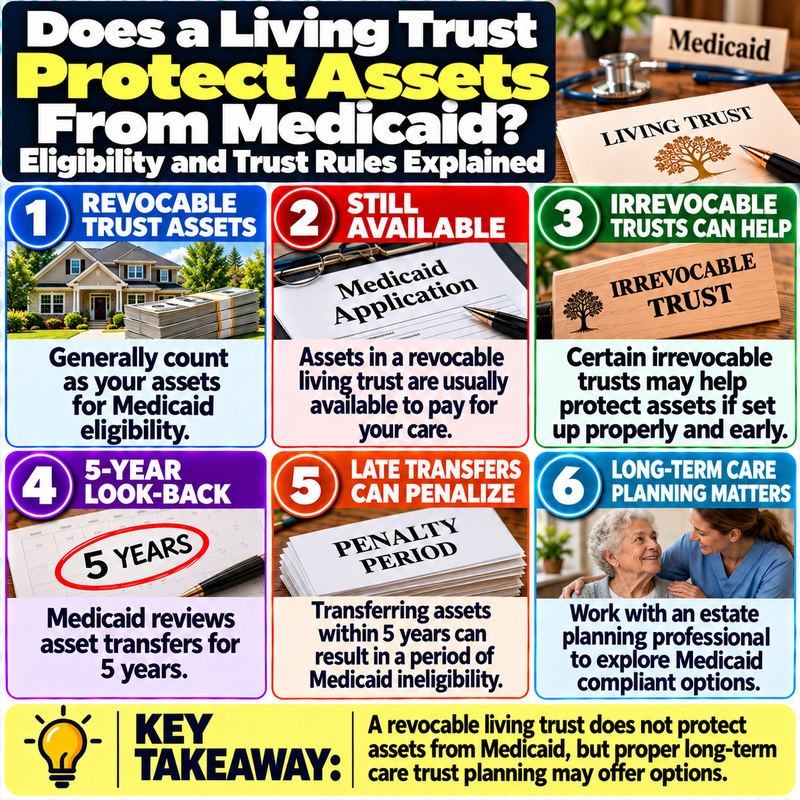
Does a Living Trust Protect Assets From Medicaid?
Here’s the distinction that matters most: when people ask whether a living trust protects assets from Medicaid, they’re almost always asking about Medicaid eligibility for long-term care, such as nursing home coverage or home and community-based services. That’s a completely different question from Medicare, which is federal health insurance that doesn’t pay for extended custodial nursing home stays and doesn’t use the same asset tests at all.
Medicaid, by contrast, is needs-based. To qualify for long-term care benefits, an applicant generally must show that countable resources fall below a strict dollar threshold set by their state. This is where trusts enter the picture, because how a trust is drafted and funded determines whether its assets count toward that threshold or not.
Under federal Medicaid trust rules, if you created and funded a trust yourself, and you retained the ability to revoke it or change its terms, the trust’s principal is typically treated as an available resource belonging to you. The state doesn’t care that the assets technically sit inside a trust document. If you can reach in and take them back whenever you want, Medicaid generally treats them as though they were still sitting in your personal bank account.
The Short Answer for a Standard Revocable Living Trust
The short answer is no. A standard revocable living trust, the kind most people set up to avoid probate and simplify estate administration, does not protect assets from Medicaid’s resource calculation. Payments made to you or on your behalf from that trust can also count as income for eligibility purposes.
What This Means for Your Nursing Home Planning
If your entire estate plan consists of a revocable living trust and nothing else, you should assume that every dollar inside it will be counted if you or your spouse ever needs to apply for long-term-care Medicaid. That doesn’t mean the trust was a bad idea; it still accomplishes probate avoidance and incapacity planning beautifully. It simply means it wasn’t designed to solve this particular problem, and pretending otherwise could leave a family scrambling during a health crisis.
Why Revocable Trust Assets Count as Available Resources
Medicaid’s logic here is actually pretty consistent once you see the pattern: the program looks at control, not labels. A trust is just a legal container. What matters to a caseworker reviewing your application is whether you, the applicant, have the legal power to access the money inside that container.
If you can revoke the trust and get the assets back, Medicaid generally treats those assets as available to you, regardless of what the trust document is titled.
This is also why understanding the difference between trust types matters so much before you rely on one for asset protection. A detailed comparison of revocable vs. irrevocable trust structures shows exactly why one type leaves you in control (and therefore countable) while the other requires giving up that control entirely to achieve protection.
You Still Control the Assets, So Medicaid Still Counts Them
Think of it this way: a revocable living trust is designed to be flexible. You can add property, remove property, change beneficiaries, or dissolve the whole thing on a whim. That flexibility is wonderful for estate planning purposes, but it’s precisely what makes the assets countable for Medicaid. The program isn’t being punitive here; it’s applying a straightforward rule that assets under your personal control are available to pay for your own care before taxpayers step in.
How Payments From the Trust Affect Your Eligibility
It’s not just the principal that matters. If the trust distributes income or makes payments to you or for your benefit, those payments can be counted as income in the month received. That means even smaller, ongoing distributions from a revocable trust, say rental income from a property held in the trust, need to be factored into your monthly income eligibility calculation, not just the lump-sum value of the trust’s assets.

How Medicaid Long-Term-Care Eligibility Actually Works
Before diving deeper into trust specifics, it helps to understand the eligibility framework itself. Long-term-care Medicaid eligibility generally depends on three things working together: your countable resources, your monthly income, and, in some cases, special protections available for a spouse who remains at home.
- Countable resources must fall below a strict limit, which varies by state and marital status.
- Monthly income is evaluated separately and must typically fall below a set threshold or be managed through specific legal tools.
- Certain resources, like a primary residence under specific conditions, may be exempt from the countable resource calculation.
- Transfers of assets within a five-year look-back window are scrutinized and can delay eligibility.
Every one of these pieces interacts with the others, which is exactly why a generic estate planning template rarely solves Medicaid eligibility problems on its own.
Resource Limits You Need to Know
Resource limits are notoriously low compared to what most families have saved over a lifetime. States administer their own Medicaid programs within the federal framework, so exact dollar thresholds differ from state to state, but the pattern is consistent: applicants are expected to spend down nearly all of their countable assets before qualifying for benefits.
Who Qualifies for Nursing Home Coverage
Qualifying for nursing home coverage under Medicaid requires meeting both a medical necessity standard, confirming that skilled nursing or long-term care is required, and a financial standard, confirming that countable resources and income fall within the state’s limits. Both boxes need to be checked. A person in excellent financial shape who needs nursing care, or a financially modest person who doesn’t yet need that level of care, wouldn’t qualify under this combined test.
Income Rules vs. Resource Rules: What’s the Difference?
People often lump “income” and “resources” together, but Medicaid treats them as two completely separate tests, and trusts can affect both differently depending on how they’re structured.
Resources are what you own at a single point in time: your bank balance, investment accounts, real estate, and similar property. Income, on the other hand, is what flows to you on a recurring basis: Social Security payments, pension income, rental income, or trust distributions. A trust that holds a lump sum of money affects the resource test, while a trust that pays out monthly distributions affects the income test, and sometimes a single trust triggers both. To understand how a trust can protect your assets, you might consider exploring a Medicaid Protection Trust.
Resources = what you own right now. Income = what comes in each month. A trust can affect either one, or both, depending on how it’s drafted.
How Medicaid Treats Your Monthly Income
If a trust pays income to you, whether that’s interest, dividends, or rent generated by trust property, that payment is typically counted as income in the month it’s received. This applies whether the trust is revocable or a properly structured irrevocable trust that retains an income interest for the grantor. The income test doesn’t disappear just because the underlying principal has been protected.
How Medicaid Treats What You Own
The resource side of the equation looks at the value of the trust’s principal itself. For a revocable trust, that principal value is counted directly against your resource limit. For specialized irrevocable trusts, the portion of principal that’s genuinely out of your reach may not count, but any portion you could still access, even technically, will likely still be counted as an available resource.

The Five-Year Look-Back Period Explained
Whenever someone applies for long-term-care Medicaid, the state doesn’t just look at what you own today. It also looks backward, typically 60 months, to review financial transactions that happened before the application date. This is commonly called the five-year look-back, and it exists specifically to catch people who gave away assets right before applying for benefits in order to artificially qualify.
If the state finds a transfer made during that window for less than fair market value, it doesn’t ignore it just because the money is already gone. Instead, it calculates a penalty period, a stretch of time during which the applicant is deemed ineligible for Medicaid coverage even though they’ve already applied and may desperately need care.
What Counts as a Disqualifying Transfer
A disqualifying transfer generally includes gifts to family members, assets moved into certain trusts, or property sold for less than it’s actually worth. The state isn’t trying to catch every small transaction; it’s specifically looking at transfers that reduced your countable resources without getting fair value in return.
How Penalty Periods Are Calculated
The penalty period is calculated by dividing the value of the improperly transferred assets by the average monthly cost of nursing home care in that state. So a larger transfer creates a longer penalty, and because nursing home care is expensive, even a moderate transfer can translate into many months without coverage. During that penalty period, the family is responsible for paying out of pocket, often at the very moment they can least afford to.
When the Look-Back Clock Actually Starts
Here’s a detail that trips a lot of families up: the five-year clock starts running on the date assets are actually transferred into a trust or given away, not on the date the trust document itself was signed. Creating a trust years ago but only funding it recently doesn’t give you credit for the earlier date. Timing of funding, not timing of drafting, is what starts the countdown.

Why Giving Away Assets or Funding a Trust Can Backfire
It’s tempting to think that simply moving money out of your name solves the problem. In reality, rushed or poorly structured transfers can create more harm than good, leaving a family with reduced resources and an active penalty period at the exact moment they need coverage most.
Transfers for Less Than Fair Market Value
Fair market value matters enormously here. Selling a home to a family member at a steep discount, or simply gifting cash to children “just in case,” are classic examples of transfers that Medicaid will flag during the look-back review. The program doesn’t distinguish between a transfer made with good intentions and one made to evade eligibility rules; the mechanics of the penalty calculation apply the same way regardless of motive.
Real Consequences of Rushed Transfers
Consider a family that transfers a substantial sum to an adult child two years before a parent needs nursing home care. When the application is filed, the state identifies the transfer, calculates a penalty period based on that amount divided by the average monthly care cost, and the family is left paying privately for months with no Medicaid support, despite having already given away the very money that could have covered that gap. This is exactly why rushed, last-minute planning is so risky, and why specialized planning needs lead time to work properly.
Revocable vs. Irrevocable Trusts: How Medicaid Treats Each
At this point, the distinction between trust types becomes the whole ballgame. Medicaid’s treatment of a trust hinges almost entirely on whether it’s revocable or irrevocable, and more specifically, on exactly how much control the grantor retained.
Why Revocable Trusts Offer No Protection
As covered earlier, a revocable trust gives you ongoing control, which means Medicaid treats its assets as yours. There’s no version of a self-funded revocable trust that shields assets from the resource test, no matter how the document is worded. If you want a deeper breakdown of exactly how these two trust categories differ in function, the comparison available through revocable vs. irrevocable trust planning lays out the structural differences clearly.
Why Irrevocable Trusts Aren’t Automatically Safe Either
It would be a mistake, however, to assume that simply labeling a trust “irrevocable” guarantees Medicaid protection. If the trust document still allows payments to be made to or for the benefit of the grantor, that portion can be treated as an available resource. And if the trust was drafted carelessly, with vague language or retained powers that weren’t intended, it may fail to accomplish what the family thought it would. Irrevocable doesn’t automatically mean protected; it means the analysis shifts, and the specific terms of the document become critical.
How Specialized Medicaid Asset Protection Trusts Work
A specialized Medicaid asset protection trust is a particular kind of irrevocable trust, purpose-built for this exact goal. Unlike a standard revocable living trust, it requires the grantor to genuinely give up direct ownership and control over the assets placed inside it. That loss of control is uncomfortable for many people, but it’s also precisely what makes the structure effective.
These trusts are not something you download as a template and fill in yourself. The drafting has to account for how your specific state treats income retained by the grantor, what triggers inclusion in the countable resource calculation, and how the trust interacts with estate recovery rules after death. Done correctly, the result is a structure where certain assets fall outside your countable resources once the five-year look-back period has passed, while still allowing some benefit to flow to you during your lifetime.
The Three Key Parties: Grantor, Trustee, and Beneficiaries
Every one of these trusts involves three distinct roles. The grantor is the person funding the trust, typically the individual doing the Medicaid planning. The trustee is the person or institution managing the trust assets, and critically, this generally cannot be the grantor, because serving as your own trustee over a trust where you’re also a beneficiary can undermine the very protection you’re trying to create. The beneficiaries are typically children or other loved ones who will eventually receive what remains in the trust.
Income You Can Keep vs. Principal You Give Up
Many of these trusts are structured so the grantor retains the right to receive income generated by the trust, things like interest, dividends, or rental income, for as long as they live. What the grantor gives up is access to the principal itself. That principal is protected from the Medicaid spend-down requirement and passes to the named beneficiaries after the grantor’s death, rather than being drained down to the state’s resource threshold first.
This income-retained, principal-protected structure explains why these trusts can feel like a reasonable compromise for some families: you keep a stream of income during your lifetime, while the bulk of the asset value is shielded from the spend-down calculation, as long as the five-year window has already passed by the time you apply.
Assets Commonly Placed Into These Trusts
The assets most frequently transferred into this type of trust tend to follow a consistent pattern:
- The primary family residence, often the single largest asset at risk
- Vacation property or secondary real estate
- Investment accounts and brokerage holdings
- Savings and other cash assets above the state’s countable resource threshold
These categories show up again and again because they represent the assets families most want to pass down intact, and because they’re the ones most exposed to a spend-down requirement if left untouched.
Assets You Should Keep Outside the Trust
Not everything belongs in one of these trusts. Retirement accounts, including IRAs, generally cannot be transferred into an irrevocable trust without triggering immediate income taxation on the full account value, which usually defeats the purpose entirely. These accounts typically need to be addressed through separate planning strategies rather than folded into a Medicaid asset protection trust.

Protecting Your Home, Spouse, and Other Exempt Resources
Medicaid rules recognize that a spouse who isn’t the one needing care still has to live somewhere and pay bills. Because of that, federal and state rules build in specific protections for what’s commonly called the “community spouse,” the spouse who remains at home while the other spouse receives nursing home care.
Community Spouse Resource Allowance Explained
The community spouse resource allowance allows the at-home spouse to retain a defined amount of the couple’s combined countable assets, rather than requiring everything to be spent down to the single applicant’s resource limit. This allowance is recalculated based on the couple’s total resources at the time of the “snapshot date,” and it exists precisely so that the healthy spouse isn’t left destitute while their partner receives care.
The goal of the community spouse allowance isn’t to eliminate spend-down entirely. It’s to make sure one spouse isn’t impoverished while the other qualifies for care.
Even with this allowance in place, though, a couple’s joint assets above that threshold can still be substantial enough that a meaningful amount must be spent down before the applying spouse qualifies. That gap is often exactly where early, specialized trust planning becomes useful, protecting assets above the allowance that would otherwise need to be spent before benefits begin.
Minimum Monthly Maintenance Needs Allowance
In addition to the resource allowance, there’s a separate income protection called the minimum monthly maintenance needs allowance. This ensures the community spouse has enough monthly income to cover basic living expenses, even if that means a portion of the institutionalized spouse’s income gets diverted to support the spouse remaining at home.
Why the Family Home Is Often the Biggest Risk
The primary residence is usually exempt from the countable resource calculation while the applicant, a spouse, or a dependent child continues living there. But exempt from the eligibility test isn’t the same as protected from estate recovery after death. Once the Medicaid recipient passes away, the state’s estate recovery program can seek reimbursement from the probate estate, and for most families, the home is the single biggest asset sitting in that estate. This is precisely why many families choose to address the home specifically through trust planning, well before it becomes urgent.
Medicaid vs. Medicare: Don’t Confuse These Two Programs
It bears repeating because the confusion is so common: Medicaid and Medicare are not the same program, and they don’t serve the same purpose. Medicare is federal health insurance available to most people once they turn 65, regardless of income or assets. Medicaid is a needs-based program, jointly administered by federal and state governments, designed for people with limited income and resources.
Key Differences in Coverage and Eligibility
Medicare generally covers short-term rehabilitative stays in a skilled nursing facility, but only for a limited period following a qualifying hospital stay, and it does not cover long-term custodial nursing home care. Medicaid, by contrast, is the primary payer for extended nursing home stays in the United States for people who qualify financially. That’s why asset protection trust planning is a Medicaid conversation, not a Medicare conversation, and why none of this planning affects your Medicare enrollment or coverage in any way.
Why Starting Early Makes or Breaks Your Protection Strategy
If there’s one theme running through everything discussed so far, it’s this: timing determines whether any of this planning actually works. A beautifully drafted Medicaid Protection Trust funded too late accomplishes nothing if the five-year look-back period hasn’t run its course by the time an application is filed.
Advance Planning vs. Crisis Planning
Families who begin this process years in advance, ideally as part of routine estate planning while everyone involved is still healthy, have the full five-year window available to them. That gives the penalty-period math time to resolve itself naturally, so that by the time care is actually needed, the transferred assets are already outside the look-back window.
- Advance planning provides the full five-year cushion for transfers to clear the look-back period
- Advance planning allows more flexibility in structuring which assets go into the trust
- Advance planning reduces the financial pressure on families during an actual health crisis
- Crisis planning, started after a diagnosis or sudden decline, often has far more limited options available
None of this means crisis planning is pointless. Even families who start late may have some options through an elder law attorney familiar with their state’s specific rules. But those options are typically narrower, and the outcomes less predictable, than what’s available to a family that planned years ahead.
What Happens If You Wait Until Care Is Already Needed
A family that waits until nursing home admission is imminent simply doesn’t have the five-year runway available anymore. Any transfers made at that point are likely to fall squarely within the look-back period, triggering the exact penalty calculation this whole structure was designed to avoid. This is the single most important reason elder law attorneys push clients toward early planning rather than reactive planning.

State Rules Vary: Why You Need Personalized Guidance
Medicaid is a joint federal-state program, which means the broad framework is consistent nationwide, but a lot of the specific numbers, thresholds, and procedural details vary by state. Resource limits, income caps, look-back enforcement, and even how certain trust provisions are interpreted can differ depending on where you live.
That variation is exactly why generic, one-size-fits-all guidance (including this article) can only take you so far. The rules that apply to your specific state, combined with your specific family situation, your specific assets, and your specific timeline, are what actually determine whether a particular trust structure helps or hurts your eligibility.
Why an Elder Law Attorney Is Worth the Investment
An elder law attorney who regularly handles Medicaid planning in your state brings something no article or template can: current knowledge of exactly how your state’s Medicaid agency interprets trust language, income rules, and look-back enforcement. Because these rules are complex and change over time, working with an experienced attorney before any transfers are made is strongly recommended rather than optional.
Questions to Ask Before You Sign Anything
Before funding any trust for Medicaid planning purposes, it’s worth asking a few direct questions of the attorney drafting it:
- Does this trust structure comply with my specific state’s current Medicaid rules?
- Who will serve as trustee, and why can’t it be me?
- What happens to the income this trust generates, and how is that treated for eligibility purposes?
- What is my realistic timeline before the five-year look-back period would be satisfied?
- What assets should stay outside this trust entirely?
A qualified elder law attorney should be able to answer each of these clearly and specifically, not in vague generalities. If the answers feel rushed or templated, that’s worth treating as a red flag.
5 Common Myths About Medicaid Trusts, Debunked
Misinformation spreads quickly around this topic, partly because the rules are genuinely complicated and partly because people want a simple answer that doesn’t exist. Separating fact from myth here can save a family from a costly mistake.
Let’s walk through the five misconceptions that come up most often, and what’s actually true in each case.
1. “A Living Trust Automatically Hides My Assets”
This is false, and it’s worth addressing directly because the phrasing itself is a problem. Medicaid planning, when done correctly, is not about hiding assets or concealing information from the state. It’s about using legally recognized structures, disclosed fully on the application, that happen to remove certain assets from the countable resource calculation because of how control and ownership are structured.
A standard revocable living trust doesn’t hide anything from Medicaid’s review, because you retain full control over it, and full control means full countability. Even a properly structured irrevocable trust isn’t “hidden”; it’s disclosed on the application, and its treatment depends entirely on its terms and funding date, not on whether the caseworker happens to notice it.
2. “I Can Be My Own Trustee and Still Be Protected”
Generally not, at least not reliably. Serving as trustee over an irrevocable trust in which you’re also a beneficiary can give a caseworker grounds to argue that you retained enough control to make the assets countable after all. Most properly structured Medicaid asset protection trusts name an independent trustee, often an adult child or a professional fiduciary, specifically to avoid this problem.
3. “I Can Set Up the Trust Right Before Applying”
This is one of the most expensive misconceptions out there. Funding a trust shortly before applying almost guarantees the transfer falls inside the five-year look-back window, triggering a penalty period rather than avoiding one. The entire strategy depends on time passing between the funding date and the application date, and there’s no legal shortcut around that requirement.
4. “Medicaid Planning Is Illegal Asset Hiding”
Also false, in the opposite direction. Properly structured Medicaid planning, using transparent, legally authorized trust structures, disclosed on the application and drafted according to current state and federal rules, is legal and widely used. The key word is “properly.” A rushed, poorly drafted, or improperly disclosed arrangement can create real problems, but that’s a drafting and disclosure issue, not evidence that the underlying strategy itself is improper.
5. “All Irrevocable Trusts Work the Same Way”
Not even close. Irrevocable trusts span an enormous range of structures, purposes, and provisions. A trust drafted for tax planning, a trust drafted for creditor protection, and a trust drafted specifically for Medicaid eligibility can all be irrevocable and still treat assets in completely different ways under Medicaid’s rules. The label “irrevocable” tells you almost nothing about Medicaid treatment on its own; the specific terms are what matter.
Weighing the Trade-Offs Before You Commit
Before funding any specialized trust, it’s worth being honest about what you’re giving up, not just what you’re gaining. These trades are real, permanent in most cases, and not right for every family.
Loss of Access to Principal
The defining feature of these trusts, giving up control of the principal, is also their biggest limitation. Once assets are transferred in, you generally cannot take them back for a major unexpected expense, a home renovation, travel, or any other personal use. You need to be genuinely comfortable with that permanence, and you need enough assets outside the trust to cover your anticipated needs for the rest of your life.
Tax Basis and Estate Tax Considerations
Assets transferred into one of these trusts typically retain your original cost basis rather than receiving a stepped-up basis at death. That can mean higher capital gains taxes for your beneficiaries if they eventually sell an appreciated asset, compared to what they’d owe if they’d inherited it directly outside the trust. Depending on how the trust is structured, the assets may or may not be included in your taxable estate for federal and state estate tax purposes, which is another detail that needs careful drafting.
Ongoing Costs and Alternatives Worth Considering
These trusts also come with ongoing administrative costs and trustee fees that a simple revocable living trust typically doesn’t carry. For some families, particularly those whose assets fall comfortably under their state’s resource limits already, this level of specialized planning simply isn’t necessary. A Medicaid asset protection trust isn’t appropriate for everyone, and a qualified attorney should help you determine whether your specific financial picture justifies the trade-offs involved.
The Bottom Line on Protecting Your Life’s Work
A standard revocable living trust won’t protect your assets from Medicaid, but a properly timed, properly drafted irrevocable trust, built specifically for this purpose and funded well in advance of need, can accomplish what a generic estate plan cannot.

Common Misconceptions Of Living Trusts And Medicaid
1. “I Can Be My Own Trustee and Still Be Protected”
This is a trap a lot of well-meaning families fall into because it feels natural to stay in charge of your own money. But serving as trustee over an irrevocable trust where you’re also named as a beneficiary tends to undercut the entire point of the structure. A caseworker reviewing your application can point to that retained control as evidence that you never really gave up access to the assets, which opens the door to counting them anyway.
Most properly structured Medicaid asset protection trusts solve this by naming an independent trustee, often an adult child, a trusted friend, or a professional fiduciary. That person manages the trust according to its terms, while you retain whatever income rights the document allows, but not the authority to direct or reclaim the principal.
2. “I Can Set Up the Trust Right Before Applying”
This misconception is probably the single most expensive one on this list. Funding a trust shortly before filing a Medicaid application almost guarantees the transfer lands squarely inside the five-year look-back window, triggering exactly the penalty period the strategy was supposed to avoid. There’s no legal workaround that compresses that timeline. The only thing that satisfies the look-back requirement is time itself passing between the funding date and the application date.
3. “Medicaid Planning Is Illegal Asset Hiding”
This one runs in the opposite direction, and it’s just as inaccurate. Properly structured Medicaid planning uses transparent, legally recognized trust arrangements that are fully disclosed on the application itself. Nothing about this process involves concealing information from the state. The strategy works because of how ownership and control are legally structured, not because anyone is hiding anything from a caseworker’s view.
4. “All Irrevocable Trusts Work the Same Way”
Not even close. Irrevocable trusts get used for all kinds of purposes, tax planning, creditor protection, charitable giving, and Medicaid eligibility among them, and the specific terms inside each one determine how it’s treated. Two trusts can both be labeled “irrevocable” and still produce completely different outcomes under Medicaid’s rules depending on what rights the grantor retained.
That’s really the throughline connecting all five of these myths: the label on the document matters far less than the specific language inside it. Generic assumptions about trusts, in either direction, tend to lead families astray.
Weighing the Trade-Offs Before You Commit
Before funding any specialized trust, it’s worth getting honest about what you’re giving up, not just what you stand to gain. These trade-offs are real, often permanent, and not the right fit for every household.
Loss of Access to Principal
The defining feature of these trusts, giving up control of the principal, is also their most significant limitation. Once assets move in, you generally can’t pull them back out for a major unexpected expense, a home renovation, or simply a change of heart. You need to feel genuinely comfortable with that permanence and have enough resources sitting outside the trust to cover whatever life throws at you afterward.
Tax Basis and Estate Tax Considerations
Assets placed into one of these trusts typically retain your original cost basis rather than receiving a stepped-up basis at death. For an appreciated asset like a long-held home, that can translate into a noticeably larger capital gains tax bill for your beneficiaries down the road compared to inheriting it outright. Whether the trust’s assets are included in your taxable estate for federal or state purposes depends entirely on how the document is drafted, which is another reason this isn’t a do-it-yourself project.
Ongoing Costs and Alternatives Worth Considering
These structures also carry ongoing administrative costs and trustee fees that a simple revocable trust typically doesn’t. For families whose assets already sit comfortably under their state’s resource limit, this level of specialized planning may simply be unnecessary. A Medicaid asset protection trust isn’t the right answer for everyone, and a qualified elder law attorney should help you figure out whether your specific numbers justify these trade-offs.
The Bottom Line on Protecting Your Life’s Work
A standard revocable living trust won’t shield your assets from Medicaid’s long-term-care eligibility rules, but a carefully drafted irrevocable trust, built specifically for this purpose and funded well ahead of need, can accomplish what a generic estate plan never could.
Frequently Asked Questions
These short answers cover the questions that come up most often once families understand the basic mechanics of Medicaid trust planning. As always, your specific state’s rules and your personal circumstances should guide any final decisions.
None of the answers below replace a conversation with a qualified elder law attorney, especially given how much variation exists from state to state.
Can Medicaid Take My House If It’s in a Living Trust?
If the trust is revocable and you still control it, the home’s value is generally still counted toward your resource limit, though the home itself may be exempt from that count while you or a spouse continue living there. Only a properly drafted, timely funded irrevocable trust changes how the home is treated.
Does an Irrevocable Trust Protect Assets From Nursing Home Costs?
It can, but only under specific conditions: the trust needs to be drafted correctly, funded more than five years before an application, and structured so the grantor genuinely can’t access the principal. Simply labeling a trust “irrevocable” guarantees nothing on its own.
This is exactly why the specific drafting language matters more than the trust’s title, and why working with an attorney experienced in your state’s Medicaid rules is non-negotiable.
How Far Back Does Medicaid Look at Bank Statements?
Generally 60 months, or five years, counted back from the date of the Medicaid application for long-term-care benefits. This is the look-back period referenced throughout this article, and it applies to transfers of all kinds, not just trust funding.
States review financial records during this window specifically to identify transfers made for less than fair market value.
If such a transfer is found, it triggers a penalty period calculation rather than an outright denial.
Can I Be the Trustee of My Own Medicaid Asset Protection Trust?
Usually not. Serving as both trustee and beneficiary over an irrevocable trust can suggest you retained enough control to undermine its protection, which is why an independent trustee is typically named instead.
What Happens If I Apply for Medicaid Within the Five-Year Look-Back?
Any disqualifying transfers made during that window can trigger a penalty period, calculated by dividing the transferred value by the average monthly cost of nursing home care in your state, during which you remain ineligible for Medicaid coverage.
Can My Spouse Keep Our House If I Need Nursing Home Care?
Often, yes. The home is typically exempt from the countable resource test while a community spouse continues living there, though estate recovery after both spouses have passed is a separate issue worth planning around.
Community spouse protections, including the resource allowance and the minimum monthly maintenance needs allowance, exist specifically to prevent the spouse remaining at home from being left without adequate support.
Do Retirement Accounts Need to Go Into the Trust?
Generally, no. Retirement accounts like IRAs typically can’t be transferred into an irrevocable trust without triggering immediate taxation on the full account value, so they usually require a separate planning approach entirely.
Is Medicaid Trust Planning Legal?
Yes, when it’s done properly and disclosed fully on the application. It’s a recognized, widely used planning strategy, not a method for concealing assets from the state.
The confusion often comes from conflating two very different things: legitimate planning using disclosed legal structures, and improper concealment of assets or information. The table below makes the distinction clear.
| Legitimate Medicaid Planning | Improper Asset Concealment |
|---|---|
| Uses disclosed, legally recognized trust structures | Hides assets or transactions from the application |
| Respects the five-year look-back timeline | Attempts to bypass look-back rules through deception |
| Drafted with licensed elder law counsel | Often relies on informal, undocumented arrangements |
| Fully reported on the Medicaid application | Omits required financial information |
That distinction is really the heart of the matter. Everything discussed in this article falls into the left-hand column, planning done openly, with professional guidance, and within the rules as written.
How Much Does It Cost to Set Up a Medicaid Asset Protection Trust?
Costs vary depending on complexity, your state, and the attorney you work with, and they typically include both the initial drafting fee and ongoing trustee administration costs over the life of the trust.
What’s the Difference Between Medicaid Estate Recovery and Probate?
Medicaid estate recovery is the specific process a state uses to seek reimbursement from a Medicaid recipient’s probate estate after death, while probate is the broader court process for administering and distributing an estate; assets properly held in an irrevocable trust generally bypass both.
- A standard revocable living trust does not protect assets from Medicaid’s resource or income tests.
- Specialized irrevocable trusts can offer protection, but only with correct drafting, an independent trustee, and enough lead time to clear the five-year look-back.
- Community spouse protections exist separately and can soften, though not eliminate, the spend-down requirement for a couple.
- State-specific rules vary enough that no generic plan should be finalized without a qualified elder law attorney reviewing your situation.
Long-term care costs aren’t getting any cheaper, and the families who come out ahead tend to be the ones who started this conversation years before a crisis forced their hand.
Trust structures that look identical on the surface can produce wildly different Medicaid outcomes based on a few lines of drafted language, which is exactly why this isn’t a decision to make from a template.
Whatever you decide, the worst outcome is doing nothing simply because the rules feel overwhelming, since even a basic understanding of the five-year window and the difference between revocable and irrevocable structures puts you ahead of where most families start.