Medicaid Estate Recovery Living Trust Rules: When Trust Assets May Be Subject to Recovery
Learn When Medicaid Estate Recovery May Apply, Why State Definitions of Estate Matter, and How Trusts Can Be Treated Differently
Can a nursing home bill reach into a trust you set up years ago? For thousands of families, that question surfaces at the worst possible moment—right after a loved one has passed and the mail brings an unexpected letter from the state Medicaid agency.
Medicaid estate recovery is real, it’s federally mandated in many cases, and it does not automatically stop at the courthouse door of probate. Understanding how it works—and how trust planning fits into the picture—can save your family from costly surprises. Resources like our living trust guide can help you understand your options, but no single document is a magic shield against every Medicaid claim.
Key Takeaways
- States are required to pursue Medicaid estate recovery for certain long-term-care benefits paid to recipients age 55 or older, though exact rules vary by state.
- Whether a trust’s assets are reachable depends heavily on state law, trust type, and the specific benefits received.
- Surviving spouses, minor children, and disabled children of any age receive special federal protections from recovery claims.
- A revocable living trust does not automatically protect assets from Medicaid estate recovery—state law determines what counts as part of the “estate.”
- Later in this article, we’ll break down how probate-estate versus expanded-estate states differ, and what undue hardship waivers can (and can’t) do for your family.
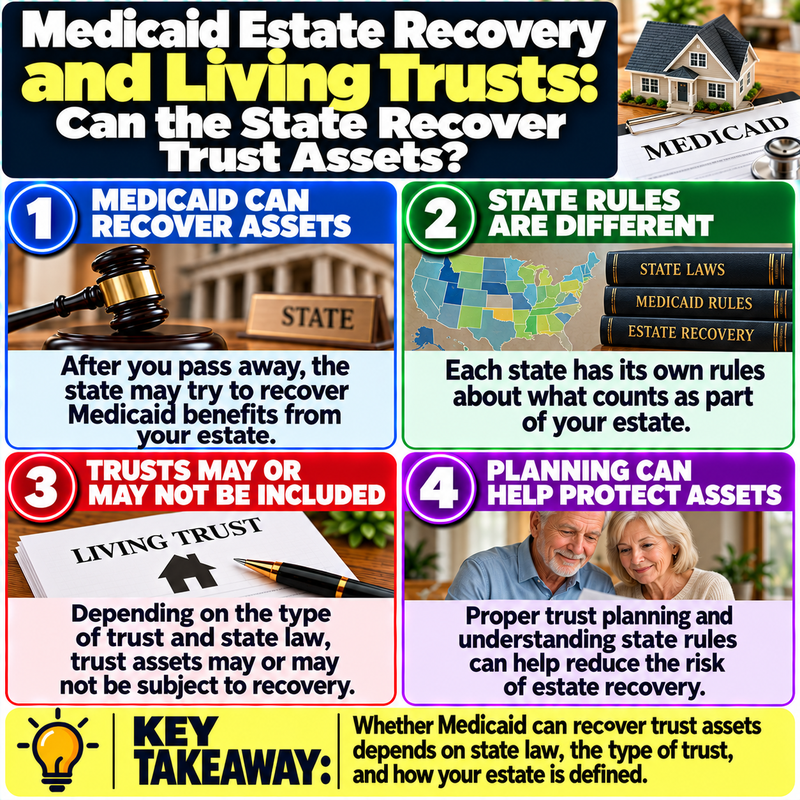
Before diving into trusts specifically, it helps to understand the recovery system as a whole. Federal Medicaid guidance sets the floor, but states build their own rules on top of it, which is exactly why two neighboring states can treat the same trust completely differently.
What Is Medicaid Estate Recovery?
Medicaid estate recovery is the legal process by which a state Medicaid program seeks reimbursement from a deceased recipient’s estate for certain benefits paid during their lifetime. This isn’t optional for states in most cases—it’s baked into federal Medicaid law under 42 U.S.C. § 1396(p). Think of it less like a bill collector showing up and more like a built-in repayment clause that Medicaid attaches to specific types of long-term-care assistance.
Why States Must Recoup Medicaid Costs
Medicaid is a joint federal-state program, and long-term care is enormously expensive. To help keep the system solvent, federal law requires states to recover costs from the estates of certain deceased recipients. According to Medicaid.gov, this requirement applies specifically to benefits paid to individuals who were age 55 or older when they received care, and it covers defined categories of services rather than every dollar Medicaid ever spent on a person.
How the Process Starts After a Recipient’s Death
Once a Medicaid recipient passes away, the state Medicaid agency typically reviews whether recovery applies. If the deceased received qualifying benefits after age 55, the agency may file a claim against the estate during probate, similar to how any other creditor would file a claim. The estate’s personal representative then has to address that claim, often by using estate assets to pay it before distributing anything to heirs.

Which Medicaid Benefits Are Subject to Mandatory Recovery
Not all Medicaid spending triggers estate recovery. Federal law narrows mandatory recovery to a specific set of services, and understanding which ones apply can help you gauge your own family’s potential exposure.
Nursing Facility Services
Payments for nursing facility care are at the top of the list. If Medicaid covered a loved one’s stay in a nursing home after they turned 55, that spending is generally subject to recovery once they pass away, regardless of how modest or significant the total cost was.
Home and Community-Based Services
Medicaid also commonly pays for home and community-based services—things like in-home aides, adult day programs, or other supports that let someone stay out of a facility. These services fall under mandatory recovery too, which surprises some families who assume recovery only applies to nursing home stays.
It’s a common misconception that staying home instead of entering a facility avoids this issue entirely. In reality, the type of service matters more than the setting.
Related Hospital and Prescription Drug Costs
When hospital care or prescription drugs are connected to the nursing facility or home-and-community-based services a person received, those related costs can also be swept into the recovery claim. States must tie recovery to person 55 or older, per Medicaid.gov guidance, and connect the services to the long-term-care categories described above.
The Age 55 Rule Explained
Age 55 is the dividing line most people need to remember. Benefits paid before that birthday generally fall outside mandatory recovery, while benefits paid at or after age 55 usually do not.
What Happens If You Received Benefits Before Age 55
If a person received Medicaid-covered nursing facility care, home and community-based services, or related hospital and prescription costs before turning 55, those particular payments are typically not subject to the mandatory recovery rules described above. This doesn’t mean all Medicaid spending before 55 is immune from every possible state rule, but the federal mandate specifically targets the 55-and-older population.
How States Apply This Threshold Differently
While age 55 sets the federal floor, states retain some discretion in how broadly they define recoverable services and how aggressively they pursue claims. Some states stick closely to the federally required minimum. Others expand recovery to additional types of Medicaid spending allowed under federal law. This state-level flexibility is one of the biggest reasons two families with similar circumstances in different states can end up with very different recovery outcomes.
Federal law sets the minimum requirements for Medicaid estate recovery, but states can choose to expand both the benefits covered and the definition of a recoverable estate—always consult your state’s specific Medicaid agency rules before assuming how recovery will apply to your situation.
Probate Estate vs. Expanded Estate Definitions
Here’s where things get interesting for families who assumed a trust would keep assets out of reach. The federal baseline only requires states to recover from the “probate estate”—generally the property that passes through a will or through intestate succession. But federal law also allows states to expand that definition if they choose.
A probate-estate-only state limits recovery to assets that go through the court-supervised probate process. An expanded-estate state can reach further, potentially including jointly held property, assets held in certain trusts, and other interests that never touch probate court at all. This single policy choice explains why identical trust structures produce wildly different outcomes depending on where the Medicaid recipient lived and died.
Can the State Reach Assets in a Revocable Living Trust?
This is the question I get asked most often, and the honest answer is: it depends on your state, and it’s rarely a simple yes-or-no.
Why Revocable Trusts Don’t Automatically Protect Assets
A revocable living trust lets you keep control over your assets during your lifetime—you can add property, remove it, change beneficiaries, or dissolve the trust entirely. That flexibility is exactly why Medicaid rules often treat revocable trust assets as still belonging to you for eligibility and recovery purposes. If you can access or control the asset, many states consider it part of your countable resources, and by extension, potentially reachable by recovery efforts after you pass away.
Choosing between trust types isn’t something you should guess at. The distinctions matter enormously for Medicaid purposes, and understanding the differences between revocable and irrevocable trusts is one of the most important steps in building a plan that actually reflects your goals.
State-by-State Differences in Treating Trust Property
In a probate-estate-only state, a revocable trust might successfully keep assets out of the recovery process, simply because trust assets typically avoid probate. In an expanded-estate state, that same trust might not offer any protection at all, since the state has specifically written its laws to reach nonprobate transfers. No article, including this one, can tell you definitively how your state treats trust property—only a licensed elder-law attorney reviewing your state’s statutes can do that.

What Happens to Trust Funds Remaining After the Recipient Dies
Even trusts that successfully avoid probate aren’t automatically off-limits. Depending on state law and how the trust was drafted, a state Medicaid agency can sometimes pursue a direct claim against remaining trust assets after the beneficiary’s death.
Reimbursement Claims Against Leftover Trust Assets
Under certain conditions, money remaining in a trust after a Medicaid enrollee dies may be used to reimburse Medicaid for benefits paid. This typically applies regardless of whether the trust avoided probate, because some states have adopted laws specifically targeting trust assets for recovery purposes. The trust document’s terms, the type of trust, and the specific state’s recovery statute all factor into whether a claim can succeed.
This is precisely why no responsible estate planner should promise that setting up a revocable trust will defeat Medicaid estate recovery. It might help in some states. It might do nothing in others. The only way to know is to look at your specific state’s rules alongside your specific trust’s terms.
How Trustees Should Handle Medicaid Notices
If you’re serving as a trustee and you receive a notice from a state Medicaid agency regarding a deceased beneficiary, don’t ignore it and don’t guess at a response. Trustees have fiduciary duties to the trust’s beneficiaries, and mishandling a Medicaid claim—either by paying too quickly or ignoring a legitimate claim—can create personal liability. Contact an elder-law attorney promptly to review the notice, verify the claim’s validity, and determine the proper next steps before distributing any remaining trust assets.
Protections for Surviving Spouses and Dependent Children
Federal Medicaid law builds in specific protections designed to keep estate recovery from leaving a surviving spouse or vulnerable children without a home or resources. These protections aren’t automatic waivers of the debt—they’re often delays or outright bars on recovery while certain conditions exist.
Generally speaking, recovery is restricted when the deceased enrollee is survived by any of the following:
- A surviving spouse, regardless of where that spouse currently lives
- A child under age 21
- A child who is blind or permanently disabled, of any age
These protections exist at the federal level, but exactly how long they last and what triggers the resumption of recovery efforts can vary by state. Some states pursue recovery once the protected circumstance ends—for example, once a disabled child’s status changes or a surviving spouse passes away—while others handle the timing differently.
Spousal Protection Rules
When a Medicaid recipient dies and leaves behind a surviving spouse, states generally cannot pursue estate recovery while that spouse is alive. The claim doesn’t disappear—it’s typically deferred. Once the surviving spouse passes away, the state may be able to pursue recovery against whatever is left of the original recipient’s estate, depending on how that state structures its deferred-claim process.
Protection for Children Under 21
If a Medicaid recipient has a child under age 21 at the time of death, recovery is restricted while that child remains a minor. This protection recognizes that a minor child shouldn’t lose their home or inheritance because a parent needed long-term-care services later in life.
Once the child turns 21, though, the protection generally ends, and the state may resume pursuing its claim unless another exception applies.
Protection for Blind or Disabled Children of Any Age
Unlike the age-21 cutoff for minor children, protection for a blind or permanently disabled child has no age limit. If a Medicaid recipient’s child meets the federal disability or blindness definition, recovery is restricted for as long as that child’s status remains unchanged—whether the child is 10 years old or 55 years old.
- This protection is one of the strongest in the entire Medicaid recovery framework
- It recognizes that disabled adult children often depend on family resources, including the family home, for their entire lives
- States still require documentation proving the disability meets federal standards before applying this protection
Families with a disabled child should talk to an elder-law attorney early, since proper documentation and planning can make the difference between a smooth protection claim and a drawn-out dispute with the state Medicaid agency.

Undue Hardship Waivers
Beyond the spouse and child protections, federal law requires states to establish undue-hardship waiver procedures. These waivers exist for situations that don’t fit neatly into the spousal or child categories but still present a genuine hardship for the people left behind.
What Qualifies as Undue Hardship
Undue hardship typically applies in situations where enforcing the Medicaid claim would cause real harm—for example, if the estate’s only asset is a home that a family member relies on for income, or if recovering the claim would leave an heir without adequate housing or means of support. Each state defines its own hardship criteria, and the bar for qualifying can be fairly high, so documentation and a clear case matter.
How to Request a Waiver
Requesting a waiver usually involves submitting an application to the state Medicaid agency, along with supporting documentation showing why recovery would create genuine hardship. Deadlines and required forms vary by state, and missing a deadline can forfeit the opportunity to request a waiver at all. Because the process is formal and time-sensitive, working with an elder-law attorney familiar with your state’s specific waiver procedure gives you the best shot at a successful outcome.
It’s worth noting that a hardship waiver is not guaranteed simply because a family faces financial strain. States evaluate each request against their own specific criteria, and approval isn’t automatic just because someone asks.
Medicaid Liens on Homes and Property
Separate from estate recovery after death, federal Medicaid rules also address liens placed on property while a recipient is still alive—specifically for individuals who are permanently institutionalized.
A lien is different from an estate recovery claim. It’s a legal interest the state places on a specific piece of property, often the recipient’s home, which can affect the owner’s ability to sell or transfer that property without satisfying the lien first.
When a Lien Can Be Placed on a Permanently Institutionalized Recipient’s Home
Generally, a state can place a lien on a Medicaid recipient’s home when that individual is permanently institutionalized—meaning they’re not expected to return home—and the home remains in their name. The lien essentially secures the state’s right to recover costs later, often becoming relevant when the home is eventually sold.
Exceptions That Prevent a Lien From Being Filed
Federal rules include protections here too. A lien generally cannot be placed if certain relatives are living in the home, such as:
- A spouse
- A child under 21
- A blind or disabled child, regardless of age
- In some states, a sibling with an equity interest who has lived in the home for a specified period before the recipient’s institutionalization
These exceptions mirror many of the same protections built into the broader estate recovery framework, which makes sense—both sets of rules aim to prevent vulnerable family members from losing their housing because of a relative’s long-term-care needs.
Why Medicaid Recovery Rules Vary So Much by State
If you’ve made it this far, you’ve probably noticed a recurring theme: almost everything in this article comes with the caveat “it depends on your state.” That’s not a cop-out—it’s the honest reality of how Medicaid estate recovery works.
Federal law sets the floor, not the ceiling. States can choose to recover more broadly than federal minimums require, define “estate” more expansively, apply different waiver standards, and handle trust assets in dramatically different ways. This patchwork system means that generic advice about Medicaid and trusts can actually do more harm than good if it doesn’t account for where you actually live.
Examples of State Flexibility Within Federal Minimums
Some states stick closely to the federal floor, pursuing recovery only against probate assets for the specific services required by federal law. Other states have expanded their definitions to include jointly owned property, life estates, and certain trust arrangements. States also differ in how they define hardship, how long they wait before filing claims, and how aggressively they pursue liens on real property.
- Some states only recover from assets that pass through probate
- Other states recover from a broader category of assets, including certain nonprobate transfers
- Waiver application deadlines and hardship criteria differ significantly from state to state
- Lien rules and their exceptions can vary in both scope and documentation requirements
Given this level of variation, treating any single article—including this one—as a complete roadmap for your specific situation would be a mistake. State-specific elder-law advice isn’t optional here; it’s essential.

Irrevocable Trusts and Other Specialized Planning Tools
Because revocable trusts generally don’t remove assets from your control, many families explore irrevocable trusts as part of broader Medicaid planning. These tools come with real trade-offs, and they’re not right for every situation.
How Irrevocable Trusts Differ From Revocable Trusts
An irrevocable trust generally can’t be changed or revoked once it’s established, and the person creating it typically gives up direct control over the assets placed inside. That loss of control is precisely what can make certain irrevocable trusts relevant to Medicaid planning, since assets you don’t control are often treated differently than assets you can freely access.
Still, the specific terms of the trust, the state’s definition of countable resources, and the timing of transfers into the trust all affect how it’s treated. If you’re weighing which structure fits your goals, reviewing how a revocable living trust functions alongside irrevocable options gives you a clearer picture of the trade-offs involved.
Special Needs Trusts and Their Role in Medicaid Planning
Special needs trusts serve a different purpose entirely—they’re designed to hold assets for the benefit of a disabled individual without disqualifying that person from needs-based government benefits, including Medicaid. These trusts often include specific “payback” provisions requiring remaining funds to reimburse Medicaid after the beneficiary’s death, which is a built-in feature rather than a loophole.
A properly drafted special needs trust can preserve a disabled beneficiary’s eligibility for Medicaid while still providing supplemental support for quality-of-life expenses—but the payback provision means Medicaid recovery still applies to remaining assets after the beneficiary passes away.
Whether an irrevocable trust, special needs trust, or another planning tool makes sense for your family depends on your goals, your state’s rules, and your overall financial picture. None of these tools guarantee full protection from Medicaid estate recovery, and claiming otherwise would be misleading.

Planning Ahead Before You Need Long-Term Care
Timing matters enormously in Medicaid planning, and waiting until a health crisis hits severely limits your options.
Timing matters enormously in Medicaid planning, and waiting until a health crisis hits severely limits your options. Many of the most effective planning tools require advance notice, and Medicaid’s look-back rules mean that last-minute moves often backfire. The earlier you start the conversation, the more choices you’ll have.
Why Timing Matters: The Five-Year Look-Back
Medicaid applications involve a look-back period, typically five years, during which the state reviews any transfers of assets for less than fair market value. If you give away or sell assets below their actual value during this window, you could face a penalty period of Medicaid ineligibility. This rule exists specifically to prevent people from giving away assets right before applying for benefits, so starting your planning well before you need care gives you a much wider range of legitimate options.
Risks of Transferring Property for Less Than Fair Market Value
It might seem like a simple solution to just sign the house over to your kids or sell it to a family member for a token amount. But transferring property for less than fair market value before applying to Medicaid can trigger a penalty period, during which you’d be ineligible for the very benefits you’re trying to protect assets to qualify for. The penalty period’s length is calculated based on the value of the transferred asset relative to the average cost of care in your state, and it can leave a family scrambling to cover care costs out of pocket during the gap.
Structuring Asset Ownership Strategically
Rather than reacting to a crisis, it’s often possible to protect assets from Medicaid estate recovery by structuring ownership in a strategic way well ahead of time. This isn’t about hiding assets or dodging rules—it’s about using legitimate, state-sanctioned planning tools within the look-back period’s constraints. Depending on your state and your goals, that might involve:
- Establishing an irrevocable trust years before care is needed
- Reviewing how property titling affects probate versus nonprobate status
- Considering long-term-care insurance alongside Medicaid planning
- Updating beneficiary designations to align with your overall estate plan
None of these steps work well as last-minute fixes. The further in advance you plan, the more flexibility you have to choose the right combination of tools for your specific family and state.
If you’re only beginning to think about long-term-care costs now, don’t panic—but don’t delay either. Every year you wait narrows your options, and every state has its own quirks that can make a generic plan ineffective.
Smart Questions to Ask an Elder-Law Attorney
Given how much variation exists between states, the single most valuable step you can take is sitting down with an elder-law attorney who practices in your specific state. Here’s what to ask once you’re in the room.
Questions About Your State’s Specific Recovery Rules
Start by asking whether your state uses a probate-estate or expanded-estate definition for recovery purposes, since that single answer shapes everything else about your planning strategy. Follow up by asking which specific Medicaid benefits trigger recovery in your state, and whether your state has adopted any additional categories beyond the federal minimum.
It’s also worth asking directly how your state handles liens on real property, since lien rules and estate recovery rules don’t always align perfectly even within the same state.
Questions About Trusts and Exempt Assets
Ask your attorney directly whether a revocable trust would offer any protection in your state, and if not, whether an irrevocable trust or another tool might serve your goals better. Request specifics about how your state treats jointly owned property, life estates, and payable-on-death accounts for recovery purposes, since these nonprobate assets often behave unpredictably across state lines.
Finally, ask what documentation you’d need in place now to support a hardship waiver or spousal protection claim later, since gathering this paperwork in advance can save significant time and stress during an already difficult period.

Protecting What Matters Most Starts With Early Planning
Medicaid estate recovery isn’t designed to be punitive, but it can feel that way to families caught off guard by a claim they never saw coming. The good news is that federal protections for spouses and certain children exist specifically to prevent the worst outcomes, and hardship waivers offer another layer of relief when genuine need exists. The better news is that proactive, state-specific planning—done early and with qualified guidance—puts you in control of the process rather than leaving your family to react after the fact.
Frequently Asked Questions
Does a living trust protect my house from Medicaid?
Not automatically. A revocable living trust generally doesn’t remove your control over the property, which means many states still treat it as part of your countable assets for Medicaid purposes. Whether it offers any protection against estate recovery depends heavily on your state’s specific laws and the trust’s exact terms.
What assets are exempt from Medicaid estate recovery?
Exempt assets vary by state, but common examples often include a home where a surviving spouse, minor child, or disabled child continues to live, along with assets protected under an approved hardship waiver. Personal property and certain burial arrangements may also be treated differently depending on your state’s specific statutes.
Can Medicaid take my home after I die?
It’s possible, depending on your state’s rules and whether any spousal or child protections apply at the time of your death. If no protected relative is living in the home and no hardship waiver applies, the state may file a claim against the home’s value as part of estate recovery.
How far back does Medicaid look at asset transfers?
Medicaid typically uses a five-year look-back period when reviewing asset transfers made before an application for long-term-care benefits. Transfers made for less than fair market value during this window can trigger a penalty period of ineligibility, so timing any planning well before an application matters significantly.
What is the difference between a revocable and irrevocable trust for Medicaid purposes?
A revocable trust allows you to maintain control and make changes at any time, which often means Medicaid treats its assets as still belonging to you. An irrevocable trust generally removes your direct control once established, which can change how those assets are treated for eligibility and recovery purposes, though specifics vary by state.
- Revocable trusts: flexible, but often treated as your own assets by Medicaid
- Irrevocable trusts: less flexible, but potentially treated differently depending on state law and trust terms
Choosing between the two isn’t a decision to make without professional guidance, since the wrong structure can create unintended consequences for both Medicaid eligibility and your broader estate plan.
Can my children lose their inheritance to Medicaid recovery?
It’s possible if your children aren’t covered by a specific protection, such as being under 21 or meeting the blind or disabled definition at the time of your death. Recovery claims are generally paid from estate assets before any remaining property passes to heirs, which can reduce or eliminate an expected inheritance.
Planning ahead, understanding your state’s specific exemptions, and working with an elder-law attorney can help you address this risk directly rather than hoping it won’t apply to your family.
Is Medicaid estate recovery the same in every state?
No. Federal law sets minimum requirements, but states have significant discretion in how they define a recoverable estate, which benefits trigger recovery, and how they handle hardship waivers. This variation is exactly why state-specific legal advice matters so much more than general information found online.
What happens if there’s no estate to recover from?
If a Medicaid recipient dies without any probate assets, and the state only pursues recovery against the probate estate, the state may have nothing to collect against. However, in expanded-estate states, the absence of a traditional probate estate doesn’t necessarily mean recovery is impossible.
- Some states may still pursue claims against nonprobate transfers like jointly held property
- Other states limit recovery strictly to probate assets, meaning no probate estate often means no recovery
- The specific outcome depends entirely on how your state has defined the recoverable estate
- An elder-law attorney can clarify exactly what applies in your situation
Can a surviving spouse be forced to sell the family home?
Generally, no—federal protections typically prevent Medicaid from pursuing estate recovery claims while a surviving spouse is alive. The claim is usually deferred rather than eliminated, meaning it could resurface after the surviving spouse’s own death, depending on how the state structures its deferred-claim process.
When should I start Medicaid planning?
Ideally, planning should begin well before you anticipate needing long-term care, given the five-year look-back period that governs asset transfers. Starting early preserves the widest range of legitimate planning tools and gives you time to structure ownership in a way that aligns with both your goals and your state’s specific Medicaid rules.
Medicaid estate recovery rules differ so significantly by state that even neighboring families with similar assets can face completely different outcomes—always verify your state’s specific approach with a licensed elder-law attorney before assuming how any planning tool, including a trust, will be treated.
Estate planning around Medicaid doesn’t have to feel overwhelming, even though the rules are genuinely complex. Breaking the process into clear steps—understanding your state’s recovery definition, reviewing your trust options, documenting potential protections, and starting early—turns an intimidating topic into a manageable checklist.
The families who navigate this most successfully are the ones who ask questions early, verify assumptions with qualified professionals, and avoid relying on generic online advice for decisions this consequential. Your state’s specific rules, your family’s specific circumstances, and your specific trust documents all need to work together, and that only happens with careful, personalized planning. For example, understanding how Medicaid estate recovery works is crucial to ensure that your family’s assets are protected.
No single article can replace a conversation with a licensed elder-law attorney who knows your state’s rules inside and out, so treat everything here as a starting point for that conversation rather than a final answer.