Revocable Living Trust Taxes: Income, Estate, and Post-Death Tax Rules Explained
Understand Grantor-Trust Tax Treatment During Life, What Can Change After Death, and Which Tax Claims to Avoid
You already know the big question: will setting up a revocable living trust save you money on taxes? The short answer is no—at least not while you’re alive—and understanding why can save you from costly misunderstandings down the road.
A properly funded revocable living trust is one of the most popular estate planning tools for retirees, mainly because it helps assets avoid probate and gives you a built-in plan if you become incapacitated. But taxes work very differently than many people assume, and the rules shift dramatically the moment you pass away.
Key Takeaways
- A revocable living trust is treated as a grantor trust by the IRS, meaning you report all trust income on your personal Form 1040 while you’re alive.
- Moving assets into your revocable trust generally does not trigger gift tax or income tax, but some asset-specific rules still apply.
- A revocable trust does not automatically remove assets from your taxable estate just because the trust holds title to them.
- Once you die, your revocable trust typically becomes irrevocable and usually needs a brand-new EIN, along with its own tax filing obligations.
- Later in this article, we’ll break down exactly what your trustee needs to do with Form 1041 after your death, and how beneficiaries get taxed on distributions.
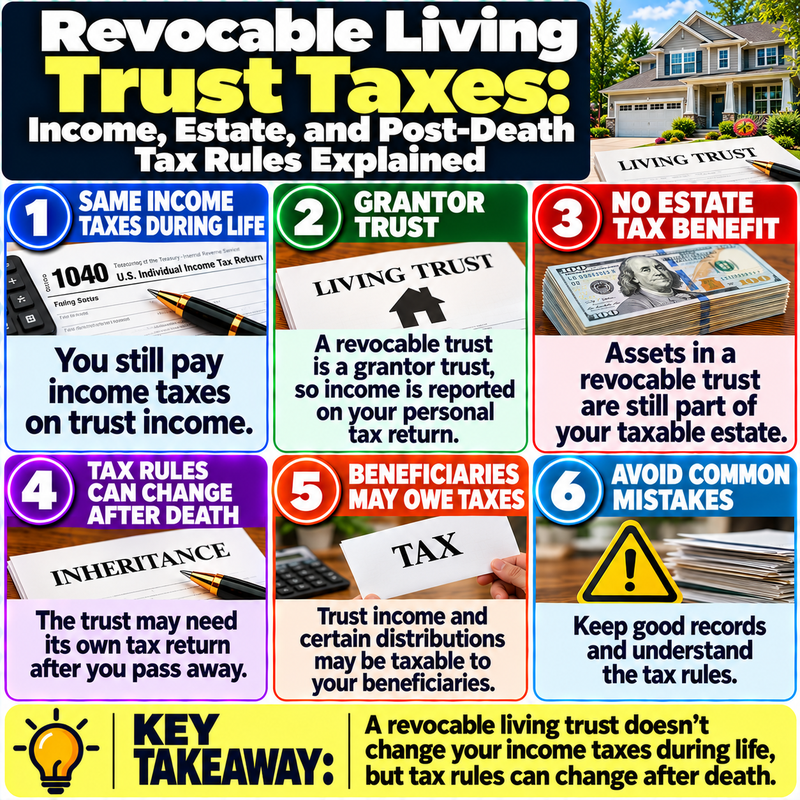
Before diving into the details, it helps to understand that tax rules for trusts are not one-size-fits-all. Your personal residency, the type of assets inside the trust, and whether you’re still alive all change the answer. Let’s walk through each stage, starting with what happens right now, while you’re still managing your own trust.
Quick Answer: Federal Tax Treatment During the Grantor’s Life
While you’re alive and able to revoke or change your trust, the IRS essentially ignores the trust for income tax purposes. All income generated by trust assets—interest, dividends, rental income, capital gains, whatever it may be—flows straight through to your personal tax return. The trust itself doesn’t pay separate income tax, and in most cases, it doesn’t even need a separate tax return.
Grantor-Trust Status Explained
This treatment has a name: grantor trust status. The IRS created this classification specifically for trusts where the person who set them up (the grantor) retains certain powers, like the ability to revoke the trust, change beneficiaries, or swap assets in and out. A standard revocable living trust checks all these boxes, which is exactly why the IRS treats it as a grantor trust for federal income tax purposes while those powers are retained.
Why the IRS Treats the Grantor as the Owner
Think of it this way: if you can undo the trust whenever you want, you still functionally own everything inside it. The IRS agrees with that logic. Because you retain control, you’re treated as the owner of trust assets for income tax purposes, even though legal title sits in the name of the trust rather than your own name.
This isn’t a loophole or a special perk—it’s simply how the tax code recognizes who actually controls the money. If you can add assets, remove assets, change trustees, or dissolve the entire arrangement, the IRS isn’t going to pretend someone else is in charge.
What This Means for Your Tax Bracket
Here’s the practical upshot: your tax bracket doesn’t change because you have a revocable trust. If you’re already in the 24% federal bracket, income generated by trust assets gets taxed at that same 24% rate, right alongside your other income. There’s no separate, lower trust tax bracket to take advantage of while you’re the grantor. Any article or advisor suggesting a revocable trust lowers your current income tax bill during your lifetime is giving you inaccurate information.

How Trust Income Is Reported While You’re Alive
Because the trust is invisible to the IRS for income tax purposes during your lifetime, the paperwork stays simple. You won’t typically deal with a separate trust tax return, a K-1 form, or complicated fiduciary accounting while you’re alive and competent.
Reporting Income on Your Form 1040
Every type of income your trust generates gets reported on your personal Form 1040, exactly as if the trust didn’t exist. If your trust owns a rental property, that rental income goes on Schedule E of your personal return. If it holds a brokerage account, dividends and capital gains show up on Schedule B and Schedule D. Nothing changes about how you file—you’re just adding trust-held assets to the same return you’d file anyway.
This is one of the quieter advantages of a revocable trust: it changes how your assets are managed and transferred, but it doesn’t complicate your annual tax filing. Many retirees are surprised at how little changes on their tax return after funding a trust.
Optional Reporting Methods Under Form 1041 Instructions
In certain situations, the IRS does allow trustees to use alternative reporting methods outlined in the Form 1041 instructions. These optional methods let certain grantor trusts report using the grantor’s own taxpayer identification number rather than operating as a separate tax-paying entity, which keeps things administratively simple. Most individual trustees managing their own revocable trust won’t need to worry about these alternative methods, but they exist for trustees handling more complex arrangements, such as co-trustees or multiple grantors.
Does a Revocable Trust Need an EIN During Life?
Generally, no. Since the trust uses your Social Security number for tax reporting purposes while you’re alive and the trust remains revocable, there’s usually no need to apply for a separate Employer Identification Number (EIN). Your bank accounts, brokerage statements, and property titles held in the trust’s name typically still report income under your personal tax ID. This changes significantly after death, which we’ll cover in detail later in this article.
Does Moving Assets Into the Trust Trigger Income Tax?
No, retitling your home, bank accounts, or investment portfolio into your revocable trust’s name is not a taxable event by itself. You’re not selling the asset, you’re not giving it to someone else, and you’re not realizing any gain or loss. You’re simply changing how the asset is titled while keeping full control.
Why Funding the Trust Isn’t a Taxable Event
Because a standard revocable trust is set up for your own benefit and you retain the power to revoke it, moving assets into the trust is not treated as a completed gift to another person. A gift generally requires giving up control of property to someone else. Since you can take the asset right back out of the trust whenever you choose, there’s no completed transfer for gift tax purposes.
This distinction matters because it’s different from what happens with many irrevocable trusts, where funding the trust often does count as a completed gift since the grantor permanently gives up control. Confusing the tax treatment of a revocable trust with an irrevocable one is one of the most common mistakes people make when researching estate planning options.
Asset-Specific Issues to Watch For
While funding your trust generally doesn’t trigger income tax, certain asset types come with their own quirks worth discussing with a professional before you retitle them:
- Mortgaged real estate: Some loan documents contain due-on-sale clauses, though federal law provides protections for transfers into revocable trusts in many cases.
- Retirement accounts: IRAs and 401(k)s generally should not be retitled into a revocable trust during your lifetime, as doing so can trigger unintended tax consequences.
- S-corporation stock: Special rules apply to keep S-corp eligibility intact when shares move into a trust.
- Out-of-state property: Transfer taxes or recording fees can vary depending on where the real estate sits.
None of these issues typically prevent you from funding your trust, but they’re exactly the kind of detail a coordinated review with your attorney, CPA, and financial advisor should catch before you make changes.

Capital Gains and Basis Concepts at a High Level
Capital gains taxation is another area where people sometimes expect a revocable trust to change the outcome. It doesn’t—at least not while you’re alive.
How Gains Are Taxed While the Grantor Is Alive
If your trust sells a stock, a piece of real estate, or any other appreciated asset while you’re the living grantor, the gain gets reported on your personal tax return exactly as it would if you owned the asset outright. There’s no special capital gains rate available just because the asset happens to sit inside a trust. Your trust is not a capital-gains shelter, and anyone marketing it that way is misrepresenting how the tax code works.
Basis Rules for Assets Held in the Trust
Basis—the number used to calculate gain or loss when an asset is sold—generally doesn’t change just because an asset moves into your revocable trust. The asset typically keeps the same basis it had before the transfer. What happens to basis after your death is a separate and more nuanced question, since federal tax law has specific rules about how basis is determined for assets included in a decedent’s estate. We’ll cover that distinction later in this article, but it’s worth noting now: basis treatment varies by asset and by law in effect at the time, so this is not something to assume or oversimplify.
Estate Tax: What the Trust Does and Does Not Change
One of the biggest misconceptions retirees have is that a revocable living trust removes assets from their taxable estate. It doesn’t. For federal estate tax purposes, assets held in a revocable trust are still considered part of your gross estate when you die, simply because you retained the right to control and revoke the trust during your lifetime. Title changing from your name to your trust’s name has no bearing on estate tax inclusion.
Estate tax planning—meaning strategies specifically designed to reduce federal or state estate tax exposure—is a distinct area of planning from the revocable trust itself. A revocable trust can work alongside estate tax strategies, but creating one is not, by itself, an estate tax reduction technique. If estate tax exposure is a concern for your situation, that conversation needs to happen separately with your attorney and tax advisor, based on your specific estate size and the laws in effect at the time.
Gift Tax During the Grantor’s Life
Gift tax questions come up often because people assume adding a child’s name to a trust, or naming multiple beneficiaries, somehow triggers gift tax reporting. For a standard revocable trust set up for your own benefit, this generally isn’t the case. Since you retain full control and can change beneficiaries at any time, naming someone as a future beneficiary isn’t a completed gift—they have no present right to anything while you’re alive and the trust remains revocable. Gift tax concerns typically arise only when assets are transferred out of your control entirely, such as directly gifting property to another person or funding certain types of irrevocable trusts where you give up the ability to take the asset back.

What Changes After the Grantor Dies
Everything discussed so far assumes one key fact: you’re alive and competent. The moment that changes, so does the tax treatment of your trust, and the shift happens immediately rather than gradually. A revocable living trust, by definition, becomes irrevocable the instant the grantor dies, since there’s no longer anyone with the legal authority to revoke or amend it. This single event triggers a cascade of new tax obligations that your successor trustee needs to understand right away.
New EIN Considerations
Once your trust becomes irrevocable at death, it generally needs its own Employer Identification Number. Your Social Security number can no longer be used for trust reporting purposes because, for tax purposes, you’re no longer the owner—the trust has effectively become its own taxpayer. Your successor trustee is typically responsible for applying for this new EIN and should do so promptly after your death to avoid delays in opening estate accounts, filing tax returns, or distributing assets.
This EIN requirement surprises a lot of families, especially when the trust has existed quietly for years using the grantor’s Social Security number without any issues. The paperwork that felt simple during your lifetime becomes noticeably more involved the moment the trust shifts to irrevocable status.
Here’s a quick snapshot of what typically changes the moment a revocable trust becomes irrevocable:
| Before Death (Revocable) | After Death (Irrevocable) |
|---|---|
| Uses grantor’s Social Security number | Generally requires a new EIN |
| Income reported on grantor’s Form 1040 | Income reported on trust’s Form 1041 |
| No separate trust tax return needed | Fiduciary income tax return typically required |
| Grantor controls all decisions | Successor trustee manages the trust per its terms |
Form 1041 and Post-Death Income
After death, the trustee generally has to file an annual fiduciary income tax return using Form 1041 to report any income the trust earns, whether that’s interest, dividends, rental income, or capital gains from selling trust-held assets. This is a meaningful shift from the grantor’s lifetime, when no separate return was needed at all. Whether the trust owes tax directly, or whether that tax liability passes to beneficiaries, depends on the trust’s terms and how income is distributed.
The deadlines and requirements for Form 1041 can get complicated quickly, especially in the first year after death when the trust might still be settling the decedent’s final affairs alongside its own tax obligations. This is exactly the kind of situation where working with a CPA experienced in fiduciary taxation pays for itself many times over.
Beneficiary Distributions and Tax Reporting
When the trustee distributes income to beneficiaries, the trust can typically deduct that distribution, shifting the tax liability to the person who received it rather than the trust itself. The trustee issues a Schedule K-1 to each beneficiary who received a taxable distribution, breaking down how much was principal versus income. The beneficiary then uses that K-1 to report the taxable portion on their own personal return.
Not every beneficiary ends up in the same position, even within the same trust. One sibling might receive a distribution of principal—say, a lump sum from selling a house—and owe no income tax on it at all. Another sibling receiving a distribution that includes accumulated interest or dividend income could owe tax on that portion. This is why beneficiaries shouldn’t assume all inheritance distributions are treated identically for tax purposes.
State Income, Estate, or Inheritance Taxes
Everything above covers federal tax treatment, but states don’t all play by the same rules. Some states impose their own income tax on trust earnings, separate estate taxes with different exemption thresholds than the federal government, or even inheritance taxes charged directly to beneficiaries based on their relationship to the deceased.
Where the trust is administered, where the trustee lives, where beneficiaries live, and where the income is sourced can all factor into which state’s tax rules apply. Because state tax treatment varies so widely and changes periodically, retirees should never assume their state follows federal rules exactly—this is a conversation to have directly with a tax professional familiar with your specific state.
Revocable vs. Irrevocable Trust Tax Differences
Understanding the gap between revocable and irrevocable trust taxation clears up most of the confusion retirees run into during estate planning conversations. These two trust types are built for different purposes, and their tax treatment reflects that difference clearly. For a comprehensive guide on revocable living trust taxes, consider exploring more detailed resources.
Who Pays the Tax: Grantor vs. Trust
With a revocable trust, you pay the tax personally because you’re treated as the owner. With most irrevocable trusts, the trust itself is typically recognized by the IRS as its own separate taxpayer, carrying its own EIN and filing its own Form 1041 from the start—not just after death. If the irrevocable trust retains income rather than distributing it, the trust generally pays the tax on that income directly, at trust tax rates rather than the grantor’s personal rates. For more detailed information, you can read how trusts are taxed.
Federal Income Tax Brackets for Irrevocable Trusts
Here’s where things get especially important for retirees considering irrevocable trusts: trusts reach the highest federal tax bracket far faster than individuals do. For the 2026 tax year, irrevocable trust income is taxed at 10% on the first $3,300, 24% on income between $3,301 and $11,700, 35% between $11,701 and $16,000, and 37% on anything above $16,000. Compare that to an individual, who might not hit the 37% bracket until earning several hundred thousand dollars, and you can see why trustees need to think carefully about whether to distribute income or let it accumulate inside the trust.

Simple vs. Complex Trust Taxation
Trusts also get classified as either “simple” or “complex,” and this classification affects who ultimately carries the tax burden. A simple trust must distribute all its income annually, cannot distribute principal, and cannot make charitable distributions. Revocable living trusts that don’t meet all three of these narrow requirements are automatically classified as complex trusts instead.
With a simple trust, income distributed to beneficiaries gets taxed at their individual rates, which is often lower than the trust’s own compressed bracket—this can meaningfully reduce the overall tax burden. With a complex trust, the tax responsibility typically gets divided between the trust and its beneficiaries, depending on how much income stays inside the trust versus how much gets distributed out.
Principal vs. Income Distributions: What’s Taxable
If there’s one distinction that clears up more beneficiary confusion than anything else, it’s the difference between principal and income. These two categories of trust distributions get taxed in completely different ways, and knowing which is which changes what a beneficiary should expect at tax time.
Why Principal Distributions Are Usually Tax-Free
Principal refers to the original assets placed into the trust—cash, stocks, real estate, whatever was contributed—along with any amounts that have already been taxed previously. Since the IRS generally assumes this money was taxed before it ever reached the trust, distributing it to a beneficiary typically doesn’t create a new taxable event. If your parents’ trust distributes $200,000 from the sale of their house, that distribution is usually principal, and you generally don’t owe income tax simply for receiving it.
How Income Distributions Get Taxed to Beneficiaries
Income is different. This category covers what the trust’s assets earn over time—interest, dividends, rental income, and similar earnings generated after the assets entered the trust. When a trustee distributes this type of income to a beneficiary, it’s generally taxable to the beneficiary, who reports it using the information provided on their Schedule K-1.
This is why two beneficiaries of the exact same trust can have wildly different tax outcomes in the same year. One receives a distribution classified entirely as principal and pays nothing in income tax. The other receives a distribution that includes several thousand dollars of accumulated interest and owes tax on that portion. Neither beneficiary did anything differently—the tax outcome depends entirely on what type of money they received.

Common Tax Myths About Revocable Living Trusts
After years of helping people untangle estate planning confusion, certain myths about trust taxation come up again and again. Clearing these up now can save you from costly assumptions later, whether you’re the grantor setting up the trust or a beneficiary expecting an inheritance.
Misinformation about trust taxation spreads easily because trusts genuinely do work differently depending on their type, timing, and terms. What’s true for an irrevocable trust is often false for a revocable one, and what’s true before death is often false after death. That inconsistency is exactly what fuels so much confusion.
Let’s walk through the three myths that cause the most trouble:
- Believing every trust files its own separate tax return
- Assuming a trust automatically creates a tax-free environment for its assets
- Thinking beneficiaries always owe tax on everything they inherit
Myth: Every Trust Files Its Own Tax Return
This myth mixes up revocable and irrevocable trust rules. A revocable living trust generally does not need a separate income tax return while the grantor is alive, since everything gets reported on the grantor’s personal Form 1040. It’s only after the grantor’s death—when the trust becomes irrevocable—or with trusts that were irrevocable from the start, that a separate Form 1041 filing typically becomes necessary.
Mixing up these two scenarios leads to unnecessary stress for retirees who assume they need to hire a trust accountant the moment they fund their revocable trust. In most straightforward cases, that additional filing obligation simply isn’t there yet—it’s a future requirement tied to your death, not a present one tied to funding the trust.
Myth: Trusts Eliminate Taxes Entirely
This is perhaps the most persistent myth in estate planning, and it’s an expensive one to believe. A trust doesn’t make income disappear from the tax system—it simply determines who reports and pays that tax: the grantor, the trust itself, or the beneficiaries receiving distributions. Whether you’re dealing with a revocable trust during the grantor’s lifetime or an irrevocable trust after death, someone in that chain is paying income tax on the money the trust earns.
Retirees sometimes come to estate planning hoping a trust will function as a tax shelter, reducing their current income tax bill or avoiding capital gains tax on appreciated investments. That’s simply not how a revocable living trust works, and treating it that way sets up unrealistic expectations. The real value of a revocable trust lies in probate avoidance, incapacity planning, and privacy—not tax reduction during your lifetime.
Myth: Beneficiaries Pay Tax on Everything They Inherit
Beneficiaries often brace themselves for a tax bill the moment they receive an inheritance distribution, but that fear is frequently misplaced. As covered earlier, principal distributions—the original assets or previously-taxed amounts sitting in the trust—typically pass to beneficiaries without triggering income tax. It’s only the income portion, things like interest and dividends earned by trust assets, that generally creates a taxable event for the person receiving it.
Beneficiaries who understand this distinction can plan more accurately for their own tax situation instead of assuming the worst. Reviewing the Schedule K-1 carefully, rather than assuming the entire distribution amount is taxable, prevents beneficiaries from overestimating what they owe or making unnecessary estimated tax payments.
Tax Planning Strategies Worth Discussing With an Advisor
While a revocable trust itself isn’t a tax reduction tool, there are legitimate strategies worth bringing up with your coordinated team of advisors, particularly as your trust transitions after death or if you’re also considering irrevocable trust planning:
- Income distribution timing: Because irrevocable trusts hit the highest tax bracket so quickly, distributing income to beneficiaries in lower individual brackets can sometimes reduce the family’s overall tax burden.
- Grantor trust structuring for irrevocable trusts: Certain irrevocable trusts can be intentionally structured so the grantor continues paying income tax personally, allowing trust assets to grow without being reduced by annual tax payments.
- Capital gains timing: Reviewing a planned sale with a tax advisor before it happens can clarify whether the gain is better recognized by the trust or passed through to a beneficiary.
- Periodic plan reviews: Tax laws, family circumstances, and asset values all shift over time, making periodic reviews of your entire estate plan a worthwhile habit rather than a one-time task.
None of these strategies should be implemented without professional guidance tailored to your specific situation, since the right approach depends heavily on your total estate size, family structure, and current tax law.
When to Involve a Tax Professional
Certain moments call for bringing in a CPA or tax attorney rather than guessing your way through the paperwork. The death of a grantor is the clearest trigger point—this is when EIN applications, first-time Form 1041 filings, and Schedule K-1 preparation all become necessary, often within a fairly tight window. Selling significant appreciated assets inside any trust, whether revocable or irrevocable, is another moment where a quick consultation before the transaction closes can prevent a surprise tax bill.
Beyond these trigger events, an annual check-in with your estate planning attorney, financial advisor, and CPA working together gives you the kind of coordinated review that catches problems before they become expensive. Tax rules change, family situations evolve, and what made sense five years ago might not fit your circumstances today. A solid starting point for understanding how your revocable living trust fits into your broader plan is reviewing it alongside these professionals rather than relying on general information alone.

Frequently Asked Questions
Do I have to file a separate tax return for my revocable living trust?
No, not while you’re alive and the trust remains revocable. All trust income gets reported on your personal Form 1040, exactly as if you owned the assets directly outside the trust.
This changes after your death, when the trust becomes irrevocable and your successor trustee typically needs to begin filing Form 1041 for the trust’s income going forward.
Does a revocable living trust avoid estate taxes?
No, a revocable trust does not remove assets from your taxable estate for federal estate tax purposes. Because you retain the power to revoke or amend the trust, those assets are still counted as part of your gross estate when you pass away.
Estate tax planning is a separate undertaking from setting up a revocable trust, and it requires its own dedicated strategy discussion with your attorney if estate tax exposure is a concern for your situation.
What happens to the trust’s tax status when I die?
Your revocable trust automatically becomes irrevocable the moment you die, since no one retains the authority to revoke or amend it any longer. This shift generally triggers the need for a new EIN and typically requires your successor trustee to begin filing Form 1041 for the trust’s income.
These changes happen immediately upon death, not gradually, which is why having a successor trustee who understands these obligations matters so much for a smooth transition.
Will my beneficiaries owe taxes on what they inherit from the trust?
It depends on what type of distribution they receive. Principal distributions, meaning the original trust assets or previously-taxed amounts, generally aren’t taxable to the beneficiary.
Income distributions, such as interest or dividends the trust earned after assets were placed inside it, are typically taxable to the beneficiary who receives them, reported through a Schedule K-1.
Can I use my Social Security number for the trust instead of an EIN?
Yes, while you’re alive and the trust remains revocable, your Social Security number is generally used for all trust tax reporting purposes. There’s usually no need for a separate EIN during this period.
Is putting my house into a revocable trust a taxable event?
No, retitling your home into your revocable trust generally doesn’t trigger income tax or gift tax, since you retain full control and the transfer isn’t considered a completed gift to anyone else. Certain asset-specific considerations, like mortgage clauses, are still worth reviewing with your attorney before making the transfer.
What’s the difference between how revocable and irrevocable trusts are taxed?
For a revocable trust’s taxes, you’re treated as the owner for tax purposes, and all income flows to your personal return while you’re alive. With most irrevocable trusts, the trust itself is typically treated as its own separate taxpayer, carrying its own EIN and filing its own Form 1041, often facing a steeper tax bracket schedule than individuals.
Understanding this distinction helps clarify why the same strategy doesn’t apply equally to both trust types, and why switching between them carries real tax consequences worth discussing with a professional first.
Do I need to report capital gains from trust assets on my personal return?
Yes, while you’re the living grantor of a revocable trust, any capital gains generated by trust assets get reported on your personal tax return, exactly as if you held the assets in your own name.
What is a Schedule K-1 and why might my beneficiaries receive one?
A Schedule K-1 is a tax form the trustee issues to beneficiaries after the grantor’s death, showing how much of a distribution counted as taxable income versus non-taxable principal. Beneficiaries use this form to report their share of taxable trust income on their own personal tax returns.
Can state taxes apply to my trust even if I set it up in another state?
Yes, state tax rules vary significantly, and factors like where the trustee lives, where beneficiaries reside, and where trust income is sourced can all affect which state’s tax rules apply. Because this area varies so much by state and changes over time, it’s best reviewed directly with a tax professional familiar with the states involved in your specific situation.
This article is intended for general educational purposes only and does not constitute legal, tax, or financial advice. Tax laws are complex, vary by state, and change frequently, so you should consult a qualified attorney, CPA, or tax professional regarding your specific circumstances before making any estate planning or tax-related decisions.
If you’re ready to build a revocable living trust with a clear understanding of how taxes work before and after your lifetime, CreateALivingTrust.com offers resources to help you start that conversation with confidence.