Living Trust Capital Gains Tax: How Asset Sales and Cost Basis Affect What You Owe
Understand Grantor-Trust Treatment, Cost Basis, Sales During Life, and Why Tax Treatment Can Change After Death
Key Takeaways
- Selling property inside a revocable living trust usually doesn’t change your tax bill — the IRS treats you, the grantor, as the owner for income tax purposes.
- Capital gains are calculated the same way whether an asset sits in your name or your revocable living trust: amount realized minus adjusted basis.
- Everything shifts once the grantor dies — the trust becomes irrevocable, and questions about basis step-up, tax ID numbers, and who pays what get more complicated.
- Not every asset in an irrevocable trust qualifies for a stepped-up basis at death, and the rules hinge on specific language in the trust document.
- Working with a platform like Bulletproof Legacy can help you understand how your trust structure interacts with capital gains before you ever list a property for sale.
Here’s the short version: if your living trust is revocable and you’re still alive, selling an appreciated asset inside it generally triggers the same capital gains tax you’d owe if you sold it in your own name. The trust itself doesn’t create a shield, a shelter, or a special discount. What changes the math isn’t the trust — it’s basis, timing, and what happens after you pass away.
A lot of people assume that once property moves into a trust, the tax rules reset. They don’t. The IRS looks straight through most revocable trusts to the person who created them, and that person’s tax situation drives everything a trustee does. Resources like Bulletproof Legacy exist precisely because this distinction trips up so many trust owners who expect a bigger tax break than the law actually provides.
Key Takeaways
Before diving into the mechanics, it helps to see the big picture in one place. The bullet points above summarize what you need to know, but the details — especially what happens the moment a grantor dies — deserve a closer look.
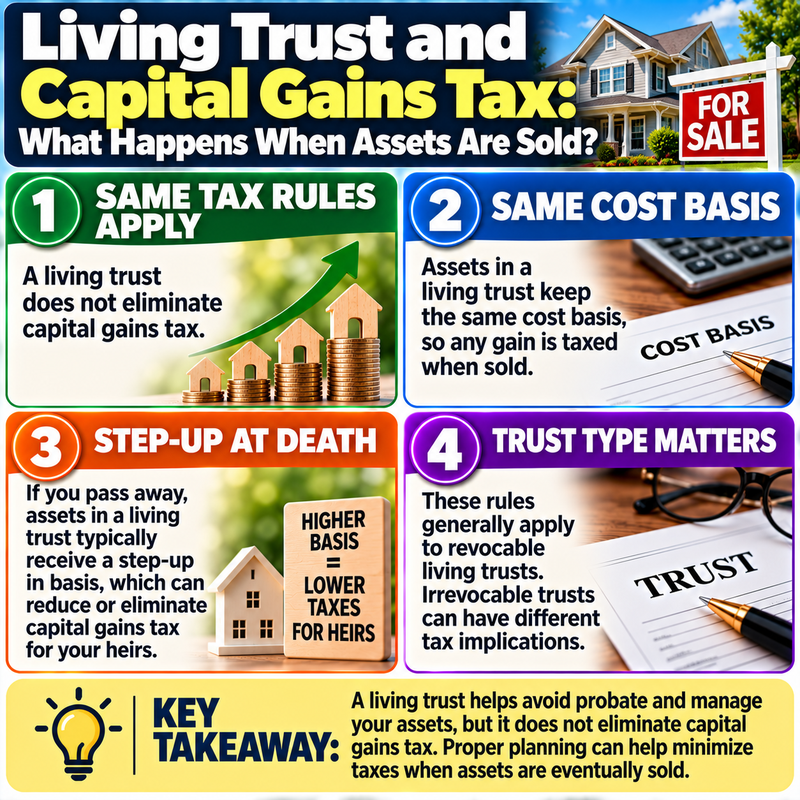
Quick Answer: Does Selling Trust Assets Trigger Capital Gains Tax?
Yes, typically. If a trustee sells an appreciated asset while the trust is revocable and the grantor is alive, the gain is calculated and taxed just as if the grantor had sold it personally. The sale isn’t exempt simply because title sits with “John Smith, Trustee of the John Smith Revocable Living Trust” instead of “John Smith” alone.
This surprises people because trusts sound like they belong to a separate legal universe. In some ways they do — they avoid probate, they can protect privacy, and they can direct how assets pass to heirs. But income tax treatment during the grantor’s lifetime isn’t one of those separate universes. The IRS collapses the trust and the grantor into a single taxpayer for income tax purposes.
Why a Revocable Trust Is Treated as a Grantor Trust
A revocable living trust almost always qualifies as what the IRS calls a “grantor trust.” That label matters because it determines who reports income, who claims deductions, and who pays tax on capital gains. Under grantor trust rules, the person who created the trust — and who typically retains the power to amend or revoke it — is treated as the owner of the trust’s assets for federal income tax purposes, even though the trust technically holds legal title.
This isn’t a loophole or a workaround. It’s baked directly into how the revocable living trust structure functions. Because the grantor retains control — the power to change beneficiaries, swap assets, or dissolve the trust entirely — the IRS doesn’t see a meaningful separation between the person and the trust. That control is exactly why the tax code refuses to treat the trust as its own separate taxpayer while the grantor is alive.
IRS Form 1041 Rules for Grantor Trusts
Normally, a trust that earns income has to file Form 1041, the U.S. Income Tax Return for Estates and Trusts. Grantor trusts get an exception. Instead of filing a full 1041 with its own tax calculations, a revocable living trust can report all income, deductions, and gains directly on the grantor’s personal Form 1040, using a simplified reporting method. The trust doesn’t calculate its own tax; it simply passes everything through to the grantor’s return.
Some trustees choose an alternate method where the trust files a 1041 but attaches a statement showing that all items pass through to the grantor. Either way, the end result is the same: one tax return, one taxpayer, no separate trust-level tax during the grantor’s life.
Why Revocable Trusts Don’t Need Their Own Tax ID
Here’s a detail that catches people off guard: a revocable living trust doesn’t need its own Employer Identification Number while the grantor is alive. It simply uses the grantor’s Social Security number for all banking, brokerage, and tax reporting purposes. Financial institutions sometimes ask for an EIN anyway, but legally, the trust is disregarded as a separate entity until something changes — usually the grantor’s death.
This ties directly back to the grantor trust concept. If the IRS already treats you and your trust as one taxpayer, there’s no need for the trust to have its own identification number. It’s the same reason the trust doesn’t file its own tax return calculating its own liability — because for tax purposes, it isn’t really “its own” anything yet.

Selling Trust Assets While the Grantor Is Still Alive
So what actually happens when a trustee sells a house, a stock portfolio, or a business interest that’s titled in the name of a revocable trust? The transaction gets reported, the gain or loss gets calculated, and the tax consequences land on the grantor’s personal return — exactly as they would if the grantor had never created a trust at all.
Real Estate Held in a Revocable Trust
Many homeowners move their primary residence into a revocable living trust as part of estate planning, and that move alone doesn’t change anything about how a later sale gets taxed. If the trustee — often the grantor themselves, acting in that role — sells the house, the capital gain is calculated using the same rules that would apply to a personally-owned home. The sale price minus selling costs gives you the amount realized; subtract the adjusted basis, and you get the gain or loss.
Where things can get specific is around available exclusions and deductions, since those depend heavily on how long the home was owned, how it was used, and other individual facts. That’s a conversation for a tax professional familiar with the grantor’s full situation rather than a blanket rule that applies to every trust-owned home.
Stocks and Investment Accounts
Brokerage accounts titled in the name of a revocable trust work the same way. When a trustee sells appreciated stock, mutual fund shares, or bonds, the resulting capital gain or loss flows to the grantor’s Form 1040 just as it would from a personal brokerage account. The holding period for determining short-term versus long-term capital gains treatment also carries over — moving an asset into the trust doesn’t restart that clock, because the trust isn’t treated as a new owner.
Dividends, interest, and other investment income follow the same pass-through logic. None of it gets a special trust-level tax treatment during the grantor’s lifetime. It’s reported, taxed, and treated exactly as if the grantor held the account directly.
Business Interests and Other Property
The same grantor trust logic extends to LLC membership interests, rental properties, and other business assets that get transferred into a revocable trust for estate planning purposes. Depreciation schedules, passive activity loss rules, and any recapture provisions that would normally apply to the grantor personally continue to apply once the asset sits inside the trust. The trust doesn’t reset depreciation, and it doesn’t create a fresh basis.
This matters a lot for rental real estate specifically, where years of depreciation deductions can create a gap between an asset’s purchase price and its current adjusted basis. That gap doesn’t disappear because a trustee, rather than an individual, signs the closing documents.
Think of a revocable living trust less like a tax strategy and more like a legal wrapper. The set-up and ongoing costs of a living trust are a separate issue. The wrapper changes who holds title and how assets pass at death — it generally doesn’t change how capital gains get calculated or taxed while the grantor is alive.

How Cost Basis Determines Your Capital Gain
Every capital gains calculation starts in the same place: basis. Without understanding basis, it’s impossible to know whether a sale produces a gain, a loss, or something in between — regardless of whether a trust is involved.
Calculating Adjusted Tax Basis
Basis generally starts with what was paid for an asset, then gets adjusted over time. For real estate, adjustments might include the cost of capital improvements, which increase basis, or depreciation deductions claimed on rental property, which decrease it. For stocks, basis adjustments are less common but can include things like reinvested dividends that purchased additional shares.
Once a trustee sells the asset, the amount realized — generally the sales price minus selling expenses like commissions and closing costs — gets compared to this adjusted basis. If the amount realized exceeds the adjusted basis, there’s a capital gain. If it’s lower, there’s a capital loss. This formula doesn’t change based on trust ownership; it’s the same calculation the IRS applies to any sale of property.
How Depreciation Recapture Affects the Math
Rental properties and other depreciable business assets add another layer: depreciation recapture. When a property has been depreciated over the years, some of that depreciation may need to be “recaptured” and taxed differently upon sale, rather than treated entirely as a standard capital gain. This applies whether the rental property sits in an individual’s name or inside a revocable living trust, because the trust doesn’t erase depreciation history or reset the clock on recapture rules.
Trustees selling depreciated rental property should expect the same recapture considerations that would apply to a personal sale. The trust doesn’t offer an escape hatch from this particular tax consequence, and assuming otherwise can lead to an unpleasant surprise come tax season.
Can You Still Claim the Primary-Residence Exclusion?
Homeowners often wonder whether placing their house in a trust jeopardizes their ability to exclude gain on the sale of a primary residence. Generally, it doesn’t — but the details matter.
The $250,000/$500,000 Exclusion Rule
Under current tax rules, individuals may be able to exclude up to $250,000 of gain from the sale of a primary residence, while married couples filing jointly may be able to exclude up to $500,000, provided certain ownership and use tests are met. A few baseline conditions generally apply, and it’s important to understand how trusts impact capital gains tax.
- The home must have been owned and used as the taxpayer’s main home for at least two of the five years before the sale.
- The exclusion generally can’t be claimed more than once every two years.
- Specific facts — like partial-year use, business use of part of the home, or prior exclusion claims — can affect eligibility and should be reviewed individually.
These rules focus on how the home was owned and used, not on whether title technically sits with an individual or with that individual’s revocable trust. Because the trust is disregarded for income tax purposes during the grantor’s life, the ownership and use tests generally look through to the grantor’s actual history with the property.
That said, eligibility can turn on specific facts — multiple residences, periods of rental use, or changes in marital status — that vary from household to household. This is exactly the kind of situation where generic advice stops being useful and a conversation with a tax professional who knows the full picture becomes essential.
Why Trust Ownership Doesn’t Disqualify You
The underlying principle is consistent: because a revocable living trust is a grantor trust, the law treats the grantor as if they personally owned and used the home, even though a trustee holds legal title. Moving a house into a revocable living trust for estate planning purposes — to avoid probate, for example — doesn’t by itself interrupt the ownership and use history that the exclusion rules are built around.
Where people run into trouble is when they confuse revocable trusts with irrevocable ones, or when a trust holds a property for reasons beyond simple probate avoidance. Understanding the difference between a revocable and irrevocable trust structure becomes critical here, since irrevocable, non-grantor trusts don’t automatically get the same pass-through treatment.

Does Moving an Asset Into a Trust Trigger Capital Gains?
This is one of the most common fears people have before funding their trust, and the good news is that it’s usually unfounded — with some caveats worth understanding.
Why a Title Change Isn’t a Taxable Sale
Transferring a house, brokerage account, or other asset from your own name into your revocable living trust is generally a change in legal title, not a sale to another taxpayer. Since the grantor and the grantor trust are treated as the same taxpayer for income tax purposes, there’s no “sale” happening in the eyes of the IRS — just a retitling. No capital gains tax typically gets triggered by this transfer alone, since you’re not selling the asset to anyone; you’re simply changing how it’s held.
This doesn’t mean every conceivable transfer into every type of trust is automatically tax-free under all circumstances. The general rule applies cleanly to straightforward transfers into a standard revocable living trust. More complex situations — transfers involving partnerships, certain business entities, or irrevocable trusts — can raise separate questions that fall outside this simple framework.
Hidden Costs: Mortgage, Transfer Tax, and Property Tax Issues
While capital gains tax usually isn’t a concern when funding a trust, other costs can pop up that have nothing to do with income tax. Some mortgage lenders include due-on-sale clauses that technically get triggered by a title transfer, though federal law provides certain protections for transfers into a revocable trust by the borrower.
Local transfer taxes or recording fees might apply depending on the state and county, even when no sale is occurring. Property tax reassessment is another area worth checking, since some states reassess property value upon any change in title — though many carve out exceptions for transfers into a grantor’s own revocable trust.
None of these issues involve capital gains tax directly, but they’re worth flagging because they often get lumped together with “tax consequences of funding a trust” in people’s minds. Clearing up that confusion early — ideally with a local attorney or tax advisor — prevents unpleasant surprises during the trust funding process.
What Changes the Moment the Grantor Dies
Everything discussed so far assumes the grantor is alive and well. The moment that changes, so does the tax picture — sometimes dramatically. A revocable living trust that spent years functioning as a simple extension of the grantor’s own tax identity suddenly becomes something else entirely, and trustees who aren’t prepared for that shift often make costly mistakes in the months following a death.
This transition catches a lot of successor trustees off guard, partly because nothing visibly changes about the trust document itself. The same trust that was disregarded for tax purposes yesterday is treated as a distinct taxpayer today, and that single fact ripples through everything from filing requirements to basis calculations.
From Revocable to Irrevocable: The Legal Shift
Once the grantor of a revocable living trust dies, the trust can no longer be changed, amended, or revoked by anyone. It automatically becomes irrevocable at that point, even if the trust document never uses that specific word. The successor trustee named in the trust steps into the role previously held by the grantor, but with far less flexibility than the grantor enjoyed.
This shift matters because the grantor trust rules that governed income tax treatment during life no longer apply in the same way. The person whose Social Security number anchored every tax filing is gone, and the trust needs its own identity for IRS purposes going forward.
Before death: One taxpayer, one tax return, no separate trust-level filing.
After death: The trust becomes its own tax entity, often requiring a new tax ID number and its own federal filing obligations.
Successor trustees sometimes assume they can keep operating exactly as the grantor did, using the same accounts and the same tax reporting habits. That assumption creates problems quickly, since the IRS now expects reporting under the trust’s own identity rather than the deceased grantor’s Social Security number.
New Tax ID Numbers and Filing Requirements
An irrevocable trust must obtain its own Employer Identification Number, separate from the grantor’s Social Security number. This isn’t optional paperwork — banks and brokerages will typically require it before allowing the successor trustee to manage accounts under the trust’s new status. Along with the new EIN comes the obligation to file Form 1041 if the trust generates income, something the trust was previously exempt from doing as a disregarded grantor trust.
The Step-Up in Basis: What Gets Adjusted and What Doesn’t
One of the most talked-about tax concepts in estate planning is the step-up in basis, and for good reason — it can meaningfully affect how much gain gets taxed when inherited property is eventually sold. But step-up rules aren’t automatic for every asset in every type of trust, and misunderstanding this point leads to some expensive surprises.
Why Grantor Trust Status Matters for Step-Up Eligibility
Generally speaking, assets included in a decedent’s estate for federal estate tax purposes may receive an adjustment to fair market value as of the date of death. For a standard revocable living trust, the assets are typically includible in the grantor’s estate because the grantor retained control over them during life — the same control that made it a grantor trust in the first place.
- Assets held in a properly structured revocable living trust are generally included in the grantor’s taxable estate.
- Estate inclusion is generally what triggers eligibility for a basis adjustment at death.
- Irrevocable trusts don’t automatically get this treatment, since the whole point of many irrevocable structures is to remove assets from the taxable estate.
- Whether specific rights were retained in the trust instrument can determine whether certain irrevocable trust assets still qualify for estate inclusion and basis adjustment.
This is a critical distinction and one that trips up even experienced trustees. The basis step-up isn’t a blanket perk attached to the word “trust.” It’s tied specifically to whether the asset is pulled back into the decedent’s taxable estate, which depends heavily on the structure and language of the trust itself.
Not every irrevocable trust loses this benefit, and not every revocable trust guarantees it for every asset under every circumstance. The specific facts of how a trust was drafted, what rights the grantor retained, and how assets were titled all play a role in determining the outcome.
Because of this complexity, nobody should assume a basis step-up applies to a particular asset without reviewing the actual trust document and consulting with a tax professional. Generic assumptions about “trusts get a step-up” or “trusts don’t get a step-up” both miss the nuance that actually controls the outcome.
IRC Section 2036 and Retained Life Estates Explained
Internal Revenue Code Section 2036 deals with transfers of property where the person who made the transfer retained certain rights, like the right to use the property or receive income from it, for life. This provision matters because it can pull certain assets back into a decedent’s taxable estate even when those assets technically sit inside an irrevocable trust. If the reservation of such rights was specifically documented — often in the deed or trust instrument itself — the asset may be treated as part of the estate for tax purposes, which can affect basis step-up eligibility.
When Irrevocable Trust Assets Miss Out on the Step-Up
Assets held in an irrevocable trust typically won’t receive a basis step-up at death if those assets aren’t subject to federal estate tax inclusion. Since many irrevocable trusts are specifically designed to move assets outside the taxable estate — often for estate tax planning or asset protection purposes — that same design can mean beneficiaries inherit the original, lower basis rather than a stepped-up one.
Consider a hypothetical: an irrevocable trust created in 2021 holds a piece of investment property, and the grantor passes away a few years later. Whether that property receives a stepped-up basis depends heavily on whether the grantor retained specific rights under the trust instrument — rights that could trigger inclusion under provisions like Section 2036. Without those retained rights properly documented, the property may carry over its original basis, meaning a sale by the trust or beneficiaries could result in a larger taxable gain than expected.

When the Successor Trustee Sells Trust Property
After the grantor’s death, the successor trustee often needs to sell trust assets — a house, an investment portfolio, a business interest — either to distribute proceeds to beneficiaries or to settle the estate’s affairs. This is where post-death basis rules and ongoing trust tax status intersect in ways that didn’t matter during the grantor’s lifetime.
Unlike sales during the grantor’s life, which flowed straight through to the grantor’s personal return, sales after death may need to be reported on the trust’s own Form 1041, assuming the trust has become an irrevocable, separate taxpaying entity. The character of the gain, the basis used, and who ultimately bears the tax burden all depend on specific facts that shouldn’t be assumed without professional review.
- Basis for the sale typically starts with whatever value was established at the grantor’s death (if a step-up applied) rather than the grantor’s original purchase price.
- Any appreciation between the date of death and the date of sale may still generate a taxable gain, even if the step-up eliminated gain on appreciation that occurred during the grantor’s lifetime.
- The trust document often dictates whether the trustee can sell outright or must distribute property in kind to beneficiaries first.
Calculating Gain on Post-Death Sales
If a step-up in basis applied, the trust’s basis in the asset resets to its fair market value as of the date of death (or an alternate valuation date, if elected and available). From that point forward, any sale by the trustee compares the sales price to this adjusted basis, just like the standard gain calculation discussed earlier. The difference is that the starting basis number has changed, which can significantly shrink — or in some cases eliminate — the taxable gain compared to what would have been owed using the grantor’s original purchase price.
Who Reports the Sale: The Trust or the Beneficiaries?
This depends on timing and trust structure. If the trustee sells the property and then distributes cash proceeds to beneficiaries, the trust itself typically reports the sale and any resulting gain on its own tax return. If, instead, the trustee distributes the property itself to beneficiaries before any sale occurs, the beneficiaries generally inherit the trust’s basis in that asset and report any gain when they personally sell it later.
This distinction matters more than people realize. Trusts often face compressed tax brackets, meaning they hit the highest marginal tax rates at much lower income levels than individuals do. Depending on each beneficiary’s personal tax situation, it can sometimes make a meaningful difference whether a gain gets reported on the trust’s return or passed through to an individual beneficiary’s return instead.

Beneficiary Distributions vs. Asset Sales: Why It Matters
The path an asset takes out of a trust — whether it’s sold first or distributed in kind — can shape the tax outcome for everyone involved. This is a detail worth discussing with the trustee and a tax advisor before major decisions get made.
Receiving Property Directly From the Trust
When beneficiaries receive property directly from a trust rather than cash from a sale, they typically take on the trust’s basis in that asset — which, following a step-up at the grantor’s death, is often the fair market value as of the date of death. This means the beneficiary isn’t necessarily facing a large built-in gain the moment they receive the property, assuming the step-up applied and little additional appreciation has occurred since death.
Receiving property this way also gives beneficiaries control over timing. They can choose to sell immediately, hold for years, or do whatever fits their own financial plans, with gain or loss measured against their own inherited basis whenever they eventually do sell.
Selling an Inherited Asset Later
If a beneficiary holds onto inherited property for a while before selling, any appreciation that occurs after they receive it is treated as their own capital gain, calculated using the basis they received when the asset passed to them. The holding period for long-term versus short-term capital gains treatment generally resets based on specific inherited-property rules rather than how long the original grantor or the trust held the asset — though the exact mechanics can vary depending on individual circumstances and should be confirmed with a tax professional.
How Irrevocable and Non-Grantor Trusts Are Taxed Differently
Not every trust operates like a simple revocable living trust. Irrevocable, non-grantor trusts play by a completely different set of tax rules, and understanding this difference prevents a lot of confusion when comparing notes with someone whose estate plan uses a different trust structure.
Separate Tax Returns and Compressed Tax Brackets
Non-grantor irrevocable trusts are treated as separate taxpayers entirely, filing their own Form 1041 and paying tax at trust income tax rates rather than passing everything through to an individual’s personal return. These trust tax brackets compress much faster than individual brackets, meaning a trust can hit the top marginal rate with a relatively modest amount of income compared to what an individual would need to earn to reach that same top bracket.
Why Trustees Often Distribute Income to Beneficiaries
Because of these compressed brackets, trustees of irrevocable trusts frequently distribute taxable income out to beneficiaries rather than retaining it inside the trust. When income gets distributed, it typically shifts the tax liability to the beneficiary, who reports it on their own personal return and pays tax at their own individual rate — which is often lower than what the trust would owe on retained income. This strategy doesn’t eliminate taxes, but it can shift who pays them and at what rate, depending on each beneficiary’s overall tax situation.
State Capital Gains and Income Tax Considerations
Everything discussed so far focuses on federal tax treatment, but state taxes add another layer that varies enormously depending on where the trust, the grantor, or the beneficiaries are located. Some states impose their own capital gains or income taxes on trusts and individuals, while others have no state income tax at all.
State rules around trust residency can get particularly tricky. A trust might be considered a resident of one state because that’s where it was created, while the trustee lives in a different state and beneficiaries live in yet another. Some states tax trusts based on the residency of the grantor, others based on the trustee’s location, and others based on where beneficiaries live — and a few states use some combination of all three factors.
Given this complexity, nobody should assume their state follows the same rules as federal law, or that another state’s rules apply the same way to their own situation. Confirming the specific state tax treatment for a trust’s capital gains requires looking at that state’s particular statutes and, in many cases, consulting with a tax professional familiar with multi-state trust taxation.
5 Tax-Planning Mistakes to Avoid With Trust Assets
Most of the costly mistakes people make with trusts and capital gains come down to a handful of recurring misunderstandings. Catching these early — ideally before a sale happens rather than after — can save significant money and headaches.
The five mistakes below tend to show up again and again, whether someone is managing their own revocable trust or stepping into the successor trustee role after a loved one’s death:
- Assuming all trust transfers are tax-free. Moving assets into a standard revocable living trust generally doesn’t trigger capital gains, but assuming this rule applies universally to every type of transfer, every type of trust, and every type of asset can lead to incorrect assumptions in more complex situations.
- Confusing estate inclusion with income taxation. Whether an asset is included in a taxable estate and whether a sale generates income tax are two separate questions governed by different code sections, and conflating them leads to faulty conclusions about step-up eligibility.
- Missing the deed language required for IRC 2036. When specific rights need to be retained to trigger estate inclusion under Section 2036, vague or missing language in the deed or trust instrument can mean an asset doesn’t get the basis step-up that was expected.
- Overlooking state-level tax rules. Federal rules get most of the attention, but state capital gains and trust residency rules can meaningfully change the actual tax bill, especially when trustees, grantors, and beneficiaries live in different states.
- Failing to update trust status after death. Continuing to operate a trust using the deceased grantor’s Social Security number, or failing to obtain a new EIN and file required returns, creates compliance problems that compound the longer they go unaddressed.
1. Assuming All Trust Transfers Are Tax-Free
The most common misstep happens before a sale ever takes place — it happens at the funding stage. People hear “no capital gains tax on transfers into a revocable trust” and assume that blanket rule covers every situation, every asset type, and every trust structure. That’s not accurate. The rule applies cleanly to a straightforward transfer of personally-owned property into your own revocable living trust. It gets murkier fast when partnerships, certain business entities, or irrevocable structures enter the picture, and assuming the same tax-free treatment applies there can lead to an unpleasant surprise.
2. Confusing Estate Inclusion With Income Taxation
These are two completely different tax questions governed by different parts of the tax code, yet people blend them together constantly. Whether an asset is included in a taxable estate determines things like basis step-up eligibility. Whether a sale generates income tax depends on amount realized versus adjusted basis. A trustee can get the estate inclusion question right and still botch the income tax reporting, or vice versa — treating them as interchangeable almost guarantees a mistake somewhere along the way.
3. Missing the Deed Language Required for IRC 2036
When a trust is structured to retain certain rights for the grantor — like a right to use property or receive income from it for life — that reservation needs to be spelled out specifically in the deed or trust instrument itself. Vague language, or language that doesn’t clearly reserve those rights, can mean an asset fails to qualify for inclusion under Section 2036 when the family was counting on it. This is a drafting detail, not a casual afterthought, and it’s exactly the kind of thing an estate planning attorney should review line by line.
Trustees and beneficiaries sometimes only discover this problem after the grantor has died and it’s too late to fix the document. That’s why reviewing trust language with a professional before it’s needed — not after — matters so much.
4. Overlooking State-Level Tax Rules
Federal rules get all the attention in most conversations about trusts and capital gains, but state tax treatment can swing the actual bill significantly. Some states tax trusts based on where the trust was created, others base it on trustee residency, and others look at where beneficiaries live. A family with a trustee in one state, beneficiaries in another, and a trust document created in a third state could be looking at a genuinely complicated state tax picture that has nothing to do with federal rules at all.
5. Failing to Update Trust Status After Death
This mistake is purely administrative, but it causes real compliance headaches. Successor trustees who keep using the deceased grantor’s Social Security number, skip obtaining a new EIN, or forget to file Form 1041 when required are setting themselves up for problems with the IRS down the road. The fix is simple — get the new tax ID, understand the filing obligations, and treat the trust as the separate taxpayer it now legally is — but it has to happen promptly after death rather than months or years later.

Frequently Asked Questions
These are the questions that come up most often when people start digging into how their revocable living trust interacts with capital gains tax. Some have fairly simple answers; others depend heavily on individual facts that only a tax professional can properly evaluate.
Use these as a starting point for your own questions, not as a substitute for personalized advice on your specific situation.
Does putting my house in a living trust avoid capital gains tax?
No, not by itself. Transferring your home into a revocable living trust generally doesn’t trigger capital gains tax, but it also doesn’t eliminate the gain that would otherwise be owed when the home is eventually sold. Since the trust is disregarded for income tax purposes during your lifetime, the sale gets taxed the same way it would if you owned the home in your own name.
Any available exclusions, like the primary-residence exclusion, typically still apply based on your own ownership and use history, not based on whether title sits with you personally or with your trust.
Who pays capital gains tax when a trust sells property?
While the grantor is alive and the trust remains revocable, the grantor pays the tax, since all income and gains flow through to their personal return. After the grantor dies and the trust becomes irrevocable, the trust itself may owe the tax on its own Form 1041, or the tax may pass through to beneficiaries if income gets distributed to them during the same tax year.
Does a revocable trust get a step-up in basis at death?
Generally, yes — assets held in a standard revocable living trust are typically included in the grantor’s taxable estate, which is usually what triggers eligibility for a basis adjustment to fair market value as of the date of death. This isn’t automatic for every asset under every circumstance, so reviewing the specific trust document and consulting a tax professional is still worthwhile.
What happens to capital gains tax after the grantor dies?
The trust becomes irrevocable, needs its own tax ID number, and may need to start filing its own Form 1041. If a basis step-up applied to the trust’s assets, future sales by the successor trustee are measured against that new, adjusted basis rather than the grantor’s original purchase price.
Any gain that accumulates between the date of death and the eventual sale date is still potentially taxable, even after a step-up has already eliminated gain on appreciation that happened during the grantor’s lifetime.
Can beneficiaries avoid capital gains tax on inherited trust property?
Beneficiaries don’t avoid capital gains tax entirely, but a basis step-up — when it applies — can significantly reduce the taxable gain compared to what would have been owed using the original owner’s purchase price. Once a beneficiary holds the inherited property, any further appreciation after they receive it is treated as their own gain, calculated against the basis they inherited.
Does an irrevocable trust get a step-up in basis?
It depends entirely on whether the trust’s assets are included in the grantor’s taxable estate. Many irrevocable trusts are specifically designed to remove assets from the estate, which generally means those assets won’t receive a basis step-up at death. Others retain certain rights for the grantor — like those addressed under IRC Section 2036 — that can pull the assets back into the estate and preserve step-up eligibility.
| Trust Type | Estate Inclusion | Basis Step-Up Likely? |
|---|---|---|
| Revocable Living Trust | Typically included | Generally yes |
| Irrevocable Trust (no retained rights) | Typically excluded | Generally no |
| Irrevocable Trust (retained rights under IRC 2036) | May be included | Depends on documented rights |
This table is a simplified snapshot, not a substitute for reviewing an actual trust document. Whether you’re working with a straightforward revocable structure or something more complex, understanding the difference between a revocable and irrevocable trust is the first step toward knowing what to expect at tax time.
Do I need a new tax ID number for my living trust?
Not while you’re alive and the trust remains revocable — it uses your Social Security number. Once the trust becomes irrevocable, typically triggered by your death, the successor trustee generally needs to obtain a new EIN for the trust.
How does IRC Section 2036 affect trust assets?
Section 2036 can pull property back into a decedent’s taxable estate if the person who transferred it retained certain rights, such as the right to use the property or receive income from it for life. For this provision to apply, the reservation of those rights typically needs to be specifically documented, often in the deed or trust instrument itself. If you have questions about how this might affect taxes, you might find this trust capital gains tax question helpful.
This matters most for irrevocable trusts, since estate inclusion under Section 2036 can determine whether assets end up qualifying for a basis step-up that might otherwise be unavailable.
Can a successor trustee claim the home sale exclusion?
This depends heavily on specific facts — whether the home was the grantor’s primary residence, how the basis was established after death, and how the sale is structured. Eligibility rules around ownership and use periods can get complicated once a death has occurred, and this is a question that really needs a tax professional’s review rather than a generic answer.
Blanket assumptions here can be costly, since the exclusion rules weren’t originally written with post-death trust sales in mind and require careful application to that scenario.
Is selling assets inside a trust different from selling them personally?
During the grantor’s lifetime, no — a revocable trust sale is taxed identically to a personal sale because the trust is disregarded for income tax purposes. After the grantor’s death, yes — the trust may become its own separate taxpayer, with its own basis rules, its own filing requirements, and potentially its own tax rates that differ from what an individual would pay on the same transaction.
During life: trust and grantor are one taxpayer. After death: the trust may stand alone, with its own basis, its own return, and its own tax consequences.
Keeping that single distinction in mind resolves most of the confusion people have about trusts and capital gains tax.
The Bottom Line on Trusts and Capital Gains Tax
A revocable living trust doesn’t create a tax shelter, and it doesn’t make appreciated property magically tax-free when sold. While the grantor is alive, the IRS looks straight through the trust and taxes everything as if the grantor owned the assets personally — same basis rules, same exclusions, same depreciation recapture, same everything. The trust’s real value shows up elsewhere: avoiding probate, maintaining privacy, and providing a clear roadmap for what happens to assets after death.
That roadmap gets more complicated the moment the grantor passes away. The trust shifts from a disregarded extension of one person into its own legal and tax entity, often needing a new EIN, new filing obligations, and a fresh look at whether a basis step-up applies to each asset it holds. Irrevocable trusts add another layer of complexity, since many are deliberately structured to stay outside the taxable estate — which can mean missing out on the step-up that revocable trust assets typically receive.
None of this should discourage anyone from using a trust as part of their estate plan. It should encourage careful drafting, clear documentation of any retained rights, and realistic expectations about what the trust will and won’t do for taxes. A trust that’s well-drafted with professional guidance tends to avoid the costly surprises described throughout this article — vague deed language, missed EIN requirements, or assumptions about step-up eligibility that don’t hold up under IRS scrutiny.
Every family’s situation involves its own mix of assets, state residency, and estate planning goals, which means generic rules can only take you so far before individualized advice becomes necessary. A qualified estate planning attorney or tax professional can review your specific trust document, your specific assets, and your specific state’s rules to confirm how capital gains tax will actually play out for your family.
If you’re building or reviewing a living trust and want to understand exactly how your assets will be treated for tax purposes, Bulletproof Legacy can help you work through the planning questions before they turn into tax-season surprises.