Living Trust vs Transfer on Death Deed: Comparing Probate, Control, and Incapacity Planning
Compare Probate, Incapacity Planning, Control, Beneficiary Transfers, Costs, and the State-Law Limits of Each Approach
Choosing between a living trust and a transfer-on-death deed often comes down to one question: do you need ongoing control over your property while you’re alive, or just a simple way to pass it on when you’re gone?
Both tools share a common goal of keeping your real estate out of probate court, but they accomplish that goal through completely different legal mechanics. A living trust works like a management structure you build now and use for decades, while a TOD deed works more like a light switch that only flips at death. Understanding which mechanism fits your situation can save your family thousands of dollars and months of court delays, which is exactly the kind of practical guidance Bulletproof Legacy focuses on for families building their estate plans.
Key Takeaways
- A living trust and a transfer-on-death deed both avoid probate for real estate, but they solve different problems: one manages property during incapacity, the other only transfers it at death.
- TOD deeds are simpler and cheaper for a single property with straightforward beneficiaries, but they offer zero protection if you become incapacitated before death.
- Living trusts cost more upfront and require “funding” (retitling property into the trust), but they handle multiple properties, contingent beneficiaries, and complex family situations more reliably.
- Not every state authorizes TOD deeds, and the rules for joint owners, mortgages, and creditor claims vary significantly by jurisdiction.
- Later in this article, you’ll find a decision checklist that walks through the exact questions to ask before picking one tool over the other.
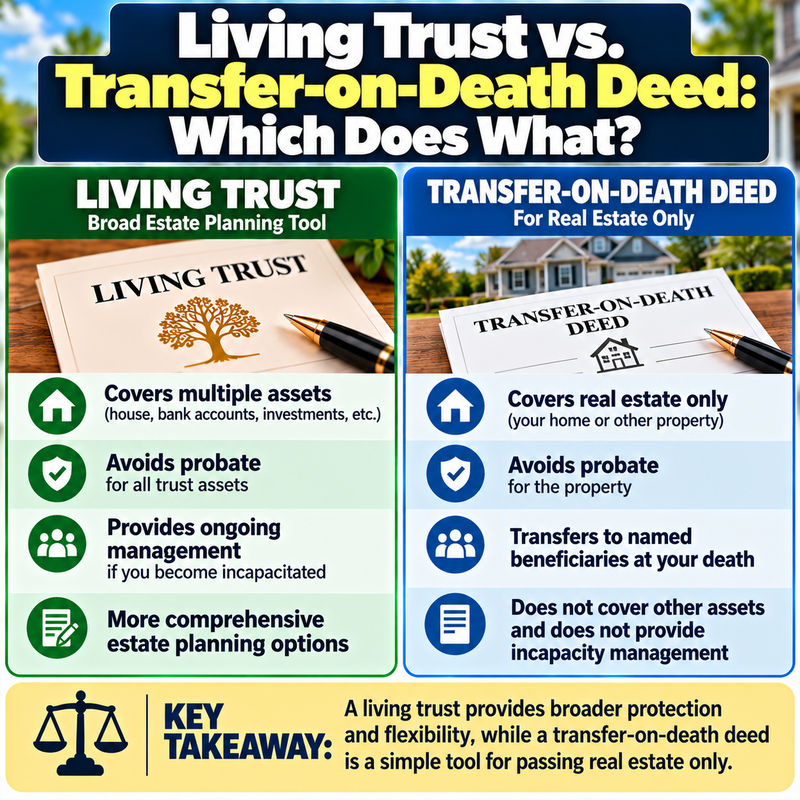
Quick Comparison: Trust vs. TOD Deed at a Glance
Before diving into the details, it helps to see the two tools side by side. Neither option is “better” in an absolute sense, they’re built for different jobs, and the right choice depends on what your estate actually needs.
- Living trust: Requires deeding property into the trust now, manages property during incapacity, allows detailed distribution instructions, costs more to set up, works well for multiple properties or complex families.
- TOD deed: Requires filing a simple deed form, provides no incapacity management, transfers at death only, costs less to set up, works well for a single property with clear-cut beneficiaries.
- Shared trait: Both can avoid probate for the specific property involved, assuming the document is executed correctly and beneficiaries survive you.
- Shared risk: Both can fail to avoid probate if there’s a drafting error, a beneficiary predeceases you without a backup named, or the property isn’t properly titled.
How a Living Trust Transfers Real Estate
A revocable living trust moves real estate out of your personal name and into the name of the trust while you’re still alive. This single step, often called funding, is what makes the trust capable of avoiding probate later. Skip this step, and the trust becomes an empty shell with no actual control over your home.
Deed Property to Yourself as Trustee
Funding a trust with real estate means signing a new deed that transfers the property from “John Smith” to “John Smith, Trustee of the John Smith Living Trust dated [date].” You still live in the house, pay the mortgage, and make all decisions exactly as before. The only difference is the name on the title, which now reflects that the trust owns the asset rather than you personally.
Successor Trustee’s Role After Death or Incapacity
Here’s where a living trust earns its keep in ways a TOD deed simply can’t match: if you become incapacitated, your named successor trustee steps in immediately to manage the property, pay the mortgage, handle repairs, and make decisions on your behalf, all without a court-appointed guardianship. This single feature is often the deciding factor for people choosing a trust over a deed-based option. When you pass away, that same successor trustee distributes the property according to whatever instructions you wrote into the trust, whether that means an outright transfer, a staggered distribution over several years, or continued management for a beneficiary who isn’t ready to handle an inheritance.
Trust Funding Mistakes That Cause Probate
A perfectly drafted trust document does nothing if the property was never actually retitled into the trust’s name. This is the single most common mistake that sends a “trust-protected” home straight into probate anyway. If you’re working through the process yourself, resources that explain how to create a living trust typically walk through funding step by step, because an unfunded trust provides no more protection than an unsigned will sitting in a drawer.

How a TOD/Beneficiary Deed Works
A transfer-on-death deed, sometimes called a beneficiary deed, takes a completely different approach than a trust. Instead of changing who owns the property today, it simply records your wish for who should own it the moment you die. You keep full ownership, full control, and the right to sell, refinance, or change your mind at any point while you’re alive.
Required Elements of a Valid TOD Deed
A valid TOD deed typically needs your name as the current owner, a clear legal description of the property, the name of one or more beneficiaries, and language specifying that the transfer takes effect only upon your death. Most states also require the deed to be signed, notarized, and witnessed according to the same formalities used for a regular deed. Miss one of these requirements, and the deed can be challenged or invalidated after you’re gone, which defeats the entire purpose of using one.
File the Deed With the Land Records Office
Signing the deed alone isn’t enough. The document has to be recorded with the county recorder, register of deeds, or land records office in the county where the property sits, and this filing typically needs to happen before your death to be effective. Unlike a will, which stays private until it’s filed with the probate court after death, a TOD deed becomes a public record the moment it’s recorded, which some owners find uncomfortable since it reveals who stands to inherit the property.
Filing fees are usually modest, often ranging from a few dollars to around a hundred, depending on the county. That low cost is part of why TOD deeds appeal to people with a single property and a straightforward plan: there’s no attorney drafting an entire trust document, no separate funding step, and no ongoing administration.
Revoke or Replace a TOD Deed
Changed your mind about who should inherit the house? You’ll need to record a new document, either a formal revocation or a brand-new TOD deed naming different beneficiaries. The most recently recorded deed generally controls, so if you forget to revoke an old one, you could end up with conflicting documents that create confusion or litigation after you’re gone. This static, document-by-document approach is very different from a trust, where you can often amend beneficiary provisions with a simple written amendment rather than touching the property title itself.

Which States Authorize TOD Deeds and Why State Law Matters
Transfer-on-death deeds aren’t a nationwide tool. More than half of U.S. states authorize them, which means a plan that works perfectly for your neighbor in one state might not even be legally available if you live somewhere else. Before relying on a TOD deed, confirm that your state’s statute actually permits this type of transfer for real estate.
States That Don’t Offer TOD Deeds
In states without TOD deed statutes, owners looking for a deed-based, non-trust option have to consider alternatives like joint ownership with right of survivorship, or in a handful of states, a Lady Bird deed. If neither of those fits, a living trust often becomes the more practical probate-avoidance route, since a properly funded trust doesn’t depend on a specific deed statute to function.
Lady Bird Deeds in Florida, Michigan, Texas, Vermont, and West Virginia
Florida, Michigan, and Vermont allow what’s known as an enhanced life estate deed, commonly nicknamed a Lady Bird deed. Texas and West Virginia go a step further, permitting both a standard TOD deed and a Lady Bird deed, giving owners in those states extra flexibility to choose the format that fits best. A Lady Bird deed works similarly to a TOD deed in that it avoids probate, but it includes language granting the owner an enhanced life estate, meaning they retain the right to sell, mortgage, or otherwise use the property freely during life, with no need for beneficiary consent.
Joint Tenancy and Community Property Rules
Married couples who co-own a home face an extra wrinkle. In many states, if the property is held as joint tenancy or as community property with right of survivorship, each spouse has to sign and record a separate TOD deed. When the first spouse dies, that spouse’s deed becomes void since ownership automatically passes to the surviving spouse under the joint ownership rules. It’s only the surviving spouse’s TOD deed that eventually transfers the property to the named beneficiaries, which means both deeds need to be drafted consistently from the start to avoid confusion down the road.

Probate Avoidance: Where Both Tools Succeed or Fail
It’s tempting to assume that signing a trust document or recording a TOD deed guarantees probate avoidance, but that’s not automatically true for either tool. Both methods only work if every technical requirement is satisfied, from correct titling to proper execution to surviving beneficiaries. A single oversight can send a “probate-avoidance” property straight through the courts anyway, often to the surprise of grieving family members who assumed everything was handled.
Conditions for Successful Probate Avoidance
For a living trust, success depends on the property actually being retitled into the trust’s name, not just mentioned in the trust document. For a TOD deed, success depends on correct execution, proper recording before death, and at least one named beneficiary surviving the owner. In both cases, naming contingent or backup beneficiaries adds an important layer of protection, since a primary beneficiary who dies first can otherwise unravel the entire plan and force the property into probate regardless of which tool you used.
Execution errors are the most common way a probate-avoidance plan falls apart after the fact. A TOD deed that wasn’t notarized correctly, wasn’t recorded before the owner’s death, or lists a beneficiary who died years earlier can all be challenged or simply disregarded by the county clerk. Similarly, a living trust that names the right beneficiaries but was never actually funded with the property leaves that real estate sitting in the deceased owner’s name, which means it has to go through probate no matter how detailed the trust document itself turns out to be.
Conflicting documents cause just as much trouble. If an owner records a TOD deed and later signs a new one without formally revoking the first, courts may have to sort out which document controls, sometimes delaying the transfer by months. The same risk applies if someone funds a trust with a property, then later signs a will that also attempts to leave that same property to someone else, a contradiction that invites litigation rather than a clean transfer.

Incapacity Management: Only One Tool Covers You While Alive
Probate avoidance gets most of the attention, but it’s only half the story. What happens if you’re still alive but unable to manage your own affairs, whether from a stroke, advanced dementia, or a serious accident? This is where the two tools diverge most sharply, and it’s often the deciding factor for people weighing a living trust against a simpler deed-based option.
A TOD deed does nothing for you while you’re alive. It’s a death-trigger document, full stop. A living trust, by contrast, builds in a management structure that activates the moment you’re no longer able to handle your own finances, without requiring anyone to go to court.
- TOD deed: No incapacity provisions whatsoever; property management during incapacity requires a separate power of attorney or court-appointed guardian.
- Living trust: Successor trustee steps in automatically under the terms you wrote into the trust, managing the property without court involvement.
- Combined approach: Many people pair a TOD deed with a durable power of attorney to cover the incapacity gap, though this adds a second document to track and maintain.
Families who’ve watched a loved one go through a contested guardianship proceeding tend to understand this distinction immediately. Guardianship court cases can take months, cost thousands in legal fees, and require ongoing court supervision, all things a properly funded trust sidesteps entirely.
Why a TOD Deed Offers No Incapacity Protection
A TOD deed only changes what happens to the property after death; it says nothing about who can sell, refinance, or manage the home if the owner becomes mentally incapacitated while still alive. If that happens without a separate power of attorney in place, family members may have no choice but to petition a court for guardianship or conservatorship just to pay the mortgage or arrange a sale, a process that can be slow, expensive, and emotionally exhausting during an already difficult time.
How a Successor Trustee Manages Property Without Court Involvement
A revocable living trust solves this gap directly. Because the trust document already names a successor trustee and spells out when that person’s authority begins, typically upon a doctor’s written determination of incapacity, there’s no need for a judge to get involved. The successor trustee can immediately start paying bills, managing repairs, and handling the property exactly as the original owner would have, all under the private terms of the trust rather than public court supervision.

Control During Life and Changing Beneficiaries
Life changes, and estate plans need to keep up. Maybe a beneficiary gets married, has a falling out with the family, or simply needs a different share than originally planned. Both tools allow changes while you’re alive and of sound mind, but the process looks very different depending on which one you’ve used.
With a revocable trust, you retain the right to amend, restate, or even fully revoke the document at any time, since “revocable” is precisely what gives you this flexibility. With a TOD deed, any change requires recording an entirely new deed or a formal revocation, since the deed itself is a static, one-time filing rather than a living document you can simply edit.
- Trusts can update distribution percentages, add new contingent beneficiaries, or restructure how and when heirs receive property, often through a short written amendment.
- TOD deeds require a brand-new recorded document every time beneficiaries change, with filing fees and paperwork repeating each time.
- Trusts can address complicated scenarios like unequal distributions among children or delayed inheritances for young beneficiaries without touching the property title again.
- TOD deeds work best when the plan is simple and unlikely to change, such as leaving a single home to one adult child.
Amend a Living Trust
Amending a trust is usually as simple as signing a written amendment that references the original trust and spells out exactly what’s changing. No new deed, no re-recording with the county, and no need to touch the property title at all, since the trust already owns the asset. For anyone researching how to create a living trust, this amendment flexibility is often cited as one of the strongest arguments for choosing a trust over a deed-based alternative, especially for families whose circumstances are likely to shift over the years.
This flexibility becomes especially valuable with multiple beneficiaries or blended families. A trust can specify that one child receives the family home while another receives an equivalent cash distribution from other trust assets, or that a beneficiary’s share is held back until they reach a certain age. None of that nuance is realistically achievable through a TOD deed, which can really only say “this property goes to this person” or “this property goes to these people in equal shares.”
- Update beneficiary percentages without re-deeding property.
- Add or remove contingent beneficiaries as family circumstances change.
- Build in staggered distributions or age-based conditions for younger heirs.
- Address blended-family situations where children from different marriages need different treatment.
Every amendment should be dated, signed, and stored with the original trust document to avoid confusion later, and many people choose to review their trust every few years to make sure it still reflects their wishes.
File a New TOD Deed to Change Beneficiaries
Changing a TOD deed means starting over. The owner signs a new deed naming the updated beneficiary or beneficiaries, has it notarized, and records it with the same land records office that holds the original. Most states treat the most recently recorded deed as controlling, which makes it important to also record a formal revocation of the old deed if the new one doesn’t explicitly state that it supersedes prior filings.
This repeat-filing requirement is manageable for a single change, but it becomes cumbersome if an owner’s wishes shift multiple times over the years. Each new deed means another trip to the recorder’s office, another notarization, and another small filing fee, costs that are minor individually but add up for anyone who updates their plan frequently.
For a mortgaged property, beneficiaries under a TOD deed generally take the property subject to the existing mortgage, meaning they inherit the debt along with the asset unless they refinance or pay it off. Property tax reassessment rules also vary by state, so a transfer through a TOD deed can sometimes trigger a reassessment depending on local law, just as a transfer through a trust might in certain jurisdictions. Checking both the mortgage’s due-on-sale clause and your state’s property tax transfer rules before finalizing either plan can prevent unwelcome surprises for the beneficiary down the road.

Decision Checklist: Which Tool Fits Your Situation?
Before choosing between a living trust and a TOD deed, walk through these questions honestly. The answers usually point clearly toward one tool or the other.
- Do you own more than one property, or assets beyond real estate that also need a probate-avoidance plan? A trust handles multiple assets under one document; a TOD deed only covers the specific property named.
- Do you want a plan in place for incapacity, not just death? Only a funded trust provides automatic property management if you become unable to handle your own affairs.
- Does your state authorize TOD deeds for real estate? Confirm this before building a plan around a tool that may not exist in your jurisdiction.
- Do you anticipate changing beneficiaries more than once? Trust amendments are generally simpler than repeatedly recording new deeds.
- Is your family situation complex, involving blended families, minor beneficiaries, or unequal distributions? Trusts handle this nuance far better than a deed ever could.
- Is your goal simple and limited to one property with a single, unlikely-to-change beneficiary? A TOD deed may accomplish that goal at a fraction of the cost.
Many estate planning professionals that families turn to for guidance in this area can help weigh these factors against your specific property, mortgage, and family circumstances before you finalize either document.
Whichever tool fits your circumstances, getting the details right matters more than the label on the document, and Bulletproof Legacy offers the kind of practical, step-by-step support that helps families fund their trust correctly and avoid the costly mistakes outlined above.