Category: Trusts & Real Estate

Learn how living trusts can affect homes, rental properties and other real estate, including transferring property into a trust, deeds, mortgages, ownership and what happens to trust property after death.

  • Condominiums and Living Trusts: What You Need to Know

    Condominiums and Living Trusts: What You Need to Know

    Putting a Condominium in a Living Trust

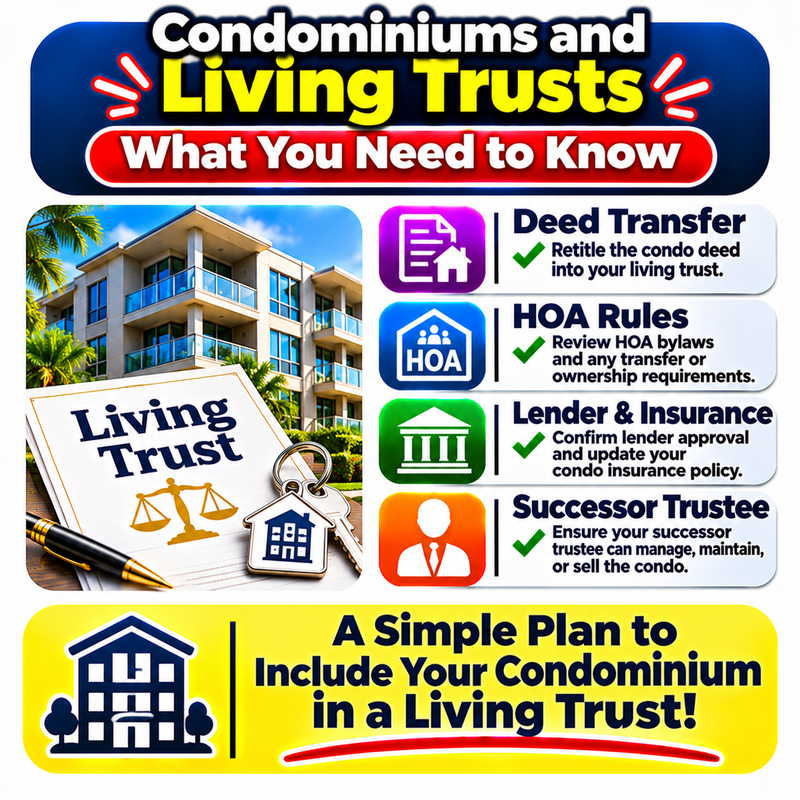
    Understand condo deed transfers, HOA rules, lender and insurance considerations, and successor trustee responsibilities.

    Signing a trust document doesn’t move your condo anywhere — you still need a deed, and your HOA still has a say.

    Key Takeaways: Condominium Living Trust Transfers at a Glance

    • A condominium living trust transfer requires a properly executed and recorded deed naming the trustee as the new owner — the trust agreement alone does not retitle your unit.
    • Your condominium’s declaration, bylaws, and association rules may include notice, approval, or occupancy requirements that keep applying even after the trust owns the unit.
    • Transferring a mortgaged condominium into a revocable trust may qualify for conditional protection against a due-on-sale clause, but lender terms and loan type still matter.
    • HOA dues, special assessments, property taxes, and insurance obligations continue exactly as before — placing title in a trust doesn’t erase any of them.
    • Later in this guide, a worked example walks through exactly what a successor trustee must verify and manage when the original owner becomes incapacitated or passes away.
    Condominium-Living-Trust

    Putting a Condominium in a Living Trust

    A condominium owner may generally transfer an eligible unit into a properly established revocable living trust, but the process looks different than it does for a detached house. Condo ownership comes bundled with a recorded declaration, association bylaws, and a layer of shared-property rights that a single-family homeowner never has to think about. A condominium living trust transfer has to account for all of that — not just the deed itself.

    None of this means the process is complicated beyond reach. It just means the steps have to happen in the right order, and a few condo-specific details can’t be skipped. The sections below walk through exactly what changes, what doesn’t, and where owners most often run into trouble.

    Understand condo deed transfers, HOA rules, lender and insurance considerations, and successor trustee responsibilities.

    The direct answer: yes, a condominium can generally be placed in a revocable living trust, but the trust document itself does nothing to the title. You need a new deed, you need to check what your association’s governing documents require, and you need to confirm your mortgage and insurance are accounted for. A trust that holds a condo on paper only — without the deed actually recorded — won’t avoid probate or do anything else it’s supposed to do.

    Legal Title vs. Practical Administration: What Changes and What Doesn’t

    Creating a trust and funding a trust are two separate legal acts. The trust document establishes the rules — who manages the property, who benefits from it, and what happens after incapacity or death. Funding is the second step, where you actually move ownership of specific assets, like your condo, into the trust’s name.

    For a condominium, funding means executing and recording a deed that names you (or whoever the acting trustee is) as trustee of the trust, rather than as an individual owner. Until that deed is recorded, the condo still belongs to you personally, no matter what the trust document says. This is one of the most common gaps in otherwise well-planned estates: a signed trust sitting next to an unfunded deed.

    Why Signing a Trust Document Alone Does Not Transfer Your Condo

    Only assets actually titled in the trustee’s name are governed by the trust’s terms. If your condominium deed still lists you individually as owner when you pass away, that unit generally has to go through probate like any other individually owned asset — the trust’s distribution instructions for it won’t apply. That outcome defeats one of the main reasons people set up a trust in the first place.

    Before tackling a condo-specific deed transfer, it helps to understand the broader process of setting up the trust correctly in the first place. This descriptive guide explaining the process of creating a living trust covers the foundational steps — naming a successor trustee, identifying beneficiaries, and drafting trust terms — that need to be settled before you start retitling specific property like a condominium unit.

    Review Your Condominium Declaration and HOA Rules First

    Every condominium is governed by a recorded declaration, a set of bylaws, and whatever current rules the association has adopted. These documents define your unit boundaries, your share of common elements, and — critically for trust planning — what the association expects when ownership changes hands. Skipping this review is one of the easiest ways to create friction with your HOA later.

    What the Declaration Says About Ownership Transfers

    Condominium declarations vary enormously depending on the state and the specific association, so there’s no universal rule here. Some declarations are silent on trust transfers entirely. Others require notice to the board, updated contact information for the trustee, or a specific form before the transfer is considered complete in the association’s records.

    Before preparing any deed, pull your declaration, bylaws, and current rules and regulations. Look specifically for:

    • Transfer or ownership-change provisions
    • Notice or registration requirements tied to a change in title
    • Resale or estoppel certificate procedures
    • Rental, leasing, or owner-occupancy restrictions
    • Insurance requirements the association imposes on unit owners
    • Any association-specific transfer forms

    Getting Association Approval or Notification Requirements

    Not every HOA has the authority to block a transfer into a revocable living trust, and not every HOA is required to approve one either — it genuinely depends on state law and what your specific governing documents say. Some associations simply want updated paperwork: the trustee’s name, a mailing address, and proof that the trust exists. Many associations will accept a short certification of trust rather than demanding the full trust agreement, though this isn’t guaranteed everywhere.

    If your association does require something before or after the transfer, find out which it is. Some want notice in advance; others only update their records after the deed has already been recorded. Getting this sequence backward can create unnecessary delays or confusion when dues notices or assessment letters go out.

    Occupancy Restrictions That Could Affect Trust Ownership

    Moving title into a trust doesn’t erase occupancy rules, leasing restrictions, pet policies, or parking assignments. If your association has an owner-occupancy requirement or caps on rentals, those restrictions generally continue to apply to whoever is living in the unit — regardless of whether the legal owner is you individually or you as trustee. A successor trustee managing the property after your incapacity or death has to work within these same rules, not around them.

    Preparing and Recording the New Deed

    Once you’ve confirmed the trust is properly established and reviewed your HOA’s requirements, the actual deed work begins. This is where the condo-specific details in your legal description start to matter.

    How the Trustee Must Be Named as Grantee

    The new deed needs to name the trustee of your trust — generally you, during your lifetime — as the grantee, along with the exact name and date of the trust. Simply listing “the trust” as owner, without identifying the trustee correctly, can create title problems down the road. Deed conventions differ by state, and some jurisdictions have specific expectations about how fiduciary ownership should be worded on a recorded deed.

    Legal Descriptions and Local Recording Requirements

    Pull your existing recorded deed before drafting anything new. Condominium legal descriptions typically include a unit number, a reference to the recorded plat or declaration, and a description of your interest in the common elements — all details that have to carry over accurately to the new deed. An incorrect unit number, a missing common-element reference, or a misspelled name on the new deed can create a defect in your title record that’s far more expensive to fix later than it would have been to get right the first time.

    Why an Experienced Attorney Should Handle This Step

    Deed preparation, execution formalities, and recording requirements vary by state, and condominium legal descriptions add a layer of complexity that a generic deed template usually isn’t built to handle. Having a qualified attorney or title professional prepare the deed reduces the risk of the kind of technical errors that cause title insurance headaches or probate disputes years later.

    Buying a New Condo? Title It as Trustee From Day One

    If you’re in the process of buying a condominium rather than retitling one you already own, the contract of sale should specify that you’re purchasing as trustee of your living trust from the start. This avoids a second transfer later and keeps your closing documents, title insurance, and mortgage paperwork consistent with how the trust will eventually hold the property.

    Contact Your Mortgage Lender Before You Transfer

    If your condominium carries a mortgage, the loan itself needs attention before you record a new deed. Transferring title into a trust changes who holds legal ownership of the unit, but it generally does not change who’s personally responsible for repaying the loan — that obligation stays with the original borrower unless the lender agrees otherwise.

    Due-on-Sale Clauses and Their Trust Exceptions

    Most mortgages include a due-on-sale clause giving the lender the right to call the full loan balance due if ownership transfers without permission. Certain qualifying transfers into a revocable inter vivos trust may receive conditional protection against this clause under applicable federal law, but the protection depends on specific facts: the loan type, whether the property remains owner-occupied, and whether the beneficial interest in the trust stays with the original borrower. These conditions aren’t automatic across every loan or every condominium transaction, so it’s worth reviewing your actual note and mortgage or deed of trust — and, in uncertain cases, reviewing how transferring mortgaged residential property into a living trust typically works before assuming your loan qualifies.

    Commercial loans, investment-property financing, and loans held by entities don’t automatically get the same treatment as a standard owner-occupied residential mortgage. If there’s any doubt about how your specific loan handles a trust transfer, a quick call to your servicer — or a conversation with a qualified attorney — is far cheaper than guessing wrong.

    Questions to Ask Your Lender Before Filing the Deed

    Before recording anything, it’s worth getting specifics in writing from your mortgage servicer. A short phone call or letter can save months of confusion later. Consider asking:

    • Does the loan documentation treat a revocable trust transfer as a trigger for the due-on-sale clause?
    • Will the loan servicing, billing name, or escrow account need to change after the deed is recorded?
    • Is there a form the lender wants on file acknowledging the trust transfer?
    • Does the loan remain in the original borrower’s name for credit reporting and tax purposes?

    Getting answers before you record the new deed — rather than after — gives you time to resolve any lender concerns without creating a gap in payments or communication.

    Check Your Title and Hazard (HO-6) Insurance Policies

    Title insurance and condominium hazard insurance protect against entirely different risks, and both deserve a second look once you decide to move forward with a condominium living trust transfer. Title insurance protects against defects in ownership history; your HO-6 policy protects the physical unit, your belongings, and your personal liability. A change in how title is held can affect either one, depending on your specific policy language and state requirements.

    Notifying Your Title Insurer of the Ownership Change

    Whether your existing title insurance policy continues to protect the property once it’s held in trust depends on the policy’s terms, any endorsements attached to it, and applicable state law — there’s no single answer that applies to every policy. Rather than guessing, contact the title insurer or a qualified title professional directly and ask whether your current policy remains in force or whether an endorsement is recommended. This is a quick conversation that closes an easy gap.

    Updating HO-6 Condo Insurance to Name the Trust

    Your HO-6 policy is the coverage you carry individually as the unit owner — it typically addresses interior improvements, personal property, personal liability, and loss assessment coverage for certain shared expenses. This is separate from the condominium association’s master policy, which generally covers the building structure and common areas. Trust ownership doesn’t automatically mean the trustee, the trust itself, or the beneficiaries are properly reflected on your HO-6 policy.

    Call your insurance agent after the deed is recorded and confirm how the trust should appear on the policy — whether as a named insured, additional insured, or in some other capacity your carrier requires. Don’t assume coverage gaps around liability, water damage, or loss assessments are automatically handled just because the condo is now trust-owned; every HO-6 policy has different terms, and some losses or assessments may not be covered at all.

    Special Assessments and Ongoing HOA Dues

    Condominium ownership comes with recurring financial obligations that don’t disappear when a trust becomes the legal owner. Regular assessments, special assessments for major repairs, reserve contributions, and late fees all continue exactly as they did before the transfer — the trust simply becomes responsible for paying them on the same schedule the association requires.

    A special assessment for a new roof, a structural repair, or an insurance deductible after a shared-property loss can hit at an inconvenient time, particularly if a successor trustee is managing the property without ready access to extra funds. Planning for these costs — and keeping some reserve available within the trust’s resources — helps avoid a scramble when an assessment notice arrives.

    • Regular monthly or quarterly HOA dues
    • Special assessments for major repairs or reserve shortfalls
    • Late charges and interest on unpaid balances
    • Potential assessment liens if payments fall behind

    Unpaid assessments can lead to liens or other collection remedies against the unit, and the exact priority and enforcement process for those liens varies by state. Trust ownership does not shield a condominium from these claims — an association’s lien rights generally attach to the property regardless of who holds title.

    Because enforcement mechanisms differ so much from one jurisdiction to the next, it’s worth confirming with the association — or a local attorney — exactly what happens if an assessment goes unpaid in your specific state.

    Who Pays Special Assessments After the Transfer

    Once the deed names the trustee as owner, the trust is the party responsible for these payments, generally funded from trust assets or from the settlor’s own funds during their lifetime if they’re also the trustee. After incapacity or death, a successor trustee takes over this responsibility and needs clear access to the trust’s accounts to keep assessments current.

    Keeping HOA Dues Current as Successor Trustee

    A successor trustee stepping in for the first time should request a current account statement from the association right away — this shows any outstanding balance, pending special assessments, or upcoming dues increases. Setting up a simple payment calendar and keeping copies of every statement and notice protects against missed payments and gives the trustee a clear paper trail if questions come up later from beneficiaries.

    Association notices sometimes get mailed to an old address or an outdated contact name, especially if the HOA wasn’t properly updated with the trustee’s information at the time of the transfer. Confirming the mailing address and primary contact with the association early on prevents a missed notice from turning into a late fee or, worse, a lien filing.

    Successor Trustee Duties and Resale Procedures

    A successor trustee generally steps into the role after the original trustee becomes incapacitated or passes away, and their authority comes from the trust instrument itself along with applicable state law. Before taking any action — paying bills, communicating with the HOA, or listing the unit for sale — the successor trustee should confirm exactly what authority the trust document gives them and what evidence they’ll need to prove it.

    What a Successor Trustee Must Manage After the Owner’s Death

    The responsibilities facing a successor trustee for a trust-owned condominium are fairly specific, and skipping any one of them can create problems:

    • Securing the unit and confirming the title and trust ownership records are accurate
    • Keeping mortgage payments, property taxes, and insurance premiums current
    • Paying HOA dues and any outstanding special assessments
    • Reviewing HO-6 insurance coverage and updating it as needed
    • Communicating with the association regarding occupancy, rental, or sale plans
    • Keeping detailed records of all income and expenses related to the unit
    • Obtaining a property valuation where needed for trust administration
    • Following the trust’s specific distribution instructions for beneficiaries

    Successor trustees typically need to provide the association, lender, or insurer with a certification of trust, a death certificate, or documentation of incapacity before these institutions will recognize the trustee’s authority. Having these documents ready in advance — rather than scrambling to gather them after a crisis — makes the transition considerably smoother.

    How Resale Rules May Differ for Trust-Owned Condos

    If the trust terms call for selling the condominium rather than distributing it to a beneficiary directly, the successor trustee still has to work through whatever resale procedures the association requires — these might include a resale certificate, an estoppel statement, or a purchaser application. Not every association imposes these requirements, and not every association has a right of first refusal, so it’s worth checking the specific governing documents rather than assuming a particular procedure applies. The trustee cannot assume that trust ownership overrides any valid restriction the condominium documents impose on occupancy, leasing, or sale.

    Worked Example: Moving a Mortgaged Condo Into a Trust

    Here’s a hypothetical that illustrates how this process typically unfolds. Imagine a condo owner living in a mortgaged unit as a primary residence who wants to transfer it into a revocable living trust while continuing to make mortgage payments and pay HOA dues as usual.

    The process might look like this:

    1. The owner reviews the signed trust document and confirms the named successor trustee and beneficiaries.
    2. The owner retrieves the recorded condominium deed and checks the legal description, including the unit number and common-element interest.
    3. The owner reviews the declaration, bylaws, and any association transfer requirements.
    4. The owner contacts the mortgage servicer to review due-on-sale terms with a qualified professional.
    5. The owner contacts the title insurer and HO-6 provider to confirm how coverage will be handled.
    6. A qualified attorney or title professional prepares the new deed naming the trustee as owner.
    7. The owner executes the deed with the required formalities and records it with the appropriate local office.
    8. The owner confirms the updated ownership record and provides any documentation the association requests.
    9. The owner continues making mortgage payments, HOA dues, insurance premiums, and property tax payments without interruption.

    Step-by-Step Decision Points for the Owner

    Years later, suppose the owner becomes incapacitated. The named successor trustee steps in, first confirming their authority under the trust document and gathering whatever documentation — a doctor’s letter, a certification of trust — the lender, insurer, and HOA require. The trustee contacts the association to update contact information, reviews the HO-6 policy to confirm proper coverage, and sets up a system for tracking mortgage payments and HOA dues going forward. If the original owner later passes away, the trustee follows the trust’s instructions: retaining the unit for a beneficiary’s use, renting it out if permitted, or coordinating a sale through whatever resale procedure the association requires.

    Documents to Gather and Professionals to Consult

    Now consider what could go wrong. If the deed was prepared but never actually recorded, the condo might still be treated as individually owned at death, forcing it through probate despite the trust’s existence. If the association was never notified of the transfer, dues notices might go to the wrong address, risking late fees or a lien. If insurance records were never updated, a claim after a water leak or fire might reveal a coverage gap nobody caught in time. And if a special assessment notice went unnoticed because nobody was monitoring association mail, the trust could face an unexpected lien. None of these outcomes are guaranteed, but each is a realistic risk when a step in the process gets skipped.

    IssueWhat to ReviewPotential ConcernRecommended Action
    Condo deed and titleCurrent recorded deed, legal descriptionIncorrect unit number or missing common-element interestHave a professional prepare and record a new deed
    HOA declaration and bylawsTransfer, notice, and occupancy provisionsUnapproved transfer or missed notice requirementContact the association before and after recording
    Mortgage and due-on-saleNote, mortgage/deed of trust termsLoan called due unexpectedlyConfirm trust eligibility with lender first
    Title insurancePolicy terms and endorsementsCoverage gap after title changeContact title insurer to confirm status
    HO-6 and master insuranceNamed insured, liability, loss assessment coverageTrust not properly listed on policyUpdate HO-6 policy with insurer
    HOA dues and assessmentsPayment history, upcoming special assessmentsMissed payment or lienMaintain payment calendar and records
    Occupancy and rental rulesLeasing and occupancy restrictionsRestriction overridden mistakenlyConfirm rules apply regardless of trust ownership
    Successor trustee authorityTrust terms, certification requirementsActing without proper authorityGather certification and proof before acting
    Resale or transfer requirementsResale certificate, estoppel, purchaser applicationSale delayed by missing documentRequest requirements from association early

    Condo-to-Trust Transfer Checklist

    Pulling all of this together, here’s a practical sequence for getting a condominium properly funded into a trust without missing a step.

    Who Handles the Deed, Lender Call, and Insurance Update

    Generally, the owner or their attorney handles the deed preparation and recording, the owner personally contacts the lender and insurers, and the association is notified either by the owner or their attorney depending on what the governing documents require. Here’s the full checklist:

    1. Confirm the trust has been properly established and signed.
    2. Obtain the current recorded condominium deed.
    3. Verify legal ownership and the exact legal description, including unit number and common-element interest.
    4. Review the declaration, bylaws, and current association rules.
    5. Identify any required association notices, approvals, or forms.
    6. Review the mortgage note and any applicable transfer restrictions.
    7. Consult the lender or a qualified attorney if loan terms are uncertain.
    8. Review title insurance coverage with the insurer.
    9. Confirm HO-6 and association master insurance considerations.
    10. Have a professional prepare, execute, and record the new deed.
    11. Complete the transfer according to applicable state law.
    12. Verify the updated ownership record and association file.
    13. Maintain mortgage, tax, insurance, and HOA payments without interruption.
    14. Document special assessments and other ongoing obligations.
    15. Give the successor trustee access to all relevant records.
    16. Revisit the plan after major ownership, financing, or family changes.

    Third Parties to Notify Before and After Recording

    Beyond the deed itself, the mortgage servicer, title insurer, HO-6 carrier, and the condominium association all generally need some form of notice that ownership is now held in trust. Research on how condominium deeds must correctly name the trustee as grantee underscores why skipping this detail can leave trust assets improperly titled even after a deed is filed. Keeping a simple list of who was notified, and when, saves time if a dispute or question ever arises.

    What Can Go Wrong and How to Catch It Early

    Most problems with condominium living trust transfers trace back to one of a handful of avoidable mistakes:

    • Assuming the signed trust document alone transfers title to the condo
    • Overlooking HOA notice, approval, or occupancy restrictions
    • Failing to review the mortgage for due-on-sale implications
    • Assuming insurance coverage carries over automatically without confirming with the carrier
    • Missing a special assessment notice because association mail wasn’t being monitored
    • Failing to prepare the successor trustee with the documents and access they’ll eventually need

    Catching these early — generally during the initial deed preparation stage — is far less costly than fixing them after an incapacity or death has already triggered the need for trust administration.

    A Properly Titled Condo Protects Your Beneficiaries

    It helps to separate out a few concepts that often get blurred together in trust planning. Probate avoidance is one potential benefit of a properly funded trust, but it only applies to assets actually retitled in the trustee’s name — the condo has to be properly funded for this benefit to apply at all. Control refers to how the trust document directs management and distribution of the property, but those instructions don’t override valid condominium restrictions or outstanding mortgage obligations.

    Liability protection is a separate issue entirely. A standard revocable living trust generally does not shield a condominium from the settlor’s own creditors simply because title sits in the trust’s name — revocable trusts typically don’t provide this kind of asset protection. Taxation is its own category too: income tax, estate tax, gift tax, capital gains, property tax, and any state transfer tax all need separate evaluation, and a revocable trust is typically treated as a grantor trust for federal income tax purposes while the settlor retains relevant powers over it. None of these outcomes happen automatically just because a condo sits in trust.

    Funding, finally, is the step that ties everything together — and it’s the one people skip most often. Guidance on reviewing estate planning documents before major property decisions reinforces why listing a condo on a trust schedule isn’t the same as legally transferring it — the deed has to actually be recorded for the trust to govern the property at death.

    Common Mistakes When Placing a Condo in a Living Trust

    The single most common mistake is assuming that signing the trust document automatically moves the condo into it. It doesn’t. The trust only controls assets that are actually retitled in the trustee’s name, and for a condominium that means a deed has to be prepared, executed, and recorded — nothing less accomplishes the funding step.

    Other recurring mistakes include overlooking HOA restrictions on leasing or occupancy, failing to check the mortgage for due-on-sale implications before recording a new deed, assuming insurance coverage carries over without confirming with the carrier, missing a special assessment notice because nobody was watching the mail, and leaving a successor trustee without access to the records they’ll eventually need. Each of these is avoidable with a short review before and after the transfer — the checklist earlier in this guide is built specifically to catch them.

    A Properly Titled Condo Protects Your Beneficiaries

    A condominium that’s correctly deeded into a trust, with the association notified, the mortgage reviewed, and insurance confirmed, generally gives beneficiaries a much smoother path than one left in individual ownership. The difference shows up most clearly at the moment a successor trustee has to step in — either because of incapacity or death — when clean records mean the trustee can act quickly instead of untangling paperwork under pressure.

    Keep in mind that a properly funded trust accomplishes several distinct things, and it’s worth being precise about which one applies to your situation:

    • It may help the condominium avoid probate, but only if the deed is actually recorded in the trustee’s name.
    • It lets you specify who manages and eventually receives the unit, though those instructions don’t override valid HOA restrictions or mortgage obligations.
    • It does not, on its own, shield the condo from the settlor’s personal creditors — a standard revocable trust isn’t built for asset protection.
    • It does not automatically reduce income tax, estate tax, or property tax exposure; those are separate questions requiring their own review.

    None of this diminishes the value of getting the transfer right. It just means the trust works best as one coordinated piece of a larger plan, rather than a single document expected to solve every ownership question on its own.

    If you’re still working through the broader structure of your estate plan, reviewing our living trust plan can help clarify which parts of a condominium transfer — deed preparation, HOA coordination, lender review — are typically handled as part of standard funding assistance, and which require a separate conversation with an attorney, lender, or insurer.

    Frequently Asked Questions

    These are the questions condominium owners ask most often when they start looking into moving a unit into a living trust.

    Do I need a lawyer to transfer my condo into a living trust?

    It’s strongly recommended. Condominium deeds carry specific legal descriptions — unit numbers, plat references, common-element interests — that have to be copied correctly onto the new deed, and execution and recording requirements vary by state. A qualified attorney or title professional reduces the risk of a technical error that could create a title defect later.

    Will my lender call the loan due if I transfer my condo to a trust?

    Not necessarily, but it depends on your specific loan. Certain transfers into a revocable trust may receive conditional protection against a due-on-sale clause under applicable federal law, though the conditions involve the loan type, occupancy status, and who holds the beneficial interest in the trust. Checking with your lender or a qualified professional before recording the deed is the safer approach.

    Does my HOA have to approve the transfer to my trust?

    It depends entirely on your association’s declaration and bylaws, along with applicable state law. Some associations have no approval requirement at all and simply want updated contact information for the trustee. Others may require notice, a specific form, or a certification of trust before updating their records.

    There’s no single rule that applies to every HOA, so checking your specific governing documents is the only reliable way to know what’s expected.

    What happens to my title insurance after the transfer?

    Whether your existing policy continues to protect the property depends on the policy’s own terms, any endorsements attached to it, and state law. Contact your title insurer directly to ask whether the current policy remains in force after the deed is recorded, or whether an additional endorsement makes sense.

    Can I still deduct property taxes after my condo is in a trust?

    Property tax treatment depends on how your trust is structured and applicable tax law in your state. Because a standard revocable trust is typically treated as a grantor trust for federal income tax purposes while the settlor retains control, tax reporting often continues much as before — but this is a question worth confirming with a tax professional rather than assuming.

    Who pays special assessments after the condo is in the trust?

    The trust becomes responsible for special assessments once the deed is recorded, just as it becomes responsible for regular HOA dues. During the settlor’s lifetime, payments typically continue from the same funds as before.

    After incapacity or death, the successor trustee takes over this obligation, generally using trust assets to keep the account current and avoid a lien.

    What happens to the condo if I become incapacitated?

    If the trust is properly funded, the named successor trustee steps in to manage the property — paying the mortgage, HOA dues, and insurance, and communicating with the association as needed. The trustee typically needs to provide documentation of the incapacity, along with a certification of trust, before lenders or the association will recognize their authority.

    Can I sell a condo that’s titled in my living trust?

    Yes, a trustee can generally sell a condominium held in trust, subject to whatever authority the trust document grants and whatever resale procedures the association requires. Some associations call for a resale certificate, an estoppel statement, or a purchaser application before a sale can close.

    These requirements vary widely by association, so it’s worth confirming the specific process with the HOA before listing the unit.

    Trust ownership doesn’t eliminate these steps — it just means the trustee, rather than you individually, is the one completing them.

    Is a revocable or irrevocable trust better for a condominium?

    For most condominium owners planning around incapacity and probate avoidance, a revocable living trust is the more common choice because it can be changed or revoked at any time while the owner remains competent. An irrevocable trust is used far less often and generally serves a narrower purpose.

    • Revocable trusts allow ongoing control and flexibility during the owner’s lifetime.
    • Irrevocable trusts are typically created for specific tax, Medicaid planning, or asset-protection purposes.
    • Irrevocable trusts generally cannot be changed except in unusual circumstances.

    Because irrevocable trusts carry permanent consequences, they’re worth setting up only after careful consultation with an attorney who understands your full financial picture.

    What records should I keep after transferring my condo to a trust?

    Keep the recorded deed, the trust agreement, any certification of trust you’ve provided to third parties, correspondence with the HOA, mortgage statements, title insurance policy documents, and your HO-6 insurance policy — all in one place that a successor trustee can access without difficulty.

    It also helps to keep a running note of who was notified about the transfer and when, along with any association forms or acknowledgments received in response.

    Reviewing this file periodically, especially after a refinance, an HOA rule change, or a new insurance policy, keeps the trust’s records matching reality rather than reflecting outdated information.

    Can a condominium be placed in a revocable living trust?

    Yes, in most cases an eligible condominium can be transferred into a revocable living trust. The process requires a properly prepared and recorded deed naming the trustee as owner, along with a review of the condominium’s governing documents, mortgage terms, and insurance policies. The trust agreement alone does not accomplish this transfer.

    Does a condominium HOA have to approve a trust transfer?

    Not necessarily. Whether an association has authority to require approval, notice, or specific documentation depends on state law and the condominium’s own declaration and bylaws. Some associations simply want updated contact information for the trustee; others may have more formal notice requirements. Check your specific governing documents rather than assuming a universal rule applies.

    Can I transfer a mortgaged condominium into a living trust?

    Generally yes, but the mortgage still needs review first. Transferring title doesn’t remove personal responsibility for the loan, and due-on-sale clauses may apply unless the transfer qualifies for a conditional exception under applicable law. Reviewing the note and mortgage terms with the lender or a qualified attorney before recording the deed is the safer approach.

    Does putting a condo in a trust change the mortgage payments?

    No. Transferring title into a trust does not change the loan terms, interest rate, or payment amount. The same monthly payment obligation continues, and someone — the settlor during life, or the successor trustee afterward — still needs to make those payments on schedule.

    Will my HO-6 insurance still cover a condominium owned by a trust?

    It depends on your specific policy and how your insurer handles the change. Trust ownership doesn’t automatically guarantee that the trustee or trust is properly covered. Contact your insurance agent after the deed is recorded to confirm how the policy should list the trust and whether any coverage gaps exist.

    Does the condominium deed need to be changed and recorded?

    Yes. A new deed naming the trustee as the owner, prepared with the correct legal description and trust information, generally has to be executed and recorded under applicable state law. Simply listing the condo on a trust schedule without recording a new deed does not complete the legal transfer.

    Who pays HOA dues and special assessments after the transfer?

    The trust becomes responsible for ongoing dues and any special assessments once the deed is recorded. During the settlor’s lifetime, these payments typically continue as before. After incapacity or death, the successor trustee takes over this responsibility using trust assets.

    Can a successor trustee rent or sell a condominium?

    Generally, yes, if the trust terms authorize it and the association’s rules permit the specific action. Occupancy restrictions, leasing rules, and resale procedures established by the condominium’s governing documents continue to apply regardless of trust ownership, so the trustee has to work within those rules.

    Does placing a condo in a living trust avoid probate and reduce taxes?

    A properly funded trust may help the condominium avoid probate, but this depends on the deed actually being recorded correctly. Tax treatment is a separate matter entirely — a standard revocable trust does not automatically produce income tax savings, estate tax exclusions, or creditor protection just because title sits in the trust’s name.

    What documents should a condo owner review before transferring ownership?

    At minimum, review the signed trust agreement, the current recorded deed, the condominium declaration and bylaws, the mortgage note and deed of trust, the title insurance policy, and the HO-6 insurance policy. Gathering these documents before starting the transfer process helps identify any requirements or restrictions early.

    A condominium living trust transfer works best when the trust, the deed, the mortgage, the association’s rules, and your insurance coverage all point in the same direction. The specific next step is straightforward: pull together your current deed, mortgage documents, HOA declaration and bylaws, and insurance policies, then have a qualified estate planning attorney or other appropriate professional review the proposed transfer before you change title.

    This article provides general educational information rather than individualized legal, tax, lending, or insurance advice, and a brief review of our living trust plan can help clarify where professional guidance fits into your specific situation. Create A Living Trust connects readers with Bulletproof Legacy Financial for further guidance on aligning condominium ownership with a properly funded estate plan.

    Third Parties to Notify Before and After Recording

    Beyond the deed itself, several outside parties typically need to know that your condominium now sits inside a trust. Your mortgage servicer, title insurer, HO-6 insurance carrier, and the condominium association each have their own reason to be updated, and each one handles that update a little differently. Missing one of these notifications doesn’t undo the deed transfer, but it can create confusion down the line — a mortgage statement mailed to the wrong name, an insurance claim that gets delayed while a carrier verifies coverage, or an HOA notice that never reaches the trustee.

    A simple way to stay organized is to keep a short list of who was contacted, what date, and what they confirmed. If the lender says the loan remains in good standing, write that down. If the association asks for a certification of trust instead of the full document, note that too. This running record becomes especially valuable later if a successor trustee has to pick up where the original owner left off.

    What Can Go Wrong and How to Catch It Early

    Most problems with a condominium living trust transfer come from a step that got skipped rather than a step that was done wrong. The deed might be drafted correctly but never actually recorded. The HOA might never receive notice, leaving its records listing you individually long after the trust technically owns the unit. Insurance might get overlooked entirely, with nobody confirming whether the HO-6 policy properly names the trust.

    Catching these gaps early is far easier than fixing them later. A quick review six months after the transfer — confirming the recorded deed, checking association records, and verifying insurance paperwork — costs almost nothing compared to untangling a title defect or a lapsed policy after an incapacity or death has already put pressure on the estate.

  • How Joint Tenancy Keeps Real Estate Out of Probate

    How Joint Tenancy Keeps Real Estate Out of Probate

    Joint Tenancy and Probate Avoidance for Real Estate

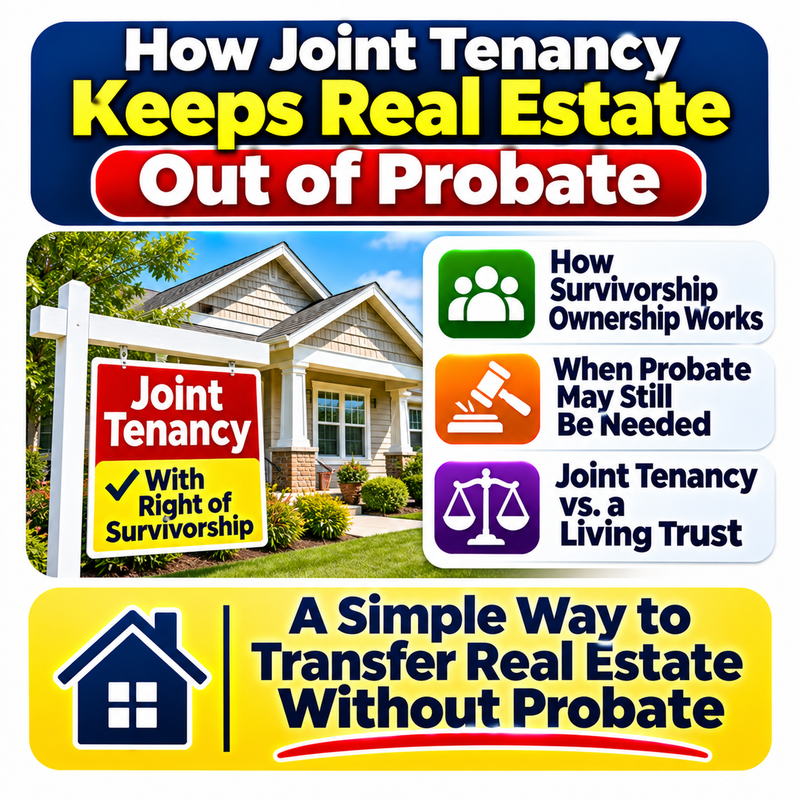
    Learn how survivorship ownership works, when probate may still be needed, and how joint tenancy compares with a living trust.

    If you and a co-owner hold a house as joint tenants with right of survivorship, the surviving owner may pick up the deceased owner’s share without a probate case for that interest. That’s the short answer. But joint tenancy probate avoidance only solves part of the puzzle, and the rest depends on exactly how your deed is worded, what happens when the last owner dies, and whether your family’s wishes match what the title paper actually says.

    Too many homeowners assume that putting two names on a deed is a permanent probate-proofing move. It isn’t always. Joint tenancy is a form of ownership, not an estate plan, and it can leave gaps that a will or a verbal promise can’t fix. Before you add anyone to your title or rely on an old deed to protect your family, it helps to understand what this ownership form actually does — and what it doesn’t.

    Key Takeaways: Joint Tenancy and Probate at a Glance

    • A valid joint tenancy with right of survivorship can let a deceased owner’s share pass to the surviving owner without probate for that interest, but the rules depend on your state and your deed’s exact wording.
    • Joint tenancy generally does not protect the property from probate when the last surviving owner dies, unless another arrangement, like a living trust, is already in place.
    • Tenancy in common works very differently: a deceased owner’s share goes to their heirs or beneficiaries, not automatically to the co-owner.
    • Adding a family member to a deed can trigger gift-tax questions, creditor exposure, and inheritance outcomes that don’t match what anyone intended.
    • A properly funded revocable living trust can offer more control over who inherits real estate and can address what happens after every owner’s death, not just the first one.
    Joint-Tenancy-Probate-Avoidance

    Learn how survivorship ownership works, when probate may still be needed, and how joint tenancy compares with a living trust.

    Joint tenancy with right of survivorship is one of the oldest ownership tools in real estate, and it remains popular because it’s simple to set up and easy to understand on the surface. Two or more people hold title together, and when one owner dies, the surviving owner (or owners) typically inherit that person’s share automatically, by operation of law rather than through a court process.

    That automatic feature is exactly why people reach for joint tenancy when they want to skip probate. It can work well in straightforward situations, like a married couple who owns one home together and wants the survivor to keep it without delay. But the deeper you look, the more this ownership form reveals edge cases, state-by-state quirks, and situations where it quietly works against the very goal you were trying to achieve.

    Right of Survivorship and Deed Wording

    The right of survivorship is the legal feature that makes joint tenancy useful for avoiding probate at the first owner’s death. When it’s valid, a deceased joint tenant’s ownership interest doesn’t pass through a will or through intestacy rules — it transfers directly to the surviving joint tenant or tenants. But this feature has to be properly created in the first place, and that’s where many property owners get tripped up.

    Exact Language a Deed Needs to Create Joint Tenancy

    Simply listing two names on a deed does not automatically create a joint tenancy with right of survivorship in every state. Many states require specific language, such as “as joint tenants with right of survivorship,” to appear on the deed itself. Without that phrase, or its state-approved equivalent, the law may default to tenancy in common instead, which behaves very differently when an owner dies.

    This is why pulling your actual recorded deed and reading the vesting language matters more than relying on family memory or assumptions about how the property is titled. A deed that looks informal, was prepared decades ago, or was drafted without legal help may not say what you think it says. If you’re not sure, a title company or real estate attorney can review the recorded document and tell you exactly how ownership is structured today.

    The Four Unities: Time, Title, Interest, and Possession

    Traditional joint tenancy law relies on what’s often called the “four unities” standard. For a joint tenancy to exist, the co-owners generally need to meet all four of these conditions:

    • Time: All owners acquire their interest in the property at the same time.
    • Title: All owners are named on the same deed or title document.
    • Interest: Each owner holds an equal share of the property.
    • Possession: Each owner has an equal right to use and enjoy the entire property, not just a fraction of it.

    If any one of these unities is missing — say, one owner was added to title years after the others, or the ownership shares aren’t equal — the arrangement may not qualify as a true joint tenancy under your state’s law. Instead, it could be classified as a tenancy in common, even if everyone involved assumed survivorship rules applied. This is a technical distinction, but it has real consequences for who inherits what when someone dies.

    What the County Recorder Requires After the First Death

    Survivorship may happen “by operation of law,” but that doesn’t mean the public record updates itself. When a joint tenant dies, the surviving owner typically still needs to take some action to clear the deceased owner’s name from title and reflect the new, sole ownership in county records.

    This commonly involves recording a certified copy of the death certificate along with an affidavit of survivorship or a similar document, depending on state and county requirements. Skipping this step can create headaches later, particularly if the surviving owner wants to sell, refinance, or transfer the property, since title companies will want to see a clean chain of ownership. It’s a modest amount of paperwork compared to probate, but it’s not nothing, and it’s worth confirming with a title professional or recorder’s office rather than assuming the property “just transfers.”

    Joint Tenancy vs Tenancy in Common

    Joint tenancy and tenancy in common are often confused because both describe situations where more than one person owns a piece of real estate. The difference comes down to what happens when an owner dies, and that difference can completely change your estate-planning outcome.

    Equal Shares vs Unequal Ownership Percentages

    Joint tenants generally hold equal shares of a property — if three siblings own a home as joint tenants, each typically holds a one-third interest, regardless of who contributed more money toward the purchase. Tenancy in common, on the other hand, allows owners to hold unequal percentages. One tenant in common might own 70% of a property while another owns 30%, based on how the ownership was structured or how much each person contributed.

    This flexibility makes tenancy in common attractive for unrelated co-owners, business partners, or family members who didn’t contribute equally to the purchase price. But it also means tenancy in common doesn’t carry the automatic survivorship feature that makes joint tenancy appealing for probate avoidance.

    Who Inherits a Tenant-in-Common Share When an Owner Dies

    When a tenant in common dies, their share of the property does not automatically go to the other co-owners. Instead, it passes according to that person’s will, trust, or — if they didn’t have one — your state’s intestacy rules. That share typically goes through probate unless another nonprobate arrangement, like a living trust, was already in place for that specific interest.

    This is the core trade-off between the two ownership forms. Joint tenancy offers simpler, faster transfers to a co-owner but less control over who ultimately inherits. Tenancy in common offers more control over your own share but doesn’t skip probate on its own. Neither one is automatically “better” — it depends entirely on what you’re trying to accomplish and who you want to inherit the property.

    What Happens at the Death of the Last Surviving Owner

    Here’s where joint tenancy probate avoidance often falls apart for families who assumed they were fully covered. Joint tenancy can handle the first death cleanly. It generally has nothing to say about the second, third, or final death.

    Why the Final Owner’s Estate Can Still Face Probate

    Picture two siblings who co-own a home as joint tenants. When the first sibling dies, the survivorship feature kicks in, and the surviving sibling becomes the sole owner — no probate needed for that transfer. But now the property is held individually, in one person’s name. If that surviving sibling dies later without having set up another nonprobate arrangement, such as a transfer-on-death deed where available or a properly funded living trust, the property is very likely headed to probate court.

    This is the distinction between avoiding probate for one property at one death and avoiding probate for an entire estate across multiple deaths. Joint tenancy handles the former. It does nothing for the latter unless you take additional steps. A will alone doesn’t change this outcome either — a will has to go through probate to be executed, so relying on a will as your only backup plan means probate is still on the table for the final owner’s estate.

    State Title Law Decides the Outcome, Not Assumptions

    Every piece of this — how joint tenancy is created, how it’s severed, what documentation is required after a death, and what happens to the last surviving owner’s estate — is governed by state law. Requirements, forms, and available alternatives like transfer-on-death deeds vary significantly from one state to the next. What’s routine in one state may not even be available in another.

    Because of this variation, it’s worth confirming your state’s current rules with a title company or estate-planning attorney rather than assuming a rule you read about somewhere else applies to your property. A plan that works perfectly for a friend in another state might not transfer the same way where you live.

    Severance and Creditor Exposure

    Joint tenancy isn’t necessarily permanent. The same flexibility that lets co-owners hold property together can also let one owner unwind the arrangement, sometimes without the other owner’s consent, depending on state law and the specific transaction involved.

    This matters for two big reasons: it means the survivorship feature you’re counting on could disappear before anyone dies, and it means that adding someone to your title exposes your property to risks tied to that person’s financial life, not just their intentions.

    Here’s a general comparison of how joint tenancy behaves next to its closest ownership alternatives, keeping in mind that actual outcomes depend on your deed, your state, and whether any arrangement has been properly documented and funded.

    Ownership ArrangementWhat Happens at DeathProbate Considerations
    Joint Tenancy with Right of SurvivorshipDeceased owner’s share passes to surviving joint tenant(s)May avoid probate at first death; last survivor’s estate may still require probate
    Tenancy in CommonDeceased owner’s share passes per will, trust, or intestacy rulesThat share typically goes through probate absent another nonprobate plan
    Properly Funded Revocable Living TrustTrustee distributes or manages property per trust termsGenerally avoids probate for property actually titled in the trust’s name

    How One Co-Owner Can Break the Joint Tenancy Alone

    In many states, a joint tenant can sever the joint tenancy unilaterally by transferring their interest to someone else, including to themselves as an individual, which converts the arrangement into a tenancy in common for that share. This can happen without the other owner’s agreement or even their knowledge, depending on the state and the specifics of the transaction. Once severed, the survivorship feature no longer applies to that portion of the property.

    This possibility is part of why joint tenancy shouldn’t be treated as a locked-in, guaranteed outcome. Family relationships change, financial pressures arise, and the legal tools that make joint tenancy flexible for co-owners can just as easily make it unpredictable for the people counting on survivorship to work a certain way.

    What Happens When a Co-Owner Faces a Lawsuit or Debt

    Adding another person to your deed as a joint tenant means their creditors, judgments, divorce proceedings, or bankruptcy filings can potentially reach their ownership interest in your property, depending on applicable state law. This is true even if that person never contributed a dollar toward the purchase or the mortgage. A well-meaning decision to add an adult child to title “just in case” can unexpectedly tie your home to that child’s financial troubles.

    Disagreements between co-owners over selling, refinancing, covering expenses, or handling maintenance can also escalate into partition proceedings, where a court is asked to force a sale or division of the property. These proceedings can be slow and expensive, and they illustrate why creditor exposure, family harmony, and probate avoidance are separate issues that deserve separate attention — not something joint tenancy automatically resolves just because the title is simple.

    Blended Families and Unequal Contribution: A Real-World Case

    Nothing exposes the gap between what people assume and what the law actually does quite like a blended family situation. Joint tenancy works beautifully when everyone involved wants the same outcome. It gets complicated fast when one owner’s wishes diverge from what the deed legally guarantees.

    Two Siblings, One House, and a Child Left Out of the Deed

    Picture this scenario. Two siblings, Mark and Laura, inherited their parents’ house years ago and took title together as joint tenants with right of survivorship. It made sense at the time — simple, equal, and probate-free if one of them passed away first. But Mark later remarried and had a daughter, and as he got older, he decided he wanted his half of the house to go to her instead of automatically passing to Laura.

    Here’s the problem: if Mark dies while the joint tenancy remains valid and unchanged, his share of the house passes directly to Laura by right of survivorship — not to his daughter. It doesn’t matter if Mark wrote a will or even set up a revocable living trust naming his daughter as the beneficiary of his half of the property. A will or trust provision generally cannot override a valid, existing survivorship arrangement, because the property interest transfers by operation of the deed, not by the terms of a separate estate-planning document. Mark’s daughter could be left with nothing from that property, despite his clear intentions on paper.

    For Mark to actually direct his share to his daughter, something would need to change about the ownership structure itself — not just his will or trust. That might mean legally severing the joint tenancy and converting his interest into a tenancy in common, where his share would then pass according to his will or trust instead of automatically to Laura. It could also mean placing his severed interest into a properly funded trust naming his daughter as beneficiary. Whether severance is even available, how it’s done, and what it triggers (notice requirements, potential tax consequences, impact on any mortgage) all depend on state law, the specific deed, and the realities of the existing loan on the property.

    Decision Points Before Adding or Removing a Name on Title

    Before anyone in Mark and Laura’s position changes title, there’s more to weigh than just one person’s inheritance goal. Severing a joint tenancy affects the other co-owner too — Laura’s expectations, her financial planning, and possibly her ability to refinance or sell depend on how the property is titled. If there’s a shared mortgage, lenders may have requirements or restrictions tied to who’s on title and who’s responsible for payments. Family relationships can also take a hit if a change in ownership feels like it came out of nowhere.

    Real estate complications multiply further when a family owns property in more than one state — for instance, if Mark and Laura’s parents left behind a vacation property in a different state in addition to the primary home. Owning real estate across state lines can trigger a separate probate proceeding in that other state even if the primary residence avoids probate through survivorship, and ancillary probate for out-of-state property can add real delay and expense on top of whatever happens with the main house. This is one more reason families with property in multiple states often look at trust-based planning as a way to handle everything under one coordinated plan instead of leaving pieces scattered across different court systems.

    Records to Pull and Professionals to Call First

    Before Mark — or anyone in a similar situation — makes a move, there’s a practical sequence worth following:

    • Obtain a current copy of the recorded deed and confirm the exact ownership and survivorship language in writing.
    • Identify who the intended beneficiary should be for each owner’s share, separate from assumptions about what “should” happen.
    • Review the mortgage documents and any lender requirements tied to the current ownership structure.
    • Talk with the other co-owner about the proposed change before taking action, since their interests and expectations are part of the picture.
    • Consult an estate-planning attorney to confirm whether severance, a transfer to tenancy in common, or a trust-funding strategy is actually legally effective in that state before anything gets signed or recorded.

    Skipping any of these steps is how families end up with deeds that don’t say what they think they say, or worse, with a severance attempt that doesn’t hold up because it wasn’t done correctly under state law.

    Title and Mortgage Review Before You Change Ownership

    Changing who’s on a deed — whether that means adding a joint tenant, severing a joint tenancy, or moving a property into a trust — isn’t just a title company transaction. It touches the mortgage, the insurance policy, and sometimes the homeowners association, and skipping that review is one of the most common mistakes property owners make.

    Due-on-Sale Clauses and Lender Notification

    Most mortgages contain a due-on-sale clause, which gives the lender the right to call the full loan balance due if ownership of the property changes without their consent. This matters anytime you’re adding or removing a name from title, not just when you’re selling the home outright.

    There is a narrower federal protection that can apply when a borrower transfers their own residential property into a revocable living trust where they remain a beneficiary — this kind of transfer may, under certain conditions, be shielded from triggering the due-on-sale clause. But that protection is conditional, tied to specific circumstances, and isn’t automatic for every transfer, every loan type, or every kind of trust. It shouldn’t be assumed to cover adding a co-owner to title, severing a joint tenancy, or transferring commercial property.

    Before changing ownership in any way, it’s worth confirming directly with the lender, in writing, whether the proposed change affects the loan. A quick phone call or letter can prevent a far more expensive surprise down the road.

    Items worth confirming with your lender and title company before any change:

    • Whether the proposed transfer triggers the due-on-sale clause
    • Whether the loan allows additional borrowers or owners to be added without refinancing
    • Whether a trust-funding transfer qualifies for any applicable federal protection
    • Whether homeowners insurance needs to be updated to reflect new owners or a trust as title holder
    • Whether HOA or condominium governing documents place restrictions on ownership changes

    Title Insurance Effects of Adding a New Owner

    Adding someone to a deed can also affect your title insurance coverage. Existing title policies are generally written to protect the owners named at the time the policy was issued — adding a new owner afterward doesn’t automatically extend that same protection to them. Depending on the title company and the nature of the transfer, a new owner might need an endorsement or a new policy altogether to be fully covered against title defects.

    This is a detail that’s easy to overlook because it doesn’t come up until there’s a title dispute down the line, and by then it’s too late to fix cheaply. A quick conversation with the title company handling the change can clarify what, if anything, needs to be updated.

    It also helps to understand how joint tenancy fits into the broader landscape of co-ownership options, since title companies and attorneys often draw distinctions that aren’t obvious to homeowners at first glance — including how joint tenancy, tenancy in common, and tenancy by the entirety each create different rights and different exposure, as outlined in this comparison of real estate co-ownership structures.

    Example: A homeowner adds her adult son to the deed as a joint tenant to “make things easier later.” Two years later, the son is named in a lawsuit unrelated to the property. Because he’s a joint tenant with an equal ownership interest, his portion of the home could be reachable by his creditors — something the homeowner never anticipated when she signed the new deed.

    That example is a reminder that title changes aren’t reversible formalities. Once someone is added to a deed, undoing it isn’t as simple as crossing out a name — it typically requires another legally effective transfer, with its own set of consequences.

    When a Revocable Living Trust Offers More Control

    Joint tenancy answers one question well: who gets this specific co-owner’s share when they die. A revocable living trust answers a much bigger set of questions, including who manages the property if an owner becomes incapacitated, how the property should be divided among multiple heirs, and what should happen if an owner wants to benefit someone other than a surviving co-owner.

    For readers trying to understand how living trust fundamentals compare with survivorship ownership, the core difference is control. Joint tenancy locks in a single, automatic outcome based purely on who’s on the deed when an owner dies. A trust lets the person who created it spell out instructions — who inherits what, when, and under what conditions — and those instructions can be updated anytime while the owner is alive and has capacity to do so.

    Naming More Than One Beneficiary for a Single Property

    One of the clearest advantages of trust-based planning shows up when an owner wants to split a single property’s value among several people, rather than handing the entire interest to one surviving co-owner. A trust can direct that a home be sold after the owner’s death and the proceeds divided among multiple children, or that one beneficiary receives the right to live in the home while another receives a different asset of comparable value. Joint tenancy simply can’t do this — its survivorship feature is built around passing the whole interest to the remaining co-owner, full stop.

    This flexibility matters most in exactly the kind of situation Mark and Laura found themselves in. If Mark’s goal was to direct his share to his daughter while still giving Laura clear answers about what to expect, a properly funded trust holding his severed interest could spell out precisely how and when that transfer happens — something no survivorship deed is built to do.

    Avoiding Probate at Every Owner’s Death, Not Just the First

    Because a trust continues to exist independently of any one person’s lifetime, it can address what happens at the first owner’s death and the final owner’s death, and every beneficiary transition in between. That’s a meaningful upgrade over joint tenancy, which — as covered earlier — generally only handles the first transfer cleanly and can leave a surviving owner’s estate exposed to probate later. For families trying to understand exactly how ownership transfers are supposed to unfold and what documentation supports each step, this explanation of how the probate process actually unfolds is a useful reference point for seeing why nonprobate alternatives carry real weight.

    How to Create a Living Trust and Fund Real Estate Into It

    A trust document alone doesn’t move real estate anywhere — signing it doesn’t retitle the house. The property has to be legally transferred into the trust’s name through a properly prepared and recorded deed, a step known as funding the trust. Skipping this step is one of the most common and costly mistakes in trust-based planning, because an unfunded trust provides no probate protection at all for the assets that were never actually transferred into it.

    For homeowners weighing whether survivorship ownership or trust-based planning fits their situation better, understanding how to create a living trust that’s properly drafted and fully funded is the difference between a plan that works on paper and one that actually performs when it’s needed.

    Checklist Before You Add or Remove a Joint Tenant

    Before making any change to how a property is titled, running through a short checklist can prevent most of the costly surprises covered so far in this article.

    1. Pull the Current Deed and a Title Report

    Start with the actual recorded document, not a memory of how the property is titled. A title report from a title company can confirm current ownership, any liens, and whether the survivorship language is even valid under current state law.

    2. Confirm Mortgage Lender Requirements in Writing

    Reach out to the lender before making any change and get their position on the due-on-sale clause, any required consent, and whether the proposed change affects the loan terms. A verbal assurance from a customer service representative isn’t the same as a written confirmation.

    3. Put Every Co-Owner’s Intentions on Paper

    Informal understandings about who “really” owns what, or who was supposed to get what, tend to fall apart exactly when they matter most. Documenting contributions, ownership intentions, and reimbursement arrangements in writing — ideally with legal help — reduces the odds of a dispute among heirs later.

    This is especially important in blended families or situations involving unequal financial contributions, where one owner may have paid more of the purchase price but discovers that recorded title, not the size of their down payment, controls what happens at death.

    4. Consult an Estate Planning Attorney or Title Officer

    Severance rules, trust-funding requirements, and survivorship documentation all vary by state, and getting any one of them wrong can undo the very protection a family was trying to create. An estate-planning attorney or an experienced title officer can confirm what’s actually required in your jurisdiction before anything is signed or recorded.

    This step also protects against a common misstep: assuming a will or trust automatically overrides an existing joint tenancy. As Mark and Laura’s situation showed, it generally doesn’t — and finding that out after death is far more painful than confirming it beforehand.

    5. Compare Joint Tenancy, Tenancy in Common, and a Revocable Living Trust

    Once the paperwork is pulled and the professionals are consulted, the final step is simply comparing the three main options side by side against the actual goal: Who should inherit this property, under what circumstances, and does the current title arrangement actually deliver that outcome?

    For some families, joint tenancy’s simplicity is exactly right. For others — particularly those with blended families, unequal contributions, or property in more than one state — a properly funded revocable living trust offers the kind of control and flexibility that survivorship ownership simply wasn’t built to provide.

    Common Mistakes Property Owners Make With Joint Tenancy

    Most of the problems covered in this article trace back to a handful of avoidable mistakes. Property owners don’t usually get into trouble because joint tenancy is a bad tool — they get into trouble because they treat it as a complete estate plan rather than one piece of a larger picture.

    Assuming Survivorship Avoids Probate at Every Death

    This is the single most common misunderstanding, and it’s the one that catches families off guard years after the fact. Joint tenancy can genuinely keep a property out of probate when the first owner dies, which is exactly why it earns a reputation as a probate-avoidance tool. But that reputation quietly stops applying the moment there’s only one owner left standing.

    Once a surviving joint tenant holds the property individually, the survivorship feature that protected the first transfer no longer exists for the second one. If that remaining owner dies without another nonprobate arrangement in place — a transfer-on-death deed where available, or a properly funded living trust — the property is very likely to end up in probate court, just delayed by one generation.

    Families who assume joint tenancy “handles everything” often discover this gap at the worst possible time, when the second owner has already passed and there’s no backup plan to fall back on. Checking this assumption early, while both owners are alive and able to act, is far easier than untangling it afterward.

    Adding a Co-Owner Without Checking the Mortgage Terms

    It’s tempting to think of adding a name to a deed as a quick, low-stakes paperwork fix. In reality, it can brush up against due-on-sale clauses, trigger lender notification requirements, and affect title insurance coverage, as covered earlier in this article. Skipping that review doesn’t always cause an immediate problem, but it leaves a property owner exposed to surprises if the lender later decides to enforce the loan terms.

    A short phone call or written request to the lender before changing title can confirm whether the proposed change is even permitted under the existing loan, and whether anything needs to be restructured first. That one conversation is far less costly than discovering after the fact that a mortgage balance has been called due.

    Trusting Verbal Promises Instead of Deed or Trust Language

    Family conversations about who’s “really” supposed to inherit a property carry real emotional weight, but they carry no legal weight once an owner has died. Recorded deeds and properly executed trust documents control the outcome — not what someone remembers being told at a kitchen table years earlier. If a verbal understanding doesn’t match the actual title or trust language, the paper wins every time.

    Match Your Ownership Choice to Who You Actually Want to Inherit

    Joint tenancy, tenancy in common, and a revocable living trust each answer the inheritance question differently, and none of them is automatically the right fit for every family. The right choice comes down to a specific set of facts: how many owners are involved, whether everyone wants the same person to inherit, whether contributions were equal, and whether the family includes children from more than one relationship. Working through those details with the actual deed in hand — rather than relying on assumptions about how the property is titled — is the surest way to confirm whether current ownership matches what you actually want to happen when an owner dies.

    Frequently Asked Questions

    These questions come up often among property owners trying to sort out what joint tenancy actually guarantees and where it falls short. The answers below are general in nature, since actual outcomes always depend on your state’s law and the specific wording of your deed or trust.

    Does joint tenancy with right of survivorship avoid probate?

    It can, for the specific interest that transfers between joint tenants. When one joint tenant dies, their share may pass to the surviving owner without a probate proceeding for that share, assuming the deed properly created a valid joint tenancy under state law. This protection applies only to that one transfer, not necessarily to the property’s entire future ownership history.

    What happens when the last surviving joint tenant dies?

    Once only one owner remains, the property is typically held individually rather than jointly. If that sole owner dies without another nonprobate arrangement in place, probate may be required to transfer the property to their heirs or beneficiaries. This is the gap many families don’t realize exists until it’s too late to plan around it.

    What is the difference between joint tenancy and tenancy in common?

    Joint tenancy generally requires equal ownership shares and includes an automatic right of survivorship, meaning a deceased owner’s interest passes directly to the surviving co-owner. Tenancy in common allows unequal ownership percentages, and a deceased owner’s share passes according to their will, trust, or intestacy rules rather than automatically to the other co-owner.

    • Joint tenancy: equal shares, automatic survivorship, generally avoids probate at the first death
    • Tenancy in common: shares can be unequal, no automatic survivorship, typically subject to probate unless another plan is in place

    Because these two forms behave so differently at death, confirming which one actually applies to your property is a critical first step before making any assumptions about inheritance.

    Can a joint tenant leave their share to a child through a will?

    Generally, no — not while a valid joint tenancy remains in place. A will or trust provision purporting to leave a joint tenant’s share to someone other than the surviving co-owner typically cannot override an existing, unbroken survivorship arrangement, because the deed’s ownership structure controls the transfer, not a separate estate-planning document. To direct a share to a child or another beneficiary, the joint tenancy usually needs to be legally severed or restructured first.

    Can joint tenancy be severed or changed?

    In many states, yes. A joint tenant can often sever the arrangement by transferring their interest, which may convert that share into a tenancy in common. Availability, required formalities, and consequences vary by state and by the specific transaction, so severance isn’t automatically available in every situation or without legal review.

    Can a joint owner’s creditors affect jointly owned property?

    Yes, depending on applicable state law. Adding someone as a joint tenant generally makes them a co-owner with a real ownership interest, which means that interest can potentially be reached by that person’s creditors, judgments, divorce proceedings, or bankruptcy filings. This risk exists regardless of whether that person ever contributed financially to the property.

    Does adding someone to a deed create gift-tax or basis issues?

    Possibly. Adding another person to title without receiving equivalent payment in return can raise gift-tax questions, and it may affect how the property’s cost basis is calculated later, including whether any basis adjustment applies at an owner’s death. Whether a reportable gift actually results in tax owed depends on the specific facts, so this is worth reviewing with a tax professional before any transfer.

    Is joint tenancy better than a revocable living trust for probate avoidance?

    It depends on the goal. Joint tenancy can be simple and effective for a single transfer between co-owners, but it generally doesn’t address what happens at the final owner’s death or allow for multiple beneficiaries and staggered inheritances. A properly funded revocable living trust can address probate avoidance across every owner’s death and offers more control over how and when beneficiaries receive the property.

    Does transferring a home into a living trust affect the mortgage or title?

    It can, which is why mortgage and title review matter before funding a trust. Certain residential mortgage transfers into a revocable trust where the borrower remains a beneficiary may receive protection from triggering a due-on-sale clause under applicable federal law, but that protection is conditional and shouldn’t be assumed to apply automatically to every loan or every type of transfer. Title insurance and lender notification should also be confirmed directly.

    What documents should homeowners review before changing ownership?

    Before making any change to how a property is titled, it helps to pull together the current recorded deed, a title report, mortgage or deed of trust documents, homeowners insurance details, property tax records, any HOA governing documents, and existing wills, trusts, or powers of attorney. Reviewing these together gives a clear, accurate picture of current ownership before anyone signs a new document or records a change.

    This information is intended as general education, not individualized legal or tax advice, and the rules governing joint tenancy, severance, and trust funding vary by state — a qualified estate-planning attorney or tax professional can confirm how current law applies to your specific property and family situation.

  • Can a Living Trust Own Property in Another State?

    Can a Living Trust Own Property in Another State?

    Living Trust Property in Another State: Deeds, Ancillary Probate, and Multistate Planning

    Learn How Multistate Property, Local Deeds, Ancillary Probate, Taxes, Homestead Rules, and Trust Administration Can Interact

    Article-at-a-Glance: Key Takeaways

    • A living trust can absolutely own real estate in a state other than the one where you live, but the deed and transfer must follow that state’s property laws, not the laws of your home state.
    • Moving title into a trust doesn’t erase local rules on mortgages, property taxes, homestead exemptions, or landlord obligations — those rules travel with the land, not with the trust document.
    • Properly funding a trust with out-of-state property can reduce your family’s exposure to a second, costly court process called ancillary probate, though it doesn’t guarantee zero court involvement in every situation.
    • Rental income and property sales in another state can trigger tax filing obligations there, even if you’ve never lived in that state.
    • A multistate-property checklist near the end of this article walks you through exactly what to verify before you transfer any out-of-state deed into your trust.
    Living-Trust-Property-In-Another-State

    Here’s the short answer: yes, a living trust can own property in another state, and for many families it’s one of the smartest reasons to set one up in the first place.

    But “yes” comes with homework attached. The property itself doesn’t care what state your trust was created in — it cares about the laws of the state where it physically sits. Get that part wrong, and you could end up with a deed that doesn’t hold up, a tax surprise, or worse, the exact probate mess you were trying to avoid. Resources like Create A Living Trust exist precisely because so many people run into these multistate wrinkles without realizing it until it’s too late.

    Yes, a Living Trust Can Own Property in Another State

    A trust is a legal arrangement, not a geographic boundary. Once you create one, it can hold almost any asset you own, including a vacation condo in Florida, a rental duplex in Ohio, or a family cabin in Michigan, regardless of where you personally live. There’s no rule that says a trust created under California law can only own California property.

    Why the Trust’s Home State Doesn’t Limit Property Location

    Think of your trust as a container. The container’s rules — who’s the trustee, how assets get distributed, when a successor steps in — come from wherever you signed the trust document. But what’s inside that container, especially real estate, still answers to the laws of wherever it physically exists. That distinction matters more than most people realize, and it’s the reason attorneys sometimes talk about “situs” law when discussing real property in a trust.

    What Local Law Still Controls

    Even after a property is retitled into your trust, several categories of law keep applying exactly as before:

    • Deed execution and recording requirements specific to that county or state
    • Property tax assessments and any applicable transfer taxes
    • Mortgage and lender terms, including due-on-sale clauses
    • Homestead exemption rules and creditor protections
    • Landlord-tenant law if the property is rented out

    None of these disappear just because a trust now holds title. A trust’s governing-law clause tells you which state’s rules apply to trust administration — it doesn’t override the real-property law of wherever the dirt sits.

    How a Trust Holds Title to Out-of-State Real Estate

    Getting property into a trust isn’t automatic. You, as the current owner, have to execute a new deed that transfers title from your individual name into the name of your trust. This step is often called “funding” the trust, and skipping it is one of the most common and costly mistakes people make after setting up their estate plan.

    Funding the Trust With a New Property Deed

    The new deed typically names the trust as grantee, using language like “John Smith, Trustee of the Smith Family Revocable Living Trust dated January 1, 2024.” That deed then has to be signed, notarized, and recorded according to the rules of the county and state where the property sits — not where you live if that’s different. A revocable living trust is the most common vehicle used for this kind of transfer because it allows you to retain full control over the property while you’re alive, including the ability to sell, refinance, or move it back out of the trust if your plans change. If you own property in more than one state, you might find it beneficial to explore why you need a trust to manage these assets effectively.

    Consolidating Multiple Properties Under One Trust

    One real advantage of using a trust for out-of-state real estate is consolidation. Instead of managing separate estate plans for each property location, a single trust document can hold title to properties in several states at once. Your successor trustee then has one clear roadmap to follow, rather than piecing together instructions scattered across multiple wills or informal arrangements.

    Local Deed and Recording Requirements You Can’t Skip

    Every state has its own formula for what makes a deed valid. Some require specific witness signatures. Others mandate particular transfer tax forms be filed alongside the deed. A few states even require a lawyer to prepare or review certain real estate transfers. None of this is standardized nationally, which is exactly why a deed that works perfectly in one state can be rejected outright in another.

    Correct Legal Description for Each Parcel

    Every deed needs an accurate legal description of the property, and this isn’t the same as a mailing address. Legal descriptions reference surveys, lot numbers, metes and bounds, or subdivision plats depending on local practice. If this description doesn’t match county records exactly, recording clerks can reject the deed or title problems can surface years later when the property is sold or inherited.

    State-Specific Transfer Forms and Disclosures

    Many states require a transfer tax declaration, an exemption affidavit, or a preliminary change of ownership form to be submitted along with the deed itself. Some states tax the transfer even when it’s just moving from your individual name into your own trust, while others offer an explicit exemption for this exact scenario. Checking this ahead of time saves you from unexpected fees or a rejected filing.

    Recording the Deed in the County Where Property Sits

    Recording isn’t optional paperwork — it’s what makes the transfer legally effective against future buyers, creditors, and courts. The deed has to be recorded in the specific county (or parish, in Louisiana) where the property is physically located, following that jurisdiction’s formatting rules, recording fees, and sometimes even paper size requirements. An unrecorded deed can leave your trust’s ownership claim vulnerable, even if everyone signed it correctly.

    Ancillary Probate and Why Trust Ownership Matters

    Here’s where multistate property ownership gets genuinely tricky if you don’t plan ahead. If you own real estate in a state other than where you’re domiciled, and that property is still in your individual name when you pass away, your executor typically has to open a second probate case in that state. This is called ancillary probate, and it runs on top of the main probate proceeding back home.

    What Happens If You Skip the Trust and Use a Will Instead

    A will only controls assets that go through probate, and probate is handled state by state. So if your will names an executor and that executor lives in your home state, they’ll still need to find local counsel, open a separate case, and follow an entirely different court’s procedures for the out-of-state property. Probate overall tends to run roughly six to nine months on average, and that timeline can stretch into years if there are disputes over the will or asset distribution.

    How Trustee Ownership Avoids a Second Probate Case

    When a property is properly titled in the name of your trust rather than your individual name, there’s no probate asset to administer in that state at all — the trustee already holds legal title and can simply continue managing or distributing the property according to your instructions. This is the core reason multistate property owners gravitate toward trusts: it collapses what could be two or three separate court proceedings into one streamlined administration process.

    Costs and Delays of Hiring an Out-of-State Attorney

    Ancillary probate isn’t just slower, it’s also more expensive. Your executor usually has to retain a local attorney in the property’s state, someone they’ve likely never worked with before, which adds legal fees on top of whatever your main estate is already paying. Court costs, appraisal fees, and sometimes a percentage-based executor fee in that state can all stack up, pulling money away from your beneficiaries and adding months to an already emotional process for your family.

    Steps to Confirm Lender Approval Before Transferring Title

    Before you move a mortgaged property into your trust, pull out your loan documents and read the due-on-sale language carefully, or better yet, ask your lender directly whether a trust transfer triggers it. Federal law under the Garn-St. Germain Act generally protects transfers into a revocable trust where the borrower remains a beneficiary, but “generally” isn’t the same as “always,” and some lenders still want written notice. A quick phone call to your loan servicer, documented in writing, can save you from an unpleasant surprise down the road.

    Mortgage Considerations for Financed Property

    If your out-of-state property still carries a mortgage, transferring it into your trust adds one more layer to think through. Lenders write due-on-sale clauses into almost every mortgage, which technically give them the right to call the loan due if ownership changes hands.

    Due-on-Sale Clauses: Why You Can’t Assume Automatic Protection

    Most lenders won’t exercise this right for a revocable trust transfer where you remain a beneficiary, but that’s a practice, not a guarantee written into every single loan. Some commercial loans, investment property mortgages, or loans from smaller regional lenders may handle this differently than a standard owner-occupied residential loan. Don’t assume your situation automatically qualifies for the same treatment as a neighbor’s; verify it against your specific loan terms.

    Property Taxes and Transfer Taxes in the Property’s State

    Taxes are another area where local rules simply don’t bend to accommodate your trust’s home state. Two separate tax questions come up here: what happens at the moment of transfer, and what continues happening every year afterward.

    Transfer Tax Triggers When Moving Property Into a Trust

    Many states charge a transfer tax or recording tax whenever a deed changes hands, calculated as a percentage of the property’s value. Fortunately, a good number of states specifically exempt transfers into a revocable trust where the original owner remains the beneficiary, treating it as a non-taxable change in form rather than a true sale. But this exemption isn’t universal, and the paperwork required to claim it varies by state. Checking your specific state’s transfer tax statute, or having a local title company confirm the exemption, prevents an unnecessary tax bill.

    Ongoing Property Tax Rules That Don’t Change

    Annual property tax assessments keep running exactly as before once the property sits inside your trust. Some states also offer reassessment exclusions for trust transfers similar to the transfer tax exemptions, meaning your property tax basis doesn’t reset just because title moved into the trust’s name. Again, this depends entirely on the state where the property sits, so it’s worth a quick check rather than an assumption either way.

    Homestead Exemptions and Creditor Protection Rules

    Homestead laws offer some of the strongest protections available to homeowners, shielding a primary residence from certain creditors and sometimes reducing property tax bills significantly. These protections are entirely creatures of state law, and moving a home into a trust doesn’t automatically preserve or eliminate them.

    Some states require the homestead to be owned in an individual’s name to qualify, which could jeopardize the exemption if the property moves into a trust without careful planning. Other states have specifically amended their homestead statutes to extend protection to properties held in a revocable trust, as long as the original owner remains a beneficiary and retains the right to live there.

    How Homestead Laws Vary by State

    Florida, for example, has robust homestead protections that extend to trust-owned property under the right circumstances, while other states impose stricter individual-ownership requirements. There’s no shortcut here — you have to look at the specific homestead statute in the state where your property sits before assuming your exemption survives the transfer.

    Creditor Claims Against Trust-Owned Property

    Creditor protection follows a similarly state-specific pattern. A revocable living trust generally doesn’t shield assets from the grantor’s own creditors during their lifetime, since the grantor retains control and can revoke the trust at will. That protection picture can shift after the grantor’s death, when the trust becomes irrevocable and different rules about creditor claims against the estate come into play.

    If asset protection from creditors is a primary goal rather than just probate avoidance, a revocable trust alone may not deliver it, and other planning tools might need to work alongside it. This is a conversation worth having directly with an estate planning professional familiar with both your home state and the property’s state, since the interaction between these two sets of rules can get complicated fast.

    The bottom line: don’t assume that tucking property into a trust automatically wraps it in a protective bubble against every creditor claim. Verify what your specific state allows, and build your plan around actual law rather than general assumptions.

    Rental-Property Issues for Out-of-State Owners

    Owning a rental property in another state through your trust adds a layer of ongoing management on top of the initial transfer paperwork. Landlord-tenant law is almost entirely state and sometimes even city-specific, and your trust’s existence changes none of it.

    Landlord-Tenant Law Still Applies Locally

    Security deposit limits, eviction procedures, required disclosures, and habitability standards all follow the law of wherever the rental sits, not where you or your trust happen to be based. A lease agreement that’s perfectly standard in Texas might violate specific disclosure requirements in California, for example.

    • Security deposit caps and return timelines
    • Required notice periods for entering the unit
    • Habitability and repair obligation standards
    • Eviction procedures and required court filings
    • Local licensing or registration requirements for rental properties

    Your trustee, whether that’s you now or a successor trustee later, steps into the landlord role and needs to follow these local rules just as carefully as an individual owner would. Many out-of-state landlords hire local property management companies specifically because keeping up with these jurisdiction-specific rules from a distance is genuinely difficult.

    Reporting Rental Income Across State Lines

    Rental income earned from an out-of-state property typically needs to be reported both to the IRS and often to the state where the property sits, even if you’ve never set foot in that state as a resident. Many states require a nonresident income tax return for rental income sourced within their borders, which means you could end up filing in two states every year simply because of where your rental property is located.

    This reporting obligation exists whether or not the property sits in a trust. A trust doesn’t change the underlying tax character of rental income — it just changes who technically holds legal title to the asset generating that income.

    Keeping clean, separate records for each property’s income and expenses makes tax season considerably less painful, and it’s a habit worth building early rather than scrambling to reconstruct later.

    State Income-Tax Implications of Out-of-State Property

    Beyond rental income specifically, owning real estate in another state can create broader income tax touchpoints depending on how the property is used and whether it’s eventually sold.

    Income Tax Owed in the Property’s State

    If you sell an out-of-state property for a gain, many states want their share of tax on that gain, even if you’re not a resident there and even if the property has been sitting inside your trust for years. The specific rules on sourcing, withholding at closing, and nonresident filing requirements vary widely, so checking the property state’s Department of Revenue guidance before a sale closes avoids unpleasant surprises.

    Fiduciary Tax Rules After the Grantor’s Death

    Once the grantor passes away and the trust becomes irrevocable, additional fiduciary income tax rules can kick in, sometimes requiring the trust itself to file a separate tax return. States differ on how they tax trust income, particularly when the trust holds assets like real estate located outside the trust’s own governing state. A successor trustee managing multistate property after the grantor’s death often benefits from working with a tax professional familiar with these fiduciary filing requirements, since mistakes here can create real liability.

    Trust’s Governing Law vs. Law Governing the Real Estate

    It helps to separate two different legal questions that often get blurred together: which state’s law governs how your trust operates, and which state’s law governs the real property it holds. These aren’t the same question, and confusing them is where a lot of multistate planning mistakes originate.

    What a Governing-Law Clause Actually Controls

    Most trust documents include a governing-law clause specifying which state’s law applies to interpreting the trust’s terms, resolving disputes among beneficiaries, and guiding the trustee’s administrative duties. If you created your trust in Illinois, that clause likely points to Illinois law for these internal trust matters.

    This clause matters a lot for questions like how trustee compensation is calculated, what notice beneficiaries are entitled to, or how trust modifications or terminations are handled. It’s the rulebook for the relationship between trustee and beneficiaries.

    But that rulebook has a boundary, and real property sits right outside it.

    Why Situs Law Always Governs the Property Itself

    Real estate follows what’s called “situs” law, meaning the law of the state where the property is physically located controls matters specific to that property: deed requirements, property tax assessment, homestead rights, foreclosure procedures, and landlord-tenant obligations. No governing-law clause in a trust document, no matter how well drafted, can override another state’s authority over real property located within its borders.

    This is why working with a living trust for multistate real estate requires attention to both layers simultaneously. Your trust’s governing law shapes the internal mechanics, while situs law shapes everything about how that specific piece of property actually gets transferred, taxed, and managed.

    Moving to Another State vs. Owning Property There

    There’s an important difference between owning a vacation home in another state while remaining domiciled elsewhere, versus actually relocating your primary residence across state lines. Both scenarios touch multistate law, but they create different planning priorities.

    Updating Your Trust After a Change of Domicile

    If you move your primary residence to a new state, it’s worth reviewing your entire trust document, not just the property deeds. Some states have unique rules about trust execution formalities, community property treatment, or elective share rights for spouses that differ meaningfully from your old state. A trust drafted correctly under one state’s law doesn’t necessarily need to be redone from scratch after a move, but a review by someone familiar with how to create a living trust that holds up across state lines is a smart step after any domicile change.

    Avoiding Dual-State Estate Tax Claims

    Domicile disputes after death are more common than people expect, particularly for individuals who split time between two states, like a northern home and a southern retirement property. If both states believe you were domiciled there at death, both may attempt to tax your estate, creating a genuinely painful situation for your family to untangle.

    Clear, documented evidence of domicile — voter registration, driver’s license, where you spend the majority of your time, where your doctors and bank accounts are — can make a meaningful difference if a domicile dispute ever arises between two states.

    Keeping this kind of documentation organized while you’re alive, and mentioning your intended domicile clearly within your estate planning documents, gives your executor or trustee solid footing if a dispute ever surfaces.

    This is a situation where proactive planning pays off far more than reactive cleanup, since estate tax disputes between states can take years to resolve and often involve real legal costs on both sides.

    Managing Multiple Out-of-State Properties in One Trust

    For families with real estate scattered across three, four, or more states, a single living trust can genuinely simplify what would otherwise be a tangled estate plan. Instead of separate wills, separate executors, and separate probate proceedings in every state, one trust document and one successor trustee can oversee the whole portfolio.

    Titling Each Property Correctly by State

    Each property still needs its own properly executed, state-compliant deed transferring it into the trust. There’s no shortcut that lets one blanket document retitle properties across multiple states simultaneously — each deed has to meet the specific recording and execution requirements of its own county and state.

    Simplifying Administration for Your Successor Trustee

    Once everything is correctly titled, though, your successor trustee gets a dramatically easier job. Rather than coordinating separate probate attorneys in multiple states, they work from one trust document, follow one set of distribution instructions, and handle each property’s local requirements as administrative tasks rather than full court proceedings. That difference alone often saves families thousands of dollars and many months of delay.

    Why a Local Professional or Title Review Matters

    Given how much local law varies, having someone familiar with the specific state where your property sits review the deed and transfer paperwork isn’t an unnecessary expense — it’s cheap insurance against a mistake that could cost far more to fix later.

    • A local real estate attorney or title company can confirm the deed meets that state’s exact execution and recording standards
    • They can verify whether a transfer tax exemption applies for trust transfers in that specific state
    • They can check whether homestead protections or reassessment exclusions carry over correctly
    • They can flag any mortgage-related notice requirements before the deed gets recorded

    A single consultation often costs far less than untangling a defective deed years later, particularly if that defect surfaces during an already stressful probate or trust administration process. Think of it as the final quality check before you file a document that’s meant to last for decades. And it’s also important to factor in ongoing trust costs over the years as amendments and changes need made.

    Your Multistate-Property Checklist

    Before transferring any out-of-state property into your trust, walk through these steps one at a time rather than rushing the paperwork.

    1. Confirm the trust document itself is properly drafted and executed, including a clear statement of your intent to hold multistate property within it.
    2. Pull the current deed and verify the exact legal description matches county records before drafting the new trust deed.
    3. Check that state’s transfer tax rules for any trust-to-trust or individual-to-trust exemption you need to claim.
    4. Review mortgage documents and contact your lender if the property is financed, confirming in writing that the transfer won’t trigger a due-on-sale issue.
    5. Research homestead exemption rules in that state if the property is a primary residence, confirming whether trust ownership preserves the benefit.
    6. Set up a system for tracking rental income and expenses separately if the property is rented, anticipating a possible nonresident tax filing.
    7. Have the finalized deed reviewed by a local professional before recording it in the county where the property sits.
    8. Keep copies of every recorded deed together with your trust document so your successor trustee has a complete record.

    One Trust Can Protect Property in Every State You Own It

    Multistate real estate ownership doesn’t have to mean multistate legal headaches for your family. With a correctly funded trust and attention to each property’s local requirements, one coordinated plan can replace what would otherwise be a patchwork of separate, expensive proceedings.

    Confirming Compliance With Each State’s Transfer Rules

    Every state has its own personality when it comes to real estate paperwork, and that personality shows up in small but important ways. One state might require two witnesses alongside a notary. Another might demand a specific transfer tax affidavit before the county clerk will even accept the deed. A third might have quirky rules about margin width or font size on recorded documents. None of this is intuitive if you’re working from a template designed for a different state entirely.

    Compliance review isn’t about being overly cautious for no reason. It’s about making sure the deed you’re relying on to avoid ancillary probate actually holds up when your successor trustee needs it most. A deed that looks fine on paper but fails to meet the local county’s technical requirements can get kicked back, delayed, or worse, challenged years later when someone tries to sell or transfer the property.

    Catching Errors Before They Become Probate Problems

    Small errors in a deed rarely cause trouble right away. They tend to surface at the worst possible moment, usually when a title company runs a search before a sale, or when a successor trustee tries to prove clear ownership after the grantor’s death. A mismatched legal description, a missing notarization, or an unrecorded deed can all undo the very protection you set out to create.

    Catching these issues while you’re alive and capable of fixing them is infinitely easier than having your successor trustee discover them during an already stressful administration. A quick title search or professional review at the time of transfer is a small investment compared to what a defective deed can cost in time, legal fees, and family stress later.

    Your Multistate-Property Checklist

    Pulling all of this together, here’s a practical sequence to follow whenever you’re moving an out-of-state property into your living trust. Treat it less like a one-time task and more like a standard process you repeat for every property you own outside your home state.

    1. Verify Local Deed and Recording Requirements

    Start by confirming exactly what the county recorder’s office in that state requires: witness signatures, notarization standards, formatting rules, and any required cover sheets. This single step prevents the majority of rejected filings and wasted trips to the courthouse.

    2. Review Any Mortgage or Loan Documents

    Pull out your note and deed of trust or mortgage agreement, and look specifically for due-on-sale language. Then call your lender directly and ask whether transferring title into your revocable trust triggers that clause, getting their answer in writing whenever possible.

    3. Check Property Tax and Transfer Tax Rules

    Research whether the state charges a transfer tax on deed changes and whether an exemption exists for transfers into a revocable trust. Also check whether the property tax assessment resets or stays the same, since this can affect your annual tax bill going forward.

    4. Confirm Homestead and Creditor Protections

    If the property is your primary residence, don’t assume homestead protections automatically survive the move into a trust. Confirm the specific rule in that state before finalizing the transfer.

    • Some states extend homestead protection to revocable trust ownership automatically
    • Others require specific trust language or retained rights to qualify
    • A few states may require individual ownership, making this step worth checking before you sign anything

    Getting this wrong doesn’t just cost money in some cases, it can affect property tax bills and creditor exposure for years to come.

    Homestead rules also interact differently depending on whether the property is owner-occupied full time or used seasonally, so be specific about your situation when researching or asking a professional.

    Don’t rely on general internet searches alone here. State-specific guidance, ideally from a local attorney, gives you a dependable answer rather than a guess.

    5. Consult a Local Attorney or Title Company

    Before recording anything, have a local professional review the deed and confirm it satisfies every requirement unique to that jurisdiction. This final check is relatively inexpensive compared to the cost of fixing a defective transfer after the fact.

    One Trust Can Protect Property in Every State You Own It

    Owning real estate across multiple states doesn’t have to mean a fragmented, stressful estate plan for the people you leave behind. With careful attention to each property’s local requirements, a single living trust can serve as the backbone for your entire real estate portfolio, no matter how many state lines it crosses.

    • Confirm your trust document is properly drafted and clearly reflects your intent to hold property in multiple states
    • Transfer each property with a deed that meets that specific state’s execution and recording standards
    • Check tax, homestead, and mortgage implications individually for each property rather than assuming uniform rules
    • Keep organized records so your successor trustee has everything needed to step in smoothly

    The work upfront is real, but it’s finite and manageable, especially compared to the alternative of leaving your family to untangle multiple probate proceedings across different states.

    Every property you correctly fund into your trust is one less court case your loved ones will have to navigate during an already difficult time.

    Multistate real estate planning rewards attention to detail far more than it punishes complexity, as long as you’re willing to check the specifics rather than assume one state’s rules apply everywhere.

    That’s really the heart of it: a living trust gives you one coordinated structure, while local law still governs the details of each individual property inside it.

    Frequently Asked Questions

    Multistate property ownership raises a lot of specific, practical questions, and most people want straightforward answers rather than long explanations. Here are the questions that come up most often from people managing real estate across state lines.

    These answers are meant as a starting point for understanding your situation, not a replacement for a conversation with a local attorney about your specific property and circumstances.

    A living trust is a tool, not a guarantee. It works exactly as well as the funding behind it, which means every deed, every state’s rules, and every detail matters just as much as the trust document itself.

    Keep that principle in mind as you read through the specifics below, since it applies to nearly every question on this list.

    Do I Need a Separate Trust for Each State?

    No, you don’t need a separate trust for every state where you own property. One properly drafted living trust can hold title to real estate located anywhere, as long as each individual property is deeded into the trust correctly according to that state’s own requirements. For more information on why you might need a trust if you own property in multiple states, you can read this article on owning property in more than one state.

    The complexity lives in the deeds and local compliance, not in needing multiple trust documents. Keeping everything under one trust actually simplifies administration for your successor trustee later.

    Can I Transfer Out-of-State Property Into My Trust Myself?

    You can prepare and sign the deed yourself in many states, but given how much local requirements vary, having a local attorney or title company review the document before you record it is a smart safeguard against costly mistakes.

    What Happens If I Forget to Transfer a Property Into My Trust?

    If a property stays titled in your individual name at the time of your death, it typically has to go through probate to pass to your heirs, and if that property sits in a different state than where you lived, your family faces ancillary probate on top of your main estate proceeding.

    This is one of the most common and preventable estate planning mistakes. A quick title check every few years can confirm every property you intended to place in your trust actually made it there.

    Does a Living Trust Avoid Estate Taxes in Multiple States?

    Not automatically. A living trust mainly helps you avoid probate, while estate tax exposure depends on separate rules in each state and on where you’re legally domiciled, which requires its own dedicated analysis.

    Can a Trust Own Rental Property in Another State?

    Yes, a trust can own and operate rental property located in another state, though your trustee still has to follow that state’s landlord-tenant law and file any required nonresident income tax returns on the rental income.

    Will My Mortgage Lender Object to a Property Transfer Into a Trust?

    Most lenders permit transfers into a revocable living trust without enforcing the due-on-sale clause, provided the original borrower remains a beneficiary of the trust, but confirming this directly with your specific lender before transferring avoids any surprises.

    Is Ancillary Probate Always Avoided With a Living Trust?

    Properly funding your trust with out-of-state property substantially reduces the chances of ancillary probate, but it isn’t an absolute guarantee in every single case, particularly if the transfer wasn’t completed correctly or a property was accidentally left out.

    Think of trust funding as the determining factor. A trust that exists on paper but holds no actual title to the property offers no real protection against ancillary probate at all.

    How Do I Know Which State’s Law Applies to My Property?

    Real estate is governed by the law of the state where the property physically sits, known as situs law, regardless of where you live, where your trust was created, or what governing-law clause appears in the trust document. For those owning property in multiple states, it’s essential to understand why you need a trust to manage these complexities effectively.

    What Documents Do I Need to Transfer Out-of-State Property?

    You’ll generally need a new deed naming your trust as the owner, any required state-specific transfer tax forms, and sometimes a certification of trust that proves the trust’s existence and the trustee’s authority without disclosing the entire trust document.

    Requirements vary by state, so confirming the exact list with a local title company before you start drafting saves you from back-and-forth corrections later.

    Should I Hire an Attorney in the State Where My Property Is Located?

    Generally, yes. A local attorney understands the specific deed requirements, transfer tax rules, and recording procedures unique to that state far better than an attorney licensed only where you live, and that local knowledge is exactly what protects your trust’s effectiveness when it matters most.

    For readers building out a plan that spans multiple states, understanding how to create a living trust that properly accounts for each property’s local requirements is the foundation everything else builds on.

    A well-funded, carefully reviewed trust turns a potentially complicated multistate estate into a manageable, well-organized plan your family can actually follow.

  • What Happens to a House in a Living Trust When the Owner Dies?

    What Happens to a House in a Living Trust When the Owner Dies?

    House in Living Trust After Death: Trustee Duties, Mortgages, Sales, and Beneficiary Options

    Learn How the Successor Trustee Handles the Property, Mortgage, Expenses, Beneficiaries, Sale Options, and Distribution Instructions

    The keys don’t automatically land in anyone’s hands the day a trust owner dies, and that surprises a lot of families. What actually happens is a process, with a real person in charge of it, and real steps that have to happen before anyone moves furniture in or signs for a sale.

    When someone passes away with a house titled in a living trust, that property typically skips probate court entirely. But “skips probate” doesn’t mean “transfers instantly.” A successor trustee has to step in, follow the trust’s instructions, handle money and paperwork, and only then hand over the house, sell it, or do whatever the trust document says to do. Resources like CreateALivingTrust.com walk families through exactly what this looks like, because the gap between “trust-owned” and “transferred” trips up more people than you’d expect.

    This article breaks down what a successor trustee actually does with a trust-owned house after the grantor dies, how taxes and mortgages factor in, and what beneficiaries should realistically expect in terms of timing.

    Key Takeaways

    • A house in a living trust usually avoids probate, but the successor trustee still has to secure, insure, and manage the property before any transfer happens.
    • The trustee is legally required to pay the mortgage, property taxes, and insurance from trust funds during administration, not from their own pocket.
    • Beneficiaries typically receive a stepped-up tax basis equal to the home’s fair market value at the date of death, which can significantly reduce capital gains taxes if the property is later sold.
    • Multiple beneficiaries often require a decision between selling the house and splitting proceeds or working out a buyout between heirs.
    • Keep reading to see the full successor-trustee checklist, including how property tax reassessment rules and state-specific exceptions might apply to your situation.
    House-In-Living-Trust-After-Death

    What Happens the Moment the Owner Dies

    The second a grantor passes away, their living trust shifts from a flexible, changeable document into a fixed set of instructions nobody can edit. This is the moment that triggers everything else: the successor trustee’s authority kicks in, the clock starts on certain legal notice requirements, and the house officially becomes an asset that has to be administered according to the trust’s terms rather than the grantor’s day-to-day wishes.

    It’s worth repeating because so many families assume otherwise: beneficiaries don’t get immediate access or ownership just because their name appears in the trust. The trustee has to work through several administrative steps first, and depending on the complexity of the estate, that can take weeks or months.

    Revocable Trust Becomes Irrevocable

    While the grantor was alive, their revocable living trust could be changed at any time; they could add a beneficiary, remove one, sell the house, or dissolve the whole trust. Death ends that flexibility permanently. The trust becomes irrevocable, meaning the terms are locked in exactly as written, and no one, including the trustee, can alter who gets what or how the house should be handled.

    This locked-in status is actually a protection for beneficiaries. It means the trustee can’t quietly change the plan after the fact, and it gives everyone a stable, enforceable document to work from.

    Why Beneficiaries Don’t Own the House Right Away

    Even with a clear beneficiary named in black and white, ownership doesn’t transfer the moment the grantor dies. The trustee still needs to get a certified death certificate, review the trust’s exact instructions, notify all beneficiaries and heirs (many states require this within a specific window, sometimes 60 days), and confirm there’s no outstanding debt or tax issue tied to the home before handing over a deed. Until that happens, the house legally remains an asset of the trust, managed by the trustee on behalf of everyone named in the document.

    Who’s in Charge: Successor Trustee Authority

    The person stepping into this role is called the successor trustee, and they’re named directly in the trust document, usually a family member, close friend, or professional fiduciary chosen in advance by the grantor. Their authority doesn’t come from a court appointment; it comes from the trust itself, which is part of why trust administration moves faster than probate in most cases.

    Legal Powers Granted by the Trust Document

    A successor trustee typically has the power to manage, maintain, insure, sell, or distribute trust property, but the exact scope depends entirely on how the trust is written. Some trusts spell out very specific instructions (sell the house within six months, for example), while others leave broader discretion to the trustee’s judgment. Either way, the trustee’s authority is limited strictly to what the document allows; they can’t invent new terms or override explicit instructions just because it seems more convenient.

    Fiduciary Duty to Beneficiaries

    Acting as trustee isn’t just a title, it’s a legal obligation called a fiduciary duty. That means the trustee has to act in the best interest of the beneficiaries, keep accurate records of every expense and decision, communicate regularly about the property’s status, and avoid self-dealing. If a trustee drags their feet, mismanages funds, or favors themselves over other beneficiaries, they can be held legally accountable and even removed by court order.

    When the Named Trustee Can’t or Won’t Serve

    Sometimes the person named as successor trustee has passed away, moved out of contact, or simply doesn’t want the responsibility. Most well-drafted trusts anticipate this and name a backup, often called an alternate trustee. If no one is named or available, a probate court can step in to appoint a replacement, which adds time and sometimes legal fees to a process that was supposed to avoid court involvement altogether.

    First Moves: Securing and Insuring the Property

    Before any paperwork gets filed or appraisals get scheduled, a responsible trustee’s first job is physically protecting the house. An empty home is vulnerable to break-ins, weather damage, and insurance lapses, and none of that waits for legal processes to catch up.

    Changing Locks and Checking Occupancy

    If the house is vacant, changing the locks is a smart, immediate step, especially if multiple family members had keys or access while the grantor was alive. The trustee should also check whether anyone is currently living in the home, whether that’s a tenant, a family member, or a caregiver, and determine whether that arrangement should continue during the administration period or needs to change.

    Keeping Homeowners Insurance Active

    Insurance policies sometimes have clauses that void coverage if a home sits vacant for more than 30 or 60 days, which is a detail that catches people off guard. The trustee needs to notify the insurance company of the owner’s death, confirm the policy stays active, and in some cases, switch to a vacant-home policy if the house will sit empty for an extended stretch. Skipping this step is one of the costliest mistakes a trustee can make, since a single uninsured fire or storm event could wipe out the home’s entire value.

    Who Pays the Mortgage and Bills During Administration

    Bills don’t pause just because the owner died, and that includes everything from the mortgage to the electric bill. The trustee is responsible for keeping these payments current using trust funds, not their own money, and not by asking beneficiaries to front the cost.

    Using Trust Funds for Ongoing Expenses

    Most living trusts include a trust bank account or liquid assets specifically intended to cover expenses like these during administration. A trustee will typically use these funds to pay:

    • Mortgage payments, if the home still carries a loan
    • Property taxes and homeowners association dues
    • Utilities, including electricity, water, and gas
    • Routine maintenance and necessary repairs
    • Updated or continued homeowners insurance premiums

    Keeping detailed records of every payment matters here. Beneficiaries are entitled to an accounting of trust expenses, and sloppy recordkeeping is one of the most common sources of family disputes during this period.

    What Happens If the Trust Has No Cash Reserves

    Not every trust comes stocked with enough liquid cash to cover months of mortgage payments and upkeep. When that happens, the trustee may need to use other trust assets, request contributions from beneficiaries, or in some cases, move quickly toward selling the house to stop the financial bleeding. This is exactly the kind of situation where a trustee’s judgment and communication with beneficiaries become critical, since delays or miscommunication here can lead to missed payments, late fees, or even foreclosure risk.

    Getting a Date-of-Death Property Value

    Before any decisions get made about selling or distributing the house, the trustee needs to know what it’s actually worth. This isn’t a guess or a quick online estimate pulled from a real estate website; it’s typically a formal, documented valuation tied to the exact date the grantor died.

    Why an Appraisal Matters for Taxes

    The value on the date of death becomes the new tax basis for the property, a detail that directly affects how much capital gains tax a beneficiary might owe later if they sell. Without a solid appraisal on record, it becomes much harder to prove that basis to the IRS down the road, which can lead to disputes or higher taxes than necessary.

    Choosing a Qualified Appraiser

    A trustee should hire a licensed, independent appraiser familiar with estate and trust valuations, not just any real estate agent offering a casual estimate. The appraisal should be formally dated and documented, since it may need to hold up to IRS scrutiny or be referenced years later if the property is sold. This single document often ends up being one of the most financially important pieces of paperwork in the entire trust administration process.

    Reading the Trust’s Instructions for the House

    Every trust document spells out what should happen to specific property, and the house is usually one of the most detailed sections. Before the trustee does anything with the home, they need to read this section carefully, sometimes more than once, since the instructions determine whether the property gets handed over outright, sold, or held in trust for a set period of time.

    Outright Distribution to a Named Beneficiary

    Many trusts simply say the house goes to a specific person, a spouse, a child, or a sibling, once administration is complete. In these cases, the trustee’s job is to confirm there are no outstanding debts tied to the property, finish any required paperwork, and prepare a new deed transferring ownership from the trust to that individual. It sounds simple on paper, but even straightforward distributions require the trustee to document every step to avoid future disputes or tax complications.

    Conditional Instructions (Age, Marriage, Spouse’s Life Estate)

    Some trusts attach conditions to the house that delay distribution well beyond the grantor’s death. A common example is a surviving spouse being granted a life estate, meaning they can live in the house for the rest of their life, with the property passing to children only after the spouse also passes away. Other trusts might require a beneficiary to reach a certain age, like 25 or 30, before receiving the home outright. When conditions like these exist, the trustee has to manage the property for years, sometimes decades, rather than distributing it quickly.

    Three Paths Forward for the Property

    Once the trustee understands exactly what the trust requires, the house generally ends up going down one of three roads. Which path applies depends entirely on the document’s language and, in some cases, the trustee’s discretion when instructions are broader.

    1. Transfer the Deed to a Beneficiary

    If the trust names a specific person to receive the house, the trustee prepares and signs a new deed, often called a trustee’s deed, transferring the property directly into that beneficiary’s name. This typically happens after debts, taxes, and expenses tied to the property have been settled, and it’s one of the more straightforward outcomes when only one person is receiving the home.

    2. Sell the House and Divide Proceeds

    Some trusts explicitly direct the trustee to sell the home and split the proceeds among multiple beneficiaries according to stated percentages. This path is common when siblings or multiple heirs are named together, since dividing one house evenly between several people isn’t physically possible the way splitting cash is.

    3. Keep the House in Trust Longer-Term

    In some situations, the trust directs the trustee to hold onto the property rather than distribute or sell it right away. This happens most often with life estates for a surviving spouse, minor beneficiaries who aren’t yet old enough to manage property, or specific family circumstances the grantor anticipated when writing the trust. During this extended period, the trustee continues managing insurance, taxes, and upkeep, sometimes for years.

    When There’s More Than One Beneficiary

    Houses don’t divide evenly, and that single fact creates more family friction than almost any other part of trust administration. When two or more people are named as beneficiaries of the same property, the trustee has to navigate everyone’s expectations while still following the trust’s written terms.

    Co-Ownership Arrangements

    Sometimes beneficiaries decide to keep the house and own it together, splitting ownership percentages based on what the trust specifies. This can work well for vacation homes or properties with sentimental value, but it also means ongoing decisions, repairs, taxes, and potential future sales all require everyone’s agreement. Co-ownership that starts out amicable can turn complicated fast if one sibling wants to sell and another wants to keep the house indefinitely.

    Clear agreements, ideally in writing, about who pays for what and how decisions get made can prevent a lot of heartache down the road. Many families find it worthwhile to formalize these arrangements with a simple co-ownership agreement rather than relying on verbal understandings.

    Buyout Options Between Siblings or Heirs

    When one beneficiary wants to keep the house and others would rather have cash, a buyout often solves the problem. The beneficiary keeping the home pays the others their share of the property’s value, usually based on the appraisal obtained after the grantor’s death, and then takes sole ownership. This requires enough liquid funds or financing on the buying beneficiary’s part, so it doesn’t work in every situation, but it’s one of the more common solutions trustees help facilitate.

    Figuring out the buyout amount typically starts with the appraised value, then subtracts any outstanding mortgage balance, and divides the remaining equity according to each beneficiary’s share. A trustee overseeing this process needs everything documented clearly to avoid later claims that the numbers were unfair.

    Resolving Disagreements Over Selling vs. Keeping

    Not every family agrees on what to do with a house, and the trustee is often caught in the middle. If the trust gives the trustee discretion to decide, they’re expected to weigh everyone’s input, but ultimately make the call that’s fairest and most practical given the circumstances. If beneficiaries genuinely cannot agree and the trust doesn’t give clear direction, mediation or even court intervention may become necessary, though that defeats some of the time and cost savings a trust was meant to provide.

    How a Trustee Sells a House Held in Trust

    Selling a trust-owned home follows a process similar to any real estate sale, but with extra layers of documentation and notice requirements built in to protect beneficiaries. The trustee acts as the legal seller, signing all documents on behalf of the trust rather than as an individual.

    Trustees typically work with a real estate agent experienced in trust and estate sales, since these transactions often involve extra paperwork most buyers’ agents aren’t used to seeing. Title companies will also usually request a copy of the trust document, or at least a certification of trust, before closing.

    Notice of Proposed Action to Beneficiaries

    In states like California, trustees are required to send beneficiaries a formal Notice of Proposed Action before finalizing a sale, giving them a set window of time, often 15 days, to object. This step exists specifically to protect beneficiaries from a trustee making major decisions without any transparency. If no one objects within the required window, the trustee can proceed with the sale.

    Listing, Offers, and Closing as Trustee

    Once any required notice period passes, the sale proceeds much like a typical home sale: listing the property, reviewing offers, negotiating terms, and closing with a title company. The difference is that every document gets signed in the trustee’s capacity as trustee, not as an individual homeowner, and the proceeds flow into the trust’s bank account rather than a personal one.

    From there, the trustee is responsible for distributing the net proceeds according to the trust’s instructions, after subtracting any remaining debts, closing costs, or administration expenses tied to the sale.

    Mortgages and Other Debts Attached to the House

    A mortgage doesn’t disappear just because the person who signed it has passed away. Whatever loan balance existed at the time of death typically stays attached to the property, and someone, either the trust or the beneficiary receiving the home, has to deal with it.

    Federal law offers some protection here. The Garn-St. Germain Depository Institutions Act prevents lenders from automatically calling a loan due just because a property transferred into or out of a living trust, which is part of why putting a house in a trust doesn’t trigger mortgage problems during the grantor’s lifetime or immediately after death.

    Due-on-Sale Clauses and Beneficiary Takeover

    While transfers into a trust are protected, beneficiaries who inherit the house and want to keep it usually need to either assume the existing mortgage or refinance into a new loan in their own name. Lenders generally work with heirs on this, especially under federal rules that allow relatives inheriting property to take over existing loan payments without immediately qualifying for a brand-new mortgage, though the exact process varies by lender.

    Paying Off Liens Before Distribution

    If the trust instructs the trustee to sell the house rather than distribute it, any mortgage balance, along with other liens like unpaid contractor bills or tax liens, gets paid off directly from the sale proceeds before anything is divided among beneficiaries. This is a standard part of closing and ensures beneficiaries never inherit someone else’s debt obligations attached to the property.

    Capital Gains and the Stepped-Up Basis Rule

    According to IRS guidance on property acquired from a decedent, the tax basis of inherited property is generally adjusted to its fair market value as of the date of death, rather than what the original owner originally paid for it.

    This single rule is one of the biggest financial advantages of inheriting property through a trust rather than receiving it as a gift during someone’s lifetime. Gifted property keeps the giver’s original cost basis, while inherited property resets to current market value, which can mean a dramatically lower tax bill if the beneficiary ever sells.

    This stepped-up basis applies automatically; beneficiaries don’t need to request it or file special paperwork beyond keeping good records of the date-of-death valuation. It’s one more reason why getting a solid, documented appraisal shortly after the grantor’s death matters so much.

    Families exploring a revocable living trust as part of their estate plan often cite this tax benefit alongside probate avoidance as two of the strongest reasons to title real estate this way.

    How the Basis Resets at Death

    Say a grantor purchased a home decades ago for $150,000, and by the time they passed away, the home was worth $400,000. Under the stepped-up basis rule, the beneficiary’s new cost basis becomes $400,000, not the original $150,000 purchase price. That $250,000 in appreciation that happened during the grantor’s lifetime essentially disappears from future tax calculations. For more information on what happens to a home in a trust after the owner dies, you can explore additional resources.

    Example: Calculating Taxable Gain After Inheritance

    If that same beneficiary later sells the inherited home for $410,000, they only owe capital gains tax on the $10,000 difference between the sale price and their stepped-up basis of $400,000. Without the step-up, they would have owed tax on the full $260,000 gain, a massive difference that makes proper valuation at death one of the most financially important steps in the entire process.

    Property Tax Reassessment After the Owner Dies

    Many states reassess a property’s tax value when ownership changes hands, which can mean a sudden jump in annual property taxes for whoever inherits the home. This catches families off guard, especially when the original owner purchased decades ago and had been paying property taxes based on a much lower, older valuation.

    Reassessment rules vary significantly by state, and in some cases, by county. A few things that typically influence whether reassessment happens include: understanding property, beneficiaries, and trustees.

    • Whether the new owner is a spouse, child, or unrelated beneficiary
    • Whether the property will be used as the beneficiary’s primary residence
    • Specific state exclusions designed to protect family transfers
    • Local assessor rules about trust transfers versus outright sales

    Because these rules differ so much from one state to the next, checking with a local tax assessor’s office or an estate attorney familiar with the property’s location is a smart move before assuming property taxes will stay the same after a transfer.

    Parent-Child Exclusion and Other State Exceptions

    Some states, California being a notable example, have historically offered exclusions allowing parents to pass a primary residence to children without triggering a full property tax reassessment, though these rules have become more limited in recent years. Other states offer similar protections for spouses inheriting a home. Because these exclusions often require specific paperwork filed within a set deadline after the transfer, missing that window can mean losing out on significant tax savings permanently.

    Does the House Avoid Probate?

    This is usually the main reason families set up a living trust in the first place, and the good news is: yes, properly funded trust property generally does avoid probate. Probate is the court-supervised process of settling an estate, and it can take months, sometimes well over a year, plus legal fees that eat into what beneficiaries ultimately receive.

    A house titled in the name of a living trust bypasses that entire court process because the trust itself, not the deceased individual, technically owns the property. The successor trustee simply steps into the role the grantor played and continues managing the asset, no judge or probate court filing required.

    Properly Funded Trusts Skip Probate

    The key phrase here is “properly funded.” A trust only protects a house from probate if the deed was actually changed to list the trust as owner while the grantor was still alive. Simply writing a trust document and naming the house in it isn’t enough; the actual title has to be transferred through a new deed recorded with the county.

    When the Deed Was Never Transferred Into the Trust

    Unfortunately, this step gets missed more often than people realize. A grantor creates a trust, fully intends to transfer their home into it, but never gets around to recording the new deed before passing away. When this happens, the house technically remains in the deceased person’s individual name, which means it may need to go through probate after all, defeating the entire purpose of setting up the trust in the first place.

    Fixing a Funding Mistake After Death (Heggstad Petition)

    Some states offer a legal workaround for this exact situation. In California, for example, a Heggstad petition allows a court to confirm that a piece of property should be treated as trust property, even though the deed was never formally transferred, as long as there’s clear evidence the grantor intended for the house to be part of the trust. This process still requires court involvement and added legal costs, but it’s typically faster and cheaper than a full probate proceeding.

    Settling Debts and Taxes Before Beneficiaries Get Paid

    Before any beneficiary receives their share, whether that’s the house itself or proceeds from its sale, the trustee has to make sure all legitimate debts and taxes tied to the estate are paid off first. Skipping this step and distributing assets prematurely can leave a trustee personally liable if creditors later come forward with valid claims.

    This typically includes unpaid medical bills, credit card debt, income taxes owed by the deceased for their final year of life, and any taxes the trust itself owes as a separate entity after death. The trustee needs to obtain a new Employer Identification Number for the trust once it becomes irrevocable, since the grantor’s Social Security number can no longer be used for trust tax filings after death.

    Only after these obligations are satisfied can the trustee move forward with finalizing distribution of the house, whether that means transferring the deed or completing a sale and dividing proceeds among beneficiaries.

    Creditor Claims Against Trust Assets

    Depending on the state, creditors may have a limited window after the grantor’s death to file claims against trust assets, including the house. Trustees often send formal notices to known creditors and sometimes publish a notice to alert unknown creditors, starting a clock that eventually cuts off their ability to make claims. Handling this step correctly protects both the trust and the trustee from future legal headaches, and it’s one more reason why rushing to distribute a house immediately after death isn’t just impractical, it can be legally risky.

    Successor-Trustee Property Checklist

    Managing a house through trust administration involves a lot of moving parts, and it helps to have a clear sequence to follow rather than guessing at what comes next. Here’s a practical rundown successor trustees can use as a starting point:

    1. Obtain several certified copies of the death certificate
    2. Secure the property, change locks if vacant, and confirm occupancy status
    3. Notify the insurance company and confirm coverage stays active
    4. Read the trust document thoroughly for specific property instructions
    5. Notify all beneficiaries and heirs as required by state law
    6. Apply for a new EIN and open a trust bank account
    7. Get a qualified date-of-death appraisal for tax basis purposes
    8. Keep mortgage, property tax, and utility payments current using trust funds
    9. Pay off valid debts, creditor claims, and final tax obligations
    10. Decide between transferring, selling, or continuing to hold the property based on trust terms
    11. Complete the deed transfer or sale, keeping thorough records throughout

    Every trust and every state has its own quirks, so this checklist works best as a starting framework rather than a one-size-fits-all script, and consulting an estate attorney familiar with local rules is always a smart move when questions come up.

    Families navigating this process don’t have to figure it all out alone, and resources like CreateALivingTrust.com exist specifically to help trustees and beneficiaries understand their rights and responsibilities every step of the way.

    Filing the Trust’s Final Income Tax Return

    Once the trustee has taken care of creditor notices and outstanding bills, there’s still a tax filing obligation to handle before anyone sees a dime. A trust that holds income-producing assets, including a house that’s rented out or sold during administration, may need to file Form 1041, the U.S. Income Tax Return for Estates and Trusts, with the IRS.

    This filing covers income the trust earned after the grantor’s death, things like rental income from the house, interest, or capital gains from a sale. The trustee uses the new EIN obtained earlier for this filing, not the grantor’s old Social Security number. Getting this step wrong, or skipping it entirely, can create personal liability for the trustee down the road if the IRS later comes looking for unpaid taxes.

    How Long Does the Whole Process Take?

    This is usually the first question families ask, and understandably so. Nobody wants to sit in limbo wondering when a house will actually transfer or sell. The honest answer depends heavily on how complicated the estate is and how organized the trustee happens to be.

    Straightforward Transfers: 30 to 90 Days

    When there’s a single beneficiary, no mortgage complications, no disputes, and all the paperwork is in order, transferring a house out of a trust can move surprisingly fast. In many cases, a trustee can complete the entire process, from death certificate to recorded deed, in roughly 30 to 90 days.

    That timeline assumes the trust was properly funded before death, the house has a clear title, and beneficiaries agree on what should happen next. Any one of those factors being off can stretch things out considerably.

    Trustees who stay organized from day one, getting the appraisal scheduled quickly, notifying beneficiaries promptly, and keeping bills current, tend to land on the faster end of this range. Procrastination is usually what pushes a simple transfer into month four or five.

    Complex Estates: 12 to 18 Months or Longer

    Multiple beneficiaries, a house that needs to be sold, creditor claims, tax filings, or disagreements among heirs can all add significant time to the process. In California, courts generally expect a trustee to wrap up administration of a typical residential trust asset within about 12 to 18 months, treating that upper range as a reasonable outer boundary rather than a hard deadline.

    Estates involving out-of-state property, contested trust terms, or a house that requires repairs before it can be sold often land on the longer end of this spectrum. None of this is unusual, and it doesn’t necessarily mean the trustee is doing anything wrong, complex situations just take longer to untangle.

    What to Do If a Trustee Is Dragging Their Feet

    Sometimes delays aren’t about complexity, they’re about a trustee who simply isn’t moving things along. Beneficiaries who suspect this is happening have a legal right to request a formal accounting of trust activity, and if that doesn’t resolve things, they can petition the probate court to compel the trustee to act or even request their removal.

    Before jumping straight to legal action, it’s usually worth sending a direct, written request asking for a status update and timeline. Many delays turn out to be simple miscommunication rather than misconduct, and a clear conversation can resolve things faster than a court filing ever could.

    Successor-Trustee Real-Estate Checklist

    Managing a trust-owned house after someone dies involves a lot of moving parts, and it helps to have a clear, ordered list rather than trying to remember everything at once. Below is a practical breakdown trustees can follow from start to finish.

    Every trust and every state has its own quirks, so this works best as a general framework. Consulting a local estate attorney before major decisions, especially around selling or transferring the house, is always a smart move.

    1. Get Certified Copies of the Death Certificate

    Nearly every step that follows, notifying the insurance company, opening a trust bank account, applying for an EIN, requires an official certified death certificate. Ordering several copies upfront, usually 10 to 15, saves the trustee from repeated trips back to the county vital records office later.

    These certificates typically come from the county where the death occurred, and funeral homes often help order them as part of their services.

    2. Secure, Insure, and Maintain the Home

    Before anything else, the trustee needs to confirm the house is locked, insured, and physically safe. This means checking on vacancy status, updating insurance coverage if needed, and arranging basic upkeep like lawn care or winterizing pipes if the home will sit empty for a while.

    3. Notify Beneficiaries and Heirs

    State law often sets a specific deadline for notifying beneficiaries and legal heirs that a trust exists and that they have rights under it. In California, for example, trustees generally have 60 days from the date of death to send this notice.

    Missing this deadline doesn’t necessarily void the trust, but it can expose the trustee to legal challenges or claims of mismanagement, so it’s worth prioritizing early.

    4. Get an EIN and Open a Trust Bank Account

    Applying for a new Employer Identification Number through the IRS is quick, often completed online in a single session, and it’s required before the trustee can open a dedicated trust bank account. All income, expenses, and transactions related to the house should flow through this account rather than the trustee’s personal finances.

    5. Pay Debts, Taxes, and Distribute or Sell

    Once valid debts, creditor claims, and any required tax filings are settled, the trustee can move forward with whatever the trust instructs, transferring the deed, selling the house and dividing proceeds, or continuing to hold the property under specific conditions. This final step should always be backed by clear documentation showing exactly how and why each decision was made.

    Quick Reference: Typical Trust Real Estate Timeline
    Death certificate obtained: Week 1
    Property secured and insured: Week 1-2
    Beneficiaries notified: Within 60 days (varies by state)
    EIN obtained, trust account opened: Weeks 2-4
    Appraisal completed: Weeks 2-6
    Debts and taxes settled: Months 2-6
    Deed transfer or sale completed: Months 3-18, depending on complexity

    Frequently Asked Questions

    Even after walking through the full process, families often have a handful of specific, practical questions that don’t quite fit anywhere else. Here are the ones that come up most often.

    Can a beneficiary live in the house before the transfer is finalized?

    Maybe, but it depends entirely on what the trust says and whether the trustee approves it. Some trusts explicitly address this, granting a surviving spouse the right to stay in the home immediately, while others are silent on the issue, leaving it to the trustee’s discretion.

    If a trustee does allow a beneficiary to move in before the formal transfer, it’s wise to put basic terms in writing, who pays utilities, how long the arrangement lasts, what happens if the house needs to be sold. This protects everyone involved and prevents misunderstandings later.

    A few things trustees typically consider before approving early occupancy include:

    • Whether other beneficiaries object to one person living there rent-free
    • Whether insurance coverage changes if the home is occupied versus vacant
    • Who’s responsible for ongoing bills during that occupancy period
    • Whether early occupancy could complicate a future sale

    When in doubt, trustees should lean toward caution and get beneficiary input before making this call unilaterally.

    Can a trustee sell a house in a trust without beneficiary approval?

    In many cases, yes, if the trust grants the trustee that authority, formal beneficiary approval isn’t legally required. That said, most states, including California, require trustees to send a Notice of Proposed Action before finalizing a sale, giving beneficiaries a window to object if they have concerns.

    What happens if the house was never put into the trust?

    If the grantor never formally transferred the deed into the trust’s name before dying, the house technically remains part of their individual estate, which usually means it has to go through probate after all.

    This is one of the most common and costly mistakes in estate planning, often happening when someone creates a trust but never follows through on the “funding” step of actually re-titling their property.

    Some states offer a legal remedy for this exact scenario. In California, a Heggstad petition lets a court confirm the house should be treated as trust property if there’s strong evidence the grantor always intended it to be included, even though the deed itself was never changed.

    Steps families typically take when this issue surfaces include:

    • Reviewing the trust document for language clearly listing the house as a trust asset
    • Gathering evidence, emails, notes, or attorney correspondence showing intent to transfer
    • Consulting a probate attorney about whether a Heggstad-style petition applies in their state
    • Comparing the cost and time of that petition against a full probate proceeding

    Who pays property taxes while the trust is being settled?

    The trust itself pays property taxes during administration, using trust funds set aside for exactly this purpose. The successor trustee is responsible for making sure these payments stay current, since falling behind can lead to penalties or even a tax lien against the house.

    Once the property transfers to a beneficiary, responsibility for property taxes shifts to them going forward.

    Does a trust protect the house from the beneficiary’s creditors?

    Generally, no, not once the house is fully distributed into the beneficiary’s name. At that point, it becomes their personal asset and is subject to the same creditor claims, judgments, or bankruptcy proceedings as anything else they own.

    Some trusts include special provisions, often called spendthrift clauses, that offer limited protection while the asset remains inside the trust. But once distributed outright, that protection generally ends.

    Can a successor trustee also be a beneficiary?

    Yes, and this is actually one of the most common setups in family trusts. A surviving adult child, for example, might serve as both trustee and one of several beneficiaries receiving a share of the house.

    This dual role does create a built-in conflict of interest, since the trustee is managing an asset they also have a personal stake in. Keeping detailed records, communicating openly with other beneficiaries, and avoiding any appearance of favoritism becomes especially important in these situations.

    What if two beneficiaries can’t agree on selling the house?

    If the trust gives the trustee final decision-making authority, they can move forward with whatever option seems fairest, even without unanimous agreement. If the trust requires beneficiary consensus and that can’t be reached, mediation is often the next step, with court intervention as a last resort.

    Is a new deed always required to transfer the house?

    Yes, transferring legal ownership of real estate almost always requires a new deed, typically a trustee’s deed, signed by the successor trustee and recorded with the county where the property sits. This formally documents the change in ownership and updates public records accordingly.

    What happens to a reverse mortgage on a trust-owned house?

    Reverse mortgages typically become due and payable when the borrower dies, regardless of whether the house sits in a trust. The trustee or beneficiary usually has a limited window, often six months with possible extensions, to either pay off the loan balance, refinance, or sell the house to satisfy the debt. For more details on what happens to a house in a trust after death, check out this resource.

    Acting quickly matters here, since lenders can begin foreclosure proceedings if the reverse mortgage isn’t addressed within the allowed timeframe.

    How is the trust’s EIN different from the grantor’s Social Security number?

    A Social Security number is tied to an individual person and stops being usable for financial purposes once that person dies. An EIN, by contrast, is assigned specifically to the trust as its own legal entity once it becomes irrevocable after death.

    This distinction matters because every financial transaction tied to the house during administration, opening a bank account, filing tax returns, receiving sale proceeds, needs to be tied to this new EIN rather than the grantor’s old Social Security number.

    Getting this number set up early is one of the simplest but most essential steps a successor trustee can take, since nearly everything else depends on having it in place.

    Trust administration doesn’t have to feel overwhelming when there’s a clear roadmap to follow, and tools from CreateALivingTrust.com can help families build that roadmap before it’s ever needed.

  • Can You Refinance a House That Is in a Living Trust?

    Can You Refinance a House That Is in a Living Trust?

    Refinance House in Living Trust: Lender, Title, and Retitling Requirements to Know

    Learn How Lender Requirements, Title, Trustee Authority, Temporary Retitling, and Trust Documents Can Affect a Refinance

    Yes, you can refinance a house that’s titled in a living trust—but whether you close in the trust’s name or have to temporarily move the property out of it depends entirely on your lender and the loan program you’re using.

    That answer might feel unsatisfying if you were hoping for a simple yes-or-no, but the truth is refinancing a trust-owned home involves more moving parts than refinancing a home titled in your own name. Lenders have to verify who actually has the authority to sign, confirm the trust is valid under state law, and decide how they want the property titled at closing. Resources on this website about trust-based refinancing can help you understand what documents to expect before you ever pick up the phone with a loan officer.

    This article walks you through exactly what to expect: how trustee authority gets verified, why some lenders ask for a temporary deed-out while others don’t, what happens to your insurance and title records, and how to make sure your home goes back into the trust properly if it’s ever removed.

    Refinance-House-In-Living-Trust

    Key Takeaways

    • Refinancing a home in a living trust is possible, but the closing process varies significantly by lender and loan program.
    • Trustees typically need to provide a certification of trust or excerpts proving they have authority to borrow and mortgage the property.
    • Some lenders allow closing directly in the trust’s name, while others require a temporary transfer to an individual before refinancing.
    • If your home is deeded out of the trust for refinancing, you must properly deed it back afterward or you risk losing your estate-plan protections.
    • Keep reading to find out exactly how the Garn-St. Germain Act protects your mortgage terms when your home is held in a revocable living trust.

    Yes, You Can Refinance a House in a Living Trust

    A living trust doesn’t lock your home out of the refinancing market. Lenders refinance trust-owned properties regularly, especially since revocable living trusts have become a standard estate-planning tool for homeowners who want to avoid probate. The trust itself isn’t the obstacle—it’s making sure the paperwork matches what the lender’s underwriting guidelines require.

    What This Means for Your Estate Plan

    If your home sits inside a living trust, that trust likely forms a core piece of how your estate avoids probate court after you pass away. Refinancing shouldn’t threaten that protection, but it can if the property gets moved out of the trust and never moved back in. Understanding the refinance process ahead of time helps you avoid an expensive and time-consuming mistake.

    Trusts only work for probate avoidance if they’re actually funded, meaning the property deed names the trust as owner. A refinance that temporarily or permanently undoes that funding defeats the purpose of having set up the trust in the first place.

    The Short Answer Lenders Won’t Always Give You Upfront

    Loan officers don’t always lead with “we’ll need you to deed the house out first” or “we can close directly in your trust.” You often have to ask directly. Getting this answer early, before you lock a rate or order an appraisal, saves you from scrambling to coordinate a deed transfer at the last minute.

    Why Lender Requirements Vary So Much

    There’s no federal law dictating exactly how banks must handle trust-titled refinances. Each lender sets its own internal policy based on risk tolerance, investor requirements, and how comfortable its underwriting team is with trust documentation.

    That inconsistency means two borrowers with nearly identical trusts could have completely different closing experiences depending on which bank they choose. One lender might ask for a one-page certification of trust and move forward. Another might want a full copy of the trust agreement reviewed by in-house counsel before approving the loan.

    No Single Industry Standard Exists

    Conventional loans sold to Fannie Mae or Freddie Mac follow specific trust guidelines, but even within those parameters, individual lenders interpret and apply the rules differently. Some loan officers handle trust refinances weekly and know the drill. Others rarely see them and treat every trust-titled property as an exception requiring extra review.

    How Loan Programs Affect the Process

    FHA, VA, USDA, and conventional loans each carry different rules about trust ownership. FHA loans, for example, have historically been more restrictive about living trusts compared to conventional financing. If you’re refinancing into a government-backed loan, expect more documentation requests and potentially a harder time closing directly in the trust’s name.

    Trustee Authority and Trust Documentation

    Before a lender will refinance your home, they need proof that whoever is signing the loan documents actually has legal authority to do so on behalf of the trust. This isn’t about doubting your honesty—it’s about protecting the lender from signing a loan that could later be challenged as invalid.

    Most lenders won’t ask to see your entire trust document, which can run dozens of pages and contain sensitive information about beneficiaries and distribution plans. Instead, they’ll typically request a condensed summary.

    What a Certification of Trust Includes

    A certification of trust (sometimes called an abstract or memorandum of trust) is a shortened document that confirms key facts without revealing the trust’s full contents. It typically includes:

    • The name and date of the trust
    • Confirmation that the trust is currently valid and has not been revoked
    • The identity of the trustee or trustees
    • A statement of the trustee’s powers, including the authority to borrow against or mortgage trust property
    • Signatures confirming the document’s accuracy

    Most states have statutes allowing certifications of trust to substitute for the full trust document in real estate and lending transactions, which keeps your private estate planning details out of the lender’s file.

    Proving You Have Power to Borrow and Mortgage

    Not every trust automatically grants the trustee power to mortgage property. Well-drafted revocable living trusts almost always include this authority, but lenders still want it spelled out in writing rather than assuming it exists. If your trust document is vague or silent on this power, you may need an amendment before refinancing can proceed.

    When an Attorney Opinion Letter Is Required

    Some lenders skip the certification route entirely and request an attorney opinion letter instead. This letter, written by your estate planning attorney, formally confirms the trust is valid, properly executed under state law, and currently in force. While thorough, this option can slow things down considerably since it requires back-and-forth communication between your attorney and the lender’s underwriting team, sometimes adding days or weeks to your closing timeline.

    Why Lenders Conduct a Title Review

    Title review exists to confirm exactly who owns the property and whether anything stands in the way of a clean transfer or new lien being placed on it. For trust-owned homes, this review carries an extra layer of scrutiny since the title company needs to match the trustee named on the deed to the trustee named in your certification of trust.

    Any mismatch—even something as small as a missing middle initial or an outdated trustee name after a trust amendment—can trigger delays while the title company requests clarification or corrected documentation.

    Confirming Trustee Identity on the Title

    The title company cross-references the trustee’s name on the current deed against the trustee named in your trust documents. If you’ve changed trustees since the home was originally titled—say, after a co-trustee passed away—you’ll need updated documentation reflecting that change before closing can proceed.

    Checking for Liens or Ownership Issues

    Beyond trustee identity, the title search looks for existing liens, judgments, or ownership disputes tied to the property. This step happens regardless of whether the home is in a trust, but trust ownership sometimes adds complexity if previous transfers into or out of the trust weren’t recorded cleanly at the county level.

    A clean title history makes trust refinances move faster. Gaps in recorded transfers—especially if the home was ever deeded out and the deed-back was never filed—are one of the most common reasons trust refinances stall at the title review stage.

    You Still Have to Qualify Like Any Other Borrower

    Here’s something worth repeating clearly: placing your home in a trust doesn’t change your borrower qualifications one bit. Lenders still evaluate your income, credit score, debt-to-income ratio, and the property’s appraised value exactly as they would for any other refinance applicant.

    Trustees sometimes assume that because the trust “owns” the home, the trust’s finances matter more than their personal financial profile. That’s not how mortgage underwriting works for revocable trusts. Since you can typically revoke or amend the trust at any time, lenders treat you as the real borrower, not the trust itself.

    • Your personal credit report and score get pulled, not a credit profile for the trust
    • Income verification follows standard documentation requirements—pay stubs, tax returns, or bank statements depending on your situation
    • Debt-to-income calculations include your personal obligations, not just property-related expenses
    • The property still needs to appraise at or above the loan amount you’re requesting

    This qualification process is identical whether your home is titled in your name or in a revocable living trust. The trust affects how the paperwork gets structured at closing—it doesn’t affect how underwriters evaluate your ability to repay the loan.

    Income, Credit, and Debt Requirements Don’t Change

    Whatever documentation your lender would normally require for a refinance—two years of tax returns, recent pay stubs, bank statements showing reserves—still applies. The trust doesn’t exempt you from standard underwriting checklists, and it doesn’t speed anything up either.

    Property Value and Appraisal Standards

    Appraisers value trust-owned homes using the same comparable sales approach used for any other refinance. Trust ownership has zero bearing on market value. Your home’s condition, location, and recent comparable sales in your neighborhood determine the appraised value, just as they would for a non-trust property.

    When a Lender Lets You Close Directly in the Trust

    Many lenders, particularly those experienced with conventional loans sold to Fannie Mae or Freddie Mac, will allow you to close your refinance with title remaining in the trust’s name the entire time. No deed-out, no deed-back, no interruption to your trust’s funding status.

    Qualifying Revocable Trusts Explained

    Fannie Mae guidelines, which many conventional lenders follow, outline specific criteria for what qualifies as an acceptable “inter vivos revocable trust” for mortgage purposes. Generally, the trust must be revocable, the borrower must be both the trustee and primary beneficiary, and the trust must grant the trustee authority to mortgage the property. When your trust meets these criteria, many lenders will proceed without requiring any change to how your property is titled.

    Benefits of Keeping Title in the Trust

    Closing directly in the trust means your estate plan never skips a beat. There’s no gap period where the home sits outside trust ownership, no risk of forgetting to transfer it back, and no extra deed recording fees to pay twice. For trustees who’ve already done the work of funding their trust properly, this is the cleanest possible outcome.

    It also simplifies things if something happens to you between the refinance closing and any future event, like a death or incapacity, that would normally trigger the trust’s successor provisions. If the home never left the trust, your successor trustee steps into a situation with no loose ends to tie up.

    • No deed-out and deed-back paperwork to track or pay for
    • Continuous probate avoidance protection with zero interruption
    • Fewer recording fees since only one deed transaction (if any) is needed
    • Less risk of human error, since there’s no second transfer to remember

    If your lender offers this option, it’s generally the simpler and safer path for trustees who want their estate plan to stay intact without extra steps.

    Why Some Lenders Request a Temporary Deed-Out

    Not every lender shares the same comfort level with trust-titled closings. Some loan officers or underwriting departments simply prefer working with an individual borrower rather than a trustee, even when the trust meets every standard qualifying criterion. In these cases, you may be asked to deed the property out of the trust and into your individual name before closing, then deed it back into the trust once the refinance is finalized.

    How the Deed-Out, Deed-Back Process Works

    The process typically involves your attorney or a title company preparing a deed transferring the property from “you as trustee of your trust” back to “you as an individual.” That deed gets recorded at the county recorder’s office before the refinance closes. Once the new loan funds, a second deed transfers the property back into the trust, and that deed also needs to be recorded.

    Each recording typically comes with a fee, and depending on your county, there may be a short waiting period between when a deed is recorded and when it shows up in the official land records. Planning for this timeline matters, especially if you’re on a tight closing schedule.

    Why Lenders Prefer Closing With an Individual Borrower

    Lenders who request this extra step often do so because it simplifies their internal compliance checklist. Closing with an individual borrower removes any ambiguity about trustee authority, trust validity, or state-specific trust law that might otherwise require extra underwriting review. It’s less about distrust of your particular trust and more about streamlining their process for loans that get sold on the secondary market.

    Smaller community banks and credit unions sometimes have more flexibility here, since they may keep loans in their own portfolio rather than selling them to investors with strict trust documentation requirements. It’s worth asking your lender directly which category they fall into before you commit to a particular refinance product.

    The Real Risk of Retitling Your Home

    Deeding your home out of the trust, even temporarily, carries a real risk: if that second deed transferring the property back into the trust never gets recorded, your home quietly sits outside your estate plan’s protection. This isn’t a hypothetical scenario. It’s one of the most common and costly mistakes trustees make during the refinance process.

    The danger isn’t that anything goes wrong during the refinance itself. The danger is what happens afterward, when the excitement of closing is over, the new loan is in place, and the task of filing that final deed slips through the cracks.

    Estate planning attorneys regularly see cases where a trust was properly created and funded years earlier, only for a refinance to accidentally unfund it because nobody followed up on the deed-back step. The home ends up sitting in the individual’s name indefinitely, sometimes for years, without anyone realizing the trust no longer owns it.

    What Happens If You Forget to Transfer It Back

    If you pass away while the home is titled in your individual name instead of the trust, that property typically has to go through probate, the very process your living trust was designed to avoid. Your heirs or beneficiaries could face months of court proceedings, legal fees, and delays accessing what was supposed to be a smoothly transferred asset.

    This outcome contradicts the entire purpose of setting up a revocable living trust in the first place. The whole point of funding a trust with your home is to bypass probate court. A forgotten deed-back undoes that benefit completely, regardless of how well the rest of your estate plan was drafted. For more information on how to add a home to a trust, check out this guide on adding your home to a living trust without refinancing.

    Make it a habit to confirm, in writing if possible, that your attorney or title company has filed the deed-back and that it has been recorded by the county. Don’t assume it happened just because you signed paperwork at closing.

    Losing Probate Protection and Other Trust Benefits

    Beyond probate avoidance, trusts often provide privacy benefits (since trust administration happens outside public court records) and can include specific instructions for incapacity planning. All of these benefits depend on the trust actually owning the property. A home sitting outside the trust, even unintentionally, loses every one of these protections until it’s properly transferred back.

    Recording, Title Insurance, and Homeowners Insurance

    Refinancing triggers more than just a new loan. It also kicks off a chain of administrative steps involving your county recorder’s office, your title insurance policy, and your homeowners insurance coverage. Each of these needs to accurately reflect who owns the property once your refinance closes.

    Making Sure Your Deed Gets Recorded Correctly

    Every deed transfer, whether it’s moving the property out of the trust, into the trust, or neither, needs to be recorded at the county level to become part of the official public record. An unrecorded deed, even if signed and notarized, doesn’t fully protect your ownership interest against future claims or disputes.

    Ask your title company or closing attorney for written confirmation once recording is complete, including the recording number and date. This gives you a paper trail to reference later if any questions arise about your property’s chain of title.

    Updating Title Insurance After Refinancing

    Your refinance will almost certainly require a new lender’s title insurance policy, since the previous policy only protected your old loan. If your home went through a deed-out and deed-back during the refinance, make sure the new title policy correctly names the trust as the insured owner once the property transfers back.

    Why Your Homeowners Policy Needs to Match Ownership

    Many trustees overlook updating their homeowners insurance policy after a refinance, especially if the property briefly left and then returned to the trust. Your insurance declarations page should list the correct owner, whether that’s the trust or you individually, depending on how title currently sits.

    A mismatch between your insurance policy’s named insured and your actual property title can create complications if you ever need to file a claim. Insurance companies scrutinize ownership details closely during claims processing, and a policy that doesn’t match current title records could slow down or complicate your payout.

    After your refinance closes, call your insurance agent and confirm the policy reflects accurate ownership. This five-minute phone call can prevent a significant headache later.

    Quick post-refinance checklist for insurance and title: Confirm your deed-back has been recorded, request written confirmation of the recording date and number, verify your title insurance names the correct current owner, and call your homeowners insurance agent to update the named insured if needed.

    Due-On-Sale Clauses and Your Trust

    Many homeowners worry that transferring property into or out of a trust might trigger their mortgage’s due-on-sale clause, which would allow the lender to demand full repayment immediately. Fortunately, federal law provides specific protection for exactly this situation.

    Garn-St. Germain Act Protections for Primary Residences

    The Garn-St. Germain Depository Institutions Act of 1982 prevents lenders from enforcing a due-on-sale clause when a borrower transfers their primary residence into a revocable living trust, as long as the borrower remains both the trustee and the primary beneficiary of that trust. This federal protection applies regardless of what your mortgage note says about due-on-sale provisions, and it covers the original transfer into the trust as well as situations where the home temporarily moves out and back in during a refinance.

    Why Rental and Vacation Properties Carry More Risk

    This federal protection specifically covers primary residences. Non-primary properties, like rental homes or vacation properties, fall into a grayer area. While it’s extremely rare for lenders to actually enforce a due-on-sale clause on these properties, especially when payments are current, the legal protection isn’t automatic the way it is for your primary home.

    If you’re planning to transfer a rental or vacation property into your living trust, or if you’re refinancing one that’s already trust-owned, it’s worth reaching out to your lender beforehand to confirm their position. A quick phone call or email can clarify their policy and prevent any surprises.

    • Primary residences transferred into a qualifying revocable trust are protected under federal law from due-on-sale enforcement
    • Rental and vacation properties don’t receive this same automatic federal protection
    • Lenders rarely enforce due-on-sale clauses on non-primary properties when payments remain current
    • Contacting your lender before transferring a non-primary property into your trust is a smart precaution

    Most lenders have little financial incentive to call a loan due simply because title moved into a trust, especially when the borrower continues making timely payments. Still, “rarely enforced” isn’t the same as “never,” so a proactive conversation with your lender remains the safest approach for non-primary properties.

    How to Confirm Your Property Is Back in the Trust

    Once your refinance closes and any required deed-back has supposedly been filed, don’t just assume everything went smoothly. Taking a few minutes to verify the paperwork can save you from discovering a costly oversight years down the road, often at the worst possible time.

    This verification process is straightforward and doesn’t require legal expertise. Most of the information you need is available through your county recorder’s office, often accessible online.

    Reviewing the New Deed After Closing

    Request a copy of the final recorded deed from your title company or closing attorney. Check that it correctly names the trust (using the exact trust name and date referenced in your original trust document) as the current owner. Small discrepancies, like an incorrect trust date or a misspelled trustee name, can create problems later, so review this document carefully rather than just filing it away unread.

    If you set up or manage a living trust for your estate plan, keeping accurate, updated deed records as part of your trust binder helps ensure continuity if a successor trustee ever needs to step in and understand exactly what the trust owns.

    Verifying County Recording Was Completed

    Most county recorder offices maintain searchable online databases where you can look up your property by address or parcel number to confirm the most recent recorded deed. If your county doesn’t offer online access, a quick phone call or in-person visit can confirm the recording details. Look for the recording date, instrument number, and confirm the grantee (the new owner) listed matches your trust’s exact legal name.

    HELOCs and Other Loan Products on Trust-Owned Homes

    Refinancing isn’t the only mortgage transaction that can involve a trust-titled property. Home equity lines of credit, home equity loans, and even second mortgages all follow similar principles when the underlying property sits in a living trust.

    That said, HELOCs sometimes come with their own set of lender-specific quirks. Because a HELOC is a revolving line of credit rather than a lump-sum loan, some lenders apply stricter trust documentation requirements, viewing the ongoing nature of the credit line as a slightly higher administrative risk than a traditional refinance.

    Do Home Equity Lines Work the Same Way as Refinances?

    Largely, yes. You’ll still need to provide trust certification or excerpts proving trustee authority, the title review process still confirms trustee identity, and some lenders may still prefer a temporary deed-out while others allow closing directly in the trust’s name. The underwriting criteria for your personal qualification (credit, income, debt-to-income ratio) remain unchanged by trust ownership, just as with a standard refinance.

    One difference worth noting: not every lender offers HELOCs on trust-owned properties at all. Because HELOCs function differently than a one-time refinance, some banks limit this product exclusively to individually titled homes. If a HELOC is part of your financial planning, confirm early in the process whether your chosen lender even offers this option for trust-titled property before you invest time gathering documentation.

    Your Refinance Checklist Before You Apply

    Before you fill out a single application, running through a short checklist can save you weeks of back-and-forth with your lender. Trust-titled refinances move faster when you walk in prepared rather than figuring things out reactively mid-process.

    1. Gather Your Trust Documents

    Pull together your trust agreement, any amendments, and if you have one, an existing certification of trust. Even if your lender ends up only needing a summary document, having the full trust accessible means you can quickly produce whatever specific page or provision they ask about.

    If you don’t already have a certification of trust prepared, ask your estate planning attorney to draft one before you start shopping for refinance rates. Having this ready to hand over on day one often shaves days off the underwriting timeline.

    2. Ask Your Lender How They Handle Trust Titles

    Call before you apply, not after you’ve locked a rate. Ask directly: does their underwriting team allow closing with title remaining in the trust, or do they require a temporary deed-out? Getting this answer upfront helps you plan your timeline and budget for any deed recording fees that might apply.

    3. Confirm Who Needs to Be on the Loan

    If your trust has co-trustees, find out whether both need to sign loan documents or whether one trustee can act alone based on your trust’s specific authority provisions. This detail matters especially if a co-trustee has passed away, become incapacitated, or lives out of state and can’t easily attend a closing in person.

    4. Plan for Re-Titling If Required

    If your lender requires a deed-out and deed-back, line up your attorney or title company to handle both transfers before closing day arrives. Ask specifically who is responsible for filing the deed-back after closing, get that commitment in writing, and set a calendar reminder to follow up within 30 days to confirm it was recorded.

    5. Review Your Insurance Policies

    Check your current homeowners insurance declarations page and confirm who’s listed as the named insured. If your refinance involves any change in title, even temporarily, plan to update this policy immediately after closing rather than letting it sit unchanged for months.

    Do the same with your title insurance expectations. Confirm with your title company that the new lender’s policy, and any owner’s policy if applicable, correctly reflects your trust as owner once all transfers are complete.

    Protecting Your Trust Through the Refinance Process

    Refinance Checklist At a Glance:
    ✓ Trust documents and certification ready
    ✓ Lender’s trust-titling policy confirmed
    ✓ Co-trustee signing authority verified
    ✓ Deed-back responsibility assigned in writing
    ✓ Insurance policies reviewed post-closing

    Refinancing a home in a living trust isn’t complicated once you understand the handful of extra steps involved. The core challenge isn’t qualifying for the loan. It’s making sure every administrative detail, from trustee certification to deed recording, gets handled correctly so your estate plan stays intact.

    Trustees who stay organized throughout this process rarely run into problems. The ones who run into trouble are almost always those who assumed someone else, whether a title company, attorney, or lender, would automatically handle the deed-back without needing a reminder.

    Treat your refinance closing as step one of a two-step process whenever a temporary deed-out is involved. Step two, confirming the deed-back recording, matters just as much even though it happens weeks after your loan has already funded.

    A properly maintained revocable living trust continues protecting your family from probate court long after your refinance closes, but only if the property actually stays titled in the trust’s name. That protection is worth the extra follow-up phone call.

    Frequently Asked Questions

    These common questions come up frequently among trustees navigating their first trust-titled refinance.

    Do I Need to Dissolve My Living Trust to Refinance?

    No. Dissolving your trust isn’t necessary and isn’t recommended. Most lenders work with the trust in place, either by closing directly in the trust’s name or through a temporary deed-out that gets reversed after closing. Full dissolution would mean unwinding your entire estate plan, which is a far more drastic step than any refinance requires.

    If a lender ever suggests dissolving your trust entirely rather than just temporarily adjusting title, that’s worth a second opinion from your estate planning attorney before proceeding.

    Will Refinancing Trigger a Due-On-Sale Clause?

    For your primary residence, federal protection under the Garn-St. Germain Act prevents your lender from calling the loan due simply because the property moves into or out of a qualifying revocable trust. This protection applies as long as you remain both trustee and primary beneficiary.

    • Primary residence transfers into a revocable trust are federally protected from due-on-sale enforcement
    • The same protection generally covers temporary deed-outs and deed-backs during a refinance
    • Non-primary properties like rentals don’t carry this same automatic protection

    For rental or vacation properties, there’s no automatic federal shield, though lenders rarely enforce due-on-sale clauses when payments remain current. Still, a quick call to your lender before transferring a non-primary property provides peace of mind.

    Can I Refinance If the Trust Is Irrevocable?

    Refinancing a home held in an irrevocable trust is possible but considerably more restrictive than with a revocable trust. Fewer lenders are willing to work with irrevocable trusts, since the trustee typically can’t unilaterally change trust terms or easily prove the kind of borrowing authority revocable trusts commonly grant.

    If your home sits in an irrevocable trust, expect to shop around more extensively and potentially work with smaller banks or credit unions that have specific experience with this type of trust structure.

    Does My Trustee Need to Sign the Loan Documents?

    Yes, whoever is named as trustee, or whichever co-trustee has authority under your trust’s specific terms, needs to sign the loan documents. This is why lenders request certification of trust documents upfront, to confirm exactly who holds signing authority before closing day arrives.

    If your trust names co-trustees who must act jointly, both will likely need to be present or provide valid power of attorney for the closing. For more details on how to manage a home within a trust, you can explore refinancing a house in a living trust.

    How Long Does a Deed-Out and Deed-Back Take?

    The deed-out typically needs to be recorded before your refinance closing, which can take anywhere from a few days to a couple of weeks depending on your county recorder’s processing times. The deed-back then happens after your loan funds, adding another recording cycle on the back end.

    All together, trust-related deed transfers can add one to three weeks to your overall refinance timeline compared to a straightforward individual-name refinance. Building this extra time into your expectations helps prevent frustration if your closing date shifts slightly.

    • Deed-out recording: typically a few days to two weeks before closing
    • Refinance closing and loan funding: standard timeline for your loan type
    • Deed-back recording: typically a few days to two weeks after closing

    Will My Interest Rate Change Because the Home Is in a Trust?

    No. Trust ownership has no bearing on the interest rate you’re offered. Your rate depends on your credit score, loan-to-value ratio, loan program, and current market conditions, exactly the same factors that would apply if the home were titled in your individual name.

    Can I Refinance a Rental Property Held in My Trust?

    Yes, rental properties held in a living trust can be refinanced, though the process may involve additional scrutiny since investment properties generally carry stricter underwriting requirements regardless of trust ownership. You’ll likely need to provide rental income documentation alongside your standard trust paperwork.

    Since rental properties don’t receive the same automatic due-on-sale protection as primary residences, it’s worth confirming with your lender beforehand how they view the property’s trust status before initiating the refinance.

    What Happens to My Trust If I Forget to Transfer the Home Back?

    If the deed-back never gets filed, your trust technically no longer owns that property, even though you may have intended it to. The home sits in your individual name, which means it would go through probate upon your death rather than passing directly to your beneficiaries as the trust intended.

    Do I Need a New Attorney Opinion Letter Every Time I Refinance?

    Possibly, depending on your lender’s specific policy and how much time has passed since your last opinion letter was issued. Some lenders accept a previous letter if it’s recent and nothing material about the trust has changed. Others require a fresh letter for every new transaction.

    Ask your lender directly whether they’ll accept an existing opinion letter or require a new one, since this affects both your timeline and any associated attorney fees.

    Should I Talk to My Lender Before Moving a Rental Property Into a Trust?

    Yes, this is a smart precaution. While it’s uncommon for lenders to enforce a due-on-sale clause on non-primary properties, that risk isn’t eliminated entirely the way it is for primary residences under federal law. A brief conversation with your lender before transferring a rental or vacation property into your trust confirms their specific policy and protects you from any surprises down the road.

  • Does Putting a House in a Trust Affect Property Taxes?

    Does Putting a House in a Trust Affect Property Taxes?

    Does Putting a House in a Trust Affect Property Taxes? Reassessment and Exemption Rules Explained

    Understand Why the Answer Depends on State and Local Law, Ownership Changes, Reassessment Rules, and Available Exclusions

    Putting a house in a trust does not automatically raise or lower your property tax bill, but the paperwork you file and the state you live in can make all the difference.

    Homeowners often assume that moving a house into a trust works like selling it, triggering a fresh market-value assessment and a bigger tax bill. In most states, that’s not how it works for a revocable trust you created yourself. If you’re exploring whether a living trust is right for your home, understanding the property tax rules in your specific county is just as important as understanding the estate planning benefits.

    Before you sign anything, it helps to see this from someone who’s walked homeowners through the process.

    Key Takeaways

    • Putting a house in a trust does not usually trigger reassessment when the trust is revocable and the original owner remains the beneficiary, though rules vary by state.
    • Property tax is separate from deed recording fees, transfer taxes, capital gains tax, and estate or inheritance tax, each of which has its own rules.
    • Homestead exemptions can be affected by a trust transfer if the deed language or required forms don’t match your county’s standards.
    • Death of the trust creator or a transfer to beneficiaries can create a different property tax event than the original transfer into the trust.
    • Keep reading to find out which forms, deadlines, and exclusions most commonly protect homeowners from unexpected reassessment.
    Does-Putting-A-House-In-A-Trust-Affect-Property-Taxes

    Does a Living Trust Change Your Property Tax Bill?

    For most homeowners who set up a revocable living trust and transfer their own house into it, the answer is no. Assessors in many states look at who actually controls and benefits from the property, not just whose name sits on the recorded deed. Since the person creating the trust typically keeps full control, the right to live in the home, and the ability to revoke the trust at any time, many jurisdictions treat this as a non-event for assessment purposes.

    That said, “many jurisdictions” is not “all jurisdictions.” Property tax law is set at the state and often county level, which means the exact treatment of a trust transfer in Ohio can look nothing like the treatment in Florida or Texas. Some states spell out specific exclusions for revocable trust transfers in their statutes. Others rely on case law or administrative guidance that isn’t always easy to find without asking directly.

    A deed into your own revocable trust usually changes legal title on paper, but it rarely changes who the tax authority considers the true owner for assessment purposes, as long as you remain the grantor, trustee, and beneficiary.

    The safest move is to call your county assessor’s office before recording the deed, not after. A five-minute phone call can save you from a surprise reassessment notice months later.

    Why Deed Transfers Raise Property Tax Questions

    Any time a new deed gets recorded, it shows up on the county’s radar. Assessors watch for deed recordings because, historically, a new name on the title often meant a sale. Sales are the most common trigger for reassessment in states that use market-value-based systems, so a trust transfer can look like a red flag even when nothing economically has changed.

    This is exactly why trust transfers raise three separate questions at once: reassessment, exemption eligibility, and reporting requirements. Each question has its own answer, and conflating them is where homeowners run into trouble.

    • Reassessment: Will the county recalculate the taxable value of the home based on current market conditions?
    • Exemptions: Will homestead, senior, or veteran exemptions carry over automatically, or do you need to refile?
    • Reporting: Does the county require a specific form, such as a preliminary change of ownership report or trust transfer affidavit, within a set number of days?

    What “Change in Ownership” Means to Your County Assessor

    Most states define “change in ownership” as a legal standard, not just a new name on a deed. States that use this concept typically exclude certain trust transfers from the definition entirely when the original owner remains the trust’s grantor and beneficiary. The logic makes sense once you see it: if you can revoke the trust at any time and take the house back into your own name, you never really gave up ownership in the way a buyer would.

    Why Recording a New Deed Isn’t the Same as Selling Your Home

    A sale involves a change in economic ownership, usually with money changing hands and a new party gaining full rights to the property. Transferring your house into your own revocable trust involves neither. You’re not paid for the transfer, and you don’t lose any rights. This distinction is central to why county assessors in many states treat the two events so differently, even though both involve recording a new deed at the county recorder’s office.

    Revocable Trusts and Who Really Owns the House

    Ownership, for tax purposes, is less about paperwork and more about control. A revocable living trust is specifically designed so the person who created it keeps full authority over the assets inside, including the power to sell, refinance, or pull the house back out of the trust whenever they choose.

    This structure is why so many state tax codes draw a clear line between revocable and irrevocable trusts. An irrevocable trust often involves a genuine transfer of control to someone else, which can look a lot more like a sale from the assessor’s perspective. A revocable trust, by contrast, keeps the original homeowner firmly in the driver’s seat. For more insights on how trusts and taxes interact, consider exploring additional resources.

    Grantor Control vs. Legal Title

    Legal title tells you whose name is on the deed. Grantor control tells you who actually calls the shots. With a revocable trust, these two things split: the trust holds legal title, but the grantor retains every meaningful right of ownership, including the right to live in the house rent-free, collect any rental income, and dissolve the trust entirely.

    Tax authorities in most states have caught up to this reality. Rather than taxing based on the name on the deed alone, they look at who holds the “bundle of rights” that come with ownership. As long as the grantor keeps that bundle intact, the trust transfer typically doesn’t count as the kind of ownership change that triggers reassessment.

    Why Most Assessors Look Past the Paperwork

    Assessors deal with thousands of trust transfers every year, and most have seen enough cases to know the difference between a genuine sale and an estate planning move. That said, “most” doesn’t mean “all,” and a poorly worded deed can create confusion even when your intent was simple. Clear language naming yourself as both trustee and beneficiary, along with your right to revoke, helps the county quickly confirm there’s no real change in ownership.

    Reassessment Exclusions and Exemptions You Should Know

    Many states build specific exclusions into their property tax codes for revocable trust transfers. These exclusions exist precisely because legislators recognized that taxing a paperwork change as if it were a sale would discourage estate planning and create unfair burdens on families simply trying to organize their affairs.

    The exclusions typically share a few common threads, even though the exact statutory language differs from state to state.

    Common Exclusions for Transfers Into Your Own Revocable Trust

    Generally, a transfer qualifies for exclusion when the following conditions are met:

    • The trust is revocable, meaning the grantor can cancel it at any time.
    • The original homeowner remains the trustee, the beneficiary, or both.
    • No other party gains a present beneficial interest in the property at the time of transfer.
    • The transfer doesn’t involve a sale, exchange, or other transaction with consideration paid.

    When all four boxes are checked, most states treat the deed recording as administrative rather than substantive, and the assessed value stays exactly where it was before the transfer.

    Why These Rules Differ by State and County

    No federal law governs property tax assessment, which means each state writes its own rules, and in some cases, individual counties add their own procedures on top. A homeowner in one state might file a single form with no fee, while a homeowner in another state might need notarized affidavits, specific statutory citations typed into the deed, or a filing within a tight window after recording.

    • Some states automatically exclude qualifying revocable trust transfers without any extra paperwork.
    • Others require a specific exclusion claim form filed within a set number of days of recording.
    • A few states have no formal exclusion process at all, relying instead on the trust’s revocable status being evident from the deed language itself.
    • Certain counties flag trust transfers for manual review regardless of state-level exclusions, which can delay confirmation even when the outcome is ultimately favorable.

    Forms and Deadlines That Can Make or Break Your Exclusion

    Missing a filing deadline is one of the most common and most avoidable mistakes homeowners make. Some jurisdictions give you as little as 45 to 90 days after recording to file the required exclusion claim, and missing that window can mean losing the exclusion even if your transfer would have otherwise qualified. Before recording any deed into a trust, confirm with your county assessor’s office exactly which forms apply and when they’re due.

    How Property-Tax Basis and Assessed Value Actually Work

    Assessed value is the number your county uses to calculate your annual property tax bill, and it’s not always the same as what your house would sell for on the open market. States that use a market-value system reassess periodically or upon a qualifying change in ownership, while states that use an acquisition-value system, like Proposition 13 in California, lock in the assessed value at the time of purchase and limit annual increases regardless of market swings.

    Assessed Value vs. Market Value

    Market value reflects what a buyer would likely pay today. Assessed value is the number on the tax roll, which may sit well below market value in states with assessment caps or acquisition-value rules. Understanding which system your state uses tells you exactly what’s at stake if a trust transfer were ever treated as a reassessment trigger.

    What Keeps Your Tax Basis From Resetting

    In acquisition-value states, the entire point of a trust exclusion is to prevent your locked-in low assessed value from resetting to current market value. This is often the single biggest financial reason homeowners in these states pay close attention to how they structure the deed into their trust. Getting the exclusion right can mean keeping a tax bill that’s thousands of dollars lower each year than it would be under a fresh assessment.

    Protecting Your Homestead Exemption After Moving Property Into a Trust

    A homestead exemption reduces the taxable value of your primary residence, and it’s a separate benefit from any reassessment exclusion. Transferring your house into a trust can sometimes interrupt this exemption if the county’s system doesn’t automatically recognize the trust as the same qualifying owner.

    Special Language Your Trust Deed May Need

    Many states require the deed itself to name the homeowner as trustee and confirm the right to occupy the property as a personal residence. Without this language, a county’s homestead exemption database may flag the property as owned by an entity rather than an individual, which can strip the exemption until it’s corrected.

    Affidavits and Applications Some Counties Require

    Some counties ask for a simple affidavit confirming the trust is revocable and the original homeowner still lives in the house. Others require a brand new homestead exemption application altogether, treating the trust as a new applicant even though nothing about the actual occupancy changed. Checking this requirement before recording the deed prevents a gap in exemption coverage that could otherwise raise your tax bill for a full year.

    Transfer Taxes and Recording Fees Are Not Property Taxes

    It’s easy to see a charge show up at the county recorder’s office and assume it’s connected to your annual property tax bill, but these are entirely different animals. A transfer tax, sometimes called a deed tax or conveyance tax, is typically a one-time charge based on the sale price or declared value of the property, paid when a deed gets recorded. Recording fees are smaller administrative charges covering the cost of filing the paperwork itself. Neither one has anything to do with the recurring, annual property tax bill that funds schools, roads, and local services.

    One-Time Costs at Recording vs. Annual Tax Bills

    Many states specifically exempt transfers into a revocable trust from transfer tax, since no sale or consideration is involved. Even in states that do charge a nominal recording fee for any deed, regardless of type, that flat fee, often somewhere between $20 and $100 depending on the county, is paid once and never again. Compare that to property tax, which arrives annually or semi-annually and is based on the assessed value of your home. Confusing the two can lead homeowners to either overestimate the cost of setting up a trust or mistakenly assume a one-time fee means their yearly tax bill changed.

    What Happens to the Trust Property When the Grantor Dies

    The original transfer into a revocable trust is usually a non-event for property tax purposes, but death changes the equation. Once the grantor passes away, the trust typically becomes irrevocable, and the property passes to the named beneficiaries. This is where many states draw a new line, because the beneficiaries receiving the house are often not the same person who originally owned it, and that can look a lot more like the kind of ownership change that triggers reassessment.

    Some states soften this blow with specific exclusions for transfers between parents and children, or in some cases grandparents and grandchildren, allowing the property to pass without a full reassessment up to certain value limits. Other states offer no such protection, and the property gets reassessed at current market value the moment it transfers to the new owner. Checking whether your state has a parent-child or similar exclusion, and understanding its dollar limits, is essential estate planning homework long before the grantor passes away.

    Why Death Can Trigger a Different Tax Event Than the Original Transfer

    The logic here mirrors the difference between a revocable and irrevocable trust discussed earlier. While the grantor is alive, they retain full control and can revoke the trust, which is why many states don’t treat the original transfer as a true change in ownership. Once the grantor dies, that control disappears, the trust becomes locked in, and the beneficiaries gain real, permanent ownership rights for the first time. That shift in actual control, not just paperwork, is what many state tax codes are watching for.

    Beneficiary Transfers and the Risk of Reassessment

    When a house passes from a trust to its beneficiaries, whether at the grantor’s death or through some other triggering event defined in the trust document, the tax consequences depend heavily on who’s receiving the property and what exclusions your state offers. A surviving spouse inheriting the family home, for example, is treated very differently in most states than a sibling, cousin, or unrelated beneficiary inheriting the same house.

    Some states cap the exclusion for parent-child transfers at a set dollar amount of assessed value, meaning only the portion of the home’s value above that cap gets reassessed, while the rest keeps its original lower assessment. Other states apply the exclusion only to a primary residence and not to rental or investment property, even if it’s the same beneficiary inheriting both types.

    Because these rules vary so widely, it’s worth treating every beneficiary transfer as its own distinct tax event rather than assuming the same protections that applied to the original trust funding will automatically carry over.

    A parent transferring a $400,000 home into their own revocable trust generally faces no reassessment. When that same home passes to an adult child after the parent’s death, the outcome depends entirely on whether the state offers a parent-child exclusion, what the assessed value cap is, and whether the child uses the home as a primary residence.

    Transfers to Children or Other Heirs

    Children inheriting a parent’s home through a trust often benefit from more favorable tax treatment than unrelated beneficiaries, but “often” isn’t “always.” States that offer parent-child exclusions typically require the inheriting child to file a claim form within a specific window, sometimes just a few months after the transfer, or risk losing the exclusion even if they would have otherwise qualified.

    Siblings, nieces, nephews, and family friends named as beneficiaries usually don’t receive the same special treatment. In most states, these transfers get reassessed at current market value, which can mean a significantly higher property tax bill than the deceased owner was paying, even though nothing physically changed about the house.

    Exclusions That May (or May Not) Apply to Inherited Property

    Beyond parent-child exclusions, a handful of states extend similar protections to grandparent-grandchild transfers, but typically only when the parents in between are deceased. Spousal transfers are almost universally excluded from reassessment, reflecting a broader public policy that surviving spouses shouldn’t face a tax penalty simply for inheriting the home they likely already lived in.

    Rental Properties and Second Homes in a Trust

    A vacation home or rental property placed into the same revocable trust as your primary residence generally receives the same reassessment exclusion while you’re alive, since the underlying logic, revocability and retained control, doesn’t change based on how you use the property. Where things diverge is at the exemption level, not the reassessment level.

    Why Non-Primary Residences Often Lose Exemption Protections

    Homestead exemptions exist specifically to reduce the tax burden on a primary residence, which means a rental property or second home was never eligible for that exemption in the first place, trust or no trust. If you’re counting on exemption savings for a property that isn’t your main home, moving it into a trust won’t create or remove that benefit, because it was never part of the equation to begin with. The only real risk with rental properties is making sure the trust’s beneficial ownership structure still qualifies for any reassessment exclusion your state offers for revocable trusts, separate from any homestead questions entirely.

    How to Check Your Local Rules Before You Record the Deed

    Every piece of general guidance in this article gets trumped by a five-minute conversation with your specific county assessor’s office. Property tax rules are hyper-local, and the person answering phones at your county office deals with trust transfers regularly enough to give you a direct, accurate answer for your exact situation.

    Questions to Ask Your County Assessor’s Office

    Before recording any deed into a trust, it helps to walk into that phone call with a specific list of questions ready.

    • Does a transfer into my own revocable trust qualify for a reassessment exclusion in this county?
    • Is there a specific form or affidavit I need to file, and what’s the deadline after recording?
    • Will my homestead exemption automatically carry over, or do I need to reapply?
    • What happens to the assessed value when the property eventually passes to my beneficiaries?
    • Is there a parent-child or spousal exclusion available for future transfers out of the trust?

    Write down the name of the person you speak with and the date of the call. If a dispute arises later, having a record of who told you what can support your case during an appeal.

    Many county assessor websites also publish trust transfer guides or FAQ pages specifically addressing revocable trusts, which can serve as a helpful starting point before you even pick up the phone.

    Reading Your State’s Change-in-Ownership Statute

    Most states publish their property tax statutes online, and the section defining “change in ownership” is usually where trust exclusions live. These statutes can read like dense legal text, but skimming for terms like “revocable trust,” “transferor,” and “beneficial interest” often leads you straight to the relevant exclusion language, even if you’re not a lawyer.

    If the statute feels genuinely confusing, a local real estate attorney or your county assessor’s public information office can usually translate the legal language into plain terms specific to your situation, often at little or no cost for a general question.

    5 Common Mistakes Homeowners Make With Trust Transfers

    Most property tax surprises connected to trust transfers come down to a handful of repeated, avoidable mistakes. Knowing them in advance puts you ahead of most homeowners going through this process for the first time.

    1. Assuming California’s Rules Apply Everywhere

    California’s Proposition 13 system is one of the most widely discussed property tax frameworks in the country, which means it shows up constantly in online searches and general advice. The problem is that Proposition 13’s acquisition-value system, strict reassessment triggers, and specific exclusion forms are unique to California and don’t reflect how most other states handle property tax at all. Treating California’s rules as a national standard is one of the fastest ways to misunderstand your own state’s requirements.

    If you live outside California, start your research with your own state’s statutes rather than generic articles written with California in mind, since the two systems can differ dramatically.

    2. Missing a Required Exclusion Filing Deadline

    Some states give homeowners a narrow window, sometimes just 45 to 90 days, to file the paperwork confirming a trust transfer qualifies for exclusion. Miss that deadline, and you may lose the exclusion entirely, even if your transfer would have otherwise qualified without question.

    Set a calendar reminder the same day you record the deed, and confirm the exact filing deadline with your county rather than relying on a general rule of thumb you read somewhere online.

    3. Forgetting to Re-File for Homestead Exemption

    Some counties treat a trust as a new legal owner for homestead exemption purposes, even when the reassessment exclusion applies without issue. This mismatch between two separate systems, reassessment and exemption, trips up homeowners who assume one approval covers both.

    4. Confusing Transfer Tax With Property Tax

    A one-time transfer tax bill, where applicable, has nothing to do with your ongoing annual property tax rate. Homeowners sometimes panic after seeing a transfer tax charge at recording, assuming it signals a permanent increase in their yearly bill, when in reality it’s a separate, one-time cost tied to the deed recording itself.

    What This Means for Your Next Move

    Putting a house in a trust is rarely the property tax disaster some homeowners fear, but it’s also not automatically risk-free in every state and county. The difference between a smooth, exclusion-protected transfer and an unexpected reassessment usually comes down to three things: whether your trust is properly drafted as revocable, whether you file the right forms on time, and whether you confirm your specific county’s rules before recording the deed rather than after.

    Frequently Asked Questions

    Does putting my house in a trust reassess my property taxes?

    Many people want to know if putting their house inside a trust will change their property taxes or make them increase. In most states, no, as long as the trust is revocable and you remain the grantor, trustee, and beneficiary. Some states require a specific exclusion form to confirm this, so check with your county assessor before assuming it’s automatic.

    Will my property taxes go up if I create a revocable living trust?

    Generally not, since creating the trust and funding it with your own home doesn’t change who truly controls the property. Your annual tax bill should stay the same as long as the transfer qualifies for your state’s exclusion.

    Do I lose my homestead exemption if I transfer my home into a trust?

    Not usually, but some counties require specific deed language or a new application to confirm the exemption carries over to the trust. Check this requirement before recording the deed to avoid a gap in coverage.

    Is a deed transfer into a trust the same as selling my house?

    No. A sale involves consideration and a true change in economic ownership, while a transfer into your own revocable trust involves neither, since you retain full control and benefit.

    What happens to property taxes when the trust creator dies?

    The trust usually becomes irrevocable, and the property passes to beneficiaries, which can trigger reassessment depending on the relationship between the deceased and the beneficiary and your state’s specific exclusions.

    Do beneficiaries get a new tax basis when they inherit trust property?

    In many states, yes, the assessed value can reset to current market value upon inheritance, though parent-child or spousal exclusions may limit or prevent this in certain situations.

    Are transfer taxes the same as ongoing property taxes?

    No. Transfer taxes are typically one-time charges paid at the time a deed is recorded, while property taxes are recurring annual bills based on assessed value.

    Does California’s reassessment rule apply in every state?

    No. California’s Proposition 13 system is unique to California, and other states use different methods, exclusions, and definitions for change in ownership.

    Do rental properties in a trust get the same tax treatment as a primary home?

    Reassessment exclusions for revocable trusts often apply the same way regardless of property use, but homestead exemptions typically only ever applied to primary residences, trust or no trust.

    How do I find out my county’s specific rules before recording a trust deed?

    Call your county assessor’s office directly, ask about exclusion forms and deadlines for trust transfers, and request written confirmation of what applies to your specific situation.

    5. Overlooking Reassessment Triggers at Death

    The most expensive mistake in this entire list happens after the trust creator passes away, not during the original transfer. Families often celebrate getting the trust set up correctly, confirm the reassessment exclusion applied when the house went in, and then assume everything stays locked in place forever. That assumption misses the second, often bigger tax event waiting at death.

    A homeowner in a market-value state purchased a house decades ago for $150,000. By the time they passed away, the home’s assessed value had crept up slowly to $280,000 under annual caps, while the market value sat closer to $600,000. Because the beneficiary was an adult child without an available exclusion in that state, the county reassessed the property at full market value the moment the trust became irrevocable, nearly doubling the annual tax bill overnight.

    This kind of jump catches families off guard specifically because the original trust transfer felt uneventful. Nothing changed, no forms triggered alarms, and the tax bill stayed flat for years. Death changes the ownership calculus in a way the initial funding of the trust never did, and skipping this step in estate planning conversations leaves beneficiaries facing a bill they never budgeted for.

    Talking through this scenario with whoever is set to inherit the house, while the grantor is still alive and able to plan, gives everyone a chance to check for available exclusions, gather documentation, and understand what the tax bill will realistically look like after the transfer.

    Property-Tax Review Checklist Before You Transfer Title

    Rather than relying on memory or general advice, it helps to work through a structured checklist before recording any deed into a trust. This keeps the process organized and reduces the chance of missing a form or deadline that could cost money down the line.

    Think of this less as a legal requirement and more as a practical safeguard, the same way you’d double-check paperwork before closing on a home purchase.

    Documents to Gather

    Before contacting your county or drafting any deed, pull together the trust document itself, your current property tax bill showing the assessed value, any existing homestead exemption approval letter, and the original deed showing how title is currently held.

    Questions to Confirm With Your County

    1. Does my county require a specific exclusion claim form for revocable trust transfers?
    2. What is the filing deadline after the deed is recorded?
    3. Will my homestead exemption automatically transfer, or do I need a new application?
    4. What exclusions, if any, apply when the property later passes to my beneficiaries?

    Steps to Protect Your Exemption and Basis

    File any required exclusion claim promptly, keep copies of every form submitted, confirm your homestead exemption status in writing after the transfer processes, and revisit the plan with your beneficiaries so they understand what happens to the tax bill after your passing.

    What This Means for Your Next Move

    Property tax treatment of trust transfers almost always depends on three things: whether the trust is revocable, whether you file the right forms on time, and what your specific state and county define as a reassessment trigger.

    None of this means you should avoid putting your house in a trust. For most homeowners, the estate planning benefits, like avoiding probate and simplifying how property passes to heirs, far outweigh the administrative steps needed to protect your property tax status. Learning more about how a living trust works alongside your local tax rules puts you in a stronger position than most homeowners who skip this research entirely.

    The goal isn’t to memorize every state’s statute. It’s to know which three or four questions matter, ask them before you record anything, and keep documentation of the answers you receive.

    Frequently Asked Questions

    These are the questions homeowners ask most often once they start researching how a trust transfer interacts with their property tax bill.

    Does putting my house in a trust reassess my property taxes?

    Usually not, as long as the trust is revocable and you remain the grantor, trustee, and beneficiary. Many states exclude this type of transfer from reassessment entirely, though some require a specific form to confirm it.

    Will my property taxes go up if I create a revocable living trust?

    Not typically. Since you retain full control over the property, most states don’t treat the transfer as a change in ownership for tax purposes.

    Do I lose my homestead exemption if I transfer my home into a trust?

    Not usually, but some counties require updated deed language or a new exemption application to confirm the trust qualifies as the same type of owner.

    A homeowner who recorded their deed correctly but skipped the exemption paperwork lost their homestead discount for one tax year before catching the error and reapplying, a gap that cost several hundred dollars in extra tax.

    Double-checking this specific requirement with your county saves you from a similar, avoidable gap.

    Is a deed transfer into a trust the same as selling my house?

    No. A sale involves payment and a genuine change in economic ownership, while moving your home into your own revocable trust involves neither.

    What happens to property taxes when the trust creator dies?

    The trust typically becomes irrevocable, and the property passes to beneficiaries, which can trigger reassessment depending on your state’s rules and the relationship between the deceased and the inheriting party.

    Do beneficiaries get a new tax basis when they inherit trust property?

    In many states, yes, the assessed value can reset to current market value, though parent-child or spousal exclusions may reduce or prevent this depending on where the property sits.

    Spousal transfers are excluded from reassessment in nearly every state, reflecting a broad policy that surviving spouses shouldn’t face a tax penalty for inheriting a home they already lived in.

    Parent-child transfers often receive similar, though sometimes capped, protection.

    Are transfer taxes the same as ongoing property taxes?

    No. Transfer taxes are one-time charges tied to recording a deed, while property taxes are recurring bills based on the home’s assessed value.

    Does California’s reassessment rule apply in every state?

    No. California’s acquisition-value system under Proposition 13 is unique to that state, and other states use their own definitions, exclusions, and assessment methods.

    Treating one state’s system as a national standard is one of the fastest ways to misread your own local requirements, especially when researching something as specific as a revocable living trust transfer.

    Do rental properties in a trust get the same tax treatment as a primary home?

    Reassessment exclusions for revocable trusts generally apply regardless of how the property is used, but homestead exemptions only ever applied to primary residences, trust or no trust.

    How do I find out my county’s specific rules before recording a trust deed?

    Call your county assessor’s office directly, ask about exclusion forms and filing deadlines for trust transfers, and request written confirmation of how your specific situation will be handled.

  • Living Trust vs. LLC for Rental Property: What’s the Difference?

    Living Trust vs. LLC for Rental Property: What’s the Difference?

    Living Trust vs LLC for Rental Property: Estate Planning and Liability Differences Explained

    Learn Why Trusts and LLCs Solve Different Problems—and How Ownership, Probate, Liability, Taxes, and Management Can Interact

    A living trust helps your rental property skip probate and pass smoothly to your heirs, while an LLC helps separate your personal assets from lawsuits tied to that same property — and knowing which job each one does changes how you protect your investment.

    Rental property owners often ask whether they need a trust, an LLC, or both, and the confusion usually comes from treating these two tools as competitors. They’re not. A living trust is an estate-planning structure built to manage who controls your assets and who inherits them. An LLC is a state-law business entity built to create a legal boundary between your personal life and your rental activities. Getting clear on that distinction — with guidance from resources like CreateALivingTrust.com — can save you from costly mistakes down the road.

    Key Takeaways

    • A living trust handles estate planning, probate avoidance, and incapacity management — it does not create liability protection for your rental property on its own.
    • An LLC is a business entity that can separate your personal assets from lawsuits connected to the rental, but that protection depends on proper formation and upkeep.
    • A trust can legally own an LLC membership interest, letting you combine probate avoidance with liability separation in one strategy.
    • Transferring property into either structure can trigger lender clauses, tax reporting changes, and operating agreement restrictions you need to check first.
    • Later in this article, you’ll find a full checklist comparing trust and LLC ownership side by side, so you can match the right tool to your specific goal.
    Living-Trust-Vs-LLC-For-Rental-Property

    Living Trust vs. LLC: The Core Difference in One Table

    Before diving into details, it helps to see the two structures side by side. Each one solves a different problem, and neither is a universal fix.

    FeatureLiving TrustLLC
    Primary purposeEstate planning, probate avoidance, incapacity managementLiability separation, business operations
    Legal basisTrust lawState business entity law
    Liability protectionNone, in most ordinary casesPotentially significant, if properly maintained
    Avoids probateYesNot by itself
    Ongoing state filingsTypically none requiredAnnual reports, fees, registered agent
    Income tax treatment (revocable, single owner)Disregarded; reported on owner’s returnDisregarded, partnership, S-corp, or C-corp depending on election

    What a Revocable Living Trust Actually Does

    A revocable living trust is a legal arrangement where you transfer ownership of your property to a trust while still controlling it as trustee during your lifetime. You can amend it, revoke it, add property to it, or remove property from it whenever you want. That flexibility is exactly why it’s called “revocable” — nothing is locked in place the way it would be with an irrevocable arrangement.

    For rental property owners, the trust acts mostly as a management and succession tool rather than a shield. It answers questions like: who manages the property if you become incapacitated, and who inherits it when you die, without the court getting involved in either scenario.

    Avoiding Probate on Your Rental Property

    Probate is the court process that validates a will and transfers property to heirs, and it can take months or even years depending on the state and the complexity of the estate. Rental property titled in your personal name, without a trust, typically has to go through this process before your heirs can sell, refinance, or even collect rent on it legally.

    When the property is titled in the name of your trust instead, that step disappears. The successor trustee you named simply steps in and manages or distributes the property according to your instructions, without waiting on a judge’s calendar.

    Planning for Incapacity and Who Manages Your Property

    Rental property requires active management — collecting rent, approving repairs, renewing leases. If you became incapacitated and the property was titled only in your name, your family would likely need a court-appointed conservatorship just to keep paying the mortgage or handling a maintenance emergency.

    A living trust solves this by naming a successor trustee who automatically steps into the management role you built the trust to anticipate. No court filing. No waiting period. The transition is often as simple as presenting a death certificate or incapacity certification to the bank.

    Directing Who Inherits the Property After You Die

    Trusts let you write specific instructions for how the rental property should be handled after you’re gone. Maybe you want your three children to inherit equal shares, or maybe you want the property sold and the proceeds split a certain way. You can even instruct the trustee to keep renting the property for years before transferring it outright.

    A living trust gives you the same level of control over a rental property after death that you had while alive — something a will alone can’t offer without a trip through probate court first.

    Why a Trust Does Not Shield You From Lawsuits

    Here’s where people get tripped up. Just because your rental property sits inside a trust doesn’t mean it’s protected from a tenant’s lawsuit, a slip-and-fall claim, or a judgment from an unrelated accident. An ordinary revocable trust is designed for estate planning, not liability defense, and courts generally treat trust-owned property the same as personally owned property when it comes to creditor claims during your lifetime.

    This is a meaningful distinction from irrevocable structures, and it’s worth understanding the difference between revocable and irrevocable trusts if asset protection is part of your goal. A revocable trust can be changed or dissolved by you at any time, which is exactly why courts and creditors don’t treat it as a liability barrier — you still have full control and access to the asset. Irrevocable structures operate under different rules entirely, but they come with tradeoffs in flexibility that most rental property owners aren’t ready to accept just for liability purposes.

    Free Trust Consultation Banner

    What an LLC Actually Does

    An LLC, or limited liability company, is a legal entity created under state law specifically to separate business activities from personal assets. When a rental property is titled in the name of an LLC instead of your own name, the LLC becomes the legal owner, the landlord on the lease, and the party responsible for the property’s debts and obligations.

    Creating a Legal Separation Between You and the Property

    Think of an LLC as a legal wall between you and your rental business. Tenants sign leases with the LLC, not with you personally. Vendors get paid from the LLC’s bank account. Mortgage payments, repairs, and property taxes all flow through LLC funds. This separation is what allows the LLC, when properly maintained, to absorb certain liabilities instead of passing them straight through to your personal bank account, car, or other properties.

    This structure is one of the most common choices for rental property owners because forming and running an LLC is relatively straightforward compared to a corporation, and most states allow a single person to be the sole member.

    Why LLC Protection Is Not Automatic or Guaranteed

    An LLC doesn’t make you immune from liability just because the paperwork exists. Courts can and do pierce through an LLC when the owner fails to treat it as a separate business — commingling personal and business funds, skipping required formalities, or signing a personal guarantee on the mortgage. Each of these actions can undo the very protection the LLC was supposed to provide.

    • Signing a personal guarantee on a loan ties your personal credit to the LLC’s debt obligations
    • Mixing personal and LLC funds in the same bank account weakens the legal separation courts look for
    • Skipping annual filings or operating agreement requirements can suggest the LLC isn’t a legitimate, separate entity
    • Personal misconduct, like driving the property’s maintenance truck negligently, can create liability that follows you regardless of the LLC

    The Power to Sue, Be Sued, and Operate Independently

    Because an LLC is its own legal entity, it can enter contracts, open bank accounts, sue tenants for unpaid rent, and be sued by a tenant who slips on an icy sidewalk — all without directly naming you as a party in most cases. This independence is central to why LLCs exist for rental property owners in the first place: it gives the business a legal identity distinct from your personal one.

    Our-Living-Trust-Plan-Banner-1

    Probate Planning: Trust Wins, LLC Falls Short Alone

    An LLC does a good job separating liability, but it does nothing to keep your rental property out of probate court when you die. That’s not what it was built for.

    What Happens to an LLC Interest When You Die Without a Trust

    If you own an LLC membership interest in your own name and you pass away without a trust, that interest typically has to go through probate just like any other personally held asset. Your heirs may be stuck waiting on the court to validate a will, appoint an executor, and formally transfer the membership interest before they can even access rental income or make management decisions.

    Why Sole Proprietorship Ownership Always Triggers Probate

    The same problem exists if you own the rental property directly in your own name, without an LLC at all. Sole ownership is the simplest way to hold property, but it offers zero probate avoidance and zero liability separation. Your interest passes through probate regardless of how the title reads, which is exactly the gap a living trust is designed to close.

    Liability Separation: LLC’s Job, Not the Trust’s

    Liability on a rental property can come from two very different directions, and understanding the difference changes how you think about protection.

    Outside Attacks: Lawsuits Against You Personally

    An outside attack happens when something unrelated to the rental property creates a judgment against you personally — a car accident, for example. If your auto insurance and umbrella policy don’t fully cover the judgment, a properly maintained LLC can keep that judgment from attaching to the rental property itself, since the LLC, not you, legally owns it.

    Inside Attacks: Lawsuits Tied to the Rental Property Itself

    An inside attack works the opposite direction. If a tenant sues because of a broken staircase or a mold problem, and the judgment exceeds your liability and umbrella insurance limits, that judgment attaches to the LLC itself — and to everything the LLC owns. This is exactly why owners with multiple properties under one LLC can end up losing more than the property where the incident actually happened.

    What Can Still Break Through LLC Protection

    Neither type of protection is bulletproof. Personal guarantees on the mortgage, personal involvement in causing the injury, or failing to maintain the LLC as a genuinely separate business can all expose personal assets regardless of how the title reads.

    Who Controls the Property Under Each Structure

    Control looks different depending on which structure holds the property, and knowing who’s actually in charge matters for day-to-day decisions as well as long-term succession.

    Trustee Authority Under a Living Trust

    Under a trust, you typically serve as your own trustee while you’re alive and capable, giving you full control over management decisions, leasing, and sales. A named successor trustee steps in automatically if you become incapacitated or pass away, following the instructions you wrote into the trust document.

    Manager and Member Authority Under an LLC Operating Agreement

    Under an LLC, control is defined by the operating agreement rather than a trust document. Members may vote on major decisions, or a designated manager may handle day-to-day operations while members act more like passive investors. These roles, voting thresholds, and transfer rules are spelled out in the operating agreement and can vary significantly from one LLC to another.

    How Taxes Work for Trusts vs. LLCs

    Tax treatment is one of the more misunderstood pieces of this comparison, mostly because the rules shift depending on how many owners are involved and what elections have been made.

    Revocable Trusts Are Ignored for Income Tax Purposes

    A revocable living trust is generally treated as a “grantor trust” by the IRS, meaning it’s ignored as a separate taxpayer while you’re alive. Rental income and expenses flow straight through to your personal tax return exactly as they would if the trust didn’t exist. There’s no separate trust tax return to file, and no added tax complexity just from placing the property into the trust.

    Single-Member LLCs and Schedule E Reporting

    • The IRS treats a single-member LLC as a “disregarded entity” by default
    • No separate federal tax return is required for the LLC itself
    • Rental income and losses are reported on Schedule E, attached to your personal Form 1040

    This default treatment is one of the reasons single-member LLCs remain popular for rental property: you get the liability separation benefits (when properly maintained) without taking on a second layer of tax filing.

    That said, “disregarded” for tax purposes doesn’t mean disregarded for legal purposes. The LLC still needs its own bank account, its own lease agreements, and its own record-keeping to maintain the separation that matters when a lawsuit shows up.

    Owners sometimes assume that because the tax filing is simple, the legal formalities can be skipped too — that assumption is exactly what gets LLC protection challenged in court.

    Multi-Member LLCs: Partnership, S-Corp, or C-Corp Elections

    Once a second member joins the LLC, the default tax treatment shifts to a partnership. That means filing IRS Form 1065 along with Form 8825 to report rental real estate income and expenses, with each member receiving a K-1 showing their share of the income or loss. Multi-member LLCs can also elect corporate tax treatment using IRS Form 8832, and from there elect S corporation status using Form 2553, though these elections carry their own tradeoffs and are rarely the default choice for a straightforward rental property.

    Whichever tax classification applies, income and losses pass through to the members’ individual returns rather than being taxed twice — once at the entity level and again at the personal level, the way a traditional corporation’s profits would be.

    Mortgages and Lender Issues When You Transfer Title

    Changing who legally owns a rental property — whether into an LLC or a trust — can trigger a conversation with your mortgage lender that many owners don’t anticipate.

    Most residential mortgages include a due-on-sale clause, giving the lender the right to call the entire loan due if the property is transferred without their consent. This clause exists to protect the lender’s interest rate and risk assessment, not to punish property owners for reasonable estate or liability planning.

    • Transferring property into an LLC can technically trigger this clause under the loan’s terms
    • Transferring property into a revocable living trust is commonly treated differently, since federal law generally protects this type of transfer for owner-occupied homes
    • Rental properties don’t always receive the same federal protection, so the lender’s own policies matter here

    Before transferring title either direction, it’s worth reading your note and mortgage documents closely, or asking the lender directly, rather than assuming the transfer is risk-free. For more insights, consider reading about placing rental property in an LLC or trust.

    The Due-on-Sale Clause and Transfers Into an LLC

    Lenders rarely call a loan due simply because a property moved into an LLC, especially if payments continue on schedule and the owner remains the same person behind the LLC. Still, the legal right to do so exists, and some commercial lenders are stricter about it than residential lenders.

    Why This Risk Rarely Triggers in Practice

    In practice, lenders are primarily concerned with getting paid. If your mortgage payments continue arriving on time and the LLC is owned entirely by you, most lenders have little financial incentive to call the loan due, even though they technically could. That said, “rarely happens” isn’t the same as “can’t happen,” and owners should weigh this risk honestly rather than dismiss it entirely.

    How Transfers Into a Trust Are Typically Treated Differently

    Transfers into a revocable living trust are treated more favorably under federal law for certain residential transfers, which is part of why trust transfers raise fewer lender flags than LLC transfers. Still, rental properties and multi-unit buildings don’t automatically fall under the same protections as an owner-occupied home, so it’s worth confirming the specifics with your lender before assuming a transfer is automatically safe.

    Insurance Still Matters No Matter Which Structure You Choose

    Neither a trust nor an LLC replaces the need for solid insurance coverage on a rental property. Both structures work best as one layer in a broader protection strategy, not as a standalone solution.

    Liability Insurance Limits and Umbrella Policies

    Landlord liability insurance typically covers claims up to a set dollar limit, and once a judgment exceeds that limit, the remaining amount becomes exposed to whatever assets aren’t otherwise protected. An umbrella policy extends coverage beyond the base limits, often for a relatively modest additional premium given the extra protection it provides.

    For rental property owners, stacking landlord liability coverage with an umbrella policy is one of the most cost-effective ways to reduce the chance that a judgment ever reaches the point of testing your LLC’s legal protections in the first place.

    Insurance pays out faster and with less legal uncertainty than relying on entity structure alone, which is exactly why most asset protection professionals recommend treating insurance as the first line of defense, not the last resort.

    Why an LLC Is Not a Replacement for Adequate Coverage

    An LLC can limit how far a judgment reaches, but it does nothing to prevent the lawsuit from happening or to cover the legal costs of defending against it. Adequate insurance coverage handles both of those problems directly, while the LLC simply works to contain the financial fallout if a judgment does exceed your coverage.

    Can a Living Trust Own an LLC Interest?

    Yes — a living trust can own a membership interest in an LLC, and for many rental property owners, this combination captures the benefits of both structures at once.

    Combining Estate Planning With Liability Protection

    In this arrangement, the LLC still owns the rental property and still provides whatever liability separation it’s designed to offer. The trust, instead of owning the property directly, owns the membership interest in the LLC. When you die, that membership interest passes to your successor trustee and beneficiaries without going through probate, while the LLC’s liability structure remains intact throughout the transition.

    What Changes (and What Doesn’t) When a Trust Holds LLC Membership

    The property itself doesn’t need to be re-titled when you add this layer — it’s already owned by the LLC. What changes is who owns the membership interest in that LLC: instead of you personally, it’s your trust. This means the probate-avoidance benefit applies to the ownership interest, while the liability-separation benefit continues to apply to the underlying property through the LLC structure.

    This layered approach does require some coordination, though. The LLC’s operating agreement needs to actually permit this kind of transfer, and depending on how the trust and LLC are drafted, there may be tax or lender considerations to review before making the move.

    Operating Agreements and Transfer Restrictions You Must Check

    Before assigning an LLC membership interest to a trust, the operating agreement deserves a close read. Many operating agreements include restrictions specifically designed to control who can become a member, and a trust transfer can run into these restrictions if it isn’t addressed carefully.

    Some agreements require unanimous consent from other members before any interest can be transferred, even into something as benign as your own revocable trust. Others distinguish between an “assignment” of economic rights (the right to receive distributions) and a full transfer of membership rights (including voting power), which can leave a trust holding only partial rights unless the agreement says otherwise.

    It’s also worth checking what happens to management authority if the trust becomes the member. Some agreements automatically name a successor manager upon a member’s death or incapacity; others leave that question unanswered, creating exactly the kind of gap a living trust is supposed to close.

    Before transferring an LLC interest into a trust, confirm three things in writing: whether the operating agreement permits the transfer, whether other members must consent, and whether voting rights transfer along with economic rights.

    Transfer Restrictions That Could Block Moving Interests to a Trust

    Multi-member LLCs are more likely to include these restrictions than single-member LLCs, since other members have a legitimate interest in knowing who they’re in business with. If your operating agreement includes a right-of-first-refusal clause or a consent requirement, you may need an amendment before the trust transfer can proceed cleanly.

    Skipping this step doesn’t necessarily void the transfer, but it can create disputes among members or ambiguity about whether the trust actually holds full membership rights — exactly the kind of loose end that surfaces at the worst possible time, like after an owner’s death.

    Successor Ownership and Voting Rights Clauses

    Pay attention to how the operating agreement defines successor ownership. Some agreements automatically recognize a trustee as having full member rights once the original member transfers their interest; others require a formal amendment naming the trust and its trustee explicitly. Getting this right avoids a situation where your successor trustee technically owns the economic interest but can’t actually vote on LLC decisions.

    Our-Living-Trust-Plan-Banner-2

    State Filing Fees and Ongoing LLC Requirements

    Running an LLC comes with recurring administrative work that a trust generally doesn’t require, and understanding these costs upfront helps you weigh the tradeoff accurately.

    Articles of Organization and Registered Agent Costs

    Forming an LLC starts with filing Articles of Organization with the state and paying the associated filing fee, which varies significantly depending on where you form the entity. Most states also require a registered agent — a person or service authorized to receive legal documents on the LLC’s behalf — which often comes with its own annual fee if you’re not acting as your own registered agent.

    Beyond formation, many states require ongoing compliance filings to keep the LLC in good standing, and missing these deadlines can result in administrative dissolution, which strips away the very liability protection you formed the LLC to get.

    Annual Reports, Franchise Taxes, and Separate Bank Accounts

    Depending on the state, an LLC may owe annual report fees, franchise taxes, or both, on top of the initial formation cost. A separate bank account is also essential — not optional — since commingling LLC funds with personal funds is one of the fastest ways to undermine the liability protection the entity is supposed to provide.

    Trust Creation and Funding Costs by Comparison

    A living trust typically involves a one-time drafting cost and the effort of retitling assets into the trust’s name, known as “funding” the trust. There’s generally no annual state filing fee or franchise tax tied to maintaining a revocable trust, since it isn’t a separate legal entity registered with the state the way an LLC is.

    That doesn’t mean a trust is “free” to maintain, though. Updating the trust after major life changes, adding new property, or revising beneficiary designations all carry their own costs over time — they’re just structured differently than the recurring state fees an LLC requires.

    Strategies for Owners With Multiple Rental Properties

    Once you own more than one rental property, the liability math changes considerably, and the structure that worked fine for a single property can become a liability concentration risk across a portfolio.

    Why One LLC Per Property Limits Cross-Liability

    If all your rental properties sit inside one LLC and a lawsuit succeeds against that LLC, every property owned by that entity becomes exposed to the judgment — not just the one where the incident occurred. Separating each property into its own LLC means a judgment tied to one property generally can’t reach into the assets of a different, separately owned LLC.

    Using a Master LLC to Manage Multiple Sub-LLCs

    Many owners with several properties set up a “master” or “holding” LLC to handle property management functions — collecting rent, paying vendors, coordinating repairs — while each individual property stays in its own separate sub-LLC. This structure keeps day-to-day operations simple and centralized without sacrificing the liability separation that comes from keeping each property legally distinct.

    Risks of Holding Several Properties in a Single LLC

    Picture this: you own four rental properties, all titled under one LLC, and a tenant at Property A wins a lawsuit for a staircase collapse that exceeds your insurance limits. Because all four properties belong to the same legal entity, the judgment can attach to Properties B, C, and D as well — even though nothing went wrong at those locations. The liability doesn’t stay contained to the property that caused it.

    This is the exact scenario that makes single-LLC portfolios risky as you scale. The convenience of managing everything under one entity comes at the cost of spreading risk across your entire portfolio instead of isolating it property by property.

    Owners sometimes resist splitting properties into separate LLCs because it means more paperwork, more bank accounts, and more annual fees. That tradeoff is real, but it’s worth weighing against the alternative: one bad lawsuit wiping out equity across multiple properties instead of just one.

    • A single LLC holding multiple properties concentrates inside-attack risk across the entire portfolio
    • Separate LLCs per property generally confine a judgment to the property where the liability occurred
    • More LLCs mean more state fees, more bank accounts, and more recordkeeping obligations
    • A master LLC can offset some of this administrative burden by centralizing management tasks

    When Trust and LLC Work Best Together

    The strongest setup for many rental property owners isn’t choosing between a trust and an LLC — it’s layering them. The LLC handles liability separation on the property itself, while the trust handles what happens to your ownership interest in that LLC when you die or become incapacitated.

    Estate Planning Layer Plus Liability Layer

    Think of it as two layers stacked on top of each other, each doing a job the other wasn’t designed for. The LLC sits closest to the property, absorbing liability risk from tenants, contractors, and visitors. The trust sits one level up, owning the membership interest in the LLC and dictating what happens to that interest after you’re gone. Neither layer tries to do the other’s job, which is exactly why the combination tends to work so well.

    A Look at the Living Trust Plus for Added Protection

    For owners who want liability protection built directly into their estate plan, rather than relying solely on an LLC, a specialized irrevocable structure known as the Living Trust Plus offers an alternative worth understanding. It functions similarly to a revocable living trust in terms of flexibility, but it’s structured as an irrevocable asset protection trust, which changes how creditors and courts can treat the assets inside it.

    Unlike a standard LLC, the Living Trust Plus can offer protection not just from lawsuits but also from probate and, in many cases, from long-term care costs that might otherwise erode the value of your estate. An LLC alone doesn’t touch probate or long-term care exposure — it was never built to.

    Because this type of trust isn’t filed with the state the way an LLC’s Articles of Organization are, it also tends to offer a level of privacy that LLC ownership doesn’t provide, since LLC filings are often public record depending on the state.

    This isn’t a fit for every rental property owner, and the irrevocable nature means giving up some of the flexibility a standard revocable trust offers. But for owners prioritizing long-term asset protection alongside estate planning, it’s worth a serious look alongside — or instead of — a traditional LLC.

    • Functions much like a revocable living trust in day-to-day flexibility
    • Offers protection from lawsuits, probate, and certain long-term care costs
    • Not filed with the state, which preserves greater ownership privacy
    • Involves giving up some revocability in exchange for stronger protection
    Free Consultation Banner 3

    Decision Checklist: Which Structure Fits Your Situation

    With all the pieces on the table, the decision usually comes down to five practical questions. Walking through each one honestly will point you toward the structure — or combination of structures — that actually fits your situation, rather than the one that sounds the most impressive.

    There’s no universal right answer here. A single-property owner with a paid-off house and no employees has very different needs than someone managing twelve units across three states.

    1. Do You Own the Property Outright or With a Mortgage?

    If there’s an active mortgage, read the due-on-sale clause carefully and consider contacting your lender before transferring title into an LLC or trust.

    Properties owned outright give you more flexibility to transfer title without triggering lender concerns. If you’re still paying a mortgage, the due-on-sale clause becomes a real factor, particularly for LLC transfers, which historically draw more lender attention than trust transfers.

    This doesn’t mean you can’t transfer a mortgaged property — many owners do it without issue. It simply means doing some homework first, rather than assuming the transfer is risk-free just because it’s common.

    Talk to your lender directly if you’re unsure. A quick phone call can clarify their specific policy and save you from an unwelcome surprise later.

    2. Is Your Main Goal Avoiding Probate or Limiting Liability?

    If probate avoidance and smooth succession planning are your top priorities, a living trust addresses that directly. If your bigger concern is keeping a tenant lawsuit from reaching your personal savings or other properties, an LLC is the tool built for that job.

    Many owners find they actually want both, which is exactly why the layered approach — trust owning an LLC interest — tends to be the most complete answer rather than picking one structure and hoping it covers everything.

    3. Are You Managing One Property or a Growing Portfolio?

    A single rental property might reasonably sit in one LLC, owned by a trust, without much added complexity. Once you’re managing multiple properties, the calculation shifts toward separating each property into its own LLC to contain inside-attack risk, possibly with a master LLC handling day-to-day operations across the portfolio.

    4. Can You Commit to LLC Formalities and Recordkeeping?

    An LLC only protects you if you treat it like a genuinely separate business. That means a dedicated bank account, leases signed in the LLC’s name, timely state filings, and keeping personal and business expenses completely separate.

    If you’re not ready to commit to that level of discipline, the LLC’s liability protection becomes shakier in practice, no matter how well the paperwork looks on paper.

    5. Should You Combine Both Structures for Full Coverage?

    For most rental property owners who’ve moved past their first property, combining a living trust with one or more LLCs delivers the most complete coverage — probate avoidance through the trust, liability separation through the LLC, and a clear succession plan for both layers at once.

    This combination requires more upfront planning and some ongoing coordination between your estate planning documents and your operating agreements. But for owners serious about protecting a growing rental portfolio, that coordination tends to pay for itself many times over.

    The right mix ultimately depends on your mortgage situation, your risk tolerance, and how many properties you’re managing — which is exactly why a quick review with both an estate planning resource and a knowledgeable attorney makes sense before finalizing anything.

    Your SituationLikely Best Fit
    One property, no mortgage, simple estateLiving trust, possibly with LLC for liability
    One property, active mortgageTrust for succession; confirm lender policy before LLC transfer
    Multiple properties, growing portfolioSeparate LLC per property, trust owning the interests
    Priority on long-term care and privacyLiving Trust Plus alongside LLC structure

    Frequently Asked Questions

    These are the questions rental property owners ask most often when weighing a trust against an LLC, or trying to figure out whether they need both.

    Does putting my rental property in a living trust protect it from lawsuits?

    No. A standard revocable living trust is built for probate avoidance and estate planning, not liability protection. If a tenant or visitor sues over something that happened at the property, the trust itself doesn’t create a shield against that claim.

    Liability protection generally comes from the LLC layer, proper insurance coverage, or a specialized irrevocable trust designed specifically for asset protection.

    Does an LLC automatically protect my personal assets?

    Not automatically, and not completely. An LLC can separate your personal assets from certain claims, but only if you maintain it properly — separate bank account, no personal guarantees where avoidable, and consistent adherence to the operating agreement.

    Skip those formalities, and a court may disregard the LLC entirely, treating you and the business as one and the same.

    Can I put an LLC-owned property directly into a living trust?

    You typically don’t transfer the property itself into the trust if an LLC already owns it. Instead, the trust owns the membership interest in the LLC, while the LLC continues to hold legal title to the property.

    Will my mortgage lender find out if I transfer my rental to an LLC?

    Possibly, though it’s not guaranteed to trigger action even if they do. Most mortgages include a due-on-sale clause that technically allows the lender to call the loan due upon a title transfer, but lenders rarely exercise this right as long as payments continue arriving on time.

    Do I still need landlord insurance if I have an LLC?

    Yes, absolutely. An LLC limits how far a judgment can reach, but it doesn’t prevent lawsuits or cover legal defense costs. Landlord liability insurance, paired with an umbrella policy, remains the first line of defense regardless of which legal structure owns the property.

    Is a single-member LLC enough asset protection for a rental property?

    It can be, depending on your state and how carefully you maintain the LLC. Courts in some jurisdictions have scrutinized single-member LLCs more heavily than multi-member LLCs, so it’s worth understanding your specific state’s treatment before relying on this structure alone.

    What happens to my LLC interest if I die without a trust or will?

    Your membership interest typically becomes part of your probate estate, meaning the court oversees how it’s distributed according to your state’s intestacy laws. This process can delay your heirs’ access to rental income and management decisions for months.

    Should each rental property have its own separate LLC?

    For owners with multiple properties, yes, this is generally the safer approach. Separate LLCs help contain liability to the specific property where an incident occurred, rather than exposing your entire portfolio to a single judgment.

    • One property, one lawsuit risk — confined to that LLC alone
    • Separate bank accounts and leases keep each LLC legitimately distinct
    • A master LLC can simplify management without sacrificing this separation

    The added administrative cost of multiple LLCs is real, but so is the risk reduction. For most owners managing more than one or two properties, the tradeoff favors separation.

    It’s also worth revisiting this setup periodically as your portfolio grows, since what worked for two properties might not scale cleanly to ten.

    How are taxes filed differently for a trust-owned property vs. an LLC-owned property?

    A revocable trust is generally ignored for income tax purposes, so rental income and expenses flow directly onto your personal return exactly as they would without the trust. A single-member LLC follows the same default treatment, reporting on Schedule E, while a multi-member LLC typically files a partnership return using Form 1065 and Form 8825.

    If the trust owns the LLC interest, the underlying LLC’s tax classification still governs how income is reported, since the trust itself remains disregarded for tax purposes during your lifetime.

    Can a trust and an LLC be used together for one rental property?

    Yes, and for many owners this is the ideal setup. The LLC holds the property and provides liability separation, while the trust holds the membership interest in the LLC, handling succession and probate avoidance.

    LayerWhat It Handles
    LLCLiability separation, operational management
    Trust (owning LLC interest)Probate avoidance, incapacity planning, succession

    Before setting this up, check the LLC’s operating agreement for any transfer restrictions that could complicate assigning the membership interest to your trust.

    A quick review with an estate planning professional can confirm the paperwork lines up correctly before you need it.

    The Bottom Line: Match the Tool to the Problem You’re Solving

    A living trust and an LLC aren’t competing solutions — they’re answers to two completely different questions. One handles who controls and inherits your rental property; the other handles how much of your personal life stays separate from that property’s risks.

    Owners who get the best results usually stop asking “which one should I pick” and start asking “which problem am I actually trying to solve right now.” From there, the right structure — or the right combination of both — becomes a lot easier to see.

  • Rental Property in a Living Trust: Benefits, Limits, and Liability Considerations

    Rental Property in a Living Trust: Benefits, Limits, and Liability Considerations

    Rental Property in Living Trust: Probate Benefits, Tax Rules, and Liability Limits

    Understand Probate Planning, Trust Funding, Mortgages, Taxes, Insurance, and Why a Living Trust Is Not a Liability Shield

    Key Takeaways

    • A properly funded revocable living trust can keep rental property out of probate and hand management to a successor trustee without court delay.
    • An ordinary revocable trust does not protect you personally from tenant lawsuits, slip-and-fall claims, or other liability — that job belongs to insurance and, often, an LLC.
    • Depreciation, basis, and gain calculations don’t change just because title moves into a trust; the IRS still looks at the underlying numbers.
    • Mortgages, leases, and insurance policies all need a second look before you retitle a rental into a trust — skipping this step causes most of the headaches owners run into later.
    • Later in this article, we’ll walk through exactly how a trust and an LLC can work together, and why California investors in particular need to watch out for a few state-specific traps.

    If you own rental property and you’re wondering whether a living trust belongs in your estate plan, the short answer is: probably yes for probate avoidance, but it’s not the whole plan. A trust solves one specific problem — getting your property to your heirs or back into your own hands quickly if you become incapacitated — while leaving liability protection, tax treatment, and day-to-day management largely untouched. Resources like CreateALivingTrust.com’s guide to living trusts walk through the mechanics in more depth, but the real-estate-specific wrinkles deserve their own conversation.

    Rental property is different from a primary residence or a bank account sitting in a trust. It has a mortgage attached. It has tenants and leases. It generates income that shows up on a tax return every year, and it depreciates according to IRS rules that don’t care who holds title. Each of those moving parts interacts with trust ownership in a slightly different way, and getting the details wrong can cost you more in paperwork headaches than the trust ever saves you in probate fees.

    Article-at-a-Glance

    Before diving into the mechanics, it helps to see the big picture. A trust is primarily a probate-avoidance and incapacity-planning tool for real estate — not a liability shield, not a tax shelter, and not a substitute for proper insurance. Keep that distinction in mind as you read, because almost every section below circles back to it.

    Rental-Property-In-Living-Trust

    Quick Answer: Should You Put Rental Property in a Living Trust?

    Yes, in most cases — but with caveats. If your goal is to avoid probate, allow a successor trustee to step in seamlessly if you’re incapacitated, and keep management continuity for your heirs, a revocable living trust does exactly what it’s designed to do. If your goal is protecting your personal assets from a lawsuit filed by an injured tenant or guest, a trust alone won’t get you there.

    GoalDoes a Revocable Trust Help?
    Avoid probate at deathYes
    Allow management during incapacityYes
    Shield grantor from personal liabilityNo
    Change how rental income is taxedNo
    Change depreciation or basis rulesNo

    That table is the whole article in miniature. A trust is a title and administration tool. It changes who has legal authority to sign documents and when that authority transfers, but it doesn’t change the tax code, your insurance obligations, or the legal separateness (or lack of it) between you and your rental business.

    So the honest answer isn’t “trust versus no trust.” It’s “trust for what, exactly?” Once you separate the estate-planning function from the liability and tax questions, the right structure for your rental portfolio becomes a lot clearer.

    Estate-Planning Benefits of a Living Trust

    The core benefit of putting rental property into a living trust is straightforward: it keeps the property out of the probate court system after you die, and it lets someone you’ve named step in and manage the property if you can’t. Those two benefits alone are usually enough to justify the paperwork for anyone who owns more than one rental, or who owns property in a state other than where they live.

    Avoiding Probate on Every Parcel at Once

    Without a trust, each piece of real estate you own in your individual name typically has to go through its own probate proceeding — or at least gets swept into one proceeding that covers your entire estate, with every parcel adding complexity and cost. A funded revocable trust sidesteps this. Because the trust, not you personally, holds title, the property doesn’t become part of your probate estate at all. Your successor trustee can distribute, sell, or continue renting out the property according to your instructions, without waiting on a probate court’s calendar.

    This matters more than people expect once a portfolio grows past one or two properties. Multiple rentals mean multiple sets of court filings, multiple notices to creditors, and multiple delays — all compounding on top of each other if they’re handled through probate instead of a trust.

    California Statutory Probate Fees by Portfolio Size

    In California, probate isn’t just slow — it’s expensive, and the fees are calculated on the gross value of the estate, not your equity. That’s a critical distinction for anyone holding mortgaged rental property. A $2 million rental portfolio with $1.2 million in mortgage debt still generates probate fees based on the full $2 million, not the $800,000 you actually own free and clear.

    Gross Estate ValueApproximate Combined Statutory Probate Fees
    $500,000$26,000
    $1,000,000$46,000
    $2,000,000$66,000
    $3,000,000$86,000
    $5,000,000$126,000

    Those numbers come from California’s statutory fee schedule, where both the estate’s attorney and the executor are each separately entitled to 4% on the first $100,000, 3% on the next $100,000, and 2% on the next $800,000. And that’s before accounting for extraordinary fees tied to property sales, contested matters, or multiple ancillary proceedings — which are common, not rare, on larger rental portfolios.

    Successor-Trustee Management Without Court Delay

    The other half of the estate-planning benefit is incapacity planning, and it’s the part people tend to underestimate. Rental property isn’t a passive asset you can just leave alone while a court sorts things out. Leases need signing. Repairs need authorizing. Rent needs collecting. Mortgage payments need to keep moving on schedule, regardless of whether you’re able to write the check yourself.

    A named successor trustee has the legal authority to step into that role immediately — no waiting for a conservatorship hearing, no court-appointed guardian, no gap in management while tenants wonder who’s in charge. That continuity is often the single biggest practical reason landlords use a revocable living trust rather than relying solely on a will, which only takes effect after death and does nothing for incapacity.

    Free Trust Consultation Banner

    Probate and Incapacity Planning

    A living trust’s incapacity benefits only work if the paperwork around it is airtight — and that means more than just the trust document itself. Most landlords also need a durable power of attorney that works alongside the trust, covering anything the trust doesn’t own or situations where quick action is needed before a deed transfer is complete.

    Why a Durable Power of Attorney Alone Falls Short

    Here’s a mistake that trips up a lot of real estate investors: assuming a generic power of attorney covers rental property management. A document that only authorizes an agent to handle “financial matters” in broad, boilerplate language often isn’t specific enough. Title companies and lenders regularly reject these documents when an agent tries to sign a lease, authorize a refinance, or close a sale, because the authority isn’t spelled out clearly enough for them to rely on.

    Real Estate Powers Your Agent Actually Needs

    A durable power of attorney built for a landlord should explicitly authorize your agent to sign leases, approve repairs and capital improvements, refinance existing loans, and — if circumstances require it — sell property on your behalf. Think of it as a backstop for anything the trust doesn’t directly own yet, or for situations where someone needs to act fast before trust paperwork catches up. Skipping this step is one of the most common gaps in otherwise well-built estate plans.

    Funding and Deed Transfer Steps

    None of the benefits above kick in automatically just because you signed a trust document. A trust only protects property that’s actually been transferred into it — a step estate planners call “funding” the trust. For real estate, that means a new deed, properly recorded, every single time.

    Recording the Grant Deed Correctly

    Moving a rental property into a trust requires a properly executed and recorded grant deed. This isn’t a form you fill out once and forget — each property needs its own deed, drafted correctly and filed with the county recorder’s office. If you’re working through the broader process of setting up and funding a living trust, real estate transfers are usually the most paperwork-intensive part, simply because every parcel needs individual attention.

    Filing the Preliminary Change of Ownership Report (PCOR)

    Alongside the deed, most counties require a Preliminary Change of Ownership Report, or PCOR, at the time of recording. This form tells the assessor’s office what kind of transfer just happened and why it should (or shouldn’t) trigger a reassessment.

    Avoiding Reassessment Under Revenue and Taxation Code § 62(d)

    Here’s the good news for anyone nervous about property tax increases: transferring real property into your own revocable trust, where you remain the present beneficiary, is exempt from reassessment under Revenue and Taxation Code § 62(d). The transfer tax exemption should be claimed directly on the deed, and the PCOR needs the trust-transfer exclusion box checked. Miss that box, and you risk an unnecessary reassessment notice landing in your mailbox months later.

    What Happens If the Deed Is Never Recorded

    An unrecorded deed means exactly what it sounds like: the property is still titled in your individual name as far as the law is concerned, no matter what your trust document says. If you die before that deed gets recorded, the property goes through probate anyway — the trust becomes irrelevant for that asset. This is the single most common way well-intentioned estate plans fail in practice, and it’s entirely avoidable with careful follow-through.

    Our-Living-Trust-Plan-Banner-1

    Existing Mortgages and Lender Considerations

    Rental property almost always comes with a mortgage attached, and that changes the transfer conversation in ways that don’t apply to a primary residence.

    Due-on-Sale Clauses and Rental Property Loans

    Federal law generally protects homeowners who transfer their primary residence into a revocable trust from triggering a due-on-sale clause. Don’t assume that same protection automatically extends to every rental property loan. Lender procedures and legal protections can differ for investment property, and the specifics depend on your loan documents and lender.

    Reviewing Loan Terms Before Transferring Title

    Before you record a new deed moving a financed rental into a trust, pull out your note and deed of trust and read the transfer provisions carefully — or have someone qualified do it for you. Some lenders want advance notice. Some require updated insurance documentation naming the trust. Skipping this review doesn’t usually blow up the loan, but it’s the kind of detail that’s far cheaper to handle upfront than to untangle later.

    Rental Income and Federal Tax Treatment

    One of the most common misconceptions about living trusts is that moving property into one somehow changes how rental income gets taxed. It doesn’t — at least not while you’re alive and the trust is revocable.

    Grantor Trust Status Explained

    A revocable living trust is generally treated as a grantor trust for federal income tax purposes. That’s a technical way of saying the IRS looks straight through the trust and treats you, the grantor, as the owner of everything inside it — including the rental property and the income it generates.

    Why Trust Title Doesn’t Change Your Tax Return

    Because of grantor trust status, rental income, expenses, and depreciation deductions still flow directly onto your personal tax return exactly as they did before the transfer. Trust title alone does not convert rental income into a different federal taxpayer during your life. You’ll still report everything on Schedule E, still track depreciation the same way, and still owe tax on the same income you always did — the trust is invisible to the IRS for these purposes until it becomes irrevocable.

    Depreciation and Basis After Transfer

    Depreciation is where a lot of rental property owners get nervous about trust transfers, worried that retitling the property somehow resets or disrupts their depreciation schedule. It doesn’t — but understanding why requires a quick look at how depreciation actually works.

    How Depreciation Is Calculated Under IRS Publication 527

    Per IRS Publication 527, rental property depreciation depends on three things: your basis in the property, the applicable recovery period, and the depreciation method you’re using. None of those three factors change simply because you’ve moved title from your individual name into your own revocable trust — you’re still the owner for tax purposes, and the depreciation clock keeps running exactly where it left off.

    What does change your depreciation calculation is adjustments to basis over time — capital improvements, casualty losses, and similar events, as outlined in IRS Publication 551. Keep a careful record of your original basis and every adjustment since; depreciation deductions you’ve already claimed reduce your basis, which directly affects the gain or loss you’ll calculate whenever the property eventually sells.

    Step-Up in Basis: Community Property vs. Joint Tenancy

    How you hold title matters enormously for your heirs’ future basis, and this is one area where trust planning and property characterization intersect. Property held as community property receives a full step-up in basis on both halves of the property at the first spouse’s death under IRC § 1014(b)(6) — not just the deceased spouse’s half.

    Property held in joint tenancy, by contrast, only receives a step-up on the deceased owner’s half interest; the surviving spouse’s half keeps its original, often much lower, basis. For married couples holding appreciated rental real estate, this distinction alone can be worth a serious conversation with a tax professional before deciding how title should read inside the trust.

    1031 Exchanges and the “Swap Until You Drop” Strategy

    Investors who’ve used 1031 exchanges to defer gain on rental property need to think about how that deferred gain interacts with a trust and with death. Deferred gain carries forward into the replacement property’s basis — it doesn’t disappear, it just moves with you to the next property. But under IRC § 1014, heirs receive a basis equal to the property’s fair market value on the date of death, which wipes out that deferred gain entirely, along with any other appreciation that built up during your lifetime.

    This is the mechanic behind what investors sometimes call “swap until you drop” — keep deferring gain through successive 1031 exchanges during life, and let the step-up at death erase the deferred tax rather than ever triggering it through a sale. If your rental portfolio includes fractional interests in a Delaware Statutory Trust, commonly used as 1031 replacement property, make sure those interests are specifically identified and properly assigned into your trust — a generic assignment that doesn’t name the specific DST interest can create funding gaps just like an unrecorded deed would.

    Free Consultation Banner 2

    Insurance Considerations for Trust-Held Rentals

    Moving a rental property into a trust almost always requires a call to your insurance carrier. Landlord policies are typically written to name the titled owner, and if your trust now holds title, the policy may need to list the trust as an additional insured or named insured to make sure a claim doesn’t get denied on a technicality after a fire, storm, or liability incident. This is a quick fix, but it’s one that’s easy to overlook in the middle of recording deeds and filing PCORs — and the consequences of forgetting it only show up at the worst possible moment, when you’re trying to file a claim.

    Why a Revocable Living Trust Is Not a Liability Shield for the Grantor

    This is the single most important limitation to understand about putting rental property in a living trust, and it bears repeating plainly: an ordinary revocable trust is not a liability shield for the grantor. If a tenant slips on an icy walkway or a guest gets hurt on the property, moving title into your own revocable trust does nothing to stop that lawsuit from reaching your personal assets.

    What Trusts Protect (and What They Don’t)

    A revocable trust protects against probate delay and provides a clear management structure during incapacity. It does not protect your other business and personal assets if someone sues you over something that happened on the rental property. That’s because you, as grantor, still control the trust and are treated as the owner of its assets for virtually every legal purpose other than probate avoidance — a court isn’t going to treat your revocable trust as a separate legal entity shielding you from a tenant’s injury claim.

    Separating Estate Planning From Asset Protection

    The practical takeaway is to stop thinking of “trust” and “liability protection” as the same conversation. Landlord liability should be addressed through adequate insurance coverage, sound risk management practices, and, where appropriate, business-entity structuring — not through trust ownership alone. A trust and a liability shield solve two completely different problems, and conflating them is one of the more expensive mistakes a real estate investor can make.

    None of this means a trust isn’t worth having — it absolutely is, for the probate and incapacity reasons covered earlier. It just means a trust shouldn’t be the only item on your liability-protection checklist. If you’re rental portfolio carries real tenant-contact risk, that’s a conversation for an insurance agent and possibly a business attorney, not something a trust document can solve on its own.

    Tenant, Lease, and Property-Management Issues

    Day-to-day, tenants generally won’t notice or care whether their landlord is an individual or a trust — rent still gets collected, repairs still get authorized, and leases still get renewed the same way. But a few administrative details do shift once a rental moves into a trust. Leases going forward should reflect the trust as landlord, not your individual name, so there’s no confusion about who holds legal authority over the tenancy.

    Property management agreements need the same update, and any property manager handling the unit should have clear instructions on who’s authorized to sign on the trust’s behalf — particularly important if a successor trustee has stepped in due to incapacity. Getting these documents aligned with your actual ownership structure avoids awkward disputes down the road, especially if a tenant dispute ever ends up in court and the paperwork doesn’t match reality.

    LLC-Owned Rentals and the Trust-Plus-LLC Structure

    For investors who own more than a property or two, the conversation almost always turns to LLCs — and for good reason. An LLC can genuinely protect you from personal liability if a tenant sues over something that happened on the property. But an LLC solves a different problem than a trust does, and understanding where the two overlap (and where they don’t) is key to building a structure that actually covers all your bases.

    Holding the LLC Membership Interest in a Trust

    Here’s the combination that handles probate avoidance, liability protection, and incapacity planning all at once: a trust that holds the membership interest in an LLC, which in turn holds title to the rental property. The LLC provides the liability wall between a tenant lawsuit and your personal assets. The trust, sitting on top of the LLC, avoids probate on the membership interest itself and gives your successor trustee immediate authority to step in if you’re incapacitated.

    Without the trust layer, an LLC protects you from liability but does nothing about probate — the membership interest is still personal property, and personal property owned outside a trust still has to go through probate court just like anything else. Without the LLC layer, a trust avoids probate just fine but leaves you personally exposed if someone gets hurt on the property. Neither piece replaces the other; they solve two separate problems that happen to show up together on every rental property you own.

    Case Law Warning: Curci Investments, LLC v. Baldwin

    LLCs aren’t bulletproof, and a 2017 California Court of Appeal decision is worth knowing about. In Curci Investments, LLC v. Baldwin (2017) 14 Cal.App.5th 214, the court held that a judgment creditor can ask a court to disregard the debtor’s LLC entirely and reach its assets directly — a concept called outside reverse veil piercing. The ruling is a reminder that an LLC’s protection isn’t automatic just because the paperwork exists; how you actually run the LLC matters just as much as the fact that you formed one.

    Keeping the LLC Separate to Preserve Creditor Protection

    An LLC run like a genuine, separate business — with its own bank account, its own records, and its own formalities observed consistently — stands on much firmer ground for asset protection than one that’s treated as a personal piggy bank. A single-member LLC that the owner controls casually and uses interchangeably with personal funds is exactly the kind of setup a court is more willing to disregard. If you’re going to go through the trouble of forming an LLC for your rental property, actually run it like one.

    Why California Doesn’t Recognize Series LLCs

    Investors sometimes ask about series LLCs as a way to hold multiple properties under one umbrella entity with internal liability separation between “series.” California doesn’t authorize the formation of series LLCs domestically, and registering a foreign series LLC to do business in the state creates its own headaches — the Franchise Tax Board has taken the position that each series may owe its own separate $800 annual tax. For most California investors, the more straightforward path remains one LLC per property, or per a small cluster of properties, with a single trust sitting on top owning all of them.

    Managing Multiple Properties Inside One Trust

    One of the quieter benefits of funding multiple rentals into a single living trust is how it simplifies management at scale. Instead of your successor trustee juggling separate probate filings, separate court approvals, and separate paperwork for each parcel, one trust document and one successor trustee designation covers the whole portfolio.

    How Compounding Probate Fees Work Across a Portfolio

    Remember those statutory fee figures from earlier — $66,000 on a $2 million portfolio, $126,000 on $5 million? Those numbers apply whether you own one large property or ten smaller ones that add up to the same total value. Probate fees are calculated against gross estate value, not property count, which means a trust’s probate-avoidance benefit scales right alongside your portfolio. The bigger your rental holdings grow, the more a funded trust has to offer.

    Our-Living-Trust-Plan-Banner-2

    Transferring Out-of-State Rental Property Into a Trust

    Investors who own rental property outside their home state face a probate wrinkle that in-state owners don’t: ancillary probate. If you die owning real estate titled in your individual name in a state other than where you live, that property typically requires its own separate probate proceeding in that state — on top of whatever probate happens where you’re domiciled.

    Avoiding Ancillary Probate in Other States

    Transferring that out-of-state rental into your revocable trust sidesteps the ancillary probate problem entirely, because the trust — not you personally — holds title, and the trust itself doesn’t die or change state residency. For anyone with rental property spread across multiple states, this is often the single clearest argument for using a trust rather than relying on a will alone.

    Proposition 19 and Parent-Child Transfer Rules

    California investors planning to leave rental property to their children need to understand a significant change in the law, because it affects trust planning directly.

    What Changed for Rental and Investment Property in 2021

    Before February 16, 2021, a parent could transfer property — including rental and commercial property — to a child and exclude up to $1 million of assessed value from reassessment. Proposition 19 eliminated that exclusion for investment and rental property entirely. Children can no longer inherit a rental duplex, for example, and keep the parent’s old Prop 13 assessed value; the property reassesses to current market value the moment it passes to a child, full stop.

    Current Family-Home Exclusion Value Cap

    The parent-child exclusion that still exists today applies only to a family home, and only if the child moves in as their principal residence within one year of the transfer. For transfers occurring from February 16, 2025 through February 15, 2027, the value cap on that exclusion is $1,044,586. If your estate plan assumes your children will inherit a rental property at your old assessed value, Proposition 19 has almost certainly changed that math — and it’s worth revisiting with a professional before you finalize how trust distributions are structured.

    When Professional Advice Is Warranted

    A lot of what’s covered in this article — deed recording, PCOR filing, basic trust funding — is straightforward enough for a careful owner to handle with good checklists and attention to detail. But a few situations consistently call for professional input rather than a do-it-yourself approach.

    If your rental portfolio spans multiple states, if you’re combining trust ownership with an LLC structure, or if you’re navigating a 1031 exchange with DST interests that need to be assigned into a trust, get an attorney or CPA involved before you record anything. The cost of professional guidance upfront is almost always smaller than the cost of unwinding a mistake after the fact — particularly when county reassessments, lender notices, or liability exposure are on the line.

    The same goes for anything touching Proposition 19 planning, community property versus joint tenancy decisions, or questions about whether your specific LLC setup would hold up against a veil-piercing challenge. These aren’t areas where a generic template gets the job done.

    • Multi-state rental portfolios needing ancillary probate avoidance
    • Combined trust-and-LLC structures
    • 1031 exchanges and DST fractional interests
    • Proposition 19 parent-child transfer planning
    • Married couples deciding between community property and joint tenancy titling

    Rental-Property Trust Checklist

    Pulling all of this together, here’s a practical sequence to work through if you’re funding rental property into a living trust. Treat it less like a one-time project and more like a maintenance routine — new properties, refinances, and life changes will all require you to revisit these steps.

    Work through each item in order, and don’t consider a property “in the trust” until every box is checked — a signed trust document with an unrecorded deed protects nobody.

    1. Confirm the Deed Is Drafted and Recorded

    Every property needs its own properly executed grant deed transferring title from your individual name to the trust, recorded with the county recorder’s office where the property sits.

    Don’t assume a deed is complete just because you signed it. Confirm the county has actually recorded it and returned a stamped copy before considering the transfer finished.

    2. File the PCOR With the Trust-Transfer Exclusion Box Checked

    File the Preliminary Change of Ownership Report alongside the deed, and make sure the trust-transfer exclusion box is checked so the transfer qualifies for exemption under Revenue and Taxation Code § 62(d). This single checkbox is the difference between a smooth transfer and an unwelcome reassessment notice.

    3. Review Mortgage and Lender Documents

    Pull your loan documents and review the due-on-sale and transfer provisions before recording a new deed on any financed rental property.

    • Check whether your lender requires advance notice of trust transfers
    • Confirm whether updated insurance documentation naming the trust will be required
    • Verify whether the loan terms treat rental property transfers differently than owner-occupied transfers

    If anything in the loan documents is unclear, a quick call to your lender’s servicing department is far cheaper than guessing wrong.

    This step gets skipped more often than it should, usually because owners assume rental loans get the same automatic due-on-sale protection as a primary residence mortgage. That assumption isn’t always safe.

    4. Update Insurance Policies to Reflect Trust Ownership

    Contact your insurance carrier and have the trust added as a named or additional insured on your landlord policy. Do this before or immediately after recording the deed, not months later after a claim has already come up.

    5. Assign LLC Membership Interests Into the Trust

    If your rental property is held inside an LLC, don’t deed the real estate itself into the trust — assign the LLC membership interest instead. This preserves the LLC’s liability protection while still giving your trust probate-avoidance benefits over the membership interest.

    Make sure the assignment document references your operating agreement and complies with any transfer restrictions it contains. A sloppy assignment that conflicts with your operating agreement can create ownership disputes down the line.

    6. Specifically Identify DST and Fractional Interests

    If you hold fractional interests in a Delaware Statutory Trust from a 1031 exchange, name that specific interest explicitly in your trust funding documents. A generic “all my real property” assignment can leave these interests in limbo.

    7. Draft a Durable Power of Attorney With Real Estate Authority

    Pair your trust with a durable power of attorney that explicitly authorizes your agent to sign leases, approve repairs, refinance loans, and sell property if necessary. This covers any gaps the trust doesn’t reach and gives you a backstop if quick action is needed.

    Revisit this document every few years, or any time you acquire new property, to make sure it still reflects your actual holdings and intentions.

    Our-Living-Trust-Plan-Banner-2

    Frequently Asked Questions

    A few questions come up constantly from rental property owners weighing a living trust, and they’re worth answering directly.

    Does putting rental property in a trust change who pays the taxes?

    No. A revocable living trust is generally a grantor trust for federal income tax purposes, which means you still report rental income, expenses, and depreciation on your own personal tax return exactly as you did before the transfer.

    Can a living trust protect me from a tenant lawsuit?

    No. An ordinary revocable living trust is not a liability shield for the grantor. If a tenant or guest is injured on your rental property, a revocable trust alone won’t stop a lawsuit from reaching your personal assets.

    Liability protection comes from adequate insurance coverage and, in many cases, from holding the property inside a properly maintained LLC. A trust and a liability shield are two separate tools solving two separate problems.

    A trust answers the question “who manages this property, and how fast, if I die or become incapacitated?” An LLC and insurance answer the question “who’s financially responsible if something goes wrong on this property?” Confusing the two is one of the costliest mistakes a landlord can make.

    What happens to my rental property trust when I die?

    Your revocable trust becomes irrevocable the moment you die. Your named successor trustee takes over management, following the instructions laid out in your trust document — distributing property to beneficiaries, continuing to manage rentals, or selling property, all without probate court involvement, assuming the property was properly funded into the trust beforehand.

    Do I need to notify my mortgage lender before transferring title to a trust?

    It depends on your specific loan terms. Review your note and deed of trust for due-on-sale and transfer provisions before recording a new deed, and contact your lender directly if anything is unclear. Don’t assume the same protections that apply to owner-occupied mortgages automatically extend to rental property loans.

    Is a revocable trust or an LLC better for a rental property?

    Neither one alone fully covers everything a rental property owner needs. A trust handles probate avoidance and incapacity planning but provides no liability protection. An LLC provides liability protection but does nothing about probate on its own. Most investors with more than a property or two benefit from combining both — a trust that holds the LLC that holds the property.

    Can I combine a trust and an LLC for the same rental property?

    Yes, and for investors with meaningful rental holdings, this combined structure is often the most complete solution. The LLC holds title to the property and provides the liability wall; the trust holds the LLC’s membership interest and handles probate avoidance and incapacity management.

    What is a Preliminary Change of Ownership Report, and why does it matter?

    A Preliminary Change of Ownership Report, or PCOR, is a form filed with the county assessor alongside your recorded deed. It tells the assessor what kind of transfer occurred and whether it qualifies for an exemption from reassessment.

    PCOR StepWhy It Matters
    File at time of recordingRequired by most California counties for every deed transfer
    Check trust-transfer exclusion boxPreserves exemption under Revenue and Taxation Code § 62(d)
    Skip or file incorrectlyRisks an unnecessary reassessment notice

    Getting this one checkbox right is the difference between a seamless trust transfer and an unexpected property tax increase showing up months later.

    Does Proposition 19 affect rental property I leave to my children?

    Yes, significantly. Proposition 19 eliminated the parent-child exclusion for rental and investment property entirely. Your children will no longer inherit your rental property at your old, lower assessed value — it reassesses to current market value the moment it passes to them, regardless of whether it’s held in a trust.

    The parent-child exclusion that still exists applies only to a family home, and only if the child moves in as their principal residence within one year of the transfer, subject to a value cap that’s currently set at $1,044,586 for transfers through February 15, 2027.

    How does depreciation work once a rental is inside a trust?

    Depreciation continues exactly as it did before the transfer. Per IRS Publication 527, depreciation depends on your basis, the applicable recovery period, and the depreciation method you’re using — none of which reset or change simply because title moved into your own revocable trust.

    Keep tracking basis adjustments under IRS Publication 551, since depreciation already claimed reduces your basis and directly affects the gain or loss calculation whenever the property eventually sells.

    Do I still need a will if my rental properties are in a trust?

    Yes. A trust only covers property that’s actually been funded into it. A will, sometimes called a pour-over will, catches anything left outside the trust — whether through oversight, a newly acquired property that hasn’t been transferred yet, or an asset type the trust wasn’t designed to hold. Think of the will as a safety net underneath the trust, not a replacement for it.

  • Can You Sell a House That Is in a Living Trust?

    Can You Sell a House That Is in a Living Trust?

    Sell House in Living Trust: Trustee Authority, Closing Steps, and Tax Considerations

    Learn Who Can Sign, How Title and Closing Work, What Happens to Sale Proceeds, and Which Tax Rules May Apply

    Yes, you can sell a house that’s in a living trust, and in most cases it’s just as simple as selling a home that’s titled in your own name.

    The trick is knowing who’s allowed to sign on the dotted line and what paperwork the title company will want to see before they hand over the keys. Whether you’re the grantor selling your own home or a successor trustee handling an estate, the rules change slightly depending on your role. Make sure you understand your specific trust document before you call a real estate agent, since not every trust is written the same way.

    Key Takeaways

    • A house held in a revocable living trust can be sold by the trustee without first transferring the property out of the trust.
    • During the grantor’s lifetime, the IRS treats a revocable trust as invisible for tax purposes, so trust ownership alone doesn’t create a separate capital gains tax bill.
    • After the grantor dies, a successor trustee takes over selling authority, and the tax rules shift to include date-of-death basis adjustments.
    • Title companies will ask for a certification of trust or similar proof of authority rather than your entire trust document.
    • Later in this article, you’ll find a full seller’s checklist covering exactly what to gather before listing a trust-owned home.
    Sell-House-In-Living-Trust

    Yes, You Can Sell a House Held in a Living Trust

    A living trust doesn’t lock up your house. It’s simply a different way of holding title, and title companies deal with trust-owned properties all the time. The listing process, the negotiations, the inspections, and the closing timeline all look the same as a standard home sale.

    Buyers typically don’t notice or care that a home is in a trust. It doesn’t change their loan approval, their title insurance, or how fast the deal closes. The only real difference shows up on the signature line of the closing documents, where the seller is identified by their trustee title rather than just their personal name.

    Who Has the Legal Authority to Sell

    Before you list the home, you need to know exactly who holds the power to sign for the sale. This depends on whether the grantor is still alive and acting as trustee, or whether a successor trustee has stepped in after death or incapacity.

    Grantor as Trustee in a Revocable Trust

    In most revocable living trust setups, the person who created the trust also serves as the original trustee. That means if you set up your own trust and funded your house into it, you likely still have full authority to list, negotiate, and sell the property whenever you want. You retain control over trust assets during your lifetime, including the right to sell, refinance, or even remove the house from the trust entirely.

    The only adjustment is how you sign. Instead of signing your name alone, you sign as “Jane Doe, Trustee of the Jane Doe Revocable Living Trust.” Everything else about the sale, from the listing agreement to the final closing statement, proceeds exactly as it would for any other homeowner.

    Successor Trustee After Death or Incapacity

    If the grantor has passed away or become incapacitated, a successor trustee named in the trust document steps into the trustee role. This person has the same selling authority the grantor had, provided the trust grants that power. Successor trustees should read through the trust carefully before listing the property, since some trusts include specific instructions, like offering the home to a particular family member first or waiting until a certain event occurs.

    Unlike probate, this transition usually doesn’t require court approval. That’s one of the main advantages of placing a home in a trust in the first place. The successor trustee can move forward with a sale without waiting on a judge’s calendar.

    Trustee Authority Under an Irrevocable Trust

    Irrevocable trusts work differently. Once a home is placed into an irrevocable trust, the grantor typically gives up direct control over it. The trustee, not the original homeowner, holds the legal authority to manage and sell the property.

    Depending on how the trust is written and what state law requires, the trustee may need to get consent from the beneficiaries before listing the home. Any sale from an irrevocable trust also has to follow the specific terms laid out in the trust document, and it can carry different tax consequences than a sale from a revocable trust. If you’re dealing with an irrevocable trust, it’s worth a closer look at the trust language before assuming you have free rein to sell.

    Review the Trust Terms and Title Before Listing

    Before you put a sign in the yard, pull out the trust document and actually read it. This step gets skipped more often than you’d think, and it can cause headaches later if the trust contains restrictions nobody remembered.

    Confirm the Trustee’s Power to Sell Real Property

    Most trusts explicitly grant the trustee the power to sell real property, but it’s worth confirming rather than assuming. Look for language that names you as trustee and spells out your authority over trust assets, including real estate. If the trust is unclear or silent on this point, it’s worth getting a second opinion before you sign a listing agreement.

    Check for Special Instructions or Restrictions

    Some grantors build in specific wishes about what happens to the house. Maybe the trust says the home should be offered to a sibling at a discounted price first, or that it can’t be sold until a certain date or event. These instructions are legally binding, so skipping past them isn’t an option. A successor trustee who sells the home against the trust’s written terms can end up personally liable to the beneficiaries, so this review step isn’t just a formality.

    Listing the Home and Signing the Purchase Agreement

    Once you’ve confirmed your authority and reviewed any restrictions, listing a trust-owned home looks almost identical to listing any other property. You’ll work with a real estate agent, set a price, market the home, and field offers the same way any seller would.

    The purchase agreement itself will identify the seller as the trust, with you signing in your capacity as trustee. Buyers’ agents and lenders are used to seeing this, and it rarely raises questions during negotiations.

    A few things tend to come up specifically with trust sales, and it helps to be ready for them:

    • The title company may request a copy of the trust or a trust certification earlier in the process than with a standard sale.
    • Your name on the purchase agreement should match the exact trustee language used in the trust document.
    • If there are co-trustees, both may need to sign unless the trust allows one trustee to act alone.
    • Any earnest money deposits and disclosures still flow through the same channels as a non-trust sale.
    Free Trust Consultation Banner

    Signing Documents in Your Trustee Capacity

    Every document connected to the sale, from the listing agreement to the closing disclosure, should reflect your trustee capacity rather than just your personal name. This isn’t just a technicality. It confirms to everyone involved, including the title company and the buyer’s lender, that you have the legal standing to transfer the property.

    Getting this wrong, even by leaving off the word “trustee,” can create delays at closing while the title company sorts out the discrepancy. It’s a small detail that’s worth double-checking on every signature page.

    What Buyers Need to Know About the Trust

    Buyers generally don’t need to see the trust document itself, and they don’t need to understand how it works. What matters to them is that the seller has clear legal authority to transfer the property and that title insurance will cover the transaction. From the buyer’s side, a trust sale closes on the same timeline, with the same inspection contingencies and financing steps, as any other home purchase.

    What the Title or Escrow Company May Request

    Before closing can happen, the title or escrow company needs proof that you’re legally allowed to sign away the property. This isn’t a formality they skip for trust sales; it’s actually one of the first things they’ll ask for once you open escrow. Expect a request for a copy of the trust, or at minimum the pages that name the trustee and spell out selling authority.

    Some title companies also want a tax ID number or Social Security number tied to the trust, confirmation of how title is currently vested, and identification for whoever is signing as trustee. None of this holds up the sale by much if you have your paperwork organized ahead of time, but scrambling to find an original trust document the week before closing can add unnecessary stress.

    Trustee Certification or Trust Documentation

    Handing over your entire trust document to a title company or a buyer’s lender isn’t usually necessary, and most people would rather not share every detail of their estate plan with strangers. That’s where a certification of trust comes in handy. It’s a shorter document that confirms the trust exists, names the trustee, and states that the trustee has authority to sell real property, without disclosing who the beneficiaries are or how assets get distributed.

    Certification of Trust vs. Full Trust Copy

    Most states recognize certifications of trust as legally sufficient for real estate transactions, and title companies generally prefer them. A full trust copy might run dozens of pages, while a certification is often just one or two. If your title company insists on the complete document anyway, that’s their call to make, but it’s worth asking if a certification will satisfy their requirements first.

    Signing the Deed and Closing Documents

    When it’s time to sign the deed, your signature block should read with your name followed by your trustee title and the trust’s exact name, matching how title is currently held. A mismatch here, even a small one like leaving off “Revocable” from the trust name, can trigger a last-minute scramble to fix the paperwork.

    Closing documents for a trust sale otherwise look like any other settlement statement. You’ll see the sale price, payoff figures, agent commissions, prorated taxes, and net proceeds laid out the same way they would be for a seller who holds title in their own name.

    Where the Sale Proceeds Go

    Sale proceeds from a trust-owned home typically get deposited into an account titled in the name of the trust, not your personal checking account. This keeps the asset within the trust structure, which matters for both recordkeeping and, in some cases, for maintaining trust protections.

    If you’re the grantor and sole trustee of your own revocable trust, this distinction feels pretty seamless since you still control the funds either way. For a successor trustee managing an estate, though, depositing proceeds into a proper trust account is a critical step. Mixing trust money with personal funds, even briefly, can create accounting headaches and raise questions from beneficiaries later.

    Once the funds land in the trust account, the trustee is responsible for distributing them according to the trust’s instructions, whether that means splitting proceeds among multiple beneficiaries, covering estate expenses first, or holding funds for a period before distribution.

    Paying Off an Existing Mortgage

    An existing mortgage on a trust-owned home gets handled at closing exactly the way it would for any other sale. The payoff amount comes directly out of the sale proceeds at the settlement table, and the lender releases its lien once the funds clear. Placing a home into a living trust doesn’t trigger a due-on-sale clause in most cases, since federal law generally protects transfers into a revocable trust for the original borrower’s benefit, but it’s still smart to notify your lender when you first fund the trust so there are no surprises when you eventually sell.

    Capital Gains Tax During the Grantor’s Lifetime

    Here’s where a lot of confusion creeps in, so let’s clear it up directly: placing your home in a revocable living trust does not create a separate tax entity for capital gains purposes while you’re alive. The IRS treats an ordinary revocable trust as a “grantor trust,” which means the trust is essentially invisible for income tax reporting during your lifetime.

    You still report any gain from the sale on your own personal tax return, using your own Social Security number, exactly as you would if the home were titled in your name alone. The trust doesn’t add a layer of tax, and it doesn’t remove one either.

    This matters because some homeowners assume that moving property into a trust somehow shelters gains or changes the tax math. It doesn’t. The underlying ownership for tax purposes stays with you as the grantor, even though legal title sits with the trust.

    A few points worth keeping straight:

    • Trust title alone does not create a new tax owner while the grantor is alive and the trust remains revocable.
    • Gain or loss calculations use the same cost basis and holding period you’d use outside of a trust.
    • Any 1099-S issued at closing is typically reported under the grantor’s Social Security number.
    • Moving the home into or out of a revocable trust is not itself a taxable event.

    Why a Revocable Trust Is Invisible to the IRS

    The IRS looks past the trust structure for grantor trusts because the grantor retains the power to revoke, amend, or control the trust assets. Since you can take the house back out of the trust at any point, the IRS treats you as the real owner for tax purposes, not the trust itself.

    • You retain the right to sell, refinance, or remove property from the trust at will.
    • The trust uses your Social Security number rather than obtaining its own taxpayer ID.
    • No separate trust tax return is required for income generated by trust assets during your lifetime.

    This is different from how an irrevocable trust might be taxed, where the trust can become its own taxpayer with its own filing obligations. If your home sits in an irrevocable trust, the tax picture changes and deserves its own careful review, ideally with a tax professional who can look at the specific trust language and your situation.

    For general background on how these trust structures work and differ, the overview at Create A Living Trust’s living trust guide walks through the distinctions in plain language.

    None of this is meant as a substitute for professional tax advice specific to your situation, since basis calculations, depreciation history, and prior use of the exclusion can all shift the numbers.

    Free Consultation Banner 2

    Principal-Residence Exclusion Considerations

    The home sale tax exclusion under IRS Section 121 can still apply to a primary residence held in a revocable living trust, but eligibility depends on meeting specific ownership and use requirements, not just on how the title reads. Current IRS guidance allows single filers to potentially exclude up to $250,000 of gain, and married couples filing jointly up to $500,000, when the underlying requirements are met.

    It’s worth being careful here: qualifying isn’t automatic just because the home sits in a trust. Nobody should assume the exclusion applies without confirming their specific facts against IRS requirements, ideally with a tax preparer who can review the details.

    Meeting the Two-Year Ownership and Use Test

    Generally speaking, the IRS looks at whether you owned and used the home as your main residence for at least two of the five years before the sale. Holding the home in trust doesn’t interrupt this test, since you’re treated as the owner for tax purposes throughout the time the revocable trust holds title. What matters is your actual residency and ownership history, not the paperwork describing who holds legal title.

    Selling the Home After the Grantor’s Death

    Once the grantor passes away, the tax and legal landscape shifts. The trust usually becomes irrevocable at that point, and a successor trustee steps in to manage and potentially sell the property. This is where things diverge noticeably from a lifetime sale by the grantor.

    Successor Trustee Responsibilities and Limits

    A successor trustee selling the home after death needs to operate within the boundaries the trust sets, and also needs to keep beneficiaries reasonably informed about the process. This typically includes providing an accounting of the sale, the expenses deducted, and how proceeds will be distributed. Trustees who skip this step, even unintentionally, can open themselves up to disputes or legal challenges from beneficiaries who feel left in the dark.

    The trustee also needs to watch for any administration expenses that come out of trust assets before distribution, such as outstanding debts, funeral costs, or taxes owed by the estate. These get sorted out according to the trust’s terms and applicable state law before beneficiaries see their share.

    Basis Rules and Post-Death Tax Issues

    Tax treatment after the grantor’s death looks very different from tax treatment during life, largely because of how basis gets recalculated. This is one of the more valuable tax benefits tied to inheriting property, and it applies whether the home sits in a trust or passes directly through a will.

    Current IRS rules allow inherited property to receive a basis adjustment to its fair market value as of the date of death, commonly called a stepped-up basis. This can significantly reduce or even eliminate capital gains tax if the home is sold relatively soon after death, since the taxable gain is calculated using the new, higher basis rather than what the original owner paid decades earlier.

    How Stepped-Up Basis Works

    Say a home was purchased decades ago for $80,000 and is worth $450,000 at the time of the owner’s death. Heirs who inherit that home generally get a new basis of $450,000, not the original $80,000. If the successor trustee sells the home shortly after death for close to that $450,000 value, there may be little to no taxable gain at all.

    This stepped-up basis rule works the same way whether the home was titled in the deceased person’s name alone or held in a revocable living trust. The trust itself doesn’t enhance or diminish this tax benefit; it simply doesn’t change the outcome either way.

    Double Step-Up in Community Property States

    Married couples living in community property states get an additional advantage worth understanding. In states that recognize community property, when one spouse passes away, both halves of jointly owned community property can receive a stepped-up basis, not just the deceased spouse’s half.

    That’s a meaningful difference compared to common law states, where typically only the deceased spouse’s half of jointly owned property gets the basis adjustment. Consider a simplified comparison:

    • Common law state: only the deceased spouse’s 50% ownership share receives a stepped-up basis at death.
    • Community property state: both the deceased and surviving spouse’s shares can receive a stepped-up basis.

    For families in community property states, this double step-up can translate into substantial tax savings if the surviving spouse later sells the home, since the entire basis resets rather than just half of it. Specific eligibility depends on state law and how the property was held, so it’s worth confirming the details with a qualified tax or estate professional rather than assuming it applies automatically.

    Our-Living-Trust-Plan-Banner-2

    Beneficiary Rights and Distribution of Proceeds

    Beneficiaries named in a trust generally have the right to be informed about major trust transactions, including the sale of real estate, and to receive an accounting of how sale proceeds get distributed. They don’t typically have the right to block a sale outright if the trustee is acting within their authority and following the trust’s terms, but they can raise objections or pursue legal action if they believe the trustee is mismanaging the sale or ignoring the trust’s instructions.

    Clear communication tends to prevent most conflicts here. A trustee who shares the listing price rationale, keeps beneficiaries updated during the sale process, and provides a transparent accounting afterward usually avoids the kind of disputes that end up costing everyone time and money in court.

    Common Closing Problems With Trust-Owned Homes

    Most trust-related home sales close without any unusual hiccups, but a handful of recurring issues do show up often enough to mention. Catching these early saves time once you’re under contract.

    Missing or Incomplete Trust Documentation

    The most common snag involves outdated or incomplete trust paperwork. If the trust has been amended over the years, the title company needs the most current version, not an old copy sitting in a file somewhere. Missing pages, unsigned amendments, or a certification of trust that doesn’t match the current trustee can all stall a closing while everyone scrambles to track down the right documents.

    Disputes Over Trustee Authority

    Occasionally, a title company or a buyer’s attorney questions whether the person signing as trustee actually has the authority they claim. This comes up more often with successor trustees, especially if there are co-trustees involved or if the trust language is ambiguous about who can act alone. Resolving this sometimes requires an attorney’s opinion letter or additional documentation before the title company will insure the transaction, which can add days or weeks to the timeline if it’s not caught early.

    Seller Checklist Before You List a Trust-Owned Home

    Before you call a real estate agent or sign a listing agreement, run through this checklist to make sure you’re set up for a smooth closing:

    • Confirm you’re named as trustee (or successor trustee) with authority to sell real property under the trust document.
    • Check the trust for any special instructions, restrictions, or conditions tied to the home.
    • Pull together a certification of trust or the relevant trust pages the title company will likely request.
    • Verify how title is currently held so your signature block matches exactly.
    • Confirm the current mortgage payoff amount and notify your lender of the upcoming sale.
    • Set up or confirm a trust bank account for receiving sale proceeds.
    • If selling after the grantor’s death, gather date-of-death valuation records to establish the stepped-up basis.
    • Talk with a tax professional about your specific basis, exclusion eligibility, and any gain before listing.
    • Keep beneficiaries informed if you’re acting as a successor trustee managing the sale for an estate.
    Free Consultation Banner 3

    Selling From a Trust Doesn’t Have to Slow You Down

    A living trust is designed to make property transfers simpler, not harder, and that holds true when it comes time to sell. With the right documentation in hand and a clear understanding of your authority as trustee, a trust-owned home sale moves through listing, negotiation, and closing just as smoothly as any other transaction.

    Disputes Over Trustee Authority

    Occasionally, a title company or a buyer’s attorney questions whether the person signing as trustee actually has the authority they claim. This shows up more often with successor trustees, especially when there are co-trustees involved or when the trust language is vague about whether one trustee can act alone or all must sign together.

    Resolving this sometimes requires an attorney’s opinion letter or extra documentation before the title company will insure the transaction. It’s not a deal-breaker, but it can add days or even weeks to your timeline if the question comes up after you’re already under contract instead of before you list.

    Seller Checklist Before You List a Trust-Owned Home

    Before you call a real estate agent or sign a listing agreement, run through this short checklist so nothing catches you off guard once you’re under contract:

    • Confirm you’re named as trustee, or successor trustee, with clear authority to sell real property under the trust document.
    • Check the trust for any special instructions, restrictions, or conditions tied specifically to the home.
    • Pull together a certification of trust or the relevant trust pages the title company will likely request.
    • Verify exactly how title is currently held so your signature block matches it precisely.
    • Confirm the current mortgage payoff amount and notify your lender ahead of closing.
    • Set up or confirm a trust bank account for receiving sale proceeds.
    • If selling after the grantor’s death, gather date-of-death valuation records to establish basis.
    • Talk with a tax professional about your specific exclusion eligibility and basis before listing.
    • Keep beneficiaries informed throughout the process if you’re acting as a successor trustee.

    Selling From a Trust Doesn’t Have to Slow You Down

    A living trust exists to make property transfers simpler, not harder, and that holds true when it’s time to sell. With the right trust documentation in hand and a clear understanding of your authority as trustee, a sale moves through listing, negotiation, and closing just as smoothly as it would for any homeowner holding title outright.

    The paperwork differences are minor compared to the benefits of avoiding probate and keeping the process moving on your timeline rather than a court’s. Once you know your role and have your documents organized, there’s really nothing unusual left standing between you and a closed sale.

    Frequently Asked Questions

    Selling a trust-owned home raises a handful of questions again and again, from buyers wondering if the trust changes anything to trustees wondering how taxes shake out. Below are straightforward answers to the ones that come up most often.

    If your situation involves an irrevocable trust, multiple trustees, or a sale shortly after a grantor’s death, it’s worth pairing these answers with advice from an attorney or tax professional familiar with your specific trust.

    Do I need to remove the house from the trust before selling it?

    No. You can sell directly out of the trust without ever transferring title back into your personal name first.

    Taking the extra step to remove the home from the trust just adds paperwork, and it can briefly expose the property to probate if something unexpected happens before the sale closes.

    Does the buyer need to know the home is in a trust?

    Not really. It doesn’t change their financing, their title insurance, or how quickly the deal closes.

    The only visible difference shows up in the closing paperwork, where the seller is identified by their trustee title rather than just their personal name.

    Can a successor trustee sell the house without going to court?

    In most cases, yes, as long as the trust document grants the trustee authority to sell real property without requiring court approval.

    What happens to the sale proceeds if the trust has multiple beneficiaries?

    Proceeds typically go into a trust account first, then get distributed according to the trust’s instructions once expenses and any debts are paid.

    Is selling a house in an irrevocable trust harder than a revocable trust?

    It can be more involved, since the trustee may need beneficiary consent and the sale must strictly follow whatever terms the trust spells out.

    Will selling the home affect my mortgage or loan terms?

    The existing mortgage gets paid off at closing directly from the sale proceeds, exactly as it would in any other home sale.

    Placing the home in a revocable living trust generally doesn’t trigger a due-on-sale clause for the original borrower, so there’s usually no lender complication tied specifically to trust ownership.

    Do I still qualify for the home sale tax exclusion if the house is in a trust?

    Possibly, but eligibility depends on meeting IRS ownership and use requirements, not simply on how title is held.

    Current guidance allows up to $250,000 in excluded gain for single filers and up to $500,000 for married couples filing jointly, provided the two-year ownership and use test is met.

    What documents does the title company usually ask for?

    Most title companies ask for a certification of trust, or occasionally the full trust document, confirming the trustee’s identity and authority to sell.

    They may also request a tax ID or Social Security number tied to the trust and confirmation of exactly how title is currently vested.

    How is the sale taxed if the grantor has already passed away?

    The home generally receives a stepped-up basis to its fair market value as of the date of death, which can significantly reduce or eliminate taxable gain on a later sale.

    Married couples in community property states may see both halves of the home’s basis adjusted, not just the deceased spouse’s share, though this depends on how the property was held and applicable state law.

    Can beneficiaries force a sale of trust property?

    Generally no, not if the trustee is acting within their authority and following the trust’s written terms.

    Beneficiaries can raise objections or pursue legal action if they believe the trustee is mismanaging the sale, which is why keeping them informed throughout the process tends to prevent conflicts before they start.

    Understanding your trustee authority upfront saves time once you’re ready to list, and reviewing your revocable living trust with the guidance available at Bulletproof Legacy Financial is a solid place to start before you call an agent.

    A house held in a revocable living trust can still be sold. The process works almost the same as selling any other property, but there are some additional steps involved. When you decide to sell, it’s important to understand the terms of the trust and how they may affect the sale. For more detailed information, you can refer to this guide on selling a house in a living trust.

  • Living Trust vs. Transfer-on-Death Deed: Which Does What?

    Living Trust vs. Transfer-on-Death Deed: Which Does What?

    Living Trust vs Transfer on Death Deed: Comparing Probate, Control, and Incapacity Planning

    Compare Probate, Incapacity Planning, Control, Beneficiary Transfers, Costs, and the State-Law Limits of Each Approach

    Choosing between a living trust and a transfer-on-death deed often comes down to one question: do you need ongoing control over your property while you’re alive, or just a simple way to pass it on when you’re gone?

    Both tools share a common goal of keeping your real estate out of probate court, but they accomplish that goal through completely different legal mechanics. A living trust works like a management structure you build now and use for decades, while a TOD deed works more like a light switch that only flips at death. Understanding which mechanism fits your situation can save your family thousands of dollars and months of court delays, which is exactly the kind of practical guidance Bulletproof Legacy focuses on for families building their estate plans.

    Key Takeaways

    • A living trust and a transfer-on-death deed both avoid probate for real estate, but they solve different problems: one manages property during incapacity, the other only transfers it at death.
    • TOD deeds are simpler and cheaper for a single property with straightforward beneficiaries, but they offer zero protection if you become incapacitated before death.
    • Living trusts cost more upfront and require “funding” (retitling property into the trust), but they handle multiple properties, contingent beneficiaries, and complex family situations more reliably.
    • Not every state authorizes TOD deeds, and the rules for joint owners, mortgages, and creditor claims vary significantly by jurisdiction.
    • Later in this article, you’ll find a decision checklist that walks through the exact questions to ask before picking one tool over the other.
    Living-Trust-Vs-Transfer-On-Death-Deed

    Quick Comparison: Trust vs. TOD Deed at a Glance

    Before diving into the details, it helps to see the two tools side by side. Neither option is “better” in an absolute sense, they’re built for different jobs, and the right choice depends on what your estate actually needs.

    • Living trust: Requires deeding property into the trust now, manages property during incapacity, allows detailed distribution instructions, costs more to set up, works well for multiple properties or complex families.
    • TOD deed: Requires filing a simple deed form, provides no incapacity management, transfers at death only, costs less to set up, works well for a single property with clear-cut beneficiaries.
    • Shared trait: Both can avoid probate for the specific property involved, assuming the document is executed correctly and beneficiaries survive you.
    • Shared risk: Both can fail to avoid probate if there’s a drafting error, a beneficiary predeceases you without a backup named, or the property isn’t properly titled.

    How a Living Trust Transfers Real Estate

    A revocable living trust moves real estate out of your personal name and into the name of the trust while you’re still alive. This single step, often called funding, is what makes the trust capable of avoiding probate later. Skip this step, and the trust becomes an empty shell with no actual control over your home.

    Deed Property to Yourself as Trustee

    Funding a trust with real estate means signing a new deed that transfers the property from “John Smith” to “John Smith, Trustee of the John Smith Living Trust dated [date].” You still live in the house, pay the mortgage, and make all decisions exactly as before. The only difference is the name on the title, which now reflects that the trust owns the asset rather than you personally.

    Successor Trustee’s Role After Death or Incapacity

    Here’s where a living trust earns its keep in ways a TOD deed simply can’t match: if you become incapacitated, your named successor trustee steps in immediately to manage the property, pay the mortgage, handle repairs, and make decisions on your behalf, all without a court-appointed guardianship. This single feature is often the deciding factor for people choosing a trust over a deed-based option. When you pass away, that same successor trustee distributes the property according to whatever instructions you wrote into the trust, whether that means an outright transfer, a staggered distribution over several years, or continued management for a beneficiary who isn’t ready to handle an inheritance.

    Trust Funding Mistakes That Cause Probate

    A perfectly drafted trust document does nothing if the property was never actually retitled into the trust’s name. This is the single most common mistake that sends a “trust-protected” home straight into probate anyway. If you’re working through the process yourself, resources that explain how to create a living trust typically walk through funding step by step, because an unfunded trust provides no more protection than an unsigned will sitting in a drawer.

    Free Trust Consultation Banner

    How a TOD/Beneficiary Deed Works

    A transfer-on-death deed, sometimes called a beneficiary deed, takes a completely different approach than a trust. Instead of changing who owns the property today, it simply records your wish for who should own it the moment you die. You keep full ownership, full control, and the right to sell, refinance, or change your mind at any point while you’re alive.

    Required Elements of a Valid TOD Deed

    A valid TOD deed typically needs your name as the current owner, a clear legal description of the property, the name of one or more beneficiaries, and language specifying that the transfer takes effect only upon your death. Most states also require the deed to be signed, notarized, and witnessed according to the same formalities used for a regular deed. Miss one of these requirements, and the deed can be challenged or invalidated after you’re gone, which defeats the entire purpose of using one.

    File the Deed With the Land Records Office

    Signing the deed alone isn’t enough. The document has to be recorded with the county recorder, register of deeds, or land records office in the county where the property sits, and this filing typically needs to happen before your death to be effective. Unlike a will, which stays private until it’s filed with the probate court after death, a TOD deed becomes a public record the moment it’s recorded, which some owners find uncomfortable since it reveals who stands to inherit the property.

    Filing fees are usually modest, often ranging from a few dollars to around a hundred, depending on the county. That low cost is part of why TOD deeds appeal to people with a single property and a straightforward plan: there’s no attorney drafting an entire trust document, no separate funding step, and no ongoing administration.

    Revoke or Replace a TOD Deed

    Changed your mind about who should inherit the house? You’ll need to record a new document, either a formal revocation or a brand-new TOD deed naming different beneficiaries. The most recently recorded deed generally controls, so if you forget to revoke an old one, you could end up with conflicting documents that create confusion or litigation after you’re gone. This static, document-by-document approach is very different from a trust, where you can often amend beneficiary provisions with a simple written amendment rather than touching the property title itself.

    Which States Authorize TOD Deeds and Why State Law Matters

    Transfer-on-death deeds aren’t a nationwide tool. More than half of U.S. states authorize them, which means a plan that works perfectly for your neighbor in one state might not even be legally available if you live somewhere else. Before relying on a TOD deed, confirm that your state’s statute actually permits this type of transfer for real estate.

    States That Don’t Offer TOD Deeds

    In states without TOD deed statutes, owners looking for a deed-based, non-trust option have to consider alternatives like joint ownership with right of survivorship, or in a handful of states, a Lady Bird deed. If neither of those fits, a living trust often becomes the more practical probate-avoidance route, since a properly funded trust doesn’t depend on a specific deed statute to function.

    Lady Bird Deeds in Florida, Michigan, Texas, Vermont, and West Virginia

    Florida, Michigan, and Vermont allow what’s known as an enhanced life estate deed, commonly nicknamed a Lady Bird deed. Texas and West Virginia go a step further, permitting both a standard TOD deed and a Lady Bird deed, giving owners in those states extra flexibility to choose the format that fits best. A Lady Bird deed works similarly to a TOD deed in that it avoids probate, but it includes language granting the owner an enhanced life estate, meaning they retain the right to sell, mortgage, or otherwise use the property freely during life, with no need for beneficiary consent.

    Joint Tenancy and Community Property Rules

    Married couples who co-own a home face an extra wrinkle. In many states, if the property is held as joint tenancy or as community property with right of survivorship, each spouse has to sign and record a separate TOD deed. When the first spouse dies, that spouse’s deed becomes void since ownership automatically passes to the surviving spouse under the joint ownership rules. It’s only the surviving spouse’s TOD deed that eventually transfers the property to the named beneficiaries, which means both deeds need to be drafted consistently from the start to avoid confusion down the road.

    Free Consultation Banner 2

    Probate Avoidance: Where Both Tools Succeed or Fail

    It’s tempting to assume that signing a trust document or recording a TOD deed guarantees probate avoidance, but that’s not automatically true for either tool. Both methods only work if every technical requirement is satisfied, from correct titling to proper execution to surviving beneficiaries. A single oversight can send a “probate-avoidance” property straight through the courts anyway, often to the surprise of grieving family members who assumed everything was handled.

    Conditions for Successful Probate Avoidance

    For a living trust, success depends on the property actually being retitled into the trust’s name, not just mentioned in the trust document. For a TOD deed, success depends on correct execution, proper recording before death, and at least one named beneficiary surviving the owner. In both cases, naming contingent or backup beneficiaries adds an important layer of protection, since a primary beneficiary who dies first can otherwise unravel the entire plan and force the property into probate regardless of which tool you used.

    Execution errors are the most common way a probate-avoidance plan falls apart after the fact. A TOD deed that wasn’t notarized correctly, wasn’t recorded before the owner’s death, or lists a beneficiary who died years earlier can all be challenged or simply disregarded by the county clerk. Similarly, a living trust that names the right beneficiaries but was never actually funded with the property leaves that real estate sitting in the deceased owner’s name, which means it has to go through probate no matter how detailed the trust document itself turns out to be.

    Conflicting documents cause just as much trouble. If an owner records a TOD deed and later signs a new one without formally revoking the first, courts may have to sort out which document controls, sometimes delaying the transfer by months. The same risk applies if someone funds a trust with a property, then later signs a will that also attempts to leave that same property to someone else, a contradiction that invites litigation rather than a clean transfer.

    Incapacity Management: Only One Tool Covers You While Alive

    Probate avoidance gets most of the attention, but it’s only half the story. What happens if you’re still alive but unable to manage your own affairs, whether from a stroke, advanced dementia, or a serious accident? This is where the two tools diverge most sharply, and it’s often the deciding factor for people weighing a living trust against a simpler deed-based option.

    A TOD deed does nothing for you while you’re alive. It’s a death-trigger document, full stop. A living trust, by contrast, builds in a management structure that activates the moment you’re no longer able to handle your own finances, without requiring anyone to go to court.

    • TOD deed: No incapacity provisions whatsoever; property management during incapacity requires a separate power of attorney or court-appointed guardian.
    • Living trust: Successor trustee steps in automatically under the terms you wrote into the trust, managing the property without court involvement.
    • Combined approach: Many people pair a TOD deed with a durable power of attorney to cover the incapacity gap, though this adds a second document to track and maintain.

    Families who’ve watched a loved one go through a contested guardianship proceeding tend to understand this distinction immediately. Guardianship court cases can take months, cost thousands in legal fees, and require ongoing court supervision, all things a properly funded trust sidesteps entirely.

    Why a TOD Deed Offers No Incapacity Protection

    A TOD deed only changes what happens to the property after death; it says nothing about who can sell, refinance, or manage the home if the owner becomes mentally incapacitated while still alive. If that happens without a separate power of attorney in place, family members may have no choice but to petition a court for guardianship or conservatorship just to pay the mortgage or arrange a sale, a process that can be slow, expensive, and emotionally exhausting during an already difficult time.

    How a Successor Trustee Manages Property Without Court Involvement

    A revocable living trust solves this gap directly. Because the trust document already names a successor trustee and spells out when that person’s authority begins, typically upon a doctor’s written determination of incapacity, there’s no need for a judge to get involved. The successor trustee can immediately start paying bills, managing repairs, and handling the property exactly as the original owner would have, all under the private terms of the trust rather than public court supervision.

    Free Consultation Banner 3

    Control During Life and Changing Beneficiaries

    Life changes, and estate plans need to keep up. Maybe a beneficiary gets married, has a falling out with the family, or simply needs a different share than originally planned. Both tools allow changes while you’re alive and of sound mind, but the process looks very different depending on which one you’ve used.

    With a revocable trust, you retain the right to amend, restate, or even fully revoke the document at any time, since “revocable” is precisely what gives you this flexibility. With a TOD deed, any change requires recording an entirely new deed or a formal revocation, since the deed itself is a static, one-time filing rather than a living document you can simply edit.

    • Trusts can update distribution percentages, add new contingent beneficiaries, or restructure how and when heirs receive property, often through a short written amendment.
    • TOD deeds require a brand-new recorded document every time beneficiaries change, with filing fees and paperwork repeating each time.
    • Trusts can address complicated scenarios like unequal distributions among children or delayed inheritances for young beneficiaries without touching the property title again.
    • TOD deeds work best when the plan is simple and unlikely to change, such as leaving a single home to one adult child.

    Amend a Living Trust

    Amending a trust is usually as simple as signing a written amendment that references the original trust and spells out exactly what’s changing. No new deed, no re-recording with the county, and no need to touch the property title at all, since the trust already owns the asset. For anyone researching how to create a living trust, this amendment flexibility is often cited as one of the strongest arguments for choosing a trust over a deed-based alternative, especially for families whose circumstances are likely to shift over the years.

    This flexibility becomes especially valuable with multiple beneficiaries or blended families. A trust can specify that one child receives the family home while another receives an equivalent cash distribution from other trust assets, or that a beneficiary’s share is held back until they reach a certain age. None of that nuance is realistically achievable through a TOD deed, which can really only say “this property goes to this person” or “this property goes to these people in equal shares.”

    • Update beneficiary percentages without re-deeding property.
    • Add or remove contingent beneficiaries as family circumstances change.
    • Build in staggered distributions or age-based conditions for younger heirs.
    • Address blended-family situations where children from different marriages need different treatment.

    Every amendment should be dated, signed, and stored with the original trust document to avoid confusion later, and many people choose to review their trust every few years to make sure it still reflects their wishes.

    File a New TOD Deed to Change Beneficiaries

    Changing a TOD deed means starting over. The owner signs a new deed naming the updated beneficiary or beneficiaries, has it notarized, and records it with the same land records office that holds the original. Most states treat the most recently recorded deed as controlling, which makes it important to also record a formal revocation of the old deed if the new one doesn’t explicitly state that it supersedes prior filings.

    This repeat-filing requirement is manageable for a single change, but it becomes cumbersome if an owner’s wishes shift multiple times over the years. Each new deed means another trip to the recorder’s office, another notarization, and another small filing fee, costs that are minor individually but add up for anyone who updates their plan frequently.

    For a mortgaged property, beneficiaries under a TOD deed generally take the property subject to the existing mortgage, meaning they inherit the debt along with the asset unless they refinance or pay it off. Property tax reassessment rules also vary by state, so a transfer through a TOD deed can sometimes trigger a reassessment depending on local law, just as a transfer through a trust might in certain jurisdictions. Checking both the mortgage’s due-on-sale clause and your state’s property tax transfer rules before finalizing either plan can prevent unwelcome surprises for the beneficiary down the road.

    Decision Checklist: Which Tool Fits Your Situation?

    Before choosing between a living trust and a TOD deed, walk through these questions honestly. The answers usually point clearly toward one tool or the other.

    1. Do you own more than one property, or assets beyond real estate that also need a probate-avoidance plan? A trust handles multiple assets under one document; a TOD deed only covers the specific property named.
    2. Do you want a plan in place for incapacity, not just death? Only a funded trust provides automatic property management if you become unable to handle your own affairs.
    3. Does your state authorize TOD deeds for real estate? Confirm this before building a plan around a tool that may not exist in your jurisdiction.
    4. Do you anticipate changing beneficiaries more than once? Trust amendments are generally simpler than repeatedly recording new deeds.
    5. Is your family situation complex, involving blended families, minor beneficiaries, or unequal distributions? Trusts handle this nuance far better than a deed ever could.
    6. Is your goal simple and limited to one property with a single, unlikely-to-change beneficiary? A TOD deed may accomplish that goal at a fraction of the cost.

    Many estate planning professionals that families turn to for guidance in this area can help weigh these factors against your specific property, mortgage, and family circumstances before you finalize either document.

    Whichever tool fits your circumstances, getting the details right matters more than the label on the document, and Bulletproof Legacy offers the kind of practical, step-by-step support that helps families fund their trust correctly and avoid the costly mistakes outlined above.