Ancillary Probate Explained: Why Out-of-State Real Estate Can Create a Second Proceeding
Understand Why Real Estate in Another State Can Create a Second Probate Proceeding and How Estate Planning May Help
Owning a vacation home in another state can turn into a legal headache your family never saw coming.
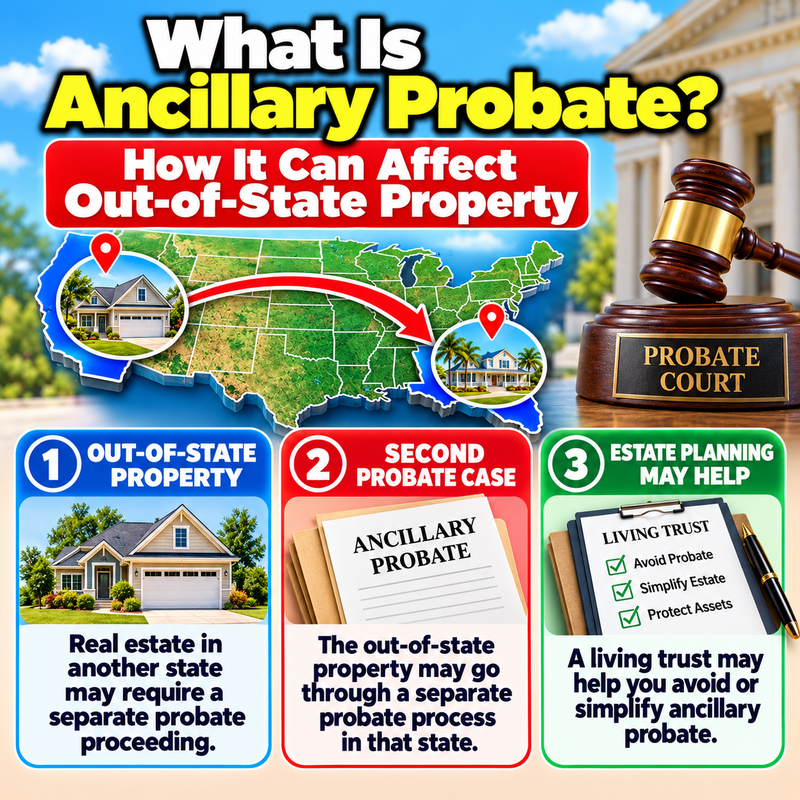
When someone dies owning real estate outside their home state, that property often can’t be handled through the regular probate process alone. A second, separate court case—called ancillary probate—may need to open in the state where the land sits, even while the main estate is being settled back home.
For families who didn’t plan ahead, this can mean months of extra delay and a second round of legal fees just to transfer a single piece of property. Resources like the living trust planning guides available through CreateALivingTrust.org walk owners through exactly how this risk gets created, and how it’s commonly avoided.
Article at a Glance
- Ancillary probate is a second, separate court proceeding required in a state other than the decedent’s home state, usually because of real estate owned there.
- The home state handles the “main” probate, but it has no legal authority over land located in another state’s borders.
- Extra filings often mean a second attorney, separate court fees, and added months before the property can be sold or transferred.
- Not every state follows identical rules, so the specific steps and costs can vary quite a bit depending on where the property sits.
- Later in this article, you’ll see how retitling property into a properly funded trust can often remove this second filing entirely.
What Ancillary Probate Means for Property Owners
Ancillary probate is a supplemental court proceeding that happens in addition to the main probate case, triggered specifically because the deceased person owned an asset—usually real estate—in a state where they didn’t live. The word “ancillary” literally means supporting or supplementary, and that’s exactly the role this proceeding plays. It doesn’t replace the primary probate case; it runs alongside it, handling only the piece of the estate located within that state’s borders.
A Second Court Proceeding in a Different State
Think of it as two courts working on the same estate but only one piece of the puzzle each. The home state court oversees the decedent’s primary assets, debts, and final wishes under its own probate code. The second state’s court only cares about what’s physically sitting within its jurisdiction, typically a house, cabin, or parcel of land.
Why This Mostly Applies to Real Estate
Real property is treated differently than most other assets in the eyes of the law. Bank accounts, vehicles titled through a central state registry, and investment accounts usually transfer based on the decedent’s domicile. Land, however, is governed by the laws of wherever it physically sits, which is why a second filing becomes necessary almost any time out-of-state real estate is involved.
Illustration: Imagine someone who lived in Oregon their entire life but bought a lake cabin in Wisconsin years ago, keeping the deed in their own name. When they pass away, their Oregon estate goes through probate at home—but the Wisconsin cabin may require its own separate ancillary filing before an heir can legally sell or transfer it.
Why Real Estate Triggers This Extra Step
States don’t automatically recognize rulings made by another state’s probate court when real property is involved. Each state wants its own court to confirm who has legal authority to transfer title to land sitting inside its borders, which is the entire reason ancillary probate exists.
Each State Controls Property Within Its Borders
This is rooted in a legal concept sometimes called situs, meaning the location of an asset determines which state’s laws apply to it. A will validated in Illinois doesn’t automatically clear title on a condo in Florida. Florida’s probate court typically needs its own confirmation that the executor has authority, even if that exact person was already appointed back home.
How This Differs From Bank Accounts and Other Assets
Financial accounts, by contrast, usually follow the owner wherever they live, since banks and brokerages operate under agreements that respect the domicile state’s probate ruling. That’s a major reason why ancillary probate almost never comes up for cash, retirement accounts, or securities, but shows up constantly for vacation homes, rental properties, and land.
Primary Probate vs. Ancillary Probate
It helps to picture these as a main event and a side event tied to the same estate. The primary, or “domiciliary,” probate proceeding opens in the state where the decedent legally resided at death. This is where the will gets validated, the executor gets formally appointed, debts get addressed, and most assets get distributed.
Where the Main Proceeding Happens
Domicile isn’t necessarily where someone owned the most property or spent the most time near the end of life—it’s their legal, permanent home. Courts look at factors like voter registration, driver’s license, and where someone intended to permanently reside to determine this.
How the Two Proceedings Work Together
Once the primary probate case is underway, the executor (or their attorney) typically needs to open the ancillary case separately in the second state, often submitting certified copies of the will, the death certificate, and proof of the executor’s authority from the home state court. The ancillary court then issues its own local authority, sometimes called “ancillary letters,” allowing the executor to act on the property within that state.
Not every estate needs this second step. If the out-of-state property was already titled in a way that avoids probate entirely, such as inside a properly funded trust, the ancillary filing simply never comes up.

Example: How a Second-State Filing Can Arise
Here’s an illustration, not a real case: Picture a widow who lived in New York for forty years but bought a small condo in Clearwater, Florida, to spend winters away from the cold. She kept the condo titled in her own name and never updated her estate plan after the purchase. When she passes away, her family opens probate in New York where she lived—but that New York ruling has no automatic authority over the Florida condo. Her executor has to separately petition a Florida court, provide certified New York documents, and wait for Florida’s own confirmation before the condo can be sold or transferred to her children.
Costs, Delays, and Extra Paperwork to Expect
Ancillary probate rarely bankrupts an estate, but it does add real friction at an already difficult time. Families should expect some combination of added legal fees, court costs, and months of extra waiting before out-of-state property can change hands.
| Burden Type | What It Often Involves |
|---|---|
| Local Counsel | Many states require or strongly recommend hiring an attorney licensed in that state to handle the filing |
| Court Fees | A separate filing fee is typically paid to the second state’s probate court, on top of fees already paid at home |
| Timeline | Depending on the state and court backlog, resolution can add weeks to several months before title clears |
| Executor Burden | The executor may need to coordinate paperwork across two states, sometimes requiring travel or notarized remote filings |
Attorney and Court Fees in a Second State
Because probate procedure is set by each state individually, an attorney licensed only in the home state usually can’t file in the second state’s court. This means hiring local counsel, which adds a separate legal bill on top of whatever the primary probate attorney is already charging the estate.
Added Time and Travel for the Executor
Executors already juggling the primary probate process now have a second court’s deadlines, forms, and local rules to track. Depending on the state, this might require notarized documents sent by mail, a local representative signing on the executor’s behalf, or in some cases, in-person appearances.
None of this is impossible to manage, but it does stretch out the time before heirs can actually sell, refinance, or move into the property in question.

Some States Offer Shortcuts
Not every ancillary probate case requires a full, drawn-out second proceeding. Many states offer simplified or expedited procedures for smaller estates or lower-value property, which can meaningfully cut down on both cost and time.
Simplified Procedures for Smaller Estates
Some states allow a simplified affidavit process when the out-of-state property falls below a certain value threshold, skipping much of the formal court process entirely. Others may recognize the primary state’s executor more readily if specific paperwork is filed promptly.
Why You Should Never Assume a Shortcut Applies
These simplified options vary enormously by state, by property value, and sometimes by the type of property involved. A shortcut available in one state may not exist at all in another, which is exactly why guessing isn’t a safe strategy here. For example, when dealing with property in multiple states, it’s crucial to understand the specific probate rules that apply.
Anyone holding out-of-state real estate should have the specific state’s current rules checked directly, rather than assuming their situation will qualify for an easier path.
How a Living Trust Can Help With Out-of-State Property
This is usually the part of the conversation where families start asking, “Could this have been avoided entirely?” In most cases involving real estate, the answer is yes. A properly funded living trust can sidestep the entire ancillary probate process, because the property technically isn’t owned by the individual anymore at the time of death—it’s owned by the trust.
Why a Revocable Living Trust Avoids a Second Court Process
Probate exists to transfer assets that are still legally owned by a deceased individual. A revocable living trust changes that equation by holding legal title to the property while the person is alive, with the individual acting as trustee. When that person dies, the trust itself doesn’t die—a successor trustee simply steps in and continues managing or distributing the property according to the trust’s instructions, with no court filing required in either state.
Illustration: Imagine a couple who live in Arizona but also own a rental property in Tennessee. If that Tennessee property were deeded directly to their revocable living trust years before either of them passed away, their successor trustee could simply transfer or sell the property after death using the trust document itself—no Tennessee probate court involvement necessary.
This is precisely why trusts have become such a common planning tool for anyone holding real estate in more than one state. It’s not just about avoiding probate in general; it’s specifically about avoiding a second, separate court process layered on top of the first.
That said, the trust only works this way if the property was actually retitled into the trust’s name while the owner was alive. A trust document sitting in a drawer, with the deed still in the individual’s own name, won’t prevent ancillary probate at all.
This is the detail that trips up a surprising number of families—they create the trust but never finish the second step of actually moving the property into it.
How to Create a Living Trust for Multistate Property
For anyone holding property across state lines, the process of setting things up correctly typically starts with drafting the trust document itself, then working through each property individually to confirm it gets properly retitled. Guides such as how to create a living trust walk through the sequence of steps involved, but multistate owners specifically need to loop in professionals familiar with each state where they hold real estate, since the retitling step isn’t one-size-fits-all.

Properly Funding the Trust With a Deed
Funding is the step where a trust goes from a legal document to something that actually controls property. For real estate, that means recording a new deed that transfers ownership from the individual’s name into the name of the trust.
This step has to be handled with real precision, because every state has its own requirements for how a valid deed must be worded, witnessed, notarized, and recorded.
Why the Deed Must Match the State’s Rules
A deed that’s valid in one state may not meet the technical requirements of another. Some states require specific statutory language, particular notarization formats, or distinct recording fees and transfer tax filings at the time of recording. Getting this wrong doesn’t just create an inconvenience—it can mean the deed is rejected by the county recorder, or worse, accepted but later challenged as invalid, which can undo the entire point of avoiding ancillary probate in the first place.
Mortgage, Title Insurance, and Tax Issues to Check First
Before recording a new deed into a trust, there are several details worth checking carefully rather than assuming they’ll sort themselves out later.
- Mortgage due-on-sale clauses: Most lenders allow transfers into a revocable trust without triggering a loan acceleration, but this should be confirmed directly with the lender rather than assumed.
- Title insurance continuity: An existing title insurance policy may or may not automatically extend coverage after a transfer into a trust, depending on the policy terms and the title company involved.
- Property tax reassessment: Some states reassess property value upon any change in ownership, while others specifically exempt transfers into a grantor’s own revocable trust.
- Homestead protections: States such as Florida and Texas offer homestead exemptions and creditor protections tied to individual ownership, and these benefits can be affected depending on how the transfer into a trust is structured.
- State-specific transfer taxes: Certain states impose a transfer tax any time a deed changes hands, even between an individual and their own trust, while others specifically waive this for revocable trust transfers.
None of these issues are reasons to avoid using a trust. They’re simply reasons to involve someone familiar with that particular state’s deed, tax, and title rules before recording anything.
Skipping this step is how well-intentioned trust plans sometimes create new problems instead of solving the original one.
Other Ways People Try to Avoid Probate (and Their Tradeoffs)
A living trust isn’t the only tool available, though it’s generally the most comprehensive one for multistate property owners. Several other options exist, each with its own set of tradeoffs worth understanding before choosing one.
Illustration: A father who owns a cabin in Montana might consider simply adding his adult son’s name to the deed instead of setting up a trust, thinking it’s a faster fix—without realizing it could expose the property to his son’s creditors or complicate a future sale while the father is still alive.
Here’s a closer look at the most common alternatives families consider.
1. Selling or Gifting the Property
If the property isn’t being used or has sentimental value that’s faded over time, selling it outright or gifting it to an heir while still alive removes it from the probate equation entirely. This isn’t always practical, particularly if the property has appreciated significantly, since gifting can carry its own tax consequences that deserve a closer look before moving forward.
2. Adding a Family Member to the Title
Adding a child or relative directly to the deed as a joint owner can allow property to bypass probate at death. However, it also means that person has an ownership interest immediately, exposing the property to their creditors, divorce proceedings, or financial decisions while the original owner is still alive.
3. Lady Bird Deeds
Available in a limited number of states, a Lady Bird deed (also called an enhanced life estate deed) allows the current owner to retain full control during their lifetime while naming a beneficiary who automatically receives the property at death, without probate involvement.
This option tends to work well where it’s available, but it simply isn’t recognized everywhere, so confirming whether a specific state permits it is an essential first step.
4. Joint Ownership With Survivorship Rights
Joint tenancy with right of survivorship automatically passes a deceased owner’s share to the surviving joint owner, skipping probate for that transfer. This is commonly used by married couples, but it comes with the same immediate ownership exposure issue as simply adding a name to a deed.
It also only solves the problem for one transfer—once the surviving owner passes away alone, the property may still need to go through probate at that point, unless further planning has been put in place.
This makes joint ownership more of a temporary patch than a long-term solution for multistate property.
5. Transfer-on-Death Deeds
Some states allow a transfer-on-death deed, sometimes called a beneficiary deed, which names a beneficiary who receives the property automatically at death while the current owner retains full control during their lifetime.
This tool has grown more common in recent years, but like Lady Bird deeds, it isn’t recognized in every state, and its exact rules, revocability, and protections vary considerably where it is allowed.
For someone who owns property in multiple states, this also means potentially needing a different solution for each individual property, depending on what that particular state permits.

Owning Property in Several States at Once
Multistate ownership adds a layer of complexity that single-property owners never have to think through. Each additional state where real estate sits represents its own potential ancillary probate exposure, its own deed rules, and its own tax considerations.
Why Each State May Require Its Own Filing
Because ancillary probate is triggered on a per-property, per-state basis, someone who owns vacation homes in three different states could theoretically face three separate ancillary proceedings if none of that property was retitled properly. This is precisely why a trust-based strategy tends to scale so much better for multistate owners—a single, properly funded trust can hold property across numerous states, with each piece retitled according to that state’s rules, but without each one triggering its own separate court process at death.
Moving States? Review Your Estate Plan
Relocating to a new state is one of life’s more common triggers for outdated estate planning, and it’s one people frequently overlook amid the busier logistics of an actual move.
Why a New Domicile Changes Your Primary Probate State
Once someone establishes a new permanent domicile, that new state typically becomes the one responsible for the primary probate proceeding going forward. Meanwhile, any property left behind in the old state, or newly purchased in yet another state, becomes a fresh candidate for ancillary probate exposure if it isn’t addressed.
Checking Whether Your Trust Covers Property in Every State
An existing trust doesn’t automatically cover property purchased after the trust was created, or property that was never formally retitled into the trust’s name in the first place.
- Confirm every property owned is actually titled in the trust’s name, not just listed in a will or mentioned verbally as “intended” for the trust.
- Revisit the plan any time a new property is purchased, inherited, or a move changes the primary domicile state.
- Check that beneficiary designations, deed language, and state-specific requirements remain current after any major life change.
Treating an estate plan as a living document, rather than a one-time task, is really the core habit that keeps multistate property out of probate court entirely.
If you’re ready to look closer at how a properly structured trust could handle property across state lines, CreateALivingTrust.org offers resources built specifically for owners navigating exactly this situation.

Multistate Property Planning Checklist
Pulling all of this together, it helps to have a simple checklist on hand rather than trying to remember every moving piece on your own. Anyone who owns real estate in more than one state can use the following steps as a starting point for a conversation with an estate planning professional.
None of these steps need to happen all at once, but each one closes a gap that could otherwise lead to an unexpected ancillary probate filing down the road.
1. List Every Property and Its State
Start with a simple inventory: every property owned, the state it sits in, and how the title is currently held. It sounds basic, but this single step is where most planning gaps get discovered, especially for older properties purchased decades ago and never revisited.
A vacation home in another state bought in the 1990s, for example, might still be titled exactly the way it was at closing, with no connection whatsoever to a trust created years later.
2. Confirm Title and Ownership Type
Once every property is listed, check exactly how each one is titled today. This determines whether ancillary probate exposure exists at all.
- Is the property titled in an individual’s name alone?
- Is it held in joint tenancy, tenancy in common, or as community property?
- Has it already been deeded into a revocable living trust?
- Does the state offer a transfer-on-death or Lady Bird deed option currently in use?
Any property still titled in an individual name alone is the one most likely to require ancillary probate later.
This step often reveals surprises, particularly for inherited property or property acquired through a prior marriage, where title was never updated.
3. Decide Whether a Trust Makes Sense
For most people holding real estate in more than one state, a properly funded revocable living trust tends to be the most complete solution, since it can be used consistently across every state involved rather than requiring a different tool for each property.
4. Get State-Specific Legal and Title Review
Before any deed gets recorded, it’s worth having someone familiar with that specific state’s requirements review the plan. Deed language, notarization standards, transfer tax rules, and homestead protections can all differ meaningfully from one state to the next.
Illustration: A couple retitling a Colorado ski cabin into their trust might find the process straightforward, while a second property in a state with strict homestead protections requires a more careful look at how the transfer affects those protections before moving forward.
Skipping this review is how otherwise well-planned trusts end up with gaps that surface only after someone has passed away, which is exactly the wrong time to discover a problem.
5. Revisit the Plan After Any Move or Purchase
Buying a new property, selling an old one, or moving to a new home state should all trigger a fresh look at the plan. A trust that worked perfectly five years ago may simply be missing a property purchased last year.

Frequently Asked Questions
Is Ancillary Probate Always Required for Out-of-State Property?
No. It depends on how the property is titled, the specific state’s rules, and sometimes the value of the property involved. Property already held in a properly funded trust, or titled using a transfer-on-death deed where available, often avoids ancillary probate entirely.
What Assets Besides Real Estate Can Trigger Ancillary Probate?
Tangible personal property physically located in another state, such as a boat, a vehicle, or an art collection, can sometimes trigger ancillary probate as well. This is less common than real estate but still worth checking if significant personal property is kept in a second state.
How Long Does Ancillary Probate Usually Take?
Timelines vary widely depending on the state, the court’s current caseload, and whether the estate qualifies for any simplified procedure. Some ancillary filings resolve in a matter of weeks, while others stretch into several months.
Can I Avoid Ancillary Probate Without a Living Trust?
Yes, in some cases. Tools like joint ownership, transfer-on-death deeds, or Lady Bird deeds can avoid ancillary probate for a specific property, though each comes with its own tradeoffs around control, creditor exposure, and state availability.
Does a Will Prevent Ancillary Probate?
No. A will actually confirms the need for probate rather than avoiding it. Even a valid, well-drafted will still has to go through the court process in each state where probate-eligible real estate is located.
This is one of the more common misunderstandings families run into, often assuming a will alone handles everything. Also, when you die without a will or a trust in place, the probate process can lean more on the directives mandated by the probate court.
A will directs how probate assets get distributed, but it doesn’t change the fact that real estate located in a second state still needs that state’s court involvement unless other planning steps were taken in advance.
What Documents Are Typically Needed for an Ancillary Filing?
Requirements vary by state, but commonly include a certified copy of the will, proof of the executor’s authority from the primary probate court, a death certificate, and documentation confirming ownership of the property in question.
Who Pays for Ancillary Probate Costs?
Ancillary probate costs are typically paid from the estate’s assets, the same way primary probate costs are covered.
| Cost Type | Typical Source |
|---|---|
| Local attorney fees | Estate funds |
| Court filing fees | Estate funds |
| Executor travel or administrative costs | Estate funds, sometimes reimbursed |
This means heirs don’t typically pay out of pocket directly, but the overall estate value available for distribution can shrink as these added costs accumulate.
Can One Executor Handle Both Probate Proceedings?
Often, yes, though the executor usually needs to work with a local attorney in the second state and may need to formally establish their authority there separately, even if they were already appointed in the primary proceeding.
What Happens if I Own Vacation Property in Multiple States?
Each additional state where real estate is held individually represents a separate potential ancillary probate proceeding. This is one of the clearest reasons multistate owners often turn to a single, properly funded trust rather than managing several separate planning tools across different states.
Should I Update My Estate Plan After Buying Out-of-State Property?
Yes. Any new property purchase is a good trigger point to confirm the title matches the rest of the estate plan, particularly if a trust is already in place and the new property hasn’t yet been retitled into it.