How to Amend a Living Trust: Updates, Restatements, and Life Changes Explained
Understand Amendments, Restatements, Major Life Changes, and When Your Trust Should Be Reviewed
Your life doesn’t stay the same, so your trust shouldn’t either — and the good news is that updating a revocable living trust is usually far simpler than creating one from scratch.
Whether you’ve gotten married, welcomed a grandchild, moved across state lines, or just realized your trustee list is outdated, you have options for bringing your trust current. This guide walks through exactly how to amend a living trust, when a simple amendment is enough, and when a full restatement makes more sense.
Article-at-a-Glance: Key Takeaways
- Amending a living trust typically means creating a short, signed written document that changes specific provisions while leaving the rest of the trust intact — but the exact process depends on what your trust document says.
- Revocable living trusts are designed to be changed during your lifetime, while irrevocable trusts are intentionally much harder to modify and often require beneficiary consent or court approval.
- Marriage, divorce, births, deaths, moves to a new state, and major shifts in your financial picture are the most common triggers for a trust update.
- If you’ve made several amendments over the years, a restatement can consolidate everything into one clean document — a decision discussed in more detail further in this guide.
- Bulletproof Legacy’s supported digital estate-planning approach is designed to help you keep your plan current with professional resources and ongoing access, which can make reviewing and updating your trust more manageable.
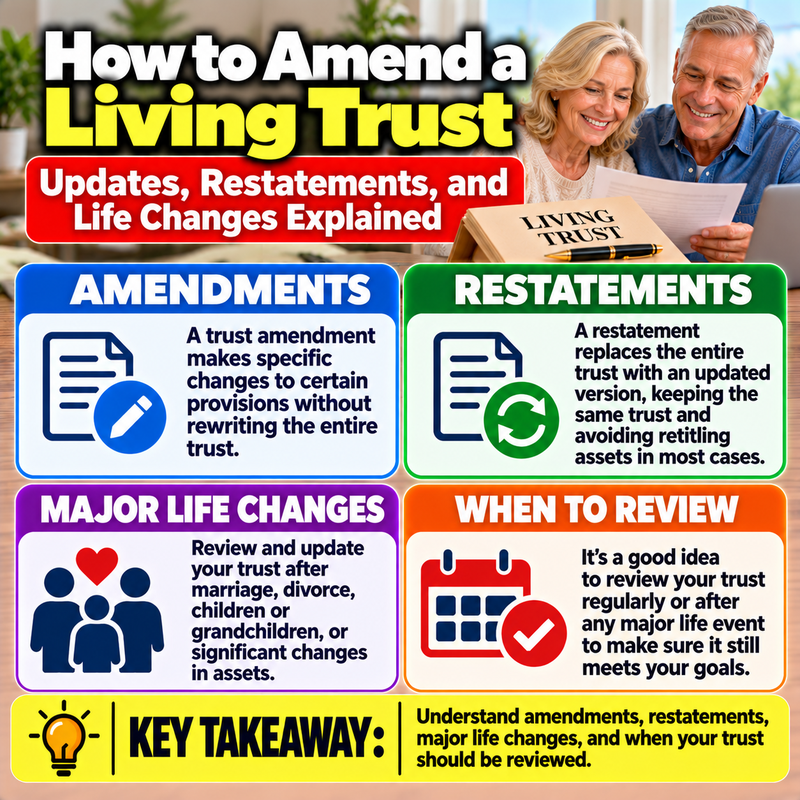
Understand Amendments, Restatements, Major Life Changes, and When Your Trust Should Be Reviewed
A living trust isn’t meant to be a “set it and forget it” document. The people, assets, and circumstances it was built around will shift over time, and the trust needs to keep pace. Understanding your options for updating it — and knowing when a small tweak is enough versus when a bigger overhaul makes sense — puts you in control of your own plan rather than leaving outdated instructions behind for your family to untangle.
Why Revocable Living Trusts Are Built to Be Changed
If you created a revocable living trust, flexibility was baked in from day one. As long as you’re alive and have the legal capacity to make decisions, you generally retain the power to amend, restate, or even revoke the trust entirely, subject to the terms of the trust itself and the laws of your state. That’s the whole point of “revocable” — it means the trust can be revoked or changed, as opposed to an irrevocable trust, which is designed to stay fixed.
This built-in flexibility is one of the reasons a living trust-based plan can be a practical foundation for estate planning. You can read more about how these documents work in Create A Living Trust’s guide on how to create a living trust, which covers the setup process this article builds on.
Amendment vs. Restatement vs. Revocation: What’s the Difference
These three terms get used loosely, but they mean very different things for your trust. An amendment changes one or more specific provisions while leaving everything else in the original trust untouched. A restatement rewrites the entire body of the trust in a new document while keeping the trust’s original name, date, and legal identity intact. A revocation cancels the trust altogether.
| Action | What It Does | Best Used When |
|---|---|---|
| Amendment | Changes specific provisions; rest of trust stays the same | One or two targeted updates, like a new trustee or beneficiary |
| Restatement | Replaces the entire trust text, keeps original name/date | Multiple past amendments or sweeping changes to structure |
| Revocation | Cancels the trust entirely | Starting over with a new estate plan or trust |
Choosing between these isn’t just a matter of preference — it’s a legal drafting decision that depends on how your trust is written and how many changes you’re making. We’ll walk through how to decide later in this article.
How This Fits Into Your Broader Estate Plan
Changing the trust document itself is only one piece of keeping your plan current. Your trust works alongside other documents and account titles, including deeds, beneficiary designations on retirement accounts, powers of attorney, and healthcare directives. An amendment to your trust doesn’t automatically update those other pieces, so a full review often means checking several documents, not just one.
If you’re still getting familiar with how a revocable trust fits into your overall plan, Create A Living Trust’s page on the revocable living trust is a useful companion resource that covers the bigger picture beyond amendments alone.

Check Your Trust’s Amendment Procedure Before Changing Anything
Before you draft a single word of change, open your original trust document and find the section that explains how it can be amended. This step gets skipped more often than it should, and skipping it can make an otherwise valid update legally shaky.
Why the Trust Document’s Own Rules Come First
If your trust spells out a specific method for making amendments, you generally need to follow that method for the change to be valid. Courts and trustees look to the trust’s own language first. A handwritten note scribbled in the margin of your signed trust, no matter how clear your intent, is not considered a safe or reliable way to make a change.
What to Look for in the Amendment Clause
Most trust documents include a clause describing who can make amendments, how they must be documented, and whether witnesses or notarization are required. As you review this section, look for guidelines on amending your trust and ensure you understand the requirements.
- Who holds the power to amend — usually the settlor (the person who created the trust) while living and competent
- Whether the amendment must be in writing and signed
- Any notarization or witness requirements specified in the trust
- Any restrictions on what can or cannot be changed
If your trust is silent on the exact procedure, state law typically fills in the gaps — but that’s a good moment to involve an attorney who understands your state’s trust statutes, since requirements vary.
Trusts With Multiple Settlors: Extra Rules to Know
Married couples often set up a joint trust with two settlors, and this adds a layer of complexity. In many cases, both settlors must agree to an amendment for it to apply to the entire trust. If only one settlor wants to make a change, that amendment may only affect the portion of trust assets attributable to that individual, depending on how the trust is written and what state law allows. This is an area where a quick conversation with an estate planning attorney can prevent confusion down the road.
Common Life Events That Call for a Trust Amendment
Certain life changes are practically universal triggers for revisiting a trust. None of these require you to overhaul your entire estate plan, but each one is worth a prompt review rather than letting your documents drift out of sync with your actual life.
Here are the most frequent reasons people amend their living trusts:
- Getting married or divorced
- Welcoming a new child, grandchild, or adopted family member
- The death of a named beneficiary or trustee
- Relocating to a different state
- A significant increase or decrease in assets
- A change in your relationship with a beneficiary or trustee
- Buying or selling a major asset, like a home or business
Let’s look at a few of these more closely.
Marriage, Divorce, and Changing Family Relationships
Marriage and divorce are two of the most common reasons people revisit their trust. After a divorce, you may want to remove an ex-spouse as a beneficiary or trustee. After remarrying, you might add your new spouse and reconsider how assets are divided between them and children from a previous relationship. These are deeply personal decisions, and an amendment lets you reflect your current family structure without rebuilding the entire trust.
Births, Adoptions, and New Grandchildren
A new child or grandchild is a joyful reason to update your trust. You might name guardians for a minor child, add a grandchild as a new beneficiary, or set specific terms for how and when a young beneficiary receives trust assets. Many families choose to hold a minor’s inheritance in trust until a certain age, and an amendment is the vehicle for adding that kind of provision.
Death of a Beneficiary or Trustee
This one deserves prompt attention. If a named beneficiary passes away and the trust doesn’t clearly state where their share should go instead, state law may decide for you — and that outcome might not match what you actually want. Similarly, if your named trustee or successor trustee is no longer able or willing to serve, an amendment lets you name a replacement before it becomes an urgent problem that requires court involvement.
Moving to a New State
Trust laws aren’t identical from state to state. A trust that was properly executed and well-suited to the laws of one state may include provisions that don’t align cleanly with the laws of your new home state. A move is a good opportunity to have your trust reviewed to confirm it still functions the way you intend.
Major Financial Changes
A trust written around a modest estate looks very different once that estate has grown substantially — or, in some cases, shrunk. Specific dollar gifts, percentage splits, or instructions tied to certain assets can become impractical or even confusing if your financial picture has shifted significantly since you signed the original trust.

Changing Trustees or Successor Trustees
Your trustee is the person or institution responsible for managing and eventually distributing trust assets according to your instructions. Circumstances change for trustees just as they do for beneficiaries, and your trust should reflect who you currently trust with that responsibility.
An amendment is typically the straightforward way to update this. Rather than rewriting your entire trust, you can simply name a new trustee or adjust the order of succession for who steps in if your first choice can’t serve.
When a Trustee Can No Longer Serve
People move, relationships change, and sometimes a trustee you once trusted completely is no longer the right fit — or simply isn’t available anymore due to health, death, or personal circumstances. If your named trustee can no longer serve and you haven’t named a successor, the trust may be left without anyone authorized to act, which can create delays and added cost.
This is exactly the kind of gap an amendment is built to close. Naming a current, willing, and capable trustee — along with at least one backup — helps make sure your trust can actually function when it’s needed.
How to Name a Replacement Without Court Involvement
One advantage of updating your trust while you’re alive and have capacity is that you can usually name a new trustee yourself, without any court process. You simply draft and execute the amendment according to your trust’s procedure and your state’s requirements, then notify the new trustee of their role.
Waiting until a trustee vacancy becomes a crisis — for example, after you’ve lost capacity or passed away — is what tends to force court involvement. A proactive amendment avoids that outcome in most cases, though the result always depends on how your specific trust is written.
Changing Beneficiaries or Distribution Instructions
Beneficiary changes are among the most common reasons people amend a living trust, and for good reason — your relationships and priorities naturally shift over the years. An amendment lets you add a new beneficiary, remove one, or adjust how much each person receives, all without disturbing the rest of your trust’s structure.
Distribution instructions deserve the same level of attention. A condition that made sense years ago, like holding a young adult’s inheritance until age 25, might feel outdated or even counterproductive once that beneficiary has become a financially capable adult. We’ll cover how to think through these kinds of updates, along with more complex situations involving special needs beneficiaries, in the next section.
Adding, Removing, or Adjusting Beneficiary Shares
Adding a beneficiary is usually as simple as naming the person (or organization) and specifying what they should receive, whether that’s a percentage, a dollar amount, or a particular asset. Removing a beneficiary works the same way in reverse — you draft language that clearly states the person is no longer included and, if needed, explain how their former share should be redistributed among the remaining beneficiaries.
Adjusting shares is common when family circumstances shift. Maybe one child has taken on more caregiving responsibility, or maybe your financial picture has changed enough that your original percentages no longer feel fair. Whatever the reason, the key is clarity: specify exactly whose share is changing and what the new terms are, so there’s no ambiguity for your trustee later.
Setting New Conditions for Distributions
Sometimes the people named in your trust haven’t changed, but your thoughts on how and when they should receive their inheritance have. You might decide to stagger distributions at certain ages, tie a distribution to a milestone like finishing college, or remove a condition that no longer makes sense now that a beneficiary has matured into a financially responsible adult.
These conditions should be worded carefully. Vague language about “when appropriate” or “at the trustee’s discretion” can create disputes, while clear, specific triggers give your trustee a straightforward roadmap to follow.
Planning for Beneficiaries Who Need Extra Protection
If a beneficiary has special needs, receives government benefits, struggles with addiction, or simply isn’t ready to manage a large inheritance responsibly, a standard outright distribution may not serve them well. In these situations, trust provisions can be structured to protect both the beneficiary and their eligibility for certain assistance programs.
Special needs planning in particular involves rules that are easy to get wrong and costly to fix after the fact. If you’re amending your trust to address a beneficiary’s unique circumstances, this is a good moment to loop in an attorney who has specific experience with special needs trusts and benefits eligibility rules in your state.
Adding or Removing Provisions in Your Trust
Beyond beneficiaries and trustees, you may want to add or remove entire provisions from your trust — things like a no-contest clause, instructions for pet care, a charitable gift, or language addressing a business you’ve since sold. An amendment can add new sections or strike out ones that no longer apply, as long as the trust’s own amendment procedure is followed and the new language is unambiguous about what it’s changing.
It helps to think of each amendment as a surgical edit rather than a rewrite. State specifically which article or section of the original trust you’re modifying, quote the old language if helpful for clarity, and spell out the new language in full. This precision is what keeps your trustee from having to guess your intent years down the road.

When a Full Restatement Makes More Sense Than Multiple Amendments
One amendment is usually simple. Two or three, still manageable. But once a trust has accumulated a handful of amendments over the years, the document can start to resemble a patchwork quilt — the original trust, plus a stack of separate papers, each referencing and altering different sections. At some point, that patchwork becomes harder to interpret than it’s worth.
This is where a restatement comes in. Instead of layering yet another amendment onto the pile, a restatement rewrites the entire trust in one clean document while keeping the trust’s original name and date intact. That continuity matters because it means you typically don’t need to retitle assets or re-establish the trust’s legal standing — from the outside, it’s still the same trust, just with updated terms inside.
Signs Your Trust Has Outgrown Simple Amendments
A few warning signs suggest it’s time to think about a restatement rather than another amendment:
- You’ve already amended the trust two or more times
- Your family structure has changed significantly since the original trust was signed, such as through divorce, remarriage, or estrangement
- You’re making sweeping changes to how assets are distributed, not just a small tweak
- Your estate planning goals have shifted substantially, such as adding charitable giving or long-term care planning
- Previous amendments reference sections of the trust that have since been changed by other amendments, creating confusion
If any of these sound familiar, it’s worth raising the restatement option with an estate planning attorney who can evaluate your specific document.
Benefits of Consolidating Changes Into One Document
A restatement gives your trustee one clear, consolidated set of instructions to follow instead of a stack of documents to cross-reference. This reduces the chance of conflicting language, eliminates confusion about which amendment takes precedence, and generally makes trust administration smoother for whoever steps into the trustee role after you.
Yes, a restatement typically costs more upfront than a single amendment. But for many people, that cost is offset by the clarity it provides — and by reducing the risk of disputes, delays, or legal interpretation issues that can arise when a trustee has to decipher a trust that’s been patched together one amendment at a time over many years.
Revocable vs. Irrevocable Trusts: What You Can and Can’t Change
Not all trusts play by the same rules, and this distinction matters enormously when it comes to amendments. The flexibility discussed throughout this article applies to revocable living trusts. Irrevocable trusts are a different story entirely.
Amending a Revocable Living Trust
As the settlor of a revocable living trust, you generally retain broad power to amend, restate, or revoke the trust while you’re alive and have legal capacity, subject to the trust’s own terms and your state’s laws. This is the defining feature of a revocable trust — the word “revocable” literally means it can be changed or canceled.
That flexibility typically ends, however, once you pass away or once the trust becomes irrevocable under its own terms (which sometimes happens automatically upon incapacity, depending on how the trust is written). After that point, modification becomes far more restricted and may require trustee action, beneficiary consent, or court involvement, depending on state law and the trust’s language.
Why Irrevocable Trusts Are Harder to Modify
Irrevocable trusts are designed, by their very nature, to be difficult to change. That rigidity is often the reason people choose this structure in the first place — certain planning goals depend on the trust terms staying fixed. Modifying an irrevocable trust generally requires one of a few paths: the trust document itself allows a specific type of amendment, all beneficiaries consent to the change, or a court approves the modification.
If you’re working with an irrevocable trust and believe it needs to change, don’t assume the amendment steps described in this article apply. The rules are different, the stakes are often higher, and this is a situation where consulting an attorney experienced in trust modification law in your state isn’t just helpful — it’s typically necessary.
Steps to Amend a Living Trust
Once you’ve confirmed that an amendment (rather than a restatement) is the right tool and you understand your trust’s specific procedure, the actual process follows a fairly consistent sequence.
1. Review the Trust and Identify What Needs to Change
Start by rereading your original trust document in full, not just skimming the section you think needs updating. Identify precisely which article, section, or provision you want to amend, and note the exact current language so you can reference it accurately.
This is also the moment to check your trust’s amendment clause one more time, confirming any specific procedures, notarization requirements, or restrictions that apply to your situation.
2. Draft Clear, Unambiguous Amendment Language
Write the amendment so it clearly states which part of the existing trust it modifies and exactly what the new terms are. Avoid vague phrasing. A well-drafted amendment typically references the trust by its full name and date, cites the specific article or section being changed, and spells out the replacement language in full.
3. Sign According to Your State’s Requirements
Trust amendments must be in writing and signed by the settlor, or by someone acting on the settlor’s behalf under a valid power of attorney. A voice memo, video recording, or verbal agreement — no matter how clearly it documents your intent — is not a legally valid amendment.
Many states and many trust documents also require the amendment to be notarized, and some require witnesses. Because these requirements vary by state and by the terms of your specific trust, it’s worth confirming exactly what’s needed before you sign, rather than assuming the rules from a general template apply to your situation.
4. Notify Your Trustee and Beneficiaries
Once the amendment is properly executed, let your trustee know about the change so they’re not caught off guard administering an outdated version of the trust later. Many people also choose to inform affected beneficiaries, along with a brief explanation of the reasoning behind the change, which can go a long way toward preventing confusion or hurt feelings down the road.
5. Store the Amendment With the Original Trust
An amendment is only useful if it can be found when it’s needed. Keep the signed amendment physically attached to or stored alongside your original trust document, and make sure copies exist wherever your original trust is kept — including with your attorney, if you used one, and with any successor trustees.
A properly executed amendment that gets lost in a drawer somewhere defeats the entire purpose of making the change. Treat your amendment with the same care you gave the original trust.

Signing, Witnessing, and Notarization Rules Vary by State
There’s no single nationwide standard for how a trust amendment must be signed, which is one of the more important things to understand before you draft one yourself. Some states require notarization for an amendment to be valid, others require witnesses, and some trusts specify requirements beyond what state law demands.
Because the consequences of an improperly executed amendment can mean the change doesn’t hold up when it matters most, this is an area where it pays to verify requirements against both your state’s statutes and your trust’s own language, rather than assuming one state’s rules apply everywhere.
How Trust Changes Affect Asset Titles and Beneficiary Designations
Here’s a detail that catches a lot of people off guard: amending your trust does not automatically update anything outside the trust document itself. If an asset’s ownership or beneficiary designation needs to change too, that requires separate action with the institution or agency involved.
Retirement Accounts and Payable-on-Death Assets
Retirement accounts like IRAs and 401(k)s, along with payable-on-death bank accounts and life insurance policies, pass according to their own beneficiary designation forms — not according to what your trust says. Changing your trust has no effect on who’s listed as the beneficiary on your IRA paperwork.
If you want a retirement account to align with your updated trust, you typically need to contact the account custodian directly and update the beneficiary form separately. This isn’t a situation where you’d simply retitle the account into the trust’s name the way you might with a bank account; retirement accounts carry their own tax rules, and moving them incorrectly can trigger unintended tax consequences. A financial advisor or tax professional can help you understand how your retirement accounts should be coordinated with your trust.
Real Estate, Jointly Owned Property, and Account Titling
Similarly, if your trust amendment involves adding a newly purchased property or changing how an asset should be handled, the deed or title for that asset may need separate attention. A trust amendment that discusses a piece of real estate doesn’t automatically retitle that property into the trust; that typically requires recording a new deed with the appropriate county office.
Whether a particular asset needs to go through this kind of retitling — and how probate outcomes are ultimately affected — depends on how the asset is owned, how it was funded into the trust originally, and the laws of your state. For a broader look at how funding works alongside trust creation, Create A Living Trust’s guide on how to create a living trust covers this process in more depth.
Keep Your Amendments Organized and Accessible
An amendment that nobody can find is nearly as problematic as no amendment at all. Organization matters just as much as the legal drafting itself.
Storing Amendments With the Original Trust Document
Keep every amendment physically with your original trust, ideally in the order they were signed. If you’ve made several amendments over the years, consider creating a simple cover sheet listing each one by date and summarizing what it changed, so anyone reviewing the file later can quickly understand the full history.
Telling Your Advisors and Fiduciaries Where Documents Live
Your successor trustee, your attorney, and any financial advisors involved in your plan should know exactly where your trust documents are stored, including every amendment. A supported digital estate-planning platform, like the approach Bulletproof Legacy takes, is designed to give you ongoing access to your documents and help keep everything organized in one place, which can reduce the risk of a lost or forgotten amendment causing problems later.
Mistakes to Avoid When Updating a Trust
A few recurring errors show up again and again when people amend trusts without fully understanding the process. Watching for these can save significant time, money, and family stress later:
- Ignoring the trust’s own amendment procedure. Following a generic process instead of the one specified in your trust can make the amendment invalid.
- Using vague or ambiguous language. Failing to clearly identify which provision is changing invites confusion and potential disputes.
- Skipping notarization or witnesses when required. State and trust-specific requirements vary, and skipping them can void the amendment.
- Forgetting to update related documents. Beneficiary forms, deeds, and account titles don’t update automatically just because the trust changed.
- Letting amendments pile up without a restatement. Multiple layered amendments can create conflicting instructions that are difficult for a trustee to untangle.
- Not telling anyone about the change. An amendment stored in a drawer, with no trustee or attorney aware it exists, risks being overlooked entirely.
How Often Should You Review Your Living Trust
There’s no single rule that applies to everyone, but a periodic review every few years is a reasonable habit, along with a review any time a major life event occurs. Reviewing your trust doesn’t necessarily mean you’ll find something to change — sometimes the review simply confirms everything still reflects your wishes, and that’s a valuable outcome in itself.
Think of it less as a chore and more as routine maintenance, similar to reviewing your insurance coverage or checking your retirement account allocations. A trust that gets a periodic second look is far less likely to surprise your family with outdated or conflicting instructions when it matters most.

Next Steps for Updating Your Living Trust With Confidence
Keeping your trust current doesn’t have to be complicated, and you don’t have to figure it out alone — if you’d like help thinking through your options, consider scheduling a Free Living Trust Consultation to talk through what makes sense for your situation. Bulletproof Legacy’s supported digital estate-planning approach is built to help you create, update, and maintain your trust with professional resources and ongoing access along the way.
Real Estate, Jointly Owned Property, and Account Titling
If your trust amendment involves adding a newly purchased property or changing instructions about how an asset should be handled, the deed or title for that property may need separate attention beyond the trust language itself. A trust amendment that discusses a piece of real estate doesn’t automatically retitle that property into the trust’s name; that typically requires recording a new deed with the appropriate county office.
Jointly owned property adds another layer of complexity, since how an asset is titled with a co-owner can affect whether it passes through the trust at all. Whether a particular asset needs to go through retitling — and how probate outcomes are ultimately affected — depends on how the asset is owned, how it was funded into the trust originally, and the laws of your state. For a broader look at how funding works alongside trust creation, Create A Living Trust’s guide on how to create a living trust covers this process in more depth.
Keep Your Amendments Organized and Accessible
An amendment that nobody can find when it’s needed is nearly as problematic as never making the change at all. Organization matters just as much as getting the legal drafting right.
Storing Amendments With the Original Trust Document
Keep every amendment physically with your original trust, ideally in the order they were signed. If you’ve made several amendments over the years, consider creating a simple cover sheet listing each one by date with a short summary of what it changed, so anyone reviewing the file later — including a trustee who’s never seen the document before — can quickly understand its full history.
Telling Your Advisors and Fiduciaries Where Documents Live
Your successor trustee, your attorney, and any financial advisors involved in your plan should know exactly where your trust documents are stored, including every amendment that’s ever been made. A supported digital estate-planning approach, like the one Bulletproof Legacy offers, is designed to give you ongoing access to your documents and help keep everything organized in one place, which can reduce the risk of a lost or forgotten amendment causing confusion later.
Mistakes to Avoid When Updating a Trust
A handful of recurring errors show up again and again when people amend trusts without fully understanding the process. Most of these mistakes are easy to avoid once you know to watch for them, but they can be costly and time-consuming to untangle after the fact.
Here are the missteps that cause the most trouble:
- Ignoring the trust’s own amendment procedure. Following a generic process instead of the one specified in your trust document can make the entire amendment invalid.
- Using vague or ambiguous language. Failing to clearly identify which provision is being changed invites confusion and potential disputes among beneficiaries later.
- Skipping notarization or witnesses when required. State and trust-specific requirements vary, and overlooking them can void the amendment entirely.
- Forgetting to update related documents. Beneficiary forms, deeds, and account titles don’t update automatically just because the trust language changed.
- Letting amendments pile up without a restatement. Multiple layered amendments can create conflicting instructions that are genuinely difficult for a trustee to interpret.
- Not telling anyone the change exists. An amendment stored in a drawer, with no trustee or attorney aware of it, risks being overlooked entirely when it matters most.
Avoiding these pitfalls generally comes down to one habit: treating each amendment with the same care and attention you gave the original trust, rather than as an afterthought.
How Often Should You Review Your Living Trust
There’s no single rule that fits everyone, but a periodic review every few years is a reasonable habit, paired with a review any time a major life event occurs. Reviewing your trust doesn’t necessarily mean you’ll find something that needs changing — sometimes the review simply confirms everything still reflects your wishes, and that peace of mind is a valuable outcome on its own.
Think of it less as a chore and more as routine maintenance, similar to reviewing your insurance coverage or checking in on your retirement account allocations. A trust that gets a periodic second look is far less likely to surprise your family with outdated or conflicting instructions at the exact moment they’re relying on it most.

Frequently Asked Questions
These are some of the most common questions people ask once they start thinking seriously about updating their living trust.
If your situation involves something more complex than what’s covered here, that’s usually a sign it’s worth a direct conversation with an estate planning professional rather than relying on general guidance alone.
Can I amend my living trust without a lawyer?
In many cases, yes, you can amend a trust, particularly for simple, straightforward changes to a revocable trust you fully control, such as swapping a successor trustee or adjusting a beneficiary’s share. That said, execution requirements vary by state, and mistakes in drafting or signing can render an amendment invalid without you ever knowing it.
Because of that risk, many people choose to draft the initial changes themselves and then have an attorney review the final document, or involve an attorney from the start if the change touches on anything involving multiple beneficiaries, blended families, or significant assets.
Does a trust amendment need to be notarized?
It depends on your state and the terms of your specific trust document. Some states and some trusts require notarization for an amendment to be legally valid, while others don’t impose that requirement.
Because this detail varies so much, it’s important to confirm the specific rule that applies to you rather than assuming your trust follows the same requirements as a trust you’ve heard about from a friend or relative in a different state.
What happens if I don’t update my trust after a divorce?
Your trust will continue operating according to its existing terms, which may still name your former spouse as a beneficiary or trustee if nothing changes. Depending on your state’s laws, some provisions involving a former spouse may be automatically affected by the divorce itself, but this protection isn’t guaranteed in every state or every situation, which is exactly why a prompt review after a divorce is strongly recommended.
How many times can I amend a living trust?
There’s generally no fixed legal limit on how many times you can amend a revocable living trust, as long as you follow the proper procedure specified in the document each time. Each amendment stands on its own as a valid, enforceable change.
That said, there’s a practical ceiling even if there’s no legal one. Once amendments start piling up, tracking which provisions are currently active and which have been superseded gets genuinely difficult, both for you and for whoever eventually administers the trust.
Signs it might be time to consider a restatement instead of another amendment include:
- You’ve already made two or more amendments to the original trust
- Earlier amendments reference sections that later amendments have since changed
- You’re struggling to summarize, from memory, what your current trust actually says
Is a trust amendment the same as a trust restatement?
No, these are different tools for different jobs. An amendment changes specific provisions while leaving the rest of the trust intact, while a restatement rewrites the entire trust document in one consolidated version, typically while keeping the original trust’s name and date unchanged.
Can I amend a trust if I have dementia or reduced capacity?
Amending a trust generally requires legal capacity, meaning you understand the nature of the document and the practical effect of the changes you’re making. This standard isn’t about a diagnosis alone; it’s about your actual understanding at the time you sign.
If capacity is in question, this becomes a sensitive and legally important matter, and involving an attorney is critical to evaluate the situation properly and protect the validity of any changes you attempt to make.
Do I need to amend my trust if I move to a new state?
Not always, but it’s worth a careful review rather than assuming nothing needs attention. Trust laws differ from state to state, and provisions that worked well where you used to live may not align cleanly with your new state’s requirements or terminology.
What happens if a trust amendment conflicts with the original trust?
Generally, the most recently executed, properly signed amendment controls over conflicting earlier language. But “generally” is doing a lot of work in that sentence, because several factors can complicate the picture.
- The exact wording of each amendment and how clearly it identifies what it’s replacing
- Whether the amendments reference each other or were drafted independently
- State-specific rules about how conflicting trust provisions should be interpreted
This is precisely the kind of ambiguity that tends to surface at the worst possible time — after the settlor has passed away and the trustee is the one left trying to figure out which version of a provision actually applies.
It’s also exactly the scenario a restatement is designed to prevent, since it consolidates everything into a single, internally consistent document rather than a stack of potentially conflicting papers.
Can all beneficiaries be changed in a revocable trust?
Typically yes, as long as you’re the settlor with the authority to amend and you follow your trust’s specified amendment procedure. You can add new beneficiaries, remove existing ones, or adjust the shares among the people already named.
This flexibility is one of the defining features that separates a revocable trust from an irrevocable one, where beneficiary changes are often restricted or require consent from the very people whose shares would be affected.
The one exception worth noting: if your trust has multiple settlors, such as a married couple’s joint trust, changing a beneficiary may require agreement from both settlors, or the change may only apply to the portion of trust assets attributable to the settlor requesting it. For more information on the process, you can read about trust amendments.
How much does it typically cost to amend a living trust?
Costs to amend a trust vary widely depending on the complexity of the change, your location, and whether you work with an attorney or a supported planning service. Simple, single-issue amendments tend to cost less than a full restatement, which involves more extensive drafting and review. For an accurate estimate tailored to your specific trust and state, it’s best to speak directly with an attorney or estate planning service familiar with your situation.
Next Steps for Updating Your Living Trust With Confidence
Keeping your trust current is one of the most practical things you can do for the people who’ll eventually rely on it, and updating it doesn’t have to mean starting over or wading through legal jargon alone. Whether you need a quick amendment or you’re noticing the signs that a full restatement makes more sense, understanding your options is the first step toward a plan that actually reflects your life today.