Ongoing Living Trust Costs: Maintenance, Updates, Trustees, and Tax Help
Budget for Amendments, Restatements, Funding Changes, Professional Trustees, Tax Help, and Other Possible Expenses
Key Takeaways
- A revocable living trust does not automatically trigger an annual attorney fee, trust tax return, or maintenance charge simply because it exists.
- Ongoing living trust costs are almost always tied to specific events, like amendments, new real estate purchases, or adding a professional trustee, not a recurring bill you pay every January.
- Tax treatment during your lifetime is typically different from what happens after the trust becomes irrevocable, so don’t assume a separate tax return is required while you’re alive and well.
- Digital estate planning services, including tools from providers like Bulletproof Legacy Financial, sometimes offer continued access or review features that can affect how you budget for updates over time.
- Later in this article, you’ll find a lifetime-cost checklist that breaks down exactly what to expect at setup, during your lifetime, and after incapacity or death.
You don’t pay a yearly bill just for owning a revocable living trust. That single sentence clears up more confusion than almost anything else in estate planning, and it’s worth repeating before diving into the details.
A lot of people hear “trust” and assume it works like a subscription service, something you pay for every single year whether you use it or not. That’s simply not how a typical revocable living trust functions while you’re alive and able to manage your own affairs. Reviewing current living trust cost information can help clear up what’s actually optional versus what’s situational, and providers like Bulletproof Legacy Financial have built digital planning tools that try to make ongoing access and reviews more transparent for clients who want that extra layer of support.
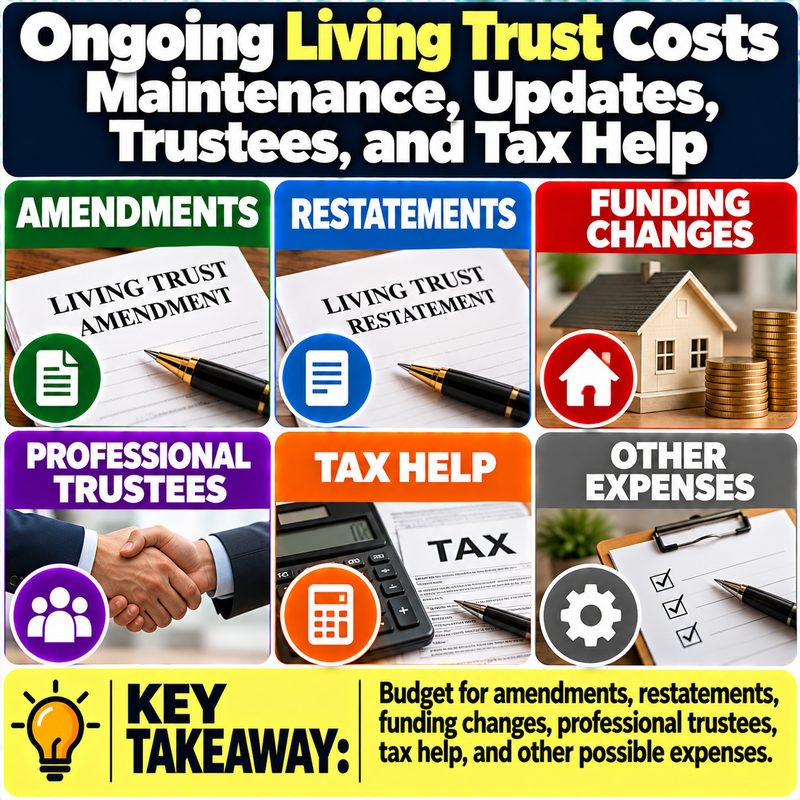
Key Takeaways
Before we go further, here’s the short version of everything this article covers, broken into digestible pieces so you can skim now and dig deeper later.
- Most revocable living trusts have zero mandatory annual fee tied to their mere existence.
- Costs show up only when something changes: new assets, amendments, a professional trustee, or administration after death.
- Tax treatment while you’re alive is usually simpler than people expect, but that can shift once the trust becomes irrevocable.
- Comparing providers means looking closely at their policies on future updates, not just their setup price.
- A short checklist at the end of this article will help you plan for lifetime costs realistically.
Quick Answer: A Revocable Living Trust Does Not Carry a Fixed Annual Fee
There is no law, rule, or standard industry practice that requires you to pay an annual fee simply because you created a revocable living trust. The trust itself is a legal container, not a service contract. Once it’s signed and funded, it sits quietly in the background, doing its job without demanding yearly payments.
Why the “Mandatory Annual Fee” Myth Persists
This misconception likely comes from confusing living trusts with other financial products that do carry recurring charges, think investment accounts with management fees or subscription-based legal services. Attorneys sometimes offer optional annual review packages, and some online platforms charge for continued access to their document portal. Those are real costs, but they’re optional add-ons, not requirements baked into the trust itself. However, revocable living trusts can have some disadvantages, depending on whether or not their intent and use is correct in application.
Another source of confusion is corporate trustee fees. If a bank or professional fiduciary manages a trust, they typically charge ongoing fees, sometimes a percentage of assets under management. People hear about these charges and assume every trust works the same way, even when the person who created the trust is still serving as their own trustee and paying nothing extra for that role.
What You Actually Pay For vs. What You Don’t
Understanding a revocable living trust means recognizing the difference between the document itself and the services surrounding it. The trust document doesn’t expire, doesn’t require renewal, and doesn’t bill you automatically. What does cost money are the things that happen around it, updating it, funding it with new property, or bringing in professionals when circumstances call for it.

Costs That May Occur After Setup
Once your trust is signed, a handful of situational expenses can pop up depending on how your life unfolds. None of these are guaranteed, and none of them happen on a fixed schedule. They’re triggered by events, not by the calendar.
Here’s a quick rundown of what tends to generate charges after the initial setup:
- Amending or restating the trust document
- Preparing and recording new deeds for real estate
- Retitling newly acquired assets into the trust’s name
- Paying for periodic attorney or professional reviews
- Maintaining access to an online trust platform or subscription service
- Covering tax or accounting work when the situation calls for it
- Compensating a professional or corporate trustee
Amendments and Restatements
Life changes, and sometimes your trust needs to change with it. Over time, amendment costs can add up. A simple amendment, swapping a beneficiary or updating a trustee, typically costs between $300 and $500 depending on your attorney and location. More substantial updates, like a full restatement that rewrites the trust while keeping its original name and date, can run $2,000 or more because of the additional drafting and review work involved.
Restating a trust makes sense when you’ve accumulated several piecemeal amendments over the years or when your estate planning goals have shifted significantly. It’s often cheaper in the long run to consolidate everything into one clean document rather than layering amendment after amendment on top of an aging original.
Funding Newly Acquired Assets
Buying a new house, opening a new investment account, or starting a business after your trust is already in place means you’ll need to retitle those assets so they’re owned by the trust. This step, often called funding, is where a lot of people get tripped up because it’s easy to forget once the initial excitement of signing the trust wears off.
If you handle this yourself, there might be minimal cost beyond your own time. If an attorney handles the paperwork, expect to pay for drafting new deeds, preparing transfer documents, or updating account beneficiary designations. This is also where learning how to create a living trust properly from the start pays off, because a trust that’s never fully funded doesn’t do its job no matter how well it’s written.
Skipping this step is one of the most common and costly mistakes trust owners make. An unfunded trust can mean your estate still goes through probate for those forgotten assets, defeating much of the purpose of creating the trust in the first place.
Deeds and Recording Fees
Transferring real estate into your trust usually requires a new deed and a trip to the county recorder’s office. Recording fees vary by county but often land somewhere between $20 and $100 per document. If you refinance a property already held in trust, the title company may also charge fees related to reflecting trust ownership on updated title insurance documents.
| Situation | Typical Cost Range |
|---|---|
| Simple trust amendment | $300 – $500 |
| Full trust restatement | $2,000+ |
| County deed recording fee | $20 – $100 |
| Notary and trust certification documents | Varies by provider |
These numbers aren’t fixed nationwide figures, they shift based on your state, county, and the attorney or service you work with. Still, they give you a realistic sense of scale so you’re not caught off guard.
Attorney or Professional Reviews
Some attorneys offer periodic review services, sometimes annually, sometimes every few years, to check whether your trust still reflects current law and your current life situation. These reviews are optional in most cases, but they can catch problems before they become expensive headaches, like an outdated beneficiary designation or a trustee who’s no longer willing or able to serve.
Platform and Subscription Fees
Digital estate planning services increasingly offer ongoing access to your documents, update tools, and sometimes annual planning check-ins. Bulletproof Legacy Financial’s materials, for example, describe features like continued digital access through an online client console and annual tax-reduction planning conversations as part of certain service models. Historical materials have referenced annual access fees in the range of under $100, though exact current pricing should always be confirmed directly with the provider before you rely on it for budgeting purposes.

Trustee Costs During the Grantor’s Lifetime
While you’re alive and capable of managing your own finances, you’re typically also serving as your own trustee. This arrangement keeps things simple and, importantly, free of additional trustee fees.
Serving as Your Own Trustee at No Extra Charge
There’s no separate paycheck for acting as trustee of your own revocable trust. You’re managing assets you already own, just under a slightly different legal label. This is one of the biggest reasons the “annual fee” myth doesn’t hold up, the person most commonly serving as trustee is you, and you’re not billing yourself.
When a Co-Trustee or Successor Steps In Early
Sometimes a spouse or adult child serves as co-trustee alongside you, often for convenience or because of health considerations. If that co-trustee is a family member serving without compensation, there’s typically no added cost. Costs only enter the picture if the person stepping in is a paid professional, which shifts into the next category entirely.
Professional or Corporate Trustee Fees
If you appoint a bank, trust company, or professional fiduciary to serve as trustee, either now or as a successor trustee down the road, expect compensation structures that look very different from the zero-cost scenario of self-trusteeship.
Percentage-of-Assets Fee Structures
Many corporate trustees charge a percentage of the assets under management annually, often somewhere in the range of 0.5% to 1.5%, though this varies widely by institution and asset size. A larger trust might negotiate a lower percentage, while a smaller trust could see a higher effective rate simply because minimum fees apply regardless of size.
This is a meaningfully different cost structure than what most people assume applies to all living trusts. It’s specific to situations where a paid fiduciary is actually managing the assets, not a universal feature of trust ownership.
Flat-Fee and Hourly Arrangements
Some professional trustees charge flat annual fees instead of a percentage, particularly for smaller or less complex trusts. Others bill hourly for the specific administrative tasks they perform. Comparing these structures matters because a percentage-based fee on a large portfolio can add up to far more than a flat fee would, while a flat fee on a small trust might feel disproportionately expensive relative to the assets involved.

Tax Preparation and Accounting Considerations
Tax questions generate more confusion around living trusts than almost any other topic, so it’s worth slowing down here.
Grantor Trust Status While You’re Alive
A typical revocable living trust is treated as a grantor trust for federal income tax purposes while you’re alive. In plain terms, that usually means the trust’s income is reported on your personal tax return using your own Social Security number, not a separate trust tax identification number. There’s generally no separate annual trust tax return required in this common scenario.
When a Separate Trust Tax Return Becomes Necessary
This grantor trust treatment is not universal or automatic in every variation of trust planning. Certain trust structures, specific provisions, or changes in circumstances can shift tax treatment, and some trusts do require separate tax identification numbers and separate returns depending on how they’re structured and what’s happening within them. Blanket statements claiming no trust ever needs its own return would be inaccurate and could lead someone to overlook a real filing obligation.
This is exactly the kind of detail where generic online guidance falls short. Your specific trust document, your state’s rules, and your individual financial situation all play into whether a separate return applies to you.
Why You Should Confirm Treatment With a Tax Professional
Because tax treatment hinges on the specific terms of your trust and your personal circumstances, a qualified tax professional or estate planning attorney should review your situation directly rather than relying on general assumptions. What’s accurate for one person’s trust may not apply to another’s, even if both trusts look similar on the surface.
Successor Trustee’s Legal and Accounting Help
When you pass away or become incapacitated, the person you named as successor trustee steps into a role that often requires outside help. Even a well-organized trust can involve legal questions about distribution, tax filing deadlines, or creditor notifications that most successor trustees haven’t dealt with before. Hiring an estate attorney to guide the process is common, and fees typically reflect the complexity of the estate rather than a flat industry standard.
Accounting support often becomes necessary too, especially if the trust holds multiple accounts, business interests, or out-of-state property. A tax professional may need to prepare a final personal income tax return for the deceased grantor and, depending on the structure, a separate trust return covering the period after death. These costs are part of trust administration, not trust creation, and they shouldn’t be confused with one another when you’re estimating what a trust “costs” over its lifetime.
Appraisal and Property-Management Expenses
If the trust holds real estate, a business, or other assets that need to be valued or sold, appraisal fees and property management costs can add up. A home might need a professional appraisal before it’s sold or distributed to beneficiaries, and if the property sits vacant for months during administration, someone needs to maintain it, pay property taxes, and keep insurance current. These are real expenses, but they’re tied to what the trust owns and how administration unfolds, not a fixed line item every trust owner should expect to pay annually while alive.
Why These Costs Aren’t Fixed or Guaranteed Amounts
It would be misleading to hand you a single number and say “this is what trust administration costs.” The truth is messier and more honest: administration expenses depend on the size of the estate, how many assets need to be retitled or sold, whether family members disagree about anything, and which state’s laws apply. A simple trust holding a paid-off house and one bank account administers very differently than a trust holding a rental property portfolio, a small business, and accounts spread across three states.
This variability is exactly why working with a knowledgeable attorney or reviewing detailed living trust cost breakdowns before and after setup matters so much. Vague promises of “low-cost” or “free” administration rarely hold up once real assets and real family dynamics enter the picture.

Trust Administration vs. Trust Creation Costs
It helps to think of these as two separate financial events that happen years, sometimes decades, apart. Creation costs are what you pay once, upfront, to get the trust drafted and signed. Administration costs are what your successor trustee pays after you’re gone or incapacitated, to carry out the instructions you left behind.
- Creation costs: attorney drafting fees, pour-over will, power of attorney, medical directives
- Administration costs: successor trustee’s legal help, tax filings, appraisals, asset distribution
- Ongoing lifetime costs: amendments, funding new assets, optional reviews
Conflating these three categories is where a lot of the confusion around “how much does a trust really cost” comes from. Someone quotes a $2,500 setup fee, someone else mentions a $15,000 administration bill for a complicated estate, and readers assume these numbers describe the same thing. They don’t.
How Setup Fees Differ From Ongoing Administration Fees
Setup is a one-time investment in getting the legal structure right. Administration is the real-world process of carrying out that structure’s instructions, often years later, under very different circumstances than when the trust was signed.
Setup fees are generally predictable because the attorney knows upfront what documents are being drafted and roughly how much customization is involved. Administration fees are less predictable because nobody knows in advance exactly what the estate will look like, how many assets there will be, or whether family relationships will stay smooth.
This is part of why learning how to create a living trust that’s clearly written and properly funded from day one pays dividends later. A clean, well-funded trust tends to administer more smoothly and affordably than one riddled with ambiguity or missing assets.
Setup costs are also largely within your control, you choose the attorney, the service, and the level of customization. Administration costs are influenced by factors outside your control at the time of setup, like how your assets grow, how family relationships evolve, and what state laws look like by the time you pass away.
Comparing these two cost categories side by side helps set realistic expectations rather than assuming a single quoted price covers the entire lifecycle of the trust.
What Changes Once the Trust Becomes Irrevocable
Most revocable living trusts become irrevocable upon the grantor’s death, and this shift can trigger different tax treatment than what applied during life. A separate taxpayer identification number is often obtained, and in many cases, the trust begins filing its own tax return covering income earned after death. This is a meaningful transition point, and it’s one of the clearest examples of why blanket statements about trust taxation don’t hold up across every stage of a trust’s life.
Factors That Make Ongoing Costs Higher
Not every trust owner faces the same situational expenses. Some people sail through decades of trust ownership with barely any additional cost beyond the initial setup, while others encounter several of the following factors that push expenses higher.
Understanding these factors ahead of time can help you anticipate costs rather than being blindsided by them.
1. Scope and Complexity of Changes
A one-line amendment changing a successor trustee’s name costs far less than reworking distribution percentages among multiple beneficiaries. The more substantive the change, the more attorney time it requires, and the higher the bill climbs.
Complex changes sometimes cascade too. Updating one provision might require reviewing how it interacts with other sections of the trust, especially in documents with intricate tax planning or multi-generational provisions.
| Type of Change | Relative Cost Impact |
|---|---|
| Updating a trustee’s name | Low |
| Changing a single beneficiary | Low to Moderate |
| Restructuring distribution terms | Moderate to High |
| Full restatement | High |
Knowing where your planned change falls on this spectrum gives you a realistic sense of what to budget before you even call an attorney.
2. Age of the Original Trust Documents
A trust drafted fifteen or twenty years ago may reference outdated laws, outdated tax exemption amounts, or family circumstances that no longer apply. Updating an older document sometimes takes more attorney time than updating a recently drafted one, simply because more has changed in the interim.
Older documents may also use language or formatting conventions that newer attorneys need to interpret carefully before making changes, adding a bit of extra review time to the process.
3. Revocable vs. Irrevocable Trust Terms
Amending a revocable living trust is typically straightforward and inexpensive compared to amending an irrevocable trust. Irrevocable trusts often require court involvement or formal consent from beneficiaries before any changes take effect, which adds legal complexity and cost that simply doesn’t exist with a revocable structure during the grantor’s lifetime.
This distinction is one more reason revocable trusts remain popular for lifetime planning purposes, flexibility costs less than rigidity when circumstances change.
4. Specialized Trusts Like Charitable or Special Needs
Trusts built around charitable giving or special needs planning often involve unique legal and regulatory requirements. Amending these documents may require attorneys with specific expertise in those niche areas, and that specialized knowledge sometimes comes with a higher hourly rate than general estate planning work.
5. Your Attorney’s Location
Urban attorneys generally charge more than their rural counterparts, reflecting higher overhead and cost of living in metropolitan areas. If you’re comparing quotes for amendments or restatements, location alone can explain a meaningful difference between two otherwise similar estimates.

Which Ongoing Costs May Be Avoidable and Which Are Situational
Not every potential expense applies to every trust owner. Some costs are genuinely optional, things you can skip without consequence if your circumstances stay simple. Others are situational, meaning they only appear if specific life events occur.
Separating these two categories helps you plan realistically instead of assuming worst-case costs apply to everyone equally.
Costs You Can Often Skip
- Professional trustee fees, if you’re serving as your own trustee
- Annual subscription or platform fees, if you chose a one-time-fee service model
- Separate trust tax returns, while the trust remains a typical grantor trust during your lifetime
- Formal restatements, if your trust terms still match your current wishes
These costs aren’t universal requirements. They only materialize if you choose a service model or trustee arrangement that includes them.
For many people with straightforward estates and stable family situations, skipping these costs entirely is a realistic and common outcome for years at a time.
That said, circumstances change, and what’s skippable today might become necessary tomorrow, which is exactly why periodic check-ins matter even when nothing seems urgent.
Costs That Depend on Your Life Circumstances
Amendments, new deeds, and funding adjustments fall into a different category entirely. These costs aren’t something you choose to pay or avoid, they’re triggered by life events like marriage, divorce, buying property, or welcoming a new family member. You can’t necessarily avoid these costs if the underlying event happens, but you can often minimize them by handling updates promptly rather than letting several changes pile up before addressing any of them.
Questions to Ask a Provider About Maintenance and Future Changes
Comparing trust providers shouldn’t stop at comparing upfront setup fees. The real test of value often shows up years later, when you need to make a change or when your successor trustee needs support. Asking the right questions upfront can save confusion and unexpected bills down the road.
Whether you’re working with a traditional estate planning attorney or a digital platform, these four questions apply equally well.
Here’s what to ask before committing to any provider:
1. What’s Included in My Ongoing Service?
Some providers include a certain number of free updates within a specific time window, while others charge for every single change regardless of size. Get this in writing before you sign anything.
2. How Are Amendments Billed?
Ask whether amendments are billed hourly, as a flat fee, or bundled into a maintenance package. Flat fees offer predictability, while hourly billing can vary significantly based on the complexity of your request.
If a provider offers a flat-fee restatement package, compare that price against what several smaller amendments might cost over time, sometimes consolidating changes into one restatement actually saves money.
3. Is There a Recurring Access or Subscription Fee?
Digital platforms increasingly bundle features like document storage, review reminders, or ongoing tax planning conversations into subscription-style pricing. Confirm whether this fee is optional, mandatory, or tiered based on the features you actually want to use.
4. Who Handles Funding New Assets Into the Trust?
This is an easy detail to overlook until you’re staring at a new house deed wondering who’s supposed to retitle it. Some providers include guidance on funding as part of their service, while others leave this entirely up to you. Setting up a revocable living trust can offer you privacy, flexibility, and greater control over your assets.
Clarifying funding support upfront prevents the common and costly mistake of buying new assets and simply forgetting to transfer them into the trust at all.
- Request a written explanation of what’s included versus billed separately
- Ask for sample pricing on common amendment scenarios
- Confirm whether subscription fees are mandatory or optional
- Clarify who’s responsible for funding new assets after setup
Getting clear answers to these questions before you commit to a provider puts you in a much stronger position to compare true lifetime value rather than just comparing day-one price tags.

How Regular Reviews Can Prevent Outdated Planning
A trust isn’t a “set it and forget it” document, even though it doesn’t come with a recurring bill. Treating it like a snapshot of your life at the moment you signed it, rather than something that needs occasional attention, is how perfectly good estate plans quietly become outdated.
Life Events That Should Trigger a Review
Certain milestones should prompt you to pull out your trust and give it a fresh read, even if nothing feels urgent. Marriage or divorce tops the list, since you may need to add a new spouse as a beneficiary or trustee, or remove a former spouse from those roles entirely. The death of anyone named in the trust, whether a beneficiary, trustee, or successor trustee, also calls for immediate attention rather than waiting until something forces the issue.
Other triggers are less dramatic but just as important. The birth of a grandchild, an adoption, or a blended family situation can all create new people who deserve consideration in your distribution plan. Moving to a new state matters too, since a trust properly executed under one state’s laws may not align cleanly with another state’s requirements. And significant shifts in your net worth change the math entirely, a trust written around a $500,000 estate reads very differently once that estate grows to $3 million or shrinks to $150,000.
Risks of Naming a Deceased Beneficiary or Trustee
An outdated trust sitting in a file cabinet can look perfectly official while quietly drifting away from reality. If a named beneficiary has passed away and the document doesn’t address what happens to that share, it creates an immediate and avoidable question mark. Similarly, a trustee who has died, become incapacitated, or simply no longer wants the responsibility can force court involvement to appoint a replacement, adding cost, delay, and public exposure that a timely update would have prevented.
Problems Created by Stacking Multiple Amendments
One or two amendments rarely cause problems. But layering amendment after amendment onto the same original trust over the years can create conflicting language, references to provisions that no longer exist, and instructions that have become genuinely confusing to interpret.
This kind of document clutter doesn’t just look messy, it creates real risk. A successor trustee trying to administer a trust with five stacked amendments may need to hire an attorney just to figure out which provisions are still active and which have been superseded. That interpretation work costs money and time, exactly when your family needs clarity the most.
The cost of sorting out these problems after you’ve passed away almost always exceeds what a timely review and cleanup would have cost while you were still around to clarify your intentions.
Restatement vs. Amendment: Which Costs Less Long-Term
A full restatement replaces the entire trust document while keeping the original trust’s name and date intact, which means you avoid the hassle of retitling assets or reestablishing the trust’s legal standing from scratch. It costs more upfront than a single amendment, but when you’re dealing with multiple complex updates, it often works out cheaper and safer than continuing to bolt amendments onto an aging document.
Think of it this way: one clear, consolidated document costs more today but tends to save money and prevent disputes during administration later. Five scattered amendments cost less individually but can add up to more legal interpretation work, and more risk, down the road.
Lifetime-Cost Checklist
Pulling everything together, here’s a realistic way to think about what a living trust actually costs across its entire lifespan, from the day you sign it to the day it’s fully administered after your passing.
This checklist isn’t meant to scare you, most trust owners never encounter every single item on this list. It’s meant to give you a complete picture so nothing catches you off guard.
Reviewing a detailed living trust cost breakdown alongside this checklist can help you budget realistically rather than relying on a single upfront number that only tells part of the story.
The biggest mistake people make isn’t underestimating trust costs, it’s assuming the initial setup fee is the only number they’ll ever need to think about.
Setup-Phase Costs to Expect
At the outset, expect to pay for drafting the trust itself, along with companion documents like a pour-over will, durable power of attorney, and medical directives. Attorney-drafted trusts for individuals commonly range from $1,200 to $3,500, while married couples pursuing joint trusts with more customization may see costs between $2,000 and $5,000. Online template-based options run considerably lower, often $50 to $400, but typically work best only for simple situations: single individuals with no children, no out-of-state real estate, and no need for special distribution terms.
| Setup Item | Typical Cost Range |
|---|---|
| Attorney-drafted individual trust | $1,200 – $3,500 |
| Attorney-drafted joint/married trust | $2,000 – $5,000 |
| Online DIY trust template | $50 – $400 |
| Initial attorney consultation | Free – $200-$500/hr |
Even with a DIY template, don’t forget to budget separately for notary services and county deed recording fees, since these are rarely included in the template price itself.
Learning how to create a living trust that’s properly funded from day one can prevent a lot of the headaches and extra costs that show up later when assets were never correctly transferred in the first place.
Ongoing Costs to Budget For
During your lifetime, situational costs include amendments ($300-$500 for simple changes, $2,000+ for restatements), new deed preparation and recording fees, trust certification documents for banks, and optional professional reviews. If you choose a digital platform with continued access features, factor in whatever recurring fee structure that provider currently charges, and confirm it directly rather than relying on older published figures.
If a professional or corporate trustee is ever appointed, budget for their fee structure too, whether that’s a percentage of assets, a flat annual rate, or hourly billing for specific tasks performed.
Post-Death Administration Costs to Plan Around
After incapacity or death, your successor trustee may need legal guidance, tax preparation help, property appraisals, or property management services depending on what the trust holds. These costs scale with the complexity of the estate, a simple trust with one home and one bank account administers far more cheaply than one holding multiple properties, business interests, or accounts across several states.
Frequently Asked Questions
Here are quick, straightforward answers to the questions people ask most often about ongoing living trust costs.
Do I have to pay an annual fee just for having a living trust?
No. A typical revocable living trust does not carry a mandatory annual legal or tax fee simply because it exists. Costs only arise when specific events happen, like amendments, new asset funding, or appointing a paid trustee.
Does a revocable living trust require its own tax return every year?
Generally no, while you’re alive and the trust remains a typical grantor trust, its income is usually reported on your personal tax return. This isn’t universal, though, since certain trust structures or circumstances can create a separate filing requirement, so confirm your specific situation with a tax professional.
How much does it typically cost to amend a living trust?
Simple amendments, like updating a beneficiary or trustee name, typically cost between $300 and $500. More substantial changes or a full restatement can exceed $2,000 depending on complexity and location.
When should I restate my trust instead of amending it?
Restatement makes sense when you’re facing multiple or complex updates, significant shifts in your estate planning goals, or several prior amendments that have made the document confusing to interpret. It costs more upfront than a single amendment but often provides better clarity and reduces administration risk later.
What happens to trust costs after I become incapacitated?
Your successor trustee may need to bring in legal, tax, or accounting help to manage your affairs properly, and these costs depend on the complexity of your assets and situation. There’s no fixed guaranteed amount since every estate looks different.
Will my successor trustee need to hire an attorney?
Often, yes, especially for anything beyond a very simple estate. Legal guidance helps successor trustees navigate distribution rules, creditor notifications, and tax filing deadlines correctly, reducing the risk of personal liability for mistakes.
Are online trust subscription services worth the recurring fee?
It depends on what features are included and how much you value ongoing access to reviews, updates, or planning tools. Compare what’s bundled into the subscription against what you’d pay an attorney for the same services individually before deciding.
What life events should prompt me to review my trust?
Marriage, divorce, the death of a named beneficiary or trustee, new children or grandchildren, moving to a different state, and significant changes in your net worth all warrant a fresh look at your trust’s terms.
How much do professional or corporate trustees typically charge?
Fees vary widely by institution and structure, commonly ranging from around 0.5% to 1.5% of assets under management annually, though flat-fee and hourly arrangements exist too, particularly for smaller trusts.
Can I avoid ongoing trust costs by doing everything myself?
You can avoid many optional costs, like professional reviews or corporate trustee fees, by handling amendments and asset funding yourself. Keep in mind that DIY handling still requires your own time and research, and mistakes in funding or drafting can create bigger, more expensive problems for your successor trustee later.