Category: Living Trust Costs

Understand the costs of creating and maintaining a living trust, including attorney fees, online trust services, DIY options and other expenses that may be involved in establishing an estate plan.

  • Understanding Trustee Fees: What You Need to Know to Choose the Right Professional

    Understanding Trustee Fees: What You Need to Know to Choose the Right Professional

    Trustee Fees Explained: Evaluating Professional Fiduciary Costs

    Understand common trustee compensation methods, service scope, fee disclosures, and questions to ask before selecting a fiduciary.

    Key Takeaways

    • Professional trustee fees are usually structured as a percentage of trust assets, an hourly rate, a flat annual charge, a minimum fee, or some blend of these methods.
    • There’s no single “standard” rate — the real comparison point is a written, itemized proposal matched to your trust’s size, asset types, and the actual duties a trustee will perform.
    • Trustee compensation is distinct from attorney fees, tax preparation charges, and investment management costs, which are frequently billed separately from the trustee’s own fee.
    • A minimum annual fee can override a lower percentage calculation, so a trust that looks inexpensive on paper may still cost more once that floor kicks in.
    • Later in this guide, we’ll walk through hypothetical math showing exactly how small percentage differences compound over time — and what questions separate a complete quote from an incomplete one.
    Professional-Trustee-Fees

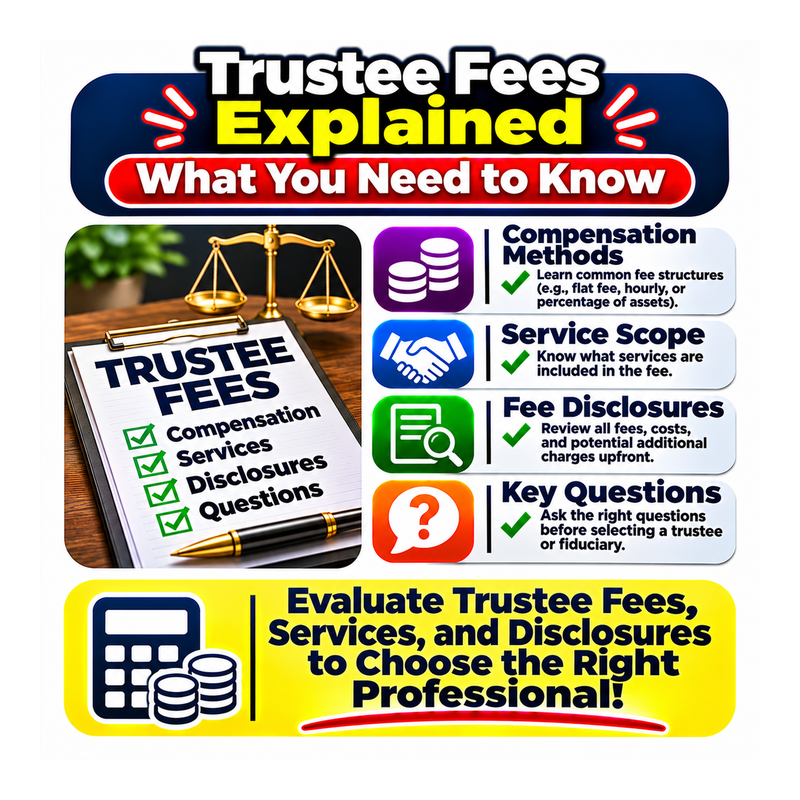
    Trustee Fees Explained: Evaluating Professional Fiduciary Costs

    Understand common trustee compensation methods, service scope, fee disclosures, and questions to ask before selecting a fiduciary.

    Professional trustee fees may be calculated as a percentage of trust assets, an hourly rate, a flat charge, a minimum annual amount, or some combination of these — and the number that matters most isn’t a headline percentage but the total written cost tied to the duties and assets actually involved.

    A trust document naming a professional fiduciary doesn’t tell you what that service will cost once the trustee actually begins administering assets. That’s a separate question from how much the trust cost to create in the first place, and it’s one families often don’t ask until they’re comparing proposals from different institutions or individuals. Organizations like Create A Living Trust exist partly to help families untangle this distinction before they’re locked into an agreement they don’t fully understand.

    Because fee structures vary so widely by provider, by state, and by the complexity of what’s being managed, understanding the mechanics behind each model — percentage, hourly, flat, and minimum — puts you in a far stronger position to evaluate any proposal placed in front of you.

    What Professional Trustee Fees Actually Cover

    Trustee Duties Versus Trust Drafting and Funding

    Being named as a successor trustee in a trust document is not the same as accepting and actively serving in that role. A fee for professional trustee services compensates someone for authorized fiduciary administration — collecting assets, managing them, communicating with beneficiaries, and making distributions — not for the drafting of the trust itself or the act of simply being listed as a future trustee.

    This distinction trips up a lot of people. The one-time work of retitling accounts and preparing deeds to move assets into a trust is the separate cost of funding a living trust, and it’s a different expense entirely from the recurring compensation paid once a trustee is actually in office and administering those same assets. Deed preparation, institutional transfer procedures, and third-party recording charges typically happen once, upfront, while trustee fees recur for as long as the trustee is actively serving.

    Where Trustee Compensation Fits Among Attorney, Custodian and Accountant Fees

    Trustee compensation also needs to be separated from an executor’s fee and a lawyer’s fee. An executor administers a probate estate; a trustee administers trust assets, often without court supervision. These are different roles governed by different rules, even when the same person happens to hold both titles at different points in an estate plan.

    It helps to think of trust-related costs in two buckets: the cost of creating and funding the plan, and the ongoing cost of administering it once a trustee steps into the role. Understanding the difference between living trust creation and administration costs is the first step toward reading any trustee fee proposal with clear eyes, because a quote that only addresses one side of that equation isn’t a complete picture of what you’ll actually pay over time.

    Four Common Fee Structures Professional Trustees Use

    1. Percentage-of-Assets Fees

    Under a percentage-of-assets model, the trustee’s fee is calculated as a share of the trust’s value, often assessed annually and sometimes billed in quarterly installments. Some industry commentary describes rates commonly falling in a lower range for more modest personal trusts, with larger or more complex trusts managed by corporate trust companies sometimes running higher — but these are general patterns reported in trade discussion, not fixed or guaranteed rates, and any specific percentage should come from a written proposal rather than an assumption.

    What matters more than the headline percentage is how it’s applied. Is the rate charged on the gross value of assets or the net value after liabilities? Does it apply annually, or is it prorated for partial years? Are illiquid holdings like real estate or a family business valued and charged the same way as cash and publicly traded securities? Those details change the real cost far more than the percentage figure itself.

    2. Flat Annual Fees for Smaller Trusts

    Some trustees — particularly for smaller or more straightforward trusts — charge a flat dollar amount each year rather than a percentage. This approach can make budgeting simpler because the number doesn’t move with market swings in the trust’s investment value.

    The tradeoff is that a flat fee assumes a relatively predictable scope of work. If the trust later takes on unusual duties, such as managing a rental property or handling a contested distribution, a flat-fee arrangement may not automatically expand to cover that added workload, which is exactly why reviewing the scope language in the fee agreement matters as much as the number attached to it.

    3. Hourly Billing for Limited Duties

    When a trustee’s responsibilities are narrow or episodic rather than full-time, some arrangements use hourly billing similar to how an attorney or accountant might charge. This model can work well for trusts that only need periodic attention, but it also shifts the predictability risk onto the family, since total hours — and total cost — aren’t fixed in advance.

    Hourly billing typically requires detailed time records, and it’s reasonable to ask how time is tracked, in what increments, and whether certain tasks are billed at different rates than others. Without that clarity, an hourly arrangement can be harder to budget for than either a percentage or flat structure.

    4. Minimum Annual Fee Thresholds

    Many professional trustees, especially corporate or institutional ones, set a minimum annual fee regardless of how the percentage or hourly calculation comes out. If a trust’s calculated percentage fee would fall below that floor, the minimum typically governs instead — meaning a smaller trust can sometimes end up paying a proportionally larger share of its assets in trustee compensation than a bigger one would. This is one of the most overlooked details in fee comparisons, and it’s worth asking about explicitly before signing any agreement.

    What Drives the Cost of a Professional Trustee

    Two trusts holding the exact same dollar amount can cost wildly different amounts to administer, because the fee isn’t really about asset value alone — it’s about workload. A trust holding a diversified brokerage account requires far less hands-on management than one holding a rental duplex, a family business interest, or mineral rights that need periodic valuation and oversight.

    Duration matters too. A trust designed to distribute assets outright within a year or two carries a very different administrative burden than one intended to support a beneficiary with special needs over several decades, or one that holds assets in further trust for grandchildren who haven’t been born yet. Longer administration periods generally mean more accountings, more communication, and more opportunities for the fee structure to be tested against real complexity.

    Trust Size, Complexity and Asset Type

    Both percentage fees and hourly bills can behave unpredictably as a trust’s composition changes. A percentage fee calculated against a growing investment portfolio rises automatically with market gains, even if the trustee’s actual workload hasn’t changed much. An hourly arrangement, by contrast, might spike sharply the moment a property needs to be sold, a tax dispute arises, or a beneficiary requests an unusual distribution that requires documentation and discretion.

    Discretionary distribution authority — where a trustee has to decide how much a beneficiary receives and when — tends to add administrative weight regardless of fee model, since it typically requires more documentation to show the decision was made prudently and in line with the trust’s terms.

    Corporate Trustee Experience Versus Individual Trustees

    Corporate or institutional trustees often have minimum account sizes below which they simply won’t accept an appointment, and they can decline to serve just as an individual can. A relatively small trust may not meet a bank trust department’s threshold at all, which pushes some families toward an individual professional fiduciary or a capable family member supported by outside advisers instead.

    Neither option is automatically cheaper or safer. A family trustee who hires a good accountant and an estate planning attorney for guidance can sometimes administer a trust competently at a lower direct cost, but that arrangement depends heavily on the individual’s willingness to follow fiduciary rules and keep careful records — something a corporate trustee is institutionally built to do as a matter of course.

    Reimbursable Expenses Beyond the Base Fee

    Regardless of which fee model applies, trustees are generally entitled to reimbursement for reasonable expenses incurred while administering the trust, separate from their compensation. These commonly include things like travel costs, storage fees, insurance premiums on trust property, filing fees, courier and postage costs, and legal expenses tied to trust administration. A written fee agreement should spell out how these reimbursements are requested and documented, since they can add up over the life of a long-running trust even when the base fee itself stays modest.

    Services Often Bundled or Billed Separately

    A quoted trustee fee rarely tells the whole story on its own. Some providers bundle core administrative services with investment management and basic reporting into one combined rate, while others bill trustee compensation separately from every other professional involved in the trust’s affairs. Neither approach is inherently better, but the difference changes what a “1% fee” actually buys you.

    It helps to think of trust-related costs as a layered stack rather than a single number. At the base sits the trustee’s own compensation for fiduciary administration. Stacked on top of that may be investment advisory fees, custodial or brokerage charges, fund-level expenses embedded in mutual funds or ETFs, CPA fees for preparing fiduciary income tax returns, attorney fees for legal guidance, and property management or appraisal costs tied to specific assets. Depending on the provider, some of these layers are folded into the trustee’s quoted rate and others are billed independently.

    Conflicts of interest deserve particular attention here. If a trustee’s firm also manages the trust’s investments through an affiliated advisory arm, ask directly whether that arrangement creates a referral fee, a revenue-sharing agreement, or any other financial incentive that could color investment decisions. None of that is necessarily improper, but it should be disclosed clearly enough that you can evaluate it.

    Fee ModelHow It Is CalculatedWhat Can Change the TotalQuestions to Ask
    Percentage of AssetsApplied to trust value, often annually or quarterlyAsset growth, valuation method, asset class treatmentIs the rate tiered? What valuation date is used?
    Flat Annual FeeFixed dollar amount regardless of asset valueScope creep, extraordinary administrationWhat triggers an increase to the flat rate?
    Hourly BillingTime spent on trust duties at a set rateComplexity of tasks, number of beneficiariesHow are time increments tracked and billed?
    Minimum Annual FeeFloor amount that overrides a lower calculationTrust size relative to the minimum thresholdDoes the minimum apply even in a partial year?

    Investment Management and Accounting Charges

    Investment management fees and trustee compensation are frequently two separate line items, even when the same institution provides both services. One overview of trustee compensation practices describes how trustee fee arrangements can vary based on whether duties are limited or extensive, which underscores why asking for an itemized breakdown matters more than accepting a single blended percentage at face value.

    Tax Preparation and Legal Consultation Fees

    Preparing a trust’s annual income tax return, typically a Form 1041 at the federal level, is accounting work and is usually billed by a CPA rather than absorbed into the trustee’s fee. Likewise, legal consultation on interpreting ambiguous trust language, resolving a beneficiary dispute, or advising on a complex distribution decision is typically a separate attorney charge, even when the trustee is the one who requests that advice on the trust’s behalf.

    Another resource examining how courts and trust documents approach trustee compensation notes that grantors can set specific conditions on how and when trustee fees are paid, which is a useful reminder that the trust document itself, not just industry habit, often controls what’s bundled and what isn’t.

    Questions to Ask Before Engaging a Trustee

    Before signing anything, ask for a written scope-of-services document that spells out exactly what’s included in the base fee and what triggers an additional charge. A trustee who can’t produce this in writing is asking you to take their word for a cost structure that could shift significantly once they’re actually in office.

    It also helps to ask how frequently you’ll receive reports, in what format, and whether sample reports are available for review before you commit. A trustee who provides clear, regular, and understandable reporting tends to be easier to evaluate over time than one whose communication is vague from the outset.

    • What is included in the base fee versus billed as an extraordinary service?
    • How and when is the fee schedule reviewed or adjusted?
    • Who handles tax preparation, and is that cost separate?
    • Is investment management bundled or billed independently?
    • What reporting will beneficiaries receive, and how often?

    None of these questions are meant to catch a trustee doing something improper — most professional fiduciaries are glad to answer them in writing, because a clear scope protects both sides from misunderstandings down the road.

    Sample Math: Calculating a Percentage-Based Trustee Fee

    The following figures are entirely hypothetical and intended only to illustrate how the arithmetic works. They are not quoted rates, industry averages, or recommendations, and no specific provider should be assumed to charge these amounts.

    Hypothetical $800,000 Trust: Comparing Two Assumed Rates

    Say a trust holds $800,000 in assets. If a hypothetical trustee charged an assumed annual fee of 0.75%, the calculation would be $800,000 × 0.0075 = $6,000 for the year. If the assumed rate were instead 1.00%, the calculation would be $800,000 × 0.01 = $8,000 — a $2,000 difference before accounting for any separately billed accounting, legal, or investment management charges. Now imagine the written agreement also specifies a $7,500 minimum annual fee. In that case, the minimum would override the lower 0.75% calculation, meaning the trust would pay $7,500 rather than the $6,000 the percentage alone would suggest, assuming the agreement’s language supports that floor.

    Hypothetical $5 Million Trust at 2% Annually

    Scaling up, a hypothetical $5,000,000 trust charged at an assumed 2% annual rate would come to $100,000 for the year ($5,000,000 × 0.02). At that size, even a seemingly small percentage difference — say 1.5% instead of 2% — would swing the annual cost by $25,000, which is exactly why larger trusts benefit from carefully negotiated, tiered fee schedules rather than a single flat percentage applied across the entire balance.

    Hypothetical $500,000 Trust Under a Flat Fee Model

    By contrast, a hypothetical $500,000 trust under a flat annual fee model might be quoted at an assumed $5,000 per year regardless of market performance. That figure wouldn’t rise if the trust’s investments appreciated, but it also wouldn’t fall if the portfolio lost value — a tradeoff worth weighing against a percentage model’s built-in responsiveness to asset value.

    Are Investment Management Fees Included or Added On Top?

    In every example above, none of the figures include a separate investment management fee, custodial charge, or CPA bill. If an investment adviser separately charges an assumed 0.5% to manage the same $800,000 portfolio, that would add another $4,000 on top of whichever trustee fee calculation applies — a layering effect that makes a single quoted trustee percentage an incomplete picture of total annual cost.

    This is precisely why asking for an all-in cost estimate, rather than just a trustee percentage, gives you a far more realistic sense of what a family will actually pay across a full year of administration.

    A Decision Framework for Choosing a Trustee

    Comparing trustee proposals works best as a structured process rather than a gut reaction to a single percentage. Start by identifying the trust’s total asset value and the types of assets involved, since that shapes both the complexity of the work and which fee model makes the most sense.

    From there, list out anticipated duties: how many beneficiaries need ongoing communication, whether distributions are discretionary or fixed, and whether any assets — like a rental property or closely held business — require specialized oversight. A proposal that doesn’t address these specifics isn’t really a complete quote yet.

    Checklist: Comparing Fee Proposals Side by Side

    When you have more than one proposal in hand, line them up against the same set of questions rather than comparing headline numbers in isolation. A percentage rate alone, without context for what’s included, isn’t a meaningful comparison point.

    Use this checklist as a starting point when evaluating any professional trustee quote:

    • Fee schedule: is it percentage-based, flat, hourly, or a blend?
    • Asset valuation: what date and method determine the trust’s value for fee purposes?
    • Minimums: is there a floor fee, and does it apply in partial years?
    • Bundled versus separate services: what’s included in the base rate?
    • Investment custody: where are assets held, and who has trading authority?
    • Accountings: how often, and in what format, will reports be delivered?
    • Extra-work charges: what triggers an additional bill beyond the base fee?
    • Conflicts: are there affiliated advisers or referral arrangements to disclose?
    • Termination: what happens, and what’s charged, if the trustee resigns or is replaced?
    • Successor arrangements: who steps in if this trustee can no longer serve?

    Once you have answers to all ten items for each proposal under consideration, the comparison becomes far more apples-to-apples than simply asking “what’s your rate?”

    Hypothetical Scenario: Family Trust Weighing a Corporate Trustee Versus a Relative

    Picture a hypothetical family with three adult beneficiaries and a trust holding a mix of investment accounts and a single rental property. A corporate trustee quotes an assumed 1% annual fee with a $10,000 minimum, bundled investment management, and quarterly online reporting. A capable adult child offers to serve instead, supported by an independently hired CPA and attorney, for a flat assumed $3,000 per year plus those professionals’ separate hourly bills.

    Neither option is automatically the right answer. The corporate arrangement offers institutional consistency and built-in oversight but may cost more overall once the minimum and bundled investment fee are factored in. The family member option could cost less in direct trustee compensation but depends heavily on that person’s diligence, availability, and willingness to document decisions the way a fiduciary is required to — which is exactly the kind of tradeoff a family should discuss openly, ideally with an estate planning attorney weighing in on the trust’s specific terms.

    How Fiduciary Duties and Accountings Affect Trustee Pay

    A trustee’s compensation doesn’t exist in a vacuum — it’s tied to a set of legal duties that exist whether or not the fee provision spells them out explicitly. These duties generally include administering the trust according to its terms and applicable state law, keeping trust assets separate from personal assets, acting loyally and avoiding self-dealing, addressing conflicts of interest transparently, and providing required reports or accountings to beneficiaries.

    A fee provision in the trust document does not excuse a trustee from these obligations, and simply disagreeing with a fee amount doesn’t, by itself, establish that the fee is unreasonable. Courts and state statutes generally look at the totality of the circumstances — the complexity of the trust, the trustee’s effort, and the outcomes delivered — rather than a beneficiary’s subjective opinion alone.

    Fiduciary duties commonly include the following obligations, though specifics vary by state and by the trust’s own terms:

    • Administering the trust according to its written terms and applicable law
    • Maintaining accurate, separate records of trust assets and transactions
    • Acting loyally and avoiding undisclosed conflicts of interest
    • Exercising prudent judgment in investment and distribution decisions
    • Providing periodic accountings or reports as required

    Required Reporting to Beneficiaries

    Many states give beneficiaries some right to request information about trust administration, though the scope of that right — and how often formal accountings are required — depends heavily on state law and the trust’s own terms. A formal accounting typically lays out the trust’s assets, income received, expenses paid, distributions made, and fees charged over a given period.

    Beneficiaries shouldn’t assume they can always demand any record at any time, or that disagreement with a fee automatically entitles them to remove a trustee. Those rights, where they exist, are shaped by the governing document and by state statute, which is one more reason qualified counsel should review both the trust terms and any fee agreement before a professional trustee is formally engaged.

    A clear accounting typically covers:

    • A full inventory of trust assets at the start and end of the reporting period
    • Income earned and expenses paid during that period
    • Distributions made to beneficiaries
    • Trustee fees and reimbursed expenses charged during the period

    Requesting a sample accounting format before engaging a trustee gives you a realistic sense of how transparent — or how sparse — ongoing reporting is likely to be.

    Courts and State Law When the Trust Document Is Silent

    When a trust document doesn’t specify a trustee’s compensation, many states direct courts to determine what’s “reasonable” by weighing factors such as the size of the trust, the income it generates, the complexity of the assets involved, the time and skill the role required, and comparable local fee standards — an approach that often mirrors how courts evaluate executor compensation in probate matters. This is a general pattern described in trust and estate commentary, not a rule guaranteed to apply identically in every state.

    This is exactly why a trust document’s silence on trustee compensation shouldn’t be treated as a minor drafting gap. Without clear fee terms, a trustee’s compensation may ultimately be decided by a court applying state-specific standards, which can take time and may not align with what either the trustee or the beneficiaries expected going in.

    Because these standards differ meaningfully from one state to the next, and because court involvement can add both delay and cost, it’s worth having an estate planning attorney review fee provisions at the drafting stage rather than leaving compensation terms to be worked out later by default rules.

    For families still in the planning stages, this is also a useful moment to understand how a living trust works more broadly, since a document drafted with clear successor trustee and compensation language tends to create far fewer disputes down the road than one that leaves these questions unaddressed.

    Where the eState Living Trust Plan Fits Into Trustee Decisions

    A living trust plan’s job is to prepare the structure a future trustee will eventually administer — it is not, itself, a substitute for professional fiduciary compensation once someone actually steps into that role.

    What the eState Living Trust plan does provide is a clearly organized document set, properly titled assets, and guidance that makes a future trustee’s job significantly easier once they do step into the role — but it does not install Create A Living Trust or Bulletproof Legacy Financial as a corporate trustee, and it doesn’t pay ongoing custody, investment, accounting, or legal fees on a family’s behalf. Those remain separate costs tied to whoever actually serves as trustee, whether that’s a relative, a professional fiduciary, or a corporate trust department.

    Where this kind of plan genuinely helps is in reducing the guesswork a successor trustee faces when they’re handed the role unexpectedly. A well-organized trust binder, clear asset titling, and documented guidance can mean the difference between a successor trustee who knows exactly where to start and one who spends the first several months just figuring out what exists and how it’s held.

    Trustee and Successor Trustee Support Included in the Plan

    Provider materials describe trustee and successor-trustee support as part of the standard eState Living Trust scope — things like guidance on the trustee’s general responsibilities and access to organized documentation showing what’s been funded into the trust and how. That support is meant to prepare a family member or chosen individual for the moment they’re called into service, not to replace the compensation a professional fiduciary would separately charge if one is appointed instead.

    It’s worth being precise here: trustee support and successor trustee preparation are not the same thing as the plan itself acting as trustee. If a family ultimately decides a corporate or individual professional trustee is the better fit, that engagement — and its fee structure — is arranged independently of the original estate planning work.

    Access to Legal, Financial and Tax Professionals

    Plan materials also describe access to attorney and other professional support as part of the broader service, which can be useful when a successor trustee has questions about their duties or needs a document reviewed before taking action. Availability and scope of this access depend on actual plan terms and jurisdiction, and it shouldn’t be assumed to cover every tax filing, legal dispute, or specialized fiduciary question that might arise during active administration.

    Frequently Asked Questions

    Trustee fee questions tend to cluster around a handful of recurring themes: how fees are calculated, who pays for what, and what rights beneficiaries actually have when something seems off. The answers below address the most common versions of those questions, with the understanding that state law and the specific trust document always have the final word.

    A few of these answers touch on sensitive territory — like challenging a fee or understanding tax treatment — where getting personalized guidance from a qualified attorney or tax professional matters more than a general answer ever could.

    • Fee calculation methods and what triggers extra charges
    • Tax treatment of trustee compensation
    • Beneficiary rights around fee disclosure and accountings
    • Differences between corporate and individual trustee costs
    • Timing questions around when compensation actually begins

    Can a Family Member Serve as Trustee Without Charging a Fee?

    Yes, a family member or close friend can agree to serve as trustee without charging a fee, and this is common when the appointed person has a close relationship with the beneficiaries or is themselves a primary beneficiary. Some trust documents even anticipate this by stating that a trustee may waive compensation.

    That said, serving without a fee doesn’t reduce the legal duties involved — an unpaid trustee still has to follow the same fiduciary standards, keep accurate records, and administer the trust according to its terms and applicable state law.

    Are Trustee Fees Negotiable Before Signing an Agreement?

    In many cases, yes. Professional trustees, particularly individual fiduciaries and smaller firms, may be willing to discuss fee structure, minimums, or bundled services before a formal engagement begins. Corporate trust departments sometimes have less flexibility on published fee schedules but may still negotiate on scope or reporting frequency. It’s always reasonable to ask before assuming a quoted rate is final.

    How Often Are Trustee Fees Paid Out of Trust Assets?

    Trustee fees are typically paid directly from trust assets rather than by the grantor, beneficiaries, or an executor personally, and many arrangements bill on a quarterly basis rather than annually or monthly. The exact timing depends on the written fee agreement and the trust’s own terms.

    Because fees come out of trust principal or income, they directly reduce what’s ultimately available for distribution to beneficiaries, which is one more reason the total cost of administration deserves the same scrutiny as any other major trust expense.

    Do Trustee Fees Change if the Trust Grows in Value?

    Under a percentage-of-assets model, yes — fees generally rise and fall with the trust’s value, since the fee is calculated as a share of whatever the trust holds at a given valuation date. Under a flat annual fee or minimum-fee arrangement, the stated amount typically doesn’t move automatically with market performance unless the agreement specifically allows for periodic adjustments.

    This is part of why understanding which model applies matters so much — a percentage fee that looks reasonable on a smaller trust can become a much larger dollar figure if the trust’s assets appreciate significantly over time.

    What Happens if a Trustee Charges More Than State Law Allows?

    State laws and trust terms vary on what constitutes a reasonable or permissible trustee fee, and remedies for an excessive fee also differ by jurisdiction. In general, a beneficiary who believes a fee is unreasonable or exceeds what the trust document or state law permits may be able to raise the issue with the trustee directly, request an accounting, or pursue a legal remedy through the appropriate court.

    Because these processes and standards differ meaningfully from state to state, anyone concerned about an excessive fee should consult a qualified estate planning or fiduciary litigation attorney rather than relying on general assumptions about what’s allowed.

    Is a Corporate Trustee Always More Expensive Than an Individual?

    Not necessarily. While corporate trustees often have minimum fees and structured percentage schedules, an individual professional fiduciary can sometimes charge comparable or even higher hourly rates depending on the complexity of the trust and the individual’s experience. A family member serving without charging a fee is typically the least expensive option on paper, though that doesn’t account for the value of institutional recordkeeping, continuity, and risk management a corporate trustee often provides.

    Can a Grantor Cap Trustee Fees in the Trust Document?

    Yes, a grantor can generally impose limits or specific conditions on trustee compensation when drafting the trust, as long as those conditions don’t violate public policy or applicable law. This might include capping a percentage rate, specifying a flat fee instead of a percentage, or setting different compensation terms for a successor trustee compared to the original one.

    Are Trustee Fees Taxed as Income to the Trustee?

    Generally, yes — trustee fees are considered taxable income to the person or entity receiving them, while the trust itself typically treats the fee as a deductible administrative expense. One nuance worth noting: a surviving spouse who is both the sole beneficiary and the trustee may face different tax considerations if they charge themselves a fee, since that arrangement can create unusual income tax outcomes depending on the structure of the trust.

    Tax treatment of trustee fees can get complicated quickly, especially in cases involving dual roles or multiple beneficiaries, which is exactly the kind of question a tax professional should weigh in on directly.

    What Should Beneficiaries Do if They Suspect Excessive Fees?

    The first step is usually requesting a detailed, itemized accounting that breaks down exactly what the fee covers and how it was calculated. A legitimate fee should be traceable to a written agreement, a clear valuation method, and documented services rendered — if a trustee can’t produce that breakdown, that alone is worth raising as a concern.

    From there, beneficiaries generally have the option to raise concerns directly with the trustee, seek mediation, or consult an attorney about formal remedies available under state law. Disagreement alone doesn’t prove a fee is unreasonable, but a lack of transparency or documentation is a legitimate reason to seek outside guidance.

    Reasonable compensation standards in many states weigh factors such as the size of the trust, the income it generates, the time and skill required, and comparable local fee practices — but these standards and the remedies available to beneficiaries differ by state and should be confirmed with local counsel rather than assumed.

    How Does a Successor Trustee’s Fee Differ From the Original Trustee’s?

    Compensation for a successor trustee doesn’t typically begin until that person actually accepts the role and starts administering the trust — simply being named as a successor doesn’t trigger a fee. Some trust documents set different compensation terms for successor trustees entirely, sometimes offering a more attractive rate specifically to encourage someone to accept a role that may involve picking up administration mid-stream, often for a trust that’s been running for years without them.

    Ready to Clarify Your Trustee Fee Questions With an Expert

    The most reliable way to compare trustee options isn’t a single percentage — it’s an itemized written proposal matched to your trust’s actual assets, beneficiary needs, reporting expectations, custody arrangements, and transition terms. Before any professional trustee is formally appointed, have qualified counsel review the compensation structure and the removal or replacement provisions, since those terms are far easier to negotiate before signing than after.

    Create A Living Trust and Bulletproof Legacy Financial focus on helping families build and fund trusts with clear successor trustee guidance, which is a useful starting point even if a professional fiduciary enters the picture later. If you haven’t yet nailed down how your trust is structured for a future trustee to step into, it’s worth taking time to learn about our living trust plan before comparing fee proposals from outside professionals.

    Whether you’re weighing a corporate trustee, an individual fiduciary, or a trusted family member, Create A Living Trust and Bulletproof Legacy Financial can help you build the groundwork a future trustee will rely on.


  • 5 Tips for Reducing Living Trust Costs with Online Legal Platforms

    5 Tips for Reducing Living Trust Costs with Online Legal Platforms

    How to Lower Living Trust Expenses When Using Online Platforms

    Five practical ways to evaluate platform pricing, hidden fees, document quality, funding support, and long-term trust maintenance.

    Key Takeaways

    • You can reduce living trust costs online by comparing the full written scope of each package rather than just the sticker price, since cheap templates often exclude funding, review, and state-specific execution help.
    • State rules on notarization, witnesses, and deed recording vary, so a document that’s valid in one state may not hold up in yours without the right signing steps.
    • Moving your house, bank accounts, or rental property into the trust (called “funding”) is usually a separate cost from drafting the trust itself, and skipping it can leave assets stuck in probate anyway.
    • Annual subscription fees for amendments and digital storage can quietly double your long-term cost if you don’t check the renewal terms before signing up.
    • Further down, you’ll see a real-world breakdown comparing an advertised online price to the actual total cost once funding, deeds, and review are added in.

    Here’s the quick version: to actually reduce living trust costs online, you compare the complete service scope — not the homepage number — verify your state’s signing rules, budget separately for funding your assets, check renewal and amendment fees, and bring in a lawyer only when your situation calls for it.

    Reduce-Living-Trust-Costs-Online

    5 Tips for Reducing Living Trust Costs with Online Legal Platforms

    Five practical ways to evaluate platform pricing, hidden fees, document quality, funding support, and long-term trust maintenance.

    A $300 trust template and a $3,000 attorney-drafted plan can both leave your house sitting outside the trust if nobody actually transfers the deed.

    That’s the trap a lot of people fall into when they shop for a living trust online. The headline price looks great, but it rarely tells you what happens after you click “buy.” Some platforms, including living trust service pricing pages from providers like Create A Living Trust, lay out what’s bundled versus what costs extra — and that kind of transparency is exactly what you want to look for before you commit your money.

    The goal here isn’t to find the cheapest document. It’s to find the lowest total cost for a plan that actually works when it’s needed — meaning the trust is signed correctly, funded with your real assets, and still usable five or ten years from now. That takes a bit more digging than comparing two prices side by side, but it’s not complicated once you know what to check.

    The Short Answer: Five Checkpoints to Cut Costs Before You Buy

    Before you hand over a credit card number, run through these five checkpoints. Each one addresses a different way online trust costs sneak up on people after the fact.

    • Base package scope — know exactly which documents and services are included, not assumed.
    • State-specific execution — confirm your state’s signing, witness, and notary rules are covered.
    • Asset funding — budget for retitling your house, accounts, and other property separately.
    • Amendments and subscriptions — check what future changes cost before you need to make one.
    • Legal review — add qualified review only where your situation genuinely needs it.

    The rest of this article walks through each of these in detail, plus a realistic cost comparison so you can see how the numbers actually play out.

    Trust Drafting, Funding, and Maintenance Are Three Separate Costs

    Most pricing confusion starts with a basic misunderstanding: people think “creating a trust” is one single purchase. In reality, it’s three distinct jobs, and online platforms don’t always price — or even perform — all three. Understanding this split is the single biggest lever for reducing your total spend, because it tells you which line item you’re actually negotiating or comparing.

    What “Trust Creation” Actually Covers

    Trust creation, narrowly defined, means drafting and signing the legal documents: the revocable trust itself, usually a pour-over will, and often financial and healthcare powers of attorney. This is the part most advertised prices refer to. It’s also the part that’s easiest to compare, since it’s a fixed deliverable. But the factors that affect living trust costs go well beyond document drafting, and a quote that only covers this step is only telling you part of the story.

    Why Funding Is a Separate Task From Drafting

    Signing a trust document doesn’t move anything into it. Your house stays titled in your personal name until a new deed is prepared and recorded. Your bank accounts stay in your name until you retitle them with the institution. Funding is physical, administrative work — deeds, recording fees, bank paperwork — and it’s frequently billed, staffed, or even offered as a completely separate service from the drafting itself.

    Why Ongoing Maintenance Adds a Second Price Tag

    Even a perfectly drafted, perfectly funded trust needs occasional updates. Maybe you buy a new property, change a beneficiary, or move to another state. Some platforms bundle a certain number of free amendments; others charge per change or require a paid annual membership to access any editing tools at all. This ongoing cost rarely shows up in the advertised price, which is exactly why it deserves its own line of scrutiny before you sign up.

    1. Identify What’s Actually Included in the Base Package

    Before comparing any two prices, get a written, itemized list of what each one buys. A “basic trust package” from one company might include the trust, pour-over will, both powers of attorney, notarization guidance, and secure storage. Another company’s “basic” package at a similar price might include only the trust document itself, with everything else sold separately. Without an itemized list, you’re not actually comparing prices — you’re comparing two different, unmatched baskets of services.

    Questions to Ask Before You Pay for a Trust Package

    A few direct questions will surface most of the gaps before you pay anything:

    • Does this price include a pour-over will and both powers of attorney, or are those extra?
    • Is there a flat attorney review included, or is that an upsell?
    • Who handles notarization or witness coordination — the platform, or me?
    • Is there a refund or correction policy if the documents need fixing?
    • Who is responsible if a task — like a deed transfer — is left unfinished?

    Get the answers in writing. A sales page that says “complete estate plan” without listing the actual documents is a signal to ask more questions, not a reason to assume everything’s covered.

    Common Exclusions That Raise Your Final Price

    The most common exclusions are property deed preparation, bank and brokerage retitling support, attorney consultation beyond a basic template, and anything beyond the first set of documents. Reviewing what goes into the cost of an online living trust before you buy can help you spot these gaps, since funding, deed work, and review services are frequently priced — or excluded — differently from one provider to the next. Choosing the lowest number on the page can turn into false economy fast if you end up purchasing three or four “extras” just to get a usable, funded trust.

    2. Verify State-Specific Signing and Notarization Rules First

    Your state decides how your trust gets signed, witnessed, and in some cases notarized — and the rules aren’t uniform across the country. Some states require two disinterested witnesses for certain estate documents; others require notarization for specific instruments; recording offices for real estate deeds have their own local procedures. An online platform that doesn’t ask about your state, or that applies a one-size-fits-all signing packet, can hand you a document that looks finished but isn’t actually valid where you live.

    Why Witness and Notary Rules Vary by State

    Trust and estate law is set at the state level, not the federal level, which is why execution requirements differ from one state to the next. A platform serving customers nationwide should be able to tell you, specifically, what your state requires for your trust, your pour-over will, and any deeds tied to real property. If a platform can’t answer that question for your state, that’s worth noting before you pay.

    How Skipping This Step Can Void Your Trust

    A trust that’s signed incorrectly for its state can be challenged or treated as invalid later — sometimes years after you thought everything was handled. That risk doesn’t show up on the invoice, but it’s arguably the most expensive mistake on this list, since fixing it after the fact (or after you’re no longer able to resign documents) can cost far more than getting it right the first time. Confirming execution rules upfront is a five-minute question that protects the entire plan. For those considering setting up a trust without an attorney, it’s important to understand the risks involved. Online legal platforms can offer guidance, but ensuring compliance with state laws is crucial.

    3. Budget for Asset Retitling and Funding Costs Separately

    Here’s the part a lot of advertised prices leave out entirely: funding. A trust only protects the assets that are actually titled in its name, and getting there usually means separate paperwork for each type of asset you own. Real estate needs a new deed. Bank accounts need retitling forms from the institution. Vehicles, business interests, and some investment accounts each have their own process. None of that happens automatically when you sign the trust document, so it’s worth budgeting for as its own line item rather than assuming it’s bundled in.

    Real Estate Deed Transfers and Recording Fees

    Moving a house into a trust requires a new deed — typically a quitclaim or grant deed naming the trust as the owner — plus recording it with the county where the property sits. Recording offices charge their own fees, and those charges are set locally, not by whatever platform drafted your trust. Some online services prepare the deed as part of a bundled package; others charge extra per property, or leave deed preparation to the customer entirely. Ask specifically whether deed drafting and recording guidance are included, and whether the service covers more than one property if you own a rental in addition to your home.

    Bank and Investment Account Retitling

    Banks and brokerages each have their own retitling procedure, usually involving a form, a copy of the trust’s certification page, and sometimes an in-person signature. This step is entirely separate from drafting the trust document, and few online platforms send someone to a bank branch on your behalf. Retirement accounts are their own category — rather than retitling an IRA into the trust outright, most plans call for reviewing and possibly updating the beneficiary designation instead, since moving retirement funds directly into a trust can trigger unwanted tax consequences. A funding checklist that simply lists “update your accounts” isn’t the same as a service that actually walks you through each institution’s requirements.

    Vehicles and Personal Property Transfers

    Cars, boats, and other titled personal property can sometimes be transferred into a trust, depending on your state’s titling rules and whether it’s practical given insurance and lender requirements. Smaller personal property — furniture, jewelry, collectibles — is usually handled through a general assignment of property rather than individual titling. These steps are low-cost compared to real estate, but they still take time, and an online platform that doesn’t mention them at all is leaving a funding gap you’ll need to close yourself.

    4. Compare Amendment, Update, Storage, and Subscription Terms

    Life doesn’t stay still after you sign a trust. You might buy a new property, welcome a grandchild, or need to swap a successor trustee. How a platform handles those updates — and what it charges for them — matters just as much as the original purchase price, especially over a ten- or twenty-year horizon. With today’s rising costs, some people consider setting up a trust without an attorney.

    One-Time Fee vs. Annual Membership Models

    Some providers sell the trust as a single purchase with no ongoing fee, leaving future amendments as a pay-per-change or pay-for-a-new-document situation. Others sell an annual membership that includes a set number of updates, digital storage, and sometimes access to legal support. Neither model is automatically cheaper — it depends on how often you expect to make changes and how long you plan to keep using the service. A one-time fee can look appealing upfront but cost more over a decade if every amendment requires buying a new package.

    Read the renewal terms closely, too. Ask what happens if you skip a renewal year — do you lose access to your stored documents, or just the discounted amendment pricing? And ask what happens if the company closes or is acquired, since that affects whether your documents and successor-trustee access remain reliable long after your initial purchase.

    How Many Free Updates You Actually Get

    “Free updates” sounds simple, but the fine print varies. Some plans cap the number of amendments per year; others only cover minor edits and charge extra for a full restatement. Digital storage and the ability to edit a document in an online account also don’t automatically make a change legally effective — amendments typically still need to be signed and, depending on your state, witnessed or notarized the same way the original trust was. Confirm exactly what “included updates” means in writing before assuming it covers whatever change you’ll eventually need.

    5. Request Qualified Legal Review When Needed

    Not every trust needs a lawyer’s eyes on it, but some situations genuinely call for professional review — and skipping it in those cases can cost far more down the line than the review fee itself. A generic questionnaire can’t always catch the issues that come up in less straightforward families or estates.

    Watch for these situations in particular:

    • Blended families with children from more than one relationship
    • Unequal inheritances planned among children or other beneficiaries
    • A beneficiary with a disability who may rely on public benefits
    • Business ownership that needs specific succession language
    • Property located in more than one state
    • Retirement accounts with tax-sensitive beneficiary considerations
    • Anticipated disagreement over a fiduciary appointment

    If any of these apply to you, a flat document fee alone probably isn’t enough. It’s worth paying for review even if it adds to the upfront cost, because the alternative — a dispute or an unintended tax outcome after you’re gone — is far more expensive to fix than it would have been to prevent.

    Situations That Call for Attorney Input

    Straightforward estates — a single homeowner with a few bank accounts and children who get along — often do fine with a standard online package and a basic review. Complicated estates need more. If your situation touches on any of the points above, ask directly whether the platform’s review includes someone licensed in your state, what specific issues they check for, and whether tax or financial questions are covered or need to be routed to a separate professional.

    Flat-Fee Review vs. Full Attorney Drafting

    Three different service levels typically show up at this stage: a flat-fee document review where a licensed attorney reads your completed documents and flags concerns, a limited-scope consultation focused on one specific issue, and full attorney-drafted representation from the start. Each has a different price and a different depth of involvement. Ask who the attorney actually represents — you personally, or just the platform — and confirm that in writing, since that detail affects what kind of advice you’re legally entitled to rely on.

    It’s worth noting that legal review, however thorough, isn’t a guarantee against future disputes. What it does is reduce the odds that an overlooked clause or missed signature requirement turns into a bigger problem later. For a side-by-side look at how trust pricing actually breaks down across different provider types, this overview of trust creation steps, funding tasks, and when professional help is worth the cost walks through many of the same risk factors discussed above, though every state and every family situation is different.

    To see how the broad categories compare on price alone — understanding that none of these figures are guaranteed quotes for your specific situation — here’s a general illustration of typical ranges:

    Service TypeTypical Price RangeFunding Included?
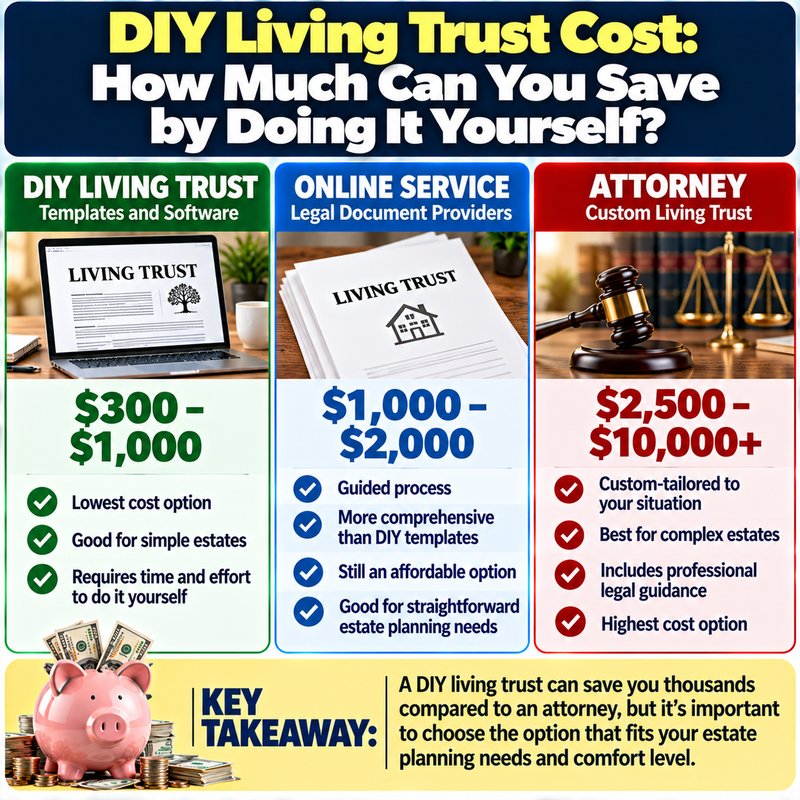
    DIY templates$0–$300Funding Process Not Included
    Online Platforms$1,000–$2,000Funding Process Not Included
    Estate Planning Attorneys$2,000–$10,000+Funding Process Not Included
    Our eState Living Trust$2,995 + Optional $95/Year For Free UpdatesFull Funding Included

    These numbers are illustrative comparisons, not independently verified national averages or a promised quote for your situation. What they do show is that the “online platforms” category and a full-funding option can land in a similar price neighborhood once you add the separate costs most DIY and online-only prices leave out — which is exactly why total scope matters more than the number at the top of the page.

    A Homeowner’s Real Cost Breakdown: Sticker Price vs. Total Spend

    Picture a hypothetical homeowner — call her Maria — who owns a primary residence, two bank accounts, and a small rental property. Maria sees an online trust document advertised at $400 and assumes that’s close to her total cost. As she reads the fine print, she finds that deed preparation for both her home and her rental are priced separately, bank retitling isn’t addressed at all, and legal review is a $300 add-on she’d need to request herself.

    Once Maria adds up what she’d actually need to finish the job — not just the document — her real total looks quite different from that initial $400 figure. This doesn’t mean the cheaper platform was a bad choice; it means she needed to see the full picture before deciding whether a higher bundled quote from another provider, one that included deed work and funding support upfront, was actually the better value for her situation.

    Cost or TaskIncluded in Quoted Price?Possible Separate Charge or WorkWhat to Confirm
    Trust document draftingYes, typicallyRarely extraDoes it include a pour-over will and POAs?
    Home deed preparationOften not includedDeed drafting fee, county recording feeWho drafts and files the deed?
    Rental property deedOften not includedSecond deed fee, recording feeDoes the price cover more than one property?
    Bank account retitlingRarely includedTime at the branch, possible notarized formsDoes the service provide retitling instructions per bank?
    Attorney reviewSometimes an add-onFlat review feeIs the reviewing attorney licensed in your state?
    Future amendmentsVaries by planPer-change fee or annual membershipHow many free changes are included per year?

    Starting Price for the Trust Document Alone

    Maria’s $400 covers the drafted trust, pour-over will, and powers of attorney — a reasonable starting point, but only one piece of the total project.

    Added Cost to Transfer the Rental Property Deed

    Because Maria owns two properties, she needs two deeds prepared and recorded, not one. If the platform charges per property for deed work, that’s an additional cost on top of the base price — and if it doesn’t offer deed services at all, she’ll need a separate preparer or local attorney for both her home and her rental.

    Recording fees themselves are set by the county, not the trust provider, so Maria should expect those as a small but real add-on regardless of which platform she chooses.

    This step is exactly where total scope starts to separate a true bargain from an incomplete one — a provider that includes deed drafting for multiple properties may ultimately save Maria money compared to one that charges per deed on top of an already-low document price.

    Added Cost to Retitle Bank Accounts

    Retitling two bank accounts usually isn’t expensive in dollar terms, but it takes time — paperwork at each branch, a certified copy of the trust, and sometimes a notarized signature. If Maria’s platform offers written retitling instructions or a funding checklist tailored to her specific banks, that’s worth more than it sounds like, since it removes guesswork from a step that’s easy to put off indefinitely once the excitement of signing the trust has worn off.

    A Quick Checklist to Compare Any Online Trust Platform

    Before choosing between two proposals, run each one through the same five checkpoints:

    1. Get an itemized written scope — don’t rely on marketing language like “complete plan.”
    2. Confirm the platform addresses your state’s specific signing and notarization rules.
    3. Ask exactly which funding tasks are included versus left to you.
    4. Check the amendment and subscription terms, including what happens if you don’t renew.
    5. Decide whether your family situation calls for paid attorney review, and confirm it’s available.

    When comparing two real proposals side by side, start with the total price including every add-on you’d realistically need, not just the base document fee. Then compare what each provider actually performs versus what they expect you to handle yourself — deed recording, bank visits, and future amendments included. The proposal with the higher upfront number sometimes ends up cheaper in total once every necessary task is accounted for.

    Where the eState Living Trust Fits Into This Cost Picture

    Create A Living Trust, through its affiliation with Bulletproof Legacy Financial, offers the eState Living Trust as one option in this comparison — not as the only answer, but as a useful reference point for what a fuller-scope package can include. According to provider materials, the plan is built around ordinary trust funding assistance, deed preparation, healthcare and financial powers of attorney, a pour-over will, beneficiary guidance, and access to professional support, subject to actual plan terms and eligibility.

    What’s Included in the Flat-Fee Package

    The flat $2,995 fee is described as covering full funding for ordinary assets, which is a meaningfully different scope than a document-only template. That doesn’t mean every specialized transfer, every third-party recording charge, or every possible future tax question is automatically covered — those still depend on the specifics of what you own and where you live. It does mean the baseline comparison against a $400 document plus separate deed and retitling fees looks different once total scope is factored in.

    How Funding Support Is Built Into the Price

    The optional $95-per-year update program is just that — optional, and not a requirement to keep using the trust. For readers weighing a lower upfront document price against a higher bundled quote, this detailed breakdown of several popular online will and trust platforms, including their base prices and subscription models, offers a useful side-by-side for anyone comparing costs across multiple providers before committing to one.

    A Quick Checklist to Compare Any Online Trust Platform

    Whether you’re weighing two online platforms or an online platform against a local attorney, the same five checkpoints apply every time. Get the itemized scope in writing, confirm your state’s execution rules are addressed, ask which funding tasks are included versus left to you, check the amendment and subscription terms, and decide whether your situation calls for paid legal review. Running through these five in order takes maybe fifteen minutes and can save you from an expensive surprise six months down the road.

    Six Questions to Ask Before You Click “Buy”

    Keep this list handy the next time you’re comparing proposals side by side:

    • What’s included in this exact price, in writing — not marketing language?
    • Does this service prepare and help record real estate deeds?
    • Who handles bank and brokerage account retitling?
    • Are attorney review and consultation included, or a separate charge?
    • What does an amendment cost after the first year?
    • What happens to my documents if I cancel or the provider shuts down?

    If a provider can’t answer one of these clearly, that’s useful information on its own. A platform confident in its scope will typically give you a straight answer without hedging, while vague responses usually mean the task falls back on you later.

    Where the eState Living Trust Fits Into This Cost Picture

    Create A Living Trust, working with Bulletproof Legacy Financial, offers the eState Living Trust as one reference point in this comparison — not the only right answer, but a useful example of what a fuller-scope package looks like next to a document-only template. According to provider materials, the plan is built around ordinary trust funding assistance, deed preparation, financial and healthcare powers of attorney, a pour-over will, beneficiary guidance, and access to professional support, subject to actual plan terms, jurisdiction, and eligibility.

    That broader scope is exactly why it’s worth lining the flat fee up against a DIY template plus its separate add-ons rather than comparing sticker prices alone. A $400 document that still needs deed work, retitling help, and a review purchased separately isn’t automatically the lower-cost option once every task is priced in.

    What’s Included in the Flat-Fee Package

    The $2,995 flat fee is described as covering full funding for ordinary assets — meaning the plan is built to address deed preparation and account retitling as part of the original price rather than as later upsells. This doesn’t mean every specialized transfer, every third-party recording charge, or every unusual asset type is automatically covered; those specifics still depend on what you own and where you live, and they’re worth confirming directly before you sign anything.

    How Funding Support Is Built Into the Price

    The optional $95-per-year update program sits outside the base fee entirely — it’s there if you want ongoing access to amendments and support, but it isn’t required to keep your trust valid or usable. For readers who want a side-by-side look at how other providers structure their base prices and subscription fees, this comparison of several popular online will and trust platforms and their pricing structures is a useful companion reference, though every provider’s terms should be confirmed directly before you decide.

    Scope and funding support aside, price comparisons are only half the equation — the other half is matching the plan to your actual family situation, which is where the next section picks up.

    Frequently Asked Questions About Reducing Living Trust Costs

    Here are quick, qualified answers to the questions that come up most often when people start comparing online trust costs.

    • Pricing varies by what’s included, not just by provider name.
    • State rules affect signing requirements, not just document content.
    • Funding and amendments are usually priced separately from the original document.

    These themes repeat throughout the questions below, since they’re the three places most people underestimate their total cost.

    If you only remember one thing from this list, make it this: ask for the full written scope before you compare any two prices against each other.

    Is a Cheaper Online Trust Always a Worse Trust?

    Not necessarily. A lower-priced template can work fine for a simple estate — a single owner, straightforward beneficiaries, no business interests or multi-state property. The risk isn’t the price itself; it’s assuming the low price covers funding, review, and future amendments when it may only cover the document.

    Before writing off a cheaper option, check whether it matches your actual situation. A low-cost platform that’s upfront about what it doesn’t include can still be the right fit, as long as you budget separately for the pieces it leaves out.

    Does the Advertised Price Include Funding My Assets?

    Often, no. Many online platforms price the trust document separately from deed preparation, recording fees, and bank or brokerage retitling. Ask this question directly rather than assuming “complete estate plan” language means every asset gets physically transferred for you.

    Can I Switch From a Will to a Trust Later Without Extra Fees?

    Usually not without cost. A will and a trust are different documents with different drafting requirements, so upgrading from one to the other typically means paying for new documents rather than a simple add-on. If you think you’ll eventually want a trust, it may be more cost-effective to start there instead of paying twice.

    Why Do Some Platforms Charge Annual Membership Fees?

    Annual fees usually cover ongoing access to digital storage, a set number of amendments, and sometimes continued attorney support. Whether that’s worth it depends on how often you expect to make changes — frequent life changes might justify the membership, while a stable situation might not need it at all.

    Will I Still Need a Notary if I Use an Online Platform?

    Possibly, depending on your state. Some states require notarization for certain estate documents or deed transfers regardless of whether the underlying document was prepared online or by a local attorney. There’s no universal rule here, so confirm your specific state’s requirements before assuming an online platform’s default process is sufficient.

    This is exactly the kind of detail covered under the factors that affect living trust costs, since execution requirements can influence both the price and the validity of your finished plan.

    Can I Add an Attorney Review After Using a DIY Platform?

    In many cases, yes. Some platforms offer a standalone review service, and independent attorneys will sometimes review documents prepared elsewhere for a flat fee. Confirm the attorney is licensed in your state and ask specifically what they’re checking for — execution validity, funding completeness, or both. For those considering setting up a trust without an attorney, it’s crucial to ensure all legal aspects are covered.

    Does a Joint Trust Cost More Than Two Individual Trusts?

    Pricing varies by provider, and it isn’t automatic that one option costs more than the other. Some platforms price joint trusts at a modest premium over an individual trust rather than charging for two entirely separate documents, while others treat them identically to two individual plans. For those considering setting up a trust without an attorney, it’s essential to consider the pros and cons. Ask for the specific joint-trust price rather than assuming it simply doubles the individual rate.

    Reducing living trust costs online comes down to five habits: reading the full written scope before you buy, confirming your state’s execution rules, budgeting funding as its own task, checking subscription and amendment terms, and adding legal review only where your family situation calls for it. The smartest next step is requesting two itemized written proposals and comparing what each one actually finishes, not just what each one charges upfront.

    Create A Living Trust, in partnership with Bulletproof Legacy Financial, is one option built around full funding support if you want to see how a bundled approach stacks up — you can schedule a free estate-planning consultation to compare it against your own numbers.

  • The Benefits of Using Professional Trustee Services in Trust Management

    The Benefits of Using Professional Trustee Services in Trust Management

    How Professional Trustee Services Can Support Trust Administration

    Compare fiduciary expertise, impartial decision-making, administrative responsibilities, and ongoing fees before appointing a professional trustee.

    Hiring a professional trustee can mean the difference between a trust that runs smoothly for decades and one that collapses into years of family disputes. The short answer: professional trustee services offer fiduciary administration, investment oversight coordination, impartial decision-making, and organized reporting, but whether that’s worth the cost depends on the trust’s size, the beneficiaries’ needs, and the fee schedule you’re agreeing to.

    Many families assume a professional trustee is either essential for every trust or unnecessary overkill for a simple one — neither assumption holds up once you look at how trust administration actually works. Create A Living Trust has walked plenty of families through this exact decision, and the pattern is almost always the same: the right choice hinges less on the size of the trust and more on how much ongoing conflict, complexity, or hands-on management the assets inside it will require.

    Key Takeaways

    • Professional trustee services may offer fiduciary administration, investment coordination, and impartial decision-making, but a professional trustee isn’t automatically necessary or cheaper than a willing, capable family member.
    • Trustee compensation is separate from the one-time cost of creating a living trust — hiring a fiduciary to administer a trust is a different expense than paying an attorney or platform to draft one.
    • Corporate trustees and individual professional fiduciaries differ in continuity, minimum asset requirements, and flexibility, which matters when comparing providers.
    • Written fee schedules matter more than headline numbers — the lowest quoted base fee isn’t always the lowest total cost once custody, investment, and extraordinary-service charges are added.
    • Further down, you’ll find a side-by-side comparison table and a due-diligence checklist that can help you evaluate whether a family trustee, a professional, or a hybrid arrangement fits your situation best.
    Professional-Trustee-Services

    Compare fiduciary expertise, impartial decision-making, administrative responsibilities, and ongoing fees before appointing a professional trustee.

    Before appointing anyone to manage a trust, it helps to separate four distinct questions that often get blurred together: does this person or institution have the technical skill to manage the assets, will they treat all beneficiaries fairly, are they willing and able to handle the day-to-day administrative load, and what will it actually cost on an ongoing basis? A trustee can score well on one of these and poorly on another — a family member might be deeply fair but lack investment experience, while a corporate trustee might be procedurally rigorous but slow to respond to a beneficiary’s urgent request.

    These four factors rarely move together, which is exactly why trust documents sometimes name co-trustees or build in a mechanism to bring in professional help later. Understanding how a living trust works as a legal structure is the starting point, because the trustee’s authority, duties, and limits all flow from the terms written into that document — not from general assumptions about what trustees typically do.

    Throughout this guide, we’ll look at what a professional trustee actually does day to day, how individual and corporate fiduciaries differ, what drives their fees, and how a family with competing interests might evaluate whether outside administration makes sense for their specific trust.

    What Is a Professional Trustee, and How Do They Differ From Trust Creation Services?

    A professional trustee is a person or institution paid to administer a trust according to its terms — managing assets, making distributions, keeping records, and acting as a fiduciary on behalf of the beneficiaries. This is a fundamentally different service than the one that creates the trust document in the first place. A trust can be drafted, funded, and sitting ready for years before any professional trustee is ever appointed or begins acting.

    It’s worth being precise about the people involved, because titles get used loosely. The grantor (also called the settlor) is the person who creates the trust and typically funds it with their assets. The trustee is whoever currently holds legal authority to manage those assets — this could be the grantor themselves, a family member, or a hired professional.

    A successor trustee is named in the document to take over later, but naming someone doesn’t give them authority immediately; they generally need a triggering event (like incapacity or death) plus formal acceptance of the role before they can act. A beneficiary is someone entitled to receive distributions or benefit from the trust, and a trust protector — if one is named — holds limited oversight powers but isn’t the trustee.

    Professional Trustee vs. Trust Drafting Attorney

    An estate-planning attorney drafts the trust document, advises on its structure, and may update it over time, but drafting the document doesn’t mean the attorney manages the assets inside it. A professional trustee, by contrast, takes on the fiduciary role of actually running the trust — opening accounts, making distributions, filing required notices, and answering to beneficiaries. Some attorneys also serve as professional trustees, but the two functions are legally and practically distinct, and a trust can use one without the other.

    Professional Trustee vs. Trust Funding Services

    Trust funding is the process of retitling assets — homes, accounts, investments — into the name of the trust so they’re actually governed by it. This typically happens once, near the time the trust is created, and it’s a separate task from ongoing trustee administration. A service that helps with funding is making sure the trust holds the right assets; a professional trustee is managing those assets and making decisions about them for years afterward. Confusing the two can lead someone to assume funding assistance also covers lifetime trustee duties, which it generally does not.

    • Trust drafting attorney: Writes the legal document and structures its terms.
    • Funding service: Retitles assets into the trust’s name, typically a one-time process.
    • Professional trustee: Administers the trust on an ongoing basis — managing assets, making distributions, and reporting to beneficiaries.
    • Financial or tax adviser: Provides specialized guidance the trustee may rely on but doesn’t hold fiduciary authority over the trust itself.

    Currently Acting Trustee vs. Named Successor Trustee

    Most people who create a revocable living trust name themselves as the initial trustee, which lets them manage their own assets exactly as they did before, just now titled in the trust’s name. The successor trustee — whether a family member or a professional — is written into the document to step in later, usually upon the grantor’s incapacity or death. It’s a mistake to assume a named professional successor is already “serving” during the grantor’s lifetime; until the triggering condition occurs and the successor formally accepts the role, they typically have no authority to act on the trust’s behalf.

    This distinction matters when families compare costs, too. A grantor capable of managing their own trust pays nothing extra for trustee services during that period — fees for a professional successor generally don’t begin until that person actually steps into the role.

    Corporate Fiduciary vs. Individual Professional Trustee

    Corporate trustees — trust companies or bank trust departments — offer institutional continuity, formal recordkeeping systems, and staff that doesn’t disappear due to illness or retirement. They often come with minimum asset thresholds, standardized fee schedules, and investment platforms built into the relationship.

    Individual professional fiduciaries, such as a licensed private trustee, may offer more personal attention and flexibility but face the same mortality and capacity limits as any individual, which raises succession questions of its own. Neither type is universally better; the right fit depends on the trust’s size, asset mix, and how much personal familiarity with the family actually matters for the decisions ahead.

    Core Duties a Professional Trustee Performs

    Every trustee, professional or not, answers to the same basic fiduciary standards: loyalty to the beneficiaries, prudence in managing assets, and strict adherence to what the trust document actually says. What changes with a professional trustee isn’t the legal standard — it’s the consistency and documentation behind how that standard gets met. A corporate or individual fiduciary typically brings established procedures for tracking decisions, which can reduce (though never fully eliminate) the risk of errors or disputes down the road.

    It helps to walk through what this looks like day to day. A newly appointed trustee generally starts by confirming their authority and reviewing the trust document, then inventories the assets, verifies how they’re titled, and sets up separate accounts so trust money is never mixed with anyone’s personal funds. From there, distributions get made according to the terms of the trust, records get kept, and periodic reports go out to beneficiaries. None of this happens automatically — a professional trustee doesn’t gain the authority to retitle property or alter how assets are distributed just because they’ve accepted the role; they’re bound by whatever the trust document actually authorizes.

    Recordkeeping and Beneficiary Reporting

    One of the most concrete benefits professional trustees offer is organized, consistent recordkeeping. Rather than relying on memory or scattered paperwork, a professional fiduciary typically maintains a formal ledger of income, expenses, and distributions, and shares periodic accountings with beneficiaries. The exact frequency and format of this reporting depends on the trust’s terms and applicable state law — there’s no single nationwide standard dictating how often a trustee must report — but having a documented paper trail tends to reduce the “where did the money go” disputes that can otherwise fracture families.

    Distribution Decisions and Discretionary Requests

    When a trust gives the trustee discretion over distributions — say, allowing payments for a beneficiary’s health, education, or general support — someone has to interpret what that language actually permits. A professional trustee generally applies the same criteria consistently across all beneficiaries, which can reduce the appearance of favoritism. That said, discretion cuts both ways: a cautious professional trustee may hesitate to approve a request that isn’t clearly spelled out in the document, even if a family member trustee might have made the call instantly based on personal knowledge of the situation.

    Tax Filing and Coordination With CPAs

    Trusts often have their own tax filing obligations, and a professional trustee is typically responsible for making sure those obligations get handled — but that’s different from personally preparing the return or offering tax advice. In practice, most professional trustees coordinate with a CPA or tax preparer rather than filing returns themselves, and they rely on qualified tax professionals for anything beyond routine compliance. Anyone serving as trustee, professional or otherwise, should confirm who is actually responsible for filing versus who is simply overseeing that it gets done.

    Investment Oversight and Asset Custody

    If the trust holds investment accounts, the trustee has an ongoing duty to manage those assets prudently — which doesn’t necessarily mean picking stocks personally. Many professional trustees work with investment advisers, sometimes affiliated with their own institution, to manage the portfolio. This is an area where it pays to ask pointed questions: where are assets custodied, is the investment adviser affiliated with the trustee, and who bears any advisory fees charged on top of the trustee’s own compensation?

    Managing Conflict Among Beneficiaries

    A trust with multiple beneficiaries — especially one involving unequal distributions, blended families, or a beneficiary who needs long-term financial oversight — creates fertile ground for disagreement. A neutral professional trustee can reduce the perception that one beneficiary is being favored, simply because they have no personal stake in the outcome. But impartiality isn’t a guarantee of harmony; a professional trustee who lacks personal knowledge of a family’s history can also frustrate beneficiaries who feel unheard, so communication style and escalation procedures matter just as much as neutrality itself.

    What Drives the Cost of Professional Trustee Services?

    Professional trustee compensation is a completely separate expense from the cost of creating the trust document in the first place. It’s easy to conflate the two, especially when researching estate planning for the first time, but drafting a trust is typically a one-time cost, while trustee compensation is an ongoing expense that continues for as long as the professional serves. For a closer look at how trustee fees fit alongside investment management, tax preparation, and legal costs over the life of a trust, this breakdown of the ongoing costs of maintaining and administering a living trust walks through how these categories typically interact.

    Percentage-Based Fees vs. Flat Annual Fees

    Professional trustees generally charge in one of two ways: a percentage of the assets under administration, or a flat annual administrative fee, sometimes with a stated minimum regardless of trust size. Percentage-based fees scale with the trust’s value, which can work in a family’s favor for smaller trusts but add up quickly for larger ones. Flat or hourly fee structures may suit trusts with modest but complex administrative needs. There’s no universal market-average percentage that applies nationwide — fee schedules vary by provider, trust size, and asset complexity, so it’s worth getting specifics in writing rather than relying on rough estimates.

    What’s Typically Included in Trustee Fees

    A base trustee fee usually covers the core fiduciary functions: reviewing the trust, maintaining records, processing routine distributions, and preparing standard reports for beneficiaries. Some providers bundle basic investment oversight into this fee as well, though that varies by institution.

    What’s Usually Billed Separately

    Extraordinary services often come with additional charges layered on top of the base fee. Common add-ons include:

    • Investment management or advisory fees, especially if the trustee uses an affiliated investment platform
    • Property management fees for real estate held in the trust, such as a rental property
    • Legal fees for attorney consultation on complex distribution questions or disputes
    • Tax preparation fees paid to an outside CPA
    • Extraordinary administrative charges for things like selling a business interest or handling litigation
    • Account termination or asset-transfer fees when the trustee’s role ends

    Because these charges can overlap or stack depending on the provider, requesting a written, all-in estimate before appointment is one of the more useful steps a family can take. It’s also worth confirming which account pays each charge — some fees come directly out of trust principal, while others might be billed to income generated by the trust’s investments.

    Questions to Ask Before Signing a Trustee Agreement

    Before any appointment is finalized, it’s reasonable to ask for a complete written fee schedule, confirmation of any minimum annual charge, a description of what counts as an “extraordinary” service subject to additional billing, and a clear answer about who absorbs custody and investment-related fees. None of this guarantees a lower total cost, but it does prevent surprises once administration is underway.

    How a Family With Multiple Beneficiaries Should Evaluate an Independent Trustee

    Consider a hypothetical family with three adult beneficiaries, one of whom has served as the primary caregiver for an aging parent in the years before the parent’s passing. The trust holds the family home, a diversified investment account, and a rental property that generates monthly income. Because one sibling has provided years of unpaid caregiving and another lives out of state, the family worries that whoever manages distributions and property decisions could face accusations of favoritism — which is exactly the kind of situation where an independent professional trustee sometimes gets considered.

    Rather than picking a provider based on a single phone call, this family would benefit from comparing two or more candidates side by side, focusing on specifics rather than general reputation.

    1. Request a Written Fee Schedule

    Each candidate should provide a complete, itemized fee schedule, not just a headline percentage. One provider might quote a lower base rate but charge separately for property management on the rental, while another bundles that service into its standard fee — meaning the lower quote on paper isn’t necessarily the lower total cost once the rental property enters the picture.

    Asking for a sample annual cost projection based on the trust’s actual asset mix — home, investments, rental income — gives a much clearer comparison than a generic brochure rate.

    2. Ask About Minimum Trust Size Requirements

    Some providers decline trusts below a certain asset threshold, while others specialize in smaller estates. This family’s trust, which includes real property and investments, should confirm upfront whether either candidate has size requirements that could affect eligibility or pricing tiers.

    3. Review Termination and Resignation Terms

    Before appointment, it’s worth understanding what happens if the relationship doesn’t work out. Can the trustee resign, and under what notice period? What fees, if any, apply when the role ends or transfers to a successor? These terms depend entirely on the trust document and the provider’s own policies — assuming a beneficiary can remove a trustee at will, or that a trustee can step down instantly, isn’t a safe default assumption anywhere.

    Getting these answers in writing before the appointment is far easier than negotiating them after a dispute has already started.

    4. Confirm Investment Custody Arrangements

    If either candidate manages investments through an affiliated advisory arm, the family should ask how that affiliation is disclosed and whether any additional advisory fees apply on top of the trustee’s base compensation. Understanding where assets are actually held in custody, and who has discretionary authority over investment decisions, helps clarify where potential conflicts of interest might arise.

    5. Understand the Escalation and Dispute Procedure

    Finally, the family should ask each candidate how disagreements get handled — is there a formal process for a beneficiary to raise a concern, and does the provider offer sample reporting formats so everyone knows what kind of statements to expect? A professional trustee doesn’t erase family disagreement simply by being neutral; having a clear escalation path matters just as much as impartiality itself.

    The table below summarizes how different trustee arrangements compare across the factors that matter most.

    Trustee OptionPotential BenefitsLimitations and CostsQuestions to Verify
    Family TrusteePersonal knowledge of beneficiaries; typically no trustee feePossible conflicts of interest; limited investment or tax expertise; risk of illness or unavailabilityIs this person willing and able to serve long-term? Do they understand their fiduciary duties?
    Individual Professional FiduciaryPersonal attention combined with fiduciary experienceSubject to the same mortality and capacity limits as any individual; fees vary widelyWhat is their succession plan if they become unable to serve? What’s their fee structure in writing?
    Corporate TrusteeInstitutional continuity; formal recordkeeping and reporting systemsMay have minimum asset thresholds; potentially less flexible on discretionary requestsWhat’s the minimum trust size? Are investment services affiliated, and what do they cost?
    Family Trustee Supported by AdvisersRetains personal family oversight while adding specialized expertise as neededRequires coordinating multiple professionals; advisory fees add up separatelyWhich decisions require professional input, and who pays for that advice?

    A Decision Framework for Choosing Between a Family Trustee and a Professional Trustee

    There’s no single formula that tells every family whether a professional trustee is worth the cost. What tends to matter most is the combination of trust size, expected duration, asset complexity, and the family’s own conflict history. A small, uncomplicated trust with a single willing and capable successor trustee may never need outside administration. A trust holding a business, multiple rental properties, or designed to last across generations is a different story entirely — especially if no family member feels equipped, or willing, to take on the fiduciary responsibility.

    Checklist: Signs a Professional Trustee May Be the Better Fit

    • The trust is expected to last many years or span multiple generations
    • Beneficiaries have a history of conflict or unequal financial need
    • The trust holds a business interest, multiple properties, or assets requiring specialized management
    • No family member is available, qualified, or willing to serve as trustee
    • A beneficiary requires long-term oversight due to age, disability, or financial inexperience

    Many families land somewhere in the middle, naming a family member as trustee while retaining professional advisers — an accountant, an investment manager, an attorney — for the specialized pieces of administration. This hybrid approach can preserve personal familiarity with beneficiaries while still bringing in expertise where it’s genuinely needed.

    Hypothetical Scenario: A Blended Family With a Multi-Generational Trust

    Picture a blended family where the trust is meant to provide for a surviving spouse during their lifetime, then distribute remaining assets to children from a prior marriage after the spouse’s death. This kind of structure creates an inherent tension: the surviving spouse may want to use trust assets generously now, while the remainder beneficiaries have an interest in preserving principal for later.

    A neutral professional trustee, bound strictly to the trust’s terms, can help manage that tension by applying consistent standards rather than being caught in the middle of family loyalty. According to one industry source that examined both the advantages and drawbacks of hiring outside fiduciaries, one analysis of professional trustee benefits and limitations, a corporate or individual fiduciary’s lack of personal stake in the family’s outcome is often cited as the primary reason families choose this structure for blended or multi-generational trusts, even though the same neutrality can feel impersonal to beneficiaries who expected more flexibility.

    Can a Trustee Be Removed or Replaced?

    Whether a trustee — professional or family member — can be removed depends almost entirely on what the trust document says and what state law applies. Some trusts give beneficiaries or a trust protector explicit authority to remove and replace a trustee under specified conditions; others are silent on the topic, which can make removal a far more complicated process requiring court involvement. It’s a mistake to assume a beneficiary can simply “fire” a trustee at will, just as it’s a mistake to assume a trustee can resign the moment they decide they’re done.

    A separate analysis of professional trustee considerations notes that fiduciary duties, reporting obligations, and removal procedures generally depend on how the trust itself is drafted, which is one reason attorney review of the trustee provisions matters before anyone signs an agreement. As another discussion of trustee duties and alternative arrangements points out, even self-trusteed arrangements where the grantor manages their own trust carry fiduciary and compliance obligations that shouldn’t be assumed away simply because no outside trustee is involved.

    Common Grounds for Trustee Removal

    When a trust document does address removal, common grounds typically include a trustee’s failure to act in beneficiaries’ best interests, serious mismanagement of assets, persistent conflicts of interest, or simple incapacity to continue serving. Some documents also allow removal without cause, provided a specified majority of beneficiaries or a trust protector agrees.

    • Breach of fiduciary duty or mismanagement of trust assets
    • Failure to provide required accountings or communicate with beneficiaries
    • Unresolved conflicts of interest, such as self-dealing
    • Incapacity, resignation, or inability to continue serving
    • Removal without cause, if explicitly permitted by the trust document and agreed to by the required parties

    Even when grounds exist, the actual process for removing a trustee — whether it requires unanimous beneficiary consent, a petition to a court, or simply written notice — varies by trust and by state, which is another reason this provision deserves careful review before a professional trustee is ever appointed.

    Role of the Trust Document in Removal Procedures

    Ultimately, the trust document controls nearly everything about removal: who has the power to initiate it, what notice is required, how a replacement gets named, and what happens to unfinished administrative matters during the transition. A well-drafted trust typically anticipates these scenarios in advance, specifying a clear successor and a defined process rather than leaving beneficiaries to figure it out after a dispute has already erupted. This is exactly the kind of provision worth flagging for an estate-planning attorney during drafting or review, long before a professional trustee is ever brought on board.

    How the eState Living Trust Plan Relates to Trustee Administration

    It’s worth being clear about where a service like the eState Living Trust plan fits into this picture, because trustee administration and trust creation are genuinely different services. The eState Living Trust, offered through Bulletproof Legacy Financial, focuses on drafting the trust document, preparing property deeds, completing the ordinary funding process, and providing trustee and successor-trustee support materials — along with powers of attorney, a pour-over will, and access to professional guidance.

    Pricing for this type of plan is typically a one-time cost, separate from the optional $95-per-year update program, which covers document updates rather than ongoing trust administration.

    None of this is the same as hiring a professional trustee to actually administer the trust for years after it’s created. The eState package can help organize records and prepare a named successor to understand their responsibilities, but it doesn’t include lifetime appointment of a corporate fiduciary, payment of an independent trustee’s compensation, or unlimited ongoing investment and tax services.

    For families weighing whether their drafting and funding costs compare reasonably against the broader market, it can help to review living trust creation costs across different service types — DIY templates, online platforms, attorneys, and full-service providers — while keeping in mind that none of those figures include what a professional trustee would later charge to administer the trust.

    A living trust document and a professional trustee are not the same purchase, even though it’s easy to assume one automatically includes the other. The eState Living Trust plan, offered through Create A Living Trust and Bulletproof Legacy Financial, is built around drafting the trust, preparing property deeds, and completing the ordinary funding process — not around appointing or paying an independent fiduciary to manage the trust for decades afterward. Understanding where that line sits helps set realistic expectations about what a trust-creation service actually delivers.

    The standard eState package is a one-time cost of $2,995, with an optional $95-per-year program available for document updates. That optional fee covers keeping the trust’s language current as circumstances change — it is not a trustee fee, and it does not pay for ongoing administration, investment oversight, or tax coordination once a successor trustee steps into the role.

    Trust creation answers the question “what does the document say and who holds the assets?” Trustee administration answers a different question entirely: “who manages those assets, year after year, once someone needs to act on the trust’s behalf?” Confusing the two can lead a family to assume a drafting service also supplies ongoing fiduciary management, which it typically does not.

    That distinction matters most at the moment a successor trustee is actually called into service — whether that’s a family member stepping in after a parent’s incapacity, or a professional fiduciary being appointed for the first time. The trust document itself dictates what authority that successor has, what discretion they’re given over distributions, and what reporting obligations apply, regardless of which service originally drafted the trust.

    Families sometimes assume that because a provider helped fund the trust, that same provider will also step in to manage it later. That’s rarely how these plans are structured, which is why it’s worth reading the plan terms closely and asking directly whether trustee administration is included, available as a referral, or entirely outside the provider’s scope.

    Funding Support Included in the eState Living Trust Package

    Per the plan’s stated scope, “full funding included” generally refers to the ordinary process of retitling assets like a primary residence or standard financial accounts into the name of the trust at the time it’s created. It typically includes deed preparation, guidance for beneficiaries, and trustee and successor-trustee support materials meant to help whoever eventually serves understand their responsibilities. That support is educational and preparatory — it’s not the same as the provider stepping into the trustee role itself.

    What the eState Plan Does Not Cover Regarding Ongoing Trustee Services

    It’s worth being direct about the boundaries here. The standard eState package is not described as including lifetime appointment of a corporate trustee, ongoing administration by a hired fiduciary, or payment of an independent professional trustee’s compensation. If a family later decides a corporate trust company or individual professional fiduciary should take over administration, that’s a separate engagement, negotiated and paid for independently of the original trust-creation cost.

    The same applies to specialized ongoing services. Unlimited attorney consultation, continuous investment management, and open-ended tax advice generally fall outside an ordinary trust-creation plan’s scope, even when the plan includes access to professional support during the drafting and funding process. Future needs — a complex distribution dispute, a business sale inside the trust, a multi-year accounting disagreement — typically require separately retained professionals.

    None of this diminishes what a well-funded, properly drafted trust accomplishes. It simply means that organizing the document and preparing a named successor is a different task than hiring someone to administer the trust for the next twenty years.

    Service AreaTypically Included in Trust-Creation PlansTypically Separate
    Drafting the trust documentYes—
    Ordinary asset funding (deeds, titling)Yes—
    Trustee/successor educational supportYes—
    Ongoing professional trustee administration—Yes
    Independent investment management—Yes
    Annual tax preparation for the trust—Yes

    Learn More About Trustee Options in a Free Educational Webinar

    Because trustee selection involves so many moving pieces — fees, custody arrangements, removal provisions, and family dynamics — it often helps to see these concepts explained in context rather than piecing them together from a document alone. Create A Living Trust periodically hosts a free estate-planning webinar that walks through trust structure and successor planning basics, which can be a useful starting point before deciding whether a professional fiduciary, or some hybrid arrangement fits a particular trust.

    Frequently Asked Questions

    Trustee questions tend to resurface at the exact moments families can least afford confusion — right after a parent’s incapacity, or in the weeks following a death. The answers below address the questions that come up most often when families are deciding how a trust should actually be administered once someone has to step into the trustee role.

    As with everything else in this guide, these answers are general education rather than advice for a specific trust, since the actual terms of the document and the laws of the relevant state will ultimately control. For more information on managing your wealth and assets, you might find this professional trustee services guide useful.

    Can a Family Member and a Professional Trustee Serve Together as Co-Trustees?

    Many trusts allow for co-trustees, pairing a family member’s personal knowledge of beneficiaries with a professional’s administrative and investment expertise. Whether this arrangement is available, and how decision-making authority is split between them, depends entirely on how the trust document is drafted — some require joint approval for every decision, while others assign specific duties to each co-trustee separately.

    Does a Professional Trustee Need to Be Licensed in My State?

    Licensing and registration requirements for professional fiduciaries vary by state, and there is no single nationwide credential required everywhere. Corporate trustees, such as bank trust departments, typically operate under banking or trust-company regulations, while individual professional fiduciaries may be subject to state-specific registration rules. Confirming a candidate’s current standing in the relevant state is a reasonable step before appointment.

    What Happens if a Professional Trustee Resigns Mid-Administration?

    Resignation terms are generally governed by the trust document and applicable state law, and a trustee typically cannot simply walk away without following the specified process. Most arrangements require formal notice, a transition period, and a handover of records and assets to a successor. It is not safe to assume a trustee can resign immediately without regard to what the document requires.

    Are Professional Trustee Fees Tax-Deductible for the Trust?

    Trustee fees may be deductible as an administrative expense of the trust in some circumstances, but deductibility depends on current tax rules and the specific nature of the fee. This is a question for a qualified tax professional familiar with trust taxation rather than a general assumption applied the same way to every trust.

    Because trust tax treatment can shift and varies by situation, it’s worth having the trustee’s CPA or the family’s own tax adviser confirm how specific fees are categorized each filing year rather than relying on a blanket rule.

    How Often Will a Professional Trustee Communicate With Beneficiaries?

    Reporting frequency isn’t standardized nationwide — it depends on what the trust document requires and what the provider’s own service standards promise. Some professional trustees issue quarterly statements, others annually, and some provide online portals with real-time account access. Asking for a sample reporting format before appointment is the clearest way to know what to expect.

    Can Beneficiaries Request a Different Trustee After One Is Appointed?

    Beneficiaries may have the ability to request a change, but whether that request leads to an actual removal depends on the trust’s specific provisions and, in some cases, court involvement. A trust that gives a trust protector or a majority of beneficiaries explicit removal power functions very differently from one that’s silent on the subject.

    Where the document is silent or ambiguous, resolving a request to change trustees may require legal guidance and, potentially, a formal petition — which is why clear removal language drafted up front tends to save families significant time and expense later.

    Does a Small Trust Ever Benefit From a Professional Trustee?

    It can, though it’s less common. A small trust with a straightforward asset mix and a willing, capable family successor usually doesn’t need professional administration. But a small trust involving a beneficiary who needs long-term financial oversight, or significant conflict among a handful of beneficiaries, might still benefit from neutral administration even at a modest asset level.

    In these cases, the decision usually comes down to weighing the fixed or minimum fees a provider charges against the actual complexity and risk of mismanagement if a family member takes on the role instead.

    What Documents Should I Review Before Hiring a Corporate Trustee?

    Document or DisclosureWhy It Matters
    Written fee scheduleConfirms base fees, minimums, and extraordinary-service charges
    Investment custody disclosureClarifies where assets are held and any affiliated-adviser relationships
    Sample accounting/reportShows what kind of reporting beneficiaries will actually receive
    Resignation and removal termsExplains how the relationship can end and what happens to records
    Conflicts-of-interest policyDiscloses how the provider manages affiliated services or products

    Reviewing these documents before signing anything gives a much clearer picture than a general sales conversation ever will. A provider willing to share all of this upfront, without hesitation, is generally signaling a more transparent working relationship going forward. For more insights on choosing the right trustee, you might find this article on estate planning helpful.

    It’s also reasonable to ask how long the provider has served trusts with a similar asset mix — a trustee experienced with investment portfolios may be less familiar with managing a rental property, for example, which matters if the trust holds both.

    None of this guarantees a particular outcome, but it does reduce the odds of discovering an unexpected fee or policy months into the administration.

    How Does a Professional Trustee Handle Real Estate or Business Interests in a Trust?

    Real estate and business interests typically require specialized handling beyond standard investment oversight — property management, insurance review, maintenance decisions, or, in the case of a business, operational oversight or a sale process. Professional trustees often coordinate with outside property managers, business valuation experts, or industry specialists rather than handling these tasks personally, and these services are usually billed separately from the base trustee fee.

    What’s the Difference Between a Trustee and a Trust Protector?

    RolePrimary FunctionTypical Authority
    TrusteeAdministers the trust day to dayManages assets, makes distributions, maintains records
    Trust ProtectorProvides limited oversight of the trusteeMay have power to remove a trustee, approve certain changes, or interpret ambiguous terms, if granted in the document

    A trust protector is not automatically included in every trust, and when one is named, their authority is strictly limited to whatever powers the document actually grants — it’s not a parallel trustee role. Some trusts use a trust protector specifically as a check on a professional trustee, giving beneficiaries an avenue for oversight without requiring court intervention for routine disagreements.

    Deciding whether a trust protector provision makes sense is a drafting question best raised with an estate-planning attorney at the time the trust is created, since adding this role after the fact can be more complicated than including it from the start.

    Choosing how a trust will be administered — by a family member, a professional fiduciary, or some blend of both — is ultimately a decision that depends on the trust’s complexity, the beneficiaries’ needs, and how clearly the document spells out fees, discretion, and removal rights. Reviewing these provisions with qualified local estate-planning counsel before naming or appointing a trustee remains the most reliable way to avoid surprises later.

  • Is a Living Trust Worth the Cost? How to Evaluate the Value

    Is a Living Trust Worth the Cost? How to Evaluate the Value

    Is a Living Trust Worth the Cost? Benefits and Expenses to Weigh Before Deciding

    Compare the Price With Probate Planning, Incapacity Planning, Privacy, Convenience, Maintenance, and Your Estate’s Complexity

    Is a living trust worth the cost? The honest answer is: it depends entirely on what you own, where you own it, and how much control you want over what happens to it while you’re alive and after you’re gone.

    A living trust isn’t a one-size-fits-all product, and anyone who tells you it is probably hasn’t looked closely at your situation. Some families save thousands of dollars and months of court delays by setting one up. Others spend money on a trust that sits unfunded in a drawer, offering no more protection than the will they already had. Resources like Bulletproof Legacy’s eState Plan have emerged specifically to help people sort through this decision with structured guidance rather than guesswork, which matters because the stakes aren’t just financial—they’re about whether your family avoids probate court during one of the hardest times of their lives.

    Key Takeaways: Is a Living Trust Worth It?

    • A living trust is worth the cost only when its benefits—probate avoidance for funded assets, incapacity planning, privacy, and multistate property coordination—actually match your situation, not just the size of your estate.
    • Setup costs range from under $300 for DIY templates to $10,000 or more for attorney-drafted complex trusts, but the real cost includes funding, maintenance, and future amendments, not just the initial document.
    • An ordinary revocable living trust is not an automatic tax shelter or creditor-protection tool—those outcomes require specific, deliberate drafting that most standard trusts don’t include.
    • Simpler will-based plans can be entirely sufficient for straightforward estates, especially in states where probate is fast and inexpensive.
    • Services like Bulletproof Legacy’s eState Plan offer a structured middle path between DIY templates and full attorney representation—more on how that comparison plays out later in this article.
    Is-A-Living-Trust-Worth-The-Cost

    Quick Answer: Value Depends on Your Goals, Assets, State, and Family Situation

    Whether a living trust is “worth it” can’t be answered by comparing a flat dollar figure against the price of a will. The value depends on a combination of factors: what kind of assets you hold, whether you own real estate in more than one state, how complicated your family situation is, how much privacy you want, and how much responsibility you’re willing to take on to keep the plan maintained over time.

    A living trust that’s properly funded and maintained can save your family from a lengthy, public probate process. A living trust that’s created but never funded—meaning your assets were never legally retitled into it—offers almost none of those benefits. The document itself isn’t magic. It’s a tool, and tools only work when they’re used correctly.

    What a Living Trust Actually Costs

    Before weighing benefits, it helps to understand the real range of costs involved, because that range is wider than most people expect. For a full breakdown of living trust cost considerations across different service models, it’s worth looking at how pricing scales with complexity and support level.

    DIY and Template Costs

    Do-it-yourself trust templates typically cost under $300 to around $1,000. These are standardized documents you fill out yourself, with little to no personalized guidance. They can work for very simple situations, but there’s no one checking whether you’ve titled your assets correctly or whether your state’s requirements are met.

    Online Platform Pricing

    Online platforms that generate trust documents with some guided input typically run from about $1,000 to $2,000. These sit between pure DIY and full attorney service, offering more structure and sometimes customer support, though the level of personalized legal advice still varies significantly between providers.

    Attorney-Drafted Trust Costs for Simple Estates

    For a straightforward estate, an attorney-drafted trust generally costs between $2,500 and $4,000. This typically includes the trust document itself along with related estate-planning paperwork like a pour-over will, power of attorney, and healthcare directive.

    A lawyer handling a basic estate plan may also charge $1,500 or more just for the trust creation, with amendments to fix simple errors potentially costing another $300 to $500 later. These numbers add up quickly if your plan needs revisions down the road.

    Attorney-Drafted Trust Costs for Complex Estates

    For complex estates—think multiple properties, business interests, blended families, or significant assets spread across states—attorney fees can run from $4,000 up to $10,000 or more. Complexity drives cost because more legal structuring, more coordination with other professionals, and more drafting time is required to make sure the trust actually accomplishes what you intend.

    Here’s a general comparison of what you might expect to pay across service models:

    • DIY/template: under $300–$1,000
    • Online platform: approximately $1,000–$2,000
    • Attorney-drafted (simple estate): approximately $2,500–$4,000
    • Attorney-drafted (complex estate): approximately $4,000–$10,000+

    Potential Benefits to Weigh Against the Cost

    Cost only tells half the story. The other half is what you’re actually buying—and that depends heavily on which benefits apply to your life. Also, depending on which state your trust is in, different laws and probate thresholds apply.

    Probate Planning for Funded Assets

    One of the most commonly cited benefits of a living trust is that properly funded assets can bypass the probate process entirely. Probate is the court-supervised process of validating a will and distributing assets, and according to an AARP survey, it takes roughly 18 months on average to settle a typical estate this way. Settlement costs from probate can also eat up as much as 5% of an estate’s value.

    That said, this benefit only applies to assets that have actually been transferred into the trust’s name. A trust document that exists but was never used to retitle your home, bank accounts, or investment accounts provides no probate protection at all for those assets.

    Incapacity Management

    A revocable living trust lets you name a successor trustee who can step in and manage your assets if you become unable to do so yourself, whether due to illness, injury, or cognitive decline. This is one of the benefits that has nothing to do with estate size—it’s about continuity of financial management during your lifetime, not just distribution after death.

    Without this kind of structure, your family might need to petition a court for guardianship or conservatorship just to pay your bills or manage your property while you’re incapacitated. That process can be slow, expensive, and emotionally draining at a time when your family is already under stress.

    Privacy Protection

    Wills become part of the public record once they go through probate, meaning anyone can look up what you owned and who you left it to. A living trust, by contrast, is typically administered privately, outside the courtroom. For people who value keeping their financial affairs out of public view, this privacy protection can be a meaningful reason to choose a trust over a will-only plan. The differences between a trust and will can help determine what’s best suited for an individual. For some people whose assets fall under their state probate threshold, sometimes a will-only plan is sufficient.

    Continuity and Successor-Trustee Management

    A trust provides a structured mechanism for how a successor trustee steps in, what their duties are, and how beneficiaries receive distributions. This structure can reduce confusion and conflict among family members because the roles and rules are spelled out in advance rather than left to interpretation.

    BenefitDepends On
    Probate avoidanceProper funding of assets into the trust
    Incapacity managementNaming and empowering a successor trustee
    PrivacyState probate transparency rules
    Multistate coordinationOwning real property in more than one state

    Notice that none of these benefits are automatic just because a trust document exists. Each one requires the trust to be set up and maintained correctly, which is why the “worth it” question is really a question about implementation, not just paperwork.

    Multistate Real Estate Coordination

    If you own real estate in more than one state, a living trust can be especially valuable. Without a trust, your heirs could face separate probate proceedings in each state where you own property—a process known as ancillary probate. That means extra court filings, extra fees, and extra delays in more than one jurisdiction. Consolidating multistate property into a single trust can simplify this considerably.

    Costs and Responsibilities That Continue After Creation

    Setting up the trust is just the first step. The ongoing responsibilities that follow often get overlooked when people compare initial price tags.

    Funding and Retitling Assets

    Funding means legally transferring ownership of your assets into the trust’s name—retitling real estate deeds, updating account ownership at your bank or brokerage, and reassigning business interests. This step is where many trusts fail to deliver on their promise, simply because it was never completed. Real estate transfers may involve filing fees to record the new title, and some assets, like retirement accounts, shouldn’t be retitled into a trust at all because doing so can trigger early withdrawal tax consequences.

    Future Amendments and Legal Updates

    Life changes—marriages, divorces, new children, new property, moving to a different state—often require updates to your trust. Each amendment can carry its own cost, whether that’s a few hundred dollars for a simple fix or more for substantial restructuring. A trust isn’t a “set it and forget it” document; it needs periodic review to stay aligned with your actual life.

    Ongoing Service or Maintenance Fees

    Some providers charge ongoing fees to maintain access to your documents, provide customer support, or offer periodic reviews. For example, some digital estate planning packages include an annual access fee on top of the initial setup cost. These fees should be weighed against what they actually provide—document storage, legal updates, or ongoing guidance—rather than assumed to be pure overhead.

    Trust Administration After Death

    Even after someone passes away, a trust doesn’t administer itself. The successor trustee still has real responsibilities: locating assets, paying debts, filing tax returns, changing titles, and distributing property to beneficiaries according to the trust’s terms. A living trust reduces court involvement, but it doesn’t eliminate the administrative work entirely.

    Situations Where a Living Trust May Offer More Value

    Owning Real Estate in Multiple States

    If you own a vacation home in Florida while living in Ohio, or a rental property in Arizona while your primary residence is in California, a will alone won’t keep your family out of court in every state where you hold title. Without a trust, each state with property in your name may require a separate probate filing, which means your heirs could be dealing with multiple courts, multiple sets of paperwork, and multiple attorneys just to settle one estate.

    A properly funded living trust consolidates this. Once your properties are retitled into the trust, your successor trustee can manage and distribute them according to the trust’s terms without triggering separate court proceedings in each jurisdiction. This single benefit alone often justifies the cost for people who own real estate across state lines.

    Complex or Blended Family Structures

    Families with stepchildren, children from previous relationships, or uneven distribution wishes often benefit from the added structure a trust provides. A will can certainly spell out who gets what, but a trust can layer in more specific instructions—staggered distributions, conditions tied to age or milestones, or separate shares for different branches of a blended family—with less ambiguity for a court to interpret.

    Concerns About Will Contests

    If you’re worried that your will might be challenged, or that your heirs might end up fighting over your estate, a living trust can offer more durability. Because a trust is typically administered privately and outside of probate court, there’s less opportunity for public challenges during the distribution process.

    That doesn’t mean a trust is immune to disputes. Beneficiaries can still challenge a trust’s validity in some circumstances. But the private, out-of-court nature of trust administration generally makes contests less common and less visible than will contests that play out in open probate proceedings.

    Desire for Structured, Staggered Distributions

    Some people don’t want their heirs to receive a lump sum all at once, especially if beneficiaries are young, financially inexperienced, or dealing with creditor issues. A trust lets you build in staggered distributions—say, a third at age 25, a third at 30, and the remainder at 35—something that’s far more difficult to accomplish cleanly through a will alone.

    Situations Where a Simpler Estate Plan May Be Adequate

    Not every estate needs the added structure and cost of a living trust. For some households, a well-drafted will paired with beneficiary designations does the job just as effectively, without the funding and maintenance responsibilities that come with a trust.

    This is where estate size alone becomes a misleading metric. A modest estate with real estate in two states might benefit more from a trust than a larger estate consisting entirely of retirement accounts and jointly titled property that already passes outside of probate.

    Straightforward Estates With Few Assets

    If your estate consists mainly of a single home, a few financial accounts, and no real estate outside your home state, a simple will may be entirely sufficient. Adding a trust in this scenario means paying for funding, maintenance, and potential future amendments without gaining much in return, since there’s little complexity to simplify in the first place.

    States With Simplified Probate Procedures

    Some states offer streamlined or small-estate probate processes that significantly reduce the time and cost typically associated with court administration. If your state has simplified probate rules and your estate qualifies, the probate-avoidance benefit of a trust becomes less compelling, since the court process you’re trying to avoid may not be especially burdensome to begin with.

    Why Estate Size Alone Is Not the Only Factor

    It’s tempting to think a living trust is only for the wealthy, but that’s a misunderstanding of what the tool actually does. A trust’s value comes from matching its features—privacy, incapacity planning, multistate coordination, structured distributions—to your specific circumstances, not from the dollar value of what you own. A person with a modest but geographically scattered estate may get more practical benefit from a trust than someone with a large but simple, single-state estate.

    Cost vs. Convenience vs. Control

    Every estate planning decision involves a tradeoff between what you pay, how much effort is required of you, and how much control you retain over the process. A DIY template costs the least but demands the most from you in terms of understanding legal requirements and correctly funding the trust yourself. An attorney-drafted trust costs more but shifts much of that burden—and the legal risk of getting it wrong—onto a professional. Supported digital platforms often try to land somewhere in the middle, offering more guidance than a blank template without the full price tag of traditional legal representation.

    How Poor Funding Can Undermine the Value of the Trust

    A living trust is only as good as its funding. This is one of the most overlooked realities in estate planning, and it’s the single biggest reason trusts fail to deliver on their promises.

    What Happens When a Trust Is Left Unfunded

    An unfunded trust is essentially an empty shell. If your home, bank accounts, and investments are never retitled into the trust’s name, those assets still pass through probate when you die, regardless of what the trust document says. Families are sometimes shocked to discover, after a loved one’s death, that the carefully drafted trust they paid for never actually held any assets because the retitling step was never completed.

    Assets That Require Special Handling

    Not every asset belongs in a trust. Retirement accounts like 401(k)s and IRAs generally should not be retitled into a trust’s name, because doing so can be treated by the IRS as an early withdrawal, triggering taxes and penalties. Beneficiary-designated assets—like life insurance policies or payable-on-death accounts—also require coordination with their own designation forms rather than simple retitling.

    Real estate, financial accounts, business interests, and valuable personal property like jewelry or artwork are more typical candidates for trust funding. Working through an accurate accounting of living trust cost considerations should include this funding step, since skipping it undermines the entire purpose of creating the trust in the first place.

    Attorney, DIY, and Supported Digital Value Propositions

    Choosing how to create a living trust isn’t just about picking the cheapest option. It’s about matching the level of service, guidance, and ongoing support to how comfortable you are handling legal and administrative details yourself.

    Each approach has a different value proposition built around service, guidance, implementation, and maintenance—not just sticker price.

    Traditional Attorney-Led Planning

    Working directly with an estate planning attorney provides the most personalized guidance, particularly for complex estates involving business interests, blended families, or significant multistate property. Attorneys can tailor the trust’s language to your specific situation and help coordinate funding, though this level of service generally comes at the higher end of the cost spectrum.

    Do-It-Yourself Trust Documents

    DIY templates offer the lowest upfront cost but place the entire burden of accuracy, funding, and compliance on you. There’s no one reviewing whether your state’s requirements are met or whether you’ve correctly retitled your assets.

    A trust document that’s legally valid on paper but never properly funded provides no more probate protection than no trust at all. The paperwork is only step one.

    This gap between “having a trust” and “having a funded trust” is exactly where DIY approaches tend to fall short, since there’s typically no built-in check to confirm the funding step was completed correctly.

    Supported Digital Platforms as a Middle Option

    Supported digital platforms attempt to close that gap by combining guided document creation with some level of ongoing access, support, or review. These services generally cost more than a pure template but less than full attorney representation, and the value depends heavily on what “support” actually includes—whether that’s customer service answering procedural questions, periodic document reviews, or access to licensed professionals for more complex questions.

    Revocable vs. Irrevocable Trusts and What Each Can Realistically Do

    The type of trust you choose dramatically affects what benefits you can realistically expect. Most people creating a living trust for the first time are working with a revocable living trust, which is different in important ways from an irrevocable trust, and confusing the two can lead to unrealistic expectations about tax savings or creditor protection.

    A revocable trust lets the person who created it—called the grantor—maintain full control. The grantor can typically serve as their own trustee, change beneficiaries, add or remove assets, or revoke the trust entirely at any point while they’re alive and mentally competent. An irrevocable trust works differently: once created, the grantor generally gives up ownership and control over those assets, and changes often require court approval or can’t be made at all.

    This distinction matters enormously for tax and creditor-protection claims. Because the grantor of a revocable trust retains control, the IRS treats those assets as still belonging to the grantor for tax purposes. That means income generated by assets in a revocable trust is still taxable to the grantor, and the trust offers no special income-tax shelter. It also means creditors can generally still reach those assets in a lawsuit, since the grantor hasn’t actually given up ownership.

    Control and Flexibility With a Revocable Living Trust

    The appeal of a revocable living trust is flexibility paired with incapacity protection. You keep full control over your assets during your lifetime, and if you become unable to manage them yourself, your named successor trustee steps in without needing court intervention. This dual benefit—control while you’re able, continuity when you’re not—is often the core reason people choose a revocable trust over more rigid alternatives.

    It’s worth being direct about what this structure does not do. A revocable living trust is not, by itself, an estate-tax elimination strategy, a Medicaid-planning tool, or a shield against creditors or lawsuits targeting the grantor. Those outcomes require different legal structures entirely, often involving irrevocable trusts drafted with those specific goals in mind, typically alongside other tax and asset-protection planning. Anyone choosing a revocable trust for those reasons specifically should have a candid conversation with a qualified professional about whether it will actually accomplish what they’re hoping for.

    Limits on Creditor Protection and Tax Benefits

    It’s worth repeating because so many people assume otherwise: a standard revocable living trust does not shield your assets from lawsuits, bankruptcy, or creditors during your lifetime. Since you retain ownership and control, the law treats trust assets the same way it treats assets held in your own name when it comes to legal claims against you.

    The same goes for income taxes. Interest, dividends, rental income, and capital gains generated by assets inside a revocable trust still flow through to your personal tax return, just as they would if you owned those assets directly. If someone is marketing a basic revocable trust as a tax-avoidance tool, that claim deserves serious scrutiny. For a realistic assessment of living trusts, it’s important to understand their true benefits and limitations.

    Questions to Ask Before Deciding

    Before committing to a living trust—or deciding to skip one—it helps to ask yourself a short list of honest questions. Your answers will tell you more about whether a trust fits your life than any generic advice ever could.

    Consider questions like: Do I own real estate in more than one state? Would my family face a complicated court process if I became incapacitated without a plan in place? Do I want my financial affairs to stay private, or am I indifferent to that? Am I willing to put in the work to retitle my assets and keep the trust updated as my life changes? Is my estate simple enough that a well-drafted will and updated beneficiary designations would get the job done just as well?

    A Practical Value-Assessment Framework

    Rather than starting with price, it helps to work through a structured framework that puts your actual circumstances first. This keeps the decision grounded in what you need rather than what feels like the “standard” thing to do.

    • Inventory your assets and how each one is currently titled
    • Identify any real estate you own outside your home state
    • Consider your family structure and whether structured distributions matter to you
    • Think through what would happen if you became incapacitated tomorrow
    • Compare total costs across service models, not just the sticker price

    Working through this list honestly tends to clarify the decision far more than comparing a flat trust price against a flat will price ever could.

    This is also where tools like Bulletproof Legacy’s eStatePlan try to add value beyond a basic template—by walking people through asset inventory and funding guidance as part of the process, rather than just generating a document and leaving the rest to chance.

    Step 1: List Your Assets and Their Titling

    Start with a simple inventory: real estate, bank accounts, investment accounts, retirement accounts, business interests, and valuable personal property. Note how each one is currently titled, since this determines what would need to change if you moved forward with a trust.

    This step alone often reveals whether a trust would actually solve a real problem for you, or whether most of your assets already pass outside probate through joint ownership or beneficiary designations.

    Step 2: Identify Your Family and Incapacity Concerns

    Think honestly about your family dynamics and your own health outlook. Do you have concerns about disputes among heirs? Do you want staggered distributions for younger beneficiaries? Is there a realistic chance you’ll need someone else managing your finances at some point due to illness or age?

    Step 3: Compare Total Lifecycle Costs, Not Just Setup Fees

    Look beyond the initial creation cost and factor in funding costs, potential future amendments, any ongoing service fees, and the eventual cost of trust administration after death. A cheaper upfront option that leaves you confused about funding can end up costing more in court fees and family stress than a slightly pricier option with clearer guidance.

    This is exactly the kind of comparison worth making before signing anything, and it’s the central idea behind evaluating living trust cost as a lifecycle expense rather than a single transaction.

    Request a clear breakdown from any provider you’re considering—DIY, digital platform, or attorney—so you know exactly what’s included and what might cost extra later.

    Step 4: Match Your Needs to a Service Model

    Once you understand your assets, your family situation, and your appetite for ongoing maintenance, matching yourself to a service model becomes far more straightforward. Simple, single-state estates with minimal family complexity may do fine with a DIY or supported digital option. Complex, multistate, or blended-family situations generally benefit from direct attorney involvement, even at a higher upfront cost.

    Frequently Asked Questions

    These are some of the most common questions people ask when trying to decide whether a living trust is worth the cost and fits their situation.

    Does a living trust avoid estate taxes?

    A standard revocable living trust does not avoid estate taxes. Because the grantor retains control over the assets, those assets remain part of the taxable estate. Reducing estate taxes generally requires more specialized planning, often involving irrevocable trusts drafted with that specific goal.

    If estate tax reduction is a priority for you, that’s a conversation to have directly with a qualified estate planning professional rather than an assumption to make about a basic revocable trust.

    Do I still need a will if I have a living trust?

    Yes. Most people with a living trust still need what’s called a pour-over will, which catches any assets that weren’t transferred into the trust and directs them into it after death. A will is also the only way to name a guardian for minor children, so it remains an essential document even alongside a trust.

    How long does it take to set up a living trust?

    Timelines vary by complexity and service model. A simple DIY trust might be completed in a few hours, while an attorney-drafted trust for a complex estate could take several weeks of drafting, review, and coordination before signing.

    Can a living trust protect my assets from creditors?

    Generally, no. A revocable living trust does not protect the grantor’s assets from creditors or lawsuits, since the grantor still legally owns and controls those assets. Creditor protection typically requires an irrevocable trust structure, which comes with significant tradeoffs in control and flexibility.

    What happens if I forget to fund my living trust?

    Assets left out of the trust don’t get the probate-avoidance benefit the trust was designed to provide. They would likely need to go through probate just as they would without a trust in place, though a pour-over will can help direct those stray assets into the trust after death.

    This is why funding isn’t optional—it’s the step that actually makes the trust functional rather than symbolic.

    Is a living trust better than a will for avoiding probate?

    For properly funded assets, yes, a living trust generally avoids probate while a will does not. But this advantage only applies to assets that were actually retitled into the trust’s name before death, which is why implementation matters as much as the decision to create one.

    Can retirement accounts be placed in a living trust?

    Generally, no. Retitling a 401(k) or IRA into a trust’s name can be treated as an early withdrawal by the IRS, triggering unwanted taxes and penalties. Instead, these accounts typically stay in your name and use beneficiary designations to direct where they go after death.

    How much does it cost to amend a living trust later?

    Amendment costs vary depending on complexity and who’s handling the change. Simple corrections might cost a few hundred dollars, while more substantial restructuring could cost significantly more, particularly through an attorney.

    Some digital platforms include certain updates as part of an ongoing service fee, which is worth factoring in when comparing total costs across providers.

    • DIY amendments: often free but require careful self-review for errors
    • Attorney amendments: typically $300–$500 for simple corrections
    • Digital platform amendments: cost varies by provider and subscription terms

    Asking upfront how amendments are priced can prevent surprises later, especially if your life circumstances are likely to change in the coming years.

    What is the difference between a revocable and irrevocable trust?

    A revocable trust lets the grantor maintain full control, make changes, and dissolve the trust at any time, while an irrevocable trust transfers ownership away from the grantor permanently, limiting changes and often requiring court approval to modify.

    Who should consider a living trust over a simple will?

    People who own real estate in more than one state, want structured incapacity planning, value privacy, or have complex family situations tend to get the most practical value from a living trust. Those with straightforward, single-state estates and simple family structures may find that a well-drafted will accomplishes nearly everything a trust would, at a fraction of the cost and ongoing responsibility.

    Ultimately, the right answer comes down to matching the tool to your actual life, not following a one-size-fits-all rule based on how much you own.

    If you’re ready to move past guesswork and get a clearer picture of what a properly funded living trust could look like for your specific situation, Bulletproof Legacy’s eState Plan offers structured guidance designed to help you make that decision with confidence.

  • Living Trust vs. Will Cost: Which Estate Planning Option Costs More?

    Living Trust vs. Will Cost: Which Estate Planning Option Costs More?

    Living Trust vs Will Cost: Comparing Upfront and Long-Term Estate Planning Expenses

    Compare Upfront Costs, Asset Transfers, Updates, Probate Considerations, and the Broader Long-Term Cost Picture

    A will typically costs less to create than a living trust, but the real answer depends on what happens after you sign the paperwork.

    If you’re comparing sticker prices alone, a will almost always wins. Simple wills can be drafted for a few hundred dollars, while a properly funded living trust often runs into the thousands. But sticker price is only half the story, and the other half — probate costs, incapacity planning, privacy, and how long your family waits for an inheritance — can flip that math entirely.

    Many families get pulled into this decision backwards, worrying first about which document costs less rather than which plan actually protects them when it matters. Working with a team like Bulletproof Legacy Financial can help you see both the upfront price and the long-term cost picture before you commit to either path.

    Key Takeaways

    • Wills are generally cheaper to draft upfront, with simple versions costing a few hundred dollars compared to a living trust’s typically higher starting price, as detailed on this breakdown of living trust cost factors.
    • A living trust’s true cost includes funding steps — deed transfers, account retitling, and business interest reviews — not just the drafting fee.
    • Probate costs vary dramatically by state and estate size; there is no single nationwide percentage or flat fee.
    • Most trust-based estate plans still include a pour-over will as a safety net for anything left outside the trust.
    • Incapacity planning, privacy, and how long heirs wait for assets are where the two approaches diverge the most — details ahead.
    Living-Trust-Vs-Will-Cost

    Quick Answer: Wills Cost Less Upfront, But That’s Not the Whole Story

    A will-centered estate plan generally costs less to set up than a trust-based plan. That’s the short version. The longer version involves what happens to that estate after death, because a will’s lower upfront price doesn’t include what your family may later pay in probate court.

    Average Price Gap Between Wills and Living Trusts

    DIY or template-based estate documents can run under $300 to $1,000, whether you’re building a basic will or a simple trust. Online platforms that offer more guided drafting typically land between $1,000 and $2,000. Where the gap widens is with attorney-drafted documents: a simple attorney-prepared estate plan often costs $2,500 to $4,000, while a complex one — think blended families, multiple properties, or business interests — can run $4,000 to $10,000 or more.

    Some firms that specialize in comprehensive living trust packages quote $6,000 to $10,000 for a properly built and funded plan with an experienced estate planning attorney.

    Why Upfront Price Doesn’t Equal Total Cost

    Here’s the catch: a will’s price tag doesn’t include what happens after death. Probate — the court process that validates a will and oversees asset distribution — can add significant cost and delay, and that expense falls on the estate, not on the person who wrote the will. A living trust’s higher upfront price, by contrast, is meant to reduce or eliminate many of those downstream probate costs, assuming the trust is properly funded. Whether that trade-off makes sense for you depends on your estate size, your state’s probate rules, and how much you value speed and privacy for your heirs.

    Typical Cost Categories for Creating a Will

    Wills come in a range of price points depending on how much complexity your estate requires and whether you involve an attorney at all.

    Because state laws and individual circumstances vary so much, it’s worth using current, credible local pricing sources rather than assuming a flat national number for will costs.

    DIY and Online Will Templates

    Template-based wills, whether downloaded or built through an online service, are the cheapest entry point into estate planning. These tools work reasonably well for very simple situations — a single person with few assets and no complicated family dynamics — but they offer no built-in review for state-specific execution requirements, which can matter a great deal if the will is ever challenged.

    Attorney-Drafted Simple Wills

    A straightforward attorney-drafted will, often paired with basic powers of attorney, typically falls into the lower end of the attorney-pricing range. You’re paying for proper legal execution, witness requirements, and language that holds up under your state’s probate code.

    Attorney-Drafted Complex Wills

    Blended families, special needs beneficiaries, guardianship nominations for minor children, or business succession questions push will costs higher. Attorneys spend more time here because mistakes in these areas are exactly what trigger expensive probate litigation later.

    Typical Cost Categories for Creating a Living Trust

    A living trust is a different animal from a will — it’s a legal entity that holds title to your assets during your lifetime and distributes them according to your instructions after death, often without court involvement. That added function is part of why trusts cost more to create.

    DIY and Online Trust Platforms

    Just like wills, trusts can be built through template services or online platforms, generally in the same $1,000 to $2,000 range for guided tools. The risk here isn’t the document itself — it’s that DIY trusts are frequently never properly funded, which means the assets never actually get retitled into the trust’s name.

    Attorney-Drafted Simple Trusts

    A straightforward revocable living trust for a single-property, single-state estate typically lands in the $2,500 to $4,000 range with an attorney, similar to a simple will package, though funding assistance can add to that total.

    Attorney-Drafted Complex Trusts

    Multiple properties, out-of-state real estate, business ownership, or blended-family dynamics push trust costs into the $4,000 to $10,000-plus range. Some full-service estate planning firms quote $6,000 to $10,000 specifically for a properly drafted and fully funded trust with an experienced attorney guiding the process. For a detailed breakdown of what drives these numbers, this living trust cost guide walks through each pricing factor in more depth.

    Why Bargain-Priced Trust Services Can Backfire

    A cheap trust document isn’t the same as a cheap estate plan. If nobody walks you through retitling your real estate, bank accounts, and investment accounts into the trust’s name, the trust is essentially an empty folder. That’s the single most common and costly mistake in trust-based planning, and it’s worth understanding before you shop by price alone.

    Funding Costs Unique to a Living Trust

    Drafting the trust document is only step one. Step two — funding — is where living trusts pick up costs and effort that wills simply don’t require, since a will has no lifetime asset-management function at all.

    Funding means retitling your assets so the trust, not you personally, is the legal owner. This step is what actually lets assets bypass probate later, and skipping it undoes most of the benefit of having a trust in the first place. If you’re unsure how this process works step by step, this guide to creating a living trust covers the full funding checklist in detail.

    Transferring Real Estate Deeds Into the Trust

    Real property has to be re-deeded into the trust’s name and recorded with the local county assessor or recorder’s office. This usually involves:

    • Drafting and signing a new deed naming the trust as owner
    • Recording that deed with the county
    • Paying any applicable recording fees
    • Notifying the mortgage lender, if applicable, to avoid triggering a due-on-sale clause review

    Retitling Bank and Investment Accounts

    Checking accounts, savings accounts, and brokerage accounts typically need to be retitled in the trust’s name or assigned to it, depending on the institution’s process. Some banks handle this quickly; others require in-person visits and extensive paperwork.

    Reviewing Business Interests

    If you own a business, interest review is part of trust funding. This can mean updating LLC operating agreements, corporate stock certificates, or partnership agreements so ownership properly flows through the trust.

    Coordinating Beneficiary Designations

    Retirement accounts, life insurance policies, and other beneficiary-designated assets usually pass outside both a will and a trust, directly to whoever is named as beneficiary. These designations still need to be reviewed and coordinated with your overall plan so there’s no conflict between what the trust says and what the beneficiary form says.

    What Happens If an Asset Is Left Out of the Trust

    This is where things get expensive. If a home worth $1 million is never deeded into the trust and recorded with the county, that property still goes through probate — and in a state like California, that can mean roughly $46,000 in probate fees on that asset alone, split between attorney and executor fees plus additional expenses. Having a trust doesn’t automatically protect an asset; only properly completed funding does.

    Future Amendment and Update Costs

    Estate plans aren’t “set it and forget it” documents, no matter which option you choose. Life changes — marriage, divorce, new children, moving states, acquiring new property — and your plan needs to keep up.

    How Often Estate Plans Typically Need Updates

    Most estate planning attorneys recommend reviewing your plan every three to five years, or immediately after any major life event. A move to a new state is a particularly important trigger, since state law differences can affect how well your existing documents hold up.

    Amendment Costs for Wills vs. Trusts

    Wills are generally amended through a codicil or a full restatement, while trusts are typically amended through a formal trust amendment. Neither is usually free if you’re using an attorney, though simple amendments tend to cost far less than the original drafting fee. The bigger cost difference shows up with trusts when an amendment involves adding or removing a property, since that can also mean additional funding work — new deeds, new account retitling, and so on — rather than just updated language on a page.

    Probate and Administration Costs After Death

    This is where the real cost difference between a will and a living trust usually shows up. A will has to go through probate — a court-supervised process — before assets can be distributed, and that process comes with filing fees, attorney fees, executor fees, and often appraisal costs. A properly funded living trust, by contrast, is usually administered privately by a successor trustee without court involvement, which tends to be faster and less expensive, though trustee fees and administrative costs still apply.

    It’s worth being blunt here: there is no single nationwide probate fee or percentage. Every state sets its own rules, some states use statutory fee schedules tied to a percentage of the estate, and others use hourly attorney billing. Anyone telling you probate costs “X% everywhere” is oversimplifying a system that varies enormously by state and even by county.

    How Probate Fees Are Calculated

    In states with statutory fee schedules, probate costs are often calculated off the gross value of the estate, not the net value. That distinction matters a lot. A home worth $1 million with a $950,000 mortgage still counts as a $1 million asset for probate fee purposes — the debt isn’t subtracted first. In states like California, this fee structure can push total probate costs to roughly 4% to 8% of estate value once attorney fees, executor fees, and additional expenses are combined.

    Real Numbers: $1 Million vs. $10 Million Estates in Probate

    Numbers make this easier to picture. A “modest” $1 million estate going through California probate can incur around $46,000 in total probate fees — split roughly evenly between attorney fees and executor fees, plus additional court and administrative costs. Scale that up, and a $10 million estate can rack up approximately $226,000 in probate fees under that same statutory structure. These figures are specific to California’s fee schedule; other states calculate probate costs differently, which is exactly why it’s worth checking your own state’s rules rather than assuming a flat percentage applies everywhere.

    Probate Timeline: Months vs. Years

    Cost isn’t the only pain point — time is too. California probate cases typically drag on for 12 to 24 months before heirs see their inheritance, and that’s assuming no disputes arise. Other states move faster or slower depending on court backlogs and local procedure. Either way, a will-only estate plan generally means your family waits considerably longer for access to assets compared to a properly funded trust.

    On average, families relying solely on a will see about a one-year delay before distributions reach heirs. That delay can be a real hardship if survivors are depending on those assets to cover living expenses, mortgage payments, or outstanding bills.

    Trust Administration Costs and Speed

    Trust administration, when the trust has been properly funded, is typically measured in months rather than years. A successor trustee gathers assets, pays debts, files necessary tax returns, and distributes property according to the trust terms — all without needing a judge’s sign-off at every step. That said, trust administration isn’t free. Trustees may charge fees, attorneys may still be consulted for tax or legal questions, and complex estates with business interests or multi-state property can extend the timeline regardless of whether a trust is involved.

    What a Will Can Do That a Living Trust Cannot

    It’s tempting to treat this comparison as trust-good, will-bad, but that’s not accurate. A will performs certain functions that a living trust simply isn’t built for, and skipping a will entirely — even with a trust in place — leaves real gaps.

    Naming Guardians for Minor Children

    Only a will can nominate a guardian for your minor children. A living trust has no mechanism for this at all, since it deals with property, not parental authority. If you have young kids, a will isn’t optional — it’s the only document that lets a court know who you want raising them if something happens to you.

    Directing Final Wishes for Assets Outside the Trust

    A will also gives you a vehicle to address anything that isn’t titled in the trust’s name when you die — intentionally or by oversight. It can name an executor with legal standing to act on behalf of your estate, including bringing legal claims such as a wrongful death action if the circumstances of your death warrant it. A trust document has no equivalent authority over matters outside its own assets.

    Some will-based plans also include a testamentary trust, which is a trust created inside the will itself and only comes into existence after death. It’s worth understanding that a testamentary trust does not avoid probate the way a living trust does — it’s created through the probate process, not instead of it, which is a common point of confusion.

    Why Many Trust-Based Plans Still Include a Pour-Over Will

    Even the most thoroughly funded living trust is typically paired with a will — specifically, a pour-over will. This isn’t redundancy; it’s a safety net.

    A pour-over will contains a catch-all provision stating that any assets still titled in your personal name at death should transfer into your trust. It won’t avoid probate for those assets, but it ensures they ultimately end up under the trust’s terms rather than being distributed according to your state’s default intestacy laws.

    Catching Assets That Were Never Retitled

    Life gets busy, and funding a trust is an ongoing responsibility, not a one-time task. Maybe you bought a new car and forgot to retitle it, or opened a new bank account and never got around to naming the trust as owner. A pour-over will catches these stray assets and directs them where they belong, even though the actual transfer still has to go through probate first.

    Testamentary Trusts vs. Living Trusts: A Common Mix-Up

    People frequently confuse these two trust types, so it’s worth laying out the differences plainly:

    • A living trust is created and funded while you’re alive, and assets inside it generally avoid probate.
    • A testamentary trust is created by your will and only comes into existence after your death, through the probate process.
    • A living trust can manage assets during incapacity; a testamentary trust has no function until after death.
    • A pour-over will works alongside a living trust; a testamentary trust is built inside a will as an alternative structure.

    Understanding this distinction matters because some people believe naming a testamentary trust in their will gives them the same probate-avoidance benefit as a living trust. It doesn’t — the assets still pass through probate first before the testamentary trust takes effect. For a similar comparison, see our living trust vs. transfer on death deed article.

    This is one of the more technical nuances in estate planning, but it’s an important one if you’re trying to minimize court involvement rather than just organize how assets are eventually distributed.

    If your main goal is avoiding probate altogether, a properly funded living trust achieves that for the assets inside it. A testamentary trust, by contrast, doesn’t change your probate exposure at all — it just restructures what happens with assets after probate concludes.

    Incapacity-Planning Differences

    Death isn’t the only event estate plans need to prepare for. Incapacity — through illness, injury, or cognitive decline — is arguably where the differences between a will and a living trust matter most, and it’s often overlooked in cost comparisons.

    Successor Trustee Authority Under a Living Trust

    A living trust typically names a successor trustee who can step in and manage trust assets if you become incapacitated, without court involvement. This person acts according to the terms you’ve already written into the trust, subject to applicable state law, which means your financial affairs can continue — bills paid, investments managed, property maintained — without interruption or a judge’s oversight.

    Court-Supervised Conservatorship Under a Will-Only Plan

    A will has no equivalent function. It only becomes operative at death, so if you become incapacitated beforehand, a will does nothing to manage your assets in the meantime. Without additional planning, this typically means a court must appoint a conservator or guardian of the estate, who then controls your assets and expenses and must report back to the court on an ongoing basis, often annually. This process is public, can be slow, and places decision-making in the hands of a court-appointed stranger rather than someone you personally chose.

    Powers of Attorney Needed in Either Plan

    Here’s an important nuance: neither a will nor a living trust alone fully solves incapacity planning without additional documents. A durable power of attorney for finances and a healthcare power of attorney are typically needed alongside either a will or a trust, since these documents authorize someone to act on your behalf for matters the trust or will doesn’t cover. A living trust reduces reliance on a conservatorship for trust-held assets, but powers of attorney still matter for anything outside the trust and for healthcare decisions.

    Privacy and Court-Process Considerations

    Privacy is one of the more emotionally weighted differences between these two planning tools, and it’s worth separating fact from exaggeration here.

    Public Record Exposure During Probate

    When a will goes through probate, it generally becomes part of the public court record. That means anyone — nosy neighbors, estranged relatives, or solicitors looking for leads — can potentially access information about what you owned and who inherited it. All estate administration filings associated with a will are public record, which some families find uncomfortable given how personal that financial information is.

    Creditor Claims and Family Disputes in Probate Court

    Probate also opens a formal venue for creditors to file claims against the estate, whether those claims are legitimate or not. It additionally gives disgruntled relatives a built-in forum to contest the will or air grievances, which can turn a straightforward inheritance into a prolonged legal fight. None of this is guaranteed to happen, but the public, court-supervised nature of probate makes it more likely than with private trust administration.

    Executors — often family members serving without legal training — can also face personal liability if the probate process is mismanaged, adding another layer of risk and stress to an already difficult time.

    How a Living Trust Keeps Financial Details Private

    Trust administration generally happens outside probate court, which means the trust document, asset values, and distribution details typically stay out of the public record. This is a meaningful privacy advantage for families who’d rather not have their financial affairs become searchable court documents.

    That said, a trust doesn’t guarantee absolute secrecy. Disputes among beneficiaries, litigation, required tax filings, and public property records can still reveal information, even with a trust in place. Privacy is a genuine benefit of trust-based planning, but it’s not an airtight shield — it’s a meaningful reduction in public exposure, not a complete erasure of your financial footprint.

    For families specifically concerned about keeping inheritance details away from extended relatives, creditors, or general public searches, this privacy difference is often one of the more practical, tangible benefits worth weighing against the higher upfront cost of a trust.

    • Will-based estate: court filings are typically public record, creditors have a formal claims process, and disputes play out in open court.
    • Trust-based estate: administration is typically private, though litigation or required filings can still surface some details.

    When a Lower-Cost Will May Be Sufficient

    None of this means a living trust is automatically the right choice for everyone. For plenty of people, a well-drafted will — paired with the right powers of attorney — is a completely reasonable, cost-effective estate plan.

    Smaller or Simpler Estates

    If your estate is modest in value and your state’s probate process for small estates is relatively quick and inexpensive, the added upfront cost of a trust may not deliver enough benefit to justify it. Many states have simplified or expedited small-estate probate procedures specifically designed to reduce cost and delay for smaller estates, which can significantly narrow the gap between the two options.

    Single-State Property Ownership

    If all your real estate is located in one state, you avoid one of the biggest cost drivers that pushes families toward trusts: ancillary probate. Ancillary administration — a separate probate proceeding required in every additional state or county where you own real property — adds real cost and complexity for multi-state property owners. If everything you own sits in one jurisdiction, that particular pain point simply doesn’t apply to you.

    A will-centered plan tends to make the most sense when your estate is straightforward, your assets are located in a single state, your family relationships are stable, and you’re comfortable with your heirs waiting through a standard probate timeline to receive their inheritance.

    It’s also worth being honest about your own follow-through. A living trust only delivers its cost and privacy advantages if it’s properly funded — meaning every relevant asset is actually retitled into the trust’s name. If you know you’re unlikely to complete that funding process, or unlikely to keep it updated as you acquire new assets, a well-maintained will may actually serve you better than a trust that exists on paper but was never properly connected to your real-world assets.

    Ultimately, the “which costs more” question isn’t really about comparing a flat dollar figure for a will against a flat dollar figure for a trust. It’s about comparing the complete lifecycle of each option — drafting, funding, updates, incapacity protection, privacy, and what your family experiences after you’re gone — and figuring out which tradeoffs make sense for your specific situation.

    When the Higher Upfront Cost of a Trust May Provide Additional Value

    On the other side of this comparison are the situations where paying more upfront for a living trust tends to pay for itself many times over. These aren’t universal truths — they’re patterns that show up again and again in estates where probate becomes expensive, slow, or publicly messy.

    The common thread in all of these situations is complexity. The more moving parts your estate has — multiple properties, a business, concerns about incapacity, or significant unrealized capital gains — the more a trust’s higher setup cost tends to make financial sense compared to what probate would eventually cost your family.

    It’s also worth remembering that a properly funded trust isn’t just about avoiding court costs. It’s about control — keeping decision-making in the hands of people you’ve chosen rather than a judge, and keeping your family’s financial details away from public view during an already difficult time.

    • Estates with real property in more than one state
    • Families wanting to avoid court-supervised conservatorship if incapacity occurs
    • Estates with significant retirement accounts or appreciated assets where tax timing matters
    • Business owners who need continuity of management without a probate freeze
    • Anyone prioritizing privacy over the lowest possible upfront document cost

    Owning Real Estate in Multiple States

    This is one of the clearest cost drivers in favor of a trust. Without one, a will requires ancillary probate administration in every single county or state where you own real property — meaning your family could be opening and paying for separate probate cases in two, three, or more jurisdictions, each with its own fees and timeline. A properly funded living trust eliminates this entirely, since trust-titled property doesn’t need a separate probate proceeding regardless of which state it sits in.

    Wanting to Avoid Court-Supervised Incapacity Proceedings

    If avoiding a court-appointed conservatorship matters to you, a trust’s successor trustee provision is hard to replace with a will alone. A will does nothing while you’re alive, which means incapacity without a trust (and without powers of attorney) typically funnels your financial affairs through a court process that’s public, ongoing, and requires annual accountings to a judge.

    With a living trust, the person you’ve named steps in to manage your financial affairs according to instructions you wrote while of sound mind — no court filing, no annual judicial review, no stranger appointed to oversee your life savings.

    For families who’ve watched a relative go through conservatorship, or who simply value staying out of the court system altogether, this single difference often outweighs the entire cost gap between a will and a trust.

    Potential Tax and Capital Gains Planning Benefits

    Properly structured trust planning can also help prevent unnecessary property tax reassessments and reduce capital gains exposure, depending on how the trust and underlying assets are structured. Retirement accounts deserve particular attention here: a large IRA left directly to an estate rather than properly coordinated with a trust or named beneficiaries can trigger an immediate, substantial income tax bill, whereas the right planning can sometimes defer that tax burden over a much longer period.

    These are highly fact-specific outcomes that depend on your state, account types, and overall structure, so they’re worth discussing directly with a planning professional rather than assuming any one outcome applies to your situation.

    Will-Only vs. Trust-Based Estate-Plan Cost Checklist

    If you’re trying to compare these two options on paper, it helps to break the decision into five concrete cost categories rather than one lump-sum number. Here’s a practical rundown of the specific details you need to understand for your situation.

    1. Upfront Drafting Costs

    Start by getting real quotes, not estimates, for both options in your state. A will-only plan will almost always quote lower, but ask specifically what’s included — powers of attorney, healthcare directives, and guardian nominations should all be part of a complete will-based package, not separate add-on charges you discover later.

    2. Funding and Retitling Costs

    If you’re pricing a trust, ask directly whether funding assistance is included or billed separately. Some firms include deed preparation and account retitling guidance in their flat fee; others charge per-asset or per-hour for this work, which can quietly double your total cost if you own multiple properties or accounts.

    3. Future Amendment Costs

    Ask what a simple amendment costs under each option, and whether adding or removing an asset from a trust triggers additional funding fees beyond the document update itself. This matters more than people expect, since most estate plans get amended at least once within a decade.

    It’s also worth asking whether your attorney or planning service offers any form of ongoing review or update support as part of the original fee, since that can meaningfully change the long-term cost math in either direction.

    4. Probate or Administration Costs

    This is the category most people skip entirely when comparing prices, and it’s often the most expensive one. Research your specific state’s probate fee structure — whether it’s a statutory percentage, hourly attorney billing, or a flat court fee schedule — rather than assuming a nationwide number applies to you.

    5. Professional Assistance and Ongoing Maintenance

    Finally, factor in whether you’ll want ongoing professional support — annual reviews, trust funding check-ins, or access to updated documents as laws change. Comprehensive planning services increasingly bundle this kind of ongoing access into their packages rather than charging separately each time you need a change, which is worth comparing when you’re weighing total lifetime cost rather than just the initial invoice.

    Frequently Asked Questions

    These are the questions that come up most often once people understand the basic cost difference and start applying it to their own situation.

    Some of these answers depend heavily on your state, so treat the general guidance below as a starting point for a conversation with a local estate planning professional rather than a final answer.

    Is a living trust always more expensive than a will?

    Upfront, yes, a living trust is typically more expensive to draft than a will, especially once funding costs are included. But “more expensive” only applies to setup — over the full lifecycle of an estate plan, a trust can end up costing less once probate fees, delays, and administration costs are factored in. For more information on how a trust can save you money, check out how a trust saves you more than it costs.

    Does a living trust completely avoid probate?

    Only assets that are properly titled in the trust’s name avoid probate. Anything left outside the trust — a forgotten bank account, a newly purchased car, a piece of property that was never deeded over — still has to go through probate, which is exactly why pour-over wills and periodic funding reviews matter so much.

    Can I use both a will and a living trust together?

    Yes, and most comprehensive trust-based estate plans do exactly this. The pour-over will handles guardian nominations, catches any stray assets left outside the trust, and gives your estate a named executor with legal standing, while the trust handles the bulk of your asset management and distribution.

    What happens if I forget to fund an asset into my trust?

    That asset stays in your personal name and typically has to go through probate when you die, regardless of how well-funded the rest of your trust is. A pour-over will can direct that asset into the trust eventually, but it won’t skip the probate process for that specific item.

    How long does probate typically take compared to trust administration?

    The gap here is usually significant. Consider the general pattern:

    • Probate proceedings in states like California commonly take 12 to 24 months from filing to final distribution.
    • Trust administration, when properly funded, is typically measured in months rather than years.
    • Will-only estates often see roughly a one-year delay before heirs receive any distribution.
    • Trust-based distributions to beneficiaries generally proceed without that same court-imposed delay.

    Do probate costs vary by state?

    Significantly, yes. Some states use statutory fee percentages tied to gross estate value, others rely on hourly attorney billing, and some have simplified procedures for smaller estates that keep costs much lower. There’s no single nationwide probate fee, so it’s important to research your specific state’s rules rather than relying on a general percentage you’ve seen quoted elsewhere. To understand more about how a trust can save you money, consider reading this guide on trust benefits.

    What is a pour-over will and why do I need one?

    A pour-over will is a will designed to work alongside a living trust. Its main job is to direct any assets still titled in your personal name at death into your trust, acting as a catch-all for anything that was never properly funded during your lifetime.

    It also still performs the functions a trust can’t — naming guardians for minor children and giving your estate a named executor with legal standing to act on your behalf. The executor and trustee have different functions in a trust. Think of it as a safety net rather than a redundant document; it’s doing a job the trust simply isn’t designed to do.

    If you’re building a trust-based plan from scratch, this step-by-step guide to creating a living trust walks through exactly where a pour-over will fits into the overall structure.

    Skipping the pour-over will entirely, even with a trust in place, leaves a real gap — there’d be no document addressing guardianship or catching unfunded assets if something was missed.

    • Catches unfunded or overlooked assets
    • Names a guardian for minor children
    • Appoints an executor with legal standing
    • Directs residuary assets into the trust

    Can a will protect my privacy the way a trust does?

    Not really. A will generally becomes part of the public probate record once filed, meaning its contents can potentially be viewed by anyone willing to look. A properly funded trust, administered outside of probate court, keeps those details largely out of public view, though it’s not an absolute guarantee of secrecy if disputes or litigation arise.

    Who manages my assets if I become incapacitated with only a will?

    Without additional planning documents, a court typically appoints a conservator or guardian of the estate to manage your assets. This person must account to the court on an ongoing basis, and the process is both public and outside your direct control in terms of who gets appointed.

    A living trust, by contrast, lets a successor trustee you’ve personally chosen step in and manage trust assets according to your own written instructions, without requiring court approval or oversight.

    This is one of the clearest practical differences between the two options, will vs. trust, and it’s a major reason some people choose a trust even when their estate isn’t especially large or complex.

    Keep in mind that powers of attorney still matter here regardless of which path you choose, since they cover decisions and assets a trust alone doesn’t reach.

    How do I decide which option is right for my estate?

    Start by honestly assessing your situation against a few key questions, then weigh the answers against both the upfront cost and the long-term lifecycle cost of each option.

    • Do you own real estate in more than one state?
    • Would you rather avoid a court-supervised conservatorship if you become incapacitated?
    • Does your family value privacy around financial matters?
    • Are you confident you’ll follow through on properly funding a trust if you set one up?
    • How does your specific state handle probate costs and timelines for an estate your size?

    If most of your answers point toward complexity, multiple jurisdictions, or a strong desire to avoid court involvement, a trust’s higher upfront cost likely delivers real value. If your estate is simple, contained to one state, and you’re comfortable with a standard probate timeline, a well-drafted will may be the more cost-effective and entirely reasonable choice.

    The Real Cost Comparison Comes Down to What Happens After You’re Gone

    A will costs less to create, but a living trust is designed to reduce what your family spends, waits for, and deals with publicly after you’re gone — and which one wins that trade-off depends entirely on your specific estate and state.

    Whichever direction you lean, working through the full lifecycle cost — not just the drafting fee — with a knowledgeable planning team is the only way to know for sure which option actually fits your situation.

    If you want help running these numbers against your own estate, Bulletproof Legacy Financial specializes in building and properly funding trust-based plans so families can compare real costs side by side before deciding.

  • Living Trust Cost by State: Why Your Location Can Affect the Price

    Living Trust Cost by State: Why Your Location Can Affect the Price

    Living Trust Cost by State: How Location Can Change Your Estate Planning Price

    See How Attorney Markets, State Requirements, Real Estate Transfers, and Estate Complexity Can Influence What You Pay

    Article-at-a-Glance

    • Living trust costs vary by state because attorney markets, state trust laws, and county recording fees are different everywhere — there’s no single national price that applies to everyone.
    • Real estate deeds, transfer taxes, and property-tax reassessment rules can add costs on top of the trust document itself, and these rules change depending on where you own property.
    • Community-property states and multistate real estate ownership both create extra planning layers that can raise the price of a properly drafted trust.
    • Online and supported digital trust services often have more standardized pricing than hiring a local attorney, but they still must produce state-appropriate documents — a national platform does not erase state-law differences.
    • Later in this guide, you’ll see how to compare quotes line by line so you know exactly what’s included and what might show up as a separate bill.
    Living-Trust-Cost-By-State

    Ask ten estate planning attorneys in ten different states what a living trust costs, and you’ll get ten different answers — and all of them could be correct.

    That’s the uncomfortable truth about living trust cost: it’s shaped by where you live, not just what you own. A trust that costs $1,500 to draft in one state might run $3,500 in another, and the gap often has nothing to do with quality. It reflects local attorney markets, state-specific legal requirements, and the paperwork needed to actually fund the trust with your property. Organizations like LegalShield have pointed out that factors such as trust complexity and state requirements directly affect what you’ll pay, and that pattern holds true whether you’re working with a solo attorney or a national service.

    Quick Answer: There Is No Single State-by-State Living Trust Price

    If you’re hoping for a clean table listing “California: $X, Texas: $Y, New York: $Z,” that table doesn’t exist in any reliable form — and anyone who hands you one without verification is guessing. Estate planning costs are driven by too many moving parts for a static chart to stay accurate for long. What you can get instead is a clear understanding of why costs differ, so you know which questions to ask before you sign anything.

    Why a National Price Table Doesn’t Exist

    Attorney fees aren’t regulated the way, say, a driver’s license fee is. Each law firm sets its own rates based on overhead, experience, and local demand. Add in the fact that counties charge their own recording fees, and that some states layer on transfer taxes or estate taxes while others don’t, and you end up with so many variables that any “average” number is really just a snapshot of what a handful of firms charged at one moment in time.

    What Actually Drives Your Final Cost

    Instead of chasing a universal number, it helps to think about the specific cost drivers that apply to your situation. These generally include:

    • Whether you’re setting up an individual or joint trust
    • The size and complexity of your estate, including business interests
    • Whether you own real estate in one state or several
    • Your state’s trust and property laws, including community-property rules
    • Local attorney rates versus online or hybrid digital services
    • County-level deed recording and notary fees

    Once you map your situation against these factors, you’ll have a far more realistic cost range than any generic chart could give you. Looking deeper into your local resources, prices and online resources will help you better determine if creating a living trust is worth it for your particular situation.

    Why Attorney Markets Differ Geographically

    Legal fees, like real estate prices, respond to local supply and demand. An attorney in a major metro area with a high cost of living and intense competition for estate-planning clients may price services differently than a solo practitioner in a smaller town. Neither approach is inherently better — but the dollar figures can look very different for comparable documents.

    Flat Fees vs. Hourly Rates by Region

    Some firms quote flat fees for a standard trust package, while others bill hourly, especially when an estate involves business interests, blended families, or out-of-state property. According to LegalShield, legal or lawyer fees for related asset transfers can average $1,000 to $5,000 or more depending on the lawyer’s hourly billing structure. That range alone shows how much variability exists even within a single service category.

    Urban vs. Rural Attorney Pricing

    It’s reasonable to expect that overhead costs — office space, staff, malpractice insurance — influence what a firm charges. An attorney working in a dense urban market may price a trust package higher than a rural counterpart handling a similar scope of work, simply because their cost structure looks different. This is a market-driven difference, not a reflection of state law, so it’s worth getting more than one quote if you’re comparing firms in different-sized markets. If you’re unsure how to evaluate the attorneys you’re considering, it helps to understand what a living trust attorney actually does before you start comparing price tags.

    Sample Attorney Quotes: Texas, Massachusetts, and Florida

    To be clear, these are individual examples from specific practices, not statewide averages. They illustrate how package pricing and inclusions can differ even when the underlying document — a revocable living trust — is similar.

    Example PracticePackage PriceWhat’s Included
    Eileen Lawrence, Texas$1,640 (individual) / $2,750 (couple)Trust document, one deed, and funding assistance
    Jessica Parenti, Massachusetts$2,250 (individual) / $2,750 (couple)Basic trust-based plan; property conveyance billed separately
    First Coast Legacy Law, FloridaStarting at $2,800 (individual) / $3,800 (couple)Trust package including one quitclaim deed

    Notice that two of these three examples bundle in deed preparation, while one bills it separately. That single difference can shift your total cost by several hundred dollars, which is exactly why comparing quotes line-by-line matters more than comparing bottom-line numbers.

    How State Trust and Estate-Planning Rules Affect Complexity

    Beyond market pricing, actual legal differences between states can make a trust more or less involved to prepare. Some states have more detailed statutory requirements for how a trust must be executed, witnessed, or funded, and attorneys licensed in those states build that compliance work into their fees.

    This is the part of state-to-state variation that isn’t just “local market pricing” — it’s genuine legal complexity. A trust prepared under one state’s laws may need additional language, additional signing formalities, or additional steps to properly transfer assets that wouldn’t be required elsewhere.

    Because of this, a document that works perfectly in one state may be incomplete or improperly executed in another. That’s one reason generic templates can create problems: they’re not always built with a specific state’s execution rules in mind.

    • Some states require additional witnesses or specific notarization procedures for trust execution
    • Certain states have unique rules governing how real property must be retitled into a trust
    • State probate-avoidance statutes can vary in what they require for a trust to be considered properly funded

    State-Specific Execution and Witnessing Requirements

    Execution requirements — who needs to sign, whether witnesses are required, and how notarization works — aren’t identical everywhere. An attorney practicing in your state will already know these requirements cold, which is part of what you’re paying for when you hire local counsel instead of relying solely on a generic template.

    How Local Law Shapes Document Length and Review Time

    States with more detailed statutory trust codes sometimes require longer documents or additional disclosures, which can add to drafting and review time. More review time generally means a higher bill, particularly for attorneys who charge hourly rather than flat fees. This isn’t padding — it’s the direct cost of making sure your trust actually complies with the law where you live.

    A trust that’s valid and fully funded in Texas isn’t automatically valid or fully funded in Massachusetts. The document language, the deed work, and even the signing requirements can differ — which is exactly why “copy and paste” trust planning across state lines is risky.

    Real-Estate Deed and Recording Costs

    Putting your home into a living trust isn’t as simple as writing the trust’s name on a sticky note and calling it done. You need a new deed that transfers the property from you personally into the trust, and that deed has to be recorded with your county — a step that comes with its own fee schedule, completely separate from whatever you paid your attorney or online service.

    Typical Deed Recording Fee Ranges

    According to LegalShield, deed recording fees for real estate title transfers can run anywhere from $10 to $300, depending on the county and the type of deed being recorded. That’s a wide range, and it has nothing to do with the quality of your trust document — it’s simply what the local recorder’s office charges to process the paperwork.

    Notary Fees: A State-by-State Example

    Notary fees follow a similar pattern of local variation. LegalShield notes that notary fees can run as low as $2 in New York and as high as $15 in California — a small gap in isolation, but a reminder that even minor administrative costs aren’t standardized nationwide.

    Example only, not a universal rate: $2 notary fee (New York) vs. $15 notary fee (California), as cited by LegalShield. Always confirm current fees with your county recorder or notary before budgeting.

    Why a Trust Document Alone Doesn’t Transfer Your Deed

    Here’s a detail that trips up a lot of people: signing your trust document does not automatically move your house into the trust. Family Estate Guide makes this point directly — a trust document does not by itself change the owner named on a deed. You need a separate, properly executed and recorded deed to complete the transfer, which is exactly why some attorney packages include deed preparation while others bill it as an add-on.

    State and Local Transfer-Tax and Reassessment Considerations

    Beyond recording fees, some states and localities impose transfer taxes when real estate changes hands — even when the “sale” is really just a transfer into your own revocable trust. Whether this applies to you depends heavily on your state’s specific rules and how your trust is structured.

    When Transfer Taxes May or May Not Apply

    Many states exempt transfers into a revocable living trust from transfer tax, since you still control the property and haven’t technically sold it to anyone. But exemptions aren’t automatic everywhere, and the paperwork to claim an exemption varies by jurisdiction. This is a question worth asking your attorney directly rather than assuming the answer based on what a friend in another state experienced.

    Property-Tax Reassessment Triggers to Watch For

    Property-tax reassessment is another area where local rules matter. Some jurisdictions have specific protections that prevent a trust transfer from triggering a reassessment, particularly for primary residences with homestead protections. Others may require specific language in the deed or trust to preserve existing tax treatment. Skipping this step could mean an unpleasant surprise on your next property tax bill.

    Community-Property vs. Separate-Property Considerations

    If you’re married and live in a community-property state, your trust planning involves an extra layer that separate-property states don’t require. Community property generally refers to assets acquired during the marriage that belong equally to both spouses, and how that property is titled inside a trust can affect tax treatment down the road.

    How Community-Property States Change Trust Planning

    In community-property states, a well-drafted trust typically needs to address how community assets are characterized and held, since mixing community and separate property carelessly can create confusion — or unintended tax consequences — later on. This isn’t a matter of local market pricing; it’s a function of the actual property law in that state, and it’s one reason joint trusts for married couples in these states may require more careful drafting than a simple individual trust.

    Extra Steps for Married Couples in These States

    Couples in community-property states often need specific trust language clarifying which assets are community property and which, if any, are separate property brought into the marriage. Attorneys familiar with their state’s community-property rules know how to draft around common pitfalls, like inadvertently converting community property into separate property through improper titling.

    This is exactly the kind of state-specific nuance that a generic template can miss. If you’re weighing whether to handle this yourself or bring in a professional, understanding how to create a living trust that properly accounts for your state’s property rules is a useful starting point before you commit to a DIY approach.

    Property in More Than One State

    Owning a vacation home in one state while living in another adds a layer of complexity that single-property estates don’t have. Each state has its own rules for property transfers, recording, and probate avoidance, which means your trust may need to satisfy more than one state’s requirements.

    Why Multi-State Property Requires Local Legal Review

    Family Estate Guide points out that property in several states may need more than one local review, since a single quote might cover a single person’s plan while a different situation calls for two coordinated plans. If you own real estate in a second state, it’s worth asking whether your attorney is reviewing that state’s specific deed and recording requirements, or simply drafting a trust and leaving you to handle the out-of-state property on your own.

    This is one of the clearest examples of legitimate legal complexity driving up cost, rather than simple market pricing. More states involved generally means more research, more documents, and more coordination — all of which take time.

    Avoiding Probate in Each State Where You Own Property

    One of the biggest reasons people set up a living trust in the first place is to avoid probate. But if you own property in two states and only fund your trust with the property in your home state, your family could still end up facing probate in the second state when you pass away. Making sure every piece of real estate is properly retitled into the trust — regardless of which state it sits in — is essential to getting the full benefit you’re paying for.

    State Estate and Inheritance Tax Considerations Where Relevant

    Federal estate tax gets most of the headlines, but some states layer on their own estate tax or inheritance tax, and the rules for who owes what can differ significantly. This doesn’t change how a basic revocable living trust works, but it absolutely affects the broader estate planning strategy built around it.

    Not every state imposes these taxes, and the states that do set their own exemption thresholds and rates. If you live in — or own property in — a state with its own estate or inheritance tax, that’s a conversation worth having directly with an attorney licensed in that state, since this is squarely legal territory rather than a pricing quirk.

    It’s worth noting that a living trust by itself doesn’t automatically eliminate state estate tax exposure. The trust helps your assets avoid probate, but your estate’s overall value may still be subject to state-level taxes depending on where you live and the size of your estate.

    States With Their Own Estate or Inheritance Tax

    Rather than list specific states and rates here — figures that change periodically and should always be confirmed with your state’s department of revenue — the key takeaway is simple: ask your attorney directly whether your state imposes an estate or inheritance tax, and if so, how your trust planning should account for it.

    How These Taxes Factor Into Trust Planning Decisions

    If you’re in a state with its own estate tax, your attorney may recommend additional planning tools beyond a basic revocable trust, such as irrevocable trusts or gifting strategies designed to reduce your taxable estate. This is another reason why a “simple” trust quote in a state with no estate tax can look very different from a quote in a state that does impose one — the underlying legal strategy may simply require more work.

    Online Services and State-Specific Documents

    Online and supported digital trust services have become popular precisely because they offer something local attorneys often can’t: predictable, published pricing. But predictable pricing doesn’t mean the underlying documents ignore state law — reputable platforms still generate state-specific trust language and advise you on state-specific execution requirements.

    LegalZoom and Trust & Will Package Pricing Breakdown

    Family Estate Guide outlines pricing from a few well-known platforms as examples, not universal benchmarks. LegalZoom’s Basic Trust is listed at $399 for an individual or $499 for a couple, while its Premium Trust runs $549 for an individual or $649 for a couple, including a first year of attorney access that renews at $199 per year. Trust & Will’s Trust Plan is listed at $499 for an individual or $599 for a couple. These are specific, named examples — not averages you should expect to apply everywhere or indefinitely, since pricing changes over time.

    What’s Included vs. Billed Separately

    Just like with attorney packages, what’s bundled into an online trust price can vary. Some platforms include guidance on retitling your property; others treat that as a separate step you’ll need to handle yourself, potentially with help from a local attorney for the deed work specifically. Family Estate Guide points out that for online plans, editing access and legal consultations aren’t necessarily permanent — memberships, amendments, additional property transfers, or professional trustee services can all create costs down the road that weren’t part of the initial sticker price.

    Can a National Platform Really Account for Your State’s Law?

    This is the question worth sitting with before you click “buy.” A national platform can absolutely generate documents tailored to your state — most reputable ones ask for your state during setup and adjust the language accordingly. But standardized pricing and state-appropriate documents are two different things. The platform’s price list might look the same whether you’re in Ohio or Oregon, while the actual trust document, execution instructions, and funding guidance still need to reflect your specific state’s requirements.

    A platform can standardize its price list nationally. It cannot standardize state law — the document you receive still has to be built around the rules of the state where you live and where your property sits.

    That’s not a criticism of online services; it’s simply a reminder to read what you’re buying carefully. If a service doesn’t ask what state you live in before generating your documents, that’s worth pausing on.

    For anyone trying to figure out whether a DIY platform, a hybrid service, or a full attorney engagement makes more sense for their situation, it helps to start from a clear understanding of what drives living trust cost in the first place, rather than comparing sticker prices alone.

    Why Generic National Averages Have Limits

    Every number floating around online — “the average living trust costs $X” — is really just an average of whatever sample the source happened to collect. It says little about what you specifically will pay, because your state, your attorney, your property, and your family situation are all different from the next person’s.

    The Range From DIY to Attorney-Drafted Complex Estates

    LegalShield’s data illustrates just how wide this range can be: DIY or template trusts can run as low as $50 and up to $1,000, online platforms tend to land between roughly $1,000 and $2,000, simple attorney-drafted plans often run $2,500 to $4,000, and complex attorney-drafted estate plans can reach $4,000 to $10,000 or more. That’s not a small range — it’s nearly a 200-fold difference from the cheapest DIY option to the most complex attorney engagement.

    Why Two “Simple” Trusts Can Cost Very Differently

    Two people can both describe their situation as “simple” and still end up with very different trusts. One might own a single home in a state with no estate tax and straightforward deed rules; the other might own a home in a community-property state with a second property in another state entirely. Both call it simple. Only one of them actually is, from a legal-complexity standpoint.

    This is why the smartest move isn’t searching for “the average cost in my state,” but instead getting a specific quote based on your actual assets, your actual state’s laws, and your actual family structure.

    How to Compare Local Attorney Quotes

    • Ask what’s included in the base price — trust document only, or also pour-over will, power of attorney, healthcare directive, and deed preparation
    • Confirm whether deed recording fees and notary fees are included or billed separately
    • Ask whether the quote covers funding assistance, meaning help retitling your bank accounts, investments, and property
    • Find out whether future amendments are included for a set period, or charged individually each time
    • Clarify whether the quote assumes a single state, or accounts for property you own elsewhere

    Once you have two or three quotes in hand, lay them side by side using these categories rather than just comparing the bottom-line total. A $2,000 quote that includes deed work, funding help, and one year of amendments may genuinely be a better deal than a $1,500 quote that covers only the trust document itself.

    It also helps to ask directly how the attorney’s fee structure works — flat fee versus hourly — since that affects what happens if your situation turns out to be more complicated than initially described.

    Don’t be afraid to ask pointed questions. A good attorney will welcome them, because transparency about pricing usually signals transparency about everything else in the engagement.

    Pricing conversations also reveal a lot about how an attorney communicates. If you’re having trouble getting straight answers about what’s included before you’ve even signed on, that’s worth noting.

    What One Quote Includes That Another Might Not

    Going back to the Texas, Massachusetts, and Florida examples mentioned earlier: the Texas package bundled a deed and funding assistance, the Massachusetts package billed property conveyance separately, and the Florida package included one quitclaim deed. Three estate planning services, three different approaches to the exact same step — moving your house into your trust.

    Red Flags When a Quote Seems Too Low

    If a quote looks dramatically lower than everything else you’ve gathered, ask specifically what it leaves out. A rock-bottom price sometimes means no deed preparation, no funding guidance, and no review of out-of-state property — pieces you’ll have to handle yourself or pay for separately later.

    A low upfront price with no deed work, no funding assistance, and no amendment support can end up costing more in the long run than a slightly higher quote that includes everything needed to make the trust actually function.

    The goal isn’t to automatically pick the most expensive option either — it’s to understand exactly what you’re buying at every price point, so the comparison is apples-to-apples rather than apples-to-oranges.

    Ultimately, the cheapest quote and the best value aren’t always the same thing, and that gap tends to show up only after the trust is signed and someone discovers a property was never properly retitled.

    Questions to Ask Before Relying on a State-Specific Price Estimate

    Before you lock in a number — whether from an online estimate, a friend’s experience, or an initial attorney consultation — run it through a short list of questions specific to your state and your situation.

    Questions About Deed Preparation and Recording Fees

    Ask whether deed preparation is included in the quoted price, and whether county recording and notary fees are itemized separately or baked into the total. These fees are set locally, so even your attorney may need to confirm current amounts with your specific county recorder’s office.

    Questions About Tax Exposure in Your State

    Ask directly whether your state imposes its own estate or inheritance tax, and if transferring property into your trust could trigger a transfer tax or property-tax reassessment. These answers depend entirely on your state and sometimes your county, so a generic online estimate won’t capture them accurately.

    Questions About Ongoing Maintenance and Amendments

    Ask what happens if you need to update the trust later — add a beneficiary, remove a trustee, or account for a new property purchase. LegalShield notes that maintenance costs often depend on whether you hire outside professionals, how complex the trust is, your state of residence, and the nature of your assets, so it’s worth understanding this upfront rather than being surprised later.

    Practical Budgeting Framework Regardless of State

    Whatever state you live in, you can build a realistic budget by working through the same four steps, rather than hunting for a number that may not apply to your situation anyway.

    Step 1: Define Your Estate’s Complexity Level

    Start by honestly assessing your situation: one property or several, one state or multiple, a straightforward family structure or a blended one with specific concerns. This single step does more to narrow your realistic price range than any search for a state average ever could.

    Step 2: Get Quotes That Separate Document Fees From Government Fees

    Request quotes that clearly separate the attorney’s or platform’s fee from the local deed recording, notary, and any applicable transfer fees. This makes it far easier to compare offers and to budget accurately, since government fees are set locally regardless of which service you choose.

    Step 3: Budget for Post-Setup Costs Like Funding and Amendments

    Set aside a reasonable buffer for funding your trust — retitling accounts and property — and for future amendments. These costs rarely show up in the headline price but are a normal part of actually using a living trust over time. For a step-by-step look at what the funding process involves, reviewing how to create a living trust from start to finish can help you anticipate these costs before you’re mid-process.

    Step 4: Know When to Upgrade From Online to Attorney Support

    If your situation involves multiple states, a business, a blended family, or a state with its own estate tax, that’s generally a signal to bring in a local attorney rather than rely solely on a template or online platform. Knowing this threshold ahead of time prevents a costly do-over later.

    Your Living Trust Cost Depends on Where You Live and What You Own

    There’s no shortcut around this reality: your living trust cost is a product of your state’s laws, your local attorney market, your county’s fee schedule, and the specific complexity of your estate. Anyone promising a universal price list is oversimplifying a genuinely local, genuinely variable process.

    The smartest approach is to understand the categories of cost — attorney fees, government fees, tax considerations, and ongoing maintenance — and then get specific quotes for your actual situation rather than anchoring on a number you saw somewhere online.

    Frequently Asked Questions

    Does every state charge a transfer tax when I move property into a trust?

    No. Many states exempt transfers into a revocable living trust from transfer tax since you still control the property, but exemptions and required paperwork vary by state, so confirm with a local attorney or your county recorder.

    Why did my neighbor in another state pay less for a similar trust?

    Differences usually come down to local attorney market rates, state-specific legal requirements, and whether deed preparation and funding assistance were included in the price — not necessarily the quality of the trust itself.

    Are online living trust services valid in every state?

    Reputable platforms generate state-specific documents based on where you live, but you should confirm this directly before purchasing, since standardized pricing doesn’t automatically mean every detail of your state’s requirements is covered without your input.

    Do I need a local attorney if I own property in two different states?

    It’s generally a smart idea. Each state has its own deed, recording, and probate-avoidance rules, and a trust drafted with only one state in mind may leave the other property outside of probate protection.

    What’s the difference between a revocable and irrevocable trust cost-wise?

    Irrevocable trusts often involve more complex drafting and ongoing administration, which can raise costs compared to a straightforward revocable living trust, though the exact difference depends on your attorney and your state.

    Will my living trust avoid state estate taxes automatically?

    No. A living trust helps your assets avoid probate, but it doesn’t automatically shrink your taxable estate for state estate or inheritance tax purposes — that requires separate planning strategies if your state imposes such a tax.

    How much should I budget for deed preparation separately from the trust?

    Deed recording fees alone have been cited in the $10 to $300 range by LegalShield, though attorney fees for preparing the deed itself can add more — ask whether this is bundled into your trust quote or billed separately.

    Can I update my living trust later, and does that cost extra?

    Yes, amendments are common and generally possible, but whether they’re included in your original price or billed separately depends on your attorney or platform, so it’s worth clarifying this upfront.

    Is a cheaper DIY trust risky if my state has unique property laws?

    It can be. DIY trusts drafted without state-specific knowledge can run into problems with vague wording, improper asset retitling, or execution errors that prevent the trust from functioning as intended.

    How do I know if my state is a community-property state?

    Your state’s statutes or a local estate planning attorney can confirm this directly, since community-property rules affect how marital assets should be titled and described within your trust.

    Whatever state you call home, Create A Living Trust is built to help you cut through the noise and get clear, state-appropriate guidance for building a trust that actually works for your situation.

    Real-Estate Deed and Recording Costs

    Putting your home into a living trust isn’t as simple as writing the trust’s name on a sticky note and calling it done. You need a new deed that transfers the property from you personally into the trust, and that deed has to be recorded with your county — a step that comes with its own fee schedule, completely separate from whatever you paid your attorney or online service.

    Typical Deed Recording Fee Ranges

    According to LegalShield, deed recording fees for real estate title transfers can run anywhere from $10 to $300, depending on the county and the type of deed being recorded. That’s a wide range, and it has nothing to do with the quality of your trust document — it’s simply what the local recorder’s office charges to process the paperwork.

    Notary Fees: A State-by-State Example

    Notary fees follow a similar pattern of local variation. LegalShield notes that notary fees can run as low as $2 in New York and as high as $15 in California — a modest gap in isolation, but a reminder that even minor administrative costs aren’t standardized nationwide.

    Example only, not a universal rate: $2 notary fee (New York) vs. $15 notary fee (California), as cited by LegalShield. Always confirm current fees with your county recorder or notary before budgeting.

    Why a Trust Document Alone Doesn’t Transfer Your Deed

    Here’s a detail that trips up a lot of people: signing your trust document does not automatically move your house into the trust. Family Estate Guide makes this point directly — a trust document does not by itself change the owner named on a deed. You need a separate, properly executed and recorded deed to complete the transfer, which is exactly why some attorney packages include deed preparation while others bill it as an add-on.

    State and Local Transfer-Tax and Reassessment Considerations

    Beyond recording fees, some states and localities impose transfer taxes when real estate changes hands — even when the “sale” is really just a transfer into your own revocable trust. Whether this applies to you depends heavily on your state’s specific rules and how your trust is structured.

    When Transfer Taxes May or May Not Apply

    Many states exempt transfers into a revocable living trust from transfer tax, since you still control the property and haven’t technically sold it to anyone. But exemptions aren’t automatic everywhere, and the paperwork required to claim an exemption varies by jurisdiction. This is a question worth asking your attorney directly rather than assuming the answer based on what a friend in another state experienced.

    Property-Tax Reassessment Triggers to Watch For

    Property-tax reassessment is another area where local rules matter. Some jurisdictions have specific protections that prevent a trust transfer from triggering a reassessment, particularly for primary residences with homestead protections. Others may require specific language in the deed or trust to preserve existing tax treatment. Skipping this step could mean an unpleasant surprise on a future property tax bill.

    Community-Property vs. Separate-Property Considerations

    If you’re married and live in a community-property state, your trust planning involves an extra layer that separate-property states don’t require. Community property generally refers to assets acquired during the marriage that belong equally to both spouses, and how that property is titled inside a trust can affect tax treatment down the road.

    How Community-Property States Change Trust Planning

    In community-property states, a well-drafted trust typically needs to address how community assets are characterized and held, since mixing community and separate property carelessly can create confusion — or unintended tax consequences — later on. This isn’t a matter of local market pricing; it’s a function of the actual property law in that state, and it’s one reason joint trusts for married couples in these states may require more careful drafting than a simple individual trust.

    Extra Steps for Married Couples in These States

    Couples in community-property states often need specific trust language clarifying which assets are community property and which, if any, are separate property brought into the marriage. Attorneys familiar with their state’s community-property rules know how to draft around common pitfalls, like inadvertently converting community property into separate property through improper titling. This is exactly the kind of state-specific nuance that a generic template can miss. If you’re weighing whether to handle this yourself or bring in a professional, understanding how to create a living trust that properly accounts for your state’s property rules is a useful starting point before you commit to a DIY approach.

    Property in More Than One State

    Owning a vacation home in one state while living in another adds a layer of complexity that single-property estates don’t have. Each state has its own rules for property transfers, recording, and probate avoidance, which means your trust may need to satisfy more than one state’s requirements.

    Why Multi-State Property Requires Local Legal Review

    Family Estate Guide points out that property in several states may need more than one local review, since a single quote might cover one person’s plan while a different situation calls for two coordinated plans.

    If you own real estate in a second state, it’s worth asking whether your attorney is reviewing that state’s specific deed and recording requirements, or simply drafting a trust and leaving you to handle the out-of-state property on your own. This is one of the clearest examples of legitimate legal complexity driving up cost, rather than simple market pricing.

    Avoiding Probate in Each State Where You Own Property

    One of the biggest reasons people set up a living trust in the first place is to avoid probate. But if you own property in two states and only fund your trust with the property in your home state, your family could still face probate in the second state when you pass away. Making sure every piece of real estate is properly retitled into the trust — regardless of which state it sits in — is essential to getting the full benefit you’re paying for.

    State Estate and Inheritance Tax Considerations Where Relevant

    Federal estate tax gets most of the headlines, but some states layer on their own estate tax or inheritance tax, and the rules for who owes what can differ significantly. This doesn’t change how a basic revocable living trust functions, but it absolutely affects the broader estate planning strategy built around it. Not every state imposes these taxes, and the states that do set their own exemption thresholds and rates, so the right move is always to confirm current figures with your state’s department of revenue rather than relying on outdated lists.

    It’s worth noting that a living trust by itself doesn’t automatically eliminate state estate tax exposure. The trust helps your assets avoid probate, but your estate’s overall value may still be subject to state-level taxes depending on where you live and the size of your estate.

    Questions About Tax Exposure in Your State

    Ask your attorney directly whether your state imposes its own estate or inheritance tax, and if so, how your current estate value compares to that state’s exemption threshold. Because these thresholds and rates change periodically, this is one area where a conversation with a licensed attorney in your state beats any article or online chart.

    If you’re in a state with its own estate tax, your attorney may recommend additional planning tools beyond a basic revocable trust, such as irrevocable trusts or gifting strategies designed to reduce your taxable estate. This is another reason why a “simple” trust quote in a state with no estate tax can look very different from a quote in a state that does impose one — the underlying legal strategy may simply require more work.

    Questions About Ongoing Maintenance and Amendments

    Ask what happens if you need to update the trust later — add a beneficiary, remove a trustee, or account for a new property purchase. LegalShield notes that maintenance costs often depend on whether you hire outside professionals, how complex the trust is, your state of residence, and the nature of your assets, so it’s worth understanding this upfront rather than being surprised later.

    Practical Budgeting Framework Regardless of State

    Whatever state you live in, you can build a realistic budget by working through the same four steps, rather than hunting for a number that may not apply to your situation anyway. This framework works whether you’re comparing attorney quotes, online platforms, or some combination of the two.

    Think of it less as finding “the price” and more as building a cost picture made up of several distinct pieces — the planning document itself, the government fees tied to your property, and the ongoing costs of keeping the trust current.

    Step 1: Define Your Estate’s Complexity Level

    Start by honestly assessing your situation: one property or several, one state or multiple, a straightforward family structure or a blended one with specific concerns. This single step does more to narrow your realistic price range than any search for a state average ever could.

    Step 2: Get Quotes That Separate Document Fees From Government Fees

    Request quotes that clearly separate the attorney’s or platform’s fee from the local deed recording, notary, and any applicable transfer fees. This makes it far easier to compare offers and to budget accurately, since government fees are set locally regardless of which service you choose.

    Step 3: Budget for Post-Setup Costs Like Funding and Amendments

    Set aside a reasonable buffer for funding your trust — retitling accounts and property — and for future amendments. These costs rarely show up in the headline price but are a normal part of actually using a living trust over time. For a step-by-step look at what the funding process involves, reviewing how to create a living trust from start to finish can help you anticipate these costs before you’re mid-process. For more information on the living trust cost, you can explore detailed comparisons of different options available.

    Step 4: Know When to Upgrade From Online to Attorney Support

    If your situation involves multiple states, a business, a blended family, or a state with its own estate tax, that’s generally a signal to bring in a local attorney rather than rely solely on a template or online platform. Knowing this threshold ahead of time prevents a costly do-over later.

    Your Living Trust Cost Depends on Where You Live and What You Own

    There’s no shortcut around this reality: your living trust cost is shaped by your state’s laws, your local attorney market, your county’s fee schedule, and the specific complexity of your estate. Anyone promising a universal price list is oversimplifying a genuinely local, genuinely variable process — and that includes the examples cited throughout this guide, which are meant to illustrate patterns, not set your expectations for an exact number.

    The smartest approach is to understand the categories of cost — attorney fees, government fees, tax considerations, and ongoing maintenance — and then get specific quotes for your actual situation rather than anchoring on a figure you saw somewhere online. A clear starting point is reviewing what drives living trust cost so you walk into any quote conversation already knowing what questions matter most. For more detailed insights, consider exploring the prices for DIY, online, & lawyers to better understand your options.

    Frequently Asked Questions

    These quick answers cover some of the most common questions readers ask once they understand that living trust pricing isn’t one-size-fits-all.

    Does every state charge a transfer tax when I move property into a trust?

    No. Many states exempt transfers into a revocable living trust from transfer tax since you still control the property, but exemptions and required paperwork vary by state, so confirm with a local attorney or your county recorder.

    Why did my neighbor in another state pay less for a similar trust?

    Differences usually come down to local attorney market rates, state-specific legal requirements, and whether deed preparation and funding assistance were included in the price — not necessarily the quality of the trust itself.

    Are online living trust services valid in every state?

    Reputable platforms generate state-specific documents based on where you live, but you should confirm this directly before purchasing, since standardized pricing doesn’t automatically mean every detail of your state’s requirements is covered without your input.

    It’s also worth asking whether the platform offers any attorney review as part of the package, since some services include a year of access to licensed counsel while others leave you entirely on your own to interpret state-specific instructions.

    Do I need a local attorney if I own property in two different states?

    It’s generally a smart idea. Each state has its own deed, recording, and probate-avoidance rules, and a trust drafted with only one state in mind may leave the other property outside of probate protection.

    What’s the difference between a revocable and irrevocable trust cost-wise?

    Irrevocable trusts often involve more complex drafting and ongoing administration, which can raise costs compared to a straightforward revocable living trust, though the exact difference depends on your attorney and your state.

    Will my living trust avoid state estate taxes automatically?

    No. A living trust helps your assets avoid probate, but it doesn’t automatically shrink your taxable estate for state estate or inheritance tax purposes — that requires separate planning strategies if your state imposes such a tax.

    If estate tax exposure is a concern, working with an attorney in your state to explore additional tools, such as irrevocable trusts or lifetime gifting strategies, is typically the next step.

    How much should I budget for deed preparation separately from the trust?

    Deed recording fees alone have been cited in the $10 to $300 range by LegalShield, though attorney fees for preparing the deed itself can add more — ask whether this is bundled into your trust quote or billed separately.

    Can I update my living trust later, and does that cost extra?

    Yes, amendments are common and generally possible, but whether they’re included in your original price or billed separately depends on your attorney or platform, so it’s worth clarifying this upfront.

    Is a cheaper DIY trust risky if my state has unique property laws?

    It can be. DIY trusts drafted without state-specific knowledge can run into problems with vague wording, improper asset retitling, or execution errors that prevent the trust from functioning as intended.

    How do I know if my state is a community-property state?

    Your state’s statutes or a local estate planning attorney can confirm this directly, since community-property rules affect how marital assets should be titled and described within your trust. If you’re married and unsure, this is one of the first questions worth asking before you finalize any trust draft, since getting it wrong can create confusion for your family later rather than the clarity a trust is supposed to provide.

    Whatever state you call home, Create A Living Trust is built to help you cut through the noise and get clear, state-appropriate guidance for building a trust that actually works for your situation.

  • Ongoing Living Trust Costs: What You May Pay After Setup

    Ongoing Living Trust Costs: What You May Pay After Setup

    Ongoing Living Trust Costs: Maintenance, Updates, Trustees, and Tax Help

    Budget for Amendments, Restatements, Funding Changes, Professional Trustees, Tax Help, and Other Possible Expenses

    Key Takeaways

    • A revocable living trust does not automatically trigger an annual attorney fee, trust tax return, or maintenance charge simply because it exists.
    • Ongoing living trust costs are almost always tied to specific events, like amendments, new real estate purchases, or adding a professional trustee, not a recurring bill you pay every January.
    • Tax treatment during your lifetime is typically different from what happens after the trust becomes irrevocable, so don’t assume a separate tax return is required while you’re alive and well.
    • Digital estate planning services, including tools from providers like Bulletproof Legacy Financial, sometimes offer continued access or review features that can affect how you budget for updates over time.
    • Later in this article, you’ll find a lifetime-cost checklist that breaks down exactly what to expect at setup, during your lifetime, and after incapacity or death.

    You don’t pay a yearly bill just for owning a revocable living trust. That single sentence clears up more confusion than almost anything else in estate planning, and it’s worth repeating before diving into the details.

    A lot of people hear “trust” and assume it works like a subscription service, something you pay for every single year whether you use it or not. That’s simply not how a typical revocable living trust functions while you’re alive and able to manage your own affairs. Reviewing current living trust cost information can help clear up what’s actually optional versus what’s situational, and providers like Bulletproof Legacy Financial have built digital planning tools that try to make ongoing access and reviews more transparent for clients who want that extra layer of support.

    Ongoing-Living-Trust-Costs

    Key Takeaways

    Before we go further, here’s the short version of everything this article covers, broken into digestible pieces so you can skim now and dig deeper later.

    • Most revocable living trusts have zero mandatory annual fee tied to their mere existence.
    • Costs show up only when something changes: new assets, amendments, a professional trustee, or administration after death.
    • Tax treatment while you’re alive is usually simpler than people expect, but that can shift once the trust becomes irrevocable.
    • Comparing providers means looking closely at their policies on future updates, not just their setup price.
    • A short checklist at the end of this article will help you plan for lifetime costs realistically.

    Quick Answer: A Revocable Living Trust Does Not Carry a Fixed Annual Fee

    There is no law, rule, or standard industry practice that requires you to pay an annual fee simply because you created a revocable living trust. The trust itself is a legal container, not a service contract. Once it’s signed and funded, it sits quietly in the background, doing its job without demanding yearly payments.

    Why the “Mandatory Annual Fee” Myth Persists

    This misconception likely comes from confusing living trusts with other financial products that do carry recurring charges, think investment accounts with management fees or subscription-based legal services. Attorneys sometimes offer optional annual review packages, and some online platforms charge for continued access to their document portal. Those are real costs, but they’re optional add-ons, not requirements baked into the trust itself. However, revocable living trusts can have some disadvantages, depending on whether or not their intent and use is correct in application.

    Another source of confusion is corporate trustee fees. If a bank or professional fiduciary manages a trust, they typically charge ongoing fees, sometimes a percentage of assets under management. People hear about these charges and assume every trust works the same way, even when the person who created the trust is still serving as their own trustee and paying nothing extra for that role.

    What You Actually Pay For vs. What You Don’t

    Understanding a revocable living trust means recognizing the difference between the document itself and the services surrounding it. The trust document doesn’t expire, doesn’t require renewal, and doesn’t bill you automatically. What does cost money are the things that happen around it, updating it, funding it with new property, or bringing in professionals when circumstances call for it.

    Free Trust Consultation Banner

    Costs That May Occur After Setup

    Once your trust is signed, a handful of situational expenses can pop up depending on how your life unfolds. None of these are guaranteed, and none of them happen on a fixed schedule. They’re triggered by events, not by the calendar.

    Here’s a quick rundown of what tends to generate charges after the initial setup:

    • Amending or restating the trust document
    • Preparing and recording new deeds for real estate
    • Retitling newly acquired assets into the trust’s name
    • Paying for periodic attorney or professional reviews
    • Maintaining access to an online trust platform or subscription service
    • Covering tax or accounting work when the situation calls for it
    • Compensating a professional or corporate trustee

    Amendments and Restatements

    Life changes, and sometimes your trust needs to change with it. Over time, amendment costs can add up. A simple amendment, swapping a beneficiary or updating a trustee, typically costs between $300 and $500 depending on your attorney and location. More substantial updates, like a full restatement that rewrites the trust while keeping its original name and date, can run $2,000 or more because of the additional drafting and review work involved.

    Restating a trust makes sense when you’ve accumulated several piecemeal amendments over the years or when your estate planning goals have shifted significantly. It’s often cheaper in the long run to consolidate everything into one clean document rather than layering amendment after amendment on top of an aging original.

    Funding Newly Acquired Assets

    Buying a new house, opening a new investment account, or starting a business after your trust is already in place means you’ll need to retitle those assets so they’re owned by the trust. This step, often called funding, is where a lot of people get tripped up because it’s easy to forget once the initial excitement of signing the trust wears off.

    If you handle this yourself, there might be minimal cost beyond your own time. If an attorney handles the paperwork, expect to pay for drafting new deeds, preparing transfer documents, or updating account beneficiary designations. This is also where learning how to create a living trust properly from the start pays off, because a trust that’s never fully funded doesn’t do its job no matter how well it’s written.

    Skipping this step is one of the most common and costly mistakes trust owners make. An unfunded trust can mean your estate still goes through probate for those forgotten assets, defeating much of the purpose of creating the trust in the first place.

    Deeds and Recording Fees

    Transferring real estate into your trust usually requires a new deed and a trip to the county recorder’s office. Recording fees vary by county but often land somewhere between $20 and $100 per document. If you refinance a property already held in trust, the title company may also charge fees related to reflecting trust ownership on updated title insurance documents.

    SituationTypical Cost Range
    Simple trust amendment$300 – $500
    Full trust restatement$2,000+
    County deed recording fee$20 – $100
    Notary and trust certification documentsVaries by provider

    These numbers aren’t fixed nationwide figures, they shift based on your state, county, and the attorney or service you work with. Still, they give you a realistic sense of scale so you’re not caught off guard.

    Attorney or Professional Reviews

    Some attorneys offer periodic review services, sometimes annually, sometimes every few years, to check whether your trust still reflects current law and your current life situation. These reviews are optional in most cases, but they can catch problems before they become expensive headaches, like an outdated beneficiary designation or a trustee who’s no longer willing or able to serve.

    Platform and Subscription Fees

    Digital estate planning services increasingly offer ongoing access to your documents, update tools, and sometimes annual planning check-ins. Bulletproof Legacy Financial’s materials, for example, describe features like continued digital access through an online client console and annual tax-reduction planning conversations as part of certain service models. Historical materials have referenced annual access fees in the range of under $100, though exact current pricing should always be confirmed directly with the provider before you rely on it for budgeting purposes.

    Our-Living-Trust-Plan-Banner-1

    Trustee Costs During the Grantor’s Lifetime

    While you’re alive and capable of managing your own finances, you’re typically also serving as your own trustee. This arrangement keeps things simple and, importantly, free of additional trustee fees.

    Serving as Your Own Trustee at No Extra Charge

    There’s no separate paycheck for acting as trustee of your own revocable trust. You’re managing assets you already own, just under a slightly different legal label. This is one of the biggest reasons the “annual fee” myth doesn’t hold up, the person most commonly serving as trustee is you, and you’re not billing yourself.

    When a Co-Trustee or Successor Steps In Early

    Sometimes a spouse or adult child serves as co-trustee alongside you, often for convenience or because of health considerations. If that co-trustee is a family member serving without compensation, there’s typically no added cost. Costs only enter the picture if the person stepping in is a paid professional, which shifts into the next category entirely.

    Professional or Corporate Trustee Fees

    If you appoint a bank, trust company, or professional fiduciary to serve as trustee, either now or as a successor trustee down the road, expect compensation structures that look very different from the zero-cost scenario of self-trusteeship.

    Percentage-of-Assets Fee Structures

    Many corporate trustees charge a percentage of the assets under management annually, often somewhere in the range of 0.5% to 1.5%, though this varies widely by institution and asset size. A larger trust might negotiate a lower percentage, while a smaller trust could see a higher effective rate simply because minimum fees apply regardless of size.

    This is a meaningfully different cost structure than what most people assume applies to all living trusts. It’s specific to situations where a paid fiduciary is actually managing the assets, not a universal feature of trust ownership.

    Flat-Fee and Hourly Arrangements

    Some professional trustees charge flat annual fees instead of a percentage, particularly for smaller or less complex trusts. Others bill hourly for the specific administrative tasks they perform. Comparing these structures matters because a percentage-based fee on a large portfolio can add up to far more than a flat fee would, while a flat fee on a small trust might feel disproportionately expensive relative to the assets involved.

    Tax Preparation and Accounting Considerations

    Tax questions generate more confusion around living trusts than almost any other topic, so it’s worth slowing down here.

    Grantor Trust Status While You’re Alive

    A typical revocable living trust is treated as a grantor trust for federal income tax purposes while you’re alive. In plain terms, that usually means the trust’s income is reported on your personal tax return using your own Social Security number, not a separate trust tax identification number. There’s generally no separate annual trust tax return required in this common scenario.

    When a Separate Trust Tax Return Becomes Necessary

    This grantor trust treatment is not universal or automatic in every variation of trust planning. Certain trust structures, specific provisions, or changes in circumstances can shift tax treatment, and some trusts do require separate tax identification numbers and separate returns depending on how they’re structured and what’s happening within them. Blanket statements claiming no trust ever needs its own return would be inaccurate and could lead someone to overlook a real filing obligation.

    This is exactly the kind of detail where generic online guidance falls short. Your specific trust document, your state’s rules, and your individual financial situation all play into whether a separate return applies to you.

    Why You Should Confirm Treatment With a Tax Professional

    Because tax treatment hinges on the specific terms of your trust and your personal circumstances, a qualified tax professional or estate planning attorney should review your situation directly rather than relying on general assumptions. What’s accurate for one person’s trust may not apply to another’s, even if both trusts look similar on the surface.

    Successor Trustee’s Legal and Accounting Help

    When you pass away or become incapacitated, the person you named as successor trustee steps into a role that often requires outside help. Even a well-organized trust can involve legal questions about distribution, tax filing deadlines, or creditor notifications that most successor trustees haven’t dealt with before. Hiring an estate attorney to guide the process is common, and fees typically reflect the complexity of the estate rather than a flat industry standard.

    Accounting support often becomes necessary too, especially if the trust holds multiple accounts, business interests, or out-of-state property. A tax professional may need to prepare a final personal income tax return for the deceased grantor and, depending on the structure, a separate trust return covering the period after death. These costs are part of trust administration, not trust creation, and they shouldn’t be confused with one another when you’re estimating what a trust “costs” over its lifetime.

    Appraisal and Property-Management Expenses

    If the trust holds real estate, a business, or other assets that need to be valued or sold, appraisal fees and property management costs can add up. A home might need a professional appraisal before it’s sold or distributed to beneficiaries, and if the property sits vacant for months during administration, someone needs to maintain it, pay property taxes, and keep insurance current. These are real expenses, but they’re tied to what the trust owns and how administration unfolds, not a fixed line item every trust owner should expect to pay annually while alive.

    Why These Costs Aren’t Fixed or Guaranteed Amounts

    It would be misleading to hand you a single number and say “this is what trust administration costs.” The truth is messier and more honest: administration expenses depend on the size of the estate, how many assets need to be retitled or sold, whether family members disagree about anything, and which state’s laws apply. A simple trust holding a paid-off house and one bank account administers very differently than a trust holding a rental property portfolio, a small business, and accounts spread across three states.

    This variability is exactly why working with a knowledgeable attorney or reviewing detailed living trust cost breakdowns before and after setup matters so much. Vague promises of “low-cost” or “free” administration rarely hold up once real assets and real family dynamics enter the picture.

    Free Consultation Banner 2

    Trust Administration vs. Trust Creation Costs

    It helps to think of these as two separate financial events that happen years, sometimes decades, apart. Creation costs are what you pay once, upfront, to get the trust drafted and signed. Administration costs are what your successor trustee pays after you’re gone or incapacitated, to carry out the instructions you left behind.

    • Creation costs: attorney drafting fees, pour-over will, power of attorney, medical directives
    • Administration costs: successor trustee’s legal help, tax filings, appraisals, asset distribution
    • Ongoing lifetime costs: amendments, funding new assets, optional reviews

    Conflating these three categories is where a lot of the confusion around “how much does a trust really cost” comes from. Someone quotes a $2,500 setup fee, someone else mentions a $15,000 administration bill for a complicated estate, and readers assume these numbers describe the same thing. They don’t.

    How Setup Fees Differ From Ongoing Administration Fees

    Setup is a one-time investment in getting the legal structure right. Administration is the real-world process of carrying out that structure’s instructions, often years later, under very different circumstances than when the trust was signed.

    Setup fees are generally predictable because the attorney knows upfront what documents are being drafted and roughly how much customization is involved. Administration fees are less predictable because nobody knows in advance exactly what the estate will look like, how many assets there will be, or whether family relationships will stay smooth.

    This is part of why learning how to create a living trust that’s clearly written and properly funded from day one pays dividends later. A clean, well-funded trust tends to administer more smoothly and affordably than one riddled with ambiguity or missing assets.

    Setup costs are also largely within your control, you choose the attorney, the service, and the level of customization. Administration costs are influenced by factors outside your control at the time of setup, like how your assets grow, how family relationships evolve, and what state laws look like by the time you pass away.

    Comparing these two cost categories side by side helps set realistic expectations rather than assuming a single quoted price covers the entire lifecycle of the trust.

    What Changes Once the Trust Becomes Irrevocable

    Most revocable living trusts become irrevocable upon the grantor’s death, and this shift can trigger different tax treatment than what applied during life. A separate taxpayer identification number is often obtained, and in many cases, the trust begins filing its own tax return covering income earned after death. This is a meaningful transition point, and it’s one of the clearest examples of why blanket statements about trust taxation don’t hold up across every stage of a trust’s life.

    Factors That Make Ongoing Costs Higher

    Not every trust owner faces the same situational expenses. Some people sail through decades of trust ownership with barely any additional cost beyond the initial setup, while others encounter several of the following factors that push expenses higher.

    Understanding these factors ahead of time can help you anticipate costs rather than being blindsided by them.

    1. Scope and Complexity of Changes

    A one-line amendment changing a successor trustee’s name costs far less than reworking distribution percentages among multiple beneficiaries. The more substantive the change, the more attorney time it requires, and the higher the bill climbs.

    Complex changes sometimes cascade too. Updating one provision might require reviewing how it interacts with other sections of the trust, especially in documents with intricate tax planning or multi-generational provisions.

    Type of ChangeRelative Cost Impact
    Updating a trustee’s nameLow
    Changing a single beneficiaryLow to Moderate
    Restructuring distribution termsModerate to High
    Full restatementHigh

    Knowing where your planned change falls on this spectrum gives you a realistic sense of what to budget before you even call an attorney.

    2. Age of the Original Trust Documents

    A trust drafted fifteen or twenty years ago may reference outdated laws, outdated tax exemption amounts, or family circumstances that no longer apply. Updating an older document sometimes takes more attorney time than updating a recently drafted one, simply because more has changed in the interim.

    Older documents may also use language or formatting conventions that newer attorneys need to interpret carefully before making changes, adding a bit of extra review time to the process.

    3. Revocable vs. Irrevocable Trust Terms

    Amending a revocable living trust is typically straightforward and inexpensive compared to amending an irrevocable trust. Irrevocable trusts often require court involvement or formal consent from beneficiaries before any changes take effect, which adds legal complexity and cost that simply doesn’t exist with a revocable structure during the grantor’s lifetime.

    This distinction is one more reason revocable trusts remain popular for lifetime planning purposes, flexibility costs less than rigidity when circumstances change.

    4. Specialized Trusts Like Charitable or Special Needs

    Trusts built around charitable giving or special needs planning often involve unique legal and regulatory requirements. Amending these documents may require attorneys with specific expertise in those niche areas, and that specialized knowledge sometimes comes with a higher hourly rate than general estate planning work.

    5. Your Attorney’s Location

    Urban attorneys generally charge more than their rural counterparts, reflecting higher overhead and cost of living in metropolitan areas. If you’re comparing quotes for amendments or restatements, location alone can explain a meaningful difference between two otherwise similar estimates.

    Our-Living-Trust-Plan-Banner-2

    Which Ongoing Costs May Be Avoidable and Which Are Situational

    Not every potential expense applies to every trust owner. Some costs are genuinely optional, things you can skip without consequence if your circumstances stay simple. Others are situational, meaning they only appear if specific life events occur.

    Separating these two categories helps you plan realistically instead of assuming worst-case costs apply to everyone equally.

    Costs You Can Often Skip

    • Professional trustee fees, if you’re serving as your own trustee
    • Annual subscription or platform fees, if you chose a one-time-fee service model
    • Separate trust tax returns, while the trust remains a typical grantor trust during your lifetime
    • Formal restatements, if your trust terms still match your current wishes

    These costs aren’t universal requirements. They only materialize if you choose a service model or trustee arrangement that includes them.

    For many people with straightforward estates and stable family situations, skipping these costs entirely is a realistic and common outcome for years at a time.

    That said, circumstances change, and what’s skippable today might become necessary tomorrow, which is exactly why periodic check-ins matter even when nothing seems urgent.

    Costs That Depend on Your Life Circumstances

    Amendments, new deeds, and funding adjustments fall into a different category entirely. These costs aren’t something you choose to pay or avoid, they’re triggered by life events like marriage, divorce, buying property, or welcoming a new family member. You can’t necessarily avoid these costs if the underlying event happens, but you can often minimize them by handling updates promptly rather than letting several changes pile up before addressing any of them.

    Questions to Ask a Provider About Maintenance and Future Changes

    Comparing trust providers shouldn’t stop at comparing upfront setup fees. The real test of value often shows up years later, when you need to make a change or when your successor trustee needs support. Asking the right questions upfront can save confusion and unexpected bills down the road.

    Whether you’re working with a traditional estate planning attorney or a digital platform, these four questions apply equally well.

    Here’s what to ask before committing to any provider:

    1. What’s Included in My Ongoing Service?

    Some providers include a certain number of free updates within a specific time window, while others charge for every single change regardless of size. Get this in writing before you sign anything.

    2. How Are Amendments Billed?

    Ask whether amendments are billed hourly, as a flat fee, or bundled into a maintenance package. Flat fees offer predictability, while hourly billing can vary significantly based on the complexity of your request.

    If a provider offers a flat-fee restatement package, compare that price against what several smaller amendments might cost over time, sometimes consolidating changes into one restatement actually saves money.

    3. Is There a Recurring Access or Subscription Fee?

    Digital platforms increasingly bundle features like document storage, review reminders, or ongoing tax planning conversations into subscription-style pricing. Confirm whether this fee is optional, mandatory, or tiered based on the features you actually want to use.

    4. Who Handles Funding New Assets Into the Trust?

    This is an easy detail to overlook until you’re staring at a new house deed wondering who’s supposed to retitle it. Some providers include guidance on funding as part of their service, while others leave this entirely up to you. Setting up a revocable living trust can offer you privacy, flexibility, and greater control over your assets.

    Clarifying funding support upfront prevents the common and costly mistake of buying new assets and simply forgetting to transfer them into the trust at all.

    • Request a written explanation of what’s included versus billed separately
    • Ask for sample pricing on common amendment scenarios
    • Confirm whether subscription fees are mandatory or optional
    • Clarify who’s responsible for funding new assets after setup

    Getting clear answers to these questions before you commit to a provider puts you in a much stronger position to compare true lifetime value rather than just comparing day-one price tags.

    Free Consultation Banner 3

    How Regular Reviews Can Prevent Outdated Planning

    A trust isn’t a “set it and forget it” document, even though it doesn’t come with a recurring bill. Treating it like a snapshot of your life at the moment you signed it, rather than something that needs occasional attention, is how perfectly good estate plans quietly become outdated.

    Life Events That Should Trigger a Review

    Certain milestones should prompt you to pull out your trust and give it a fresh read, even if nothing feels urgent. Marriage or divorce tops the list, since you may need to add a new spouse as a beneficiary or trustee, or remove a former spouse from those roles entirely. The death of anyone named in the trust, whether a beneficiary, trustee, or successor trustee, also calls for immediate attention rather than waiting until something forces the issue.

    Other triggers are less dramatic but just as important. The birth of a grandchild, an adoption, or a blended family situation can all create new people who deserve consideration in your distribution plan. Moving to a new state matters too, since a trust properly executed under one state’s laws may not align cleanly with another state’s requirements. And significant shifts in your net worth change the math entirely, a trust written around a $500,000 estate reads very differently once that estate grows to $3 million or shrinks to $150,000.

    Risks of Naming a Deceased Beneficiary or Trustee

    An outdated trust sitting in a file cabinet can look perfectly official while quietly drifting away from reality. If a named beneficiary has passed away and the document doesn’t address what happens to that share, it creates an immediate and avoidable question mark. Similarly, a trustee who has died, become incapacitated, or simply no longer wants the responsibility can force court involvement to appoint a replacement, adding cost, delay, and public exposure that a timely update would have prevented.

    Problems Created by Stacking Multiple Amendments

    One or two amendments rarely cause problems. But layering amendment after amendment onto the same original trust over the years can create conflicting language, references to provisions that no longer exist, and instructions that have become genuinely confusing to interpret.

    This kind of document clutter doesn’t just look messy, it creates real risk. A successor trustee trying to administer a trust with five stacked amendments may need to hire an attorney just to figure out which provisions are still active and which have been superseded. That interpretation work costs money and time, exactly when your family needs clarity the most.

    The cost of sorting out these problems after you’ve passed away almost always exceeds what a timely review and cleanup would have cost while you were still around to clarify your intentions.

    Restatement vs. Amendment: Which Costs Less Long-Term

    A full restatement replaces the entire trust document while keeping the original trust’s name and date intact, which means you avoid the hassle of retitling assets or reestablishing the trust’s legal standing from scratch. It costs more upfront than a single amendment, but when you’re dealing with multiple complex updates, it often works out cheaper and safer than continuing to bolt amendments onto an aging document.

    Think of it this way: one clear, consolidated document costs more today but tends to save money and prevent disputes during administration later. Five scattered amendments cost less individually but can add up to more legal interpretation work, and more risk, down the road.

    Lifetime-Cost Checklist

    Pulling everything together, here’s a realistic way to think about what a living trust actually costs across its entire lifespan, from the day you sign it to the day it’s fully administered after your passing.

    This checklist isn’t meant to scare you, most trust owners never encounter every single item on this list. It’s meant to give you a complete picture so nothing catches you off guard.

    Reviewing a detailed living trust cost breakdown alongside this checklist can help you budget realistically rather than relying on a single upfront number that only tells part of the story.

    The biggest mistake people make isn’t underestimating trust costs, it’s assuming the initial setup fee is the only number they’ll ever need to think about.

    Setup-Phase Costs to Expect

    At the outset, expect to pay for drafting the trust itself, along with companion documents like a pour-over will, durable power of attorney, and medical directives. Attorney-drafted trusts for individuals commonly range from $1,200 to $3,500, while married couples pursuing joint trusts with more customization may see costs between $2,000 and $5,000. Online template-based options run considerably lower, often $50 to $400, but typically work best only for simple situations: single individuals with no children, no out-of-state real estate, and no need for special distribution terms.

    Setup ItemTypical Cost Range
    Attorney-drafted individual trust$1,200 – $3,500
    Attorney-drafted joint/married trust$2,000 – $5,000
    Online DIY trust template$50 – $400
    Initial attorney consultationFree – $200-$500/hr

    Even with a DIY template, don’t forget to budget separately for notary services and county deed recording fees, since these are rarely included in the template price itself.

    Learning how to create a living trust that’s properly funded from day one can prevent a lot of the headaches and extra costs that show up later when assets were never correctly transferred in the first place.

    Ongoing Costs to Budget For

    During your lifetime, situational costs include amendments ($300-$500 for simple changes, $2,000+ for restatements), new deed preparation and recording fees, trust certification documents for banks, and optional professional reviews. If you choose a digital platform with continued access features, factor in whatever recurring fee structure that provider currently charges, and confirm it directly rather than relying on older published figures.

    If a professional or corporate trustee is ever appointed, budget for their fee structure too, whether that’s a percentage of assets, a flat annual rate, or hourly billing for specific tasks performed.

    Post-Death Administration Costs to Plan Around

    After incapacity or death, your successor trustee may need legal guidance, tax preparation help, property appraisals, or property management services depending on what the trust holds. These costs scale with the complexity of the estate, a simple trust with one home and one bank account administers far more cheaply than one holding multiple properties, business interests, or accounts across several states.

    Frequently Asked Questions

    Here are quick, straightforward answers to the questions people ask most often about ongoing living trust costs.

    Do I have to pay an annual fee just for having a living trust?

    No. A typical revocable living trust does not carry a mandatory annual legal or tax fee simply because it exists. Costs only arise when specific events happen, like amendments, new asset funding, or appointing a paid trustee.

    Does a revocable living trust require its own tax return every year?

    Generally no, while you’re alive and the trust remains a typical grantor trust, its income is usually reported on your personal tax return. This isn’t universal, though, since certain trust structures or circumstances can create a separate filing requirement, so confirm your specific situation with a tax professional.

    How much does it typically cost to amend a living trust?

    Simple amendments, like updating a beneficiary or trustee name, typically cost between $300 and $500. More substantial changes or a full restatement can exceed $2,000 depending on complexity and location.

    When should I restate my trust instead of amending it?

    Restatement makes sense when you’re facing multiple or complex updates, significant shifts in your estate planning goals, or several prior amendments that have made the document confusing to interpret. It costs more upfront than a single amendment but often provides better clarity and reduces administration risk later.

    What happens to trust costs after I become incapacitated?

    Your successor trustee may need to bring in legal, tax, or accounting help to manage your affairs properly, and these costs depend on the complexity of your assets and situation. There’s no fixed guaranteed amount since every estate looks different.

    Will my successor trustee need to hire an attorney?

    Often, yes, especially for anything beyond a very simple estate. Legal guidance helps successor trustees navigate distribution rules, creditor notifications, and tax filing deadlines correctly, reducing the risk of personal liability for mistakes.

    Are online trust subscription services worth the recurring fee?

    It depends on what features are included and how much you value ongoing access to reviews, updates, or planning tools. Compare what’s bundled into the subscription against what you’d pay an attorney for the same services individually before deciding.

    What life events should prompt me to review my trust?

    Marriage, divorce, the death of a named beneficiary or trustee, new children or grandchildren, moving to a different state, and significant changes in your net worth all warrant a fresh look at your trust’s terms.

    How much do professional or corporate trustees typically charge?

    Fees vary widely by institution and structure, commonly ranging from around 0.5% to 1.5% of assets under management annually, though flat-fee and hourly arrangements exist too, particularly for smaller trusts.

    Can I avoid ongoing trust costs by doing everything myself?

    You can avoid many optional costs, like professional reviews or corporate trustee fees, by handling amendments and asset funding yourself. Keep in mind that DIY handling still requires your own time and research, and mistakes in funding or drafting can create bigger, more expensive problems for your successor trustee later.

  • How Much Does It Cost to Amend a Living Trust?

    How Much Does It Cost to Amend a Living Trust?

    Cost to Amend a Living Trust: What Changes Can Add to Your Estate Planning Expenses

    Learn What Simple Amendments, Major Changes, Restatements, and Professional Help May Cost

    Amending a living trust can cost anywhere from nothing if you do it yourself to several hundred or even a few thousand dollars if an attorney needs to untangle a complicated plan.

    That wide range isn’t a dodge. It’s the honest answer, because the price of a trust amendment depends almost entirely on what you’re changing, who’s doing the work, and how the rest of your estate plan is currently set up. A one-sentence tweak to a beneficiary’s name is a different job than restructuring how your entire estate gets distributed after a divorce or a death in the family.

    Throughout this guide, I’ll walk you through what actually drives amendment pricing, when a simple amendment won’t cut it, and the hidden costs that tend to surprise people after they’ve already signed the paperwork. If you’re still comparing providers before you even create your plan, this breakdown of living trust costs is a good place to see how upfront pricing and later update costs fit together. Services like Bulletproof Legacy Financial have also published commentary on how ongoing digital access to an estate plan can affect what you pay over your lifetime, which is worth understanding before you pick a provider.

    Key Takeaways

    • There’s no single, universal price to amend a living trust — attorney fees, online platforms, and DIY approaches all price the work differently, and the scope of your change matters more than the method you choose.
    • A simple amendment (changing one beneficiary or trustee) typically costs far less than a restatement or a full new plan, because restatements involve rewriting the trust’s entire operative structure.
    • Hidden costs — like new deeds, notarization, and updating companion documents such as wills and beneficiary forms — often add more to your total bill than the amendment document itself.
    • Irrevocable trusts follow a completely different (and usually harder) modification process than revocable living trusts, often requiring beneficiary consent or court involvement.
    • Before choosing a trust provider, ask specifically about future-update access and pricing — a cheap upfront cost can become expensive later if every small change requires a brand-new engagement.
    Cost-To-Amend-A-Living-Trust

    Quick Answer: What Affects The Cost Of Changing A Living Trust

    Four things mostly decide what you’ll pay: who prepares the amendment, how complicated the change is, whether property or deeds are involved, and whether other documents need to be updated alongside the trust. An attorney charging by the hour for a messy, multi-part change will cost more than the same attorney handling a single clean edit.

    A subscription-based online platform might fold the amendment into your existing plan at no extra charge, while a pay-per-document service charges every time you touch the trust. If you want a deeper dive into how these pricing models compare across the full lifecycle of a trust, not just the amendment stage, this living trust cost guide breaks down the numbers in more detail.

    The honest truth is that quoting a flat national average would be misleading. What matters is understanding the variables well enough to ask the right questions before you commit to a provider or sign a new document.

    Can You Actually Change A Living Trust? Revocable Vs. Irrevocable Rules

    Yes — if it’s a revocable living trust. The entire point of a revocable living trust is that you, as the creator, retain the right to change or cancel it while you’re alive and legally competent. That flexibility is baked into the design, which is exactly why revocable trusts have become the go-to estate planning tool for people whose lives and assets are likely to change over time. For more information on how to amend a revocable trust, you can refer to this guide on amending revocable trusts.

    Why Revocable Trusts Can Be Changed While You’re Alive

    Because you hold the power to revoke the trust entirely, you naturally also hold the lesser power to just revise part of it. This is one of the defining legal characteristics that separates a revocable trust from most irrevocable ones. As long as you’re mentally competent and alive, you can typically amend beneficiaries, trustees, distribution terms, or almost anything else in the document.

    Life changes constantly — marriages happen, children arrive, relationships end, and assets grow or shrink. A revocable trust is built with the expectation that your plan today might not match your life in five or ten years, and the trust amendment process exists specifically to handle that reality.

    Why Irrevocable Trusts Are a Different Story

    Irrevocable trusts play by a completely different rulebook. You generally can’t just decide to change one whenever you feel like it. Modifying an irrevocable trust might require consent from all beneficiaries, specific authority granted to the trustee, a court petition, or a legal process called decanting, depending on your state’s statutes and the trust’s original terms. If you’re dealing with an irrevocable trust, the “amendment” conversation looks nothing like what we’re covering in this guide, and you’ll want guidance specific to that structure rather than assuming revocable trust rules apply.

    Free Trust Consultation Banner

    Amendment Vs. Restatement Vs. Creating A New Trust

    Not every change calls for the same tool. Trust professionals generally work with three options — a straightforward amendment, a full restatement, or scrapping the old plan and starting fresh — and picking the wrong one can cost you more down the line, either in legal fees or in confusion for whoever has to administer your trust later.

    Here’s the general breakdown trust attorneys use to decide which route fits a given situation:

    ApproachWhat It DoesBest For
    AmendmentChanges specific provisions while leaving the rest of the trust intactSmall, isolated changes like updating a trustee or one beneficiary
    RestatementReplaces the trust’s operative provisions in a new consolidated document while keeping the original trust relationshipMultiple changes or a trust that’s been amended several times already
    New TrustCreates an entirely separate plan, often replacing the old oneMajor life changes, moving states, or starting over with a different structure

    What An Amendment Changes

    An amendment is a targeted document. It identifies the specific section of your existing trust you want to change and replaces just that language, leaving everything else as originally written. This is usually the fastest and least expensive route when you only need to adjust one or two things, like swapping a successor trustee or adding a grandchild as a beneficiary.

    What A Restatement Changes

    A restatement is more thorough. Instead of bolting on another page of changes, it rewrites the trust’s entire operative structure in a single, clean, updated document — while technically preserving the same underlying trust relationship that existed before. Attorneys often recommend a restatement once a trust has accumulated several piecemeal amendments, since stacking changes on top of changes makes the plan harder to read, harder to administer, and more prone to conflicting language.

    When Starting Over Makes More Sense

    Sometimes the cleanest and most cost-effective move is building a new trust altogether. This tends to make sense after a major life shift — a second marriage, relocating to a state with different trust laws, or a complete overhaul of your estate planning goals. If you’re at that stage, it helps to revisit how a living trust gets created in the first place, since a new trust essentially restarts that process rather than just editing an old one.

    Our-Living-Trust-Plan-Banner-1

    Common Reasons People Amend Their Trust

    Trusts don’t usually get amended on a whim. Certain life events show up again and again as the trigger, and recognizing them ahead of time can help you budget for the eventual update rather than being caught off guard.

    • Marriage or divorce — your spouse’s role as beneficiary or trustee almost always needs revisiting.
    • A birth or death in the family — new children, grandchildren, or the passing of a named beneficiary or trustee.
    • Changing your beneficiaries — shifting percentages, adding charities, or removing someone entirely.
    • Replacing a successor trustee — your original choice may no longer be willing, able, or appropriate.
    • Major financial changes — buying property, selling a business, or a significant shift in net worth.
    • Moving to another state — different states can have different trust and property laws that affect your plan.

    Marriage Or Divorce

    A new spouse often needs to be added as a beneficiary or even co-trustee, while a divorce typically means removing an ex-spouse from every role they previously held in the trust. Skipping this update is one of the most common — and most regretted — oversights in estate planning.

    Births Or Deaths In The Family

    New additions to the family usually need to be named as beneficiaries, and losing a named trustee or beneficiary means your trust needs a replacement lined up so there’s no gap in who’s responsible or who inherits.

    Changing Your Beneficiaries

    Beneficiary changes are probably the most frequent reason trusts get amended. Maybe one child needs a larger share due to circumstances, or you want to add a grandchild, or remove someone you’ve had a falling out with. These changes sound simple but require precise language to avoid unintentionally affecting other parts of the trust.

    That precision matters more than people expect. Vague or poorly drafted amendment language has, in real cases, accidentally voided unrelated gifts or caused assets to pass under state intestacy law instead of the trust’s instructions — which is exactly the kind of mistake that turns a “cheap” DIY amendment into an expensive legal mess.

    Replacing A Successor Trustee

    Successor trustees sometimes become unavailable, move away, or simply aren’t the right fit anymore. Updating this role is usually one of the simpler and lower-cost amendments, assuming nothing else in the trust is being touched at the same time.

    New Property Or Major Financial Changes

    Buying a new home, selling a business, or experiencing a significant jump (or drop) in net worth can all justify revisiting your trust’s terms. These situations often carry additional costs beyond the amendment itself, since property changes may require new deeds or retitling — something we’ll cover in more detail later in this guide.

    How Much Attorneys Charge To Amend A Trust

    Attorney pricing for trust amendments generally falls into two camps: a flat fee for straightforward changes, or hourly billing when the scope is unclear or the trust needs deeper review. Flat fees tend to apply when you’re returning to the same attorney who drafted your original trust, since they already understand the document and don’t need to review it from scratch.

    Flat Fee Vs. Hourly Billing

    A flat fee gives you price certainty upfront, which is why many attorneys offer it for routine amendments like a trustee swap or a single beneficiary change. Hourly billing, on the other hand, tends to apply when the attorney isn’t sure how much work the change will actually require — maybe the trust is poorly organized, maybe it conflicts with other estate documents, or maybe the “simple” request turns out to touch several interconnected provisions once they start reading. If your attorney quotes hourly, ask for a rough estimate of total hours before you agree, so you’re not surprised by the final bill.

    Why A Different Attorney May Charge More Than The Original One

    Here’s something people rarely expect: going to a new attorney to amend a trust someone else drafted usually costs more than going back to the original drafter. It’s not about being difficult — it’s professional responsibility. A new attorney has to review the entire trust, not just the section you want changed, because once they put their name behind an amendment, they’re vouching for the whole document’s soundness.

    That review process takes time, and time is what you’re paying for. If the original trust has gaps, outdated language, or structural issues, the new attorney may need to correct, amend, or even fully restate parts of the plan before they’re comfortable moving forward — turning what felt like a quick fix into a more involved (and pricier) project. This is one reason staying with the same provider, or at least choosing one with a track record of standing behind their work, tends to save money over the life of your plan.

    Free Consultation Banner 2

    Online Services And Digital Platform Costs For Amendments

    Online estate planning platforms handle amendment pricing in a few different ways, and it’s worth understanding the model before you sign up rather than after. Some platforms bundle future amendments into an annual membership or subscription, meaning you log in, make the change yourself through guided prompts, and the system generates updated documents at no extra per-edit charge.

    Others charge a one-time fee for the original trust but then bill separately — sometimes a flat per-amendment fee — every time you want to make a change later.

    Bulletproof Legacy Financial has published materials referencing an annual access fee around $95 for ongoing digital access to an eStatePlan, which illustrates how a subscription-style model can work in practice, though pricing details can shift over time and should always be confirmed directly with any provider before you rely on them.

    Subscription Models Vs. Pay-Per-Amendment

    The math here matters more than it might seem at first glance. If you expect to update your trust only once or twice in your lifetime, a pay-per-amendment model might end up cheaper overall. But if your life situation is likely to keep shifting — young kids, a growing business, multiple properties, blended family dynamics — a subscription model with unlimited or included updates can save real money across a decade or two, simply because you won’t be paying a fresh fee every single time something changes.

    Before choosing either route, it’s worth reading through a full comparison of living trust costs so you’re weighing the subscription price against realistic long-term use, not just the sticker price on day one.

    DIY Amendment Costs And The Risks That Come With Them

    Technically, you can amend a revocable living trust yourself, using a template or boilerplate language, without paying an attorney or platform a cent. The direct cost is close to zero. But “cheap” and “low-risk” aren’t the same thing, and trust law has a way of punishing shortcuts that look harmless on the surface.

    The appeal is obvious — why pay someone else to change one sentence? The problem is that trust documents are built on precise, interconnected legal language, and even a well-intentioned DIY edit can accidentally undo protections or provisions you didn’t mean to touch.

    What Can Go Wrong If You Amend It Yourself

    Real cases have shown just how costly a DIY mistake can become. In one documented scenario, someone tried to add a new gift to their trust through a self-made amendment, but the language was written in a way that accidentally replaced the entire distribution plan with that single gift. Every other asset ended up passing under the state’s intestacy laws instead of the trust’s original instructions — the opposite of what the person intended, and a mess that required court involvement to sort out.

    Amendments can also unintentionally damage the sections of a trust that handle incapacity planning — the provisions that let someone step in and manage your affairs if you become unable to do so yourself. If a DIY edit disrupts that language without you realizing it, you might not discover the problem until it’s too late to fix easily.

    Why Unclear Language Can Void A Gift Or Trigger Litigation

    Trust amendments need very specific wording to make clear that the change applies only to the targeted section, not the entire document. Miss that clarity, and you risk voiding gifts, confusing successor trustees about which version of the trust controls, or giving disgruntled family members an opening to challenge the plan in court. Litigation over an ambiguous amendment can easily cost far more than what you would have paid an attorney to draft it correctly the first time.

    None of this means DIY amendments are always a bad idea — for very simple, low-stakes changes, they can work fine. But the complexity of your trust, the size of your estate, and how many people are affected by the change should all factor into whether you handle it alone or bring in professional review.

    Additional Costs That Pop Up After An Amendment

    The amendment document itself is often just one piece of the total bill. Depending on what you’re changing, several related costs can stack on top, and people are frequently surprised by these add-ons after assuming the amendment fee covered everything.

    New Deeds Or Property Title Changes

    If your amendment involves adding, removing, or retitling real estate, you’ll likely need a new deed prepared and recorded with your county. This is a separate legal step from the trust amendment itself, and it usually carries its own preparation and recording fees.

    Recording fees vary by county and state, and some jurisdictions also charge transfer taxes depending on how the property is being moved in or out of the trust. It’s worth asking your attorney or title company for these costs upfront rather than discovering them after the amendment is already signed.

    Property changes tied to a trust amendment often require: a newly drafted deed, notarization of that deed, and county recording fees — each billed separately from the amendment document itself.

    Skipping the deed update is a common and costly mistake. If your trust says a property belongs to a new owner or structure but the deed on file still reflects the old arrangement, the public record and your trust can conflict — creating confusion exactly when your family can least afford it.

    Notarization Requirements

    Most states require trust amendments to be notarized to be considered valid and enforceable. Notarization fees are typically modest, often in the range of a few dollars to around $25 depending on your state and whether you use a mobile notary, bank notary, or online notarization service. It’s a small cost, but it’s a mandatory step — don’t assume a document is final just because it’s signed.

    Updating Wills, Powers Of Attorney, And Beneficiary Forms

    A trust amendment rarely exists in isolation. If you’re changing a beneficiary or trustee in your trust, the same update often needs to happen in your pour-over will, your financial power of attorney, your healthcare directive, and any life insurance or retirement account beneficiary designations that reference the same people. Missing one of these creates a mismatch between your documents — and mismatches are exactly what cause confusion, delay, or disputes after you pass away.

    Our-Living-Trust-Plan-Banner-2

    When A Restatement Beats Multiple Small Amendments

    If you’ve amended your trust three or four times over the years, it might be time to consider a restatement instead of bolting on amendment number five. Every additional amendment adds another layer that whoever administers your trust later has to read, cross-reference, and reconcile — and the more layers there are, the higher the chance of conflicting language slipping through.

    A restatement consolidates everything into one clean, current document while keeping the original trust relationship intact, which can actually reduce long-term administration costs even though the restatement itself might cost more upfront than a single small amendment. Think of it as periodic maintenance — a little more expensive now, but it keeps the whole structure easier (and cheaper) to manage down the road.

    When An Amendment May Not Be Legally Available

    Amendments assume you’re working with a revocable trust and that you’re still alive and legally competent to make changes. Once either of those conditions isn’t met — the trust has become irrevocable due to your passing, or you’ve lost legal capacity — trust amendment is generally off the table. At that point, any changes to the trust’s terms would have to go through whatever mechanisms exist for irrevocable trusts, which, as covered earlier, usually involves beneficiary consent, trustee authority, or court procedures rather than a simple signed amendment.

    Tax Traps To Watch For When You Change A Trust

    Amending a trust can sometimes trigger tax consequences that people don’t see coming, simply because “revocable” sounds like it should mean “no tax implications.” That’s not always true.

    Why Revocable Trusts Don’t Shield You From Taxes

    Any change to a revocable trust has the potential to create an unforeseen taxable event — income taxes, capital gains taxes, inheritance taxes, or estate taxes, depending on what’s being changed and which state you live in. This is especially relevant if your amendment affects how or when assets transfer, rather than just updating a name or percentage.

    Example: If you live in a state with an inheritance tax and your amendment divides a single asset unevenly between two children, one child could end up responsible for the inheritance tax on both shares — even though the other child received an equal or larger piece of the actual asset.

    This kind of outcome is rarely intentional. It happens because people focus on who gets what, without considering how the tax burden attached to that gift gets distributed alongside it. Before finalizing any amendment that changes how assets are divided, it’s worth asking specifically whether the change creates a tax consequence for any one beneficiary — and if your state has an inheritance or estate tax, that question becomes even more important.

    Taxes aside, the bigger lesson across every section of this guide is the same: the cost of amending a living trust isn’t just about the document fee. It’s the deed, the notarization, the companion documents, the tax review, and — maybe most importantly — whether your provider makes future updates easy or expensive. Asking about update access and pricing before you ever sign a trust can save you far more than the amendment fee itself ever will.

    If you’re still comparing your options for creating or updating a trust, Bulletproof Legacy Financial offers resources designed to help you think through these cost and access questions before you commit to a plan.

    How Uneven Gifts Can Burden One Beneficiary With Tax

    This scenario deserves its own spotlight because it’s one of the most overlooked costs of a trust amendment. Picture two siblings each inheriting a property through your trust. If one property happens to carry a larger built-in tax liability — maybe due to how it was acquired or its appreciation — and your state imposes an inheritance tax, that one sibling could end up owing tax on both properties’ combined value, not just their own share.

    The amendment itself might read as perfectly fair on paper, splitting assets evenly, while the real-world tax outcome is anything but.

    This is exactly why a quick DIY beneficiary swap can backfire financially even when the document itself is legally valid. Running the numbers past someone familiar with your state’s tax rules before finalizing the change is often worth far more than the small fee it costs to ask.

    Questions To Ask About Future-Update Policies Before You Sign

    Before you commit to any trust provider — attorney, online platform, or otherwise — it pays to ask how future amendments are handled, not just how much the original trust costs. A low sticker price today means very little if every small life change requires a brand-new engagement, a new fee, and a new wait.

    Questions worth asking any provider before you sign:

    • Is there a flat fee for amendments, or is it billed hourly?
    • Does my plan include any ongoing or subscription-based digital access?
    • If I move to another state, is my trust still valid, and what does updating it cost?
    • Will the same person or firm be available in 10 or 20 years to make changes?
    • What happens to my plan if the provider goes out of business or becomes unresponsive?

    That last question matters more than people realize. If an inexpensive provider disappears or stops responding, you may have to hire a completely new attorney to review your entire plan from scratch before they’ll agree to make even a small change — turning what looked like a bargain into one of the more expensive estate planning decisions you’ll make.

    Reputation, responsiveness, and whether estate planning is a core part of a provider’s practice all matter here too. You’re not just paying for a document today — you’re choosing who you’ll be calling back in a decade when your life looks different.

    Free Consultation Banner 3

    Cost-Saving Maintenance Practices To Keep Your Trust Current

    A few simple habits can keep your amendment costs lower over the long run. Reviewing your trust every few years — even if nothing major has changed — helps you catch small updates before they pile into a messy restatement.

    Keeping a running list of life events (a new grandchild, a sold property, a change in your relationship with a beneficiary) between reviews also makes any attorney meeting faster and cheaper, since you’re not trying to remember everything on the spot. And whenever you do make a change, updating your will, powers of attorney, and beneficiary designations in the same sitting avoids a second round of fees later for documents that should have matched from the start.

    Final Word On Keeping Your Trust Amendments Affordable

    The cost to amend a living trust was never going to be a single number, and by now it should be clear why. A trustee swap costs far less than a full restatement. A subscription-based platform might make your tenth amendment free, while a pay-per-document service charges the same fee every single time. The real cost control comes from understanding which category your change falls into and choosing a provider whose future-update model actually fits how your life tends to change.

    Don’t let the amendment fee be the only number you look at. Factor in notarization, potential deed work, companion document updates, and — critically — whether you’re choosing a provider who’ll still be reachable and reasonably priced years from now.

    Estate planning isn’t a one-time purchase; it’s an ongoing relationship with your own changing life. Price it accordingly, and you’ll avoid most of the surprises this guide has covered.

    Frequently Asked Questions

    These quick answers cover the questions that come up most often once people understand the basics of trust amendments and start thinking through their own situation.

    If you don’t see your exact question here, it’s worth raising directly with whoever prepared your trust, since state-specific rules can change the answer.

    Can I Amend My Living Trust Without A Lawyer?

    Yes, for a revocable living trust, you can technically draft and sign an amendment yourself. The risk is that imprecise language can accidentally undo other parts of your plan, so simple, low-stakes changes are generally safer for DIY than complex ones involving multiple beneficiaries or property.

    If your change affects taxes, property titles, or incapacity planning sections, professional review is usually worth the cost.

    How Long Does It Take To Amend A Living Trust?

    A simple amendment can often be drafted, signed, and notarized within a few days to a couple of weeks, depending on your attorney’s availability. More complex changes or restatements can take longer, especially if other documents need coordinated updates.

    Does Amending A Trust Require Notarization?

    Most states require notarization for a trust amendment to be considered valid. Notarization is typically inexpensive, but skipping it can leave your amendment legally unenforceable, which defeats the purpose of making the change in the first place.

    Some states also have witness requirements in addition to notarization, so it’s worth confirming your specific state’s rules.

    Can I Amend A Trust Multiple Times?

    Yes, a revocable trust can generally be amended as many times as needed while you’re alive and competent. That said, stacking several amendments can make the document harder to administer, which is when a restatement often becomes the more practical option.

    There’s no fixed limit, but each additional amendment adds complexity for whoever eventually has to read and follow the trust.

    What Happens If I Don’t Update My Trust After A Divorce?

    If you don’t remove an ex-spouse from your trust, they could remain a named beneficiary or trustee, potentially receiving assets or authority you never intended after your divorce. Updating this is one of the most important amendments to prioritize quickly.

    Waiting too long increases the risk that the outdated terms get enforced exactly as written, regardless of your actual current wishes.

    Is A Trust Amendment Public Record?

    No, a living trust and its amendments are generally private documents, unlike a will, which typically becomes part of the public probate record after death. This privacy is one of the common reasons people choose a trust over a will-only plan.

    Can A Successor Trustee Amend The Trust?

    Generally, no. The power to amend a revocable trust belongs to the person who created it (the grantor), not the successor trustee, while the grantor is alive and competent. A successor trustee typically only steps in to manage or distribute the trust after the grantor dies or becomes incapacitated.

    If you want someone else to have amendment authority under specific circumstances, that needs to be addressed directly in the original trust language.

    Do I Need To Amend My Trust After Moving To Another State?

    It depends on your trust’s terms and the laws of your new state. Some trusts remain valid across state lines without changes, while others may need updates to address differences in property, tax, or trust administration law. It’s worth having your trust reviewed any time you relocate permanently.

    What’s The Difference Between A Codicil And A Trust Amendment?

    A codicil modifies a will, while a trust amendment modifies a living trust — they’re similar concepts applied to different documents. If your estate plan includes both a trust and a pour-over will, changes to one usually need a matching update to the other to keep everything consistent.

    Can An Irrevocable Trust Ever Be Amended?

    Sometimes, but it’s far more restrictive than amending a revocable trust. Depending on the trust’s terms and state law, modification might require consent from all beneficiaries, specific trustee authority, a court petition, or a legal process called decanting. This isn’t something to attempt without professional guidance, since the rules vary significantly by state and by trust.

    Bottom line: revocable trusts are built for change, irrevocable trusts are built for permanence — and the cost, process, and even legal possibility of amendment reflects that core difference.

    Every example in this guide circles back to the same idea: the price of amending a living trust is really the price of matching the right service model to the size of your change. A one-line beneficiary update doesn’t need the same investment as a full restatement, and knowing the difference is what keeps your estate plan both accurate and affordable over time.

    Getting this right isn’t about finding the cheapest amendment fee available — it’s about avoiding the far more expensive mistakes that come from rushed or unclear changes.

  • Cost to Fund a Living Trust: Fees for Transferring Your Assets

    Cost to Fund a Living Trust: Fees for Transferring Your Assets

    Cost to Fund a Living Trust: Deeds, Transfers, and Professional Fees Explained

    Understand the Potential Costs of Deeds, Recording Fees, Account Retitling, Business Interests, and Professional Assistance

    Funding a living trust costs far less than most people expect, but the real question is not “how much” — it’s “which assets, and how.”

    Trust funding fees range from $0 for a quick bank account retitling to several hundred dollars for a batch of deed recordings, and sometimes more if a business interest or multi-state property gets involved. The price tag depends entirely on what you own, where you live, and whether you tackle the paperwork yourself or bring in help. Resources like CreateALivingTrust.com walk families through exactly this kind of asset-by-asset funding math, which matters because a trust that looks finished on paper but isn’t actually funded won’t protect your family the way you think it will.

    Article-at-a-Glance

    • Trust creation and trust funding are two separate steps, and funding costs are driven almost entirely by what kinds of assets you own.
    • Real estate funding involves deed preparation and county recording fees that can run from roughly $10 to $300 per property, depending on your state.
    • Many banks and brokerage firms retitle accounts into a trust for little or no fee once they receive a Certification of Trust.
    • Retirement accounts and life insurance require careful beneficiary-designation planning rather than automatic retitling into the trust.
    • Later in this article, you’ll find a practical checklist for confirming whether every asset you meant to fund actually made it into your trust.
    Cost-To-Fund-A-Living-Trust

    Quick Answer: Why Funding Costs Vary by Asset

    There’s no flat-rate invoice for “funding a trust” because funding isn’t one task — it’s a collection of different tasks, each tied to a different kind of asset. Moving a house into a trust means dealing with a county recorder’s office. Moving a bank account into a trust usually just means filling out a form at a branch. Moving a business interest might require rewriting an operating agreement. Each of those processes has its own paperwork, its own fees, and sometimes its own waiting period, which is why total funding costs can look completely different from one family to the next even when their overall living trust cost for drafting the document itself was similar.

    What It Means to Fund a Living Trust

    Funding a trust means retitling your assets — or updating their beneficiary designations — so that the trust, rather than you personally, legally holds or controls them. Think of the trust document as an empty container. Signing it doesn’t automatically pull your house, your bank account, or your investment portfolio inside. You have to physically (or legally) place each asset into that container, one at a time, using the transfer method that applies to that specific type of property.

    This is the step most people underestimate. A living trust only works as intended once it actually holds the assets it was designed to manage. Skip funding, and the trust becomes a legal document sitting in a drawer while your estate still runs into the very probate process you were trying to avoid.

    Why Signing the Trust Is Different From Transferring Assets

    Signing your trust is a legal event. Funding your trust is an administrative project. Confusing the two is one of the most common — and most costly — mistakes in estate planning.

    Why a Signed Trust Alone Does Not Avoid Probate

    A signed revocable living trust does not, by itself, keep your family out of probate court. Probate avoidance only happens for assets that are actually titled in the trust’s name or that list the trust as beneficiary. If your house deed still says your name instead of the trust’s name, that house goes through probate regardless of how well-written your trust document is. This single fact explains why trust funding deserves just as much attention — and sometimes just as much budget — as the drafting process itself.

    The Legal Arrangement vs. The Implementation Step

    Creating the trust establishes the rules: who the trustee is, who the beneficiaries are, and how assets should be managed or distributed. Funding the trust puts those rules into motion by matching your actual property to that legal structure. If you’re still working through the drafting phase, the guide on how to create a living trust walks through that first stage in detail — but creation and funding genuinely are two separate undertakings, each with its own timeline and its own costs.

    Free Trust Consultation Banner

    Real Estate Funding Costs

    Real estate is usually the single biggest funding project in a trust plan, and it’s also where costs show up most visibly.

    Deed Preparation

    Moving a house, rental property, or vacant land into a trust requires a new deed — typically a quitclaim deed or a warranty deed, depending on your state and your attorney’s recommendation. Preparing that deed correctly matters enormously; a mistake here can cloud the title or even prevent the transfer from holding up later. Some people draft the deed themselves using state-specific templates, while others pay an attorney a flat fee per property.

    County Recording Fees

    Once the new deed is signed and notarized, it has to be recorded at the county recorder or land records office where the property sits. Recording fees for these transfers typically fall between $10 and $300, depending on the county and state. Some counties charge a flat fee; others charge per page or add surcharges for specific document types, so it’s worth checking your local recorder’s fee schedule before assuming a number.

    Multiple Properties and Multiple States

    Owning more than one property multiplies both the paperwork and the cost. Each property needs its own deed, its own notarization, and its own recording fee. If you own property in more than one state, things get more complicated still — each state has its own deed requirements, transfer tax rules, and recording procedures, which often makes professional help worthwhile rather than optional.

    Mortgage and Title Considerations

    A mortgaged home can usually still be transferred into a revocable trust, but lenders, title insurers, and local tax authorities each have their own policies that can affect the process. Some states have specific reassessment or transfer-tax rules that apply when a deed changes names, even when the change is into your own revocable trust. Because these rules vary so much by location, this is an area where a quick call to an estate planning attorney before you record anything can save you from an expensive correction later.

    Bank and Credit-Union Accounts

    Compared to real estate, funding bank accounts is usually the easiest and least expensive part of the process. Many financial institutions charge no fee at all to retitle an account into a trust’s name — it’s often treated as routine account maintenance rather than a billable service.

    Certification of Trust vs. Full Trust Document

    Banks generally don’t need — or want — to see your entire trust document, which can run dozens of pages and contain private family details. Instead, most institutions accept a Certification of Trust (sometimes called an Affidavit of Trust), a shorter document that proves the trust exists and confirms who has authority to act on its behalf, without exposing every provision of your estate plan.

    Information Your Bank Will Request

    Before retitling an account, expect your bank to ask for a specific set of details. Having these ready in advance speeds up the process considerably:

    • The trust’s exact legal name as it appears in the trust document
    • The names of the current trustee or trustees
    • The date the trust was signed
    • A Certification or Affidavit of Trust
    • A current list of the assets you want retitled

    For most people, the bank can continue using your Social Security Number for a revocable trust account during your lifetime, though policies differ from institution to institution — some may ask for an Employer Identification Number instead, so it’s worth confirming directly with your branch.

    Our-Living-Trust-Plan-Banner-1

    Brokerage and Non-Retirement Investment Accounts

    Taxable brokerage accounts tend to be one of the more straightforward funding tasks once you know the process. The account itself doesn’t need to be emptied or sold off — funding simply changes the registration on the account from your individual name to the trust’s name, while the underlying stocks, bonds, and funds stay exactly where they are.

    Retitling Steps and Potential Fees

    Most brokerage firms have their own trust paperwork, so you’ll typically need to request the firm’s specific forms rather than relying on a generic template. The firm will usually ask for a copy of the Certification of Trust, the trustee’s identifying information, and sometimes a new account application even though you’re not actually opening a new investment — just changing the name on the existing one. Many firms don’t charge a separate fee for this retitling, though it’s worth asking directly since policies vary by company and sometimes by account type.

    Common Registration Mistakes

    The biggest funding error with brokerage accounts isn’t a cost problem — it’s a paperwork problem. People sometimes assume that naming a beneficiary on the account (similar to a payable-on-death designation) accomplishes the same thing as retitling into the trust. It doesn’t always line up with the trust’s broader distribution instructions, especially if the trust has specific terms for how and when beneficiaries receive assets. Getting the registration itself changed to the trust’s name, rather than relying solely on a beneficiary designation, keeps the account consistent with the rest of your plan.

    Business Interests

    Business ownership is where trust funding can get genuinely complicated, and where costs can climb the fastest. Unlike a bank account or a stock portfolio, a business interest often comes with its own set of legal rules about who’s allowed to own a piece of it and under what conditions.

    Operating Agreements and Transfer Restrictions

    If you own an LLC, a partnership interest, or shares in a closely held corporation, the governing documents — the operating agreement, partnership agreement, shareholder agreement, or buy-sell agreement — often dictate whether and how that ownership interest can be transferred. Some agreements require consent from other owners before any transfer, including a transfer into your own revocable trust. Skipping this step doesn’t just risk a few dollars in wasted paperwork; it can create a transfer that’s technically invalid under the business’s own governing rules.

    When You Need Professional Review

    This is one area where paying for professional review tends to be worth it. An attorney can confirm what the operating agreement actually requires, prepare the correct assignment or transfer documents, and make sure company records get updated to reflect the trust as the new owner. Costs here vary widely depending on the complexity of the business structure and whether other owners need to sign off, but it’s rarely a task worth tackling entirely alone if real money is riding on the business running smoothly after the transfer.

    Personal Property and Assignments

    Not every asset needs its own individual deed or form. Household items, furniture, jewelry, art, and other personal belongings are often handled through a single document called a general assignment of assets, which names the trust as the new owner of everything listed without requiring separate paperwork for each item.

    This approach keeps personal property funding simple and inexpensive compared to real estate or business interests. That said, a general assignment works well for ordinary household items but isn’t always the right tool for anything that comes with its own title document — which brings up vehicles specifically.

    Using a General Assignment of Assets

    A general assignment typically lists categories of personal property — furniture, collectibles, tools, artwork — rather than itemizing every single possession. Signing this one document can move a large volume of personal belongings into the trust at once, with no recording fee and usually no institutional involvement at all. It’s one of the lowest-cost funding steps in the entire process.

    Vehicles and State Title Rules

    Vehicles don’t usually fall under a general assignment the same way furniture does, because cars, trucks, and boats are governed by state-specific title and registration rules. Some states make it easy to retitle a vehicle into a trust; others create complications around insurance or registration that can outweigh the benefit, especially since vehicles typically have low resale value relative to the hassle.

    Before retitling a car into your trust, it’s worth asking whether doing so actually helps your overall plan or whether it’s simpler to just name a beneficiary directly through your state’s transfer-on-death vehicle title option, if available.

    Free Consultation Banner 2

    Assets That Require Special Treatment

    Some assets don’t follow the standard “change the name on the title” funding process at all. These require their own approach, and treating them the same way you’d treat a bank account or a house can create real tax or distribution problems down the road.

    Assets that typically require special handling include:

    • Retirement accounts, including IRAs and employer-sponsored plans like 401(k)s
    • Life insurance policies
    • Annuities
    • Payable-on-death (POD) bank accounts
    • Transfer-on-death (TOD) brokerage registrations

    Each of these assets already has a built-in mechanism for passing to the next person — a beneficiary designation — rather than a title that gets changed. That distinction matters enormously when it comes to funding costs and funding strategy.

    Retirement Accounts

    Retirement accounts generally should not be retitled into a revocable living trust the way a house or bank account would be. These accounts keep their individual ownership structure, and estate planning for them typically centers on who you name as beneficiary rather than changing who legally owns the account today. Naming a trust as the beneficiary of a retirement account is sometimes done, but it carries potential tax consequences and distribution rules that depend heavily on your specific situation — this isn’t a step to take without first talking through the details with an attorney or tax professional who can look at your full picture.

    Life Insurance and Beneficiary-Designated Assets

    Life insurance passes to whoever is named as beneficiary on the policy, not through a title change. For many families, naming an individual directly — a spouse, an adult child — is the simplest and most cost-effective choice.

    Naming the trust as beneficiary instead can make sense in specific circumstances, such as when you have minor children, want a trustee to manage proceeds for someone who isn’t ready to handle a lump sum, or need the insurance payout coordinated with other distribution terms in your estate plan. But adding the trust as beneficiary introduces an extra administrative layer, so it’s worth confirming with your advisor that the added complexity actually serves a purpose in your situation before making the change.

    Professional Funding Assistance and What It May Cost

    Plenty of people handle trust funding entirely on their own, especially for simpler estates with a house, a couple of bank accounts, and a brokerage account. Once business interests, multiple properties, or more complicated family circumstances enter the picture, professional help often becomes worth the added cost.

    Attorney Fees vs. Funding Specialist Fees

    Attorneys typically charge by the hour or offer a flat project fee for funding assistance, and rates can average anywhere from roughly $1,000 to $5,000 or more depending on the complexity of the estate and the attorney’s billing structure. Some firms also offer dedicated funding specialists or “implementation teams” who handle the administrative legwork — contacting banks, preparing deeds, tracking down paperwork — often at a lower rate than an attorney’s hourly fee, while the attorney handles only the pieces that genuinely require legal judgment.

    Notary Fees by State

    Nearly every real estate transfer and many financial institution forms require notarization, and notary fees vary quite a bit depending on where you live. A notarized signature might cost as little as $2 in a state like New York, while California allows notaries to charge up to $15 per signature. These fees add up fastest when you’re signing multiple deeds or multiple institutional forms in one sitting, so it’s worth budgeting a small cushion if you’re funding several properties or accounts at once.

    Professional Trustee Fees

    If you’re using a professional trustee — a bank trust department or a private fiduciary — rather than serving as your own trustee, expect an ongoing fee structured as a small percentage of the trust’s total asset value, typically somewhere between 0.5% and 2% annually. This is a different cost than the one-time funding fees discussed throughout this article; it’s an ongoing management cost tied to who’s running the trust day to day, not to the initial process of transferring assets into it.

    Our-Living-Trust-Plan-Banner-2

    Costs of Adding Assets Later

    Funding isn’t a one-time event you complete and forget. Life keeps moving after your trust is signed, and every new asset you acquire needs the same funding attention the original assets received.

    New Real Estate Purchases

    Buy a new home or investment property after your trust is already signed, and you’ll need to repeat the real estate funding process from scratch — a new deed prepared in the trust’s name, signed, notarized, and recorded with the county. Some people arrange with their real estate attorney or title company to take title directly in the trust’s name at closing, which skips a separate deed transfer later and can save both time and a second recording fee.

    Opening New Accounts or Forming a Business

    Opening a new bank account, brokerage account, or starting a new business venture after your trust exists means making a choice right away: open it directly in the trust’s name, or open it individually and retitle it later. Opening directly in the trust’s name from the start is almost always simpler and avoids a second round of paperwork down the line.

    Refinancing Property Held in Trust

    Refinancing a mortgage on a home that’s already titled in your trust can sometimes require temporarily transferring the property back into your individual name for the refinance, then transferring it back into the trust once the new loan closes. Not every lender requires this step, but it’s common enough that it’s worth asking your lender directly before assuming the process will be seamless. This back-and-forth transfer typically means two more deed recordings and two more sets of notary fees, so it’s a cost worth anticipating if a refinance is on the horizon.

    Common Funding Mistakes That Can Create Future Expense

    Most funding mistakes don’t show up right away — they surface years later, usually at the worst possible time, when a family is already grieving and trying to settle an estate. The good news is that nearly every common mistake is preventable with a little attention during the funding process itself.

    Real Estate Deed and Recording Errors

    A deed that’s signed but never recorded at the county office doesn’t actually transfer anything — it’s just a piece of paper sitting in a file. Similarly, a deed with the trust’s name slightly misspelled, or missing the exact date the trust was signed, can create title problems that surface during a future sale or refinance. These errors are inexpensive to fix at the time they’re made but can become expensive and time-consuming to untangle later, sometimes requiring a corrective deed prepared and recorded all over again.

    Bank Accounts Left Untitled to the Trust

    It’s surprisingly common for people to retitle their primary checking account but forget about a secondary savings account, a CD, or an account at a smaller credit union. Each untitled account represents a gap in the plan — an asset that will likely need to go through probate even though everything else was handled correctly. A simple way to catch this gap is to pull together every statement you’ve received in the last year and check each one against your trust’s asset list:

    • Checking and savings accounts at every bank or credit union you use
    • Certificates of deposit (CDs)
    • Money market accounts
    • Any account opened more recently than your trust’s signing date

    If any of these still show your individual name instead of the trust, that’s an easy fix — but only if you catch it while you’re still able to sign the paperwork yourself.

    Outdated or Conflicting Beneficiary Designations

    Beneficiary designations have a strange tendency to outlive the people they were originally set up for. A life insurance policy might still list an ex-spouse. A retirement account might name a sibling who passed away years ago. These outdated designations override whatever your trust document says, because beneficiary forms generally take legal priority over a will or trust’s general instructions. Reviewing every beneficiary-designated asset alongside your trust — rather than assuming the trust automatically covers them — closes one of the most overlooked gaps in estate planning.

    Business Interests Transferred Without Documentation

    Verbally agreeing that “the business is now part of the trust” doesn’t actually transfer anything. Without a proper assignment document, updated company records, and confirmation that the transfer complies with the operating agreement or partnership agreement, the business interest can remain legally owned by you as an individual — regardless of what everyone intended.

    This gap often isn’t discovered until a succession event forces someone to check the paperwork, which is exactly the wrong time to find out it was never done correctly. For more information on ensuring your trust is properly funded, you can read about funding a trust.

    Free Consultation Banner 3

    A Practical Trust-Funding Cost Checklist

    Before considering your trust fully funded, it helps to walk through a short list of questions that mirror what an attorney or funding specialist would check. Running through this list costs nothing but a bit of time, and it often catches gaps before they become expensive problems.

    Asset TypeTypical Funding CostKey Question to Ask
    Real estate$10–$300+ per property (recording fees, plus deed prep)Does the deed show the trust as owner, and was it recorded?
    Bank accountsOften $0Does the account title match the trust’s exact legal name?
    Brokerage accountsOften $0, firm-dependentIs the registration in the trust’s name, not just a TOD designation?
    Business interestsVaries widely; attorney review often neededDoes the operating agreement allow this transfer?
    Personal propertyMinimal (covered by general assignment)Is there a signed assignment of assets on file?
    Retirement accountsUsually $0 (beneficiary update only)Has the beneficiary designation been reviewed with an advisor?
    Life insuranceUsually $0 (beneficiary update only)Does the current beneficiary reflect your actual wishes?

    Walking through this table asset by asset is often more useful than trying to estimate one lump “trust funding cost,” since every household’s mix of assets is different.

    Frequently Asked Questions

    These are the questions that come up most often once people realize funding is separate from signing the trust document itself.

    Does creating a living trust automatically transfer my assets into it?

    No. Signing a living trust creates the legal structure, but it does not move any property, accounts, or assets into the trust by itself. Each asset has to be individually retitled or have its beneficiary designation updated to reflect the trust.

    This is the single most misunderstood part of the entire process, and it’s the reason some families discover — after a death or incapacity — that their trust didn’t work the way they expected.

    The fix is straightforward: treat funding as its own project with its own checklist, separate from the signing appointment.

    How much does it typically cost to fund a living trust?

    Funding costs vary dramatically based on what you own, but many families spend somewhere between $0 and a few hundred dollars on institutional fees, recording fees, and notary costs, with real estate typically representing the largest expense.

    Do I need a lawyer to fund my living trust?

    Not necessarily. Many people successfully fund bank accounts, brokerage accounts, and personal property on their own. Real estate, business interests, and situations involving multiple states or complex family dynamics are where legal help tends to pay for itself.

    Should I put my retirement accounts into my living trust?

    Generally, no — retirement accounts aren’t retitled into a trust the way a house or bank account is. Instead, estate planning for retirement accounts usually focuses on the beneficiary designation, and naming a trust as beneficiary carries tax considerations that deserve individual review with an advisor before making any changes.

    Every family’s tax situation is different enough that a blanket recommendation simply isn’t responsible here — this is a conversation to have directly with a qualified professional who can look at your specific accounts and goals.

    What happens if I forget to fund an asset into my trust?

    An asset that’s never retitled into the trust typically ends up going through probate, even if your trust document otherwise covers everything else perfectly. Some states offer backup tools, like a pour-over will, to help direct forgotten assets into the trust after death, but this still usually involves probate first.

    How much does it cost to transfer real estate into a trust?

    Recording fees alone typically run between $10 and $300 per property, depending on the county and state. Add in deed preparation costs if you’re using an attorney, and total costs per property can range from under $100 to several hundred dollars.

    Properties with mortgages, multiple owners, or locations in more than one state tend to push costs toward the higher end of that range.

    Do banks charge fees to retitle accounts into a trust?

    Many banks and credit unions don’t charge a separate fee for this — it’s often treated as routine account maintenance. That said, policies vary by institution, so it’s worth confirming directly with your bank before assuming there’s no cost.

    Can I fund a trust myself without professional help?

    Yes, for many straightforward assets like bank accounts, brokerage accounts, and personal property. Gathering account statements, requesting the right forms, and following each institution’s process is work most people can handle on their own.

    Where self-funding gets riskier is with real estate across multiple states, business interests governed by restrictive agreements, or any asset where a mistake could cloud title or trigger unintended tax consequences.

    For those situations, bringing in an attorney isn’t about cost avoidance — it’s about making sure the transfer actually holds up when it matters.

    What is a Certification of Trust and why do institutions ask for it?

    A Certification of Trust (sometimes called an Affidavit of Trust) is a shorter document that confirms your trust exists, names the current trustee, and proves authority to act on the trust’s behalf — without revealing every private detail in the full trust document. Banks and other institutions prefer it because it gives them what they legally need while protecting your privacy.

    How often should I update my trust funding after signing it?

    Any time you acquire a significant new asset — a new home, a new investment account, a new business venture — that’s a signal to revisit your funding and retitle the new asset into the trust. Maintaining a trust over time is crucial for its functionality. Many people also do a general review every few years to catch anything that slipped through, especially after a refinance or a major life change.

    Treating funding as an ongoing habit, rather than a one-time task completed at signing, is what keeps a living trust working the way it was designed to.

  • DIY Living Trust Cost: How Much Can You Save by Doing It Yourself?

    DIY Living Trust Cost: How Much Can You Save by Doing It Yourself?

    DIY Living Trust Cost: What You Save, What You Pay, and What You Risk

    Look Beyond the Template Price to Understand Documents, Funding, Time, Updates, and Potential Professional Help

    Setting up a living trust yourself can cost as little as $100 for a basic template or run closer to $1,000 if you choose a more robust guided software platform—but that number only tells part of the story.

    The real question isn’t just “what does the document cost,” it’s “what does the whole process cost,” including the time, paperwork, and follow-through most templates don’t mention on their sales page. CreateALivingTrust.com breaks down these hidden steps so you know exactly what you’re signing up for before you commit to the DIY route.

    Key Takeaways

    • DIY living trust document costs typically range from under $300 to around $1,000, but this is only the starting price, not the total cost.
    • Hidden expenses—like notarization, deed preparation, county recording fees, and asset retitling—can add to your total even when you skip attorney fees.
    • Your personal time spent researching, filling out paperwork, and funding the trust is a real cost, even though it has no fixed dollar value.
    • DIY may work well for simple, single-state estates, while blended families, business owners, or multi-state property often benefit from professional input—read our full living trust cost breakdown for a side-by-side comparison.
    • Guided digital planning services sit between pure DIY and full attorney representation, offering a potential middle ground worth understanding before you choose.
    DIY-Living-Trust-Cost

    Quick Answer: Typical Categories of DIY Living Trust Expenses

    A DIY living trust isn’t just one purchase—it’s a bundle of smaller expenses that show up at different stages. The document itself (book, software, or online template) is usually the cheapest part. After that, you’re looking at notarization fees, possible deed preparation if you own real estate, county recording charges, and sometimes a consultation fee if you hit a question the template can’t answer.

    Here’s a simplified look at where the money typically goes:

    Expense CategoryTypical Range
    Template, book, or softwareUnder $300 to ~$1,000
    NotarizationVaries by state and notary
    Deed preparation and recordingSet by county recorder
    Trust administration (after death)$3,000 to $10,000

    Notice that trust administration—the process of actually distributing assets after someone passes—often costs far more than the trust itself. That’s a detail many DIY shoppers overlook entirely.

    What Counts as a DIY Living Trust

    A DIY living trust is any trust document you create without a licensed attorney reviewing or drafting it specifically for your situation. This includes fill-in-the-blank books, downloadable templates, and software programs that walk you through questions and generate a finished document. If you want a deeper walkthrough of the actual steps involved, our guide on how to create a living trust covers the process from start to finish, independent of which method you choose.

    Template, Book, Software, and Online Document Costs

    Most DIY trust products fall somewhere between $100 and $1,000 for the base document. Some books and basic software programs sit at the lower end of this range, while more comprehensive online platforms—especially ones that generate multiple companion documents—land closer to the top. Price alone doesn’t guarantee quality or ease of use, though. A $150 template and a $600 template might produce similarly valid documents; the difference often comes down to how much guidance, customization, and support is built into the process.

    It’s worth comparing a few products before buying rather than grabbing the first one you find. Look closely at what’s actually included in an online trust program: Does it generate a pour-over will? Does it include instructions for funding the trust? Does it offer any customer support if you get stuck halfway through? These details matter more than the sticker price.

    Expenses People May Overlook

    The document price is rarely the full cost. Several additional expenses tend to surface only after you’ve already purchased the template, which can catch people off guard if they didn’t budget for them upfront.

    Notarization

    Most states require a living trust to be notarized to be valid. Notary fees vary by state and by provider—some banks offer free notarization for account holders, while mobile notary services charge a travel fee on top of their signing fee. This is usually a small cost, but it’s not zero, and it’s easy to forget when you’re focused on the document itself.

    • Bank notary services: often free for customers, but not guaranteed
    • Mobile or traveling notaries: typically charge a base fee plus travel
    • UPS Store or similar retail locations: flat per-signature fee

    Some states also require witnesses in addition to notarization, which means coordinating schedules with two or more people who aren’t beneficiaries of the trust.

    Deed Preparation and Recording

    If you own real estate and want it inside your trust, you’ll need a new deed transferring the property from your individual name to the trust’s name. Preparing that deed correctly—with the right legal description and language—is its own small project, and recording it with the county recorder’s office comes with a filing fee set by that county. Skip this step, and your house technically stays outside the trust no matter what the trust document says.

    Asset Retitling and Funding

    This is the step most DIY users underestimate. Signing the trust document doesn’t move a single asset into it. You still have to contact each financial institution, request retitling paperwork, and follow through on every account individually. Retirement accounts are particularly tricky—these typically should not be retitled into a revocable living trust the same way a checking account might be, since beneficiary designations and tax rules require separate, careful handling.

    Business interests can come with their own transfer restrictions depending on how the entity is structured, which sometimes means a DIY trust owner needs to loop in an accountant or business attorney just for that one asset.

    Companion Estate-Planning Documents

    A living trust rarely stands alone. Most complete estate plans also include a pour-over will, financial power of attorney, and healthcare directive—each with its own preparation requirements.

    Many DIY software packages bundle these companion documents in with the trust, which is part of why pricing varies so widely across products. If your chosen template doesn’t include them, you may need to purchase them separately or draft them through a different source, which adds both cost and coordination work.

    Without a pour-over will, for example, any asset you forget to retitle before death could end up going through probate instead of passing according to your trust’s instructions—defeating one of the main reasons people set up a trust in the first place.

    Professional Help if Questions Arise

    Even confident DIY users sometimes hit a point where they’re unsure how a clause applies to their situation, or how a particular asset should be handled. At that point, a one-time consultation with a living trust attorney can resolve the question without requiring a full attorney-drafted trust from scratch. This hybrid approach—DIY document plus occasional professional check-ins—is more common than people expect, and it doesn’t mean the DIY approach has failed. For many, understanding the difference between a trust vs a will is crucial in estate planning.

    Free Trust Consultation Banner

    The Value of Your Time and Administrative Work

    Beyond dollars, DIY trust creation asks something else of you: time. You’re responsible for researching your state’s requirements, filling out the questionnaire or template accurately, scheduling notarization, and then following through on every single funding step afterward.

    • Reading through instructions and understanding trust terminology
    • Gathering account numbers, deed information, and beneficiary details
    • Scheduling and attending a notary appointment
    • Contacting each bank, brokerage, or title company to retitle assets
    • Keeping records of which assets have and haven’t been transferred
    • Revisiting the plan later when life circumstances change

    None of these steps carries a universal price tag, but they’re real work nonetheless. Someone who’s comfortable with paperwork and has a straightforward estate might breeze through this list in a weekend. Someone juggling a full-time job, several financial accounts, and limited familiarity with legal documents might find the same list stretches out over weeks or months—and that gap is worth being honest with yourself about before you start.

    When DIY May Be Reasonable

    DIY planning isn’t automatically risky or invalid. For someone with a single-state estate, a small number of straightforward assets, and a clear idea of who should inherit what, a well-built template can accomplish exactly what’s needed.

    The key factors that make DIY more workable include having assets concentrated in one state, no business ownership complications, no special-needs beneficiaries requiring supplemental needs language, and a comfort level with reading instructions carefully and following through on administrative tasks. If all of those line up, the lower cost and faster timeline of a DIY trust can be a reasonable tradeoff.

    That said, “reasonable” doesn’t mean “risk-free of mistakes”—it means the tradeoff between cost savings and personal effort tends to make sense for simpler situations. The next question is what happens when your situation isn’t quite so simple.

    Situations That Can Make DIY More Difficult

    Complexity doesn’t make a DIY trust invalid, but it does raise the odds of missing something important or leaving an awkward gap for your family to sort out later. A few common scenarios tend to push people toward professional guidance, not because DIY tools are flawed, but because these situations require judgment calls a template simply can’t make for you.

    Blended Families

    When a marriage includes children from previous relationships, deciding who inherits what—and when—gets more delicate. A generic template might not have built-in language addressing how to balance a surviving spouse’s needs against children from an earlier marriage, which can lead to unintended results if the default clauses don’t match your actual wishes. In addition to blended families, married couple trusts may involve additional needs as well, when the couple each has separate assets coming into the marriage, regardless of any children present.

    Multiple-State Property

    Owning real estate in more than one state adds a layer of complication that’s easy to underestimate. Each state has its own deed requirements, recording procedures, and occasionally its own rules about how trusts interact with real property.

    A trust that works perfectly for a home in one state might need a slightly different deed format or additional language to properly cover a vacation property across state lines.

    Example: A homeowner with a primary residence in California and a cabin in Oregon would need two separate deed transfers, each following that state’s specific recording rules—doubling the administrative steps compared to owning property in just one location.

    This doesn’t mean DIY is off the table for multi-state owners, but it does mean extra research and extra care at the funding stage.

    Business Interests

    Business ownership introduces its own set of transfer restrictions. Operating agreements, shareholder agreements, and partnership documents sometimes include clauses that limit or complicate how an ownership interest can move into a trust. Without checking those underlying documents first, a DIY trust owner might assume their business interest is covered when it isn’t actually transferable the way they expect.

    Special-Needs Beneficiaries

    Leaving assets directly to a beneficiary who receives government benefits can unintentionally disqualify them from that assistance. Specialized trust language—often called a supplemental or special needs trust provision—is designed to prevent this problem, but it requires precise drafting that goes beyond what most general-purpose templates offer.

    Families in this situation often benefit from at least a one-time consultation, even if the rest of the estate plan is handled independently.

    Advanced Tax or Asset-Protection Goals

    If your goals include minimizing estate taxes, protecting assets from creditors, or exploring an irrevocable trust structure, the stakes rise considerably. Irrevocable trusts can’t be changed once established, and getting the terms wrong isn’t something you can simply undo later. This is a case where the cost of a mistake can outweigh the savings of skipping professional advice.

    DIY vs. Online Guided Service

    Between pure DIY and hiring a traditional attorney sits a third option: guided or supported digital planning. These services combine software-driven document generation with some level of professional review, customer support, or attorney consultation built into the package.

    Pricing for this middle-ground approach often lands in a similar range to basic DIY products—roughly $400 to $1,000—but the experience can feel meaningfully different. Instead of relying entirely on your own interpretation of a questionnaire, you typically get some combination of guided prompts, customer support to answer procedural questions, and sometimes a licensed attorney reviewing the final document before it’s finalized.

    This model won’t replace a fully customized attorney-drafted plan for someone with a genuinely complex estate, but it can bridge the gap for people who want more confidence than a static template offers without paying full attorney rates. It’s worth comparing a few guided services directly against straightforward DIY templates to see what level of support actually comes with the price tag—support varies significantly from one provider to the next.

    • Pure DIY template: lowest cost, full personal responsibility for accuracy and funding
    • Guided digital service: similar price range, but with built-in support or review
    • Traditional attorney: highest cost, full individualized legal advice and drafting

    DIY vs. Estate-Planning Attorney

    Attorney-prepared living trusts typically run from $1,500 to $4,000, substantially more than the $400 to $1,000 range common for DIY and guided digital options. That gap exists because an attorney isn’t just filling in a template—they’re reviewing your specific assets, advising on state-specific requirements, and tailoring language to your family’s exact situation.

    For someone with a complex estate, that customization can prevent costly errors down the road. For someone with a simple, single-state estate and a handful of accounts, the extra cost may buy more than they actually need. Our full living trust cost breakdown walks through how these price tiers compare side by side, including what drives attorney fees higher in certain cases.

    Common Cost Mistakes When Comparing DIY With Professional Options

    One frequent mistake is comparing only the sticker price of a DIY template against an attorney’s full fee, without accounting for notarization, deed preparation, recording fees, and the time required for funding. Another common misstep is assuming a cheaper DIY product automatically means less work—sometimes a bare-bones template actually requires more personal research because it offers less built-in guidance. Finally, some people forget to budget for the possibility of a one-time attorney consultation if a question comes up mid-process, which can turn a “DIY” plan into a hybrid one without warning.

    How to Reduce Costs Without Ignoring Funding and Maintenance

    If cost is the primary driver, there are ways to keep expenses down without skipping the steps that actually make a trust function. Choosing a notary through your bank rather than a mobile service, batching deed preparation and recording into a single trip to the county office, and keeping a simple checklist of every asset that needs retitling can all reduce friction without adding real risk.

    It also helps to revisit your trust periodically—after a marriage, divorce, home purchase, or the birth of a child—rather than assuming a document created years ago still matches your current situation. A quick review, whether done yourself or with brief professional input, costs far less than discovering a gap after it’s too late to fix.

    DIY Decision Checklist

    Before committing to a DIY living trust, it helps to run through a short gut-check: Is your estate contained to one state? Are your assets straightforward—primarily a home, bank accounts, and standard investment accounts? Do you feel confident reading legal instructions and following through on multi-step administrative tasks without someone double-checking your work? Does your family situation avoid the more complicated scenarios covered above, like blended family dynamics or special-needs beneficiaries?

    If you answered yes to most of these, a DIY approach is worth serious consideration. If you found yourself hesitating on more than one question, that’s a reasonable signal to at least schedule a single consultation with a professional before finalizing your plan—even if you ultimately handle the bulk of the work yourself.

    Free Consultation Banner 3

    Frequently Asked Questions

    Running your estate planning questions through a quick FAQ format can clear up a lot of confusion fast, especially when you’re trying to decide between a template, a guided service, or an attorney. Below are the questions people ask most often when weighing a DIY living trust against other options.

    These answers are meant to give you a clear starting point, not a substitute for reviewing your own state’s specific rules before signing anything.

    Is a DIY living trust legally valid?

    Yes. A properly executed DIY living trust that meets your state’s signing and notarization requirements is legally valid. Validity depends on following the correct execution steps—signing in front of the right witnesses or notary, using language your state recognizes—not on whether an attorney personally drafted the document.

    Where DIY trusts sometimes run into trouble isn’t legal validity, it’s incomplete funding. A valid trust that never received any assets doesn’t accomplish much, which is why the signing step and the funding step need to be treated as equally important.

    If you’re ever unsure whether your specific document meets your state’s execution rules, that’s a reasonable moment to ask a local attorney a single, targeted question rather than guessing.

    How much does it cost to set up a living trust myself?

    DIY living trust setup generally costs under $300 to around $1,000 for the document itself. That range covers everything from a basic fill-in-the-blank book to a more comprehensive online software platform with built-in guidance.

    Remember that this range reflects only the document—notarization, deed preparation, recording fees, and your own time spent on funding sit outside that number and should be factored into your overall budget.

    What is the cheapest way to create a living trust?

    A basic book or low-cost template typically represents the cheapest entry point. That said, the lowest-priced option may offer less guidance and support than a mid-range template or a guided digital service, so cheaper isn’t always simpler in practice. For more insights, explore this DIY living trust cost guide.

    Do I still need a lawyer if I use an online template?

    Not necessarily, but a one-time consultation can be worthwhile if your estate includes complicating factors like business ownership, property in multiple states, or a beneficiary with special needs. Many people use templates for the bulk of their planning and bring in an attorney only to answer a specific question or review a tricky clause.

    How much does trust administration cost after death?

    Trust administration—the process of distributing assets after death—often costs between $3,000 and $10,000. This cost is separate from whatever you spent setting up the trust originally and typically involves whoever serves as trustee at that time. For those considering alternatives, understanding the differences between a trust vs a will can be beneficial.

    Can I write my own living trust without a notary?

    Most states require notarization for a living trust to be valid, so skipping this step typically isn’t an option regardless of which DIY method you use. Some states also require witnesses in addition to a notary, so it’s worth checking your specific state’s rules before you schedule your signing.

    Notarization is usually inexpensive and widely available through banks, shipping stores, or mobile notary services, so it rarely adds significant cost—just an extra appointment to plan around. For many California homeowners, understanding the differences between a trust vs a will can also be an important part of planning their estate.

    What happens if I forget to transfer assets into my trust?

    Assets left outside the trust generally don’t receive the trust’s benefits and may need to pass through probate instead, which is the exact outcome a living trust is usually designed to avoid. This is why funding—retitling accounts, preparing deeds, updating beneficiary paperwork—matters just as much as the signing ceremony itself.

    Is a revocable or irrevocable trust cheaper to set up?

    A revocable living trust typically costs less to set up because it’s simpler to draft and doesn’t involve the additional planning considerations that come with an irrevocable structure. Most people start with a revocable trust since it can still be changed or dissolved later if circumstances shift.

    Irrevocable trusts carry higher setup costs in part because they’re permanent decisions, and getting the language wrong isn’t something you can simply undo afterward. That permanence is usually the reason professional drafting is recommended for this trust type.

    Does my state affect how much a living trust costs?

    Yes. Notary fees, recording fees, and specific deed requirements all vary by state and even by county, which can shift your total cost up or down depending on where you live and where your property is located.

    When should I hire an attorney instead of doing it myself?

    Professional guidance tends to make the most sense for blended families, multi-state property, business ownership, special-needs beneficiaries, or advanced tax and asset-protection goals. If your situation checks any of these boxes, the cost of a consultation is often small compared to the risk of an overlooked detail.

    Outside of those scenarios, many people find that a straightforward estate with assets in one state is manageable through a well-built template, paired with careful attention to the funding steps afterward.

    • Document cost (template, book, or software): under $300 to ~$1,000
    • Notarization and witness requirements: small added cost, varies by state
    • Deed preparation and county recording: set by local government, not the template provider
    • Asset retitling and funding: no dollar cost, but real time and follow-through required
    • Trust administration after death: typically $3,000 to $10,000, separate from setup

    Looking at the full picture, the appeal of a DIY living trust isn’t just the lower sticker price—it’s the control and flexibility of handling your own estate plan at your own pace. That said, the savings only hold up if the funding and maintenance steps actually get done, since an unfunded trust can leave your family facing the very probate process you were trying to avoid.

    Simple, single-state estates with straightforward assets are often well-suited to a DIY approach, especially for someone comfortable with paperwork and willing to follow through on retitling accounts and property. More complicated situations—blended families, multiple states, business ownership, or special-needs beneficiaries—tend to benefit from at least one professional conversation, even if the rest of the plan is handled independently.

    There’s no single right answer for everyone, and that’s exactly why comparing your options side by side matters more than chasing the lowest possible price tag. Whether you lean toward a template, a guided digital service, or full attorney representation, the right choice is the one that matches both your estate’s complexity and your own comfort level with the administrative work involved.