Executor vs Trustee: Comparing Their Roles, Authority, and Responsibilities
Compare Their Authority, Responsibilities, Timing, Court Oversight, and Roles in Wills and Living Trusts
An executor handles your probate estate through the court system, while a trustee manages assets already sitting inside your trust—and if you’ve set up both documents, the same person might wear two very different legal hats at the same time.
That overlap confuses a lot of people building their first estate plan. You name someone as executor in your will, you name someone as trustee in your trust, and sometimes it’s the same name written twice. But the authority, the paperwork, and even the property each person touches can be completely different depending on which role they’re acting in at that moment.
Getting this distinction right matters because mixing up the two roles can delay distributions, trigger unnecessary probate, or leave your family unsure of who’s actually in charge of what. Working through a professional who understands how these roles interact with your specific documents can prevent a lot of that confusion before it starts.
Key Takeaways
Before diving into the details, here’s what you need to know about how these two roles compare:
- An executor administers your probate estate under court supervision, while a trustee manages trust assets according to the trust document—two separate jobs, even if one person holds both titles.
- A living trust lets you name yourself as initial trustee, meaning you control your own assets while alive and capable, something a will and executor arrangement can’t offer.
- Court oversight, compensation rules, and how long each job lasts can differ significantly between the executor role and the trustee role, even within the same estate plan.
- Naming the same person as both executor and trustee is common and often practical, but it doesn’t merge their legal responsibilities into one job.
- Later in this article, we’ll break down exactly how a pour-over will connects these two roles and why that detail trips up so many families during probate.
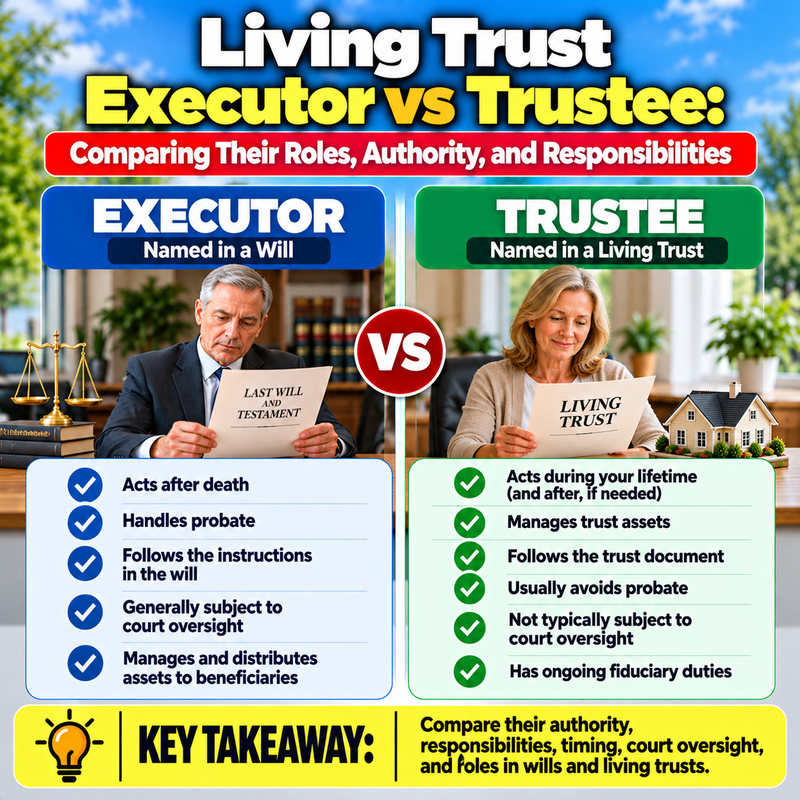
Executor vs. Trustee at a Glance
Think of an executor as someone hired to close out a project that has a clear finish line: settle debts, pay taxes, distribute what’s left, done. A trustee’s job can look more like ongoing property management, sometimes lasting years or even decades after the person who created the trust has passed away.
Both are fiduciaries, meaning both owe a legal duty to act in the best interests of beneficiaries rather than themselves. But the documents that create their authority, the courts that may or may not watch over them, and the property they’re allowed to touch are entirely separate.
Side-by-Side Comparison Table
| Factor | Executor | Trustee |
|---|---|---|
| Source of authority | Last will and testament, confirmed by probate court | Trust document and state trust law |
| Property controlled | Probate assets only | Assets titled in the trust’s name |
| Court involvement | Direct supervision through probate | Minimal to none, unless disputed |
| When authority begins | After death, once court issues Letters Testamentary | Can begin during the grantor’s life (as initial trustee) or at incapacity/death |
| Typical duration | Months to a couple years, until distribution and release | Can span years or generations |
The One-Sentence Difference You Need to Remember
An executor settles an estate through probate court; a trustee manages a trust outside of probate court. That’s the core distinction everything else in this article builds on.
What an Executor (Personal Representative) Actually Does
An executor is the person named in a will to carry out its instructions after someone dies. That includes identifying what’s part of the probate estate, securing those assets, paying off legitimate debts and taxes, and eventually distributing whatever’s left to the beneficiaries named in the will.
This isn’t an honorary title. Courts expect executors to file paperwork correctly, keep detailed records of every transaction, and account for how estate funds were used. Miss a step, and beneficiaries can petition the court to challenge the executor’s handling of the estate.
How the Role Gets Its Name in a Will
You name your executor directly in your will, usually in one of the opening paragraphs. Most people also name a backup executor in case the first choice is unable or unwilling to serve when the time comes.
Why Some States Call This Person an Administrator Instead
Not every estate has a named executor. If someone dies without a will, or if the will doesn’t name anyone who’s able to serve, the probate court appoints what’s called an administrator instead. The job is functionally the same—settle the estate—but the title changes because there’s no will directing who should do it. Some states also use “personal representative” as a catch-all term covering both executors and administrators.

What a Trustee Actually Does
A trustee manages property that’s been placed into a trust, following whatever instructions the trust document lays out. That might mean investing assets, making distributions to beneficiaries, paying trust-related expenses, or simply holding property until a certain condition is met, like a beneficiary turning 25. See our will vs. trust article for more information about the differences in use and cost.
Unlike an executor, a trustee’s job isn’t necessarily tied to someone’s death. If you’ve set up a revocable living trust, you can serve as your own initial trustee while you’re alive and capable, managing your own assets exactly as you always have.
Trustee as Legal Owner of Trust Property
Here’s a detail that surprises a lot of people: a trustee technically holds legal title to trust property, even though beneficiaries hold what’s called equitable title, meaning the right to benefit from it. That’s why a trustee’s signature, not a beneficiary’s, is what’s needed to sell trust-owned real estate or move trust-owned investment accounts.
Initial Trustee vs. Successor Trustee in a Revocable Living Trust
Most living trusts name the person who created it as the initial trustee. A successor trustee is named to step in if that person becomes incapacitated or passes away, taking over management duties without needing court approval to do so. This built-in succession plan is one of the biggest practical advantages a trust offers over a will-only estate plan.
When Does Each Person’s Authority Begin?
Timing is where executors and trustees really diverge. An executor’s authority doesn’t exist in any usable form until a probate court says so. A trustee, by contrast, may already have full authority the moment the trust is signed and funded—no court required.
Letters of Testamentary and Court Approval for Executors
Before an executor can do anything official—open an estate bank account, sell property, negotiate with creditors—they typically need a document called Letters Testamentary from the probate court. This document proves to banks, title companies, and other institutions that the executor has legal authority to act on the estate’s behalf. Without it, most financial institutions won’t even talk to the named executor.
Trust Documents and State Law as a Trustee’s Authority
A trustee’s authority comes straight from the trust document itself, combined with whatever trust laws apply in that state. There’s no waiting period, no court filing, no certificate to obtain before a successor trustee can start managing trust assets after the original trustee’s death or incapacity. That’s part of why trusts are often used specifically to avoid the delays associated with probate.
Who Controls What Property?
This is where a lot of families get tripped up. Just because someone is named trustee doesn’t mean they control everything the deceased person owned—and just because someone is named executor doesn’t mean they control trust assets.
Probate Assets Under the Executor’s Control
An executor only has authority over assets that are part of the probate estate. Generally, this includes property titled solely in the deceased person’s name without a beneficiary designation or joint owner. Common examples include:
- A house titled only in the deceased’s name, with no transfer-on-death deed
- A personal checking account without a payable-on-death beneficiary
- Vehicles, personal belongings, and other property without a designated beneficiary
- Any asset the will specifically directs through probate
If an asset doesn’t fall into one of these categories, it likely passes outside of probate entirely, meaning the executor never touches it.
Trust Assets Under the Trustee’s Control
A trustee, meanwhile, only controls property that’s actually been retitled into the name of the trust. This is often called “funding” the trust, and it’s a step people sometimes forget to complete. Assets commonly funded into a trust include:
- Real estate deeded into the trust’s name
- Bank and investment accounts retitled to the trust
- Business interests assigned to the trust
- Personal property assigned via a general assignment document
If it’s titled in the trust’s name, the trustee manages it. If it’s not, the trustee generally has no authority over it, no matter what the trust document says.
Why a Trustee Can’t Touch Assets Never Transferred to the Trust
A trust only controls what’s inside it. If someone creates a living trust but never gets around to transferring their rental property into it, that property stays outside the trust’s reach and ends up going through probate instead, managed by the executor rather than the trustee. This is one of the most common and most avoidable estate planning mistakes.
How a Pour-Over Will Connects the Two Roles
Most living trusts are paired with what’s called a pour-over will. Its job is simple: catch any assets that were accidentally left out of the trust and direct them into it after death. But here’s the catch—those assets still have to go through probate first, with the executor handling the process, before they can legally “pour over” into the trust for the trustee to manage. So even with a trust in place, the executor’s role doesn’t disappear entirely; it just handles a smaller, cleanup-focused slice of the estate.

Does Probate Court Watch Over Both Roles?
Court oversight is one of the sharpest differences between these two roles, and it’s often the exact reason people choose to set up a trust in the first place.
Court Supervision of Executors
Executors operate under direct probate court supervision. That often means filing an inventory of estate assets with the court, getting court approval before selling certain property, and submitting a final accounting before the estate can be closed. Beneficiaries also have standing to raise objections directly with the court if they believe the executor isn’t handling things properly.
Why Trusts Typically Avoid Court Oversight
Trustees, by comparison, generally operate without court supervision unless a dispute arises that forces the matter into litigation. This is intentional. One of the main reasons people set up a trust is specifically to keep asset management private and out of the public, court-supervised probate process. That said, “no court oversight” doesn’t mean “no accountability”—trustees still owe beneficiaries regular reporting and can be sued for breaching their fiduciary duties.
Core Fiduciary Duties Both Roles Share
Despite all these differences, executors and trustees are held to a similar legal standard once they accept the role: they must act as a fiduciary, putting beneficiaries’ interests ahead of their own.
Acting in the Best Interest of Beneficiaries
Being a fiduciary isn’t just a formality—it’s a legally enforceable duty. Executors and trustees alike can be held personally liable if they mismanage assets, play favorites among beneficiaries, or use estate or trust property for their own benefit. Courts take this seriously, and beneficiaries who suspect wrongdoing have the right to demand an accounting or petition for the fiduciary’s removal.
Recordkeeping, Taxes, and Communication Requirements
Both roles also come with paperwork obligations that don’t go away just because no court is watching. Executors and trustees alike need to keep clear records of every dollar that moves in or out, file whatever tax returns apply to the estate or trust, and communicate regularly enough that beneficiaries aren’t left guessing about the status of their inheritance. A trustee who goes silent for two years, even with good intentions, is asking for a legal challenge.
Good recordkeeping isn’t just about avoiding lawsuits—it protects the fiduciary too. If a beneficiary ever questions a decision, having detailed records showing why a distribution was made or why an asset was sold at a particular price can make the difference between a quick resolution and a drawn-out court battle.
Executor Responsibilities From Start to Finish
An executor’s job follows a fairly predictable sequence from the moment someone passes away until the estate officially closes. While the exact steps vary by state, the general pattern looks remarkably similar across the country.
Here’s what that typically looks like in practice, broken down into the major phases an executor works through:
Filing the Will and Death Certificate
The first official step is filing the original will with the probate court, assuming it hasn’t already been filed. The executor also needs a certified copy of the death certificate, which gets used repeatedly throughout the process—banks, insurance companies, and government agencies will all ask for it before releasing information or assets.
Once the will is filed, the court reviews it and, assuming everything checks out, issues Letters Testamentary. This document is the executor’s official proof of authority, and without it, most institutions won’t cooperate.
Notifying Heirs, Beneficiaries, and Agencies
Next comes notification. Beneficiaries named in the will need to be informed, as do any legal heirs even if they weren’t left anything. This isn’t just courtesy—most states legally require it, and skipping this step can open the door to a will contest down the road.
Beyond family, the executor also needs to notify a long list of institutions: Social Security, the deceased’s banks and lenders, insurance companies, and any pension or retirement account administrators. Each of these notifications can trigger its own paperwork trail, from stopping benefit payments to closing accounts.
Many executors find this phase the most time-consuming part of the entire process, simply because of how many separate institutions need individual contact.
Securing Assets and Paying Debts
Once notifications are underway, the executor needs to locate, secure, and maintain probate assets until they’re ready to be distributed. That might mean changing locks on a vacant house, maintaining insurance on a vehicle, or simply making sure nothing walks off before the estate is settled.
At the same time, valid debts need to be paid from estate funds, in whatever priority order state law requires. This usually means funeral expenses and administration costs come first, followed by secured debts, then unsecured debts like credit cards. An executor who pays the wrong creditors out of order can end up personally liable for the shortfall.
Filing Final Tax Returns
Tax obligations don’t disappear with death—they just shift to the executor’s desk. This typically includes a final personal income tax return for the deceased, covering income earned up until the date of death, plus a separate estate income tax return if the estate itself earns income during administration. Larger estates may also owe federal or state estate tax, depending on the value of assets involved and current exemption thresholds.
Distributing Remaining Property
Once debts, taxes, and expenses are settled, whatever’s left gets distributed to beneficiaries according to the will’s instructions. The executor then files a final accounting with the court, and once approved, receives a release confirming the job is done. At that point, the executor’s authority ends completely.

Trustee Responsibilities From Start to Finish
A trustee’s responsibilities often start before death ever enters the picture and can continue long after an executor has closed out the probate estate entirely. The job is less about a single finish line and more about ongoing stewardship.
Whether stepping in as a successor trustee after someone’s death or incapacity, the responsibilities generally break down into a few key areas.
Confirming Trust Terms and Asset Control
Before doing anything else, a new trustee needs to get fully oriented: reading the trust document closely, identifying who the beneficiaries are, confirming what assets are actually titled in the trust’s name, and making sure prior account records are accurate and complete. Skipping this step is how mistakes happen later—a trustee can’t properly manage what they don’t fully understand.
Investing Trust Assets Under the Prudent Investor Rule
Most states require trustees to follow what’s known as the prudent investor rule, meaning investment decisions need to balance growth with reasonable risk, always with the beneficiaries’ interests in mind. A trustee can’t gamble trust assets on speculative investments just because they personally feel lucky—doing so can expose them to personal liability for any resulting losses.
Making Distribution Decisions to Beneficiaries
Depending on how the trust is written, a trustee may have significant discretion over when and how much beneficiaries receive. Some trusts call for straightforward, scheduled distributions. Others give the trustee judgment calls to make—like deciding whether a beneficiary’s request for funds toward education or a medical emergency fits within the trust’s purpose.
This discretionary power is one of the biggest responsibilities a trustee carries, since it requires balancing the needs of current beneficiaries against the interests of future ones, particularly in trusts designed to last across multiple generations.
Getting this wrong—either by being too generous or too restrictive—can lead to disputes among family members and even legal challenges to the trustee’s judgment.
Preparing Statements and Trust Tax Returns
Trustees also carry ongoing reporting duties. That typically includes preparing periodic account statements for beneficiaries, filing annual trust tax returns, and keeping thorough records of every transaction made on the trust’s behalf.
Unlike an executor’s one-time final accounting, a trustee’s recordkeeping is an ongoing obligation that can continue for years or even decades, especially with trusts designed to benefit grandchildren or provide for a beneficiary’s lifetime.
Beneficiaries generally have the right to request copies of these records, and a trustee who refuses reasonable requests for transparency can quickly find themselves facing a legal challenge.
Coordinating With the Executor on Shared Debts
When both an executor and a trustee are involved in settling the same person’s affairs, coordination matters. The trustee often needs to work with the executor to address outstanding debts that might affect both the probate estate and the trust, particularly if certain expenses need to be paid before trust distributions can move forward.
How Long Does Each Role Last?
Duration is one of the clearest practical differences between these two roles, and it’s worth planning around when deciding who to name for each job.
An executor’s role is, by design, temporary. It exists to close out a specific set of affairs and then end. A trustee’s role, on the other hand, can be built to last indefinitely, depending entirely on how the trust is written.
This difference matters most when choosing who to name. Someone great at handling a short, intense project might not be the right fit for a role that requires years of patient, ongoing management—and vice versa.
When an Executor’s Job Ends
An executor’s responsibilities typically wrap up once all estate assets have been distributed and the probate court issues a formal release. Depending on the complexity of the estate, this process might take anywhere from several months to a couple of years, though simpler estates can close faster.
Once that release is granted, the executor has no further legal authority or obligation tied to the estate. The job is done.
Why a Trustee’s Job Can Span Generations
A trustee’s job ends only when the trust itself ends—whether that’s because the trust is revoked, reaches a specific end date written into its terms, or all its assets have been fully distributed. For trusts designed to provide for minor children until adulthood, or to protect assets for multiple generations of a family, that could mean the trustee role continues for decades after the person who created the trust has passed away.

Getting Paid: Compensation and Expenses
Both executors and trustees are generally entitled to reasonable compensation for their work, though how that compensation gets calculated differs between the two roles.
Family members serving in either role often choose to waive their fee entirely, particularly for smaller, simpler estates or trusts. Professional fiduciaries, on the other hand, almost always charge for their services, and that cost should be weighed against the value they bring to a complex situation.
How Executor Fees Are Typically Set
Executor compensation is often set by state statute, sometimes as a percentage of the estate’s value, sometimes based on a reasonable hourly rate, and sometimes dictated directly by the terms of the will itself. State probate courts generally have the final say if a dispute arises over what’s reasonable.
How Trustee Fees Are Typically Set
Trustee compensation usually comes from the terms of the trust document itself, or from state law if the trust is silent on the matter. Professional and corporate trustees typically charge an annual fee based on a percentage of assets under management, which can add up significantly for larger, long-running trusts.
Family members acting as trustee sometimes take a more modest fee, or none at all, particularly when the trust primarily benefits their own close relatives. Either way, the fee arrangement should be clearly documented to avoid disputes with beneficiaries later.
Can One Person Be Both Executor and Trustee?
Yes, and it’s actually quite common. Many people name the same trusted individual—a spouse, adult child, or close friend—as both executor in their will and successor trustee in their trust. This can simplify communication and reduce the chance of friction between two separate decision-makers handling related assets.
Why the Roles Stay Legally Separate Even With One Person
Even when one person holds both titles, they’re still legally acting in two distinct capacities, governed by two separate documents, over two separate pools of property. A probate court only has authority over the executor side of that person’s actions; it has no say over how they manage trust assets as trustee. The two roles simply don’t merge into one job just because one name appears on both documents.
This distinction matters practically, too. The same person might need to open a separate estate bank account as executor, while also maintaining entirely separate trust accounts as trustee—commingling the two can create real headaches for tax reporting and liability purposes.
Pros and Cons of Naming the Same Person
Naming the same individual for both roles can streamline communication, since there’s no need to coordinate between two different people handling related family assets. It also reduces the chance of disagreements between an executor and trustee who might otherwise have different priorities or personalities.
On the flip side, loading both responsibilities onto one person can be overwhelming, particularly if that person isn’t especially organized or doesn’t have much free time. In those cases, splitting the roles between two capable people—or bringing in a professional co-trustee for the more complex trust duties—might serve the family better.
Successor Trustees and What Happens During Incapacity
One of the most practical advantages of a trust shows up long before anyone dies. Because a revocable living trust lets the person who created it serve as their own initial trustee, it naturally sets up a built-in plan for what happens if that person becomes incapacitated, whether due to illness, injury, or age-related decline.
A will and executor arrangement offers no equivalent protection during someone’s lifetime—an executor’s authority only ever kicks in after death. That gap is exactly why so many people pair a will with a living trust rather than relying on a will alone.
How a Successor Trustee Steps In Without Court Involvement
When incapacity strikes, a named successor trustee can typically step into the management role without ever setting foot in a courtroom. Most trusts spell out exactly what triggers this transition, often requiring written confirmation from one or two physicians that the original trustee can no longer manage their own affairs. Once that documentation is in hand, the successor trustee presents it to banks and financial institutions along with the trust document, and management authority transfers smoothly.
Compare that to the alternative: without a trust, a family often has no choice but to petition a court for a conservatorship or guardianship, a public, often slow, and sometimes expensive legal process just to get someone authorized to pay bills and manage property on an incapacitated person’s behalf.
This single feature—avoiding a conservatorship proceeding—is one of the most compelling reasons families choose a living trust over relying solely on a will. A will simply has nothing to offer here, since its executor provisions only activate after death.

How to Choose the Right Executor and Trustee
Picking the right person for each role isn’t about finding the smartest person in the family or the one with the fanciest job title. It’s about matching someone’s actual strengths and availability to the specific demands of the job they’d be taking on.
There’s no universally “best” choice here—a sibling who’s great under pressure and comfortable with paperwork might make an excellent executor but a poor long-term trustee if they’re not naturally patient or detail-oriented over the long haul. Think through each role’s real demands before deciding who fits where.
Key Traits to Look For in Each Role
Since an executor’s job is intense but short-term, look for someone who’s organized, responsive, and comfortable dealing with paperwork and deadlines under pressure. A trustee’s job, especially for a long-running trust, calls for patience, financial discipline, and the ability to communicate fairly with multiple beneficiaries over potentially many years.
A few questions worth asking before naming either role:
- Does this person live close enough to realistically handle in-person tasks, like securing property or meeting with an attorney?
- Can they communicate clearly and fairly with other beneficiaries, even if tensions run high?
- Do they have the financial literacy to handle investments, taxes, and recordkeeping, or know when to ask for help?
- Are they willing to serve at all? Not everyone wants the responsibility, and it’s worth asking directly rather than assuming.
- Could a conflict of interest arise, such as a beneficiary also serving as trustee over assets they’ll eventually inherit?
When to Consider a Professional or Corporate Trustee
Sometimes the best answer isn’t a family member at all. If a trust is expected to run for many years, involves significant assets, or includes beneficiaries who might not get along, a professional trustee or corporate trust company can bring neutrality and expertise that a well-meaning relative simply can’t match.
Professional trustees charge fees, typically a percentage of assets under management, but that cost often buys consistency, experienced tax handling, and a buffer against family conflict. For blended families or situations involving a special needs beneficiary, professional management can be worth every penny.
Naming Co-Trustees for Long-Term Trusts
Another option worth considering is naming co-trustees—pairing a family member who understands the beneficiaries’ needs with a professional or corporate trustee who handles the technical, investment, and tax side of things. This arrangement lets the family member maintain a personal connection to distribution decisions while offloading the more complex administrative burden.
Co-trusteeship isn’t without friction, though. If the trust document doesn’t clearly spell out how decisions get made when co-trustees disagree, it can create more problems than it solves. A well-drafted trust should address this directly, specifying whether decisions require unanimous agreement or simply a majority.
Ultimately, the choice between a solo family trustee, a solo professional trustee, or a co-trustee arrangement comes down to the complexity of the trust, the dynamics among beneficiaries, and how much ongoing time and expertise the role genuinely requires.
Common Misunderstandings About Executors and Trustees
A surprising number of estate planning headaches trace back to simple misunderstandings about what these two roles actually do. Clearing up a few of the most common ones now can save a lot of confusion later.
Most of these misunderstandings stem from treating a will and a trust as interchangeable documents, when in reality they serve different purposes and activate under different circumstances.
Thinking a Trustee Automatically Controls All Your Assets
People often assume that creating a trust and naming a trustee automatically means that person controls everything someone owns. In reality, a trustee only controls what’s been properly retitled into the trust’s name. Anything left outside the trust—whether by oversight or simply never getting around to it—falls to the executor and probate court instead.
This is why “funding” a trust, the process of actually transferring ownership of assets into it, matters just as much as creating the trust document in the first place. A beautifully drafted trust with no assets inside it accomplishes nothing.
Assuming One Document Covers Both Roles
Some people believe that naming someone as trustee in a trust also automatically makes that person their executor, or vice versa. These are two entirely separate appointments, made in two separate documents. If someone wants the same individual serving in both capacities, that person needs to be named specifically in both the will and the trust.
Confusing State-Specific Rules With General Practice
Executor compensation, trustee fee structures, probate timelines, and even terminology (personal representative versus executor versus administrator) all vary by state. What’s standard practice in one state may work differently just across a border. Anyone comparing notes with a friend or relative in another state should take general guidance with a grain of salt and confirm specifics with local counsel.

Frequently Asked Questions
Here are quick answers to some of the most common questions people ask when comparing these two roles.
Does a living trust need an executor at all?
Yes, in most cases. Even with a living trust, a pour-over will typically names an executor to handle any assets accidentally left outside the trust, along with any other probate matters that arise after death.
What happens if my named executor and trustee disagree?
Since they’re operating under separate legal authority, disagreements get worked out through communication and, if necessary, legal counsel for each side. The executor can’t override trust decisions, and the trustee can’t override probate matters—each stays within their own lane. For more information on their distinct roles, you can explore the key differences between executors and trustees.
Can a trustee be held personally liable for mistakes?
Yes. A trustee who breaches their fiduciary duty, whether through negligence, self-dealing, or simply poor judgment in managing trust assets, can be held personally liable and sued by beneficiaries for resulting losses.
Do I need a lawyer to name an executor or trustee?
You don’t legally need a lawyer to name either role, but given how much these decisions affect how smoothly an estate or trust gets administered, working with an attorney helps ensure the documents are drafted correctly and the chosen individuals have the legal authority they’ll need.
What is a pour-over will and why does my trust need one?
A pour-over will catches any assets that weren’t properly transferred into a trust before death and directs them into the trust through probate. It acts as a safety net, ensuring nothing accidentally bypasses the overall estate plan.
How do I remove or replace a trustee after the trust is created?
This depends entirely on what the trust document says. Many trusts include a specific process for removing and replacing a trustee, sometimes requiring beneficiary consent or a court petition if there’s no cooperative resolution. Revocable trusts created by someone still living and capable can typically be amended to change the trustee outright.
If the trust is silent on removal procedures, state law typically provides a default process, though it often requires court involvement, which can be slower and more expensive than having clear instructions built into the trust itself from the start.
This is exactly why working with experienced counsel when drafting a trust matters so much upfront—a well-written removal clause can save a family significant time and legal expense down the road.
Does an executor get paid even if the estate is small?
Generally yes, though many executors handling smaller, straightforward estates for close family members choose to waive their fee. Compensation is usually set by state statute or by the will itself, regardless of estate size.
For very small estates, some states offer simplified probate procedures that reduce both the executor’s workload and the associated fees, making the role far less burdensome than handling a large, complex estate.
Can a beneficiary also serve as a trustee or executor?
Absolutely, and it’s quite common, particularly when a surviving spouse or adult child is both a primary beneficiary and the most logical choice to manage the estate or trust. The key is ensuring that person still acts fairly toward other beneficiaries despite their own personal stake in the outcome.
What documents does a trustee need after someone dies?
A successor trustee typically needs a certified copy of the death certificate, the original trust document, and sometimes an affidavit of trust, which summarizes key trust terms without disclosing the entire document to third parties like banks.
Is a successor trustee the same as a power of attorney?
No. A power of attorney authorizes someone to act on another person’s behalf during their lifetime, but that authority ends the moment the person dies. A successor trustee’s authority specifically concerns trust property and can continue well beyond death, picking up exactly where a power of attorney’s authority leaves off.
The Bottom Line on Executors and Trustees
An executor and a trustee can absolutely be the same person, but they’re never doing the same job. One operates through probate court, settling a will-directed estate within a defined timeline. The other manages trust property according to a separate document, sometimes for decades, often without any court looking over their shoulder.
Building an estate plan that uses both a will and a trust means thinking carefully about who’s best suited for each distinct role, how those roles might overlap, and what happens if incapacity strikes before death ever enters the picture. Getting the details right—funding the trust properly, naming capable successor trustees, and choosing an executor who can handle probate’s demands—makes the difference between a smooth transition for your family and a drawn-out legal headache.
If you’re still sorting out who should fill these roles in your own plan, talking it through with Create A Living Trust can help clarify how an executor and trustee would work together under your specific documents.