How to Choose a Successor Trustee: Key Qualities and Decisions to Consider
What the Role Requires, Who Can Serve, and the Qualities to Consider Before You Decide
Choosing the wrong successor trustee can turn a carefully built living trust into a source of family conflict, delay, and expense—while choosing the right one can make the entire process feel almost invisible to the people you love.
If you’re working through how to create a living trust, naming a successor trustee is one of the handful of decisions that actually determines whether your plan works the way you intended. It’s not a box to check off quickly or an honorary title to hand to your oldest child. It’s a real job with real responsibilities, and the person you pick needs to be capable of doing it—or smart enough to get help when they need it. Bulletproof Legacy’s supported digital estate-planning approach was built around this exact gap, pairing trust documents with the kind of practical guidance that helps families actually fund and maintain their plans instead of letting them sit untouched in a drawer.
Article at a Glance: Key Takeaways
- How to choose a successor trustee comes down to four traits: trustworthiness, financial competence, availability, and impartiality—not simply who is closest to you or oldest in birth order.
- A successor trustee only has authority over what’s actually inside the trust, so funding and coordination with other documents matters just as much as who you name.
- Family members, friends, private professional fiduciaries, and corporate trustees each come with different tradeoffs in cost, objectivity, and continuity.
- Naming backups, having a direct conversation before you decide, and reviewing your choice periodically can prevent the most common and costly mistakes.
- Later in this article, you’ll find a practical checklist and the specific questions to ask any potential trustee before you put their name on the document.
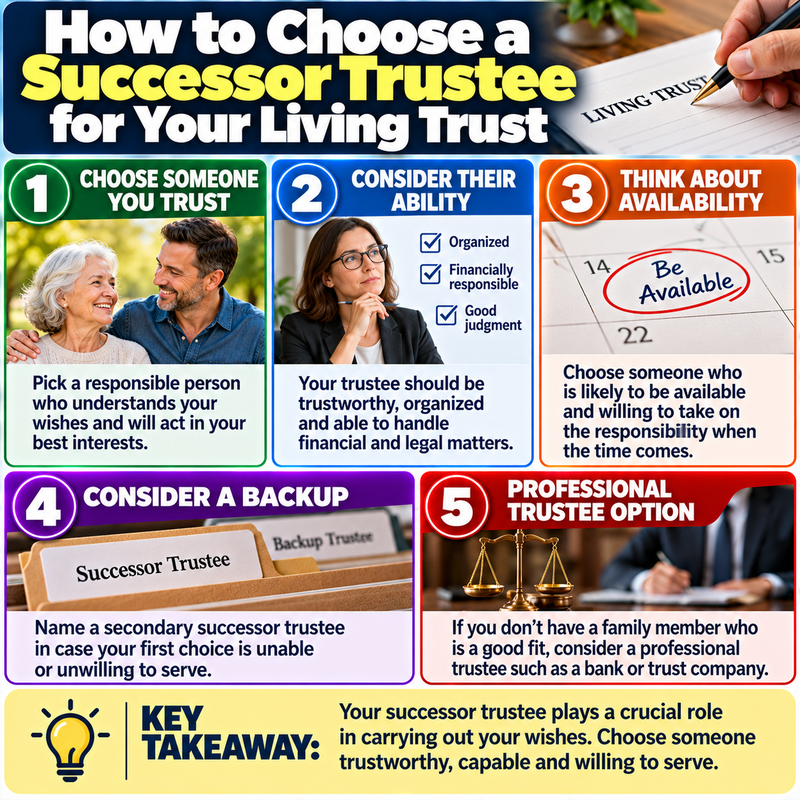
What the Role Requires, Who Can Serve, and the Qualities to Consider Before You Decide
A successor trustee is the person or institution who steps in to manage your trust when you no longer can—whether that’s because of incapacity, resignation, or death. Most people serve as their own trustee while they’re alive and well, which means the successor trustee role often sits dormant for years before it’s ever activated. That delay is exactly why so many people underestimate how important the choice is: the role feels abstract until the day it suddenly isn’t.
What a Successor Trustee Is and When the Role Begins
In a typical revocable living trust, you name yourself as the initial trustee so you keep full control over your own assets while you’re capable of managing them. The successor trustee’s authority usually begins under one of two triggers: you become incapacitated and can no longer manage your affairs, or you pass away. At that point, the successor trustee takes over trust administration according to the instructions you’ve already written into the document.
This handoff is designed to happen without a court proceeding, which is one of the practical advantages of using a trust-based plan. That said, a living trust doesn’t guarantee your estate will avoid probate altogether—that outcome depends on how thoroughly the trust was funded, how your other assets are titled, and what your state’s laws require. A successor trustee can only manage what’s actually been placed into the trust.
Successor Trustee vs. Current Trustee, Executor, Power of Attorney, and Beneficiary
These roles get confused constantly, so it helps to separate them clearly:
- Current trustee — Usually you, while you’re alive and able to manage your own trust.
- Successor trustee — Takes over trust management after incapacity or death.
- Executor — Named in your will, this person typically handles probate and oversees your “pour-over will,” which moves any assets left outside the trust into it after you die.
- Power of attorney — A separate document and separate role that may authorize someone to manage assets titled in your individual name, outside the trust.
- Beneficiary — Someone who receives assets or benefits from the trust; this person can sometimes also serve as trustee, which raises its own considerations covered later in this article.
You can name the same person for multiple roles, but you don’t have to. Some people split responsibilities deliberately—for instance, naming one adult child as executor and another as successor trustee—to divide the workload or sidestep a perceived conflict of interest.
Core Duties Your Successor Trustee Will Take On
Before you can judge who’s right for the job, it helps to know exactly what the job involves. A successor trustee isn’t just holding a title—they’re taking on a fiduciary duty, which is a legal obligation to act in the best interests of the trust’s beneficiaries rather than their own.
| Duty | What It Involves |
|---|---|
| Asset management | Locating, safeguarding, and managing trust property, including real estate, accounts, and investments |
| Recordkeeping | Tracking income, expenses, and distributions with accurate, accessible records |
| Communication | Keeping beneficiaries reasonably informed and responding to their questions |
| Bill paying | Covering valid expenses tied to trust assets, like property taxes or maintenance |
| Tax coordination | Working with an accountant to handle any required tax filings |
| Distribution | Following your instructions for how and when beneficiaries receive assets |
Locating, Protecting, and Managing Trust Assets
One of the first things a successor trustee has to do is figure out what’s actually in the trust and make sure it’s protected. That might mean securing a vacant house, redirecting mail, managing a rental property, or simply confirming that bank and investment accounts are properly titled in the trust’s name. If major assets were never retitled into the trust while you were alive, the successor trustee’s ability to help can be limited, since a trustee can only act on property the trust actually owns.
Working With Accountants, Attorneys, and Financial Advisors
A good trustee doesn’t need to be a CPA or a financial advisor, but they do need to be comfortable bringing in professionals when the situation calls for it. Trustees can hire accountants, attorneys, and investment professionals to help with technical matters, but they generally can’t hand off the ultimate decision-making responsibility. In other words, a trustee can delegate tasks, not accountability.
Communicating With Beneficiaries and Keeping Records
Beneficiaries are entitled to reasonable information about how the trust is being managed, and a trustee who goes silent for months at a time tends to create suspicion even when nothing improper is happening. Clear, consistent communication—paired with organized records of income, expenses, and distributions—tends to prevent most disputes before they start.
Recordkeeping matters even more than people expect. A trustee who can’t produce a clear accounting when asked is far more likely to face pushback from beneficiaries, regardless of whether they’ve actually done anything wrong.
Following Your Distribution Instructions
Your trust document spells out how and when beneficiaries receive their inheritance—all at once, in staggered amounts tied to age milestones, or held in an ongoing trust for someone who needs more structure. The successor trustee’s job is to follow those instructions as written, not to improvise based on what they personally think is fair.
This is where impartiality becomes critical, especially if the trustee is also a beneficiary. Sticking to the document, rather than personal judgment calls, is what keeps the trustee’s actions defensible if a beneficiary ever disagrees with a decision.

Skills and Personal Qualities That Matter Most
So what actually makes someone a good successor trustee? It’s tempting to default to whoever is “closest” to you emotionally, but the traits that matter most are more specific than that.
Trustworthiness and Financial Organization
Trustworthiness means more than “I trust this person with my feelings.” It means this person has historically been honest, careful with money, and comfortable being held accountable for their decisions. Financial organization is a separate but related skill—can this person handle paperwork, meet deadlines, and work through account statements without getting overwhelmed or simply avoiding the task?
Judgment, Communication, and Follow-Through
A trustee will inevitably face situations your trust document doesn’t explicitly address, and good judgment is what fills that gap. Communication matters just as much: beneficiaries who feel informed are far less likely to escalate disagreements into something more serious. Follow-through ties it all together—plenty of people have good intentions, but a trustee needs to actually complete tasks, return calls, and meet deadlines consistently.
Red Flags That Signal a Poor Fit
Certain patterns tend to predict trouble before it happens. Watch for these warning signs when you’re evaluating a potential trustee:
- A history of financial problems, secrecy about money, or difficulty respecting boundaries
- Chronic disorganization or a habit of avoiding administrative tasks and ignoring details
- An overcommitted schedule, frequent travel, or an unstable life situation that leaves little room for new responsibility
- Long-running family conflicts, a tendency to “settle scores,” or difficulty saying no when it matters
If you notice more than one of these patterns in a candidate, it’s worth pausing before naming them—even if they’re the person you’d otherwise expect to choose.
Family Member, Friend, or Professional Trustee: Weighing Your Options
Most people start by assuming a family member will serve as successor trustee, and in plenty of cases, that’s exactly the right call. But it’s worth understanding the full range of options before you settle on one, since the “obvious” choice isn’t always the best fit for your specific situation.
Broadly, you’re choosing between a relationship-based trustee—someone who knows your family personally, like a relative or close friend—and a process-based trustee, such as a private professional fiduciary or corporate trust company. Neither option is inherently better; the right choice depends on your assets, your beneficiaries, and how much ongoing management your trust will require.
Naming an Adult Child or Relative
Adult children are the most common choice for a reason: they usually know the family, understand your wishes, and will serve without charging a trustee fee. But an adult child needs to be evaluated the same way any other candidate would be—based on organization, availability, and communication skills, not birth order. The oldest child isn’t automatically the best administrator, and naming someone purely out of tradition can set up resentment among siblings who sense they were passed over for a less-qualified choice.
It’s also worth remembering that people change. An adult child who was responsible and capable at twenty-five may be dealing with their own career demands, health issues, or family obligations by the time they’re actually called on to serve. Revisiting your choice periodically—something covered later in this article—helps account for that kind of drift over time.
Naming a Trusted Friend
A close friend can work well for many of the same reasons a family member does: personal knowledge of your situation and no added fee. The tradeoff is similar, too—friends take on the same administrative burden as family members, often without professional experience handling fiduciary duties, accountings, or tax coordination.
Private Professional Fiduciaries
When no family member or friend is a good fit—or when the trust’s value falls below what a corporate trustee requires—a private professional fiduciary can fill the gap. These are individuals who serve as trustee professionally, typically for a fee, and bring experience handling the administrative and interpersonal demands of the role. If you’re considering this route, it’s reasonable to ask directly about their succession plan: who steps in if something happens to them?
Trust Companies vs. Traditional Trust Banks
Corporate trustees generally fall into two categories, and the distinction matters more than most people realize. Traditional trust banks are custodial institutions, typically operating as a division of a larger bank, and they handle both trust administration and investment management. Trust companies, on the other hand, are non-custodial—they handle the fiduciary administration of the trust but leave investment decisions to a separate financial advisor, often one the family already works with.
Fee structures and investment approaches can differ significantly between the two, and conflicts of interest are worth understanding before you commit. A tax or estate planning professional can help you evaluate which structure fits your situation, particularly if your estate includes significant assets or property across multiple states.

Objectivity, Conflicts of Interest, and Family Dynamics
Family dynamics have a way of surfacing during trust administration even when everyone got along fine beforehand. Money, grief, and old sibling patterns tend to combine in ways that test even a well-drafted trust, which is why objectivity deserves serious weight in your decision.
When a Beneficiary Also Serves as Trustee
It’s common—and generally allowed—for a beneficiary to also serve as trustee. An adult child, for example, often fills both roles simultaneously. The challenge is impartiality: can this person follow the trust’s distribution instructions evenhandedly, even when a decision benefits them directly or disadvantages a sibling? If other beneficiaries already have doubts about this person’s fairness, naming them as sole trustee can intensify conflict rather than resolve it, even if their intentions are good.
Avoiding Birth-Order Bias and Old Rivalries
Choosing a trustee because someone is the oldest, or because it would “hurt their feelings” not to be picked, tends to backfire more often than it helps. Age and birth order say nothing about someone’s organizational skills, availability, or ability to communicate fairly with siblings. The decision deserves the same scrutiny you’d apply to hiring someone for a job, because that’s effectively what you’re doing.
Old family rivalries have a way of resurfacing the moment money and property enter the picture, even among siblings who’ve gotten along fine for decades. If two of your children have a long history of friction, naming one as sole trustee over the other’s inheritance can reignite that tension at the worst possible time—right when everyone is also grieving.
- Ask yourself whether your chosen trustee can communicate calmly with a sibling they’ve clashed with in the past
- Consider whether naming a neutral party, such as a professional fiduciary, might reduce tension if family relationships are already strained
- Think about whether full transparency with all beneficiaries from the start would ease concerns about favoritism
None of this means family members can’t serve well together. It simply means the decision should be based on evidence of how people actually behave under stress, not on hope that old patterns will magically disappear once real responsibility is on the line.
If you’re uncertain whether a family candidate can stay impartial, it’s worth having an honest conversation with them directly, and possibly with other beneficiaries, before finalizing anything in your trust documents.
Financial Competence and Willingness to Serve
A trustee doesn’t need an accounting degree, but they do need enough financial comfort to review account statements, pay bills on schedule, and understand when a decision calls for professional help. Someone who avoids opening mail or ignores overdue notices in their own life is unlikely to suddenly develop those habits when managing someone else’s trust.
Willingness matters just as much as competence. Serving as a trustee is unpaid work for most family members, and it can stretch across months or years depending on how the trust is structured. Someone who agrees out of obligation, without understanding the time commitment, may quietly resent the role or let tasks slip once the initial urgency fades.
Signs Someone Can Handle the Paperwork and Deadlines
Look at how a potential trustee manages their own financial life. Do they pay bills on time? Do they keep records organized enough to find a document when they need it? Have they handled a parent’s estate, a small business, or any other situation requiring attention to financial detail? None of these are hard requirements, but a pattern of competence in their own affairs is a reasonable predictor of how they’ll handle yours.
Why You Must Ask Before You Name Someone
It’s surprisingly common for people to name a successor trustee without ever telling that person they’ve been chosen. This creates an unpleasant surprise during an already difficult moment—incapacity or death—when the named trustee suddenly discovers a responsibility they never agreed to take on.
A direct conversation ahead of time solves this. Explain what the role involves, confirm the person is willing to serve, and give them a chance to ask questions or decline. If the conversation feels tense or the person hesitates, that reaction is useful information—it’s far better to learn about reluctance now than to have your trust depend on someone who never wanted the job.

Age, Health, Geography, and Long-Term Availability
A trustee candidate who looks perfect on paper today might not be the right choice decades from now, which is why age, health, and geography deserve real consideration rather than an afterthought.
These factors don’t disqualify anyone outright, but they shape how practical the choice will be when the role actually activates—which, for many people, could be twenty or thirty years after the trust is signed.
Why Naming a Same-Age Trustee Can Backfire
If you’re in your fifties or sixties and you name a sibling or friend close to your own age as successor trustee, that person is aging alongside you. By the time your trust actually needs a successor trustee—often when you’re in your eighties or nineties—your chosen trustee may be dealing with their own health limitations, or may no longer be living at all. This is one of the most overlooked planning gaps, and it’s easily solved by naming at least one younger backup trustee alongside your primary choice.
How Distance Affects Property and Administration
Living far away from a potential trustee doesn’t automatically disqualify them, especially with how much trust administration can now be handled remotely through phone, email, and electronic document sharing. That said, distance becomes more relevant when the trust includes physical property that needs hands-on attention—a house that needs to be cleaned out, repaired, or sold, for instance.
If your trustee lives across the country from your primary residence, it’s worth thinking through how they’d handle these logistics. Some families address this by naming a local co-trustee for property matters or by building in flexibility for the trustee to hire local help, such as a property manager or real estate agent, to handle tasks that require physical presence.
State Residency and Trust Taxation Considerations
Where your trustee lives can also affect how a continuing trust is taxed after your death. In some cases, a trust’s state tax treatment follows the trustee’s residency rather than the trust creator’s—meaning a trust set up to avoid state income tax could lose that advantage if the person actually serving as trustee lives in a high-tax state. This is a nuanced, state-specific issue, and if your estate plan is built around minimizing state income tax exposure for continuing trusts, it’s worth a conversation with a tax-savvy estate planning attorney before finalizing your trustee selections.
Naming Co-Trustees: Benefits and Complications
It’s tempting to name two or three people as co-trustees to avoid choosing a single “favorite,” especially among siblings. Shared authority can work, but it comes with a structural risk that’s worth understanding clearly before you build it into your trust.
When Shared Authority Works Well
Co-trustees can function well when they genuinely get along, communicate easily, and bring complementary skills to the role—one handles financial details while the other manages beneficiary communication, for example. A trust document can also specify how decisions get made among co-trustees, such as requiring majority agreement rather than unanimous consent, which helps avoid gridlock on smaller matters.
How Deadlocks Can Delay Major Decisions
The risk with co-trustees is what happens when they disagree, particularly on something significant like selling real estate or making a large distribution. Without a clear decision-making process built into the trust, a disagreement between co-trustees can stall action indefinitely—sometimes at the exact moment a beneficiary is depending on a timely decision.
- Picture three siblings named as joint trustees, where two want to sell an inherited property and one refuses—the sale can stall or fall apart entirely
- A trust with unclear co-trustee authority may require all parties to sign off on even routine transactions, slowing down simple tasks
- Disagreements between co-trustees can sometimes escalate into the kind of conflict that requires legal intervention to resolve
Many estate planning attorneys recommend naming a single trustee at a time, with backups in a clear order of succession, rather than co-trustees serving simultaneously. If you do want to name co-trustees, make sure the trust document spells out exactly how disagreements get resolved, rather than leaving it open to interpretation during a stressful moment.
If you’re torn between two equally capable candidates, it may be simpler to name one as primary trustee and the other as the first backup, preserving both people’s involvement without creating a built-in deadlock.

Naming Backup Trustees and an Order of Succession
Even the most carefully chosen successor trustee can become unavailable—due to death, illness, relocation, or simply changing their mind about serving. A trust without backup trustees named leaves a gap that typically has to be filled by a court, which adds delay and expense right when your family needs things to move smoothly.
Building a Clear Primary, Second, and Third Choice
A well-drafted trust usually names at least one backup trustee, and often two, creating a clear order of succession: primary, second choice, third choice. This structure means that if your first choice can’t or won’t serve, the next person is already identified and ready to step in without requiring a new legal proceeding. Make sure contact information for each backup is current and easy for your family to locate, since outdated contact details can cause unnecessary delays even when the succession plan itself is sound.
Using a Corporate Trustee as a Last-Resort Backup
Some people name a corporate trustee or trust company as a final backup, in case none of the individual choices are available or willing to serve when the time comes. This approach provides a safety net without requiring you to pay ongoing corporate trustee fees while your preferred individual choices are still able to serve. It’s a practical way to make sure your trust never ends up without a trustee entirely, even decades after you’ve signed the document.
Have This Conversation Before You Name Anyone
Naming someone as successor trustee without ever discussing it with them is one of the most common—and most avoidable—mistakes in trust planning. This isn’t a favor you’re asking for “someday.” It’s a fiduciary role with real legal responsibility, and the person deserves a clear, upfront conversation about what you’re asking them to take on.
This conversation also gives you valuable information. How someone responds when you explain the role—curious and engaged, or hesitant and vague—tells you a lot about whether they’re genuinely prepared to serve. If the conversation feels uncomfortable now, that discomfort usually doesn’t improve once real responsibility and family emotions are involved.
Treat this discussion the way you would a serious job offer, because that’s essentially what it is. Be specific about expectations, timelines, and what kind of support they’d have access to, including professionals you already work with.
Questions to Ask a Potential Successor Trustee
Before finalizing your decision, sit down with your chosen candidate and ask questions that reveal both their willingness and their readiness for the role.
- Are you willing to serve as successor trustee, and do you understand what that role involves?
- If I became incapacitated, how quickly could you realistically step in and start managing things?
- Are you comfortable working with an accountant or an estate attorney if the situation calls for it?
- How would you handle it if a beneficiary disagreed with a decision you made?
- Do you feel confident you could stay fair, even if you’re also a beneficiary of the trust?
- Would you want to be paid a trustee fee, and how would you document your time and expenses?
- What kind of support or resources would make you feel more prepared for this role?
Pay close attention not just to the answers, but to how comfortable the person seems discussing the topic at all. Genuine willingness usually sounds different from polite agreement given just to end an awkward conversation.
Compensation and Expense Considerations
Whether a successor trustee gets paid—and how much—varies significantly depending on who you choose and what your trust document specifies. This is worth addressing directly in your trust rather than leaving it ambiguous, since unclear compensation terms can become a source of tension among beneficiaries later. For more guidance, you can explore who should be your successor trustee to ensure clarity and fairness.
Family Trustee Fees vs. Professional Trustee Fees
Family members and friends often serve without charging a formal fee, though many trust documents allow for reasonable compensation if the trustee wants it, particularly for a lengthy or complex administration. Professional fiduciaries and corporate trustees, by contrast, typically charge fees as a standard part of their service, often based on a percentage of trust assets or an hourly rate for their time.
If you’re considering a corporate trustee, it’s worth understanding how their fee structure works and whether it includes investment management or purely administrative services, since these two models can carry very different costs. A private professional fiduciary will usually have their own fee schedule as well, which is reasonable to discuss openly during your initial conversations with them.
Whatever you decide, spell it out clearly in the trust document itself. Ambiguity about compensation—especially when a family member serves without pay while putting in significant time and effort—can quietly breed resentment that surfaces at the worst possible moment.

How Incapacity Provisions Affect the Transition
One of the most valuable features of a living trust is its ability to provide for management of your affairs if you become incapacitated, without requiring a court-supervised guardianship proceeding. But this only works smoothly if the trust is properly funded and your successor trustee actually knows how to step in when the time comes.
Funding the Trust So Your Successor Can Actually Act
A successor trustee’s authority only extends to assets the trust actually owns. If significant accounts or property were never retitled into the trust during your lifetime, your successor trustee may find themselves with limited ability to help, even with the best of intentions and a well-written trust document. This is one of the most common gaps in otherwise solid estate plans—the trust exists, but it was never properly funded.
It’s also worth remembering that certain assets typically stay outside a living trust altogether, including retirement accounts like IRAs and 401(k)s, as well as life insurance and annuities. These assets pass according to their beneficiary designations rather than trust instructions, so coordinating those designations with your overall plan matters just as much as funding the trust itself. If you’re unsure whether your accounts and property are properly aligned with your trust, a financial advisor or the institution holding the account can usually confirm how a specific asset is titled or designated.
Coordinating With Powers of Attorney and Other Documents
A living trust rarely works alone. A durable power of attorney, for instance, typically covers decisions about assets that stay outside the trust, while healthcare directives address medical decisions that a trust document doesn’t touch at all. If these documents name different people, or if they conflict in how incapacity gets determined, your successor trustee could face confusion at exactly the moment clarity matters most.
It’s worth reviewing all of your estate planning documents together, rather than treating the trust as a standalone solution. Confirm that your power of attorney, healthcare directive, and trust all point toward a consistent plan, with people who know they’ve been named and understand how their roles fit together.
This kind of coordination is exactly where a supported planning approach adds value. Bulletproof Legacy’s process is designed to help families connect these pieces—trust funding, beneficiary designations, and related documents—so a successor trustee isn’t left guessing about what falls under their authority and what doesn’t.
Safeguards Against Trustee Misconduct
Most successor trustees do their job honestly and carefully. But it’s worth understanding, plainly, that trusts don’t come with the same built-in oversight that probate does, and that gap is exactly why your trustee selection deserves serious scrutiny rather than a quick decision made out of family obligation.
Trustees are legally bound to follow the terms of the trust and act in beneficiaries’ best interests. In practice, though, no court or law enforcement agency routinely monitors what a trustee actually does day to day. Unless a beneficiary raises a concern or takes legal action, a trustee’s management of the trust typically goes unexamined.
This is different from how a probate executor operates. An executor named in a will often serves under a bond and must account to the court throughout the process. A bond isn’t quite insurance, but if an executor steals from the estate, the bonding company is typically on the hook to replace the money. Trusts generally don’t come with this same bonding requirement, which means the protection has to come from your trustee selection itself.
None of this is meant to scare you away from naming an individual trustee—most people serve honestly and take the role seriously. It simply means the decision deserves the weight it’s due:
- If you have even a small, nagging doubt about someone’s honesty or judgment, it’s worth naming a different trustee
- A trustee who has handled other people’s money responsibly in the past is a stronger candidate than one who hasn’t
- Building in a trust protector, discussed next, adds a layer of protection that doesn’t require court involvement
Why Trusts Lack the Bonding and Court Oversight of Probate
This absence of routine oversight is a tradeoff, not an oversight in the drafting itself. Trusts are designed to avoid the cost and delay of court supervision, and that efficiency is part of what makes them appealing. The flip side is that your trustee’s integrity carries more weight than it would in a probate process with built-in checks.
This is exactly why the trustworthiness factor discussed earlier in this article matters so much. A trustee’s honesty isn’t just a nice-to-have personality trait—it’s functioning as your primary safeguard against mismanagement, since the legal system generally won’t catch a problem until a beneficiary notices and takes action.
If your estate or family situation involves higher risk of conflict, or if you’re naming someone you don’t know as well as you’d like, building in additional protections—like the trust protector role described below—can offer meaningful peace of mind.
If you have the slightest doubt about whether someone will handle this responsibility honestly, it’s worth naming a different person—even if that means an uncomfortable conversation now.
Using a Trust Protector to Remove a Problem Trustee
A trust protector is typically an attorney or other qualified professional given limited authority to step in and make specific changes to a trust without requiring a court proceeding—including, in many cases, the power to remove and replace a trustee. This role is especially valuable for any continuing trust meant to last well beyond your death, such as one set up for a child with special needs, a beneficiary who struggles with managing money, or anyone who may become vulnerable to undue influence over time. For more information on choosing the right person for this role, consider reading about who should be your successor trustee.
Without a trust protector in place, family members who suspect a trustee is mismanaging or misusing trust funds typically have to go to court—using their own money and time—to have that trustee removed. A trust protector can act much faster, sometimes with nothing more than a signature, stopping a problem before it compounds while the family sorts out next steps.

When and How to Revisit Your Trustee Choice
Naming a successor trustee isn’t a decision you make once and never touch again. People change, relationships shift, and circumstances that made sense ten years ago may no longer fit your family today. Building in a habit of periodic review keeps your trust aligned with reality rather than a snapshot of your life from years ago.
A good rule of thumb is to revisit your trustee selection every few years, even if nothing dramatic has happened. Life has a way of shifting gradually—health changes, moves, new relationships, and evolving family dynamics—without any single moment clearly signaling that your estate plan needs a second look.
Major Life Events That Call for a Review
Certain events deserve a prompt review rather than waiting for your next scheduled check-in: a divorce or remarriage in the family, a falling-out between your chosen trustee and a beneficiary, your trustee relocating to a different state, a significant change in your trustee’s health, or a major shift in the size or complexity of your estate. Any of these can change whether your original choice still makes sense.
Practical Successor Trustee Selection Checklist
Before you finalize your trust documents, it helps to run through a simple checklist to confirm you’ve covered the key considerations discussed throughout this article:
- Have you evaluated candidates based on trustworthiness, financial competence, availability, and impartiality—not birth order or emotional obligation?
- Have you had a direct conversation with your chosen trustee, confirming they understand and accept the role?
- Have you named at least one, ideally two, backup trustees with a clear order of succession?
- Have you considered age and geography, including whether a same-age trustee might not be available decades from now?
- Have you addressed compensation clearly in the trust document, rather than leaving it ambiguous?
- Have you confirmed the trust is properly funded so your successor trustee can actually act when needed?
- Have you coordinated your trust with powers of attorney, healthcare directives, and beneficiary designations?
- Have you considered whether a trust protector makes sense, especially for any continuing trust?
When to Involve an Estate Planning Attorney
Many of the decisions covered in this article—trustee authority, incapacity triggers, co-trustee structures, and state-specific administration rules—can vary significantly depending on where you live and how your estate is structured. Even a straightforward estate can benefit from an attorney’s review simply to confirm the trust document says what you think it says.
An estate planning attorney becomes especially important if you have a blended family or elevated risk of conflict among beneficiaries, a beneficiary with disabilities or ongoing care needs, significant assets or real estate spread across multiple states, a business interest that needs special handling, or a likely need for a professional or corporate trustee. These situations involve legal nuances that go beyond general guidance and deserve individualized attention.
Frequently Asked Questions
These are some of the most common questions people ask once they’ve worked through the core decision of who to name as successor trustee.
Can a successor trustee also be a beneficiary of the trust?
Yes, this is common and generally allowed. Many people name an adult child as both a beneficiary and the successor trustee. The main consideration is whether that person can stay impartial, following the trust’s distribution instructions evenly even when a decision affects their own inheritance.
What happens if my chosen successor trustee declines to serve?
If you’ve named backup trustees in a clear order of succession, the next person in line typically steps in. Without named backups, the court may need to appoint a trustee, which adds time and expense your family could otherwise avoid.
Does a successor trustee get paid?
It depends on your trust document and who you’ve named. Family members often serve without charging a fee, though many trusts allow for reasonable compensation if requested. Professional fiduciaries and corporate trustees typically charge fees as a standard part of their service.
Can I change my successor trustee after the trust is signed?
Generally, yes—this is one of the advantages of a revocable living trust. As long as you’re mentally competent and the trust remains revocable, you can typically amend it to name a different successor trustee if your circumstances or relationships change.
The process for making this change usually involves a trust amendment rather than creating an entirely new document, though the specific requirements can vary depending on how your trust was originally drafted.
What disqualifies someone from serving as a trustee?
There’s no single universal list, since requirements can vary by state and by the trust document itself. Generally, a trustee needs to be a legal adult of sound mind, without a history that raises serious concerns about honesty or financial responsibility.
Beyond these baseline requirements, it’s really about fit—someone who lacks organizational skills, availability, or impartiality may not be disqualified in a legal sense, but they may still be a poor practical choice for your specific trust.
Do I need to tell my successor trustee they’ve been named?
You’re not legally required to, but it’s strongly recommended. Telling your chosen trustee ahead of time lets you confirm their willingness, answer their questions, and avoid an unpleasant surprise during an already difficult moment.
It also gives the trustee a chance to prepare—knowing where important documents are kept, who your other advisors are, and what your general wishes look like—long before they’re actually called on to act.
Is a successor trustee the same as power of attorney?
No, these are distinct roles governed by different documents. A successor trustee manages assets held inside your living trust, while a power of attorney typically authorizes someone to handle your affairs and assets that are titled in your individual name, outside the trust.
You can name the same person for both roles, which many people do for simplicity, but you’re not required to. Some families intentionally split these responsibilities between different people based on each person’s strengths.
- A successor trustee’s authority comes from the trust document and activates based on the terms you’ve written into it
- A power of attorney’s authority comes from a separate document and may activate under different conditions
Reviewing both documents together, rather than treating them as unrelated pieces of paperwork, helps ensure there are no gaps or conflicts between them.
Can an out-of-state resident serve as my successor trustee?
In most cases, yes, though distance can create practical challenges if your trust includes physical property that needs hands-on management. It’s also worth considering how trustee residency might affect state tax treatment for any continuing trust, which is a nuanced issue best discussed with an estate planning attorney familiar with your state’s rules.
What if my successor trustee and executor are different people?
This is common and can work well, especially if you’re dividing responsibilities based on each person’s strengths. Your executor typically handles probate matters and oversees your pour-over will, while your successor trustee manages the trust itself.
The key is making sure both people understand how their roles relate to each other, so tasks don’t fall through the cracks simply because each person assumed the other was handling something.
How many backup trustees should I name?
Most estate planning guidance suggests naming at least one backup, and ideally two, to create a clear order of succession. This helps ensure your trust always has someone ready to step in, even if your first or second choice becomes unavailable decades after you’ve signed the document.
A trust with no named backup trustee leaves a gap that typically has to be filled by a court-appointed trustee—adding delay and expense at a time your family can least afford either.
Naming a corporate trustee as a final backup, discussed earlier in this article, is one practical way to make sure that gap never actually happens, regardless of how your personal circumstances change over time.
Get Help Choosing the Right Successor Trustee for Your Trust
Choosing a successor trustee touches nearly every other part of your estate plan, from how smoothly your family handles incapacity to how cleanly your assets transfer after you’re gone. Getting this decision right now can save your loved ones from confusion, conflict, and unnecessary expense later.
If you’d like help thinking through your options or want a second opinion on a trustee decision you’re already leaning toward, scheduling a Free Living Trust Consultation is a low-pressure way to get clarity before you finalize your documents.