DIY Living Trust Cost: What You Save, What You Pay, and What You Risk
Look Beyond the Template Price to Understand Documents, Funding, Time, Updates, and Potential Professional Help
Setting up a living trust yourself can cost as little as $100 for a basic template or run closer to $1,000 if you choose a more robust guided software platform—but that number only tells part of the story.
The real question isn’t just “what does the document cost,” it’s “what does the whole process cost,” including the time, paperwork, and follow-through most templates don’t mention on their sales page. CreateALivingTrust.com breaks down these hidden steps so you know exactly what you’re signing up for before you commit to the DIY route.
Key Takeaways
- DIY living trust document costs typically range from under $300 to around $1,000, but this is only the starting price, not the total cost.
- Hidden expenses—like notarization, deed preparation, county recording fees, and asset retitling—can add to your total even when you skip attorney fees.
- Your personal time spent researching, filling out paperwork, and funding the trust is a real cost, even though it has no fixed dollar value.
- DIY may work well for simple, single-state estates, while blended families, business owners, or multi-state property often benefit from professional input—read our full living trust cost breakdown for a side-by-side comparison.
- Guided digital planning services sit between pure DIY and full attorney representation, offering a potential middle ground worth understanding before you choose.
Quick Answer: Typical Categories of DIY Living Trust Expenses
A DIY living trust isn’t just one purchase—it’s a bundle of smaller expenses that show up at different stages. The document itself (book, software, or online template) is usually the cheapest part. After that, you’re looking at notarization fees, possible deed preparation if you own real estate, county recording charges, and sometimes a consultation fee if you hit a question the template can’t answer.
Here’s a simplified look at where the money typically goes:
| Expense Category | Typical Range |
|---|---|
| Template, book, or software | Under $300 to ~$1,000 |
| Notarization | Varies by state and notary |
| Deed preparation and recording | Set by county recorder |
| Trust administration (after death) | $3,000 to $10,000 |
Notice that trust administration—the process of actually distributing assets after someone passes—often costs far more than the trust itself. That’s a detail many DIY shoppers overlook entirely.
What Counts as a DIY Living Trust
A DIY living trust is any trust document you create without a licensed attorney reviewing or drafting it specifically for your situation. This includes fill-in-the-blank books, downloadable templates, and software programs that walk you through questions and generate a finished document. If you want a deeper walkthrough of the actual steps involved, our guide on how to create a living trust covers the process from start to finish, independent of which method you choose.
Template, Book, Software, and Online Document Costs
Most DIY trust products fall somewhere between $100 and $1,000 for the base document. Some books and basic software programs sit at the lower end of this range, while more comprehensive online platforms—especially ones that generate multiple companion documents—land closer to the top. Price alone doesn’t guarantee quality or ease of use, though. A $150 template and a $600 template might produce similarly valid documents; the difference often comes down to how much guidance, customization, and support is built into the process.
It’s worth comparing a few products before buying rather than grabbing the first one you find. Look closely at what’s actually included in an online trust program: Does it generate a pour-over will? Does it include instructions for funding the trust? Does it offer any customer support if you get stuck halfway through? These details matter more than the sticker price.

Expenses People May Overlook
The document price is rarely the full cost. Several additional expenses tend to surface only after you’ve already purchased the template, which can catch people off guard if they didn’t budget for them upfront.
Notarization
Most states require a living trust to be notarized to be valid. Notary fees vary by state and by provider—some banks offer free notarization for account holders, while mobile notary services charge a travel fee on top of their signing fee. This is usually a small cost, but it’s not zero, and it’s easy to forget when you’re focused on the document itself.
- Bank notary services: often free for customers, but not guaranteed
- Mobile or traveling notaries: typically charge a base fee plus travel
- UPS Store or similar retail locations: flat per-signature fee
Some states also require witnesses in addition to notarization, which means coordinating schedules with two or more people who aren’t beneficiaries of the trust.
Deed Preparation and Recording
If you own real estate and want it inside your trust, you’ll need a new deed transferring the property from your individual name to the trust’s name. Preparing that deed correctly—with the right legal description and language—is its own small project, and recording it with the county recorder’s office comes with a filing fee set by that county. Skip this step, and your house technically stays outside the trust no matter what the trust document says.
Asset Retitling and Funding
This is the step most DIY users underestimate. Signing the trust document doesn’t move a single asset into it. You still have to contact each financial institution, request retitling paperwork, and follow through on every account individually. Retirement accounts are particularly tricky—these typically should not be retitled into a revocable living trust the same way a checking account might be, since beneficiary designations and tax rules require separate, careful handling.
Business interests can come with their own transfer restrictions depending on how the entity is structured, which sometimes means a DIY trust owner needs to loop in an accountant or business attorney just for that one asset.
Companion Estate-Planning Documents
A living trust rarely stands alone. Most complete estate plans also include a pour-over will, financial power of attorney, and healthcare directive—each with its own preparation requirements.
Many DIY software packages bundle these companion documents in with the trust, which is part of why pricing varies so widely across products. If your chosen template doesn’t include them, you may need to purchase them separately or draft them through a different source, which adds both cost and coordination work.
Without a pour-over will, for example, any asset you forget to retitle before death could end up going through probate instead of passing according to your trust’s instructions—defeating one of the main reasons people set up a trust in the first place.
Professional Help if Questions Arise
Even confident DIY users sometimes hit a point where they’re unsure how a clause applies to their situation, or how a particular asset should be handled. At that point, a one-time consultation with a living trust attorney can resolve the question without requiring a full attorney-drafted trust from scratch. This hybrid approach—DIY document plus occasional professional check-ins—is more common than people expect, and it doesn’t mean the DIY approach has failed. For many, understanding the difference between a trust vs a will is crucial in estate planning.

The Value of Your Time and Administrative Work
Beyond dollars, DIY trust creation asks something else of you: time. You’re responsible for researching your state’s requirements, filling out the questionnaire or template accurately, scheduling notarization, and then following through on every single funding step afterward.
- Reading through instructions and understanding trust terminology
- Gathering account numbers, deed information, and beneficiary details
- Scheduling and attending a notary appointment
- Contacting each bank, brokerage, or title company to retitle assets
- Keeping records of which assets have and haven’t been transferred
- Revisiting the plan later when life circumstances change
None of these steps carries a universal price tag, but they’re real work nonetheless. Someone who’s comfortable with paperwork and has a straightforward estate might breeze through this list in a weekend. Someone juggling a full-time job, several financial accounts, and limited familiarity with legal documents might find the same list stretches out over weeks or months—and that gap is worth being honest with yourself about before you start.
When DIY May Be Reasonable
DIY planning isn’t automatically risky or invalid. For someone with a single-state estate, a small number of straightforward assets, and a clear idea of who should inherit what, a well-built template can accomplish exactly what’s needed.
The key factors that make DIY more workable include having assets concentrated in one state, no business ownership complications, no special-needs beneficiaries requiring supplemental needs language, and a comfort level with reading instructions carefully and following through on administrative tasks. If all of those line up, the lower cost and faster timeline of a DIY trust can be a reasonable tradeoff.
That said, “reasonable” doesn’t mean “risk-free of mistakes”—it means the tradeoff between cost savings and personal effort tends to make sense for simpler situations. The next question is what happens when your situation isn’t quite so simple.

Situations That Can Make DIY More Difficult
Complexity doesn’t make a DIY trust invalid, but it does raise the odds of missing something important or leaving an awkward gap for your family to sort out later. A few common scenarios tend to push people toward professional guidance, not because DIY tools are flawed, but because these situations require judgment calls a template simply can’t make for you.
Blended Families
When a marriage includes children from previous relationships, deciding who inherits what—and when—gets more delicate. A generic template might not have built-in language addressing how to balance a surviving spouse’s needs against children from an earlier marriage, which can lead to unintended results if the default clauses don’t match your actual wishes. In addition to blended families, married couple trusts may involve additional needs as well, when the couple each has separate assets coming into the marriage, regardless of any children present.
Multiple-State Property
Owning real estate in more than one state adds a layer of complication that’s easy to underestimate. Each state has its own deed requirements, recording procedures, and occasionally its own rules about how trusts interact with real property.
A trust that works perfectly for a home in one state might need a slightly different deed format or additional language to properly cover a vacation property across state lines.
Example: A homeowner with a primary residence in California and a cabin in Oregon would need two separate deed transfers, each following that state’s specific recording rules—doubling the administrative steps compared to owning property in just one location.
This doesn’t mean DIY is off the table for multi-state owners, but it does mean extra research and extra care at the funding stage.
Business Interests
Business ownership introduces its own set of transfer restrictions. Operating agreements, shareholder agreements, and partnership documents sometimes include clauses that limit or complicate how an ownership interest can move into a trust. Without checking those underlying documents first, a DIY trust owner might assume their business interest is covered when it isn’t actually transferable the way they expect.
Special-Needs Beneficiaries
Leaving assets directly to a beneficiary who receives government benefits can unintentionally disqualify them from that assistance. Specialized trust language—often called a supplemental or special needs trust provision—is designed to prevent this problem, but it requires precise drafting that goes beyond what most general-purpose templates offer.
Families in this situation often benefit from at least a one-time consultation, even if the rest of the estate plan is handled independently.
Advanced Tax or Asset-Protection Goals
If your goals include minimizing estate taxes, protecting assets from creditors, or exploring an irrevocable trust structure, the stakes rise considerably. Irrevocable trusts can’t be changed once established, and getting the terms wrong isn’t something you can simply undo later. This is a case where the cost of a mistake can outweigh the savings of skipping professional advice.

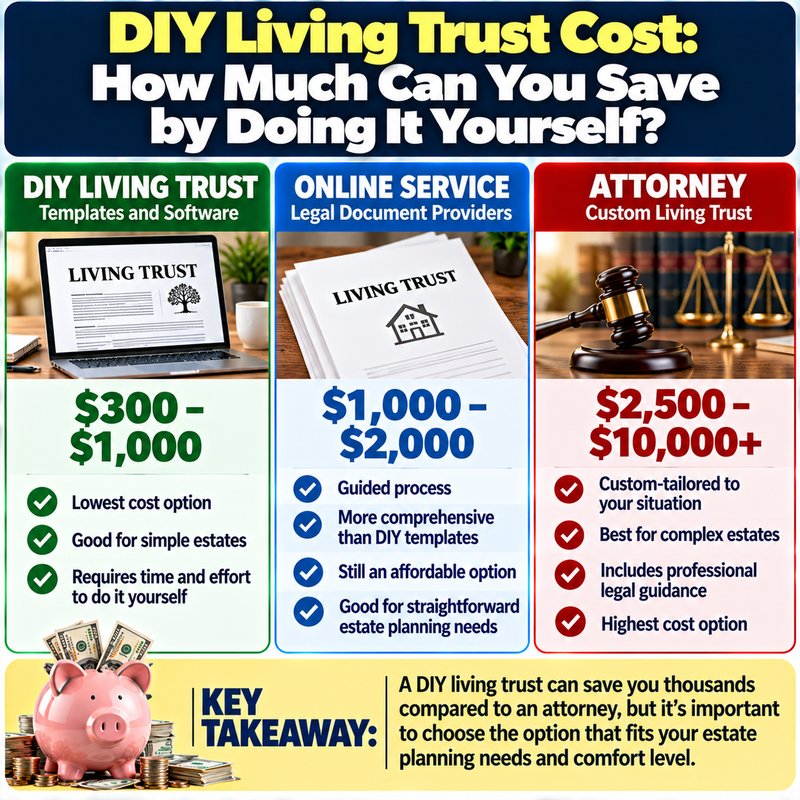
DIY vs. Online Guided Service
Between pure DIY and hiring a traditional attorney sits a third option: guided or supported digital planning. These services combine software-driven document generation with some level of professional review, customer support, or attorney consultation built into the package.
Pricing for this middle-ground approach often lands in a similar range to basic DIY products—roughly $400 to $1,000—but the experience can feel meaningfully different. Instead of relying entirely on your own interpretation of a questionnaire, you typically get some combination of guided prompts, customer support to answer procedural questions, and sometimes a licensed attorney reviewing the final document before it’s finalized.
This model won’t replace a fully customized attorney-drafted plan for someone with a genuinely complex estate, but it can bridge the gap for people who want more confidence than a static template offers without paying full attorney rates. It’s worth comparing a few guided services directly against straightforward DIY templates to see what level of support actually comes with the price tag—support varies significantly from one provider to the next.
- Pure DIY template: lowest cost, full personal responsibility for accuracy and funding
- Guided digital service: similar price range, but with built-in support or review
- Traditional attorney: highest cost, full individualized legal advice and drafting

DIY vs. Estate-Planning Attorney
Attorney-prepared living trusts typically run from $1,500 to $4,000, substantially more than the $400 to $1,000 range common for DIY and guided digital options. That gap exists because an attorney isn’t just filling in a template—they’re reviewing your specific assets, advising on state-specific requirements, and tailoring language to your family’s exact situation.
For someone with a complex estate, that customization can prevent costly errors down the road. For someone with a simple, single-state estate and a handful of accounts, the extra cost may buy more than they actually need. Our full living trust cost breakdown walks through how these price tiers compare side by side, including what drives attorney fees higher in certain cases.
Common Cost Mistakes When Comparing DIY With Professional Options
One frequent mistake is comparing only the sticker price of a DIY template against an attorney’s full fee, without accounting for notarization, deed preparation, recording fees, and the time required for funding. Another common misstep is assuming a cheaper DIY product automatically means less work—sometimes a bare-bones template actually requires more personal research because it offers less built-in guidance. Finally, some people forget to budget for the possibility of a one-time attorney consultation if a question comes up mid-process, which can turn a “DIY” plan into a hybrid one without warning.
How to Reduce Costs Without Ignoring Funding and Maintenance
If cost is the primary driver, there are ways to keep expenses down without skipping the steps that actually make a trust function. Choosing a notary through your bank rather than a mobile service, batching deed preparation and recording into a single trip to the county office, and keeping a simple checklist of every asset that needs retitling can all reduce friction without adding real risk.
It also helps to revisit your trust periodically—after a marriage, divorce, home purchase, or the birth of a child—rather than assuming a document created years ago still matches your current situation. A quick review, whether done yourself or with brief professional input, costs far less than discovering a gap after it’s too late to fix.
DIY Decision Checklist
Before committing to a DIY living trust, it helps to run through a short gut-check: Is your estate contained to one state? Are your assets straightforward—primarily a home, bank accounts, and standard investment accounts? Do you feel confident reading legal instructions and following through on multi-step administrative tasks without someone double-checking your work? Does your family situation avoid the more complicated scenarios covered above, like blended family dynamics or special-needs beneficiaries?
If you answered yes to most of these, a DIY approach is worth serious consideration. If you found yourself hesitating on more than one question, that’s a reasonable signal to at least schedule a single consultation with a professional before finalizing your plan—even if you ultimately handle the bulk of the work yourself.

Frequently Asked Questions
Running your estate planning questions through a quick FAQ format can clear up a lot of confusion fast, especially when you’re trying to decide between a template, a guided service, or an attorney. Below are the questions people ask most often when weighing a DIY living trust against other options.
These answers are meant to give you a clear starting point, not a substitute for reviewing your own state’s specific rules before signing anything.
Is a DIY living trust legally valid?
Yes. A properly executed DIY living trust that meets your state’s signing and notarization requirements is legally valid. Validity depends on following the correct execution steps—signing in front of the right witnesses or notary, using language your state recognizes—not on whether an attorney personally drafted the document.
Where DIY trusts sometimes run into trouble isn’t legal validity, it’s incomplete funding. A valid trust that never received any assets doesn’t accomplish much, which is why the signing step and the funding step need to be treated as equally important.
If you’re ever unsure whether your specific document meets your state’s execution rules, that’s a reasonable moment to ask a local attorney a single, targeted question rather than guessing.
How much does it cost to set up a living trust myself?
DIY living trust setup generally costs under $300 to around $1,000 for the document itself. That range covers everything from a basic fill-in-the-blank book to a more comprehensive online software platform with built-in guidance.
Remember that this range reflects only the document—notarization, deed preparation, recording fees, and your own time spent on funding sit outside that number and should be factored into your overall budget.
What is the cheapest way to create a living trust?
A basic book or low-cost template typically represents the cheapest entry point. That said, the lowest-priced option may offer less guidance and support than a mid-range template or a guided digital service, so cheaper isn’t always simpler in practice. For more insights, explore this DIY living trust cost guide.
Do I still need a lawyer if I use an online template?
Not necessarily, but a one-time consultation can be worthwhile if your estate includes complicating factors like business ownership, property in multiple states, or a beneficiary with special needs. Many people use templates for the bulk of their planning and bring in an attorney only to answer a specific question or review a tricky clause.
How much does trust administration cost after death?
Trust administration—the process of distributing assets after death—often costs between $3,000 and $10,000. This cost is separate from whatever you spent setting up the trust originally and typically involves whoever serves as trustee at that time. For those considering alternatives, understanding the differences between a trust vs a will can be beneficial.
Can I write my own living trust without a notary?
Most states require notarization for a living trust to be valid, so skipping this step typically isn’t an option regardless of which DIY method you use. Some states also require witnesses in addition to a notary, so it’s worth checking your specific state’s rules before you schedule your signing.
Notarization is usually inexpensive and widely available through banks, shipping stores, or mobile notary services, so it rarely adds significant cost—just an extra appointment to plan around. For many California homeowners, understanding the differences between a trust vs a will can also be an important part of planning their estate.
What happens if I forget to transfer assets into my trust?
Assets left outside the trust generally don’t receive the trust’s benefits and may need to pass through probate instead, which is the exact outcome a living trust is usually designed to avoid. This is why funding—retitling accounts, preparing deeds, updating beneficiary paperwork—matters just as much as the signing ceremony itself.
Is a revocable or irrevocable trust cheaper to set up?
A revocable living trust typically costs less to set up because it’s simpler to draft and doesn’t involve the additional planning considerations that come with an irrevocable structure. Most people start with a revocable trust since it can still be changed or dissolved later if circumstances shift.
Irrevocable trusts carry higher setup costs in part because they’re permanent decisions, and getting the language wrong isn’t something you can simply undo afterward. That permanence is usually the reason professional drafting is recommended for this trust type.
Does my state affect how much a living trust costs?
Yes. Notary fees, recording fees, and specific deed requirements all vary by state and even by county, which can shift your total cost up or down depending on where you live and where your property is located.
When should I hire an attorney instead of doing it myself?
Professional guidance tends to make the most sense for blended families, multi-state property, business ownership, special-needs beneficiaries, or advanced tax and asset-protection goals. If your situation checks any of these boxes, the cost of a consultation is often small compared to the risk of an overlooked detail.
Outside of those scenarios, many people find that a straightforward estate with assets in one state is manageable through a well-built template, paired with careful attention to the funding steps afterward.
- Document cost (template, book, or software): under $300 to ~$1,000
- Notarization and witness requirements: small added cost, varies by state
- Deed preparation and county recording: set by local government, not the template provider
- Asset retitling and funding: no dollar cost, but real time and follow-through required
- Trust administration after death: typically $3,000 to $10,000, separate from setup
Looking at the full picture, the appeal of a DIY living trust isn’t just the lower sticker price—it’s the control and flexibility of handling your own estate plan at your own pace. That said, the savings only hold up if the funding and maintenance steps actually get done, since an unfunded trust can leave your family facing the very probate process you were trying to avoid.
Simple, single-state estates with straightforward assets are often well-suited to a DIY approach, especially for someone comfortable with paperwork and willing to follow through on retitling accounts and property. More complicated situations—blended families, multiple states, business ownership, or special-needs beneficiaries—tend to benefit from at least one professional conversation, even if the rest of the plan is handled independently.
There’s no single right answer for everyone, and that’s exactly why comparing your options side by side matters more than chasing the lowest possible price tag. Whether you lean toward a template, a guided digital service, or full attorney representation, the right choice is the one that matches both your estate’s complexity and your own comfort level with the administrative work involved.