How Much Does Probate Cost? Breaking Down the Major Estate Administration Expenses
Understand Court Costs, Attorney and Executor Fees, Appraisals, Accounting, and the Factors That Can Increase Estate Administration Expenses
Probate can cost anywhere from a few hundred dollars to tens of thousands, and the final number depends far more on your state’s rules and your estate’s complexity than on a simple formula.
Key Takeaways
- Probate costs are governed by state law, not a nationwide percentage, so the same estate could cost very different amounts depending on where it’s administered.
- Typical probate expenses include court filing fees, attorney fees, executor or personal-representative compensation, appraisals, accounting and tax-preparation work, bonds, and creditor-notice publication costs.
- Estate size alone doesn’t determine your final bill — disputes among heirs, real estate holdings, unresolved debts, and tax complications often matter more than the dollar value of the assets.
- Working with a knowledgeable estate planning resource, like Create A Living Trust, can help families understand which planning tools actually reduce probate exposure before a crisis forces the issue.
- Later in this guide, we’ll break down how probate costs compare to the expense of creating and maintaining a living trust — and why “avoiding probate” doesn’t automatically mean avoiding cost.
Families searching for a straightforward answer to “how much does probate cost” are often met with vague percentages that don’t hold up once you look at actual court filings. The truth is messier, but also more useful: probate costs are built from several separate line items, each governed by different rules depending on your state and the specifics of the estate. Understanding those line items — rather than chasing a single percentage — is what actually helps you plan.
Why There’s No Single Answer to “What Does Probate Cost?”
Ask ten probate attorneys what an estate will cost to settle, and you’ll likely get ten different ranges. That’s not evasiveness — it’s accuracy. Probate is a court-supervised process, and courts operate under state statutes that vary dramatically in their fee structures, timelines, and compensation formulas.
Probate Rules Are Set by Each State, Not Federal Law
There is no federal probate code. Every state writes its own rules for filing fees, executor compensation, notice requirements, and the thresholds that determine whether an estate qualifies for a simplified process. A $300,000 estate in one state might sail through a streamlined small-estate procedure, while the identical estate in another state could require full traditional probate with months of court hearings.
Why a “Percentage of the Estate” Rule Is Misleading
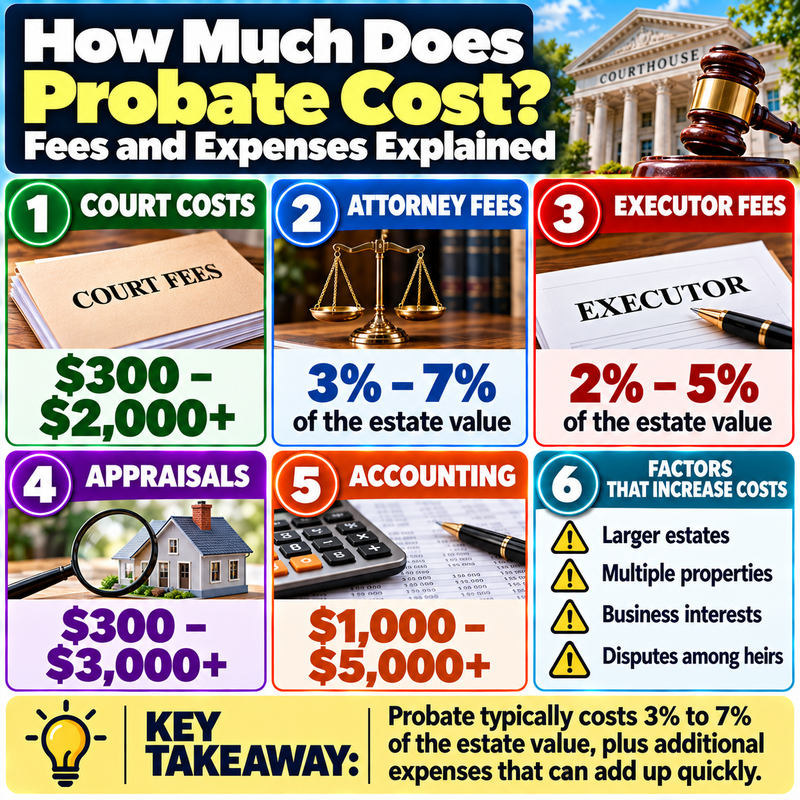
You’ll see claims online that probate “typically costs 3% to 7% of the estate’s value.” That range can show up in real cases, but treating it as a universal rule ignores how much variation exists. A simple estate with one heir, no real estate, and no disputes might settle for a few thousand dollars in flat fees. A contested estate with rental property, outstanding creditor claims, and multiple attorneys involved could easily exceed that percentage. The percentage is a symptom of complexity, not a cause of it — which is why this guide focuses on the actual cost components instead.
Court Filing and Administrative Fees
Every probate case starts with filing fees paid to the court clerk. These are usually the smallest and most predictable cost in the entire process, though they add up as the estate requires additional filings.
- Initial petition or application filing fees
- Letters testamentary or letters of administration issuance fees
- Certified copies needed for banks, transfer agents, and the DMV
- Additional filing fees for inventories, accountings, or petitions for instructions
- Fees for recording real estate transfers tied to the estate
Standard Filing Fee Ranges
Court filing fees commonly fall somewhere between $250 and $600 for the initial petition, though this varies by county and by whether the estate is using a full probate process or an expedited small-estate procedure. Expedited court fees are often lower, sometimes landing between $100 and $300, since the court’s involvement is intentionally limited.
Certified Copies and Clerk Charges
Beyond the initial filing, executors usually need several certified copies of the letters testamentary to present to banks, brokerage firms, and county recorders. Each certified copy typically carries its own small fee. It’s a minor cost individually, but if an estate has accounts spread across five or six institutions, those charges accumulate.
Attorney Fees in Probate
Attorney fees are usually the largest single expense in a traditional probate case, and they’re also the most variable. Some attorneys bill hourly, some charge flat fees for routine estates, and a handful of states use statutory fee schedules tied to the estate’s value.
Attorney fee ranges commonly cited in probate matters run from roughly $2,000 for a simple, uncontested estate to $10,000 or more for estates involving real estate, multiple beneficiaries, or disputes. Complex litigation — like a will contest — can push legal costs well beyond that range, since attorneys bill for every hearing, motion, and negotiation involved.
Hourly Billing
Hourly billing is common for estates that don’t fit a predictable pattern. If an executor needs ongoing legal guidance to resolve creditor claims, handle a property sale, or respond to a beneficiary dispute, the attorney tracks time spent and bills accordingly. This structure rewards efficiency but can become expensive if the estate drags on.
Flat-Fee Arrangements
Many attorneys offer flat fees for standard, uncontested probate administration. This gives families cost certainty upfront, which is part of why flat-fee probate has grown more common for simpler estates. The tradeoff is that flat fees typically only cover routine work — anything outside the agreed scope, like litigation, usually triggers additional charges.
Statutory or Formula-Based Fees in Some States
A handful of states use a statutory formula to calculate attorney compensation, often tied to a percentage of the estate’s value on a sliding scale. Where this applies, it’s set by that state’s probate code specifically, not by a nationwide standard, so families should confirm the actual statute in their jurisdiction rather than assuming a formula applies everywhere.

Executor and Personal Representative Compensation
The person managing the estate — called the executor, personal representative, or administrator depending on the state — is generally entitled to compensation for their time and responsibility. This isn’t automatic charity work; settling an estate can involve dozens of hours of paperwork, communication, and legal coordination.
Statutory vs. Reasonable Compensation
Some states set a statutory formula for executor compensation, often calculated as a percentage of the estate’s value, commonly cited in the range of 2% to 5% depending on the jurisdiction. Other states simply require “reasonable compensation,” which the court evaluates based on the complexity of the work and time invested. Professional fiduciaries — individuals or companies hired specifically to administer estates — often operate under their own separate fee schedules rather than the family-member default rates.
Because these rules differ so much by state, two estates of identical value can produce very different executor fees. A family member serving as executor in a state with a flexible “reasonable compensation” standard might request far less than the statutory maximum, especially if they’re also inheriting from the estate.
When Executors Waive Their Fee
It’s common, especially among close family members, for the executor to waive compensation entirely. This often happens when the executor is also the primary beneficiary, since taking a fee would effectively just shift money from one pocket to another while creating taxable income. Waiving the fee can also smooth relationships among co-beneficiaries who might otherwise question why the executor is being paid from shared estate funds.
Appraisal and Property Valuation Expenses
Most probate estates require some form of professional appraisal, particularly when real estate, business interests, or valuable personal property are involved. Courts typically require a fair market valuation as of the date of death, both for tax reporting and for fair distribution among heirs. If you’re navigating the loss of a loved one, the last thing you want is financial uncertainty surrounding the probate process.
Appraisal costs commonly range from a few hundred dollars for a single piece of personal property up to several thousand dollars for commercial real estate, business valuations, or collections requiring specialized expertise. A single-family home appraisal is usually the most predictable cost in this category, while unique assets — think closely held business interests or art collections — require specialists whose fees reflect that expertise.

Accounting and Tax-Preparation Costs
Settling an estate almost always involves some accounting work, even when the estate itself owes no federal estate tax. Executors are typically required to prepare an inventory of assets, track income generated during administration, and often file a final accounting with the court before the estate can close.
Tax preparation adds another layer. The decedent’s final personal income tax return usually needs to be filed, covering income earned up until the date of death. If the estate itself generates income during administration — interest, dividends, or rental income, for example — it may trigger a separate filing requirement.
According to current IRS guidance, an estate generally must file Form 1041 if it generates more than $600 in annual gross income during the administration period.
Accounting and appraisal costs together are commonly cited in the range of $500 to $5,000 or more, depending on how many assets require valuation and how complicated the estate’s income situation becomes during administration.
Filing the Decedent’s Final Income Tax Return
This return covers the deceased person’s income from January 1 through the date of death. It’s a standard requirement regardless of estate size, and most families hire a CPA or enrolled agent to prepare it correctly, particularly if the decedent had investment income, business income, or multiple income sources.
When an Estate Needs to File IRS Form 1041
Form 1041 is the income tax return for the estate itself, covering any income the estate generates after death but before assets are distributed. This commonly applies when an estate holds investment accounts, rental property, or other income-producing assets for an extended administration period. If the estate crosses the $600 gross income threshold mentioned above, the executor is responsible for ensuring this return gets filed on time.
Probate Costs Are Separate From Federal Estate Tax
Federal estate tax is a different matter entirely, and it’s important not to confuse the two. Federal estate tax applies only to estates that exceed the federal exemption threshold under current filing rules, and when it applies, it’s calculated and paid separately from routine probate administration expenses. Most estates never owe federal estate tax at all, yet they still incur the accounting, appraisal, and court costs described above. Labeling federal estate tax as a standard “probate fee” overstates what most families will actually pay.
Bond, Publication, and Other Miscellaneous Costs
Beyond attorneys, appraisers, and accountants, probate carries a handful of smaller but still meaningful expenses that families often don’t anticipate until the bills start arriving. These costs exist to protect the estate’s assets and to satisfy legal notice requirements, and skipping them usually isn’t an option once the court requires them.
Surety Bond Premiums
Many courts require an executor or administrator to post a surety bond before taking control of estate assets, essentially insuring the estate against mismanagement or theft. Bond premiums commonly fall somewhere between $300 and $1,500, depending on the size of the estate and the bonding company’s underwriting. Wills can sometimes waive the bond requirement outright, which is one reason estate planning attorneys often recommend including a bond waiver clause when drafting a will — it’s a small detail that can save a real expense later.
Not every estate needs a bond. If the will specifically waives the requirement, or if all trust beneficiaries agree in writing to waive it, the court may allow the executor to proceed without one. Estates administered without a will, however, often face a bond requirement by default, since there’s no document establishing the deceased person’s wishes about who should serve without one.
Creditor Notices and Publication Fees
State law typically requires executors to notify known creditors directly and to publish a notice in a local newspaper, giving unknown creditors a window of time to file claims against the estate. Publication costs commonly run between $100 and $500, depending on the newspaper’s rates and how many notices the state requires. This step isn’t optional paperwork — it starts the clock on the legal period during which creditors can make claims, and skipping it can leave an estate exposed to late claims long after assets have been distributed.
Property Maintenance, Storage, and Insurance
When an estate includes a house, vehicle, or storage unit full of belongings, someone has to keep paying for upkeep while probate works its way through the court system. That means continued property insurance, utility bills, lawn care, and sometimes security systems to prevent vacant-home break-ins. These costs are easy to overlook in cost estimates, but they’re very real, especially in a traditional probate case that drags on for a year or more.
A home that sits vacant during a lengthy probate case can also lose value or require unexpected repairs, adding indirect costs on top of the obvious maintenance bills. Executors are generally responsible for managing these ongoing expenses out of estate funds, which is one more reason why a faster administration process tends to protect more value for the heirs.
Real Estate Sale Expenses
If the estate plan or the heirs decide to sell real property during probate, standard real estate transaction costs apply on top of everything else: real estate agent commissions, closing costs, title insurance, and any repairs needed to make the property marketable. These costs aren’t unique to probate, but they’re easy to forget when estimating the total expense of settling an estate that includes a house.

What Makes Probate More Expensive or Less Expensive
Here’s the part that surprises most families: estate size alone doesn’t predict the final cost. A $200,000 estate with a contested will and a disputed property sale can easily cost more to administer than a $600,000 estate with one cooperative heir and liquid bank accounts. Cost follows complexity, not dollar value.
Several factors drive that complexity far more than the size of the estate itself.
Estate Size and Complexity
Larger estates do tend to involve more moving parts — multiple properties, business interests, investment accounts spread across institutions — and that complexity naturally increases legal and accounting work. But complexity can show up in a modest estate too. A single rental property with a messy title history, or a small business with unclear ownership documents, can generate legal fees that dwarf what a much larger but simpler estate would cost.
Whether the Will Is Contested
Nothing drives up probate costs faster than a legal dispute. When an heir challenges the will’s validity, questions the executor’s conduct, or disputes asset distribution, the case shifts from routine administration into litigation. That means depositions, additional court hearings, expert witnesses in some cases, and attorney hours that can stretch into the tens of thousands of dollars.
Disputes also extend the timeline dramatically, which compounds other costs — property maintenance continues, bond premiums may need renewal, and professional fees accrue the longer the case remains open. All of these factors contribute to how long a probate process takes. More time and more parties involved in a probate case generally correlate with more disagreements, simply because there are more opportunities for conflicting interests to surface.
Consider two estates of identical value to see how dramatically this plays out in practice.
| Factor | Uncontested, Simple Estate | Contested, Complex Estate |
|---|---|---|
| Attorney fees | $2,000–$4,000 flat fee | $15,000+ in hourly billing |
| Timeline | 3–6 months | 12–24+ months |
| Property costs | Minimal, quick sale | Ongoing maintenance, insurance, possible decline in value |
| Court involvement | One or two routine hearings | Multiple hearings, possible trial |
How Long the Process Takes
Time itself is a cost driver. The longer an estate remains open, the more it accumulates in attorney hours, property upkeep, bond renewal fees, and accounting work for additional tax years. A probate case that closes in four months naturally costs less than one that drags on for eighteen, even if the underlying asset list is nearly identical.
Small-Estate and Simplified Probate Procedures
Not every estate has to go through full traditional probate. Most states offer some form of simplified or expedited procedure for estates that fall under a certain value threshold and meet specific eligibility criteria, and these processes can dramatically cut both the time and the cost of administration.
The American Bar Association notes that many states provide expedited or simplified proceedings specifically designed to reduce court involvement for smaller, less complicated estates. These procedures go by different names depending on the state — small estate affidavit, summary administration, simplified probate — but they share the same basic goal of skipping unnecessary court steps when the estate doesn’t need heavy supervision.
Typical Eligibility Requirements
Qualifying for a simplified process usually requires meeting several conditions at once, and failing even one can push the estate back into traditional probate.
- The estate’s total value falls below a state-specific threshold, often somewhere between $75,000 and $150,000 depending on the state
- There are no disputes among heirs or beneficiaries about how assets should be distributed
- There are no outstanding taxes or unusually complex debts attached to the estate
- No legal challenges or will contests are pending
- In some states, additional restrictions apply depending on whether the decedent died with or without a valid will
These eligibility rules are set individually by each state, so the dollar threshold and specific requirements in one state won’t necessarily match a neighboring state’s rules.
How Much You Can Save With a Simplified Process
In one documented case, a $60,000 estate using a Small Estate Affidavit process was settled in less than three months for a total cost of $750 — compared to a traditional probate case involving a $420,000 estate that took nearly 14 months and cost more than $22,000 in total expenses.
That gap illustrates just how much the procedural path matters, independent of estate value. Simplified procedures typically cost somewhere between $300 and $2,000 total, a fraction of what traditional probate commonly runs once attorney fees, court costs, and administrative expenses are added together.
It’s worth noting, though, that simplified probate isn’t risk-free. These streamlined processes generally skip the formal court review that might catch problems like an unknown creditor or a disputed asset. If a creditor or long-lost heir surfaces after a simplified proceeding closes, there’s often limited legal recourse compared to what a traditional probate case would have provided. And once a family begins one path — traditional or expedited — they’re typically expected to see it through on that track, rather than switching partway if new complications appear.
Before assuming a simplified process will apply, it’s worth having a probate attorney confirm eligibility under your specific state’s statute, since a single disqualifying factor — an unresolved debt, a disputed asset, or an estate value just over the threshold — can send the case into full traditional probate anyway.

Probate Costs vs. Living Trust Administration Costs
Families comparing probate to a living trust often ask the wrong question: which one is “free”? Neither is. The real comparison is between the cost of court-supervised administration after death versus the cost of creating, funding, and maintaining a trust-based plan during life. Understanding the full living trust cost structure helps put probate expenses into proper context, rather than assuming a trust magically eliminates all expense.
What a Living Trust Actually Costs to Create and Fund
Setting up a living trust involves upfront legal fees to draft the trust document, plus the administrative work of retitling assets into the trust’s name — a step often called “funding” the trust. Skipping proper funding is one of the most common mistakes families make, since an unfunded trust provides no probate protection at all for the assets left outside it. Bank accounts, real estate deeds, and investment accounts all typically need to be formally retitled, which takes time and sometimes incurs recording or transfer fees.
Ongoing Trustee and Administration Expenses
A funded trust doesn’t eliminate administrative work after death — it shifts that work outside the courtroom. The successor trustee still has to manage the trust’s assets, work with accountants on any tax filings the trust generates, potentially coordinate property sales, and communicate with beneficiaries. Trustees are generally entitled to reasonable compensation for this work, just as an executor would be in probate, and professional trustees may charge according to their own fee schedules. The difference is that trust administration typically happens without court supervision, which usually means faster timelines and more privacy, even though real costs still apply.
When a Living Trust Attorney Is Worth Hiring
Because a trust needs to be properly drafted and consistently funded to work as intended, many families choose to work with a living trust attorney rather than attempting a do-it-yourself template. An attorney familiar with your state’s property and tax rules can help ensure the trust actually accomplishes what it’s meant to — avoiding probate for the assets inside it — rather than leaving gaps that force part of the estate back into court anyway.
Can Good Estate Planning Lower Your Probate Bill?
Good planning rarely eliminates administrative cost entirely, but it can meaningfully reduce how much of the estate ends up tied to court-supervised probate in the first place. The goal isn’t finding a loophole — it’s matching the right tool to each type of asset so less of the estate needs full probate administration at all.
Several straightforward planning tools can shrink the portion of an estate that goes through probate, which in turn reduces the fees, timeline, and court involvement tied to that portion.
None of these tools work in isolation, and none of them are truly “free” either — each comes with its own setup requirements and occasional pitfalls if not maintained properly. But used thoughtfully, together they can significantly change how much of an estate ends up exposed to probate’s costs and delays.
Using Beneficiary Designations and Transfer-on-Death Deeds
Retirement accounts, life insurance policies, and many investment accounts allow you to name a beneficiary directly, which means those assets pass outside probate automatically when the account holder dies. Similarly, many states now allow Transfer on Death (TOD) deeds for real estate, letting a home pass directly to a named beneficiary without going through the court process that would otherwise apply. Keeping these designations updated — especially after major life events like divorce or remarriage — is one of the simplest, lowest-cost ways to reduce probate exposure for specific assets.
Joint Ownership With Right of Survivorship
Holding property jointly with right of survivorship means that when one owner dies, the surviving owner automatically becomes the sole owner — no probate required for that asset. This approach works well for married couples and is commonly used for jointly held bank accounts, vehicles, and real estate. It’s worth noting, though, that joint ownership has tradeoffs beyond probate avoidance, including shared liability and loss of control during the original owner’s lifetime, so it shouldn’t be used as a blanket strategy without considering those implications.
Keeping Organized Records for Your Executor
One of the most overlooked ways to reduce probate costs has nothing to do with legal documents at all: keeping clear, organized records. An executor who has to hunt down account numbers, locate deeds, and guess at which bills are still owed will rack up far more billable hours — their own time if compensated, and their attorney’s time if questions arise — than one who’s handed a clean folder of information. A simple list of accounts, insurance policies, debts, and key contacts can shave real money off the eventual administration cost, regardless of which legal structure the estate ultimately uses.

Questions to Ask Before Trusting Any Probate Cost Estimate
Given how much variation exists state to state and estate to estate, it pays to be skeptical of any cost estimate that doesn’t come with context. Before accepting a number — whether it’s from a blog post, an attorney’s initial quote, or a well-meaning friend’s experience — it helps to ask a few pointed questions.
These questions apply whether you’re researching probate costs in advance or evaluating a quote from a probate attorney for an estate you’re currently administering.
Is This Figure State-Specific?
Because probate is governed entirely by state law, a cost figure that doesn’t specify which state’s rules it’s based on should be treated with caution. Executor compensation formulas, filing fee amounts, and small-estate thresholds can all differ meaningfully between neighboring states, so a number quoted without state context tells you very little about what your own estate will actually face.
Does This Number Include Attorney and Executor Fees Separately?
Some cost estimates bundle attorney fees and executor compensation into one combined figure, while others list them separately — and conflating the two can make a given estimate look either artificially low or artificially high. Ask specifically whether a quoted range covers legal fees alone, executor compensation alone, or the full combined administration cost including appraisals, accounting, and court fees.
Is Federal Estate Tax Being Confused With Probate Costs?
As covered earlier, federal estate tax is a completely separate matter from probate administration expenses, triggered only when an estate exceeds the federal exemption threshold. Any cost breakdown that folds estate tax into “probate costs” is mixing two unrelated categories, and it’s worth asking directly whether a given estimate includes tax liability or strictly administrative expense.
The Smartest Next Step for Protecting Your Estate
Probate costs aren’t a mystery once you break them into their actual components — court fees, attorney fees, executor compensation, appraisals, accounting, bonds, and the handful of smaller expenses that come with managing property and notifying creditors. None of these costs are fixed percentages handed down from some universal rule; they’re shaped by your state’s specific statutes and the real complexity of your estate.
The families who fare best are the ones who understand these cost drivers well before a crisis forces the issue, and who make informed choices about which planning tools — wills, trusts, beneficiary designations, or some combination — fit their actual situation. Speaking with a qualified estate planning professional about your specific state’s rules and your family’s circumstances is a reasonable next step toward a plan that actually reflects your goals.

Frequently Asked Questions
Does probate cost a fixed percentage of the estate?
No. There is no universal percentage that applies nationwide. Some figures circulating online suggest probate costs commonly fall in a 3% to 7% range of the estate’s value, but that figure reflects outcomes in specific cases rather than a legal standard.
Actual costs depend on your state’s statutes, whether the estate qualifies for simplified administration, and how much complexity or conflict is involved.
A $500,000 estate processed through traditional probate with disputes or real estate complications could reasonably cost $15,000 to $35,000, while a simpler estate of similar value with no conflicts might settle for a fraction of that amount.
The percentage framing is best treated as a rough historical observation, not a planning tool.
Who pays for probate costs, the estate or the family?
Probate costs are paid out of the estate’s own assets before any distribution to heirs, not out of pocket by family members. This means beneficiaries generally receive less than the gross value of the estate once fees, taxes, and expenses are subtracted.
Can probate costs be deducted from estate taxes?
In some cases, certain administration expenses can be deducted on the estate’s tax return, reducing the taxable value of the estate for federal estate tax purposes if the estate is large enough to owe that tax in the first place.
Administration expenses such as attorney fees, executor compensation, and court costs may qualify as deductions under IRS rules governing estate tax returns, though the specific treatment depends on which return — the estate’s income tax return or the estate tax return — the deduction is claimed against.
Since most estates fall below the federal estate tax exemption threshold, this deduction question typically only matters for larger estates.
Families with a potentially taxable estate should work with a CPA or estate attorney familiar with current IRS rules, since misclassifying a deduction can create complications during an audit.
How long does probate typically take?
Timelines vary widely based on the procedure used and whether disputes arise. A simplified small-estate process can sometimes wrap up in six weeks to three months, while traditional probate involving real estate, multiple beneficiaries, or disputes commonly stretches to 12 months or longer.
The documented case of a $420,000 estate taking nearly 14 months to settle illustrates how traditional probate timelines can extend well beyond a year even without extreme complications.
Is probate required if there’s a will?
Having a will does not avoid probate — it simply tells the court how you want assets distributed once probate begins. Probate is still generally required to legally transfer ownership of assets held solely in the deceased person’s name, regardless of whether a will exists.
Assets held in a properly funded trust, or those with valid beneficiary designations, can bypass probate separately from whether a will exists.
What happens if the estate can’t afford probate costs?
Probate expenses are generally paid from the estate’s own assets as they become available, often meaning certain costs like filing fees or attorney retainers are advanced by the executor or family and reimbursed later from the estate. If an estate genuinely lacks sufficient liquid assets, courts in some states allow for alternative arrangements, though specifics depend heavily on state law and the nature of the estate’s assets.
Does a living trust completely eliminate court costs?
A properly funded living trust can avoid probate court involvement for the assets titled in the trust’s name, which does eliminate the court filing fees and attorney costs tied specifically to probate administration for those assets. However, any assets accidentally left outside the trust at death may still require probate, and trust administration itself can involve its own legal, accounting, and trustee compensation costs.
Can you negotiate probate attorney fees?
In states that use hourly or flat-fee billing rather than a statutory formula, attorney fees are often negotiable, particularly for routine, uncontested estates. It’s reasonable to request a written fee agreement upfront and to ask whether a flat fee or hourly arrangement would be more cost-effective for your specific situation.
In states with statutory fee schedules tied to estate value, negotiation may be more limited, since the fee structure is set by law rather than by individual attorney discretion.
What is considered a “small estate” for simplified probate?
Small-estate thresholds are set individually by each state and commonly range somewhere between $75,000 and $150,000, though exact figures and qualifying conditions vary significantly. Some states exclude certain assets, like homestead property, from this calculation, which can allow larger overall estates to still qualify for simplified procedures.
Eligibility typically also requires no disputes among heirs, no complicated outstanding debts, and no pending legal challenges, so the dollar threshold alone doesn’t guarantee qualification.
Do all states charge the same executor compensation rate?
No. Some states use a statutory formula, often citing figures in the 2% to 5% range of the estate’s value, while others simply require “reasonable compensation” determined by the court based on the complexity of the work performed.
Professional fiduciaries, as opposed to family members serving as executor, often operate under entirely separate fee schedules that reflect their professional services.
Because of this variation, it’s worth confirming your specific state’s executor compensation rules directly rather than assuming a rate seen elsewhere will apply.
If you’re ready to explore how a thoughtfully structured estate plan might reduce the administrative burden on your family, Create A Living Trust offers resources to help you understand your options before you need them. Additionally, if you’re curious about the costs associated with probate, there are guides available to assist you.