What Is Probate? Understanding the Court Process From Start to Finish
Understand What Happens After Someone Dies, From Filing the Will to Distributing the Estate
Article-at-a-Glance
- Probate is the court-supervised process that transfers a deceased person’s property, pays their debts, and closes out their financial affairs.
- Not every asset goes through probate — accounts with named beneficiaries, jointly owned property, and assets properly held in a trust often bypass it entirely.
- The exact forms, deadlines, and even the name of the court handling probate differ from state to state, so what applies in one state may not apply in yours.
- An executor or administrator carries specific legal duties, including locating assets, paying valid debts, filing tax returns, and distributing what’s left to heirs.
- Later in this guide, we’ll break down how a properly funded living trust changes — but doesn’t always eliminate — the need for probate.
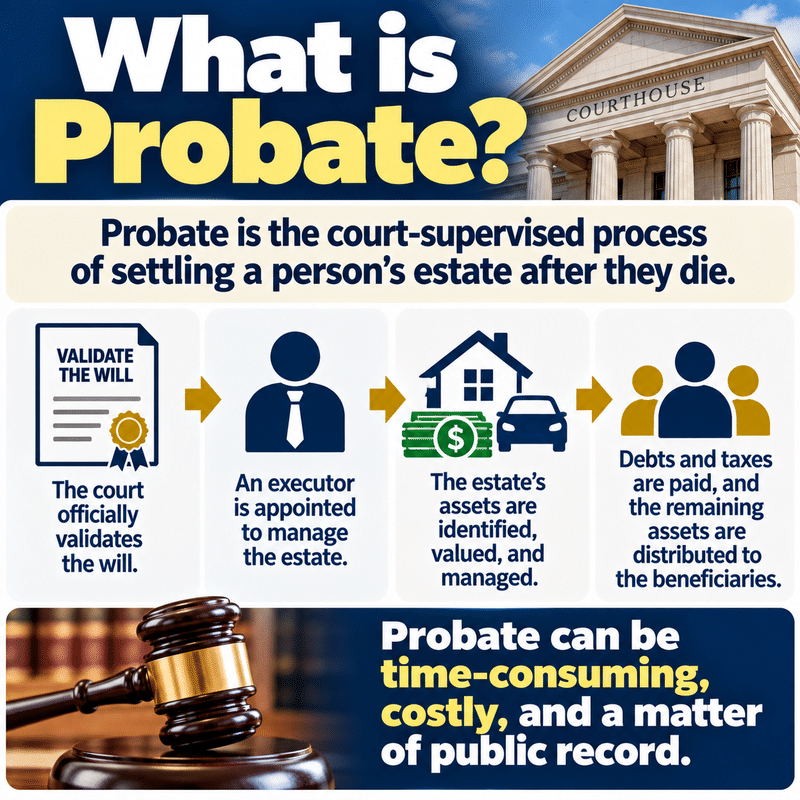
Probate is the legal process courts use to settle a person’s affairs after they die, and depending on the size of the estate, it can take anywhere from a few months to over a year.
If you’re reading this shortly after losing someone, you’re probably overwhelmed by unfamiliar terms and a stack of paperwork nobody warned you about. That’s normal. Probate sounds intimidating, but it’s really just a structured checklist the court uses to make sure debts get paid and property ends up with the right people. Organizations like Create a Living Trust spend a lot of time helping families understand this exact process, because confusion here is common and it’s rarely anyone’s fault — most people just never needed to know this before.
What Probate Is
Probate is the legal process that happens after someone dies to make sure their estate — meaning their money, property, and belongings — gets managed correctly and transferred to the right people. If the person left a will, probate is the mechanism that validates it. If they didn’t, probate is still what determines who inherits, just using state law instead of a written document. Either way, the court supervises the process to prevent disputes and confirm that whoever is handling the estate is actually authorized to do so.
Without this kind of oversight, there’d be no official way to prove ownership transferred legally, and family disagreements over who gets what could spiral fast. Probate exists to put a neutral referee — the court — into that process.
Why the Court Gets Involved After a Death
Courts get involved because someone has to have legal authority to act on behalf of a person who can no longer act for themselves. Banks won’t release funds, title companies won’t transfer real estate, and creditors won’t stop calling just because someone died — they all need a court-issued document proving who’s now in charge. That document usually comes from a probate judge appointing an executor or administrator.
Executor, Administrator, and Personal Representative Explained
These terms get used almost interchangeably, but there’s a subtle difference worth knowing:
- Executor — the person named in a valid will to handle the estate.
- Administrator — the person the court appoints when there’s no will, or no executor available to serve.
- Personal representative — a general term some states use to cover both roles.
Whichever title applies, the person holding it has the same basic job: gather the assets, pay what’s owed, and distribute what’s left according to the will or, absent a will, state inheritance law.

When Probate May Be Required
Probate isn’t automatic just because someone died — it depends on how their assets were owned. If everything was jointly titled, had a named beneficiary, or was sitting inside a properly funded trust, there may be little or nothing left for a court to touch. But if the deceased owned property or accounts solely in their own name, probate is typically the only legal way to transfer that ownership.
Assets Owned Solely in the Deceased’s Name
This is the trigger most families run into. A house deeded only in the deceased’s name, a car titled solely to them, or a bank account with no payable-on-death designation — these assets don’t automatically know who should inherit them. The court has to formally recognize the new owner before a deed can be transferred, a title reissued, or funds released.
If, on the other hand, the deceased had no solely owned assets at the time of death — because everything passed directly to a beneficiary or joint owner — probate may not be necessary at all. That’s an important distinction, and it’s one of the biggest reasons estate planning matters long before anyone gets sick or passes away.
- Real estate titled only in the deceased’s name
- Bank or brokerage accounts without a payable-on-death or transfer-on-death designation
- Vehicles titled solely to the deceased
- Personal property like collectibles, jewelry, or business interests with no other named owner
Every state sets its own rules for exactly which assets trigger probate and what dollar threshold qualifies an estate for a simplified process, so it’s worth checking your state court’s probate division or an estate attorney licensed where the deceased lived.
Probate With a Will Versus Without a Will
Having a will doesn’t skip probate — it guides it. The court still needs to confirm the will is valid, that it wasn’t revoked or replaced, and that the named executor is willing and able to serve. Without a will, the court instead follows the state’s intestacy statute, a built-in formula that decides which relatives inherit and in what order, usually starting with a spouse and children.
Which Assets Are Generally Part of the Probate Estate
Generally speaking, the probate estate includes anything titled solely in the deceased’s name with no automatic transfer mechanism attached. That can include real estate, vehicles, bank accounts, investment accounts, business ownership stakes, and even valuable personal property like art or jewelry. If the deceased was the sole signer or sole title holder, it likely belongs in the probate inventory.
Assets That May Transfer Outside Probate
Plenty of assets are specifically designed to skip probate altogether. Life insurance proceeds paid directly to a named beneficiary, retirement accounts like a 401(k) or IRA with a beneficiary listed, jointly held property with rights of survivorship, and payable-on-death or transfer-on-death accounts all transfer automatically once the institution receives a death certificate. Assets properly held inside a trust also generally avoid probate, since the trust — not the individual — technically owns them.

Step-by-Step Probate Process
While every state has its own version of the rules, most probate cases move through a similar sequence of steps. Here’s the general order things typically unfold:
Locate the Will and Estate-Planning Documents
The first practical step is finding the original will, along with any trust documents, insurance policies, deeds, or account statements. Many people keep these in a home safe, a bank safe deposit box, or with their estate planning attorney. Without the original will, some courts require additional steps to prove a copy is valid, which can add delay.
File the Petition and Will With the Appropriate Court
Next, someone — usually the named executor or a close family member — files a petition with the probate court in the county where the deceased lived. This petition formally opens the case and asks the court to either admit the will to probate or, if there’s no will, appoint an administrator. Filing fees, required forms, and even which court handles the case (probate court, surrogate’s court, or district court, depending on the state) vary widely.
Some states also require formal notice to heirs and beneficiaries at this stage, giving them a chance to object if they believe the will is invalid or someone else should serve as executor.
Appointment of Executor or Administrator
Once the court reviews the petition, it issues what’s often called “letters testamentary” (if there’s a will) or “letters of administration” (if there isn’t). This document is what banks, title companies, and government agencies will ask to see before they’ll talk to the executor about the deceased’s accounts or property. Until this letter is issued, the executor technically has no legal authority to act.
Identify, Secure, Inventory, and Value Estate Assets
With authority in hand, the executor’s next job is tracking down everything the deceased owned — bank accounts, real estate, vehicles, investment portfolios, digital assets, business interests, even storage units. Many states require a formal inventory be filed with the court within a set number of months, often listing each asset’s estimated value at the date of death. This may require hiring an appraiser for real estate, vehicles, or valuable personal property.
Securing assets matters too. That might mean changing locks on a vacant house, redirecting mail, or making sure property insurance stays active during the probate period.
Notify Creditors and Address Valid Claims
Creditors get a defined window to file claims against the estate, and that window is set entirely by state law — in some states it’s a matter of weeks, in others it stretches to several months. The executor typically has to publish a notice to creditors in a local newspaper and, in many states, send direct notice to known creditors like credit card companies or medical providers.
Any valid claims get paid from estate funds before heirs receive their share. If the estate doesn’t have enough cash on hand, the executor may need to sell assets to cover debts — which is one reason probate can take longer than families expect.
Handle Taxes and Estate Expenses
Taxes are one of the most confusing parts of probate, mostly because there are actually three separate tax questions to answer, not one. First, the deceased’s final personal income tax return has to be filed, covering income earned from January 1 through the date of death. Second, if the estate itself earns income during probate — say, interest on a bank account or rental income from a property waiting to be sold — that may trigger a separate estate income tax return. Third, and far less common, is federal estate tax, which only applies to estates above a certain value threshold set by federal law each year.
Most estates never come close to owing federal estate tax, so don’t assume probate automatically means a tax bill. That said, tax rules shift depending on the size and structure of the estate, and this is an area where it’s worth talking to a CPA or estate attorney rather than guessing. The executor is also responsible for paying any outstanding property taxes, final utility bills, or other ongoing expenses out of estate funds before distribution happens.
Resolve Disputes or Other Required Court Matters
Not every probate case runs smoothly. Sometimes an heir challenges the will’s validity, questions whether the executor is acting properly, or disputes how an asset was valued. When that happens, the court may need to hold hearings, review evidence, or even remove and replace an executor who isn’t fulfilling their duties. Most estates never reach this point, but when disagreements do surface, they’re usually rooted in family tension that existed long before the death — not the paperwork itself.
Distribute Remaining Property
Once debts, taxes, and valid creditor claims are settled, the executor distributes whatever remains to the beneficiaries named in the will, or to heirs determined by the state’s intestacy law if there was no will. Some states require court approval before any distribution happens, while others allow the executor to distribute once a waiting period passes. In Kentucky, for example, no distributions can legally go out until the estate has been open for a minimum of six months, giving creditors a fair chance to file claims.
Distribution isn’t always as simple as writing checks. Real estate might need to be sold and proceeds divided, personal property might need to be appraised and split evenly, and disagreements over sentimental items — a piece of furniture, a photo album — can sometimes cause more friction than disputes over money ever do.
Final Accounting and Closing the Estate
Typical Probate Timeline (General Example Only — Actual Timelines Vary by State)
Filing petition and appointment: 2–6 weeks
Creditor notice period: 3–6 months (state-dependent)
Asset inventory and appraisal: concurrent with creditor period
Debt and tax resolution: varies based on complexity
Final distribution and closing: often 6 months to 1 year total
Before the court will officially close the estate, the executor typically has to file a final accounting — a detailed report showing every dollar that came in, every dollar that went out, and exactly how the remaining assets were distributed. This document protects everyone involved. Beneficiaries get proof their inheritance was handled correctly, and the executor gets legal confirmation that their duties are complete.
Once the court approves the final accounting, it issues an order closing the estate. At that point, the executor’s legal authority ends, and the probate case is officially over.
Some states allow a simplified closing process for smaller estates, skipping the formal accounting requirement entirely. Whether that applies depends heavily on the estate’s size and the specific state’s small-estate threshold, so it’s worth checking local probate court rules early rather than assuming.

Executor and Administrator Responsibilities
Serving as an executor isn’t an honorary title — it comes with real legal obligations, and courts take those obligations seriously. The role requires organization, patience, and a willingness to keep meticulous records, even when family members are anxious for the process to move faster.
Legal Duties Owed to the Estate and Heirs
An executor owes what’s called a fiduciary duty to the estate and its beneficiaries, meaning they’re legally required to act in the estate’s best interest, not their own. That includes managing assets responsibly, avoiding conflicts of interest, keeping estate funds completely separate from personal funds, and providing beneficiaries with reasonable updates on the estate’s progress.
Executors who mismanage funds or ignore these duties can be held personally liable, which is why many choose to work with a probate attorney even in straightforward cases.
Common Challenges Executors Face
Executors are often close family members handling this responsibility for the first time, right in the middle of their own grief. That combination creates predictable friction points:
- Locating all the deceased’s assets, especially digital accounts or property in other states
- Managing creditor claims while keeping careful documentation of every payment
- Balancing legal deadlines with the emotional needs of grieving family members
- Handling disagreements between beneficiaries who expected a faster process
- Filing tax returns correctly without formal accounting or legal training
None of these challenges are unusual, and executors who feel overwhelmed aren’t doing anything wrong — probate genuinely asks a lot of one person during an already difficult time.
It also helps to remember that executors aren’t expected to know everything on day one. Probate courts, court clerks, and estate attorneys deal with these questions constantly, and asking for guidance early tends to prevent bigger problems later.
Finally, keeping detailed records from the very first day — every receipt, every communication with creditors, every asset valuation — makes the final accounting far easier and protects the executor if anyone later questions how the estate was handled.
How Long Probate Can Take
How long probate takes depends on several factors. A simple estate with a clear will, cooperative heirs, and few assets might close in as little as four to six months. A more complex estate — one with real estate in multiple states, business ownership, unclear beneficiaries, or family disputes — can easily stretch past a year. Court backlogs matter too; probate courts in densely populated counties often move slower simply due to caseload volume.

What Probate Can Cost
Probate isn’t free, and the costs come out of the estate before heirs receive anything. Typical expenses include court filing fees, executor compensation (which some states calculate as a percentage of the estate), attorney fees, and appraisal costs for real estate or valuable personal property. Depending on the estate’s size and complexity, total probate costs can range from a few hundred dollars for a simple case to several thousand dollars for a more complicated one.
Simplified or Small-Estate Procedures
Many states offer a streamlined process for estates below a certain dollar threshold, often called small-estate affidavits or summary administration. These procedures skip much of the formal court oversight, allowing heirs to claim assets with a simplified sworn statement instead of a full probate case. Thresholds and requirements differ significantly by state, so what qualifies as a “small estate” in one state might not qualify in another — checking the specific rules where the deceased lived is essential before assuming this shortcut applies.
How Estate Planning Can Affect Probate
The choices someone makes while they’re alive have a direct impact on how much probate their family faces later. Naming beneficiaries on retirement accounts and life insurance, titling property jointly with rights of survivorship, and setting up payable-on-death designations on bank accounts can all move assets outside the probate process entirely. None of these tools require a lawyer to set up, but they do require someone to actually take the time to do the paperwork — which is exactly where many families fall short.
A well-structured living trust is another common planning tool families use to reduce how much of an estate ends up in probate court. Unlike a will, which only takes effect after death and still requires court validation, a properly funded trust can allow assets to be managed and distributed by a successor trustee without court involvement at all.
That said, planning tools only work if they’re used correctly. A trust that’s never actually funded — meaning assets were never legally retitled into it — provides no probate protection whatsoever, no matter how well the trust document itself was written.
Common Assets and Whether They Typically Avoid Probate
Life insurance with named beneficiary — Avoids probate
401(k) or IRA with named beneficiary — Avoids probate
Jointly owned property with survivorship rights — Avoids probate
Assets properly titled in a funded trust — Avoids probate
Real estate titled solely in deceased’s name — Goes through probate
Bank account with no beneficiary designation — Goes through probate
Living Trusts and Probate: What They Can and Cannot Do
A living trust is often marketed as a magic bullet against probate, but the reality is a little more nuanced. A revocable living trust works by having a person transfer ownership of their assets into the trust while they’re still alive, then naming themselves as trustee so they retain full control. When they pass away, a successor trustee steps in to manage and distribute those trust assets according to the trust’s instructions — without needing court supervision, because the trust, not the individual, technically owns the property.
This can meaningfully reduce the time, cost, and public exposure that comes with traditional probate. But it only applies to assets that were actually transferred into the trust before death. A trust document sitting in a drawer, describing assets that were never legally retitled, does nothing to avoid probate for those specific items.
Property Titled in the Trust Versus Property Left Out
This distinction trips up more families than almost anything else in estate planning. If a house deed was updated to show the trust as owner, that house avoids probate. If the deed still shows the individual’s name, it doesn’t matter that a trust exists — the house is still part of the probate estate. The same logic applies to bank accounts, investment accounts, and vehicles: ownership on paper is what determines whether probate applies, not the mere existence of a trust document.
This is why funding a trust — the process of actually retitling assets into it — matters just as much as creating the trust in the first place. Many families create a trust with an attorney’s help, then never complete the funding step, leaving significant assets exposed to probate anyway.
Why a Pour-Over Will Still May Involve Probate
Most living trusts are paired with what’s called a pour-over will, a backup document that directs any assets left outside the trust at death to “pour over” into it. The catch is that a pour-over will is still a will, and wills still require probate to take legal effect. So if someone forgot to retitle a bank account into their trust before passing away, that account has to go through probate first before it can join the trust — the pour-over will doesn’t skip that step, it just determines where the asset ends up afterward.

Common Probate Misconceptions
A lot of families walk into probate expecting either a courtroom drama or an automatic disaster, and neither is usually accurate. One persistent myth is that probate always means a drawn-out legal battle — in reality, plenty of estates move through the process in a matter of months with no conflict at all.
Another common misunderstanding is that having a will means probate gets skipped entirely; a will guides the process, but it still has to be recognized and validated by a court before it carries legal weight. And finally, probate and federal estate tax often get confused as the same thing, when they’re actually separate issues entirely — going through probate doesn’t automatically mean the estate owes federal estate tax, since most estates fall well below the threshold where that tax applies.
If you’re trying to figure out what a living trust could mean for your own family’s estate, Create a Living Trust offers a free consultation to walk through your specific situation and options.
Myth: Probate Always Means a Long Court Battle
This is probably the most common fear families have when they hear the word “probate” for the first time, usually because of a story they heard from a friend or a movie scene where lawyers argue for hours in front of a judge. In reality, most probate cases never see the inside of a courtroom at all. The executor files paperwork, the court reviews it, and as long as nobody objects, the case moves forward on paper with no hearings required.
Disputes do happen, but they’re the exception rather than the rule. A contested probate case usually involves specific red flags — a will signed under suspicious circumstances, an executor accused of mismanaging funds, or siblings who already had a strained relationship before their parent passed away. If none of those factors are present, the process tends to move along quietly and predictably.
The length of probate has far more to do with the size and complexity of the estate than with conflict. A small estate with one house and a bank account can close in a matter of months, while a large estate with business interests, real estate in multiple states, or unclear beneficiaries will simply take longer to sort out — not because anyone is fighting, but because there’s genuinely more to untangle.
Myth: Having a Will Avoids Probate Entirely
A will is often misunderstood as a probate-avoidance tool, but that’s not quite what it does. A will is really just an instruction manual for the court to follow once probate has already been opened. It tells the judge who should inherit what and who should serve as executor, but it doesn’t remove the need for court validation in the first place.
- A will must still be filed with the probate court and formally admitted before it has any legal authority
- The named executor still needs court-issued letters testamentary before banks or title companies will cooperate
- Assets solely in the deceased’s name still require the same inventory, creditor notice, and distribution steps
- Even an uncontested will typically goes through the same basic probate sequence as an estate with no will at all
What a will does provide is clarity and control. Instead of state intestacy law deciding who inherits, the deceased’s own wishes guide the process — and that alone can prevent a lot of family tension, even if it doesn’t shorten the paperwork.
The real probate-avoidance tools are things like beneficiary designations, joint ownership, and a properly funded living trust — not the will itself. A will and a trust often work together, but they solve different problems.
Myth: Probate and Federal Estate Tax Are the Same Thing
These two words get lumped together constantly, but they’re entirely separate legal concepts. Probate is a state court process concerned with transferring ownership of property. Federal estate tax is a completely different matter handled at the federal level, and it only applies once an estate’s total value crosses a specific threshold set by federal law for that year.
Most estates that go through probate never come close to owing federal estate tax, simply because the exclusion amount is set quite high. Going through probate says nothing about whether taxes are owed — it’s entirely possible, and common, for an estate to go through a full probate process and never trigger a federal estate tax filing requirement at all.
Questions Families Should Ask After a Death
In the first few days after a loss, it helps to slow down and ask a few grounding questions rather than trying to solve everything at once. Was there a will, and if so, where is the original copy kept? Did the deceased own anything solely in their own name, or was most of their property jointly held or already inside a trust? Who is named as executor, and are they willing and able to take on that responsibility right now?
It’s also worth asking whether the deceased’s state has a small-estate procedure that might apply, since that single question can save months of unnecessary court involvement. None of these questions need to be answered immediately, but having them in mind early tends to make the next several weeks far less chaotic.

Frequently Asked Questions
Probate raises a lot of the same questions across nearly every family, regardless of the size of the estate or the state involved. Below are answers to the ones that come up most often, written in plain language rather than legal terminology.
Keep in mind that while the general answers below hold true in most states, specific deadlines, forms, and thresholds always depend on where the deceased lived at the time of death.
If a question you have isn’t covered here, a local probate court clerk or an estate attorney licensed in that state is usually the fastest way to get a reliable answer.
Do all estates have to go through probate?
No. Probate is generally only required when the deceased owned assets solely in their own name with no beneficiary designation, joint owner, or funded trust in place to handle the transfer automatically.
What happens if someone dies without a will?
When someone dies without a will, the court applies the state’s intestacy statute, a built-in formula that decides which relatives inherit and in what order — typically starting with a spouse and children before moving to more distant relatives.
The court also appoints an administrator to manage the estate in this situation, since there’s no named executor to step into that role. The administrator carries the same basic duties an executor would, just without a will to guide the distribution.
Can an executor also be a beneficiary of the estate?
Yes, this is extremely common. A surviving spouse or adult child often serves as both executor and beneficiary at the same time, and there’s nothing improper about that as long as the executor still fulfills their legal duty to treat all beneficiaries fairly.
Problems only arise if the executor uses their position to benefit themselves at the expense of other heirs, which is exactly what the fiduciary duty requirement is designed to prevent.
Who pays the debts of the deceased during probate?
Valid debts get paid directly out of estate assets before any distribution happens to heirs. This is one of the core reasons probate exists in the first place — to make sure creditors get a fair chance to file claims before property changes hands.
If the estate doesn’t have enough liquid cash to cover its debts, the executor may need to sell other assets, like real estate or investments, to satisfy those obligations before anything is distributed.
Does a joint bank account go through probate?
Generally, no. If the account was titled with rights of survivorship, ownership passes automatically to the surviving account holder the moment the other owner dies, without any court involvement at all.
This is different from an account that simply lists two names without survivorship rights specified, which can sometimes still require probate depending on how the account was originally set up.
- Joint accounts with rights of survivorship — bypass probate
- Payable-on-death accounts with a named beneficiary — bypass probate
- Accounts titled solely in the deceased’s name — typically require probate
Bank policies and state law both play a role here, so it’s worth checking the account’s original paperwork if there’s any uncertainty about how it was titled.
Can probate be avoided completely with proper planning?
Not always entirely, but proper planning can significantly shrink or even eliminate the portion of an estate that ends up in probate. Beneficiary designations, joint ownership, and a properly funded living trust are the main tools families use to accomplish this.
What is the difference between an executor and an administrator?
An executor is the person named in a valid will to handle the estate. An administrator is the person the court appoints instead, when there’s no will, no named executor, or the named executor is unable or unwilling to serve.
Do life insurance proceeds go through probate?
No, as long as the policy has a named beneficiary. The insurance company pays the proceeds directly to that person once they receive a death certificate, and the money never becomes part of the probate estate.
The only exception is if the policy’s beneficiary designation is missing, outdated, or lists the deceased’s own estate as the beneficiary — in that case, the proceeds would need to go through probate before reaching anyone.
Is probate handled the same way in every state?
No. Terminology, filing deadlines, required forms, creditor notice periods, and small-estate thresholds all vary by state, sometimes significantly. What qualifies for a simplified process in one state might require full formal probate in another.
What happens if heirs disagree during the probate process?
Disagreements can range from minor friction over personal belongings to formal objections filed with the court. If a beneficiary believes the will is invalid, the executor is mismanaging assets, or the estate is being handled unfairly, they can file a formal objection that the court will need to review.
In more serious cases, the court has the authority to remove an executor who isn’t fulfilling their duties properly and appoint someone else in their place. This is relatively rare, since most executors take their responsibilities seriously, but it exists as a safeguard for beneficiaries.
Most disagreements, though, resolve without ever reaching that level. Open communication between the executor and beneficiaries throughout the process — sharing inventory lists, explaining delays, and keeping records accessible — tends to prevent small frustrations from escalating into formal disputes.
If your family is trying to sort out whether a living trust makes sense for your own situation, Create a Living Trust offers guidance to help you understand your options before probate ever becomes a concern.