Revocable Living Trust Benefits: Control, Probate Planning, Privacy, and Incapacity Protection
Understand Probate Planning, Incapacity Management, Privacy, Control, and the Important Limits of a Revocable Trust
A revocable living trust lets you control your assets while you’re alive, avoid probate for what you actually put into it, and hand off management smoothly if you become incapacitated—but it does none of that automatically just because you signed the paperwork.
That single distinction—between what a trust can do and what it does the moment you fund it—is where most confusion about revocable living trusts begins. People hear “avoids probate” and assume every asset they own is protected the day the trust is signed. They hear “keep control” and think that also means keeping creditors away. Neither assumption is accurate, and getting the details right matters more than getting the marketing pitch memorized.
This guide walks through what a revocable living trust actually accomplishes, the conditions that make each benefit real, and the limitations that responsible estate planning should always disclose upfront.
Article-at-a-Glance: Key Takeaways
- A revocable living trust gives you ongoing control over your assets and lets you amend, restate, or revoke it at any time while you’re mentally competent.
- Probate avoidance only applies to assets that are actually retitled into the trust’s name—the trust document alone doesn’t move anything.
- Because you retain control as grantor, the trust is generally treated as a grantor trust for federal income tax purposes, meaning it isn’t an automatic tax shelter.
- Retained control also means an ordinary revocable trust should not be marketed as automatic creditor protection—that’s a different legal tool entirely.
- Later in this article, we’ll break down exactly which assets slip through probate, which ones don’t, and how supported digital models like Bulletproof Legacy’s help close that gap through funding assistance.
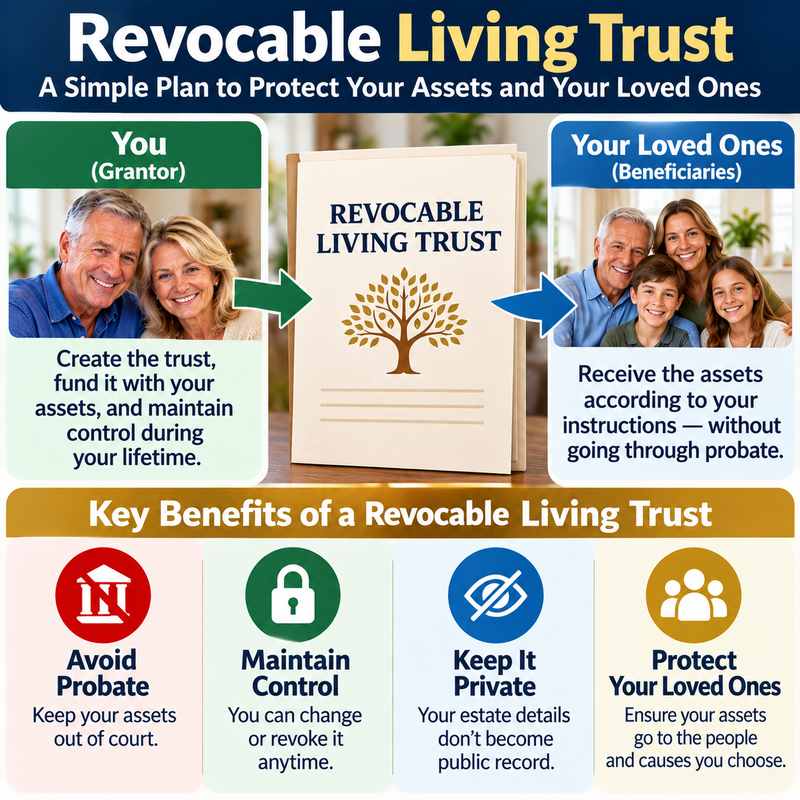
Quick Answer: The Major Benefits of a Revocable Living Trust
At its core, a revocable living trust is a legal arrangement where you transfer ownership of assets into a trust you control, name yourself as trustee, and designate who takes over management if you can’t act or after you pass away. The “revocable” part means you can change your mind—add beneficiaries, remove them, swap trustees, or unwind the whole thing—right up until you lose capacity or die.
The practical upside shows up in several places: continuity of asset management if you’re incapacitated, private administration instead of public probate filings, streamlined transfers for properly funded property, and the flexibility to build in detailed instructions for beneficiaries, including minors or family members with special needs. Some people also use a living trust structure specifically to simplify how out-of-state property gets handled after death, since real estate titled correctly in the trust generally avoids a second probate proceeding in that state.
None of these benefits are automatic guarantees, though. Each one depends on proper drafting, correct titling, and ongoing maintenance—details this article covers section by section.
Retaining Control While You Are Alive
One of the most underappreciated features of a revocable living trust is how little actually changes for you day-to-day. You’re not signing away ownership or handing your finances to someone else. You’re simply restructuring how your assets are titled, while keeping the same access and authority you had before.
You Can Serve as Your Own Trustee
In most revocable trust arrangements, you name yourself as the initial trustee. That means you continue managing your bank accounts, investment portfolios, and real estate exactly as you did before—buying, selling, refinancing, or spending as you see fit. The trust simply becomes the titled owner, with you at the controls.
You Keep Access to Trust Assets and Income
Because you retain beneficial access to everything inside the trust, there’s no loss of income or liquidity. Rental property income still flows to you. Dividends still hit your account. Nothing about daily financial life changes just because the title on an account reads “John Smith, Trustee of the John Smith Revocable Living Trust” instead of just “John Smith.”

Ability to Amend or Revoke the Trust
Life changes—marriages happen, families grow, relationships shift—and your estate plan should be able to keep up. A revocable living trust is designed for exactly that kind of flexibility, which is part of what separates it from an irrevocable structure.
Changing Beneficiaries and Successor Trustees
You can update who inherits what, in what proportions, and under what conditions, generally at any time while you’re competent to do so. The same goes for successor trustees—if the person you originally named to step in after you is no longer the right fit, you can name someone else. This is one of the biggest reasons people choose a revocable structure over an irrevocable one; for a deeper look at how those two approaches differ in terms of control and flexibility, see our comparison of revocable vs. irrevocable trust planning.
Revoking the Trust Entirely if Your Situation Changes
If your circumstances shift dramatically—say, a major change in family structure or a decision to pursue a different planning strategy—you can revoke the trust altogether, subject to your state’s laws and the terms of your specific trust document. That flexibility is a defining feature, but it also means the trust offers none of the asset-protection benefits associated with giving up control permanently.
Probate Planning for Properly Funded Assets
This is where a lot of the confusion around living trusts starts, so it’s worth being precise. A revocable living trust can allow assets to be administered by your successor trustee outside of ordinary probate court proceedings after your death—but only for assets that were actually transferred into the trust’s name while you were alive.
Why Funding Is Essential
Signing a trust document doesn’t move your house, your brokerage account, or your business interest into the trust automatically. You—or whoever helps you set it up—have to retitle each asset, one by one. A house needs a new deed. A bank account needs new ownership paperwork. A trust that looks great on paper but was never funded properly still sends those unfunded assets through probate, the same as if no trust existed at all.
This is also why a pour-over will typically accompanies a revocable living trust. It acts as a safety net, directing any assets accidentally left outside the trust to be transferred into it after death—though those specific assets would still need to go through probate first.
Assets That May Transfer Outside Probate for Other Reasons
Not every asset needs a trust to skip probate. Some assets pass outside probate regardless of whether a trust exists, because of how they’re titled or designated. Common examples include:
- Retirement accounts and life insurance policies with a named beneficiary
- Bank or brokerage accounts held as joint tenants with right of survivorship
- Payable-on-death or transfer-on-death accounts
- Property held in joint tenancy or as community property with survivorship rights, depending on state law
Understanding this distinction matters because it prevents both overconfidence and unnecessary duplication—there’s no need to fund a trust with an asset that already has a clear beneficiary designation doing the same job.

Incapacity Planning and Successor-Trustee Management
Nobody likes thinking about becoming incapacitated, but it happens—strokes, accidents, advancing dementia—and when it does, someone needs authority to keep paying bills and managing property without waiting on a judge. This is one of the most practical, day-to-day useful benefits of a revocable living trust, and it doesn’t require anyone to guess what you would have wanted.
How a Successor Trustee Steps In Without Court Involvement
Your trust document names a successor trustee and spells out the circumstances under which that person can step in—often triggered by a written incapacity determination from one or more physicians, as defined in the trust itself. Once that trigger is met, your successor trustee can immediately begin managing trust assets: paying the mortgage, handling investment accounts, covering medical expenses, whatever the situation calls for. There’s no need to petition a court or wait for a guardianship hearing, which can otherwise take weeks and cost thousands of dollars in legal fees.
Limits: Assets Outside the Trust Still Need a Power of Attorney
Here’s the catch that trips people up: your successor trustee’s authority only extends to assets actually titled in the trust. If you own a car in your own name, or a bank account you never got around to retitling, your successor trustee has no legal standing over those assets just because they’re managing your trust. That’s why a revocable living trust is typically paired with:
- A durable financial power of attorney, covering assets and accounts left outside the trust
- A pour-over will, to catch anything unfunded at the time of death
- Beneficiary designations reviewed and coordinated with the trust’s terms
Skipping the power of attorney is a common gap. Someone assumes the trust covers everything, then discovers during a health crisis that a forgotten checking account or a vehicle title sits completely outside their successor trustee’s reach.
The fix isn’t complicated, but it does require follow-through: a complete asset inventory, matched against what’s actually titled in the trust, reviewed periodically as new accounts get opened or old ones get closed.
Health-Care Decisions Require Separate Documents
A revocable living trust has nothing to do with medical decision-making. It’s a financial and property management tool. If you want someone authorized to make health-care choices on your behalf, or to have your wishes about life support and treatment options honored, you need a separate health-care power of attorney and, in many states, a living will or advance directive. These documents work alongside your trust, not as part of it.

Privacy Compared With Probate Administration
Estate settlement doesn’t have to become public record, and for a lot of families, that privacy matters as much as the time saved. Probate is a court process, and court processes generally involve filings that become part of the public record—anyone can walk into a courthouse, look up a probate file, and see what someone owned, who inherited it, and how much it was worth.
Trust administration, by contrast, generally happens privately between the trustee and the beneficiaries. There’s no court filing announcing the contents of the trust to the world, no public docket listing asset values or beneficiary names.
What Stays Private Versus What Becomes Public
With a properly funded revocable living trust, the terms of distribution, the value of assets, and the identity of beneficiaries typically remain outside public court records. That’s a meaningful difference for anyone who values discretion—business owners who don’t want competitors seeing valuation figures, blended families who’d rather not air inheritance details to extended relatives, or simply people who consider their financial affairs nobody else’s business.
Situations That Can Still Require Disclosure
Privacy isn’t absolute, though, and no honest estate planning discussion should suggest otherwise. If beneficiaries dispute the trust’s terms and the matter ends up in litigation, court records can become public. Financial institutions, the IRS, and other regulatory bodies may still require certain disclosures during administration. And if trust assets get distributed to another entity—say, retitled into a beneficiary’s own revocable trust—that new arrangement has its own disclosure rules. Privacy is a genuine benefit, but it’s a relative one, not an ironclad guarantee.

Continuity for Real Estate and Financial Assets
When assets are properly funded into a revocable living trust, the transition after death tends to be smoother and faster than probate administration for the same assets. Your successor trustee already has legal authority to act—there’s no waiting period for a court to appoint an executor or issue letters testamentary before anyone can access funds or manage property.
This continuity matters most in the weeks immediately following a death, when bills still need paying and households still need functioning income.
Faster Access for a Surviving Spouse or Family Member
Consider a surviving spouse who needs to keep making mortgage payments and cover everyday living expenses. If assets are tied up in probate, that spouse may face months of restricted access while the court process plays out. With a funded revocable trust, the successor trustee can typically access trust accounts and begin distributions or bill payments almost immediately, based on the terms already spelled out in the trust document.
Planning for Beneficiaries and Distribution Instructions
A revocable living trust isn’t just about avoiding court—it’s also a flexible instruction manual for how and when your beneficiaries receive what you leave them. Unlike a simple will, which typically hands over assets outright, a trust lets you build in conditions, timelines, and safeguards. See how a revocable living trust compares to a will to see the differences.
This level of control becomes especially valuable when beneficiaries are minors, financially inexperienced, or dealing with circumstances that make an outright lump-sum inheritance risky.
Staggered Distributions for Minor Children
Instead of handing an eighteen-year-old a six-figure inheritance the day they legally become an adult, many trusts stagger distributions across several ages and milestones.
Example: A trust might direct that a child receive one-third of their share at age 25, another third at 30, and the remainder at 35—giving them time to mature financially before gaining full control of the inheritance.
This kind of staged approach doesn’t require ongoing court supervision the way a guardianship arrangement for a minor’s inheritance often does. The successor trustee simply follows the instructions already written into the trust.
Special Needs Trust Provisions
For beneficiaries with disabilities who rely on government benefits like Supplemental Security Income or Medicaid, an outright inheritance can actually cause more harm than good—it can disqualify them from need-based programs entirely. A properly drafted special needs provision within a revocable trust allows assets to be held for that beneficiary’s benefit without counting against eligibility limits, provided the trust language meets specific state and federal requirements.
This is a highly technical area of trust drafting, and getting the language wrong can undo the entire purpose of the provision. It’s not a do-it-yourself section of estate planning—professional drafting matters here more than almost anywhere else in the trust.
Reducing Family Conflict With Clear Instructions
Ambiguity breeds disputes. When a trust clearly states who gets what, under what conditions, and how disagreements should be resolved, there’s simply less room for family members to argue over interpretation.
Naming a neutral, capable successor trustee—rather than defaulting to whichever sibling is oldest or most assertive—also tends to reduce friction. A trustee who has no personal stake in favoring one beneficiary over another can administer the trust according to its terms, rather than according to family politics.

Potential Advantages for Property in More Than One State
Owning real estate in more than one state creates a planning wrinkle that catches a lot of people off guard: without proper planning, each property can potentially be subject to its own separate probate proceeding, filed in the state where it’s located, in addition to the probate proceeding in your home state.
Avoiding Ancillary Probate on Out-of-State Real Estate
When real estate is properly titled in the name of your revocable living trust, it generally avoids that second, out-of-state probate proceeding—known as ancillary probate—because the trust, not you personally, holds legal title. Instead of your estate needing separate legal representation and court filings in two or more states, your successor trustee can typically handle the transfer according to the trust’s terms.
Title, Deed, and State-Law Details That Still Apply
None of this happens automatically, and state law variation makes it important to get details right. Real estate transfers into a trust typically require a new deed, properly executed and recorded with the county where the property sits. Mortgage lenders sometimes have their own notification requirements, even though federal law generally protects borrowers from being forced to accelerate a loan simply because title moved into a revocable trust they control.
Homestead exemptions, property tax reassessment triggers, and transfer tax rules also vary significantly from state to state, so what works cleanly in one jurisdiction may require extra steps in another. This is exactly the kind of detail where working with someone familiar with your specific state’s requirements pays off—get the deed language wrong, and the ancillary probate you were trying to avoid can end up happening anyway.
What a Revocable Living Trust Generally Does NOT Do
Every genuine benefit of a revocable living trust comes with a limitation worth understanding upfront. Overselling what a trust accomplishes doesn’t just create disappointment later—it can lead people to skip other planning tools they actually need.
- It does not automatically reduce your income taxes while you’re alive
- It does not automatically remove assets from your taxable estate
- It does not protect your assets from your own creditors
- It does not guarantee every asset avoids probate—only the ones properly funded into it
- It does not replace the need for a power of attorney or health-care directive
Understanding these boundaries isn’t a reason to avoid a revocable living trust—it’s simply what allows you to build a complete plan instead of relying on one document to do a job it was never designed for.
A trust that’s marketed as solving every estate planning problem at once is usually oversimplifying something important.
No Automatic Income-Tax Reduction
For federal income-tax purposes, a revocable living trust is generally treated as a grantor trust while you retain the powers described under the grantor trust rules. In plain terms, that means the IRS looks straight through the trust and treats the income as yours, reported on your own individual tax return, using your own Social Security number. There’s no separate trust tax return required during your lifetime in the typical arrangement, and there’s no tax-saving magic happening simply because assets sit inside the trust instead of your own name.
This matters because some people are told, incorrectly, that moving assets into a revocable trust creates income-tax advantages. It doesn’t. The trust is a probate-planning and management tool first—tax treatment during your lifetime stays essentially unchanged.
No Automatic Estate-Tax Reduction
Because you retain the ability to revoke the trust, change beneficiaries, and access the assets, those same assets generally remain part of your taxable estate for federal estate tax purposes. Simply retitling your home, brokerage account, or business interest into a revocable trust doesn’t remove it from estate tax calculations.
- Estate tax exposure depends on the total value of your estate, not on whether assets are titled in a trust or your own name
- More advanced strategies—like irrevocable trusts, gifting strategies, or specific marital deduction planning—address estate tax exposure directly, but they involve giving up control in ways a revocable trust does not
- Step-up in basis rules for capital gains purposes can still apply to appreciated assets held in a properly structured revocable trust at death, which matters more for reducing future capital gains tax for heirs than for reducing estate tax itself
If minimizing estate tax exposure is a genuine concern based on your net worth, that’s a conversation for an estate planning attorney familiar with current exemption thresholds and the more advanced planning tools designed specifically for that purpose.
No Automatic Protection of the Grantor’s Assets From Creditors
Here’s a limitation that deserves direct language: because you retain control over the trust and beneficial access to its assets, an ordinary revocable living trust generally does not protect those assets from your own creditors during your lifetime. Courts have consistently treated self-settled revocable trusts as reachable by creditors precisely because the grantor never gave up meaningful control.
This differs sharply from certain irrevocable trust structures, which do involve giving up control specifically in exchange for creditor protection benefits, subject to state-specific rules and look-back periods.
- If asset protection from creditors is a priority, that requires a different, more specialized planning conversation—often involving an irrevocable trust structure and state-specific legal guidance
No Guarantee That Every Asset Avoids Probate
This bears repeating because it’s the single most common misunderstanding about revocable living trusts: only assets actually transferred into the trust benefit from probate avoidance. A trust sitting in a drawer, fully signed but never funded, provides essentially the same probate exposure as having no trust at all.
Funding isn’t a one-time task, either. New accounts opened after the trust is signed, property purchased later, or assets received through inheritance all need to be retitled or otherwise coordinated with the trust to keep the plan intact.

Costs, Funding Work, and Maintenance Responsibilities
A revocable living trust generally costs more to set up initially than a simple will, largely because of the funding work involved. That upfront investment of time and money is often recovered later through faster, less expensive estate administration—but only if the funding step actually gets done and stays current.
Retitling Accounts and Property Into the Trust
Every asset you want covered by the trust needs its ownership changed. That means new deeds for real estate, updated account ownership forms for bank and brokerage accounts, and sometimes assignment documents for business interests or personal property. Financial institutions each have their own paperwork requirements, and the process can take real time and follow-up to complete correctly across every account you own.
This is precisely where a lot of otherwise well-drafted trusts fall short in practice—not because the legal document was wrong, but because the funding process stalled out partway through. Supported digital models, including the one Bulletproof Legacy Financial offers, are built around closing that specific gap. Rather than handing someone a trust document and leaving the retitling work entirely up to them, the model includes funding assistance, professional resources, and digital access designed to help make sure assets actually get transferred—not just documented.
Reviewing the Trust After Major Life Changes
A trust isn’t a “set it and forget it” document. Marriage, divorce, births, deaths, moving to a new state, buying or selling significant property, or a substantial change in net worth are all good reasons to revisit your trust and make sure it still reflects your actual wishes and current asset picture. Some planning models build in periodic plan reviews specifically so this maintenance step doesn’t fall through the cracks over the years.
Who May Benefit Most From Considering a Revocable Living Trust
People who own real estate in more than one state, want privacy around their financial affairs, have concerns about incapacity planning, or want detailed control over how and when beneficiaries receive an inheritance tend to get the most practical value from a revocable living trust. Blended families managing complex beneficiary relationships, parents of minor children, and anyone caring for a family member with special needs often find the added structure worth the setup effort.
When a Simpler Estate Plan May Be Adequate
Not everyone needs a revocable living trust. Someone with a modest, straightforward estate, no out-of-state property, few or no minor beneficiaries, and no particular concern about privacy or incapacity planning may find that a simple will, paired with proper beneficiary designations and a financial power of attorney, covers their needs adequately. The right answer depends on your specific assets, family situation, and goals—not on a one-size-fits-all rule.
Practical Decision Checklist
Learn more about what a revocable living trust does and doesn’t do before deciding whether a revocable living trust fits your situation, it helps to walk through a few honest questions rather than relying on general assumptions about what trusts do.
- Do you own real estate in more than one state, or significant assets that would benefit from continuity if you became incapacitated?
- Do you have minor children, beneficiaries with special needs, or family dynamics that would benefit from clear, staged distribution instructions?
- Are you prepared to complete the funding process—retitling accounts and property—rather than leaving a signed trust document unfunded?
- Do you understand that the trust won’t reduce your income taxes, estate taxes, or protect assets from your own creditors while you’re alive?
- Are you willing to revisit and update the trust after major life changes, rather than treating it as a permanent, unchangeable document?
If most of these resonate with your situation, a revocable living trust is worth a serious look—ideally with guidance that includes actual funding support, not just a document.
Frequently Asked Questions About Revocable Living Trust Benefits
1. What are the main benefits of a revocable living trust?
The primary benefits of a revocable living trust include avoiding probate for properly funded assets, maintaining control of your property during your lifetime, protecting your family’s privacy, and providing continuity if you become incapacitated. A revocable trust also allows you to establish detailed instructions for distributing assets to your beneficiaries after your death. However, these benefits depend on proper trust creation, funding, and ongoing maintenance.
2. Does a revocable living trust avoid probate?
Yes, a properly funded revocable living trust can help your assets avoid probate after your death. However, simply signing a trust document does not automatically prevent probate. Assets generally must be legally transferred into the trust or otherwise arranged to pass outside probate. Property left outside the trust may still require probate proceedings, even if you have a pour-over will.
3. Can I still control my assets after creating a revocable living trust?
Yes. One of the biggest advantages of a revocable living trust is that you generally retain control over your assets while you’re alive and mentally competent. You can typically serve as your own trustee, manage investments, buy or sell property, receive income, change beneficiaries, and amend or revoke the trust. Creating a revocable living trust does not ordinarily mean surrendering control of your finances.
4. Does a revocable living trust protect my assets from creditors or lawsuits?
Generally, no. Because you retain control over the assets in a revocable living trust, those assets typically remain accessible to your creditors during your lifetime. A standard revocable trust is primarily an estate planning and asset management tool, not an automatic creditor-protection strategy. More specialized planning, potentially involving irrevocable trusts, may be necessary when creditor protection is a primary objective.
5. Does a revocable living trust reduce estate taxes or income taxes?
A standard revocable living trust does not automatically reduce your income taxes or federal estate taxes. While you’re alive, income from assets held in the trust is generally reported on your personal income tax return. Because you retain control over the assets, they also typically remain part of your taxable estate. Additional estate planning strategies may be appropriate for individuals concerned about estate tax exposure.
6. What happens to my revocable living trust if I become incapacitated?
A revocable living trust can provide continuity in managing your finances if you become incapacitated. Your designated successor trustee may be able to step in and manage trust-owned assets according to the trust’s instructions, potentially avoiding the need for a court-appointed conservator. However, the trustee’s authority generally extends only to assets held in the trust. A durable financial power of attorney and appropriate healthcare documents remain important parts of a complete estate plan.
7. What assets should be transferred into a revocable living trust?
Common assets that may be transferred into a revocable living trust include real estate, certain bank and brokerage accounts, and some business interests. The appropriate funding process depends on the asset and applicable law. Retirement accounts such as IRAs and 401(k)s generally should not be retitled into a living trust during your lifetime. Instead, their beneficiary designations should be reviewed as part of your estate plan. Proper funding is essential because assets left outside the trust may not receive its intended probate-avoidance benefits.
8. Does a revocable living trust keep my estate and beneficiaries private?
A revocable living trust can provide greater privacy than a will administered through probate. Unlike probate proceedings, which generally involve public court records, trust administration typically occurs outside the public court system. This can help keep information about your assets, beneficiaries, and distribution instructions private. However, privacy is not absolute. Litigation, legal reporting requirements, and other circumstances may still require disclosure of certain trust information.
9. Can a revocable living trust protect my children and control when they receive their inheritance?
Yes. A revocable living trust can establish specific instructions for how and when beneficiaries receive their inheritance. For example, you might direct that a child receive portions of an inheritance at certain ages rather than receiving everything at once. Trust provisions may also address beneficiaries with special needs, although specialized drafting is important to avoid interfering with eligibility for government benefits. These features can provide more flexibility than leaving assets outright.
10. Do I need to update or maintain my revocable living trust after creating it?
Yes. A revocable living trust should be reviewed periodically and after significant life changes, such as marriage, divorce, births, deaths, changes in beneficiaries, or major property transactions. New assets may need to be transferred into the trust, and beneficiary designations should remain coordinated with your estate plan. Although not every life change requires a formal trust amendment, ongoing maintenance helps ensure the trust continues to reflect your wishes and that your assets are properly positioned to receive its intended benefits.