Rental Property in Living Trust: Probate Benefits, Tax Rules, and Liability Limits
Understand Probate Planning, Trust Funding, Mortgages, Taxes, Insurance, and Why a Living Trust Is Not a Liability Shield
Key Takeaways
- A properly funded revocable living trust can keep rental property out of probate and hand management to a successor trustee without court delay.
- An ordinary revocable trust does not protect you personally from tenant lawsuits, slip-and-fall claims, or other liability — that job belongs to insurance and, often, an LLC.
- Depreciation, basis, and gain calculations don’t change just because title moves into a trust; the IRS still looks at the underlying numbers.
- Mortgages, leases, and insurance policies all need a second look before you retitle a rental into a trust — skipping this step causes most of the headaches owners run into later.
- Later in this article, we’ll walk through exactly how a trust and an LLC can work together, and why California investors in particular need to watch out for a few state-specific traps.
If you own rental property and you’re wondering whether a living trust belongs in your estate plan, the short answer is: probably yes for probate avoidance, but it’s not the whole plan. A trust solves one specific problem — getting your property to your heirs or back into your own hands quickly if you become incapacitated — while leaving liability protection, tax treatment, and day-to-day management largely untouched. Resources like CreateALivingTrust.com’s guide to living trusts walk through the mechanics in more depth, but the real-estate-specific wrinkles deserve their own conversation.
Rental property is different from a primary residence or a bank account sitting in a trust. It has a mortgage attached. It has tenants and leases. It generates income that shows up on a tax return every year, and it depreciates according to IRS rules that don’t care who holds title. Each of those moving parts interacts with trust ownership in a slightly different way, and getting the details wrong can cost you more in paperwork headaches than the trust ever saves you in probate fees.
Article-at-a-Glance
Before diving into the mechanics, it helps to see the big picture. A trust is primarily a probate-avoidance and incapacity-planning tool for real estate — not a liability shield, not a tax shelter, and not a substitute for proper insurance. Keep that distinction in mind as you read, because almost every section below circles back to it.
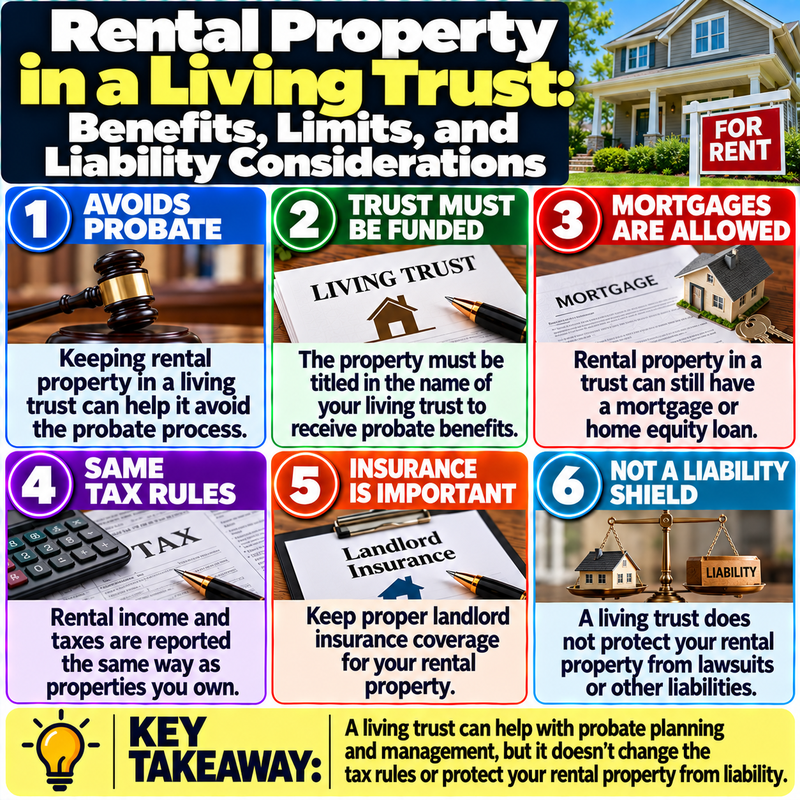
Quick Answer: Should You Put Rental Property in a Living Trust?
Yes, in most cases — but with caveats. If your goal is to avoid probate, allow a successor trustee to step in seamlessly if you’re incapacitated, and keep management continuity for your heirs, a revocable living trust does exactly what it’s designed to do. If your goal is protecting your personal assets from a lawsuit filed by an injured tenant or guest, a trust alone won’t get you there.
| Goal | Does a Revocable Trust Help? |
|---|---|
| Avoid probate at death | Yes |
| Allow management during incapacity | Yes |
| Shield grantor from personal liability | No |
| Change how rental income is taxed | No |
| Change depreciation or basis rules | No |
That table is the whole article in miniature. A trust is a title and administration tool. It changes who has legal authority to sign documents and when that authority transfers, but it doesn’t change the tax code, your insurance obligations, or the legal separateness (or lack of it) between you and your rental business.
So the honest answer isn’t “trust versus no trust.” It’s “trust for what, exactly?” Once you separate the estate-planning function from the liability and tax questions, the right structure for your rental portfolio becomes a lot clearer.
Estate-Planning Benefits of a Living Trust
The core benefit of putting rental property into a living trust is straightforward: it keeps the property out of the probate court system after you die, and it lets someone you’ve named step in and manage the property if you can’t. Those two benefits alone are usually enough to justify the paperwork for anyone who owns more than one rental, or who owns property in a state other than where they live.
Avoiding Probate on Every Parcel at Once
Without a trust, each piece of real estate you own in your individual name typically has to go through its own probate proceeding — or at least gets swept into one proceeding that covers your entire estate, with every parcel adding complexity and cost. A funded revocable trust sidesteps this. Because the trust, not you personally, holds title, the property doesn’t become part of your probate estate at all. Your successor trustee can distribute, sell, or continue renting out the property according to your instructions, without waiting on a probate court’s calendar.
This matters more than people expect once a portfolio grows past one or two properties. Multiple rentals mean multiple sets of court filings, multiple notices to creditors, and multiple delays — all compounding on top of each other if they’re handled through probate instead of a trust.
California Statutory Probate Fees by Portfolio Size
In California, probate isn’t just slow — it’s expensive, and the fees are calculated on the gross value of the estate, not your equity. That’s a critical distinction for anyone holding mortgaged rental property. A $2 million rental portfolio with $1.2 million in mortgage debt still generates probate fees based on the full $2 million, not the $800,000 you actually own free and clear.
| Gross Estate Value | Approximate Combined Statutory Probate Fees |
|---|---|
| $500,000 | $26,000 |
| $1,000,000 | $46,000 |
| $2,000,000 | $66,000 |
| $3,000,000 | $86,000 |
| $5,000,000 | $126,000 |
Those numbers come from California’s statutory fee schedule, where both the estate’s attorney and the executor are each separately entitled to 4% on the first $100,000, 3% on the next $100,000, and 2% on the next $800,000. And that’s before accounting for extraordinary fees tied to property sales, contested matters, or multiple ancillary proceedings — which are common, not rare, on larger rental portfolios.
Successor-Trustee Management Without Court Delay
The other half of the estate-planning benefit is incapacity planning, and it’s the part people tend to underestimate. Rental property isn’t a passive asset you can just leave alone while a court sorts things out. Leases need signing. Repairs need authorizing. Rent needs collecting. Mortgage payments need to keep moving on schedule, regardless of whether you’re able to write the check yourself.
A named successor trustee has the legal authority to step into that role immediately — no waiting for a conservatorship hearing, no court-appointed guardian, no gap in management while tenants wonder who’s in charge. That continuity is often the single biggest practical reason landlords use a revocable living trust rather than relying solely on a will, which only takes effect after death and does nothing for incapacity.

Probate and Incapacity Planning
A living trust’s incapacity benefits only work if the paperwork around it is airtight — and that means more than just the trust document itself. Most landlords also need a durable power of attorney that works alongside the trust, covering anything the trust doesn’t own or situations where quick action is needed before a deed transfer is complete.
Why a Durable Power of Attorney Alone Falls Short
Here’s a mistake that trips up a lot of real estate investors: assuming a generic power of attorney covers rental property management. A document that only authorizes an agent to handle “financial matters” in broad, boilerplate language often isn’t specific enough. Title companies and lenders regularly reject these documents when an agent tries to sign a lease, authorize a refinance, or close a sale, because the authority isn’t spelled out clearly enough for them to rely on.
Real Estate Powers Your Agent Actually Needs
A durable power of attorney built for a landlord should explicitly authorize your agent to sign leases, approve repairs and capital improvements, refinance existing loans, and — if circumstances require it — sell property on your behalf. Think of it as a backstop for anything the trust doesn’t directly own yet, or for situations where someone needs to act fast before trust paperwork catches up. Skipping this step is one of the most common gaps in otherwise well-built estate plans.
Funding and Deed Transfer Steps
None of the benefits above kick in automatically just because you signed a trust document. A trust only protects property that’s actually been transferred into it — a step estate planners call “funding” the trust. For real estate, that means a new deed, properly recorded, every single time.
Recording the Grant Deed Correctly
Moving a rental property into a trust requires a properly executed and recorded grant deed. This isn’t a form you fill out once and forget — each property needs its own deed, drafted correctly and filed with the county recorder’s office. If you’re working through the broader process of setting up and funding a living trust, real estate transfers are usually the most paperwork-intensive part, simply because every parcel needs individual attention.
Filing the Preliminary Change of Ownership Report (PCOR)
Alongside the deed, most counties require a Preliminary Change of Ownership Report, or PCOR, at the time of recording. This form tells the assessor’s office what kind of transfer just happened and why it should (or shouldn’t) trigger a reassessment.
Avoiding Reassessment Under Revenue and Taxation Code § 62(d)
Here’s the good news for anyone nervous about property tax increases: transferring real property into your own revocable trust, where you remain the present beneficiary, is exempt from reassessment under Revenue and Taxation Code § 62(d). The transfer tax exemption should be claimed directly on the deed, and the PCOR needs the trust-transfer exclusion box checked. Miss that box, and you risk an unnecessary reassessment notice landing in your mailbox months later.
What Happens If the Deed Is Never Recorded
An unrecorded deed means exactly what it sounds like: the property is still titled in your individual name as far as the law is concerned, no matter what your trust document says. If you die before that deed gets recorded, the property goes through probate anyway — the trust becomes irrelevant for that asset. This is the single most common way well-intentioned estate plans fail in practice, and it’s entirely avoidable with careful follow-through.

Existing Mortgages and Lender Considerations
Rental property almost always comes with a mortgage attached, and that changes the transfer conversation in ways that don’t apply to a primary residence.
Due-on-Sale Clauses and Rental Property Loans
Federal law generally protects homeowners who transfer their primary residence into a revocable trust from triggering a due-on-sale clause. Don’t assume that same protection automatically extends to every rental property loan. Lender procedures and legal protections can differ for investment property, and the specifics depend on your loan documents and lender.
Reviewing Loan Terms Before Transferring Title
Before you record a new deed moving a financed rental into a trust, pull out your note and deed of trust and read the transfer provisions carefully — or have someone qualified do it for you. Some lenders want advance notice. Some require updated insurance documentation naming the trust. Skipping this review doesn’t usually blow up the loan, but it’s the kind of detail that’s far cheaper to handle upfront than to untangle later.
Rental Income and Federal Tax Treatment
One of the most common misconceptions about living trusts is that moving property into one somehow changes how rental income gets taxed. It doesn’t — at least not while you’re alive and the trust is revocable.
Grantor Trust Status Explained
A revocable living trust is generally treated as a grantor trust for federal income tax purposes. That’s a technical way of saying the IRS looks straight through the trust and treats you, the grantor, as the owner of everything inside it — including the rental property and the income it generates.
Why Trust Title Doesn’t Change Your Tax Return
Because of grantor trust status, rental income, expenses, and depreciation deductions still flow directly onto your personal tax return exactly as they did before the transfer. Trust title alone does not convert rental income into a different federal taxpayer during your life. You’ll still report everything on Schedule E, still track depreciation the same way, and still owe tax on the same income you always did — the trust is invisible to the IRS for these purposes until it becomes irrevocable.
Depreciation and Basis After Transfer
Depreciation is where a lot of rental property owners get nervous about trust transfers, worried that retitling the property somehow resets or disrupts their depreciation schedule. It doesn’t — but understanding why requires a quick look at how depreciation actually works.
How Depreciation Is Calculated Under IRS Publication 527
Per IRS Publication 527, rental property depreciation depends on three things: your basis in the property, the applicable recovery period, and the depreciation method you’re using. None of those three factors change simply because you’ve moved title from your individual name into your own revocable trust — you’re still the owner for tax purposes, and the depreciation clock keeps running exactly where it left off.
What does change your depreciation calculation is adjustments to basis over time — capital improvements, casualty losses, and similar events, as outlined in IRS Publication 551. Keep a careful record of your original basis and every adjustment since; depreciation deductions you’ve already claimed reduce your basis, which directly affects the gain or loss you’ll calculate whenever the property eventually sells.
Step-Up in Basis: Community Property vs. Joint Tenancy
How you hold title matters enormously for your heirs’ future basis, and this is one area where trust planning and property characterization intersect. Property held as community property receives a full step-up in basis on both halves of the property at the first spouse’s death under IRC § 1014(b)(6) — not just the deceased spouse’s half.
Property held in joint tenancy, by contrast, only receives a step-up on the deceased owner’s half interest; the surviving spouse’s half keeps its original, often much lower, basis. For married couples holding appreciated rental real estate, this distinction alone can be worth a serious conversation with a tax professional before deciding how title should read inside the trust.
1031 Exchanges and the “Swap Until You Drop” Strategy
Investors who’ve used 1031 exchanges to defer gain on rental property need to think about how that deferred gain interacts with a trust and with death. Deferred gain carries forward into the replacement property’s basis — it doesn’t disappear, it just moves with you to the next property. But under IRC § 1014, heirs receive a basis equal to the property’s fair market value on the date of death, which wipes out that deferred gain entirely, along with any other appreciation that built up during your lifetime.
This is the mechanic behind what investors sometimes call “swap until you drop” — keep deferring gain through successive 1031 exchanges during life, and let the step-up at death erase the deferred tax rather than ever triggering it through a sale. If your rental portfolio includes fractional interests in a Delaware Statutory Trust, commonly used as 1031 replacement property, make sure those interests are specifically identified and properly assigned into your trust — a generic assignment that doesn’t name the specific DST interest can create funding gaps just like an unrecorded deed would.

Insurance Considerations for Trust-Held Rentals
Moving a rental property into a trust almost always requires a call to your insurance carrier. Landlord policies are typically written to name the titled owner, and if your trust now holds title, the policy may need to list the trust as an additional insured or named insured to make sure a claim doesn’t get denied on a technicality after a fire, storm, or liability incident. This is a quick fix, but it’s one that’s easy to overlook in the middle of recording deeds and filing PCORs — and the consequences of forgetting it only show up at the worst possible moment, when you’re trying to file a claim.
Why a Revocable Living Trust Is Not a Liability Shield for the Grantor
This is the single most important limitation to understand about putting rental property in a living trust, and it bears repeating plainly: an ordinary revocable trust is not a liability shield for the grantor. If a tenant slips on an icy walkway or a guest gets hurt on the property, moving title into your own revocable trust does nothing to stop that lawsuit from reaching your personal assets.
What Trusts Protect (and What They Don’t)
A revocable trust protects against probate delay and provides a clear management structure during incapacity. It does not protect your other business and personal assets if someone sues you over something that happened on the rental property. That’s because you, as grantor, still control the trust and are treated as the owner of its assets for virtually every legal purpose other than probate avoidance — a court isn’t going to treat your revocable trust as a separate legal entity shielding you from a tenant’s injury claim.
Separating Estate Planning From Asset Protection
The practical takeaway is to stop thinking of “trust” and “liability protection” as the same conversation. Landlord liability should be addressed through adequate insurance coverage, sound risk management practices, and, where appropriate, business-entity structuring — not through trust ownership alone. A trust and a liability shield solve two completely different problems, and conflating them is one of the more expensive mistakes a real estate investor can make.
None of this means a trust isn’t worth having — it absolutely is, for the probate and incapacity reasons covered earlier. It just means a trust shouldn’t be the only item on your liability-protection checklist. If you’re rental portfolio carries real tenant-contact risk, that’s a conversation for an insurance agent and possibly a business attorney, not something a trust document can solve on its own.
Tenant, Lease, and Property-Management Issues
Day-to-day, tenants generally won’t notice or care whether their landlord is an individual or a trust — rent still gets collected, repairs still get authorized, and leases still get renewed the same way. But a few administrative details do shift once a rental moves into a trust. Leases going forward should reflect the trust as landlord, not your individual name, so there’s no confusion about who holds legal authority over the tenancy.
Property management agreements need the same update, and any property manager handling the unit should have clear instructions on who’s authorized to sign on the trust’s behalf — particularly important if a successor trustee has stepped in due to incapacity. Getting these documents aligned with your actual ownership structure avoids awkward disputes down the road, especially if a tenant dispute ever ends up in court and the paperwork doesn’t match reality.
LLC-Owned Rentals and the Trust-Plus-LLC Structure
For investors who own more than a property or two, the conversation almost always turns to LLCs — and for good reason. An LLC can genuinely protect you from personal liability if a tenant sues over something that happened on the property. But an LLC solves a different problem than a trust does, and understanding where the two overlap (and where they don’t) is key to building a structure that actually covers all your bases.
Holding the LLC Membership Interest in a Trust
Here’s the combination that handles probate avoidance, liability protection, and incapacity planning all at once: a trust that holds the membership interest in an LLC, which in turn holds title to the rental property. The LLC provides the liability wall between a tenant lawsuit and your personal assets. The trust, sitting on top of the LLC, avoids probate on the membership interest itself and gives your successor trustee immediate authority to step in if you’re incapacitated.
Without the trust layer, an LLC protects you from liability but does nothing about probate — the membership interest is still personal property, and personal property owned outside a trust still has to go through probate court just like anything else. Without the LLC layer, a trust avoids probate just fine but leaves you personally exposed if someone gets hurt on the property. Neither piece replaces the other; they solve two separate problems that happen to show up together on every rental property you own.
Case Law Warning: Curci Investments, LLC v. Baldwin
LLCs aren’t bulletproof, and a 2017 California Court of Appeal decision is worth knowing about. In Curci Investments, LLC v. Baldwin (2017) 14 Cal.App.5th 214, the court held that a judgment creditor can ask a court to disregard the debtor’s LLC entirely and reach its assets directly — a concept called outside reverse veil piercing. The ruling is a reminder that an LLC’s protection isn’t automatic just because the paperwork exists; how you actually run the LLC matters just as much as the fact that you formed one.
Keeping the LLC Separate to Preserve Creditor Protection
An LLC run like a genuine, separate business — with its own bank account, its own records, and its own formalities observed consistently — stands on much firmer ground for asset protection than one that’s treated as a personal piggy bank. A single-member LLC that the owner controls casually and uses interchangeably with personal funds is exactly the kind of setup a court is more willing to disregard. If you’re going to go through the trouble of forming an LLC for your rental property, actually run it like one.
Why California Doesn’t Recognize Series LLCs
Investors sometimes ask about series LLCs as a way to hold multiple properties under one umbrella entity with internal liability separation between “series.” California doesn’t authorize the formation of series LLCs domestically, and registering a foreign series LLC to do business in the state creates its own headaches — the Franchise Tax Board has taken the position that each series may owe its own separate $800 annual tax. For most California investors, the more straightforward path remains one LLC per property, or per a small cluster of properties, with a single trust sitting on top owning all of them.
Managing Multiple Properties Inside One Trust
One of the quieter benefits of funding multiple rentals into a single living trust is how it simplifies management at scale. Instead of your successor trustee juggling separate probate filings, separate court approvals, and separate paperwork for each parcel, one trust document and one successor trustee designation covers the whole portfolio.
How Compounding Probate Fees Work Across a Portfolio
Remember those statutory fee figures from earlier — $66,000 on a $2 million portfolio, $126,000 on $5 million? Those numbers apply whether you own one large property or ten smaller ones that add up to the same total value. Probate fees are calculated against gross estate value, not property count, which means a trust’s probate-avoidance benefit scales right alongside your portfolio. The bigger your rental holdings grow, the more a funded trust has to offer.

Transferring Out-of-State Rental Property Into a Trust
Investors who own rental property outside their home state face a probate wrinkle that in-state owners don’t: ancillary probate. If you die owning real estate titled in your individual name in a state other than where you live, that property typically requires its own separate probate proceeding in that state — on top of whatever probate happens where you’re domiciled.
Avoiding Ancillary Probate in Other States
Transferring that out-of-state rental into your revocable trust sidesteps the ancillary probate problem entirely, because the trust — not you personally — holds title, and the trust itself doesn’t die or change state residency. For anyone with rental property spread across multiple states, this is often the single clearest argument for using a trust rather than relying on a will alone.
Proposition 19 and Parent-Child Transfer Rules
California investors planning to leave rental property to their children need to understand a significant change in the law, because it affects trust planning directly.
What Changed for Rental and Investment Property in 2021
Before February 16, 2021, a parent could transfer property — including rental and commercial property — to a child and exclude up to $1 million of assessed value from reassessment. Proposition 19 eliminated that exclusion for investment and rental property entirely. Children can no longer inherit a rental duplex, for example, and keep the parent’s old Prop 13 assessed value; the property reassesses to current market value the moment it passes to a child, full stop.
Current Family-Home Exclusion Value Cap
The parent-child exclusion that still exists today applies only to a family home, and only if the child moves in as their principal residence within one year of the transfer. For transfers occurring from February 16, 2025 through February 15, 2027, the value cap on that exclusion is $1,044,586. If your estate plan assumes your children will inherit a rental property at your old assessed value, Proposition 19 has almost certainly changed that math — and it’s worth revisiting with a professional before you finalize how trust distributions are structured.
When Professional Advice Is Warranted
A lot of what’s covered in this article — deed recording, PCOR filing, basic trust funding — is straightforward enough for a careful owner to handle with good checklists and attention to detail. But a few situations consistently call for professional input rather than a do-it-yourself approach.
If your rental portfolio spans multiple states, if you’re combining trust ownership with an LLC structure, or if you’re navigating a 1031 exchange with DST interests that need to be assigned into a trust, get an attorney or CPA involved before you record anything. The cost of professional guidance upfront is almost always smaller than the cost of unwinding a mistake after the fact — particularly when county reassessments, lender notices, or liability exposure are on the line.
The same goes for anything touching Proposition 19 planning, community property versus joint tenancy decisions, or questions about whether your specific LLC setup would hold up against a veil-piercing challenge. These aren’t areas where a generic template gets the job done.
- Multi-state rental portfolios needing ancillary probate avoidance
- Combined trust-and-LLC structures
- 1031 exchanges and DST fractional interests
- Proposition 19 parent-child transfer planning
- Married couples deciding between community property and joint tenancy titling
Rental-Property Trust Checklist
Pulling all of this together, here’s a practical sequence to work through if you’re funding rental property into a living trust. Treat it less like a one-time project and more like a maintenance routine — new properties, refinances, and life changes will all require you to revisit these steps.
Work through each item in order, and don’t consider a property “in the trust” until every box is checked — a signed trust document with an unrecorded deed protects nobody.
1. Confirm the Deed Is Drafted and Recorded
Every property needs its own properly executed grant deed transferring title from your individual name to the trust, recorded with the county recorder’s office where the property sits.
Don’t assume a deed is complete just because you signed it. Confirm the county has actually recorded it and returned a stamped copy before considering the transfer finished.
2. File the PCOR With the Trust-Transfer Exclusion Box Checked
File the Preliminary Change of Ownership Report alongside the deed, and make sure the trust-transfer exclusion box is checked so the transfer qualifies for exemption under Revenue and Taxation Code § 62(d). This single checkbox is the difference between a smooth transfer and an unwelcome reassessment notice.
3. Review Mortgage and Lender Documents
Pull your loan documents and review the due-on-sale and transfer provisions before recording a new deed on any financed rental property.
- Check whether your lender requires advance notice of trust transfers
- Confirm whether updated insurance documentation naming the trust will be required
- Verify whether the loan terms treat rental property transfers differently than owner-occupied transfers
If anything in the loan documents is unclear, a quick call to your lender’s servicing department is far cheaper than guessing wrong.
This step gets skipped more often than it should, usually because owners assume rental loans get the same automatic due-on-sale protection as a primary residence mortgage. That assumption isn’t always safe.
4. Update Insurance Policies to Reflect Trust Ownership
Contact your insurance carrier and have the trust added as a named or additional insured on your landlord policy. Do this before or immediately after recording the deed, not months later after a claim has already come up.
5. Assign LLC Membership Interests Into the Trust
If your rental property is held inside an LLC, don’t deed the real estate itself into the trust — assign the LLC membership interest instead. This preserves the LLC’s liability protection while still giving your trust probate-avoidance benefits over the membership interest.
Make sure the assignment document references your operating agreement and complies with any transfer restrictions it contains. A sloppy assignment that conflicts with your operating agreement can create ownership disputes down the line.
6. Specifically Identify DST and Fractional Interests
If you hold fractional interests in a Delaware Statutory Trust from a 1031 exchange, name that specific interest explicitly in your trust funding documents. A generic “all my real property” assignment can leave these interests in limbo.
7. Draft a Durable Power of Attorney With Real Estate Authority
Pair your trust with a durable power of attorney that explicitly authorizes your agent to sign leases, approve repairs, refinance loans, and sell property if necessary. This covers any gaps the trust doesn’t reach and gives you a backstop if quick action is needed.
Revisit this document every few years, or any time you acquire new property, to make sure it still reflects your actual holdings and intentions.
Frequently Asked Questions
A few questions come up constantly from rental property owners weighing a living trust, and they’re worth answering directly.
Does putting rental property in a trust change who pays the taxes?
No. A revocable living trust is generally a grantor trust for federal income tax purposes, which means you still report rental income, expenses, and depreciation on your own personal tax return exactly as you did before the transfer.
Can a living trust protect me from a tenant lawsuit?
No. An ordinary revocable living trust is not a liability shield for the grantor. If a tenant or guest is injured on your rental property, a revocable trust alone won’t stop a lawsuit from reaching your personal assets.
Liability protection comes from adequate insurance coverage and, in many cases, from holding the property inside a properly maintained LLC. A trust and a liability shield are two separate tools solving two separate problems.
A trust answers the question “who manages this property, and how fast, if I die or become incapacitated?” An LLC and insurance answer the question “who’s financially responsible if something goes wrong on this property?” Confusing the two is one of the costliest mistakes a landlord can make.
What happens to my rental property trust when I die?
Your revocable trust becomes irrevocable the moment you die. Your named successor trustee takes over management, following the instructions laid out in your trust document — distributing property to beneficiaries, continuing to manage rentals, or selling property, all without probate court involvement, assuming the property was properly funded into the trust beforehand.
Do I need to notify my mortgage lender before transferring title to a trust?
It depends on your specific loan terms. Review your note and deed of trust for due-on-sale and transfer provisions before recording a new deed, and contact your lender directly if anything is unclear. Don’t assume the same protections that apply to owner-occupied mortgages automatically extend to rental property loans.
Is a revocable trust or an LLC better for a rental property?
Neither one alone fully covers everything a rental property owner needs. A trust handles probate avoidance and incapacity planning but provides no liability protection. An LLC provides liability protection but does nothing about probate on its own. Most investors with more than a property or two benefit from combining both — a trust that holds the LLC that holds the property.
Can I combine a trust and an LLC for the same rental property?
Yes, and for investors with meaningful rental holdings, this combined structure is often the most complete solution. The LLC holds title to the property and provides the liability wall; the trust holds the LLC’s membership interest and handles probate avoidance and incapacity management.
What is a Preliminary Change of Ownership Report, and why does it matter?
A Preliminary Change of Ownership Report, or PCOR, is a form filed with the county assessor alongside your recorded deed. It tells the assessor what kind of transfer occurred and whether it qualifies for an exemption from reassessment.
| PCOR Step | Why It Matters |
|---|---|
| File at time of recording | Required by most California counties for every deed transfer |
| Check trust-transfer exclusion box | Preserves exemption under Revenue and Taxation Code § 62(d) |
| Skip or file incorrectly | Risks an unnecessary reassessment notice |
Getting this one checkbox right is the difference between a seamless trust transfer and an unexpected property tax increase showing up months later.
Does Proposition 19 affect rental property I leave to my children?
Yes, significantly. Proposition 19 eliminated the parent-child exclusion for rental and investment property entirely. Your children will no longer inherit your rental property at your old, lower assessed value — it reassesses to current market value the moment it passes to them, regardless of whether it’s held in a trust.
The parent-child exclusion that still exists applies only to a family home, and only if the child moves in as their principal residence within one year of the transfer, subject to a value cap that’s currently set at $1,044,586 for transfers through February 15, 2027.
How does depreciation work once a rental is inside a trust?
Depreciation continues exactly as it did before the transfer. Per IRS Publication 527, depreciation depends on your basis, the applicable recovery period, and the depreciation method you’re using — none of which reset or change simply because title moved into your own revocable trust.
Keep tracking basis adjustments under IRS Publication 551, since depreciation already claimed reduces your basis and directly affects the gain or loss calculation whenever the property eventually sells.
Do I still need a will if my rental properties are in a trust?
Yes. A trust only covers property that’s actually been funded into it. A will, sometimes called a pour-over will, catches anything left outside the trust — whether through oversight, a newly acquired property that hasn’t been transferred yet, or an asset type the trust wasn’t designed to hold. Think of the will as a safety net underneath the trust, not a replacement for it.