Revocable Living Trust vs Will: Probate, Incapacity, Privacy, and Cost Compared
Compare Probate, Incapacity Planning, Privacy, Asset Management, Costs, and How the Two Documents Can Work Together
Article-at-a-Glance
- A revocable living trust and a will serve different jobs — one manages property while you’re alive and after you pass, the other mainly directs what happens to your property after death.
- Neither document is inherently “better” — many complete estate plans use both a trust and a will working together rather than picking just one.
- A properly funded trust can let your family skip probate entirely for the assets inside it, while a will almost always requires a probate court process.
- Only a will can nominate a guardian for minor children, which is one reason families with young kids often need both documents regardless of trust ownership.
- Later in this guide, you’ll see exactly how a pour-over will fits into a trust-based plan and why it’s not a backup plan — it’s often a required companion document.
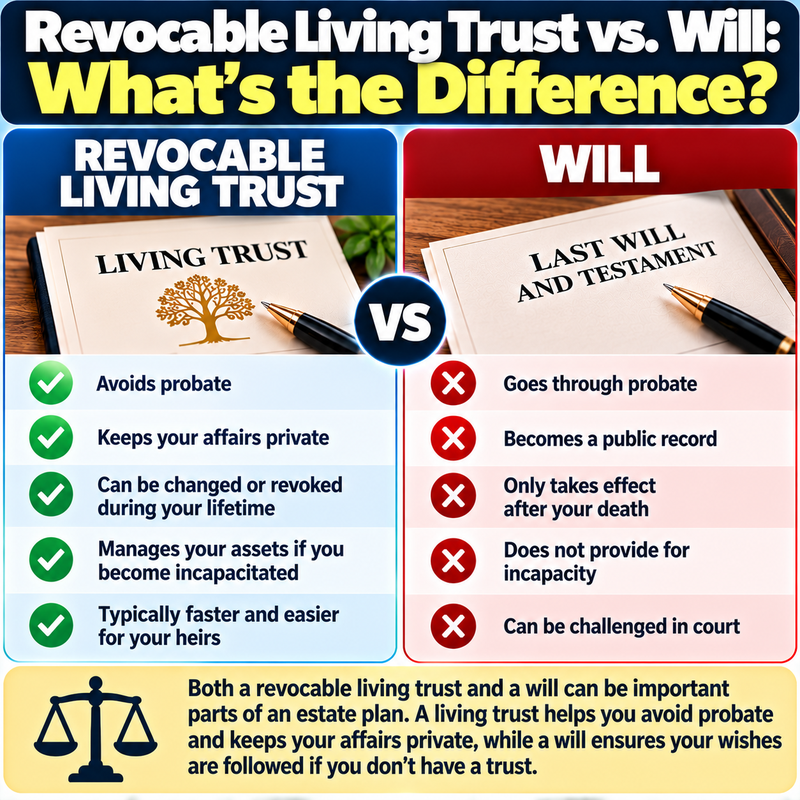
Which one actually protects your family better: a revocable living trust or a will? The honest answer is that it depends on what you’re protecting against, because these two documents solve different problems rather than competing for the same job.
If you’re building a complete plan, resources like CreateALivingTrust.com’s guide to revocable living trusts can help you understand how trust-based planning fills gaps that a will simply wasn’t designed to cover. That said, understanding both documents side by side is the fastest way to figure out what your family actually needs.
Quick Comparison: Trust vs. Will Side by Side
Before diving into the details, it helps to see the core differences laid out plainly. The table below compares the two documents across the categories that matter most to families making this decision.
| Feature | Revocable Living Trust | Will |
|---|---|---|
| Takes effect | Immediately upon signing and funding | Only after death |
| Probate required? | Generally no, for funded assets | Yes, for probate property |
| Covers incapacity? | Yes, through successor trustee | No |
| Public or private? | Generally private | Becomes public during probate |
| Can name a guardian? | No | Yes |
| Upfront cost | Higher | Lower |
| Requires funding? | Yes | No |
When Each Document Takes Effect
Why a Will Only Works After You Die
A will sits dormant the entire time you’re alive. It has no legal power until a probate court formally validates it after your death, which means it can’t help manage your affairs if you become seriously ill or incapacitated. Its main function is to direct how probate property gets distributed and to name an executor who carries out those instructions.
This delayed activation is often the biggest surprise for people who assume a will handles “everything.” It doesn’t manage your bank accounts while you’re in a coma, and it doesn’t authorize anyone to sell your house if you’re unable to sign documents yourself.
Why a Trust Works the Moment You Sign It
A revocable living trust is different because it’s active the day you create it. You typically serve as your own trustee, meaning you keep full control over everything you place inside the trust. The structure of a living trust allows a built-in successor trustee to step into your role automatically, whether that’s because you’ve become incapacitated or because you’ve passed away.
Probate Differences: What Really Avoids Court
Why a Will Does Not Skip Probate
Here’s a common misconception worth clearing up: a will does not avoid probate. It simply gives the probate court instructions on how to distribute your property once the process is complete. Everything you own that’s titled in your name alone and passes through your will generally has to go through this court-supervised process.
How a Funded Trust Bypasses the Probate Process
Assets that are properly titled in the name of your trust generally bypass probate entirely. Because the trust technically owns these assets rather than you personally, there’s no need for a court to transfer ownership after death — your successor trustee simply steps in and distributes according to the trust’s terms.
The key phrase here is “properly titled.” A trust document alone doesn’t avoid probate — only assets actually retitled into the trust’s name get that benefit.
Time and Cost Impact of Probate
Probate can add months, sometimes over a year, onto the process of settling an estate, along with court fees and potential attorney costs. Families dealing with a will-only estate often feel this delay most acutely when they need quick access to funds for expenses like funeral costs or ongoing bills.

Incapacity Planning: Who Manages Things If You Can’t
Why a Will Offers Zero Protection During Your Lifetime
A will provides no help whatsoever if you become incapacitated while you’re still alive. It wasn’t designed for that purpose, and courts won’t honor its instructions until after death. This gap catches a lot of families off guard, especially when a medical event happens unexpectedly.
Without additional planning, a family facing a loved one’s incapacity may need to go through a court-supervised guardianship or conservatorship process just to manage that person’s finances. This can be:
- Time-consuming, often taking weeks to get court approval
- Expensive, with legal and court filing fees adding up quickly
- Public, since guardianship proceedings typically become part of the court record
- Stressful, adding legal hurdles on top of an already difficult family situation
How a Successor Trustee Steps In Without Court Involvement
A revocable living trust solves this problem directly. This is one of the many benefits of a revocable living trust. If you become unable to manage your affairs, your named successor trustee can step in immediately to manage trust assets — paying bills, handling property, and making financial decisions — without needing court approval or supervision.
Why You Still Need a Power of Attorney
Even with a trust in place, a financial power of attorney still matters. It covers assets and legal matters that fall outside your trustee’s authority, such as signing tax returns or handling matters related to property that was never transferred into the trust.
Privacy: Public Record vs. Private Document
Privacy is one of the most underrated differences between these two planning tools, and it often matters more to families than they initially expect.
How Probate Makes Your Will Public
Once a will enters probate, it becomes part of the public court record. That means anyone — a nosy neighbor, a distant relative, or even a stranger — can request and view the document, including details about who inherits what.
Why Trust Details Usually Stay Private
Trust administration generally happens outside of court, which keeps the terms private. Your beneficiaries, asset values, and distribution instructions typically stay out of the public record. That said, it’s worth being accurate here: a trust isn’t an absolute privacy guarantee in every circumstance, but it does avoid the automatic public exposure that comes with probate.

Asset Ownership and Trust Funding
This is where a lot of the real-world difference between these two documents comes down to action, not just paperwork.
| Document | Asset Requirement |
|---|---|
| Will | No retitling needed; assets stay in your name until death |
| Living Trust | Assets must be retitled into the trust’s name to gain its benefits |
A will doesn’t require you to do anything with your property while you’re alive. Your house, car, and bank accounts can all stay titled exactly as they are, and the will simply becomes the instruction manual once probate opens.
A trust works completely differently. It only controls the assets that are actually transferred — or “funded” — into its name. This step is non-negotiable if you want the probate-avoidance and incapacity-management benefits a trust is known for.
What “Funding a Trust” Actually Means
Funding a trust means retitling ownership of your assets from your individual name into the name of the trust. For a house, that typically means recording a new deed. For a bank account, it might mean changing the account title with your financial institution. Reviewing the full costs involved in setting up and funding a living trust can help you budget for this step, since funding work is part of what separates a trust that actually avoids probate from one that technically exists but doesn’t function as intended.
Common Mistakes That Leave Assets Unprotected
The single biggest trust mistake isn’t in the drafting — it’s in the follow-through. Families sometimes sign a beautiful trust document and then never get around to retitling their house, car, or investment accounts. When that happens, those unfunded assets still have to go through probate, defeating one of the trust’s biggest advantages.
Assets That Typically Don’t Need Retitling for a Will
A will skips this funding requirement entirely, which is part of its appeal for families who want simplicity. Life insurance policies, retirement accounts, and jointly owned property with rights of survivorship generally pass outside the will through beneficiary designations or automatic survivorship rules, regardless of whether a trust exists.
This means a will can work as a catch-all for anything you own individually, without requiring the ongoing maintenance a trust demands. For some families, that lower-maintenance approach is exactly what fits their situation, especially when the estate is straightforward and the assets are modest in value.

Beneficiary and Distribution Planning
How you want your assets handed over matters just as much as who receives them, and this is one area where the two documents genuinely diverge in capability.
Setting Conditions on Inheritance Through a Trust
- Distributing funds gradually at ages 25, 30, and 35 instead of all at once
- Withholding a large inheritance until a beneficiary finishes college
- Protecting assets for a beneficiary with special needs without disqualifying them from government benefits
- Setting spending restrictions or requiring funds be used for specific purposes, like education or a first home
A revocable living trust allows you to build in these kinds of staged or conditional distributions because the trust can continue operating after your death, with your successor trustee managing the terms you’ve laid out.
This flexibility is especially valuable for parents worried about handing a large sum of money to a young adult all at once. It’s also useful for blended families who want to balance support for a current spouse with inheritance protection for children from a previous relationship.
None of this structure is available through a will. A will can specify who gets what, but it generally can’t dictate ongoing conditions once the inheritance is distributed.
For families with complex dynamics or beneficiaries who need extra protection, this single difference often tips the scale toward trust-based planning.
Simple Outright Gifts Through a Will
A will works best for straightforward, one-time gifts. If your plan is simply “my house and savings go to my spouse, and if something happens to both of us, everything is split evenly among our kids,” a will can usually accomplish that without needing the added structure a trust provides.
Guardian Nominations for Minor Children
This is one of the most important reasons nearly every parent with minor children needs a will, regardless of whether they also have a trust.
Why Only a Will Can Nominate a Guardian
A revocable living trust has no mechanism for naming a guardian for your children. Guardian nominations are a function reserved specifically for wills, which makes a will a non-negotiable document for parents even if they’ve built out a full trust-based estate plan.
Court Approval and State Law Requirements
Naming a guardian in your will tells the court who you’d want raising your children, but the court still makes the final legal appointment. Judges generally give significant weight to parental wishes stated in a will, but state law and the child’s best interests ultimately guide the final decision.
Costs and Implementation
Cost is often the first question families ask, and it’s a fair one — but the full picture requires looking beyond just the upfront price tag.
Upfront Price of a Simple Will
A basic will is generally the less expensive option to draft initially. It’s a shorter, simpler document that doesn’t require the additional funding work a trust needs.
- Lower attorney fees for drafting
- No deed transfers or account retitling required
- Faster to execute, often in a single signing appointment
That lower upfront cost can shift significantly once probate enters the picture, since court fees, executor compensation, and attorney involvement during probate can add up over the following months.
Why Trusts Cost More to Set Up
A revocable living trust typically costs more upfront because of its added complexity. This leads some people to wonder if a revocable living trust is worth the cost. And depending on their situation it may or may not make sense to have one. Drafting the trust is only part of the expense; funding it — preparing new deeds, retitling accounts, and coordinating with banks or financial institutions — adds both time and cost to the process.
Long-Term Savings From Avoiding Probate
Despite the higher starting cost, many families find that trust-based planning saves money in the long run. Avoiding probate means skipping court fees, reducing the need for probate attorneys, and sidestepping the months-long delays that can rack up administrative costs.

Amendments and Updates
Life changes — marriages, divorces, new grandchildren, moves to a new state — and your estate plan needs to be able to keep up. Both documents allow updates, but the process looks different for each.
How to Revise a Will
You can revise a will at any point during your lifetime, as long as you’re mentally competent to do so. Updates are typically made through a formal amendment called a codicil or by drafting an entirely new will that revokes the old one.
Most estate planning professionals recommend reviewing your will every few years or after any major life event, such as:
- Marriage or divorce
- The birth or adoption of a child
- A significant change in assets or net worth
- Moving to a different state
- The death of a named executor or guardian
Skipping these reviews is one of the most common ways a will ends up outdated and misaligned with a family’s current situation.
How to Amend or Revoke a Living Trust
Because it’s revocable, you retain full authority to amend, restate, or completely revoke your trust at any point while you’re alive and mentally competent. This might mean adding a new beneficiary, removing an asset, or changing successor trustee instructions.
Amendments to a trust are typically handled through a formal document called a trust amendment, while more significant changes might call for a full restatement of the trust terms. Either way, the process keeps the trust flexible to match your life as it evolves.
Why a Trust-Based Plan Commonly Still Includes a Pour-Over Will
Here’s something that surprises a lot of people: even a well-funded trust usually still needs a will. This is called a pour-over will, and it plays a specific backup role rather than duplicating the trust’s function.
A pour-over will is designed to work alongside your trust, not replace it. It directs any assets that were never formally transferred into your trust to “pour over” into the trust after your death, ensuring they’re ultimately distributed according to the same instructions as everything else.
Catching Assets You Forgot to Transfer
Even the most organized person can forget to retitle an asset, open a new account without adding the trust as owner, or inherit property shortly before passing away. A pour-over will acts as a safety net for these overlooked items, directing them into the trust rather than letting them pass according to generic state intestacy laws.
Why Pour-Over Assets May Still Face Probate
It’s important to understand what a pour-over will does not do: it doesn’t avoid probate for those forgotten assets. Property that passes through a pour-over will generally still needs to go through probate first, before it’s transferred into the trust. The benefit is that it ensures those assets end up distributed under your trust’s terms — not that it eliminates the court process for them.

What Happens to Assets Outside the Trust
Unfunded assets don’t disappear from your estate plan, but they do lose the trust’s probate-avoidance advantage. If you own a asset that was never retitled, that property typically needs to pass through probate before it can be distributed, whether that happens through a pour-over will or, in the absence of any will at all, through state intestacy laws.
This is why trust funding isn’t a one-time task to check off and forget. It requires periodic review, especially after buying new property, opening new financial accounts, or receiving a sizable inheritance or gift.
A reasonable system for staying on top of funding includes:
- Reviewing account titling annually alongside other financial check-ins
- Confirming new real estate purchases are deeded directly into the trust
- Updating beneficiary designations on retirement accounts and life insurance to align with the overall plan
- Keeping a simple asset inventory that notes which accounts and properties are titled in the trust’s name
When a Will-Centered Plan May Be Sufficient
Not every family needs the full complexity of a funded trust, and it’s worth being honest about that. A will-centered plan can be entirely reasonable for someone with a smaller estate, minimal real estate holdings, and straightforward distribution wishes — especially if probate costs and timelines in their state aren’t a major concern.
Families with young children who primarily need a guardian nomination, a simple distribution plan, and basic peace of mind often find that a well-drafted will covers their needs without the added cost and maintenance of trust funding. The right choice always comes down to your specific assets, family situation, and how much complexity you’re willing to manage.
When a Revocable Living Trust May Provide Additional Value
On the other end of the spectrum, certain situations make a funded trust worth the extra upfront effort. These scenarios tend to share one thing in common: added complexity that a simple will wasn’t built to handle.
Owning Property in Multiple States
If you own real estate in more than one state, a trust can prevent a headache most families don’t see coming. Without a trust, your estate could end up facing probate in every state where you own property — a process called ancillary probate.
- A vacation home in another state generally triggers its own separate probate proceeding
- Each state’s probate court has its own rules, timelines, and fees
- Multiple probate cases mean multiple attorneys and multiple sets of court costs
Placing out-of-state property into a revocable living trust sidesteps this entirely, since the trust — not the probate court — holds legal title to the property regardless of which state it’s located in.
For families with a second home, inherited land, or rental property across state lines, this single benefit alone often justifies the cost of setting up a trust.
Planning Ahead for Possible Incapacity
If you’re concerned about cognitive decline, a serious illness, or an unexpected accident, a trust offers a layer of protection a will simply can’t provide. The built-in successor trustee mechanism means someone you’ve chosen can step in immediately, without a court-supervised guardianship process slowing things down during an already stressful time.
Wanting Privacy or Managing Complex Family Dynamics
Blended families, estranged relatives, or simply a personal preference for keeping financial matters private are all common reasons families lean toward trust-based planning. A trust keeps distribution details out of the public record and allows for more nuanced control over how and when beneficiaries receive their inheritance.
None of this means a trust is the “correct” answer for every family — it means these specific circumstances tend to benefit the most from the added structure a trust provides. The right call always comes back to your own assets, family makeup, and planning goals.
Decision Checklist: 7 Questions to Ask Before Choosing
Rather than guessing which document fits your situation, running through a short checklist can clarify things quickly. Ask yourself the following questions as you weigh a will-only plan against a trust-based approach.
Be honest with your answers here — there’s no right or wrong response, only what’s true for your family’s circumstances right now.
Once you’ve worked through these, patterns usually emerge pointing you toward one approach or a combination of both.
- Do I own real estate in more than one state?
- Am I concerned about who would manage my finances if I became incapacitated?
- Do I have minor children who need a named guardian?
- Is privacy around my financial affairs important to me?
- Do I want to set conditions on when and how beneficiaries receive their inheritance?
- Is my estate relatively simple, with modest assets and straightforward wishes?
- Am I comfortable with the ongoing task of funding and maintaining a trust?

Frequently Asked Questions
Here are quick, direct answers to the questions families ask most often when comparing these two documents.
Can I Have Both a Will and a Revocable Living Trust?
Yes, and in most trust-based estate plans, you actually should. A pour-over will typically accompanies a revocable living trust to catch any assets that weren’t transferred into the trust before death, while the trust handles the bulk of your asset management and distribution. There are various differences between revocable living trusts and wills and they each have their place in estate planning.
Does a Revocable Living Trust Protect Assets From Creditors?
Generally, no. Because you retain control over a revocable living trust and can change or revoke it at any time, the law typically treats those assets as still belonging to you for creditor purposes.
Irrevocable trusts offer different creditor protections, but that’s a separate planning tool with its own tradeoffs, since you give up the ability to amend or revoke it once it’s created.
What Happens If I Don’t Fund My Trust Properly?
An unfunded trust doesn’t do much good. Assets left outside the trust typically still have to go through probate, regardless of how well-drafted the trust document itself is.
- Real estate not retitled into the trust may require a separate probate proceeding
- Bank accounts still in your individual name bypass the trust entirely
- Investment accounts without the trust listed as owner don’t receive the trust’s benefits
This is precisely why a pour-over will exists — it’s a safety net for assets you forgot to transfer, not a replacement for proper funding.
If you’re unsure whether your trust is fully funded, reviewing your account titles and deeds periodically is the most reliable way to catch gaps before they become a problem for your family.
Funding isn’t a one-time task you complete and forget — it’s an ongoing habit tied to every major financial decision you make going forward. To learn more about estate planning, you might consider exploring the differences between a revocable living trust and a will.
Can I Be My Own Trustee?
Yes. Most people who create a revocable living trust name themselves as the initial trustee, which means you keep full control over the assets inside it during your lifetime.
Do I Still Need a Will If I Have a Trust?
Almost certainly, yes. A will handles things a trust can’t, like nominating a guardian for minor children, and a pour-over will specifically directs any forgotten assets into your trust after death.
How Long Does Probate Typically Take Without a Trust?
Timelines vary significantly by state and estate complexity, but probate commonly takes several months to over a year to fully resolve, particularly if there are disputes among heirs or complicated assets involved.
Can a Revocable Living Trust Be Changed After It’s Created?
Yes, that flexibility is built right into its name. You can amend, restate, or completely revoke a revocable living trust at any point while you’re alive and mentally competent to do so.
This makes it a living document that can grow and change alongside your family, rather than something locked in place the day you sign it.
Who Should I Choose as Successor Trustee?
Choose someone you trust to handle financial matters responsibly, whether that’s an adult child, a sibling, a close friend, or a professional fiduciary. The best successor trustee is organized, trustworthy, and willing to take on the administrative responsibility if you become incapacitated or pass away.
Is a Revocable Living Trust Only for Wealthy People?
No, that’s a common misconception. Families with modest estates often benefit from trusts too, particularly if they own property in multiple states, want to avoid probate costs, or have concerns about incapacity planning.
What Happens to a Revocable Living Trust After I Die?
Upon your death, the trust generally becomes irrevocable, and your named successor trustee steps in to manage and distribute the trust assets according to the terms you laid out — without needing probate court involvement for those funded assets.
This transition is typically far faster and more private than the probate process a will-only estate would need to go through.
The Bottom Line on Choosing Between a Trust and a Will
So, which one wins — a revocable living trust or a will? Neither, really, because the smartest estate plans typically use both documents working in tandem rather than picking one and discarding the other.
A will handles guardian nominations and acts as a pour-over safety net, while a properly funded trust manages your property during incapacity, avoids probate, and allows for more detailed control over how and when beneficiaries receive their inheritance.
Your family size, the states where you own property, your comfort with ongoing trust maintenance, and your desire for privacy should all factor into which combination of documents makes the most sense for you.
There’s no universal right answer here — only the plan that genuinely fits your life, your assets, and the people you’re trying to protect.
If you’re ready to map out which combination of documents makes sense for your situation, a conversation with an estate planning professional can help turn these concepts into a concrete, personalized plan — and a team like Bulletproof Legacy can walk you through building a trust and will that actually work together for your family.