Is a Living Trust Worth the Cost? Benefits and Expenses to Weigh Before Deciding
Compare the Price With Probate Planning, Incapacity Planning, Privacy, Convenience, Maintenance, and Your Estate’s Complexity
Is a living trust worth the cost? The honest answer is: it depends entirely on what you own, where you own it, and how much control you want over what happens to it while you’re alive and after you’re gone.
A living trust isn’t a one-size-fits-all product, and anyone who tells you it is probably hasn’t looked closely at your situation. Some families save thousands of dollars and months of court delays by setting one up. Others spend money on a trust that sits unfunded in a drawer, offering no more protection than the will they already had. Resources like Bulletproof Legacy’s eState Plan have emerged specifically to help people sort through this decision with structured guidance rather than guesswork, which matters because the stakes aren’t just financial—they’re about whether your family avoids probate court during one of the hardest times of their lives.
Key Takeaways: Is a Living Trust Worth It?
- A living trust is worth the cost only when its benefits—probate avoidance for funded assets, incapacity planning, privacy, and multistate property coordination—actually match your situation, not just the size of your estate.
- Setup costs range from under $300 for DIY templates to $10,000 or more for attorney-drafted complex trusts, but the real cost includes funding, maintenance, and future amendments, not just the initial document.
- An ordinary revocable living trust is not an automatic tax shelter or creditor-protection tool—those outcomes require specific, deliberate drafting that most standard trusts don’t include.
- Simpler will-based plans can be entirely sufficient for straightforward estates, especially in states where probate is fast and inexpensive.
- Services like Bulletproof Legacy’s eState Plan offer a structured middle path between DIY templates and full attorney representation—more on how that comparison plays out later in this article.
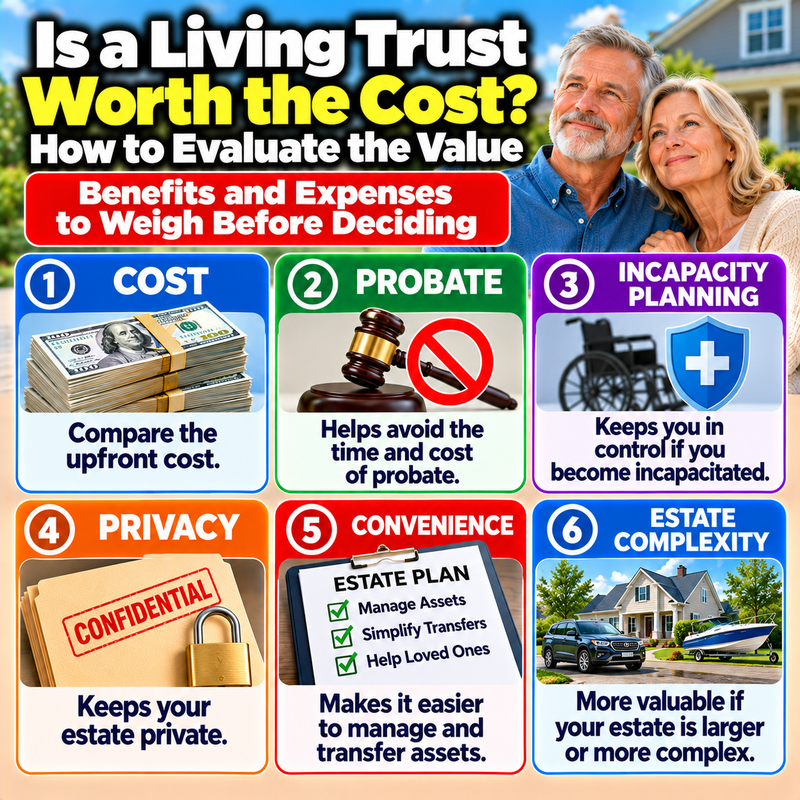
Quick Answer: Value Depends on Your Goals, Assets, State, and Family Situation
Whether a living trust is “worth it” can’t be answered by comparing a flat dollar figure against the price of a will. The value depends on a combination of factors: what kind of assets you hold, whether you own real estate in more than one state, how complicated your family situation is, how much privacy you want, and how much responsibility you’re willing to take on to keep the plan maintained over time.
A living trust that’s properly funded and maintained can save your family from a lengthy, public probate process. A living trust that’s created but never funded—meaning your assets were never legally retitled into it—offers almost none of those benefits. The document itself isn’t magic. It’s a tool, and tools only work when they’re used correctly.
What a Living Trust Actually Costs
Before weighing benefits, it helps to understand the real range of costs involved, because that range is wider than most people expect. For a full breakdown of living trust cost considerations across different service models, it’s worth looking at how pricing scales with complexity and support level.
DIY and Template Costs
Do-it-yourself trust templates typically cost under $300 to around $1,000. These are standardized documents you fill out yourself, with little to no personalized guidance. They can work for very simple situations, but there’s no one checking whether you’ve titled your assets correctly or whether your state’s requirements are met.
Online Platform Pricing
Online platforms that generate trust documents with some guided input typically run from about $1,000 to $2,000. These sit between pure DIY and full attorney service, offering more structure and sometimes customer support, though the level of personalized legal advice still varies significantly between providers.
Attorney-Drafted Trust Costs for Simple Estates
For a straightforward estate, an attorney-drafted trust generally costs between $2,500 and $4,000. This typically includes the trust document itself along with related estate-planning paperwork like a pour-over will, power of attorney, and healthcare directive.
A lawyer handling a basic estate plan may also charge $1,500 or more just for the trust creation, with amendments to fix simple errors potentially costing another $300 to $500 later. These numbers add up quickly if your plan needs revisions down the road.
Attorney-Drafted Trust Costs for Complex Estates
For complex estates—think multiple properties, business interests, blended families, or significant assets spread across states—attorney fees can run from $4,000 up to $10,000 or more. Complexity drives cost because more legal structuring, more coordination with other professionals, and more drafting time is required to make sure the trust actually accomplishes what you intend.
Here’s a general comparison of what you might expect to pay across service models:
- DIY/template: under $300–$1,000
- Online platform: approximately $1,000–$2,000
- Attorney-drafted (simple estate): approximately $2,500–$4,000
- Attorney-drafted (complex estate): approximately $4,000–$10,000+

Potential Benefits to Weigh Against the Cost
Cost only tells half the story. The other half is what you’re actually buying—and that depends heavily on which benefits apply to your life. Also, depending on which state your trust is in, different laws and probate thresholds apply.
Probate Planning for Funded Assets
One of the most commonly cited benefits of a living trust is that properly funded assets can bypass the probate process entirely. Probate is the court-supervised process of validating a will and distributing assets, and according to an AARP survey, it takes roughly 18 months on average to settle a typical estate this way. Settlement costs from probate can also eat up as much as 5% of an estate’s value.
That said, this benefit only applies to assets that have actually been transferred into the trust’s name. A trust document that exists but was never used to retitle your home, bank accounts, or investment accounts provides no probate protection at all for those assets.
Incapacity Management
A revocable living trust lets you name a successor trustee who can step in and manage your assets if you become unable to do so yourself, whether due to illness, injury, or cognitive decline. This is one of the benefits that has nothing to do with estate size—it’s about continuity of financial management during your lifetime, not just distribution after death.
Without this kind of structure, your family might need to petition a court for guardianship or conservatorship just to pay your bills or manage your property while you’re incapacitated. That process can be slow, expensive, and emotionally draining at a time when your family is already under stress.
Privacy Protection
Wills become part of the public record once they go through probate, meaning anyone can look up what you owned and who you left it to. A living trust, by contrast, is typically administered privately, outside the courtroom. For people who value keeping their financial affairs out of public view, this privacy protection can be a meaningful reason to choose a trust over a will-only plan. The differences between a trust and will can help determine what’s best suited for an individual. For some people whose assets fall under their state probate threshold, sometimes a will-only plan is sufficient.
Continuity and Successor-Trustee Management
A trust provides a structured mechanism for how a successor trustee steps in, what their duties are, and how beneficiaries receive distributions. This structure can reduce confusion and conflict among family members because the roles and rules are spelled out in advance rather than left to interpretation.
| Benefit | Depends On |
|---|---|
| Probate avoidance | Proper funding of assets into the trust |
| Incapacity management | Naming and empowering a successor trustee |
| Privacy | State probate transparency rules |
| Multistate coordination | Owning real property in more than one state |
Notice that none of these benefits are automatic just because a trust document exists. Each one requires the trust to be set up and maintained correctly, which is why the “worth it” question is really a question about implementation, not just paperwork.
Multistate Real Estate Coordination
If you own real estate in more than one state, a living trust can be especially valuable. Without a trust, your heirs could face separate probate proceedings in each state where you own property—a process known as ancillary probate. That means extra court filings, extra fees, and extra delays in more than one jurisdiction. Consolidating multistate property into a single trust can simplify this considerably.

Costs and Responsibilities That Continue After Creation
Setting up the trust is just the first step. The ongoing responsibilities that follow often get overlooked when people compare initial price tags.
Funding and Retitling Assets
Funding means legally transferring ownership of your assets into the trust’s name—retitling real estate deeds, updating account ownership at your bank or brokerage, and reassigning business interests. This step is where many trusts fail to deliver on their promise, simply because it was never completed. Real estate transfers may involve filing fees to record the new title, and some assets, like retirement accounts, shouldn’t be retitled into a trust at all because doing so can trigger early withdrawal tax consequences.
Future Amendments and Legal Updates
Life changes—marriages, divorces, new children, new property, moving to a different state—often require updates to your trust. Each amendment can carry its own cost, whether that’s a few hundred dollars for a simple fix or more for substantial restructuring. A trust isn’t a “set it and forget it” document; it needs periodic review to stay aligned with your actual life.
Ongoing Service or Maintenance Fees
Some providers charge ongoing fees to maintain access to your documents, provide customer support, or offer periodic reviews. For example, some digital estate planning packages include an annual access fee on top of the initial setup cost. These fees should be weighed against what they actually provide—document storage, legal updates, or ongoing guidance—rather than assumed to be pure overhead.
Trust Administration After Death
Even after someone passes away, a trust doesn’t administer itself. The successor trustee still has real responsibilities: locating assets, paying debts, filing tax returns, changing titles, and distributing property to beneficiaries according to the trust’s terms. A living trust reduces court involvement, but it doesn’t eliminate the administrative work entirely.

Situations Where a Living Trust May Offer More Value
Owning Real Estate in Multiple States
If you own a vacation home in Florida while living in Ohio, or a rental property in Arizona while your primary residence is in California, a will alone won’t keep your family out of court in every state where you hold title. Without a trust, each state with property in your name may require a separate probate filing, which means your heirs could be dealing with multiple courts, multiple sets of paperwork, and multiple attorneys just to settle one estate.
A properly funded living trust consolidates this. Once your properties are retitled into the trust, your successor trustee can manage and distribute them according to the trust’s terms without triggering separate court proceedings in each jurisdiction. This single benefit alone often justifies the cost for people who own real estate across state lines.
Complex or Blended Family Structures
Families with stepchildren, children from previous relationships, or uneven distribution wishes often benefit from the added structure a trust provides. A will can certainly spell out who gets what, but a trust can layer in more specific instructions—staggered distributions, conditions tied to age or milestones, or separate shares for different branches of a blended family—with less ambiguity for a court to interpret.
Concerns About Will Contests
If you’re worried that your will might be challenged, or that your heirs might end up fighting over your estate, a living trust can offer more durability. Because a trust is typically administered privately and outside of probate court, there’s less opportunity for public challenges during the distribution process.
That doesn’t mean a trust is immune to disputes. Beneficiaries can still challenge a trust’s validity in some circumstances. But the private, out-of-court nature of trust administration generally makes contests less common and less visible than will contests that play out in open probate proceedings.
Desire for Structured, Staggered Distributions
Some people don’t want their heirs to receive a lump sum all at once, especially if beneficiaries are young, financially inexperienced, or dealing with creditor issues. A trust lets you build in staggered distributions—say, a third at age 25, a third at 30, and the remainder at 35—something that’s far more difficult to accomplish cleanly through a will alone.
Situations Where a Simpler Estate Plan May Be Adequate
Not every estate needs the added structure and cost of a living trust. For some households, a well-drafted will paired with beneficiary designations does the job just as effectively, without the funding and maintenance responsibilities that come with a trust.
This is where estate size alone becomes a misleading metric. A modest estate with real estate in two states might benefit more from a trust than a larger estate consisting entirely of retirement accounts and jointly titled property that already passes outside of probate.
Straightforward Estates With Few Assets
If your estate consists mainly of a single home, a few financial accounts, and no real estate outside your home state, a simple will may be entirely sufficient. Adding a trust in this scenario means paying for funding, maintenance, and potential future amendments without gaining much in return, since there’s little complexity to simplify in the first place.
States With Simplified Probate Procedures
Some states offer streamlined or small-estate probate processes that significantly reduce the time and cost typically associated with court administration. If your state has simplified probate rules and your estate qualifies, the probate-avoidance benefit of a trust becomes less compelling, since the court process you’re trying to avoid may not be especially burdensome to begin with.

Why Estate Size Alone Is Not the Only Factor
It’s tempting to think a living trust is only for the wealthy, but that’s a misunderstanding of what the tool actually does. A trust’s value comes from matching its features—privacy, incapacity planning, multistate coordination, structured distributions—to your specific circumstances, not from the dollar value of what you own. A person with a modest but geographically scattered estate may get more practical benefit from a trust than someone with a large but simple, single-state estate.
Cost vs. Convenience vs. Control
Every estate planning decision involves a tradeoff between what you pay, how much effort is required of you, and how much control you retain over the process. A DIY template costs the least but demands the most from you in terms of understanding legal requirements and correctly funding the trust yourself. An attorney-drafted trust costs more but shifts much of that burden—and the legal risk of getting it wrong—onto a professional. Supported digital platforms often try to land somewhere in the middle, offering more guidance than a blank template without the full price tag of traditional legal representation.
How Poor Funding Can Undermine the Value of the Trust
A living trust is only as good as its funding. This is one of the most overlooked realities in estate planning, and it’s the single biggest reason trusts fail to deliver on their promises.
What Happens When a Trust Is Left Unfunded
An unfunded trust is essentially an empty shell. If your home, bank accounts, and investments are never retitled into the trust’s name, those assets still pass through probate when you die, regardless of what the trust document says. Families are sometimes shocked to discover, after a loved one’s death, that the carefully drafted trust they paid for never actually held any assets because the retitling step was never completed.
Assets That Require Special Handling
Not every asset belongs in a trust. Retirement accounts like 401(k)s and IRAs generally should not be retitled into a trust’s name, because doing so can be treated by the IRS as an early withdrawal, triggering taxes and penalties. Beneficiary-designated assets—like life insurance policies or payable-on-death accounts—also require coordination with their own designation forms rather than simple retitling.
Real estate, financial accounts, business interests, and valuable personal property like jewelry or artwork are more typical candidates for trust funding. Working through an accurate accounting of living trust cost considerations should include this funding step, since skipping it undermines the entire purpose of creating the trust in the first place.
Attorney, DIY, and Supported Digital Value Propositions
Choosing how to create a living trust isn’t just about picking the cheapest option. It’s about matching the level of service, guidance, and ongoing support to how comfortable you are handling legal and administrative details yourself.
Each approach has a different value proposition built around service, guidance, implementation, and maintenance—not just sticker price.
Traditional Attorney-Led Planning
Working directly with an estate planning attorney provides the most personalized guidance, particularly for complex estates involving business interests, blended families, or significant multistate property. Attorneys can tailor the trust’s language to your specific situation and help coordinate funding, though this level of service generally comes at the higher end of the cost spectrum.
Do-It-Yourself Trust Documents
DIY templates offer the lowest upfront cost but place the entire burden of accuracy, funding, and compliance on you. There’s no one reviewing whether your state’s requirements are met or whether you’ve correctly retitled your assets.
A trust document that’s legally valid on paper but never properly funded provides no more probate protection than no trust at all. The paperwork is only step one.
This gap between “having a trust” and “having a funded trust” is exactly where DIY approaches tend to fall short, since there’s typically no built-in check to confirm the funding step was completed correctly.
Supported Digital Platforms as a Middle Option
Supported digital platforms attempt to close that gap by combining guided document creation with some level of ongoing access, support, or review. These services generally cost more than a pure template but less than full attorney representation, and the value depends heavily on what “support” actually includes—whether that’s customer service answering procedural questions, periodic document reviews, or access to licensed professionals for more complex questions.

Revocable vs. Irrevocable Trusts and What Each Can Realistically Do
The type of trust you choose dramatically affects what benefits you can realistically expect. Most people creating a living trust for the first time are working with a revocable living trust, which is different in important ways from an irrevocable trust, and confusing the two can lead to unrealistic expectations about tax savings or creditor protection.
A revocable trust lets the person who created it—called the grantor—maintain full control. The grantor can typically serve as their own trustee, change beneficiaries, add or remove assets, or revoke the trust entirely at any point while they’re alive and mentally competent. An irrevocable trust works differently: once created, the grantor generally gives up ownership and control over those assets, and changes often require court approval or can’t be made at all.
This distinction matters enormously for tax and creditor-protection claims. Because the grantor of a revocable trust retains control, the IRS treats those assets as still belonging to the grantor for tax purposes. That means income generated by assets in a revocable trust is still taxable to the grantor, and the trust offers no special income-tax shelter. It also means creditors can generally still reach those assets in a lawsuit, since the grantor hasn’t actually given up ownership.
Control and Flexibility With a Revocable Living Trust
The appeal of a revocable living trust is flexibility paired with incapacity protection. You keep full control over your assets during your lifetime, and if you become unable to manage them yourself, your named successor trustee steps in without needing court intervention. This dual benefit—control while you’re able, continuity when you’re not—is often the core reason people choose a revocable trust over more rigid alternatives.
It’s worth being direct about what this structure does not do. A revocable living trust is not, by itself, an estate-tax elimination strategy, a Medicaid-planning tool, or a shield against creditors or lawsuits targeting the grantor. Those outcomes require different legal structures entirely, often involving irrevocable trusts drafted with those specific goals in mind, typically alongside other tax and asset-protection planning. Anyone choosing a revocable trust for those reasons specifically should have a candid conversation with a qualified professional about whether it will actually accomplish what they’re hoping for.
Limits on Creditor Protection and Tax Benefits
It’s worth repeating because so many people assume otherwise: a standard revocable living trust does not shield your assets from lawsuits, bankruptcy, or creditors during your lifetime. Since you retain ownership and control, the law treats trust assets the same way it treats assets held in your own name when it comes to legal claims against you.
The same goes for income taxes. Interest, dividends, rental income, and capital gains generated by assets inside a revocable trust still flow through to your personal tax return, just as they would if you owned those assets directly. If someone is marketing a basic revocable trust as a tax-avoidance tool, that claim deserves serious scrutiny. For a realistic assessment of living trusts, it’s important to understand their true benefits and limitations.
Questions to Ask Before Deciding
Before committing to a living trust—or deciding to skip one—it helps to ask yourself a short list of honest questions. Your answers will tell you more about whether a trust fits your life than any generic advice ever could.
Consider questions like: Do I own real estate in more than one state? Would my family face a complicated court process if I became incapacitated without a plan in place? Do I want my financial affairs to stay private, or am I indifferent to that? Am I willing to put in the work to retitle my assets and keep the trust updated as my life changes? Is my estate simple enough that a well-drafted will and updated beneficiary designations would get the job done just as well?

A Practical Value-Assessment Framework
Rather than starting with price, it helps to work through a structured framework that puts your actual circumstances first. This keeps the decision grounded in what you need rather than what feels like the “standard” thing to do.
- Inventory your assets and how each one is currently titled
- Identify any real estate you own outside your home state
- Consider your family structure and whether structured distributions matter to you
- Think through what would happen if you became incapacitated tomorrow
- Compare total costs across service models, not just the sticker price
Working through this list honestly tends to clarify the decision far more than comparing a flat trust price against a flat will price ever could.
This is also where tools like Bulletproof Legacy’s eStatePlan try to add value beyond a basic template—by walking people through asset inventory and funding guidance as part of the process, rather than just generating a document and leaving the rest to chance.
Step 1: List Your Assets and Their Titling
Start with a simple inventory: real estate, bank accounts, investment accounts, retirement accounts, business interests, and valuable personal property. Note how each one is currently titled, since this determines what would need to change if you moved forward with a trust.
This step alone often reveals whether a trust would actually solve a real problem for you, or whether most of your assets already pass outside probate through joint ownership or beneficiary designations.
Step 2: Identify Your Family and Incapacity Concerns
Think honestly about your family dynamics and your own health outlook. Do you have concerns about disputes among heirs? Do you want staggered distributions for younger beneficiaries? Is there a realistic chance you’ll need someone else managing your finances at some point due to illness or age?
Step 3: Compare Total Lifecycle Costs, Not Just Setup Fees
Look beyond the initial creation cost and factor in funding costs, potential future amendments, any ongoing service fees, and the eventual cost of trust administration after death. A cheaper upfront option that leaves you confused about funding can end up costing more in court fees and family stress than a slightly pricier option with clearer guidance.
This is exactly the kind of comparison worth making before signing anything, and it’s the central idea behind evaluating living trust cost as a lifecycle expense rather than a single transaction.
Request a clear breakdown from any provider you’re considering—DIY, digital platform, or attorney—so you know exactly what’s included and what might cost extra later.
Step 4: Match Your Needs to a Service Model
Once you understand your assets, your family situation, and your appetite for ongoing maintenance, matching yourself to a service model becomes far more straightforward. Simple, single-state estates with minimal family complexity may do fine with a DIY or supported digital option. Complex, multistate, or blended-family situations generally benefit from direct attorney involvement, even at a higher upfront cost.

Frequently Asked Questions
These are some of the most common questions people ask when trying to decide whether a living trust is worth the cost and fits their situation.
Does a living trust avoid estate taxes?
A standard revocable living trust does not avoid estate taxes. Because the grantor retains control over the assets, those assets remain part of the taxable estate. Reducing estate taxes generally requires more specialized planning, often involving irrevocable trusts drafted with that specific goal.
If estate tax reduction is a priority for you, that’s a conversation to have directly with a qualified estate planning professional rather than an assumption to make about a basic revocable trust.
Do I still need a will if I have a living trust?
Yes. Most people with a living trust still need what’s called a pour-over will, which catches any assets that weren’t transferred into the trust and directs them into it after death. A will is also the only way to name a guardian for minor children, so it remains an essential document even alongside a trust.
How long does it take to set up a living trust?
Timelines vary by complexity and service model. A simple DIY trust might be completed in a few hours, while an attorney-drafted trust for a complex estate could take several weeks of drafting, review, and coordination before signing.
Can a living trust protect my assets from creditors?
Generally, no. A revocable living trust does not protect the grantor’s assets from creditors or lawsuits, since the grantor still legally owns and controls those assets. Creditor protection typically requires an irrevocable trust structure, which comes with significant tradeoffs in control and flexibility.
What happens if I forget to fund my living trust?
Assets left out of the trust don’t get the probate-avoidance benefit the trust was designed to provide. They would likely need to go through probate just as they would without a trust in place, though a pour-over will can help direct those stray assets into the trust after death.
This is why funding isn’t optional—it’s the step that actually makes the trust functional rather than symbolic.
Is a living trust better than a will for avoiding probate?
For properly funded assets, yes, a living trust generally avoids probate while a will does not. But this advantage only applies to assets that were actually retitled into the trust’s name before death, which is why implementation matters as much as the decision to create one.
Can retirement accounts be placed in a living trust?
Generally, no. Retitling a 401(k) or IRA into a trust’s name can be treated as an early withdrawal by the IRS, triggering unwanted taxes and penalties. Instead, these accounts typically stay in your name and use beneficiary designations to direct where they go after death.
How much does it cost to amend a living trust later?
Amendment costs vary depending on complexity and who’s handling the change. Simple corrections might cost a few hundred dollars, while more substantial restructuring could cost significantly more, particularly through an attorney.
Some digital platforms include certain updates as part of an ongoing service fee, which is worth factoring in when comparing total costs across providers.
- DIY amendments: often free but require careful self-review for errors
- Attorney amendments: typically $300–$500 for simple corrections
- Digital platform amendments: cost varies by provider and subscription terms
Asking upfront how amendments are priced can prevent surprises later, especially if your life circumstances are likely to change in the coming years.
What is the difference between a revocable and irrevocable trust?
A revocable trust lets the grantor maintain full control, make changes, and dissolve the trust at any time, while an irrevocable trust transfers ownership away from the grantor permanently, limiting changes and often requiring court approval to modify.
Who should consider a living trust over a simple will?
People who own real estate in more than one state, want structured incapacity planning, value privacy, or have complex family situations tend to get the most practical value from a living trust. Those with straightforward, single-state estates and simple family structures may find that a well-drafted will accomplishes nearly everything a trust would, at a fraction of the cost and ongoing responsibility.
Ultimately, the right answer comes down to matching the tool to your actual life, not following a one-size-fits-all rule based on how much you own.
If you’re ready to move past guesswork and get a clearer picture of what a properly funded living trust could look like for your specific situation, Bulletproof Legacy’s eState Plan offers structured guidance designed to help you make that decision with confidence.