Living Trust Mistakes: Costly Funding and Planning Errors to Avoid
From Failing to Fund the Trust to Outdated Beneficiaries, Learn What to Review Before Problems Develop
A living trust can fail to do its job even after you’ve signed it, and most of the time it’s not because the document was wrong—it’s because something around it was overlooked.
Small gaps like an unfunded account, an old beneficiary form, or a successor trustee who was never told about the role can quietly undo years of careful planning. The good news is that nearly every one of these problems is preventable once you know where to look. Bulletproof Legacy’s approach to creating a living trust focuses on closing these gaps through ongoing funding support and plan access, not just document preparation.
Key Takeaways
- The single biggest living trust mistake is failing to fund the trust—meaning assets are never actually retitled into it, so they can still end up in probate.
- Retirement accounts like IRAs and 401(k)s generally should not be retitled into a trust the way a bank account or house would be; they’re handled through beneficiary designations instead.
- Beneficiary forms on life insurance, annuities, and retirement accounts can override instructions in your trust or will if they’re never updated.
- A living trust isn’t a “set it and forget it” document—major life events like marriage, divorce, a new child, or a big purchase should trigger a review.
- Choosing the right successor trustee matters just as much as the trust document itself, and the article below walks through how to vet that choice.
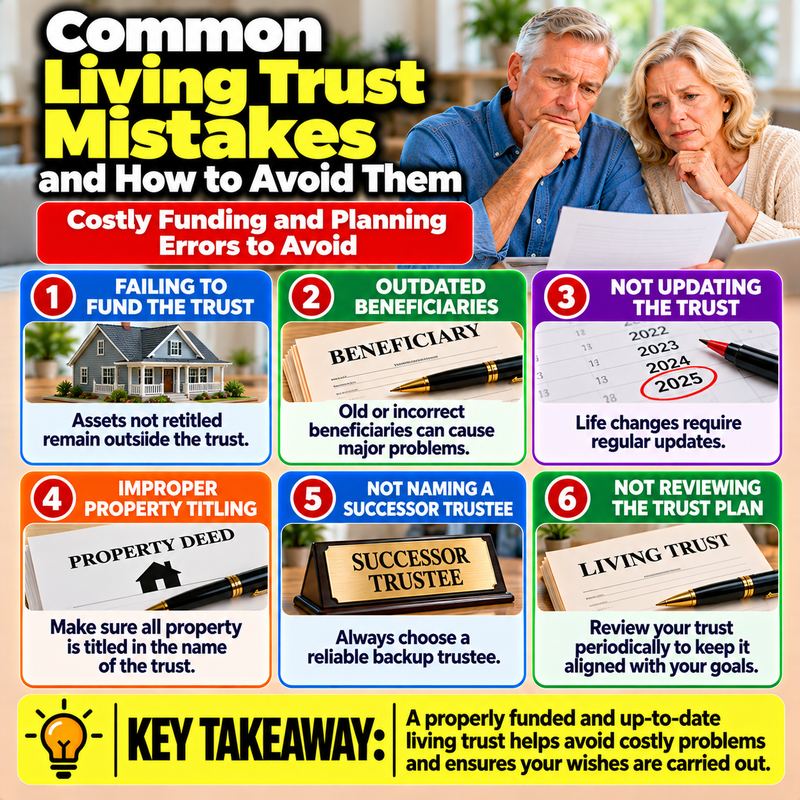
From Failing to Fund the Trust to Outdated Beneficiaries, Learn What to Review Before Problems Develop
Most living trust mistakes fall into one of a handful of categories: assets that were never moved into the trust, beneficiary designations that don’t match the plan, a trustee choice that wasn’t thought through, or a trust that simply fell out of date. None of these are exotic legal problems. They’re maintenance issues, and like any maintenance issue, they’re far easier to fix before they cause a crisis than after. The sections below walk through the ten mistakes that come up most often, along with what to check in your own plan.
Mistake 1: You Created a Trust but Never Funded It
Signing a trust document is the easy part. The part that actually makes the trust work—called “funding”—is where most living trust mistakes happen. An unfunded trust is sometimes described as an empty shell: it exists as a legal document, but it doesn’t control anything because nothing was ever placed inside it.
What “Funding” Actually Means
Funding means changing the ownership or title of an asset so that the trust, rather than you as an individual, is the legal owner. For a house, that typically means recording a new deed. For a bank or brokerage account, it usually means retitling the account in the trust’s name or adding the trust as an owner. Personal property can often be assigned to the trust through a general assignment document. Each asset type has its own mechanics, and skipping this step is the difference between a trust that works and one that doesn’t.
Why an Unfunded Trust Still Ends Up in Probate
If an asset is never retitled into the trust, it’s still owned by you individually at the time of your death. That means it typically has to pass through probate, the court process designed to resolve ownership and pay creditors, regardless of what your trust document says you wanted. This is one of the most common and costly estate planning mistakes, precisely because it defeats the purpose of having a trust in the first place. A pour-over will can direct those leftover assets into the trust after death, but it generally does so through probate, not around it.
To avoid this mistake, it helps to treat funding as an ongoing project rather than a one-time task. That means:
- Making a full inventory of real estate, bank accounts, investment accounts, vehicles, and significant personal property
- Confirming each item’s current title or ownership documentation
- Working with the relevant institution, title company, or attorney to retitle each asset into the trust’s name
- Reviewing that inventory periodically, since funding isn’t something you do once and never revisit
This is also where ongoing support can matter more than the initial paperwork. Many people manage to sign a trust but never finish the funding step simply because no one walks them through it asset by asset.

Mistake 2: Assuming Every Asset Belongs in the Trust the Same Way
Not every asset is funded the same way, and treating them all identically is its own kind of mistake. Real estate, bank accounts, and business interests are generally retitled directly into the trust. Other assets, particularly those with their own beneficiary designations, work differently and shouldn’t simply be handed over to the trust without thinking through the consequences.
This distinction trips people up because it seems counterintuitive. If a trust is supposed to hold your assets, why wouldn’t everything go into it? The answer is that some assets are designed to transfer through a contract-like beneficiary form rather than through trust or probate law, and retitling them incorrectly can create tax problems or administrative headaches that outweigh any benefit.
| Asset Type | Typical Approach |
|---|---|
| Primary home or other real estate | Usually retitled into the trust via new deed |
| Bank and brokerage accounts | Usually retitled into the trust’s name |
| Vehicles and personal property | Often assigned to the trust directly |
| Retirement accounts (IRA, 401k) | Generally stay individually owned; coordinated by beneficiary form |
| Life insurance and annuities | Controlled by beneficiary designation, not trust title |
Assets That Typically Need Retitling
Real property, investment and bank accounts, and business interests are the classic candidates for retitling into a living trust. For more detail on how this process works across different asset types, the living trust overview covers the broader mechanics of what a trust can and can’t hold.
Business interests deserve particular care. Depending on how the business is structured, moving an ownership interest into a trust may involve operating agreements, buy-sell provisions, or lender consent, so it’s often worth checking with a business attorney or the relevant institution before making changes.
Assets That Should Stay Outside the Trust
Retirement accounts, certain insurance products, and payable-on-death or transfer-on-death accounts generally stay outside the trust and are instead coordinated through their own beneficiary paperwork. Forcing these into the trust the way you would a bank account is a common and avoidable error.
Mistake 3: Mishandling Retirement Accounts
Retirement accounts are one of the most misunderstood pieces of trust planning, largely because the instinct to “put everything in the trust” doesn’t apply here the same way it does to a house or a savings account.
Why IRAs and 401(k)s Usually Stay Out of the Trust
An IRA or 401(k) is already owned individually, and changing that ownership to a trust during your lifetime can trigger unintended tax consequences, since these accounts are designed to be owned by a person, not an entity like a trust. Instead of retitling the account itself, these assets are typically coordinated through the beneficiary designation on file with the plan administrator or custodian.
That beneficiary designation matters more than most people realize. A few things worth double-checking:
- Whether the primary and contingent beneficiaries still reflect your current wishes
- Whether an ex-spouse is still listed from years ago
- Whether a named beneficiary has since passed away
- Whether the account custodian has your most recent form on file, since old paperwork can sometimes resurface
It’s rarely appropriate to name a living trust as the direct beneficiary of a retirement account without understanding the tax and distribution rules involved, since doing so can affect how quickly the account must be distributed and how it’s taxed.
When Naming a Trust as Beneficiary Makes Sense
There are situations where naming a trust as a retirement account beneficiary is intentional, such as when a beneficiary has special needs, is a minor, or shouldn’t receive a lump sum outright. These situations typically call for a specifically drafted trust provision designed to meet IRS rules for retirement account beneficiaries, which is a conversation worth having with an estate planning attorney or tax professional rather than guessing at the paperwork.

Mistake 4: Forgetting to Add Newly Acquired Assets
A trust that was perfectly funded on day one can quietly become incomplete a few years later. Life keeps moving after the trust is signed—you refinance the house, open a new investment account, buy a vacation property, or start a side business—and if those new assets never get titled into the trust, they fall into the same unfunded trap as if the trust had never been funded at all.
This is one of the easiest mistakes to avoid and one of the easiest to make, simply because funding isn’t usually top of mind when you’re signing new paperwork for a mortgage refinance or opening a brokerage account. Building a habit of asking “does this need to go into my trust?” whenever you acquire a significant new asset closes this gap before it becomes a problem.
Mistake 5: Failing to Coordinate Beneficiary Designations
A living trust and a set of beneficiary designations are supposed to work together, but when they’re not coordinated, the beneficiary form usually wins.
How a Beneficiary Form Can Override Your Trust or Will
For most retirement accounts, life insurance policies, annuities, and payable-on-death bank accounts, the beneficiary designation on file with the institution generally controls who receives that asset, regardless of what your trust or will says. This surprises a lot of people, especially when the trust was updated more recently than the beneficiary form. If the two documents conflict, the account typically pays out according to its own paperwork.
Keeping these forms current isn’t a one-time task. It’s worth revisiting them:
- After a marriage or divorce
- After the birth or adoption of a child
- After the death of a previously named beneficiary
- Whenever you open a new account or policy
- Any time you update your living trust or will, since the two should generally tell the same story
Accounts That Deserve a Second Look
Life insurance policies, annuities, IRAs, 401(k)s, and payable-on-death or transfer-on-death accounts are the usual suspects. It’s common for someone to update their trust after a major life change and assume the job is done, not realizing the insurance policy they bought a decade earlier still lists an outdated beneficiary.
A trust update and a beneficiary form update are two separate tasks. Doing one without the other is one of the most common ways a plan ends up working against itself.
Running through this list every few years, or any time a major life event happens, is a simple habit that prevents one of the more frustrating living trust mistakes: a plan that looks complete on paper but doesn’t actually reflect current wishes once beneficiary forms are factored in.
Mistake 6: Choosing the Wrong Trustee or Skipping a Backup
The trustee you name does the actual work of carrying out your wishes, which makes this choice just as important as anything written in the trust document itself. Yet trustee selection often gets less thought than it deserves, sometimes defaulting to “oldest child” or “whoever asked” rather than who’s actually suited to the role.
A trustee’s job can include managing accounts, filing tax paperwork, communicating with beneficiaries, following the distribution terms exactly as written, and handling disagreements fairly. That’s a real administrative and interpersonal workload, not just a title.
Naming only one trustee with no backup is its own version of this mistake. If that person becomes unavailable, incapacitated, or passes away, and no successor was named, the trust may need court involvement to appoint a replacement—exactly the outcome a trust is often meant to avoid.
- Consider whether the person is organized enough to track paperwork and deadlines
- Consider whether they can communicate clearly with beneficiaries, even during disagreements
- Consider whether they’re willing to act impartially, especially if they’re also a beneficiary
- Always name at least one successor trustee in case the first choice can’t serve
Qualities to Look for in a Trustee
- Reliability and follow-through on administrative tasks
- Sound judgment, particularly with money
- Willingness to communicate with beneficiaries honestly and regularly
- Ability to remain neutral, even if they personally stand to inherit
A trustee doesn’t need financial expertise to do the job well, but they do need the discipline to follow instructions and the people skills to keep beneficiaries informed. Those two traits prevent more trustee-related problems than any amount of financial sophistication.
When a Professional Trustee Makes Sense
If there’s no family member or friend suited to the role—or if naming one risks stirring up conflict among beneficiaries—a professional trustee or trust company is worth considering. This option typically comes with its own cost structure and requirements, so it’s generally discussed directly with an estate planning attorney or the trust institution being considered.

Mistake 7: Leaving Unclear or Outdated Instructions
A trust document that was crystal clear the day you signed it can turn into a source of confusion years later if the language no longer matches your actual wishes or family situation. Vague wording about “dividing assets equally among my children” sounds simple until a child has passed away, a grandchild enters the picture, or a family relationship has changed in ways the original document never anticipated.
Why Vague Language Creates Family Conflict
Ambiguous instructions leave room for interpretation, and interpretation is exactly what causes disputes among beneficiaries after you’re gone. Terms like “my personal property” or “distribute fairly” can mean different things to different people, and without you there to clarify, your successor trustee is left making judgment calls that may not match what you actually intended.
This is one reason poorly drafted trust language can lead to confusion, legal challenges, and distributions nobody actually wanted. Precise language—naming specific people, specific assets, and specific percentages where possible—removes most of that ambiguity before it has a chance to cause problems.
How to Keep Instructions Current
Because a standard living trust is revocable, you’re not locked into the instructions you wrote originally. You can amend the trust as many times as you’d like while you’re alive and have legal capacity to do so, which is part of what makes the revocable living trust structure useful for a plan that needs to evolve over time.
The practical habit worth building is simple: any time a family relationship shifts, a beneficiary’s circumstances change, or your own wishes evolve, treat that as a cue to review the trust’s language rather than waiting for a formal “estate planning season” that may never arrive.
Mistake 8: Ignoring Real Estate Deeds, Mortgages, and State Rules
Real estate is often the most valuable asset in a trust, and it’s also one of the most technical to handle correctly. A deed that was never recorded, a mortgage clause that wasn’t reviewed, or a state-specific filing requirement that got missed can all undermine what should be a straightforward transfer.
Deed and Title Issues to Watch For
Moving a home into a trust typically requires a new deed that names the trust as owner, and that deed generally needs to be properly executed and recorded with the local county or municipal office. Skipping this step, or using a deed that doesn’t meet your state’s formatting requirements, can leave the property technically outside the trust even if everyone involved assumed it was handled.
Mortgages add another layer. While many lenders allow a transfer into a revocable trust without triggering a due-on-sale clause under federal law, it’s worth confirming with the lender or a title professional before recording any deed change, since requirements can vary by lender and loan type.
Why Trust Rules Differ From State to State
Homestead protections, marital property rules, transfer tax exemptions, and the exact formalities for executing a deed all vary by state. What works cleanly in one state may require an extra step, a different form, or additional disclosure in another. This is one of the clearer examples of where general education about living trusts needs to give way to state-specific guidance, typically from a title company, real estate attorney, or the attorney who prepared your trust.
If you own property in more than one state, this becomes even more important, since each state’s rules apply independently to the property located there.
Mistake 9: Failing to Update the Plan After Major Life Events
A living trust isn’t meant to be signed once and tucked away forever. Life changes, and a trust that doesn’t change with it can end up working against the very goals it was built to support.
- Marriage or remarriage
- Divorce or separation
- Birth or adoption of a child or grandchild
- Death of a beneficiary, trustee, or successor trustee
- A significant change in financial circumstances, positive or negative
- Purchase or sale of a major asset, such as a home or business
- A change in the relationship with a named trustee or beneficiary
- Changes in state or federal law that affect estate or tax planning
Any one of these events is a reasonable trigger to pull out the trust and read through it again, even if nothing ends up needing to change. The review itself is the safeguard.
An outdated plan can sometimes create more problems than no plan at all, particularly when the plan’s assumptions no longer match current law or current family circumstances.
Life Events That Should Trigger a Review
Beyond the list above, it’s worth specifically flagging estrangement or reconciliation within a family, since these shifts in relationship don’t always come with an obvious paperwork trigger the way a marriage or birth certificate does, but they’re just as relevant to how a trust should distribute assets.
How Outdated Tax Planning Can Create New Problems
Estate and tax law changes over time, and trust provisions written to address one set of rules can become mismatched with current law. Certain older trust structures, for example, were designed around federal estate tax exemption levels that have since changed substantially.
A provision that made sense under one exemption amount may create unnecessary complexity, or even an unintended tax consequence for heirs, under current law. This is a tax and legal question, not a do-it-yourself fix, and it’s generally worth raising with both an estate planning attorney and a tax professional if your trust is more than a few years old or was drafted under significantly different tax law.

Mistake 10: Losing Track of Documents and Funding Records
A properly drafted and fully funded trust still needs to be findable. If your successor trustee doesn’t know where the original trust document is, doesn’t have a list of which assets were retitled into the trust, or doesn’t know who your attorney or financial advisor is, they’re left starting from scratch at the worst possible time.
Keeping a simple, organized record—where the trust document is stored, which assets have been funded, and who to contact for help—removes an entire category of stress from an already difficult period. This doesn’t need to be complicated; a single folder or digital file that’s shared with your trustee and updated whenever something changes is usually enough.
Why a Pour-Over Will Is Not a Substitute for Properly Funding Your Trust
Many living trust plans include a pour-over will as a backstop, designed to catch any assets that were never formally transferred into the trust during your lifetime and direct them into the trust after death. It’s a useful safety net, but it’s not a substitute for funding the trust properly in the first place. Assets that pass through a pour-over will typically still go through probate before they reach the trust, which means the delay, cost, and public nature of probate can still apply to those assets.
Treating the pour-over will as your primary funding strategy, rather than as a backup for anything accidentally missed, is one of the more common misunderstandings people have about how their plan actually works.
How Periodic Reviews Close the Gaps Other Mistakes Create
Nearly every mistake covered so far shares a common thread: it tends to surface not because the original planning was flawed, but because nobody revisited it. A periodic review catches an unfunded account, an outdated beneficiary form, or a trustee who’s no longer the right fit before any of it becomes a crisis.
How Often You Should Review Your Trust
A general guideline is to review your trust every three to five years, even if nothing major has happened in your life. That said, any significant life event—described earlier in this article—is reason enough to move up that timeline and review sooner.
Think of it less like a deadline and more like a checkup. The goal isn’t to rewrite the trust every time; it’s to confirm that what’s on paper still matches reality.
What to Bring to a Review Meeting
A productive review typically covers your current asset list and how each item is titled, your most recent beneficiary designations across retirement accounts and insurance policies, your named trustee and successor trustees, and any family changes since your last review. Walking in with this information ready makes the conversation faster and more useful.

A Practical Living Trust Maintenance Checklist
Maintaining a living trust doesn’t require constant attention, but it does benefit from a predictable rhythm. The following checklist covers the habits that prevent most of the mistakes discussed above.
1. Confirm Every Asset Is Titled in the Trust’s Name
Pull your deed, account statements, and titles at least once a year and confirm the trust is listed as owner where it’s supposed to be. This single habit catches the funding gaps that cause the most common and most costly living trust mistakes.
2. Check Beneficiary Designations Every Year
Retirement accounts, life insurance, and annuities operate outside the trust, which means they need their own annual check. Confirm that primary and contingent beneficiaries still reflect your current wishes, and update the form directly with the institution whenever something needs to change.
It’s worth keeping a simple list of which accounts have beneficiary designations and when each one was last confirmed, so this step doesn’t get lost among everything else on your plate.
Taken together, these habits turn trust maintenance into something manageable rather than overwhelming, and they’re a big part of why Bulletproof Legacy’s approach to creating and maintaining a living trust emphasizes ongoing funding support alongside the initial document itself.
3. Update the Trust After Marriage, Divorce, Birth, or Death
Any time your family changes shape—through marriage, divorce, a new child or grandchild, or the death of a beneficiary or trustee—treat that as a trigger to open your trust document and read through it again. These events are the most common reasons a trust’s instructions stop matching reality, and they’re also the easiest to miss simply because updating a legal document isn’t usually the first thing on your mind during a major life transition.
You don’t necessarily need to rewrite the entire trust every time. Sometimes a simple amendment is enough to reflect the change, which is one of the practical advantages of a revocable living trust—it can be adjusted as your circumstances evolve, as long as you’re alive and have the legal capacity to make changes.
4. Store Documents Where Your Trustee Can Find Them
A trust that’s perfectly drafted and fully funded still fails the people relying on it if nobody can find the paperwork when it’s needed. Keep the original trust document, your funding records, and a list of key contacts—attorney, financial advisor, accountant—somewhere your successor trustee knows to look, and make sure that person actually knows where it is before it becomes urgent.
5. Schedule a Legal Review Every Three to Five Years
Even without a major life event, estate planning laws, tax rules, and your own financial picture shift over time. A periodic review with an estate planning attorney, roughly every three to five years, gives you a chance to catch anything that’s drifted out of alignment before it turns into a real problem for your beneficiaries.
Think of this review as distinct from the annual check-ins described earlier. The yearly review is about confirming titles and beneficiary forms are current; the three-to-five-year review is about confirming the trust’s underlying structure and legal language still make sense given how laws and your life have changed.
When to Bring in a Lawyer, Tax Professional, or Financial Advisor
- You’re transferring real estate into the trust and need to confirm deed language and recording requirements for your state
- You own a business interest and need to understand how a transfer affects operating agreements or loan terms
- You’re deciding how to handle a retirement account beneficiary, especially if a beneficiary has special needs or is a minor
- Your estate includes property in more than one state
- Your trust was drafted many years ago under different tax law
- You’re unsure whether a past gift or loan to a family member should be treated as an advance on inheritance
Not every question about a living trust requires a professional’s involvement, but the items above tend to carry legal, tax, or institutional nuance that’s hard to navigate alone. Getting it wrong in these areas isn’t usually catastrophic on its own, but it can create confusion or added cost for your beneficiaries later.
A tax professional, in particular, is worth consulting any time a trust provision could affect how an asset is taxed after your death, since trust and tax rules don’t always move in step with each other. Title companies and real estate attorneys play a similar role for property-specific questions, since deed and recording requirements vary by county and state.
Financial advisors can also help confirm that beneficiary designations across investment and retirement accounts are coordinated with your overall plan, rather than left as an afterthought from years earlier.
All of these professionals can help people avoid common trust mistakes and make the entire process go more smoothly.
Situations That Call for Specialized Guidance
If your situation involves a blended family, a beneficiary with special needs, a family business, or property in multiple states, it’s generally worth treating your plan as one that needs more than a generic template. These circumstances tend to benefit from someone who can walk through the specific details with you rather than apply a one-size-fits-all approach.

Frequently Asked Questions
These are some of the questions that come up most often once people start reviewing their own living trust for potential mistakes.
What happens if I never fund my living trust?
Assets that are never retitled into the trust generally remain under your individual ownership, which means they typically pass through probate at your death regardless of what the trust document says. The trust itself doesn’t automatically gather up your assets—you or your attorney have to take the steps to retitle them.
Can I retitle my retirement account into my living trust?
Generally, no—IRAs and 401(k)s are usually kept in individual ownership and coordinated through their own beneficiary designation rather than retitled into the trust. Moving ownership of a retirement account can trigger unintended tax consequences, so this is an area where it’s worth confirming the right approach with a tax professional or the account custodian before making any changes.
How often should I update my living trust?
A general guideline is every three to five years, but major life events should move up that timeline. Consider reviewing sooner if any of the following happen:
- You get married, remarried, or divorced
- You have a child or grandchild
- A named beneficiary or trustee passes away
- You buy or sell a significant asset
- Your financial circumstances change substantially
Treating these events as review triggers, rather than waiting for a scheduled check-in, closes the gap faster.
Does a pour-over will keep my estate out of probate?
Not entirely. A pour-over will is designed to catch assets that were never formally transferred into the trust and direct them into it after death, but those assets typically still pass through probate first.
A pour-over will is a safety net for assets accidentally left out of the trust—it’s not a replacement for funding the trust properly while you’re alive.
Relying on a pour-over will as your primary funding strategy, rather than as a backstop, is one of the more common misconceptions about how a living trust actually works.
Who should I choose as my successor trustee?
Look for someone who is organized, trustworthy with money, able to communicate clearly with beneficiaries, and willing to act impartially—even if they’re also a beneficiary themselves. The role involves real administrative responsibility, so reliability and follow-through often matter more than financial expertise.
Always name at least one backup successor trustee as well, in case your first choice is unavailable, unwilling, or incapacitated when the time comes.
If no suitable family member or friend exists, or if naming one risks family conflict, a professional trustee or trust company is worth discussing with your estate planning attorney.
What assets should never go into a living trust?
Retirement accounts like IRAs and 401(k)s generally shouldn’t be retitled into a trust during your lifetime, since they’re designed to be individually owned and are instead coordinated through beneficiary designations. Certain other accounts with their own beneficiary or payable-on-death designations may also be better left outside the trust, depending on your overall plan.
When in doubt about a specific asset, it’s worth checking with the institution that holds it or with your estate planning attorney before making a change.
Can beneficiary designations override my living trust?
Yes, for many types of accounts. Life insurance policies, annuities, retirement accounts, and payable-on-death or transfer-on-death accounts generally pay out according to the beneficiary form on file with the institution, regardless of what your trust or will says. Keeping these forms updated alongside your trust is essential to avoid a mismatch.
Do I need a new trust if I move to another state?
Not necessarily a new trust, but it’s worth having your existing trust reviewed. Real estate rules, homestead protections, and certain state-specific requirements can differ, so a review helps confirm that your trust still functions as intended under your new state’s law. The process of creating a living trust can vary slightly from state to state, which makes this review worthwhile after a move.
What happens to jointly owned property in a living trust?
How jointly owned property interacts with a living trust depends on the type of joint ownership and your state’s laws. Some forms of joint ownership pass directly to the surviving owner outside of the trust and outside of probate, while others may need to be specifically addressed in your funding plan.
Because the rules here vary, it’s generally worth discussing jointly held property directly with your estate planning attorney to confirm how it should be titled relative to your trust.
How do I know if my old trust is outdated?
Signs that a trust may need updating include outdated tax provisions written under older exemption rules, beneficiaries who are no longer accurate, a trustee who’s no longer available or appropriate, and language that doesn’t reflect current family circumstances. If your trust hasn’t been reviewed in more than five years, or if any major life event has occurred since the last review, it’s a reasonable time to have it looked at.
Review Your Trust Now, Before a Mistake Becomes a Family Problem
Every common living trust mistake covered in this article shares the same underlying fix: a periodic, honest review of what’s actually in the trust, who’s named where, and whether the instructions still reflect your wishes. None of these issues require starting over—they require attention, and usually just a conversation to confirm everything is aligned.