Living Trust vs Will Cost: Comparing Upfront and Long-Term Estate Planning Expenses
Compare Upfront Costs, Asset Transfers, Updates, Probate Considerations, and the Broader Long-Term Cost Picture
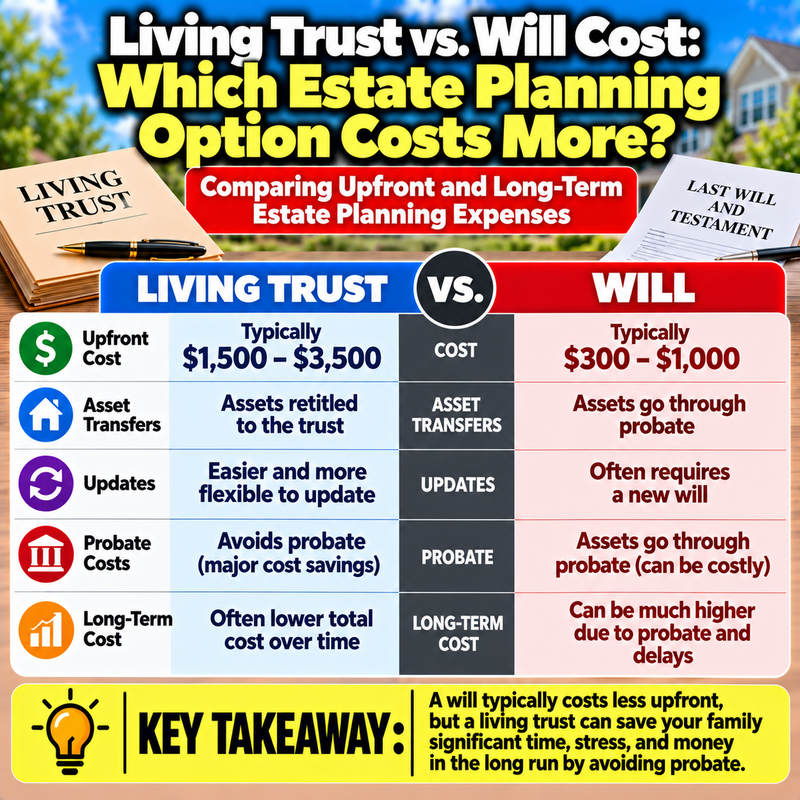
A will typically costs less to create than a living trust, but the real answer depends on what happens after you sign the paperwork.
If you’re comparing sticker prices alone, a will almost always wins. Simple wills can be drafted for a few hundred dollars, while a properly funded living trust often runs into the thousands. But sticker price is only half the story, and the other half — probate costs, incapacity planning, privacy, and how long your family waits for an inheritance — can flip that math entirely.
Many families get pulled into this decision backwards, worrying first about which document costs less rather than which plan actually protects them when it matters. Working with a team like Bulletproof Legacy Financial can help you see both the upfront price and the long-term cost picture before you commit to either path.
Key Takeaways
- Wills are generally cheaper to draft upfront, with simple versions costing a few hundred dollars compared to a living trust’s typically higher starting price, as detailed on this breakdown of living trust cost factors.
- A living trust’s true cost includes funding steps — deed transfers, account retitling, and business interest reviews — not just the drafting fee.
- Probate costs vary dramatically by state and estate size; there is no single nationwide percentage or flat fee.
- Most trust-based estate plans still include a pour-over will as a safety net for anything left outside the trust.
- Incapacity planning, privacy, and how long heirs wait for assets are where the two approaches diverge the most — details ahead.
Quick Answer: Wills Cost Less Upfront, But That’s Not the Whole Story
A will-centered estate plan generally costs less to set up than a trust-based plan. That’s the short version. The longer version involves what happens to that estate after death, because a will’s lower upfront price doesn’t include what your family may later pay in probate court.
Average Price Gap Between Wills and Living Trusts
DIY or template-based estate documents can run under $300 to $1,000, whether you’re building a basic will or a simple trust. Online platforms that offer more guided drafting typically land between $1,000 and $2,000. Where the gap widens is with attorney-drafted documents: a simple attorney-prepared estate plan often costs $2,500 to $4,000, while a complex one — think blended families, multiple properties, or business interests — can run $4,000 to $10,000 or more.
Some firms that specialize in comprehensive living trust packages quote $6,000 to $10,000 for a properly built and funded plan with an experienced estate planning attorney.
Why Upfront Price Doesn’t Equal Total Cost
Here’s the catch: a will’s price tag doesn’t include what happens after death. Probate — the court process that validates a will and oversees asset distribution — can add significant cost and delay, and that expense falls on the estate, not on the person who wrote the will. A living trust’s higher upfront price, by contrast, is meant to reduce or eliminate many of those downstream probate costs, assuming the trust is properly funded. Whether that trade-off makes sense for you depends on your estate size, your state’s probate rules, and how much you value speed and privacy for your heirs.
Typical Cost Categories for Creating a Will
Wills come in a range of price points depending on how much complexity your estate requires and whether you involve an attorney at all.
Because state laws and individual circumstances vary so much, it’s worth using current, credible local pricing sources rather than assuming a flat national number for will costs.
DIY and Online Will Templates
Template-based wills, whether downloaded or built through an online service, are the cheapest entry point into estate planning. These tools work reasonably well for very simple situations — a single person with few assets and no complicated family dynamics — but they offer no built-in review for state-specific execution requirements, which can matter a great deal if the will is ever challenged.
Attorney-Drafted Simple Wills
A straightforward attorney-drafted will, often paired with basic powers of attorney, typically falls into the lower end of the attorney-pricing range. You’re paying for proper legal execution, witness requirements, and language that holds up under your state’s probate code.
Attorney-Drafted Complex Wills
Blended families, special needs beneficiaries, guardianship nominations for minor children, or business succession questions push will costs higher. Attorneys spend more time here because mistakes in these areas are exactly what trigger expensive probate litigation later.

Typical Cost Categories for Creating a Living Trust
A living trust is a different animal from a will — it’s a legal entity that holds title to your assets during your lifetime and distributes them according to your instructions after death, often without court involvement. That added function is part of why trusts cost more to create.
DIY and Online Trust Platforms
Just like wills, trusts can be built through template services or online platforms, generally in the same $1,000 to $2,000 range for guided tools. The risk here isn’t the document itself — it’s that DIY trusts are frequently never properly funded, which means the assets never actually get retitled into the trust’s name.
Attorney-Drafted Simple Trusts
A straightforward revocable living trust for a single-property, single-state estate typically lands in the $2,500 to $4,000 range with an attorney, similar to a simple will package, though funding assistance can add to that total.
Attorney-Drafted Complex Trusts
Multiple properties, out-of-state real estate, business ownership, or blended-family dynamics push trust costs into the $4,000 to $10,000-plus range. Some full-service estate planning firms quote $6,000 to $10,000 specifically for a properly drafted and fully funded trust with an experienced attorney guiding the process. For a detailed breakdown of what drives these numbers, this living trust cost guide walks through each pricing factor in more depth.
Why Bargain-Priced Trust Services Can Backfire
A cheap trust document isn’t the same as a cheap estate plan. If nobody walks you through retitling your real estate, bank accounts, and investment accounts into the trust’s name, the trust is essentially an empty folder. That’s the single most common and costly mistake in trust-based planning, and it’s worth understanding before you shop by price alone.
Funding Costs Unique to a Living Trust
Drafting the trust document is only step one. Step two — funding — is where living trusts pick up costs and effort that wills simply don’t require, since a will has no lifetime asset-management function at all.
Funding means retitling your assets so the trust, not you personally, is the legal owner. This step is what actually lets assets bypass probate later, and skipping it undoes most of the benefit of having a trust in the first place. If you’re unsure how this process works step by step, this guide to creating a living trust covers the full funding checklist in detail.
Transferring Real Estate Deeds Into the Trust
Real property has to be re-deeded into the trust’s name and recorded with the local county assessor or recorder’s office. This usually involves:
- Drafting and signing a new deed naming the trust as owner
- Recording that deed with the county
- Paying any applicable recording fees
- Notifying the mortgage lender, if applicable, to avoid triggering a due-on-sale clause review
Retitling Bank and Investment Accounts
Checking accounts, savings accounts, and brokerage accounts typically need to be retitled in the trust’s name or assigned to it, depending on the institution’s process. Some banks handle this quickly; others require in-person visits and extensive paperwork.
Reviewing Business Interests
If you own a business, interest review is part of trust funding. This can mean updating LLC operating agreements, corporate stock certificates, or partnership agreements so ownership properly flows through the trust.
Coordinating Beneficiary Designations
Retirement accounts, life insurance policies, and other beneficiary-designated assets usually pass outside both a will and a trust, directly to whoever is named as beneficiary. These designations still need to be reviewed and coordinated with your overall plan so there’s no conflict between what the trust says and what the beneficiary form says.
What Happens If an Asset Is Left Out of the Trust
This is where things get expensive. If a home worth $1 million is never deeded into the trust and recorded with the county, that property still goes through probate — and in a state like California, that can mean roughly $46,000 in probate fees on that asset alone, split between attorney and executor fees plus additional expenses. Having a trust doesn’t automatically protect an asset; only properly completed funding does.

Future Amendment and Update Costs
Estate plans aren’t “set it and forget it” documents, no matter which option you choose. Life changes — marriage, divorce, new children, moving states, acquiring new property — and your plan needs to keep up.
How Often Estate Plans Typically Need Updates
Most estate planning attorneys recommend reviewing your plan every three to five years, or immediately after any major life event. A move to a new state is a particularly important trigger, since state law differences can affect how well your existing documents hold up.
Amendment Costs for Wills vs. Trusts
Wills are generally amended through a codicil or a full restatement, while trusts are typically amended through a formal trust amendment. Neither is usually free if you’re using an attorney, though simple amendments tend to cost far less than the original drafting fee. The bigger cost difference shows up with trusts when an amendment involves adding or removing a property, since that can also mean additional funding work — new deeds, new account retitling, and so on — rather than just updated language on a page.
Probate and Administration Costs After Death
This is where the real cost difference between a will and a living trust usually shows up. A will has to go through probate — a court-supervised process — before assets can be distributed, and that process comes with filing fees, attorney fees, executor fees, and often appraisal costs. A properly funded living trust, by contrast, is usually administered privately by a successor trustee without court involvement, which tends to be faster and less expensive, though trustee fees and administrative costs still apply.
It’s worth being blunt here: there is no single nationwide probate fee or percentage. Every state sets its own rules, some states use statutory fee schedules tied to a percentage of the estate, and others use hourly attorney billing. Anyone telling you probate costs “X% everywhere” is oversimplifying a system that varies enormously by state and even by county.
How Probate Fees Are Calculated
In states with statutory fee schedules, probate costs are often calculated off the gross value of the estate, not the net value. That distinction matters a lot. A home worth $1 million with a $950,000 mortgage still counts as a $1 million asset for probate fee purposes — the debt isn’t subtracted first. In states like California, this fee structure can push total probate costs to roughly 4% to 8% of estate value once attorney fees, executor fees, and additional expenses are combined.
Real Numbers: $1 Million vs. $10 Million Estates in Probate
Numbers make this easier to picture. A “modest” $1 million estate going through California probate can incur around $46,000 in total probate fees — split roughly evenly between attorney fees and executor fees, plus additional court and administrative costs. Scale that up, and a $10 million estate can rack up approximately $226,000 in probate fees under that same statutory structure. These figures are specific to California’s fee schedule; other states calculate probate costs differently, which is exactly why it’s worth checking your own state’s rules rather than assuming a flat percentage applies everywhere.
Probate Timeline: Months vs. Years
Cost isn’t the only pain point — time is too. California probate cases typically drag on for 12 to 24 months before heirs see their inheritance, and that’s assuming no disputes arise. Other states move faster or slower depending on court backlogs and local procedure. Either way, a will-only estate plan generally means your family waits considerably longer for access to assets compared to a properly funded trust.
On average, families relying solely on a will see about a one-year delay before distributions reach heirs. That delay can be a real hardship if survivors are depending on those assets to cover living expenses, mortgage payments, or outstanding bills.
Trust Administration Costs and Speed
Trust administration, when the trust has been properly funded, is typically measured in months rather than years. A successor trustee gathers assets, pays debts, files necessary tax returns, and distributes property according to the trust terms — all without needing a judge’s sign-off at every step. That said, trust administration isn’t free. Trustees may charge fees, attorneys may still be consulted for tax or legal questions, and complex estates with business interests or multi-state property can extend the timeline regardless of whether a trust is involved.

What a Will Can Do That a Living Trust Cannot
It’s tempting to treat this comparison as trust-good, will-bad, but that’s not accurate. A will performs certain functions that a living trust simply isn’t built for, and skipping a will entirely — even with a trust in place — leaves real gaps.
Naming Guardians for Minor Children
Only a will can nominate a guardian for your minor children. A living trust has no mechanism for this at all, since it deals with property, not parental authority. If you have young kids, a will isn’t optional — it’s the only document that lets a court know who you want raising them if something happens to you.
Directing Final Wishes for Assets Outside the Trust
A will also gives you a vehicle to address anything that isn’t titled in the trust’s name when you die — intentionally or by oversight. It can name an executor with legal standing to act on behalf of your estate, including bringing legal claims such as a wrongful death action if the circumstances of your death warrant it. A trust document has no equivalent authority over matters outside its own assets.
Some will-based plans also include a testamentary trust, which is a trust created inside the will itself and only comes into existence after death. It’s worth understanding that a testamentary trust does not avoid probate the way a living trust does — it’s created through the probate process, not instead of it, which is a common point of confusion.
Why Many Trust-Based Plans Still Include a Pour-Over Will
Even the most thoroughly funded living trust is typically paired with a will — specifically, a pour-over will. This isn’t redundancy; it’s a safety net.
A pour-over will contains a catch-all provision stating that any assets still titled in your personal name at death should transfer into your trust. It won’t avoid probate for those assets, but it ensures they ultimately end up under the trust’s terms rather than being distributed according to your state’s default intestacy laws.
Catching Assets That Were Never Retitled
Life gets busy, and funding a trust is an ongoing responsibility, not a one-time task. Maybe you bought a new car and forgot to retitle it, or opened a new bank account and never got around to naming the trust as owner. A pour-over will catches these stray assets and directs them where they belong, even though the actual transfer still has to go through probate first.
Testamentary Trusts vs. Living Trusts: A Common Mix-Up
People frequently confuse these two trust types, so it’s worth laying out the differences plainly:
- A living trust is created and funded while you’re alive, and assets inside it generally avoid probate.
- A testamentary trust is created by your will and only comes into existence after your death, through the probate process.
- A living trust can manage assets during incapacity; a testamentary trust has no function until after death.
- A pour-over will works alongside a living trust; a testamentary trust is built inside a will as an alternative structure.
Understanding this distinction matters because some people believe naming a testamentary trust in their will gives them the same probate-avoidance benefit as a living trust. It doesn’t — the assets still pass through probate first before the testamentary trust takes effect. For a similar comparison, see our living trust vs. transfer on death deed article.
This is one of the more technical nuances in estate planning, but it’s an important one if you’re trying to minimize court involvement rather than just organize how assets are eventually distributed.
If your main goal is avoiding probate altogether, a properly funded living trust achieves that for the assets inside it. A testamentary trust, by contrast, doesn’t change your probate exposure at all — it just restructures what happens with assets after probate concludes.

Incapacity-Planning Differences
Death isn’t the only event estate plans need to prepare for. Incapacity — through illness, injury, or cognitive decline — is arguably where the differences between a will and a living trust matter most, and it’s often overlooked in cost comparisons.
Successor Trustee Authority Under a Living Trust
A living trust typically names a successor trustee who can step in and manage trust assets if you become incapacitated, without court involvement. This person acts according to the terms you’ve already written into the trust, subject to applicable state law, which means your financial affairs can continue — bills paid, investments managed, property maintained — without interruption or a judge’s oversight.
Court-Supervised Conservatorship Under a Will-Only Plan
A will has no equivalent function. It only becomes operative at death, so if you become incapacitated beforehand, a will does nothing to manage your assets in the meantime. Without additional planning, this typically means a court must appoint a conservator or guardian of the estate, who then controls your assets and expenses and must report back to the court on an ongoing basis, often annually. This process is public, can be slow, and places decision-making in the hands of a court-appointed stranger rather than someone you personally chose.
Powers of Attorney Needed in Either Plan
Here’s an important nuance: neither a will nor a living trust alone fully solves incapacity planning without additional documents. A durable power of attorney for finances and a healthcare power of attorney are typically needed alongside either a will or a trust, since these documents authorize someone to act on your behalf for matters the trust or will doesn’t cover. A living trust reduces reliance on a conservatorship for trust-held assets, but powers of attorney still matter for anything outside the trust and for healthcare decisions.
Privacy and Court-Process Considerations
Privacy is one of the more emotionally weighted differences between these two planning tools, and it’s worth separating fact from exaggeration here.
Public Record Exposure During Probate
When a will goes through probate, it generally becomes part of the public court record. That means anyone — nosy neighbors, estranged relatives, or solicitors looking for leads — can potentially access information about what you owned and who inherited it. All estate administration filings associated with a will are public record, which some families find uncomfortable given how personal that financial information is.
Creditor Claims and Family Disputes in Probate Court
Probate also opens a formal venue for creditors to file claims against the estate, whether those claims are legitimate or not. It additionally gives disgruntled relatives a built-in forum to contest the will or air grievances, which can turn a straightforward inheritance into a prolonged legal fight. None of this is guaranteed to happen, but the public, court-supervised nature of probate makes it more likely than with private trust administration.
Executors — often family members serving without legal training — can also face personal liability if the probate process is mismanaged, adding another layer of risk and stress to an already difficult time.
How a Living Trust Keeps Financial Details Private
Trust administration generally happens outside probate court, which means the trust document, asset values, and distribution details typically stay out of the public record. This is a meaningful privacy advantage for families who’d rather not have their financial affairs become searchable court documents.
That said, a trust doesn’t guarantee absolute secrecy. Disputes among beneficiaries, litigation, required tax filings, and public property records can still reveal information, even with a trust in place. Privacy is a genuine benefit of trust-based planning, but it’s not an airtight shield — it’s a meaningful reduction in public exposure, not a complete erasure of your financial footprint.
For families specifically concerned about keeping inheritance details away from extended relatives, creditors, or general public searches, this privacy difference is often one of the more practical, tangible benefits worth weighing against the higher upfront cost of a trust.
- Will-based estate: court filings are typically public record, creditors have a formal claims process, and disputes play out in open court.
- Trust-based estate: administration is typically private, though litigation or required filings can still surface some details.

When a Lower-Cost Will May Be Sufficient
None of this means a living trust is automatically the right choice for everyone. For plenty of people, a well-drafted will — paired with the right powers of attorney — is a completely reasonable, cost-effective estate plan.
Smaller or Simpler Estates
If your estate is modest in value and your state’s probate process for small estates is relatively quick and inexpensive, the added upfront cost of a trust may not deliver enough benefit to justify it. Many states have simplified or expedited small-estate probate procedures specifically designed to reduce cost and delay for smaller estates, which can significantly narrow the gap between the two options.
Single-State Property Ownership
If all your real estate is located in one state, you avoid one of the biggest cost drivers that pushes families toward trusts: ancillary probate. Ancillary administration — a separate probate proceeding required in every additional state or county where you own real property — adds real cost and complexity for multi-state property owners. If everything you own sits in one jurisdiction, that particular pain point simply doesn’t apply to you.
A will-centered plan tends to make the most sense when your estate is straightforward, your assets are located in a single state, your family relationships are stable, and you’re comfortable with your heirs waiting through a standard probate timeline to receive their inheritance.
It’s also worth being honest about your own follow-through. A living trust only delivers its cost and privacy advantages if it’s properly funded — meaning every relevant asset is actually retitled into the trust’s name. If you know you’re unlikely to complete that funding process, or unlikely to keep it updated as you acquire new assets, a well-maintained will may actually serve you better than a trust that exists on paper but was never properly connected to your real-world assets.
Ultimately, the “which costs more” question isn’t really about comparing a flat dollar figure for a will against a flat dollar figure for a trust. It’s about comparing the complete lifecycle of each option — drafting, funding, updates, incapacity protection, privacy, and what your family experiences after you’re gone — and figuring out which tradeoffs make sense for your specific situation.
When the Higher Upfront Cost of a Trust May Provide Additional Value
On the other side of this comparison are the situations where paying more upfront for a living trust tends to pay for itself many times over. These aren’t universal truths — they’re patterns that show up again and again in estates where probate becomes expensive, slow, or publicly messy.
The common thread in all of these situations is complexity. The more moving parts your estate has — multiple properties, a business, concerns about incapacity, or significant unrealized capital gains — the more a trust’s higher setup cost tends to make financial sense compared to what probate would eventually cost your family.
It’s also worth remembering that a properly funded trust isn’t just about avoiding court costs. It’s about control — keeping decision-making in the hands of people you’ve chosen rather than a judge, and keeping your family’s financial details away from public view during an already difficult time.
- Estates with real property in more than one state
- Families wanting to avoid court-supervised conservatorship if incapacity occurs
- Estates with significant retirement accounts or appreciated assets where tax timing matters
- Business owners who need continuity of management without a probate freeze
- Anyone prioritizing privacy over the lowest possible upfront document cost
Owning Real Estate in Multiple States
This is one of the clearest cost drivers in favor of a trust. Without one, a will requires ancillary probate administration in every single county or state where you own real property — meaning your family could be opening and paying for separate probate cases in two, three, or more jurisdictions, each with its own fees and timeline. A properly funded living trust eliminates this entirely, since trust-titled property doesn’t need a separate probate proceeding regardless of which state it sits in.
Wanting to Avoid Court-Supervised Incapacity Proceedings
If avoiding a court-appointed conservatorship matters to you, a trust’s successor trustee provision is hard to replace with a will alone. A will does nothing while you’re alive, which means incapacity without a trust (and without powers of attorney) typically funnels your financial affairs through a court process that’s public, ongoing, and requires annual accountings to a judge.
With a living trust, the person you’ve named steps in to manage your financial affairs according to instructions you wrote while of sound mind — no court filing, no annual judicial review, no stranger appointed to oversee your life savings.
For families who’ve watched a relative go through conservatorship, or who simply value staying out of the court system altogether, this single difference often outweighs the entire cost gap between a will and a trust.
Potential Tax and Capital Gains Planning Benefits
Properly structured trust planning can also help prevent unnecessary property tax reassessments and reduce capital gains exposure, depending on how the trust and underlying assets are structured. Retirement accounts deserve particular attention here: a large IRA left directly to an estate rather than properly coordinated with a trust or named beneficiaries can trigger an immediate, substantial income tax bill, whereas the right planning can sometimes defer that tax burden over a much longer period.
These are highly fact-specific outcomes that depend on your state, account types, and overall structure, so they’re worth discussing directly with a planning professional rather than assuming any one outcome applies to your situation.

Will-Only vs. Trust-Based Estate-Plan Cost Checklist
If you’re trying to compare these two options on paper, it helps to break the decision into five concrete cost categories rather than one lump-sum number. Here’s a practical rundown of the specific details you need to understand for your situation.
1. Upfront Drafting Costs
Start by getting real quotes, not estimates, for both options in your state. A will-only plan will almost always quote lower, but ask specifically what’s included — powers of attorney, healthcare directives, and guardian nominations should all be part of a complete will-based package, not separate add-on charges you discover later.
2. Funding and Retitling Costs
If you’re pricing a trust, ask directly whether funding assistance is included or billed separately. Some firms include deed preparation and account retitling guidance in their flat fee; others charge per-asset or per-hour for this work, which can quietly double your total cost if you own multiple properties or accounts.
3. Future Amendment Costs
Ask what a simple amendment costs under each option, and whether adding or removing an asset from a trust triggers additional funding fees beyond the document update itself. This matters more than people expect, since most estate plans get amended at least once within a decade.
It’s also worth asking whether your attorney or planning service offers any form of ongoing review or update support as part of the original fee, since that can meaningfully change the long-term cost math in either direction.
4. Probate or Administration Costs
This is the category most people skip entirely when comparing prices, and it’s often the most expensive one. Research your specific state’s probate fee structure — whether it’s a statutory percentage, hourly attorney billing, or a flat court fee schedule — rather than assuming a nationwide number applies to you.
5. Professional Assistance and Ongoing Maintenance
Finally, factor in whether you’ll want ongoing professional support — annual reviews, trust funding check-ins, or access to updated documents as laws change. Comprehensive planning services increasingly bundle this kind of ongoing access into their packages rather than charging separately each time you need a change, which is worth comparing when you’re weighing total lifetime cost rather than just the initial invoice.

Frequently Asked Questions
These are the questions that come up most often once people understand the basic cost difference and start applying it to their own situation.
Some of these answers depend heavily on your state, so treat the general guidance below as a starting point for a conversation with a local estate planning professional rather than a final answer.
Is a living trust always more expensive than a will?
Upfront, yes, a living trust is typically more expensive to draft than a will, especially once funding costs are included. But “more expensive” only applies to setup — over the full lifecycle of an estate plan, a trust can end up costing less once probate fees, delays, and administration costs are factored in. For more information on how a trust can save you money, check out how a trust saves you more than it costs.
Does a living trust completely avoid probate?
Only assets that are properly titled in the trust’s name avoid probate. Anything left outside the trust — a forgotten bank account, a newly purchased car, a piece of property that was never deeded over — still has to go through probate, which is exactly why pour-over wills and periodic funding reviews matter so much.
Can I use both a will and a living trust together?
Yes, and most comprehensive trust-based estate plans do exactly this. The pour-over will handles guardian nominations, catches any stray assets left outside the trust, and gives your estate a named executor with legal standing, while the trust handles the bulk of your asset management and distribution.
What happens if I forget to fund an asset into my trust?
That asset stays in your personal name and typically has to go through probate when you die, regardless of how well-funded the rest of your trust is. A pour-over will can direct that asset into the trust eventually, but it won’t skip the probate process for that specific item.
How long does probate typically take compared to trust administration?
The gap here is usually significant. Consider the general pattern:
- Probate proceedings in states like California commonly take 12 to 24 months from filing to final distribution.
- Trust administration, when properly funded, is typically measured in months rather than years.
- Will-only estates often see roughly a one-year delay before heirs receive any distribution.
- Trust-based distributions to beneficiaries generally proceed without that same court-imposed delay.
Do probate costs vary by state?
Significantly, yes. Some states use statutory fee percentages tied to gross estate value, others rely on hourly attorney billing, and some have simplified procedures for smaller estates that keep costs much lower. There’s no single nationwide probate fee, so it’s important to research your specific state’s rules rather than relying on a general percentage you’ve seen quoted elsewhere. To understand more about how a trust can save you money, consider reading this guide on trust benefits.
What is a pour-over will and why do I need one?
A pour-over will is a will designed to work alongside a living trust. Its main job is to direct any assets still titled in your personal name at death into your trust, acting as a catch-all for anything that was never properly funded during your lifetime.
It also still performs the functions a trust can’t — naming guardians for minor children and giving your estate a named executor with legal standing to act on your behalf. The executor and trustee have different functions in a trust. Think of it as a safety net rather than a redundant document; it’s doing a job the trust simply isn’t designed to do.
If you’re building a trust-based plan from scratch, this step-by-step guide to creating a living trust walks through exactly where a pour-over will fits into the overall structure.
Skipping the pour-over will entirely, even with a trust in place, leaves a real gap — there’d be no document addressing guardianship or catching unfunded assets if something was missed.
- Catches unfunded or overlooked assets
- Names a guardian for minor children
- Appoints an executor with legal standing
- Directs residuary assets into the trust
Can a will protect my privacy the way a trust does?
Not really. A will generally becomes part of the public probate record once filed, meaning its contents can potentially be viewed by anyone willing to look. A properly funded trust, administered outside of probate court, keeps those details largely out of public view, though it’s not an absolute guarantee of secrecy if disputes or litigation arise.
Who manages my assets if I become incapacitated with only a will?
Without additional planning documents, a court typically appoints a conservator or guardian of the estate to manage your assets. This person must account to the court on an ongoing basis, and the process is both public and outside your direct control in terms of who gets appointed.
A living trust, by contrast, lets a successor trustee you’ve personally chosen step in and manage trust assets according to your own written instructions, without requiring court approval or oversight.
This is one of the clearest practical differences between the two options, will vs. trust, and it’s a major reason some people choose a trust even when their estate isn’t especially large or complex.
Keep in mind that powers of attorney still matter here regardless of which path you choose, since they cover decisions and assets a trust alone doesn’t reach.
How do I decide which option is right for my estate?
Start by honestly assessing your situation against a few key questions, then weigh the answers against both the upfront cost and the long-term lifecycle cost of each option.
- Do you own real estate in more than one state?
- Would you rather avoid a court-supervised conservatorship if you become incapacitated?
- Does your family value privacy around financial matters?
- Are you confident you’ll follow through on properly funding a trust if you set one up?
- How does your specific state handle probate costs and timelines for an estate your size?
If most of your answers point toward complexity, multiple jurisdictions, or a strong desire to avoid court involvement, a trust’s higher upfront cost likely delivers real value. If your estate is simple, contained to one state, and you’re comfortable with a standard probate timeline, a well-drafted will may be the more cost-effective and entirely reasonable choice.
The Real Cost Comparison Comes Down to What Happens After You’re Gone
A will costs less to create, but a living trust is designed to reduce what your family spends, waits for, and deals with publicly after you’re gone — and which one wins that trade-off depends entirely on your specific estate and state.
Whichever direction you lean, working through the full lifecycle cost — not just the drafting fee — with a knowledgeable planning team is the only way to know for sure which option actually fits your situation.
If you want help running these numbers against your own estate, Bulletproof Legacy Financial specializes in building and properly funding trust-based plans so families can compare real costs side by side before deciding.