Does a Living Trust Avoid Probate? How Funding Determines What Stays Out of Court
Learn Why Trust Funding Matters, Which Assets Can Still Face Probate, and Why a Pour-Over Will Remains Important
Article at a Glance
- A living trust only avoids probate for assets that are actually retitled into the trust’s name—signing the document alone doesn’t move anything.
- Bank accounts, real estate, and investment accounts need formal retitling or deeding to the trust to skip the probate process entirely.
- Retirement accounts and life insurance policies transfer through beneficiary designations, not through the trust, so they need separate attention.
- A pour-over will catches forgotten assets, but those assets may still need to pass through probate before reaching the trust.
- Even when probate is avoided, a successor trustee still has real administrative work to do—find out what that looks like later in this article.
Does a living trust avoid probate? Sometimes, but only for the assets you actually put into it.
That single qualifier—”only for the assets you actually put into it”—separates families who skip probate court entirely from families who end up there anyway, trust document in hand. A living trust is a powerful estate planning tool, but it’s not magic. It works exactly as well as the paperwork behind it, and a lot of well-intentioned people sign a trust, file it away, and never finish the job.
Services like CreateALivingTrust.com exist precisely because this funding step trips up so many people, offering guidance on retitling assets correctly so the trust actually does what it was built to do.
This article walks through what a trust can and can’t accomplish on its own, why funding is the make-or-break step, and what still needs attention even after everything is properly titled.
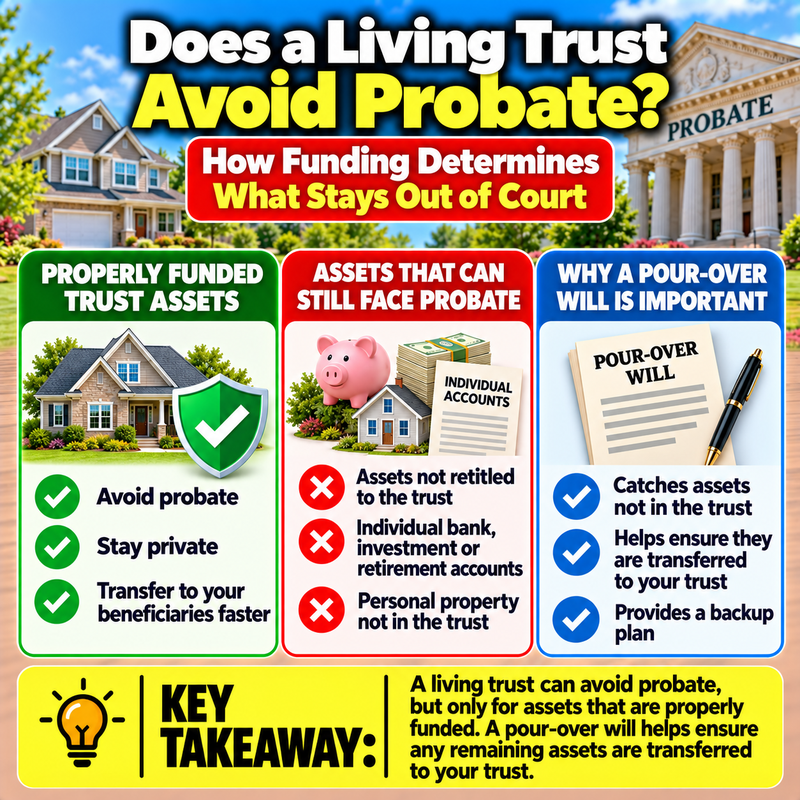
Does a Living Trust Avoid Probate? The Direct Answer
A properly funded revocable living trust allows assets legally owned by the trust to be administered and distributed by a successor trustee without those assets passing through probate court. That’s the short version. The long version matters more, because the word “funded” is doing all the heavy lifting in that sentence.
Why “It Depends on Funding” Is the Real Answer
Think of a trust like a container. You can build the most sophisticated, well-drafted container in the world, but if you never put anything inside it, there’s nothing to protect. A trust document by itself doesn’t change who owns your house, your checking account, or your brokerage portfolio. Ownership changes only when you retitle those assets—deeding real estate to the trust, changing account registrations, reissuing stock certificates. Skip that step, and the trust sits empty while your assets remain in your individual name, fully exposed to probate.
What the American Bar Association Says About Total Probate Avoidance
The American Bar Association has cautioned that a living trust can almost never totally avoid probate and recommends a case-by-case comparison before assuming a trust eliminates court involvement entirely. That’s a meaningful warning from a national legal authority, not a marketing claim from a trust company. Even well-funded trusts tend to leave a few loose ends—a forgotten account, a late-arriving inheritance, an asset acquired after the trust was signed—and those loose ends sometimes need judicial handling.
Why Trust Ownership—Not Merely Signing the Document—Matters
Here’s where a lot of estate plans quietly fail. Someone pays an attorney, signs a beautifully drafted trust, feels accomplished, and stops there. Meanwhile, the deed to their house still says their name, not the trust’s name. Their investment accounts are still registered individually. Nothing has actually moved.
Probate exists specifically to deal with property that’s titled in an individual’s name at death. If your name is on the asset instead of your trust’s name, that asset is a candidate for probate no matter how thorough your revocable living trust looks on paper.
Signing a Trust vs. Funding a Trust
Signing a trust creates the legal entity. Funding a trust transfers ownership of your assets into that entity. These are two separate steps, and only the second one does anything to avoid probate. A trust that’s signed but not funded is sometimes called an “empty trust”—technically valid, practically useless for its main purpose.
You Stay in Control as Trustee While Alive
One reason people underestimate the funding step is that nothing feels different day-to-day. As the grantor of a revocable living trust, you typically serve as your own trustee while you’re alive and competent. You still write checks, sell property, and manage investments exactly as before. The trust operates quietly in the background, which is exactly why it’s easy to forget that the paperwork transferring ownership still needs to happen.

How Properly Funded Trust Assets Are Administered After Death
When assets are correctly titled in the trust’s name, something different happens after death compared to assets left in an individual’s name. There’s no court petition, no waiting for a judge’s calendar, no public filing. Instead, the person you named as successor trustee simply steps into the role and starts managing trust property according to the instructions you left behind.
This is the practical payoff of proper funding. Trust administration can begin almost immediately, while probate keeps assets frozen until the court process runs its course.
Role of the Successor Trustee
Your successor trustee takes over trust management duties the moment you die or become incapacitated. That means gathering trust assets, paying outstanding bills and taxes from trust funds, and distributing property to your named beneficiaries according to your instructions. None of this requires a judge’s approval because the trust itself—not a court—grants that authority.
Why This Process Stays Out of Court
Probate exists to resolve ownership of property that doesn’t already have a clear transfer mechanism. A funded trust already answers that question before death occurs—the trust owns the asset, and the trust document specifies who gets it and when. There’s nothing left for a probate court to decide, which is exactly why properly funded trust assets bypass that process.
Assets Left Outside the Trust
Here’s where things get complicated for a lot of families. Even people who fund their trust diligently tend to miss something. Maybe it’s a car title, a small inheritance received after the trust was created, or a new bank account opened without thinking to register it properly.
Whatever didn’t make it into the trust remains individually owned property, and individually owned property generally still goes through probate.
Why Individually Titled Property Still Faces Probate
Probate courts exist to transfer ownership of assets that don’t have another legal mechanism already in place. If an asset is titled in your name alone at death, with no beneficiary designation and no trust ownership, the court process is often the only way to legally transfer that asset to your heirs. This is true even if you have an otherwise excellent, comprehensive trust covering everything else you own.
Beneficiary-Designated Assets
Not every probate-avoidance tool runs through your trust. Some assets transfer automatically based on a form you filled out separately, completely independent of your trust document.
Life Insurance and Payable-on-Death Accounts
Life insurance policies, annuities, and retirement accounts commonly transfer to beneficiaries you name directly on the account paperwork, regardless of what your trust says. Similarly, payable-on-death (POD) and transfer-on-death (TOD) designations on bank and brokerage accounts allow those specific assets to pass directly to a named person without probate and without needing the trust at all.
It’s worth being precise about this distinction, because it’s commonly misunderstood:
- These assets avoid probate because of the beneficiary designation itself, not because you also happen to have a living trust
- If the beneficiary designation is outdated, missing, or lists your estate as the beneficiary, the asset can end up in probate anyway
- A trust can be named as the beneficiary on these accounts, but that’s a deliberate choice you make on the designation form—it doesn’t happen automatically
Why These Transfers Happen Regardless of a Trust
The legal mechanism here is contractual, not testamentary. When you name a beneficiary on a life insurance policy or retirement account, you’ve created a binding contract with the insurance company or custodian specifying who gets the money. That contract controls the transfer, independent of your will or your trust. It’s a separate system that happens to accomplish the same goal—probate avoidance—through different means.

Retirement Accounts
Retirement accounts deserve their own section because they’re frequently mishandled in the funding process, and the mistake can be costly. Understanding how a revocable trust avoids probate can help in managing these accounts effectively.
Retirement accounts should not be routinely retitled into a revocable living trust. Moving ownership of an IRA or 401(k) directly into a trust can trigger unintended tax consequences, since these accounts have specific rules about ownership and distribution that don’t mesh well with trust ownership.
Instead of retitling, the standard approach is naming the trust as a beneficiary on the account—not the owner. This preserves the tax-deferred status of the account during your lifetime while still directing where the funds go after death.
Why 401(k)s and IRAs Shouldn’t Be Retitled Into a Trust
Retirement accounts operate under a specific tax framework tied to your individual ownership and your individual life expectancy for distribution purposes. Transferring ownership to a trust can be treated as a taxable distribution, potentially creating a tax bill you didn’t intend to trigger. The safer, more standard path is leaving the account titled in your name and simply updating the beneficiary designation to reflect your wishes—whether that’s a person, multiple people, or your trust itself in certain planning situations.
Real Estate
Real estate is usually the single largest asset in an estate plan, and it’s also one of the easiest to get wrong. Unlike a bank account where a phone call might update ownership, real property requires a formal deed change recorded with the county.
Deeding your home, rental property, or vacation property into your trust’s name is often the most consequential step in the entire funding process, simply because of the asset’s value and the fact that real estate almost never has an alternative probate-avoidance mechanism like a beneficiary designation.
Deeding Property Into the Trust’s Name
Moving a house into a trust requires preparing and recording a new deed—usually a quitclaim or grant deed—that transfers ownership from you, as an individual, to you, as trustee of your trust. This isn’t something you can accomplish by simply mentioning the property in the trust document. The deed has to be drafted correctly, signed, notarized, and recorded with the county recorder’s office where the property sits. Many county offices charge a modest recording fee, and some states require additional transfer tax forms or exemption paperwork since you’re not selling the property, just retitling it.
If you own property in more than one state, this step has to be repeated separately for each piece of real estate, following that state’s specific recording requirements. A vacation home in Colorado and a primary residence in Michigan each need their own deed, filed in their own county, following their own local rules. This is one of the more detail-heavy parts of the funding process, which is why resources that walk through how to create a living trust typically spend considerable time on the deeding step specifically.
What Happens If a Deed Is Never Changed
If the deed still lists your name instead of the trust’s name when you die, that property is treated as individually owned, regardless of how clearly your trust document says it should go to your children or spouse. Your successor trustee has no legal authority to transfer property that was never actually placed into the trust. The home becomes a probate asset, and your family will likely need to open a probate case just to deal with that single piece of real estate, even if every other asset you own sailed through trust administration without issue.
This is a common and heartbreaking gap in estate plans. Someone does the hard work of funding bank accounts and investment accounts but overlooks the house—often because they assume the trust document itself covers it, or because they moved and never updated the deed on a newly purchased property. The fix is straightforward in theory (file a new deed) but easy to overlook in practice, especially years after the original trust was signed.

The Role of a Pour-Over Will
Because perfect funding is rare, most comprehensive estate plans pair a living trust with a pour-over will. Think of it as a safety net designed to catch anything that slipped through the cracks.
How It Catches Assets Left Outside the Trust
A pour-over will is a specific type of will that names your trust as the beneficiary of any assets you still owned individually at the time of your death. Instead of distributing those leftover assets directly to family members or friends, the will directs them into the trust, where they’re then distributed according to the trust’s existing instructions.
This matters because it creates consistency. Rather than having one set of instructions for trust assets and a completely different set of instructions for anything left outside the trust, a pour-over will channels everything toward the same destination. Your trust document ends up being the single source of truth for how your estate gets divided, even for assets that technically never made it into the trust before you died.
Without a pour-over will, any asset left outside the trust would be distributed according to your state’s intestacy laws if you don’t also have a separate traditional will covering it. That can produce results wildly different from what you actually wanted, since intestacy laws follow a rigid formula based on family relationships rather than your personal wishes.
Why Pour-Over Assets May Still Require Probate First
Here’s the catch, and it’s an important one: a pour-over will is still a will. Wills generally need to go through probate before their instructions take effect. So while a pour-over will does eventually get a stray asset into your trust, that asset typically has to pass through the probate process first before it arrives there.
In other words, a pour-over will doesn’t avoid probate for the assets it covers—it just makes sure those assets end up in the right place once probate concludes. This is precisely the nuance the American Bar Association points to when it cautions that a living trust can almost never totally avoid probate. The pour-over will is a backstop, not a probate-avoidance tool in its own right.
If an asset is caught by a pour-over will, expect probate court involvement for that specific asset, followed by distribution into the trust once the court process wraps up. This is different from assets that were properly funded into the trust before death, which skip probate court entirely.
The practical lesson here is that a pour-over will should be viewed as insurance against mistakes, not a substitute for careful funding. The goal should always be funding assets into the trust directly while you’re alive, reserving the pour-over will for genuinely unexpected situations—like an inheritance received shortly before death that there simply wasn’t time to retitle.
Situations Where Probate Can Still Occur
Even with diligent funding and a solid pour-over will as backup, certain situations can still pull an estate into probate court.
Forgotten or Newly Acquired Assets
Life doesn’t stop once you sign a trust. You might open a new bank account for a side project, inherit property from a relative, or receive a settlement check years after your trust was created. If these assets aren’t promptly retitled into the trust, they sit in your individual name and become probate candidates, pour-over will notwithstanding.
Disputes Over Trust Validity or Terms
Occasionally, a family member challenges whether a trust was properly executed, whether the person who created it had the mental capacity to do so, or whether its terms were the product of undue influence. These disputes sometimes end up in court, which can functionally resemble probate litigation even though the underlying asset was titled in the trust. This is less common than straightforward funding gaps, but it’s a real possibility worth understanding, particularly in blended families or situations involving significant wealth.

Small-Estate Procedures
Not every leftover asset requires a full probate proceeding. Many states offer simplified alternatives specifically designed for situations where only modest-value property remains outside a trust.
These small-estate procedures exist because lawmakers recognized that full probate is overkill for minor assets, and families shouldn’t have to endure a year-long court process to transfer a car title or collect a small bank balance.
Simplified Alternatives for Modest-Value Assets
Depending on the state and the value involved, options often include:
- A small estate affidavit, which allows an heir to collect certain assets by signing a sworn statement rather than opening a full probate case
- Summary administration, a shortened probate process available in some states when the estate falls below a specific dollar threshold
- Simplified transfer procedures for vehicles, which many states allow without probate when the value is below a set limit
These thresholds and procedures vary significantly by state, so what qualifies as a “small estate” in one jurisdiction might not qualify in another. Still, knowing these options exist can be a relief for families dealing with a modest asset that slipped outside the trust—it doesn’t automatically mean a drawn-out court battle.
Trust Administration Still Involves Work and Expense
Here’s a point that’s easy to lose in all the probate-avoidance talk: skipping probate court doesn’t mean skipping work entirely. Trust administration is its own process, with its own set of responsibilities that fall squarely on whoever you’ve named as successor trustee.
Trust administration isn’t free, and it isn’t instant. It’s almost always faster and cheaper than the equivalent probate process, but “cheaper and faster” isn’t the same as “nothing to do.”
Identifying, Valuing, and Managing Assets
A successor trustee has to figure out exactly what the trust owns, which sometimes requires tracking down account statements, property records, and business interests. Real estate and valuable personal property typically need a formal appraisal to establish value, both for tax purposes and for fair distribution among multiple beneficiaries. If the trust owns a rental property or a business interest, the trustee may need to manage that asset actively—collecting rent, paying expenses, or making operational decisions—until it’s sold or distributed.
This workload scales with the complexity of the estate. A trust holding a single paid-off house and a couple of bank accounts requires relatively little hands-on management. A trust holding multiple properties, business interests, and varied investment accounts demands considerably more attention and time.
Handling Debts, Claims, and Taxes
Death doesn’t erase financial obligations. The trustee typically needs to notify known creditors, pay legitimate debts from trust assets, and file final income tax returns on behalf of the deceased, along with any necessary trust tax returns. Depending on the size of the estate, federal estate tax filings might also come into play, though this only affects estates above a fairly high exemption threshold.
Why Avoiding Court Doesn’t Mean Avoiding Effort
Probate avoidance refers specifically to skipping court supervision—not skipping the underlying administrative tasks that come with settling someone’s affairs. Those tasks exist whether you’re going through probate or trust administration; the trust route simply removes the judge, the court filings, and the waiting periods tied to court schedules.
For many families, this distinction is exactly where the ABA’s caution about “case-by-case comparison” becomes practical advice rather than abstract legal commentary: a complex trust with many assets may still require significant time and even professional help to administer correctly, even without a single court appearance.

Other Benefits of a Living Trust Beyond Probate
Probate avoidance tends to dominate the conversation, but it’s not the only reason people set up a living trust. Several other benefits matter just as much, sometimes more, depending on your circumstances.
These advantages don’t require the same level of hype that probate avoidance sometimes gets in marketing materials. They’re genuinely useful on their own, grounded in how trusts function structurally compared to wills.
Continuity of Management During Incapacity
If you become incapacitated—through illness, injury, or cognitive decline—a properly drafted trust allows your named successor trustee to step in and manage trust assets immediately, without needing a court-appointed conservatorship. This is often underrated compared to probate avoidance, but it can matter just as much, since incapacity planning addresses a scenario that happens while you’re still alive, not just after death.
Privacy Compared to the Public Probate Record
Probate is a public court process. Anyone can generally access probate filings, which means the contents of a will, the value of assets, and the identity of beneficiaries become part of the public record. A trust isn’t filed with a court and doesn’t become public record in the same way. For business owners, blended families, or anyone who simply prefers to keep financial matters private, this distinction carries real weight.
Faster Access to Funds for Beneficiaries
Because trust administration doesn’t wait on court schedules, beneficiaries of a well-funded trust often receive distributions considerably faster than they would through probate. While probate frequently takes seven months to a year for even straightforward estates, trust administration can sometimes distribute assets in a matter of weeks, particularly when the trust is simple and well-organized. This speed can matter enormously for beneficiaries who depend on that inheritance for immediate expenses.
Does a living trust avoid probate? For the assets you take the time to fund into it, generally yes. For everything else, the answer depends on beneficiary designations, pour-over wills, and whether you keep the trust updated as your life changes—getting that funding right from the start is where CreateALivingTrust.com focuses its guidance.
Trust-Funding and Maintenance Checklist
Knowing that funding matters is one thing. Actually doing it is another. Here’s a practical rundown of what needs attention, both when you first set up your trust and on an ongoing basis afterward.
1. Retitle Real Estate Into the Trust
Start with your biggest assets first, and for most people, that’s real estate. Every property you own—your primary residence, a vacation home, a rental property—needs a new deed prepared, signed, notarized, and recorded with the county where the property sits. This isn’t optional paperwork you can skip because it feels redundant; without a recorded deed showing the trust as owner, that property remains yours individually and becomes a probate asset.
If you own property across multiple states, expect to repeat this process separately in each county, following that state’s specific recording rules and fees. It’s tedious, but it’s also one of the most consequential steps in the entire funding process given how much value real estate typically represents in an estate.
2. Update Financial and Investment Account Ownership
Bank accounts, brokerage accounts, and certificates of deposit generally need to be retitled directly in the trust’s name. Most financial institutions have a straightforward process for this—usually involving a copy of your trust document or a certification of trust, along with new account paperwork. Business ownership interests, including shares in a closely held corporation or membership interests in an LLC, often require this same retitling step, though the specific mechanics depend on your business’s governing documents.
Don’t assume this happens automatically just because you mentioned the account in your trust. Each institution needs its own retitling request, and skipping even one account leaves that asset individually owned.
3. Review Beneficiary Designations Separately
Life insurance policies, IRAs, 401(k)s, and annuities operate outside the trust entirely, transferring based on whatever beneficiary designation is on file with the custodian or insurance company. This means you need to review these forms separately from your trust funding work, making sure they reflect your actual current wishes rather than an outdated name from years ago.
Retirement accounts specifically should generally not be retitled into the trust directly, since doing so can trigger unintended tax consequences. Instead, most people name the trust as a contingent or primary beneficiary on the designation form itself, preserving the account’s tax treatment while still directing where the funds eventually go.
4. Revisit the Trust After Major Life Changes
A trust isn’t a document you sign once and forget. Marriage, divorce, the birth of a grandchild, the sale of a business, or a move to a new state can all affect whether your trust still reflects your actual circumstances. Newly acquired property after the trust was created also needs to be funded into it—buying a second home five years after signing your trust doesn’t automatically include that home unless you take the extra step of deeding it in.
5. Confirm Assets Match the Trust Document Annually
A simple annual check-in can catch funding gaps before they become problems for your family. Pull your trust’s asset schedule, compare it against your current account statements and property deeds, and confirm everything still lines up. This takes an afternoon once a year and can save your successor trustee—and your beneficiaries—from an unexpected probate case down the road.

Frequently Asked Questions
A few questions come up repeatedly when people start thinking seriously about trusts and probate. Here are direct answers to the most common ones.
Does putting my house in a living trust avoid probate?
Yes, as long as the deed is actually changed to reflect the trust as owner. Simply writing your house into the trust document isn’t enough; a new deed needs to be prepared, signed, and recorded with your county. Once that’s done correctly, your home transfers to beneficiaries through trust administration rather than through probate court.
If the deed was never updated, the house remains in your individual name and will likely need to go through probate regardless of what your trust document says about it.
What happens if I never fund my living trust?
An unfunded trust is essentially a document with no assets inside it. Anything left in your individual name at death generally still goes through probate, meaning your family faces the exact court process, timeline, and expense you were likely trying to avoid by creating the trust in the first place.
Do bank accounts need to be retitled into a trust?
Generally, yes. Most banks and brokerage firms require a specific retitling process, often involving a certification of trust document, before they’ll change the account ownership from your individual name to the trust’s name. This step doesn’t happen automatically just because you have a trust.
Can a living trust protect assets from creditors?
A revocable living trust generally does not shield assets from your own creditors during your lifetime, since you typically retain control over the trust and can revoke it at any time. Creditor protection is more commonly associated with irrevocable trusts, which involve giving up control in exchange for additional legal protections—a very different planning tool with different tradeoffs.
Is a living trust better than a will for avoiding probate?
A properly funded living trust can avoid probate for the assets it holds, while a will does not avoid probate at all—a will actually has to go through probate to take legal effect. That said, a trust only avoids probate for assets titled in its name, so the comparison depends heavily on how thoroughly the trust was funded.
Many comprehensive estate plans use both tools together: a trust for major assets, paired with a pour-over will to catch anything left outside it.
Do I still need a will if I have a living trust?
Yes. Even with a well-funded trust, a pour-over will serves as a backstop for any assets accidentally left in your individual name. Without this backup will, those stray assets would be distributed according to your state’s intestacy laws rather than your actual wishes.
How long does trust administration take compared to probate?
Probate for even a straightforward estate typically takes seven months to a year, and complicated estates can stretch to two years or more. Trust administration, by contrast, can sometimes distribute assets in a matter of weeks, since there’s no court calendar to wait on and no public filing requirements slowing things down.
Does a living trust avoid estate taxes?
No. A revocable living trust does not reduce or eliminate federal or state estate taxes on its own, since you retain control over the trust’s assets during your lifetime and they’re still considered part of your taxable estate.
Reducing estate tax exposure typically requires different planning tools, such as irrevocable trusts or lifetime gifting strategies, which involve giving up control of the assets in exchange for tax benefits.
For most people, estate tax isn’t even a concern, since federal exemption thresholds are quite high. But if your estate is large enough to trigger the issue, a conversation with a tax-focused estate planning professional is worth having separately from the probate-avoidance conversation.
Can a living trust be contested like a will?
Yes, though it’s less common. A family member can challenge a trust’s validity by arguing the person who created it lacked mental capacity, was subjected to undue influence, or that the document wasn’t properly executed according to state law.
These challenges can functionally resemble probate litigation even though the underlying assets were titled in the trust rather than passing through a will. This is less likely than a straightforward funding gap, but it remains a real possibility, especially in situations involving blended families or significant wealth.
Several factors tend to increase the risk of a successful challenge:
- Evidence suggesting the person who signed the trust had diminished mental capacity at the time
- A sudden, unexplained change in beneficiaries shortly before death
- Involvement of a caregiver or new acquaintance in drafting or amending the trust
- Poor documentation of the signing process, including a lack of witnesses where state law requires them
How often should I review my living trust?
An annual review is a reasonable baseline for most people, simply to confirm that assets still match the trust’s schedule and that beneficiary designations remain current. Beyond that routine check-in, certain life events should trigger an immediate review regardless of when your last annual check happened.
Consider revisiting your trust promptly after any of the following:
- Marriage or divorce
- The birth or adoption of a child or grandchild
- Buying or selling significant property, including real estate or a business
- Moving to a different state, since trust laws and requirements vary
- The death of a named beneficiary or successor trustee
Treating your trust as a living document that evolves with your life—rather than a one-time project—is what keeps it functioning the way you intended years or decades after you first signed it.
A Trust Only Works as Hard as You Fund It
Does a living trust avoid probate? For assets properly retitled into the trust’s name, generally yes. For everything else—unfunded accounts, newly acquired property, forgotten assets—probate remains a real possibility, pour-over will or not.
The gap between those two outcomes isn’t really about the quality of your trust document. It’s about follow-through: deeding the house, retitling the accounts, updating beneficiary forms, and revisiting the whole plan as life changes. A trust sitting unfunded in a filing cabinet accomplishes nothing more than a will would, and in some cases, less.
None of this diminishes what a well-funded trust genuinely offers. Faster distribution to beneficiaries, privacy compared to the public probate record, and continuity of management if you become incapacitated are all real, substantial benefits that exist independent of probate avoidance. These advantages are worth having even for someone who isn’t primarily worried about court costs or timelines.
The honest takeaway is that a living trust is a tool, not a guarantee. It does exactly what you fund it to do, no more and no less, which means the real work happens after the signing appointment, not during it. To understand more about its benefits, you might want to explore how living trusts help you avoid probate and save time and money.
CreateALivingTrust.com focuses specifically on helping people complete that funding and maintenance work correctly, so the trust they’ve created actually functions the way it was designed to.