How to Avoid Probate: Practical Ways to Transfer Assets Outside the Court Process
Understand Living Trusts, Beneficiary Designations, Joint Ownership, Transfer-on-Death Tools, and Their Limitations
Probate doesn’t have to swallow your estate in court fees and delays if you plan ahead with the right legal tools.
Article-at-a-Glance
- A properly funded revocable living trust lets assets pass to your successor trustee without court supervision, but the trust must actually hold title to your property.
- Beneficiary designations, POD accounts, and TOD deeds can move specific assets outside probate, yet each comes with its own limitations and potential family conflicts.
- A will alone almost never avoids probate; it simply tells the court how to distribute what’s left inside your name.
- Joint ownership with survivorship rights can skip probate for one asset while creating gift tax issues or unequal inheritance problems for everyone else.
- Bulletproof Legacy focuses on making sure trusts are actually funded and coordinated with every other piece of your plan, a detail many people overlook until it’s too late.
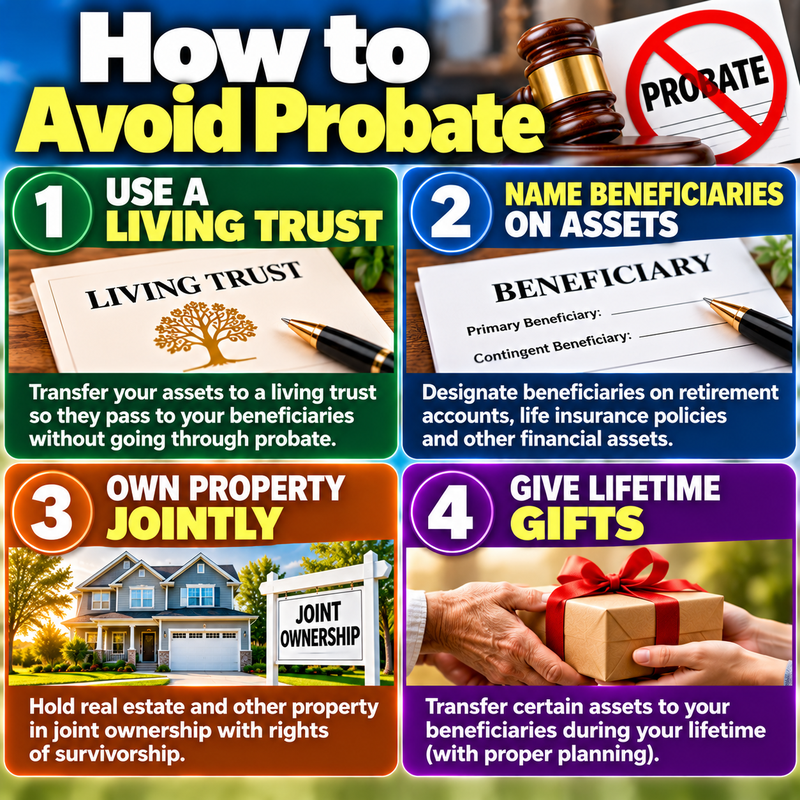
Every strategy on this page can move specific assets outside the probate process, but none of them function as a universal shortcut that erases every court step for every estate. That distinction matters because a lot of estate planning content sells probate avoidance as a single switch you flip once and forget. In reality, it’s asset-by-asset work that requires coordination, periodic updates, and sometimes professional guidance to avoid new problems replacing the old one.
What “Avoiding Probate” Actually Means
Probate is the court-supervised process that happens after someone dies. It involves gathering up the deceased person’s assets, paying off remaining debts, and distributing what’s left to heirs or beneficiaries.
Depending on the state, executor or personal representative fees can run as high as 5% of the estate’s value, and the process itself can stretch from several months to multiple years. Everything filed during probate also becomes part of the public record, meaning asset amounts, property types, and beneficiary names are all technically viewable by anyone who looks.
“Avoiding probate” really means arranging ownership or transfer instructions so a particular asset passes through a valid nonprobate mechanism instead of landing in the probate estate. It’s asset-specific, not estate-wide. You can avoid probate for your house, your bank account, and your life insurance policy individually while still leaving behind an item or two that ends up in front of a judge.
Probate Property vs. Nonprobate Property
Probate property is anything owned solely in the decedent’s name without a designation or mechanism directing what happens to it after death. Nonprobate property, by contrast, already has instructions built into its ownership structure. Common examples of nonprobate transfers include:
- Assets titled in the name of a properly funded revocable living trust
- Life insurance policies and retirement accounts with named beneficiaries
- Bank accounts with a payable-on-death designation
- Real estate or vehicles with a transfer-on-death designation, where state law allows it
- Property held in joint tenancy with right of survivorship
Everything else, unless it falls under a small-estate exception, typically goes through probate regardless of what your will says.
Why No Strategy Guarantees 100% Avoidance
No combination of tools guarantees a zero-probate outcome. Assets can get left out of a trust by accident, beneficiary forms can go missing or get outdated, and state law can limit which tools are even available for certain property types. The honest goal isn’t total elimination; it’s minimizing exposure by handling each asset deliberately and reviewing the plan as life circumstances change.
Revocable Living Trusts
A living trust is one of the most commonly used tools for avoiding probate on a broad range of assets. Property that’s properly transferred into the trust gets administered by a successor trustee according to the trust’s terms after the grantor passes away, without court involvement for those specific assets. Because the grantor typically serves as trustee during their lifetime, they keep full control over the property even though legal title has technically moved to the trust.
Why Funding Is Essential
Signing a trust document is only step one. The trust has to actually be funded, meaning title to your home, bank accounts, investment accounts, and other property needs to be formally retitled in the name of the trust. A trust sitting empty on a shelf does absolutely nothing for probate avoidance; it’s the retitling step that most people either skip or do halfway, and it’s where a lot of “I thought I had a trust” surprises come from after someone passes away. If you’re working through this process, understanding how to create a living trust correctly from the start, including the funding stage, prevents this exact problem.
What a Trust Does Not Automatically Solve
Even a well-drafted, fully funded revocable living trust doesn’t automatically protect against every scenario. The American Bar Association has cautioned that living trusts almost never totally eliminate probate, since property acquired after the trust was set up, or assets someone simply forgot to retitle, often still require some court involvement. A well-designed plan may also leave certain assets outside the trust on purpose, or run into circumstances where court oversight becomes necessary anyway, such as disputes among heirs or complications involving a minor beneficiary.
The Role of a Pour-Over Will
This is exactly why a pour-over will remains a standard part of any trust-based estate plan. If something gets left out of the trust, whether by oversight or because it was acquired shortly before death, the pour-over will directs that forgotten asset into the trust through probate. It’s a backstop, not a failure of the plan. Think of it as a safety net that catches anything that slipped through, so it still ends up distributed according to the same trust terms rather than default state inheritance laws.
Naming a Successor Trustee
A successor trustee has to be named in the trust document to take over management and distribution duties once the original grantor passes away or becomes incapacitated. Without this appointment, the whole structure stalls, since no one has legal authority to act on the trust’s behalf. Choosing someone organized, trustworthy, and willing to follow the trust’s instructions matters just as much as the funding step itself.

Beneficiary Designations
Life insurance policies, 401(k)s, IRAs, and certain other financial products allow you to name a beneficiary directly on the account. When the account holder dies, the asset passes straight to whoever is named, completely bypassing probate and, notably, bypassing whatever is written in a will or trust agreement too. That second part catches people off guard constantly.
Accounts and Policies That Allow Direct Beneficiaries
Most retirement accounts, annuities, and life insurance policies include a beneficiary designation form as a standard part of account setup. These forms typically allow for a primary beneficiary and one or more contingent beneficiaries in case the primary beneficiary has already passed away. Some plans even allow percentage splits among multiple people, which can simplify things considerably compared to probate court dividing assets according to a will.
Why Outdated Designations Can Override Your Will
Here’s the part that trips people up: a beneficiary designation form legally overrides whatever your will or trust says, every time. If you divorced ten years ago and never updated your old 401(k) beneficiary form, your ex-spouse could still legally receive that account even though your will leaves everything to your current spouse. Reviewing these forms every few years, and especially after major life events like marriage, divorce, or the birth of a child, is one of the simplest and most overlooked estate planning habits a person can build.
POD and TOD arrangements work on a similar principle, just applied to different asset types. Both let you name a beneficiary directly on an account or title, so the asset transfers automatically when you pass away instead of going through probate.

POD and TOD Arrangements
Payable-on-death and transfer-on-death designations function almost identically to beneficiary designations, just applied to bank accounts, brokerage accounts, and in some states, real estate and vehicles. You fill out a simple form with your financial institution or state agency, name a beneficiary, and that asset bypasses probate entirely when you die. It’s one of the easiest, lowest-cost tools available, which is exactly why it’s worth double-checking that the paperwork is actually on file rather than assumed.
Payable-on-Death Bank Accounts
Checking and savings accounts can have a POD designation added at any bank, usually for free, allowing the account to pass directly to a named beneficiary without probate involvement. Some banks default joint accounts to include survivorship rights automatically unless the account holder specifies otherwise at account opening, so it’s worth confirming exactly how your account is titled rather than assuming.
Transfer-on-Death Securities and Vehicles
Brokerage accounts, individual stocks, and in several states, vehicles and real estate, can use a TOD designation to accomplish the same probate-free transfer. Ohio, for example, permits TOD designations for both vehicles and real property. The catch is that availability and the specific paperwork required varies significantly by state, so what works in Ohio may not translate directly to Georgia or California without checking local law first.
Joint Ownership With Survivorship Rights
Adding a co-owner with survivorship rights is one of the oldest probate-avoidance tactics around, and it does work for the specific asset involved. When one owner dies, title passes automatically to the surviving owner without court involvement. But this simplicity hides a surprising number of complications that often don’t surface until it’s too late to fix them.
Joint Tenancy With Right of Survivorship Explained
Joint tenancy with right of survivorship means that when one co-owner passes away, the surviving owner automatically becomes the sole owner of the property, no probate required. This applies to real estate, bank accounts, and various other asset types depending on state law. It sounds straightforward, and for a married couple splitting ownership of a home, it often is.
Tenancy by the Entirety and Community Property Limits
Tenancy by the entirety functions the same way as joint tenancy with right of survivorship but is reserved exclusively for married couples, and it isn’t recognized in every state; South Carolina, for instance, doesn’t allow it. Community property ownership, meanwhile, is only available in a handful of states, including California, Arizona, Texas, Nevada, Alaska, and Wisconsin. If you move states after setting up this kind of ownership, it’s worth confirming the designation still holds the same legal weight where you now live.
Hidden Risks: Control, Creditors, and Gift Tax
Adding a joint owner isn’t as neutral a move as it sounds. Once someone else’s name goes on the title, they gain a real ownership interest immediately, not just upon your death. That means their creditors could potentially place a claim against the asset, they’d need to agree before you sold or refinanced it, and depending on the asset’s value, adding them could trigger gift tax reporting requirements the same tax year the ownership change happens.
There’s also a family fairness issue that comes up more often than people expect. If you have three children and add just one as a joint owner on your bank account so it skips probate, that child becomes the sole legal owner when you die, regardless of what your will says about splitting things equally. The other two children have no legal claim to that account unless the joint owner voluntarily shares it, which doesn’t always happen even with the best intentions.

Transfer-on-Death Deeds and State-Specific Tools
Real estate often represents the single largest asset in someone’s estate, which is why many states have created specific tools for transferring property outside of probate.
How TOD Deeds Work for Real Estate
A transfer-on-death deed lets a property owner name a beneficiary who automatically receives the property upon the owner’s death, without the asset passing through probate. Unlike adding a joint owner, a TOD deed doesn’t grant the named beneficiary any present ownership interest or control while the original owner is alive. The owner can sell the property, refinance it, or even revoke the deed entirely, all without needing permission from the named beneficiary.
This makes a TOD deed meaningfully different from joint tenancy, since it avoids the immediate creditor exposure and shared-decision complications that come with adding someone to a title while you’re still alive.
Why Availability Depends on Your State
Not every state recognizes transfer-on-death deeds for real property, and the ones that do often have specific formatting, witnessing, or recording requirements that must be followed exactly for the deed to hold up legally. Before relying on this tool, confirming it’s recognized where the property sits, and that the deed is drafted and recorded correctly, matters more than almost any other step in the process.
Lifetime Gifts and Important Tradeoffs
Giving assets away while you’re still alive removes them from your estate entirely, which means they’re no longer subject to probate when you pass away. It’s a legitimate strategy, but it comes with tradeoffs that are easy to underestimate in the moment.
Once a gift is made, it’s generally irreversible. You lose control over how that asset gets used, invested, or protected, and you can’t simply ask for it back if your financial circumstances change later. For larger gifts, there are also federal tax reporting requirements and lifetime limits that come into play, so this isn’t a strategy to pursue casually without understanding the numbers involved.
Gifting also affects the asset’s tax basis for whoever receives it, which can create a larger capital gains tax bill down the road compared to if they’d inherited the same asset instead.
A gifted asset typically carries over the original owner’s cost basis, while an inherited asset usually receives a stepped-up basis to its value at the date of death. That difference alone can mean a substantially larger tax bill for the recipient of a gift versus an inheritance, depending on how much the asset has appreciated over time.
Annual and Lifetime Gift Tax Limits
Federal law sets both annual and lifetime limits on how much a person can give away without triggering gift tax reporting requirements. These thresholds change periodically, so checking current IRS figures before making a significant gift is essential rather than relying on numbers from a few years back.
Exceeding the annual exclusion amount doesn’t necessarily mean taxes are owed immediately; it typically just requires filing a gift tax return and counts against the lifetime exemption amount. Still, understanding where you stand matters, especially for larger gifts like a down payment on a house or a transfer of business interests.
Loss of Control and Medicaid Planning Impacts
Beyond taxes, lifetime gifting carries several other consequences worth weighing carefully:
- Once given away, the asset is no longer available for your own use, even if your financial needs change later
- Gifted assets become exposed to the recipient’s creditors, divorce proceedings, or poor financial decisions
- Large gifts made within a certain lookback period before applying for Medicaid can delay eligibility for long-term care benefits
- Gifting can unintentionally create unequal treatment among family members if not coordinated with the overall estate plan
For anyone considering gifting as part of a Medicaid or long-term-care strategy, the timing and structure matter enormously, and getting it wrong can create a penalty period that delays benefits right when they’re needed most.

Small-Estate Procedures Are Different From Probate Avoidance
Many states offer a simplified process, often called a small-estate affidavit, for estates that fall below a certain dollar threshold. This isn’t the same thing as avoiding probate altogether; it’s a streamlined version of probate designed to move smaller estates through faster and with less paperwork.
- Small-estate procedures typically require the estate’s total value to fall under a state-specific dollar limit
- The process usually involves filing a sworn affidavit rather than opening a full probate case
- It can significantly reduce the time and cost involved for qualifying estates
If your estate qualifies, this can be a genuine relief for your family, but it’s worth understanding it as a faster path through probate rather than a way around it entirely.
Why a Will Alone Does Not Avoid Probate
A will is often misunderstood as a probate-avoidance tool, when in reality it’s simply an instruction manual for the probate court. A will tells the court how property titled solely in your name should be distributed and who should administer the process, but it does nothing to remove that property from probate in the first place. If every asset you own is titled only in your individual name with no trust, beneficiary designation, or survivorship arrangement attached, having a will doesn’t change the fact that all of it goes through probate.
Why Combining Strategies Can Create Conflicts
Using multiple probate-avoidance tools at once is common and often effective, but it requires careful coordination. When different tools aren’t aligned with each other, they can create confusion, unequal outcomes, or even legal disputes among the people you intended to help.
When Trust Terms and Beneficiary Forms Disagree
A living trust might state that all assets should be split evenly among three children, but if a life insurance policy’s beneficiary form still lists only one child by name, that policy pays out entirely to the named beneficiary regardless of what the trust says. Beneficiary designations override trust and will instructions every time, which means keeping these forms updated and consistent with your overall plan isn’t optional, it’s essential maintenance.
Unequal Inheritance Risks With Joint Accounts
Similarly, a joint bank account with survivorship rights passes entirely to the surviving co-owner, even if your will or trust intended an even split among multiple heirs. If a parent adds one adult child to a bank account purely for convenience, intending it to be split later among siblings, that intention has no legal force once the parent passes away; the surviving joint owner owns it outright.
Tax, Creditor, Medicaid, Family, and Control Considerations
Probate avoidance is just one piece of a much bigger estate-planning picture. Tax planning often requires a different set of strategies entirely, particularly for larger estates approaching federal or state estate tax thresholds. Creditor protection, especially for beneficiaries who might face lawsuits, divorce, or bankruptcy, often requires specific trust structures rather than simple outright transfers.
Medicaid and long-term-care planning involves lookback periods and asset protection strategies that operate on a completely different timeline and rulebook than probate avoidance. And for families with a beneficiary who has special needs, struggles with money management, or is a minor, maintaining control over how and when an inheritance is distributed matters more than simply getting the asset to them quickly.
When Avoiding Probate May Not Be the Only or Primary Planning Goal
It’s worth stepping back and asking whether probate avoidance is even the most pressing concern for your particular situation. For some families, avoiding a lengthy court process is the top priority. For others, protecting a vulnerable beneficiary, minimizing estate taxes, or planning for potential incapacity matters considerably more, and the tools used to accomplish those goals don’t always overlap neatly with pure probate avoidance strategies.
Someone with a modest estate and a straightforward family situation might genuinely need little more than a few beneficiary designations and a transfer-on-death deed. Someone with a blended family, a special needs dependent, significant real estate holdings, or concerns about a beneficiary’s spending habits likely needs a more layered plan, one where probate avoidance is just one consideration among several.
This is where working with an experienced estate planning attorney pays off, since they can look at your full financial and family picture rather than applying a one-size-fits-all checklist. Firms like Bulletproof Legacy emphasize this kind of coordinated approach, making sure that trust funding, beneficiary designations, and broader planning goals all work together instead of accidentally undermining each other.
Before finalizing any estate plan, it helps to walk through a short list of questions:
- Does every asset I own have a clear nonprobate transfer mechanism, or will some default to probate?
- Have I reviewed my beneficiary designations within the past two to three years?
- If I have a living trust, has every applicable asset actually been retitled into the trust’s name?
- Do I have a plan in place for incapacity, not just death?
- Does my plan account for creditor protection, tax exposure, or Medicaid eligibility if those are relevant to my situation?
Incapacity Planning and Powers of Attorney
Avoiding probate addresses what happens after death, but it does nothing to address what happens if you become incapacitated while still alive. A durable power of attorney and a healthcare directive are both essential documents that allow someone you trust to make financial and medical decisions on your behalf if you’re unable to do so yourself.
Without these documents in place, your family may need to petition a court for guardianship or conservatorship, which is its own time-consuming and public legal process, somewhat ironic given that it’s the exact outcome most people are trying to avoid with their estate plan in the first place.
A properly structured revocable living trust can also help with incapacity planning, since a successor trustee can step in to manage trust assets without court involvement if the original trustee becomes unable to continue. This is another reason the living trust document plays such a central role in comprehensive planning, beyond just its probate-avoidance benefits.
A durable power of attorney remains in effect even if the person who signed it becomes incapacitated, which is precisely why it’s called “durable.” Without this designation, decision-making authority typically has to be granted through a court guardianship proceeding instead.
Protecting Beneficiaries With Special Needs or Creditor Issues
Outright transfers through POD designations, joint ownership, or simple beneficiary forms work fine for many families, but they can create real problems for a beneficiary who receives government benefits, struggles with money management, or is currently facing creditor or divorce issues. A special needs trust or a trust with staggered distribution terms can protect that inheritance in ways a simple beneficiary designation never could, preserving benefit eligibility and shielding assets from being seized or spent too quickly.

Probate-Planning Checklist
Turning everything you’ve learned into action means working through your assets methodically rather than tackling them all at once. A simple five-step checklist can help you move from scattered research to an actual plan that holds up when it matters.
1. Inventory Your Assets by Ownership Type
Start by listing every asset you own and noting how it’s currently titled, whether that’s solely in your name, jointly with someone else, inside a trust, or with a beneficiary already attached. This single exercise usually reveals gaps immediately, like a bank account that’s still titled only in your name years after you meant to add a POD designation, or a piece of real estate that never made it into your trust despite everything else being retitled.
2. Review and Update Beneficiary Designations
Pull up the beneficiary forms for every life insurance policy, retirement account, and annuity you own and confirm they still reflect your current wishes. Life changes like divorce, remarriage, or the birth of a new grandchild can make an old form dangerously outdated, and since these designations override your will, this is one of the highest-impact, lowest-effort updates you can make.
3. Decide Whether a Living Trust Fits Your Goals
A revocable living trust makes the most sense for people with real estate, multiple accounts, or a desire to avoid court involvement across a broad set of assets rather than just one or two items. It also tends to make more sense for anyone planning for potential incapacity, since a successor trustee can step in without court intervention if the need arises. Smaller, simpler estates with few assets and no real estate might find that beneficiary designations and a TOD deed accomplish nearly the same result with far less setup.
If a trust does make sense for your situation, the decision doesn’t end at signing the document. Every asset meant to avoid probate through the trust has to be formally retitled, which means contacting banks, updating deeds, and sometimes amending account paperwork across multiple institutions. Skipping this step is the single most common reason trusts fail to deliver the probate protection people assumed they had.
It’s also worth remembering that even a fully funded trust typically still needs a pour-over will as backup, along with a clear plan for who serves as successor trustee and what authority they have. These details often get worked out with an attorney who understands how revocable living trust structures interact with your specific state’s laws and your family’s particular needs.
A funded trust holding a home, investment accounts, and a rental property can allow all three assets to bypass probate entirely upon the grantor’s death, while an unfunded trust holding the same assets on paper only, without actual retitling, provides no probate protection whatsoever. The legal document and the funding process are two separate steps, and both have to be completed for the strategy to work.
4. Confirm Your State’s POD, TOD, and Deed Options
Every state handles payable-on-death and transfer-on-death tools a little differently, so confirming exactly what’s available where you live and where your property is located matters before you assume anything applies to your situation. Some states allow TOD deeds for real estate with straightforward requirements, while others don’t recognize them at all, requiring alternative tools like a living trust instead.
Bank and brokerage accounts are usually the simplest to set up, often requiring nothing more than a form at your local branch or a few clicks through an online portal. Real estate tends to require more formal steps, including proper drafting, witnessing, and recording with the county, so errors here are more costly to fix later.
| Asset Type | Common Tool | State Dependency |
|---|---|---|
| Bank accounts | POD designation | Widely available |
| Brokerage accounts/securities | TOD designation | Widely available |
| Vehicles | TOD title designation | Varies by state |
| Real estate | TOD deed | Not recognized everywhere |
Once you’ve confirmed what’s available, it’s worth setting a reminder to revisit these designations every few years, since state laws and your own circumstances can both shift in ways that affect which tools remain the best fit.
5. Work With an Estate Planning Attorney
DIY forms and online templates can work for simple situations, but combining multiple strategies correctly, especially when a trust, beneficiary designations, and real estate are all involved, benefits enormously from professional review. An attorney can catch the kind of conflicts discussed earlier, like a trust and a beneficiary form that disagree with each other, before they become a problem your family has to untangle after you’re gone.

Frequently Asked Questions
These are some of the most common questions people ask as they start building or reviewing their own probate-avoidance plan.
Many of these questions come up repeatedly because the tools involved, while individually simple, interact with each other and with state law in ways that aren’t always obvious at first glance.
If your question isn’t covered here, it’s worth raising directly with an estate planning attorney who can speak to your specific state and situation.
Does having a will mean my estate skips probate?
No. A will simply instructs the probate court on how your solely-owned assets should be distributed and who should handle the process; it doesn’t remove anything from probate on its own.
If every asset you own is titled only in your individual name with no trust, beneficiary form, or survivorship arrangement attached, having a will changes nothing about whether probate happens, only what the court does once it’s underway.
Can a living trust completely eliminate probate?
Not entirely, and it’s important not to treat it as a guarantee. A properly funded trust avoids probate for the assets it actually holds, but forgotten property, assets acquired shortly before death, or unusual family disputes can still require some level of court involvement even with a well-drafted trust in place.
What happens if I forget to fund my trust?
Any asset left out of the trust typically still goes through probate when you die, regardless of what the trust document says it was supposed to contain. This is exactly the scenario a pour-over will is designed to address, directing that forgotten asset into the trust after the fact so it still ends up distributed according to your overall plan.
That said, routing the asset through the pour-over will still means going through probate first, so funding mistakes do cost time and money even when the backup plan works as intended.
Is joint ownership a safe way to avoid probate?
It works for avoiding probate on that specific asset, but it’s not without risk. Adding a co-owner can expose the property to that person’s creditors, require their agreement for future sales or refinancing, and create unequal inheritance outcomes if you have other heirs who weren’t added to the title.
Are transfer-on-death deeds available in every state?
No, availability varies significantly, and some states don’t recognize TOD deeds for real property at all. Checking your specific state’s law, and following its formatting and recording requirements exactly, is essential before relying on this tool for a piece of real estate.
How much can I gift without tax consequences?
Federal law sets both an annual exclusion amount and a lifetime exemption amount, and these figures are adjusted periodically by the IRS. Checking current limits before making a significant gift matters, since exceeding the annual exclusion typically requires filing a gift tax return and counts against your lifetime exemption, even if no tax is owed immediately.
What is a pour-over will and do I need one?
A pour-over will directs any assets accidentally left outside your trust into the trust after your death, acting as a safety net for the funding process. Nearly every trust-based estate plan includes one, since it’s rare for every single asset to be perfectly retitled and kept current over the years.
Can beneficiary designations override my will?
Yes, and this surprises a lot of people. Life insurance, retirement accounts, and similar products pass directly to whoever is named on the beneficiary form, regardless of what your will or trust says.
This is why reviewing these forms periodically matters so much. Consider updating them after any of the following events:
- Marriage or divorce
- Birth or adoption of a child or grandchild
- Death of a previously named beneficiary
- A significant falling out or reconciliation within the family
- Opening a new account or policy that defaults to a beneficiary you didn’t intend
An outdated form doesn’t just fail to reflect your wishes, it actively works against them, since the institution holding the account is legally obligated to follow the form on file rather than your more recent will or trust.
Taking twenty minutes every couple of years to confirm these forms match your current intentions is one of the cheapest forms of estate-planning insurance available.
Does a small-estate affidavit count as probate avoidance?
A small-estate affidavit allows a qualifying estate, typically one below a state-specific dollar threshold, to bypass the full probate process in favor of a simplified sworn statement procedure. It’s faster and cheaper, but it’s still a form of probate administration, not an avoidance strategy.
The distinction matters because some people assume qualifying for this procedure means they successfully avoided probate altogether, when really they’ve just qualified for an easier version of the same process.
Thresholds for what counts as a “small estate” vary considerably by state, and some states exclude certain asset types, like real estate, from the calculation entirely. Confirming your state’s specific threshold and rules is worth doing well before it becomes relevant to your family.
Even if your estate qualifies, pairing this option with other nonprobate tools like beneficiary designations and a funded living trust can reduce the number of assets that need to go through even the simplified process.
Should I hire an attorney instead of using DIY forms?
For genuinely simple situations, like a single person with one bank account and no real estate, basic online forms might be sufficient. But most estates involve enough moving pieces, a home, multiple accounts, several beneficiaries, maybe a blended family, that coordinating everything correctly benefits from professional guidance.
An attorney brings value beyond just drafting documents correctly. They can spot the kind of conflicts discussed throughout this article, like a trust that says one thing while a beneficiary form says another, and fix them before they become a dispute your family has to sort out in court after you’re gone. For more insights, consider these estate planning tips for avoiding probate.
Probate avoidance is asset-specific. The objective is generally to ensure that your assets are transferred to your beneficiaries without going through the probate process. To achieve this, you can explore various estate planning tips that can help you avoid probate, such as setting up trusts, joint ownership, or designating beneficiaries on your accounts. By taking these steps, you can save time and reduce stress for your loved ones.