What Assets Go Through Probate? Property That May—and May Not—Require Court Administration
See How Ownership, Beneficiary Designations, Joint Title, and Living Trusts Can Affect What Happens After Death
Key Takeaways
- Probate status depends mainly on how an asset is titled and whether it has a working nonprobate transfer instruction, not on what kind of asset it is.
- Real estate, bank accounts, and personal property held solely in one person’s name typically pass through probate unless a valid beneficiary designation, joint title, or trust ownership says otherwise.
- Life insurance, retirement accounts, and POD/TOD accounts usually skip probate—but only if the beneficiary designation is current and the named person actually survives the account owner.
- A will does not avoid probate on its own; it only tells the court how to distribute assets that are already inside the probate estate.
- Later in this guide, you’ll see exactly what happens when a named beneficiary dies first and why that single detail can pull an otherwise “protected” asset straight back into probate court.
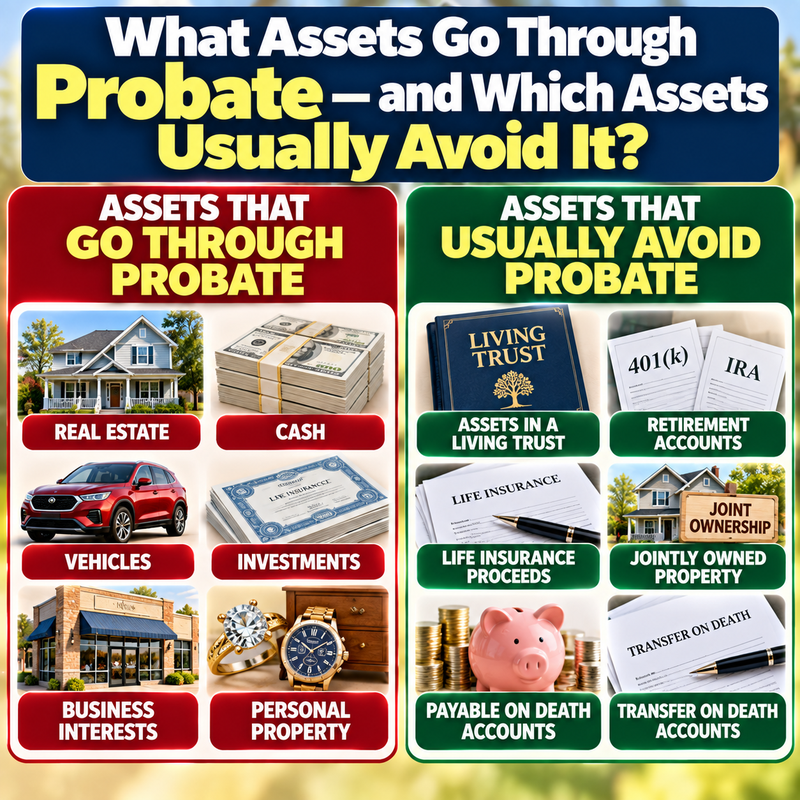
Here’s the short answer: an asset goes through probate when it’s owned solely in the deceased person’s name and has no legal mechanism—like a beneficiary designation, joint title, or trust ownership—that transfers it automatically at death.
That single rule explains almost every confusing probate question people ask. Why did my aunt’s house need probate but her life insurance didn’t? Why did one bank account skip the court process while another one sat in probate for a year? The asset type rarely matters as much as people assume. What matters is the ownership structure sitting underneath it. Groups like Create A Living Trust spend a lot of time helping families sort through exactly this distinction, because the difference between a probate asset and a nonprobate asset often comes down to paperwork most people never think to check.
This guide walks through the major categories of property—real estate, accounts, personal belongings, business interests, retirement plans, and trust-held assets—and explains, asset by asset, what commonly triggers probate and what commonly avoids it. State law varies quite a bit here, so treat the patterns below as strong general rules rather than guarantees for your specific situation.
The Basic Rule: Ownership and Transfer Instructions Determine Probate Treatment
Probate courts don’t care whether an asset is a house, a stock portfolio, or a coin collection. They care about one thing: who legally owns it, and whether that ownership already includes instructions for what happens when the owner dies. If the answer is “just the deceased person, with no automatic transfer mechanism,” the asset lands in probate. If the answer is “jointly owned,” “held in trust,” or “payable to a named beneficiary,” probate usually isn’t needed for that particular asset.
This is why two people can own the exact same type of asset—say, a savings account—and have completely different outcomes. One account has a payable-on-death designation on file at the bank. The other doesn’t. Same asset type, opposite probate result.
Rule of thumb: Ask “how is this titled, and does it have a beneficiary or survivorship feature?” before asking “what kind of asset is this?” The first question determines probate status far more reliably than the second.
What Makes an Asset a “Probate Asset”
An asset becomes part of the probate estate when it’s titled solely in the deceased person’s individual name and lacks any effective nonprobate transfer instruction. That includes a house deeded only to the decedent, a checking account with no payable-on-death form on file, a car registered in one name, or shares in a small business with no succession agreement. None of these assets have anywhere else to go automatically, so the probate court steps in to oversee who receives them.
Why the Same Asset Type Can Be Treated Differently in Different Estates
The same category of asset can be a probate headache in one estate and a complete non-issue in another. A bank account is a perfect example: add a payable-on-death beneficiary, and it transfers directly to that person with a death certificate and photo ID. Skip that step, and the same account sits in probate alongside everything else. This is also true for a properly funded living trust—property titled in the name of the trust generally bypasses probate because the trustee, not the court, controls distribution under the trust’s terms.

Assets Commonly Subject to Probate
Certain categories of property show up in probate estates again and again, mostly because people forget to update titling or beneficiary paperwork after buying them. Below are the assets that most commonly require probate administration when no other transfer mechanism has been put in place.
Individually Owned Real Estate
A house, condo, or piece of land titled solely in the deceased person’s name typically must go through probate before it can be sold or transferred to heirs. This is one of the most common probate assets simply because many people never retitle their homes after buying them, even if they later create an estate plan. Joint ownership with right of survivorship, a transfer-on-death deed where the state allows it, or trust ownership are the usual ways real estate skips this step.
Individually Owned Bank and Investment Accounts Without Effective Beneficiary Designations
Checking accounts, savings accounts, and brokerage accounts held only in the deceased’s name—without a payable-on-death or transfer-on-death designation—are subject to probate. This trips up a lot of families because they assume all bank accounts automatically go to a spouse or child. Without the actual designation on file with the institution, that assumption is wrong, and the account becomes part of the probate estate.
Personal Property Like Jewelry, Vehicles, and Household Goods
Furniture, jewelry, art, collectibles, and vehicles registered solely in the decedent’s name generally pass through probate unless they’ve been placed in a trust or transferred through some other estate planning tool. Many states offer a shortcut here: personal property under a certain dollar value can sometimes be transferred using a simple affidavit instead of full probate. The threshold and process vary by state, so it’s worth checking local rules before assuming everything needs full court administration.
Certain Business Interests Without a Succession Plan
Shares in a small business, partnership interests, or other privately held business stakes are often subject to probate when there’s no succession plan in place. This is a category where the details really matter, because business ownership documents can override the default probate outcome. Before assuming a business interest will or won’t go through probate, it helps to review:
- The entity’s operating agreement, partnership agreement, or corporate bylaws
- Any buy-sell agreement that may dictate what happens to the ownership stake at death
- Whether the ownership interest was ever transferred into a trust
- Any transfer restrictions written into the entity’s founding documents
Skipping this review is a common mistake. A buy-sell agreement, for instance, can require the business to purchase the deceased owner’s shares directly from the estate, which changes both the probate timeline and the value passing to heirs.

Assets That Commonly Transfer Outside Probate
Just as certain assets predictably land in probate, others predictably skip it. The common thread isn’t the asset category—it’s the presence of a legal mechanism that names who receives the property automatically at death. Here’s where that mechanism most often shows up.
Properly Funded Living Trust Assets
Property titled in the name of a trust doesn’t belong to the deceased individually anymore—it belongs to the trust, which continues to exist after the person’s death. That means a trustee, not a probate court, handles distribution according to the trust’s written instructions. This is one of the biggest advantages of a properly funded revocable living trust: assets that were actually retitled into the trust’s name generally bypass probate entirely, often letting beneficiaries receive property within weeks instead of months.
Joint Ownership With Survivorship Rights
Property held as joint tenants with right of survivorship, or as tenancy by the entirety between spouses, automatically passes to the surviving owner the moment the other owner dies. No court filing is needed for that transfer—the surviving owner simply becomes the sole owner by operation of law. This applies to jointly titled bank accounts, jointly owned real estate, and jointly registered vehicles, among other assets.
POD and TOD Accounts or Registrations Where Available
Payable-on-death (POD) designations on bank accounts and transfer-on-death (TOD) registrations on brokerage accounts let the owner name a beneficiary directly with the financial institution. When the owner dies, that beneficiary typically just presents identification and a death certificate to claim the funds—no probate required. Some states extend a similar concept to real estate through transfer-on-death deeds, though availability and rules differ from state to state.
Life Insurance With a Surviving Named Beneficiary
Life insurance proceeds generally pass directly to whoever is named as beneficiary on the policy, completely outside the probate process. The insurance contract itself is the transfer mechanism—there’s no need for court involvement as long as a valid beneficiary is on file and that person is alive when the insured dies.
Retirement Accounts With Effective Beneficiary Designations
IRAs, 401(k)s, and other retirement accounts pass according to their beneficiary designation forms, not according to a will and not through probate. This is worth repeating because it trips up a lot of people building an estate plan: retirement accounts aren’t something you retitle into a trust the way you might retitle a house or brokerage account. Instead, they require ongoing beneficiary-designation planning, since retitling a retirement account into a trust’s name can trigger unwanted tax consequences.

What Happens When a Beneficiary Dies First or a Designation Fails
Nonprobate transfer tools only work when they actually work. If the named beneficiary is no longer alive, if the paperwork was never properly filed, or if the designation names someone who’s since become ineligible, the asset doesn’t just disappear into limbo—it typically flows back into the probate estate.
How a Failed Designation Sends an Asset Back Into Probate
Picture a life insurance policy where the named beneficiary passed away five years before the policyholder, and no one ever updated the form. When the policyholder dies, there’s technically no valid living beneficiary on file. In most cases, without a contingent beneficiary listed, the proceeds get paid to the policyholder’s estate—meaning they now go through probate, the exact outcome the beneficiary designation was supposed to prevent. The same domino effect applies to retirement accounts, POD bank accounts, and TOD brokerage accounts: no valid beneficiary means the asset defaults back to the estate.
This is one of the most overlooked risks in estate planning. People set up beneficiary designations once, feel confident their assets will avoid probate, and never revisit the paperwork again—sometimes for decades. Divorces, deaths, and family changes happen in that time, and the designation quietly becomes outdated without anyone noticing until it’s too late to fix.
Why Naming Contingent Beneficiaries Matters
Naming a backup, or contingent, beneficiary on every account and policy solves most of this problem. If the primary beneficiary has died or can’t be located, the asset simply passes to the contingent beneficiary instead of defaulting to the estate. It’s a small addition to a beneficiary form that can save an estate months of unnecessary probate administration.
Why a Will Does Not Itself Make an Asset Nonprobate
A common misconception is that having a will means an estate skips probate. It doesn’t. A will only controls what happens to assets that are already part of the probate estate—it directs the court on how to distribute probate property, but it has no power over property that’s jointly owned, held in trust, or governed by a beneficiary designation. In other words, a will works inside probate, not around it.
The Difference Between a Will and a Living Trust
This is exactly where a living trust differs from a will in practical effect. A will becomes a public court document that a judge uses to guide asset distribution through probate. A trust, by contrast, holds legal title to property directly, so when the owner dies, the trustee can distribute trust-owned assets according to the trust’s terms without ever going near a courtroom. Anyone researching how to create a living trust will quickly learn that the trust document itself is only half the equation—the property actually has to be retitled into the trust’s name to get the probate-avoidance benefit.
Real Estate and State-Specific Transfer Tools
Real estate deserves its own conversation because state law varies so much on how it can be transferred outside probate. Unlike bank accounts, where POD designations are widely standardized, real estate transfer tools depend heavily on where the property is located.
Some states allow property owners to add survivorship language to a deed, transfer property into a trust, or use a transfer-on-death deed that names a beneficiary directly on the property record. Others don’t recognize transfer-on-death deeds at all, which means residents there have fewer options for keeping real estate out of probate short of joint ownership or trust funding.
Transfer-on-Death Deeds and Lady Bird Deeds
A transfer-on-death deed lets a property owner name a beneficiary who automatically receives the property at death, while the owner keeps full control during their lifetime. Michigan and a handful of other states also recognize a variation called a Lady Bird deed, which allows real estate to pass to a named beneficiary immediately upon the owner’s death without probate. Not every state permits this technique, so it’s worth checking local law before relying on it.
Why State Law Changes the Outcome for Real Property
Because real property is recorded and regulated at the state and county level, the rules governing its transfer are far less uniform than the rules for financial accounts. A deed that avoids probate cleanly in one state might not be recognized at all in another. This is one of the clearest examples of why “type of asset” is the wrong lens for predicting probate status—the same house could be a probate asset in one state and a nonprobate asset in another, depending entirely on which transfer tools that state’s law recognizes.

Business Ownership Complications
Business interests are rarely as simple as “probate asset” or “nonprobate asset.” Ownership structure, entity type, and any existing agreements between owners all play a role in determining what happens to a deceased owner’s stake.
How Buy-Sell Agreements Affect Probate Status
A buy-sell agreement is a contract between business owners that spells out what happens to an owner’s share when they die, retire, or become disabled. If a valid buy-sell agreement exists, it often controls what happens to the ownership interest regardless of what a will says, sometimes requiring the remaining owners or the business itself to purchase the deceased owner’s share. This can effectively remove the business interest from probate’s practical impact, even if the interest technically remains part of the estate until the buyout is completed.
Reviewing Entity Documents Before Assuming an Outcome
Before assuming a business interest will or won’t go through probate, someone needs to actually pull the operating agreement, partnership agreement, or corporate bylaws and read the transfer provisions. These documents sometimes restrict who can inherit an ownership stake at all, regardless of what the deceased owner intended. Skipping this step is one of the more expensive mistakes in estate administration, since it can lead to disputes among surviving owners and heirs who assumed different outcomes.
Small-Estate Procedures and Probate Thresholds
Not every probate asset requires a full, formal probate proceeding. Many states offer streamlined alternatives for smaller estates, which can save families significant time and money.
Simplified Probate for Estates Below a State’s Threshold
States commonly set a dollar threshold below which an estate qualifies for a simplified or expedited probate process. Michigan, for example, allows a simplified process for estates valued under a certain amount, cutting down on the paperwork, court appearances, and time typically required for full probate. These thresholds and procedures vary widely from state to state, so it’s worth checking local probate court rules rather than assuming a specific dollar figure applies everywhere.
Affidavit Transfers for Low-Value Personal Property
Personal property under a certain value—things like furniture, jewelry, or a modest bank account balance—can often be transferred using a simple sworn affidavit instead of going through probate court at all. This shortcut typically applies only to smaller amounts and specific asset types, and the exact dollar limits differ by state. It’s a useful option for families dealing with a modest estate that doesn’t include real estate or large financial holdings.
| Situation | Common Result |
|---|---|
| Estate value falls below state’s small-estate threshold | Simplified probate procedure available |
| Personal property below a set dollar value | Affidavit transfer may replace probate |
| Real estate with no survivorship or TOD deed | Full probate typically required |
| Business interest with active buy-sell agreement | Agreement terms may control outcome despite probate |
How Trust Funding Changes the Analysis
A living trust only avoids probate for the property that’s actually been placed inside it. This is the single most misunderstood part of trust planning, and it’s worth spelling out clearly: signing a trust agreement is a legal formality, not a transfer of ownership. The trust has to hold title to specific property for that property to skip probate.
Why Signing a Trust Document Isn’t Enough
Plenty of people create a trust, sign it, file it away, and assume their estate planning work is finished. Meanwhile, their house is still deeded to them individually, their bank accounts still list only their own name, and their brokerage account has never been retitled. When they die, none of that property is actually owned by the trust, so all of it ends up in probate anyway—defeating the entire purpose of setting up the trust in the first place.
Steps to Properly Fund a Revocable Living Trust
Funding a trust means physically retitling assets so the trust—not the individual—becomes the legal owner. This generally involves:
- Recording a new deed that transfers real estate title from the individual’s name into the trust’s name
- Contacting banks and brokerages to retitle accounts in the name of the trust
- Updating vehicle titles where the state allows trust ownership of vehicles
- Assigning ownership of business interests to the trust where the entity’s governing documents permit it
Not every asset belongs in the trust, though. Retirement accounts, for instance, are usually left out and handled through beneficiary designations instead, since retitling them into a trust can create tax complications. The goal isn’t to move everything into the trust—it’s to move the specific assets where trust ownership actually makes sense for that person’s situation.

Asset-by-Asset Probate Planning Checklist
A quick review of how each asset is titled can save an estate months of unnecessary court involvement. Since probate status hinges on ownership structure rather than asset type, the checklist below focuses on exactly that—verifying titling, beneficiary designations, and trust funding across the board. For a deeper understanding, explore what assets pass through probate and what can be avoided.
Use this as a working list to go through with a spouse, family member, or estate planning attorney, checking off each category as it’s confirmed.
Confirm Beneficiary Designations on Financial and Retirement Accounts
Pull up the most recent beneficiary forms for every bank account, brokerage account, life insurance policy, and retirement plan. Confirm the primary beneficiary is still living and still who you’d want to receive the asset, and make sure a contingent beneficiary is also named in case the primary beneficiary predeceases the account owner.
Verify Titling on Real Estate and Vehicles
Check how the deed to any real estate is actually worded—sole ownership, joint tenancy, tenancy by the entirety, or trust ownership all produce different probate outcomes. Do the same for vehicle titles, since a car registered solely in one name will typically require probate unless the state offers a transfer-on-death registration option.
Decide Which Assets Belong in a Living Trust
Not every asset needs to sit inside a trust, and stuffing everything into one isn’t the goal. Real estate, business interests, and taxable investment accounts are common candidates for trust funding, while retirement accounts are typically better handled through beneficiary designations alone.
Work through each major asset and ask whether trust ownership actually adds value for that specific item, or whether a simpler tool—like a POD designation or joint title—already accomplishes the same goal.
Revisit the Plan After Major Life Changes
Beneficiary designations and trust funding aren’t a one-time task. Certain life events should trigger an immediate review:
- Marriage, divorce, or remarriage
- Birth or adoption of a child or grandchild
- Death of a previously named beneficiary
- Purchase or sale of real estate
- Opening a new bank, brokerage, or retirement account
- Starting or changing ownership in a business
Each of these events has the potential to make an old beneficiary form or deed outdated, which is exactly how assets end up back in probate despite years of careful planning.
Since probate outcomes depend so heavily on the fine print of titling and beneficiary paperwork, it’s worth having someone familiar with these details review the full picture rather than assuming each account or deed is set up correctly.

Frequently Asked Questions
These are the questions that come up most often once people understand that probate status depends on ownership structure rather than asset type.
Does having a will mean my estate skips probate?
No. A will only directs how probate assets get distributed—it doesn’t remove those assets from the probate process itself. Assets that are jointly owned, held in trust, or governed by a valid beneficiary designation avoid probate regardless of what a will says, but everything else still goes through the court process the will describes. Often, a revocable living trust will have a pour-over will included, but the trust structure itself prevents the assets from going through probate.
Can a bank account with no listed beneficiary still avoid probate?
Generally not, unless it’s jointly titled with survivorship rights. A solely owned bank account with no payable-on-death designation and no joint owner typically becomes part of the probate estate.
What happens to jointly owned property if one owner dies?
If the property is titled as joint tenants with right of survivorship, or as tenancy by the entirety between spouses, it passes automatically to the surviving owner without probate. The surviving owner simply becomes the sole legal owner by operation of the title itself.
Do all states allow transfer-on-death deeds for real estate?
No. Availability varies significantly by state, and some states don’t recognize transfer-on-death deeds at all. It’s worth checking local law before assuming this option is available for a specific piece of property.
Is life insurance ever subject to probate?
Yes, in specific situations. If the named beneficiary has died before the policyholder and no contingent beneficiary was named, or if the policy names the estate directly as beneficiary, the proceeds typically flow into the probate estate instead of passing directly to an individual.
This is exactly why reviewing beneficiary designations regularly matters as much as setting them up in the first place.
What happens if my named beneficiary dies before me?
Without a contingent beneficiary on file, most accounts and policies default the asset back to the estate, which means it becomes subject to probate. This applies to life insurance, retirement accounts, POD bank accounts, and TOD brokerage accounts alike.
The fix is straightforward: add a contingent beneficiary to every account and policy, not just a primary one. That single step prevents an otherwise well-planned asset from unexpectedly landing in probate court.
It’s also worth periodically confirming that named beneficiaries are still living, particularly for older accounts that haven’t been reviewed in years.
- Check primary beneficiaries for accuracy
- Confirm contingent beneficiaries are named
- Update forms after any beneficiary’s death
Skipping this review is one of the most common—and most avoidable—reasons families end up in probate despite having beneficiary designations already in place.
Do small estates still have to go through full probate?
Not always. Many states offer a simplified or expedited probate process for estates that fall below a certain dollar threshold, and some allow low-value personal property to transfer via a simple affidavit instead of formal probate. The exact thresholds and procedures differ by state, so it’s worth checking local probate court rules.
Does putting a house in a trust guarantee it avoids probate?
Only if the house has actually been retitled into the trust’s name. Simply signing a trust document doesn’t transfer ownership of the property—the deed itself has to be changed to list the trust as owner. For more information on what assets pass through probate, you can read what assets can be avoided.
This is the step people most often forget, and it’s the reason some trusts fail to accomplish their main purpose of avoiding probate for real estate.
Are retirement accounts like IRAs and 401(k)s always exempt from probate?
They’re exempt from probate as long as there’s a valid, living beneficiary named on the account. Unlike real estate or bank accounts, retirement accounts generally aren’t retitled into a trust, since doing so can trigger unwanted tax consequences—beneficiary designation planning is the correct tool here instead.
Can a business interest be passed on without going through probate?
It depends on the entity’s governing documents. If a buy-sell agreement or similar provision controls what happens to an ownership interest at death, that agreement may dictate the outcome regardless of probate. Without such an agreement, business interests without a succession plan commonly become part of the probate estate.
Reviewing the operating agreement, partnership agreement, or corporate bylaws ahead of time is the only reliable way to know which outcome applies to a specific business interest.
Working through beneficiary designations, titling, and trust funding one asset at a time is exactly the kind of detailed review that CreateALivingTrust helps estate planners tackle with confidence.