There are a Few Disadvantages of a Revocable Living Trust, Let’s Take a Closer Look at Them
Understand Setup and Funding Work, Ongoing Maintenance, Costs, and the Protections a Revocable Trust Does Not Provide
A revocable living trust can simplify your estate, but it also comes with real costs, ongoing work, and limits that sales-focused content rarely mentions.
Key Takeaways
- A revocable living trust involves upfront costs, funding work, and ongoing maintenance that a simple will typically does not require.
- Trusts offer no meaningful creditor protection or automatic tax savings because you retain full control over the assets during your lifetime.
- Every asset must be individually retitled into the trust’s name, or it may still be forced through probate.
- Platforms like Bulletproof Legacy can reduce some implementation friction through funding support and digital tools, though they can’t eliminate every tradeoff discussed here.
- Later in this article, we break down how attorney-drafted, DIY, and supported digital trusts compare when it comes to these specific disadvantages.
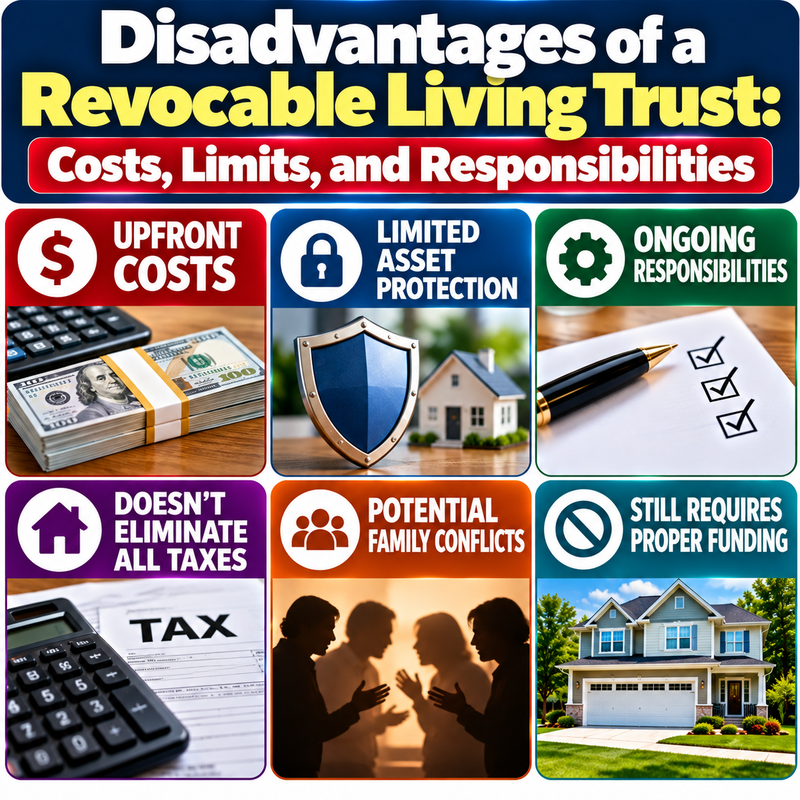
Quick Answer: Common Disadvantages and Tradeoffs
The most commonly cited disadvantages of a revocable living trust include higher upfront costs compared to a will, the manual work of funding the trust with your assets, ongoing maintenance obligations, limited creditor protection, no automatic tax benefits, and the fact that a trust doesn’t replace every other estate-planning document you need. None of these points mean a trust is a bad choice. They just mean the decision deserves an honest look at what a trust actually does and doesn’t do, rather than a pitch that skips the fine print.
The Core Tradeoff: Convenience Now for Work Upfront
Trusts trade a little more effort today for a smoother process for your family later. That’s the honest version of the pitch. Instead of a court validating your will after you pass, a properly funded trust can let your successor trustee manage and distribute assets without probate court involvement. But “properly funded” is doing a lot of heavy lifting in that sentence, and it’s where most of the disadvantages live.
- Setting up a trust typically takes more time and paperwork than signing a basic will.
- Assets must be retitled or reassigned into the trust’s name one by one.
- The trust needs periodic review as your life and assets change.
- You still need supporting documents like a pour-over will and powers of attorney.
Each of these tradeoffs is manageable, but they’re not optional extras. Skip them, and the trust may not function the way you expect when it matters most.
What a Revocable Trust Does Not Do
A revocable trust does not shield your assets from creditors or lawsuits, because you retain the right to revoke it and take the assets back at any time. It does not reduce your federal income tax bill, since the IRS treats it as a grantor trust and taxes the income as if it were earned directly by you. It does not automatically manage assets you forget to transfer into it. And it does not replace a will, a financial power of attorney, or health-care directives. Understanding these limits upfront prevents the kind of disappointment that happens when someone assumes a trust does more than it legally can.
Higher Upfront Effort Than a Simple Will
Compared to a basic will, a revocable trust asks more of you at the start. That’s not a flaw in the trust itself, it’s simply the nature of a more comprehensive planning tool. A will names an executor and states who gets what, then a probate court steps in to enforce it. A trust, by contrast, requires you to build a working structure that holds title to your property while you’re alive, which takes more documentation and more decisions upfront.
Drafting Time and Document Complexity
A trust package usually bundles together the trust document itself, a pour-over will, financial and medical powers of attorney, and sometimes a certification of trust for use with banks and title companies. Each document has its own purpose, and getting them all coordinated correctly takes more attention than filling out a single-page will template. This doesn’t mean it’s complicated to the point of being unmanageable, but it is more involved than the simplest estate-planning options.
Why a Will Alone Can Be Faster to Set Up
If your estate is small, your beneficiary designations are current, and you live in a state with a simple small-estate probate process, a will alone might get the job done with less initial effort. The tradeoff is that your estate could still go through probate, which takes time and is a matter of public record. Whether that tradeoff is worth avoiding depends on your family’s situation, your state’s probate rules, and how much privacy and speed matter to you.

Creation and Professional-Service Costs
Cost is one of the first disadvantages people run into, and it varies more than most people expect. A revocable trust can be created online for as little as a few hundred dollars, while an attorney-drafted trust commonly runs $1,000 to $3,000 depending on complexity and location. Irrevocable trusts, which serve different purposes, almost always require an attorney and often cost $3,000 to $10,000 or more. For a deeper breakdown of what drives these numbers, our guide on living trust cost walks through pricing by provider type and complexity level.
Online Platforms vs. Estate Planning Attorneys
Online platforms tend to be less expensive and faster, which works well for straightforward estates. Attorneys cost more but bring judgment for complicated situations, like blended families, business ownership, or state-specific quirks that a template can’t anticipate. Neither option is universally “better.” The right choice depends on how complex your assets and family situation actually are.
What Drives Price Differences
Price differences usually come down to a few factors: whether an attorney reviews or drafts the documents personally, how many supporting documents are bundled in, whether the provider offers funding assistance, and how much ongoing support or updates are included after the initial purchase. A lower price isn’t automatically a worse deal, and a higher price isn’t automatically better protection. It depends on what’s actually included and whether it matches what your estate needs.
Funding Requires Asset-by-Asset Work
Here’s the disadvantage that catches the most people off guard: creating the trust document is only step one. The trust has to be “funded,” meaning ownership of your property has to actually be transferred into the trust’s name. Skip this step, and the trust exists on paper but doesn’t control anything. The ongoing trust costs of amending and updating the trust can add up over time depending on how the trust was created, who created it and what type of access you have to making changes to it.
Retitling Real Estate Deeds
Real estate typically requires a new deed that transfers the property from your individual name into the name of the trust. This deed then has to be recorded with the county. It’s not a difficult process, but it is a distinct legal step that has to happen for every property you own, and it’s easy to overlook if you buy a new home after your trust is already set up.
Updating Bank and Brokerage Accounts
Bank accounts, brokerage accounts, and other financial holdings each have their own retitling procedures set by the institution. Some banks handle this quickly with a simple form; others require in-person visits or additional documentation. Because every institution does it a little differently, funding a trust often means several separate phone calls or visits rather than one universal process.
Handling Retirement Accounts and Beneficiary Designations
Retirement accounts like 401(k)s and IRAs are usually handled differently. Rather than retitling the account itself, these assets are typically coordinated through beneficiary designation forms. This distinction matters because people sometimes assume “funding the trust” means moving every asset into it, when in reality, some assets pass more effectively through designated beneficiaries instead.
What Happens If Property Is Never Transferred
If an asset is never properly transferred into the trust, it doesn’t automatically become part of the trust just because you have one. In many states, that asset may still have to go through probate, defeating one of the main reasons people set up a trust in the first place. A pour-over will is usually included as a backup, directing any leftover assets into the trust after death, but that pour-over will still has to go through probate to do its job. Funding isn’t a one-time task you can skip and rely on someone else to fix later.

Ongoing Maintenance as Assets and Life Circumstances Change
A trust isn’t a “set it and forget it” document. It needs periodic attention as your financial life and family circumstances shift, and neglecting that upkeep is one of the more common ways a trust ends up underperforming.
Titling New Purchases in the Trust’s Name
Every time you buy a new home, open a new investment account, or acquire a significant asset, that asset needs to be titled in the trust’s name to be covered by it. This is easy to forget in the excitement of a big purchase, but it’s a necessary step for the trust to keep functioning as intended.
Updating Successor Trustees and Beneficiaries
Life changes, divorces, deaths, falling-outs, moves, and shifting relationships can all affect who you’d want serving as your successor trustee or receiving specific assets. A trust that reflects your wishes from ten years ago may no longer reflect your wishes today, and it won’t update itself.
Reviewing the Trust After Major Life Events
Marriage, divorce, the birth of a child, a significant change in net worth, or a move to a new state are all reasonable triggers for a trust review. State laws around trusts and property can differ, so relocating is a particularly common reason a trust needs a second look, even if nothing else in your life has changed.
None of this maintenance work is overwhelming on its own, but it does add up over the years. Choosing a provider that makes updates simple, rather than treating the initial purchase as the finish line, can meaningfully reduce how burdensome this ongoing responsibility feels.
A Trust Does Not Automatically Control Unfunded Assets
It’s worth repeating because it trips up so many people: a trust only controls what’s actually inside it. Anything left outside the trust at the time of death is governed by other rules entirely, regardless of what the trust document says.
Why Assets Outside the Trust May Still Face Probate
If a bank account, a piece of property, or an investment account was never retitled into the trust’s name, it typically doesn’t skip probate just because you happen to have a trust. Courts look at how the asset is actually titled, not what your broader estate plan intended. This is one of the most common gaps between what people believe a trust does and what it actually accomplishes in practice.
The Role of a Pour-Over Will as a Safety Net
Because unfunded assets are such a common issue, most trust packages include a pour-over will. This document acts as a catch-all, stating that anything you own outside the trust at your death should “pour over” into it. It’s a helpful backstop, but it’s not a shortcut around probate. Assets named in a pour-over will still typically go through the probate process before they can be transferred into the trust, so it’s a safety net rather than a substitute for proper funding.
Think of the pour-over will as insurance against forgetting something, not as a replacement for doing the retitling work in the first place. The goal is to fund the trust thoroughly enough that the pour-over will rarely, if ever, needs to be used.

No Automatic Income-Tax or Estate-Tax Savings
One of the most persistent myths about revocable trusts is that they come with built-in tax advantages. They don’t. Because you retain full control over a revocable trust, including the ability to change or cancel it entirely, the IRS doesn’t treat it as a separate taxpayer. Everything that happens inside the trust is treated, for tax purposes, as if it happened to you personally.
This distinction matters because some people choose a revocable trust specifically hoping to lower their tax bill, only to find out later that this was never how the tool was designed to work. If tax reduction is your primary goal, a revocable trust isn’t the mechanism for it.
How the IRS Treats a Revocable Trust
The IRS classifies a revocable living trust as a “grantor trust.” In plain terms, that means the trust is invisible to the IRS as long as you retain the power to revoke it or change its terms. There’s no separate tax entity, no separate tax filing requirement tied to the trust’s existence, and no special tax rate that applies just because assets sit inside a trust rather than in your own name.
This is different from how the IRS treats certain irrevocable trusts, which can be recognized as separate taxpayers depending on their structure. If you’re weighing the differences between trust types, our comparison of revocable vs. irrevocable trust options breaks down exactly where those tax treatments diverge.
None of this means a revocable trust is a poor tool. It just means its main value lies in probate avoidance, privacy, and incapacity planning, not tax reduction.
Reporting Trust Income on Your Personal Return
Any income generated by trust assets, whether from dividends, interest, or rental property, gets reported on your personal tax return using your own Social Security number as the trust’s tax identification number. You won’t file a separate tax return for the trust itself while you’re alive and serving as trustee. This is one of the simpler aspects of trust ownership, but it also underscores that the trust isn’t providing any tax shelter you wouldn’t already have.
Federal Estate Tax Exemption and Why Most Estates Aren’t Affected
Assets held in a revocable trust are still considered part of your taxable estate when you die. If your total estate exceeds the federal estate tax exemption, currently set at $13.99 million per individual for 2025 and 2026, the amount above that threshold could be subject to federal estate tax. That said, this exemption is high enough that fewer than 1 percent of estates in the country actually owe federal estate tax. For the vast majority of families, estate tax simply isn’t a deciding factor when choosing between a will and a trust, or between a revocable and irrevocable structure.

Limited Creditor and Asset-Protection Benefits for the Grantor
Another disadvantage worth stating plainly: a revocable living trust offers little to no protection from creditors or lawsuits while you’re alive. This surprises people who assume that moving assets into a trust automatically shields them, the way it might with certain irrevocable structures.
Why Retained Control Means Retained Exposure
The reason comes down to control. Because you can revoke the trust and reclaim the assets whenever you want, the law generally treats those assets as still belonging to you for purposes of creditor claims and lawsuits. If you’re sued or owe a debt, assets sitting inside a revocable trust are typically just as reachable as assets held in your own name. The trust doesn’t add a legal barrier between you and a creditor, because legally, you never gave up control.
How This Differs From Irrevocable Trust Planning
Irrevocable trusts work differently because you give up the right to change or cancel them, and often give up direct control over the assets as well. That surrendered control is precisely what can create stronger creditor protection in some cases, depending on state law and how the trust is structured. It’s also why irrevocable trusts tend to cost more to set up and require more careful, permanent decision-making upfront.
This tradeoff is worth sitting with. A revocable trust gives you flexibility and control, but that same flexibility is what limits its protective power. An irrevocable trust can offer more protection, but only by asking you to give up the very control that makes a revocable trust convenient in the first place. Neither option is objectively better. It depends on what you’re trying to accomplish.
A Living Trust Does Not Replace Every Estate-Planning Document
A trust is a powerful tool, but it’s not a complete estate plan on its own. This is one of the most important disadvantages to understand, because it directly contradicts the way trusts are sometimes marketed as an all-in-one solution.
Even a fully funded revocable trust leaves gaps that other documents are specifically designed to fill. Think of the trust as handling one job extremely well, managing and distributing property, while other documents handle jobs the trust was never built to do.
A complete estate plan built around a revocable trust typically still includes:
- A pour-over will to catch any assets left outside the trust
- A financial power of attorney for decisions the trust doesn’t cover
- A health-care directive and medical power of attorney
- Updated beneficiary designations on retirement accounts and life insurance
Financial Power of Attorney
A trust only controls property that’s titled in its name. If you become incapacitated, your successor trustee can step in to manage trust assets, but they generally have no automatic authority over things like your personal bank accounts that weren’t transferred into the trust, tax filings, or other financial matters outside the trust’s scope. A durable financial power of attorney fills that gap by naming someone to act on your behalf for anything the trust doesn’t cover.
Without this document, a family could find itself in the frustrating position of having a fully funded trust for property, but no legal authority to handle other financial matters if you’re unable to act for yourself.
This is a common blind spot. People assume “I have a trust” means “I’m covered,” when in reality the trust and the power of attorney are meant to work together, each handling a different slice of the picture.
Health-Care Directives
A trust has nothing to do with medical decision-making. A health-care directive, sometimes called a living will, along with a medical power of attorney, is what allows someone you trust to make medical decisions on your behalf if you can’t communicate them yourself. These documents are separate from the trust entirely and need to be created alongside it.
Beneficiary Designations Still Matter
Retirement accounts, life insurance policies, and certain payable-on-death accounts typically pass through beneficiary designations rather than through the trust itself. If those designations are outdated or point to an estate rather than a person, those assets could bypass the trust’s instructions entirely, regardless of how well the trust document was written. Reviewing these designations periodically is just as important as funding the trust in the first place.

Trustee and Successor-Trustee Responsibilities
Choosing a successor trustee is one of the more consequential decisions in setting up a trust, and it’s a responsibility that shouldn’t be underestimated. This person steps into a fiduciary role, meaning they’re legally required to act in the best interests of the beneficiaries, not their own convenience.
Fiduciary Duties After Incapacity or Death
If you become incapacitated, your successor trustee may need to step in and manage trust property on your behalf, paying bills, managing investments, and handling day-to-day financial matters tied to the trust. After death, the responsibilities expand further. The successor trustee typically needs to inventory trust assets, keep accurate records, notify and communicate with beneficiaries, address any outstanding debts or final taxes, and eventually distribute assets according to the trust’s terms.
This isn’t necessarily difficult work, but it is real work, and it takes time. A trustee who ignores their duties or mismanages assets can be held personally liable in some situations, which is part of why the role shouldn’t be handed to just anyone.
It’s also worth noting that avoiding probate doesn’t mean avoiding administration altogether. Someone still has to do the work of managing and distributing the estate. A trust simply moves that work outside the courtroom and into the hands of your chosen trustee.
Here’s a quick comparison of what a successor trustee typically handles versus what a probate-appointed executor handles:
A successor trustee manages funded trust assets privately, without court supervision, following the instructions written into the trust. An executor, by contrast, manages probate assets under court oversight, often with public filings and court approval required at multiple stages. Both roles carry fiduciary duties, but the trustee’s work generally moves faster and stays out of public record.
Qualities to Look for When Choosing a Trustee
A good successor trustee is organized, trustworthy, and willing to communicate clearly with beneficiaries, even during emotionally difficult times. Financial savvy helps, but it’s not strictly required if the trustee is willing to work with an accountant or financial professional when needed. What matters most is someone who will follow your instructions faithfully and treat the role with the seriousness it deserves.
Possible Complexity for Banks, Real Estate, Businesses, and Unusual Assets
Not every asset moves into a trust with the same ease. Some categories of property come with their own procedural hurdles that can add friction to the funding process.
Business Interests and Operating Agreement Restrictions
If you own a business, transferring your ownership interest into a trust isn’t always as simple as filling out a form. Operating agreements or partnership agreements sometimes include transfer restrictions that require consent from other owners before an interest can be assigned to a trust. Skipping this step, or assuming it’s automatically allowed, can create complications down the line. For a deeper understanding of these issues, you might explore what constitutes a revocable living trust agreement.
Financial Institution Retitling Procedures
Every bank, credit union, and brokerage firm has its own internal process for retitling an account into a trust’s name. Some institutions make this straightforward with a short form; others require in-person appointments, notarized documents, or additional verification steps. Because there’s no universal standard, funding a trust across multiple institutions often means navigating several different sets of paperwork, which adds up in time even when each individual step is simple.
When a Living Trust May Be More Planning Than Someone Needs
Not every estate benefits equally from a revocable trust, and it’s worth being honest about that. Someone with a modest estate, effective beneficiary designations already in place, and minimal probate exposure under their state’s rules might find that a simpler plan does the job just fine.
Simple Estates With Effective Beneficiary Designations
If most of your assets already pass outside of probate, through joint ownership, payable-on-death designations, or retirement account beneficiaries, the probate-avoidance benefit of a trust shrinks considerably. In states with generous small-estate probate procedures, a simple will paired with updated beneficiary forms might accomplish nearly everything a trust would, with less upfront cost and less ongoing maintenance. This doesn’t apply to everyone, but it’s worth evaluating honestly before assuming a trust is the right fit by default.
Every disadvantage covered here, cost, funding work, maintenance, limited tax and creditor benefits, and trustee responsibilities, is real, but none of them are unique to poorly built trusts. Good implementation, clear instructions, and ongoing support can meaningfully reduce the friction involved, which is where a resource like Bulletproof Legacy fits in: through funding assistance, digital account access, and ongoing document maintenance, it’s built to help you manage these responsibilities rather than pretend they don’t exist. If you’re weighing whether a revocable living trust fits your situation, a conversation with Bulletproof Legacy can help you look at the tradeoffs clearly before you decide.
State Small-Estate Probate Alternatives
Many states also offer simplified probate procedures for estates below a certain dollar threshold, sometimes called small-estate affidavits. If your state’s threshold is generous and your estate falls under it, the probate process could be short, inexpensive, and far less burdensome than the horror stories that trust marketing often leans on. It’s worth checking your specific state’s threshold before assuming a trust is the only way to avoid a lengthy court process.

How Disadvantages Compare Across Attorney, DIY, and Supported Digital Approaches
The disadvantages discussed throughout this article don’t hit everyone the same way. How much cost, funding work, and ongoing maintenance actually burden you depends heavily on which path you take to create the trust in the first place. An attorney, a do-it-yourself template, and a supported digital platform each shift these tradeoffs in different directions.
It helps to think of this less as “which option is best” and more as “which option matches how much guidance and support you actually want.” Some people prefer handling every detail themselves. Others want a professional double-checking each step. Many fall somewhere in between, wanting structure and support without the full cost of hourly attorney fees.
Here’s a side-by-side look at how each approach tends to handle the core disadvantages covered in this article:
| Disadvantage | Attorney-Drafted | DIY Template | Supported Digital Platform |
|---|---|---|---|
| Upfront cost | Highest, often $1,000–$3,000+ | Lowest, but limited guidance | Moderate, often includes support |
| Funding assistance | Sometimes included, often extra | Rarely included | Often included or guided |
| Ongoing updates | Usually billed separately | Self-managed | Often included via digital access |
| Personalized legal judgment | Highest | Lowest | Moderate, template-based with support |
What an Attorney-Drafted Trust Addresses
An attorney brings judgment to situations a template can’t anticipate, blended families, business succession, out-of-state property, or unusual family dynamics. That judgment comes at a price, both in dollars and in time, since attorney-drafted trusts typically take longer to finalize and often bill separately for updates down the road.
What a DIY Trust Leaves on Your Shoulders
A DIY trust is the least expensive option upfront, but it also puts nearly all the funding and maintenance responsibility on you, with little to no built-in guidance if you get stuck. For a simple estate with straightforward assets, this can work fine. For anything more complex, the lack of support can turn small mistakes into bigger problems later.
What Supported Digital Platforms Can and Cannot Fix
A supported digital platform sits between these two extremes. Bulletproof Legacy, for example, pairs the affordability of a digital trust with funding assistance, secure digital document access, and professional resources meant to reduce the friction of getting assets properly retitled and keeping the plan updated over time.
This kind of support can meaningfully lower the odds of an unfunded asset or a forgotten update, but it doesn’t eliminate every disadvantage discussed in this article. Costs, tax treatment, and creditor exposure remain the same regardless of which provider you choose, because those limitations come from how trusts work under the law, not from who drafted the paperwork.
Questions to Ask Before Deciding
Before committing to a revocable living trust, it helps to run through a short set of honest questions. These aren’t meant to talk you out of a trust, they’re meant to make sure you go in with clear eyes about what you’re taking on. They illustrate some the pros and cons of a revocable living trust to help you be better informed.
Does Your Estate Size and Complexity Justify a Trust?
- Do you own real estate, especially in more than one state?
- Do your assets exceed your state’s small-estate probate threshold?
- Do you have a blended family, business interests, or beneficiaries with special needs?
If you answered yes to any of these, a trust likely earns its keep. If your estate is modest and your beneficiary designations are already in order, the case for a trust becomes less automatic.
It’s also worth considering privacy. Wills go through probate, which is a public record. Trusts generally keep the details of your estate private, which matters more to some families than others.
There’s no universal right answer here. The goal is matching the tool to your actual situation, not defaulting to whatever option sounds the most sophisticated.
Who Will Serve as Your Successor Trustee?
Before you finalize anything, have a real conversation with the person you’re considering as successor trustee. Make sure they understand the responsibility, are willing to accept it, and have a way to get support if they run into something unfamiliar. A trust is only as strong as the person managing it after you’re gone.
Can You Commit to Funding and Updating It?
- Are you prepared to retitle real estate deeds and financial accounts after signing?
- Will you review the trust after major life events like a move, marriage, or new purchase?
- Do you have a plan for keeping beneficiary designations current alongside the trust?
If the honest answer to these questions is “probably not,” that’s worth acknowledging now rather than after the trust is signed and sitting unfunded in a drawer. Choosing a provider with built-in funding support or ongoing reminders can help close this gap, but the commitment still ultimately rests with you. For more information on whether a trust might be suitable for your needs, you can explore what a revocable living trust agreement entails.
Frequently Asked Questions
These are some of the most common questions people ask once they understand the tradeoffs involved in setting up a revocable living trust.
Each answer below stays short and direct, since the goal here is clarity, not more sales copy.
Is a revocable living trust worth the cost for a small estate?
It depends on your state’s small-estate probate rules and how many assets already pass outside probate through beneficiary designations. If those factors already minimize probate exposure, a trust may add cost without adding much practical benefit.
Does a revocable trust protect my assets from lawsuits?
No. Because you retain full control and the ability to revoke the trust, creditors and lawsuit judgments can generally still reach assets held inside it, the same as if you owned them in your own name.
Will a revocable trust reduce my estate taxes?
No. The IRS treats a revocable trust as a grantor trust, meaning its assets are still part of your taxable estate. Reducing estate tax liability typically requires different planning tools, especially since the current federal exemption already excludes the vast majority of estates.
If estate tax reduction is a specific goal, it’s worth discussing irrevocable options separately rather than assuming a revocable trust will accomplish it.
What happens if I forget to transfer an asset into my trust?
That asset generally isn’t controlled by the trust and may still be subject to probate. A pour-over will can direct it into the trust after death, but the asset typically still has to pass through probate first.
This is why funding, not just signing, is the step that determines whether a trust actually delivers on its main benefit.
Can Medicaid count assets held in my revocable trust?
Yes. Assets in a revocable trust are counted as your resources for Medicaid eligibility purposes, since you retain control over them. A revocable trust does not shield assets from nursing home costs or Medicaid spend-down requirements.
Do I still need a will if I have a revocable trust?
Yes. A will compliments a trust. A pour-over will is typically still needed to catch any assets that weren’t transferred into the trust, ensuring they eventually get directed to it rather than passing through unrelated intestacy rules.
Who should I choose as my successor trustee?
Someone organized, trustworthy, and willing to communicate clearly with beneficiaries during a difficult time. Financial expertise helps but isn’t required if they’re willing to bring in professional help when needed.
How often should I update my revocable living trust?
Review it after any major life event, marriage, divorce, a new child, a significant asset purchase, or a move to a new state. Even without a major event, a periodic check every few years helps catch anything that’s drifted out of sync.
The trust doesn’t update itself, so building this review into your regular financial habits matters more than most people expect. The cost to update a trust varies depending on how it was created, who created it and what type of control you have over it.
Is a revocable trust more expensive to maintain than a will?
Generally, yes, in terms of ongoing effort. A will typically just sits until it’s needed, while a trust requires funding upfront and periodic updates as your assets and life circumstances change.
Can creditors still reach assets in a revocable trust?
Yes. Since you retain the power to revoke the trust and reclaim its assets, the law generally treats those assets as still belonging to you for purposes of debts, judgments, and lawsuits.
This is one of the clearest limitations of a revocable trust compared to certain irrevocable structures, which can offer stronger protection in exchange for giving up direct control.
Understanding this distinction upfront helps set realistic expectations about what a revocable trust can and can’t do for your financial protection.
None of these limitations mean a revocable trust is the wrong choice, they simply mean it’s a tool built for probate avoidance, privacy, and incapacity planning rather than tax reduction or creditor protection.