Does a Living Trust Reduce Estate Taxes? Understanding What a Revocable Trust Can and Cannot Do
Learn Why an Ordinary Revocable Trust Does Not Automatically Lower Estate Tax—and Which Estate-Tax Concepts May Still Matter
Article-at-a-Glance
- A living trust alone won’t lower your federal estate tax bill. Because you keep full control over a revocable trust, the IRS still counts those assets as yours when you die.
- Federal estate tax only applies above a large exclusion threshold, so most families never owe a dime, even without fancy planning.
- Some irrevocable trust structures can remove assets from your taxable estate, but the word “irrevocable” alone doesn’t guarantee tax savings.
- State estate and inheritance taxes often kick in at much lower thresholds than the federal exemption, so location matters as much as trust type.
- Curious which trust structures actually move the needle on taxes versus which ones simply skip probate? We’ll break down the difference section by section, and tools like Create A Living Trust can help you sort through the paperwork once you know which direction fits your goals.
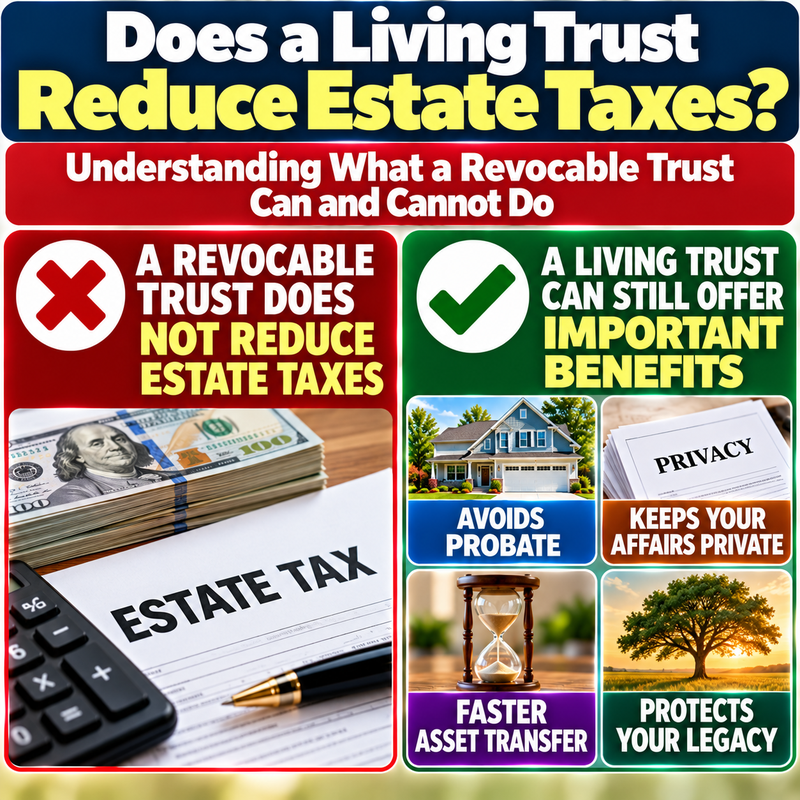
Does a living trust reduce estate taxes? For the ordinary revocable living trust that most families set up, the answer is no. Placing your house, bank accounts, and investments into a standard revocable trust does not shrink your taxable estate, because you still legally control everything inside it. Revocable living trust taxes are a different subject and have several variables to consider.
That surprises a lot of people, since trusts get marketed as an all-purpose estate planning fix. They’re fantastic for skipping probate court and keeping your affairs private. But tax reduction is a different job, one that requires different tools entirely. Services like Create A Living Trust can walk you through setting one up correctly, though the trust itself still won’t change what the IRS counts as yours.
Short Answer: No, Not By Itself
A garden-variety revocable living trust does not remove assets from your taxable estate. You created it, you can amend it, you can revoke it, and you can pull assets back out whenever you want. That flexibility is exactly why the IRS treats trust assets as if they never left your name. Although, some trusts have an EIN, depending on certain variables.
Why Revocability Means You Still Own It
Think of a revocable living trust like a folder you keep in your own filing cabinet. You put your house deed in the folder, but you still own the house. You can take the deed back out any time you want. The IRS looks at trusts the same way: if you can undo it, you still own what’s inside.
This isn’t a loophole or an oversight. It’s baked into how estate tax law defines ownership. The difference between revocable and irrevocable trusts comes down to exactly this kind of control, and that distinction drives almost every tax consequence that follows.
Your Right to Change or Cancel the Trust
With a revocable living trust, you typically serve as trustee and beneficiary while you’re alive. You can add assets, remove them, change beneficiaries, or cancel the whole arrangement. That level of authority is precisely what keeps the trust’s contents inside your taxable estate.
Why the IRS Treats Retained Control as Ownership
Estate tax law focuses on control and economic benefit, not just titles on paper. If you retain the power to change who benefits from an asset or to reclaim it for yourself, the law treats you as the owner at death. Retitling your home or investment account into a revocable trust changes the paperwork trail for probate purposes, but it doesn’t sever your ownership rights in the eyes of the tax code.
This is why estate planning attorneys draw such a sharp line between “avoiding probate” and “avoiding estate tax.” They solve different problems, and confusing the two leads to some expensive surprises down the road.
Federal Estate Tax Basics You Need to Know
Federal estate tax operates on what’s called a unified system, meaning gifts you make during life and assets you leave at death share the same overall exemption. Every dollar you give away during your lifetime above the annual gift exclusion chips away at the same bucket you’d otherwise use at death.
The good news: that bucket is large. Current IRS guidance for 2026 lists a basic exclusion amount of $15,000,000 per individual, though this figure is indexed for inflation and subject to legislative change, so it’s worth confirming the current figure before relying on it for your own planning.
Because the exclusion sits so high, the overwhelming majority of American households never come close to owing federal estate tax. The tax exists to target very large estates, not the typical family home and retirement account.
Gross Estate vs. Taxable Estate
Your gross estate includes everything you own or control at death: real estate, bank accounts, retirement plans, life insurance you own, and yes, assets sitting in a revocable trust. From that gross estate, certain deductions apply, such as debts, funeral costs, and the marital deduction for assets passing to a surviving spouse.
- Gross estate: the full inventory of what you owned or controlled at death
- Deductions: debts, administrative expenses, and qualifying marital or charitable transfers
- Taxable estate: what’s left after deductions, compared against the exclusion amount
Only the amount exceeding your available exclusion gets taxed, and even then, the rate structure and specific calculations depend on current law at the time of death.
Current Federal Exclusion Amount and Why It Keeps Changing
Congress has adjusted the federal exclusion amount repeatedly over the past two decades, and inflation indexing means the number shifts annually even without new legislation. Because tax law can change through new statutes, sunset provisions, or regulatory updates, anyone doing serious estate planning should verify the current year’s figure rather than relying on last year’s number.
Portability Between Spouses, Explained Simply
Portability lets a surviving spouse use their deceased spouse’s unused exclusion amount, effectively doubling the exemption available to the couple. But portability isn’t automatic. It requires filing an estate tax return and making a proper election, even if no tax is owed on the first spouse’s death. Skipping that filing step can mean losing access to the unused exemption entirely.

Why Retitling Assets Into a Revocable Trust Doesn’t Cut Your Tax Bill
Funding a revocable trust means moving legal title of your assets to the trustee, who might be you, acting on behalf of the trust. On paper, your house now says “Smith Family Trust” instead of “John Smith.” But since you control that trust completely, the IRS treats the underlying ownership as unchanged.
This distinction trips people up because a living trust genuinely does accomplish several valuable goals. It just doesn’t accomplish tax reduction through the revocable structure alone.
What Actually Happens to Your Assets When You Fund a Trust
When you fund a revocable trust, you’re essentially renaming the owner of each asset from yourself individually to yourself as trustee. Your Social Security number still applies to the accounts for tax reporting purposes during your lifetime. Income the trust generates gets reported on your personal tax return, exactly as it would if you’d never created the trust at all.
The Difference Between Avoiding Probate and Avoiding Taxes
Probate avoidance and tax avoidance solve entirely separate problems. Probate is the court process that validates a will and oversees asset distribution; a funded revocable trust sidesteps that process because the trust, not your individual name, already owns the assets. Estate tax, on the other hand, cares about who has economic control over an asset, regardless of whether that asset passes through probate or not.
You can have a beautifully funded trust that completely avoids probate court and still owes estate tax on everything inside it, if your estate exceeds the exclusion amount. The two concepts simply don’t overlap the way many people assume.

State Estate and Inheritance Taxes Can Still Apply
Federal exemption thresholds get most of the attention, but state-level taxes operate under completely separate rules, and several states set their thresholds dramatically lower than the federal amount. A trust that has no impact on federal estate tax might also have no impact on state estate tax, depending on how that particular state defines taxable ownership.
States With Their Own Estate Tax
A handful of states impose their own estate tax, calculated on the value of the decedent’s estate before distribution to heirs. These state exemption amounts frequently sit well below the federal threshold, meaning a family could owe state estate tax while owing nothing at all federally. The specific states and thresholds shift periodically, so checking current state law is essential rather than assuming national exemption figures apply everywhere.
States With Inheritance Tax Instead
Other states skip estate tax altogether and instead impose inheritance tax, which works differently: it’s calculated based on what each individual beneficiary receives, not on the estate as a whole. Rates often vary depending on the beneficiary’s relationship to the deceased, with spouses and children typically taxed at lower rates (or exempted entirely) compared to more distant relatives or unrelated beneficiaries.
Some states have no separate estate or inheritance tax whatsoever, relying solely on the federal system. California falls into this category, for example, which is one reason state residency plays such a significant role in overall estate tax exposure.
Because state rules vary so widely and change periodically, anyone with meaningful assets should check current thresholds for their specific state rather than assuming federal figures tell the whole story.
Married Couples: Why Old-Style Trust Formulas May Backfire Now
Before portability existed, married couples relied heavily on a planning technique often called a bypass trust, or sometimes an A/B trust arrangement. The first spouse to die would fund an irrevocable trust with assets up to the exclusion amount, sheltering that value from estate tax at the second spouse’s death. It worked well under the old rules, but the legal landscape has shifted considerably since portability became available.
Bypass Trusts and Why They Made Sense Before Portability
Before portability, a surviving spouse couldn’t simply inherit the deceased spouse’s unused exemption amount. If the first spouse died without using their exclusion, that amount was lost forever unless it had been captured through a bypass trust structure. Attorneys built entire estate plans around this mechanic, and for large estates at the time, it made complete sense.
When It’s Time to Update an Outdated A/B Trust Plan
Now that portability allows a surviving spouse to claim the deceased spouse’s unused exclusion (provided the proper election gets filed on a timely estate tax return), some older bypass trust plans create more complexity than benefit. Families with these older documents should have them reviewed periodically, especially if:
- The original documents were drafted more than ten years ago, before portability rules solidified
- The couple’s combined estate has grown or shrunk significantly since the plan was created
- State estate tax laws in their residence state have changed or didn’t exist when the plan was drafted
- One spouse has since passed away and the portability election was never filed

Revocable Trusts vs. Irrevocable Trusts for Tax Planning
Understanding the practical difference between revocable and irrevocable trusts clears up most of the confusion around estate tax planning. The core distinction isn’t complicated: control determines tax treatment. Give up control completely and permanently, and you may remove an asset from your taxable estate. Retain any meaningful control, and the asset generally stays in your estate for tax purposes.
What a Revocable Trust Can and Can’t Do
A revocable trust excels at avoiding probate, maintaining privacy, and providing a smooth mechanism for asset management if you become incapacitated. What it can’t do, by design, is remove assets from your taxable estate, precisely because you retain the power to revoke it at any moment.
How Certain Irrevocable Trusts Can Remove Assets From Your Estate
Specialized irrevocable trusts work differently because you give up specific rights permanently when you create them. An irrevocable life insurance trust, for example, owns a life insurance policy through the trust itself rather than through you personally, which keeps the death benefit outside your taxable estate. A qualified personal residence trust transfers your home into an irrevocable structure at a reduced gift value, based on your retained right to live there for a set term, ultimately shrinking the taxable value passed to your beneficiaries.
Charitable remainder trusts follow a similar logic: you donate assets irrevocably, receive income for a term or for life, and the remainder eventually goes to charity, generating both an immediate charitable deduction and a reduction in your taxable estate. Each of these structures accomplishes tax objectives through permanent, well-defined transfers of control, not just through the label “irrevocable.”
Why “Irrevocable” Doesn’t Automatically Mean “Tax-Free”
Here’s where people get tripped up: not every irrevocable trust removes assets from your taxable estate. If the trust terms allow you to retain certain powers, such as the right to change beneficiaries or to benefit from trust income beyond narrowly defined limits, the IRS may still include those assets in your estate despite the “irrevocable” label on the document.
Tax results depend heavily on the specific terms, retained powers, and how the trust gets drafted and administered. This is precisely why generic templates or DIY irrevocable trust documents can backfire. A structure intended to remove assets from an estate, drafted incorrectly, can fail to accomplish that one job while still locking you out of the flexibility a revocable trust would have offered.

Lifetime Gifts and the Unified Tax System
Federal gift tax and estate tax share a single unified system, meaning the exclusion you use during your lifetime through gifting directly reduces what’s available at death. Think of it as one large bucket of exemption that gets depleted by both lifetime gifts above the annual exclusion and your eventual taxable estate.
Annual Gift Exclusion vs. Lifetime Exemption
Two separate numbers matter here, and mixing them up causes confusion. The annual gift exclusion lets you give a certain amount per recipient each year without touching your lifetime exemption at all. The lifetime exemption is the much larger unified amount that covers both gifts exceeding the annual exclusion and, eventually, your taxable estate at death.
Quick distinction: The annual exclusion resets every calendar year and applies per gift recipient. The lifetime exemption is a single running total across your entire life, shared between gifts and your estate at death.
Because these figures adjust periodically for inflation, and because tax legislation can change them outright, verifying current-year numbers before making significant gifts is essential rather than optional.
How Gifting Now Affects Your Estate Later
Gifts made during your lifetime, particularly those exceeding the annual exclusion amount, reduce the exemption available to your estate at death. This creates genuine planning opportunities for people with substantial assets, since transferring wealth earlier can remove future appreciation from the taxable estate entirely. A gift made today locks in today’s value, while any growth that asset experiences afterward benefits the recipient, not your taxable estate.
That said, gifting strategies carry their own complexity around valuation, timing, and reporting requirements. They’re not a simple substitute for comprehensive estate planning, and they interact with trust structures in ways that benefit from professional guidance rather than guesswork.
5 Common Myths About Living Trusts and Taxes
Misunderstandings about trusts and taxes tend to repeat themselves across families and generations, often because outdated advice gets passed down without anyone checking whether it still applies. Here are the five myths that come up most often.
Myth 1: A Living Trust Automatically Lowers Estate Taxes
Reality check: A standard revocable living trust does not reduce federal estate tax by itself, because the grantor retains full control over the trust’s assets.
This myth persists partly because trusts genuinely do accomplish other valuable goals, like probate avoidance and incapacity planning, which people sometimes conflate with tax savings. The confusion is understandable, but the distinction matters enormously when you’re deciding how to structure your estate.
If tax reduction is your primary goal, a revocable trust alone won’t get you there. You’d need to look at irrevocable structures, gifting strategies, or other tools specifically designed for that purpose.
None of this diminishes the value of a revocable trust for the majority of families. Most households never approach the federal exclusion threshold anyway, making probate avoidance and incapacity planning the more relevant benefits in the first place.
Myth 2: Irrevocable Always Means Outside Your Estate
As covered earlier, the word “irrevocable” describes your inability to change or cancel the trust, not automatically its tax treatment. Poorly drafted irrevocable trusts, or those where you retain too much control, can still end up included in your taxable estate.
Proper drafting, with specific attention to retained powers and beneficiary designations, determines whether an irrevocable trust actually accomplishes its tax-reduction goal.
Myth 3: Trusts Eliminate All Income Tax on Assets
Assets held in a revocable trust generate income that flows directly to your personal tax return during your lifetime, exactly as it would without the trust. The trust itself doesn’t create a separate taxable entity while it remains revocable and you’re alive. Even many irrevocable trusts still generate income tax obligations, whether at the trust level or passed through to beneficiaries, depending on how the trust is structured.
Myth 4: Every State Follows the Same Federal Exemption
States set their own rules entirely separate from the federal system. Some states impose no estate or inheritance tax whatsoever, while others apply thresholds well below the federal exclusion amount, catching estates that owe nothing federally but still face a state tax bill.
This creates situations where residency, or where you own real property, matters just as much as the total value of your estate. Moving to a different state, or owning vacation property in one with its own estate tax, can change your overall tax exposure even if your federal situation stays identical.
- Check your home state’s current estate and inheritance tax thresholds
- Check the rules in any state where you own real property, since some states tax non-residents on property located within their borders
- Revisit state tax exposure whenever you relocate permanently
Myth 5: One Trust Document Works for Every Family
Trust requirements and effectiveness vary by state law, family structure, and asset composition. A trust drafted for a family in one state, with a particular mix of assets and beneficiaries, may not translate cleanly to a different family’s circumstances, even within the same state.
Capacity requirements, trustee qualifications, and beneficiary rules all shift depending on jurisdiction and individual circumstances, which is exactly why generic templates carry real risk. A document that technically satisfies legal requirements for creation doesn’t necessarily accomplish the specific tax or asset-protection goals a particular family needs.

When You Should Talk to an Estate Tax Professional
Most families don’t need to lose sleep over federal estate tax, given how high the current exclusion sits. But certain situations warrant a closer look with a qualified professional before assuming a basic living trust covers everything.
Signs Your Estate May Owe Federal or State Tax
Consider a professional consultation if your combined household assets, including life insurance death benefits, retirement accounts, real estate, and business interests, approach or exceed your state’s estate tax threshold, even if you’re comfortably under the federal exclusion. Business owners, real estate investors, and anyone holding significant life insurance policies should also verify how those assets get valued and counted, since the numbers can add up faster than expected.
What an Elder Law or Estate Planning Attorney Actually Does
A qualified attorney analyzes your full asset picture, designs trust structures suited to your specific goals, prepares the legal documents correctly, and coordinates with your financial advisor on timing and valuation questions. This coordination matters because tax law changes, and a plan that made sense five years ago may need adjustment today. Working with someone who stays current on both federal and state rules protects you from the kind of outdated assumptions that cause the myths covered above.
Bottom Line: Match the Tool to the Goal
A living trust remains one of the most useful estate planning tools available, just not for the job of reducing estate taxes on its own. Match your specific goal, whether that’s probate avoidance, incapacity planning, or genuine tax reduction, to the right tool, and you’ll avoid the costly mistake of assuming one document does everything.

Frequently Asked Questions
Does putting my house in a living trust avoid estate tax?
No. Putting your house into a revocable living trust changes the legal title but keeps the property in your taxable estate, since you retain full control over the trust.
What’s the difference between a revocable and irrevocable trust for tax purposes?
A revocable trust can be changed or canceled by you, which means the IRS still counts its assets as yours. An irrevocable trust permanently transfers control, which can, depending on how it’s drafted, remove assets from your taxable estate.
Do I still pay income tax on assets held in my living trust?
Yes. Income generated by assets in a revocable trust flows to your personal tax return during your lifetime, exactly as it would without the trust.
Can a living trust help my heirs avoid inheritance tax?
A revocable trust generally doesn’t avoid inheritance tax, since state inheritance tax rules typically look at what beneficiaries receive, regardless of whether it passed through a trust or an estate.
What is the current federal estate tax exemption?
Current IRS guidance lists a basic exclusion amount for 2026, but exemption figures are indexed for inflation and subject to change, so confirm the exact current-year number before relying on it for planning purposes.
What happens if my state has its own estate tax?
Some states impose estate or inheritance tax with thresholds lower than the federal exemption, meaning you could owe state tax even if you owe nothing federally. Check your specific state’s current rules.
How does portability work for married couples?
Portability lets a surviving spouse use a deceased spouse’s unused federal exclusion, but only if a proper election gets filed on a timely estate tax return. It isn’t automatic.
Is an ILIT the same thing as a living trust?
No. An irrevocable life insurance trust (ILIT) is a specialized irrevocable structure designed to hold a life insurance policy outside your taxable estate, distinct from an ordinary revocable living trust.
Can I convert my revocable trust to an irrevocable one later?
Generally, a revocable trust becomes irrevocable at your death, or you can create a separate irrevocable trust during your lifetime for specific tax planning goals. Converting an existing revocable trust’s terms requires careful legal drafting and depends on state law.
Do I need an attorney to reduce estate taxes with a trust?
For genuine tax reduction strategies involving irrevocable trusts, gifting, or complex asset structures, working with a qualified estate planning or elder law attorney helps ensure the structure actually accomplishes its intended goal under current law.
For help organizing the trust and probate-avoidance side of your plan, Create A Living Trust offers resources to simplify the document creation process so you can focus your professional consultations on the tax strategy questions that actually need one.
When You Should Talk to an Estate Tax Professional
Most families don’t need to lose sleep over federal estate tax, given how high the current exclusion sits. But certain situations warrant a closer look with a qualified professional before assuming a basic living trust covers everything.
Waiting until a health crisis or a major life event forces the issue rarely produces the cleanest results. The families who fare best tend to review their plan periodically, long before any of these triggers become urgent.
Signs Your Estate May Owe Federal or State Tax
Consider a professional consultation if your combined household assets, including life insurance death benefits, retirement accounts, real estate, and business interests, approach or exceed your state’s estate tax threshold, even if you’re comfortably under the federal exclusion. Business owners, real estate investors, and anyone holding significant life insurance policies should also verify how those assets get valued and counted, since the numbers can add up faster than expected.
What an Elder Law or Estate Planning Attorney Actually Does
A qualified attorney analyzes your full asset picture, designs trust structures suited to your specific goals, prepares the legal documents correctly, and coordinates with your financial advisor on timing and valuation questions. This coordination matters because tax law changes, and a plan that made sense five years ago may need adjustment today. Working with someone who stays current on both federal and state rules protects you from the kind of outdated assumptions that cause the myths covered earlier in this guide.
Bottom Line: Match the Tool to the Goal
A living trust remains one of the most useful estate planning tools available, just not for the job of reducing estate taxes on its own. If your goal is avoiding probate, planning for incapacity, or keeping your affairs private, a revocable trust does exactly what it’s designed to do.
Match your specific goal, whether that’s probate avoidance, incapacity planning, or genuine tax reduction, to the right tool, and you’ll avoid the costly mistake of assuming one document does everything.
Frequently Asked Questions
These quick answers cover the questions that come up most often once families understand the basic distinction between probate planning and tax planning.
Does putting my house in a living trust avoid estate tax?
No. Putting your house into a revocable living trust changes the legal title but keeps the property in your taxable estate, since you retain full control over the trust.
What’s the difference between a revocable and irrevocable trust for tax purposes?
A revocable trust can be changed or canceled by you, which means the IRS still counts its assets as yours. An irrevocable trust permanently transfers control, which can, depending on how it’s drafted, remove assets from your taxable estate.
The distinction between revocable and irrevocable trusts comes down almost entirely to how much control you’re willing to give up, and for how long.
Do I still pay income tax on assets held in my living trust?
Yes. Income generated by assets in a revocable trust flows to your personal tax return during your lifetime, exactly as it would without the trust.
Can a living trust help my heirs avoid inheritance tax?
A revocable trust generally doesn’t avoid inheritance tax, since state inheritance tax rules typically look at what beneficiaries receive, regardless of whether it passed through a trust or an estate. Some irrevocable structures may affect inheritance tax outcomes, but that depends entirely on the specific state’s rules and how the trust is drafted.
What is the current federal estate tax exemption?
Current IRS guidance lists a basic exclusion amount for 2026, but exemption figures are indexed for inflation and subject to legislative change, so confirm the exact current-year number before relying on it for planning purposes.
Because this figure shifts so frequently, checking the latest IRS guidance or consulting an estate planning professional before making major decisions is always the safer route.
What happens if my state has its own estate tax?
Some states impose estate or inheritance tax with thresholds lower than the federal exemption, meaning you could owe state tax even if you owe nothing federally. Check your specific state’s current rules, since thresholds and structures vary considerably from one state to the next.
How does portability work for married couples?
Portability lets a surviving spouse use a deceased spouse’s unused federal exclusion, but only if a proper election gets filed on a timely estate tax return. It isn’t automatic, and missing the filing window can mean losing access to that unused exemption entirely.
Is an ILIT the same thing as a living trust?
No. An irrevocable life insurance trust (ILIT) is a specialized irrevocable structure designed to hold a life insurance policy outside your taxable estate, distinct from an ordinary revocable living trust.
While both are technically trusts, they serve very different functions and carry very different tax consequences.
Can I convert my revocable trust to an irrevocable one later?
Generally, a revocable trust becomes irrevocable at your death, or you can create a separate irrevocable trust during your lifetime for specific tax planning goals. Converting an existing revocable trust’s terms requires careful legal drafting and depends on state law.
Some states allow a process called decanting, where assets from an existing trust get transferred into a new trust with updated terms. Whether that option works for your situation depends heavily on your state’s specific trust statutes.
Because this area involves real legal complexity, it’s worth a direct conversation with an attorney rather than attempting a DIY conversion.
Do I need an attorney to reduce estate taxes with a trust?
For genuine tax reduction strategies involving irrevocable trusts, gifting, or complex asset structures, working with a qualified estate planning or elder law attorney helps ensure the structure actually accomplishes its intended goal under current law.
Poorly drafted irrevocable trusts can fail to remove assets from your estate while still locking you out of the flexibility a revocable trust offers, so getting the drafting right matters as much as choosing the right type of trust in the first place.
A professional can also coordinate your trust strategy with gifting plans, life insurance ownership, and portability elections, so nothing falls through the cracks between different parts of your overall plan.
For help organizing the trust and probate-avoidance side of your plan, Create A Living Trust offers resources to simplify the document creation process, so you can focus your professional consultations on the tax strategy questions that actually need one.