Does a Living Trust Need an EIN? Tax ID Rules During Life and After Death
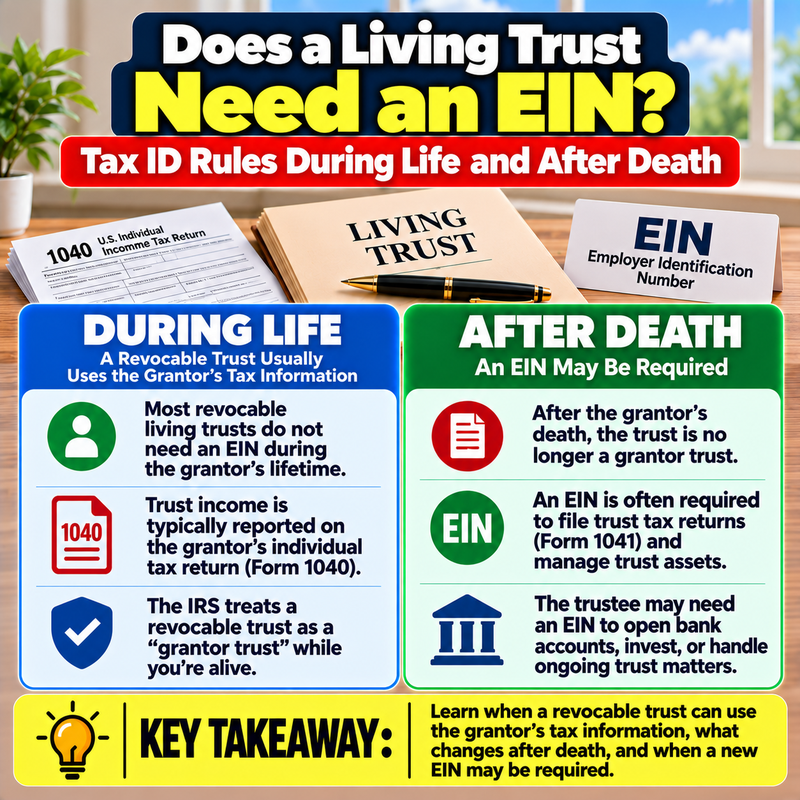
Learn When a Revocable Trust Can Use the Grantor’s Tax Information, What Changes After Death, and When a New EIN May Be Required
A living trust usually sails through your lifetime without ever needing its own federal tax ID number, but the moment it changes status, that can flip overnight.
Figuring out exactly when the IRS expects you to apply for an Employer Identification Number (EIN) trips up even careful trust creators, which is why resources like CreateALivingTrust.com exist to walk you through the paperwork trail before small mistakes turn into IRS notices. If you’re still in the planning stages or want to understand how your revocable living trust gets taxed from day one, this guide breaks down exactly when an EIN becomes necessary and when it doesn’t.
Key Takeaways
- A standard revocable living trust typically does not need its own EIN while the grantor is alive and competent, because it uses the grantor’s Social Security number instead.
- The IRS treats most grantor trusts as “invisible” for tax purposes, meaning all income gets reported directly on your personal Form 1040.
- Once a revocable trust becomes irrevocable—usually after the grantor’s death—it typically needs its own EIN and must start filing Form 1041.
- Simply swapping out a trustee or updating an address does not, by itself, require applying for a new EIN.
- Keep reading to find out exactly which five situations force a grantor trust to get an EIN even before the grantor passes away.
Quick Answer: It Depends on the Trust’s Status
Here’s the short version: if your trust is revocable and you’re alive, you probably don’t need an EIN. If it’s irrevocable, or if the grantor has died, you almost certainly do. The deciding factor isn’t the word “trust” on the document—it’s whether the IRS still considers you the owner of the assets inside it.
What an EIN Actually Is
An EIN, or Employer Identification Number, is a nine-digit code the IRS issues to identify a business or entity for tax reporting purposes. Despite the name, you don’t need employees to get one. Trusts, estates, corporations, and partnerships all use EINs the same way individuals use Social Security numbers.
Why the IRS Requires One for Certain Entities
The IRS needs a way to track income, deductions, and distributions tied to an entity that exists separately from any one person. When a trust becomes its own taxpayer—meaning it’s no longer treated as an extension of the grantor—it needs an EIN so the IRS can match tax filings to that specific entity.
Current IRS Form SS-4 instructions spell out exactly which entities need to apply and which ones are exempt. For certain grantor-type trusts, the instructions specifically say not to file Form SS-4 at all, as long as the trustee is furnishing the grantor’s name, address, and taxpayer ID to banks and other payers instead.
EIN vs. Social Security Number for Tax Reporting
Think of it this way: your Social Security number is like your personal ID badge, while an EIN is an ID badge for an entity. During your lifetime, as the grantor of a revocable trust, your trust usually just wears your badge. Once the trust becomes a separate taxpayer, it needs its own badge—an EIN—so brokerage firms, banks, and the IRS all know where to send tax documents and how to process income reporting.
Revocable Grantor Trusts During Your Lifetime
Most people who set up a living trust do so specifically because it’s revocable—meaning they retain the power to change or cancel it anytime. This single feature is what keeps things tax-simple while you’re alive. For more details on whether your trust needs an EIN, you can refer to this resource.
Why the IRS Treats Your Trust as Invisible
For federal income tax purposes, a revocable living trust is essentially a ghost. The IRS doesn’t see it as a separate entity because you, the grantor, still control the assets and can revoke the trust at will. Legally speaking, nothing has really changed hands yet—you’ve just retitled your assets into a different name, but you still call all the shots.
Income Flows to Your Personal Tax Return
Because the trust is invisible to the IRS, every dollar of interest, dividends, rental income, or capital gains generated by trust assets flows straight through to your personal Form 1040. You report it exactly as you would if the assets were still titled in your own name. No separate trust tax return. No EIN. No extra complexity.
This arrangement continues for as long as you’re alive and legally competent to manage your own affairs. It’s one of the biggest administrative perks of revocable trusts compared to other estate planning tools.

When the Grantor’s SSN Can Be Used Instead of an EIN
The IRS doesn’t just allow this arrangement by accident—it’s built into the rules governing how grantor trusts report income. Understanding the specific conditions helps you know exactly when you’re covered and when you’re not.
Reporting Rules While You’re Alive and Competent
As long as you’re the grantor, serving as your own trustee, and mentally competent to manage your affairs, the trust reports under your Social Security number. Banks and investment accounts titled in the trust’s name simply use your SSN on file, and 1099 forms get issued in your name at year-end.
What Changes If You Become Incapacitated
Here’s a detail many people miss: even if a successor trustee steps in because you’ve become incapacitated, the trust still doesn’t need an EIN. The grantor—meaning you—continues to be the one who reports all income and expenses on your personal return, regardless of who’s physically managing the trust’s day-to-day affairs. The EIN question is tied to whose assets these legally still are, not who’s signing the checks.
IRS Optional Reporting Methods for Grantor Trusts
The IRS actually offers a few different ways for grantor trusts to handle reporting, and knowing which one applies to your situation prevents unnecessary paperwork.
Optional Method 1: Using the Grantor’s Taxpayer ID
Under what’s commonly called Optional Method 1, a grantor trust that hasn’t applied for an EIN can simply use the grantor’s Social Security number with payers—banks, brokerages, and anyone else issuing tax documents. As long as the trust continues to qualify under this method and reports accordingly, it never needs to apply for its own EIN at all.
What Form SS-4 Instructions Say About Filing Requirements
Current Form SS-4 instructions directly address this scenario. They state that certain grantor-type trusts should not file for an EIN when the trustee is furnishing the grantor or owner’s name, taxpayer ID number, and trust address to payers. This isn’t a loophole—it’s the IRS’s own documented exception built specifically for situations like a standard revocable living trust.
5 Situations Where a Grantor Trust May Need an EIN
Even a trust that starts out fully grantor-owned can hit a point where an EIN becomes necessary—sometimes well before the grantor dies. Here are the five scenarios worth watching for.
1. Non-Grantor Trust Classification
If a trust is structured so that the grantor doesn’t retain enough control to be treated as the owner under IRS rules, it’s classified as a non-grantor trust. Non-grantor trusts are treated as entirely separate taxpayers from day one, which means an EIN and a separate Form 1041 filing become mandatory regardless of whether the grantor is alive.
2. Trust No Longer Qualifies for Optional Methods
Sometimes a trust that initially qualified for the grantor reporting shortcut outgrows it—maybe ownership structure changes, or multiple grantors are involved in a way that complicates reporting. Once a trust no longer meets the conditions for Optional Method 1, the trustee needs to apply for an EIN to keep reporting compliant.
3. Multiple Trustees or Complex Reporting Needs
Trusts with co-trustees or complicated management structures sometimes outgrow the simplicity of the grantor reporting shortcut. If a bank or brokerage firm can’t cleanly match account activity to a single Social Security number because multiple parties are involved in decision-making, trustees often find it easier to just apply for an EIN rather than untangle reporting conflicts every tax season.
4. Financial Institution Requirements
Not every bank or brokerage firm follows IRS optional reporting methods the same way. Some institutions, especially larger ones with strict compliance departments, simply require an EIN before they’ll open a trust account—regardless of whether the IRS technically mandates one. If your bank is asking for a tax ID number for the trust itself, it’s worth checking whether that’s a hard requirement or just their internal policy before assuming you need to file Form SS-4.
5. Trust Splits Into Separate Shares
Joint trusts created by married couples often include language that splits the trust into separate shares after the first spouse passes away. Typically, one share stays revocable (tied to the surviving spouse) while the other becomes irrevocable immediately. That irrevocable share needs its own EIN right away, even though the other half of the trust can keep operating under the surviving spouse’s Social Security number. This split is one of the most commonly missed triggers for an EIN application, since people assume nothing changes until both spouses have passed.

What Happens to the Trust After the Grantor Dies
Death changes everything from a tax perspective, even if the trust document itself doesn’t change a single word. The moment the grantor passes away, the IRS stops treating the trust as invisible.
The Trust Becomes a Separate Taxpayer
Once the grantor dies, the trust can no longer be revoked by anyone, which means the IRS now views it as its own distinct taxpayer. This is the single biggest shift in how a revocable living trust gets handled from a tax standpoint. The trustee—who may be the same successor trustee who was already managing things during incapacity—now has new legal obligations that didn’t exist the day before.
Filing Form 1041 for Post-Death Income
Instead of reporting trust income on the deceased grantor’s personal Form 1040, the trustee must now file Form 1041, the U.S. Income Tax Return for Estates and Trusts. This form captures all income earned by trust assets after the date of death, and it requires its own EIN to file correctly.
Current IRS Form 1041 instructions make clear that trusts filing under this form need a valid EIN listed on the return. Without one, the IRS has no way to match the filing to the correct entity, which can delay processing or trigger correspondence asking for clarification.
Revocable Trust Becoming Irrevocable
This transition—revocable to irrevocable—is the single most common reason a living trust ends up needing an EIN. It happens automatically at death in nearly every standard revocable trust structure, whether or not the trust document specifically mentions it.
Some people assume that because nothing about the trust’s assets or beneficiaries changed, the tax treatment shouldn’t change either. But the IRS looks specifically at control and revocability, not just asset ownership. Once that power to revoke disappears, so does the ability to keep using the deceased grantor’s Social Security number.
Why a New EIN Is Required at This Transition
An irrevocable trust is permanent by definition—nobody, not even the trustee, can undo it or change its terms unilaterally. Because of that permanence, the IRS treats it the same way it treats a corporation or partnership: as its own standalone taxpayer that needs its own identification number. This isn’t optional paperwork; it’s a structural requirement for filing any tax return tied to the trust going forward.
It’s worth noting that this requirement applies whether the trust is large or small, simple or complex. A trust holding a single rental property and a modest investment account still needs an EIN once it becomes irrevocable, just as much as a trust holding millions in diversified assets.
Timing: How Soon You Need to Apply
Trustees should apply for the EIN as soon as possible after the grantor’s death, ideally before any income is received or tax documents need to be issued under the trust’s name. Banks and brokerage firms typically request the new EIN fairly quickly to update account titling, and delays can create headaches around 1099 reporting at year-end. There’s no strict IRS deadline printed on a calendar, but practically speaking, waiting too long creates a scramble later when tax season arrives and nothing matches up cleanly.
Trust EIN vs. Estate EIN: Knowing the Difference
It’s easy to assume that a deceased person’s estate and their living trust are basically the same thing for tax purposes, but the IRS treats them as two entirely separate taxpayers. This distinction trips up a lot of trustees who are also serving as executors.
A decedent’s probate estate—the assets that pass through the will or through intestacy—is a different legal entity from any trust that person created during their lifetime. Even if both exist simultaneously after someone dies, each one generally needs its own EIN if it has income to report. Mixing up the two, or assuming one EIN covers both, is a common and avoidable mistake.
Why a Decedent’s Estate May Need Its Own EIN
If the deceased person had assets that didn’t make it into the trust before death—maybe a bank account that was never retitled, or a piece of property still in their individual name—those assets typically pass through probate as part of the estate, not the trust. That estate, administered separately by an executor or personal representative, needs its own EIN to file Form 1041 for any income those probate assets generate.
This is actually one of the strongest arguments for properly funding your trust while you’re alive. An unfunded trust doesn’t avoid probate no matter how well the trust document itself is written, and it also creates this exact tangle of needing two separate EINs and two separate tax filings after death instead of one clean structure.
Trustees managing both the trust and the estate simultaneously should keep meticulous records of which EIN applies to which income source. The IRS cross-references these filings, and mismatched or missing EINs on a Form 1041 are a quick way to generate a notice asking for clarification.
The Section 645 Election for Qualified Revocable Trusts
There’s a useful tool available for trustees managing a qualified revocable trust alongside an estate: the Section 645 election. This election, made under Internal Revenue Code Section 645, allows a qualified revocable trust to be treated as part of the decedent’s estate for federal income tax purposes, rather than as a separate trust. To qualify, the grantor must have had the power to revoke the trust up until death, which describes the vast majority of standard revocable living trusts.
Choosing Your Fiscal Year-End Under Section 645
One major benefit of making this election is flexibility around the tax year. A trust that doesn’t make the Section 645 election must use a calendar year for tax purposes. But an electing trust can select any fiscal year-end that falls within 12 months of the date of death, which can simplify planning around income timing and deductions. This election should be made before applying for the EIN, so the trustee can request the appropriate year-end from the start rather than correcting it later.
Two-Year Limit on the Section 645 Election
The Section 645 election isn’t permanent—it’s only valid for two years from the date of death. During that window, the electing trust follows estate income tax rules rather than trust rules, including not having to make estimated tax payments during that period. Once the two years end, the IRS stops treating the trust as part of the estate, and the trustee must switch over to standard trust income tax rules, including the calendar year requirement and estimated payment obligations that come with it.

Changing Trustees or Updating Addresses
According to current IRS guidance reflected in Form SS-4 instructions, a trust does not need a new EIN simply because the trustee changes or because the grantor’s or beneficiary’s name or address changes.
This is one of the more reassuring pieces of IRS guidance for families navigating a trustee transition, whether due to resignation, incapacity, or the natural passing of responsibilities to a successor. The EIN belongs to the trust itself as an entity, not to whichever individual happens to be managing it at a given moment.
Plenty of trustees assume that because they’ve taken over for someone else, they need to start fresh with a new tax ID number. That assumption often leads to unnecessary EIN applications, confusing paper trails with banks, and sometimes even duplicate EINs for a single trust—which creates its own cleanup headache down the road.
If you’ve just become a successor trustee and the trust already has an EIN from a prior transition, your job is to update the trustee information with the IRS and with financial institutions, not to apply for a brand-new number. The existing EIN stays attached to the trust as long as the trust itself hasn’t changed its fundamental tax status.
When a New EIN Is NOT Required
To summarize clearly: a new EIN is not required for a trustee change, an address update, a beneficiary change, or any other administrative shift that doesn’t alter whether the trust is revocable, irrevocable, grantor, or non-grantor. The EIN tracks the entity’s tax classification, not its management roster.
How to Apply for an EIN When It’s Actually Required
When one of the trigger events above does apply, applying for an EIN is a relatively quick process. The IRS has streamlined this specifically to avoid unnecessary delays for trustees handling time-sensitive estate matters.
Completing Form SS-4 Online
The fastest method is applying directly through the IRS website using the online EIN application tool, which walks you through Form SS-4 step by step. Most trustees receive their EIN immediately upon completing the online application, as long as the information provided matches IRS records. Paper and fax applications are also available but take considerably longer to process.
Information You’ll Need Before You Apply
Before starting the application, gather the trust’s full legal name exactly as it appears in the trust document, the date the trust became irrevocable (or the date of death, if applicable), the responsible party’s name and Social Security number or existing EIN, and the trust’s mailing address. Having the trust document itself on hand helps answer any questions about the trust’s type and structure that come up during the application.

5 Common EIN Mistakes That Trigger IRS Notices
Getting the EIN timing wrong—in either direction—creates problems that ripple through tax filings for years. These are the mistakes that show up most often when trusts transition between tax statuses.
Here’s a quick rundown of what tends to go sideways when setting up a living trust. You might want to check if your trust needs an EIN to avoid complications.
1. Applying for an EIN Too Early
It might feel proactive to get ahead of the paperwork, but applying for an EIN before the trust actually needs one can backfire. The IRS may assume a trust tax return should now be filed under that EIN, even if the trust is still fully revocable and all income is properly being reported under the grantor’s Social Security number instead.
Example: A trustee applies for an EIN right after setting up a new revocable trust “just in case.” Two years later, the IRS sends a notice asking why no Form 1041 has been filed under that EIN, even though the grantor has been correctly reporting all trust income on their personal return the entire time.
Untangling this kind of notice usually means writing a letter to the IRS explaining that the EIN was obtained prematurely and that the trust has continued to qualify for grantor trust reporting. It’s a solvable problem, but it’s extra work that’s easily avoided by waiting until a genuine trigger event occurs.
The better approach is holding off on the EIN application until one of the specific situations we’ve already covered actually applies—whether that’s the grantor’s death, a trust split, or a shift to non-grantor status. Patience here saves paperwork headaches later.
2. Forgetting to Update Financial Institutions
Once a trust transitions to using its own EIN, every single financial institution holding trust assets needs to be notified—banks, brokerage firms, insurance companies, even smaller accounts like certificates of deposit. Missing even one account means that institution keeps issuing tax documents under the old Social Security number, creating a mismatch the IRS will eventually flag.
Trustees sometimes update the big accounts right away but forget about smaller, less active accounts that don’t get much attention throughout the year. Come January, those overlooked accounts generate 1099 forms tied to the wrong taxpayer ID, which then don’t match what’s reported on the trust’s Form 1041. Creating a simple checklist of every account titled in the trust’s name at the time of the EIN transition helps prevent this gap.
3. Mismatched Tax ID Numbers Across Accounts
This mistake often grows directly out of the one above. When some accounts are updated with the new EIN and others still carry the grantor’s old Social Security number, the IRS receives conflicting information about who earned what income during the same tax year.
These mismatches don’t always surface immediately. Sometimes a trust operates for a full tax year with split reporting before anyone notices, and by then the trustee is dealing with amended 1099s, corrected filings, and possibly an IRS inquiry asking why income reported under one taxpayer ID doesn’t reconcile with filings under another.
The fix is straightforward but time-consuming: cross-reference every account statement from the transition year, confirm which taxpayer ID each institution used, and correct any that are still using the old number. Doing this cleanup within the same tax year, rather than waiting until the IRS sends a notice, saves significant back-and-forth later.
4. Missing the Section 645 Election Deadline
The Section 645 election has a specific filing window tied to the trust’s first income tax return after death, and missing that window means losing access to the benefits entirely—including the flexible fiscal year-end and the exemption from estimated tax payments during the first two years. Trustees who wait too long to consult with a tax professional about this election sometimes discover the deadline has already passed, locking the trust into calendar-year reporting and standard trust estimated payment rules from day one.
5. Confusing Trust Tax Rates With Individual Rates
Trust tax brackets are dramatically more compressed than individual brackets. A trust can hit the top 37% federal tax rate at a relatively low level of income, whereas an individual would need substantially more income to reach that same bracket. Trustees who assume trust income gets taxed similarly to personal income are often surprised by how quickly the tax bill climbs if income is retained inside the trust rather than distributed to beneficiaries. Distributing income out to beneficiaries, when the trust document allows it, often shifts that tax burden to individuals who may fall into lower personal tax brackets, reducing the overall tax hit.

When to Call a CPA or Estate Attorney
Nothing in this article is meant to replace individualized guidance from a licensed professional. EIN timing, Section 645 elections, and trust classification questions all depend heavily on the specific language in your trust document and your family’s particular circumstances.
A CPA who regularly handles fiduciary income tax returns can confirm whether your trust qualifies for the Section 645 election, help you choose the right fiscal year-end, and make sure Form 1041 gets filed correctly from the very first year. An estate attorney, meanwhile, can clarify whether your trust document triggers a split into separate shares, whether non-grantor provisions apply, and how your state’s rules interact with federal requirements.
Red Flags That Signal You Need Professional Help
Certain situations are worth flagging for professional review sooner rather than later:
- The grantor has recently passed away and the trust document contains language about splitting into separate shares
- Multiple trustees are managing the trust and disagreeing about reporting responsibilities
- A financial institution is requesting an EIN but you’re unsure whether the trust actually qualifies for grantor reporting
- You’ve already received an IRS notice referencing a mismatched taxpayer ID or missing tax return
- The trust holds out-of-state property or business interests that complicate standard reporting rules
If any of these apply to your situation, it’s worth scheduling time with a professional before the next filing deadline rather than guessing and correcting mistakes afterward.
Your Trust’s Tax ID Status Can Change Fast—Stay Ahead of It
The difference between needing an EIN and not needing one often comes down to a single event—death, incapacity, or a structural change buried in the trust document—so staying aware of your trust’s current status, rather than assuming it never changes, is the simplest way to avoid IRS headaches down the road.

Frequently Asked Questions
These quick answers cover the questions trustees and grantors ask most often when sorting out EIN requirements for a living trust.
Does a revocable living trust need an EIN while I’m alive?
No. As long as the trust remains revocable and you’re alive and competent, it typically uses your Social Security number instead of a separate EIN, and all income reports directly on your personal tax return.
What happens to the trust’s tax ID when I die?
The trust generally becomes irrevocable at death, which means it’s treated as a separate taxpayer requiring its own EIN. The trustee must apply for this EIN and begin filing Form 1041 for any income the trust earns after the date of death.
Can I use my Social Security number instead of an EIN for my trust?
Yes, as long as the trust qualifies as a grantor trust under IRS rules and you’re using one of the optional reporting methods outlined in current Form SS-4 instructions. This typically applies only while the grantor is alive and the trust remains revocable.
How do I know if my trust is a grantor trust or non-grantor trust?
A trust is generally a grantor trust if the person who created it retains enough control—like the power to revoke it or amend its terms—to be treated as the owner for tax purposes. If that control doesn’t exist, or ends at a certain point, the trust shifts to non-grantor status and becomes its own separate taxpayer.
What is the Section 645 election and should I make it?
The Section 645 election allows a qualified revocable trust to be treated as part of the decedent’s estate for federal income tax purposes for up to two years after death. Whether it makes sense for your situation depends on factors like fiscal year flexibility and estimated tax payment timing, which a CPA can evaluate based on the specific trust and estate involved.
Do I need a new EIN if I change successor trustees?
No. Current IRS guidance confirms that a trustee change alone doesn’t require a new EIN. The existing EIN stays attached to the trust as long as its underlying tax classification hasn’t changed.
How long does it take to get an EIN for a trust?
Applying online through the IRS website typically results in immediate issuance of an EIN, assuming all the information provided matches IRS records correctly. Paper or fax applications take considerably longer, often several weeks.
What’s the difference between a trust EIN and an estate EIN?
A trust EIN applies to the living trust itself, while an estate EIN applies to the decedent’s probate estate—a separate legal entity that may include assets never transferred into the trust. Both can exist simultaneously after someone dies, and each requires its own EIN if it has income to report.
Confusing the two, or assuming a single EIN covers both entities, is one of the more common errors trustees and executors make when administering an estate alongside a trust.
Can getting an EIN too early cause problems with the IRS?
Yes. Applying for an EIN before the trust actually requires one can lead the IRS to expect a Form 1041 filing under that EIN, even if the trust still qualifies for grantor reporting under the grantor’s Social Security number.
Rule of thumb: don’t apply for an EIN until a genuine trigger event occurs—death, a trust split, or a shift to non-grantor status. Applying “just in case” tends to create more paperwork, not less.
If this mistake has already happened, a written explanation to the IRS clarifying why no return was filed under the premature EIN usually resolves the issue, though it does require some back-and-forth correspondence.
Are trust tax rates higher than individual tax rates?
Trust tax brackets are significantly more compressed than individual brackets, meaning a trust reaches the top federal tax rate at a much lower income level than an individual would. This is one reason many trustees choose to distribute income to beneficiaries when the trust document permits it, shifting the tax burden to individuals who may be in lower personal brackets.
Here’s a simplified way to think about the decision:
- Income retained inside the trust: taxed at compressed trust rates, which climb to the top bracket quickly
- Income distributed to beneficiaries: taxed at each beneficiary’s individual rate, which may be lower depending on their overall income
Working through this calculation each year, rather than defaulting to the same distribution pattern automatically, can meaningfully reduce the overall tax bill for the trust and its beneficiaries combined. For more details on whether a trust needs an EIN, you can visit this informative article.
Understanding exactly when your trust needs an EIN—and when it doesn’t—removes one more layer of uncertainty from an already complicated process, and resources like CreateALivingTrust.com can help you build a trust structure designed to minimize these transitions from the start.