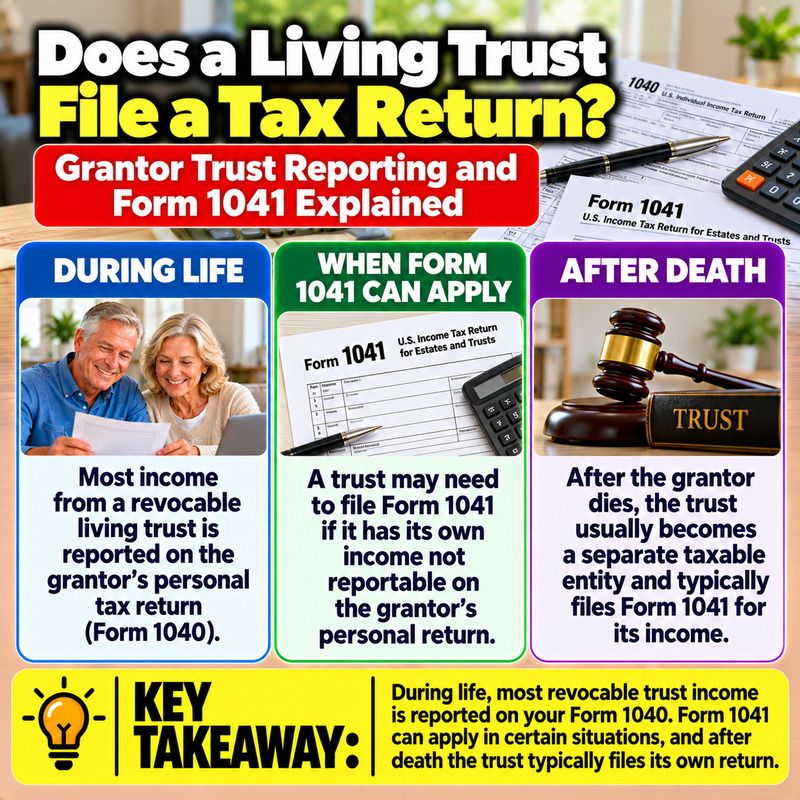
Does a Living Trust File a Tax Return? Grantor Trust Reporting and Form 1041 Explained
Understand How Revocable Trust Income Is Reported During Life, When Form 1041 Can Apply, and What Changes After Death
If you’ve ever wondered whether your revocable living trust needs to file its own tax paperwork, the short answer is almost always no while you’re alive, but that answer flips the moment you pass away.
Trust taxation confuses even seasoned accountants because the rules change depending on who’s living, who’s retained control, and what type of trust you’ve actually created. The team at Create a Living Trust gets this question constantly from clients who assume their trust needs a separate tax identity the day they sign the paperwork, when in reality the IRS treats most living trusts as if they don’t exist for tax purposes during your lifetime.
Key Takeaways
- A revocable living trust generally does not file its own Form 1041 while the grantor is alive; income flows directly to the grantor’s personal Form 1040 instead.
- Saying “a living trust never files Form 1041” is too broad, because optional IRS reporting methods and certain situations can still involve a 1041-style filing even during life.
- Once the grantor dies, the trust typically becomes irrevocable, needs its own EIN, and may be required to file Form 1041 as a separate taxpayer.
- Beneficiaries who receive trust income after the grantor’s death usually get a Schedule K-1, which is different from reporting on the decedent’s final individual tax return.
- State fiduciary filing rules add another layer of complexity that depends on where the trustee, beneficiaries, and trust assets are located, as we’ll cover later in this guide.
Quick Answer: Does a Living Trust File Taxes?
During your lifetime, a revocable living trust almost never files its own income tax return because the IRS classifies it as a grantor trust. That means every dollar of interest, dividends, rent, or capital gains the trust generates gets reported on your personal Form 1040, exactly as if you’d earned it outside the trust. The trust is, for all practical tax purposes, invisible to the IRS while you’re the one calling the shots.
Revocable Trusts Are Disregarded While You’re Alive
The IRS calls this “disregarded entity” treatment, and it applies because you retain the power to revoke, amend, or control the trust at any time. Since you can undo the trust whenever you want, the tax code refuses to treat it as a separate taxpayer. Your Social Security number stays attached to trust accounts, your brokerage statements still show your name, and tax season looks exactly the same as it did before you created the trust.
This disregarded status is actually one of the biggest selling points of a revocable living trust: you get all the probate-avoidance and incapacity-planning benefits without adding a single extra tax form to your annual routine. People sometimes expect complexity that simply isn’t there.
Everything Changes the Moment the Grantor Dies
Death flips the switch. The moment you pass away, the trust loses its revocable status and becomes irrevocable by operation of law. The IRS stops disregarding it and starts treating it as its own distinct taxpayer, complete with its own tax identification number and, in many cases, its own filing obligation on Form 1041. This is the dividing line that trips up a lot of families and even some financial professionals who assume trust tax treatment never changes.

Revocable Living Trusts as Grantor Trusts
Understanding why your trust avoids separate filing starts with understanding what “grantor trust” actually means under the tax code. It’s not a complicated concept once you see the logic behind it.
What “Grantor Trust” Actually Means
A grantor trust is any trust where the person who created it (the grantor) has retained enough control or benefit that the IRS says, “this isn’t really separate from you.” Internal Revenue Code sections 671 through 679 lay out the specific powers that trigger grantor trust status. If you keep any of these powers, the trust’s income, deductions, and credits pass straight through to your personal return.
This isn’t a loophole or a technicality trustees need to exploit. It’s the default, automatic result of how most living trusts are drafted. Attorneys build revocable trusts specifically so they qualify as grantor trusts, because that’s what keeps tax reporting simple during your lifetime.
Common powers that create grantor trust status include:
- The power to revoke or amend the trust at any time
- The power to control who benefits from trust income or principal
- The retained right to receive trust income for yourself
- The power to substitute or swap trust assets of equivalent value
- The ability to borrow trust funds without adequate security
IRS Powers That Keep a Trust in Grantor Status
Most revocable living trusts check multiple boxes on that list simultaneously. You typically retain the right to revoke, the right to amend, the right to receive income, and the right to swap assets, all at once. Any single one of these powers would be enough to trigger grantor status, so having several just reinforces the same outcome: the trust is disregarded for income tax purposes.
It’s worth noting that irrevocable trusts can sometimes qualify as grantor trusts too, if the grantor retains certain powers even after giving up the right to revoke. That’s a more advanced planning technique, but it explains why “irrevocable” and “non-grantor” aren’t automatically the same thing.
Why Most Living Trusts Qualify Automatically
Standard estate planning documents are written with grantor trust status baked in from the start. Attorneys know clients want simplicity, so the trust language almost always preserves the grantor’s control. Unless you’ve done something unusual, like transferring the trust to an independent trustee and stripping yourself of all retained powers, your living trust is a grantor trust by default.
How Income Is Generally Taxed During the Grantor’s Life
Once you know the trust is disregarded, the mechanics of actually reporting income become straightforward. There’s no separate trust tax return competing for your attention each April.
Income Flows Straight to Your Personal Form 1040
Every dividend, every rental payment, every capital gain your trust generates shows up on your own 1040 as if the trust weren’t involved. If you sell your house inside the trust, the gain (and any available home-sale exclusion) is calculated using your personal tax situation. If your trust owns a rental property, that income and those expenses land on your Schedule E exactly like they would if you owned the property in your own name.
No Separate Tax Rate for the Trust Itself
This matters more than people realize. Non-grantor trusts face compressed tax brackets, meaning they hit the top federal rate at a shockingly low income level compared to individuals. Grantor trusts sidestep this entirely. Because the income is taxed to you personally, you benefit from your own individual tax brackets, which are almost always more favorable than trust brackets would be.
Moving Assets In or Out Doesn’t Trigger Tax
Funding your trust, transferring your home, retitling your brokerage account, or moving assets back out of the trust generally isn’t a taxable event. Since you’re disregarded as the owner either way, shuffling assets between “you” and “your trust” doesn’t create gain, loss, or any reportable transaction. This is one reason living trust funding tends to be far less stressful than people expect once they understand the tax treatment doesn’t change.

Optional IRS Reporting Methods
Here’s where the oversimplified advice starts to break down. Trustees of grantor trusts actually have a choice in how they report income to the IRS, and the method they pick can look different depending on the trust’s structure.
- Method one: report everything under the grantor’s name and Social Security number, with no separate trust filing at all
- Method two: use the trust’s EIN but attach a statement identifying the grantor, who then reports the income personally
- Method three: file a simplified Form 1041 with a grantor statement attached, used less often but still available
The IRS lays these options out in the Form 1041 instructions, and trustees pick whichever method fits their banking relationships and recordkeeping preferences best.
Using the Grantor’s Name and Social Security Number
This is the simplest and most common approach for a typical revocable living trust. Banks and brokerages title the account in the trust’s name but report earnings under the grantor’s Social Security number. Come tax time, 1099 forms arrive with your name and number on them, and you report the income exactly as you always have.
- No EIN application is needed
- No separate tax return is filed
- 1099s arrive under the grantor’s SSN
- Reporting looks identical to pre-trust tax filings
This method works well for the vast majority of living trusts because it requires zero extra administrative steps. Most people never even notice their accounts are titled in trust, because the tax reporting experience doesn’t change at all.
The Alternative Reporting Method Explained
Some trustees prefer to get an EIN for the trust even though it’s still a grantor trust, often because a bank or financial institution requests it, or because the trust holds a business interest. In that case, the trustee attaches a statement to a short Form 1041 explaining that all income is being reported by the grantor personally, and no tax is actually calculated on the 1041 itself.
- The trust has its own EIN on file
- A brief Form 1041 may be filed showing the trust passed income through
- A grantor statement explains where the income actually lands
- The grantor still reports and pays tax on their personal return
This is exactly why the blanket claim “a living trust never files Form 1041” doesn’t hold up. In this scenario, a Form 1041 absolutely gets filed, it’s just a reporting vehicle rather than a tax calculation.
What Payers and Banks Need From You
If you choose the first method, make sure every bank, brokerage, and payer has your Social Security number on file for trust accounts, not a separate EIN. If you choose the alternative method, you’ll need to supply the trust’s EIN to those same institutions. Mixing up the two methods across different accounts is a common source of year-end 1099 mismatches, so pick one approach and stay consistent across all trust-titled accounts.
When Form 1041 May Be Used for a Grantor Trust
Trustees sometimes assume Form 1041 is reserved exclusively for irrevocable, non-grantor trusts after death. That’s not accurate. A grantor trust can file a 1041 during the grantor’s lifetime under certain circumstances, even though no tax gets calculated on it.
The form essentially becomes an informational pass-through document rather than a tax return in the traditional sense.
- The trust already has an EIN for banking or business reasons
- A co-trustee or successor trustee wants clear documentation of trust activity
- The trust holds an interest in a partnership or S-corporation that issues a K-1 to the trust’s EIN
Any of these situations might push a trustee toward filing a 1041 with a grantor statement, even though the underlying tax liability still belongs entirely to the grantor.
The Grantor Statement Attachment
The grantor statement is the key piece of this puzzle. It’s a plain-language attachment listing each item of income, deduction, and credit, along with a note explaining that these amounts are being reported on the grantor’s individual return instead of being taxed at the trust level. Without this attachment, the IRS would have no way of knowing the 1041 isn’t meant to calculate actual tax owed by the trust.
Preparers sometimes also attach a transmittal explaining the trust’s revocable status, just to eliminate any ambiguity for the IRS or for future trustees reviewing the file.
Situations Where Trustees Choose This Route
Trustees managing more complex asset structures, like a trust holding commercial real estate with a partnership interest, often find it cleaner to use the trust’s EIN consistently across all documents rather than switching between the grantor’s SSN and the EIN depending on the asset. In those cases, filing the informational 1041 keeps everything organized in one place, even though the actual tax bill still lands on the grantor’s 1040.

EIN Considerations
Whether or not your trust needs its own EIN during your lifetime depends almost entirely on which reporting method you’ve chosen and what kinds of assets the trust holds.
Why Most Revocable Trusts Skip an EIN During Life
Since the IRS disregards the trust as a separate taxpayer, there’s usually no functional need for an EIN while you’re alive. Your Social Security number already does the job of identifying who owes tax on the trust’s income. Applying for an EIN you don’t need just adds an extra number to track and an extra point of confusion for banks handling your accounts.
When a New EIN Becomes Necessary
Some situations force an EIN even while you’re alive and the trust remains revocable. If your trust owns an interest in a partnership that requires a separate taxpayer identification number for K-1 reporting, or if a bank simply won’t open an account without one, you’ll need to apply. Getting an EIN doesn’t change the trust’s grantor status or create a new filing obligation on its own; it just means you’ll likely use the “alternative reporting method” described earlier instead of reporting under your personal Social Security number.
Applying is quick. The IRS allows online EIN applications for trusts, and the process typically takes just a few minutes if you have your trust document and personal information handy. Keep that EIN confirmation letter in your estate planning file, because successor trustees will need it later regardless of whether you use it right away.
What Changes After Death
Death is the real turning point in trust taxation, and it’s worth slowing down here because so much confusion stems from assuming nothing changes just because the trust was set up to “avoid probate” or “avoid taxes.” Avoiding probate and avoiding all future tax filings are two completely different things.
The Trust Becomes Irrevocable Immediately
The instant the grantor dies, the trust’s revocable provisions lock in place. The successor trustee named in the trust document steps into their role, and from that point forward, nobody has the power to amend, revoke, or undo the trust’s terms. This irrevocability is what triggers the shift in tax treatment, because the very powers that made the trust disregarded for tax purposes no longer exist.
The IRS Stops Disregarding the Trust
Once those retained powers disappear, the IRS can no longer treat the trust as an extension of the grantor, because the grantor is gone. The trust becomes its own taxpayer, responsible for reporting and potentially paying tax on income earned after the date of death. This is a structural shift, not an optional choice the trustee gets to make.
A New Taxpayer Is Born
Practically speaking, this means the successor trustee needs to apply for a new EIN for the trust right away, usually within a reasonably short window after death. Financial institutions will generally require this new EIN before they’ll retitle accounts or release funds to the trustee. If the trust previously used the grantor’s Social Security number, that number can no longer be used for trust income earned after the date of death.
When Post-Death Form 1041 May Be Required
After death, the question of whether a 1041 gets filed stops being optional in the way it was during life. The IRS sets specific thresholds that determine whether the now-irrevocable trust must file.
According to current Form 1041 instructions, a trust generally must file if it has any taxable income for the year, gross income of a certain threshold or more (currently $600, though always verify the latest figure before filing), or if any beneficiary is a nonresident alien, regardless of income level.
Even if the trust distributes every single dollar of income out to beneficiaries, it typically still needs to file the 1041. The trust takes a distribution deduction for income passed through, but the filing requirement itself doesn’t disappear just because the trust didn’t keep any of the money.
This catches people off guard. Families sometimes assume that because the trust immediately paid out all income to beneficiaries, there’s nothing left to report. In reality, passing income through to beneficiaries is exactly the kind of activity Form 1041 is designed to document.
- Any taxable income at all during the tax year
- Gross income meeting or exceeding the current IRS threshold (verify current figures each filing season)
- Any beneficiary who is a nonresident alien, regardless of income amount
- Income earned by trust assets between the date of death and full distribution
Income Thresholds That Trigger Filing
Gross income thresholds for trusts are intentionally low compared to individual filing thresholds, and they can shift from year to year. Rather than relying on a number that might be outdated by the time you read this, check the current Form 1041 instructions directly on IRS.gov before determining whether your trust needs to file for a given tax year.
Trustees who skip this step because “it’s only a small amount of interest income” sometimes discover later that they missed a filing requirement entirely, which can create penalty exposure down the road.
Nonresident Alien Beneficiaries and Filing Duty
If even one beneficiary of the trust is a nonresident alien, the trust generally must file Form 1041 regardless of how much or how little income it earned. This rule exists to make sure the IRS can track income flowing to beneficiaries outside the standard domestic reporting system. If your family includes beneficiaries living abroad, flag this for your tax preparer early, since it affects filing obligations even in years with minimal trust income.
Calendar Year Rules for Trusts
Trusts are generally required to use a calendar tax year, running January 1 through December 31, unlike some businesses that can elect a fiscal year. This matters for the first post-death return especially, since the trust’s “first year” might only cover a partial period from the date of death through December 31. Trustees sometimes have flexibility around certain elections in that first short year, which is another reason to loop in a tax professional rather than guessing.

Simple vs. Complex Trust Concepts at a High Level
A simple trust must distribute all its income annually, cannot distribute principal, and cannot make charitable distributions. A complex trust can accumulate income, distribute principal, and make charitable gifts. Most trusts after the grantor’s death, especially during administration, end up classified as complex trusts at least for part of their existence.
Once a trust files Form 1041 as its own taxpayer, the IRS further classifies it as either a simple trust or a complex trust, and this classification affects which schedules and deductions apply. It’s a high-level distinction trustees should understand even if the fine details get handled by a preparer.
Simple trusts are, true to the name, more straightforward. They must distribute all income annually, which means beneficiaries report that income on their own returns via Schedule K-1, and the trust itself rarely owes much tax beyond rare rounding situations.
Complex trusts have more moving parts. They might retain income instead of distributing it, make discretionary principal distributions, or direct money toward charitable purposes. Many trusts drift between simple and complex classification year to year depending on what the trustee actually decides to do with income during that particular tax year.
Distinguishing Features Between Simple and Complex Trusts
The IRS doesn’t ask trustees to permanently label their trust as “simple” or “complex” on the trust document itself. Instead, classification happens annually based on actual behavior that tax year. A trust that distributed all income one year but accumulated some the next year would file as a simple trust for the first year and a complex trust for the second.
How Distribution Patterns Affect Tax Treatment
Whether a trust is simple or complex in a given year directly affects where the tax liability lands. Income distributed to beneficiaries generally shifts the tax burden to them through the distribution deduction mechanism, while income retained inside the trust gets taxed at the trust’s compressed rate structure. This is exactly why trustees managing non-grantor trusts often lean toward distributing income whenever reasonably possible, since trust brackets compress so quickly compared to individual brackets.
Trustees making discretionary decisions about distributions should weigh this tax impact alongside the beneficiaries’ own financial circumstances, since pushing income to a beneficiary already in a high bracket might not always be the most efficient move.
Schedule K-1 and Beneficiary Reporting
Once a trust files Form 1041 and distributes income, beneficiaries don’t just get a check in the mail with no explanation. They get a Schedule K-1, the document that tells them exactly what portion of the trust’s income, deductions, and credits belong on their own personal tax return.
This creates a reporting chain: the trust reports total income and deductions on its 1041, takes a distribution deduction for amounts passed through, and issues K-1s matching that deduction to each beneficiary. The IRS cross-references these documents, so a mismatch between what the trust reports as distributed and what a beneficiary reports as received tends to draw attention quickly.
How K-1s Pass Income to Beneficiaries
Each K-1 breaks income down by category, since interest, dividends, capital gains, and rental income are often taxed differently on a beneficiary’s personal return. A beneficiary might see a modest amount of qualified dividends alongside ordinary interest income, and each category flows to a different line on their Form 1040.
Beneficiaries should hold onto every K-1 they receive, even in years when the amounts seem small, since the IRS matches this information against trust filings. Losing track of a K-1 can create unnecessary headaches during an otherwise straightforward tax season.
Income vs. Principal: What’s Actually Taxable
Not every distribution from a trust creates taxable income for the beneficiary. Distributions of trust principal, meaning the original assets placed into the trust rather than income those assets generated, generally aren’t taxable to the person receiving them. A beneficiary who receives $50,000 of principal from a trust that held cash and investments doesn’t typically owe income tax on that $50,000, since it’s simply a transfer of assets that were already accounted for.
Income the trust earned, on the other hand, whether interest, dividends, rent, or in some cases capital gains, generally is taxable when distributed to a beneficiary. This distinction between principal and income trips up a lot of beneficiaries who assume any check from a trust automatically means a tax bill.
Why Beneficiaries Must Wait for Their K-1 Before Filing
Trustees have deadlines for issuing K-1s, but those deadlines sometimes land close to when beneficiaries would otherwise want to file their own personal returns. Filing a 1040 before receiving an expected K-1 risks either omitting income the IRS will later expect to see, or guessing at numbers that turn out to be wrong once the actual K-1 arrives.
Beneficiaries expecting a K-1 from an estate or trust administration should check with the trustee early in the tax season rather than assuming the document will arrive automatically by a specific date. If it looks like the K-1 won’t arrive before the regular filing deadline, filing an extension is usually the safer move rather than guessing.
This waiting period frustrates some families, especially when the trust administration drags on. But rushing a personal return before the K-1 is finalized almost always creates more work later than simply requesting a short extension.
Trust Income vs. the Decedent’s Final Form 1040
One of the most common points of confusion involves separating the decedent’s own final tax return from the trust’s return. These are two entirely different documents covering two different time periods and two different taxpayers, even though they both relate to the same person’s estate plan.
The decedent’s final Form 1040 covers income earned while they were alive, from January 1 of the year of death through the date of death itself. Any paycheck, investment income, or other earnings that hit before death belong on this final individual return, prepared and filed just like any other year’s 1040, just marked as final.
Two Separate Returns With Two Separate Purposes
The trust’s Form 1041, by contrast, covers income earned by trust assets after the date of death. These are fundamentally different buckets of income reported on fundamentally different forms, filed by different responsible parties. The executor or personal representative typically handles the final 1040, while the successor trustee handles the trust’s 1041.
Where the Dividing Line Falls on Income Timing
The date of death is the precise dividing line. A dividend payment that posts the day before death belongs on the final 1040. That same dividend posting the day after death belongs on the trust’s 1041. This sounds simple in theory, but in practice it requires careful recordkeeping, since financial institutions don’t always clearly flag which side of that line a particular payment falls on. Executors and trustees working together with a tax preparer can sort through brokerage statements to allocate income correctly between the two returns.

State Fiduciary Income-Tax Returns
Federal rules are only half the picture. Most states impose their own fiduciary income tax filing requirements, and these don’t always mirror federal thresholds or even federal classification of the trust.
Residency-Based Filing Triggers
States generally base fiduciary filing requirements on some combination of where the trust is administered, where the trustee lives, where beneficiaries live, and where the trust’s income is sourced. A trust administered in one state with a trustee in a second state and beneficiaries scattered across several others can sometimes trigger filing obligations in multiple states simultaneously. This is an area where state law varies significantly, so trustees shouldn’t assume the rules from one state apply universally.
How Trustee and Beneficiary Location Matter
Some states look primarily at trustee residency, others focus on beneficiary residency, and still others care about where the trust document itself was executed or where it’s administered day to day. A trustee who moves to a new state, or a beneficiary who relocates, can inadvertently change the trust’s state filing obligations without anyone realizing it happened.
Because these rules shift from state to state and change periodically, trustees handling multi-state situations should confirm current requirements with a tax professional licensed in the relevant states rather than relying on assumptions carried over from a different jurisdiction.
Common Filing Misconceptions
A few persistent myths keep circulating around trust taxation, and clearing them up now can save trustees real headaches later.
“My Living Trust Needs Its Own Tax ID Now” Myth
People often assume that creating a revocable living trust means immediately applying for an EIN, treating the trust like a brand-new business entity. In most cases, that’s unnecessary work. As covered earlier, the trust remains disregarded while you’re alive and generally continues using your Social Security number unless specific circumstances call for an EIN.
“Irrevocable Always Means a Big Tax Bill” Myth
Becoming irrevocable after death doesn’t automatically mean the trust owes significant tax. If the trustee distributes income to beneficiaries promptly, the distribution deduction often shifts most or all of the tax liability to those beneficiaries, who may be in lower brackets than the compressed trust rate structure would otherwise impose. The trust filing a return doesn’t necessarily mean the trust is writing a large check to the IRS.
“Funding My Trust Is a Taxable Event” Myth
Retitling your home, bank accounts, or investment portfolio into your living trust’s name doesn’t create a taxable event. Because you remain the disregarded owner for tax purposes, moving assets in doesn’t trigger gain recognition, and moving them back out later doesn’t either. This misconception sometimes stops people from properly funding their trust, which defeats the probate-avoidance purpose the trust was created for in the first place.
Tax-Professional Checklist
Whether you’re the grantor managing a living trust during your lifetime or a successor trustee handling things after a death, a little organization goes a long way toward smooth tax filings.
Documents to Gather Before Your Appointment
- The complete trust document, including any amendments
- Prior year tax returns for both the grantor and the trust, if applicable
- All 1099s, K-1s, and brokerage statements for the tax year in question
- The trust’s EIN confirmation letter, if one has been issued
- A record of all distributions made to beneficiaries during the year
- Death certificate and date of death, for post-death filings
Questions to Ask Your CPA or Attorney
Come prepared with specific questions rather than a general “what do I need to do” ask. Good starting points include confirming whether the trust currently qualifies as a grantor trust, whether an EIN is needed given the trust’s current assets, which reporting method makes the most sense for your situation, and whether any state fiduciary filings apply based on trustee or beneficiary residency.
Red Flags That Mean You Need Help Now
- The trust owns a business interest or rental property generating significant income
- Beneficiaries live in multiple states or outside the U.S.
- The grantor passed away and nobody has applied for a new EIN yet
- You’re unsure whether prior year 1099s were issued correctly under the right tax ID
- The trust document includes unusual powers or provisions you don’t fully understand
Getting trust taxation right the first time saves everyone involved a lot of stress, and the team at Create a Living Trust helps families build estate plans designed to keep these filing obligations as simple as possible from day one.
How Trustee and Beneficiary Location Matter
Some states look primarily at trustee residency, others focus on beneficiary residency, and still others care about where the trust document itself was executed or where it’s administered day to day. A trustee who moves to a new state, or a beneficiary who relocates, can inadvertently change the trust’s state filing obligations without anyone realizing it happened.
Because these rules shift from state to state and change periodically, trustees handling multi-state situations should confirm current requirements with a tax professional licensed in the relevant states rather than relying on assumptions carried over from a different jurisdiction.
Common Filing Misconceptions
A few persistent myths keep circulating around trust taxation, and clearing them up now can save trustees real headaches later. Most of these misconceptions come from treating every trust as if it worked the same way, when in reality the rules shift dramatically depending on whether the grantor is alive, whether the trust has become irrevocable, and how income actually gets distributed.
The danger with these myths isn’t just confusion, it’s the practical consequences. Someone who assumes their trust needs a brand-new tax ID might waste time and create reporting mismatches at the bank. Someone who assumes irrevocable trusts always owe huge tax bills might panic unnecessarily after a loved one’s death. And someone who fears that funding their trust triggers a tax event might leave their trust unfunded entirely, which quietly defeats the whole purpose of setting it up.
Here’s a quick side-by-side look at what people often assume versus what actually happens under current tax rules.
| Common Assumption | What Actually Happens |
|---|---|
| A living trust needs its own EIN immediately after signing | Most revocable trusts use the grantor’s SSN during life; no EIN is typically required |
| Irrevocable trusts always trigger a big tax bill | Distributions often shift tax liability to beneficiaries, who may be in lower brackets |
| Transferring assets into a living trust is a taxable event | Funding a revocable trust generally isn’t taxable since the grantor remains the disregarded owner |
“My Living Trust Needs Its Own Tax ID Now” Myth
People often assume that creating a revocable living trust means immediately applying for an EIN, treating the trust like a brand-new business entity the moment the paperwork is signed. In most cases, that’s unnecessary work. As covered earlier, the trust remains disregarded while you’re alive and generally continues using your Social Security number unless specific circumstances, like holding a partnership interest, call for an EIN.
This myth tends to spread because people confuse living trusts with irrevocable trusts or with estates, both of which typically do require a separate tax ID. The confusion is understandable, but it’s worth getting straight early, since applying for an unnecessary EIN can actually create more paperwork headaches at your bank than simply leaving things as they are.
“Irrevocable Always Means a Big Tax Bill” Myth
Becoming irrevocable after death doesn’t automatically mean the trust owes significant tax. If the trustee distributes income to beneficiaries promptly, the distribution deduction often shifts most or all of the tax liability to those beneficiaries, who may be in lower individual brackets than the compressed trust rate structure would otherwise impose. The trust filing a return doesn’t necessarily mean the trust itself is writing a large check to the IRS.
“Funding My Trust Is a Taxable Event” Myth
Retitling your home, bank accounts, or investment portfolio into your living trust’s name doesn’t create a taxable event. Because you remain the disregarded owner for tax purposes, moving assets in doesn’t trigger gain recognition, and moving them back out later doesn’t either. This misconception sometimes stops people from properly funding their trust, which quietly defeats the probate-avoidance purpose the trust was created for in the first place.

Tax-Professional Checklist
Whether you’re the grantor managing a living trust during your lifetime or a successor trustee handling things after a death, a little organization goes a long way toward smooth, stress-free tax filings.
Documents to Gather Before Your Appointment
Walking into a tax professional’s office with the right paperwork in hand saves time and money, since preparers typically bill by the hour and spend less time chasing down missing documents when you arrive prepared. Before your appointment, gather the complete trust document and any amendments, prior year tax returns for both the grantor and the trust if applicable, all 1099s and K-1s received during the tax year, the trust’s EIN confirmation letter if one exists, a written record of distributions made to beneficiaries, and, for post-death situations, a copy of the death certificate along with the exact date of death.
Questions to Ask Your CPA or Attorney
Come prepared with specific questions rather than a general “what do I need to do” ask. Good starting points include confirming whether the trust currently qualifies as a grantor trust, whether an EIN is needed given the trust’s current assets, which reporting method makes the most sense for your particular situation, and whether any state fiduciary filings apply based on trustee or beneficiary residency.
It’s also worth asking directly whether your trustee or executor roles create any personal exposure if a filing deadline gets missed, since that answer tends to shape how much urgency the rest of the administration process deserves.
Red Flags That Mean You Need Help Now
Certain situations call for professional guidance sooner rather than later, before small issues turn into expensive ones. Watch for these warning signs: the trust owns a business interest or rental property generating meaningful income, beneficiaries live in multiple states or outside the U.S., the grantor has passed away and nobody has applied for a new EIN yet, prior year 1099s look like they were issued under the wrong tax ID, or the trust document contains unusual powers or provisions that nobody currently administering the trust fully understands.
Frequently Asked Questions
Trust taxation questions tend to cluster around a handful of recurring themes: what happens while the grantor is alive, what changes at death, and how beneficiaries are supposed to handle what lands in their mailbox. The answers below cover the most common questions people ask once they start digging into how their revocable living trust actually gets treated for tax purposes.
Quick reference: during the grantor’s life, income generally flows to the grantor’s personal 1040. After death, the trust typically becomes its own taxpayer and may need to file Form 1041, separate from the decedent’s final individual return.
Keep in mind that tax rules shift periodically, and specific dollar thresholds mentioned in IRS guidance can change from year to year. Always confirm current figures against the latest Form 1041 instructions before relying on a specific number for a filing decision.
Below are answers to the questions that come up most often, written to give you a solid starting point before your own conversation with a tax professional.
These answers apply broadly across most revocable living trust situations, though every family’s circumstances carry their own wrinkles worth discussing individually.
Does a revocable living trust file its own tax return?
No, not usually. While the grantor is alive, a revocable living trust is generally disregarded for tax purposes, meaning its income gets reported on the grantor’s personal Form 1040 instead of on a separate trust return.
This changes once the grantor dies and the trust becomes irrevocable, at which point the trust often does need to file its own return going forward.
Do I need an EIN for my living trust while I’m alive?
Generally no, unless specific circumstances require one, such as a bank request or a trust-owned partnership interest that needs separate identification for K-1 reporting purposes. Most revocable trusts simply use the grantor’s existing Social Security number for all banking and reporting.
If you’re unsure which approach applies to your situation, check with whichever financial institution holds your trust accounts, since their internal policies sometimes drive this decision more than tax law itself does.
| Trust Status | Typical Tax ID Used |
|---|---|
| Revocable, grantor alive | Grantor’s Social Security Number |
| Revocable, EIN requested by bank or for partnership reporting | Trust’s own EIN, with grantor statement attached |
| Irrevocable after grantor’s death | New EIN required for the trust |
Whichever method applies to your situation, make sure every account titled in the trust’s name reports consistently under the same tax ID to avoid year-end mismatches on your 1099s.
What happens to the trust’s taxes when I die?
The trust becomes irrevocable immediately, and the IRS stops disregarding it as an extension of you personally. From that point forward, the trust is treated as its own distinct taxpayer, often requiring its own EIN and its own Form 1041 filing.
- The successor trustee typically applies for a new EIN shortly after death
- Income earned by trust assets after the date of death belongs to the trust, not to your final personal return
- The trust may owe tax on income it retains, or pass that liability to beneficiaries through distributions
- Filing thresholds for taxable income, gross income, and nonresident alien beneficiaries all come into play
Many families find this shift jarring, especially if the trust had operated so simply during the grantor’s lifetime that nobody ever thought about tax filings at all. Suddenly there’s a new EIN, a new form, and sometimes a new accountant to find.
The good news is that this transition, while it adds administrative steps, doesn’t typically catch well-prepared successor trustees off guard. Most estate planning attorneys walk trustees through exactly what to expect during the trust administration process.
Getting the EIN application done early, usually within the first few weeks after death, keeps the rest of the administration timeline moving smoothly and prevents banks from freezing access to trust accounts over missing documentation.
Is money I put into my living trust taxable?
No. Funding a revocable living trust by retitling assets into it generally isn’t a taxable event, since you remain the disregarded owner for tax purposes the entire time you’re alive and the trust stays revocable.
This applies whether you’re transferring a home, a brokerage account, or personal property into the trust’s name. The transfer itself doesn’t create gain, loss, or any reportable transaction on your tax return.
What is the difference between a grantor and non-grantor trust?
A grantor trust’s income is taxed directly to the person who created it, with the trust essentially disregarded for income tax purposes. A non-grantor trust is treated as its own separate taxpayer, filing its own return and potentially paying tax at compressed trust rates on any income it retains rather than distributes.
Do beneficiaries pay tax on trust distributions?
It depends entirely on what’s being distributed. Income distributions, covering interest, dividends, rent, and in some cases capital gains, are generally taxable to the beneficiary who receives them. Principal distributions, meaning the original assets that funded the trust, generally are not taxable.
When must a trust file Form 1041 after death?
Generally when it has any taxable income at all, gross income meeting or exceeding the current IRS threshold, or any beneficiary who is a nonresident alien, regardless of how much income the trust actually earned that year.
Because that gross income threshold can shift between tax years, always confirm the current figure in the latest Form 1041 instructions before assuming your trust falls below the filing requirement.
Does my state require a separate trust tax return?
Possibly. States set their own fiduciary filing rules based on factors like trustee residency, beneficiary residency, and where the trust is administered, so there’s no single nationwide answer here.
Trustees handling trusts that cross state lines, whether through the trustee’s location, the beneficiaries’ locations, or the trust’s administration, should check current requirements with a professional licensed in each relevant state rather than assuming one state’s rules apply everywhere. For further guidance, you can explore more about irrevocable trust tax returns.
What is a Schedule K-1 and why did I receive one?
A Schedule K-1 reports your share of a trust’s income, deductions, and credits that you need to include on your own personal tax return. The trust issues this document after it files its own Form 1041, breaking down exactly what portion of its income passed through to you as a beneficiary.
Receiving a K-1 doesn’t necessarily mean you owe a large tax bill, it simply means the trust distributed income to you during the tax year, and the IRS wants to make sure that income gets reported correctly on your return rather than slipping through the cracks.
If you’re expecting a K-1 but haven’t received one as your filing deadline approaches, contact the trustee directly rather than guessing at the numbers. Filing an extension is almost always the safer choice over estimating figures that could turn out to be wrong.
Hold onto every K-1 you receive, even in years when the amounts look small, since the IRS cross-references these documents against what the trust reported on its own return.
Can a trustee be held personally liable for unfiled trust returns?
Trustees carry a fiduciary duty to handle tax filings properly, and failing to file required returns can create personal exposure to penalties and interest, which is exactly why many trustees choose to work closely with a tax professional throughout the administration process.
This liability concern is one of the strongest reasons successor trustees shouldn’t try to wing it with a trust’s tax obligations after a loved one passes away, especially in the often-confusing first year when short tax periods and new EINs are involved.