Sell House in Living Trust: Trustee Authority, Closing Steps, and Tax Considerations
Learn Who Can Sign, How Title and Closing Work, What Happens to Sale Proceeds, and Which Tax Rules May Apply
Yes, you can sell a house that’s in a living trust, and in most cases it’s just as simple as selling a home that’s titled in your own name.
The trick is knowing who’s allowed to sign on the dotted line and what paperwork the title company will want to see before they hand over the keys. Whether you’re the grantor selling your own home or a successor trustee handling an estate, the rules change slightly depending on your role. Make sure you understand your specific trust document before you call a real estate agent, since not every trust is written the same way.
Key Takeaways
- A house held in a revocable living trust can be sold by the trustee without first transferring the property out of the trust.
- During the grantor’s lifetime, the IRS treats a revocable trust as invisible for tax purposes, so trust ownership alone doesn’t create a separate capital gains tax bill.
- After the grantor dies, a successor trustee takes over selling authority, and the tax rules shift to include date-of-death basis adjustments.
- Title companies will ask for a certification of trust or similar proof of authority rather than your entire trust document.
- Later in this article, you’ll find a full seller’s checklist covering exactly what to gather before listing a trust-owned home.
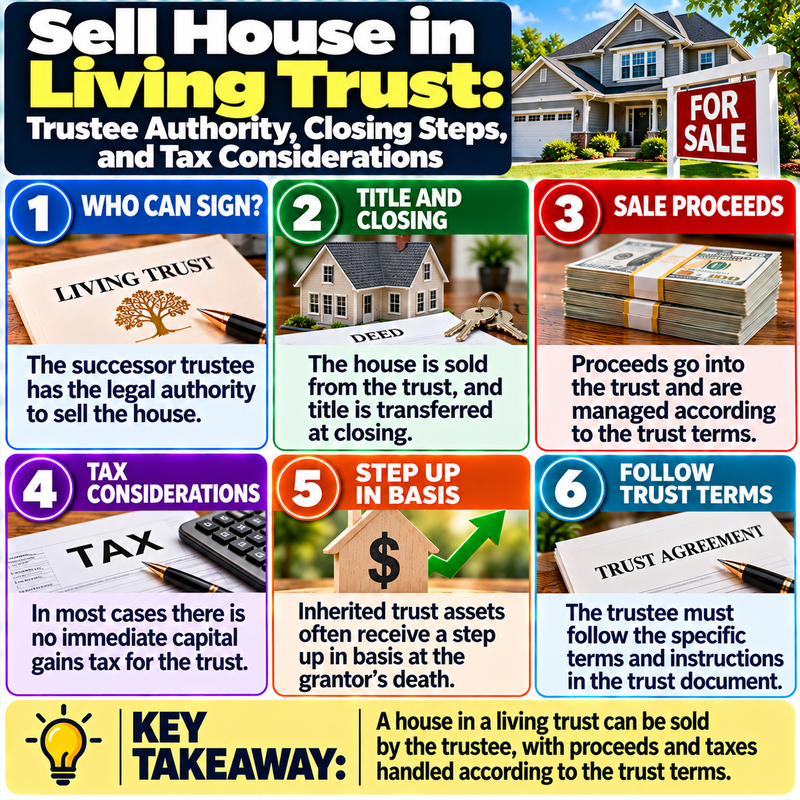
Yes, You Can Sell a House Held in a Living Trust
A living trust doesn’t lock up your house. It’s simply a different way of holding title, and title companies deal with trust-owned properties all the time. The listing process, the negotiations, the inspections, and the closing timeline all look the same as a standard home sale.
Buyers typically don’t notice or care that a home is in a trust. It doesn’t change their loan approval, their title insurance, or how fast the deal closes. The only real difference shows up on the signature line of the closing documents, where the seller is identified by their trustee title rather than just their personal name.
Who Has the Legal Authority to Sell
Before you list the home, you need to know exactly who holds the power to sign for the sale. This depends on whether the grantor is still alive and acting as trustee, or whether a successor trustee has stepped in after death or incapacity.
Grantor as Trustee in a Revocable Trust
In most revocable living trust setups, the person who created the trust also serves as the original trustee. That means if you set up your own trust and funded your house into it, you likely still have full authority to list, negotiate, and sell the property whenever you want. You retain control over trust assets during your lifetime, including the right to sell, refinance, or even remove the house from the trust entirely.
The only adjustment is how you sign. Instead of signing your name alone, you sign as “Jane Doe, Trustee of the Jane Doe Revocable Living Trust.” Everything else about the sale, from the listing agreement to the final closing statement, proceeds exactly as it would for any other homeowner.
Successor Trustee After Death or Incapacity
If the grantor has passed away or become incapacitated, a successor trustee named in the trust document steps into the trustee role. This person has the same selling authority the grantor had, provided the trust grants that power. Successor trustees should read through the trust carefully before listing the property, since some trusts include specific instructions, like offering the home to a particular family member first or waiting until a certain event occurs.
Unlike probate, this transition usually doesn’t require court approval. That’s one of the main advantages of placing a home in a trust in the first place. The successor trustee can move forward with a sale without waiting on a judge’s calendar.
Trustee Authority Under an Irrevocable Trust
Irrevocable trusts work differently. Once a home is placed into an irrevocable trust, the grantor typically gives up direct control over it. The trustee, not the original homeowner, holds the legal authority to manage and sell the property.
Depending on how the trust is written and what state law requires, the trustee may need to get consent from the beneficiaries before listing the home. Any sale from an irrevocable trust also has to follow the specific terms laid out in the trust document, and it can carry different tax consequences than a sale from a revocable trust. If you’re dealing with an irrevocable trust, it’s worth a closer look at the trust language before assuming you have free rein to sell.

Review the Trust Terms and Title Before Listing
Before you put a sign in the yard, pull out the trust document and actually read it. This step gets skipped more often than you’d think, and it can cause headaches later if the trust contains restrictions nobody remembered.
Confirm the Trustee’s Power to Sell Real Property
Most trusts explicitly grant the trustee the power to sell real property, but it’s worth confirming rather than assuming. Look for language that names you as trustee and spells out your authority over trust assets, including real estate. If the trust is unclear or silent on this point, it’s worth getting a second opinion before you sign a listing agreement.
Check for Special Instructions or Restrictions
Some grantors build in specific wishes about what happens to the house. Maybe the trust says the home should be offered to a sibling at a discounted price first, or that it can’t be sold until a certain date or event. These instructions are legally binding, so skipping past them isn’t an option. A successor trustee who sells the home against the trust’s written terms can end up personally liable to the beneficiaries, so this review step isn’t just a formality.
Listing the Home and Signing the Purchase Agreement
Once you’ve confirmed your authority and reviewed any restrictions, listing a trust-owned home looks almost identical to listing any other property. You’ll work with a real estate agent, set a price, market the home, and field offers the same way any seller would.
The purchase agreement itself will identify the seller as the trust, with you signing in your capacity as trustee. Buyers’ agents and lenders are used to seeing this, and it rarely raises questions during negotiations.
A few things tend to come up specifically with trust sales, and it helps to be ready for them:
- The title company may request a copy of the trust or a trust certification earlier in the process than with a standard sale.
- Your name on the purchase agreement should match the exact trustee language used in the trust document.
- If there are co-trustees, both may need to sign unless the trust allows one trustee to act alone.
- Any earnest money deposits and disclosures still flow through the same channels as a non-trust sale.

Signing Documents in Your Trustee Capacity
Every document connected to the sale, from the listing agreement to the closing disclosure, should reflect your trustee capacity rather than just your personal name. This isn’t just a technicality. It confirms to everyone involved, including the title company and the buyer’s lender, that you have the legal standing to transfer the property.
Getting this wrong, even by leaving off the word “trustee,” can create delays at closing while the title company sorts out the discrepancy. It’s a small detail that’s worth double-checking on every signature page.
What Buyers Need to Know About the Trust
Buyers generally don’t need to see the trust document itself, and they don’t need to understand how it works. What matters to them is that the seller has clear legal authority to transfer the property and that title insurance will cover the transaction. From the buyer’s side, a trust sale closes on the same timeline, with the same inspection contingencies and financing steps, as any other home purchase.
What the Title or Escrow Company May Request
Before closing can happen, the title or escrow company needs proof that you’re legally allowed to sign away the property. This isn’t a formality they skip for trust sales; it’s actually one of the first things they’ll ask for once you open escrow. Expect a request for a copy of the trust, or at minimum the pages that name the trustee and spell out selling authority.
Some title companies also want a tax ID number or Social Security number tied to the trust, confirmation of how title is currently vested, and identification for whoever is signing as trustee. None of this holds up the sale by much if you have your paperwork organized ahead of time, but scrambling to find an original trust document the week before closing can add unnecessary stress.
Trustee Certification or Trust Documentation
Handing over your entire trust document to a title company or a buyer’s lender isn’t usually necessary, and most people would rather not share every detail of their estate plan with strangers. That’s where a certification of trust comes in handy. It’s a shorter document that confirms the trust exists, names the trustee, and states that the trustee has authority to sell real property, without disclosing who the beneficiaries are or how assets get distributed.
Certification of Trust vs. Full Trust Copy
Most states recognize certifications of trust as legally sufficient for real estate transactions, and title companies generally prefer them. A full trust copy might run dozens of pages, while a certification is often just one or two. If your title company insists on the complete document anyway, that’s their call to make, but it’s worth asking if a certification will satisfy their requirements first.
Signing the Deed and Closing Documents
When it’s time to sign the deed, your signature block should read with your name followed by your trustee title and the trust’s exact name, matching how title is currently held. A mismatch here, even a small one like leaving off “Revocable” from the trust name, can trigger a last-minute scramble to fix the paperwork.
Closing documents for a trust sale otherwise look like any other settlement statement. You’ll see the sale price, payoff figures, agent commissions, prorated taxes, and net proceeds laid out the same way they would be for a seller who holds title in their own name.

Where the Sale Proceeds Go
Sale proceeds from a trust-owned home typically get deposited into an account titled in the name of the trust, not your personal checking account. This keeps the asset within the trust structure, which matters for both recordkeeping and, in some cases, for maintaining trust protections.
If you’re the grantor and sole trustee of your own revocable trust, this distinction feels pretty seamless since you still control the funds either way. For a successor trustee managing an estate, though, depositing proceeds into a proper trust account is a critical step. Mixing trust money with personal funds, even briefly, can create accounting headaches and raise questions from beneficiaries later.
Once the funds land in the trust account, the trustee is responsible for distributing them according to the trust’s instructions, whether that means splitting proceeds among multiple beneficiaries, covering estate expenses first, or holding funds for a period before distribution.
Paying Off an Existing Mortgage
An existing mortgage on a trust-owned home gets handled at closing exactly the way it would for any other sale. The payoff amount comes directly out of the sale proceeds at the settlement table, and the lender releases its lien once the funds clear. Placing a home into a living trust doesn’t trigger a due-on-sale clause in most cases, since federal law generally protects transfers into a revocable trust for the original borrower’s benefit, but it’s still smart to notify your lender when you first fund the trust so there are no surprises when you eventually sell.
Capital Gains Tax During the Grantor’s Lifetime
Here’s where a lot of confusion creeps in, so let’s clear it up directly: placing your home in a revocable living trust does not create a separate tax entity for capital gains purposes while you’re alive. The IRS treats an ordinary revocable trust as a “grantor trust,” which means the trust is essentially invisible for income tax reporting during your lifetime.
You still report any gain from the sale on your own personal tax return, using your own Social Security number, exactly as you would if the home were titled in your name alone. The trust doesn’t add a layer of tax, and it doesn’t remove one either.
This matters because some homeowners assume that moving property into a trust somehow shelters gains or changes the tax math. It doesn’t. The underlying ownership for tax purposes stays with you as the grantor, even though legal title sits with the trust.
A few points worth keeping straight:
- Trust title alone does not create a new tax owner while the grantor is alive and the trust remains revocable.
- Gain or loss calculations use the same cost basis and holding period you’d use outside of a trust.
- Any 1099-S issued at closing is typically reported under the grantor’s Social Security number.
- Moving the home into or out of a revocable trust is not itself a taxable event.
Why a Revocable Trust Is Invisible to the IRS
The IRS looks past the trust structure for grantor trusts because the grantor retains the power to revoke, amend, or control the trust assets. Since you can take the house back out of the trust at any point, the IRS treats you as the real owner for tax purposes, not the trust itself.
- You retain the right to sell, refinance, or remove property from the trust at will.
- The trust uses your Social Security number rather than obtaining its own taxpayer ID.
- No separate trust tax return is required for income generated by trust assets during your lifetime.
This is different from how an irrevocable trust might be taxed, where the trust can become its own taxpayer with its own filing obligations. If your home sits in an irrevocable trust, the tax picture changes and deserves its own careful review, ideally with a tax professional who can look at the specific trust language and your situation.
For general background on how these trust structures work and differ, the overview at Create A Living Trust’s living trust guide walks through the distinctions in plain language.
None of this is meant as a substitute for professional tax advice specific to your situation, since basis calculations, depreciation history, and prior use of the exclusion can all shift the numbers.

Principal-Residence Exclusion Considerations
The home sale tax exclusion under IRS Section 121 can still apply to a primary residence held in a revocable living trust, but eligibility depends on meeting specific ownership and use requirements, not just on how the title reads. Current IRS guidance allows single filers to potentially exclude up to $250,000 of gain, and married couples filing jointly up to $500,000, when the underlying requirements are met.
It’s worth being careful here: qualifying isn’t automatic just because the home sits in a trust. Nobody should assume the exclusion applies without confirming their specific facts against IRS requirements, ideally with a tax preparer who can review the details.
Meeting the Two-Year Ownership and Use Test
Generally speaking, the IRS looks at whether you owned and used the home as your main residence for at least two of the five years before the sale. Holding the home in trust doesn’t interrupt this test, since you’re treated as the owner for tax purposes throughout the time the revocable trust holds title. What matters is your actual residency and ownership history, not the paperwork describing who holds legal title.
Selling the Home After the Grantor’s Death
Once the grantor passes away, the tax and legal landscape shifts. The trust usually becomes irrevocable at that point, and a successor trustee steps in to manage and potentially sell the property. This is where things diverge noticeably from a lifetime sale by the grantor.
Successor Trustee Responsibilities and Limits
A successor trustee selling the home after death needs to operate within the boundaries the trust sets, and also needs to keep beneficiaries reasonably informed about the process. This typically includes providing an accounting of the sale, the expenses deducted, and how proceeds will be distributed. Trustees who skip this step, even unintentionally, can open themselves up to disputes or legal challenges from beneficiaries who feel left in the dark.
The trustee also needs to watch for any administration expenses that come out of trust assets before distribution, such as outstanding debts, funeral costs, or taxes owed by the estate. These get sorted out according to the trust’s terms and applicable state law before beneficiaries see their share.
Basis Rules and Post-Death Tax Issues
Tax treatment after the grantor’s death looks very different from tax treatment during life, largely because of how basis gets recalculated. This is one of the more valuable tax benefits tied to inheriting property, and it applies whether the home sits in a trust or passes directly through a will.
Current IRS rules allow inherited property to receive a basis adjustment to its fair market value as of the date of death, commonly called a stepped-up basis. This can significantly reduce or even eliminate capital gains tax if the home is sold relatively soon after death, since the taxable gain is calculated using the new, higher basis rather than what the original owner paid decades earlier.
How Stepped-Up Basis Works
Say a home was purchased decades ago for $80,000 and is worth $450,000 at the time of the owner’s death. Heirs who inherit that home generally get a new basis of $450,000, not the original $80,000. If the successor trustee sells the home shortly after death for close to that $450,000 value, there may be little to no taxable gain at all.
This stepped-up basis rule works the same way whether the home was titled in the deceased person’s name alone or held in a revocable living trust. The trust itself doesn’t enhance or diminish this tax benefit; it simply doesn’t change the outcome either way.
Double Step-Up in Community Property States
Married couples living in community property states get an additional advantage worth understanding. In states that recognize community property, when one spouse passes away, both halves of jointly owned community property can receive a stepped-up basis, not just the deceased spouse’s half.
That’s a meaningful difference compared to common law states, where typically only the deceased spouse’s half of jointly owned property gets the basis adjustment. Consider a simplified comparison:
- Common law state: only the deceased spouse’s 50% ownership share receives a stepped-up basis at death.
- Community property state: both the deceased and surviving spouse’s shares can receive a stepped-up basis.
For families in community property states, this double step-up can translate into substantial tax savings if the surviving spouse later sells the home, since the entire basis resets rather than just half of it. Specific eligibility depends on state law and how the property was held, so it’s worth confirming the details with a qualified tax or estate professional rather than assuming it applies automatically.

Beneficiary Rights and Distribution of Proceeds
Beneficiaries named in a trust generally have the right to be informed about major trust transactions, including the sale of real estate, and to receive an accounting of how sale proceeds get distributed. They don’t typically have the right to block a sale outright if the trustee is acting within their authority and following the trust’s terms, but they can raise objections or pursue legal action if they believe the trustee is mismanaging the sale or ignoring the trust’s instructions.
Clear communication tends to prevent most conflicts here. A trustee who shares the listing price rationale, keeps beneficiaries updated during the sale process, and provides a transparent accounting afterward usually avoids the kind of disputes that end up costing everyone time and money in court.
Common Closing Problems With Trust-Owned Homes
Most trust-related home sales close without any unusual hiccups, but a handful of recurring issues do show up often enough to mention. Catching these early saves time once you’re under contract.
Missing or Incomplete Trust Documentation
The most common snag involves outdated or incomplete trust paperwork. If the trust has been amended over the years, the title company needs the most current version, not an old copy sitting in a file somewhere. Missing pages, unsigned amendments, or a certification of trust that doesn’t match the current trustee can all stall a closing while everyone scrambles to track down the right documents.
Disputes Over Trustee Authority
Occasionally, a title company or a buyer’s attorney questions whether the person signing as trustee actually has the authority they claim. This comes up more often with successor trustees, especially if there are co-trustees involved or if the trust language is ambiguous about who can act alone. Resolving this sometimes requires an attorney’s opinion letter or additional documentation before the title company will insure the transaction, which can add days or weeks to the timeline if it’s not caught early.
Seller Checklist Before You List a Trust-Owned Home
Before you call a real estate agent or sign a listing agreement, run through this checklist to make sure you’re set up for a smooth closing:
- Confirm you’re named as trustee (or successor trustee) with authority to sell real property under the trust document.
- Check the trust for any special instructions, restrictions, or conditions tied to the home.
- Pull together a certification of trust or the relevant trust pages the title company will likely request.
- Verify how title is currently held so your signature block matches exactly.
- Confirm the current mortgage payoff amount and notify your lender of the upcoming sale.
- Set up or confirm a trust bank account for receiving sale proceeds.
- If selling after the grantor’s death, gather date-of-death valuation records to establish the stepped-up basis.
- Talk with a tax professional about your specific basis, exclusion eligibility, and any gain before listing.
- Keep beneficiaries informed if you’re acting as a successor trustee managing the sale for an estate.

Selling From a Trust Doesn’t Have to Slow You Down
A living trust is designed to make property transfers simpler, not harder, and that holds true when it comes time to sell. With the right documentation in hand and a clear understanding of your authority as trustee, a trust-owned home sale moves through listing, negotiation, and closing just as smoothly as any other transaction.
Disputes Over Trustee Authority
Occasionally, a title company or a buyer’s attorney questions whether the person signing as trustee actually has the authority they claim. This shows up more often with successor trustees, especially when there are co-trustees involved or when the trust language is vague about whether one trustee can act alone or all must sign together.
Resolving this sometimes requires an attorney’s opinion letter or extra documentation before the title company will insure the transaction. It’s not a deal-breaker, but it can add days or even weeks to your timeline if the question comes up after you’re already under contract instead of before you list.
Seller Checklist Before You List a Trust-Owned Home
Before you call a real estate agent or sign a listing agreement, run through this short checklist so nothing catches you off guard once you’re under contract:
- Confirm you’re named as trustee, or successor trustee, with clear authority to sell real property under the trust document.
- Check the trust for any special instructions, restrictions, or conditions tied specifically to the home.
- Pull together a certification of trust or the relevant trust pages the title company will likely request.
- Verify exactly how title is currently held so your signature block matches it precisely.
- Confirm the current mortgage payoff amount and notify your lender ahead of closing.
- Set up or confirm a trust bank account for receiving sale proceeds.
- If selling after the grantor’s death, gather date-of-death valuation records to establish basis.
- Talk with a tax professional about your specific exclusion eligibility and basis before listing.
- Keep beneficiaries informed throughout the process if you’re acting as a successor trustee.
Selling From a Trust Doesn’t Have to Slow You Down
A living trust exists to make property transfers simpler, not harder, and that holds true when it’s time to sell. With the right trust documentation in hand and a clear understanding of your authority as trustee, a sale moves through listing, negotiation, and closing just as smoothly as it would for any homeowner holding title outright.
The paperwork differences are minor compared to the benefits of avoiding probate and keeping the process moving on your timeline rather than a court’s. Once you know your role and have your documents organized, there’s really nothing unusual left standing between you and a closed sale.
Frequently Asked Questions
Selling a trust-owned home raises a handful of questions again and again, from buyers wondering if the trust changes anything to trustees wondering how taxes shake out. Below are straightforward answers to the ones that come up most often.
If your situation involves an irrevocable trust, multiple trustees, or a sale shortly after a grantor’s death, it’s worth pairing these answers with advice from an attorney or tax professional familiar with your specific trust.
Do I need to remove the house from the trust before selling it?
No. You can sell directly out of the trust without ever transferring title back into your personal name first.
Taking the extra step to remove the home from the trust just adds paperwork, and it can briefly expose the property to probate if something unexpected happens before the sale closes.
Does the buyer need to know the home is in a trust?
Not really. It doesn’t change their financing, their title insurance, or how quickly the deal closes.
The only visible difference shows up in the closing paperwork, where the seller is identified by their trustee title rather than just their personal name.
Can a successor trustee sell the house without going to court?
In most cases, yes, as long as the trust document grants the trustee authority to sell real property without requiring court approval.
What happens to the sale proceeds if the trust has multiple beneficiaries?
Proceeds typically go into a trust account first, then get distributed according to the trust’s instructions once expenses and any debts are paid.
Is selling a house in an irrevocable trust harder than a revocable trust?
It can be more involved, since the trustee may need beneficiary consent and the sale must strictly follow whatever terms the trust spells out.
Will selling the home affect my mortgage or loan terms?
The existing mortgage gets paid off at closing directly from the sale proceeds, exactly as it would in any other home sale.
Placing the home in a revocable living trust generally doesn’t trigger a due-on-sale clause for the original borrower, so there’s usually no lender complication tied specifically to trust ownership.
Do I still qualify for the home sale tax exclusion if the house is in a trust?
Possibly, but eligibility depends on meeting IRS ownership and use requirements, not simply on how title is held.
Current guidance allows up to $250,000 in excluded gain for single filers and up to $500,000 for married couples filing jointly, provided the two-year ownership and use test is met.
What documents does the title company usually ask for?
Most title companies ask for a certification of trust, or occasionally the full trust document, confirming the trustee’s identity and authority to sell.
They may also request a tax ID or Social Security number tied to the trust and confirmation of exactly how title is currently vested.
How is the sale taxed if the grantor has already passed away?
The home generally receives a stepped-up basis to its fair market value as of the date of death, which can significantly reduce or eliminate taxable gain on a later sale.
Married couples in community property states may see both halves of the home’s basis adjusted, not just the deceased spouse’s share, though this depends on how the property was held and applicable state law.
Can beneficiaries force a sale of trust property?
Generally no, not if the trustee is acting within their authority and following the trust’s written terms.
Beneficiaries can raise objections or pursue legal action if they believe the trustee is mismanaging the sale, which is why keeping them informed throughout the process tends to prevent conflicts before they start.
Understanding your trustee authority upfront saves time once you’re ready to list, and reviewing your revocable living trust with the guidance available at Bulletproof Legacy Financial is a solid place to start before you call an agent.
A house held in a revocable living trust can still be sold. The process works almost the same as selling any other property, but there are some additional steps involved. When you decide to sell, it’s important to understand the terms of the trust and how they may affect the sale. For more detailed information, you can refer to this guide on selling a house in a living trust.