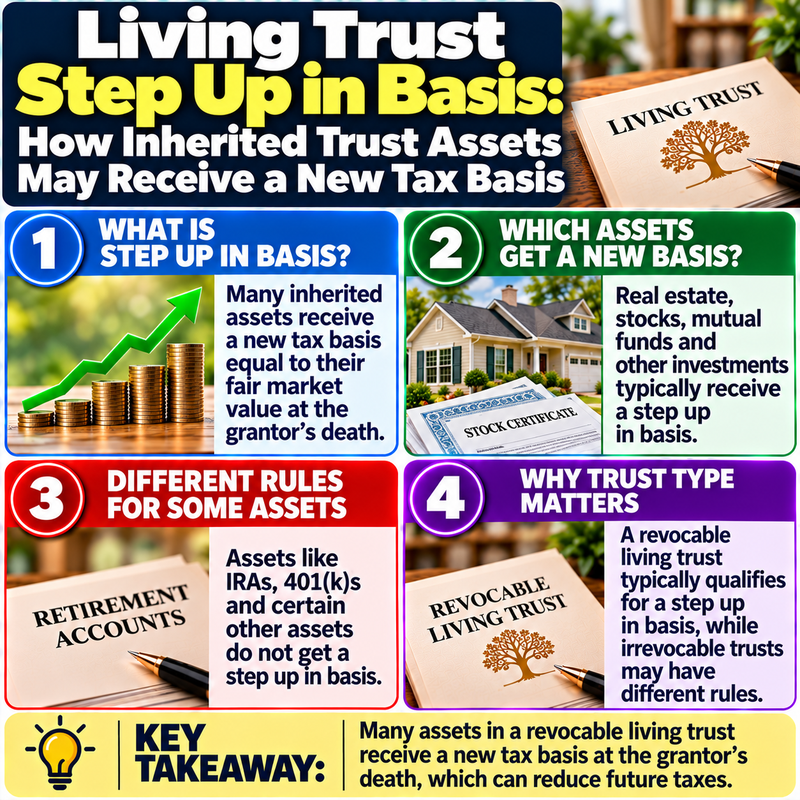
Living Trust Step Up in Basis: How Inherited Trust Assets May Receive a New Tax Basis
Learn When Inherited Trust Assets May Receive a Basis Adjustment, Which Assets Follow Different Rules, and Why Trust Type Matters
Key Takeaways
- A living trust itself does not create a step-up in basis — it’s your continued ownership for tax purposes that keeps this benefit available at your death.
- Step-up in basis means an inherited asset’s taxable value resets to its fair market value on the date of death, often erasing decades of taxable gain.
- Basis can move in either direction — assets that lost value receive a step-down, not a step-up, which permanently eliminates that loss for the heir.
- Retirement accounts like IRAs and 401(k)s don’t follow these rules at all; they’re taxed as income in respect of a decedent regardless of how they’re titled.
- Later in this guide, you’ll see how jointly owned property, community property states, and irrevocable trusts can each produce very different basis outcomes.
Putting a house, a brokerage account, or a rental property into a trust doesn’t automatically change how the IRS taxes it when you die — and that surprises a lot of people who assume “trust” means “tax shelter.”
If you’re building or reviewing a revocable living trust, understanding basis adjustment matters just as much as understanding probate avoidance, because it directly affects how much your heirs pay in capital gains tax after you’re gone. Resources like CreateALivingTrust.com walk families through exactly where these tax rules intersect with trust planning, which is a detail many basic trust templates gloss over entirely.
Quick Answer: Does a Living Trust Get a Step-Up in Basis?
Yes — assets held in an ordinary revocable living trust generally receive a step-up in basis at the grantor’s death, because those assets are still considered part of the grantor’s taxable estate under federal tax law. The trust is a legal container, not a tax shield. What matters to the IRS is whether you retained enough control and economic benefit over the asset while you were alive, not what the title on the deed or account says.
What Cost Basis Means
Tax basis is simply the dollar figure used to calculate gain or loss when you sell something. If you bought a stock for $10,000 and sold it for $40,000, your basis is $10,000 and your taxable gain is $30,000. Basis isn’t always a fixed number, though — it moves over time based on improvements, depreciation, and other adjustments the tax code recognizes.
Think of basis as a running scorecard. Every dollar you put into fixing up a rental property adds to it. Every dollar of depreciation you claim on that same property subtracts from it. By the time you sell or pass away, your adjusted basis might look nothing like your original purchase price.
Original Basis vs. Adjusted Basis
Original basis is what you paid (or the value assigned when you received the asset as a gift). Adjusted basis accounts for everything that happened afterward — capital improvements, depreciation deductions, stock splits, or partial sales. This distinction matters enormously for inherited assets, since death doesn’t just preserve the original number; it can reset the entire calculation.
How Basis Determines Your Taxable Gain
Taxable gain is calculated as sale price minus adjusted basis. A higher basis means less taxable gain, and a lower basis means more. This is exactly why the step-up rule matters so much financially — it can mean the difference between owing tax on $500,000 of appreciation and owing nothing at all.
What “Step-Up in Basis” Actually Refers To
Under Internal Revenue Code Section 1014, property acquired from a decedent gets a new basis equal to its fair market value on the date of death. This applies broadly across asset types included in the gross estate.
- Stocks, bonds, and mutual funds reset to their date-of-death market value.
- Real estate — both personal residences and investment property — gets revalued at death.
- Business interests, including many partnership and sole-proprietorship assets, can qualify.
- Collectibles, art, and jewelry are included in the step-up rule as well.
- Personal property like vehicles and furniture technically qualifies too, though it’s often adjusted downward due to wear and depreciation.
All the appreciation that built up during the decedent’s lifetime simply disappears from an income tax standpoint. No capital gains tax gets paid on it, no depreciation recapture gets triggered, and the heir starts fresh with a clean basis number.
IRC Section 1014 Explained
Section 1014 is the specific statute the IRS relies on to justify this treatment. It was briefly repealed in 1976 before that repeal was undone, and it has remained a stable, well-established part of the tax code since. It’s worth noting this is fundamentally an income tax rule, not an estate tax rule — it exists independently of whether your estate owes any federal estate tax at all.
Why Inherited Assets Get a New Starting Value
The logic behind Section 1014 is that taxing unrealized appreciation at death, on top of potential estate tax, would amount to taxing the same economic gain twice. Instead, Congress chose to let income tax basis reset entirely, while estate tax (for estates large enough to owe it) handles taxation of the overall estate value separately.

Why Revocable-Trust Assets Can Still Be Included in the Decedent’s Estate
A lot of people assume that once an asset is “in the trust,” it’s somehow separate from them personally. For an ordinary revocable living trust, that’s not how the IRS sees it. Because you retain the power to amend, revoke, or control the trust during your lifetime, the IRS treats those assets as though you still own them directly for tax purposes.
This is actually good news. It means assets in your revocable living trust remain eligible for the same step-up treatment they would have received if you’d simply owned them in your own name. The trust accomplishes probate avoidance and management continuity without sacrificing this valuable tax benefit.
Where people get confused is in thinking that trust ownership alone changes tax outcomes. It doesn’t, at least not for revocable trusts. The real dividing line in the tax code is control, not title — and that distinction becomes especially important when comparing revocable and irrevocable trust structures, which follow very different rules.
The Difference Between Trust Title and Tax Ownership
Title tells you whose name is on the paperwork. Tax ownership asks a different question: who had the power to change, revoke, or benefit from the asset while alive? With a revocable trust, you answer yes to that question until the day you die, which is precisely why the IRS still counts those assets as part of your gross estate.
Illustrative example: Maria transfers her rental duplex, originally purchased for $150,000, into her revocable living trust. Twenty years later she passes away, and the property is worth $480,000. Because the duplex remained part of her taxable estate, her son inherits it with a new basis of $480,000 — not $150,000. If he sells shortly after for $485,000, he owes capital gains tax on roughly $5,000, not $335,000. This example is illustrative only and not tax advice; actual outcomes depend on individual circumstances and current law.
That gap between $5,000 and $335,000 in taxable gain is the entire point of understanding how basis adjustment interacts with trust planning. Skipping this detail in estate planning conversations can cost families real money.
Why a Revocable Trust Offers No Special Tax Benefit
It’s worth being direct here: a revocable living trust doesn’t create extra tax savings beyond what you’d get from outright ownership. Its value lies in avoiding probate court, keeping your affairs private, and providing a smooth transition if you become incapacitated. The step-up in basis happens because the assets are still part of your taxable estate — the trust simply doesn’t interfere with that outcome one way or the other.

Fair-Market-Value Basis Rules at Death
Fair market value, for basis purposes, means what a willing buyer would pay a willing seller on the open market, with neither party under pressure to act. For publicly traded securities, this is straightforward — it’s the closing price on the date of death. For real estate, closely held business interests, or collectibles, it usually requires a professional appraisal.
How the Date-of-Death Value Is Determined
Executors typically obtain documentation close to the date of death: brokerage statements showing account values, real estate appraisals reflecting market conditions on that specific date, and business valuations where applicable. This documentation becomes critical later if the IRS ever questions the basis an heir claims on a future sale.
The Alternate Valuation Date Option
Under IRC Section 2032, an executor can elect to value the entire estate six months after death instead of on the date of death itself, but only if doing so reduces both the gross estate value and the estate tax owed. This is a narrow tool used mainly in larger estates where asset values dropped significantly in the months following death, and it applies estate-wide rather than asset-by-asset.
Appreciated vs. Depreciated Property
Step-up in basis sounds like it only works in one direction, but that’s a misconception worth clearing up early. Basis adjusts to match fair market value at death — and that can mean the number goes up, down, or in rare cases, stays about the same.
Step-Up for Assets That Gained Value
When an asset’s value increased during the decedent’s life, the heir’s new basis reflects that higher value, erasing the taxable gain that would otherwise have existed. This is the scenario everyone focuses on, and it’s genuinely the more common outcome for assets held long-term, like real estate or stock portfolios that have appreciated over decades.
Step-Down for Assets That Lost Value
The flip side is less talked about but just as real. If an asset’s fair market value at death is lower than the decedent’s original basis, the heir’s basis steps down to that lower figure — and the built-in loss simply vanishes. Nobody gets to claim it. If Dad bought stock for $80,000 and it’s worth $50,000 when he dies, his heir’s basis is $50,000, not $80,000. That $30,000 loss is gone for good, which is why selling a severely depreciated asset before death (rather than holding it) sometimes makes more financial sense for a family, depending on their broader tax picture.
Assets That Follow Different Basis Rules
Not everything inherited gets this treatment, and assuming otherwise can lead to an unpleasant tax surprise. Certain asset categories are carved out of Section 1014 entirely, following their own distinct rules regardless of whether they sit inside a trust, a will, or neither.
Retirement Accounts
IRAs, 401(k)s, 403(b)s, and similar retirement accounts don’t receive a step-up in basis, full stop. It doesn’t matter if the account is payable directly to a beneficiary or routed through a living trust — the IRS treats these as income in respect of a decedent, meaning the money was always going to be taxed as ordinary income whenever it’s withdrawn, by the original owner or by whoever inherits it.
Income in Respect of a Decedent
Income in respect of a decedent, often abbreviated IRD, refers to income the decedent had a right to receive but hadn’t yet received or reported before death. This includes retirement account balances, unpaid salary or bonuses, uncollected business receivables, and deferred annuity gains.
IRD items carry their original tax character forward to the beneficiary. If your father had $400,000 in a traditional IRA, that entire amount remains taxable as ordinary income when withdrawn, whether he withdraws it himself at 75 or his daughter withdraws it after inheriting it. The step-up rule simply doesn’t apply here, and no amount of trust planning changes that outcome.
Annuities follow this same IRD logic. The deferred gain inside a non-qualified annuity is still taxable to whoever eventually receives the funds, trust or no trust. This is one of the more important distinctions families need to understand, because it’s easy to assume all inherited assets behave the same way when they clearly don’t.

Jointly Owned and Community-Property Considerations
Ownership structure outside of trusts also changes how basis adjustment plays out, and this is an area where state law matters as much as federal tax law. Jointly owned property and community property follow genuinely different rules from one another, and getting this wrong can mean paying tax that wasn’t actually owed.
Married couples especially need to pay attention here, since the state they live in can produce dramatically different basis outcomes for the exact same asset and the exact same death.
This is a case where generic advice falls short — ownership form, state of residence, and how title was actually held all factor into the final answer, which is why confirming details with a qualified estate or tax professional is worth the time before making assumptions.
Step-Up Rules for Jointly Held Property
For jointly held property between non-spouses (say, two siblings who co-own a vacation home), typically only the deceased owner’s fractional share receives a step-up. If two siblings each own 50% and one dies, only that 50% interest gets revalued to fair market value — the surviving sibling’s 50% basis stays exactly where it was.
For married couples holding property as joint tenants with right of survivorship (outside community property states), generally only half the property’s value steps up at the first spouse’s death, leaving the surviving spouse’s original basis on the other half unchanged.
Full Step-Up in Community-Property States
Community property states — including California, Texas, Arizona, and several others — handle this differently and more generously for surviving spouses. Both halves of community property receive a full step-up in basis when one spouse dies, not just the deceased spouse’s half. This “double step-up” can be a meaningful planning advantage for married couples in these states, and it’s one more reason location matters when structuring a trust.
Real Estate in a Living Trust
Real estate is often the single largest asset in a family’s estate, and it’s usually where basis adjustment makes the biggest financial difference. Whether it’s a primary residence or a rental property, placing real estate into a revocable living trust doesn’t change how basis adjusts at death — but it’s worth understanding how the rule plays out for each property type.
How Step-Up Applies to a Primary Residence
A primary residence held in a revocable living trust receives the same step-up treatment it would have gotten through outright ownership. If a couple bought their home decades ago for $120,000 and it’s worth $650,000 when the surviving spouse passes, the heirs’ basis becomes $650,000 — eliminating over half a million dollars of what would otherwise be taxable gain.
This is precisely why transferring a home into a revocable living trust tends to make sense for homeowners who want to avoid probate without giving up this tax benefit. The trust handles the transfer efficiently after death while the step-up rule handles the tax side automatically.
How Step-Up Applies to Investment Properties
Rental and investment real estate benefit from step-up in basis too, and the financial impact here can be even larger because these properties typically carry accumulated depreciation that’s been reducing basis for years. Once the property passes to an heir, that depreciation history is wiped clean — the heir starts fresh with a new basis equal to fair market value and begins depreciating the property all over again from that new, higher number.
This “depreciation reset” is often overlooked but genuinely valuable. A rental property owner who’s been depreciating a building down toward zero basis for 25 years hands their heir a brand-new depreciation schedule, starting from current market value, which can meaningfully reduce the heir’s future taxable rental income.
It’s worth noting that land itself isn’t depreciable, so the step-up here primarily affects the improvements — the building, not the dirt underneath it — though both components get revalued to fair market value at death.

Irrevocable Trusts and Why Basis Results Can Differ
Everything discussed so far applies to ordinary revocable trusts, where the grantor retains control. Irrevocable trusts are a fundamentally different animal, and basis outcomes can diverge sharply depending on how the trust is structured.
The general principle is this: if you give up enough control and ownership rights that the asset is removed from your taxable estate, you also generally give up the step-up in basis for that asset. There’s a trade-off baked into irrevocable trust planning that families need to weigh carefully.
- Assets transferred to a properly structured irrevocable trust may be excluded from the grantor’s taxable estate, which can reduce estate tax exposure for larger estates.
- Excluding the asset from the estate generally means it does not receive a step-up in basis at the grantor’s death.
- Some modern irrevocable trust designs (such as certain grantor trusts with retained powers) are structured specifically to preserve step-up eligibility while still achieving other planning goals.
- Whether a specific irrevocable trust preserves or forfeits step-up treatment depends entirely on its drafting and the powers retained by the grantor.
This is exactly the kind of decision where the choice between structures isn’t one-size-fits-all. Comparing a revocable trust against an irrevocable trust side by side, specifically around how each handles basis at death, is essential before deciding which structure fits a family’s actual estate size and goals.
For most families whose estates fall well under current federal exemption levels, giving up the step-up in basis to avoid an estate tax that likely wouldn’t apply anyway rarely makes sense. Irrevocable trusts tend to earn their keep in larger estates, or in situations involving asset protection, Medicaid planning, or specific family circumstances — not as a default choice.
When Assets Leave Your Taxable Estate
Illustrative example: James transfers a commercial building worth $900,000 into an irrevocable trust for his children, giving up all control and retained interest. Ten years later he dies, and the building is now worth $1,400,000. Because the building was removed from his taxable estate at the time of transfer, his children’s basis remains at James’s original cost — not the $1,400,000 value at his death. If they sell for $1,420,000, they owe capital gains tax on roughly $520,000 of appreciation (assuming an original basis near $900,000), rather than the small gain a step-up would have produced. This example is illustrative only and not tax advice; actual results depend on trust terms, timing, and current law.
That’s a dramatic difference compared to the duplex example from earlier in this guide, and it illustrates exactly why the irrevocable trust decision shouldn’t be made lightly or copied from someone else’s plan without reviewing the specifics.
Some families end up using a combination approach — keeping most assets in a revocable trust to preserve the step-up, while using a targeted irrevocable trust for specific assets or goals where estate tax reduction outweighs the basis cost. There’s no universal right answer here; it depends on estate size, asset types, and family priorities.
The IRS has also shown increasing scrutiny toward irrevocable trust structures that try to have it both ways — claiming estate tax exclusion while attempting to preserve step-up benefits without proper legal grounding. Working with a professional familiar with current IRS guidance helps avoid structures that could later be challenged or unwound.
Trade-Offs Between Tax Savings and Control
Every irrevocable trust decision boils down to a trade: you’re exchanging some combination of control, flexibility, and step-up basis eligibility for potential estate tax savings or asset protection. For families well under the federal exemption threshold, that trade usually isn’t worth making. For families with larger, more complex estates, it might be exactly the right move — but it should be a deliberate choice, not a default one.
Basis Reporting and Recordkeeping
None of this step-up benefit means much if nobody can prove what the asset was actually worth at the date of death. Good recordkeeping isn’t optional here — it’s what stands between an heir and a potential dispute with the IRS years down the road when the asset eventually sells.
Documents You Need After a Death
Executors and trustees should gather and preserve specific documentation close to the time of death, since memories fade and records get harder to recreate later.
- Brokerage and bank statements showing account balances as of the date of death.
- Professional real estate appraisals reflecting market value on or near the date of death.
- Business valuation reports for any closely held business interests.
- Copies of the estate tax return (Form 706), if one was filed, since it documents reported values.
- Purchase records and improvement receipts for the original owner’s cost basis history, in case alternate valuation or partial step-down calculations are needed.
Why Appraisals and Purchase Records Matter
An appraisal obtained months or years after death carries far less weight than one obtained close to the date of death, since markets shift and the IRS expects documentation that reflects actual conditions at the relevant time. Waiting too long to establish value can leave an heir scrambling to reconstruct numbers that should have been locked in immediately.
Purchase records matter too, even after a step-up, because they help establish whether a step-up or a step-down applies in the first place. Without knowing the original basis, nobody can determine whether fair market value at death was higher or lower than what the decedent originally paid.
Executors who skip this documentation step often create real problems for heirs down the line. An IRS inquiry years after a sale, with no appraisal or valuation on file, can turn a straightforward step-up situation into a drawn-out dispute over what the asset was actually worth on a specific day that’s long since passed.
Illustrative example: Priya inherits her mother’s house through a revocable living trust in 2024. The trustee obtains a formal appraisal valuing the property at $610,000 as of the date of death, documents it in the trust’s records, and keeps the mother’s original 1995 purchase paperwork showing a $175,000 basis. When Priya sells the house in 2027 for $640,000, she can clearly show her basis was $610,000, resulting in a taxable gain of only $30,000 — fully supported by documentation if the IRS ever asks. This example is illustrative only and not tax advice; outcomes depend on individual facts and applicable law at the time of sale.
Working with a knowledgeable estate planner when setting up a revocable living trust gives families a head start on this documentation process, since good trust administration naturally builds in the records heirs will eventually need. Services like CreateALivingTrust.com are built around helping families set up these structures correctly from day one, so the tax benefits already baked into the law don’t get lost through sloppy paperwork or missed deadlines.
If you’re putting together or revisiting a living trust, understanding how step-up in basis actually works — and where it doesn’t apply — is one of the most valuable things you can do to protect your family’s financial future, and a resource like CreateALivingTrust.com can help you get those details right from the start.

Examples Illustrating Potential Capital-Gain Differences
Numbers tend to make abstract tax rules click in a way explanations alone can’t. The timing of a sale after inheriting an asset changes the math significantly, even when the step-up rule applies the same way in both cases.
Below are two illustrative scenarios showing how the same inherited asset can produce very different tax outcomes depending on when the heir decides to sell.
Selling an Inherited Asset Right Away
When an heir sells shortly after inheriting, the sale price and the stepped-up basis tend to be close to each other, since fair market value hasn’t had much time to shift. This typically means a small taxable gain or even a small loss, depending on selling costs and minor market movement.
This is one reason families sometimes choose to sell inherited real estate or investment accounts fairly quickly — not just for convenience, but because the tax consequences tend to be minimal when the sale happens close to the date-of-death valuation.
Illustrative example: Daniel inherits his father’s brokerage account through a revocable living trust. The account’s stepped-up basis is set at $340,000 based on the date-of-death statement. Daniel sells the holdings three weeks later for $342,500. His taxable gain is just $2,500, even though the original shares had been purchased decades earlier for roughly $95,000. This example is illustrative only and not tax advice; actual results depend on market timing and individual circumstances.
Selling an Inherited Asset Years Later
Waiting to sell changes the equation. Once the step-up locks in the basis at death, any further appreciation that happens after that point becomes taxable gain for the heir, just like it would for any other asset they purchased themselves.
This doesn’t erase the benefit of the step-up — it simply means the clock resets at death and starts running again from that new number. An heir who holds the asset for years afterward is only taxed on growth that happened on their watch, not during the decedent’s lifetime.
There’s also a secondary consideration worth mentioning: assets held by an heir for longer than one year after inheriting typically qualify for long-term capital gains rates automatically, regardless of how briefly the heir has actually owned the asset, since inherited property is treated as long-term by default under current IRS rules.
When a CPA or Estate Attorney Should Be Involved
Basis rules get complicated fast once jointly owned property, community property states, irrevocable trusts, or business interests enter the picture, and that’s exactly when guessing becomes expensive. Bringing in a CPA familiar with estate taxation, alongside an estate planning attorney who understands how your specific trust is drafted, helps confirm which rules actually apply to your family’s assets before a sale happens rather than after.

Frequently Asked Questions
These are some of the most common questions families ask once they start digging into how basis adjustment works alongside trust planning.
Does Putting My House in a Living Trust Avoid Capital Gains Tax?
Not on its own, no. A revocable living trust doesn’t eliminate capital gains tax during your lifetime, and it doesn’t create a special tax exemption just because the home is titled in the trust’s name. What it does preserve is your eligibility for the step-up in basis at death, since the home remains part of your taxable estate.
If you sold the home while alive, through the trust or otherwise, you’d still owe capital gains tax on any appreciation above your basis, subject to the usual home-sale exclusion rules if it’s your primary residence.
The real benefit shows up after death, when your heirs inherit the stepped-up value rather than your original purchase price.
So the trust itself isn’t the tax tool — it’s the vehicle that keeps the asset in your estate, which is what triggers the step-up in basis when the time comes.
Illustrative example: Tom’s home, held in his revocable trust, was purchased for $200,000 and is worth $575,000 at his death. His heirs inherit it with a $575,000 basis. If Tom had instead sold the home himself the year before he passed, he would have owed capital gains tax on the $375,000 of appreciation, minus any available home-sale exclusion. This example is illustrative only and not tax advice.
Do Beneficiaries Pay Taxes on Inherited Trust Assets?
Generally, beneficiaries don’t owe income tax simply for inheriting an asset. Tax exposure usually only arises later, if and when they sell the asset for more than their stepped-up basis, or when they withdraw income-in-respect-of-a-decedent items like retirement account funds.
What Happens If an Asset’s Value Drops Before Death?
If fair market value at death is lower than the decedent’s original basis, the heir’s basis steps down to match that lower value, and the built-in loss is permanently forfeited — nobody gets to claim it on a future tax return. For more information on how the stepped-up basis works, you can refer to detailed guides.
Does an Irrevocable Trust Get a Step-Up in Basis?
It depends entirely on the structure. Assets genuinely removed from the grantor’s taxable estate typically don’t receive a step-up, while certain specially drafted irrevocable trusts that retain specific grantor powers may still preserve it. This is a detail that requires careful legal drafting, not assumption.
Do Retirement Accounts Ever Get a Step-Up in Basis?
No. IRAs, 401(k)s, and similar retirement accounts are treated as income in respect of a decedent and never receive a step-up in basis, regardless of how they’re titled or who inherits them.
How Is Step-Up Basis Calculated for Jointly Owned Property?
For non-spouse joint owners, typically only the deceased owner’s fractional interest receives a step-up, while the surviving owner’s share keeps its original basis. Spousal joint ownership follows different rules depending on whether the couple lived in a community property state.
What Is the Alternate Valuation Date and When Is It Used?
Under IRC Section 2032, an executor can elect to value an entire estate six months after death instead of on the actual date of death, but only if doing so reduces both the gross estate value and the resulting estate tax liability.
This election applies to the whole estate rather than individual assets, and it’s used far less often than the standard date-of-death valuation, mainly in cases where markets declined sharply in the months following a death.
Can I Lose the Step-Up by Gifting an Asset Before Death?
Yes, potentially. Lifetime gifts carry over the donor’s original basis to the recipient rather than resetting to fair market value, which is very different from how inherited assets are treated. Giving away a highly appreciated asset while alive, rather than letting it pass at death, can actually eliminate the step-up benefit entirely for that recipient.
This is one of the more counterintuitive traps in estate planning — trying to “get ahead” of estate taxes by gifting assets early can sometimes cost a family more in capital gains tax than it saves in estate tax, especially for families whose estates already fall well under current exemption thresholds.
How Do I Prove the Stepped-Up Value to the IRS?
Documentation obtained close to the date of death — brokerage statements, professional appraisals, and estate tax filings if applicable — serves as the evidence needed to substantiate a stepped-up basis if the IRS ever questions a later sale.
Should I Choose a Revocable or Irrevocable Trust for Tax Purposes?
For most families whose estates fall under current federal exemption levels, a revocable trust preserves the step-up benefit without sacrificing anything, making it the more straightforward choice. Irrevocable trusts make more sense for larger estates facing genuine estate tax exposure, or for specific goals like asset protection, where giving up the step-up is a worthwhile trade-off.
Comparing the two structures directly against your family’s actual asset values, rather than relying on generic advice, is the only reliable way to know which approach fits your situation.
Working through these details with a professional before finalizing your trust documents tends to save families far more than it costs, especially once real estate or business interests are involved.
Getting this right from the start is exactly where CreateALivingTrust.com can help families build a trust that protects both their privacy and their tax position for years to come.