Pour-Over Will Explained: How It Supports a Living Trust and Handles Unfunded Assets
Learn Why Trust-Based Estate Plans Still Use a Will—and Why Assets Passing Through It May Still Require Probate
A pour-over will acts like a safety net for your living trust, scooping up any stray assets you forgot to transfer and sending them into the trust after you pass away.
If you’ve already set up a living trust, you might wonder why your estate planning attorney still handed you a will. It seems redundant, right? Not quite. A pour-over will exists specifically to catch anything that slipped through the cracks during your lifetime, whether that’s a car you bought last year or an inheritance you never got around to retitling.
Companies like Bulletproof Legacy build pour-over wills directly into their trust planning packages because they know funding a trust is an ongoing process, not a one-time event. People forget. Life moves fast. A pour-over will accounts for that reality.
Article-at-a-Glance
- A pour-over will directs leftover assets into your living trust after death, but those assets typically still pass through probate first.
- Trust-based estate plans almost always include a pour-over will as a backup document, not as a probate-avoidance tool.
- Pour-over wills can also handle tasks a trust cannot, like naming a guardian for minor children.
- Properly funding your trust during your lifetime is what actually avoids probate, not the pour-over will itself.
- Later in this article, you’ll find a trust-funding checklist to help you coordinate your documents correctly.
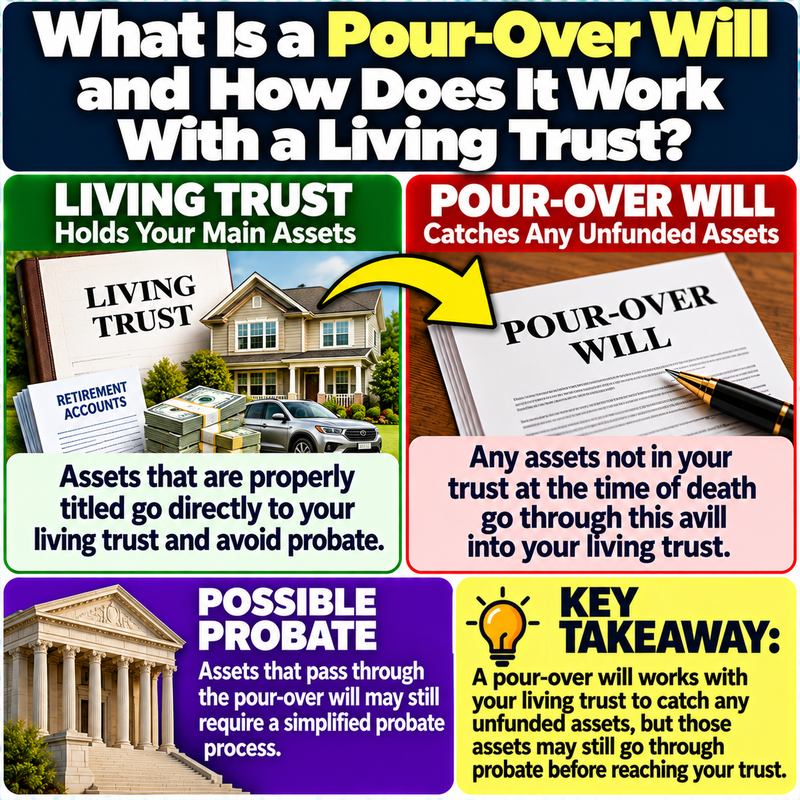
Pour-Over Will Definition
A pour-over will is a legal document that works alongside a living trust. Its job is simple: any property still titled in your individual name at the time of your death gets “poured” into your trust, where it then gets distributed according to the trust’s instructions.
Think of it as a funnel. Your living trust is the container holding most of your assets, but the pour-over will makes sure nothing gets left on the counter.
How It Connects a Will to a Living Trust
Your living trust names a trustee who manages and distributes assets according to terms you set while you were alive. A pour-over will names that same trust as the beneficiary of anything left outside it. When you pass away, the will’s job is to identify those stray assets and direct them to the trust.
- The trust document controls how assets are ultimately distributed.
- The pour-over will controls what happens to assets that never made it into the trust.
- Together, they’re designed to work as a single coordinated plan rather than two separate documents.
Without this connection, any asset left outside your trust at death would be treated as though you had no instructions for it at all, which creates problems we’ll cover shortly.
Why It’s Called a “Pour-Over” Document
The name comes from the action itself. Assets “pour over” from your individual ownership into your trust, much like water pouring from one container into another. It’s a visual way to describe a legal mechanism that otherwise sounds pretty dry.
Attorneys sometimes call these “backup wills” or “safety-net wills” for the same reason. The terminology varies, but the function stays consistent across states.
Why a Living-Trust Plan Still Needs a Will
Here’s where a lot of people get confused. If the whole point of a revocable living trust is to avoid probate, why do you need a will at all?
The answer is that trusts only control assets that have actually been retitled into the trust’s name. Anything you forget, anything you acquire late in life, or anything you intentionally leave outside the trust for convenience needs a backup plan. That’s the will’s job.
Closing the Gaps a Trust Alone Can’t Cover
Trusts are powerful, but they’re not automatic. You have to physically transfer each asset into trust ownership, and people frequently miss things. Maybe you buy a vehicle and forget to retitle it. Maybe you inherit land from a relative and never get around to deeding it to the trust. Maybe you open a new bank account and skip the paperwork to name the trust as owner.
In every one of these situations, the asset technically belongs to you as an individual, not to your trust, at the moment of death. That’s exactly the gap a pour-over will is built to close.
What the American Bar Association Says About Trusts and Probate
The American Bar Association has noted that a living trust can almost never totally avoid probate, and that a simple will is typically needed to pour into the trust any property that wasn’t transferred during life. This isn’t a flaw in trust planning; it’s simply an acknowledgment that no plan is airtight without a backup mechanism.

How the Pour-Over Process Works After Death
When someone with a pour-over will passes away, a specific sequence of events unfolds. Understanding this sequence helps explain why the pour-over will is described as a backup rather than a shortcut.
The process generally moves through four stages, though timing varies by state and by the complexity of the estate.
Step 1: The Will Is Filed With the Probate Court
Just like a traditional will, a pour-over will must be filed with the probate court after death. This step is required regardless of whether a trust exists. The court reviews the document and formally appoints the executor named in the will.
This is often the point where people realize a pour-over will doesn’t actually skip probate. It simply directs where probate assets eventually go.
Step 2: The Executor Identifies Leftover Assets
Once appointed, the executor’s first task is identifying which assets were never transferred into the trust. This might include a newly purchased car, an inherited piece of property, or a forgotten savings account. The executor compiles these assets as part of the probate estate.
Step 3: Assets Are Transferred Into the Living Trust
After the probate court completes its review, usually after creditor claims are addressed and any required waiting periods pass, the executor transfers the identified assets into the trust. This is the “pour-over” moment the document is named for.
Depending on your state, this step can take anywhere from a few months to over a year, especially if the estate includes real property or if creditors file claims against it.
If you’re still building your plan and haven’t retitled major assets yet, reviewing how to create a living trust can help you understand which assets need direct transfer now versus relying on the pour-over backup later.
Step 4: The Successor Trustee Takes Over Distribution
Once assets land inside the trust, the executor’s job is essentially done. The successor trustee then takes over, managing and distributing all trust assets, including the newly poured-over property, according to the instructions you laid out in the trust document.
Why Assets Passing Through the Will May Still Require Probate
This is the single most important distinction to understand about pour-over wills: they do not avoid probate. They route assets through probate and then into the trust.
A pour-over will is a backup plan, not a bypass plan. Assets it covers still go through the probate court before reaching your trust.
People sometimes assume that naming a trust as beneficiary in their will somehow shields assets from probate court involvement. It doesn’t. The property is still part of your individually owned estate at death, which means it’s still subject to your state’s probate rules.
Pour-Over Wills Do Not Avoid Probate
To be direct about it: if an asset is covered only by your pour-over will, it has to go through probate first. The will simply tells the court where that asset should end up once probate concludes, which is inside your trust.
This is different from assets that were properly retitled into the trust while you were alive. Those assets bypass probate entirely because the trust already legally owns them at the moment of your death.
- Properly funded trust assets: skip probate, go directly to trustee management.
- Pour-over will assets: go through probate first, then transfer to the trust.
- Unfunded assets with no pour-over will: distributed according to state intestacy law instead.
How State Probate Laws Affect Timing and Cost
Every state handles probate differently. Some states have streamlined processes for smaller estates, while others require formal court supervision regardless of estate size. The time and cost involved in moving pour-over assets through probate depends heavily on where you live and how your estate is structured.
Small-Estate Exceptions That May Speed Things Up
Many states offer simplified or expedited probate procedures when the value of assets left outside the trust falls below a certain threshold. If your pour-over will only needs to catch a small, low-value asset, like a forgotten bank account, your state’s small-estate affidavit process might apply instead of full formal probate. This can shorten the timeline considerably, though rules and thresholds vary widely by state.

Examples of Property That Might Be Caught by the Pour-Over Will
It helps to see concrete examples of what actually ends up needing a pour-over will’s help. These aren’t hypothetical edge cases, they’re common situations that trip up even well-organized people.
Assets Acquired Shortly Before Death
Say you buy a vacation condo six months before passing away and never get around to retitling it into your trust. That property is now sitting outside your trust, owned individually. Your pour-over will catches it, directs it through probate, and eventually sends it into the trust where your beneficiaries receive it according to your trust terms.
Property Accidentally Left Out of the Trust
Sometimes it’s not about timing, it’s about human error. You might sign your trust documents, transfer your house and investment accounts, and genuinely believe you’re done. But a secondary savings account, a small life insurance policy without a named beneficiary, or an old stock certificate gets overlooked. These oversights happen constantly, and they’re exactly why estate attorneys insist on including a pour-over will even when someone feels confident their trust is fully funded.
Vehicles and Other Individually Titled Items
Vehicles are a classic example because people rarely think to retitle a car into a trust’s name. Most states also don’t require it for everyday driving purposes, so it’s easy to forget. The same goes for boats, recreational vehicles, and other titled personal property.
- Cars, trucks, and motorcycles still registered in your individual name
- Boats or personal watercraft with separate titling requirements
- Collectibles or valuable personal property never formally assigned to the trust
None of these items are usually worth enough to cause major probate delays on their own, but they still legally require the pour-over will to redirect them properly.
If several of these smaller items add up, though, the executor may need to go through a more formal probate process than expected, which is worth keeping in mind when deciding whether to retitle assets now versus leaving them for the pour-over will to handle later.
Inherited Property Never Retitled Into the Trust
Inheritances create a unique gap. If you inherit land, a bank account, or other property from a parent or relative, that asset typically arrives titled in your name, not your trust’s name. Unless you take the extra step of transferring it into your trust, it remains individually owned.
This is one of the most common scenarios Bulletproof Legacy’s planning materials specifically address, since people often assume inherited assets are automatically protected simply because they already have an estate plan in place. The pour-over will exists precisely to catch situations like this.

Pour-Over Will vs. Ordinary Will
A pour-over will and a conventional will look similar on paper. Both go through probate. Both name an executor. Both can be contested in court. But the destination of the assets is completely different, and that difference matters quite a bit.
Where the Assets Go: Trust vs. Direct Beneficiaries
A conventional will, sometimes called a dispositive will, directly names individual beneficiaries, your children, your spouse, a charity, and distributes specific assets to each of them once probate concludes. A pour-over will skips that step entirely. Instead of naming individual people, it names your living trust as the sole beneficiary.
| Feature | Pour-Over Will | Conventional Will |
|---|---|---|
| Primary Beneficiary | Your living trust | Individually named people or organizations |
| Goes Through Probate | Yes | Yes |
| Final Distribution Instructions | Found in the trust document | Found in the will itself |
| Used With a Trust-Based Plan | Yes, as a backup | Rarely paired with a trust |
In other words, a conventional will is the final word on distribution. A pour-over will is more like a relay runner, it just hands the baton off to the trust, which then handles the actual distribution.
Why a Standard Will Alone May Not Match a Trust-Based Plan
If you’ve already created a trust and set specific instructions for how and when your beneficiaries receive assets, maybe spreading out distributions over several years, or placing conditions on inheritance, a conventional will can actually work against those goals. Since a conventional will distributes assets directly and immediately, it bypasses whatever careful structuring you built into your trust. A pour-over will, by contrast, respects and reinforces the trust’s instructions instead of competing with them.
Guardian Nominations and Other Will Functions
Trusts are excellent at managing and distributing property, but they can’t do everything. Certain legal functions simply require a will, and a pour-over will is typically where those functions live inside a trust-based estate plan.
This is one of the biggest reasons attorneys recommend keeping a will even when someone has a fully funded trust. Without it, there would be no legal document addressing these responsibilities at all.
A living trust manages property. A pour-over will handles the people-related decisions a trust legally cannot make, like naming a guardian for your minor children.
Bulletproof Legacy’s planning package specifically pairs a pour-over will with its trust documents for this exact reason, ensuring clients aren’t left with gaps in guardian nominations or other legally required declarations that a trust simply isn’t built to handle.
Naming a Guardian for Minor Children
If you have minor children, naming a guardian is arguably one of the most important things your estate plan can do, and it has to happen in a will. Trusts have no mechanism for naming who raises your children if something happens to you. Your pour-over will fills that role, formally nominating a guardian subject to court approval.
Other Legal Duties a Trust Cannot Perform
Beyond guardian nominations, a will can also name an executor to handle final affairs, address specific personal property distributions you want handled outside the trust, and provide instructions for anything the trust doesn’t directly cover. These are narrow but important functions, and leaving them out entirely would create real gaps in your plan.
None of this diminishes the value of your trust. It simply confirms that a complete trust-based estate plan includes both documents working together, not one replacing the other.

Why the Pour-Over Will Is a Backup—Not a Substitute for Funding
It bears repeating because it’s the most misunderstood part of this entire topic: a pour-over will is not a substitute for properly funding your trust during your lifetime. It’s a backstop, meant to catch mistakes and oversights, not a primary transfer mechanism you should rely on intentionally.
The Importance of Properly Funding Your Living Trust
Funding your trust means actually retitling your assets, real estate deeds, bank accounts, investment accounts, and other property, into the trust’s name while you’re alive. This is the step that actually avoids probate. If you skip it and plan to rely on your pour-over will instead, you’re essentially guaranteeing that your estate goes through probate anyway, just with an extra step tacked on at the end.
What Happens When Funding Is Incomplete
Incomplete funding creates a strange situation where your estate plan technically exists, you have a trust, you have a pour-over will, but a meaningful portion of your assets still ends up tied up in probate court. Families in this situation often experience the exact delays and costs they thought their trust was designed to avoid.
This is why estate planning attorneys consistently emphasize funding as an ongoing responsibility, not a one-time task completed at signing. Every time you acquire a new asset, open a new account, or receive an inheritance, funding your trust properly should be part of that transaction.
The good news is that this problem is entirely preventable with regular check-ins on your asset titling, something a periodic review with your attorney can catch before it ever becomes relevant.
Privacy Considerations
One of the most commonly cited benefits of trust-based planning is privacy, and it’s worth understanding exactly where that privacy applies and where it doesn’t when a pour-over will is involved.
Trust administration generally stays out of public court records, while anything processed through probate becomes part of the public record, accessible to anyone who wants to look.
Probate Records Are Public
Once your pour-over will is filed with the probate court, it becomes a public document. That means the identified assets, their values, and often your named beneficiaries can be viewed by members of the public who request the file. If privacy matters to you, this is a strong argument for minimizing what ends up relying on the pour-over will in the first place.
Trust Administration Offers More Privacy, Not Absolute Secrecy
Once assets are inside the trust, their distribution details stay private, the trustee doesn’t have to file anything with a court, and beneficiaries don’t have their inheritance amounts exposed publicly. That said, privacy isn’t absolute. Anything that passed through probate on its way into the trust was already exposed during that probate process, even if the trust handles it privately afterward.
What Happens If the Trust Is Invalid, Revoked, or Unavailable
Occasionally, a trust itself runs into problems, it might be improperly executed, revoked and never replaced, or otherwise unavailable at the time of death. In these rare situations, the pour-over will’s intended destination essentially disappears.
Assets May Default to State Intestacy Laws
If there’s no valid trust to pour assets into, those assets typically get distributed according to your state’s intestacy laws instead, the same default rules that apply when someone dies without any estate plan at all. This outcome ignores your actual wishes entirely and hands distribution decisions over to a statutory formula that may not reflect your family situation.
This is precisely why periodic reviews of your full estate plan matter so much. A trust that was valid and properly executed ten years ago should still be checked against current state law, current family circumstances, and current asset holdings to confirm it’s still doing its job. A pour-over will is only as good as the trust standing behind it, so keeping both documents current and correctly coordinated is what actually protects your family.

Trust-Funding and Coordination Checklist
Before closing out your estate plan, run through this quick checklist to confirm your pour-over will and trust are properly coordinated:
- Confirm your living trust is signed, dated, and properly executed according to your state’s requirements.
- Retitle real estate, bank accounts, and investment accounts into the trust’s name wherever possible.
- Name your trust as beneficiary on accounts that allow payable-on-death or transfer-on-death designations, where appropriate.
- Draft a pour-over will that names your trust as the backup beneficiary for anything left outside it.
- Include guardian nominations in your pour-over will if you have minor children.
- Review and update your plan after major life events, marriage, divorce, new children, new property purchases, or relocation to a new state.
- Check in with your attorney every few years to confirm your trust funding is still complete and accurate.
Getting these steps right isn’t complicated, but it does require follow-through, and that follow-through is exactly where most trust-based plans either succeed or quietly fall short.
If you want help putting these pieces together correctly from the start, Bulletproof Legacy builds pour-over wills directly into its trust planning packages so nothing gets left behind.
Why Reviewing Trust Validity Periodically Matters
Laws change. Families change. A trust drafted a decade ago might not reflect your current marriage, your newest grandchild, or updated tax rules in your state. If your trust ever becomes invalid, say it wasn’t signed correctly, or a later document accidentally revoked it, your pour-over will has nowhere to send those leftover assets.
That’s a serious problem because it means your careful planning collapses back into default state rules instead of your actual wishes.
- Confirm the trust document itself is still signed and witnessed according to your state’s current requirements.
- Check that no later document accidentally contradicts or revokes the trust.
- Verify your successor trustee is still willing and able to serve.
Think of this as routine maintenance, not a one-time formality. A trust you set up correctly once can still drift out of alignment with your life if nobody checks on it periodically.
This is exactly why attorneys recommend a review every few years, or immediately after any major life event, rather than treating your estate plan as something you finish and forget.
How to Keep a Trust-Based Plan Coordinated
A pour-over will only works well when it’s paired with a properly funded, properly maintained trust. Here’s how that coordination actually comes together in practice.
Create and Fund Your Living Trust
Start with the trust itself. Once it’s signed, the real work begins: retitling your home, bank accounts, investment accounts, and other major assets into the trust’s name. This step is what actually keeps those assets out of probate court.
If you’re not sure which assets need direct transfer versus which can safely rely on backup coverage, reviewing a straightforward guide to how to create a living trust can walk you through the funding process asset by asset.
Draft a Pour-Over Will as a Safety Net
Once your trust is funded, your pour-over will acts as backup coverage for anything that slips through. It should name your trust as beneficiary, name an executor, and include guardian nominations if you have minor children.
Don’t treat this document as optional just because you have a trust. The two are meant to be signed together, not one instead of the other.
- Name your living trust as the sole beneficiary of the pour-over will.
- Appoint an executor you trust to handle probate filings if needed.
- Include guardian nominations for minor children, if applicable.
Keep both documents stored together and let your executor and successor trustee know where to find them.
Review Your Plan After Major Life Changes
Marriage, divorce, a new child, a home purchase, an inheritance, or a move to a different state are all good reasons to pull your estate plan back out and double-check everything still lines up. Each of these events can introduce new assets that need to be retitled or new people who need to be named.
Work With an Estate Planning Attorney for State-Specific Rules
Probate procedures, intestacy rules, and trust funding requirements vary significantly from state to state. What works smoothly in one state might create unexpected delays in another. An estate planning attorney familiar with your state’s specific rules can confirm your trust and pour-over will are both drafted and coordinated correctly.
This is especially important if you’ve moved states since your original plan was created, since some documents that were valid where you signed them may need updates to fully align with your new state’s requirements.
A trust and a pour-over will are meant to be reviewed together, not separately. If one changes, the other usually needs a second look too.
Getting this coordination right the first time saves your family from unnecessary delays, costs, and confusion later.

Frequently Asked Questions
Here are quick, direct answers to the questions people ask most often about how pour-over wills actually function.
Does a pour-over will avoid probate?
No. A pour-over will does not avoid probate. Assets covered by it still have to go through the probate court process before they’re transferred into your living trust.
What is the difference between a pour-over will and a living trust?
A living trust holds and manages assets that have been properly transferred into it during your lifetime, and it avoids probate for those assets. A pour-over will, by contrast, only covers assets left outside the trust, and it has to pass through probate first before those assets reach the trust.
In short, the trust is your primary plan, and the pour-over will is your backup.
Do I need a pour-over will if I already have a living trust?
Yes, most estate planning attorneys recommend it. Even a well-funded trust can miss an asset here or there, and a pour-over will makes sure anything left out still ends up where you intended instead of being distributed under state intestacy law.
It also covers functions a trust can’t, like naming a guardian for minor children.
What happens if I don’t have a pour-over will?
- Any asset left outside your trust has no instructions attached to it.
- That asset gets distributed according to your state’s intestacy laws instead of your trust’s terms.
- Your family may need to go through probate anyway, without the benefit of having the asset eventually land in the trust.
In practical terms, skipping the pour-over will removes your safety net entirely.
Even a single forgotten account can end up tied up in a legal process your family never intended to deal with.
That’s a risk most people decide isn’t worth taking, especially when the document itself is relatively simple to draft alongside a trust.
Can a pour-over will name a guardian for my children?
Yes. Naming a guardian for minor children is one of the key functions a pour-over will performs that a trust cannot. This nomination is subject to court approval, but it gives the court clear guidance on your wishes.
Who is responsible for transferring assets into the trust after death?
The executor named in your pour-over will handles the probate process and ensures identified assets are transferred into the trust. Once that transfer is complete, the successor trustee takes over, managing and distributing those assets according to the trust’s instructions.
These two roles can be filled by the same person, but they don’t have to be.
How long does probate take for a pour-over will?
It depends heavily on your state and the size of the leftover estate. Some states offer simplified procedures for small estates that can wrap up in a few months. Larger or more complicated estates can take over a year, especially if creditor claims or disputes arise.
There’s no universal timeline, which is part of why minimizing reliance on the pour-over will through proper trust funding matters so much.
What is a revocable living trust?
A revocable living trust is a trust you can change, amend, or revoke during your lifetime as your circumstances shift. It holds assets for your benefit while you’re alive and outlines exactly how those assets should be managed and distributed after you pass away.
Most pour-over wills are paired specifically with revocable trusts, since the flexibility of a revocable trust matches well with the ongoing nature of asset titling and life changes.
How do I create a living trust?
Creating a living trust typically involves drafting the trust document, naming a trustee and successor trustee, and then formally retitling your major assets into the trust’s name. Working with an estate planning attorney ensures the document meets your state’s specific legal requirements and that funding is handled correctly from the start.
What assets commonly get left out of a living trust by mistake?
Vehicles, newly purchased property, small bank accounts, and inherited assets are among the most common items people forget to retitle. Life insurance policies without updated beneficiary designations and collectibles acquired after the trust was signed also show up frequently.
None of these oversights are unusual, and they’re precisely why pour-over wills exist as a standard part of trust-based planning.
The goal isn’t perfection, it’s having a backup system in place for the moments when life moves faster than your paperwork does.
If even one of these gaps sounds familiar, it’s worth revisiting your plan sooner rather than later.
Bulletproof Legacy helps clients build trust-based estate plans that include a properly coordinated pour-over will, so nothing important gets left behind.