Online Living Trust Cost: Pricing, Services, and Hidden Expenses to Compare
Compare Upfront Pricing, Attorney-Review Options, Funding Help, Subscriptions, and Other Potential Expenses
Online living trust prices range from under $100 for a bare-bones template to nearly $3,000 for a fully supported digital estate plan, and the sticker price rarely tells the whole story.
The real question isn’t “what’s the cheapest option on the homepage?” It’s “what will I actually spend by the time my trust is signed, funded, notarized, and ready to protect my family?” That total can look very different depending on whether you’re buying a template, a guided platform, or a service that includes attorney access and funding help. Bulletproof Legacy Financial is one example of a provider that packages these pieces together rather than selling a document alone, which is worth understanding as a point of comparison as you shop.
Key Takeaways
- Online living trust costs typically fall between $1,000 and $2,000 for guided platforms, while basic DIY templates can run under $300 to $1,000, though these figures vary by provider and package.
- The advertised price doesn’t always include spousal planning, attorney review, deed preparation, trust funding, notarization, or future updates — these can add significant cost later.
- Some digital estate-planning services, including historical Bulletproof Legacy Financial packages, have bundled document creation with attorney review, advisor assistance, and ongoing access for a combined fee.
- Comparing online services to a traditional attorney means looking past the checkout price to funding support, update policies, and what happens if your situation gets complicated.
- Further down, we break down exactly which add-on costs tend to surprise people and how to ask providers the right questions before you buy.
Quick Answer: What Online Living Trusts Actually Cost
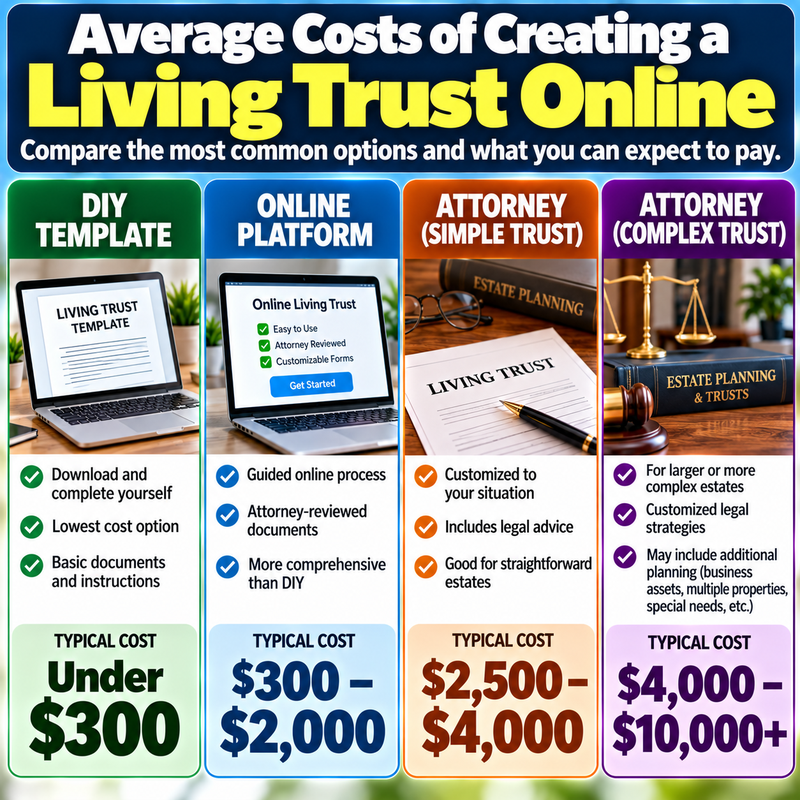
If you want the short version: expect to pay somewhere between $1,000 and $2,000 for a reputable online living trust platform that includes guided document creation, state-specific forms, and at least some professional support. Bare-bones template services can cost far less — sometimes under $300 — but they usually hand you a document and little else. On the other end, fuller digital estate-planning packages that bundle attorney review, advisor assistance, and ongoing access have historically priced closer to $2,500–$3,000.
None of these numbers are fixed across the industry. Pricing changes, packages get restructured, and promotions come and go. For a detailed breakdown of what drives these costs and how they compare across provider types, the living trust cost guide walks through the full pricing landscape in more depth.
Typical Price Range for Online Platforms
Most consumer-facing online trust platforms price their core package somewhere in the four-figure range once you include the trust itself plus companion documents like a pour-over will, financial power of attorney, and healthcare directive. That bundle approach makes sense — a living trust rarely works well as a standalone document, since you still need backup instructions for anything that doesn’t make it into the trust before you pass away.
Where platforms differ is in what’s layered on top of that core bundle. Some charge flat fees with everything included. Others use a base price plus optional add-ons for things like attorney consultations, deed preparation, or extra copies. A few operate more like subscription services, charging an ongoing fee for continued access to your documents and the ability to make changes.
- Entry-level template generators: DIY trusts often cost under $300, sometimes closer to $75–$150 for basic software-based tools.
- Mid-tier guided platforms: roughly $300–$1,000, typically including state-specific forms and some level of customer support.
- Full-service digital estate planning packages: approximately $1,000–$2,000 for broader document sets and some professional touchpoints.
- Comprehensive packages with attorney review, advisor assistance, and ongoing access: have historically run closer to $2,500–$3,000 combined.
Basic Template Costs vs. Full-Service Platforms
A $75 software package and a $2,500 guided service are not competing for the same customer, even though both technically produce a living trust document. The template buyer is typically comfortable researching state law, understanding funding requirements, and handling notarization and recording without guidance. The full-service buyer is paying for structure — a system that walks through each decision, flags what needs to happen next, and often includes some form of professional review.
Think of it less like comparing two trust documents and more like comparing a recipe card to a meal-kit subscription. Both can get you dinner. One assumes you already know what you’re doing.
Neither approach is automatically wrong. A person with a simple estate, no minor children, and confidence navigating paperwork may do perfectly well with a template. Someone who wants a hand held through funding, review, and updates may find that the extra cost of a full-service platform buys genuine peace of mind, not just convenience.

What “Online Living Trust Service” Can Mean
The phrase “online living trust” covers a surprisingly wide range of products, and that’s exactly why price comparisons get confusing. Before judging whether $400 or $2,000 is the “right” price, it helps to know which category you’re actually shopping in.
Document Generator
This is the simplest model: an online questionnaire produces a trust document (and sometimes a basic will) based on your answers. You typically print, sign, and notarize it yourself, then handle funding on your own — meaning you’re responsible for retitling property, updating account ownership, and recording any deeds.
There’s no professional review built in, and support is usually limited to customer service for technical issues rather than legal guidance. This model works best for people who already understand what a living trust requires and just need the paperwork drafted.
Document generator = you provide the knowledge, the platform provides the form.
For anyone unsure what steps come after the document is signed, the guide on how to create a living trust covers the full sequence — from drafting through funding — which is worth reviewing before choosing a bare-template route.
Guided Platform
Guided platforms add structure on top of the basic questionnaire. They typically walk you through decisions step by step, explain terms in plain language, and may flag issues specific to your state. Some include basic customer support from non-attorney staff who can answer process questions, though not legal advice.
- Step-by-step interview format rather than a single long form
- State-specific document language built into the platform
- Some level of built-in guidance on funding steps
- Customer support for technical and process questions
These services often price higher than a pure template but lower than full attorney-supported packages, landing in that $300–$1,000 middle range mentioned earlier.
Attorney-Review or Attorney-Access Model
Some online services add a layer where a licensed attorney reviews your completed documents before they’re finalized, or where you get limited access to ask an attorney questions. It’s important not to assume “attorney review” means the same thing as hiring an attorney directly — the scope, depth, and nature of that relationship varies by provider and should be confirmed in the service’s actual terms before you buy.
This distinction matters enough that it deserves its own comparison. The page on working with a living trust attorney breaks down what a full attorney engagement typically includes, which is useful context when deciding whether “attorney review” inside an online package meets your needs or whether you want a direct attorney relationship instead.
Supported Digital Estate-Planning Service
At the fuller end of the spectrum sit services designed to function less like a document vending machine and more like an ongoing estate-planning system. Bulletproof Legacy Financial’s eStatePlan, for example, has been described as a digital estate-planning system combining online document access with professional resources, attorney review, advisor-team assistance, funding assistance, and ongoing access so the plan can be updated as circumstances change.
That kind of bundled structure is where historical pricing has landed closer to $2,195 for the core eState Plan component, with attorney review priced separately at around $500, advisor-team assistance at roughly $300, and annual access around $95 — adding up to a combined package historically priced near $2,995. These figures reflect past Bulletproof Legacy Financial packaging specifically, not an industry standard, and pricing structures like this can change, so current numbers should always be confirmed directly with the provider before you commit.
Component Price eStatePlan (core document system) $2,195 Attorney review $500 Advisor-team assistance $300 Annual access $95 Total package $2,995
Common Upfront Costs You’ll See
Before you even get to add-ons, most online services charge for a core set of items at checkout. That typically includes the living trust document itself, plus one or more companion documents designed to work alongside it. Depending on the provider, you might also see a one-time setup fee, a flat package price, or tiered pricing based on how many documents you select.
It’s worth reading the checkout page carefully rather than assuming every platform bundles the same things. One service’s “complete package” might mean trust plus will plus power of attorney. Another’s might mean just the trust document with everything else sold separately.

What May Be Included in the Advertised Price
The sticker price on an online trust service can hide a lot of variation in what you’re actually getting. Some platforms include planning for a spouse at no extra charge, while others treat each spouse as a separate purchase. Some bundle in a pour-over will, financial power of attorney, and healthcare directive automatically; others sell those as optional add-ons.
Attorney consultations, attorney review, deed preparation, funding assistance, notarization, and document storage are the items most likely to be inconsistent from provider to provider. None of these should be assumed to be included just because a competitor includes them. The only reliable way to know what you’re getting is to check the specific provider’s current package details before purchasing — and to remember that creating the trust document itself does not automatically transfer any of your assets into it. That step, called funding, is separate and often requires its own paperwork.
Possible Add-On and Recurring Costs
Once the base package is purchased, several categories of cost tend to show up depending on your situation and the provider you choose. Understanding these ahead of time prevents the unpleasant surprise of a $400 trust turning into an $800 total once everything is accounted for.
Attorney Review and Consultations
Many online platforms offer attorney review as a separate add-on, sometimes priced in the $300–$500 range based on historical examples from bundled digital estate-planning packages. This usually means a licensed attorney looks over your completed documents for obvious errors or state-compliance issues — it is not the same as a full attorney-client relationship where an attorney drafts custom provisions or advises on complex tax strategy. If you want that deeper level of involvement, it’s worth comparing costs directly with a living trust attorney rather than assuming an online add-on covers the same ground.
Couples or Additional Documents
If you’re married or in a partnership, check whether the base price covers both people or just one. Some services price per person, which can roughly double your cost if you both need trusts, wills, and powers of attorney. Additional documents — extra property schedules, certification copies for financial institutions, or specialized trust provisions — can also carry their own line-item fees.
Updates and Subscriptions
Life doesn’t stop after your documents are signed. You might move states, have another child, buy a new property, or simply change your mind about who should serve as successor trustee. Some online services include a window of free updates — a year, for example — before switching to a subscription or per-change fee. Others charge for every amendment from day one.
Annual access fees, sometimes historically priced around $95 in bundled digital estate-planning packages, cover continued login access to your documents and the ability to make revisions without starting over. Before buying, it’s worth asking exactly how long updates are included and what happens once that window closes — because an estate plan that can’t evolve with your life tends to become outdated fast.
Deeds and Trust Funding
Funding your trust means legally moving ownership of your assets into it, and real estate is usually the trickiest part. Transferring a home into a trust typically requires a properly prepared and recorded deed, and not every online service includes deed preparation in the base price. Some charge an additional fee per property; others don’t offer deed services at all, leaving you to find a local professional or title company.
Banks, brokerage firms, and business entities each have their own procedures for updating ownership records, and these aren’t always included in an online package either. If your estate includes a small business, check whether operating agreements or partnership agreements restrict how ownership can be transferred into a trust — that’s a detail standardized online forms sometimes miss.
Notary and Recording Fees
Signing a trust often requires notarization, and in some states, witness signatures as well. Many online services don’t include notarization in the purchase price, meaning you’ll need to find a notary — sometimes for a small per-signature fee, sometimes free through a bank if you’re a customer.
If a deed needs to be recorded with your county recorder’s office, that typically involves its own recording fee, separate from anything you paid the online platform. These are small costs individually, often $10–$50 depending on location, but they add up and are easy to overlook when comparing advertised prices.

Why the Cheapest Online Trust Isn’t Always the Lowest Total Cost
A $150 template might look like the obvious budget choice next to a $1,500 guided platform. But if that template doesn’t include funding guidance, and you end up paying a local attorney $400 just to prepare and record a deed for your house, your “cheap” option just became more expensive than some mid-tier platforms that bundle funding support in from the start.
The smartest way to compare cost isn’t checkout price versus checkout price. It’s total cost of getting a fully funded, legally sound, update-ready estate plan in place. The detailed living trust cost breakdown is a useful reference point here, since it lays out the full range of expenses — not just the headline price — that factor into a real-world estate plan.
- Does the price include funding assistance, or will you need to arrange deed preparation separately?
- Are updates included for a set period, or charged per change from the start?
- Is attorney review included, or is it an optional add-on?
- Does the package cover a spouse, or is pricing per individual?
- Are notarization and recording costs your responsibility, or partially covered?
Running through these five questions before purchasing gives a much clearer picture of total cost than comparing homepage prices alone.
Online Service vs. DIY Template: Which Costs Less in the Long Run
A pure DIY template is almost always the cheapest option at checkout — sometimes under $100. The tradeoff is that you’re on your own for funding, notarization, state-compliance details, and future updates. For someone with a straightforward estate and the time to research their state’s requirements, that tradeoff can be perfectly reasonable. For someone juggling a blended family, out-of-state property, or a small business, the lack of guidance can turn into costly mistakes down the road — an improperly funded trust, for instance, doesn’t avoid probate no matter how well-written the document is.
Online Service vs. Traditional Attorney: Comparing the Real Numbers
Traditional attorney fees for a full estate plan — trust, wills, powers of attorney, and healthcare directives — commonly run from roughly $1,500 to $3,500 or more, based on individual accounts across different states. That’s often more than a guided online platform, but it buys direct, personalized legal advice from someone who can tailor language to your specific family and asset situation rather than relying on a standardized questionnaire.
What Attorney Fees Look Like Across Different States
Reported attorney fees vary widely by location and complexity. One individual in a middle American state paid around $500 for two wills with trusts for minor children, healthcare powers of attorney, and general durable powers of attorney. In California, by contrast, quotes for a revocable living trust package — including wills, powers of attorney, and advance directives — have ranged from roughly $2,000 up to $4,000 depending on the firm and the complexity of the estate.
Other reported figures fall in between: a Bay Area resident with no children paid around $700 for a full package of wills, trusts, and health directives, while a DC-area single person paid $3,500 for revocable trust documents in 2018. A Maine resident paid $1,500 for two trusts benefiting grandchildren along with powers of attorney and mirror-image wills for a couple. These numbers illustrate just how much attorney pricing can swing based on region and the specifics of what’s being drafted.
How Geography and Firm Size Change the Price
Generally speaking, higher cost-of-living regions like California and the Washington DC metro area tend to report higher attorney fees for comparable estate plans than smaller markets. Firm size and reputation play a role too — boutique estate-planning firms or attorneys with specialized trust experience may charge more than a general-practice attorney handling a simple will.
None of this means an attorney is automatically the “expensive” choice and an online service is automatically the “cheap” one. A complicated estate handled by an inexperienced online platform can create costly problems later, while a straightforward estate handled efficiently by an attorney might cost less than expected. The guide to creating a living trust covers the step-by-step process either route requires, which makes it easier to see where attorney involvement adds real value versus where a standardized online workflow may be entirely sufficient.

What to Look For in an Online Living Trust Service
Price alone doesn’t tell you whether an online service fits your situation. A handful of practical questions matter more than the number on the checkout screen.
State-Specific Documents
Trust and estate law varies by state, and a document generated for one state’s requirements may not hold up correctly in another. Confirm the platform tailors its forms to your specific state rather than using a generic, one-size-fits-all template.
Funding Support
Ask directly whether the service helps with funding — specifically deed preparation for real estate, guidance on retitling bank and brokerage accounts, and direction on how business interests or retirement accounts should be handled. A trust document that’s never properly funded won’t accomplish what it’s designed to do, which is avoid probate and streamline asset transfer.
Retirement accounts in particular usually shouldn’t be retitled into a trust the same way a bank account would be. These typically require beneficiary-designation planning instead, and a quality service should flag that distinction rather than treating every asset the same way.
Professional Access
Clarify what “attorney review” or “attorney access” actually means for the specific provider you’re considering. Does it mean a brief document scan for errors, or does it include a conversation where you can ask questions about your specific family situation? These are very different levels of service, even when marketed with similar language.
Update and Document-Access Policies
Find out how long you have access to make changes after purchase, whether that access requires an ongoing subscription, and what the process looks like for amending a document versus starting from scratch. An estate plan that’s difficult or expensive to update tends to fall out of date as life changes — which defeats much of the purpose of having one in the first place.
Data and Security Considerations
Since online estate planning involves entering sensitive personal and financial information, it’s reasonable to ask how a provider stores and protects your data, who has access to your documents, and what happens to that information if you stop using the service. These aren’t questions unique to estate planning, but they matter more here given how sensitive the underlying information is.
Situations Where a Standardized Online Workflow May Not Be Enough
Online platforms work well for a lot of estates, but certain situations tend to outgrow a standardized questionnaire fast. Blended families with children from previous relationships, estates involving special needs beneficiaries who need carefully structured trusts to preserve government benefits, and ownership of property in multiple states all introduce complexity that a one-size-fits-all form may not handle well. The same goes for business succession planning, significant estate tax exposure, or family dynamics where disputes among heirs are a realistic concern.
None of this means online services are unsuitable for complicated lives across the board. Some supported digital services do build in attorney access specifically to catch these issues before they become problems. But it’s worth being honest with yourself about your own situation before assuming a standardized template will cover everything. If your estate checks several of these boxes, a direct conversation with a living trust attorney may be worth the extra cost, even alongside an online platform you’re already using for the basic documents.

Questions to Ask Before You Purchase
Before entering your credit card information, it helps to get clear answers on a short list of practical questions — in writing, if possible, rather than relying on marketing copy alone.
- What exactly is included in the base price, and what costs extra?
- Does the service include deed preparation for real estate, or is that a separate fee?
- What does “attorney review” mean specifically — document scan or actual conversation?
- How long do I have access to make free updates, and what happens after that period?
- Is pricing per person or does it cover a couple under one fee?
- What happens to my documents and data if I stop using the service?
Getting these answers upfront — rather than discovering them at checkout or, worse, after your trust is already signed — is the single biggest factor in avoiding surprise costs down the road.
How to Compare Lifetime Value, Not Just Checkout Price
The most useful way to compare options isn’t lining up headline prices side by side. It’s asking which option gets you to a fully funded, properly executed, update-ready estate plan for the least total cost and effort over time. A $2,000 package that includes attorney review, funding assistance, and a year of free updates may deliver more real value than a $400 template that leaves you paying separately for deed preparation, notarization, and every future change.
The living trust cost resource is a good place to start building that bigger-picture comparison, since it walks through the full range of expenses that go into an estate plan rather than just the initial purchase price. Whatever provider you choose, the goal is the same: a trust that’s actually funded, legally sound in your state, and flexible enough to keep up with your life.

Frequently Asked Questions
Is an online living trust legally valid?
Yes. An online living trust is legally valid as long as it’s created in compliance with your state’s specific laws. That means the trust needs to be properly declared, a trustee needs to be appointed, beneficiaries need to be named, and the document needs to be signed and notarized according to your state’s requirements.
Validity comes down to whether these core legal components are correctly handled, not whether the document was created online versus on paper in an attorney’s office. A properly executed online trust and a properly executed attorney-drafted trust carry the same legal weight.
How long does it take to set up a living trust online?
Most online living trust services can be completed in a matter of hours, assuming you have all the necessary information about your assets and beneficiaries ready to go. The time-consuming part usually isn’t filling out the questionnaire — it’s gathering account numbers, property deeds, and beneficiary details beforehand.
Funding the trust afterward can take longer, since it involves separate steps like retitling accounts with banks and brokerages, preparing and recording deeds, and reviewing retirement account beneficiary designations.
Does creating a trust document online automatically move my assets into the trust?
No. Creating the document — whether online or with an attorney — only establishes the trust itself. Actually funding it, meaning transferring ownership of your assets into the trust’s name, is a separate process that doesn’t happen automatically. For a comprehensive guide on this process, you can explore the essentials of setting up a living trust online.
What’s the difference between attorney review and hiring an attorney?
Attorney review typically means a licensed attorney looks over completed documents for errors or state-compliance issues, often as a limited add-on service rather than a full legal engagement. Hiring an attorney directly usually means a more personalized relationship where the attorney drafts custom language, advises on your specific family and tax situation, and takes on a broader professional responsibility for your plan.
Can I update my online living trust after it’s created?
In most cases, yes. Most online living trust services allow amendments or even full revocation of the trust as long as you follow the proper legal procedures required by your state. Some platforms include a set period of free updates, after which you may need to pay a subscription or per-change fee to continue making revisions.
Do online living trust services cover my spouse too?
It depends entirely on the provider. Some services price per couple and include spousal planning as part of the base package, while others charge separately for each spouse’s documents. This is exactly the kind of detail worth confirming before purchase, since it can significantly affect total cost for a married couple.
What happens if my state has specific trust requirements?
State requirements for signing, witnessing, and notarizing trust documents vary, and your trust needs to comply with the laws of your specific state to be valid. Quality online platforms build state-specific language into their documents rather than using a generic national template, which is one reason it’s worth confirming this detail before purchasing.
Are there hidden fees with online trust services?
Not necessarily “hidden,” but definitely possible if you don’t read the fine print. Costs for attorney review, additional documents, deed preparation, notarization, recording, and ongoing updates are often priced separately from the base package rather than being automatically included, so it pays to check exactly what’s covered before you buy.
Is a cheap DIY trust template enough for a simple estate?
For some people, yes. If your estate is straightforward — no minor children, no blended family complications, no out-of-state property, no business interests — a basic template combined with careful attention to your state’s funding and notarization requirements can be entirely sufficient.
The risk isn’t that templates are inherently flawed; it’s that funding and compliance steps are easy to overlook without guidance. If you choose this route, budget extra time to research your state’s specific requirements rather than assuming the template alone will handle everything.
How do I know if I need a traditional attorney instead of an online service?
Complexity is usually the deciding factor. Blended families, special needs beneficiaries, significant business ownership, multi-state property, or any concern about family disputes over the estate are all signs that individualized legal advice may be worth the added cost compared to a standardized online workflow.
If you’re on the fence, many people use a hybrid approach — starting with an online platform’s guided process for the basic structure, then consulting a living trust attorney for the specific pieces that feel too complicated to navigate alone.
Whatever path fits your situation, Bulletproof Legacy Financial’s eState Plan offers one example of a digital estate-planning system built to combine online convenience with professional support for people who want more than a bare template.