Cost to Fund a Living Trust: Deeds, Transfers, and Professional Fees Explained
Understand the Potential Costs of Deeds, Recording Fees, Account Retitling, Business Interests, and Professional Assistance
Funding a living trust costs far less than most people expect, but the real question is not “how much” — it’s “which assets, and how.”
Trust funding fees range from $0 for a quick bank account retitling to several hundred dollars for a batch of deed recordings, and sometimes more if a business interest or multi-state property gets involved. The price tag depends entirely on what you own, where you live, and whether you tackle the paperwork yourself or bring in help. Resources like CreateALivingTrust.com walk families through exactly this kind of asset-by-asset funding math, which matters because a trust that looks finished on paper but isn’t actually funded won’t protect your family the way you think it will.
Article-at-a-Glance
- Trust creation and trust funding are two separate steps, and funding costs are driven almost entirely by what kinds of assets you own.
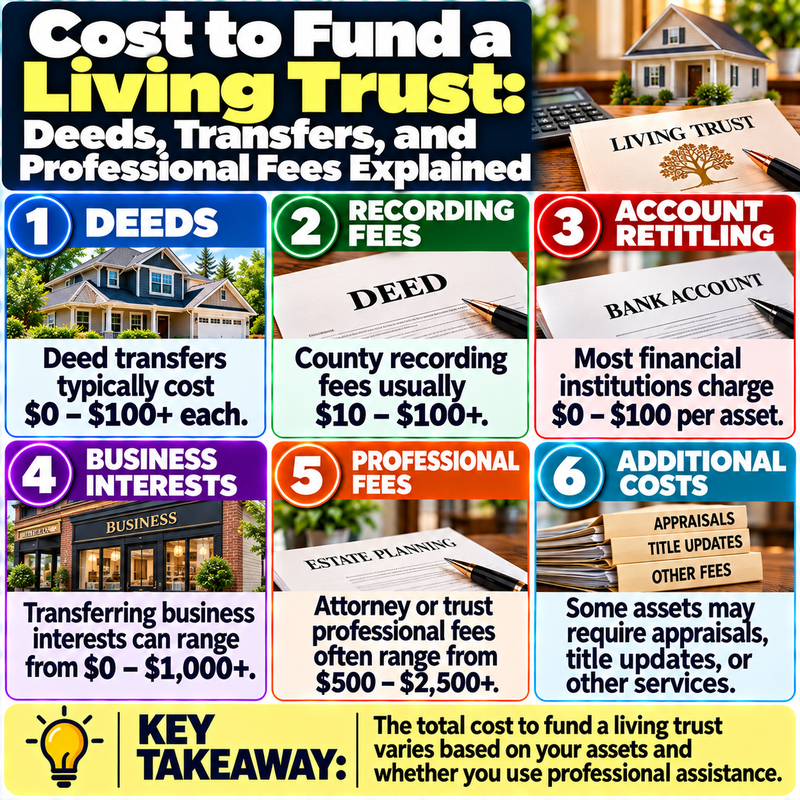
- Real estate funding involves deed preparation and county recording fees that can run from roughly $10 to $300 per property, depending on your state.
- Many banks and brokerage firms retitle accounts into a trust for little or no fee once they receive a Certification of Trust.
- Retirement accounts and life insurance require careful beneficiary-designation planning rather than automatic retitling into the trust.
- Later in this article, you’ll find a practical checklist for confirming whether every asset you meant to fund actually made it into your trust.
Quick Answer: Why Funding Costs Vary by Asset
There’s no flat-rate invoice for “funding a trust” because funding isn’t one task — it’s a collection of different tasks, each tied to a different kind of asset. Moving a house into a trust means dealing with a county recorder’s office. Moving a bank account into a trust usually just means filling out a form at a branch. Moving a business interest might require rewriting an operating agreement. Each of those processes has its own paperwork, its own fees, and sometimes its own waiting period, which is why total funding costs can look completely different from one family to the next even when their overall living trust cost for drafting the document itself was similar.
What It Means to Fund a Living Trust
Funding a trust means retitling your assets — or updating their beneficiary designations — so that the trust, rather than you personally, legally holds or controls them. Think of the trust document as an empty container. Signing it doesn’t automatically pull your house, your bank account, or your investment portfolio inside. You have to physically (or legally) place each asset into that container, one at a time, using the transfer method that applies to that specific type of property.
This is the step most people underestimate. A living trust only works as intended once it actually holds the assets it was designed to manage. Skip funding, and the trust becomes a legal document sitting in a drawer while your estate still runs into the very probate process you were trying to avoid.
Why Signing the Trust Is Different From Transferring Assets
Signing your trust is a legal event. Funding your trust is an administrative project. Confusing the two is one of the most common — and most costly — mistakes in estate planning.
Why a Signed Trust Alone Does Not Avoid Probate
A signed revocable living trust does not, by itself, keep your family out of probate court. Probate avoidance only happens for assets that are actually titled in the trust’s name or that list the trust as beneficiary. If your house deed still says your name instead of the trust’s name, that house goes through probate regardless of how well-written your trust document is. This single fact explains why trust funding deserves just as much attention — and sometimes just as much budget — as the drafting process itself.
The Legal Arrangement vs. The Implementation Step
Creating the trust establishes the rules: who the trustee is, who the beneficiaries are, and how assets should be managed or distributed. Funding the trust puts those rules into motion by matching your actual property to that legal structure. If you’re still working through the drafting phase, the guide on how to create a living trust walks through that first stage in detail — but creation and funding genuinely are two separate undertakings, each with its own timeline and its own costs.

Real Estate Funding Costs
Real estate is usually the single biggest funding project in a trust plan, and it’s also where costs show up most visibly.
Deed Preparation
Moving a house, rental property, or vacant land into a trust requires a new deed — typically a quitclaim deed or a warranty deed, depending on your state and your attorney’s recommendation. Preparing that deed correctly matters enormously; a mistake here can cloud the title or even prevent the transfer from holding up later. Some people draft the deed themselves using state-specific templates, while others pay an attorney a flat fee per property.
County Recording Fees
Once the new deed is signed and notarized, it has to be recorded at the county recorder or land records office where the property sits. Recording fees for these transfers typically fall between $10 and $300, depending on the county and state. Some counties charge a flat fee; others charge per page or add surcharges for specific document types, so it’s worth checking your local recorder’s fee schedule before assuming a number.
Multiple Properties and Multiple States
Owning more than one property multiplies both the paperwork and the cost. Each property needs its own deed, its own notarization, and its own recording fee. If you own property in more than one state, things get more complicated still — each state has its own deed requirements, transfer tax rules, and recording procedures, which often makes professional help worthwhile rather than optional.
Mortgage and Title Considerations
A mortgaged home can usually still be transferred into a revocable trust, but lenders, title insurers, and local tax authorities each have their own policies that can affect the process. Some states have specific reassessment or transfer-tax rules that apply when a deed changes names, even when the change is into your own revocable trust. Because these rules vary so much by location, this is an area where a quick call to an estate planning attorney before you record anything can save you from an expensive correction later.
Bank and Credit-Union Accounts
Compared to real estate, funding bank accounts is usually the easiest and least expensive part of the process. Many financial institutions charge no fee at all to retitle an account into a trust’s name — it’s often treated as routine account maintenance rather than a billable service.
Certification of Trust vs. Full Trust Document
Banks generally don’t need — or want — to see your entire trust document, which can run dozens of pages and contain private family details. Instead, most institutions accept a Certification of Trust (sometimes called an Affidavit of Trust), a shorter document that proves the trust exists and confirms who has authority to act on its behalf, without exposing every provision of your estate plan.
Information Your Bank Will Request
Before retitling an account, expect your bank to ask for a specific set of details. Having these ready in advance speeds up the process considerably:
- The trust’s exact legal name as it appears in the trust document
- The names of the current trustee or trustees
- The date the trust was signed
- A Certification or Affidavit of Trust
- A current list of the assets you want retitled
For most people, the bank can continue using your Social Security Number for a revocable trust account during your lifetime, though policies differ from institution to institution — some may ask for an Employer Identification Number instead, so it’s worth confirming directly with your branch.

Brokerage and Non-Retirement Investment Accounts
Taxable brokerage accounts tend to be one of the more straightforward funding tasks once you know the process. The account itself doesn’t need to be emptied or sold off — funding simply changes the registration on the account from your individual name to the trust’s name, while the underlying stocks, bonds, and funds stay exactly where they are.
Retitling Steps and Potential Fees
Most brokerage firms have their own trust paperwork, so you’ll typically need to request the firm’s specific forms rather than relying on a generic template. The firm will usually ask for a copy of the Certification of Trust, the trustee’s identifying information, and sometimes a new account application even though you’re not actually opening a new investment — just changing the name on the existing one. Many firms don’t charge a separate fee for this retitling, though it’s worth asking directly since policies vary by company and sometimes by account type.
Common Registration Mistakes
The biggest funding error with brokerage accounts isn’t a cost problem — it’s a paperwork problem. People sometimes assume that naming a beneficiary on the account (similar to a payable-on-death designation) accomplishes the same thing as retitling into the trust. It doesn’t always line up with the trust’s broader distribution instructions, especially if the trust has specific terms for how and when beneficiaries receive assets. Getting the registration itself changed to the trust’s name, rather than relying solely on a beneficiary designation, keeps the account consistent with the rest of your plan.
Business Interests
Business ownership is where trust funding can get genuinely complicated, and where costs can climb the fastest. Unlike a bank account or a stock portfolio, a business interest often comes with its own set of legal rules about who’s allowed to own a piece of it and under what conditions.
Operating Agreements and Transfer Restrictions
If you own an LLC, a partnership interest, or shares in a closely held corporation, the governing documents — the operating agreement, partnership agreement, shareholder agreement, or buy-sell agreement — often dictate whether and how that ownership interest can be transferred. Some agreements require consent from other owners before any transfer, including a transfer into your own revocable trust. Skipping this step doesn’t just risk a few dollars in wasted paperwork; it can create a transfer that’s technically invalid under the business’s own governing rules.
When You Need Professional Review
This is one area where paying for professional review tends to be worth it. An attorney can confirm what the operating agreement actually requires, prepare the correct assignment or transfer documents, and make sure company records get updated to reflect the trust as the new owner. Costs here vary widely depending on the complexity of the business structure and whether other owners need to sign off, but it’s rarely a task worth tackling entirely alone if real money is riding on the business running smoothly after the transfer.

Personal Property and Assignments
Not every asset needs its own individual deed or form. Household items, furniture, jewelry, art, and other personal belongings are often handled through a single document called a general assignment of assets, which names the trust as the new owner of everything listed without requiring separate paperwork for each item.
This approach keeps personal property funding simple and inexpensive compared to real estate or business interests. That said, a general assignment works well for ordinary household items but isn’t always the right tool for anything that comes with its own title document — which brings up vehicles specifically.
Using a General Assignment of Assets
A general assignment typically lists categories of personal property — furniture, collectibles, tools, artwork — rather than itemizing every single possession. Signing this one document can move a large volume of personal belongings into the trust at once, with no recording fee and usually no institutional involvement at all. It’s one of the lowest-cost funding steps in the entire process.
Vehicles and State Title Rules
Vehicles don’t usually fall under a general assignment the same way furniture does, because cars, trucks, and boats are governed by state-specific title and registration rules. Some states make it easy to retitle a vehicle into a trust; others create complications around insurance or registration that can outweigh the benefit, especially since vehicles typically have low resale value relative to the hassle.
Before retitling a car into your trust, it’s worth asking whether doing so actually helps your overall plan or whether it’s simpler to just name a beneficiary directly through your state’s transfer-on-death vehicle title option, if available.

Assets That Require Special Treatment
Some assets don’t follow the standard “change the name on the title” funding process at all. These require their own approach, and treating them the same way you’d treat a bank account or a house can create real tax or distribution problems down the road.
Assets that typically require special handling include:
- Retirement accounts, including IRAs and employer-sponsored plans like 401(k)s
- Life insurance policies
- Annuities
- Payable-on-death (POD) bank accounts
- Transfer-on-death (TOD) brokerage registrations
Each of these assets already has a built-in mechanism for passing to the next person — a beneficiary designation — rather than a title that gets changed. That distinction matters enormously when it comes to funding costs and funding strategy.
Retirement Accounts
Retirement accounts generally should not be retitled into a revocable living trust the way a house or bank account would be. These accounts keep their individual ownership structure, and estate planning for them typically centers on who you name as beneficiary rather than changing who legally owns the account today. Naming a trust as the beneficiary of a retirement account is sometimes done, but it carries potential tax consequences and distribution rules that depend heavily on your specific situation — this isn’t a step to take without first talking through the details with an attorney or tax professional who can look at your full picture.
Life Insurance and Beneficiary-Designated Assets
Life insurance passes to whoever is named as beneficiary on the policy, not through a title change. For many families, naming an individual directly — a spouse, an adult child — is the simplest and most cost-effective choice.
Naming the trust as beneficiary instead can make sense in specific circumstances, such as when you have minor children, want a trustee to manage proceeds for someone who isn’t ready to handle a lump sum, or need the insurance payout coordinated with other distribution terms in your estate plan. But adding the trust as beneficiary introduces an extra administrative layer, so it’s worth confirming with your advisor that the added complexity actually serves a purpose in your situation before making the change.
Professional Funding Assistance and What It May Cost
Plenty of people handle trust funding entirely on their own, especially for simpler estates with a house, a couple of bank accounts, and a brokerage account. Once business interests, multiple properties, or more complicated family circumstances enter the picture, professional help often becomes worth the added cost.
Attorney Fees vs. Funding Specialist Fees
Attorneys typically charge by the hour or offer a flat project fee for funding assistance, and rates can average anywhere from roughly $1,000 to $5,000 or more depending on the complexity of the estate and the attorney’s billing structure. Some firms also offer dedicated funding specialists or “implementation teams” who handle the administrative legwork — contacting banks, preparing deeds, tracking down paperwork — often at a lower rate than an attorney’s hourly fee, while the attorney handles only the pieces that genuinely require legal judgment.
Notary Fees by State
Nearly every real estate transfer and many financial institution forms require notarization, and notary fees vary quite a bit depending on where you live. A notarized signature might cost as little as $2 in a state like New York, while California allows notaries to charge up to $15 per signature. These fees add up fastest when you’re signing multiple deeds or multiple institutional forms in one sitting, so it’s worth budgeting a small cushion if you’re funding several properties or accounts at once.
Professional Trustee Fees
If you’re using a professional trustee — a bank trust department or a private fiduciary — rather than serving as your own trustee, expect an ongoing fee structured as a small percentage of the trust’s total asset value, typically somewhere between 0.5% and 2% annually. This is a different cost than the one-time funding fees discussed throughout this article; it’s an ongoing management cost tied to who’s running the trust day to day, not to the initial process of transferring assets into it.

Costs of Adding Assets Later
Funding isn’t a one-time event you complete and forget. Life keeps moving after your trust is signed, and every new asset you acquire needs the same funding attention the original assets received.
New Real Estate Purchases
Buy a new home or investment property after your trust is already signed, and you’ll need to repeat the real estate funding process from scratch — a new deed prepared in the trust’s name, signed, notarized, and recorded with the county. Some people arrange with their real estate attorney or title company to take title directly in the trust’s name at closing, which skips a separate deed transfer later and can save both time and a second recording fee.
Opening New Accounts or Forming a Business
Opening a new bank account, brokerage account, or starting a new business venture after your trust exists means making a choice right away: open it directly in the trust’s name, or open it individually and retitle it later. Opening directly in the trust’s name from the start is almost always simpler and avoids a second round of paperwork down the line.
Refinancing Property Held in Trust
Refinancing a mortgage on a home that’s already titled in your trust can sometimes require temporarily transferring the property back into your individual name for the refinance, then transferring it back into the trust once the new loan closes. Not every lender requires this step, but it’s common enough that it’s worth asking your lender directly before assuming the process will be seamless. This back-and-forth transfer typically means two more deed recordings and two more sets of notary fees, so it’s a cost worth anticipating if a refinance is on the horizon.
Common Funding Mistakes That Can Create Future Expense
Most funding mistakes don’t show up right away — they surface years later, usually at the worst possible time, when a family is already grieving and trying to settle an estate. The good news is that nearly every common mistake is preventable with a little attention during the funding process itself.
Real Estate Deed and Recording Errors
A deed that’s signed but never recorded at the county office doesn’t actually transfer anything — it’s just a piece of paper sitting in a file. Similarly, a deed with the trust’s name slightly misspelled, or missing the exact date the trust was signed, can create title problems that surface during a future sale or refinance. These errors are inexpensive to fix at the time they’re made but can become expensive and time-consuming to untangle later, sometimes requiring a corrective deed prepared and recorded all over again.
Bank Accounts Left Untitled to the Trust
It’s surprisingly common for people to retitle their primary checking account but forget about a secondary savings account, a CD, or an account at a smaller credit union. Each untitled account represents a gap in the plan — an asset that will likely need to go through probate even though everything else was handled correctly. A simple way to catch this gap is to pull together every statement you’ve received in the last year and check each one against your trust’s asset list:
- Checking and savings accounts at every bank or credit union you use
- Certificates of deposit (CDs)
- Money market accounts
- Any account opened more recently than your trust’s signing date
If any of these still show your individual name instead of the trust, that’s an easy fix — but only if you catch it while you’re still able to sign the paperwork yourself.
Outdated or Conflicting Beneficiary Designations
Beneficiary designations have a strange tendency to outlive the people they were originally set up for. A life insurance policy might still list an ex-spouse. A retirement account might name a sibling who passed away years ago. These outdated designations override whatever your trust document says, because beneficiary forms generally take legal priority over a will or trust’s general instructions. Reviewing every beneficiary-designated asset alongside your trust — rather than assuming the trust automatically covers them — closes one of the most overlooked gaps in estate planning.
Business Interests Transferred Without Documentation
Verbally agreeing that “the business is now part of the trust” doesn’t actually transfer anything. Without a proper assignment document, updated company records, and confirmation that the transfer complies with the operating agreement or partnership agreement, the business interest can remain legally owned by you as an individual — regardless of what everyone intended.
This gap often isn’t discovered until a succession event forces someone to check the paperwork, which is exactly the wrong time to find out it was never done correctly. For more information on ensuring your trust is properly funded, you can read about funding a trust.

A Practical Trust-Funding Cost Checklist
Before considering your trust fully funded, it helps to walk through a short list of questions that mirror what an attorney or funding specialist would check. Running through this list costs nothing but a bit of time, and it often catches gaps before they become expensive problems.
| Asset Type | Typical Funding Cost | Key Question to Ask |
|---|---|---|
| Real estate | $10–$300+ per property (recording fees, plus deed prep) | Does the deed show the trust as owner, and was it recorded? |
| Bank accounts | Often $0 | Does the account title match the trust’s exact legal name? |
| Brokerage accounts | Often $0, firm-dependent | Is the registration in the trust’s name, not just a TOD designation? |
| Business interests | Varies widely; attorney review often needed | Does the operating agreement allow this transfer? |
| Personal property | Minimal (covered by general assignment) | Is there a signed assignment of assets on file? |
| Retirement accounts | Usually $0 (beneficiary update only) | Has the beneficiary designation been reviewed with an advisor? |
| Life insurance | Usually $0 (beneficiary update only) | Does the current beneficiary reflect your actual wishes? |
Walking through this table asset by asset is often more useful than trying to estimate one lump “trust funding cost,” since every household’s mix of assets is different.
Frequently Asked Questions
These are the questions that come up most often once people realize funding is separate from signing the trust document itself.
Does creating a living trust automatically transfer my assets into it?
No. Signing a living trust creates the legal structure, but it does not move any property, accounts, or assets into the trust by itself. Each asset has to be individually retitled or have its beneficiary designation updated to reflect the trust.
This is the single most misunderstood part of the entire process, and it’s the reason some families discover — after a death or incapacity — that their trust didn’t work the way they expected.
The fix is straightforward: treat funding as its own project with its own checklist, separate from the signing appointment.
How much does it typically cost to fund a living trust?
Funding costs vary dramatically based on what you own, but many families spend somewhere between $0 and a few hundred dollars on institutional fees, recording fees, and notary costs, with real estate typically representing the largest expense.
Do I need a lawyer to fund my living trust?
Not necessarily. Many people successfully fund bank accounts, brokerage accounts, and personal property on their own. Real estate, business interests, and situations involving multiple states or complex family dynamics are where legal help tends to pay for itself.
Should I put my retirement accounts into my living trust?
Generally, no — retirement accounts aren’t retitled into a trust the way a house or bank account is. Instead, estate planning for retirement accounts usually focuses on the beneficiary designation, and naming a trust as beneficiary carries tax considerations that deserve individual review with an advisor before making any changes.
Every family’s tax situation is different enough that a blanket recommendation simply isn’t responsible here — this is a conversation to have directly with a qualified professional who can look at your specific accounts and goals.
What happens if I forget to fund an asset into my trust?
An asset that’s never retitled into the trust typically ends up going through probate, even if your trust document otherwise covers everything else perfectly. Some states offer backup tools, like a pour-over will, to help direct forgotten assets into the trust after death, but this still usually involves probate first.
How much does it cost to transfer real estate into a trust?
Recording fees alone typically run between $10 and $300 per property, depending on the county and state. Add in deed preparation costs if you’re using an attorney, and total costs per property can range from under $100 to several hundred dollars.
Properties with mortgages, multiple owners, or locations in more than one state tend to push costs toward the higher end of that range.
Do banks charge fees to retitle accounts into a trust?
Many banks and credit unions don’t charge a separate fee for this — it’s often treated as routine account maintenance. That said, policies vary by institution, so it’s worth confirming directly with your bank before assuming there’s no cost.
Can I fund a trust myself without professional help?
Yes, for many straightforward assets like bank accounts, brokerage accounts, and personal property. Gathering account statements, requesting the right forms, and following each institution’s process is work most people can handle on their own.
Where self-funding gets riskier is with real estate across multiple states, business interests governed by restrictive agreements, or any asset where a mistake could cloud title or trigger unintended tax consequences.
For those situations, bringing in an attorney isn’t about cost avoidance — it’s about making sure the transfer actually holds up when it matters.
What is a Certification of Trust and why do institutions ask for it?
A Certification of Trust (sometimes called an Affidavit of Trust) is a shorter document that confirms your trust exists, names the current trustee, and proves authority to act on the trust’s behalf — without revealing every private detail in the full trust document. Banks and other institutions prefer it because it gives them what they legally need while protecting your privacy.
How often should I update my trust funding after signing it?
Any time you acquire a significant new asset — a new home, a new investment account, a new business venture — that’s a signal to revisit your funding and retitle the new asset into the trust. Maintaining a trust over time is crucial for its functionality. Many people also do a general review every few years to catch anything that slipped through, especially after a refinance or a major life change.
Treating funding as an ongoing habit, rather than a one-time task completed at signing, is what keeps a living trust working the way it was designed to.