Category: Living Trust Costs

Understand the costs of creating and maintaining a living trust, including attorney fees, online trust services, DIY options and other expenses that may be involved in establishing an estate plan.

  • Online Living Trust Cost: What Do Online Trust Services Really Cost?

    Online Living Trust Cost: What Do Online Trust Services Really Cost?

    Online Living Trust Cost: Pricing, Services, and Hidden Expenses to Compare

    Compare Upfront Pricing, Attorney-Review Options, Funding Help, Subscriptions, and Other Potential Expenses

    Online living trust prices range from under $100 for a bare-bones template to nearly $3,000 for a fully supported digital estate plan, and the sticker price rarely tells the whole story.

    The real question isn’t “what’s the cheapest option on the homepage?” It’s “what will I actually spend by the time my trust is signed, funded, notarized, and ready to protect my family?” That total can look very different depending on whether you’re buying a template, a guided platform, or a service that includes attorney access and funding help. Bulletproof Legacy Financial is one example of a provider that packages these pieces together rather than selling a document alone, which is worth understanding as a point of comparison as you shop.

    Key Takeaways

    • Online living trust costs typically fall between $1,000 and $2,000 for guided platforms, while basic DIY templates can run under $300 to $1,000, though these figures vary by provider and package.
    • The advertised price doesn’t always include spousal planning, attorney review, deed preparation, trust funding, notarization, or future updates — these can add significant cost later.
    • Some digital estate-planning services, including historical Bulletproof Legacy Financial packages, have bundled document creation with attorney review, advisor assistance, and ongoing access for a combined fee.
    • Comparing online services to a traditional attorney means looking past the checkout price to funding support, update policies, and what happens if your situation gets complicated.
    • Further down, we break down exactly which add-on costs tend to surprise people and how to ask providers the right questions before you buy.
    Online-Living-Trust-Cost

    Quick Answer: What Online Living Trusts Actually Cost

    If you want the short version: expect to pay somewhere between $1,000 and $2,000 for a reputable online living trust platform that includes guided document creation, state-specific forms, and at least some professional support. Bare-bones template services can cost far less — sometimes under $300 — but they usually hand you a document and little else. On the other end, fuller digital estate-planning packages that bundle attorney review, advisor assistance, and ongoing access have historically priced closer to $2,500–$3,000.

    None of these numbers are fixed across the industry. Pricing changes, packages get restructured, and promotions come and go. For a detailed breakdown of what drives these costs and how they compare across provider types, the living trust cost guide walks through the full pricing landscape in more depth.

    Typical Price Range for Online Platforms

    Most consumer-facing online trust platforms price their core package somewhere in the four-figure range once you include the trust itself plus companion documents like a pour-over will, financial power of attorney, and healthcare directive. That bundle approach makes sense — a living trust rarely works well as a standalone document, since you still need backup instructions for anything that doesn’t make it into the trust before you pass away.

    Where platforms differ is in what’s layered on top of that core bundle. Some charge flat fees with everything included. Others use a base price plus optional add-ons for things like attorney consultations, deed preparation, or extra copies. A few operate more like subscription services, charging an ongoing fee for continued access to your documents and the ability to make changes.

    • Entry-level template generators: DIY trusts often cost under $300, sometimes closer to $75–$150 for basic software-based tools.
    • Mid-tier guided platforms: roughly $300–$1,000, typically including state-specific forms and some level of customer support.
    • Full-service digital estate planning packages: approximately $1,000–$2,000 for broader document sets and some professional touchpoints.
    • Comprehensive packages with attorney review, advisor assistance, and ongoing access: have historically run closer to $2,500–$3,000 combined.

    Basic Template Costs vs. Full-Service Platforms

    A $75 software package and a $2,500 guided service are not competing for the same customer, even though both technically produce a living trust document. The template buyer is typically comfortable researching state law, understanding funding requirements, and handling notarization and recording without guidance. The full-service buyer is paying for structure — a system that walks through each decision, flags what needs to happen next, and often includes some form of professional review.

    Think of it less like comparing two trust documents and more like comparing a recipe card to a meal-kit subscription. Both can get you dinner. One assumes you already know what you’re doing.

    Neither approach is automatically wrong. A person with a simple estate, no minor children, and confidence navigating paperwork may do perfectly well with a template. Someone who wants a hand held through funding, review, and updates may find that the extra cost of a full-service platform buys genuine peace of mind, not just convenience.

    Free Trust Consultation Banner

    What “Online Living Trust Service” Can Mean

    The phrase “online living trust” covers a surprisingly wide range of products, and that’s exactly why price comparisons get confusing. Before judging whether $400 or $2,000 is the “right” price, it helps to know which category you’re actually shopping in.

    Document Generator

    This is the simplest model: an online questionnaire produces a trust document (and sometimes a basic will) based on your answers. You typically print, sign, and notarize it yourself, then handle funding on your own — meaning you’re responsible for retitling property, updating account ownership, and recording any deeds.

    There’s no professional review built in, and support is usually limited to customer service for technical issues rather than legal guidance. This model works best for people who already understand what a living trust requires and just need the paperwork drafted.

    Document generator = you provide the knowledge, the platform provides the form.

    For anyone unsure what steps come after the document is signed, the guide on how to create a living trust covers the full sequence — from drafting through funding — which is worth reviewing before choosing a bare-template route.

    Guided Platform

    Guided platforms add structure on top of the basic questionnaire. They typically walk you through decisions step by step, explain terms in plain language, and may flag issues specific to your state. Some include basic customer support from non-attorney staff who can answer process questions, though not legal advice.

    • Step-by-step interview format rather than a single long form
    • State-specific document language built into the platform
    • Some level of built-in guidance on funding steps
    • Customer support for technical and process questions

    These services often price higher than a pure template but lower than full attorney-supported packages, landing in that $300–$1,000 middle range mentioned earlier.

    Attorney-Review or Attorney-Access Model

    Some online services add a layer where a licensed attorney reviews your completed documents before they’re finalized, or where you get limited access to ask an attorney questions. It’s important not to assume “attorney review” means the same thing as hiring an attorney directly — the scope, depth, and nature of that relationship varies by provider and should be confirmed in the service’s actual terms before you buy.

    This distinction matters enough that it deserves its own comparison. The page on working with a living trust attorney breaks down what a full attorney engagement typically includes, which is useful context when deciding whether “attorney review” inside an online package meets your needs or whether you want a direct attorney relationship instead.

    Supported Digital Estate-Planning Service

    At the fuller end of the spectrum sit services designed to function less like a document vending machine and more like an ongoing estate-planning system. Bulletproof Legacy Financial’s eStatePlan, for example, has been described as a digital estate-planning system combining online document access with professional resources, attorney review, advisor-team assistance, funding assistance, and ongoing access so the plan can be updated as circumstances change.

    That kind of bundled structure is where historical pricing has landed closer to $2,195 for the core eState Plan component, with attorney review priced separately at around $500, advisor-team assistance at roughly $300, and annual access around $95 — adding up to a combined package historically priced near $2,995. These figures reflect past Bulletproof Legacy Financial packaging specifically, not an industry standard, and pricing structures like this can change, so current numbers should always be confirmed directly with the provider before you commit.

    ComponentPrice
    eStatePlan (core document system)$2,195
    Attorney review$500
    Advisor-team assistance$300
    Annual access$95
    Total package$2,995

    Common Upfront Costs You’ll See

    Before you even get to add-ons, most online services charge for a core set of items at checkout. That typically includes the living trust document itself, plus one or more companion documents designed to work alongside it. Depending on the provider, you might also see a one-time setup fee, a flat package price, or tiered pricing based on how many documents you select.

    It’s worth reading the checkout page carefully rather than assuming every platform bundles the same things. One service’s “complete package” might mean trust plus will plus power of attorney. Another’s might mean just the trust document with everything else sold separately.

    What May Be Included in the Advertised Price

    The sticker price on an online trust service can hide a lot of variation in what you’re actually getting. Some platforms include planning for a spouse at no extra charge, while others treat each spouse as a separate purchase. Some bundle in a pour-over will, financial power of attorney, and healthcare directive automatically; others sell those as optional add-ons.

    Attorney consultations, attorney review, deed preparation, funding assistance, notarization, and document storage are the items most likely to be inconsistent from provider to provider. None of these should be assumed to be included just because a competitor includes them. The only reliable way to know what you’re getting is to check the specific provider’s current package details before purchasing — and to remember that creating the trust document itself does not automatically transfer any of your assets into it. That step, called funding, is separate and often requires its own paperwork.

    Possible Add-On and Recurring Costs

    Once the base package is purchased, several categories of cost tend to show up depending on your situation and the provider you choose. Understanding these ahead of time prevents the unpleasant surprise of a $400 trust turning into an $800 total once everything is accounted for.

    Attorney Review and Consultations

    Many online platforms offer attorney review as a separate add-on, sometimes priced in the $300–$500 range based on historical examples from bundled digital estate-planning packages. This usually means a licensed attorney looks over your completed documents for obvious errors or state-compliance issues — it is not the same as a full attorney-client relationship where an attorney drafts custom provisions or advises on complex tax strategy. If you want that deeper level of involvement, it’s worth comparing costs directly with a living trust attorney rather than assuming an online add-on covers the same ground.

    Couples or Additional Documents

    If you’re married or in a partnership, check whether the base price covers both people or just one. Some services price per person, which can roughly double your cost if you both need trusts, wills, and powers of attorney. Additional documents — extra property schedules, certification copies for financial institutions, or specialized trust provisions — can also carry their own line-item fees.

    Updates and Subscriptions

    Life doesn’t stop after your documents are signed. You might move states, have another child, buy a new property, or simply change your mind about who should serve as successor trustee. Some online services include a window of free updates — a year, for example — before switching to a subscription or per-change fee. Others charge for every amendment from day one.

    Annual access fees, sometimes historically priced around $95 in bundled digital estate-planning packages, cover continued login access to your documents and the ability to make revisions without starting over. Before buying, it’s worth asking exactly how long updates are included and what happens once that window closes — because an estate plan that can’t evolve with your life tends to become outdated fast.

    Deeds and Trust Funding

    Funding your trust means legally moving ownership of your assets into it, and real estate is usually the trickiest part. Transferring a home into a trust typically requires a properly prepared and recorded deed, and not every online service includes deed preparation in the base price. Some charge an additional fee per property; others don’t offer deed services at all, leaving you to find a local professional or title company.

    Banks, brokerage firms, and business entities each have their own procedures for updating ownership records, and these aren’t always included in an online package either. If your estate includes a small business, check whether operating agreements or partnership agreements restrict how ownership can be transferred into a trust — that’s a detail standardized online forms sometimes miss.

    Notary and Recording Fees

    Signing a trust often requires notarization, and in some states, witness signatures as well. Many online services don’t include notarization in the purchase price, meaning you’ll need to find a notary — sometimes for a small per-signature fee, sometimes free through a bank if you’re a customer.

    If a deed needs to be recorded with your county recorder’s office, that typically involves its own recording fee, separate from anything you paid the online platform. These are small costs individually, often $10–$50 depending on location, but they add up and are easy to overlook when comparing advertised prices.

    Why the Cheapest Online Trust Isn’t Always the Lowest Total Cost

    A $150 template might look like the obvious budget choice next to a $1,500 guided platform. But if that template doesn’t include funding guidance, and you end up paying a local attorney $400 just to prepare and record a deed for your house, your “cheap” option just became more expensive than some mid-tier platforms that bundle funding support in from the start.

    The smartest way to compare cost isn’t checkout price versus checkout price. It’s total cost of getting a fully funded, legally sound, update-ready estate plan in place. The detailed living trust cost breakdown is a useful reference point here, since it lays out the full range of expenses — not just the headline price — that factor into a real-world estate plan.

    • Does the price include funding assistance, or will you need to arrange deed preparation separately?
    • Are updates included for a set period, or charged per change from the start?
    • Is attorney review included, or is it an optional add-on?
    • Does the package cover a spouse, or is pricing per individual?
    • Are notarization and recording costs your responsibility, or partially covered?

    Running through these five questions before purchasing gives a much clearer picture of total cost than comparing homepage prices alone.

    Online Service vs. DIY Template: Which Costs Less in the Long Run

    A pure DIY template is almost always the cheapest option at checkout — sometimes under $100. The tradeoff is that you’re on your own for funding, notarization, state-compliance details, and future updates. For someone with a straightforward estate and the time to research their state’s requirements, that tradeoff can be perfectly reasonable. For someone juggling a blended family, out-of-state property, or a small business, the lack of guidance can turn into costly mistakes down the road — an improperly funded trust, for instance, doesn’t avoid probate no matter how well-written the document is.

    Online Service vs. Traditional Attorney: Comparing the Real Numbers

    Traditional attorney fees for a full estate plan — trust, wills, powers of attorney, and healthcare directives — commonly run from roughly $1,500 to $3,500 or more, based on individual accounts across different states. That’s often more than a guided online platform, but it buys direct, personalized legal advice from someone who can tailor language to your specific family and asset situation rather than relying on a standardized questionnaire.

    What Attorney Fees Look Like Across Different States

    Reported attorney fees vary widely by location and complexity. One individual in a middle American state paid around $500 for two wills with trusts for minor children, healthcare powers of attorney, and general durable powers of attorney. In California, by contrast, quotes for a revocable living trust package — including wills, powers of attorney, and advance directives — have ranged from roughly $2,000 up to $4,000 depending on the firm and the complexity of the estate.

    Other reported figures fall in between: a Bay Area resident with no children paid around $700 for a full package of wills, trusts, and health directives, while a DC-area single person paid $3,500 for revocable trust documents in 2018. A Maine resident paid $1,500 for two trusts benefiting grandchildren along with powers of attorney and mirror-image wills for a couple. These numbers illustrate just how much attorney pricing can swing based on region and the specifics of what’s being drafted.

    How Geography and Firm Size Change the Price

    Generally speaking, higher cost-of-living regions like California and the Washington DC metro area tend to report higher attorney fees for comparable estate plans than smaller markets. Firm size and reputation play a role too — boutique estate-planning firms or attorneys with specialized trust experience may charge more than a general-practice attorney handling a simple will.

    None of this means an attorney is automatically the “expensive” choice and an online service is automatically the “cheap” one. A complicated estate handled by an inexperienced online platform can create costly problems later, while a straightforward estate handled efficiently by an attorney might cost less than expected. The guide to creating a living trust covers the step-by-step process either route requires, which makes it easier to see where attorney involvement adds real value versus where a standardized online workflow may be entirely sufficient.

    Free Consultation Banner 3

    What to Look For in an Online Living Trust Service

    Price alone doesn’t tell you whether an online service fits your situation. A handful of practical questions matter more than the number on the checkout screen.

    State-Specific Documents

    Trust and estate law varies by state, and a document generated for one state’s requirements may not hold up correctly in another. Confirm the platform tailors its forms to your specific state rather than using a generic, one-size-fits-all template.

    Funding Support

    Ask directly whether the service helps with funding — specifically deed preparation for real estate, guidance on retitling bank and brokerage accounts, and direction on how business interests or retirement accounts should be handled. A trust document that’s never properly funded won’t accomplish what it’s designed to do, which is avoid probate and streamline asset transfer.

    Retirement accounts in particular usually shouldn’t be retitled into a trust the same way a bank account would be. These typically require beneficiary-designation planning instead, and a quality service should flag that distinction rather than treating every asset the same way.

    Professional Access

    Clarify what “attorney review” or “attorney access” actually means for the specific provider you’re considering. Does it mean a brief document scan for errors, or does it include a conversation where you can ask questions about your specific family situation? These are very different levels of service, even when marketed with similar language.

    Update and Document-Access Policies

    Find out how long you have access to make changes after purchase, whether that access requires an ongoing subscription, and what the process looks like for amending a document versus starting from scratch. An estate plan that’s difficult or expensive to update tends to fall out of date as life changes — which defeats much of the purpose of having one in the first place.

    Data and Security Considerations

    Since online estate planning involves entering sensitive personal and financial information, it’s reasonable to ask how a provider stores and protects your data, who has access to your documents, and what happens to that information if you stop using the service. These aren’t questions unique to estate planning, but they matter more here given how sensitive the underlying information is.

    Situations Where a Standardized Online Workflow May Not Be Enough

    Online platforms work well for a lot of estates, but certain situations tend to outgrow a standardized questionnaire fast. Blended families with children from previous relationships, estates involving special needs beneficiaries who need carefully structured trusts to preserve government benefits, and ownership of property in multiple states all introduce complexity that a one-size-fits-all form may not handle well. The same goes for business succession planning, significant estate tax exposure, or family dynamics where disputes among heirs are a realistic concern.

    None of this means online services are unsuitable for complicated lives across the board. Some supported digital services do build in attorney access specifically to catch these issues before they become problems. But it’s worth being honest with yourself about your own situation before assuming a standardized template will cover everything. If your estate checks several of these boxes, a direct conversation with a living trust attorney may be worth the extra cost, even alongside an online platform you’re already using for the basic documents.

    Questions to Ask Before You Purchase

    Before entering your credit card information, it helps to get clear answers on a short list of practical questions — in writing, if possible, rather than relying on marketing copy alone.

    1. What exactly is included in the base price, and what costs extra?
    2. Does the service include deed preparation for real estate, or is that a separate fee?
    3. What does “attorney review” mean specifically — document scan or actual conversation?
    4. How long do I have access to make free updates, and what happens after that period?
    5. Is pricing per person or does it cover a couple under one fee?
    6. What happens to my documents and data if I stop using the service?

    Getting these answers upfront — rather than discovering them at checkout or, worse, after your trust is already signed — is the single biggest factor in avoiding surprise costs down the road.

    How to Compare Lifetime Value, Not Just Checkout Price

    The most useful way to compare options isn’t lining up headline prices side by side. It’s asking which option gets you to a fully funded, properly executed, update-ready estate plan for the least total cost and effort over time. A $2,000 package that includes attorney review, funding assistance, and a year of free updates may deliver more real value than a $400 template that leaves you paying separately for deed preparation, notarization, and every future change.

    The living trust cost resource is a good place to start building that bigger-picture comparison, since it walks through the full range of expenses that go into an estate plan rather than just the initial purchase price. Whatever provider you choose, the goal is the same: a trust that’s actually funded, legally sound in your state, and flexible enough to keep up with your life.

    Frequently Asked Questions

    Is an online living trust legally valid?

    Yes. An online living trust is legally valid as long as it’s created in compliance with your state’s specific laws. That means the trust needs to be properly declared, a trustee needs to be appointed, beneficiaries need to be named, and the document needs to be signed and notarized according to your state’s requirements.

    Validity comes down to whether these core legal components are correctly handled, not whether the document was created online versus on paper in an attorney’s office. A properly executed online trust and a properly executed attorney-drafted trust carry the same legal weight.

    How long does it take to set up a living trust online?

    Most online living trust services can be completed in a matter of hours, assuming you have all the necessary information about your assets and beneficiaries ready to go. The time-consuming part usually isn’t filling out the questionnaire — it’s gathering account numbers, property deeds, and beneficiary details beforehand.

    Funding the trust afterward can take longer, since it involves separate steps like retitling accounts with banks and brokerages, preparing and recording deeds, and reviewing retirement account beneficiary designations.

    Does creating a trust document online automatically move my assets into the trust?

    No. Creating the document — whether online or with an attorney — only establishes the trust itself. Actually funding it, meaning transferring ownership of your assets into the trust’s name, is a separate process that doesn’t happen automatically. For a comprehensive guide on this process, you can explore the essentials of setting up a living trust online.

    What’s the difference between attorney review and hiring an attorney?

    Attorney review typically means a licensed attorney looks over completed documents for errors or state-compliance issues, often as a limited add-on service rather than a full legal engagement. Hiring an attorney directly usually means a more personalized relationship where the attorney drafts custom language, advises on your specific family and tax situation, and takes on a broader professional responsibility for your plan.

    Can I update my online living trust after it’s created?

    In most cases, yes. Most online living trust services allow amendments or even full revocation of the trust as long as you follow the proper legal procedures required by your state. Some platforms include a set period of free updates, after which you may need to pay a subscription or per-change fee to continue making revisions.

    Do online living trust services cover my spouse too?

    It depends entirely on the provider. Some services price per couple and include spousal planning as part of the base package, while others charge separately for each spouse’s documents. This is exactly the kind of detail worth confirming before purchase, since it can significantly affect total cost for a married couple.

    What happens if my state has specific trust requirements?

    State requirements for signing, witnessing, and notarizing trust documents vary, and your trust needs to comply with the laws of your specific state to be valid. Quality online platforms build state-specific language into their documents rather than using a generic national template, which is one reason it’s worth confirming this detail before purchasing.

    Are there hidden fees with online trust services?

    Not necessarily “hidden,” but definitely possible if you don’t read the fine print. Costs for attorney review, additional documents, deed preparation, notarization, recording, and ongoing updates are often priced separately from the base package rather than being automatically included, so it pays to check exactly what’s covered before you buy.

    Is a cheap DIY trust template enough for a simple estate?

    For some people, yes. If your estate is straightforward — no minor children, no blended family complications, no out-of-state property, no business interests — a basic template combined with careful attention to your state’s funding and notarization requirements can be entirely sufficient.

    The risk isn’t that templates are inherently flawed; it’s that funding and compliance steps are easy to overlook without guidance. If you choose this route, budget extra time to research your state’s specific requirements rather than assuming the template alone will handle everything.

    How do I know if I need a traditional attorney instead of an online service?

    Complexity is usually the deciding factor. Blended families, special needs beneficiaries, significant business ownership, multi-state property, or any concern about family disputes over the estate are all signs that individualized legal advice may be worth the added cost compared to a standardized online workflow.

    If you’re on the fence, many people use a hybrid approach — starting with an online platform’s guided process for the basic structure, then consulting a living trust attorney for the specific pieces that feel too complicated to navigate alone.

    Whatever path fits your situation, Bulletproof Legacy Financial’s eState Plan offers one example of a digital estate-planning system built to combine online convenience with professional support for people who want more than a bare template.


  • Living Trust Attorney Fees: What Do Lawyers Charge for a Trust?

    Living Trust Attorney Fees: What Do Lawyers Charge for a Trust?

    Living Trust Attorney Fees: Costs, Billing Methods, and What Services Include

    Understand Flat Fees, Hourly Rates, Package Pricing, and What May or May Not Be Included

    Sticker shock is often the first thing people feel when they start asking, “What does a living trust cost?”

    The honest answer is that living trust attorney fees can range from a few hundred dollars for a simple document to well over $10,000 for a complex, multi-property, multi-business estate plan—and the number you’re quoted depends heavily on what’s actually included in that price. Comparing two quotes side by side without understanding what’s bundled in is a bit like comparing two car prices without knowing if one includes the engine.

    This guide breaks down exactly what drives the cost of a living trust, what should be included in a reasonable quote, and where extra charges tend to hide. For readers who want a side-by-side look at how attorney pricing compares to other planning methods, this breakdown of living trust cost is a useful companion resource. And if you’re weighing whether a supported digital planning option like Bulletproof Legacy makes sense for your situation, keep reading—we’ll cover that comparison later in this piece.

    Key Takeaways

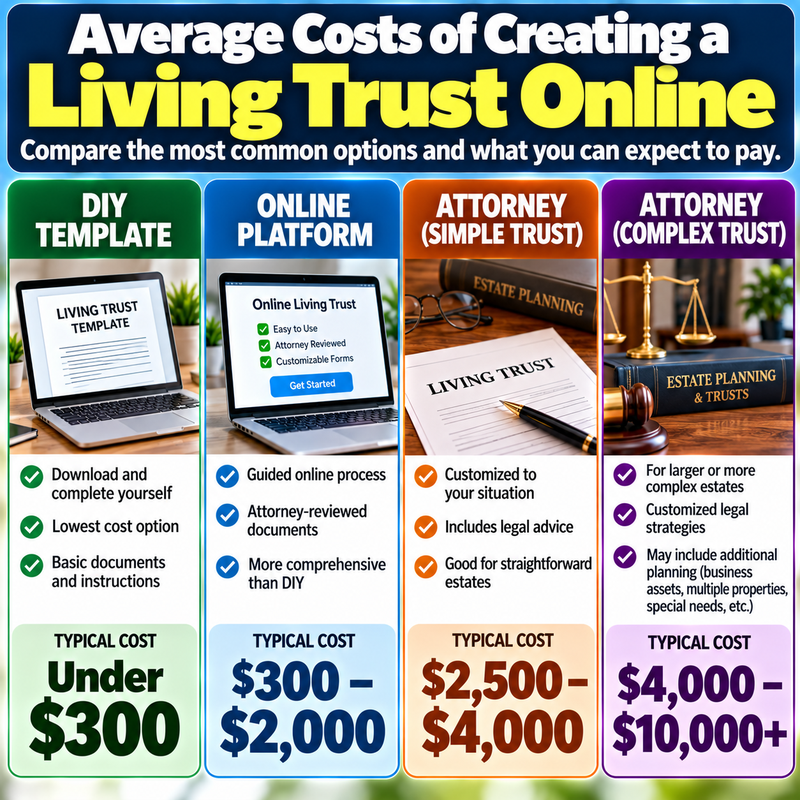
    • Living trust attorney fees typically range from about $2,500 to $4,000 for a simple estate plan and can reach $4,000 to $10,000 or more for complex situations, according to industry pricing surveys.
    • Attorneys generally bill either a flat fee for a defined package or hourly rates for consultations, drafting, and unusual provisions—knowing which model you’re being quoted matters as much as the number itself.
    • Fees vary based on geography, estate complexity, whether you’re planning as an individual or a married couple, multiple properties, business ownership, blended families, and tax considerations.
    • Some packages include companion documents like a pour-over will and powers of attorney, while others charge separately for funding assistance, deed preparation, and future amendments.
    • Comparing a written scope of services—rather than just a headline price—is the only reliable way to know what you’re actually paying for, a topic we’ll unpack in detail below.
    Living-Trust-Attorney-Fees

    Quick Answer: How Living Trust Attorney Fees Are Commonly Structured

    Most estate planning attorneys price their services one of two ways: a flat fee for a defined package of documents, or an hourly rate that adds up based on time spent. Flat fees are more common for straightforward living trust plans because they give clients cost certainty upfront. Hourly billing tends to show up when an estate involves unusual assets, contested family dynamics, or provisions that don’t fit a standard template.

    Neither model is inherently better—it depends on your situation. A flat fee protects you from surprise costs if your plan is genuinely simple. Hourly billing can actually save money if your needs are minimal, since you’re not paying for a “one-size-fits-all” package. The key is understanding which model you’re being quoted and what specific work that fee covers, something we’ll return to throughout this piece. Working with a living trust attorney who provides this clarity from the start tends to prevent billing disputes down the road.

    Flat-Fee Living Trust Packages

    Flat-fee arrangements are the most common way estate planning attorneys price a living trust for individuals and couples with relatively uncomplicated finances. Instead of tracking hours, the attorney quotes one price for a defined bundle of services—typically the trust document itself, plus a set of companion documents and a consultation or two. The appeal is predictability: you know the number before you sign anything.

    But “flat fee” doesn’t always mean “everything included.” Some flat-fee packages stop at drafting the documents and leave funding work—the process of actually transferring assets into the trust—as a separate, billable task. Others build funding assistance directly into the package price. This is exactly why asking for an itemized scope of services matters more than comparing two flat numbers side by side.

    Typical Flat-Fee Ranges for Simple Estates

    According to available industry pricing data, a simple attorney-drafted estate plan—typically covering an individual or couple with modest assets, no business interests, and no complicated family dynamics—tends to run approximately $2,500 to $4,000 as an estimate. In some markets, a trust-based plan can come in around $2,500 to $5,000, while a basic will-based plan for an individual may run closer to $1,000 to $1,500, with couples paying somewhat more.

    These figures are general estimates and can shift based on your state, your attorney’s experience level, and exactly what’s bundled into the package. For a deeper dive into how these numbers break down by plan type, the living trust cost overview covers additional pricing scenarios worth reviewing before you request quotes.

    Typical Flat-Fee Ranges for Complex Estates

    Complexity changes the math quickly. A complex attorney-drafted estate plan—one involving multiple properties, business ownership, blended family considerations, or significant tax planning—can run approximately $4,000 to $10,000 or more, according to available estimates. This isn’t arbitrary padding; more complexity generally means more drafting time, more customized provisions, and more careful review to make sure the plan actually holds up as intended. For further insights, you can explore estate planning costs in detail.

    It’s worth noting that cost isn’t purely a function of how much wealth you have—it’s more about what shape that wealth takes. A trust holding straightforward liquid assets like bank and brokerage accounts is generally simpler and less expensive to draft than one holding real estate with an existing mortgage, since transferring mortgaged property into a trust involves extra steps and documentation. A $2 million estate made up mostly of cash and investments can sometimes cost less to plan than a $500,000 estate that includes a rental property, a small business, and out-of-state real estate.

    Free Trust Consultation Banner

    Hourly Billing and When Attorneys May Use It

    Some attorneys bill hourly rather than flat fee, particularly for initial consultations, drafting unusual provisions, handling funding work, or making changes after the original plan is signed. Hourly billing gives attorneys flexibility to charge based on actual time spent, which can work in your favor if your needs are limited, or add up quickly if your situation requires extensive back-and-forth.

    The practical takeaway is this: before agreeing to hourly billing, ask for an estimated range based on similar past clients. A good attorney should be able to give you a ballpark—even if it’s not a guarantee—based on the complexity of what you’re asking for. If an attorney can’t or won’t estimate a range, that’s worth treating as a caution flag rather than dismissing outright, since some genuinely complex situations are hard to estimate precisely.

    What an Attorney’s Living Trust Fee May Include

    A well-structured living trust fee typically covers more than just a stack of paper with your name on it. Most attorney-drafted packages include an initial consultation, a review of your family and financial circumstances, drafting of the trust document itself, a round of revisions based on your feedback, and instructions for properly signing and notarizing everything. What varies from firm to firm is how far past “drafting” the fee actually extends.

    Initial Consultation and Estate Review

    Nearly every attorney-drafted plan starts with a conversation—reviewing your assets, your family structure, and your goals for who gets what and when. This step is foundational because it shapes every document that follows. Some attorneys offer this consultation as a free introductory meeting, while others build the time into the overall flat fee.

    Trust Drafting and Revisions

    The core of the fee pays for actually drafting the revocable living trust document, tailored to your state’s laws and your specific wishes. Most flat-fee packages include at least one round of revisions if something needs adjusting before signing. It’s worth confirming how many revision rounds are included before you’re locked into a fee, since unlimited revisions and a single revision are very different value propositions.

    Pour-Over Will and Powers of Attorney

    A living trust rarely stands alone. Most comprehensive plans also include a pour-over will, which catches any assets accidentally left outside the trust, along with a financial power of attorney and a health-care directive. Some attorney packages bundle these companion documents into the base price, while others price them as add-ons—so ask directly whether these are included or billed separately.

    Signing and Notarization Guidance

    Proper execution matters just as much as proper drafting. A trust that isn’t signed and witnessed correctly under your state’s rules can end up legally ineffective, which defeats the entire purpose of paying for one. Reputable attorneys walk clients through signing requirements as a standard part of the service, ensuring the document will actually hold up when it’s needed.

    Trust-Funding Guidance or Deed Work

    Here’s where packages diverge most sharply. A trust only works if assets are actually retitled into it—a step known as “funding.” Some attorneys include general funding instructions as part of the base fee, while others go further and personally prepare deeds or coordinate account retitling. Others leave funding entirely to the client. This single difference can represent hundreds or thousands of dollars in additional value or additional cost, depending on how it’s structured.

    What May Cost Extra

    Even a clear flat-fee quote can grow once your attorney understands the full picture of your estate. Knowing where extra charges commonly show up helps you ask better questions upfront, rather than being surprised by an invoice later.

    • Additional deeds and properties: Each additional piece of real estate—especially out-of-state property or property with an existing mortgage—can add drafting time and separate recording fees at the county level.
    • Business interests and unusual assets: Transferring an LLC, partnership interest, or closely held business into a trust often requires additional legal analysis beyond a standard residential and investment portfolio.
    • Tax planning: Estates with significant tax exposure may require specialized provisions, which typically involve more attorney time and, in some cases, coordination with a tax professional.
    • Major revisions or future amendments: A simple typo fix is different from a comprehensive restatement of the entire trust. Ask upfront how amendments are billed, since this is one of the most common places clients get an unexpected invoice years down the line.

    None of these additional charges are unreasonable on their own—complex work generally deserves additional compensation. The issue only arises when a client assumed a flat fee covered everything, only to learn later that business interests or multiple properties triggered add-on charges they didn’t anticipate.

    Why Attorney Fees Vary

    Two attorneys quoting the exact same living trust package can land on very different numbers, and it’s rarely arbitrary. Several factors consistently explain the spread.

    Geography plays a bigger role than most people expect. Attorneys practicing in major metropolitan areas with higher overhead costs and cost of living typically charge more than attorneys in smaller towns or rural markets, even for comparable services. This doesn’t necessarily mean big-city attorneys provide better work—it often just reflects local market rates.

    Geographic Market

    State law itself also factors in here, since trust and probate rules differ from state to state, and an attorney licensed and experienced in your specific state’s requirements is generally a safer choice than a generic template that wasn’t built around your jurisdiction’s rules.

    Attorney Experience

    A newly licensed attorney and a 20-year estate planning specialist may charge very different rates for what looks like the same trust document on paper. More experienced attorneys often justify higher fees through faster turnaround, deeper knowledge of common pitfalls, and the ability to spot issues a less experienced drafter might miss.

    That said, higher price doesn’t automatically guarantee better service, and a newer attorney focused specifically on estate planning can sometimes offer excellent value. The key is asking about their specific experience with situations similar to yours—blended families, business ownership, or multistate property—rather than assuming years in practice tells the whole story.

    Estate and Family Complexity

    As covered earlier, complexity drives cost more directly than total asset value. Blended families with children from prior relationships, special-needs beneficiaries, and unusual distribution schemes all require more customized drafting than a straightforward “everything to my spouse, then to my kids” plan.

    Individual vs. Couple Planning

    Married couples typically pay somewhat more than individuals for trust-based planning, since a joint trust involves coordinating two sets of assets, beneficiary wishes, and often separate powers of attorney and health-care directives for each spouse. This isn’t double the individual price, but it’s rarely identical either.

    Questions to Ask Before Accepting a Flat-Fee Quote

    Before signing on with any attorney based on a flat-fee quote, it’s worth asking a short list of pointed questions. Does the fee include a pour-over will, financial power of attorney, and health-care directive, or are those priced separately? Does it include funding assistance—meaning will the attorney actually prepare deeds and help retitle accounts, or just hand you instructions? How many revision rounds are included before signing? And critically, how are future amendments billed—hourly, or as a smaller flat fee for minor changes?

    Asking these questions upfront, and requesting the answers in writing, turns a vague headline number into a real scope of services you can actually compare against a competing quote. Two attorneys quoting $3,000 aren’t necessarily offering the same thing, and the only way to know is to ask.

    Attorney vs. Online vs. DIY Costs

    Traditional attorney representation isn’t the only path to a living trust, and it’s fair to compare it honestly against other models rather than assume it’s automatically the right choice for everyone. DIY estate planning products—templates and software you complete yourself—generally carry the lowest upfront cost, but they place the entire burden of legal accuracy, state-specific compliance, and proper execution on the consumer.

    For someone with a genuinely simple estate and no unusual circumstances, this can work fine. For anyone with real estate, business interests, or a blended family, the risk of a mistake going unnoticed until it matters most is real.

    Online services occupy a wide spectrum, from bare-bones document generators to guided platforms that offer more structure and support. Bulletproof Legacy’s eStatePlan approach falls into this middle category—a supported digital model that combines online convenience with professional resources, rather than leaving clients entirely on their own with a template.

    This kind of hybrid approach can appeal to people who want more guidance than a pure DIY tool but don’t necessarily need the full customization of a traditional attorney engagement. And the costs of online trust services can vary widely. The right fit ultimately depends on how complex your estate is and how much hands-on legal analysis your specific situation requires.

    When Paying for Individualized Legal Advice Can Be Valuable

    There are estate planning situations where paying for a licensed living trust attorney genuinely earns its cost. Complex estates involving multiple businesses, significant tax exposure, or multistate real estate benefit from someone who can analyze the specific facts and apply current law to your exact circumstances—something a template simply can’t do.

    Blended families are another area where individualized advice matters. Deciding how to balance a current spouse’s needs against children from a prior marriage involves nuanced legal structuring that a one-size-fits-all document often handles poorly or not at all. Special-needs planning falls into the same category, since a poorly drafted trust can accidentally disqualify a beneficiary from essential government benefits.

    Unusual beneficiary arrangements, disinheritance concerns, or family dynamics that might invite legal challenges after death also warrant professional judgment. An experienced attorney can draft language specifically designed to hold up under scrutiny, which is difficult to replicate with a generic template regardless of price.

    How to Compare Total Service Rather Than Price Alone

    The single best defense against fee confusion is requesting a written scope of services from every attorney or provider you’re considering, rather than comparing headline prices in isolation. A written scope should spell out exactly which documents are included, whether funding assistance is part of the package, how many revisions are covered, and how future changes will be billed.

    Once you have two or three scopes in hand, the comparison becomes far more useful than simply asking “who’s cheapest?” A $4,500 quote that includes full funding assistance, both spouses’ companion documents, and free minor amendments for a year may genuinely be a better value than a $2,800 quote that only covers the trust document itself. Comparing total trust creation service, not just the number on the page, is how informed consumers actually make this decision well.

    Red Flags in Vague or Incomplete Pricing

    A few warning signs suggest a quote deserves more scrutiny before you commit. Be cautious of any provider unwilling to put their scope of services in writing, since verbal promises are hard to enforce later.

    Similarly, a headline price with no mention of funding assistance, companion documents, or amendment policies often means those costs will surface later as separate charges. And if an attorney can’t explain in plain language why your specific situation costs more than a basic package, that’s worth a follow-up question before moving forward.

    Final Checklist for Comparing Living Trust Attorney Fees

    Before choosing a provider, confirm the following in writing: what documents are included, whether funding assistance is part of the fee, how revisions before signing are handled, how future amendments are billed, and whether the price reflects a flat fee or hourly structure. Walking through this checklist with every attorney or service you’re considering removes most of the guesswork from an otherwise confusing comparison process.

    Frequently Asked Questions

    How much does a living trust attorney charge on average?

    Estimates suggest a simple attorney-drafted living trust plan typically runs approximately $2,500 to $4,000, while complex plans can run $4,000 to $10,000 or more, depending on the estate’s complexity and the attorney’s location. See this living trust cost and comparison guide for more information.

    Is a living trust cheaper than a will in the long run?

    A living trust often costs more upfront than a simple will, but it can help beneficiaries avoid probate, which in some states can consume 3% to 7% of an estate’s value and take six to twelve months or longer to resolve.

    Do attorneys charge separately for a pour-over will?

    It depends on the provider. Some flat-fee packages include a pour-over will as a standard companion document, while others price it separately, so this is worth confirming before signing.

    What’s included in a basic living trust package?

    A basic package typically includes an initial consultation, drafting of the trust document, a round of revisions, signing instructions, and general funding guidance, though the exact scope varies by attorney.

    Why do some attorneys charge more for trust funding?

    Trust funding involves retitling assets like real estate and financial accounts, which requires preparing deeds and coordinating with banks or county recording offices—work that goes beyond simply drafting the document.

    Can I negotiate a flat fee with an estate planning attorney?

    Many attorneys are open to discussing scope and price, particularly if your estate is simpler than their standard package assumes, so it’s reasonable to ask.

    Does a married couple pay more than an individual for a trust?

    Generally yes, since a joint trust for a couple typically involves coordinating two sets of assets and often separate companion documents for each spouse, though the increase usually isn’t double the individual rate.

    Are online trust services cheaper than hiring an attorney?

    Online and supported digital services often carry lower costs than traditional attorney representation, though the level of guidance and customization varies significantly between providers.

    What happens if I need to amend my trust later?

    This depends entirely on the original agreement—some attorneys include minor amendments in an ongoing relationship, while others bill hourly or charge a separate flat fee for changes, so it’s worth clarifying this before signing your initial plan.

    How do I know if a low-cost trust quote is missing something important?

    Request a written scope of services and compare it against the checklist above—if funding assistance, companion documents, or amendment policies aren’t addressed, ask directly before assuming they’re included.

    Whatever path you choose, understanding exactly what you’re paying for—and what might cost extra later—is the real key to simplifying your estate planning decision, and Bulletproof Legacy’s supported digital eStatePlan model exists to help make that process more transparent and accessible from the start.

    Red Flags in Vague or Incomplete Pricing

    A few warning signs suggest a quote deserves more scrutiny before you commit. Be cautious of any provider unwilling to put their scope of services in writing, since verbal promises about what’s “included” are hard to enforce later if a dispute arises. Similarly, a headline price with no mention of the funding cost or assistance, companion documents, or amendment policies often means those costs will surface later as separate line items on an invoice.

    If an attorney can’t explain in plain language why your specific situation costs more than a basic package, that hesitation is worth a follow-up question before you move forward with signing anything.

    Final Checklist for Comparing Living Trust Attorney Fees

    Before choosing a provider, confirm the following in writing: what documents are included, whether funding assistance is part of the fee, how revisions before signing are handled, how future amendments are billed, and whether the price reflects a flat fee or hourly structure. Getting clear answers to these five points turns a confusing number on a page into a real, comparable scope of work.

    Walking through this checklist with every attorney or service you’re considering removes most of the guesswork from an otherwise confusing comparison process. It also protects you from the most common complaint people have after signing with an estate planning provider—discovering, months later, that something they assumed was included was actually billed separately.

    Attorneys who include funding assistance in their base fee are essentially absorbing this extra work into the flat price, which is one reason two quotes with similar headline numbers can represent very different total value.

    Before signing with any provider, it’s worth asking specifically:

    • Will the attorney prepare and record deeds for real estate, or only provide instructions?
    • Does the fee include coordinating with financial institutions to retitle accounts?
    • Is there a limit on how many properties or accounts are covered under the base fee?

    Can I negotiate a flat fee with an estate planning attorney?

    Many attorneys are open to discussing scope and price, particularly if your estate is simpler than their standard package assumes or if you only need specific documents rather than a full plan. It’s reasonable to ask whether the fee can be adjusted if you don’t need certain companion documents or funding assistance.

    That said, negotiation works best when you come prepared with a clear picture of what you actually need. Vague requests to “lower the price” rarely go anywhere, but specific questions about trimming unnecessary components often do.

    Some attorneys are also more flexible on payment timing than on total price, offering installment arrangements rather than reducing the fee itself.

    Does a married couple pay more than an individual for a trust?

    Generally yes, since a joint trust for a couple typically involves coordinating two sets of assets, beneficiary wishes, and often separate financial powers of attorney and health-care directives for each spouse. The increase usually isn’t double the individual rate, but it’s rarely identical either.

    Are online trust services cheaper than hiring an attorney?

    Online and supported digital services often carry lower upfront costs than traditional attorney representation, though the level of guidance, customization, and support varies significantly between providers. Some key differences to weigh include:

    • Whether the platform offers access to licensed professionals for review, or only self-guided document creation
    • Whether state-specific compliance is built into the platform or left to the user to verify
    • Whether funding guidance is included or left entirely to the client
    • How much customization is possible for blended families, business interests, or unusual provisions

    For straightforward estates with no unusual assets or family complications, a supported digital option can offer meaningful savings without sacrificing much in terms of legal soundness. For estates involving business ownership, multistate property, or blended family dynamics, the individualized analysis a licensed attorney provides often justifies the higher price.

    The right answer isn’t universal—it depends on how closely your situation matches a standard template versus how much custom legal judgment your specific circumstances require.

    Reading through a resource like the living trust cost comparison before deciding can help clarify which category your estate falls into.

    What happens if I need to amend my trust later?

    This depends entirely on the terms of your original agreement. Some attorneys include minor amendments as part of an ongoing client relationship at no extra charge, while others bill hourly or charge a separate flat fee for any change, however small.

    It’s worth clarifying this distinction before signing your initial plan, since life events like a new grandchild, a divorce, or a change in beneficiaries are common enough that most people end up amending a trust at least once.

    How do I know if a low-cost trust quote is missing something important?

    Request a written scope of services and compare it against the checklist covered earlier in this guide—if funding assistance, companion documents, or amendment policies aren’t clearly addressed, ask directly before assuming they’re included. For more information on understanding estate planning costs, you can explore this guide on estate plans.

    A low price isn’t necessarily a bad deal, but it becomes a problem when it’s missing pieces you’ll need later and didn’t realize weren’t part of the package.

  • What Assets Should Be in a Living Trust?

    What Assets Should Be in a Living Trust?

    What Assets Should Be in a Living Trust? A Practical Property Checklist

    A Practical Checklist for Real Estate, Bank Accounts, Investments, Business Interests, and Other Property

    Not every asset you own belongs inside your living trust, and putting the wrong one in—or leaving the right one out—can quietly undo months of careful planning.

    That’s the central tension anyone setting up a trust eventually runs into. A living trust is only as good as the property actually titled in its name, yet not every account, deed, or policy should be moved there. Some assets, like retirement accounts, can trigger tax headaches if retitled incorrectly. Others, like everyday vehicles, may not need to be in the trust at all. This article breaks down exactly what assets should be in a living trust, what should stay out, and how to think through the gray areas in between. If you’re still working through the broader mechanics of setting one up, our step-by-step guide on how to create a living trust covers the full process from start to finish.

    Key Takeaways: Article at a Glance

    • Real estate, non-retirement bank and investment accounts, business interests, and valuable personal property are generally the strongest candidates for a living trust.
    • Retirement accounts like IRAs and 401(k)s typically should not be retitled into a trust, since doing so can trigger unwanted tax consequences.
    • Simply signing a trust document doesn’t move any property into it—each asset has to be individually retitled or assigned, a process called funding.
    • Coordinating beneficiary designations, deeds, and account titling with your trust matters just as much as which assets you choose to include.
    • Later in this article, we’ll walk through exactly how business interests, life insurance, and vehicles fit into the picture—along with when it makes sense to get professional guidance.
    What-Assets-Should-Be-In-A-Living-Trust

    A Practical Checklist for Real Estate, Bank Accounts, Investments, Business Interests, and Other Property

    Think of your trust as an empty container the day you sign it. It has legal authority, but it doesn’t automatically hold anything. Every asset—your house, your brokerage account, your business interest—has to be individually moved into that container through a process called funding. What follows is a practical, asset-by-asset breakdown of what typically goes in, what typically stays out, and why the distinction matters more than most people realize.

    What It Means for an Asset to Be “In” a Living Trust

    An asset is “in” your living trust when its legal ownership has actually been changed to reflect the trust as the owner—not when it’s merely listed on a piece of paper somewhere in your estate planning binder. This distinction trips up more people than almost anything else in the trust-creation process.

    Retitling Ownership vs. Simply Mentioning an Asset in the Trust Document

    Your trust document names the property you intend to transfer, but the document itself doesn’t perform the transfer. For real estate, that means a new deed. For adding a bank account to a trust, that means new paperwork at the bank. For stock certificates, that means a change of ownership through the transfer agent. A living trust only controls what has actually been retitled into its name, which is why attorneys and financial professionals talk so much about “funding” as a separate, essential step.

    • Real estate requires a new deed recorded with the county.
    • Bank and brokerage accounts require new account paperwork naming the trust as owner.
    • Personal property without a title or certificate is typically handled through a signed assignment document.
    • Business interests may require review of governing agreements before any transfer can happen.

    If any of these steps get skipped, the asset stays in your individual name—which matters a great deal when it comes to probate.

    Why Funding the Trust Is a Separate Step From Signing It

    Signing your trust is a legal formality. Funding it is the actual work. Many people create a trust with an attorney or online service, feel a sense of completion, and then never follow through on retitling their accounts and property. The trust sits there, technically valid but functionally empty for the assets that were never transferred into it.

    A revocable living trust can be amended or unwound at any time while you’re alive and mentally competent, which is part of why funding sometimes gets put off—there’s no hard deadline forcing the issue. But an unfunded trust provides none of the coordination benefits it was designed for, so treating funding as a distinct, necessary step (rather than an afterthought) is one of the most important habits in the entire process.

    Why Asset Selection Matters for Probate Avoidance and Trust Administration

    Choosing the right assets for your trust affects two separate things: whether those assets avoid probate, and how smoothly your successor trustee can manage and distribute them later. Getting the selection right on both counts is what separates a trust that works as intended from one that creates confusion.

    How Unfunded Assets Can Still End Up in Probate

    Probate outcomes depend on how an asset is titled at the time of death—not on whether you happen to have a trust. An account or property still held in your individual name, without a payable-on-death designation or joint owner, will typically need to go through probate regardless of what your trust document says. This is true whether you have a will, a trust, both, or neither; probate is triggered by how the asset is titled, not by the existence of an estate plan.

    This is why real estate left out of the trust, a bank account never retitled, or a brokerage account overlooked during a move can all end up subject to probate court supervision even though the owner intended otherwise.

    The Link Between Proper Titling and a Smooth Trust Administration

    Beyond probate, correct titling determines how easily your successor trustee can step in and act. If your home, accounts, and investments are clearly titled in the trust’s name, your successor trustee can typically manage or distribute them according to your instructions without needing separate court authorization for each asset. When titling is inconsistent or incomplete, the trustee may need to spend extra time—and sometimes legal help—sorting out which assets the trust actually controls.

    Real Estate You Should Consider Placing in a Living Trust

    Real estate is one of the most common—and most straightforward—assets to place in a living trust. Because property ownership is documented through a deed, transferring it into the trust is a well-established process, though the specific requirements vary by state and by property type. For more information, you can read about what assets should be included in your trust.

    Primary Residences and Vacation Homes

    Your primary home is often the single largest asset in an estate, which makes it a natural candidate for trust ownership. The same logic generally applies to a vacation home. Transferring either requires preparing and recording a new deed that names the trust as owner, a task usually handled with the help of an attorney or title professional familiar with your state’s recording requirements.

    Rental and Investment Properties

    Rental properties can also be titled in a living trust, which may simplify management if you own several properties or want a successor trustee to be able to step in and handle tenant matters, leases, or a sale without waiting on probate court involvement. As with any real estate transfer, review how the change affects insurance coverage, existing leases, and any local landlord-tenant registration requirements tied to ownership.

    Mortgages, Title Insurance, and Homestead Protections to Review First

    Before transferring mortgaged property into a trust, a few things deserve attention. Some lenders have policies or loan terms that address transfers to a revocable trust, and title insurance coverage should be confirmed to make sure it continues after the deed changes hands. If your state offers homestead protections tied to individual ownership, it’s worth asking a local attorney or title company whether those protections carry over once the property is titled in the trust’s name. These are the kinds of details that vary by state and by lender, so getting specific guidance before recording a new deed is generally worthwhile.

    Second Homes and Out-of-State Property

    Owning property in more than one state adds a wrinkle that a living trust is particularly well-suited to address. Without proper planning, a second home in another state can mean your estate faces probate proceedings in two different courts—one in your home state and another where the second property sits.

    Avoiding Multiple Probate Proceedings Across State Lines

    When out-of-state real estate is properly titled in your living trust, it generally passes to your beneficiaries through the trust’s terms rather than triggering a separate probate case in that state. This is one of the more practical reasons people with vacation homes, inherited property, or investment real estate in multiple states choose to fund those properties into their trust specifically.

    State-Specific Deed and Recording Requirements

    Every state has its own rules for deed language, notarization, and recording fees, and those rules apply based on where the property is located—not where you live. A deed that’s valid in your home state won’t necessarily meet the recording requirements in another. This is an area where working with a local attorney or title company in the state where the property sits is typically the most reliable path.

    Checking, Savings, CDs, and Taxable Investment Accounts

    Non-retirement financial accounts are among the easiest assets to move into a living trust, and doing so is common practice.

    • Checking and savings accounts
    • Brokerage and taxable investment accounts
    • Money market accounts
    • Certificates of deposit
    • Physical stock and bond certificates

    Retitling Bank Accounts Into the Trust’s Name

    Retitling a bank account typically means visiting your bank with a copy of your trust document (or a certification of trust) and completing new account paperwork that lists the trust as the owner. Some banks handle this quickly; others require additional documentation. It’s worth asking your bank directly what they require, since procedures vary by institution.

    If you plan to keep using an account for everyday bill-paying, make sure you’ll retain full control as trustee before moving it—active accounts you no longer control directly can create practical headaches.

    • Bring your trust document or certification of trust to the bank.
    • Complete the bank’s account retitling paperwork.
    • Confirm signing authority and online access remain intact under the new titling.

    Brokerage Accounts, Stocks, and Bond Certificates

    Taxable brokerage accounts generally transfer to a trust through paperwork with the brokerage firm, similar to a bank account. Physical stock and bond certificates require a change of ownership processed through the stock transfer agent or bond issuer, which can take longer than an electronic account transfer.

    Certificates of Deposit and Early-Withdrawal Penalty Risks

    CDs deserve a bit of extra caution. Retitling an existing CD into a trust’s name can sometimes trigger an early-withdrawal penalty, depending on the bank’s policies. Many people instead wait until a CD matures and then open the replacement CD directly in the trust’s name, avoiding the penalty altogether.

    Business and Closely Held Ownership Interests

    Business ownership interests can often be placed in a living trust, but the process is rarely as simple as retitling a bank account. Governing documents, lender agreements, and other owners’ rights all come into play.

    Sole Proprietorships

    If you run a sole proprietorship, the business and its assets are legally indistinguishable from you personally, which means transferring them to a trust works much like transferring any other personal asset. Business equipment, accounts, and property used in the business can typically be assigned or retitled the same way you would handle other property.

    Partnership Interests and Governing Agreement Restrictions

    Partnership interests are a different story. Many partnership agreements include restrictions on transferring an ownership interest to a third party—including a trust—without consent from the other partners. Before attempting to fund a partnership interest into your trust, review the partnership agreement carefully or have an attorney review it for you. Some agreements permit the transfer outright; others require formal approval first, and a few may prohibit it altogether.

    Ignoring these restrictions doesn’t just risk an invalid transfer—it can also create friction with business partners who expected a say in ownership changes. Taking the time to check the governing document up front avoids that problem entirely.

    For businesses with more than one owner, this kind of due diligence is simply part of doing the transfer correctly rather than an optional extra step.

    LLC Membership Interests and Operating Agreement Approval

    Limited liability companies typically operate under an operating agreement that spells out whether and how membership interests can be transferred. Many operating agreements require approval from a majority of the other members before an interest can move into a living trust. Once approved and transferred, the trust generally holds the economic ownership share, while voting rights and management authority often remain structured according to the terms of the operating agreement.

    Because LLC structures vary so widely from one company to the next, reviewing your specific operating agreement—ideally with an attorney familiar with business entities—is the most reliable way to confirm what’s required before you attempt the transfer.

    Personal Property and Assignment of Assets

    Not everything you own comes with a title or deed, but that doesn’t mean it has to stay outside your trust. Jewelry, art, family heirlooms, and furniture can all be included through a simpler mechanism than retitling: a signed assignment document.

    Jewelry, Art, Collectibles, and Furniture

    Valuable personal property—fine jewelry, artwork, collectibles, antique furniture—can be transferred into your living trust even though these items don’t have a title certificate the way a car or house does. Because there’s no formal registry to update, the transfer happens through documentation rather than a government filing.

    This matters most for higher-value items. A collection of antique furniture or a valuable art piece can create genuine disputes among heirs if ownership isn’t clearly documented, so taking the time to list these items properly is worth the effort even though no deed or title change is involved.

    Using an Assignment Document for Items Without Titles

    An assignment of personal property is a signed document, usually prepared alongside your trust, in which you formally transfer ownership of untitled items to the trust. Rather than retitling each item individually, you typically:

    • List the specific items or categories of personal property on a schedule attached to the trust
    • Sign a general assignment document transferring your interest in that property to the trust
    • Keep the schedule updated as you acquire or dispose of significant items

    This approach is far more practical than trying to create individual transfer paperwork for every piece of furniture or jewelry you own.

    It’s worth revisiting this schedule periodically—especially after acquiring a new valuable item or gifting away an old one—so the trust’s records stay accurate over time.

    For everyday household items of modest value, most people don’t bother with a formal assignment at all, since the cost and effort of documentation outweighs the benefit for property without significant resale or sentimental value.

    Mineral, Oil, Gas, and Water Rights

    If you own mineral, oil, gas, or water rights, these can typically be transferred into a living trust through an assignment or a new deed, depending on how the rights were originally established and how your state treats them. Because these rights are often tied to specific legal documents and may involve royalty payments from third parties, it’s worth confirming with an attorney familiar with mineral rights in your state exactly what paperwork the transfer requires.

    These transfers may also require notifying the company that manages royalty payments, so the payments continue to flow correctly once ownership shows the trust as the rights holder.

    Assets With Beneficiary Designations: Coordinate Rather Than Assume

    Some of your most valuable assets—retirement accounts, life insurance, certain bank accounts—don’t pass through your trust at all. They pass according to whoever you named as beneficiary on the account itself, regardless of what your trust document says.

    This is one of the most misunderstood parts of estate planning. People sometimes assume that creating a trust automatically updates or overrides these beneficiary designations. It doesn’t. The two systems run in parallel, and if they’re not coordinated, the outcome can directly contradict what you intended in your trust.

    Payable-on-Death and Transfer-on-Death Accounts

    Many banks and brokerages let you add a payable-on-death (POD) designation to checking and savings accounts, or a transfer-on-death (TOD) designation to investment accounts. These designations let the asset pass directly to the named person when you die, without going through probate—similar in effect to trust ownership, but achieved through a different mechanism entirely. Some people use POD and TOD designations instead of retitling an account into the trust; others use both together, naming the trust itself as the POD or TOD beneficiary.

    Why the Trust Doesn’t Automatically Override a Named Beneficiary

    If an account has a named beneficiary on file with the institution, that designation controls where the asset goes—full stop. Your trust’s instructions about that same asset are simply irrelevant if the beneficiary designation says otherwise, because the financial institution follows its own records, not your trust document.

    This is why reviewing beneficiary designations on every applicable account is just as important as funding your trust with titled property. A trust that says one thing while an old beneficiary form says another creates exactly the kind of conflict that can end up disputed after you’re gone.

    Retirement Accounts and Why They Need Special Handling

    Retirement accounts are the asset category where people most often get tripped up, largely because the instinct to “put everything in the trust” runs directly against how these accounts are designed to work.

    Unlike a bank account or a house, an IRA or 401(k) isn’t something you simply retitle into a trust’s name the way you would other property. Doing so can trigger consequences that most account owners never intended.

    Why IRAs, 401(k)s, and 403(b)s Generally Stay Out of the Trust

    Retirement accounts are tax-advantaged specifically because they remain titled in your individual name during your lifetime. This category includes what assets belong in a trust.

    • Traditional and Roth IRAs
    • 401(k) plans
    • 403(b) plans
    • 457 plans

    Attempting to retitle one of these accounts into your living trust’s name is generally treated as a withdrawal or distribution of the entire account—not a simple ownership change. That’s a very different outcome than retitling a bank account, and it’s why financial professionals routinely advise leaving retirement accounts titled in your individual name.

    Instead, retirement accounts are coordinated through the beneficiary designation on file with the plan administrator or custodian, not through trust ownership.

    Tax Consequences of Retitling a Retirement Account

    If a retirement account is retitled into a revocable trust as though it were an ordinary asset, the IRS may treat that change as a full distribution of the account. That means the entire balance could become taxable income in the year of the transfer, and you’d lose the tax-deferred growth the account was designed to provide. This is a significant, often irreversible mistake, which is exactly why retirement accounts get treated so differently from every other asset discussed so far.

    When Naming the Trust as Beneficiary May Be Appropriate

    There are situations where naming your living trust as the beneficiary of a retirement account—rather than an individual person—makes sense, such as when you want more control over how and when funds are distributed to a beneficiary, or when a beneficiary has special circumstances that warrant structured distributions.

    But this is a nuanced decision with tax implications that depend on the type of account, current tax law, and your specific goals. It’s a decision worth making with an estate planning attorney or tax advisor rather than as a default choice, since the rules governing inherited retirement accounts have changed significantly in recent years and continue to carry real consequences for beneficiaries.

    Life Insurance Considerations

    Life insurance sits in an interesting middle ground. It’s not typically “funded” into a trust the way a bank account is, but it can still be coordinated with your trust in more than one way. For more details on how to include life insurance in your estate planning, you can explore what assets should be included in your trust.

    Naming the Trust as Owner vs. Beneficiary

    You can name your living trust as the beneficiary of a life insurance policy, which means the death benefit pays into the trust and then gets distributed according to the trust’s terms. Alternatively, some people transfer ownership of the policy itself to the trust, which is a different and more involved step usually done for specific planning reasons. Simply naming the trust as beneficiary is the more common and generally simpler approach for most policyholders.

    Estate Tax Exposure When a Trust Is the Beneficiary

    If you’re the trustee of your own revocable living trust and your life insurance policy is owned by that trust or payable to it, the death benefit is generally still counted as part of your taxable estate. This surprises some people, since life insurance is often associated with tax-free proceeds to beneficiaries—and the proceeds themselves typically are received income-tax-free—but that’s a different question from whether the value counts toward federal estate tax thresholds. A

    s of 2024, the federal estate tax exemption is $13.61 million for an individual and $27.22 million for a married couple, rising to $13.99 million and $27.98 million respectively in 2025. Most estates fall well under these thresholds, but if your estate is large, this is a detail worth discussing with an estate planning attorney or tax advisor rather than assuming it doesn’t apply to you.

    Vehicles and Other State-Titled Property

    Cars, trucks, boats, and motorcycles occupy an unusual position in trust planning: they’re titled property, similar to real estate, but they usually don’t need to be transferred into a trust the way a house does.

    Why Everyday Cars, Boats, and Motorcycles Usually Stay Out

    Many states offer simplified transfer procedures for vehicles after death, meaning they often don’t go through the full probate process even without being in a trust. On top of that, some states impose sales or transfer taxes when a vehicle is retitled to a trust, which can make the transfer more costly than any benefit it provides.

    For a family car or a used pickup truck, the effort and potential cost of retitling into a trust typically isn’t worth it given the simplified transfer options many states already provide.

    State Rules on Retitling Fees and Named Beneficiaries

    Rules here vary significantly by state. Some states allow a transfer-on-death designation directly on a vehicle title, which accomplishes a similar goal to trust ownership without any retitling fees or trust paperwork at all. Checking with your state’s department of motor vehicles is the most reliable way to find out what options are available where you live.

    Collectible or High-Value Vehicles Worth Transferring

    The calculation changes for vehicles with significant cash value—a classic car, a vintage motorcycle, or a valuable boat, for example. These can be worth transferring into a living trust despite the extra paperwork, particularly if the value is high enough that you want the item to avoid probate and pass according to your trust’s specific instructions.

    Jointly Owned Property and Transfer-on-Death Arrangements

    Joint ownership is another area where an asset can technically avoid probate without ever touching your trust, which sometimes creates overlap or confusion with trust planning.

    How Joint Ownership With Rights of Survivorship Interacts With a Trust

    Property owned jointly with rights of survivorship automatically passes to the surviving owner when one owner dies, regardless of what a trust or will says. This happens outside of probate and independently of your trust entirely. Many married couples hold their home or bank accounts this way, which means the property passes to the surviving spouse directly—and only becomes relevant to the trust after both owners have passed.

    When These Arrangements May Duplicate or Conflict With Trust Terms

    Problems arise when joint ownership and trust instructions point in different directions. For example, if your trust divides your assets equally among three children, but a bank account is jointly titled with just one child, that account will go entirely to the joint owner—not split three ways—regardless of what the trust says. Reviewing how each asset is actually titled, alongside your trust’s terms, is the only way to catch these mismatches before they become a problem.

    Assets That May Not Belong in the Trust

    Beyond retirement accounts and everyday vehicles, a handful of other asset types are generally poor candidates for trust ownership, either because of legal restrictions or practical complications.

    • Health savings accounts (HSAs) and medical savings accounts (MSAs): these generally cannot be transferred into a living trust due to how they’re structured under federal rules.
    • UGMA/UTMA custodial accounts for minors: these accounts are already governed by custodianship rules designed to protect a minor’s interests, and attempting to fold them into a trust can create legal complications—particularly if a trustee were to pass away before the minor reaches the age of majority.
    • Active bill-paying accounts: an account you use regularly for day-to-day expenses can technically be titled in the trust’s name, but only if you’re serving as trustee with full, unrestricted control—otherwise, moving daily spending accounts into a trust can create unnecessary friction.

    None of this means these assets are left permanently unprotected or poorly planned for—it simply means a living trust isn’t the right tool for them. See our trust funding checklist for more detailed information. Other elements of your broader estate plan, such as beneficiary designations or account-specific rules, are typically better suited to handle these categories.

    If you’re unsure whether a specific account or asset falls into this category, that uncertainty is common—and it’s exactly the kind of question worth raising with an attorney or financial professional rather than guessing.

    How to Decide Asset by Asset

    With so many categories to consider, it helps to have a simple filter you can run each asset through rather than trying to memorize every rule at once.

    Questions to Ask Before Retitling Any Asset

    Before moving any asset into your trust, ask yourself:

    1. Does this asset already have a beneficiary designation, joint owner, or transfer-on-death provision that accomplishes what I want?
    2. Would retitling this asset trigger a tax consequence, penalty, or fee?
    3. Does a governing document—like a partnership or operating agreement—restrict or require approval for this transfer?
    4. Will I still have the level of control I need over this asset after it’s retitled?
    5. Is this an asset type that state law already allows to bypass probate through a simpler mechanism?

    Running through these questions for each significant asset you own turns a potentially overwhelming task into a manageable checklist.

    Common Funding Mistakes That Undermine a Trust

    The most common mistake isn’t choosing the wrong assets—it’s simply not finishing the job. People create a trust, retitle their house, and then stop, leaving bank accounts, investment accounts, or a business interest untouched. Others retitle assets but forget to update beneficiary designations on retirement accounts or life insurance, creating a mismatch between the trust’s instructions and what the institution has on file. Both mistakes are common, and both are entirely avoidable with a methodical review of everything you own.

    Reviewing and Updating the Trust as Assets Change

    A living trust isn’t a one-time project—it’s a structure that needs to keep pace with your life.

    Life Events That Should Trigger a Funding Review

    Certain moments call for a fresh look at what’s titled in your trust and what isn’t: buying or selling a home, opening a new investment account, starting or closing a business, receiving an inheritance, or experiencing a major family change like marriage, divorce, or the birth of a child. Each of these events can introduce a new asset that needs funding into the trust or an old one that no longer needs to be there.

    Keeping a Schedule of Trust Assets Current

    Many trusts include a schedule of assets—essentially a running list of what’s been transferred into the trust. Keeping this schedule updated as you acquire, sell, or reorganize assets makes it far easier for you, and eventually your successor trustee, to know exactly what the trust controls without having to reconstruct that picture from scratch.

    Free Consultation Banner 3

    When to Get Professional Guidance

    Some funding decisions are simple enough to handle on your own—retitling a bank account rarely requires legal help. Others, like transferring a business interest, coordinating retirement account beneficiaries, or moving property across state lines, benefit significantly from attorney, tax, or financial professional involvement. Bulletproof Legacy’s supported digital estate-planning approach is built around this reality, pairing digital access to your trust documents with professional resources and trust-funding assistance, so you’re not left guessing which category a particular asset falls into or how to complete the paperwork correctly.

    Frequently Asked Questions

    Do I need a lawyer to fund my living trust?

    Not always. Retitling a bank account or brokerage account is often something you can do directly with the institution. Real estate transfers, business interests, and out-of-state property, however, frequently benefit from attorney or title company involvement to make sure the paperwork meets your state’s specific requirements.

    Can I put my house in a living trust if I still have a mortgage?

    Generally, yes, but it’s worth reviewing your loan terms and confirming your title insurance stays in effect after the deed changes hands. Lender policies and state rules vary, so checking with your mortgage servicer or an attorney before recording a new deed is a reasonable precaution.

    What happens to assets left out of my living trust?

    Assets that aren’t retitled into the trust, and don’t have a beneficiary designation or joint owner, generally remain part of your individual estate and are typically subject to probate under your state’s laws.

    Should my life insurance policy be owned by my trust?

    It depends on your goals. Many people simply name the trust as beneficiary rather than transferring ownership outright. Either approach has different implications worth discussing with an attorney or financial advisor familiar with your full estate picture.

    Can a living trust own an LLC or S-corporation?

    Often, yes for an LLC, subject to the operating agreement’s transfer rules and other members’ approval. S-corporation ownership by a trust involves additional tax rules that require careful review, since not every type of trust qualifies as an eligible S-corp shareholder.

    Is it a mistake to put my retirement account in a trust?

    Retitling a retirement account directly into a trust’s name is generally not advisable and can trigger a taxable distribution of the entire balance. Naming the trust as a beneficiary is a different, sometimes appropriate strategy, but it should be discussed with a tax or estate planning professional first.

    How do I transfer bank accounts into a living trust?

    Bring your trust document or a certification of trust to your bank and complete their account retitling paperwork. Requirements vary by institution, so it’s worth calling ahead to ask what they need.

    Do I need a separate deed for each property in different states?

    Yes. Each property must be transferred according to the recording and deed requirements of the state where it’s located, since those rules don’t carry over from one state to another.

    What is a certification of trust and when will I need one?

    A certification of trust is a shortened document that proves your trust exists and summarizes key terms, like who the trustee is, without disclosing the entire trust document. Banks, title companies, and other institutions often accept this instead of the full trust when you’re retitling an asset.

    How often should I review my trust’s asset list?

    Reviewing it after any major life event—buying property, starting a business, receiving an inheritance—is a good baseline, along with a general check-in every few years even if nothing major has changed.

    Your Next Step in Building a Fully Funded Living Trust

    If you’d like help thinking through which of your specific assets make sense for a trust and how to get them properly funded, scheduling a Free Living Trust Consultation is a low-pressure way to get clarity on your options. Bulletproof Legacy’s supported digital estate-planning approach is designed to help you move from a signed trust document to a fully funded plan with professional resources along the way.

    Health Savings and Medical Savings Accounts

    Health savings accounts and medical savings accounts generally cannot be transferred into a living trust. These accounts are structured under federal rules that tie ownership directly to an individual, and that structure doesn’t accommodate a trust stepping in as the titled owner. If you want to address what happens to unused HSA or MSA funds after you’re gone, that’s typically handled through the beneficiary designation on the account itself rather than through your trust.

    UGMA/UTMA Accounts for Minors

    Custodial accounts set up under the Uniform Gifts to Minors Act or Uniform Transfers to Minors Act come with their own built-in legal structure designed to protect the child’s interest until they reach the age of majority. Folding one of these accounts into a living trust can create more complications than it solves, particularly if the custodian or trustee were to pass away before the minor reaches the qualifying age.

    Because these accounts already have a legal framework built around protecting a minor beneficiary, most families leave them alone rather than attempting to merge them with trust planning. If you have concerns about how a custodial account will be handled, that’s a good question to raise directly with the financial institution managing the account or with an attorney familiar with your state’s UGMA/UTMA rules.

    Active Bill-Paying Accounts Without Full Trustee Control

    An account you use for everyday expenses—your primary checking account, for instance—can technically be retitled into a living trust, but only if you’re serving as trustee and retain full, unrestricted control over it. If a co-trustee or successor trustee arrangement would complicate your day-to-day access, it’s often simpler to leave an active bill-paying account in your individual name and address it through other planning tools instead.

    How to Decide Asset by Asset

    By now it should be clear that there’s no single rule that applies to every asset you own. Real estate behaves differently than a retirement account, which behaves differently than a business interest, which behaves differently than a piece of jewelry. Rather than trying to memorize every exception, it helps to have a simple, repeatable process you can apply to each asset individually.

    Working through your assets one at a time—rather than trying to make a single blanket decision about “everything I own”—tends to produce a far more accurate and useful result. It also surfaces the handful of assets that genuinely need professional input before you move forward.

    Questions to Ask Before Retitling Any Asset

    Before you retitle or assign any single asset into your trust, run it through a short set of questions:

    1. Does this asset already have a beneficiary designation, joint owner, or transfer-on-death provision that accomplishes what I want without involving the trust at all?
    2. Would retitling this asset trigger a tax consequence, early-withdrawal penalty, or transfer fee?
    3. Does a governing document—like a partnership agreement or LLC operating agreement—restrict or require approval for this kind of transfer?
    4. Will I still have the level of day-to-day control I need over this asset once it’s retitled?
    5. Is this an asset type that my state already allows to bypass probate through a simpler, built-in mechanism?

    Answering these five questions for each significant asset you own turns an intimidating task into a series of small, manageable decisions. Most assets will have a clear answer once you work through the list; the ones that don’t are usually the ones worth a phone call to an attorney or financial professional.

    Common Funding Mistakes That Undermine a Trust

    The single most common mistake isn’t choosing the wrong assets—it’s simply stopping halfway through. People often retitle their home into the trust, feel like the job is done, and never get around to the bank accounts, the investment portfolio, or the business interest sitting alongside it.

    Others retitle the big-ticket items but forget to update beneficiary designations on life insurance or retirement accounts, leaving those forms pointing to outdated instructions that conflict with the trust. Either mistake can leave gaps in an otherwise well-designed plan, which is exactly why a full, asset-by-asset review matters more than any single transfer on its own.

    Reviewing and Updating the Trust as Assets Change

    A living trust isn’t something you set up once and forget. Your financial life keeps moving—new accounts open, old ones close, property gets bought and sold—and your trust’s funding needs to move with it.

    Treating your trust as a living document, rather than a one-time project, is what keeps it actually functional years down the road. A trust that was perfectly funded five years ago but hasn’t been touched since may no longer reflect what you actually own today.

    Life Events That Should Trigger a Funding Review

    Certain milestones are natural checkpoints for revisiting what’s titled in your trust: buying or selling a home, opening a new investment or brokerage account, starting or winding down a business, receiving an inheritance, or going through a major family change like marriage, divorce, or the birth of a child. Any of these events can introduce a new asset that needs to be funded into the trust, or reveal an old one that no longer belongs there.

    Keeping a Schedule of Trust Assets Current

    Many trusts include a schedule of assets attached to the trust document—essentially a running inventory of what’s been transferred in. Updating this schedule whenever you acquire, sell, or reorganize significant property makes life dramatically easier for you now and for your successor trustee later, since they won’t have to reconstruct the full picture from scratch during an already difficult time.

    When to Get Professional Guidance

    Some funding tasks are simple enough to handle without outside help. Retitling a checking account rarely requires more than a trip to your bank with the right paperwork. Other situations—transferring a business interest, coordinating retirement account beneficiaries, moving property across state lines, or untangling a mismatch between joint ownership and trust instructions—benefit from attorney, tax, or financial professional involvement.

    Bulletproof Legacy’s supported digital estate-planning approach is built around this reality. It pairs digital access to your trust documents with professional resources and trust-funding assistance, so you’re not left guessing which category a particular asset falls into or piecing together the paperwork on your own.

    Frequently Asked Questions

    • What belongs in the trust versus what stays out
    • How retirement accounts and life insurance are handled differently
    • What happens to property you never got around to transferring
    • When a certification of trust can substitute for the full document

    The questions below cover the situations that come up most often once someone has a trust in hand and starts working through the funding process. Some of these answers repeat points made earlier in this article, but they’re worth restating here in a quick-reference format.

    None of these answers should be read as a substitute for advice tailored to your specific accounts, property, and state of residence. Rules around retitling, taxation, and probate vary enough from one situation to the next that a general answer can only take you so far.

    If your situation involves multiple states, a business interest, or a retirement account with a large balance, it’s worth treating that as a signal to loop in a professional rather than relying solely on general guidance.

    For everything else—bank accounts, a primary residence, personal property—the answers below should give you enough clarity to move forward with confidence.

    Do I need a lawyer to fund my living trust?

    Not necessarily for every asset. Retitling a bank account or brokerage account is often something you can handle directly with the institution using your trust document or a certification of trust. Real estate transfers, business interests, and property located in another state, however, frequently benefit from attorney or title company involvement to make sure the paperwork meets your state’s specific requirements.

    If you’re unsure whether a particular asset falls into the “do it yourself” category or the “get help” category, that uncertainty itself is a good reason to ask a professional before proceeding.

    Can I put my house in a living trust if I still have a mortgage?

    Generally, yes. Most mortgaged homes can be transferred into a revocable living trust, though it’s worth confirming your title insurance remains in effect after the deed changes and checking whether your lender has any specific requirements or notifications related to the transfer.

    What happens to assets left out of my living trust?

    Assets that were never retitled into the trust, and that don’t have a beneficiary designation or joint owner attached to them, generally remain part of your individual estate. That typically means they’re subject to probate under your state’s laws, regardless of what your trust document says about them.

    Should my life insurance policy be owned by my trust?

    It depends on your specific goals. Many people simply name the trust as the beneficiary of the policy rather than transferring ownership of the policy itself, which is generally the simpler approach for most policyholders.

    Transferring actual ownership of a policy to the trust is a more involved step, usually undertaken for specific tax or control-related reasons. Either approach carries different implications worth discussing with an attorney or financial advisor who understands your full financial picture.

    Can a living trust own an LLC or S-corporation?

    Often, yes, for an LLC—subject to whatever transfer rules and member-approval requirements are spelled out in the operating agreement. Some operating agreements permit the transfer freely, while others require a vote from the other members first.

    S-corporation ownership by a trust involves additional tax rules that require careful review, since not every type of trust automatically qualifies as an eligible S-corp shareholder under IRS rules. This is an area where a tax advisor’s input before the transfer is generally worthwhile.

    Is it a mistake to put my retirement account in a trust?

    Retitling a retirement account directly into a trust’s name as though it were an ordinary bank account is generally not advisable, since it can be treated as a full distribution of the account and trigger immediate income tax on the entire balance.

    Naming the trust as a beneficiary of the account—rather than retitling ownership—is a different and sometimes appropriate strategy, but it comes with its own set of tax rules that have changed in recent years. This decision is best made with a tax or estate planning professional rather than on your own.

    How do I transfer bank accounts into a living trust?

    The typical process involves bringing a copy of your trust document, or a shorter certification of trust, to your bank and completing their account retitling paperwork. Some banks move through this quickly, while others may ask for additional documentation depending on their internal policies.

    It helps to call ahead and ask exactly what the bank requires before you show up, since requirements can vary meaningfully from one institution to the next.

    • Bring your trust document or certification of trust to the bank
    • Complete the bank’s account retitling paperwork
    • Confirm your signing authority and online access remain intact under the new titling

    Once the account is retitled, it’s worth double-checking your statements and online banking access to confirm the trust now appears as the account holder correctly.

    Do I need a separate deed for each property in different states?

    Yes. Each property has to be transferred according to the deed and recording requirements of the state where it’s physically located, since those rules don’t carry over from your home state to a property elsewhere.

    What is a certification of trust and when will I need one?

    A certification of trust is a shortened summary document that confirms your trust exists and outlines key details—like who the trustee is and what authority they have—without disclosing the full contents of the trust document.

    Banks, title companies, and other institutions often accept this certification instead of the complete trust document when you’re retitling an asset, which lets you keep the more detailed terms of your trust private while still satisfying the institution’s paperwork requirements. For more information on what assets should be included, you can refer to this guide on trust assets.

    How often should I review my trust’s asset list?

    A good baseline is reviewing it after any major life event—buying property, starting a business, receiving an inheritance—along with a general check-in every few years even if nothing significant has changed in the meantime.

    Your Next Step in Building a Fully Funded Living Trust

    Deciding what assets should be in a living trust is only half the equation—actually completing the transfers is what makes the plan work the way it’s supposed to. If you’d like help thinking through your specific accounts, property, and business interests, scheduling a Free Living Trust Consultation is a low-pressure way to get clarity before you start retitling anything.

  • How Much Does a Living Trust Cost for a Married Couple?

    How Much Does a Living Trust Cost for a Married Couple?

    Living Trust Cost for Married Couple: What Couples Should Expect to Pay

    What Couples Should Budget for a Trust, Related Documents, Funding, and Future Updates

    A married couple typically pays anywhere from a few hundred dollars for a basic template to $10,000 or more for a fully customized attorney-drafted plan, depending on complexity, service type, and how many assets need to be retitled into the trust.

    That’s a wide range, and for good reason. Two spouses often bring together separate properties, retirement accounts, business interests, and sometimes children from prior relationships, all of which can shift the price tag in ways a single person’s estate plan rarely does. Understanding what actually drives living trust cost before you shop around can save you from sticker shock later, or worse, from paying for features you don’t actually need.

    Key Takeaways: What Married Couples Pay for a Living Trust

    • DIY and template-based trusts for couples generally start under $300 and can run close to $1,000, while online platforms often land between $1,000 and $2,000
    • Attorney-drafted trusts for couples with straightforward assets typically run $1,500 to $4,000, and complex estates can push past $7,000
    • The document price is only part of the picture; funding the trust with deeds, account retitling, and notarization can add several hundred dollars more
    • Couples must decide between one joint trust and two separate trusts, a choice that can affect both upfront cost and long-term flexibility
    • Ongoing costs like amendments, restatements, and professional trustee fees are common but not guaranteed, and they depend heavily on which service model a couple chooses

    Before diving into numbers, it helps to know that pricing conversations around trusts can get confusing fast because “cost” means different things depending on who’s asking. A bare-bones legal document is one number. Getting that document to actually protect your house, your bank accounts, and your business interest is a separate number entirely. Companies like Bulletproof Legacy have built their process around this distinction, treating the trust as one part of a larger plan rather than a standalone purchase.

    Living-Trust-Cost-For-Married-Couple

    Quick Answer: What a Married Couple May Pay for a Living Trust

    For a fast benchmark, DIY or template services generally cost under $300 to about $1,000. Online or supported digital platforms commonly charge between $1,000 and $2,000. Attorney-drafted plans for a couple with a fairly simple estate often fall between $1,500 and $4,000, while more complex situations, think multiple properties, a family business, or a blended family with specific inheritance instructions, can push the total to $7,000 or beyond.

    These figures cover the legal documents themselves. They don’t always include the separate costs of actually funding the trust, which is a step couples sometimes overlook until it’s too late. For a full breakdown of pricing by service type and complexity level, the complete living trust cost guide walks through each tier in more detail.

    Why a Couple’s Trust Can Cost More Than an Individual Trust

    Two people combining finances is rarely as simple as adding two single estates together. Married couples frequently own real estate jointly, hold retirement accounts under separate names, and may have children from a current or prior marriage, each of which introduces a decision point that a single person’s trust doesn’t face.

    State law adds another wrinkle. In community-property states, how assets are titled and characterized can shape which trust structure makes sense, sometimes requiring extra drafting work to properly reflect ownership.

    A couple’s plan also has to answer questions an individual trust never needs to: what happens to jointly owned property if one spouse dies first, how separate assets stay separate if that matters to the family, and who the successor trustee should be if both spouses become incapacitated at the same time. Each of these questions can add time, and therefore cost, to the drafting process.

    The Three Main Ways Couples Can Create a Living Trust

    Most couples end up choosing from three general paths, each with a different balance of cost, guidance, and control. None of these is universally “better.” The right fit depends on how complicated your assets are, how comfortable you are handling legal paperwork, and how much hands-on support you want along the way.

    DIY or Template-Based Trusts

    Template-based trusts are the least expensive route, often priced under $300 and rarely exceeding $1,000 for a couple. These typically come as fill-in-the-blank documents with minimal or no personalized legal review.

    They can work reasonably well for couples with simple, low-complexity estates, no blended-family concerns, and a clear understanding of their state’s requirements. The tradeoff is that nobody is checking your specific situation against your state’s laws, and mistakes in the document or in the funding process later can undermine the entire plan. Anyone considering this route should first understand the full process of creating a living trust, since a template only handles one piece of a multi-step process.

    Online or Supported Digital Services

    Online platforms sit in the middle ground, generally charging $1,000 to $2,000 for a couple’s trust package. These services often include some guided input, occasionally attorney review as an add-on, and sometimes ongoing access for updates. This tier can suit couples who want more structure and some professional touchpoints without the full cost of traditional attorney drafting, though the depth of support varies significantly from one provider to the next, so it’s worth checking exactly what’s included before assuming two platforms are equivalent.

    Estate-Planning Attorney

    Traditional attorney drafting remains the most customizable option and the most expensive, typically $1,500 to $4,000 for a simple couple’s estate and $3,000 to $7,000 or more when the situation involves real estate in multiple states, a business, or blended-family provisions. An attorney can tailor language to state-specific quirks, address unusual family dynamics directly, and answer questions in real time. For couples with meaningfully complex finances or family situations, working with a qualified living trust attorney often reduces the risk of costly errors down the road, even though the upfront price is higher.

    What Is Normally Included in a Couple’s Living Trust Package

    A living trust package built for two spouses usually bundles more than just the trust document itself. Most attorney-drafted packages, and many online platforms, include a pour-over will for each spouse, financial powers of attorney, healthcare directives, and HIPAA authorizations. The pour-over will exists specifically to catch any asset acquired after the trust was funded but never formally retitled into it, acting as a safety net rather than a primary distribution tool.

    Couples should also expect the package to name a successor trustee, someone who steps in to manage trust assets if both spouses become incapacitated or pass away. Some packages include an assignment of personal property, a simple document that moves tangible items like furniture or jewelry into the trust without requiring individual titling. Knowing what’s supposed to be in the box helps you compare providers on an apples-to-apples basis instead of judging purely on sticker price.

    Costs Beyond Drafting the Trust

    The number quoted for “creating a living trust” almost never reflects the full cost of making that trust actually work. Funding, the process of retitling assets so they’re legally owned by the trust, carries its own set of fees that vary by asset type and location.

    Deeds and Real-Estate Transfers

    Moving real estate into a trust requires preparing and recording a new deed with the county, and this step alone can run $10 to $300 per property depending on the jurisdiction. Couples who own a primary home plus a vacation property, or property in two different states, should budget for multiple recording fees rather than assuming one flat charge covers everything.

    Funding Bank and Investment Accounts

    Retitling bank accounts and taxable investment accounts into the trust’s name typically doesn’t carry a direct dollar cost, but it does require paperwork specific to each financial institution. This step is often where couples lose momentum, since it demands contacting multiple banks and brokerages individually rather than filling out one master form.

    Notarization, Recording, and Administrative Fees

    Notarization costs vary noticeably by state, running as low as about $2 per signature in New York and as high as roughly $15 in California. For a household with a single property, total funding costs, combining notarization, recording, and related administrative fees, often land somewhere between $200 and $800. A couple with two properties in different states might see combined deed recording costs alone reach around $300.

    Funding TaskTypical Cost Range
    Deed recording (per property)$10 to $300
    Notarization (per signature)$2 to $15
    Total funding for single-property household$200 to $800

    Companion Estate-Planning Documents

    Because a will is the only legal instrument that can name a guardian for minor children, most complete packages include one even when a trust is the primary planning tool. Powers of attorney and healthcare directives round out the package, giving each spouse legal authority to act for the other if illness or injury prevents one partner from making decisions.

    Factors That Can Increase the Cost

    Certain circumstances reliably push a couple’s trust cost toward the higher end of any given range, regardless of which service tier they choose. Recognizing these ahead of time helps set realistic budget expectations before requesting quotes.

    Multiple Properties or Property in Multiple States

    Owning real estate in more than one state introduces a legal wrinkle: each state has its own deed requirements and recording procedures. A trust drafted without accounting for out-of-state property may need supplemental documents just to properly transfer that second piece of real estate.

    This is one of the more common reasons a couple’s cost climbs from the simple-estate range into the complex-estate range, since it typically demands extra attorney time even in an otherwise straightforward plan.

    Business Interests

    When one or both spouses own a business, whether a small LLC or a larger operating company, the trust drafting process usually requires reviewing the business’s governing documents. Operating agreements sometimes restrict how ownership interests can be transferred, and a trust attorney needs to confirm the transfer into the trust doesn’t violate those terms.

    This review work adds both time and cost, and it’s a step that template-based or basic online services generally aren’t equipped to handle with the same level of scrutiny.

    Blended Families and Complex Beneficiary Instructions

    Couples with children from a prior relationship often want more nuanced instructions than “everything to the surviving spouse, then split evenly among children.” Structuring provisions that protect a surviving spouse’s needs while also preserving an inheritance for children from a first marriage takes more customized drafting, which naturally raises the price compared to a straightforward, no-complications estate.

    Tax-Planning or Specialized Trust Provisions

    Under current federal law, the estate tax exclusion sits at $15,000,000 per individual for 2026, or $30,000,000 for a married couple using portability, so most families won’t face federal estate tax exposure. Still, couples pursuing specialized tax-planning provisions, irrevocable structures, or state-specific tax strategies should expect additional drafting complexity and cost beyond a standard revocable living trust.

    Free Consultation Banner 2

    Joint Trust vs. Separate Trusts for Spouses and How That Can Affect Cost

    Married couples generally choose between one joint revocable trust holding both spouses’ assets, or two separate trusts, each funded and managed independently. A joint trust can simplify administration and may cost less upfront since it’s a single document, but separate trusts sometimes offer more flexibility for couples who want to keep certain assets distinctly titled, particularly in situations involving prior marriages or state-specific community-property rules.

    Neither structure is universally correct; the right choice depends on state law, how assets are currently owned, and what the couple wants to happen if one spouse passes away first. This is exactly the kind of decision where a conversation with someone knowledgeable about your state’s rules pays off, since choosing the wrong structure can create complications well after the documents are signed.

    Future Costs After the Trust Is Created

    Signing the trust document is rarely the last financial decision a couple makes about their estate plan. Life changes, and the trust often needs to change with it.

    A revocable living trust doesn’t automatically require an annual attorney fee, but the service model chosen at the outset frequently determines what future trust costs look like. Some platforms charge recurring access fees, others charge only when an actual amendment is needed. For those who are a bit savvy and would like to save money, they can consider the cheaper alternative of DIY trust costs if they want to create and upkeep the trust themselves.

    Amendments and Restatements

    Attorney amendments commonly run $250 to $400 per hour, meaning even a modest update, like changing a successor trustee or adjusting a beneficiary provision, can cost a few hundred dollars. A full restatement, essentially rewriting the trust from scratch while keeping the same underlying structure, costs more since it involves more drafting time.

    Adding Newly Acquired Assets

    Every time a couple buys a new property, opens a new investment account, or starts a new business venture, that asset needs to be retitled into the trust to actually be protected by it. This ongoing funding responsibility is easy to overlook, but skipping it means the new asset could still end up in probate court despite the trust’s existence.

    Couples who treat their trust as a living document, something to revisit after every major purchase, tend to avoid the costly surprise of an unfunded gap years down the road.

    Professional Reviews or Trustee Services

    Some couples choose to hire a professional corporate trustee rather than naming a family member, particularly when they want a neutral third party managing the trust’s assets. Professional trustees typically charge roughly 0.5% to 2% of trust assets annually. Separately, if a successor trustee ever needs legal help settling the trust after both spouses pass away, engaging an attorney for that administration commonly costs $3,000 to $7,000 for a straightforward estate.

    Questions Couples Should Ask Before Comparing Trust Prices

    Shopping by price alone almost never leads to the right decision, since the cheapest quote and the most expensive quote can both be reasonable depending on what’s actually included. Before comparing numbers, couples should ask each provider a consistent set of questions:

    • Does this price include funding assistance, or just the trust document itself?
    • Are pour-over wills, powers of attorney, and healthcare directives included, or priced separately?
    • What happens if we need to amend the trust later, is there a flat fee or hourly billing?
    • Does the provider offer any ongoing access, review, or support after the initial signing?
    • How does this service handle multi-state property or business interests, if applicable to our situation?

    Asking these questions upfront turns a vague price comparison into a much clearer picture of total value.

    How to Evaluate Total Value Instead of Upfront Price Alone

    The lowest sticker price can end up being the most expensive choice if the trust isn’t properly funded or if it’s missing provisions the couple actually needed. Total value means weighing the document price against funding support, the availability of professional review, how easy future amendments will be, and whether the service can handle the couple’s specific complexity, whether that’s a second property, a business, or a blended family. A detailed breakdown of pricing across every service tier is available on the living trust cost resource page, which can help couples benchmark any quote they receive against a broader market picture.

    When Professional Guidance May Be Especially Useful

    Not every couple needs an attorney to draft their trust from scratch, but certain situations tend to benefit meaningfully from professional input. Couples juggling property across multiple states, a business interest, a blended family with specific inheritance wishes, or simply uncertainty about which trust structure fits their state’s laws often find that the added upfront cost of professional guidance prevents far more expensive problems later.

    Even couples who start with a digital or template-based approach can benefit from at least one round of professional review before signing, since a trained eye catches funding gaps and drafting errors that templates alone can’t flag. Whether that guidance comes from a solo attorney, a firm, or a supported digital service with attorney access built in, the goal is the same: making sure the plan actually works the way the couple intends when it’s needed most.

    Bulletproof Legacy approaches estate planning with that same principle in mind, treating the trust as one part of a coordinated plan that includes funding support alongside the legal documents.

    Final Cost-Planning Checklist for Married Couples

    Before signing anything, it helps to walk through a short list that keeps the full cost picture in view rather than focusing only on the document price. Consider confirming each of the following before choosing a service:

    • Whether funding assistance is included
    • Whether both spouses’ names and assets are properly reflected in the structure
    • Whether the package includes companion documents like powers of attorney and healthcare directives
    • Whether the provider offers a clear path for future amendments

    It also helps to know upfront whether the state you live in has any unique deed or notarization requirements that could add to the funding cost.

    Couples who work through this checklist before comparing quotes tend to make more confident decisions, since they’re comparing total value rather than reacting to whichever number looks smallest on a homepage. A plan that costs a little more upfront but is properly funded and fully documented is almost always worth more than a cheaper plan that leaves gaps.

    Frequently Asked Questions

    Married couples researching living trusts tend to ask a similar set of questions once they’ve seen the range of prices out there. The answers below address the most common ones, though every situation is different enough that a quick conversation with a knowledgeable professional is often worth the time.

    These answers are meant as general guidance rather than a substitute for advice tailored to your specific state and family situation.

    Does a Living Trust Cost More for a Married Couple Than a Single Person?

    Often, yes, but not always by a huge margin. Many providers charge a modest premium for a couple’s trust compared to an individual trust, since drafting has to account for two people’s assets and wishes rather than one, but the increase is usually far smaller than the cost of creating two entirely separate plans.

    Can Married Couples Share One Trust Instead of Buying Two?

    Yes, many couples choose a single joint revocable trust that holds both spouses’ assets together, which can simplify both the drafting process and future administration. Whether that’s the right choice depends on state law, how assets are currently titled, and whether the couple wants to keep certain property separate, so it’s worth discussing with whoever is drafting the plan.

    Is a Living Trust Worth the Cost for a Married Couple With a Modest Estate?

    Wondering if a living trust is worth the cost is common among those with a modest estate. It depends on what “modest” includes. Couples who rent their home and hold most of their wealth in retirement accounts with current beneficiary designations may find a will sufficient, while couples who own real estate, especially in a state with high probate costs, often find the trust pays for itself by avoiding probate fees and delays.

    What Happens to the Cost if One Spouse Dies After the Trust Is Created?

    A well-funded revocable living trust is designed to let the surviving spouse continue managing trust assets without a new legal proceeding, which is one of the main cost advantages over a will-based plan. Some couples choose to have the trust reviewed or restated after the first spouse’s passing to reflect the new circumstances, which can carry its own smaller cost depending on the complexity of the update.

    Do Community-Property States Change How Much a Couple’s Trust Costs?

    They can. Community-property rules affect how assets are characterized and can require additional drafting language to properly reflect ownership, which may add to the attorney’s time and therefore the overall price.

    Are There Ongoing Fees After the Trust Is Set Up?

    Not automatically, a revocable living trust doesn’t require annual attorney fees simply to exist. That said, the service model a couple chooses often determines what ongoing costs look like, since some platforms include membership-style access fees while others only charge when an actual amendment is requested.

    Can a Married Couple Write Their Own Trust to Save Money?

    Template-based options exist and can work for couples with very simple, low-complexity estates, but this approach shifts the responsibility of correctly funding the trust and following state-specific rules entirely onto the couple. Anyone considering this route benefits from first understanding the complete process involved in setting up and funding a trust properly.

    How Much Does It Cost to Update a Trust After a Major Life Change?

    Attorney amendments commonly run $250 to $400 per hour, so a straightforward update like changing a successor trustee might cost a few hundred dollars, while a full restatement addressing more significant changes will cost more due to the additional drafting time involved.

    Does a Living Trust Automatically Keep a Married Couple Out of Probate?

    Only for assets that have actually been retitled into the trust’s name. An unfunded trust doesn’t protect anything, assets still held in a person’s individual name at death typically go through probate regardless of whether a trust document exists.

    What Additional Costs Should a Couple Budget for Beyond the Trust Document?

    Beyond the trust drafting fee itself, couples should budget for deed recording, notarization, and any institution-specific paperwork needed to retitle bank or investment accounts. For a single-property household, funding costs typically add somewhere between $200 and $800 on top of the document price, and couples with property in multiple states or a business interest should expect that figure to run higher.

    Planning for these additional costs from the start, rather than being surprised by them later, is part of what separates a trust that works as intended from one that quietly leaves gaps.