When Does a Revocable Trust Become Irrevocable? Death, Incapacity, and Trust Terms Explained
Learn What Usually Changes at Death, How Trust Terms Control the Transition, and Why Amendment and Revocation Rights Matter
One sentence answer: a revocable living trust typically becomes irrevocable the moment its grantor dies, though joint trusts, incapacity clauses, and state law can shift that timeline in ways most people never expect.
If you’ve ever asked an estate planning attorney this question, you probably got a answer that started with “it depends,” and that’s because it genuinely does. The short version is simple enough: death ends your legal ability to revoke, so the trust locks into place. But the full picture involves trustee powers, spousal shares, and sometimes court involvement, which is exactly why sites like Create A Living Trust exist to help families sort through these mechanics before they become a crisis.
This guide walks through the rule, the exceptions, and the practical steps your successor trustee needs to take once that revocable trust flips to irrevocable status.
Key Takeaways
- A revocable living trust generally becomes irrevocable when its grantor dies, because the legal power to amend or cancel the trust dies with them.
- Joint trusts often split at the first spouse’s death, locking in one share while leaving the survivor’s share amendable.
- Incapacity doesn’t automatically make a trust irrevocable, but it can limit who may exercise the grantor’s powers under the trust’s own terms.
- Even after a trust becomes irrevocable, modification may still be possible through decanting, consent procedures, or court petitions, depending on state law.
- Keep reading for a post-death checklist covering EIN applications, beneficiary notices, and the first 90 days of trust administration.
A Revocable Trust Becomes Irrevocable at the Grantor’s Death
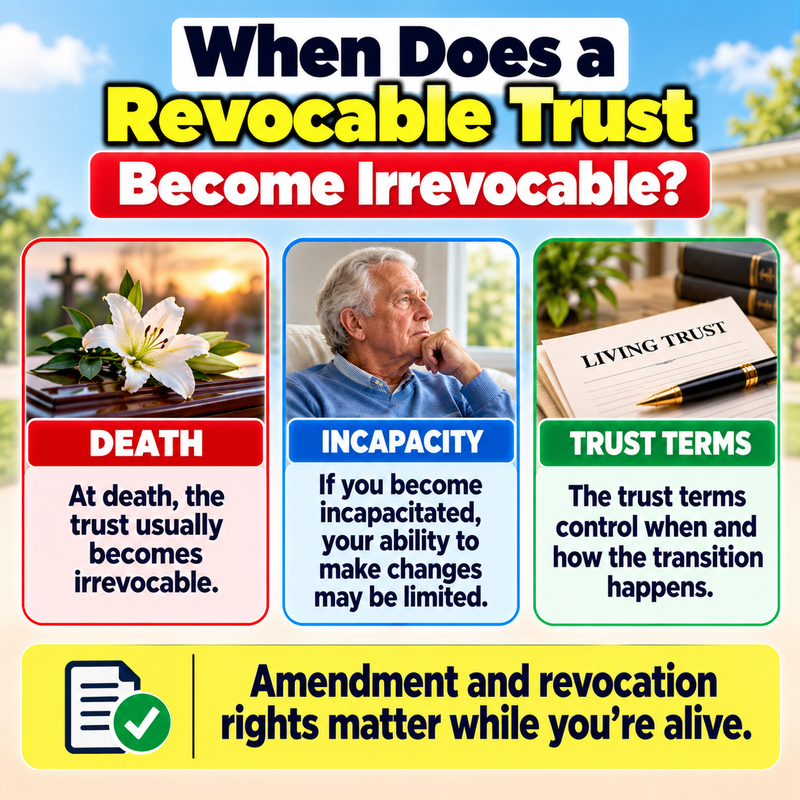
A revocable living trust is defined by one core feature: the grantor retains the power to revoke or amend it at any time while they’re alive and competent. That power is personal to the grantor. It doesn’t transfer to anyone else, and it doesn’t survive the grantor’s death. Once that person passes away, there’s no one left holding the legal authority to undo or rewrite the trust, so the document hardens into its final form. For more information on what a revocable trust is and how it works, explore our comprehensive guide.
This is why estate planning attorneys describe death as the default triggering event for irrevocability. It’s baked into the structure of nearly every single-grantor revocable trust, regardless of which state you live in.
Why Death Ends the Power to Revoke
Think of the revocation power like a key that only fits one lock, and only one person was ever given that key. The grantor’s attorney drafted the trust so that amendment and revocation rights belonged exclusively to the grantor during their lifetime. When the grantor dies, that key disappears with them. Nobody inherits it, not even the successor trustee or the beneficiaries named in the document.
That’s a meaningful distinction from other legal powers that can pass to an agent or representative. Revocation rights typically don’t work that way. Once the grantor is gone, the trust terms are what they are, and administration moves forward based on exactly what’s written.
Why This Isn’t True for Every Single Trust
Here’s where things get more complicated than a one-line rule can capture. Trusts with two grantors, trusts built around powers of appointment, and trusts that explicitly delay irrevocability until a later triggering event all behave differently. State law also plays a role, since some states have statutes that affect how and when revocation rights terminate.
Before assuming your situation fits the simple version of this rule, it helps to understand the difference between revocable and irrevocable trusts and how each type treats the grantor’s ongoing authority. The terms of the specific document always control, not a generic assumption about how trusts “usually” work.
Quick check: if your trust was drafted by one person, for one person’s benefit, with no co-grantor language, the death-triggers-irrevocability rule almost certainly applies to you. Joint trusts and multi-grantor arrangements need a closer look.

How Revocability Works While You’re Alive
While you’re alive and have legal capacity, you hold nearly complete control over your revocable trust. You can add assets, remove them, change beneficiaries, swap out the successor trustee, or cancel the whole thing and start over. None of that requires court approval or anyone else’s consent. This flexibility is the entire point of a living trust structure compared to a will.
That flexibility comes with a tax trade-off, though, and it’s one people frequently misunderstand.
Your Right to Amend, Restate, or Cancel the Trust
You can amend a single provision, restate the entire document, or revoke it outright, and you can do this as many times as you want during your lifetime. Most trust documents spell out the exact mechanism for exercising these rights, whether that’s a signed amendment, a notarized restatement, or a formal revocation document delivered to the trustee. Following the document’s specified procedure matters. Courts have invalidated attempted revocations that didn’t follow the method the trust itself required.
Why the Trust Is Still Considered Your Asset for Taxes
Because you maintain this level of control, the IRS and most state tax authorities treat the trust’s assets as if they still belong to you personally. You report trust income on your own personal tax return. You use your own Social Security number for any trust accounts. And for estate tax purposes, everything inside the trust still counts as part of your taxable estate, exactly as if you’d never placed it in a trust at all.
- No separate tax return is required for a revocable trust during the grantor’s lifetime in most cases, since income passes through to the grantor’s personal return.
- The trust doesn’t shield assets from your creditors while you’re alive, since you still control and can access everything inside it.
- Estate tax exposure remains unchanged, because retained control means the IRS counts those assets as yours.

What Changes the Moment the Grantor Dies
The instant the grantor dies, the trust’s operating rules shift from “grantor controls everything” to “successor trustee administers according to fixed instructions.” This handoff is designed to happen smoothly and privately, without a courtroom involved.
That said, smooth doesn’t mean instant or effortless. The successor trustee has real legal duties that start right away.
The Successor Trustee Takes Over Immediately
Upon the grantor’s death, the person named as successor trustee steps into the role and gains authority to manage trust assets, pay valid debts, and eventually distribute property according to the trust’s terms. This transition happens automatically under the trust document itself, not through a separate legal appointment process.
No Court Approval Needed to Begin Administration
Unlike executors handling a probate estate, successor trustees generally don’t need a judge’s sign-off to start working. They can begin notifying beneficiaries, gathering asset information, and opening accounts in the trust’s name almost immediately. This is one of the biggest practical advantages of trust-based estate planning over using a will alone, since probate court involvement and its associated delays, costs, and public record exposure are avoided entirely. And of course dying without even a will in place often leads to probate court.
Joint and Marital Trusts Split Differently at the First Death
Married couples frequently use a single joint trust instead of two separate ones, and this is where the simple “death equals irrevocable” rule gets more nuanced. Joint trusts aren’t all built the same way, and the drafting choices made at the outset determine what happens when the first spouse dies.
Survivor’s Share May Stay Revocable
In many joint trust structures, the surviving spouse retains full revocation and amendment rights over their own share of the trust assets, even after their spouse has died. This lets the survivor continue adjusting beneficiaries, trustees, and distribution terms for the portion of the trust that’s still theirs to control.
Deceased Spouse’s Share Typically Locks In
Meanwhile, the deceased spouse’s share typically becomes irrevocable at the moment of death, since that spouse no longer has any legal capacity to revoke anything. Some joint trusts split into separate subtrusts at this point, commonly labeled as a survivor’s trust, a bypass trust, or a marital trust, each carrying different rules about who can touch what.
Why You Must Read Your Specific Trust Document
None of this is universal. Some joint trusts are drafted so that the entire trust becomes irrevocable at the first spouse’s death, with no split at all. Others allow the survivor to revoke the whole thing, including provisions the deceased spouse wanted preserved. The only way to know for certain is to read the actual trust document’s language on revocation rights after the first death, ideally with help from an estate planning attorney who can interpret the specific clauses involved.
| Trust Structure | Typical Outcome at First Spouse’s Death |
|---|---|
| Single joint trust, no subtrust split | Entire trust may stay revocable by survivor, or become fully irrevocable, depending on drafting |
| Joint trust with automatic subtrust split | Deceased spouse’s share becomes irrevocable; survivor’s share stays revocable |
| Separate trusts for each spouse | Deceased spouse’s trust becomes irrevocable; survivor’s trust is unaffected |
Does Losing Mental Capacity Make a Trust Irrevocable?
This is one of the most misunderstood areas of trust law, and it’s worth being precise about it. Losing mental capacity does not automatically convert every revocable trust into an irrevocable one. The trust itself doesn’t legally transform just because the grantor becomes incapacitated. What changes is who can practically exercise the powers the trust document grants.
Incapacity Limits Your Power, It Doesn’t Always End It
A grantor who becomes incapacitated may lose the practical and legal ability to sign amendments or exercise revocation rights personally. But the trust document usually has specific mechanisms addressing exactly this scenario, rather than defaulting to permanent irrevocability. Some trusts allow an agent under a durable power of attorney to exercise certain trust powers on the grantor’s behalf. Others name a successor trustee to step in for administrative purposes while leaving revocation rights dormant until the grantor either regains capacity or passes away.
How the Trust Document Defines Incapacity
Well-drafted trusts include a specific definition of incapacity, often requiring written certification from one or two physicians, or sometimes a determination process involving a designated committee of family members or professionals. This definition matters enormously, because vague or missing incapacity language can lead to disputes about whether the grantor is actually unable to manage their own affairs. Reading this section of your trust before a crisis hits saves enormous confusion later.
Bypass, Marital, and Family Trust Shares
When a joint trust splits at the first spouse’s death, it often divides into named subtrusts, each with its own label and its own rules. A bypass trust (sometimes called a credit shelter trust) typically holds the deceased spouse’s share and is designed to use that spouse’s estate tax exemption. A marital trust often holds assets intended to benefit the surviving spouse while still preserving some of the deceased spouse’s wishes about final distribution. A family trust may blend elements of both, depending on how the original document was drafted.
Why Each Subtrust Follows Its Own Rules
- The bypass trust almost always becomes irrevocable immediately, since it’s funded with the deceased spouse’s assets and that spouse no longer has legal capacity to alter anything.
- The marital trust may give the surviving spouse income rights, limited withdrawal rights, or even a lifetime power of appointment, but typically doesn’t let the survivor rewrite who ultimately inherits the principal.
- The survivor’s own separate share, if one exists, generally remains fully revocable and amendable, just like a standalone trust would be.
- Funding formulas written into the trust (sometimes tied to the federal estate tax exemption amount in effect at the time) determine exactly how much goes into each subtrust, which can shift year to year as tax law changes.
Because these subtrust arrangements involve layered rules, successor trustees frequently bring in an estate planning attorney or CPA shortly after the first spouse’s death just to confirm the funding formula was applied correctly and that each subtrust is being administered according to its specific terms.

What Becoming Irrevocable Actually Changes
Once a trust (or a portion of it) becomes irrevocable, the legal consequences are concrete and enforceable, not just theoretical. The terms stop being a draft that someone can adjust and start functioning as a binding set of instructions that a trustee is legally obligated to follow.
Revocation Rights End for the Deceased Grantor
The most direct consequence is that nobody can exercise the deceased grantor’s former power to amend or revoke. Not the successor trustee, not the beneficiaries, and not even a surviving co-grantor with respect to the deceased grantor’s specific share. This is the mechanism that gives trust beneficiaries confidence that the instructions they’re relying on won’t quietly change after the fact. For more information on how these trusts function, you can explore what a revocable trust is and how it works.
That said, “the terms are locked” doesn’t mean “the terms are perfect” or “nothing can ever be adjusted.” There’s an important distinction between the grantor’s lost unilateral authority and the separate legal pathways that might still allow modification, which gets covered a little further down.
Beneficiaries Gain Enforceable Rights
Before the trust became irrevocable, beneficiaries named in the document had no enforceable legal claim to anything, since the grantor could change beneficiaries at will. Once irrevocability kicks in, that changes substantially. Beneficiaries typically gain the right to receive notice of the trust’s existence, request copies of relevant trust provisions, demand periodic accountings, and hold the trustee legally accountable for mismanagement or breach of fiduciary duty.
Can an Irrevocable Trust Still Be Changed?
Here’s where a lot of generic advice oversimplifies things. People often say irrevocable trusts “can never be changed,” but that’s not accurate as a blanket statement. Several legitimate pathways exist for modifying an irrevocable trust, and which ones apply depends heavily on the specific trust language and the state law governing the trust.
Modification Through Trust Terms or Powers of Appointment
Some irrevocable trusts are drafted with built-in flexibility from the start. A limited or general power of appointment, for example, lets a designated person (often the surviving spouse or a trust protector) redirect how remaining assets are ultimately distributed, within boundaries the original grantor set. If the trust document includes a power of appointment clause, that alone can allow meaningful changes without touching the trust’s underlying irrevocability.
Decanting and Nonjudicial Settlement Agreements
Many states have adopted decanting statutes, which allow a trustee to “pour” assets from an existing irrevocable trust into a new trust with updated terms, provided certain statutory conditions are met. This can be used to fix drafting errors, update trustee succession provisions, or adjust distribution language to better reflect current circumstances.
Separately, a growing number of states permit nonjudicial settlement agreements, where the trustee and all interested beneficiaries sign off on a modification without ever going to court. These agreements generally can’t be used to achieve something that violates a material purpose of the trust, but for routine administrative fixes, they’re often faster and cheaper than litigation.
Both tools are creatures of state statute, meaning availability and procedural requirements vary widely depending on where the trust is administered.
A family discovered their irrevocable trust named a corporate trustee that had since merged and changed its fee structure dramatically. Rather than petitioning a court, the beneficiaries and trustee used their state’s nonjudicial settlement agreement statute to substitute a different corporate trustee entirely, resolving the issue in weeks instead of months.
Not every state offers this option, and not every modification qualifies, which is exactly why understanding the differences between revocable and irrevocable trust structures matters before assuming a trust is permanently frozen in place.
When Court Approval Becomes Necessary
Some modifications simply can’t happen without a judge’s involvement. If beneficiaries disagree about a proposed change, if a minor or unascertained beneficiary is involved and can’t legally consent, or if the proposed modification would alter a material purpose of the trust, a court petition is usually required.
Courts generally apply one of a few established legal doctrines when deciding whether to approve a modification. The most common include:
- Changed circumstances: the trust’s original purpose has become impossible, illegal, or impractical to carry out as written.
- Unanticipated circumstances: something occurred that the grantor couldn’t have reasonably foreseen when drafting the trust.
- Administrative deviation: a technical or administrative provision is causing problems that don’t affect the trust’s core purpose.
- Termination for impracticality: the trust’s remaining value is so small that continued administration costs would outweigh any benefit to beneficiaries.
Court involvement adds time and expense, but it also provides a layer of judicial oversight that can protect vulnerable beneficiaries and resolve disputes that a purely private agreement couldn’t settle fairly.

Who Controls the Trust Now: Trustee or Beneficiaries?
Once irrevocability sets in, control effectively splits between two parties with very different roles. The trustee holds legal title to trust assets and administrative authority, while beneficiaries hold equitable rights to the benefits the trust was created to provide. Neither party acts entirely independently of the other.
Trustee’s Fiduciary Duty After Irrevocability
The trustee’s job shifts from simply following a living grantor’s instructions to independently exercising fiduciary judgment within the boundaries the trust document sets. This includes a duty of loyalty to beneficiaries, a duty to invest prudently, a duty to keep adequate records, and a duty to treat multiple beneficiaries impartially when the trust names more than one. Breaching any of these duties can expose a trustee to personal liability, which is why many successor trustees lean on professional guidance during this period rather than guessing at their obligations.
Beneficiary Rights to Information and Accountings
Beneficiaries aren’t passive bystanders either. Most states require trustees to provide beneficiaries with regular accountings showing income, expenses, and distributions, along with reasonable access to information about trust administration. A beneficiary who suspects mismanagement typically has the right to petition a court to compel an accounting, remove a trustee, or seek damages for losses the trust suffered due to a breach of duty.
New Tax ID and Reporting Rules After Death
Tax treatment shifts almost immediately once a trust becomes irrevocable due to the grantor’s death, and this is a step people frequently overlook in the early weeks of administration.
While the grantor was alive, the trust generally used the grantor’s own Social Security number for tax reporting, since the IRS treated the trust as a “grantor trust” for tax purposes. That arrangement ends at death.
Applying for a New EIN With the IRS
Current IRS guidance requires a revocable trust that becomes irrevocable upon the grantor’s death to obtain a new Employer Identification Number (EIN), since it can no longer rely on the deceased grantor’s Social Security number for tax reporting purposes. The successor trustee can apply for this EIN directly through the IRS, and the process is typically straightforward when completed online through the IRS’s own application system.
Getting this number early matters, since banks, brokerage firms, and other financial institutions generally require the EIN before they’ll retitle accounts into the trust’s post-death administration name or issue tax documents correctly.
Filing Form 1041 for the Trust
Once the trust has its own EIN, it generally needs to file IRS Form 1041, the U.S. Income Tax Return for Estates and Trusts, to report any income the trust earns after the grantor’s death. Depending on the trust’s terms and the amount of income involved, the trust may pay tax directly at trust income tax rates, or it may pass income through to beneficiaries via Schedule K-1, with beneficiaries then reporting that income on their own personal returns. Which approach applies depends on the specific distribution provisions in the trust document and how much income was actually distributed during the tax year.
Irrevocable Doesn’t Mean Automatic Asset Protection
A common assumption trips people up here: that once a trust becomes irrevocable, its assets are automatically shielded from creditors. That’s not a safe assumption to make without reading the specific trust terms and understanding state law, since protection levels vary enormously depending on how the trust is structured and who the beneficiaries are.
Why Lifetime Revocable Trusts Offer No Creditor Shield
While the grantor is alive, a revocable trust offers essentially zero creditor protection, since the grantor retains full control over the assets. Creditors can generally reach trust assets just as easily as they could reach assets held in the grantor’s own name, because the law treats retained control as equivalent to ownership for these purposes.
What Changes for Creditors After Death
After the grantor’s death, the calculation shifts somewhat, but not automatically in the beneficiaries’ favor across the board. Many states allow a deceased grantor’s creditors to make claims against trust assets for a limited period after death, similar to how probate estates handle creditor claims. Separately, trusts that include spendthrift provisions can offer beneficiaries meaningful protection from their own personal creditors, but only if that language exists in the document and the state recognizes spendthrift protections for the specific type of distribution involved.
A beneficiary going through a divorce discovered that the irrevocable trust share they were set to inherit included strong spendthrift language, which kept those assets outside the marital estate being divided in the divorce proceedings. Had the trust lacked that specific provision, the outcome could have been very different.
Because creditor protection rules vary so dramatically by state and depend entirely on specific drafting choices, nobody should assume an irrevocable trust automatically creates a protective shield. Reading the trust’s actual spendthrift and distribution language, ideally with an attorney familiar with the relevant state’s law, is the only reliable way to know what protection actually exists.

Your Checklist for the First 90 Days After a Death
Administering a trust after someone dies can feel overwhelming, especially while grieving. Breaking the process into concrete steps makes it more manageable and helps successor trustees avoid common mistakes that create legal or tax problems down the road. For more information on managing trusts, you might consider learning about key legal facts about living trusts.
1. Locate and Read the Trust Document
Before doing anything else, find the complete, signed trust document along with any amendments or restatements. Read the sections covering successor trustee powers, distribution instructions, and any subtrust funding formulas carefully, since these govern every decision that follows.
2. Notify Beneficiaries as Required by State Law
Most states impose specific notice requirements and timelines for informing beneficiaries that the trust exists and that the grantor has died. Missing these deadlines can expose a trustee to liability, so confirming the exact requirements for the governing state early on is worth the time.
3. Apply for a New Tax ID Number
Obtain the trust’s new EIN from the IRS as soon as possible, since nearly every subsequent administrative step, from opening bank accounts to filing tax returns, depends on having this number in hand.
4. Inventory and Secure Trust Assets
Create a complete inventory of everything the trust holds, including real estate, investment accounts, bank accounts, and personal property. Secure physical assets, confirm insurance coverage remains active, and retitle accounts into the trust’s post-death administration name where required.
5. Pay Valid Debts and File Final Tax Returns
Identify and pay legitimate debts and expenses, file the deceased grantor’s final personal income tax return, and begin tracking trust income for the first Form 1041 filing. Keeping meticulous records throughout this process protects the trustee if beneficiaries ever request an accounting.
Know Your Trust Document Before You Need It
The single best thing anyone can do, whether they’re a grantor, a successor trustee, or a named beneficiary, is read the actual trust document before a death or incapacity forces the question. Resources like Create A Living Trust can help you understand these provisions clearly, so when the moment actually arrives, you already know exactly what happens next.
Your Checklist for the First 90 Days After a Death
Administering a trust after someone dies can feel overwhelming, especially while grieving. Breaking the process into concrete steps makes it more manageable and helps successor trustees avoid common mistakes that create legal or tax problems down the road.
1. Locate and Read the Trust Document
Before doing anything else, find the complete, signed trust document along with any amendments or restatements. Read the sections covering successor trustee powers, distribution instructions, and any subtrust funding formulas carefully, since these govern every decision that follows.
2. Notify Beneficiaries as Required by State Law
Most states impose specific notice requirements and timelines for informing beneficiaries that the trust exists and that the grantor has died. Missing these deadlines can expose a trustee to liability, so confirming the exact requirements for the governing state early on is worth the time.
3. Apply for a New Tax ID Number
Obtain the trust’s new EIN from the IRS as soon as possible, since nearly every subsequent administrative step, from opening bank accounts to filing tax returns, depends on having this number in hand.
4. Inventory and Secure Trust Assets
Create a complete inventory of everything the trust holds, including real estate, investment accounts, bank accounts, and personal property. Secure physical assets, confirm insurance coverage remains active, and retitle accounts into the trust’s post-death administration name where required.
5. Pay Valid Debts and File Final Tax Returns
Identify and pay legitimate debts and expenses, file the deceased grantor’s final personal income tax return, and begin tracking trust income for the first Form 1041 filing. Keeping meticulous records throughout this process protects the trustee if beneficiaries ever request an accounting.

Frequently Asked Questions
Trust administration raises the same handful of questions over and over, regardless of family size or asset complexity. Here are the ones that come up most often once a revocable trust shifts into irrevocable status.
Many of these answers depend on the specific trust document and the state law governing it, so treat these as general guidance rather than a substitute for reading your own trust or consulting an attorney familiar with your situation.
Does a Revocable Trust Automatically Become Irrevocable When the Grantor Dies?
Yes, in most cases. A single-grantor revocable trust typically becomes irrevocable automatically upon the grantor’s death, since the legal power to amend or revoke the trust doesn’t survive the grantor and doesn’t transfer to anyone else.
This is the default rule built into nearly every standard revocable trust document, though joint trusts and trusts with unusual drafting can behave differently, as covered earlier in this guide.
Can a Successor Trustee Change the Trust After Death?
A successor trustee once contacted an attorney convinced they could “fix” an outdated beneficiary designation in the trust simply because the named beneficiary had passed away years earlier and the document hadn’t been updated. The attorney had to explain that the trustee’s job was to follow the document’s contingent beneficiary language exactly as written, not to decide what the grantor “probably would have wanted.”
Generally no, not unilaterally. A successor trustee’s job is to administer the trust according to its existing terms, not to rewrite them.
Some modifications may still be possible through decanting, nonjudicial settlement agreements, or court approval, but a trustee acting alone typically can’t simply change beneficiaries or distribution terms because the outcome seems unfair or outdated.
If a trustee believes a genuine modification is warranted, the proper path involves beneficiary consent procedures or a court petition, not independent action.
What Happens to a Joint Trust When One Spouse Dies?
It depends entirely on how the joint trust was drafted. Many joint trusts split into subtrusts at the first spouse’s death, with the deceased spouse’s share becoming irrevocable while the surviving spouse’s share may remain revocable. Some joint trusts handle this differently, locking the entire document at the first death, so reading the specific document is essential rather than assuming a standard outcome applies.
Does a Living Trust Become Irrevocable If the Grantor Becomes Incapacitated?
Not automatically. Incapacity limits the grantor’s practical and legal ability to exercise their own revocation rights personally, but the trust document often includes specific mechanisms, like an agent under a power of attorney or a designated successor trustee, for handling this situation without converting the entire trust into an irrevocable one.
Can Beneficiaries Modify an Irrevocable Trust?
Sometimes, depending on state law. Many states allow beneficiaries and the trustee to agree to certain modifications through a nonjudicial settlement agreement, provided the change doesn’t violate a material purpose of the trust.
More significant changes, especially those affecting a minor beneficiary’s interest or involving disagreement among the parties, often require court approval before taking effect.
Does the Trust Need a New EIN After Becoming Irrevocable?
Yes. Current IRS guidance requires a trust to obtain a new EIN once it becomes irrevocable due to the grantor’s death, since it can no longer use the grantor’s Social Security number for tax reporting.
The successor trustee typically applies for this number through the IRS shortly after death, and most financial institutions will require it before retitling accounts or issuing tax documents for the trust.
How Long Does a Successor Trustee Have to Notify Beneficiaries?
This varies by state, with many states setting specific deadlines, often measured in weeks, after the grantor’s death. Checking the specific statutory requirement for the state governing the trust is essential, since missing the deadline can create personal liability for the trustee.
Is an Irrevocable Trust Protected From Creditors?
It depends on the trust’s specific language and the state’s law. Spendthrift provisions can offer meaningful protection from a beneficiary’s personal creditors, but a deceased grantor’s own creditors may still be able to make claims against trust assets for a limited period after death in many states.
No single rule applies universally, which is why reviewing the trust’s actual spendthrift and distribution language matters more than relying on general assumptions about irrevocable trusts.
What Is the Difference Between a Revocable and Irrevocable Trust?
A revocable trust can be amended or canceled by the grantor at any time while they’re alive and competent, while an irrevocable trust generally can’t be unilaterally changed by any single party once it takes effect, though some modification pathways may still exist depending on the trust terms and state law.
Can an Irrevocable Trust Be Terminated Early?
In some circumstances, yes. If all beneficiaries consent, if continuing the trust has become impractical due to its small remaining value, or if a court finds grounds to approve termination, early termination may be possible, though the specific requirements vary by state.
Know Your Trust Document Before You Need It
The single best thing anyone can do, whether they’re a grantor, a successor trustee, or a named beneficiary, is read the actual trust document before a death or incapacity forces the question. Generic rules about when trusts become irrevocable are useful for orientation, but the specific clauses in your own document, covering joint trust splits, incapacity definitions, and any powers of appointment, are what actually control the outcome.
Trustees who understand these mechanics ahead of time administer trusts with far more confidence and far fewer costly missteps. Beneficiaries who understand their rights are better equipped to hold trustees accountable without unnecessary conflict.