Revocable Living Trust Incapacity Planning: How a Successor Trustee Can Step In
Understand Successor Trustee Authority, Trust Assets, Capacity Provisions, and How a Trust Fits With Powers of Attorney
Article-at-a-Glance
- A revocable living trust lets a successor trustee step in and manage your assets the moment incapacity is confirmed, without a judge, a courtroom, or a conservatorship filing.
- Your trust document — not a generic legal standard — decides how incapacity gets determined, whether that’s one doctor’s letter, two physician certifications, or a disability panel you hand-picked.
- A successor trustee only controls property actually titled into the trust, which is why pairing your trust with a financial power of attorney matters more than most people realize.
- Health-care decisions sit outside the trustee’s authority entirely; those require separate documents like an advance directive and a HIPAA release.
- Further down, you’ll find the exact checklist estate planning firms use to stress-test incapacity provisions before a crisis ever hits.
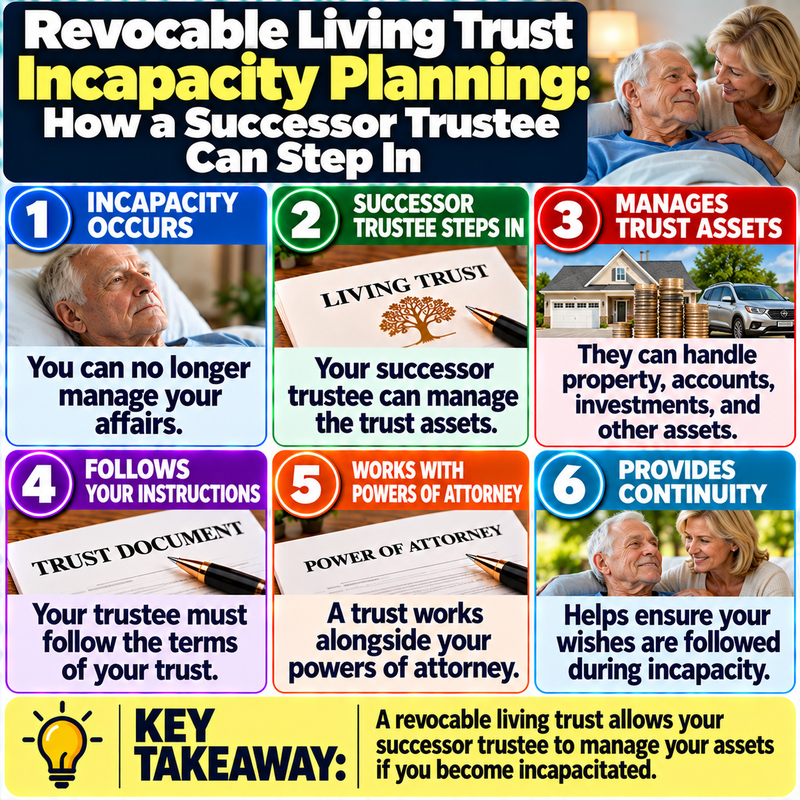
One sentence answers the headline question: a properly drafted and funded revocable living trust names someone to manage your money and property the instant you can’t, based on rules you wrote while you were still fully capable.
That sounds simple, but the mechanics underneath it trip up a lot of families. The trust has to define incapacity in a way that actually triggers action. The successor trustee has to know what they can touch and what they can’t. And everyone involved needs to understand that a trust solves a financial problem, not a medical one. Firms like Bulletproof Legacy spend a lot of time walking clients through exactly where those lines sit, because getting it wrong usually means a trip to probate court at the worst possible moment.
Why Incapacity Planning Is a Core Job of Your Trust
Most people set up a trust thinking about what happens after they die. That’s half the job. The other half — arguably the more urgent half — is what happens if you’re still alive but unable to manage your own affairs. A stroke, a serious accident, advanced dementia, or even a temporary coma can leave bills unpaid, investments neglected, and property exposed, all while you’re still breathing and still the legal owner of everything.
A revocable living trust is built to answer that exact scenario. Because you transferred assets into the trust while you had capacity, the trust itself keeps functioning even if you can’t. The successor trustee you named doesn’t need a court’s permission to act. They just need proof, under the terms you wrote, that the incapacity threshold has been met.
What Happens Financially Without a Plan
Without this kind of structure, incapacity turns into a logistical mess fast. Bills go unpaid and late fees stack up. Investment accounts sit on autopilot with no one adjusting for risk or market conditions. Property can go uninsured. And if family members disagree about who should step in, those disputes often end up in front of a judge anyway — the exact outcome a trust is supposed to prevent.
How a Funded Trust Avoids Court Involvement
Here’s the part that actually saves families time and money: when assets are properly retitled into the trust, the successor trustee’s authority comes from the trust document itself, not from a court order. That means no guardianship hearing, no conservatorship proceeding, and no ongoing judicial supervision of every financial decision. The trustee simply presents the required proof of incapacity to banks and financial institutions, and they take over management from there.

How Your Trust Document Defines Incapacity
There’s no single legal definition of “incapacitated” that automatically applies to every trust. Instead, the trust instrument spells out exactly what has to happen before a successor trustee gains authority. This is one of the most important — and most overlooked — sections of any estate plan, because a vague or missing definition can stall the entire process right when speed matters most.
Some states layer their own standards on top of whatever the trust says. California, for example, defines legal incapacity as evidence that a person can’t understand or evaluate the important facts of their own life, usually because of a deficiency in one or more cognitive abilities, and requires that incapacity be established through both legal and medical evaluation. Doctors typically rely on medical exams, cognitive testing, and mental health evaluations, and many situations call for two licensed health professionals to provide written documentation before anyone acts.
The takeaway here is straightforward: your trust’s incapacity clause needs to work alongside your state’s legal framework, not in spite of it. A well-drafted document anticipates this and builds in a process that satisfies both.
| Incapacity Type | Example | Duration |
|---|---|---|
| Mental | Dementia, severe depression, traumatic brain injury | Varies |
| Physical | Stroke, paralysis, chronic illness | Varies |
| Temporary | Post-surgery recovery, short-term unconsciousness | Short-term |
| Permanent | Advanced Alzheimer’s, major brain trauma | Long-term |
| Progressive | Parkinson’s disease | Worsens over time |
Physician Certification Requirements
Most trust documents lean on physician certification as the trigger mechanism. Frequently, the trust will require that one or two physicians certify incapacity in writing before the successor trustee can step in. This isn’t just a formality — it’s the evidentiary bar that protects the grantor from a premature or improper handover of control, while still giving the trustee a clear, actionable standard to work from.
Why State Law Also Shapes the Standard
Even a well-written trust doesn’t operate in a vacuum. State law can impose additional requirements on how incapacity gets documented, who qualifies as a competent evaluator, and what paperwork financial institutions will accept. This is exactly why generic, off-the-shelf trust language can create friction later — the document needs to reflect the legal environment where the grantor actually lives.
Narrow vs. Broad Incapacity Definitions
Some grantors want a narrow definition that only triggers under severe, clearly diagnosable conditions. Others prefer a broader standard that captures a wider range of situations, including temporary or fluctuating impairments. Neither approach is universally “better” — it depends on the grantor’s risk tolerance and family dynamics.
What matters more than narrow versus broad is clarity. A vague definition invites disagreement among family members, and disagreement invites litigation. A precise definition, even if it’s broad in scope, gives everyone — the trustee, the beneficiaries, and the grantor’s physicians — a shared standard to work from.
This is also where a trust and a standalone living trust framework tend to diverge from boilerplate documents. Thoughtful drafting anticipates ambiguity instead of leaving it to be resolved after the fact, when the grantor can no longer weigh in.
Using a Disability Panel Instead of One Doctor
Some grantors opt for a disability panel rather than relying on a single doctor’s opinion. A disability panel is typically two or three physicians or trusted advisors tasked with jointly determining whether incapacity has occurred. This structure adds a layer of impartiality, reduces the risk of one person’s bias driving the outcome, and can defuse family conflict before it starts. Drafting a disability panel into the trust puts control over this sensitive determination in the grantor’s hands, rather than leaving it to a single physician or, worse, a courtroom.

How a Successor Trustee Steps In
Once the trust’s incapacity standard is satisfied, the transition of authority happens administratively, not judicially. The successor trustee doesn’t file a petition or wait for a hearing date. They gather the required proof — physician letters, panel determinations, or whatever the trust specifies — and present it to the institutions holding trust assets.
No Court Filing or Judge Approval Needed
This is the structural advantage a funded revocable trust offers over doing nothing at all. Successor trustees derive their legal authority directly from the trust document, not from the courts. That authority lets them intervene immediately: paying bills, accessing accounts, and managing property without the delays that come with court involvement.
Compare that to the alternative: if someone becomes incapacitated without a funded trust in place, family members may need to open a court guardianship or conservatorship proceeding. In New York, for instance, that means an Article 81 guardianship case in state Supreme Court — a process that takes time, requires legal representation, and results in ongoing court supervision of every major asset decision going forward.
Conservatorship proceedings aren’t just slow — they’re public and expensive, sometimes running into thousands of dollars in legal fees and taking months to resolve. A funded trust sidesteps all of that by keeping the entire transition private and under the terms the grantor already approved.
Documentation Banks and Firms Typically Request
In practice, a successor trustee stepping in for the first time should expect to produce a specific packet of paperwork: a certified copy of the trust document, the physician certifications or panel determination proving incapacity, and identification confirming their appointment as successor trustee. Financial institutions use this packet to update signature authority on accounts without requiring any court paperwork.
It helps to assemble this packet before it’s needed. Waiting until a crisis hits to track down certified trust copies or figure out which doctors need to sign off only adds stress to an already difficult situation.
What the Successor Trustee Can Manage
Once authority transfers, the successor trustee’s job looks a lot like running a household’s finances on someone else’s behalf — just with fiduciary obligations attached. They step into the economic decision-making role the grantor can no longer fill, covering everything from routine expenses to larger asset management decisions.
This isn’t a narrow, ceremonial role. The trustee is expected to actively manage trust property in the grantor’s best interest, which can mean making investment adjustments, handling real estate, or reallocating funds to cover the grantor’s care.
Here’s a breakdown of the core responsibilities a successor trustee typically takes on during incapacity:
- Paying ongoing bills and household expenses from trust funds
- Filing the grantor’s personal and trust-related tax returns
- Managing investment accounts held in the trust’s name
- Handling and maintaining real property owned by the trust
- Keeping accurate records of every transaction and decision made
Paying Bills and Filing Taxes
Day-to-day financial continuity is often the most immediate need during incapacity. The successor trustee keeps mortgage payments, utility bills, insurance premiums, and other recurring obligations current, and they’re also responsible for filing tax returns for both the grantor and the trust — a task that gets more complicated quickly if assets span multiple states or countries.
Managing Investments and Property
Beyond bill-paying, the trustee has to actively manage whatever’s sitting inside the trust. That might mean rebalancing a portfolio, selling a property that’s become a liability, or making sure real estate stays insured and maintained. The guiding principle throughout is prudence: decisions should reflect what a reasonably careful person would do with someone else’s money, not what’s most convenient for the trustee.

What the Successor Trustee Cannot Manage
Authority under a revocable living trust has a hard boundary, and it’s one that catches people off guard. A successor trustee’s power extends only to property that’s actually been transferred into the trust. Nothing more.
This limitation is exactly why trust funding isn’t a one-time paperwork exercise you can skip or half-finish. Assets that never made it into the trust stay outside the trustee’s reach, no matter how clearly the trust document spells out their authority.
Assets Never Transferred Into the Trust
If a bank account, piece of real estate, or investment account was never retitled in the trust’s name, the successor trustee has no legal authority over it during incapacity. Those assets remain governed by whatever other planning tools exist — or, in the absence of any, by default state law, which usually means a court proceeding.
This gap is one of the most common and most preventable failures in estate planning. A trust document can be flawless, but if the grantor never finished transferring assets into it, the protection it offers during incapacity is only partial.
Medical and Health-Care Choices
The other hard boundary involves health care. Serving as successor trustee does not automatically make someone the grantor’s medical decision-maker. Those are two entirely separate roles governed by two entirely separate sets of documents.
A trustee can pay medical bills from trust funds, but they generally can’t consent to a surgery, choose a treatment plan, or make end-of-life decisions unless a separate health-care document grants them that authority. Conflating these two roles is a common misunderstanding — and one worth clearing up before an emergency forces the issue.
Revocable Trust vs. Financial Power of Attorney
Because a successor trustee’s authority stops at the edge of the trust’s assets, most comprehensive incapacity plans pair the trust with a financial power of attorney. The power of attorney picks up where the trust leaves off, covering financial or legal matters that fall outside what’s been formally transferred into the trust.
Why Many Families Need Both Documents
A revocable living trust and a financial power of attorney solve different pieces of the same puzzle, which is why relying on just one often leaves gaps. The trust handles everything you’ve formally transferred into it — bank accounts, real estate, investment portfolios. The power of attorney handles everything else: a paycheck that hasn’t been deposited yet, a new account opened after the trust was signed, or a tax refund that arrives in the grantor’s individual name.
Unlike a general power of attorney, which terminates the moment someone becomes incapacitated, a durable power of attorney stays in effect specifically because it’s designed to function during incapacity. That distinction matters enormously. A durable financial power of attorney lets the named agent keep paying bills, managing investments, and handling property without interruption, even after the grantor can no longer act for themselves. Many states, including California, require the document to be signed in front of witnesses or a notary to be valid.
Covering Assets the Trust Doesn’t Own
Think of the power of attorney as a safety net underneath the trust. If an asset slips through the funding process — and this happens more often than most people expect — the agent named in the power of attorney can still act on it. Without that backup document, an unfunded or partially funded asset sits exposed, with no one legally authorized to manage it until a court gets involved.
This is one of the quiet reasons estate planning attorneys insist on drafting a trust and a durable power of attorney together rather than treating the trust as a standalone solution. Bulletproof Legacy’s financial power of attorney documents are built specifically to work alongside a revocable living trust, closing this exact gap so nothing falls outside someone’s legal authority during incapacity.

Health-Care Decisions Require Separate Documents
Money and medicine are governed by completely different legal instruments, and no amount of clever trust drafting changes that. A successor trustee’s authority, no matter how broad, stops at the hospital door. Medical decision-making requires its own dedicated paperwork, signed and witnessed according to state-specific rules.
A trust manages your money. A power of attorney manages what the trust doesn’t own. A health-care directive manages your medical treatment. None of these three documents substitutes for the others — and a complete incapacity plan needs all three working together.
This separation isn’t a technicality; it reflects two very different kinds of decision-making. Financial decisions involve property, contracts, and fiduciary obligations to beneficiaries. Medical decisions involve bodily autonomy, treatment preferences, and end-of-life wishes that belong to the individual alone, expressed in advance through a legally binding document.
Skipping this piece of the plan is one of the most common oversights families run into. They’ll spend significant time and money funding a trust, then assume that work covers them medically too — only to discover during an actual emergency that no one has legal authority to speak with doctors on the grantor’s behalf.
Advance Health Care Directives
An advance health care directive lets the grantor specify, in writing, how they want to be treated medically if they can’t communicate those wishes themselves. It also names a health-care agent — someone authorized to confer directly with physicians and make treatment decisions consistent with the grantor’s stated preferences. Bulletproof Legacy’s health-care power of attorney documents are structured to pair directly with this kind of directive, giving the named agent clear, enforceable authority to act when it matters most.
HIPAA Authorization for Medical Records Access
Even a well-drafted health-care directive can run into friction without a HIPAA authorization attached. Without it, doctors and hospitals may refuse to share medical information with the named agent, citing privacy law, even when that agent has clear legal authority to make decisions. A HIPAA release solves this by explicitly granting access to medical records and communications, so the agent isn’t fighting bureaucracy while trying to make urgent decisions.
Pairing a HIPAA authorization with an advance directive closes a gap that trips up families constantly — having the legal right to decide, but not the practical ability to get the information needed to decide well.
Duties a Successor Trustee Must Follow
Stepping into the successor trustee role doesn’t just hand someone a set of powers — it hands them a set of binding legal obligations. A trustee is a fiduciary, which is one of the highest standards of care recognized under the law. That status shapes every decision they make from the moment they take over.
Loyalty to Beneficiaries Over Self-Interest
The core fiduciary obligation is loyalty: the trustee must act under the trust’s terms and applicable law for the benefit of the beneficiaries, not for personal gain. This means avoiding improper self-dealing, even in situations where the trustee might feel personally entitled to use trust funds a certain way.
This duty becomes especially important when the trustee is also a family member and a beneficiary themselves. The law doesn’t excuse conflicts of interest just because everyone involved is related. A trustee managing their incapacitated parent’s trust, for instance, still has to prioritize the parent’s needs and the interests of all named beneficiaries over their own convenience.
Recordkeeping and Reporting Obligations
Fiduciary duty also demands transparency. Trustees are expected to maintain appropriate records, manage property prudently, and be ready to account for every decision they’ve made with trust assets. A trustee who acts without understanding these obligations can face personal liability for breach of fiduciary duty — a risk that catches unprepared family members off guard more often than it should.
| Duty | What It Requires |
|---|---|
| Loyalty | Act solely in beneficiaries’ interest; avoid self-dealing |
| Prudence | Manage assets as a reasonably careful person would |
| Transparency | Keep accurate records; respond to beneficiary inquiries |
| Compliance | Follow trust terms and applicable state law |
In practice, this means a trustee should expect to produce periodic accountings, respond promptly to questions from beneficiaries, and document the reasoning behind major financial decisions. None of this needs to be adversarial — it’s simply the standard of care the role requires, and good documentation protects the trustee as much as it protects the beneficiaries.

Using Trust Assets for the Grantor’s Benefit
During incapacity, the primary purpose of the trust’s assets shifts toward supporting the grantor directly. The successor trustee isn’t managing the trust for some abstract future distribution — they’re using it to keep the grantor cared for in the present.
This often means drawing on trust funds in ways that look different from typical estate administration. The trustee has discretion, within the bounds of the trust document, to use assets flexibly to meet the grantor’s immediate needs, rather than simply preserving the trust untouched for eventual beneficiaries.
Covering Medical and Living Expenses
Trust funds during incapacity commonly go toward medical bills, in-home care, assisted living costs, and everyday living expenses the grantor can no longer manage themselves. The trustee pays these costs directly from trust assets, which is exactly why having the trust properly funded ahead of time matters so much — there’s no scramble to locate or access money when it’s needed immediately.
Why Prudent Management Still Applies
Spending trust assets on the grantor’s care doesn’t suspend the trustee’s duty of prudence. Every expenditure still needs to reflect reasonable, careful judgment. A trustee can’t justify reckless investment choices or unnecessary spending simply because the money is technically “for the grantor’s benefit.”
This balance — meeting real, pressing needs while still managing assets responsibly — is often where experienced trustees distinguish themselves from well-meaning but unprepared ones. It’s also a strong argument for naming a trustee with some financial literacy, or pairing a family trustee with professional advisors who can guide bigger decisions.
What Happens If the Grantor Regains Capacity
Incapacity isn’t always permanent. Someone might recover from a stroke, come out of a coma, or stabilize after a serious medical event to the point where they’re fully capable of managing their own affairs again. A well-drafted trust anticipates this possibility and lays out what happens next.
Procedures for restoring control to the grantor vary from trust to trust and don’t follow a single universal standard — some documents require renewed physician certification confirming capacity has returned, while others rely on a simpler process. What matters is that the trust actually addresses this scenario rather than assuming incapacity, once triggered, is a one-way door. Grantors drafting their trust should talk through this specific provision with their attorney, since leaving it vague can create unnecessary friction if and when capacity returns.
Common Mistakes That Undermine Incapacity Planning
Even a well-drafted trust can fail to deliver real protection if a handful of common mistakes creep into the plan. These aren’t exotic errors — they’re the same handful of issues that show up again and again in estate planning practices.
Leaving the Trust Unfunded
This is, by a wide margin, the most common failure point. Most of the time, a trust doesn’t fail because of a drafting error — it fails because the grantor never completed the asset transfers. An unfunded revocable trust is, practically speaking, a document without effect.
Signing the trust is only step one. Step two — retitling bank accounts, deeding real estate into the trust’s name, updating beneficiary designations where appropriate — is what actually gives the successor trustee something to manage.
A properly executed trust that sits unfunded offers no more protection during incapacity than no trust at all. The paperwork exists, but there’s nothing for the successor trustee to step into.
Grantors should treat trust funding as an ongoing responsibility, not a one-time task completed at signing. New accounts opened after the trust is created need to be retitled too, or they’ll fall outside the trustee’s reach just like any other unfunded asset.
Opening New Accounts Outside the Trust
Life doesn’t stop after a trust is signed. New accounts get opened, properties get purchased, and investments shift. Each of these, if not retitled into the trust, becomes a gap in incapacity coverage. Periodically reviewing account titling is a simple habit that prevents this problem from accumulating.
Choosing the Wrong Successor Trustee
Naming a successor trustee isn’t just about trust in the emotional sense — it’s a matter of competence, character, and availability. A capable trustee needs to be organized, able to make hard decisions under pressure, and reasonably financially literate. For larger or more complex estates, or in families where conflict seems likely, a corporate trustee or professional fiduciary can remove the risk that personal relationships disrupt trust administration.
Skipping Companion Documents
A trust alone, no matter how well drafted, can’t cover health-care decisions or assets left outside the trust. Skipping the durable power of attorney, advance health care directive, or HIPAA authorization leaves real gaps in the plan — gaps that only become obvious during an actual incapacity event, when there’s no time left to fix them. For more information on how a living trust can protect your family during such events, visit this resource on living trusts and incapacity.
Your Incapacity-Planning Checklist
Pulling all of this together, a complete incapacity plan built around a revocable living trust needs several interlocking pieces working at once. No single document, on its own, covers everything.
Before an incapacity event ever happens, it’s worth sitting down with an estate planning attorney and confirming each of the following is actually in place, not just assumed to be.
Use this as a working checklist for your own plan, or for a loved one’s:
- Confirm every major asset — bank accounts, real estate, investment portfolios — is actually retitled into the trust, not just mentioned in it
- Make sure the trust’s incapacity definition is clear and matches your state’s legal standards
- Decide whether a single physician certification or a disability panel fits your situation better, and draft accordingly
- Name a successor trustee who’s organized, trustworthy, and capable of handling financial pressure
- Pair the trust with a durable financial power of attorney to cover assets the trust doesn’t own
- Sign an advance health care directive naming a medical decision-maker
- Add a HIPAA authorization so your health-care agent can actually access medical information
- Review the entire plan every three to five years, or immediately after a major life change
Getting each of these pieces right takes more than filling out a template — it takes a clear-eyed look at your specific assets, family dynamics, and state law. Bulletproof Legacy works with clients to build revocable living trusts alongside the financial and health-care powers of attorney needed to make incapacity planning actually hold up when it’s tested.
1. Fund the Trust With All Major Assets
This is the step that makes or breaks everything else. A trust document can be flawlessly drafted, but if bank accounts, real estate, and investment portfolios haven’t actually been retitled into the trust’s name, the successor trustee has nothing to manage. Funding isn’t glamorous work, but it’s the single most important task after signing the trust itself.
2. Define Incapacity Clearly in the Document
Vague language here creates problems exactly when clarity matters most. Specify whether one physician’s certification is enough or whether you want two, and spell out what kind of medical documentation satisfies the standard. The clearer this section reads, the less room there is for family disagreement or institutional pushback later.
3. Name a Capable Successor Trustee
Pick someone organized, financially literate, and willing to take on a fiduciary role under pressure. This doesn’t have to be your closest relative — it has to be someone who can actually handle bill payments, tax filings, and investment oversight without getting overwhelmed.
If your estate is large or your family dynamics are complicated, a corporate trustee or professional fiduciary can remove a lot of the interpersonal friction that sometimes derails family-run trust administration.
4. Pair the Trust With a Power of Attorney
Your revocable living trust only covers what’s inside it. A durable financial power of attorney picks up everything else — new accounts, overlooked assets, anything that slipped through the funding process.
Make sure the power of attorney document specifies that it’s durable, meaning it stays in effect through incapacity rather than terminating the moment it’s needed most.
5. Add Health-Care Directives and HIPAA Release
Your trustee manages money, not medical treatment. An advance health care directive names someone to make treatment decisions and records your wishes in writing, while a HIPAA authorization makes sure that person can actually get medical information from doctors and hospitals without running into privacy roadblocks.
Skipping either of these documents leaves a gap that financial planning alone can’t fill, no matter how well-funded the trust is.
6. Review the Plan Every Few Years
Estate plans aren’t “set it and forget it.” Review your trust and companion documents every three to five years, or immediately after marriage, divorce, a new grandchild, a major move, or a significant shift in assets. Laws change, families change, and a plan that made sense five years ago might have gaps today.
Treat this review as routine maintenance, not an emergency task. The families who stay ahead of it are the ones who avoid scrambling when an incapacity event actually occurs.

A Properly Funded Trust Keeps Your Family Out of Court
Strip away all the legal terminology, and the core value proposition of a revocable living trust during incapacity comes down to one thing: it keeps decision-making authority with the people you chose, not with a judge who’s never met you. A funded trust, paired with the right financial and health-care documents, lets your successor trustee act immediately, privately, and according to terms you set while you were fully capable of setting them.
The families who get burned aren’t usually the ones without a trust at all — they’re the ones who signed a trust years ago, never finished funding it, and assumed the paperwork alone would be enough. A little diligence now, reviewing titling, updating companion documents, and confirming your successor trustee actually understands their role, is what separates a plan that works from one that just looks good in a binder.
Frequently Asked Questions
These are the questions that come up most often once people start digging into how incapacity planning actually works in practice.
Most of them circle back to the same core theme: authority, documentation, and the boundaries between financial and medical decision-making.
Does a successor trustee automatically control all of my assets?
No. A successor trustee only controls assets that have been formally transferred into the trust. Anything titled in your individual name — a checking account you forgot to retitle, a car, a newly opened investment account — falls outside their authority unless a separate document like a power of attorney covers it.
Who decides when I’m incapacitated?
Your trust document decides, based on the standard you wrote into it. Most commonly, that means one or two physicians providing written certification, though some grantors prefer a disability panel of two or three doctors or advisors instead.
| Determination Method | How It Works |
|---|---|
| Single physician certification | One doctor provides written proof of incapacity |
| Dual physician certification | Two doctors independently confirm incapacity in writing |
| Disability panel | Two or three doctors or advisors jointly determine capacity |
State law can also layer additional requirements on top of whatever the trust specifies, so the document and your state’s legal standard need to work together rather than in conflict.
If your trust doesn’t clearly spell out a method, that ambiguity can slow everything down right when speed matters most — which is exactly why this section deserves careful attention during drafting.
Can my successor trustee make medical decisions for me?
Not automatically, and usually not at all unless a separate document grants that authority. Serving as trustee gives someone control over trust property, not control over your body or your treatment choices.
Medical decision-making runs through an advance health care directive, which names a health-care agent separately from whoever you’ve chosen as successor trustee. These can be the same person, but the authority comes from two different legal documents.
What’s the difference between a trustee and a power of attorney agent?
A successor trustee manages property that’s been formally transferred into the trust, and their authority comes directly from the trust document. A power of attorney agent, by contrast, can act on your behalf regarding assets and legal matters outside the trust, with authority coming from the power of attorney document itself.
Many estate plans use both roles together, often filled by the same trusted person, so that nothing — whether inside or outside the trust — ends up without someone legally authorized to manage it.
Do I need a lawyer to certify incapacity?
No. Incapacity certification is typically a medical determination, made by one or more physicians according to whatever standard your trust document specifies. A lawyer’s role comes earlier, in drafting that standard clearly, and later, if any dispute arises over whether the standard was properly met.
What happens to assets I never transferred into my trust?
Assets left outside the trust stay outside your successor trustee’s reach during incapacity. Depending on what other planning you’ve done, these assets might be covered by:
- A durable financial power of attorney, if one is in place
- Joint ownership arrangements, if applicable
- Default state law, which often means a court-supervised guardianship or conservatorship proceeding
This is exactly why trust funding gets so much emphasis from estate planning professionals. A trust that only partially holds your assets only partially protects you.
Regularly reviewing your account titling, especially after opening something new, keeps this gap from quietly growing over time.
Can I choose who determines my incapacity instead of doctors?
You can shape the process, though medical input is usually still required in some form. Many grantors use a disability panel instead of relying on a single physician, giving two or three trusted doctors or advisors joint authority to make the determination. This adds impartiality and reduces the risk that one person’s judgment, alone, controls such a significant decision.
Does becoming incapacitated end my trust?
No. The trust continues operating exactly as designed, just with your successor trustee managing it instead of you. Revocable living trusts are built specifically to function through incapacity, not just after death — that continuity is one of their core purposes.
What if I recover after my trustee has taken over?
Your trust should address this scenario directly. Procedures vary by document, but many require renewed physician certification confirming that capacity has returned before authority transfers back to you. If your trust is silent on this point, it’s worth revisiting with an attorney to add clear language before it becomes an actual issue.
How often should I update my incapacity provisions?
Review your plan every three to five years, or sooner after any major life change — marriage, divorce, a new child or grandchild, a significant change in assets, or a move to a different state. Laws around incapacity determination can shift, and your own preferences about who should serve as trustee may change too.
An outdated incapacity provision doesn’t just create inconvenience — it can create real gaps in protection at the worst possible time.
Waiting until a health crisis forces the issue is the one mistake estate planning professionals see most often, and it’s also the easiest one to avoid with a little periodic attention.
If you’re ready to build or review a revocable living trust that actually holds up during incapacity, Bulletproof Legacy can help you put the trust, financial power of attorney, and health-care documents in place together.