Living Trust vs LLC for Rental Property: Estate Planning and Liability Differences Explained
Learn Why Trusts and LLCs Solve Different Problems—and How Ownership, Probate, Liability, Taxes, and Management Can Interact
A living trust helps your rental property skip probate and pass smoothly to your heirs, while an LLC helps separate your personal assets from lawsuits tied to that same property — and knowing which job each one does changes how you protect your investment.
Rental property owners often ask whether they need a trust, an LLC, or both, and the confusion usually comes from treating these two tools as competitors. They’re not. A living trust is an estate-planning structure built to manage who controls your assets and who inherits them. An LLC is a state-law business entity built to create a legal boundary between your personal life and your rental activities. Getting clear on that distinction — with guidance from resources like CreateALivingTrust.com — can save you from costly mistakes down the road.
Key Takeaways
- A living trust handles estate planning, probate avoidance, and incapacity management — it does not create liability protection for your rental property on its own.
- An LLC is a business entity that can separate your personal assets from lawsuits connected to the rental, but that protection depends on proper formation and upkeep.
- A trust can legally own an LLC membership interest, letting you combine probate avoidance with liability separation in one strategy.
- Transferring property into either structure can trigger lender clauses, tax reporting changes, and operating agreement restrictions you need to check first.
- Later in this article, you’ll find a full checklist comparing trust and LLC ownership side by side, so you can match the right tool to your specific goal.
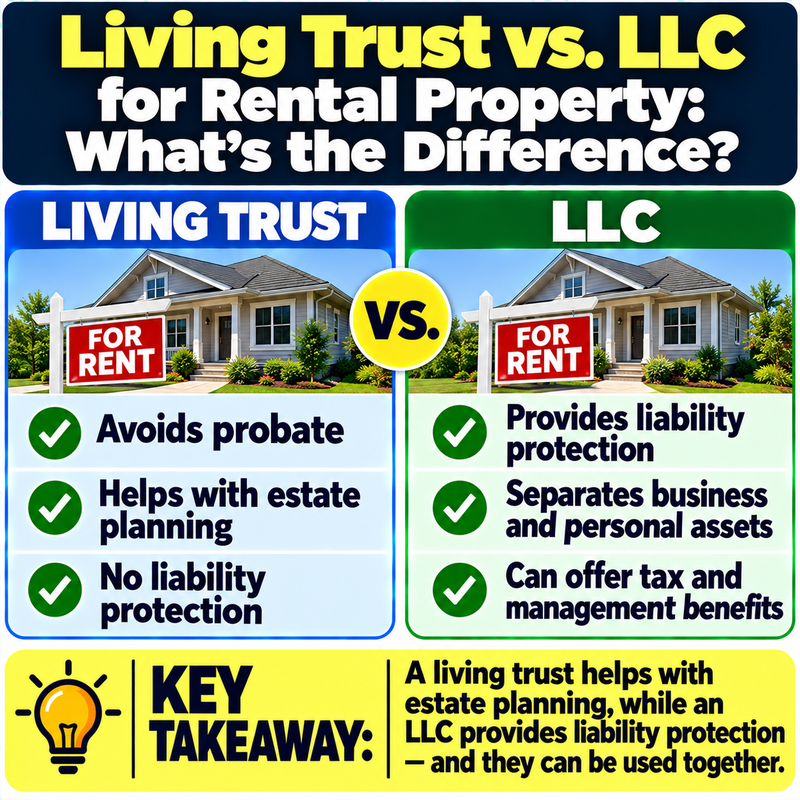
Living Trust vs. LLC: The Core Difference in One Table
Before diving into details, it helps to see the two structures side by side. Each one solves a different problem, and neither is a universal fix.
| Feature | Living Trust | LLC |
|---|---|---|
| Primary purpose | Estate planning, probate avoidance, incapacity management | Liability separation, business operations |
| Legal basis | Trust law | State business entity law |
| Liability protection | None, in most ordinary cases | Potentially significant, if properly maintained |
| Avoids probate | Yes | Not by itself |
| Ongoing state filings | Typically none required | Annual reports, fees, registered agent |
| Income tax treatment (revocable, single owner) | Disregarded; reported on owner’s return | Disregarded, partnership, S-corp, or C-corp depending on election |
What a Revocable Living Trust Actually Does
A revocable living trust is a legal arrangement where you transfer ownership of your property to a trust while still controlling it as trustee during your lifetime. You can amend it, revoke it, add property to it, or remove property from it whenever you want. That flexibility is exactly why it’s called “revocable” — nothing is locked in place the way it would be with an irrevocable arrangement.
For rental property owners, the trust acts mostly as a management and succession tool rather than a shield. It answers questions like: who manages the property if you become incapacitated, and who inherits it when you die, without the court getting involved in either scenario.
Avoiding Probate on Your Rental Property
Probate is the court process that validates a will and transfers property to heirs, and it can take months or even years depending on the state and the complexity of the estate. Rental property titled in your personal name, without a trust, typically has to go through this process before your heirs can sell, refinance, or even collect rent on it legally.
When the property is titled in the name of your trust instead, that step disappears. The successor trustee you named simply steps in and manages or distributes the property according to your instructions, without waiting on a judge’s calendar.
Planning for Incapacity and Who Manages Your Property
Rental property requires active management — collecting rent, approving repairs, renewing leases. If you became incapacitated and the property was titled only in your name, your family would likely need a court-appointed conservatorship just to keep paying the mortgage or handling a maintenance emergency.
A living trust solves this by naming a successor trustee who automatically steps into the management role you built the trust to anticipate. No court filing. No waiting period. The transition is often as simple as presenting a death certificate or incapacity certification to the bank.
Directing Who Inherits the Property After You Die
Trusts let you write specific instructions for how the rental property should be handled after you’re gone. Maybe you want your three children to inherit equal shares, or maybe you want the property sold and the proceeds split a certain way. You can even instruct the trustee to keep renting the property for years before transferring it outright.
A living trust gives you the same level of control over a rental property after death that you had while alive — something a will alone can’t offer without a trip through probate court first.
Why a Trust Does Not Shield You From Lawsuits
Here’s where people get tripped up. Just because your rental property sits inside a trust doesn’t mean it’s protected from a tenant’s lawsuit, a slip-and-fall claim, or a judgment from an unrelated accident. An ordinary revocable trust is designed for estate planning, not liability defense, and courts generally treat trust-owned property the same as personally owned property when it comes to creditor claims during your lifetime.
This is a meaningful distinction from irrevocable structures, and it’s worth understanding the difference between revocable and irrevocable trusts if asset protection is part of your goal. A revocable trust can be changed or dissolved by you at any time, which is exactly why courts and creditors don’t treat it as a liability barrier — you still have full control and access to the asset. Irrevocable structures operate under different rules entirely, but they come with tradeoffs in flexibility that most rental property owners aren’t ready to accept just for liability purposes.

What an LLC Actually Does
An LLC, or limited liability company, is a legal entity created under state law specifically to separate business activities from personal assets. When a rental property is titled in the name of an LLC instead of your own name, the LLC becomes the legal owner, the landlord on the lease, and the party responsible for the property’s debts and obligations.
Creating a Legal Separation Between You and the Property
Think of an LLC as a legal wall between you and your rental business. Tenants sign leases with the LLC, not with you personally. Vendors get paid from the LLC’s bank account. Mortgage payments, repairs, and property taxes all flow through LLC funds. This separation is what allows the LLC, when properly maintained, to absorb certain liabilities instead of passing them straight through to your personal bank account, car, or other properties.
This structure is one of the most common choices for rental property owners because forming and running an LLC is relatively straightforward compared to a corporation, and most states allow a single person to be the sole member.
Why LLC Protection Is Not Automatic or Guaranteed
An LLC doesn’t make you immune from liability just because the paperwork exists. Courts can and do pierce through an LLC when the owner fails to treat it as a separate business — commingling personal and business funds, skipping required formalities, or signing a personal guarantee on the mortgage. Each of these actions can undo the very protection the LLC was supposed to provide.
- Signing a personal guarantee on a loan ties your personal credit to the LLC’s debt obligations
- Mixing personal and LLC funds in the same bank account weakens the legal separation courts look for
- Skipping annual filings or operating agreement requirements can suggest the LLC isn’t a legitimate, separate entity
- Personal misconduct, like driving the property’s maintenance truck negligently, can create liability that follows you regardless of the LLC
The Power to Sue, Be Sued, and Operate Independently
Because an LLC is its own legal entity, it can enter contracts, open bank accounts, sue tenants for unpaid rent, and be sued by a tenant who slips on an icy sidewalk — all without directly naming you as a party in most cases. This independence is central to why LLCs exist for rental property owners in the first place: it gives the business a legal identity distinct from your personal one.

Probate Planning: Trust Wins, LLC Falls Short Alone
An LLC does a good job separating liability, but it does nothing to keep your rental property out of probate court when you die. That’s not what it was built for.
What Happens to an LLC Interest When You Die Without a Trust
If you own an LLC membership interest in your own name and you pass away without a trust, that interest typically has to go through probate just like any other personally held asset. Your heirs may be stuck waiting on the court to validate a will, appoint an executor, and formally transfer the membership interest before they can even access rental income or make management decisions.
Why Sole Proprietorship Ownership Always Triggers Probate
The same problem exists if you own the rental property directly in your own name, without an LLC at all. Sole ownership is the simplest way to hold property, but it offers zero probate avoidance and zero liability separation. Your interest passes through probate regardless of how the title reads, which is exactly the gap a living trust is designed to close.
Liability Separation: LLC’s Job, Not the Trust’s
Liability on a rental property can come from two very different directions, and understanding the difference changes how you think about protection.
Outside Attacks: Lawsuits Against You Personally
An outside attack happens when something unrelated to the rental property creates a judgment against you personally — a car accident, for example. If your auto insurance and umbrella policy don’t fully cover the judgment, a properly maintained LLC can keep that judgment from attaching to the rental property itself, since the LLC, not you, legally owns it.
Inside Attacks: Lawsuits Tied to the Rental Property Itself
An inside attack works the opposite direction. If a tenant sues because of a broken staircase or a mold problem, and the judgment exceeds your liability and umbrella insurance limits, that judgment attaches to the LLC itself — and to everything the LLC owns. This is exactly why owners with multiple properties under one LLC can end up losing more than the property where the incident actually happened.
What Can Still Break Through LLC Protection
Neither type of protection is bulletproof. Personal guarantees on the mortgage, personal involvement in causing the injury, or failing to maintain the LLC as a genuinely separate business can all expose personal assets regardless of how the title reads.
Who Controls the Property Under Each Structure
Control looks different depending on which structure holds the property, and knowing who’s actually in charge matters for day-to-day decisions as well as long-term succession.
Trustee Authority Under a Living Trust
Under a trust, you typically serve as your own trustee while you’re alive and capable, giving you full control over management decisions, leasing, and sales. A named successor trustee steps in automatically if you become incapacitated or pass away, following the instructions you wrote into the trust document.
Manager and Member Authority Under an LLC Operating Agreement
Under an LLC, control is defined by the operating agreement rather than a trust document. Members may vote on major decisions, or a designated manager may handle day-to-day operations while members act more like passive investors. These roles, voting thresholds, and transfer rules are spelled out in the operating agreement and can vary significantly from one LLC to another.

How Taxes Work for Trusts vs. LLCs
Tax treatment is one of the more misunderstood pieces of this comparison, mostly because the rules shift depending on how many owners are involved and what elections have been made.
Revocable Trusts Are Ignored for Income Tax Purposes
A revocable living trust is generally treated as a “grantor trust” by the IRS, meaning it’s ignored as a separate taxpayer while you’re alive. Rental income and expenses flow straight through to your personal tax return exactly as they would if the trust didn’t exist. There’s no separate trust tax return to file, and no added tax complexity just from placing the property into the trust.
Single-Member LLCs and Schedule E Reporting
- The IRS treats a single-member LLC as a “disregarded entity” by default
- No separate federal tax return is required for the LLC itself
- Rental income and losses are reported on Schedule E, attached to your personal Form 1040
This default treatment is one of the reasons single-member LLCs remain popular for rental property: you get the liability separation benefits (when properly maintained) without taking on a second layer of tax filing.
That said, “disregarded” for tax purposes doesn’t mean disregarded for legal purposes. The LLC still needs its own bank account, its own lease agreements, and its own record-keeping to maintain the separation that matters when a lawsuit shows up.
Owners sometimes assume that because the tax filing is simple, the legal formalities can be skipped too — that assumption is exactly what gets LLC protection challenged in court.
Multi-Member LLCs: Partnership, S-Corp, or C-Corp Elections
Once a second member joins the LLC, the default tax treatment shifts to a partnership. That means filing IRS Form 1065 along with Form 8825 to report rental real estate income and expenses, with each member receiving a K-1 showing their share of the income or loss. Multi-member LLCs can also elect corporate tax treatment using IRS Form 8832, and from there elect S corporation status using Form 2553, though these elections carry their own tradeoffs and are rarely the default choice for a straightforward rental property.
Whichever tax classification applies, income and losses pass through to the members’ individual returns rather than being taxed twice — once at the entity level and again at the personal level, the way a traditional corporation’s profits would be.
Mortgages and Lender Issues When You Transfer Title
Changing who legally owns a rental property — whether into an LLC or a trust — can trigger a conversation with your mortgage lender that many owners don’t anticipate.
Most residential mortgages include a due-on-sale clause, giving the lender the right to call the entire loan due if the property is transferred without their consent. This clause exists to protect the lender’s interest rate and risk assessment, not to punish property owners for reasonable estate or liability planning.
- Transferring property into an LLC can technically trigger this clause under the loan’s terms
- Transferring property into a revocable living trust is commonly treated differently, since federal law generally protects this type of transfer for owner-occupied homes
- Rental properties don’t always receive the same federal protection, so the lender’s own policies matter here
Before transferring title either direction, it’s worth reading your note and mortgage documents closely, or asking the lender directly, rather than assuming the transfer is risk-free. For more insights, consider reading about placing rental property in an LLC or trust.
The Due-on-Sale Clause and Transfers Into an LLC
Lenders rarely call a loan due simply because a property moved into an LLC, especially if payments continue on schedule and the owner remains the same person behind the LLC. Still, the legal right to do so exists, and some commercial lenders are stricter about it than residential lenders.
Why This Risk Rarely Triggers in Practice
In practice, lenders are primarily concerned with getting paid. If your mortgage payments continue arriving on time and the LLC is owned entirely by you, most lenders have little financial incentive to call the loan due, even though they technically could. That said, “rarely happens” isn’t the same as “can’t happen,” and owners should weigh this risk honestly rather than dismiss it entirely.
How Transfers Into a Trust Are Typically Treated Differently
Transfers into a revocable living trust are treated more favorably under federal law for certain residential transfers, which is part of why trust transfers raise fewer lender flags than LLC transfers. Still, rental properties and multi-unit buildings don’t automatically fall under the same protections as an owner-occupied home, so it’s worth confirming the specifics with your lender before assuming a transfer is automatically safe.

Insurance Still Matters No Matter Which Structure You Choose
Neither a trust nor an LLC replaces the need for solid insurance coverage on a rental property. Both structures work best as one layer in a broader protection strategy, not as a standalone solution.
Liability Insurance Limits and Umbrella Policies
Landlord liability insurance typically covers claims up to a set dollar limit, and once a judgment exceeds that limit, the remaining amount becomes exposed to whatever assets aren’t otherwise protected. An umbrella policy extends coverage beyond the base limits, often for a relatively modest additional premium given the extra protection it provides.
For rental property owners, stacking landlord liability coverage with an umbrella policy is one of the most cost-effective ways to reduce the chance that a judgment ever reaches the point of testing your LLC’s legal protections in the first place.
Insurance pays out faster and with less legal uncertainty than relying on entity structure alone, which is exactly why most asset protection professionals recommend treating insurance as the first line of defense, not the last resort.
Why an LLC Is Not a Replacement for Adequate Coverage
An LLC can limit how far a judgment reaches, but it does nothing to prevent the lawsuit from happening or to cover the legal costs of defending against it. Adequate insurance coverage handles both of those problems directly, while the LLC simply works to contain the financial fallout if a judgment does exceed your coverage.
Can a Living Trust Own an LLC Interest?
Yes — a living trust can own a membership interest in an LLC, and for many rental property owners, this combination captures the benefits of both structures at once.
Combining Estate Planning With Liability Protection
In this arrangement, the LLC still owns the rental property and still provides whatever liability separation it’s designed to offer. The trust, instead of owning the property directly, owns the membership interest in the LLC. When you die, that membership interest passes to your successor trustee and beneficiaries without going through probate, while the LLC’s liability structure remains intact throughout the transition.
What Changes (and What Doesn’t) When a Trust Holds LLC Membership
The property itself doesn’t need to be re-titled when you add this layer — it’s already owned by the LLC. What changes is who owns the membership interest in that LLC: instead of you personally, it’s your trust. This means the probate-avoidance benefit applies to the ownership interest, while the liability-separation benefit continues to apply to the underlying property through the LLC structure.
This layered approach does require some coordination, though. The LLC’s operating agreement needs to actually permit this kind of transfer, and depending on how the trust and LLC are drafted, there may be tax or lender considerations to review before making the move.
Operating Agreements and Transfer Restrictions You Must Check
Before assigning an LLC membership interest to a trust, the operating agreement deserves a close read. Many operating agreements include restrictions specifically designed to control who can become a member, and a trust transfer can run into these restrictions if it isn’t addressed carefully.
Some agreements require unanimous consent from other members before any interest can be transferred, even into something as benign as your own revocable trust. Others distinguish between an “assignment” of economic rights (the right to receive distributions) and a full transfer of membership rights (including voting power), which can leave a trust holding only partial rights unless the agreement says otherwise.
It’s also worth checking what happens to management authority if the trust becomes the member. Some agreements automatically name a successor manager upon a member’s death or incapacity; others leave that question unanswered, creating exactly the kind of gap a living trust is supposed to close.
Before transferring an LLC interest into a trust, confirm three things in writing: whether the operating agreement permits the transfer, whether other members must consent, and whether voting rights transfer along with economic rights.
Transfer Restrictions That Could Block Moving Interests to a Trust
Multi-member LLCs are more likely to include these restrictions than single-member LLCs, since other members have a legitimate interest in knowing who they’re in business with. If your operating agreement includes a right-of-first-refusal clause or a consent requirement, you may need an amendment before the trust transfer can proceed cleanly.
Skipping this step doesn’t necessarily void the transfer, but it can create disputes among members or ambiguity about whether the trust actually holds full membership rights — exactly the kind of loose end that surfaces at the worst possible time, like after an owner’s death.
Successor Ownership and Voting Rights Clauses
Pay attention to how the operating agreement defines successor ownership. Some agreements automatically recognize a trustee as having full member rights once the original member transfers their interest; others require a formal amendment naming the trust and its trustee explicitly. Getting this right avoids a situation where your successor trustee technically owns the economic interest but can’t actually vote on LLC decisions.

State Filing Fees and Ongoing LLC Requirements
Running an LLC comes with recurring administrative work that a trust generally doesn’t require, and understanding these costs upfront helps you weigh the tradeoff accurately.
Articles of Organization and Registered Agent Costs
Forming an LLC starts with filing Articles of Organization with the state and paying the associated filing fee, which varies significantly depending on where you form the entity. Most states also require a registered agent — a person or service authorized to receive legal documents on the LLC’s behalf — which often comes with its own annual fee if you’re not acting as your own registered agent.
Beyond formation, many states require ongoing compliance filings to keep the LLC in good standing, and missing these deadlines can result in administrative dissolution, which strips away the very liability protection you formed the LLC to get.
Annual Reports, Franchise Taxes, and Separate Bank Accounts
Depending on the state, an LLC may owe annual report fees, franchise taxes, or both, on top of the initial formation cost. A separate bank account is also essential — not optional — since commingling LLC funds with personal funds is one of the fastest ways to undermine the liability protection the entity is supposed to provide.
Trust Creation and Funding Costs by Comparison
A living trust typically involves a one-time drafting cost and the effort of retitling assets into the trust’s name, known as “funding” the trust. There’s generally no annual state filing fee or franchise tax tied to maintaining a revocable trust, since it isn’t a separate legal entity registered with the state the way an LLC is.
That doesn’t mean a trust is “free” to maintain, though. Updating the trust after major life changes, adding new property, or revising beneficiary designations all carry their own costs over time — they’re just structured differently than the recurring state fees an LLC requires.
Strategies for Owners With Multiple Rental Properties
Once you own more than one rental property, the liability math changes considerably, and the structure that worked fine for a single property can become a liability concentration risk across a portfolio.
Why One LLC Per Property Limits Cross-Liability
If all your rental properties sit inside one LLC and a lawsuit succeeds against that LLC, every property owned by that entity becomes exposed to the judgment — not just the one where the incident occurred. Separating each property into its own LLC means a judgment tied to one property generally can’t reach into the assets of a different, separately owned LLC.
Using a Master LLC to Manage Multiple Sub-LLCs
Many owners with several properties set up a “master” or “holding” LLC to handle property management functions — collecting rent, paying vendors, coordinating repairs — while each individual property stays in its own separate sub-LLC. This structure keeps day-to-day operations simple and centralized without sacrificing the liability separation that comes from keeping each property legally distinct.
Risks of Holding Several Properties in a Single LLC
Picture this: you own four rental properties, all titled under one LLC, and a tenant at Property A wins a lawsuit for a staircase collapse that exceeds your insurance limits. Because all four properties belong to the same legal entity, the judgment can attach to Properties B, C, and D as well — even though nothing went wrong at those locations. The liability doesn’t stay contained to the property that caused it.
This is the exact scenario that makes single-LLC portfolios risky as you scale. The convenience of managing everything under one entity comes at the cost of spreading risk across your entire portfolio instead of isolating it property by property.
Owners sometimes resist splitting properties into separate LLCs because it means more paperwork, more bank accounts, and more annual fees. That tradeoff is real, but it’s worth weighing against the alternative: one bad lawsuit wiping out equity across multiple properties instead of just one.
- A single LLC holding multiple properties concentrates inside-attack risk across the entire portfolio
- Separate LLCs per property generally confine a judgment to the property where the liability occurred
- More LLCs mean more state fees, more bank accounts, and more recordkeeping obligations
- A master LLC can offset some of this administrative burden by centralizing management tasks
When Trust and LLC Work Best Together
The strongest setup for many rental property owners isn’t choosing between a trust and an LLC — it’s layering them. The LLC handles liability separation on the property itself, while the trust handles what happens to your ownership interest in that LLC when you die or become incapacitated.
Estate Planning Layer Plus Liability Layer
Think of it as two layers stacked on top of each other, each doing a job the other wasn’t designed for. The LLC sits closest to the property, absorbing liability risk from tenants, contractors, and visitors. The trust sits one level up, owning the membership interest in the LLC and dictating what happens to that interest after you’re gone. Neither layer tries to do the other’s job, which is exactly why the combination tends to work so well.
A Look at the Living Trust Plus for Added Protection
For owners who want liability protection built directly into their estate plan, rather than relying solely on an LLC, a specialized irrevocable structure known as the Living Trust Plus offers an alternative worth understanding. It functions similarly to a revocable living trust in terms of flexibility, but it’s structured as an irrevocable asset protection trust, which changes how creditors and courts can treat the assets inside it.
Unlike a standard LLC, the Living Trust Plus can offer protection not just from lawsuits but also from probate and, in many cases, from long-term care costs that might otherwise erode the value of your estate. An LLC alone doesn’t touch probate or long-term care exposure — it was never built to.
Because this type of trust isn’t filed with the state the way an LLC’s Articles of Organization are, it also tends to offer a level of privacy that LLC ownership doesn’t provide, since LLC filings are often public record depending on the state.
This isn’t a fit for every rental property owner, and the irrevocable nature means giving up some of the flexibility a standard revocable trust offers. But for owners prioritizing long-term asset protection alongside estate planning, it’s worth a serious look alongside — or instead of — a traditional LLC.
- Functions much like a revocable living trust in day-to-day flexibility
- Offers protection from lawsuits, probate, and certain long-term care costs
- Not filed with the state, which preserves greater ownership privacy
- Involves giving up some revocability in exchange for stronger protection

Decision Checklist: Which Structure Fits Your Situation
With all the pieces on the table, the decision usually comes down to five practical questions. Walking through each one honestly will point you toward the structure — or combination of structures — that actually fits your situation, rather than the one that sounds the most impressive.
There’s no universal right answer here. A single-property owner with a paid-off house and no employees has very different needs than someone managing twelve units across three states.
1. Do You Own the Property Outright or With a Mortgage?
If there’s an active mortgage, read the due-on-sale clause carefully and consider contacting your lender before transferring title into an LLC or trust.
Properties owned outright give you more flexibility to transfer title without triggering lender concerns. If you’re still paying a mortgage, the due-on-sale clause becomes a real factor, particularly for LLC transfers, which historically draw more lender attention than trust transfers.
This doesn’t mean you can’t transfer a mortgaged property — many owners do it without issue. It simply means doing some homework first, rather than assuming the transfer is risk-free just because it’s common.
Talk to your lender directly if you’re unsure. A quick phone call can clarify their specific policy and save you from an unwelcome surprise later.
2. Is Your Main Goal Avoiding Probate or Limiting Liability?
If probate avoidance and smooth succession planning are your top priorities, a living trust addresses that directly. If your bigger concern is keeping a tenant lawsuit from reaching your personal savings or other properties, an LLC is the tool built for that job.
Many owners find they actually want both, which is exactly why the layered approach — trust owning an LLC interest — tends to be the most complete answer rather than picking one structure and hoping it covers everything.
3. Are You Managing One Property or a Growing Portfolio?
A single rental property might reasonably sit in one LLC, owned by a trust, without much added complexity. Once you’re managing multiple properties, the calculation shifts toward separating each property into its own LLC to contain inside-attack risk, possibly with a master LLC handling day-to-day operations across the portfolio.
4. Can You Commit to LLC Formalities and Recordkeeping?
An LLC only protects you if you treat it like a genuinely separate business. That means a dedicated bank account, leases signed in the LLC’s name, timely state filings, and keeping personal and business expenses completely separate.
If you’re not ready to commit to that level of discipline, the LLC’s liability protection becomes shakier in practice, no matter how well the paperwork looks on paper.
5. Should You Combine Both Structures for Full Coverage?
For most rental property owners who’ve moved past their first property, combining a living trust with one or more LLCs delivers the most complete coverage — probate avoidance through the trust, liability separation through the LLC, and a clear succession plan for both layers at once.
This combination requires more upfront planning and some ongoing coordination between your estate planning documents and your operating agreements. But for owners serious about protecting a growing rental portfolio, that coordination tends to pay for itself many times over.
The right mix ultimately depends on your mortgage situation, your risk tolerance, and how many properties you’re managing — which is exactly why a quick review with both an estate planning resource and a knowledgeable attorney makes sense before finalizing anything.
| Your Situation | Likely Best Fit |
|---|---|
| One property, no mortgage, simple estate | Living trust, possibly with LLC for liability |
| One property, active mortgage | Trust for succession; confirm lender policy before LLC transfer |
| Multiple properties, growing portfolio | Separate LLC per property, trust owning the interests |
| Priority on long-term care and privacy | Living Trust Plus alongside LLC structure |
Frequently Asked Questions
These are the questions rental property owners ask most often when weighing a trust against an LLC, or trying to figure out whether they need both.
Does putting my rental property in a living trust protect it from lawsuits?
No. A standard revocable living trust is built for probate avoidance and estate planning, not liability protection. If a tenant or visitor sues over something that happened at the property, the trust itself doesn’t create a shield against that claim.
Liability protection generally comes from the LLC layer, proper insurance coverage, or a specialized irrevocable trust designed specifically for asset protection.
Does an LLC automatically protect my personal assets?
Not automatically, and not completely. An LLC can separate your personal assets from certain claims, but only if you maintain it properly — separate bank account, no personal guarantees where avoidable, and consistent adherence to the operating agreement.
Skip those formalities, and a court may disregard the LLC entirely, treating you and the business as one and the same.
Can I put an LLC-owned property directly into a living trust?
You typically don’t transfer the property itself into the trust if an LLC already owns it. Instead, the trust owns the membership interest in the LLC, while the LLC continues to hold legal title to the property.
Will my mortgage lender find out if I transfer my rental to an LLC?
Possibly, though it’s not guaranteed to trigger action even if they do. Most mortgages include a due-on-sale clause that technically allows the lender to call the loan due upon a title transfer, but lenders rarely exercise this right as long as payments continue arriving on time.
Do I still need landlord insurance if I have an LLC?
Yes, absolutely. An LLC limits how far a judgment can reach, but it doesn’t prevent lawsuits or cover legal defense costs. Landlord liability insurance, paired with an umbrella policy, remains the first line of defense regardless of which legal structure owns the property.
Is a single-member LLC enough asset protection for a rental property?
It can be, depending on your state and how carefully you maintain the LLC. Courts in some jurisdictions have scrutinized single-member LLCs more heavily than multi-member LLCs, so it’s worth understanding your specific state’s treatment before relying on this structure alone.
What happens to my LLC interest if I die without a trust or will?
Your membership interest typically becomes part of your probate estate, meaning the court oversees how it’s distributed according to your state’s intestacy laws. This process can delay your heirs’ access to rental income and management decisions for months.
Should each rental property have its own separate LLC?
For owners with multiple properties, yes, this is generally the safer approach. Separate LLCs help contain liability to the specific property where an incident occurred, rather than exposing your entire portfolio to a single judgment.
- One property, one lawsuit risk — confined to that LLC alone
- Separate bank accounts and leases keep each LLC legitimately distinct
- A master LLC can simplify management without sacrificing this separation
The added administrative cost of multiple LLCs is real, but so is the risk reduction. For most owners managing more than one or two properties, the tradeoff favors separation.
It’s also worth revisiting this setup periodically as your portfolio grows, since what worked for two properties might not scale cleanly to ten.
How are taxes filed differently for a trust-owned property vs. an LLC-owned property?
A revocable trust is generally ignored for income tax purposes, so rental income and expenses flow directly onto your personal return exactly as they would without the trust. A single-member LLC follows the same default treatment, reporting on Schedule E, while a multi-member LLC typically files a partnership return using Form 1065 and Form 8825.
If the trust owns the LLC interest, the underlying LLC’s tax classification still governs how income is reported, since the trust itself remains disregarded for tax purposes during your lifetime.
Can a trust and an LLC be used together for one rental property?
Yes, and for many owners this is the ideal setup. The LLC holds the property and provides liability separation, while the trust holds the membership interest in the LLC, handling succession and probate avoidance.
| Layer | What It Handles |
|---|---|
| LLC | Liability separation, operational management |
| Trust (owning LLC interest) | Probate avoidance, incapacity planning, succession |
Before setting this up, check the LLC’s operating agreement for any transfer restrictions that could complicate assigning the membership interest to your trust.
A quick review with an estate planning professional can confirm the paperwork lines up correctly before you need it.
The Bottom Line: Match the Tool to the Problem You’re Solving
A living trust and an LLC aren’t competing solutions — they’re answers to two completely different questions. One handles who controls and inherits your rental property; the other handles how much of your personal life stays separate from that property’s risks.
Owners who get the best results usually stop asking “which one should I pick” and start asking “which problem am I actually trying to solve right now.” From there, the right structure — or the right combination of both — becomes a lot easier to see.