Joint Tenancy and Probate Avoidance for Real Estate
Learn how survivorship ownership works, when probate may still be needed, and how joint tenancy compares with a living trust.
If you and a co-owner hold a house as joint tenants with right of survivorship, the surviving owner may pick up the deceased owner’s share without a probate case for that interest. That’s the short answer. But joint tenancy probate avoidance only solves part of the puzzle, and the rest depends on exactly how your deed is worded, what happens when the last owner dies, and whether your family’s wishes match what the title paper actually says.
Too many homeowners assume that putting two names on a deed is a permanent probate-proofing move. It isn’t always. Joint tenancy is a form of ownership, not an estate plan, and it can leave gaps that a will or a verbal promise can’t fix. Before you add anyone to your title or rely on an old deed to protect your family, it helps to understand what this ownership form actually does — and what it doesn’t.
Key Takeaways: Joint Tenancy and Probate at a Glance
- A valid joint tenancy with right of survivorship can let a deceased owner’s share pass to the surviving owner without probate for that interest, but the rules depend on your state and your deed’s exact wording.
- Joint tenancy generally does not protect the property from probate when the last surviving owner dies, unless another arrangement, like a living trust, is already in place.
- Tenancy in common works very differently: a deceased owner’s share goes to their heirs or beneficiaries, not automatically to the co-owner.
- Adding a family member to a deed can trigger gift-tax questions, creditor exposure, and inheritance outcomes that don’t match what anyone intended.
- A properly funded revocable living trust can offer more control over who inherits real estate and can address what happens after every owner’s death, not just the first one.
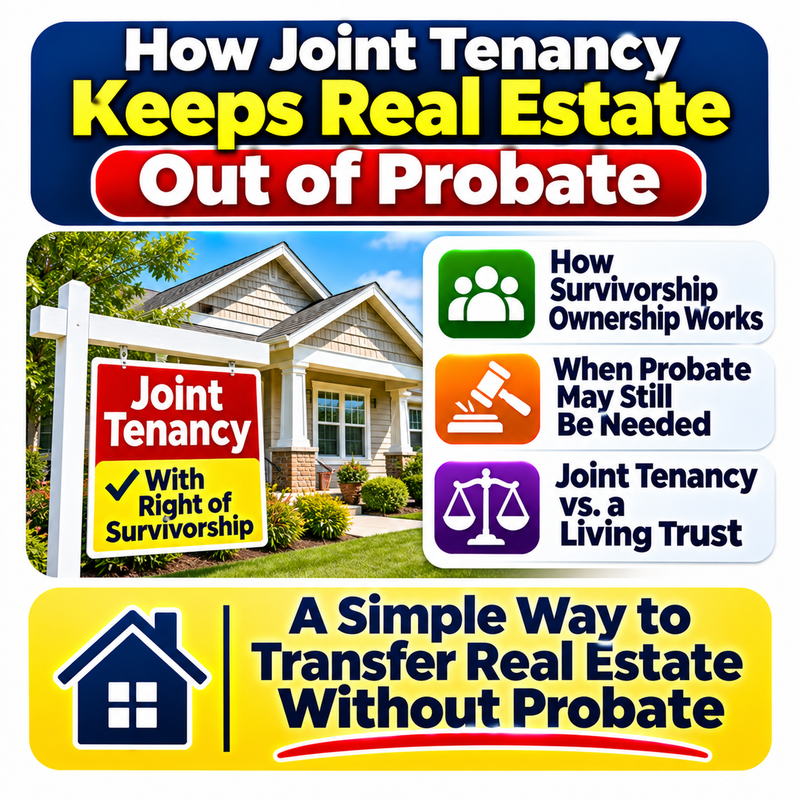
Learn how survivorship ownership works, when probate may still be needed, and how joint tenancy compares with a living trust.
Joint tenancy with right of survivorship is one of the oldest ownership tools in real estate, and it remains popular because it’s simple to set up and easy to understand on the surface. Two or more people hold title together, and when one owner dies, the surviving owner (or owners) typically inherit that person’s share automatically, by operation of law rather than through a court process.
That automatic feature is exactly why people reach for joint tenancy when they want to skip probate. It can work well in straightforward situations, like a married couple who owns one home together and wants the survivor to keep it without delay. But the deeper you look, the more this ownership form reveals edge cases, state-by-state quirks, and situations where it quietly works against the very goal you were trying to achieve.
Right of Survivorship and Deed Wording
The right of survivorship is the legal feature that makes joint tenancy useful for avoiding probate at the first owner’s death. When it’s valid, a deceased joint tenant’s ownership interest doesn’t pass through a will or through intestacy rules — it transfers directly to the surviving joint tenant or tenants. But this feature has to be properly created in the first place, and that’s where many property owners get tripped up.
Exact Language a Deed Needs to Create Joint Tenancy
Simply listing two names on a deed does not automatically create a joint tenancy with right of survivorship in every state. Many states require specific language, such as “as joint tenants with right of survivorship,” to appear on the deed itself. Without that phrase, or its state-approved equivalent, the law may default to tenancy in common instead, which behaves very differently when an owner dies.
This is why pulling your actual recorded deed and reading the vesting language matters more than relying on family memory or assumptions about how the property is titled. A deed that looks informal, was prepared decades ago, or was drafted without legal help may not say what you think it says. If you’re not sure, a title company or real estate attorney can review the recorded document and tell you exactly how ownership is structured today.
The Four Unities: Time, Title, Interest, and Possession
Traditional joint tenancy law relies on what’s often called the “four unities” standard. For a joint tenancy to exist, the co-owners generally need to meet all four of these conditions:
- Time: All owners acquire their interest in the property at the same time.
- Title: All owners are named on the same deed or title document.
- Interest: Each owner holds an equal share of the property.
- Possession: Each owner has an equal right to use and enjoy the entire property, not just a fraction of it.
If any one of these unities is missing — say, one owner was added to title years after the others, or the ownership shares aren’t equal — the arrangement may not qualify as a true joint tenancy under your state’s law. Instead, it could be classified as a tenancy in common, even if everyone involved assumed survivorship rules applied. This is a technical distinction, but it has real consequences for who inherits what when someone dies.
What the County Recorder Requires After the First Death
Survivorship may happen “by operation of law,” but that doesn’t mean the public record updates itself. When a joint tenant dies, the surviving owner typically still needs to take some action to clear the deceased owner’s name from title and reflect the new, sole ownership in county records.
This commonly involves recording a certified copy of the death certificate along with an affidavit of survivorship or a similar document, depending on state and county requirements. Skipping this step can create headaches later, particularly if the surviving owner wants to sell, refinance, or transfer the property, since title companies will want to see a clean chain of ownership. It’s a modest amount of paperwork compared to probate, but it’s not nothing, and it’s worth confirming with a title professional or recorder’s office rather than assuming the property “just transfers.”

Joint Tenancy vs Tenancy in Common
Joint tenancy and tenancy in common are often confused because both describe situations where more than one person owns a piece of real estate. The difference comes down to what happens when an owner dies, and that difference can completely change your estate-planning outcome.
Equal Shares vs Unequal Ownership Percentages
Joint tenants generally hold equal shares of a property — if three siblings own a home as joint tenants, each typically holds a one-third interest, regardless of who contributed more money toward the purchase. Tenancy in common, on the other hand, allows owners to hold unequal percentages. One tenant in common might own 70% of a property while another owns 30%, based on how the ownership was structured or how much each person contributed.
This flexibility makes tenancy in common attractive for unrelated co-owners, business partners, or family members who didn’t contribute equally to the purchase price. But it also means tenancy in common doesn’t carry the automatic survivorship feature that makes joint tenancy appealing for probate avoidance.
Who Inherits a Tenant-in-Common Share When an Owner Dies
When a tenant in common dies, their share of the property does not automatically go to the other co-owners. Instead, it passes according to that person’s will, trust, or — if they didn’t have one — your state’s intestacy rules. That share typically goes through probate unless another nonprobate arrangement, like a living trust, was already in place for that specific interest.
This is the core trade-off between the two ownership forms. Joint tenancy offers simpler, faster transfers to a co-owner but less control over who ultimately inherits. Tenancy in common offers more control over your own share but doesn’t skip probate on its own. Neither one is automatically “better” — it depends entirely on what you’re trying to accomplish and who you want to inherit the property.
What Happens at the Death of the Last Surviving Owner
Here’s where joint tenancy probate avoidance often falls apart for families who assumed they were fully covered. Joint tenancy can handle the first death cleanly. It generally has nothing to say about the second, third, or final death.
Why the Final Owner’s Estate Can Still Face Probate
Picture two siblings who co-own a home as joint tenants. When the first sibling dies, the survivorship feature kicks in, and the surviving sibling becomes the sole owner — no probate needed for that transfer. But now the property is held individually, in one person’s name. If that surviving sibling dies later without having set up another nonprobate arrangement, such as a transfer-on-death deed where available or a properly funded living trust, the property is very likely headed to probate court.
This is the distinction between avoiding probate for one property at one death and avoiding probate for an entire estate across multiple deaths. Joint tenancy handles the former. It does nothing for the latter unless you take additional steps. A will alone doesn’t change this outcome either — a will has to go through probate to be executed, so relying on a will as your only backup plan means probate is still on the table for the final owner’s estate.
State Title Law Decides the Outcome, Not Assumptions
Every piece of this — how joint tenancy is created, how it’s severed, what documentation is required after a death, and what happens to the last surviving owner’s estate — is governed by state law. Requirements, forms, and available alternatives like transfer-on-death deeds vary significantly from one state to the next. What’s routine in one state may not even be available in another.
Because of this variation, it’s worth confirming your state’s current rules with a title company or estate-planning attorney rather than assuming a rule you read about somewhere else applies to your property. A plan that works perfectly for a friend in another state might not transfer the same way where you live.

Severance and Creditor Exposure
Joint tenancy isn’t necessarily permanent. The same flexibility that lets co-owners hold property together can also let one owner unwind the arrangement, sometimes without the other owner’s consent, depending on state law and the specific transaction involved.
This matters for two big reasons: it means the survivorship feature you’re counting on could disappear before anyone dies, and it means that adding someone to your title exposes your property to risks tied to that person’s financial life, not just their intentions.
Here’s a general comparison of how joint tenancy behaves next to its closest ownership alternatives, keeping in mind that actual outcomes depend on your deed, your state, and whether any arrangement has been properly documented and funded.
| Ownership Arrangement | What Happens at Death | Probate Considerations |
|---|---|---|
| Joint Tenancy with Right of Survivorship | Deceased owner’s share passes to surviving joint tenant(s) | May avoid probate at first death; last survivor’s estate may still require probate |
| Tenancy in Common | Deceased owner’s share passes per will, trust, or intestacy rules | That share typically goes through probate absent another nonprobate plan |
| Properly Funded Revocable Living Trust | Trustee distributes or manages property per trust terms | Generally avoids probate for property actually titled in the trust’s name |
How One Co-Owner Can Break the Joint Tenancy Alone
In many states, a joint tenant can sever the joint tenancy unilaterally by transferring their interest to someone else, including to themselves as an individual, which converts the arrangement into a tenancy in common for that share. This can happen without the other owner’s agreement or even their knowledge, depending on the state and the specifics of the transaction. Once severed, the survivorship feature no longer applies to that portion of the property.
This possibility is part of why joint tenancy shouldn’t be treated as a locked-in, guaranteed outcome. Family relationships change, financial pressures arise, and the legal tools that make joint tenancy flexible for co-owners can just as easily make it unpredictable for the people counting on survivorship to work a certain way.
What Happens When a Co-Owner Faces a Lawsuit or Debt
Adding another person to your deed as a joint tenant means their creditors, judgments, divorce proceedings, or bankruptcy filings can potentially reach their ownership interest in your property, depending on applicable state law. This is true even if that person never contributed a dollar toward the purchase or the mortgage. A well-meaning decision to add an adult child to title “just in case” can unexpectedly tie your home to that child’s financial troubles.
Disagreements between co-owners over selling, refinancing, covering expenses, or handling maintenance can also escalate into partition proceedings, where a court is asked to force a sale or division of the property. These proceedings can be slow and expensive, and they illustrate why creditor exposure, family harmony, and probate avoidance are separate issues that deserve separate attention — not something joint tenancy automatically resolves just because the title is simple.

Blended Families and Unequal Contribution: A Real-World Case
Nothing exposes the gap between what people assume and what the law actually does quite like a blended family situation. Joint tenancy works beautifully when everyone involved wants the same outcome. It gets complicated fast when one owner’s wishes diverge from what the deed legally guarantees.
Two Siblings, One House, and a Child Left Out of the Deed
Picture this scenario. Two siblings, Mark and Laura, inherited their parents’ house years ago and took title together as joint tenants with right of survivorship. It made sense at the time — simple, equal, and probate-free if one of them passed away first. But Mark later remarried and had a daughter, and as he got older, he decided he wanted his half of the house to go to her instead of automatically passing to Laura.
Here’s the problem: if Mark dies while the joint tenancy remains valid and unchanged, his share of the house passes directly to Laura by right of survivorship — not to his daughter. It doesn’t matter if Mark wrote a will or even set up a revocable living trust naming his daughter as the beneficiary of his half of the property. A will or trust provision generally cannot override a valid, existing survivorship arrangement, because the property interest transfers by operation of the deed, not by the terms of a separate estate-planning document. Mark’s daughter could be left with nothing from that property, despite his clear intentions on paper.
For Mark to actually direct his share to his daughter, something would need to change about the ownership structure itself — not just his will or trust. That might mean legally severing the joint tenancy and converting his interest into a tenancy in common, where his share would then pass according to his will or trust instead of automatically to Laura. It could also mean placing his severed interest into a properly funded trust naming his daughter as beneficiary. Whether severance is even available, how it’s done, and what it triggers (notice requirements, potential tax consequences, impact on any mortgage) all depend on state law, the specific deed, and the realities of the existing loan on the property.
Decision Points Before Adding or Removing a Name on Title
Before anyone in Mark and Laura’s position changes title, there’s more to weigh than just one person’s inheritance goal. Severing a joint tenancy affects the other co-owner too — Laura’s expectations, her financial planning, and possibly her ability to refinance or sell depend on how the property is titled. If there’s a shared mortgage, lenders may have requirements or restrictions tied to who’s on title and who’s responsible for payments. Family relationships can also take a hit if a change in ownership feels like it came out of nowhere.
Real estate complications multiply further when a family owns property in more than one state — for instance, if Mark and Laura’s parents left behind a vacation property in a different state in addition to the primary home. Owning real estate across state lines can trigger a separate probate proceeding in that other state even if the primary residence avoids probate through survivorship, and ancillary probate for out-of-state property can add real delay and expense on top of whatever happens with the main house. This is one more reason families with property in multiple states often look at trust-based planning as a way to handle everything under one coordinated plan instead of leaving pieces scattered across different court systems.
Records to Pull and Professionals to Call First
Before Mark — or anyone in a similar situation — makes a move, there’s a practical sequence worth following:
- Obtain a current copy of the recorded deed and confirm the exact ownership and survivorship language in writing.
- Identify who the intended beneficiary should be for each owner’s share, separate from assumptions about what “should” happen.
- Review the mortgage documents and any lender requirements tied to the current ownership structure.
- Talk with the other co-owner about the proposed change before taking action, since their interests and expectations are part of the picture.
- Consult an estate-planning attorney to confirm whether severance, a transfer to tenancy in common, or a trust-funding strategy is actually legally effective in that state before anything gets signed or recorded.
Skipping any of these steps is how families end up with deeds that don’t say what they think they say, or worse, with a severance attempt that doesn’t hold up because it wasn’t done correctly under state law.

Title and Mortgage Review Before You Change Ownership
Changing who’s on a deed — whether that means adding a joint tenant, severing a joint tenancy, or moving a property into a trust — isn’t just a title company transaction. It touches the mortgage, the insurance policy, and sometimes the homeowners association, and skipping that review is one of the most common mistakes property owners make.
Due-on-Sale Clauses and Lender Notification
Most mortgages contain a due-on-sale clause, which gives the lender the right to call the full loan balance due if ownership of the property changes without their consent. This matters anytime you’re adding or removing a name from title, not just when you’re selling the home outright.
There is a narrower federal protection that can apply when a borrower transfers their own residential property into a revocable living trust where they remain a beneficiary — this kind of transfer may, under certain conditions, be shielded from triggering the due-on-sale clause. But that protection is conditional, tied to specific circumstances, and isn’t automatic for every transfer, every loan type, or every kind of trust. It shouldn’t be assumed to cover adding a co-owner to title, severing a joint tenancy, or transferring commercial property.
Before changing ownership in any way, it’s worth confirming directly with the lender, in writing, whether the proposed change affects the loan. A quick phone call or letter can prevent a far more expensive surprise down the road.
Items worth confirming with your lender and title company before any change:
- Whether the proposed transfer triggers the due-on-sale clause
- Whether the loan allows additional borrowers or owners to be added without refinancing
- Whether a trust-funding transfer qualifies for any applicable federal protection
- Whether homeowners insurance needs to be updated to reflect new owners or a trust as title holder
- Whether HOA or condominium governing documents place restrictions on ownership changes
Title Insurance Effects of Adding a New Owner
Adding someone to a deed can also affect your title insurance coverage. Existing title policies are generally written to protect the owners named at the time the policy was issued — adding a new owner afterward doesn’t automatically extend that same protection to them. Depending on the title company and the nature of the transfer, a new owner might need an endorsement or a new policy altogether to be fully covered against title defects.
This is a detail that’s easy to overlook because it doesn’t come up until there’s a title dispute down the line, and by then it’s too late to fix cheaply. A quick conversation with the title company handling the change can clarify what, if anything, needs to be updated.
It also helps to understand how joint tenancy fits into the broader landscape of co-ownership options, since title companies and attorneys often draw distinctions that aren’t obvious to homeowners at first glance — including how joint tenancy, tenancy in common, and tenancy by the entirety each create different rights and different exposure, as outlined in this comparison of real estate co-ownership structures.
Example: A homeowner adds her adult son to the deed as a joint tenant to “make things easier later.” Two years later, the son is named in a lawsuit unrelated to the property. Because he’s a joint tenant with an equal ownership interest, his portion of the home could be reachable by his creditors — something the homeowner never anticipated when she signed the new deed.
That example is a reminder that title changes aren’t reversible formalities. Once someone is added to a deed, undoing it isn’t as simple as crossing out a name — it typically requires another legally effective transfer, with its own set of consequences.
When a Revocable Living Trust Offers More Control
Joint tenancy answers one question well: who gets this specific co-owner’s share when they die. A revocable living trust answers a much bigger set of questions, including who manages the property if an owner becomes incapacitated, how the property should be divided among multiple heirs, and what should happen if an owner wants to benefit someone other than a surviving co-owner.
For readers trying to understand how living trust fundamentals compare with survivorship ownership, the core difference is control. Joint tenancy locks in a single, automatic outcome based purely on who’s on the deed when an owner dies. A trust lets the person who created it spell out instructions — who inherits what, when, and under what conditions — and those instructions can be updated anytime while the owner is alive and has capacity to do so.
Naming More Than One Beneficiary for a Single Property
One of the clearest advantages of trust-based planning shows up when an owner wants to split a single property’s value among several people, rather than handing the entire interest to one surviving co-owner. A trust can direct that a home be sold after the owner’s death and the proceeds divided among multiple children, or that one beneficiary receives the right to live in the home while another receives a different asset of comparable value. Joint tenancy simply can’t do this — its survivorship feature is built around passing the whole interest to the remaining co-owner, full stop.
This flexibility matters most in exactly the kind of situation Mark and Laura found themselves in. If Mark’s goal was to direct his share to his daughter while still giving Laura clear answers about what to expect, a properly funded trust holding his severed interest could spell out precisely how and when that transfer happens — something no survivorship deed is built to do.
Avoiding Probate at Every Owner’s Death, Not Just the First
Because a trust continues to exist independently of any one person’s lifetime, it can address what happens at the first owner’s death and the final owner’s death, and every beneficiary transition in between. That’s a meaningful upgrade over joint tenancy, which — as covered earlier — generally only handles the first transfer cleanly and can leave a surviving owner’s estate exposed to probate later. For families trying to understand exactly how ownership transfers are supposed to unfold and what documentation supports each step, this explanation of how the probate process actually unfolds is a useful reference point for seeing why nonprobate alternatives carry real weight.
How to Create a Living Trust and Fund Real Estate Into It
A trust document alone doesn’t move real estate anywhere — signing it doesn’t retitle the house. The property has to be legally transferred into the trust’s name through a properly prepared and recorded deed, a step known as funding the trust. Skipping this step is one of the most common and costly mistakes in trust-based planning, because an unfunded trust provides no probate protection at all for the assets that were never actually transferred into it.
For homeowners weighing whether survivorship ownership or trust-based planning fits their situation better, understanding how to create a living trust that’s properly drafted and fully funded is the difference between a plan that works on paper and one that actually performs when it’s needed.

Checklist Before You Add or Remove a Joint Tenant
Before making any change to how a property is titled, running through a short checklist can prevent most of the costly surprises covered so far in this article.
1. Pull the Current Deed and a Title Report
Start with the actual recorded document, not a memory of how the property is titled. A title report from a title company can confirm current ownership, any liens, and whether the survivorship language is even valid under current state law.
2. Confirm Mortgage Lender Requirements in Writing
Reach out to the lender before making any change and get their position on the due-on-sale clause, any required consent, and whether the proposed change affects the loan terms. A verbal assurance from a customer service representative isn’t the same as a written confirmation.
3. Put Every Co-Owner’s Intentions on Paper
Informal understandings about who “really” owns what, or who was supposed to get what, tend to fall apart exactly when they matter most. Documenting contributions, ownership intentions, and reimbursement arrangements in writing — ideally with legal help — reduces the odds of a dispute among heirs later.
This is especially important in blended families or situations involving unequal financial contributions, where one owner may have paid more of the purchase price but discovers that recorded title, not the size of their down payment, controls what happens at death.
4. Consult an Estate Planning Attorney or Title Officer
Severance rules, trust-funding requirements, and survivorship documentation all vary by state, and getting any one of them wrong can undo the very protection a family was trying to create. An estate-planning attorney or an experienced title officer can confirm what’s actually required in your jurisdiction before anything is signed or recorded.
This step also protects against a common misstep: assuming a will or trust automatically overrides an existing joint tenancy. As Mark and Laura’s situation showed, it generally doesn’t — and finding that out after death is far more painful than confirming it beforehand.
5. Compare Joint Tenancy, Tenancy in Common, and a Revocable Living Trust
Once the paperwork is pulled and the professionals are consulted, the final step is simply comparing the three main options side by side against the actual goal: Who should inherit this property, under what circumstances, and does the current title arrangement actually deliver that outcome?
For some families, joint tenancy’s simplicity is exactly right. For others — particularly those with blended families, unequal contributions, or property in more than one state — a properly funded revocable living trust offers the kind of control and flexibility that survivorship ownership simply wasn’t built to provide.
Common Mistakes Property Owners Make With Joint Tenancy
Most of the problems covered in this article trace back to a handful of avoidable mistakes. Property owners don’t usually get into trouble because joint tenancy is a bad tool — they get into trouble because they treat it as a complete estate plan rather than one piece of a larger picture.
Assuming Survivorship Avoids Probate at Every Death
This is the single most common misunderstanding, and it’s the one that catches families off guard years after the fact. Joint tenancy can genuinely keep a property out of probate when the first owner dies, which is exactly why it earns a reputation as a probate-avoidance tool. But that reputation quietly stops applying the moment there’s only one owner left standing.
Once a surviving joint tenant holds the property individually, the survivorship feature that protected the first transfer no longer exists for the second one. If that remaining owner dies without another nonprobate arrangement in place — a transfer-on-death deed where available, or a properly funded living trust — the property is very likely to end up in probate court, just delayed by one generation.
Families who assume joint tenancy “handles everything” often discover this gap at the worst possible time, when the second owner has already passed and there’s no backup plan to fall back on. Checking this assumption early, while both owners are alive and able to act, is far easier than untangling it afterward.
Adding a Co-Owner Without Checking the Mortgage Terms
It’s tempting to think of adding a name to a deed as a quick, low-stakes paperwork fix. In reality, it can brush up against due-on-sale clauses, trigger lender notification requirements, and affect title insurance coverage, as covered earlier in this article. Skipping that review doesn’t always cause an immediate problem, but it leaves a property owner exposed to surprises if the lender later decides to enforce the loan terms.
A short phone call or written request to the lender before changing title can confirm whether the proposed change is even permitted under the existing loan, and whether anything needs to be restructured first. That one conversation is far less costly than discovering after the fact that a mortgage balance has been called due.
Trusting Verbal Promises Instead of Deed or Trust Language
Family conversations about who’s “really” supposed to inherit a property carry real emotional weight, but they carry no legal weight once an owner has died. Recorded deeds and properly executed trust documents control the outcome — not what someone remembers being told at a kitchen table years earlier. If a verbal understanding doesn’t match the actual title or trust language, the paper wins every time.

Match Your Ownership Choice to Who You Actually Want to Inherit
Joint tenancy, tenancy in common, and a revocable living trust each answer the inheritance question differently, and none of them is automatically the right fit for every family. The right choice comes down to a specific set of facts: how many owners are involved, whether everyone wants the same person to inherit, whether contributions were equal, and whether the family includes children from more than one relationship. Working through those details with the actual deed in hand — rather than relying on assumptions about how the property is titled — is the surest way to confirm whether current ownership matches what you actually want to happen when an owner dies.
Frequently Asked Questions
These questions come up often among property owners trying to sort out what joint tenancy actually guarantees and where it falls short. The answers below are general in nature, since actual outcomes always depend on your state’s law and the specific wording of your deed or trust.
Does joint tenancy with right of survivorship avoid probate?
It can, for the specific interest that transfers between joint tenants. When one joint tenant dies, their share may pass to the surviving owner without a probate proceeding for that share, assuming the deed properly created a valid joint tenancy under state law. This protection applies only to that one transfer, not necessarily to the property’s entire future ownership history.
What happens when the last surviving joint tenant dies?
Once only one owner remains, the property is typically held individually rather than jointly. If that sole owner dies without another nonprobate arrangement in place, probate may be required to transfer the property to their heirs or beneficiaries. This is the gap many families don’t realize exists until it’s too late to plan around it.
What is the difference between joint tenancy and tenancy in common?
Joint tenancy generally requires equal ownership shares and includes an automatic right of survivorship, meaning a deceased owner’s interest passes directly to the surviving co-owner. Tenancy in common allows unequal ownership percentages, and a deceased owner’s share passes according to their will, trust, or intestacy rules rather than automatically to the other co-owner.
- Joint tenancy: equal shares, automatic survivorship, generally avoids probate at the first death
- Tenancy in common: shares can be unequal, no automatic survivorship, typically subject to probate unless another plan is in place
Because these two forms behave so differently at death, confirming which one actually applies to your property is a critical first step before making any assumptions about inheritance.
Can a joint tenant leave their share to a child through a will?
Generally, no — not while a valid joint tenancy remains in place. A will or trust provision purporting to leave a joint tenant’s share to someone other than the surviving co-owner typically cannot override an existing, unbroken survivorship arrangement, because the deed’s ownership structure controls the transfer, not a separate estate-planning document. To direct a share to a child or another beneficiary, the joint tenancy usually needs to be legally severed or restructured first.
Can joint tenancy be severed or changed?
In many states, yes. A joint tenant can often sever the arrangement by transferring their interest, which may convert that share into a tenancy in common. Availability, required formalities, and consequences vary by state and by the specific transaction, so severance isn’t automatically available in every situation or without legal review.
Can a joint owner’s creditors affect jointly owned property?
Yes, depending on applicable state law. Adding someone as a joint tenant generally makes them a co-owner with a real ownership interest, which means that interest can potentially be reached by that person’s creditors, judgments, divorce proceedings, or bankruptcy filings. This risk exists regardless of whether that person ever contributed financially to the property.
Does adding someone to a deed create gift-tax or basis issues?
Possibly. Adding another person to title without receiving equivalent payment in return can raise gift-tax questions, and it may affect how the property’s cost basis is calculated later, including whether any basis adjustment applies at an owner’s death. Whether a reportable gift actually results in tax owed depends on the specific facts, so this is worth reviewing with a tax professional before any transfer.
Is joint tenancy better than a revocable living trust for probate avoidance?
It depends on the goal. Joint tenancy can be simple and effective for a single transfer between co-owners, but it generally doesn’t address what happens at the final owner’s death or allow for multiple beneficiaries and staggered inheritances. A properly funded revocable living trust can address probate avoidance across every owner’s death and offers more control over how and when beneficiaries receive the property.
Does transferring a home into a living trust affect the mortgage or title?
It can, which is why mortgage and title review matter before funding a trust. Certain residential mortgage transfers into a revocable trust where the borrower remains a beneficiary may receive protection from triggering a due-on-sale clause under applicable federal law, but that protection is conditional and shouldn’t be assumed to apply automatically to every loan or every type of transfer. Title insurance and lender notification should also be confirmed directly.
What documents should homeowners review before changing ownership?
Before making any change to how a property is titled, it helps to pull together the current recorded deed, a title report, mortgage or deed of trust documents, homeowners insurance details, property tax records, any HOA governing documents, and existing wills, trusts, or powers of attorney. Reviewing these together gives a clear, accurate picture of current ownership before anyone signs a new document or records a change.
This information is intended as general education, not individualized legal or tax advice, and the rules governing joint tenancy, severance, and trust funding vary by state — a qualified estate-planning attorney or tax professional can confirm how current law applies to your specific property and family situation.