Choosing a Living Trust Trustee: Tax Responsibilities
Compare individual and professional trustees, fiduciary tax reporting, grantor trust treatment, and post-death administration obligations.
Key Takeaways
- A living trust trustee’s tax responsibilities shift dramatically the moment the grantor dies, so picking someone who understands recordkeeping matters as much as picking someone you trust.
- While you’re alive and competent, your revocable trust typically doesn’t need its own tax return — the income usually flows straight to your personal Form 1040.
- After death, the trust may become a separate taxpayer requiring an EIN and possibly a Form 1041, but that’s a fiduciary income tax issue, not automatically an estate tax bill.
- Working with a service like Create A Living Trust’s free consultation can help you map out trustee succession before a tax deadline sneaks up on your family.
- Later in this article, we’ll walk through a real-world style example of a daughter stepping into the successor trustee role and the exact documents she needs to track down first.
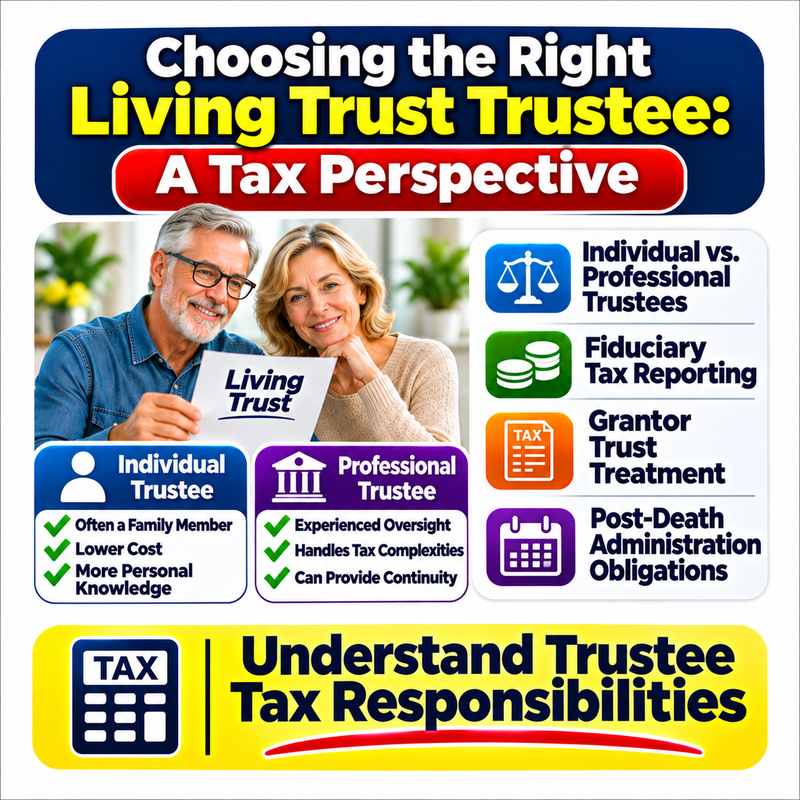
Here’s the question nobody asks until it’s too late: can your chosen trustee actually handle the tax paperwork, or just the paperwork everyone assumes comes with the job?
Most people pick a trustee based on trust alone — a spouse, an adult child, a sibling who seems responsible. That’s not wrong, but it skips a step. A trustee isn’t just managing property; they’re stepping into a role that touches income tax reporting, recordkeeping, and sometimes federal estate tax questions. Getting this wrong doesn’t just cost money — it can trigger penalties, delay distributions to beneficiaries, and create friction in a family that’s already grieving. Working through these decisions with resources like Create A Living Trust tends to catch problems before they become expensive.
Choosing a Living Trust Trustee: Tax Responsibilities
Compare individual and professional trustees, fiduciary tax reporting, grantor trust treatment, and post-death administration obligations.
The short answer: tax competence matters because the rules change the instant your trust’s status changes — and that status change can happen without anyone announcing it. A trustee needs to recognize when the trust stops being treated as an extension of you (the grantor, meaning the person who created the trust) and starts being its own taxpayer. They need to protect records well enough that a CPA can reconstruct a year of transactions without guessing. And they need to know when a situation is too complex to handle without professional help.
Legal authority to act as trustee and competence to manage the tax side of that role are two completely different things. The trust document and state law determine who’s legally allowed to sign checks and sell property. But nothing in that legal authority guarantees the person understands fiduciary income tax, distinguishes it from estate tax, or knows what a schedule K-1 is. Families often conflate the two, assuming that because Uncle Jim is named successor trustee in the document, he’s automatically equipped to file the right forms. He might be. He also might not be.
How Living Trusts Are Taxed While You’re Alive
While the person who created the trust — called the grantor or settlor — is alive and mentally competent, the trust is almost always treated as a grantor trust for federal income tax purposes. That’s a technical term meaning the IRS looks through the trust and attributes its income directly to the grantor, as if the trust didn’t exist as a separate tax entity. This is one of the quieter advantages of a revocable living trust: it doesn’t create extra tax complexity during your lifetime, even though it holds legal title to your assets.
Grantor Trust Status and Why It Matters
Grantor trust status exists because the grantor typically retains the power to revoke the trust, change its terms, or benefit from its income at any time. Since the grantor keeps that much control, the IRS doesn’t treat the trust as a separate taxpayer. Interest, dividends, rental income, and capital gains generated by trust-owned accounts and property are reported as if they belonged to the grantor personally — because, for tax purposes, they do.
This matters for trustee selection because it means a competent individual trustee usually doesn’t need deep fiduciary tax knowledge during the grantor’s lifetime. The bigger skill required at this stage is simply accurate recordkeeping — tracking what the trust owns, what it earns, and what gets spent — so that when the rules eventually change, there’s a clean paper trail to work from.
Reporting Trust Income on Your Personal Tax Return
In practice, income generated by a revocable living trust during the grantor’s life is typically reported on the grantor’s individual Form 1040, the standard personal income tax return, right alongside income from accounts held outside the trust. No separate trust return is usually required at this stage. Financial institutions holding trust-titled accounts commonly issue tax documents, such as 1099 forms, using identifying information tied to the grantor rather than a separate trust identity.
It’s worth noting that this isn’t automatic or universal in every single arrangement — specific trust terms, how accounts are titled, and how institutions process reporting can all vary. A trustee helping a grantor during their lifetime should still confirm, rather than assume, how income is being reported.
Using Your Social Security Number as the Trust’s Tax ID
Many revocable living trusts use the grantor’s Social Security number as the trust’s taxpayer identification number while the grantor is alive, rather than obtaining a separate Employer Identification Number (EIN) — a unique number the IRS assigns to identify a tax entity. This reinforces the grantor trust concept: the trust isn’t being treated as its own distinct taxpayer.
That said, not every trust follows an identical procedure, and circumstances such as certain irrevocable sub-trusts, specific drafting choices, or unusual funding arrangements can call for different handling. A trustee shouldn’t assume the identification number situation is the same for every trust they encounter — checking the governing document and getting professional confirmation is the safer move.
One detail trustees often overlook: becoming incapacitated doesn’t automatically end grantor trust status. If the grantor loses capacity but the trust terms and applicable tax law still support grantor trust treatment, the income tax reporting may continue largely unchanged, even though a successor trustee has stepped in to manage daily affairs. This is exactly the kind of nuance that calls for reviewing both the trust document and current tax guidance rather than guessing.

What Changes for Taxes After the Grantor Dies
Death is the real turning point. An ordinary revocable living trust frequently converts from a grantor trust into a separate, nongrantor taxpayer once the grantor dies — meaning the trust itself may now need to report its own income rather than funneling everything through the deceased person’s personal return. Selecting the right Estate Trustee is a critical decision in effective estate planning.
When a Living Trust Becomes a Separate Taxpayer
Once this shift happens, the trust may be required to obtain its own EIN and start filing its own fiduciary income tax return, commonly Form 1041, U.S. Income Tax Return for Estates and Trusts. Whether this is actually required depends on factors like how much income the trust generates after death, how long administration takes, and the specific terms of the trust — it isn’t automatic in every single case, but it’s common enough that a successor trustee should expect to deal with it.
Applying for an Employer Identification Number (EIN)
Getting an EIN is typically one of the first administrative tasks a successor trustee handles after death, since many financial institutions and the IRS itself expect the trust to have its own identifying number once it’s no longer treated as the grantor’s alter ego. This is also where a trustee’s organizational skills get tested early — without an EIN, retitling accounts, opening a trust checking account for expenses, and filing returns can all stall.
Form 1041 Filing Triggers and Deadlines
Whether Form 1041 is actually required depends on the trust’s income after death and other filing thresholds set by the IRS, which can change and should be confirmed with a current tax professional rather than assumed from memory. It’s also distinct from several other filings that might be happening around the same time: the decedent’s final individual Form 1040, any separate federal estate tax return based on the size of the estate, and K-1 forms that pass income information through to beneficiaries when the trust distributes income to them. A trustee who confuses these forms — or assumes none of them apply — risks missing deadlines that a beneficiary or the IRS will eventually notice.
Fiduciary Income Tax vs Federal Estate Tax vs State Taxes
These are genuinely different tax regimes, and conflating them is one of the most common mistakes a new successor trustee makes. Fiduciary income tax deals with income the trust earns after death — interest, dividends, rental income, capital gains. Federal estate tax deals with the value of everything the deceased person owned at death, and only applies when the estate’s value crosses a threshold set by federal law. State taxes add another layer entirely, since some states impose their own income tax, estate tax, or inheritance tax with completely different rules than federal law.
Why a Successor Trustee Doesn’t Automatically Owe Estate Tax
Here’s the part worth repeating clearly: agreeing to serve as successor trustee does not, by itself, create a federal estate tax obligation. Estate tax liability depends on the size and composition of the deceased person’s overall estate, not on who happens to be managing the trust afterward. A trustee administers trust property and handles fiduciary income tax reporting; estate tax, when it applies, is generally a separate calculation tied to the estate as a whole, which may involve the trustee’s cooperation but isn’t the trustee’s personal debt.
Personal liability for a trustee typically only becomes a real risk through mismanagement — things like commingling funds, missing filing deadlines through clear negligence, or distributing assets improperly before resolving known tax obligations. Simply serving as trustee and following prudent administration practices doesn’t expose someone to the estate’s tax bill.
State-Level Inheritance and Income Tax Variations
Governing law varies significantly by state, and this is exactly the kind of detail that shouldn’t be generalized nationally. Some states impose their own estate tax with thresholds different from the federal one. Others impose an inheritance tax paid by beneficiaries based on their relationship to the deceased. Still others have no separate estate or inheritance tax at all but do tax trust income differently than federal law does. A trustee administering a trust with beneficiaries or assets in multiple states should verify the applicable rules with a tax professional familiar with those specific states rather than relying on general assumptions.

Individual, Professional, and Co-Trustee Tax Capabilities
Not every trustee candidate brings the same tax skill set to the table, and that’s worth mapping out honestly before anyone accepts the role.
Family Member Trustees and Their Tax Limitations
Naming a sibling, adult child, or spouse as trustee carries real advantages — they know the family, they understand the grantor’s wishes, and they’re usually motivated to do right by everyone involved. The limitation isn’t character, it’s logistics. Most family members have never filed a fiduciary income tax return, never applied for an EIN, and don’t have a system for tracking cost basis on inherited property. That’s not a character flaw; it’s just an unfamiliar skill set that needs backup from a CPA or tax attorney once the trust’s tax situation gets complicated.
Corporate Fees and Built-In Tax Expertise
A professional or corporate trustee — typically a bank trust department or an independent trust company — brings staff who handle fiduciary accounting and tax coordination as a routine part of the job. That doesn’t mean they personally prepare the Form 1041 or represent the trust in an IRS matter; many corporate trustees still work alongside outside CPAs for actual return preparation, even though they’re far more comfortable managing the recordkeeping and coordination than a first-time family trustee would be.
The tradeoff is cost: professional trustee fees are ongoing administration charges, separate and distinct from whatever a family paid to set up the living trust in the first place. Families sometimes confuse the two, assuming a low-cost trust creation package somehow includes years of professional administration — it doesn’t, and comparing those numbers side by side only causes confusion.
Co-Trustee Arrangements for Sharing Tax Duties
Pairing a family member with a corporate co-trustee is a popular middle path. The family member contributes personal knowledge of the beneficiaries and the grantor’s intent; the corporate co-trustee contributes the organizational muscle for tax deadlines and recordkeeping. It works well when both parties communicate clearly and agree on decision-making authority up front — it works poorly when nobody clarifies who’s actually responsible for filing what, which can lead to missed deadlines each assumed the other was handling.
| Factor | Individual Family Trustee | Co-Trustees | Professional/Corporate Trustee |
|---|---|---|---|
| Bookkeeping capacity | Varies widely; often limited | Combined strength, if coordinated | Generally strong, built-in systems |
| Independence/impartiality | Can be lower in blended families | Moderate; depends on roles | High |
| Availability | Depends on personal schedule | Shared workload | Consistent, staffed |
| Continuity | Limited by lifespan/health | Improved over sole individual | Institutional, long-term |
| Potential fees | Often minimal or none | May involve some professional fees | Ongoing administration fees apply |
| Conflict risk | Higher among siblings/beneficiaries | Reduced with clear roles | Low personal conflict |
| Need for outside tax advice | Usually significant | Moderate | Lower, but CPA coordination still common |
Record Retention and Bookkeeping Requirements for Trustees
Good trustee decisions start with good paperwork, and that’s true whether the trustee is a family member or a trust company. Sloppy records don’t just slow down tax filings — they can trigger beneficiary disputes, since beneficiaries are generally entitled to a reasonably clear accounting of trust income, expenses, and distributions.
Documents Every Trustee Must Keep
A trustee stepping into the role, especially after someone’s death, needs to assemble a fairly specific paper trail before doing much of anything else:
- The signed trust document and any amendments, showing current terms and who’s named as trustee
- Evidence of successor authority, such as an affidavit of successor trustee or acceptance document
- Death certificates, usually several certified copies
- Prior income tax returns for the grantor and, if any exist, for the trust itself
- Account statements, deeds, and registration documents showing exactly what’s titled in the trust’s name
- Cost-basis and valuation records for real estate, securities, and other property
- Income documents such as 1099s, K-1s, and rental or business records
- Beneficiary contact information and any distribution instructions in the trust
- Expense receipts and a running distribution ledger
One detail that trips up new trustees constantly: account title and beneficiary designation are not interchangeable. A bank account can be titled in the trust’s name, while a 401(k) or life insurance policy passes by beneficiary designation completely outside the trust, regardless of what the trust document says. Confusing the two leads trustees to either overstep into property they don’t control or overlook assets that actually need trust administration.
Why Bookkeeping Capacity Should Guide Trustee Selection
This is really where the rubber meets the road on trustee selection from a tax perspective. Someone can be the most loving, well-intentioned family member alive and still be a poor fit if they can’t keep receipts organized, respond to a CPA’s questions promptly, or resist the urge to mix trust funds with their own checking account. Understanding the relationship between a trustee and the beneficiaries they serve often comes down to this kind of consistent, transparent recordkeeping — beneficiaries trust a trustee who can show their work, and they grow suspicious of one who can’t.

A Step-by-Step Example: From Owner-Trustee to Successor Trustee
Here’s a fictional but realistic walk-through that shows exactly where tax questions show up in real life, not just in theory.
Year One: The Owner Manages the Trust as Trustee
Picture a homeowner named Carol who creates a revocable living trust and names herself as initial trustee, transferring her house and two bank accounts into the trust’s name. For years, nothing about her tax life changes — she still files her regular Form 1040 each April, and the income from her accounts shows up under her own Social Security number, exactly as it did before the trust existed.
- Her house deed is retitled to read “Carol [Last Name], Trustee of the Carol [Last Name] Living Trust”
- Her checking and savings accounts are retitled the same way at her bank
- Her retirement account stays outside the trust entirely, with her daughter named directly as beneficiary
Carol keeps a simple folder with her trust document, account statements, and the deed, though she never really expects anyone else will need to use it. She assumes, like many people do, that because the trust avoids probate for the house and bank accounts, it also somehow simplifies taxes automatically. For now, that assumption happens to be harmless, because grantor trust treatment is already doing exactly that during her lifetime.
What Carol hasn’t fully grasped is that this ease won’t necessarily continue after she’s gone. The trust’s tax-quiet existence during her life is a feature of grantor trust status, not a permanent guarantee built into every revocable trust regardless of circumstances.
Years later, Carol passes away, and her daughter, named as successor trustee in the trust document, now has to figure out what actually changes.
After Death: The Daughter Steps In as Successor Trustee
The daughter’s first move is confirming her legal authority — pulling the trust document, reading the successor trustee provisions, and obtaining certified copies of the death certificate. From there, she checks what’s actually titled in the trust’s name: the house and two bank accounts are confirmed as trust property, but the retirement account passes directly to her as named beneficiary, completely bypassing the trust. She also locates Carol’s prior tax returns and cost-basis records for the house, since those numbers matter for any future sale.
She reaches out to a CPA to ask whether the trust now needs its own EIN and whether a Form 1041 will be required, since the trust may have earned interest and rental income after Carol’s death but before everything was distributed. Separately, she coordinates with the person handling Carol’s final individual Form 1040, since that’s a different filing entirely, tied to Carol’s income during the part of the year she was alive. She also asks whether any federal estate tax filing question applies — a separate matter from the trust’s fiduciary income tax, determined by the overall size of Carol’s estate rather than by her role as trustee.
Identifying Which Tax Forms Now Apply
Where things could go wrong is obvious in hindsight. If the daughter assumed the trust had no reporting obligations simply because it never needed its own return during Carol’s lifetime, she might miss an EIN application or a required Form 1041 filing, generating penalties and interest down the road. Alternatively, if she mistook fiduciary income tax for estate tax, she might panic about owing a large federal estate tax bill that may not even apply, based on a misunderstanding of how the two regimes work. Neither mistake reflects poorly on her character — they reflect how easy it is to blur lines between forms that sound similar but serve entirely different purposes.

Trustee Selection Checklist: Documents, Tax Questions, and Professionals
Before anyone accepts a trustee role — or before a grantor names someone to it — a short readiness check can prevent most of the headaches described above.
Documents to Gather Before Accepting the Role
A prospective trustee should ask to see the trust document itself, confirm how major assets are currently titled, and get a sense of whether organized records already exist or whether they’ll be starting from scratch. It helps enormously to know in advance whether the grantor’s financial life is simple — one house, one or two accounts — or complicated, involving business interests, multiple states, or retirement accounts with layered beneficiary designations.
It’s also worth asking whether prior tax returns are stored somewhere accessible, since a successor trustee often needs at least the last return or two to understand cost basis, carryover items, and prior reporting patterns.
Finally, confirming where original documents are physically kept — a safe deposit box, a fireproof safe, an attorney’s office — saves enormous time later, since nothing stalls administration faster than a document search during an already stressful period.
Tax Questions to Ask a Candidate Trustee
Before accepting, a prospective trustee should feel comfortable asking an estate planning attorney and a tax professional some direct questions: Does this trust already have provisions addressing what happens tax-wise at death, or will that need to be figured out from scratch? Is there any reason to expect the trust will owe fiduciary income tax soon after administration begins, based on its current holdings? And practically speaking, who’s expected to actually prepare any required returns — is that the trustee’s job, or will a CPA be retained separately?
These aren’t awkward questions to ask; they’re the exact questions a responsible trustee candidate should want answered before signing on.
Professionals Who Should Be on Your Team
An estate planning attorney clarifies legal authority, interprets ambiguous trust language, and confirms what state law requires for notice to beneficiaries. A CPA or enrolled agent — a tax professional licensed to represent taxpayers before the IRS — handles the actual mechanics of EIN applications, Form 1041 preparation, and coordinating the decedent’s final individual return.
Depending on the trust’s complexity, a financial advisor familiar with cost-basis tracking and investment transfers may also be worth involving, particularly when securities or business interests are part of the trust’s holdings.
Common Trustee Tax Mistakes and When to Call a Specialist
Most trustee tax problems fall into a small handful of recurring categories, and recognizing them early is half the battle.
Missing the EIN Application Deadline
Trustees sometimes delay applying for an EIN simply because nobody told them it was necessary, assuming the trust can keep operating under the deceased grantor’s Social Security number indefinitely. Financial institutions typically won’t allow that once they’re notified of the death, which can freeze account access at an inconvenient moment.
Confusing Fiduciary Income Tax With Estate Tax
As the earlier example showed, trustees frequently assume that any tax discussion after death automatically means federal estate tax. In reality, most trustees will deal far more often with fiduciary income tax on the trust’s post-death earnings than with an actual federal estate tax filing, which depends on the estate’s total value and applies in a smaller share of cases. This research from overview of trustee responsibilities underscores why trustees need working knowledge of both tax planning and tax return preparation rather than assuming expertise isn’t required.
When to Bring in a Tax Attorney, CPA, or Fiduciary Specialist
Complexity is the trigger, not fear. A straightforward trust with one house and modest bank accounts may be manageable with basic professional check-ins. A trust involving a family business, out-of-state real estate, retirement account distributions, or any irrevocable sub-trust created at death is a different animal entirely, and attempting that alone usually costs more in corrected errors than hiring help from the start would have. Estate fiduciary duties reinforce that trustworthiness, financial literacy, and availability all matter together — missing any one of them is reason enough to bring in outside help.

Pick a Trustee Who Can Handle the Tax Side, Not Just the Assets
The best trustee choice balances personal trust with practical tax competence, so review your successor designations, confirm how your assets are actually titled, and make sure whoever steps into the role has clear access to your records and a professional team ready to help. A free consultation with Create A Living Trust can help you walk through trustee selection and funding details before they become someone else’s emergency.
Missing the EIN Application Deadline
Trustees sometimes delay applying for a new Employer Identification Number simply because nobody told them it was necessary, assuming the trust can keep operating under the deceased grantor’s Social Security number indefinitely. Banks and brokerages typically won’t allow that once they’re notified of the death, which can freeze account access at the exact moment bills need paying and beneficiaries are waiting on information.
The fix is simple once someone knows to look for it: ask early, during the first few weeks of administration, whether an EIN application is needed. It’s a short process, but only if the trustee knows it’s on the to-do list in the first place.
Confusing Fiduciary Income Tax With Estate Tax
As the Carol-and-her-daughter example showed earlier, trustees frequently assume that any tax discussion after death automatically means federal estate tax. In reality, most trustees will deal far more often with fiduciary income tax on the trust’s post-death earnings than with an actual federal estate tax filing, since estate tax depends on the total value of everything the deceased person owned and applies in a smaller share of cases overall.
When to Bring in a Tax Attorney, CPA, or Fiduciary Specialist
Complexity is the trigger, not fear. A straightforward trust with one house and modest bank accounts may be manageable with basic professional check-ins along the way. A trust involving a family business, out-of-state real estate, retirement account distributions, or any irrevocable sub-trust created at death is a different animal entirely, and attempting that alone usually costs more in corrected errors than hiring help from the start would have.
This overview of trustee responsibilities underscores why trustees need real working knowledge of investing, tax planning, and tax return preparation rather than assuming good intentions alone will carry them through. The same reasoning applies to this guidance on estate fiduciary duties, which lists trustworthiness, financial literacy, and availability as equally essential qualities — missing any one of them is reason enough to bring in outside help before small mistakes compound into bigger ones.

Frequently Asked Questions
These questions come up constantly once families start comparing a family member against a professional fiduciary, so it helps to have straightforward answers on hand before the conversation turns into a guessing game.
None of these answers are meant to replace a conversation with your own attorney or CPA, especially once state law or an unusual asset enters the picture.
Still, having a baseline understanding makes that professional conversation far more productive.
Who reports trust income while the grantor is alive?
While the grantor is alive and competent, income from a revocable living trust is typically reported on the grantor’s personal Form 1040, not a separate trust return. This reflects grantor trust status, where the IRS treats the trust’s income as the grantor’s own for tax purposes, even though the trust legally owns the underlying accounts and property.
Most banks and brokerages issue 1099 forms tied to the grantor’s identifying information during this period, which keeps year-end tax prep looking almost identical to pre-trust life.
What changes after the grantor dies?
After death, an ordinary revocable trust may convert into a separate nongrantor taxpayer, potentially requiring its own EIN and a Form 1041 fiduciary income tax return. This runs alongside, but separately from, the decedent’s final individual Form 1040 and any estate tax question tied to the overall estate.
Several moving pieces land at once, which is exactly why a checklist and a professional sounding board matter so much during this window.
- The decedent’s final personal income tax return, covering income earned up to the date of death
- The trust’s own fiduciary income tax return, if required, covering income earned after death
- Any separate federal estate tax filing, based on the overall size of the estate
A trustee who treats all three as one single task is far more likely to miss something important.
Does a successor trustee need a new tax ID number?
Often, yes, once a trust stops being a grantor trust and becomes its own taxpayer after death. During the grantor’s lifetime, many trusts simply use the grantor’s Social Security number instead of a separate EIN.
A successor trustee should confirm the specific requirement with a tax professional rather than assuming either outcome automatically applies to their particular trust.
Is trustee compensation taxable income?
Generally, yes — fees paid to a trustee for serving in that role are typically considered taxable income to the trustee, reportable on their own personal tax return, separate from any income the trust itself earns.
Can a trustee be held personally liable for tax mistakes?
Personal liability typically arises from clear mismanagement rather than simple errors made in good faith. Commingling trust funds with personal accounts, ignoring known filing deadlines, or distributing assets before resolving known tax obligations are the kinds of actions that expose a trustee to real liability.
Honest mistakes made while following reasonable professional advice are treated very differently than negligence or self-dealing.
That distinction is exactly why documentation matters so much — a trustee who can show they consulted a CPA and followed that guidance is in a far stronger position than one who simply guessed.
- Keep written records of professional advice received and followed
- Avoid mixing trust funds with personal accounts under any circumstances
- Address known deadlines promptly rather than letting them slide
How long should a trustee keep trust financial records?
- Trust documents and amendments: indefinitely, or until final distribution and professional sign-off
- Tax returns and supporting documentation: several years beyond filing, per professional guidance
- Cost-basis and valuation records: until the related asset is sold or fully distributed
Specific retention periods can vary based on the type of document and applicable tax rules, so checking with a CPA about current requirements is safer than relying on a fixed number pulled from memory.
When in doubt, keeping records longer rather than shorter rarely causes a problem, while discarding them too early sometimes does.
Digital storage with backups has made this far less burdensome than it used to be, so there’s little reason to destroy anything prematurely.
Do all successor trustees need to file Form 1041?
Not necessarily. Whether Form 1041 is required depends on the trust’s income after death and other filing thresholds, which can shift over time and should be confirmed with a current tax professional rather than assumed.
Some trusts with minimal post-death income, or those administered and distributed quickly, may fall below the filing requirement entirely — but a trustee shouldn’t guess their way to that conclusion without checking.
What’s the difference between a trustee and an executor for tax purposes?
A trustee manages trust-owned assets, while an executor (sometimes called a personal representative) manages the probate estate — assets owned by the deceased person individually, outside any trust. Their tax responsibilities overlap in some ways but remain distinct filings tied to different pools of property.
One person can hold both roles at once, which happens often in smaller estates, but the two jobs still carry separate tax obligations that shouldn’t be blended together on paper.
Should I choose a family member or a corporate trustee for tax matters?
It depends on the complexity of the estate and the family member’s actual bandwidth and comfort level with paperwork. A simple trust with modest assets and an organized, available family member can work perfectly well with occasional CPA support. A complex trust with business interests, multiple states, or contentious beneficiaries often benefits from the structure a corporate trustee provides.
A good rule of thumb: if the trust’s tax situation would challenge you on your own personal return, it will likely challenge a first-time trustee even more — plan support accordingly.
Pick a Trustee Who Can Handle the Tax Side, Not Just the Assets
The best trustee choice balances personal trust with practical tax competence, so review your successor designations, confirm how your assets are actually titled, and make sure whoever steps into the role has clear access to your records and a professional team ready to help.
A free consultation with Create A Living Trust can help you walk through trustee selection and funding details before they become someone else’s emergency.