How Digital Asset Trusts Protect Online Business Assets
Plan for access, ownership, succession, and continuity of websites, domains, digital accounts, and online revenue streams.
A website that earns money while you sleep can stop generating a cent the moment something happens to the person running it — not because the business failed, but because nobody could log in.
Key Takeaways
- A digital asset trust for online business can help identify who manages or inherits transferable assets, but it does not automatically own your domain, ad account, or payment processor balance.
- Ownership, contractual account access, and operational continuity are three separate problems that each need their own planning steps.
- Platforms like registrars, hosting companies, and ad networks enforce their own rules regardless of what your trust document says.
- A well-organized succession plan documents vendor contacts, renewal dates, and legal ownership — not just a list of assets.
- Keep reading for a practical checklist, a real-world comparison table, and the exact questions to ask an attorney, registrar, or tax adviser before a crisis hits.
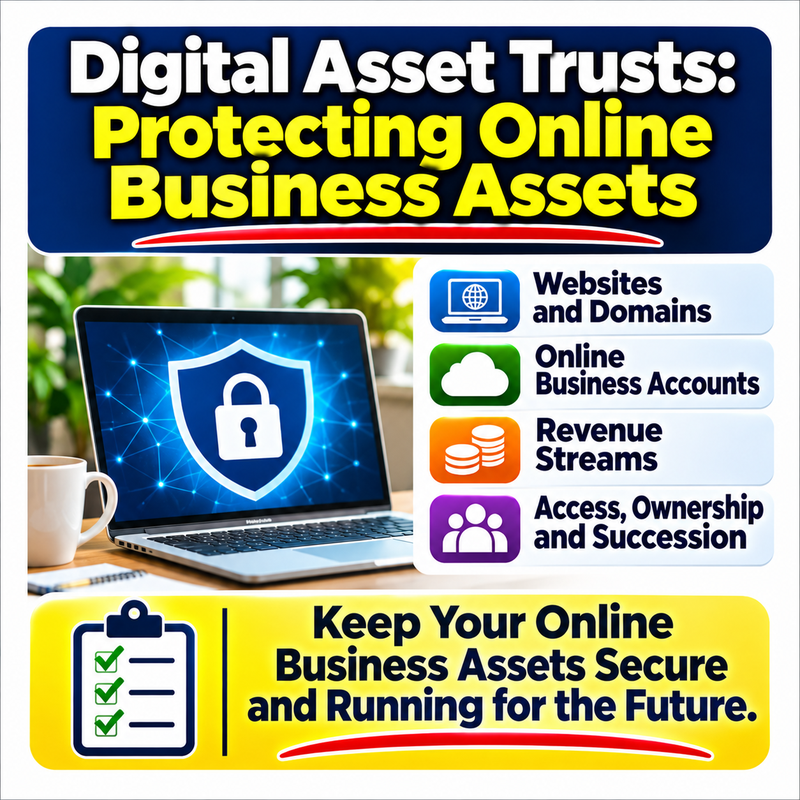
How Digital Asset Trusts Protect Online Business Assets
Plan for access, ownership, succession, and continuity of websites, domains, digital accounts, and online revenue streams.
A properly designed and funded trust may establish who manages or receives certain transferable online-business assets after incapacity or death. That’s the honest starting point. But continuity of an income-producing website depends on much more than a trust document — it depends on legal ownership records, business-entity paperwork, vendor contracts, authorized platform access, and a written operational plan someone can actually follow.
Here’s the part a lot of planning guides skip: a trust does not automatically own a domain, a website, a customer database, an ad account, a payment-processor balance, or a social-media profile just because someone typed those words into an estate-planning document. Ownership of each of those things is governed by a different set of rules — registrar agreements, platform terms of service, state entity law, and sometimes federal intellectual-property law. Mixing those up is one of the most common and costly mistakes online business owners make.
What Is a Digital Asset Trust, and Who Actually Needs One?
A digital asset trust for online business is really just a revocable living trust — the same tool used for a house or a brokerage account — applied deliberately to the specific assets that keep a web-based business running. It names a trustee, lays out instructions for a successor, and can hold a transferable ownership interest in a business entity. What it is not is a technical workaround for platform rules that restrict who can operate an account.
When a Standard Revocable Living Trust Falls Short
A generic trust template written for traditional assets often says nothing specific about domain registrars, hosting providers, or ad network payout agreements. Without that detail, a successor trustee may inherit legal authority over a business entity but still have no idea which vendor holds the keys to the website itself. The trust document and the operational knowledge need to travel together.
Business Owners Who Should Prioritize This Planning
Anyone who earns meaningful income from a website, app, or online storefront benefits from thinking through this now rather than later. That includes:
- Content site owners earning advertising or affiliate revenue
- E-commerce sellers with inventory, supplier contracts, and marketplace accounts
- Software developers with code repositories, licenses, and subscription billing
- Solo creators who are the sole holder of login credentials and recovery codes
- Partners or cofounders whose operating agreement says little about incapacity or death
The common thread isn’t the size of the business — it’s whether someone besides the owner could step in and keep the lights on within days, not months.
Situations Where a Trust May Not Be the Right Tool
A trust won’t help if the underlying assets were never properly funded into it, and it can’t override a platform’s terms of service or a federal privacy statute. If a business is a sole proprietorship with no separate legal entity, moving “the business” into a trust is more complicated than it sounds, because there may be no distinct legal thing to transfer — just a bundle of contracts, accounts, and personal obligations.

How the Trust Works: Roles From Settlor to Custodian
Every trust has a settlor (the person creating it), a trustee (who manages trust assets), and usually a successor trustee who steps in during incapacity or after death. For an online business, this structure has to interact with roles the trust doesn’t control directly — LLC managers, corporate officers, account administrators at a hosting company, and contractors who built the code.
Settlor, Trustee, and Successor Trustee Duties
The trustee’s job is straightforward in theory: follow the trust document, act in beneficiaries’ interests, and manage property prudently. In practice, a successor trustee managing an online business also has to:
- Preserve existing revenue streams without making unauthorized changes to contracts
- Keep accurate records of income and expenses tied to the business
- Maintain confidentiality around sensitive data and credentials
- Get professional help when technical or legal questions exceed their expertise
Trustee powers under the trust document are distinct from the authority an LLC manager or corporate officer holds under entity law — a successor trustee might need both roles depending on how the business is structured.
Executor and Probate Court Interaction
A pour-over will is often paired with a trust to catch assets that weren’t properly funded during life, but it typically still requires probate to move those assets into the trust after death. That’s a meaningful distinction: a trust is designed to help assets avoid probate when they’re actually retitled into it ahead of time, but a will-based catch-all does not offer that same advantage. For an online business, this matters because any account or asset left outside the trust at death may need to go through a probate process before a successor has clear legal authority to deal with it.
Beneficiary Rights and Practical Access Limits
Beneficiaries named in a trust have a right to eventual distribution and, in many states, a right to information about how the trust is being administered. What they don’t automatically get is login access to a website’s CMS or an ad network dashboard. Legal entitlement to an asset’s value and practical ability to operate an account are two different things, and conflating them is where a lot of succession plans fall apart.
Advisors and Custodians Who Hold the Keys
Beyond the trustee, a realistic plan usually involves a small team: an estate or trust attorney for the legal structure, a business attorney for entity and contract questions, an IT professional who understands the hosting and CMS setup, and an accountant for tax reporting on ongoing revenue. No single person — including the trustee — typically has every skill needed to keep a content website or e-commerce store running without interruption.
| Role | What They Control | What They Don’t Control |
|---|---|---|
| Trustee / Successor Trustee | Trust assets, distributions, fiduciary decisions | Platform account rules, registrar policies |
| LLC Manager / Officer | Day-to-day entity operations | Personal accounts not owned by the entity |
| Registrar / Hosting Provider | Domain renewal, server access | Legal ownership disputes between heirs |
| Beneficiary | Right to eventual distribution | Automatic login credentials |
Domain Registrar Accounts: Keeping Your Web Address Alive
A website is only as permanent as its domain renewal. Before anything else, it’s worth checking which registrar actually holds your domain, who is listed as the registrant and administrative contact, when renewal is due, whether auto-renewal is turned on, and what payment method is attached to it. These details sound mundane until a card expires or an email bounces and a business’s front door quietly goes dark.
Domain-lock settings and transfer restrictions add another layer. Most registrars lock a domain against unauthorized transfer by default, and moving a domain to a new registrant or registrar generally requires identity verification and compliance with the registrar’s own transfer procedure — not just a trust document showing who the new owner should be.
Registrar Transfer Rules and Lock Periods
Domain transfer rules vary by registrar and by the top-level domain itself, and recently transferred or newly registered domains often carry a lock period during which transfers aren’t permitted at all. A successor trustee can’t assume a court order or trust certificate instantly unlocks a domain for transfer; the registrar’s own verification process still applies, and skipping it isn’t realistic.
Naming a Trust as Technical Contact vs Account Owner
Some owners try to list a trust as the registrant on record, but registrar systems are built around individual or business account holders, not necessarily trusts as registrants in every case. A more reliable approach for many owners is keeping the registrant as the business entity (if one exists) and ensuring the trust holds an interest in that entity, while documenting registrar login details separately and securely for the successor trustee.
Auto-Renewal and Payment Continuity Risks
Auto-renewal tied to a personal credit card is one of the single most common failure points in digital succession. If that card is canceled, expires, or the account becomes inaccessible, the domain can lapse — and once DNS goes down, so does every account, email address, and revenue stream connected to it. Reviewing renewal payment methods annually is a small habit that prevents a large problem.

Website Hosting and Server Access Succession
Hosting is where the operational rubber meets the road. A successor needs authorized access to the hosting account, DNS settings, SSL certificate management, and the content management system itself before they can do anything to maintain or fix the site. None of that access is automatic just because someone is named as successor trustee.
Shared vs Dedicated Hosting Transfer Differences
Shared hosting plans are usually tied to a single account holder and a single billing method, making them simpler to document but also a single point of failure. Dedicated servers or cloud infrastructure accounts — think AWS, Google Cloud, or a managed VPS — often involve more complex access controls, multiple admin users, and separate billing relationships that need their own succession notes.
| Hosting Type | Typical Access Complexity | Succession Consideration |
|---|---|---|
| Shared Hosting | Low | Single login; single point of failure |
| VPS / Dedicated Server | Medium | Root access and SSH keys need secure documentation |
| Cloud Infrastructure (AWS, GCP) | High | Multiple IAM users, billing accounts, and permissions |
Whatever the hosting setup, backups matter more than almost anything else. A successor who can confirm recent, working backups exist has options even if primary access is delayed — they can potentially rebuild on new infrastructure. A successor without verified backups is gambling on a single account surviving a transition it was never designed for.
Documenting Credentials Without Filing Them Publicly
Passwords, recovery codes, and private keys should never appear in a will, a probate filing, or any publicly accessible trust document — those become public record in many jurisdictions. Instead, a secure password manager with a designated emergency access feature, combined with confidential written instructions kept separately from the trust itself, gives a successor trustee a path to credentials without exposing them to the public.
Code Repositories and Software Intellectual Property
If the online business runs on custom code, that code’s ownership often lives somewhere different from the business’s day-to-day accounts. A repository hosted on GitHub or GitLab has its own account structure, its own organization-level permissions, and its own billing — separate from the website’s hosting account and separate from who legally owns the underlying intellectual property.
GitHub and GitLab Organization Ownership Transfer
Transferring ownership of a GitHub organization or repository generally requires action by someone with existing administrative rights on the account, following that platform’s own ownership transfer process. A successor trustee without that access may need to work directly with the platform’s support process, and delays here can stall development or bug fixes on a live product.
Licensing Terms That Restrict Reassignment
Original code written in-house is usually owned outright by whoever created it or, in the case of employees, often by the employer under standard work-for-hire principles — though this depends on actual employment agreements, not assumptions. Code built with contractors is murkier: without a written agreement explicitly assigning intellectual property rights to the business, a contractor may retain certain rights even after being paid for the work. Licensed themes, plugins, and third-party software come with their own license terms that may restrict transfer or resale entirely, regardless of who owns the business using them.

Customer Data: Privacy Law Limits on Inheritance
A successor trustee’s fiduciary authority to manage trust property is not the same thing as blanket permission to access, export, or sell a customer email list.
An online business built on an email list, customer accounts, or purchase history is sitting on something legally sensitive. That data didn’t come with an “ownership” label the way a domain or a trademark does — it came with privacy obligations attached, and those obligations don’t disappear when the business owner dies or becomes incapacitated.
Fiduciary duty gives a trustee authority to manage trust property prudently, but it doesn’t automatically override the privacy commitments the business made to its customers. If a company’s privacy policy promised data would only be used for specific purposes, that promise generally travels with the business regardless of who’s running it now.
Practically speaking, this means a successor shouldn’t assume they can immediately export a customer database, start a new marketing campaign, or sell a list to a third party just because they now control the trust. Reviewing what the business actually promised customers — and what state or federal rules apply — has to happen first.
Good security hygiene also matters here. Multifactor authentication, access logs, and a least-privilege approach (where only the people who truly need data access get it) reduce the risk of a messy transition turning into a data breach. A successor managing customer information should treat that responsibility as seriously as the original owner did.
GDPR, CCPA, and Conflicting State Privacy Rules
Federal privacy requirements apply nationally, but much of the detailed rulemaking around consumer data in the U.S. happens at the state level, and those rules are not identical from one state to the next. A business collecting customer data from residents of multiple states may need to comply with several different frameworks simultaneously, and a successor trustee inheriting that compliance burden needs to know it exists before making any changes to how data is stored or used.
For businesses with international customers, the General Data Protection Regulation (GDPR) imposes its own separate obligations on data from EU residents, regardless of where the business itself is based. None of these frameworks are things a trust document can define away — they apply based on whose data it is and where that person lives, not based on who legally owns the business collecting it.
Some practical considerations for a successor stepping into this role include:
- Locating the business’s existing privacy policy and confirming what it actually promises customers
- Identifying which states or countries the customer base is located in
- Checking whether a data processing agreement exists with any third-party vendor handling customer information
- Avoiding any bulk export, sale, or repurposing of customer data until these questions are answered
These state-specific privacy frameworks referenced here are examples of how state law varies — they are not nationwide rules, and a successor should confirm current requirements with qualified counsel rather than assume one state’s approach applies everywhere.
Data Processing Agreements That Survive the Owner
Many online businesses rely on third-party vendors — email marketing platforms, analytics tools, payment processors — that handle customer data under a data processing agreement. These agreements typically continue regardless of who owns the business, but they often specify who is authorized to make decisions about that data, and a successor may need to formally update that authorization with each vendor.
This is one more reason a succession plan benefits from an inventory, not just a trust document. Knowing which vendors touch customer data, and what each agreement actually says about account transfers, saves a successor from guessing during an already stressful transition.

Intellectual Property Ownership: Trademarks, Copyrights, and Patents
A business’s brand name, logo, published content, and any proprietary processes represent real value, but each type of intellectual property has its own ownership rules under federal law. Copyright protection generally attaches automatically to original written content, images, and code the moment they’re created, while trademark rights depend on actual use in commerce and can be strengthened through federal registration.
Assigning Registered IP Into the Trust Correctly
A registered trademark or patent can, in many cases, be formally assigned to a trust or to a business entity owned by the trust, but this requires an actual written assignment — not just a mention in a trust schedule. The distinction between listing an asset in estate-planning papers and completing legally effective trust funding matters enormously here; a page in a trust binder that says “all intellectual property” doesn’t substitute for the formal assignment document that transfers legal title.
For a deeper look at how asset transfers into a trust actually work, this guide on how to fund a living trust explains the funding process in more depth, though it’s worth noting that ordinary trust-funding guidance doesn’t itself establish ownership of restricted platform accounts, registrant rights, or third-party intellectual property — those each require their own specific transfer steps.
Unregistered Rights and Work-for-Hire Complications
Unregistered copyrights are trickier because ownership depends heavily on who created the work and under what arrangement. Content written by the business owner personally is typically owned outright. Content created by an employee acting within the scope of their job is often owned by the employer under standard work-for-hire principles, but content created by an outside contractor follows different rules entirely.
Without a written agreement that explicitly transfers copyright ownership, a freelance writer, designer, or developer may retain certain rights to work they were paid to produce. This is an easy gap to overlook when a business has used contractors over the years without formal IP assignment clauses in every contract, and it’s a gap worth closing now rather than discovering during a succession crisis.
Reviewing existing contractor agreements with a business attorney — rather than assuming payment alone transferred full ownership — is the only reliable way to know where a business actually stands on this question.
Payment Processors and Revenue Account Access
Money moving through Stripe, PayPal, or a similar processor doesn’t sit there indefinitely waiting for a successor to claim it. These platforms have their own identity verification requirements, their own rules about account ownership changes, and their own policies about what happens when an account holder dies or becomes unreachable.
A successor should not assume a payment processor will recognize a trust as the new account holder automatically, or that payouts will simply continue uninterrupted. Account identity mismatches — where the name on file no longer matches who’s managing the account — can trigger holds, verification requests, or account freezes.
- Confirm whose name and tax ID are actually on file with each payment processor
- Check whether the processor has a documented process for account ownership changes or estate situations
- Review any reserve balance held by the processor and what conditions release it
- Document whether the account is tied to a personal identity or a registered business entity
That last point often makes the biggest difference. An account registered under a business entity’s tax ID tends to transition more smoothly than one tied to a personal Social Security number, simply because the entity itself doesn’t “die” the way an individual does.
Stripe, PayPal, and Merchant Account Identity Verification
Most major payment processors require identity verification tied to the account holder, and changing that identity after the fact typically means going through the processor’s own support and compliance process — not something a trust certificate alone resolves. A successor should contact the processor directly, explain the situation, and follow whatever documentation process that specific company requires, understanding that outcomes can vary and aren’t guaranteed to match what worked for someone else’s account.
Reserve Funds and Chargeback Liability After Death
Many payment processors hold back a reserve percentage of revenue to cover potential chargebacks or disputes, releasing it after a waiting period. If a business owner dies while a reserve balance is outstanding, that money doesn’t necessarily transfer immediately — it may remain tied to the original account until the processor’s own release conditions are met, and any outstanding chargeback liability generally still applies to the business regardless of ownership changes.

Social Media and Platform Account Succession
A brand’s Instagram following, a YouTube channel, or a Twitter/X audience can represent years of built-up trust and reach — but the account itself is governed by a license agreement with the platform, not a transferable property right in the traditional sense.
Platform Terms That Prohibit Account Transfer
Many major social platforms include terms of service that restrict transferring account ownership or credentials to another person, treating the account as personal to the individual who created it. This is a meaningful limitation: even with full legal authority as a successor trustee, a person may not have a guaranteed contractual right to simply take over someone else’s social account and continue operating it under the same name. For more information on these limitations, you can read about digital asset vulnerabilities.
The content posted to an account and the contractual right to operate that account are two separate things — owning the copyright to your photos doesn’t automatically mean you’re entitled to keep using someone else’s account to display them.
Some platforms have begun developing specific processes for deceased users’ accounts, often described as memorialization options or legacy contact settings, but these vary by platform and are typically designed for personal accounts rather than business-driven creator or advertising accounts. A business-focused account tied to monetization, advertising partnerships, or a verified creator fund may follow entirely different and more restrictive rules.
Several states have passed digital-fiduciary-access laws that give executors or trustees some legal standing to request access to a deceased person’s digital accounts under certain conditions, but these laws don’t override a platform’s own terms of service, and they don’t grant unrestricted access or permission to impersonate the account holder. These state laws are examples, not nationwide guarantees, and their practical effect depends heavily on how a specific platform chooses to respond to a request.
Memorialization and Legacy Contact Settings
Where a platform does offer a legacy contact or memorialization feature, setting it up in advance — while the owner is alive and able to configure it — is far more reliable than hoping a successor can navigate account recovery processes after the fact. This is a rare case where a small amount of proactive setup meaningfully changes the outcome compared to reactive planning.
For business accounts specifically, documenting which accounts are personal versus business-owned, and confirming whether the business entity itself (rather than an individual) is listed as the account administrator where platforms allow it, reduces the risk of a social presence becoming inaccessible at the worst possible moment.
Business Entity Structure: LLC, S-Corp, or Sole Proprietor
How an online business is legally structured shapes almost every other succession question. A business run as a sole proprietorship has no legal separation between the owner and the business — accounts, contracts, and liabilities are all personally held, which makes succession planning harder, not easier. An LLC or corporation, by contrast, creates a distinct legal entity that can, in many cases, continue operating independent of any single person’s death or incapacity.
A living trust can play a useful role here by holding a membership interest in an LLC or shares in a corporation, which allows a successor trustee to step into an ownership position without that ownership interest needing to pass through probate. But it’s worth being clear about the limits: a trust holding equity in a business entity is not the same as the trust directly owning every account, contract, or asset that entity uses day to day. The entity continues to own its own accounts and assets; the trust simply holds the ownership interest in the entity itself.
Operating Agreement Provisions for Successor Managers
An LLC’s operating agreement is often the single most overlooked document in digital business succession planning. Many operating agreements include transfer restrictions, buy-sell provisions, or consent requirements that determine what happens to a member’s interest after death — and these provisions can directly affect whether a trust beneficiary actually gains management authority or only an economic interest in distributions.
Reviewing these provisions with a business attorney before relying on them is far more reliable than assuming trust documents simply override whatever the operating agreement says. In multi-member businesses especially, cofounders or partners may have their own rights that limit how smoothly a membership interest transfers.
Funding an LLC Membership Interest Into the Trust
Moving an LLC membership interest into a trust typically requires an assignment document, consistent with whatever the operating agreement allows, plus updated company records reflecting the trust as the member of record. This is a separate legal step from simply writing “my business” into a trust schedule, and skipping it is one of the more common reasons succession plans fail to work as intended when they’re actually needed.
Contracts, Vendor Agreements, and Transfer Restrictions
Every online business runs on a web of contracts most owners rarely reread after signing them — hosting agreements, software licenses, affiliate program terms, advertising network agreements, and supplier contracts for e-commerce inventory. Many of these contracts include language addressing whether, and how, the agreement can be assigned to someone else.
A useful comparison comes from research on how digital assets are being incorporated into more sophisticated planning structures internationally, where specialized trustees are navigating evolving rules around volatile and non-traditional asset classes. As one overview of digital asset trust structures notes, the regulatory landscape for these assets is evolving quickly, and not every jurisdiction or platform treats contractual transfer the same way — a reminder that online business owners face a similarly fragmented set of rules when it comes to vendor and platform agreements.
Non-Assignment Clauses in Service Agreements
Many vendor contracts include a non-assignment clause that prohibits transferring the agreement to a new party without the vendor’s written consent. A hosting agreement, for instance, might technically prohibit a successor from simply taking over billing and management without notifying the provider and getting approval — even though in practice, many vendors are accommodating when a legitimate succession situation is explained.
The safer approach is treating these clauses as real constraints rather than formalities to ignore. Reaching out to a vendor proactively, explaining the situation, and following their stated process tends to produce a smoother outcome than assuming a contract automatically transfers along with the business.
Renegotiating Vendor Contracts After Ownership Changes
Ownership changes sometimes present an opportunity to renegotiate vendor terms entirely — a new pricing tier, a different service level, or updated billing arrangements that better fit how the successor plans to run things. This isn’t always necessary, but it’s worth considering as part of a broader operational review rather than simply preserving every legacy arrangement by default.
| Contract Type | Typical Transfer Restriction | Recommended First Step |
|---|---|---|
| Hosting Agreement | May require vendor notification or consent | Contact provider’s support team directly |
| Affiliate Program Terms | Often non-transferable without re-application | Review program’s account change policy |
| Software License | May be tied to original purchaser | Check license terms for transfer language |
| Supplier Agreement | Varies widely by contract | Review contract for assignment clause |
Case Study: Keeping a Content Site Running After the Owner’s Death
Consider a hypothetical website owner who runs a profitable content site earning money through display advertising and affiliate commissions. The site relies on a registered domain, a hosting account, a WordPress CMS, an analytics dashboard, an email list, and a payment account that receives monthly ad revenue. This owner dies unexpectedly, and a successor now has to figure out how to keep the business running — fast.
The scenario plays out very differently depending on how prepared the owner was. Two versions of this same hypothetical situation illustrate the gap between organized planning and good intentions left unfinished.
The Hypothetical Situation: Domains, Hosting, and Ad Revenue at Risk
In the first version, the owner had verified actual ownership records months earlier, documented every vendor contact in a secure password manager, had a legally reviewed trust naming a successor trustee with clear authority over the business entity, and kept renewal dates and payment methods current. In the second version, the domain, ad network account, and payment processor were all registered under the owner’s personal name with no business entity involved, and the only person who knew the account recovery details was the owner.
Neither version is guaranteed to go smoothly — platform cooperation and timing always introduce some uncertainty — but one version gives the successor a fighting chance, and the other leaves them starting from zero.
Step-by-Step Actions the Successor Trustee Took
| Business component | Immediate continuity risk | Ownership or access question | Prudent successor action |
|---|---|---|---|
| Domain name | Renewal lapse within weeks | Who is listed as registrant? | Contact registrar, confirm renewal status and lock settings |
| Hosting account | Site goes offline if billing fails | Who has account admin access? | Verify backups exist; contact hosting support |
| Ad network account | Payouts frozen or account flagged | Personal or business-registered? | Review account terms; contact platform support |
| Payment processor | Reserve funds withheld | Does identity on file match successor? | Submit required documentation; expect delays |
| Email list / customer data | Compliance exposure if mishandled | What does the privacy policy promise? | Review policy before any data use changes |
In the organized scenario, the successor trustee’s first calls were to the business attorney to confirm LLC succession provisions, then the registrar to verify the domain wasn’t at risk of lapsing, then the hosting provider to confirm backup integrity. Within the first week, the site stayed online, and the trustee had a documented path toward formally transferring the LLC membership interest.
In the disorganized scenario, the successor spent weeks trying to prove identity to a payment processor that had no record of a business entity, discovered the domain’s auto-renewal card had already been canceled by the bank, and had no way to access the ad network account because the recovery email was also inaccessible. Some of these problems were eventually resolved through platform support processes, but not before the site had gone offline and lost meaningful ad revenue during the gap.
Lessons From This Hypothetical Transition
The difference between these two outcomes wasn’t the trust document itself — both hypothetical owners could have had similar trusts. The difference was whether ownership records, vendor documentation, and account structures were actually organized and verified while the owner was alive and able to fix problems. Keeping a domain renewed is not the same as being legally authorized to operate the business account tied to it, and this hypothetical makes that distinction unavoidable.

A Digital Business Succession Checklist
Pulling this together into something actionable, here’s a starting checklist worth reviewing at least once a year:
- Confirm which registrar holds each domain and whether registrant details are current and accurate
- Verify hosting account access, backup schedules, and recovery contact information
- Document which business entity, if any, owns each payment processor and ad network account
- Review operating agreements or bylaws for succession and transfer provisions
- Confirm contractor agreements include written IP assignment language
- Store passwords and recovery codes securely — never in a public trust or probate filing
- Review the business’s privacy policy and any data processing agreements
- Identify a successor with enough context (or professional support) to act quickly
Questions to Ask Before You Need Them
A short list of direct questions can save months of confusion later. For a trust and estate attorney: does my trust actually need specific business-asset provisions, or is a general funding clause sufficient? For a business attorney: does my operating agreement allow a trust to hold a membership interest without triggering a buy-sell obligation?
For the domain registrar or hosting provider: what is your documented process for account access changes after an owner’s death? For a cybersecurity specialist: is my credential storage and recovery setup actually secure and accessible to a designated successor? And for a tax adviser: how should ongoing business income be reported during a transition in ownership or management?
Digital Asset Protection Options Compared
Online business owners generally have four realistic paths for protecting digital assets, and each comes with real tradeoffs in cost, control, and how quickly a successor can actually act. None of these options is a shortcut around registrar rules, platform terms of service, or entity law — they’re simply different levels of structure and professional support applied to the same underlying problem.
Cost, Control, and Liquidity by Planning Method
DIY trust templates, typically priced between $0 and $300, give an owner a document but no funding assistance, which means the owner is entirely responsible for retitling accounts, assigning IP, and documenting vendor access themselves. Online trust platforms in the $1,000 to $2,000 range usually offer more guided drafting but still leave funding — the actual legal transfer work — up to the owner.
Working directly with an estate planning attorney generally runs from $2,000 up to $10,000 or more, and funding is still typically a separate task unless specifically negotiated. A fully funded offering like the eState Living Trust, priced at $2,995 with an optional $95 per year for updates, includes the ordinary trust funding process as part of the standard package — though it’s worth being clear that this ordinary funding process does not include domain transfers, platform-account succession, business valuations, or IP assignment work, which remain specialized tasks outside a general estate-planning package.
Liquidity and control also depend heavily on how a business is structured going in. An owner who has already formed an LLC and documented vendor access has far more control over how smoothly a transition happens than an owner relying solely on a trust document with no underlying entity or inventory behind it.
Tax and Compliance Differences by State
Trust administration rules, probate procedures, and digital-fiduciary-access statutes vary from state to state, and what works smoothly in one state may involve extra steps in another. Some states have adopted versions of the Revised Uniform Fiduciary Access to Digital Assets Act, which gives fiduciaries a legal basis to request access to certain digital accounts, but the practical effect still depends on how an individual platform responds. These are state-level examples of how law can differ, not universal rules every online business owner can rely on nationwide, so confirming current requirements with a licensed attorney in the relevant state is the only reliable approach.
How a Revocable Living Trust Fits Into the Bigger Picture
A living trust plays a genuinely useful role in online business succession, but it’s one piece of a larger puzzle rather than a complete solution on its own. It works well for holding ownership interests in a business entity, directing how those interests pass to beneficiaries, and avoiding probate for anything properly funded into it ahead of time.
What a Revocable Living Trust Already Covers
A properly funded trust can name a successor trustee who steps in during incapacity, hold membership interests in an LLC or shares in a corporation, and provide clear instructions about how business income should be distributed to beneficiaries. It also typically works alongside a pour-over will, financial power of attorney, and healthcare directives as part of a complete estate plan.
When You Need a Separate Specialized Agreement
Where a trust falls short is in the technical and contractual details specific to digital operations — things like domain registrant records, platform account recovery, contractor IP assignments, and vendor non-assignment clauses. These typically require separate documentation: formal assignment agreements for intellectual property, updated operating agreements for entity succession, and a secure, confidential inventory of account access that lives outside the trust document itself.
Where Professional Help Matters
No single professional covers every angle of digital business succession, and trying to handle all of it alone usually means missing something important. A realistic team includes a trust and estate attorney for the fiduciary structure, a business attorney for entity and contract review, an IP attorney for registration and assignment questions, a cybersecurity specialist for credential management, and a tax adviser for ongoing income reporting.
Dividing responsibilities this way isn’t overkill — it reflects how genuinely different these problems are from each other. A trust attorney who drafts an excellent succession plan may have no visibility into whether a GitHub organization transfer is even technically possible, and a skilled developer may have no idea whether an LLC’s operating agreement restricts who can step into a management role.
Research on digital asset planning more broadly shows a similar pattern: as these structures mature, dedicated professionals with specific expertise in the underlying asset type consistently produce better outcomes than general-purpose planning alone. One practical framework for digital asset succession planning emphasizes identifying the actual legal owner of each asset, assessing transfer restrictions, and documenting recordkeeping obligations before assuming any transfer is possible — a sequence that applies directly to websites, domains, and revenue accounts.
Tasks Best Left to Attorneys and Tax Professionals
Reviewing an LLC operating agreement for transfer restrictions, drafting a formal IP assignment for contractor-created work, and determining how business income should be reported during an ownership transition are all tasks that carry real legal and financial consequences if handled incorrectly. These aren’t areas where a template or a general assumption should substitute for actual professional review.
What Documented Living Trust Services Like eState Can and Cannot Do
A documented living trust service can help an owner establish the core estate-planning structure — the trust itself, a pour-over will, powers of attorney, and ordinary funding support for typical assets like real estate and financial accounts. It’s worth being specific about what this does not include: business valuations, platform-account succession, cryptocurrency custody, IP assignment drafting, or specialized business succession transactions all generally fall outside a standard estate-planning package and require separate, specialized professional help.
Understanding this distinction up front prevents an unpleasant surprise later — an owner who assumes a general estate plan automatically handles every digital business detail may discover gaps only after a crisis has already begun.
Frequently Asked Questions
Can a trust own my domain names directly?
In some cases a trust can be listed as a domain registrant, but registrar policies vary on whether they accept a trust as the account holder. A more common approach is having a business entity own the domain registration while the trust holds an ownership interest in that entity, which avoids registrar-specific complications.
Either way, the registrar’s own verification process applies to any ownership change, so checking with the specific registrar before assuming a transfer method will work is the safer route.
What happens to my website if I die without a plan?
Without documented ownership records, vendor contacts, and legal authority for a successor, a website can go offline simply because nobody knows the domain is about to expire or how to access the hosting account. Family members or business partners may eventually sort it out, but often only after real downtime and lost revenue.
Do I need to put my passwords in my trust document?
No — passwords, recovery codes, and private keys should never appear in a trust document, will, or any filing that could become part of the public record. A secure password manager with emergency access features, combined with separately stored confidential instructions, gives a successor a path to credentials without exposing them publicly.
Can my executor access my PayPal or Stripe account immediately?
Not automatically. Payment processors require their own identity verification before recognizing a new account administrator, and this process typically takes time regardless of what estate documents say. An executor or successor trustee should contact the processor directly and expect to follow its specific documentation process.
Reserve balances held by the processor may also remain frozen until standard release conditions are met, independent of the estate’s legal status.
Does a trust override a platform’s terms of service?
No. A trust establishes legal ownership and fiduciary authority under state trust law, but it doesn’t change the contractual terms a platform has with its account holders. Social media platforms, ad networks, and hosting providers each enforce their own rules about account access and transfer, regardless of what a trust document states.
This is one of the most important distinctions in digital business succession — legal authority to manage trust assets and contractual permission to operate a specific platform account are simply not the same thing.
How do I transfer an LLC that owns my online business?
| Step | What It Involves |
|---|---|
| 1 | Review the operating agreement for transfer restrictions or consent requirements |
| 2 | Draft a formal assignment of the membership interest to the trust |
| 3 | Update company records to reflect the trust as the member of record |
| 4 | Confirm whether other members or cofounders must consent to the change |
This process generally requires a business attorney’s involvement, especially in multi-member LLCs where buy-sell provisions or right-of-first-refusal clauses may apply. Simply listing the business in a trust schedule without completing these steps typically does not accomplish a legally effective transfer.
The distinction between listing an asset and actually funding it matters here just as much as it does with a domain name or a brokerage account — ordinary trust funding processes handle common asset types well, but business entity interests often need their own specific assignment paperwork reviewed against the operating agreement.
What happens to customer data when business ownership changes?
Customer data remains subject to whatever privacy policy and data processing agreements were already in place, regardless of who now owns or manages the business. A new owner or successor doesn’t gain blanket permission to export, repurpose, or sell customer information simply because they now control the business entity or trust.
Can a successor trustee be denied access by a hosting company?
Yes, at least initially. Hosting providers have their own account verification and support processes, and a trust document alone doesn’t automatically unlock access. A successor typically needs to work through the provider’s specific process, sometimes alongside legal documentation proving their authority, and outcomes can vary by provider.
Is a digital asset trust valid in every state?
Revocable living trusts are recognized nationwide, but the specific rules around trust administration, probate procedures, and digital-fiduciary-access statutes differ by state. An owner operating across state lines, or a successor managing a trust in a different state than where it was created, should confirm current rules with a licensed attorney rather than assume uniform treatment everywhere.
How often should I update my digital asset inventory?
Reviewing the inventory at least once a year, or any time a major account, vendor, or business structure changes, keeps the plan realistic rather than outdated. Domains get renewed, hosting providers change, and new accounts get added constantly in an online business — a stale inventory from several years ago is often more misleading than having no inventory at all.
Start Protecting Your Online Business Before It’s Too Late
Protecting an online business for the long run comes down to a short list of honest habits: verify who actually owns each asset, review entity and platform agreements instead of assuming a trust overrides them, document domain, hosting, and revenue dependencies somewhere a successor can find them, and complete legally effective transfers wherever they’re genuinely permitted.
A trust supports this kind of planning in real and valuable ways, but it doesn’t rewrite a registrar’s transfer rules, a platform’s terms of service, or a state’s privacy law — and pretending otherwise just sets a successor up for a rough surprise later. For more insight, explore what makes digital assets in a trust vulnerable.
Create A Living Trust works alongside Bulletproof Legacy Financial to help readers put foundational estate-planning documents in place, giving online business owners one solid piece of a much bigger succession puzzle.