Category: Trust Laws & Taxes

Explore legal and tax considerations involving living trusts, including state trust laws, estate and income taxes, asset protection, Medicaid considerations and other rules that may affect an estate plan.

  • Living Trust and Step-Up in Basis: How Does It Work?

    Living Trust and Step-Up in Basis: How Does It Work?

    Living Trust Step Up in Basis: How Inherited Trust Assets May Receive a New Tax Basis

    Learn When Inherited Trust Assets May Receive a Basis Adjustment, Which Assets Follow Different Rules, and Why Trust Type Matters

    Key Takeaways

    • A living trust itself does not create a step-up in basis — it’s your continued ownership for tax purposes that keeps this benefit available at your death.
    • Step-up in basis means an inherited asset’s taxable value resets to its fair market value on the date of death, often erasing decades of taxable gain.
    • Basis can move in either direction — assets that lost value receive a step-down, not a step-up, which permanently eliminates that loss for the heir.
    • Retirement accounts like IRAs and 401(k)s don’t follow these rules at all; they’re taxed as income in respect of a decedent regardless of how they’re titled.
    • Later in this guide, you’ll see how jointly owned property, community property states, and irrevocable trusts can each produce very different basis outcomes.

    Putting a house, a brokerage account, or a rental property into a trust doesn’t automatically change how the IRS taxes it when you die — and that surprises a lot of people who assume “trust” means “tax shelter.”

    If you’re building or reviewing a revocable living trust, understanding basis adjustment matters just as much as understanding probate avoidance, because it directly affects how much your heirs pay in capital gains tax after you’re gone. Resources like CreateALivingTrust.com walk families through exactly where these tax rules intersect with trust planning, which is a detail many basic trust templates gloss over entirely.
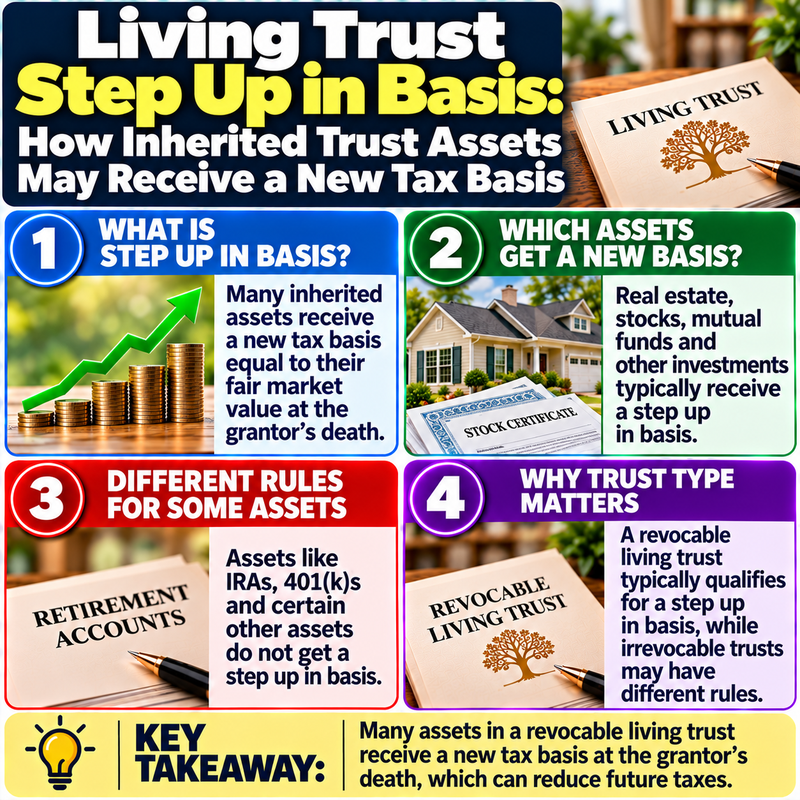
    Living-Trust-Step-Up-In-Basis

    Quick Answer: Does a Living Trust Get a Step-Up in Basis?

    Yes — assets held in an ordinary revocable living trust generally receive a step-up in basis at the grantor’s death, because those assets are still considered part of the grantor’s taxable estate under federal tax law. The trust is a legal container, not a tax shield. What matters to the IRS is whether you retained enough control and economic benefit over the asset while you were alive, not what the title on the deed or account says.

    What Cost Basis Means

    Tax basis is simply the dollar figure used to calculate gain or loss when you sell something. If you bought a stock for $10,000 and sold it for $40,000, your basis is $10,000 and your taxable gain is $30,000. Basis isn’t always a fixed number, though — it moves over time based on improvements, depreciation, and other adjustments the tax code recognizes.

    Think of basis as a running scorecard. Every dollar you put into fixing up a rental property adds to it. Every dollar of depreciation you claim on that same property subtracts from it. By the time you sell or pass away, your adjusted basis might look nothing like your original purchase price.

    Original Basis vs. Adjusted Basis

    Original basis is what you paid (or the value assigned when you received the asset as a gift). Adjusted basis accounts for everything that happened afterward — capital improvements, depreciation deductions, stock splits, or partial sales. This distinction matters enormously for inherited assets, since death doesn’t just preserve the original number; it can reset the entire calculation.

    How Basis Determines Your Taxable Gain

    Taxable gain is calculated as sale price minus adjusted basis. A higher basis means less taxable gain, and a lower basis means more. This is exactly why the step-up rule matters so much financially — it can mean the difference between owing tax on $500,000 of appreciation and owing nothing at all.

    What “Step-Up in Basis” Actually Refers To

    Under Internal Revenue Code Section 1014, property acquired from a decedent gets a new basis equal to its fair market value on the date of death. This applies broadly across asset types included in the gross estate.

    • Stocks, bonds, and mutual funds reset to their date-of-death market value.
    • Real estate — both personal residences and investment property — gets revalued at death.
    • Business interests, including many partnership and sole-proprietorship assets, can qualify.
    • Collectibles, art, and jewelry are included in the step-up rule as well.
    • Personal property like vehicles and furniture technically qualifies too, though it’s often adjusted downward due to wear and depreciation.

    All the appreciation that built up during the decedent’s lifetime simply disappears from an income tax standpoint. No capital gains tax gets paid on it, no depreciation recapture gets triggered, and the heir starts fresh with a clean basis number.

    IRC Section 1014 Explained

    Section 1014 is the specific statute the IRS relies on to justify this treatment. It was briefly repealed in 1976 before that repeal was undone, and it has remained a stable, well-established part of the tax code since. It’s worth noting this is fundamentally an income tax rule, not an estate tax rule — it exists independently of whether your estate owes any federal estate tax at all.

    Why Inherited Assets Get a New Starting Value

    The logic behind Section 1014 is that taxing unrealized appreciation at death, on top of potential estate tax, would amount to taxing the same economic gain twice. Instead, Congress chose to let income tax basis reset entirely, while estate tax (for estates large enough to owe it) handles taxation of the overall estate value separately.

    Why Revocable-Trust Assets Can Still Be Included in the Decedent’s Estate

    A lot of people assume that once an asset is “in the trust,” it’s somehow separate from them personally. For an ordinary revocable living trust, that’s not how the IRS sees it. Because you retain the power to amend, revoke, or control the trust during your lifetime, the IRS treats those assets as though you still own them directly for tax purposes.

    This is actually good news. It means assets in your revocable living trust remain eligible for the same step-up treatment they would have received if you’d simply owned them in your own name. The trust accomplishes probate avoidance and management continuity without sacrificing this valuable tax benefit.

    Where people get confused is in thinking that trust ownership alone changes tax outcomes. It doesn’t, at least not for revocable trusts. The real dividing line in the tax code is control, not title — and that distinction becomes especially important when comparing revocable and irrevocable trust structures, which follow very different rules.

    The Difference Between Trust Title and Tax Ownership

    Title tells you whose name is on the paperwork. Tax ownership asks a different question: who had the power to change, revoke, or benefit from the asset while alive? With a revocable trust, you answer yes to that question until the day you die, which is precisely why the IRS still counts those assets as part of your gross estate.

    Illustrative example: Maria transfers her rental duplex, originally purchased for $150,000, into her revocable living trust. Twenty years later she passes away, and the property is worth $480,000. Because the duplex remained part of her taxable estate, her son inherits it with a new basis of $480,000 — not $150,000. If he sells shortly after for $485,000, he owes capital gains tax on roughly $5,000, not $335,000. This example is illustrative only and not tax advice; actual outcomes depend on individual circumstances and current law.

    That gap between $5,000 and $335,000 in taxable gain is the entire point of understanding how basis adjustment interacts with trust planning. Skipping this detail in estate planning conversations can cost families real money.

    Why a Revocable Trust Offers No Special Tax Benefit

    It’s worth being direct here: a revocable living trust doesn’t create extra tax savings beyond what you’d get from outright ownership. Its value lies in avoiding probate court, keeping your affairs private, and providing a smooth transition if you become incapacitated. The step-up in basis happens because the assets are still part of your taxable estate — the trust simply doesn’t interfere with that outcome one way or the other.

    Free Trust Consultation Banner

    Fair-Market-Value Basis Rules at Death

    Fair market value, for basis purposes, means what a willing buyer would pay a willing seller on the open market, with neither party under pressure to act. For publicly traded securities, this is straightforward — it’s the closing price on the date of death. For real estate, closely held business interests, or collectibles, it usually requires a professional appraisal.

    How the Date-of-Death Value Is Determined

    Executors typically obtain documentation close to the date of death: brokerage statements showing account values, real estate appraisals reflecting market conditions on that specific date, and business valuations where applicable. This documentation becomes critical later if the IRS ever questions the basis an heir claims on a future sale.

    The Alternate Valuation Date Option

    Under IRC Section 2032, an executor can elect to value the entire estate six months after death instead of on the date of death itself, but only if doing so reduces both the gross estate value and the estate tax owed. This is a narrow tool used mainly in larger estates where asset values dropped significantly in the months following death, and it applies estate-wide rather than asset-by-asset.

    Appreciated vs. Depreciated Property

    Step-up in basis sounds like it only works in one direction, but that’s a misconception worth clearing up early. Basis adjusts to match fair market value at death — and that can mean the number goes up, down, or in rare cases, stays about the same.

    Step-Up for Assets That Gained Value

    When an asset’s value increased during the decedent’s life, the heir’s new basis reflects that higher value, erasing the taxable gain that would otherwise have existed. This is the scenario everyone focuses on, and it’s genuinely the more common outcome for assets held long-term, like real estate or stock portfolios that have appreciated over decades.

    Step-Down for Assets That Lost Value

    The flip side is less talked about but just as real. If an asset’s fair market value at death is lower than the decedent’s original basis, the heir’s basis steps down to that lower figure — and the built-in loss simply vanishes. Nobody gets to claim it. If Dad bought stock for $80,000 and it’s worth $50,000 when he dies, his heir’s basis is $50,000, not $80,000. That $30,000 loss is gone for good, which is why selling a severely depreciated asset before death (rather than holding it) sometimes makes more financial sense for a family, depending on their broader tax picture.

    Assets That Follow Different Basis Rules

    Not everything inherited gets this treatment, and assuming otherwise can lead to an unpleasant tax surprise. Certain asset categories are carved out of Section 1014 entirely, following their own distinct rules regardless of whether they sit inside a trust, a will, or neither.

    Retirement Accounts

    IRAs, 401(k)s, 403(b)s, and similar retirement accounts don’t receive a step-up in basis, full stop. It doesn’t matter if the account is payable directly to a beneficiary or routed through a living trust — the IRS treats these as income in respect of a decedent, meaning the money was always going to be taxed as ordinary income whenever it’s withdrawn, by the original owner or by whoever inherits it.

    Income in Respect of a Decedent

    Income in respect of a decedent, often abbreviated IRD, refers to income the decedent had a right to receive but hadn’t yet received or reported before death. This includes retirement account balances, unpaid salary or bonuses, uncollected business receivables, and deferred annuity gains.

    IRD items carry their original tax character forward to the beneficiary. If your father had $400,000 in a traditional IRA, that entire amount remains taxable as ordinary income when withdrawn, whether he withdraws it himself at 75 or his daughter withdraws it after inheriting it. The step-up rule simply doesn’t apply here, and no amount of trust planning changes that outcome.

    Annuities follow this same IRD logic. The deferred gain inside a non-qualified annuity is still taxable to whoever eventually receives the funds, trust or no trust. This is one of the more important distinctions families need to understand, because it’s easy to assume all inherited assets behave the same way when they clearly don’t.

    Jointly Owned and Community-Property Considerations

    Ownership structure outside of trusts also changes how basis adjustment plays out, and this is an area where state law matters as much as federal tax law. Jointly owned property and community property follow genuinely different rules from one another, and getting this wrong can mean paying tax that wasn’t actually owed.

    Married couples especially need to pay attention here, since the state they live in can produce dramatically different basis outcomes for the exact same asset and the exact same death.

    This is a case where generic advice falls short — ownership form, state of residence, and how title was actually held all factor into the final answer, which is why confirming details with a qualified estate or tax professional is worth the time before making assumptions.

    Step-Up Rules for Jointly Held Property

    For jointly held property between non-spouses (say, two siblings who co-own a vacation home), typically only the deceased owner’s fractional share receives a step-up. If two siblings each own 50% and one dies, only that 50% interest gets revalued to fair market value — the surviving sibling’s 50% basis stays exactly where it was.

    For married couples holding property as joint tenants with right of survivorship (outside community property states), generally only half the property’s value steps up at the first spouse’s death, leaving the surviving spouse’s original basis on the other half unchanged.

    Full Step-Up in Community-Property States

    Community property states — including California, Texas, Arizona, and several others — handle this differently and more generously for surviving spouses. Both halves of community property receive a full step-up in basis when one spouse dies, not just the deceased spouse’s half. This “double step-up” can be a meaningful planning advantage for married couples in these states, and it’s one more reason location matters when structuring a trust.

    Real Estate in a Living Trust

    Real estate is often the single largest asset in a family’s estate, and it’s usually where basis adjustment makes the biggest financial difference. Whether it’s a primary residence or a rental property, placing real estate into a revocable living trust doesn’t change how basis adjusts at death — but it’s worth understanding how the rule plays out for each property type.

    How Step-Up Applies to a Primary Residence

    A primary residence held in a revocable living trust receives the same step-up treatment it would have gotten through outright ownership. If a couple bought their home decades ago for $120,000 and it’s worth $650,000 when the surviving spouse passes, the heirs’ basis becomes $650,000 — eliminating over half a million dollars of what would otherwise be taxable gain.

    This is precisely why transferring a home into a revocable living trust tends to make sense for homeowners who want to avoid probate without giving up this tax benefit. The trust handles the transfer efficiently after death while the step-up rule handles the tax side automatically.

    How Step-Up Applies to Investment Properties

    Rental and investment real estate benefit from step-up in basis too, and the financial impact here can be even larger because these properties typically carry accumulated depreciation that’s been reducing basis for years. Once the property passes to an heir, that depreciation history is wiped clean — the heir starts fresh with a new basis equal to fair market value and begins depreciating the property all over again from that new, higher number.

    This “depreciation reset” is often overlooked but genuinely valuable. A rental property owner who’s been depreciating a building down toward zero basis for 25 years hands their heir a brand-new depreciation schedule, starting from current market value, which can meaningfully reduce the heir’s future taxable rental income.

    It’s worth noting that land itself isn’t depreciable, so the step-up here primarily affects the improvements — the building, not the dirt underneath it — though both components get revalued to fair market value at death.

    Free Consultation Banner 2

    Irrevocable Trusts and Why Basis Results Can Differ

    Everything discussed so far applies to ordinary revocable trusts, where the grantor retains control. Irrevocable trusts are a fundamentally different animal, and basis outcomes can diverge sharply depending on how the trust is structured.

    The general principle is this: if you give up enough control and ownership rights that the asset is removed from your taxable estate, you also generally give up the step-up in basis for that asset. There’s a trade-off baked into irrevocable trust planning that families need to weigh carefully.

    • Assets transferred to a properly structured irrevocable trust may be excluded from the grantor’s taxable estate, which can reduce estate tax exposure for larger estates.
    • Excluding the asset from the estate generally means it does not receive a step-up in basis at the grantor’s death.
    • Some modern irrevocable trust designs (such as certain grantor trusts with retained powers) are structured specifically to preserve step-up eligibility while still achieving other planning goals.
    • Whether a specific irrevocable trust preserves or forfeits step-up treatment depends entirely on its drafting and the powers retained by the grantor.

    This is exactly the kind of decision where the choice between structures isn’t one-size-fits-all. Comparing a revocable trust against an irrevocable trust side by side, specifically around how each handles basis at death, is essential before deciding which structure fits a family’s actual estate size and goals.

    For most families whose estates fall well under current federal exemption levels, giving up the step-up in basis to avoid an estate tax that likely wouldn’t apply anyway rarely makes sense. Irrevocable trusts tend to earn their keep in larger estates, or in situations involving asset protection, Medicaid planning, or specific family circumstances — not as a default choice.

    When Assets Leave Your Taxable Estate

    Illustrative example: James transfers a commercial building worth $900,000 into an irrevocable trust for his children, giving up all control and retained interest. Ten years later he dies, and the building is now worth $1,400,000. Because the building was removed from his taxable estate at the time of transfer, his children’s basis remains at James’s original cost — not the $1,400,000 value at his death. If they sell for $1,420,000, they owe capital gains tax on roughly $520,000 of appreciation (assuming an original basis near $900,000), rather than the small gain a step-up would have produced. This example is illustrative only and not tax advice; actual results depend on trust terms, timing, and current law.

    That’s a dramatic difference compared to the duplex example from earlier in this guide, and it illustrates exactly why the irrevocable trust decision shouldn’t be made lightly or copied from someone else’s plan without reviewing the specifics.

    Some families end up using a combination approach — keeping most assets in a revocable trust to preserve the step-up, while using a targeted irrevocable trust for specific assets or goals where estate tax reduction outweighs the basis cost. There’s no universal right answer here; it depends on estate size, asset types, and family priorities.

    The IRS has also shown increasing scrutiny toward irrevocable trust structures that try to have it both ways — claiming estate tax exclusion while attempting to preserve step-up benefits without proper legal grounding. Working with a professional familiar with current IRS guidance helps avoid structures that could later be challenged or unwound.

    Trade-Offs Between Tax Savings and Control

    Every irrevocable trust decision boils down to a trade: you’re exchanging some combination of control, flexibility, and step-up basis eligibility for potential estate tax savings or asset protection. For families well under the federal exemption threshold, that trade usually isn’t worth making. For families with larger, more complex estates, it might be exactly the right move — but it should be a deliberate choice, not a default one.

    Basis Reporting and Recordkeeping

    None of this step-up benefit means much if nobody can prove what the asset was actually worth at the date of death. Good recordkeeping isn’t optional here — it’s what stands between an heir and a potential dispute with the IRS years down the road when the asset eventually sells.

    Documents You Need After a Death

    Executors and trustees should gather and preserve specific documentation close to the time of death, since memories fade and records get harder to recreate later.

    1. Brokerage and bank statements showing account balances as of the date of death.
    2. Professional real estate appraisals reflecting market value on or near the date of death.
    3. Business valuation reports for any closely held business interests.
    4. Copies of the estate tax return (Form 706), if one was filed, since it documents reported values.
    5. Purchase records and improvement receipts for the original owner’s cost basis history, in case alternate valuation or partial step-down calculations are needed.

    Why Appraisals and Purchase Records Matter

    An appraisal obtained months or years after death carries far less weight than one obtained close to the date of death, since markets shift and the IRS expects documentation that reflects actual conditions at the relevant time. Waiting too long to establish value can leave an heir scrambling to reconstruct numbers that should have been locked in immediately.

    Purchase records matter too, even after a step-up, because they help establish whether a step-up or a step-down applies in the first place. Without knowing the original basis, nobody can determine whether fair market value at death was higher or lower than what the decedent originally paid.

    Executors who skip this documentation step often create real problems for heirs down the line. An IRS inquiry years after a sale, with no appraisal or valuation on file, can turn a straightforward step-up situation into a drawn-out dispute over what the asset was actually worth on a specific day that’s long since passed.

    Illustrative example: Priya inherits her mother’s house through a revocable living trust in 2024. The trustee obtains a formal appraisal valuing the property at $610,000 as of the date of death, documents it in the trust’s records, and keeps the mother’s original 1995 purchase paperwork showing a $175,000 basis. When Priya sells the house in 2027 for $640,000, she can clearly show her basis was $610,000, resulting in a taxable gain of only $30,000 — fully supported by documentation if the IRS ever asks. This example is illustrative only and not tax advice; outcomes depend on individual facts and applicable law at the time of sale.

    Working with a knowledgeable estate planner when setting up a revocable living trust gives families a head start on this documentation process, since good trust administration naturally builds in the records heirs will eventually need. Services like CreateALivingTrust.com are built around helping families set up these structures correctly from day one, so the tax benefits already baked into the law don’t get lost through sloppy paperwork or missed deadlines.

    If you’re putting together or revisiting a living trust, understanding how step-up in basis actually works — and where it doesn’t apply — is one of the most valuable things you can do to protect your family’s financial future, and a resource like CreateALivingTrust.com can help you get those details right from the start.

    Free Consultation Banner 3

    Examples Illustrating Potential Capital-Gain Differences

    Numbers tend to make abstract tax rules click in a way explanations alone can’t. The timing of a sale after inheriting an asset changes the math significantly, even when the step-up rule applies the same way in both cases.

    Below are two illustrative scenarios showing how the same inherited asset can produce very different tax outcomes depending on when the heir decides to sell.

    Selling an Inherited Asset Right Away

    When an heir sells shortly after inheriting, the sale price and the stepped-up basis tend to be close to each other, since fair market value hasn’t had much time to shift. This typically means a small taxable gain or even a small loss, depending on selling costs and minor market movement.

    This is one reason families sometimes choose to sell inherited real estate or investment accounts fairly quickly — not just for convenience, but because the tax consequences tend to be minimal when the sale happens close to the date-of-death valuation.

    Illustrative example: Daniel inherits his father’s brokerage account through a revocable living trust. The account’s stepped-up basis is set at $340,000 based on the date-of-death statement. Daniel sells the holdings three weeks later for $342,500. His taxable gain is just $2,500, even though the original shares had been purchased decades earlier for roughly $95,000. This example is illustrative only and not tax advice; actual results depend on market timing and individual circumstances.

    Selling an Inherited Asset Years Later

    Waiting to sell changes the equation. Once the step-up locks in the basis at death, any further appreciation that happens after that point becomes taxable gain for the heir, just like it would for any other asset they purchased themselves.

    This doesn’t erase the benefit of the step-up — it simply means the clock resets at death and starts running again from that new number. An heir who holds the asset for years afterward is only taxed on growth that happened on their watch, not during the decedent’s lifetime.

    There’s also a secondary consideration worth mentioning: assets held by an heir for longer than one year after inheriting typically qualify for long-term capital gains rates automatically, regardless of how briefly the heir has actually owned the asset, since inherited property is treated as long-term by default under current IRS rules.

    When a CPA or Estate Attorney Should Be Involved

    Basis rules get complicated fast once jointly owned property, community property states, irrevocable trusts, or business interests enter the picture, and that’s exactly when guessing becomes expensive. Bringing in a CPA familiar with estate taxation, alongside an estate planning attorney who understands how your specific trust is drafted, helps confirm which rules actually apply to your family’s assets before a sale happens rather than after.

    Frequently Asked Questions

    These are some of the most common questions families ask once they start digging into how basis adjustment works alongside trust planning.

    Does Putting My House in a Living Trust Avoid Capital Gains Tax?

    Not on its own, no. A revocable living trust doesn’t eliminate capital gains tax during your lifetime, and it doesn’t create a special tax exemption just because the home is titled in the trust’s name. What it does preserve is your eligibility for the step-up in basis at death, since the home remains part of your taxable estate.

    If you sold the home while alive, through the trust or otherwise, you’d still owe capital gains tax on any appreciation above your basis, subject to the usual home-sale exclusion rules if it’s your primary residence.

    The real benefit shows up after death, when your heirs inherit the stepped-up value rather than your original purchase price.

    So the trust itself isn’t the tax tool — it’s the vehicle that keeps the asset in your estate, which is what triggers the step-up in basis when the time comes.

    Illustrative example: Tom’s home, held in his revocable trust, was purchased for $200,000 and is worth $575,000 at his death. His heirs inherit it with a $575,000 basis. If Tom had instead sold the home himself the year before he passed, he would have owed capital gains tax on the $375,000 of appreciation, minus any available home-sale exclusion. This example is illustrative only and not tax advice.

    Do Beneficiaries Pay Taxes on Inherited Trust Assets?

    Generally, beneficiaries don’t owe income tax simply for inheriting an asset. Tax exposure usually only arises later, if and when they sell the asset for more than their stepped-up basis, or when they withdraw income-in-respect-of-a-decedent items like retirement account funds.

    What Happens If an Asset’s Value Drops Before Death?

    If fair market value at death is lower than the decedent’s original basis, the heir’s basis steps down to match that lower value, and the built-in loss is permanently forfeited — nobody gets to claim it on a future tax return. For more information on how the stepped-up basis works, you can refer to detailed guides.

    Does an Irrevocable Trust Get a Step-Up in Basis?

    It depends entirely on the structure. Assets genuinely removed from the grantor’s taxable estate typically don’t receive a step-up, while certain specially drafted irrevocable trusts that retain specific grantor powers may still preserve it. This is a detail that requires careful legal drafting, not assumption.

    Do Retirement Accounts Ever Get a Step-Up in Basis?

    No. IRAs, 401(k)s, and similar retirement accounts are treated as income in respect of a decedent and never receive a step-up in basis, regardless of how they’re titled or who inherits them.

    How Is Step-Up Basis Calculated for Jointly Owned Property?

    For non-spouse joint owners, typically only the deceased owner’s fractional interest receives a step-up, while the surviving owner’s share keeps its original basis. Spousal joint ownership follows different rules depending on whether the couple lived in a community property state.

    What Is the Alternate Valuation Date and When Is It Used?

    Under IRC Section 2032, an executor can elect to value an entire estate six months after death instead of on the actual date of death, but only if doing so reduces both the gross estate value and the resulting estate tax liability.

    This election applies to the whole estate rather than individual assets, and it’s used far less often than the standard date-of-death valuation, mainly in cases where markets declined sharply in the months following a death.

    Can I Lose the Step-Up by Gifting an Asset Before Death?

    Yes, potentially. Lifetime gifts carry over the donor’s original basis to the recipient rather than resetting to fair market value, which is very different from how inherited assets are treated. Giving away a highly appreciated asset while alive, rather than letting it pass at death, can actually eliminate the step-up benefit entirely for that recipient.

    This is one of the more counterintuitive traps in estate planning — trying to “get ahead” of estate taxes by gifting assets early can sometimes cost a family more in capital gains tax than it saves in estate tax, especially for families whose estates already fall well under current exemption thresholds.

    How Do I Prove the Stepped-Up Value to the IRS?

    Documentation obtained close to the date of death — brokerage statements, professional appraisals, and estate tax filings if applicable — serves as the evidence needed to substantiate a stepped-up basis if the IRS ever questions a later sale.

    Should I Choose a Revocable or Irrevocable Trust for Tax Purposes?

    For most families whose estates fall under current federal exemption levels, a revocable trust preserves the step-up benefit without sacrificing anything, making it the more straightforward choice. Irrevocable trusts make more sense for larger estates facing genuine estate tax exposure, or for specific goals like asset protection, where giving up the step-up is a worthwhile trade-off.

    Comparing the two structures directly against your family’s actual asset values, rather than relying on generic advice, is the only reliable way to know which approach fits your situation.

    Working through these details with a professional before finalizing your trust documents tends to save families far more than it costs, especially once real estate or business interests are involved.

    Getting this right from the start is exactly where CreateALivingTrust.com can help families build a trust that protects both their privacy and their tax position for years to come.
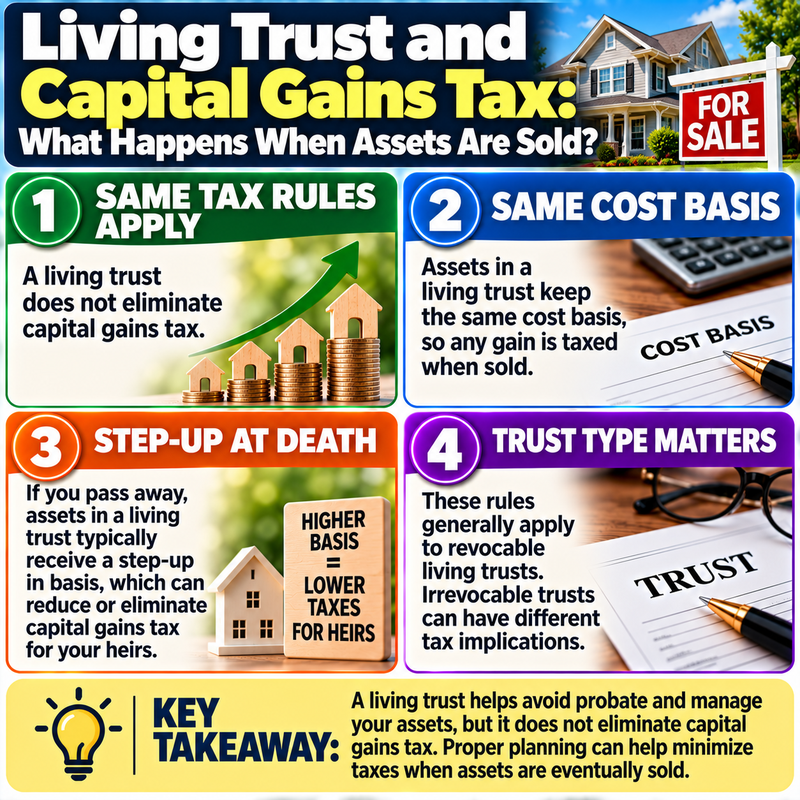

  • Living Trust and Capital Gains Tax: What Happens When Assets Are Sold?

    Living Trust and Capital Gains Tax: What Happens When Assets Are Sold?

    Living Trust Capital Gains Tax: How Asset Sales and Cost Basis Affect What You Owe

    Understand Grantor-Trust Treatment, Cost Basis, Sales During Life, and Why Tax Treatment Can Change After Death

    Key Takeaways

    • Selling property inside a revocable living trust usually doesn’t change your tax bill — the IRS treats you, the grantor, as the owner for income tax purposes.
    • Capital gains are calculated the same way whether an asset sits in your name or your revocable living trust: amount realized minus adjusted basis.
    • Everything shifts once the grantor dies — the trust becomes irrevocable, and questions about basis step-up, tax ID numbers, and who pays what get more complicated.
    • Not every asset in an irrevocable trust qualifies for a stepped-up basis at death, and the rules hinge on specific language in the trust document.
    • Working with a platform like Bulletproof Legacy can help you understand how your trust structure interacts with capital gains before you ever list a property for sale.

    Here’s the short version: if your living trust is revocable and you’re still alive, selling an appreciated asset inside it generally triggers the same capital gains tax you’d owe if you sold it in your own name. The trust itself doesn’t create a shield, a shelter, or a special discount. What changes the math isn’t the trust — it’s basis, timing, and what happens after you pass away.

    A lot of people assume that once property moves into a trust, the tax rules reset. They don’t. The IRS looks straight through most revocable trusts to the person who created them, and that person’s tax situation drives everything a trustee does. Resources like Bulletproof Legacy exist precisely because this distinction trips up so many trust owners who expect a bigger tax break than the law actually provides.

    Key Takeaways

    Before diving into the mechanics, it helps to see the big picture in one place. The bullet points above summarize what you need to know, but the details — especially what happens the moment a grantor dies — deserve a closer look.

    Living-Trust-Capital-Gains-Tax

    Quick Answer: Does Selling Trust Assets Trigger Capital Gains Tax?

    Yes, typically. If a trustee sells an appreciated asset while the trust is revocable and the grantor is alive, the gain is calculated and taxed just as if the grantor had sold it personally. The sale isn’t exempt simply because title sits with “John Smith, Trustee of the John Smith Revocable Living Trust” instead of “John Smith” alone.

    This surprises people because trusts sound like they belong to a separate legal universe. In some ways they do — they avoid probate, they can protect privacy, and they can direct how assets pass to heirs. But income tax treatment during the grantor’s lifetime isn’t one of those separate universes. The IRS collapses the trust and the grantor into a single taxpayer for income tax purposes.

    Why a Revocable Trust Is Treated as a Grantor Trust

    A revocable living trust almost always qualifies as what the IRS calls a “grantor trust.” That label matters because it determines who reports income, who claims deductions, and who pays tax on capital gains. Under grantor trust rules, the person who created the trust — and who typically retains the power to amend or revoke it — is treated as the owner of the trust’s assets for federal income tax purposes, even though the trust technically holds legal title.

    This isn’t a loophole or a workaround. It’s baked directly into how the revocable living trust structure functions. Because the grantor retains control — the power to change beneficiaries, swap assets, or dissolve the trust entirely — the IRS doesn’t see a meaningful separation between the person and the trust. That control is exactly why the tax code refuses to treat the trust as its own separate taxpayer while the grantor is alive.

    IRS Form 1041 Rules for Grantor Trusts

    Normally, a trust that earns income has to file Form 1041, the U.S. Income Tax Return for Estates and Trusts. Grantor trusts get an exception. Instead of filing a full 1041 with its own tax calculations, a revocable living trust can report all income, deductions, and gains directly on the grantor’s personal Form 1040, using a simplified reporting method. The trust doesn’t calculate its own tax; it simply passes everything through to the grantor’s return.

    Some trustees choose an alternate method where the trust files a 1041 but attaches a statement showing that all items pass through to the grantor. Either way, the end result is the same: one tax return, one taxpayer, no separate trust-level tax during the grantor’s life.

    Why Revocable Trusts Don’t Need Their Own Tax ID

    Here’s a detail that catches people off guard: a revocable living trust doesn’t need its own Employer Identification Number while the grantor is alive. It simply uses the grantor’s Social Security number for all banking, brokerage, and tax reporting purposes. Financial institutions sometimes ask for an EIN anyway, but legally, the trust is disregarded as a separate entity until something changes — usually the grantor’s death.

    This ties directly back to the grantor trust concept. If the IRS already treats you and your trust as one taxpayer, there’s no need for the trust to have its own identification number. It’s the same reason the trust doesn’t file its own tax return calculating its own liability — because for tax purposes, it isn’t really “its own” anything yet.

    Selling Trust Assets While the Grantor Is Still Alive

    So what actually happens when a trustee sells a house, a stock portfolio, or a business interest that’s titled in the name of a revocable trust? The transaction gets reported, the gain or loss gets calculated, and the tax consequences land on the grantor’s personal return — exactly as they would if the grantor had never created a trust at all.

    Real Estate Held in a Revocable Trust

    Many homeowners move their primary residence into a revocable living trust as part of estate planning, and that move alone doesn’t change anything about how a later sale gets taxed. If the trustee — often the grantor themselves, acting in that role — sells the house, the capital gain is calculated using the same rules that would apply to a personally-owned home. The sale price minus selling costs gives you the amount realized; subtract the adjusted basis, and you get the gain or loss.

    Where things can get specific is around available exclusions and deductions, since those depend heavily on how long the home was owned, how it was used, and other individual facts. That’s a conversation for a tax professional familiar with the grantor’s full situation rather than a blanket rule that applies to every trust-owned home.

    Stocks and Investment Accounts

    Brokerage accounts titled in the name of a revocable trust work the same way. When a trustee sells appreciated stock, mutual fund shares, or bonds, the resulting capital gain or loss flows to the grantor’s Form 1040 just as it would from a personal brokerage account. The holding period for determining short-term versus long-term capital gains treatment also carries over — moving an asset into the trust doesn’t restart that clock, because the trust isn’t treated as a new owner.

    Dividends, interest, and other investment income follow the same pass-through logic. None of it gets a special trust-level tax treatment during the grantor’s lifetime. It’s reported, taxed, and treated exactly as if the grantor held the account directly.

    Business Interests and Other Property

    The same grantor trust logic extends to LLC membership interests, rental properties, and other business assets that get transferred into a revocable trust for estate planning purposes. Depreciation schedules, passive activity loss rules, and any recapture provisions that would normally apply to the grantor personally continue to apply once the asset sits inside the trust. The trust doesn’t reset depreciation, and it doesn’t create a fresh basis.

    This matters a lot for rental real estate specifically, where years of depreciation deductions can create a gap between an asset’s purchase price and its current adjusted basis. That gap doesn’t disappear because a trustee, rather than an individual, signs the closing documents.

    Think of a revocable living trust less like a tax strategy and more like a legal wrapper. The set-up and ongoing costs of a living trust are a separate issue. The wrapper changes who holds title and how assets pass at death — it generally doesn’t change how capital gains get calculated or taxed while the grantor is alive.

    Free Trust Consultation Banner

    How Cost Basis Determines Your Capital Gain

    Every capital gains calculation starts in the same place: basis. Without understanding basis, it’s impossible to know whether a sale produces a gain, a loss, or something in between — regardless of whether a trust is involved.

    Calculating Adjusted Tax Basis

    Basis generally starts with what was paid for an asset, then gets adjusted over time. For real estate, adjustments might include the cost of capital improvements, which increase basis, or depreciation deductions claimed on rental property, which decrease it. For stocks, basis adjustments are less common but can include things like reinvested dividends that purchased additional shares.

    Once a trustee sells the asset, the amount realized — generally the sales price minus selling expenses like commissions and closing costs — gets compared to this adjusted basis. If the amount realized exceeds the adjusted basis, there’s a capital gain. If it’s lower, there’s a capital loss. This formula doesn’t change based on trust ownership; it’s the same calculation the IRS applies to any sale of property.

    How Depreciation Recapture Affects the Math

    Rental properties and other depreciable business assets add another layer: depreciation recapture. When a property has been depreciated over the years, some of that depreciation may need to be “recaptured” and taxed differently upon sale, rather than treated entirely as a standard capital gain. This applies whether the rental property sits in an individual’s name or inside a revocable living trust, because the trust doesn’t erase depreciation history or reset the clock on recapture rules.

    Trustees selling depreciated rental property should expect the same recapture considerations that would apply to a personal sale. The trust doesn’t offer an escape hatch from this particular tax consequence, and assuming otherwise can lead to an unpleasant surprise come tax season.

    Can You Still Claim the Primary-Residence Exclusion?

    Homeowners often wonder whether placing their house in a trust jeopardizes their ability to exclude gain on the sale of a primary residence. Generally, it doesn’t — but the details matter.

    The $250,000/$500,000 Exclusion Rule

    Under current tax rules, individuals may be able to exclude up to $250,000 of gain from the sale of a primary residence, while married couples filing jointly may be able to exclude up to $500,000, provided certain ownership and use tests are met. A few baseline conditions generally apply, and it’s important to understand how trusts impact capital gains tax.

    • The home must have been owned and used as the taxpayer’s main home for at least two of the five years before the sale.
    • The exclusion generally can’t be claimed more than once every two years.
    • Specific facts — like partial-year use, business use of part of the home, or prior exclusion claims — can affect eligibility and should be reviewed individually.

    These rules focus on how the home was owned and used, not on whether title technically sits with an individual or with that individual’s revocable trust. Because the trust is disregarded for income tax purposes during the grantor’s life, the ownership and use tests generally look through to the grantor’s actual history with the property.

    That said, eligibility can turn on specific facts — multiple residences, periods of rental use, or changes in marital status — that vary from household to household. This is exactly the kind of situation where generic advice stops being useful and a conversation with a tax professional who knows the full picture becomes essential.

    Why Trust Ownership Doesn’t Disqualify You

    The underlying principle is consistent: because a revocable living trust is a grantor trust, the law treats the grantor as if they personally owned and used the home, even though a trustee holds legal title. Moving a house into a revocable living trust for estate planning purposes — to avoid probate, for example — doesn’t by itself interrupt the ownership and use history that the exclusion rules are built around.

    Where people run into trouble is when they confuse revocable trusts with irrevocable ones, or when a trust holds a property for reasons beyond simple probate avoidance. Understanding the difference between a revocable and irrevocable trust structure becomes critical here, since irrevocable, non-grantor trusts don’t automatically get the same pass-through treatment.

    Free Consultation Banner 2

    Does Moving an Asset Into a Trust Trigger Capital Gains?

    This is one of the most common fears people have before funding their trust, and the good news is that it’s usually unfounded — with some caveats worth understanding.

    Why a Title Change Isn’t a Taxable Sale

    Transferring a house, brokerage account, or other asset from your own name into your revocable living trust is generally a change in legal title, not a sale to another taxpayer. Since the grantor and the grantor trust are treated as the same taxpayer for income tax purposes, there’s no “sale” happening in the eyes of the IRS — just a retitling. No capital gains tax typically gets triggered by this transfer alone, since you’re not selling the asset to anyone; you’re simply changing how it’s held.

    This doesn’t mean every conceivable transfer into every type of trust is automatically tax-free under all circumstances. The general rule applies cleanly to straightforward transfers into a standard revocable living trust. More complex situations — transfers involving partnerships, certain business entities, or irrevocable trusts — can raise separate questions that fall outside this simple framework.

    Hidden Costs: Mortgage, Transfer Tax, and Property Tax Issues

    While capital gains tax usually isn’t a concern when funding a trust, other costs can pop up that have nothing to do with income tax. Some mortgage lenders include due-on-sale clauses that technically get triggered by a title transfer, though federal law provides certain protections for transfers into a revocable trust by the borrower.

    Local transfer taxes or recording fees might apply depending on the state and county, even when no sale is occurring. Property tax reassessment is another area worth checking, since some states reassess property value upon any change in title — though many carve out exceptions for transfers into a grantor’s own revocable trust.

    None of these issues involve capital gains tax directly, but they’re worth flagging because they often get lumped together with “tax consequences of funding a trust” in people’s minds. Clearing up that confusion early — ideally with a local attorney or tax advisor — prevents unpleasant surprises during the trust funding process.

    What Changes the Moment the Grantor Dies

    Everything discussed so far assumes the grantor is alive and well. The moment that changes, so does the tax picture — sometimes dramatically. A revocable living trust that spent years functioning as a simple extension of the grantor’s own tax identity suddenly becomes something else entirely, and trustees who aren’t prepared for that shift often make costly mistakes in the months following a death.

    This transition catches a lot of successor trustees off guard, partly because nothing visibly changes about the trust document itself. The same trust that was disregarded for tax purposes yesterday is treated as a distinct taxpayer today, and that single fact ripples through everything from filing requirements to basis calculations.

    From Revocable to Irrevocable: The Legal Shift

    Once the grantor of a revocable living trust dies, the trust can no longer be changed, amended, or revoked by anyone. It automatically becomes irrevocable at that point, even if the trust document never uses that specific word. The successor trustee named in the trust steps into the role previously held by the grantor, but with far less flexibility than the grantor enjoyed.

    This shift matters because the grantor trust rules that governed income tax treatment during life no longer apply in the same way. The person whose Social Security number anchored every tax filing is gone, and the trust needs its own identity for IRS purposes going forward.

    Before death: One taxpayer, one tax return, no separate trust-level filing.
    After death: The trust becomes its own tax entity, often requiring a new tax ID number and its own federal filing obligations.

    Successor trustees sometimes assume they can keep operating exactly as the grantor did, using the same accounts and the same tax reporting habits. That assumption creates problems quickly, since the IRS now expects reporting under the trust’s own identity rather than the deceased grantor’s Social Security number.

    New Tax ID Numbers and Filing Requirements

    An irrevocable trust must obtain its own Employer Identification Number, separate from the grantor’s Social Security number. This isn’t optional paperwork — banks and brokerages will typically require it before allowing the successor trustee to manage accounts under the trust’s new status. Along with the new EIN comes the obligation to file Form 1041 if the trust generates income, something the trust was previously exempt from doing as a disregarded grantor trust.

    The Step-Up in Basis: What Gets Adjusted and What Doesn’t

    One of the most talked-about tax concepts in estate planning is the step-up in basis, and for good reason — it can meaningfully affect how much gain gets taxed when inherited property is eventually sold. But step-up rules aren’t automatic for every asset in every type of trust, and misunderstanding this point leads to some expensive surprises.

    Why Grantor Trust Status Matters for Step-Up Eligibility

    Generally speaking, assets included in a decedent’s estate for federal estate tax purposes may receive an adjustment to fair market value as of the date of death. For a standard revocable living trust, the assets are typically includible in the grantor’s estate because the grantor retained control over them during life — the same control that made it a grantor trust in the first place.

    • Assets held in a properly structured revocable living trust are generally included in the grantor’s taxable estate.
    • Estate inclusion is generally what triggers eligibility for a basis adjustment at death.
    • Irrevocable trusts don’t automatically get this treatment, since the whole point of many irrevocable structures is to remove assets from the taxable estate.
    • Whether specific rights were retained in the trust instrument can determine whether certain irrevocable trust assets still qualify for estate inclusion and basis adjustment.

    This is a critical distinction and one that trips up even experienced trustees. The basis step-up isn’t a blanket perk attached to the word “trust.” It’s tied specifically to whether the asset is pulled back into the decedent’s taxable estate, which depends heavily on the structure and language of the trust itself.

    Not every irrevocable trust loses this benefit, and not every revocable trust guarantees it for every asset under every circumstance. The specific facts of how a trust was drafted, what rights the grantor retained, and how assets were titled all play a role in determining the outcome.

    Because of this complexity, nobody should assume a basis step-up applies to a particular asset without reviewing the actual trust document and consulting with a tax professional. Generic assumptions about “trusts get a step-up” or “trusts don’t get a step-up” both miss the nuance that actually controls the outcome.

    IRC Section 2036 and Retained Life Estates Explained

    Internal Revenue Code Section 2036 deals with transfers of property where the person who made the transfer retained certain rights, like the right to use the property or receive income from it, for life. This provision matters because it can pull certain assets back into a decedent’s taxable estate even when those assets technically sit inside an irrevocable trust. If the reservation of such rights was specifically documented — often in the deed or trust instrument itself — the asset may be treated as part of the estate for tax purposes, which can affect basis step-up eligibility.

    When Irrevocable Trust Assets Miss Out on the Step-Up

    Assets held in an irrevocable trust typically won’t receive a basis step-up at death if those assets aren’t subject to federal estate tax inclusion. Since many irrevocable trusts are specifically designed to move assets outside the taxable estate — often for estate tax planning or asset protection purposes — that same design can mean beneficiaries inherit the original, lower basis rather than a stepped-up one.

    Consider a hypothetical: an irrevocable trust created in 2021 holds a piece of investment property, and the grantor passes away a few years later. Whether that property receives a stepped-up basis depends heavily on whether the grantor retained specific rights under the trust instrument — rights that could trigger inclusion under provisions like Section 2036. Without those retained rights properly documented, the property may carry over its original basis, meaning a sale by the trust or beneficiaries could result in a larger taxable gain than expected.

    When the Successor Trustee Sells Trust Property

    After the grantor’s death, the successor trustee often needs to sell trust assets — a house, an investment portfolio, a business interest — either to distribute proceeds to beneficiaries or to settle the estate’s affairs. This is where post-death basis rules and ongoing trust tax status intersect in ways that didn’t matter during the grantor’s lifetime.

    Unlike sales during the grantor’s life, which flowed straight through to the grantor’s personal return, sales after death may need to be reported on the trust’s own Form 1041, assuming the trust has become an irrevocable, separate taxpaying entity. The character of the gain, the basis used, and who ultimately bears the tax burden all depend on specific facts that shouldn’t be assumed without professional review.

    • Basis for the sale typically starts with whatever value was established at the grantor’s death (if a step-up applied) rather than the grantor’s original purchase price.
    • Any appreciation between the date of death and the date of sale may still generate a taxable gain, even if the step-up eliminated gain on appreciation that occurred during the grantor’s lifetime.
    • The trust document often dictates whether the trustee can sell outright or must distribute property in kind to beneficiaries first.

    Calculating Gain on Post-Death Sales

    If a step-up in basis applied, the trust’s basis in the asset resets to its fair market value as of the date of death (or an alternate valuation date, if elected and available). From that point forward, any sale by the trustee compares the sales price to this adjusted basis, just like the standard gain calculation discussed earlier. The difference is that the starting basis number has changed, which can significantly shrink — or in some cases eliminate — the taxable gain compared to what would have been owed using the grantor’s original purchase price.

    Who Reports the Sale: The Trust or the Beneficiaries?

    This depends on timing and trust structure. If the trustee sells the property and then distributes cash proceeds to beneficiaries, the trust itself typically reports the sale and any resulting gain on its own tax return. If, instead, the trustee distributes the property itself to beneficiaries before any sale occurs, the beneficiaries generally inherit the trust’s basis in that asset and report any gain when they personally sell it later.

    This distinction matters more than people realize. Trusts often face compressed tax brackets, meaning they hit the highest marginal tax rates at much lower income levels than individuals do. Depending on each beneficiary’s personal tax situation, it can sometimes make a meaningful difference whether a gain gets reported on the trust’s return or passed through to an individual beneficiary’s return instead.

    Free Consultation Banner 3

    Beneficiary Distributions vs. Asset Sales: Why It Matters

    The path an asset takes out of a trust — whether it’s sold first or distributed in kind — can shape the tax outcome for everyone involved. This is a detail worth discussing with the trustee and a tax advisor before major decisions get made.

    Receiving Property Directly From the Trust

    When beneficiaries receive property directly from a trust rather than cash from a sale, they typically take on the trust’s basis in that asset — which, following a step-up at the grantor’s death, is often the fair market value as of the date of death. This means the beneficiary isn’t necessarily facing a large built-in gain the moment they receive the property, assuming the step-up applied and little additional appreciation has occurred since death.

    Receiving property this way also gives beneficiaries control over timing. They can choose to sell immediately, hold for years, or do whatever fits their own financial plans, with gain or loss measured against their own inherited basis whenever they eventually do sell.

    Selling an Inherited Asset Later

    If a beneficiary holds onto inherited property for a while before selling, any appreciation that occurs after they receive it is treated as their own capital gain, calculated using the basis they received when the asset passed to them. The holding period for long-term versus short-term capital gains treatment generally resets based on specific inherited-property rules rather than how long the original grantor or the trust held the asset — though the exact mechanics can vary depending on individual circumstances and should be confirmed with a tax professional.

    How Irrevocable and Non-Grantor Trusts Are Taxed Differently

    Not every trust operates like a simple revocable living trust. Irrevocable, non-grantor trusts play by a completely different set of tax rules, and understanding this difference prevents a lot of confusion when comparing notes with someone whose estate plan uses a different trust structure.

    Separate Tax Returns and Compressed Tax Brackets

    Non-grantor irrevocable trusts are treated as separate taxpayers entirely, filing their own Form 1041 and paying tax at trust income tax rates rather than passing everything through to an individual’s personal return. These trust tax brackets compress much faster than individual brackets, meaning a trust can hit the top marginal rate with a relatively modest amount of income compared to what an individual would need to earn to reach that same top bracket.

    Why Trustees Often Distribute Income to Beneficiaries

    Because of these compressed brackets, trustees of irrevocable trusts frequently distribute taxable income out to beneficiaries rather than retaining it inside the trust. When income gets distributed, it typically shifts the tax liability to the beneficiary, who reports it on their own personal return and pays tax at their own individual rate — which is often lower than what the trust would owe on retained income. This strategy doesn’t eliminate taxes, but it can shift who pays them and at what rate, depending on each beneficiary’s overall tax situation.

    State Capital Gains and Income Tax Considerations

    Everything discussed so far focuses on federal tax treatment, but state taxes add another layer that varies enormously depending on where the trust, the grantor, or the beneficiaries are located. Some states impose their own capital gains or income taxes on trusts and individuals, while others have no state income tax at all.

    State rules around trust residency can get particularly tricky. A trust might be considered a resident of one state because that’s where it was created, while the trustee lives in a different state and beneficiaries live in yet another. Some states tax trusts based on the residency of the grantor, others based on the trustee’s location, and others based on where beneficiaries live — and a few states use some combination of all three factors.

    Given this complexity, nobody should assume their state follows the same rules as federal law, or that another state’s rules apply the same way to their own situation. Confirming the specific state tax treatment for a trust’s capital gains requires looking at that state’s particular statutes and, in many cases, consulting with a tax professional familiar with multi-state trust taxation.

    5 Tax-Planning Mistakes to Avoid With Trust Assets

    Most of the costly mistakes people make with trusts and capital gains come down to a handful of recurring misunderstandings. Catching these early — ideally before a sale happens rather than after — can save significant money and headaches.

    The five mistakes below tend to show up again and again, whether someone is managing their own revocable trust or stepping into the successor trustee role after a loved one’s death:

    1. Assuming all trust transfers are tax-free. Moving assets into a standard revocable living trust generally doesn’t trigger capital gains, but assuming this rule applies universally to every type of transfer, every type of trust, and every type of asset can lead to incorrect assumptions in more complex situations.
    2. Confusing estate inclusion with income taxation. Whether an asset is included in a taxable estate and whether a sale generates income tax are two separate questions governed by different code sections, and conflating them leads to faulty conclusions about step-up eligibility.
    3. Missing the deed language required for IRC 2036. When specific rights need to be retained to trigger estate inclusion under Section 2036, vague or missing language in the deed or trust instrument can mean an asset doesn’t get the basis step-up that was expected.
    4. Overlooking state-level tax rules. Federal rules get most of the attention, but state capital gains and trust residency rules can meaningfully change the actual tax bill, especially when trustees, grantors, and beneficiaries live in different states.
    5. Failing to update trust status after death. Continuing to operate a trust using the deceased grantor’s Social Security number, or failing to obtain a new EIN and file required returns, creates compliance problems that compound the longer they go unaddressed.

    1. Assuming All Trust Transfers Are Tax-Free

    The most common misstep happens before a sale ever takes place — it happens at the funding stage. People hear “no capital gains tax on transfers into a revocable trust” and assume that blanket rule covers every situation, every asset type, and every trust structure. That’s not accurate. The rule applies cleanly to a straightforward transfer of personally-owned property into your own revocable living trust. It gets murkier fast when partnerships, certain business entities, or irrevocable structures enter the picture, and assuming the same tax-free treatment applies there can lead to an unpleasant surprise.

    2. Confusing Estate Inclusion With Income Taxation

    These are two completely different tax questions governed by different parts of the tax code, yet people blend them together constantly. Whether an asset is included in a taxable estate determines things like basis step-up eligibility. Whether a sale generates income tax depends on amount realized versus adjusted basis. A trustee can get the estate inclusion question right and still botch the income tax reporting, or vice versa — treating them as interchangeable almost guarantees a mistake somewhere along the way.

    3. Missing the Deed Language Required for IRC 2036

    When a trust is structured to retain certain rights for the grantor — like a right to use property or receive income from it for life — that reservation needs to be spelled out specifically in the deed or trust instrument itself. Vague language, or language that doesn’t clearly reserve those rights, can mean an asset fails to qualify for inclusion under Section 2036 when the family was counting on it. This is a drafting detail, not a casual afterthought, and it’s exactly the kind of thing an estate planning attorney should review line by line.

    Trustees and beneficiaries sometimes only discover this problem after the grantor has died and it’s too late to fix the document. That’s why reviewing trust language with a professional before it’s needed — not after — matters so much.

    4. Overlooking State-Level Tax Rules

    Federal rules get all the attention in most conversations about trusts and capital gains, but state tax treatment can swing the actual bill significantly. Some states tax trusts based on where the trust was created, others base it on trustee residency, and others look at where beneficiaries live. A family with a trustee in one state, beneficiaries in another, and a trust document created in a third state could be looking at a genuinely complicated state tax picture that has nothing to do with federal rules at all.

    5. Failing to Update Trust Status After Death

    This mistake is purely administrative, but it causes real compliance headaches. Successor trustees who keep using the deceased grantor’s Social Security number, skip obtaining a new EIN, or forget to file Form 1041 when required are setting themselves up for problems with the IRS down the road. The fix is simple — get the new tax ID, understand the filing obligations, and treat the trust as the separate taxpayer it now legally is — but it has to happen promptly after death rather than months or years later.

    Frequently Asked Questions

    These are the questions that come up most often when people start digging into how their revocable living trust interacts with capital gains tax. Some have fairly simple answers; others depend heavily on individual facts that only a tax professional can properly evaluate.

    Use these as a starting point for your own questions, not as a substitute for personalized advice on your specific situation.

    Does putting my house in a living trust avoid capital gains tax?

    No, not by itself. Transferring your home into a revocable living trust generally doesn’t trigger capital gains tax, but it also doesn’t eliminate the gain that would otherwise be owed when the home is eventually sold. Since the trust is disregarded for income tax purposes during your lifetime, the sale gets taxed the same way it would if you owned the home in your own name.

    Any available exclusions, like the primary-residence exclusion, typically still apply based on your own ownership and use history, not based on whether title sits with you personally or with your trust.

    Who pays capital gains tax when a trust sells property?

    While the grantor is alive and the trust remains revocable, the grantor pays the tax, since all income and gains flow through to their personal return. After the grantor dies and the trust becomes irrevocable, the trust itself may owe the tax on its own Form 1041, or the tax may pass through to beneficiaries if income gets distributed to them during the same tax year.

    Does a revocable trust get a step-up in basis at death?

    Generally, yes — assets held in a standard revocable living trust are typically included in the grantor’s taxable estate, which is usually what triggers eligibility for a basis adjustment to fair market value as of the date of death. This isn’t automatic for every asset under every circumstance, so reviewing the specific trust document and consulting a tax professional is still worthwhile.

    What happens to capital gains tax after the grantor dies?

    The trust becomes irrevocable, needs its own tax ID number, and may need to start filing its own Form 1041. If a basis step-up applied to the trust’s assets, future sales by the successor trustee are measured against that new, adjusted basis rather than the grantor’s original purchase price.

    Any gain that accumulates between the date of death and the eventual sale date is still potentially taxable, even after a step-up has already eliminated gain on appreciation that happened during the grantor’s lifetime.

    Can beneficiaries avoid capital gains tax on inherited trust property?

    Beneficiaries don’t avoid capital gains tax entirely, but a basis step-up — when it applies — can significantly reduce the taxable gain compared to what would have been owed using the original owner’s purchase price. Once a beneficiary holds the inherited property, any further appreciation after they receive it is treated as their own gain, calculated against the basis they inherited.

    Does an irrevocable trust get a step-up in basis?

    It depends entirely on whether the trust’s assets are included in the grantor’s taxable estate. Many irrevocable trusts are specifically designed to remove assets from the estate, which generally means those assets won’t receive a basis step-up at death. Others retain certain rights for the grantor — like those addressed under IRC Section 2036 — that can pull the assets back into the estate and preserve step-up eligibility.

    Trust TypeEstate InclusionBasis Step-Up Likely?
    Revocable Living TrustTypically includedGenerally yes
    Irrevocable Trust (no retained rights)Typically excludedGenerally no
    Irrevocable Trust (retained rights under IRC 2036)May be includedDepends on documented rights

    This table is a simplified snapshot, not a substitute for reviewing an actual trust document. Whether you’re working with a straightforward revocable structure or something more complex, understanding the difference between a revocable and irrevocable trust is the first step toward knowing what to expect at tax time.

    Do I need a new tax ID number for my living trust?

    Not while you’re alive and the trust remains revocable — it uses your Social Security number. Once the trust becomes irrevocable, typically triggered by your death, the successor trustee generally needs to obtain a new EIN for the trust.

    How does IRC Section 2036 affect trust assets?

    Section 2036 can pull property back into a decedent’s taxable estate if the person who transferred it retained certain rights, such as the right to use the property or receive income from it for life. For this provision to apply, the reservation of those rights typically needs to be specifically documented, often in the deed or trust instrument itself. If you have questions about how this might affect taxes, you might find this trust capital gains tax question helpful.

    This matters most for irrevocable trusts, since estate inclusion under Section 2036 can determine whether assets end up qualifying for a basis step-up that might otherwise be unavailable.

    Can a successor trustee claim the home sale exclusion?

    This depends heavily on specific facts — whether the home was the grantor’s primary residence, how the basis was established after death, and how the sale is structured. Eligibility rules around ownership and use periods can get complicated once a death has occurred, and this is a question that really needs a tax professional’s review rather than a generic answer.

    Blanket assumptions here can be costly, since the exclusion rules weren’t originally written with post-death trust sales in mind and require careful application to that scenario.

    Is selling assets inside a trust different from selling them personally?

    During the grantor’s lifetime, no — a revocable trust sale is taxed identically to a personal sale because the trust is disregarded for income tax purposes. After the grantor’s death, yes — the trust may become its own separate taxpayer, with its own basis rules, its own filing requirements, and potentially its own tax rates that differ from what an individual would pay on the same transaction.

    During life: trust and grantor are one taxpayer. After death: the trust may stand alone, with its own basis, its own return, and its own tax consequences.

    Keeping that single distinction in mind resolves most of the confusion people have about trusts and capital gains tax.

    The Bottom Line on Trusts and Capital Gains Tax

    A revocable living trust doesn’t create a tax shelter, and it doesn’t make appreciated property magically tax-free when sold. While the grantor is alive, the IRS looks straight through the trust and taxes everything as if the grantor owned the assets personally — same basis rules, same exclusions, same depreciation recapture, same everything. The trust’s real value shows up elsewhere: avoiding probate, maintaining privacy, and providing a clear roadmap for what happens to assets after death.

    That roadmap gets more complicated the moment the grantor passes away. The trust shifts from a disregarded extension of one person into its own legal and tax entity, often needing a new EIN, new filing obligations, and a fresh look at whether a basis step-up applies to each asset it holds. Irrevocable trusts add another layer of complexity, since many are deliberately structured to stay outside the taxable estate — which can mean missing out on the step-up that revocable trust assets typically receive.

    None of this should discourage anyone from using a trust as part of their estate plan. It should encourage careful drafting, clear documentation of any retained rights, and realistic expectations about what the trust will and won’t do for taxes. A trust that’s well-drafted with professional guidance tends to avoid the costly surprises described throughout this article — vague deed language, missed EIN requirements, or assumptions about step-up eligibility that don’t hold up under IRS scrutiny.

    Every family’s situation involves its own mix of assets, state residency, and estate planning goals, which means generic rules can only take you so far before individualized advice becomes necessary. A qualified estate planning attorney or tax professional can review your specific trust document, your specific assets, and your specific state’s rules to confirm how capital gains tax will actually play out for your family.

    If you’re building or reviewing a living trust and want to understand exactly how your assets will be treated for tax purposes, Bulletproof Legacy can help you work through the planning questions before they turn into tax-season surprises.

  • Does a Living Trust Reduce Estate Taxes?

    Does a Living Trust Reduce Estate Taxes?

    Does a Living Trust Reduce Estate Taxes? Understanding What a Revocable Trust Can and Cannot Do

    Learn Why an Ordinary Revocable Trust Does Not Automatically Lower Estate Tax—and Which Estate-Tax Concepts May Still Matter

    Article-at-a-Glance

    • A living trust alone won’t lower your federal estate tax bill. Because you keep full control over a revocable trust, the IRS still counts those assets as yours when you die.
    • Federal estate tax only applies above a large exclusion threshold, so most families never owe a dime, even without fancy planning.
    • Some irrevocable trust structures can remove assets from your taxable estate, but the word “irrevocable” alone doesn’t guarantee tax savings.
    • State estate and inheritance taxes often kick in at much lower thresholds than the federal exemption, so location matters as much as trust type.
    • Curious which trust structures actually move the needle on taxes versus which ones simply skip probate? We’ll break down the difference section by section, and tools like Create A Living Trust can help you sort through the paperwork once you know which direction fits your goals.

    Does a living trust reduce estate taxes? For the ordinary revocable living trust that most families set up, the answer is no. Placing your house, bank accounts, and investments into a standard revocable trust does not shrink your taxable estate, because you still legally control everything inside it. Revocable living trust taxes are a different subject and have several variables to consider.

    That surprises a lot of people, since trusts get marketed as an all-purpose estate planning fix. They’re fantastic for skipping probate court and keeping your affairs private. But tax reduction is a different job, one that requires different tools entirely. Services like Create A Living Trust can walk you through setting one up correctly, though the trust itself still won’t change what the IRS counts as yours.

    Does-A-Living-Trust-Reduce-Estate-Taxes

    Short Answer: No, Not By Itself

    A garden-variety revocable living trust does not remove assets from your taxable estate. You created it, you can amend it, you can revoke it, and you can pull assets back out whenever you want. That flexibility is exactly why the IRS treats trust assets as if they never left your name. Although, some trusts have an EIN, depending on certain variables.

    Why Revocability Means You Still Own It

    Think of a revocable living trust like a folder you keep in your own filing cabinet. You put your house deed in the folder, but you still own the house. You can take the deed back out any time you want. The IRS looks at trusts the same way: if you can undo it, you still own what’s inside.

    This isn’t a loophole or an oversight. It’s baked into how estate tax law defines ownership. The difference between revocable and irrevocable trusts comes down to exactly this kind of control, and that distinction drives almost every tax consequence that follows.

    Your Right to Change or Cancel the Trust

    With a revocable living trust, you typically serve as trustee and beneficiary while you’re alive. You can add assets, remove them, change beneficiaries, or cancel the whole arrangement. That level of authority is precisely what keeps the trust’s contents inside your taxable estate.

    Why the IRS Treats Retained Control as Ownership

    Estate tax law focuses on control and economic benefit, not just titles on paper. If you retain the power to change who benefits from an asset or to reclaim it for yourself, the law treats you as the owner at death. Retitling your home or investment account into a revocable trust changes the paperwork trail for probate purposes, but it doesn’t sever your ownership rights in the eyes of the tax code.

    This is why estate planning attorneys draw such a sharp line between “avoiding probate” and “avoiding estate tax.” They solve different problems, and confusing the two leads to some expensive surprises down the road.

    Federal Estate Tax Basics You Need to Know

    Federal estate tax operates on what’s called a unified system, meaning gifts you make during life and assets you leave at death share the same overall exemption. Every dollar you give away during your lifetime above the annual gift exclusion chips away at the same bucket you’d otherwise use at death.

    The good news: that bucket is large. Current IRS guidance for 2026 lists a basic exclusion amount of $15,000,000 per individual, though this figure is indexed for inflation and subject to legislative change, so it’s worth confirming the current figure before relying on it for your own planning.

    Because the exclusion sits so high, the overwhelming majority of American households never come close to owing federal estate tax. The tax exists to target very large estates, not the typical family home and retirement account.

    Gross Estate vs. Taxable Estate

    Your gross estate includes everything you own or control at death: real estate, bank accounts, retirement plans, life insurance you own, and yes, assets sitting in a revocable trust. From that gross estate, certain deductions apply, such as debts, funeral costs, and the marital deduction for assets passing to a surviving spouse.

    • Gross estate: the full inventory of what you owned or controlled at death
    • Deductions: debts, administrative expenses, and qualifying marital or charitable transfers
    • Taxable estate: what’s left after deductions, compared against the exclusion amount

    Only the amount exceeding your available exclusion gets taxed, and even then, the rate structure and specific calculations depend on current law at the time of death.

    Current Federal Exclusion Amount and Why It Keeps Changing

    Congress has adjusted the federal exclusion amount repeatedly over the past two decades, and inflation indexing means the number shifts annually even without new legislation. Because tax law can change through new statutes, sunset provisions, or regulatory updates, anyone doing serious estate planning should verify the current year’s figure rather than relying on last year’s number.

    Portability Between Spouses, Explained Simply

    Portability lets a surviving spouse use their deceased spouse’s unused exclusion amount, effectively doubling the exemption available to the couple. But portability isn’t automatic. It requires filing an estate tax return and making a proper election, even if no tax is owed on the first spouse’s death. Skipping that filing step can mean losing access to the unused exemption entirely.

    Free Trust Consultation Banner

    Why Retitling Assets Into a Revocable Trust Doesn’t Cut Your Tax Bill

    Funding a revocable trust means moving legal title of your assets to the trustee, who might be you, acting on behalf of the trust. On paper, your house now says “Smith Family Trust” instead of “John Smith.” But since you control that trust completely, the IRS treats the underlying ownership as unchanged.

    This distinction trips people up because a living trust genuinely does accomplish several valuable goals. It just doesn’t accomplish tax reduction through the revocable structure alone.

    What Actually Happens to Your Assets When You Fund a Trust

    When you fund a revocable trust, you’re essentially renaming the owner of each asset from yourself individually to yourself as trustee. Your Social Security number still applies to the accounts for tax reporting purposes during your lifetime. Income the trust generates gets reported on your personal tax return, exactly as it would if you’d never created the trust at all.

    The Difference Between Avoiding Probate and Avoiding Taxes

    Probate avoidance and tax avoidance solve entirely separate problems. Probate is the court process that validates a will and oversees asset distribution; a funded revocable trust sidesteps that process because the trust, not your individual name, already owns the assets. Estate tax, on the other hand, cares about who has economic control over an asset, regardless of whether that asset passes through probate or not.

    You can have a beautifully funded trust that completely avoids probate court and still owes estate tax on everything inside it, if your estate exceeds the exclusion amount. The two concepts simply don’t overlap the way many people assume.

    State Estate and Inheritance Taxes Can Still Apply

    Federal exemption thresholds get most of the attention, but state-level taxes operate under completely separate rules, and several states set their thresholds dramatically lower than the federal amount. A trust that has no impact on federal estate tax might also have no impact on state estate tax, depending on how that particular state defines taxable ownership.

    States With Their Own Estate Tax

    A handful of states impose their own estate tax, calculated on the value of the decedent’s estate before distribution to heirs. These state exemption amounts frequently sit well below the federal threshold, meaning a family could owe state estate tax while owing nothing at all federally. The specific states and thresholds shift periodically, so checking current state law is essential rather than assuming national exemption figures apply everywhere.

    States With Inheritance Tax Instead

    Other states skip estate tax altogether and instead impose inheritance tax, which works differently: it’s calculated based on what each individual beneficiary receives, not on the estate as a whole. Rates often vary depending on the beneficiary’s relationship to the deceased, with spouses and children typically taxed at lower rates (or exempted entirely) compared to more distant relatives or unrelated beneficiaries.

    Some states have no separate estate or inheritance tax whatsoever, relying solely on the federal system. California falls into this category, for example, which is one reason state residency plays such a significant role in overall estate tax exposure.

    Because state rules vary so widely and change periodically, anyone with meaningful assets should check current thresholds for their specific state rather than assuming federal figures tell the whole story.

    Married Couples: Why Old-Style Trust Formulas May Backfire Now

    Before portability existed, married couples relied heavily on a planning technique often called a bypass trust, or sometimes an A/B trust arrangement. The first spouse to die would fund an irrevocable trust with assets up to the exclusion amount, sheltering that value from estate tax at the second spouse’s death. It worked well under the old rules, but the legal landscape has shifted considerably since portability became available.

    Bypass Trusts and Why They Made Sense Before Portability

    Before portability, a surviving spouse couldn’t simply inherit the deceased spouse’s unused exemption amount. If the first spouse died without using their exclusion, that amount was lost forever unless it had been captured through a bypass trust structure. Attorneys built entire estate plans around this mechanic, and for large estates at the time, it made complete sense.

    When It’s Time to Update an Outdated A/B Trust Plan

    Now that portability allows a surviving spouse to claim the deceased spouse’s unused exclusion (provided the proper election gets filed on a timely estate tax return), some older bypass trust plans create more complexity than benefit. Families with these older documents should have them reviewed periodically, especially if:

    • The original documents were drafted more than ten years ago, before portability rules solidified
    • The couple’s combined estate has grown or shrunk significantly since the plan was created
    • State estate tax laws in their residence state have changed or didn’t exist when the plan was drafted
    • One spouse has since passed away and the portability election was never filed

    Revocable Trusts vs. Irrevocable Trusts for Tax Planning

    Understanding the practical difference between revocable and irrevocable trusts clears up most of the confusion around estate tax planning. The core distinction isn’t complicated: control determines tax treatment. Give up control completely and permanently, and you may remove an asset from your taxable estate. Retain any meaningful control, and the asset generally stays in your estate for tax purposes.

    What a Revocable Trust Can and Can’t Do

    A revocable trust excels at avoiding probate, maintaining privacy, and providing a smooth mechanism for asset management if you become incapacitated. What it can’t do, by design, is remove assets from your taxable estate, precisely because you retain the power to revoke it at any moment.

    How Certain Irrevocable Trusts Can Remove Assets From Your Estate

    Specialized irrevocable trusts work differently because you give up specific rights permanently when you create them. An irrevocable life insurance trust, for example, owns a life insurance policy through the trust itself rather than through you personally, which keeps the death benefit outside your taxable estate. A qualified personal residence trust transfers your home into an irrevocable structure at a reduced gift value, based on your retained right to live there for a set term, ultimately shrinking the taxable value passed to your beneficiaries.

    Charitable remainder trusts follow a similar logic: you donate assets irrevocably, receive income for a term or for life, and the remainder eventually goes to charity, generating both an immediate charitable deduction and a reduction in your taxable estate. Each of these structures accomplishes tax objectives through permanent, well-defined transfers of control, not just through the label “irrevocable.”

    Why “Irrevocable” Doesn’t Automatically Mean “Tax-Free”

    Here’s where people get tripped up: not every irrevocable trust removes assets from your taxable estate. If the trust terms allow you to retain certain powers, such as the right to change beneficiaries or to benefit from trust income beyond narrowly defined limits, the IRS may still include those assets in your estate despite the “irrevocable” label on the document.

    Tax results depend heavily on the specific terms, retained powers, and how the trust gets drafted and administered. This is precisely why generic templates or DIY irrevocable trust documents can backfire. A structure intended to remove assets from an estate, drafted incorrectly, can fail to accomplish that one job while still locking you out of the flexibility a revocable trust would have offered.

    Free Consultation Banner 2

    Lifetime Gifts and the Unified Tax System

    Federal gift tax and estate tax share a single unified system, meaning the exclusion you use during your lifetime through gifting directly reduces what’s available at death. Think of it as one large bucket of exemption that gets depleted by both lifetime gifts above the annual exclusion and your eventual taxable estate.

    Annual Gift Exclusion vs. Lifetime Exemption

    Two separate numbers matter here, and mixing them up causes confusion. The annual gift exclusion lets you give a certain amount per recipient each year without touching your lifetime exemption at all. The lifetime exemption is the much larger unified amount that covers both gifts exceeding the annual exclusion and, eventually, your taxable estate at death.

    Quick distinction: The annual exclusion resets every calendar year and applies per gift recipient. The lifetime exemption is a single running total across your entire life, shared between gifts and your estate at death.

    Because these figures adjust periodically for inflation, and because tax legislation can change them outright, verifying current-year numbers before making significant gifts is essential rather than optional.

    How Gifting Now Affects Your Estate Later

    Gifts made during your lifetime, particularly those exceeding the annual exclusion amount, reduce the exemption available to your estate at death. This creates genuine planning opportunities for people with substantial assets, since transferring wealth earlier can remove future appreciation from the taxable estate entirely. A gift made today locks in today’s value, while any growth that asset experiences afterward benefits the recipient, not your taxable estate.

    That said, gifting strategies carry their own complexity around valuation, timing, and reporting requirements. They’re not a simple substitute for comprehensive estate planning, and they interact with trust structures in ways that benefit from professional guidance rather than guesswork.

    5 Common Myths About Living Trusts and Taxes

    Misunderstandings about trusts and taxes tend to repeat themselves across families and generations, often because outdated advice gets passed down without anyone checking whether it still applies. Here are the five myths that come up most often.

    Myth 1: A Living Trust Automatically Lowers Estate Taxes

    Reality check: A standard revocable living trust does not reduce federal estate tax by itself, because the grantor retains full control over the trust’s assets.

    This myth persists partly because trusts genuinely do accomplish other valuable goals, like probate avoidance and incapacity planning, which people sometimes conflate with tax savings. The confusion is understandable, but the distinction matters enormously when you’re deciding how to structure your estate.

    If tax reduction is your primary goal, a revocable trust alone won’t get you there. You’d need to look at irrevocable structures, gifting strategies, or other tools specifically designed for that purpose.

    None of this diminishes the value of a revocable trust for the majority of families. Most households never approach the federal exclusion threshold anyway, making probate avoidance and incapacity planning the more relevant benefits in the first place.

    Myth 2: Irrevocable Always Means Outside Your Estate

    As covered earlier, the word “irrevocable” describes your inability to change or cancel the trust, not automatically its tax treatment. Poorly drafted irrevocable trusts, or those where you retain too much control, can still end up included in your taxable estate.

    Proper drafting, with specific attention to retained powers and beneficiary designations, determines whether an irrevocable trust actually accomplishes its tax-reduction goal.

    Myth 3: Trusts Eliminate All Income Tax on Assets

    Assets held in a revocable trust generate income that flows directly to your personal tax return during your lifetime, exactly as it would without the trust. The trust itself doesn’t create a separate taxable entity while it remains revocable and you’re alive. Even many irrevocable trusts still generate income tax obligations, whether at the trust level or passed through to beneficiaries, depending on how the trust is structured.

    Myth 4: Every State Follows the Same Federal Exemption

    States set their own rules entirely separate from the federal system. Some states impose no estate or inheritance tax whatsoever, while others apply thresholds well below the federal exclusion amount, catching estates that owe nothing federally but still face a state tax bill.

    This creates situations where residency, or where you own real property, matters just as much as the total value of your estate. Moving to a different state, or owning vacation property in one with its own estate tax, can change your overall tax exposure even if your federal situation stays identical.

    • Check your home state’s current estate and inheritance tax thresholds
    • Check the rules in any state where you own real property, since some states tax non-residents on property located within their borders
    • Revisit state tax exposure whenever you relocate permanently

    Myth 5: One Trust Document Works for Every Family

    Trust requirements and effectiveness vary by state law, family structure, and asset composition. A trust drafted for a family in one state, with a particular mix of assets and beneficiaries, may not translate cleanly to a different family’s circumstances, even within the same state.

    Capacity requirements, trustee qualifications, and beneficiary rules all shift depending on jurisdiction and individual circumstances, which is exactly why generic templates carry real risk. A document that technically satisfies legal requirements for creation doesn’t necessarily accomplish the specific tax or asset-protection goals a particular family needs.

    When You Should Talk to an Estate Tax Professional

    Most families don’t need to lose sleep over federal estate tax, given how high the current exclusion sits. But certain situations warrant a closer look with a qualified professional before assuming a basic living trust covers everything.

    Signs Your Estate May Owe Federal or State Tax

    Consider a professional consultation if your combined household assets, including life insurance death benefits, retirement accounts, real estate, and business interests, approach or exceed your state’s estate tax threshold, even if you’re comfortably under the federal exclusion. Business owners, real estate investors, and anyone holding significant life insurance policies should also verify how those assets get valued and counted, since the numbers can add up faster than expected.

    What an Elder Law or Estate Planning Attorney Actually Does

    A qualified attorney analyzes your full asset picture, designs trust structures suited to your specific goals, prepares the legal documents correctly, and coordinates with your financial advisor on timing and valuation questions. This coordination matters because tax law changes, and a plan that made sense five years ago may need adjustment today. Working with someone who stays current on both federal and state rules protects you from the kind of outdated assumptions that cause the myths covered above.

    Bottom Line: Match the Tool to the Goal

    A living trust remains one of the most useful estate planning tools available, just not for the job of reducing estate taxes on its own. Match your specific goal, whether that’s probate avoidance, incapacity planning, or genuine tax reduction, to the right tool, and you’ll avoid the costly mistake of assuming one document does everything.

    Free Consultation Banner 3

    Frequently Asked Questions

    Does putting my house in a living trust avoid estate tax?

    No. Putting your house into a revocable living trust changes the legal title but keeps the property in your taxable estate, since you retain full control over the trust.

    What’s the difference between a revocable and irrevocable trust for tax purposes?

    A revocable trust can be changed or canceled by you, which means the IRS still counts its assets as yours. An irrevocable trust permanently transfers control, which can, depending on how it’s drafted, remove assets from your taxable estate.

    Do I still pay income tax on assets held in my living trust?

    Yes. Income generated by assets in a revocable trust flows to your personal tax return during your lifetime, exactly as it would without the trust.

    Can a living trust help my heirs avoid inheritance tax?

    A revocable trust generally doesn’t avoid inheritance tax, since state inheritance tax rules typically look at what beneficiaries receive, regardless of whether it passed through a trust or an estate.

    What is the current federal estate tax exemption?

    Current IRS guidance lists a basic exclusion amount for 2026, but exemption figures are indexed for inflation and subject to change, so confirm the exact current-year number before relying on it for planning purposes.

    What happens if my state has its own estate tax?

    Some states impose estate or inheritance tax with thresholds lower than the federal exemption, meaning you could owe state tax even if you owe nothing federally. Check your specific state’s current rules.

    How does portability work for married couples?

    Portability lets a surviving spouse use a deceased spouse’s unused federal exclusion, but only if a proper election gets filed on a timely estate tax return. It isn’t automatic.

    Is an ILIT the same thing as a living trust?

    No. An irrevocable life insurance trust (ILIT) is a specialized irrevocable structure designed to hold a life insurance policy outside your taxable estate, distinct from an ordinary revocable living trust.

    Can I convert my revocable trust to an irrevocable one later?

    Generally, a revocable trust becomes irrevocable at your death, or you can create a separate irrevocable trust during your lifetime for specific tax planning goals. Converting an existing revocable trust’s terms requires careful legal drafting and depends on state law.

    Do I need an attorney to reduce estate taxes with a trust?

    For genuine tax reduction strategies involving irrevocable trusts, gifting, or complex asset structures, working with a qualified estate planning or elder law attorney helps ensure the structure actually accomplishes its intended goal under current law.

    For help organizing the trust and probate-avoidance side of your plan, Create A Living Trust offers resources to simplify the document creation process so you can focus your professional consultations on the tax strategy questions that actually need one.

    When You Should Talk to an Estate Tax Professional

    Most families don’t need to lose sleep over federal estate tax, given how high the current exclusion sits. But certain situations warrant a closer look with a qualified professional before assuming a basic living trust covers everything.

    Waiting until a health crisis or a major life event forces the issue rarely produces the cleanest results. The families who fare best tend to review their plan periodically, long before any of these triggers become urgent.

    Signs Your Estate May Owe Federal or State Tax

    Consider a professional consultation if your combined household assets, including life insurance death benefits, retirement accounts, real estate, and business interests, approach or exceed your state’s estate tax threshold, even if you’re comfortably under the federal exclusion. Business owners, real estate investors, and anyone holding significant life insurance policies should also verify how those assets get valued and counted, since the numbers can add up faster than expected.

    What an Elder Law or Estate Planning Attorney Actually Does

    A qualified attorney analyzes your full asset picture, designs trust structures suited to your specific goals, prepares the legal documents correctly, and coordinates with your financial advisor on timing and valuation questions. This coordination matters because tax law changes, and a plan that made sense five years ago may need adjustment today. Working with someone who stays current on both federal and state rules protects you from the kind of outdated assumptions that cause the myths covered earlier in this guide.

    Bottom Line: Match the Tool to the Goal

    A living trust remains one of the most useful estate planning tools available, just not for the job of reducing estate taxes on its own. If your goal is avoiding probate, planning for incapacity, or keeping your affairs private, a revocable trust does exactly what it’s designed to do.

    Match your specific goal, whether that’s probate avoidance, incapacity planning, or genuine tax reduction, to the right tool, and you’ll avoid the costly mistake of assuming one document does everything.

    Frequently Asked Questions

    These quick answers cover the questions that come up most often once families understand the basic distinction between probate planning and tax planning.

    Does putting my house in a living trust avoid estate tax?

    No. Putting your house into a revocable living trust changes the legal title but keeps the property in your taxable estate, since you retain full control over the trust.

    What’s the difference between a revocable and irrevocable trust for tax purposes?

    A revocable trust can be changed or canceled by you, which means the IRS still counts its assets as yours. An irrevocable trust permanently transfers control, which can, depending on how it’s drafted, remove assets from your taxable estate.

    The distinction between revocable and irrevocable trusts comes down almost entirely to how much control you’re willing to give up, and for how long.

    Do I still pay income tax on assets held in my living trust?

    Yes. Income generated by assets in a revocable trust flows to your personal tax return during your lifetime, exactly as it would without the trust.

    Can a living trust help my heirs avoid inheritance tax?

    A revocable trust generally doesn’t avoid inheritance tax, since state inheritance tax rules typically look at what beneficiaries receive, regardless of whether it passed through a trust or an estate. Some irrevocable structures may affect inheritance tax outcomes, but that depends entirely on the specific state’s rules and how the trust is drafted.

    What is the current federal estate tax exemption?

    Current IRS guidance lists a basic exclusion amount for 2026, but exemption figures are indexed for inflation and subject to legislative change, so confirm the exact current-year number before relying on it for planning purposes.

    Because this figure shifts so frequently, checking the latest IRS guidance or consulting an estate planning professional before making major decisions is always the safer route.

    What happens if my state has its own estate tax?

    Some states impose estate or inheritance tax with thresholds lower than the federal exemption, meaning you could owe state tax even if you owe nothing federally. Check your specific state’s current rules, since thresholds and structures vary considerably from one state to the next.

    How does portability work for married couples?

    Portability lets a surviving spouse use a deceased spouse’s unused federal exclusion, but only if a proper election gets filed on a timely estate tax return. It isn’t automatic, and missing the filing window can mean losing access to that unused exemption entirely.

    Is an ILIT the same thing as a living trust?

    No. An irrevocable life insurance trust (ILIT) is a specialized irrevocable structure designed to hold a life insurance policy outside your taxable estate, distinct from an ordinary revocable living trust.

    While both are technically trusts, they serve very different functions and carry very different tax consequences.

    Can I convert my revocable trust to an irrevocable one later?

    Generally, a revocable trust becomes irrevocable at your death, or you can create a separate irrevocable trust during your lifetime for specific tax planning goals. Converting an existing revocable trust’s terms requires careful legal drafting and depends on state law.

    Some states allow a process called decanting, where assets from an existing trust get transferred into a new trust with updated terms. Whether that option works for your situation depends heavily on your state’s specific trust statutes.

    Because this area involves real legal complexity, it’s worth a direct conversation with an attorney rather than attempting a DIY conversion.

    Do I need an attorney to reduce estate taxes with a trust?

    For genuine tax reduction strategies involving irrevocable trusts, gifting, or complex asset structures, working with a qualified estate planning or elder law attorney helps ensure the structure actually accomplishes its intended goal under current law.

    Poorly drafted irrevocable trusts can fail to remove assets from your estate while still locking you out of the flexibility a revocable trust offers, so getting the drafting right matters as much as choosing the right type of trust in the first place.

    A professional can also coordinate your trust strategy with gifting plans, life insurance ownership, and portability elections, so nothing falls through the cracks between different parts of your overall plan.

    For help organizing the trust and probate-avoidance side of your plan, Create A Living Trust offers resources to simplify the document creation process, so you can focus your professional consultations on the tax strategy questions that actually need one.

  • Do You Pay Taxes on a Living Trust? Income, Estate, and Inheritance Taxes Explained

    Do You Pay Taxes on a Living Trust? Income, Estate, and Inheritance Taxes Explained

    Do You Pay Taxes on a Living Trust? Income, Estate, Capital Gains, and Inheritance Tax Basics

    Understand Income Tax During Life, What Changes After Death, and How Estate and Inheritance Taxes Fit Into the Picture

    Key Takeaways

    • A revocable living trust is generally treated as a grantor trust for federal income tax purposes while you’re alive, meaning you report the income on your own return, not a separate trust return.
    • An ordinary revocable trust does not automatically remove assets from your taxable estate, so it isn’t a built-in estate tax shelter the way some people assume.
    • Federal law has no inheritance tax, but several states impose their own inheritance or state estate taxes with very different rules and thresholds.
    • Tax treatment can shift significantly after death, when a trust may need its own EIN and start filing fiduciary income tax returns.
    • Working with professionals who understand both estate planning and tax law, resources organizations like Bulletproof Legacy help connect people to, can make it easier to sort out which rules actually apply to your situation later in this article.
    Living-Trust-Cost-For-Married-Couple

    Setting up a living trust often comes with a nagging question: will this thing create a tax headache I didn’t have before? The short answer is that a properly drafted revocable living trust usually doesn’t change your day-to-day income tax picture while you’re alive, but the full story involves several different tax systems working independently of each other.

    Groups like Bulletproof Legacy exist precisely because these distinctions confuse so many families, and getting connected with the right legal or tax professional early on can prevent costly misunderstandings down the road. This article breaks the topic into the five tax categories people usually mix up: income tax, estate tax, inheritance tax, capital gains tax, and gift tax, so you know exactly which rule applies at which stage of your trust’s life.

    Quick Answer: A Trust Does Not Create One Single “Trust Tax”

    There’s no single “living trust tax” waiting to surprise you. Instead, a living trust interacts with several separate tax systems, and each one has its own rules, its own triggers, and its own timing. Federal income tax works one way while you’re alive and often a different way after you die. Estate tax and inheritance tax are entirely separate concepts, even though people use the terms interchangeably. Capital gains tax and gift tax add two more layers that depend on what you put into the trust and when.

    Federal Income Tax During the Grantor’s Lifetime

    While you’re alive and the trust remains revocable, the IRS generally treats your revocable living trust as a grantor trust. That classification comes straight from how IRS Form 1041 instructions define these arrangements, and it’s the single most important tax fact to understand about living trusts.

    Being a grantor trust means the trust itself is essentially invisible to the IRS for income tax purposes. The income, deductions, and credits generated by trust assets are treated as belonging directly to you, the grantor, rather than to some separate legal taxpayer. In practical terms, if your trust owns a rental property or a brokerage account, the rent and dividends flow onto your personal tax return exactly as they would if you’d never created the trust at all.

    Revocable Trusts and Grantor-Trust Treatment

    Grantor trust status isn’t automatic magic that happens because the word “trust” appears on the paperwork. It happens because you, as grantor, retain specific powers over the trust. The most common one is simply the power to revoke or amend the trust yourself, which is exactly what makes a trust “revocable” in the first place.

    Other powers that trigger grantor trust treatment include the ability to swap trust assets for equivalent value, the ability to borrow trust assets without adequate security, the possibility that you or your spouse could receive distributions from the trust, or trust income being used to pay premiums on a life insurance policy covering you or your spouse.

    This is one of the clearest lines separating a revocable arrangement from an irrevocable one. If you’re weighing the differences, comparing a revocable vs. irrevocable trust structure side by side can clarify why irrevocable trusts sometimes file their own returns and pay their own taxes, while revocable ones typically don’t.

    How Income Is Generally Reported

    Because a grantor trust’s income belongs to you for tax purposes, the paperwork stays relatively simple. A grantor trust may use your own Social Security number as its taxpayer identification number, in which case it doesn’t need to file its own income tax return at all. Banks, brokerages, and other payers simply issue 1099s and other tax documents in your name, and you report everything on your usual Form 1040 as if the trust didn’t exist.

    If the trust instead has its own separate taxpayer identification number, it may need to file a return for informational purposes only. This is often called a pro forma tax return. It identifies the trust as a grantor trust and includes a grantor trust letter listing every income item that ultimately gets reported on your individual return. Either way, the tax liability lands with you, not with the trust as a separate entity.

    Free Trust Consultation Banner

    Does the Trust Itself Pay Income Tax During Life?

    Generally, no, an ordinary revocable living trust doesn’t pay its own income tax while the grantor is alive and the trust remains revocable. That said, whether any trust pays its own taxes depends on how it’s classified, and not every trust works the same way.

    Grantor Trusts vs. Simple and Complex Trusts

    Trusts generally fall into three tax categories, and knowing which one applies changes everything about how taxes get handled:

    • Grantor trusts do not pay their own taxes. The grantor pays taxes on the trust’s income directly, which is the category most revocable living trusts fall into during the grantor’s lifetime.
    • Simple trusts require all income to be distributed at least annually, have no charitable beneficiaries, and don’t distribute principal. Simple trusts pay their own income taxes on anything not distributed.
    • Complex trusts are trusts that don’t meet the simple trust definition and aren’t grantor trusts. Like simple trusts, complex trusts pay their own income taxes.

    A living trust typically starts life as a grantor trust. It may later convert into a simple or complex trust, most commonly after the grantor’s death, once the powers that created grantor status no longer exist.

    When a Trust Needs Its Own Tax Return

    A trustee generally must file Form 1041 if the trust is a simple trust or complex trust and has taxable income, or gross income of $600 or more. Grantor trusts are the exception to this rule in most cases, since their income is reported by the grantor personally rather than by the trust. This distinction matters because families sometimes assume every trust needs its own annual tax filing, when in reality an ordinary revocable trust usually doesn’t add a new filing obligation while the grantor is alive.

    What Changes After the Grantor Dies

    Everything discussed so far assumes the grantor is alive and the trust remains revocable. Death changes the equation. Tax treatment can shift substantially once the person who created the trust passes away, because the very features that made the trust a grantor trust, namely your ongoing control over it, disappear the moment you’re gone.

    Depending on how the trust is drafted, it may become irrevocable at death, or it may split into sub-trusts for a surviving spouse and other beneficiaries. Either way, the trust often stops being invisible to the IRS and starts operating as its own taxpayer.

    EIN and Fiduciary-Return Considerations

    One of the first practical steps after a grantor’s death is usually obtaining a new Employer Identification Number for the trust, since it can no longer rely on the deceased grantor’s Social Security number. Once the trust has its own EIN and is no longer classified as a grantor trust, it typically takes on fiduciary income tax reporting obligations, meaning the trustee may need to file Form 1041 going forward, similar to how a simple or complex trust operates.

    This is often the moment where families realize a revocable living trust isn’t a “set it and forget it” document even from a tax standpoint. The trustee steps into a role that includes tracking income, calculating deductions, and meeting filing deadlines the grantor previously handled personally without a second thought.

    Trust Income and Beneficiary Reporting

    Once a trust becomes a simple or complex trust after death, its tax treatment starts to resemble what was described earlier for those categories. Income that gets distributed to beneficiaries generally passes through to them via a Schedule K-1, and beneficiaries report and pay tax on that income on their own personal returns. Income the trust retains instead of distributing gets taxed at the trust level, using the trust’s own compressed tax brackets rather than an individual’s bracket.

    This distinction, retained income versus distributed income, drives a lot of post-death tax planning. Trustees often weigh whether to distribute income out to beneficiaries in lower individual tax brackets, or let it accumulate inside the trust where it might get taxed at a much higher rate sooner.

    The 65-Day Rule for Trustee Distributions

    Trustees have a useful tool available after year-end called the 65-day rule. Under this rule, a trustee can make distributions to beneficiaries within 65 days after the calendar year ends and elect to treat those distributions as though they happened in the prior tax year. For a given tax year, the deadline typically falls on March 6, or March 5 in a leap year.

    This rule gives trustees breathing room. Rather than being forced to decide on December 31 exactly how much income to distribute, a trustee can wait until the trust’s full financial picture for the year becomes clear, then make a distribution decision in early January, February, or early March and still have it count for the prior year. Trustees typically use this when distributions during the calendar year fell short of the trust’s distributable net income, allowing them to shift more tax liability from the trust to beneficiaries after the fact.

    Federal Estate Tax and Living Trusts

    Here’s where one of the most common misunderstandings about living trusts shows up. Many people assume that simply placing assets into any living trust automatically shields those assets from federal estate tax. That assumption is incorrect for an ordinary revocable living trust.

    Why a Revocable Trust Stays in Your Taxable Estate

    Because you retain the power to revoke, amend, or otherwise control a revocable trust during your lifetime, the IRS treats assets inside that trust as still belonging to you for federal estate tax purposes. An ordinary revocable living trust does not automatically remove property from your federal gross estate. The trust accomplishes plenty of valuable things, like avoiding probate and providing management continuity if you become incapacitated, but by itself, it isn’t an estate tax reduction tool.

    This is a critical point worth repeating clearly: a revocable living trust is not inherently an estate-tax shelter. If reducing estate tax exposure is a goal, that typically requires additional, more specialized planning techniques, often involving irrevocable trusts where the grantor permanently gives up certain control.

    Current Federal Estate Tax Exclusion Amounts

    Federal estate tax only applies once an estate’s value exceeds a certain exclusion amount, and that threshold is adjusted periodically. Current IRS guidance sets the 2026 basic exclusion amount at $15 million. Because these figures get updated, and Congress can change the underlying law, it’s worth confirming the current exclusion amount directly with the IRS or a tax professional before relying on any specific number for planning purposes.

    State Estate and Inheritance Taxes

    Federal estate tax is only part of the picture. Separately, individual states can impose their own estate taxes or inheritance taxes, and these state-level rules vary dramatically from one state to another.

    How State Tax Jurisdiction Over a Trust Works

    States generally claim tax jurisdiction over a trust based on factors like where the grantor lived when the trust was created, where the trustee is located, or where trust assets are situated. If a state has jurisdiction, the trust may need to file a state income tax return and pay state income tax there, separate and apart from anything owed federally.

    It’s entirely possible for a single trust’s income to be taxable in more than one state at the same time, simply because different states apply different jurisdictional tests. This is one reason trustees sometimes restructure trusteeship or trust administration to manage state tax exposure more efficiently.

    Examples: New York and California Trust Tax Rules

    New York offers a good illustration of how specific and technical these rules can get. New York may tax a trust if the grantor resided in New York when the trust was funded, unless the trust has no New York trustees, no New York situs trust assets, and no New York source income. Some families have addressed this by replacing a New York-resident trustee with a trustee located outside the state, provided the trust also has no New York situs assets or New York source income, potentially eliminating New York state tax liability on the trust.

    California takes a different approach. California may tax a trust if any one of its trustees or beneficiaries is a California resident, a broader standard than New York’s grantor-residence test. Because state rules like these change and carry real financial consequences, anyone dealing with a trust that touches multiple states should confirm current requirements with a qualified tax professional or the relevant state tax authority rather than relying on general assumptions.

    Free Consultation Banner 2

    Capital Gains and Basis at a High Level

    Capital gains tax adds yet another layer, and it behaves differently depending on whether the grantor is alive or has passed away.

    Capital Gains Treatment While the Grantor Is Alive

    While the grantor is alive and the trust remains a grantor trust, selling an appreciated asset held inside the trust, say, stock or real estate, generally follows the same capital gains tax treatment it would if the grantor owned the asset outright. The trust’s grantor-trust status means the sale gets reported on the grantor’s personal return, using the grantor’s own cost basis and holding period.

    This is another reason why an ordinary revocable trust doesn’t create a separate income tax universe during the grantor’s lifetime. If you’d pay capital gains tax on selling an asset personally, putting that asset in your revocable trust first doesn’t change that outcome.

    There’s no special capital gains exemption or deferral that kicks in simply because an asset sits inside a revocable trust rather than in your own name. The trust is transparent for this purpose, just as it is for other income tax questions discussed earlier.

    Basis Considerations After Death

    After the grantor’s death, basis rules can become more favorable for beneficiaries, depending on the asset and how the trust is structured. Assets that receive a stepped-up basis at death get valued for tax purposes at their fair market value on the date of death, rather than at whatever the original grantor paid for them.

    • A stepped-up basis can significantly reduce or eliminate capital gains tax if the asset is sold shortly after death.
    • Whether an asset actually qualifies for stepped-up basis treatment depends on specific tax rules and how the asset is titled or held.
    • Assets that were already given away, or that pass through certain irrevocable trust structures, may not receive the same basis treatment.

    Because basis rules involve technical distinctions that can meaningfully affect a family’s tax bill, this is an area where getting personalized guidance matters more than relying on general rules of thumb.

    Basis questions often intersect with estate tax questions too, since the same date-of-death valuation used for basis purposes frequently overlaps with valuations used for estate tax reporting. Sorting out both correctly usually requires coordinated advice from someone familiar with both areas.

    Gift-Tax Issues When Assets Are Transferred

    Gift tax rounds out the five major tax categories relevant to living trusts, and it tends to confuse people because “gift” sounds like it should apply anytime you give something to a trust.

    In reality, whether a gift tax issue arises depends heavily on whether you’ve given up control over the asset, not simply on whether you’ve retitled it into a trust’s name.

    Funding Your Own Revocable Trust vs. Making a Gift

    Funding your own ordinary revocable trust, meaning transferring your assets into a trust where you remain the grantor with full power to revoke or amend it, is generally not treated as a completed gift. Because you retain control, the IRS doesn’t view this transfer the same way it views giving an asset to another person outright.

    Think of it this way: moving money from your left pocket to your right pocket isn’t a gift to anyone, even though the money changed location. Funding your own revocable trust works similarly, since you still control where the money ultimately goes.

    This is one reason the process of setting up a revocable living trust typically doesn’t trigger a gift tax filing requirement on its own. The mechanics of retitling assets into the trust’s name are administrative, not a taxable transfer to someone else.

    Other Trust Transfers That Can Trigger Gift Tax

    Gift tax concerns show up in different scenarios, particularly when a trust involves giving up control rather than retaining it. Funding an irrevocable trust for someone else’s benefit, adding another person as a co-grantor with independent rights, or structuring a trust so a beneficiary receives an immediate, unrestricted right to trust assets can all raise gift tax questions depending on the specific facts. Because these situations vary widely and the tax consequences depend on precise drafting language, anyone considering a transfer beyond a simple, self-funded revocable trust should get personalized guidance before moving forward.

    Revocable vs. Irrevocable Trust Tax Differences

    By now you’ve probably noticed a pattern: almost every tax rule discussed so far depends on whether the trust is revocable or irrevocable, and whether the grantor has retained certain powers. Understanding this distinction is really the key to understanding living trust taxation as a whole. A closer look at revocable vs. irrevocable trust structures shows why one type stays tax-transparent during life while the other can create its own separate tax obligations almost immediately.

    Grantor-Retained Powers That Trigger Grantor Trust Status

    Grantor trust status doesn’t depend on the trust’s name or the fact that it’s labeled “revocable.” It depends on specific powers the grantor keeps. As mentioned earlier, these include the power to revoke or amend, the power to swap trust assets for equivalent value, the power to borrow trust funds without adequate security, the possibility of distributions to the grantor or spouse, and trust income being used to pay life insurance premiums on the grantor or spouse.

    Irrevocable trusts are specifically designed to strip away these powers, which is exactly why they often become separate taxpayers rather than staying invisible to the IRS.

    Deductions Available to Simple and Complex Trusts

    Once a trust becomes a simple or complex trust, whether through drafting or after the grantor’s death, it gains access to deductions that grantor trusts simply don’t need, since grantor trusts aren’t considered separate taxpayers in the first place. These deductions typically include:

    • State income tax paid by the trust
    • Trustee fees, though only the portion attributable to taxable income
    • Tax return preparer fees, again limited to the taxable-income portion
    • The income distribution deduction, tied to distributable net income

    Distributable net income, often shortened to DNI, equals the trust’s total income, including tax-exempt interest but excluding capital gains or losses, minus these allowable deductions. DNI becomes the benchmark trustees use to figure out how much of a distribution shifts tax liability to beneficiaries.

    2025 Trust Income Tax Brackets Compared to Individual Rates

    Here’s a detail that surprises a lot of people: trusts hit the highest tax bracket at a dramatically lower income level than individuals do. For the 2025 tax year, a simple or complex trust reaches the top 37 percent bracket once its income exceeds just $15,650. Compare that to individuals, where the 37 percent bracket doesn’t start until income exceeds $626,350 for a single filer, or $751,600 for married couples filing jointly.

    2025 Trust IncomeTax Owed
    $0 to $3,15010% of income
    $3,151 to $11,450$315 plus 24% of amount over $3,150
    $11,450 to $15,650$2,307 plus 35% of amount over $11,450
    Over $15,650$3,777 plus 37% of amount over $15,650

    This compressed bracket structure is exactly why trustees pay close attention to whether income should be distributed to beneficiaries or retained inside the trust. Retained income taxed at trust rates can end up costing far more than the same income taxed at an individual beneficiary’s presumably lower personal rate.

    Free Consultation Banner 3

    Common Living-Trust Tax Myths

    Misunderstandings about trust taxation tend to repeat themselves across families and generations, usually because trust terminology sounds more complicated, or more magical, than it actually is. Clearing up these three myths resolves most of the confusion people bring to an estate planning conversation.

    “A Living Trust Avoids Estate Tax”

    This is probably the single most persistent myth in estate planning, and it’s simply not accurate for an ordinary revocable living trust. Because you retain control over the trust during your lifetime, its assets remain part of your taxable estate for federal estate tax purposes. A revocable living trust accomplishes other valuable goals, like avoiding probate and providing a clear management plan if you become incapacitated, but reducing federal estate tax isn’t one of them without additional, more advanced planning.

    “A Trust Pays Taxes Separately From Me While I’m Alive”

    This myth gets the relationship backward. While your revocable trust is a grantor trust, it doesn’t pay separate taxes at all in most cases. You pay the taxes personally, on your own Form 1040, using your own tax bracket. The trust may not even need its own tax return if it uses your Social Security number as its taxpayer identification number. The separate-tax-return scenario usually only kicks in after the grantor dies and the trust converts into a simple or complex trust.

    “Inheritance Tax Is a Federal Tax”

    Federal law simply does not impose an inheritance tax. There’s no federal inheritance tax line item anywhere in the tax code. What does exist is a federal estate tax, which is a different concept entirely, along with inheritance taxes and state estate taxes that some individual states choose to impose on their own.

    Confusing these two terms leads to a lot of unnecessary worry, or worse, unnecessary complacency. Someone might assume they owe nothing because they’ve heard there’s no federal inheritance tax, without realizing their state has its own inheritance tax with entirely different rules and a much lower exemption threshold than anything at the federal level.

    When Professional Tax Advice Is Appropriate

    Reading through all these tax categories, you’ve probably noticed that the rules shift depending on small factual details: whether a trust is revocable or irrevocable, whether the grantor is alive or deceased, which state has jurisdiction, and how specific assets are titled. That level of detail is exactly why generic information, including everything in this article, works best as a starting point rather than a final answer for your specific situation.

    A few situations in particular tend to call for personalized guidance rather than general research:

    • Your estate approaches or exceeds the current federal estate tax exclusion amount
    • You or your trustee are dealing with multi-state tax jurisdiction questions
    • The grantor has recently passed away and the trust needs an EIN and its first fiduciary return
    • You’re considering transfers into an irrevocable trust rather than a simple revocable one
    • You want to weigh the 65-day rule or distribution timing to manage tax brackets across the trust and its beneficiaries

    This is where connecting with the right professionals makes a real difference. Bulletproof Legacy focuses on helping people access legal, tax, and financial professional resources so these trust-related tax questions get answered by someone who can look at the actual trust document, the actual state of residence, and the actual family circumstances involved.

    Frequently Asked Questions

    These quick answers cover the questions that come up most often once people understand the basic tax categories discussed above.

    Do I Have to File a Separate Tax Return for My Living Trust?

    Usually not, while you’re alive and the trust remains revocable and uses your Social Security number. Since it’s treated as a grantor trust, its income gets reported on your personal return instead.

    Does Putting My House in a Living Trust Change My Property Taxes?

    Property tax rules are separate from income, estate, and inheritance tax rules, and they’re set at the state and local level. Some states offer specific protections or require specific paperwork when a homestead property moves into a revocable trust, so this is worth confirming with your local tax assessor’s office or a professional familiar with your state’s rules.

    What Happens to the Trust’s EIN When I Die?

    If the trust already had its own EIN as a grantor trust, that number generally can’t continue to be used the same way once grantor trust status ends at death. Trustees typically need to obtain a new EIN for the trust once it becomes irrevocable and starts operating as its own taxpayer.

    This is one of the first administrative steps trustees handle after a death, often alongside notifying financial institutions and beginning the process of retitling or distributing assets according to the trust terms.

    Are Distributions From a Trust Taxable to Beneficiaries?

    Often, yes, at least for the portion tied to income the trust generated and passed through. When a simple or complex trust distributes income, that amount typically shows up on a Schedule K-1 issued to the beneficiary, who then reports it on their own personal return.

    Distributions of trust principal, meaning the original assets rather than income generated by those assets, are generally treated differently and often aren’t taxable income to the beneficiary in the same way.

    Can a Living Trust Reduce My Federal Estate Tax Bill?

    An ordinary revocable living trust, by itself, does not reduce federal estate tax exposure, since its assets remain part of your taxable estate. Reducing estate tax typically requires additional planning strategies beyond a basic revocable trust, and that kind of planning should be discussed with a qualified estate planning professional familiar with current exclusion amounts and available techniques.

    Which States Charge an Inheritance Tax?

    A handful of states impose their own inheritance tax, separate from any federal estate tax rules. Because state tax laws change and vary significantly in terms of who owes the tax and how much, checking directly with your state’s department of revenue or a tax professional licensed in that state is the most reliable way to get current, accurate information.

    How Does the Step-Up in Basis Work for Trust Assets?

    Certain assets receive a stepped-up basis at the original owner’s death, meaning their tax basis resets to fair market value as of the date of death rather than staying at the original purchase price. This can significantly reduce capital gains tax if the asset is sold relatively soon after death.

    Whether a specific asset qualifies for this treatment depends on how it’s held and structured within the trust, which is another detail worth confirming with a tax professional rather than assuming applies universally.

    What Is the Difference Between a Simple and Complex Trust for Tax Purposes?

    A simple trust must distribute all its income at least annually, cannot have charitable beneficiaries, and cannot distribute principal. A complex trust is essentially everything else that isn’t a grantor trust, meaning it might accumulate income, make principal distributions, or benefit charities.

    • Simple trusts pay tax only on income that isn’t distributed to beneficiaries
    • Complex trusts similarly pay tax on retained income, but have more flexibility in how and when distributions happen
    • Both types file their own Form 1041 and claim their own deductions, unlike grantor trusts

    Living trusts often convert from grantor trust status into simple or complex trust status after the grantor’s death, which is why understanding both categories matters even if your trust starts out as a straightforward grantor trust.

    Do I Owe Gift Tax When I Fund My Revocable Trust?

    Generally, no. Transferring your own assets into your own revocable trust, where you retain the power to revoke or amend it, is not treated as a completed gift because you haven’t given up control of anything.

    Gift tax questions become more relevant when a trust involves giving assets to someone else, particularly through an irrevocable structure where the grantor gives up control permanently. If you’re setting up any trust arrangement beyond a simple, self-funded revocable trust, it’s worth confirming the gift tax implications with a professional before finalizing the transfer.

    The rules around gift tax also interact with annual exclusion amounts and lifetime exemption amounts, both of which are adjusted periodically. Always verify current figures before assuming a transfer falls safely within any exclusion.

    How Are Irrevocable Life Insurance Trusts Taxed Differently?

    An irrevocable life insurance trust, often called an ILIT, works quite differently from an ordinary revocable living trust because the grantor gives up control over the trust and typically over the life insurance policy itself. Because the grantor no longer retains the powers that create grantor trust status, an ILIT may be treated as a complex trust for income tax purposes rather than as a grantor trust.

    The primary tax goal behind an ILIT usually centers on estate tax, since life insurance proceeds can potentially be kept out of the insured’s taxable estate if the ILIT is structured and funded correctly. This is a much more specialized planning tool than a basic revocable trust, and it requires careful, professional drafting to work as intended.

    Given the complexity involved, an ILIT is a clear example of a situation where general information isn’t enough. Anyone considering this type of trust should work directly with an estate planning attorney experienced in life insurance trust structures, since small drafting errors can undermine the very tax benefits the trust is meant to provide.

    If you’re ready to talk through how these trust tax rules apply to your own situation, Bulletproof Legacy can help connect you with estate planning professionals for a consultation, though nothing in this article should be treated as personalized tax or legal advice.