How to Include Ethereum in a Living Trust
Review ownership, wallet access, trustee authority, funding, and security considerations when planning for ETH inheritance.
Key Takeaways
- An ethereum living trust can hold legal rights to ETH, but a trust document alone does not move coins into your control.
- Ownership, trustee authority, and technical wallet access are three separate things, and each needs its own plan.
- Exchange-held ETH and self-custody wallets require very different funding and succession steps.
- Our eState Living Trust service, offered through Bulletproof Legacy Financial, provides ordinary trust funding and successor-trustee support, though specialized crypto custody work falls outside its standard scope.
- Later in this guide, you’ll see a side-by-side breakdown of what a successor trustee must verify for exchange accounts versus hardware wallets, plus the exact questions to bring to your attorney.
Ethereum doesn’t sit in a drawer, so handing it down isn’t as simple as writing an address on a piece of paper.
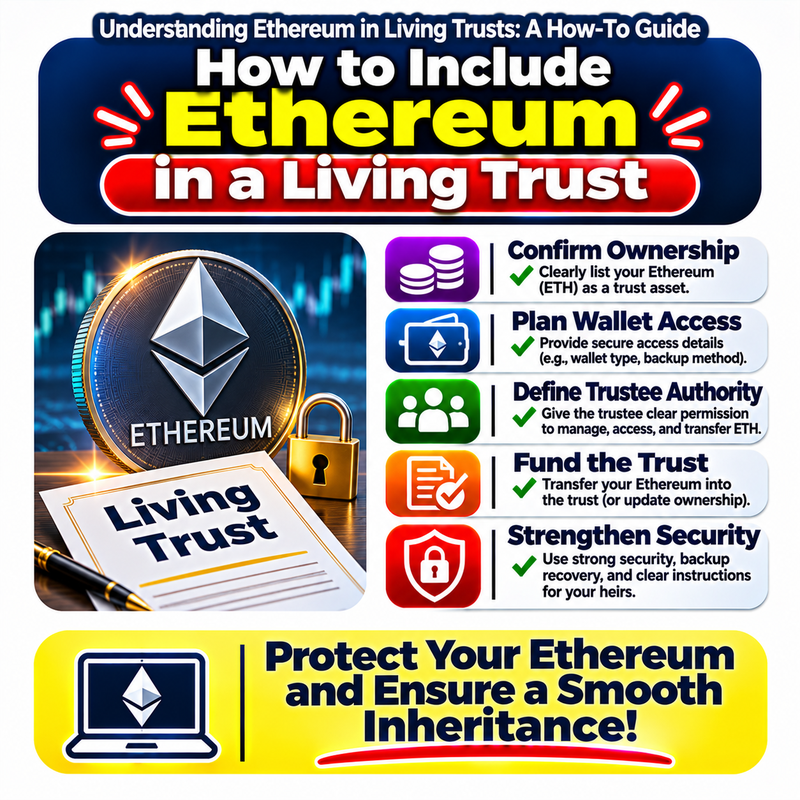
How to Include Ethereum in a Living Trust
Yes, an owner may be able to incorporate ETH into a properly designed revocable living trust, but doing it correctly takes more than mentioning cryptocurrency in a legal document. You need a legally effective ownership or transfer arrangement, and you need a secure, authorized way for a successor to actually access the asset once you’re no longer able to manage it yourself.
If you’re researching how estate planning services approach digital assets, you’ve probably already noticed that a lot of general guidance treats cryptocurrency like a bank account. It isn’t one. A trust that lists your wallet address is making a note, not completing a transfer. Holding a private key doesn’t necessarily mean you’re the legal owner in the eyes of a court. And being named trustee doesn’t hand you the technical ability to move coins on the Ethereum network. These are three separate puzzle pieces, and this guide walks through how to fit them together.
Review ownership, wallet access, trustee authority, funding, and security considerations when planning for ETH inheritance.
The Short Answer: What You Need to Know Right Now
ETH can be coordinated with a revocable living trust, but the process looks different depending on where the asset lives. Custodial exchange accounts, like Coinbase or Kraken, follow their own internal rules for trusts and estates. Self-custody wallets, controlled through hardware devices or software apps, depend entirely on whoever holds the private key or recovery phrase.
Legal ownership through a trust and technical access through a device or exchange login are governed by completely different systems. One is paperwork and state trust law; the other is cryptography and platform policy. A successful plan accounts for both, and it treats them as distinct problems with distinct solutions rather than assuming one fixes the other.

What Is a Living Trust and Why ETH Owners Need One
A revocable living trust is a legal arrangement where a grantor transfers assets into the trust’s name while retaining control during their lifetime, with a successor trustee ready to step in upon incapacity or death. It’s designed to help avoid probate for properly funded assets and to give a trustee clear authority to manage property according to the grantor’s wishes. For traditional assets like real estate or bank accounts, this process is well established.
Ethereum complicates the picture because it isn’t registered with any central authority the way a house deed or brokerage account is. There’s no county recorder for a wallet. That means the trust’s legal framework still matters, but it has to be paired with a technical access plan that the trust document alone cannot provide.
Who Should Add Ethereum to a Trust
Anyone holding ETH worth enough to matter to their estate should think about this, whether that’s a few hundred dollars in a Coinbase account or a six-figure position split across a hardware wallet and staking contracts. The amount matters less than the complexity of access. If a family member wouldn’t know where to start looking, that’s a signal to formalize the plan now rather than later.
When a Living Trust Alone Isn’t Enough
A trust is a strong legal foundation, but it doesn’t solve every problem on its own. Consider situations like these:
- ETH sits in an exchange account that doesn’t recognize trust ownership structures.
- A hardware wallet’s recovery phrase is known only to the grantor.
- Staked ETH is locked under validator terms that restrict withdrawal timing.
- A successor trustee has no documented, secure way to retrieve login credentials.
In each of these cases, the trust document might say the right things legally, but the practical path to actually moving or accessing the ETH is missing. That gap is where most crypto inheritance plans fail.
Ethereum Ownership vs. Ethereum Custody
Before going further, it helps to separate what ETH actually is from the tools used to interact with it. Ether is the native asset of the Ethereum network, distinct from tokens built on top of Ethereum, NFTs, staking positions, smart-contract balances, or claims recorded on an exchange’s internal ledger. Each of these can behave differently for legal and tax purposes, even though people often lump them all together as “crypto.”
Legal Title vs. Private Key Possession
A public address identifies a destination on the blockchain. It doesn’t necessarily identify the legally recognized owner, and it doesn’t confirm who is authorized to transact with the funds sitting there. These are different components, each with its own role:
- Wallet application — software like MetaMask that displays balances and builds transactions.
- Hardware signing device — a physical device, such as a Ledger or Trezor, that approves transactions using keys generated and stored on the device.
- Public address — the visible identifier where ETH is sent and received.
- Private key — the cryptographic credential that authorizes spending from an address.
- Recovery phrase — a sequence of words that can regenerate private keys if a device is lost.
- Exchange account — a custodial platform where the exchange, not the user, controls the underlying signing keys.
Mixing these up is one of the most common mistakes in crypto estate planning. Holding a hardware device is not the same as holding legal title, and legal title granted through a trust doesn’t automatically generate the cryptographic credentials needed to move funds.
Why Naming a Wallet in a Trust Doesn’t Automatically Fund It
Writing a wallet address into a trust schedule is useful for record-keeping, but it isn’t a legally completed transfer by itself. Funding a trust generally requires documented action, whether that’s retitling an account, executing an assignment, or in some cases an on-chain movement of assets, depending on how the custody arrangement is structured and what the governing trust document requires. Skipping that step means the trust may have no actual legal claim to the ETH, no matter what the schedule says.

Self-Hosted Wallets vs. Exchange Accounts
How you plan for ETH succession depends heavily on where the asset is held. These two models work in fundamentally different ways, and conflating them is a recipe for a stuck estate.
Self-Custody Wallets: MetaMask, Ledger, and Trezor
In a self-custody setup, the owner controls the private keys directly, with no third party acting as a gatekeeper. This gives full control over the asset, but it also means there’s no customer support line to call if access is lost. Whoever holds a usable recovery phrase can move the funds, which is exactly why these phrases require careful, secure handling rather than casual storage.
Exchange-Held ETH: Coinbase, Kraken, and Gemini
Custodial exchanges hold the signing keys on behalf of users and typically require account-specific identity verification. Each platform sets its own rules for trust accounts, estate claims, withdrawal limits, and transfer procedures, and those procedures are provider-specific rather than standardized across the industry. Some platforms may not support trust titling at all, which means a trustee’s access depends entirely on that exchange’s internal estate or incapacity process.
How Successor Access Differs Between the Two
For exchange accounts, a successor trustee generally has to work through the platform’s documented process, which might require a death certificate, trust certification, or court documentation, depending on the company’s policies. For self-custody wallets, there’s no company process at all. Access depends solely on whether the successor has a secure, pre-arranged way to obtain the private key or recovery phrase, which has to be set up in advance since there’s no recovery hotline for a lost seed phrase.
Trust Titling for Ethereum Where Supported
Where an exchange does offer support for trust ownership, the retitling process typically mirrors what happens with a brokerage account, though the specific steps vary by provider.
Retitling Exchange Accounts in the Name of the Trust
Depending on the platform, this might involve:
- Providing a certification of trust or relevant trust excerpts to the exchange.
- Completing the exchange’s own trust account application, if one exists.
- Updating account registration details to reflect the trust as the titled owner.
- Confirming whether the exchange requires a new account entirely versus a conversion of the existing one.
None of this happens automatically just because a trust exists. The account holder has to initiate it, and the exchange has to actually support the structure being requested.
Why Most Self-Custody Wallets Can’t Be Titled
Self-custody wallets don’t have an account registration system the way exchanges do. There’s no form to fill out that changes legal ownership on the blockchain itself. Instead, ownership has to be documented off-chain, through trust schedules, assignments, and other estate planning paperwork, while the technical access plan is handled separately.
Assignment of Property as a Workaround
An assignment of property is a document where the grantor formally transfers ownership of specific assets, including digital assets, into the trust. For self-custody ETH, this kind of document can establish the legal ownership question even though the blockchain itself has no record of a “trust” as an entity.
An assignment of property can establish that ETH legally belongs to the trust, but it does not, by itself, give the trustee the private key needed to move it. Those are two separate steps that both need to happen.
This is exactly why attorney involvement matters here rather than a generic do-it-yourself template. The right documentation depends on state trust law, the specific custody arrangement, and how the trust defines its funding requirements.
Trustee Powers and Fiduciary Authority Over Digital Assets
A trust document needs to explicitly address digital assets, not just assume that general property language covers cryptocurrency. Courts and institutions increasingly expect specific authorization before granting a trustee access to digital accounts.
Without that explicit language, a trustee might find themselves legally entitled to manage the ETH but unable to prove that authority to an exchange, or unsure whether accessing a self-custody wallet using credentials left behind by the grantor is even permitted.
Granting Explicit Authority to Access and Manage ETH
Trust language should specifically authorize the trustee to access, hold, manage, and transact with digital assets, including cryptocurrency, digital wallets, and related credentials. General catch-all language about “personal property” may not be interpreted broadly enough by an exchange’s compliance team, even if it would hold up in court.
Avoiding Violations of Computer Fraud and Privacy Laws
Here’s something many people don’t expect: using someone else’s login credentials, even with good intentions, can run into federal computer fraud and privacy statutes if the person accessing the account doesn’t have documented legal authority to do so. A successor trustee who logs into a deceased grantor’s exchange account without the proper trust authorization isn’t just taking a shortcut around paperwork; they may be creating a legal problem on top of an access problem. This is another reason the trust document itself needs clear, specific digital asset provisions rather than relying on informal permission given during the grantor’s lifetime.
Successor Trustee Responsibilities After Incapacity or Death
A triggering event, usually a documented incapacity or death, is what activates a successor trustee’s authority under a properly drafted revocable living trust. Before that trigger, the grantor typically manages everything themselves, including any ETH holdings. Once it occurs, the trust terms generally spell out exactly what the successor trustee is permitted to do, which is a legal question entirely separate from whether that person can technically open a wallet or log into an exchange.
This distinction trips up a lot of families. A successor trustee might have a certified copy of the trust, a doctor’s letter confirming incapacity, and full legal standing to act, yet still have no idea how to access a hardware wallet sitting in a safe deposit box. Legal authority and technical access are not interchangeable, and neither a court order nor a trustee appointment can recreate a private key that was never documented anywhere. For a deeper look at how a revocable living trust addresses incapacity, it helps to understand how the triggering mechanism works before layering digital assets on top of it.

Private Key Access Without Compromising Security
Anyone who obtains a usable recovery phrase or private key can move ETH, and that transfer is generally irreversible once broadcast to the network. This single fact shapes almost every recommendation in crypto estate planning. The goal is giving a trusted successor a path to access, without creating a document trail that exposes the keys to anyone who happens to read a will, a court filing, or an unsecured email.
A private key or seed phrase should never appear in a will, a public probate filing, or an unsecured digital file. Wills become public record during probate in most states, and anything printed there is no longer private.
Instead, the credential itself needs to live somewhere separate from the trust document, with instructions on how to find and use it documented in a way that’s accessible to the right person and no one else. Some families use a layered approach, where the trust explains that access instructions exist and where to find them, without the instructions containing the actual secret.
Multisignature wallet arrangements, which require multiple approvals before a transaction executes, can offer an additional layer of protection for larger holdings. They’re not a guaranteed solution, and they add real technical complexity, so they tend to make more sense for sophisticated holders working with a digital asset specialist than for a typical retail investor.
Never Store Seed Phrases in the Trust Document
This bears repeating because it’s the single most common security mistake in crypto estate planning: do not write a recovery phrase, private key, password, or PIN into a trust, will, or any document that might become part of a public record. Once compromised, ETH secured by that key can be moved by anyone, with no way to reverse the transaction and no customer service line to call.
Secure Storage Options: Safe Deposit Boxes, Metal Backups, and Password Managers
Common approaches to storing the credential itself, separate from the trust document, include engraved metal backups kept in a bank safe deposit box, sealed instructions held by an attorney, or encrypted entries in a reputable password manager protected by multi-factor authentication. Each option carries tradeoffs around accessibility, durability, and who else might need permission to retrieve it.
A single point of failure is the enemy here. If only one person knows where the backup is stored, or if the only copy exists on a damaged device, the entire plan can collapse. Redundancy, paired with careful access control, tends to work better than relying on one perfect hiding spot.
Creating a Separate Memorandum for Access Instructions
A standalone memorandum, kept outside the trust document itself, can describe where credentials are stored and how a successor should proceed, without listing the actual secrets. This document can be updated privately whenever storage locations or wallet setups change, without having to amend the trust itself every time.
Because this memorandum often touches on sensitive security details, it’s worth having an attorney review the overall structure even if the memorandum isn’t formally part of the trust. The goal is a system that works when it’s actually needed, not just one that sounds reasonable on paper.
Smart Contracts, Staking, and DeFi Positions in a Trust
Not all ETH sits quietly in a wallet waiting to be spent. A meaningful share gets locked, staked, delegated, wrapped, or otherwise committed through smart contracts, and each of these arrangements can affect how liquid the asset is and how complicated it becomes to administer after an incapacity or death.
According to one industry overview of cryptocurrency estate planning, millions of dollars in digital assets have already been lost due to forgotten keys or inadequate estate planning, a pattern that tends to get worse, not better, when positions are locked inside smart contracts the heirs don’t know exist.
Staked ETH and Validator Keys
ETH that’s staked, either directly through a validator or through a staking pool, may be subject to withdrawal delays, lockup periods, or slashing risk depending on the protocol and network conditions. A successor trustee who gains access to a wallet doesn’t automatically gain the ability to unstake those funds immediately; the underlying protocol rules govern that timeline, not the trust document.
Validator keys, separate from the wallet’s spending key in some staking configurations, add another layer that needs documentation. If a validator is run independently rather than through a pooled service, the operational knowledge required to manage or unwind that position can be substantial.
Trustees facing a staking position they don’t fully understand should treat it the way they would any specialized investment with unusual liquidity constraints: get qualified help before making assumptions about how quickly funds can be accessed or what penalties might apply.
Liquidity Pools and Lending Protocols
ETH committed to a liquidity pool or a lending protocol carries its own set of risks, including smart contract vulnerabilities, impermanent loss, and platform-specific withdrawal mechanics. Valuing these positions for estate purposes isn’t always straightforward, since the value can depend on pool composition and market conditions at a specific point in time rather than a simple wallet balance.
Added Complexity for Trustees Managing DeFi Assets
A trustee stepping into administration of a trust holding DeFi positions faces decisions that go beyond traditional portfolio management. Should the position be unwound immediately, or does it make sense to let it mature? What are the smart contract risks of leaving funds committed during a lengthy administration period? These aren’t questions a standard estate planning document answers, which is why specialized guidance matters here more than almost anywhere else in this guide.
Access to a wallet, even with full legal authority, doesn’t guarantee that a smart contract position can be withdrawn on demand. Some protocols build in timelocks, governance votes, or other mechanisms that simply don’t care who legally owns the underlying trust.

Gas Fees and Transaction Costs During Trust Administration
Every Ethereum transaction requires a gas fee, paid in ETH, to compensate network validators for processing it. These fees fluctuate based on network demand and aren’t fixed, which matters for a trustee trying to budget for moving assets out of a trust or consolidating holdings during administration.
Funding Wallets With ETH for Transaction Fees
A wallet needs a small ETH balance just to pay for its own transactions, which sounds obvious but trips people up in practice. If a trustee is trying to move tokens or NFTs out of a wallet that’s otherwise been drained of ETH, there may be no way to cover the gas fee without first adding more ETH to that same address.
Network Congestion and Timing Considerations
Fees tend to spike during periods of high network activity, so a trustee with some flexibility in timing can often avoid paying a premium by simply waiting for calmer conditions. There’s no guarantee of a specific fee at any given moment, and anyone promising a fixed cost for a future transaction isn’t being accurate about how the network works.
Transaction Records and Taxable Events
Good recordkeeping becomes essential the moment ETH changes hands, whether that’s a sale, a transfer to a beneficiary, or a movement between wallets controlled by the same trust. On-chain data shows a transaction occurred, but it doesn’t show the full tax picture on its own.
Cost Basis Step-Up at Death
Depending on how an asset is held and applicable federal tax rules at the time, inherited property may receive adjusted tax basis treatment at death. This is a facts-and-circumstances determination that depends on current IRS guidance, the specific ownership structure, and how the asset passes to beneficiaries, so it’s worth confirming with a tax professional rather than assuming a particular outcome applies to every situation.
A trust’s internal records, paired with historical exchange statements or wallet transaction histories, help establish the information needed to support whatever tax treatment ultimately applies. Without that documentation, beneficiaries and their tax preparers may be left guessing.
Capital Gains When Trustees Sell or Transfer ETH
If a trustee sells ETH during trust administration, that sale can trigger a taxable event depending on the trust’s basis in the asset and current market value. A transfer between wallets, by contrast, isn’t automatically a taxable disposition, though the specific facts matter and shouldn’t be assumed without professional review.
Documentation Trustees Should Keep for the IRS
Useful records for a trustee to maintain include acquisition dates, transaction hashes, wallet addresses without any accompanying secrets, exchange statements, fee histories, cost basis information where it can be established, income records from staking or similar activity, and valuations as of relevant dates such as the date of death.
One resource covering general cryptocurrency and estate planning documents notes that maintaining privacy and security around cryptocurrency involves making sure estate plans don’t inadvertently reveal sensitive access information, which is a useful reminder that recordkeeping and security aren’t competing goals, they’re two sides of the same planning problem.
Worked Scenario: Planning for ETH Held on an Exchange and in Self-Custody
To see how all of this fits together, consider a hypothetical grantor, entirely for illustration, who holds ETH in two different places and wants a successor trustee ready to administer both after incapacity or death.
Hypothetical Grantor Profile and Assumptions
This hypothetical grantor has a revocable living trust in place, naming an adult child as successor trustee. Holding A is ETH sitting in an individually registered account on a major custodial exchange. Holding B is ETH controlled through a self-custody wallet secured by a hardware signing device, with the recovery phrase stored separately.
Neither holding has been formally addressed beyond a general mention of “digital assets” in the trust’s property schedule. That’s a common starting point, and also a common gap, since a general mention doesn’t establish the specific authority or access plan either holding actually needs.
Step-by-Step Plan for the Exchange-Held ETH
For the exchange-held ETH, the grantor and successor trustee need to work through a specific sequence rather than assuming the account will simply transfer on its own:
- Contact the exchange directly to find out whether it supports trust-titled accounts or has a documented estate and incapacity process.
- If trust titling is supported, complete the exchange’s required paperwork, which may include a certification of trust or similar documentation.
- If trust titling is not supported, document the ownership through the trust’s assignment of property and understand that the successor trustee may need to work through the exchange’s standard estate claims process instead.
- Confirm what identification and legal documents the exchange will require from a successor trustee before releasing funds.
It’s worth stressing that the successor trustee cannot assume the exchange will simply retitle the account because a trust document exists. Every platform sets its own rules, and those rules can include delays, specific forms, or outright restrictions that have nothing to do with how well the trust itself was drafted.
Testing this process, to whatever extent an exchange allows, before it’s actually needed can reveal gaps while there’s still time to fix them. Waiting until after an incapacity event to discover that a platform doesn’t recognize trust accounts leaves far fewer options on the table.
This is also where documentation earns its keep. A trustee showing up with a certification of trust, a clear assignment of property, and a paper trail of prior communication with the exchange is in a much stronger position than one showing up with nothing but a death certificate and hope.
Step-by-Step Plan for the Self-Custody Wallet
For the self-custody wallet, the plan looks entirely different because there’s no company to call. The grantor needs to document, in a secure and separate location, where the hardware device is kept and where the recovery phrase backup can be found, without putting the actual phrase into the trust or any widely shared document. The successor trustee needs clear, tested instructions for retrieving that information once their legal authority has been established, and the grantor should periodically confirm the backup still works, since a stale or damaged backup is functionally the same as no backup at all.

Comparison: Exchange Custody vs. Self-Custody in a Trust
Laid side by side, the planning requirements for these two custody models diverge enough that treating them identically almost guarantees a gap somewhere. The table below summarizes the core issues a successor trustee needs to verify for each.
Neither column represents a “better” option in the abstract. Exchange custody offers a documented process but depends on that specific platform’s policies and cooperation. Self-custody offers full control but zero institutional safety net if the access plan fails.
| Issue | Exchange-held ETH | Self-custody ETH | What the successor must verify |
|---|---|---|---|
| Legal ownership transfer | May require platform-specific trust account paperwork | Documented through trust assignment, not the blockchain itself | Whether funding documentation actually exists and is current |
| Technical access | Platform login credentials, subject to provider’s estate process | Private key or recovery phrase, held independently of any company | Where credentials are securely stored and whether backups are tested |
| Incapacity handling | Depends on exchange’s documented incapacity procedures, if any | Depends entirely on pre-arranged successor access plan | Whether a triggering event has been properly documented per trust terms |
| Risk of total loss | Platform insolvency, account freezes, compliance holds | Lost or destroyed key with no recovery mechanism | Whether redundant, secure backups exist for critical access points |
| Tax documentation | Often available via account statements | Must be reconstructed from wallet history and personal records | Whether cost basis and transaction records have been preserved |
How a Revocable Living Trust Complements Your ETH Strategy
A revocable living trust remains a sound foundation for managing most of an estate, including ETH, because it establishes who has legal authority to act and under what circumstances. For a broader look at how this structure works across different asset types, it helps to understand how a living trust generally functions before layering digital-asset-specific provisions on top of it.
What a trust document alone cannot do is generate a private key, log into an exchange, or unstake a locked validator position. Treating the trust as the complete solution, rather than one essential piece of a larger plan, is where a lot of otherwise well-intentioned planning falls short.
What a Standard Trust Document Covers
A properly drafted trust should cover the legal basics: naming the trustee and successor trustee, granting explicit authority over digital assets, establishing how and when that authority activates, and documenting the trust’s ownership claim to specific property, including ETH holdings where applicable.
When You Need a Specialized Digital Asset Addendum
Beyond the basics, many grantors benefit from a separate, secured memorandum addressing where access credentials are stored, which platforms hold assets, and any special considerations like staking positions or multisignature arrangements. This addendum works alongside the trust rather than replacing it.
Where Professional Help Matters
Few estate planning documents are genuinely do-it-yourself when cryptocurrency enters the picture, and ETH held across both exchange and self-custody environments is a good example of why. The right team typically includes more than one type of specialist.
Attorneys Who Understand Both Trusts and Digital Assets
An estate planning attorney familiar with digital asset provisions can draft the specific trustee authority language needed, confirm whether state trust law in the relevant jurisdiction requires anything particular, and review assignment documents for self-custody holdings. Questions worth bringing to that conversation include:
- Does my trust’s current language explicitly authorize the trustee to access digital assets, or does it rely on general property language?
- What documentation does my state require to establish a successor trustee’s authority after incapacity?
- Should ETH holdings be referenced in the trust, a separate schedule, or a secured memorandum?
A digital asset custody specialist can help evaluate hardware wallet setups, backup redundancy, and whether a multisignature arrangement makes sense for the size and complexity of the holdings involved. A tax adviser familiar with cryptocurrency can address cost basis documentation, staking income reporting, and how a trustee’s sale or transfer decisions might play out under current federal tax rules. And a conversation with the actual exchange holding custodial ETH, however informal, can clarify whether that specific platform even supports a trust account before any paperwork gets drafted.
How eState Supports Documented Living Trust Services
Our eState Living Trust plan, offered through Bulletproof Legacy Financial, includes ordinary trust funding assistance, deed-related support, secure document access, powers of attorney, a pour-over will, and successor-trustee guidance for a standard estate plan. It does not include specialized crypto custody services such as private key management, exchange account transfers, staking administration, or smart contract review, so grantors with meaningful ETH holdings should plan to coordinate that piece separately with the specialists described above.

Final Thoughts: Protecting Your Ethereum for the Next Generation
Coordinating ETH with a living trust is entirely achievable, but it takes treating ownership, funding, trustee authority, and technical access as four separate requirements rather than one bundled task. A trust document that mentions a wallet address isn’t the finish line; it’s one piece of a plan that also needs secure credential storage, platform-specific verification, and clear instructions a successor can actually follow when the time comes.
How a Revocable Living Trust Complements Your ETH Strategy
None of this is a case against using a revocable living trust for digital assets. It remains one of the clearest legal tools available for naming who manages property, defining when that authority activates, and keeping many assets out of probate when they’re properly funded. ETH simply asks a little more of the document, since it has to address ownership and funding language precise enough to hold up with an exchange or stand on its own for a self-custody wallet.
What a Standard Trust Document Covers
A well-drafted trust names the grantor, trustee, and successor trustee, defines the powers each holds, and establishes how and when a successor’s authority activates, typically tied to incapacity or death. It also includes a property schedule describing what the trust holds, which can reference ETH holdings by general description or wallet identifier as a record-keeping tool.
What the standard document often leaves out, unless specifically drafted to include it, is explicit authorization for the trustee to access digital wallets, exchange accounts, and related credentials. Without that language, an exchange’s compliance team or a court reviewing the matter may not treat general “personal property” clauses as sufficient authority to act on a digital asset.
When You Need a Specialized Digital Asset Addendum
Grantors with meaningful ETH holdings, especially those spread across exchange accounts and self-custody wallets, generally benefit from a separate addendum or memorandum addressing where assets are held, how credentials should be retrieved securely, and any staking or smart contract positions that need special handling. This addendum sits alongside the trust rather than replacing any of its core legal functions.
Where Professional Help Matters
Cryptocurrency estate planning draws on more than one discipline at once, which is part of why it trips people up. Legal authority, technical access, and tax treatment each follow their own rules, and no single professional typically covers all three.
Bringing the right specialists into the conversation early tends to save far more time than trying to patch gaps after an incapacity or death has already occurred. A short list of targeted questions, asked before there’s a crisis, often reveals exactly where a plan needs strengthening.
Attorneys Who Understand Both Trusts and Digital Assets
An estate planning attorney familiar with digital assets can confirm whether a trust’s language explicitly authorizes trustee access to wallets and exchange accounts, review assignment documents for self-custody holdings, and flag any state-specific trust administration requirements relevant to the grantor’s situation.
How eState Supports Documented Living Trust Services
Our eState Living Trust plan, offered through Bulletproof Legacy Financial, provides ordinary trust funding assistance, deed-related support, secure document access, healthcare and financial powers of attorney, a pour-over will, and successor-trustee guidance for a standard estate plan. It’s built around the kind of documentation a trust needs to function for everyday assets like homes and bank accounts.
That standard scope does not extend to specialized crypto services such as private key management, exchange account transfers, staking administration, or smart contract review. Grantors holding ETH should treat that piece of the plan as a separate, parallel effort, often requiring its own specialist, rather than assuming it’s bundled into a general estate planning package.
Before finalizing a plan that includes ETH, it helps to walk through a short checklist with the professionals involved:
- Ask an estate planning attorney whether your trust’s digital asset language is specific enough to be enforceable with exchanges and courts in your state.
- Ask an exchange representative directly whether their platform supports trust-titled accounts or has a documented fiduciary access process.
- Ask a digital asset custody specialist to review your backup redundancy and whether a multisignature setup fits your holdings.
- Ask a tax adviser how cost basis, staking income, and date-of-death valuation should be documented for your specific holdings.
Final Thoughts: Protecting Your Ethereum for the Next Generation
An ethereum living trust works best when ownership, funding, trustee authority, and technical access are treated as four separate jobs, each confirmed and documented on its own rather than assumed to be covered by the others; our team at Create A Living Trust, working alongside Bulletproof Legacy Financial, can help you build the ordinary trust foundation that plan depends on.
Frequently Asked Questions
These questions cover the issues that come up most often once a grantor starts trying to turn general crypto estate planning advice into an actual, working plan. None of the answers below are a substitute for reviewing your specific trust language and holdings with a qualified professional.
Where a question touches on tax treatment or state-specific rules, treat the answer as a starting point for a conversation with an attorney or tax adviser rather than a final word, since the right approach depends on your particular facts and jurisdiction.
Can I put my Ethereum wallet address directly into my living trust document?
You can reference a wallet address in a trust’s property schedule, and many grantors do, but doing so is a record-keeping step, not a completed legal transfer. The address tells a successor where to look; it doesn’t by itself establish that the trust legally owns the ETH at that address or grant the trustee any technical ability to access it.
Legal ownership generally needs to be documented separately, often through an assignment of property or, where supported, a retitled exchange account. The wallet address and the legal transfer are two different pieces of the puzzle.
It’s also worth remembering that a public wallet address is just that: public. Listing it in a trust doesn’t expose your private key, but it’s still worth thinking through whether you want that information attached to a document that could become part of a probate record in some circumstances.
- Use the address for identification purposes in a schedule.
- Document legal ownership separately through assignment or account retitling.
- Keep private keys and recovery phrases entirely out of the trust document.
Think of the wallet address as a label on a box, not the key that opens it.
What happens to my ETH if I don’t include it in my estate plan?
Unlike a bank account, there’s no central institution a family member can call to report a death and request access to a cryptocurrency wallet. If ETH isn’t addressed in your estate plan, with both legal ownership and a technical access path documented, it can become effectively inaccessible, even though it still technically exists on the blockchain.
For exchange-held ETH without trust planning, the asset would likely need to go through the exchange’s general estate claims process, which can be slower and more document-intensive than a properly funded trust transfer. For self-custody ETH, the risk is more severe: without documented access to the private key, there’s often no recovery path at all.
Do I need a separate trust just for cryptocurrency?
Not necessarily. Many grantors incorporate digital assets like ETH into their existing revocable living trust, provided that trust includes explicit digital asset authority for the trustee and proper funding documentation for each holding. A separate crypto-specific trust is sometimes used by holders with very large or complex positions, but it’s not a requirement for most people.
How does my trustee access my Ethereum if I become incapacitated?
Access depends on two things happening together: documented legal authority under the trust’s incapacity provisions, and a working technical access plan for wherever the ETH is held. The first is a legal question governed by your trust’s terms and state law; the second is a practical question about whether your successor can actually retrieve login credentials or private keys.
| Requirement | Exchange-held ETH | Self-custody ETH |
|---|---|---|
| Legal trigger | Documented incapacity per trust terms | Documented incapacity per trust terms |
| Access mechanism | Exchange’s fiduciary or incapacity procedure | Pre-arranged secure credential retrieval |
| Common gap | Platform doesn’t recognize trust authority | No one else knows where the backup is stored |
Neither path works on its own. A trustee with full legal authority but no idea where a hardware wallet’s backup phrase is stored faces the same practical dead end as a trustee with the credentials but no documented authority to use them.
This is precisely why how a revocable living trust addresses incapacity matters so much before layering crypto holdings on top of the structure. The trigger mechanism and documentation standard set in the trust determine when a successor can legally step in, which then needs to be paired with whatever technical access plan the grantor has separately put in place.
Is staked Ethereum harder to transfer than regular ETH?
Generally, yes. Staked ETH can be subject to withdrawal delays, lockup periods, or protocol-specific unstaking processes that don’t apply to ETH sitting freely in a wallet. A trustee gaining wallet access doesn’t automatically gain the ability to unstake those funds immediately; the underlying protocol’s rules, not the trust document, govern that timeline.
Will my beneficiaries owe taxes on inherited Ethereum?
It depends on the specific facts, including how the ETH was held, current federal tax rules at the time, and what the beneficiary later does with the asset. Receiving inherited property doesn’t automatically trigger a tax bill, but a later sale or transfer can create a taxable event depending on basis and applicable law. This is a question to bring directly to a tax adviser familiar with current IRS guidance rather than one with a universal answer.
Can I name a charity as a beneficiary of my Ethereum?
Yes, a trust can direct ETH to a charitable beneficiary, provided that charity is set up to receive and process cryptocurrency donations. Not every charitable organization accepts digital assets directly, so it’s worth confirming that capability with the specific organization before finalizing the designation. A new legal issue in estate planning is how to handle digital assets during one’s lifetime, and how to include them in a living trust.
If charitable giving is a significant part of your plan, a conversation with both your estate planning attorney and the receiving organization can help confirm the mechanics work the way you expect, since the transfer process for a charity may differ from a transfer to an individual beneficiary.
What’s the difference between a public key and a private key for estate planning purposes?
A public key, or wallet address, is the identifier you can safely share to receive ETH; it’s meant to be visible. A private key is the credential that authorizes spending from that address, and it must never be shared or exposed, including in a trust document, will, or any record that might become public. For estate planning, the public address can appear in schedules as a reference; the private key needs a separate, secure storage and access plan entirely outside the trust paperwork.
How often should I update my trust to reflect my crypto holdings?
A general guideline many estate planners follow is reviewing trust documents every few years or after major life changes, and crypto holdings can shift fast enough to warrant more frequent check-ins than other assets. New wallets, new exchanges, staking positions that open or close, and even hardware upgrades can all mean your documented access plan is out of date, so it’s worth revisiting at least annually or whenever your holdings materially change.
Can Coinbase or other exchanges transfer ETH directly to my trust?
It depends entirely on that specific exchange’s policies, which vary by provider and can change over time. Some platforms support trust-titled accounts with a documented application process; others may require the standard estate claims process regardless of trust ownership. Because of this variation, it’s worth contacting your specific exchange directly, before an incapacity or death occurs, to confirm what documentation they’ll require and whether trust titling is even an option on their platform.
Don’t assume cooperation just because a trust document exists and names the exchange account. The exchange’s internal policy, not your trust’s language, ultimately determines what process applies, which is exactly why confirming this in advance matters so much for a successor trustee’s peace of mind.
Can Ethereum be included in a revocable living trust?
Yes, ETH can be coordinated with a revocable living trust, but it requires more than a general mention. The trust needs explicit digital asset authority for the trustee, proper documentation establishing legal ownership, and a separate, secure plan for technical access, since the trust document alone doesn’t generate a private key or log into an exchange account.
Does listing an Ethereum wallet address fund a trust?
No. Listing a wallet address in a trust schedule serves as a record but doesn’t by itself complete a legal transfer of ownership. Funding typically requires documented action, such as an assignment of property or, depending on the custody arrangement, an actual on-chain or account-level transfer consistent with the trust’s terms and applicable law.
How does trust planning differ for exchange-held ETH versus self-custody?
Exchange-held ETH depends on that specific platform’s policies for trust accounts and estate claims, which vary by provider and may require specific paperwork. Self-custody ETH has no company process at all; access depends entirely on whether a successor has a secure, pre-arranged way to obtain the private key or recovery phrase.
Can a successor trustee access ETH after incapacity?
Only if two separate things are in place: documented legal authority under the trust’s incapacity terms, and a working technical access plan for wherever the ETH is held. Legal authority alone doesn’t unlock a hardware wallet or an exchange account; the trustee also needs the actual means to access the asset, which has to be arranged in advance.
Should seed phrases or private keys appear in trust documents?
No. Trust documents, wills, and anything that might become part of a public probate record should never contain actual seed phrases, private keys, passwords, or PINs. These credentials should be stored separately and securely, with instructions on where to find them documented in a way that protects against unauthorized access.
Does legal title guarantee wallet access?
No. Legal title, established through proper trust funding, confirms ownership rights but doesn’t automatically provide the technical credentials needed to access a wallet or exchange account. Access depends on possessing the private key, recovery phrase, or platform login, which must be arranged separately from the legal ownership documentation.
What do gas fees and smart contracts mean for trustees?
Gas fees are transaction costs paid in ETH to process network activity, and they fluctuate with network demand rather than staying fixed. Smart contract positions, like staking or liquidity pools, can restrict how quickly funds are withdrawn regardless of who holds legal or technical access, so trustees should budget time and ETH for fees and anticipate potential withdrawal delays.
How should ETH holdings be valued and documented for taxes?
Useful documentation includes acquisition dates, transaction hashes, exchange statements, wallet addresses without secrets, fee records, cost basis where it can be established, staking income records, and valuations as of relevant dates such as date of death. Because on-chain data alone doesn’t capture full tax basis or beneficial ownership details, these records should be organized and preserved proactively.
Can holding ETH in a trust avoid probate?
Properly structured trust ownership may help reduce probate exposure for ETH that’s actually been funded into the trust, but it doesn’t guarantee probate avoidance for everything. If an asset was never properly transferred into the trust’s legal ownership, it may still be subject to probate regardless of what the trust document says.
When should an owner consult legal, tax, and digital-asset custody specialists?
Before finalizing any ETH-related estate plan, ideally as soon as holdings reach a meaningful size or complexity, such as staking positions or multiple custody types. An attorney addresses trust authority and funding documentation, a tax adviser addresses cost basis and reporting, and a digital-asset custody specialist addresses secure access and backup planning.
Getting an ethereum living trust right starts with an honest inventory of where your holdings actually sit, followed by specialist review of ownership, funding, and access, each handled as its own distinct task rather than one assumed to cover the others; our team at Create A Living Trust, working alongside Bulletproof Legacy Financial, can help you build the ordinary trust foundation this plan depends on.
Control, Liquidity, and Compliance Tradeoffs
Exchange custody trades independence for structure. You get a documented process, customer support, and often simpler tax statements, but you’re also bound by whatever rules that specific platform sets for trust accounts, withdrawal limits, and identity verification. Self-custody trades that structure for full control, meaning there’s no company standing between you and your ETH, but also no one to call if a backup fails or a successor can’t locate the right credentials. Neither model is inherently safer; each just shifts the risk to a different place.
Cost and Administrative Burden for Trustees
Exchange accounts tend to be lighter lifts administratively once the correct paperwork is identified, since the platform handles custody and often provides statements that simplify valuation. Self-custody holdings put more of that burden on the trustee directly, requiring careful coordination with whoever understands the hardware setup, the backup location, and any smart contract positions tied to the wallet. A trustee facing both holding types at once should expect the self-custody side to take meaningfully more time and attention.